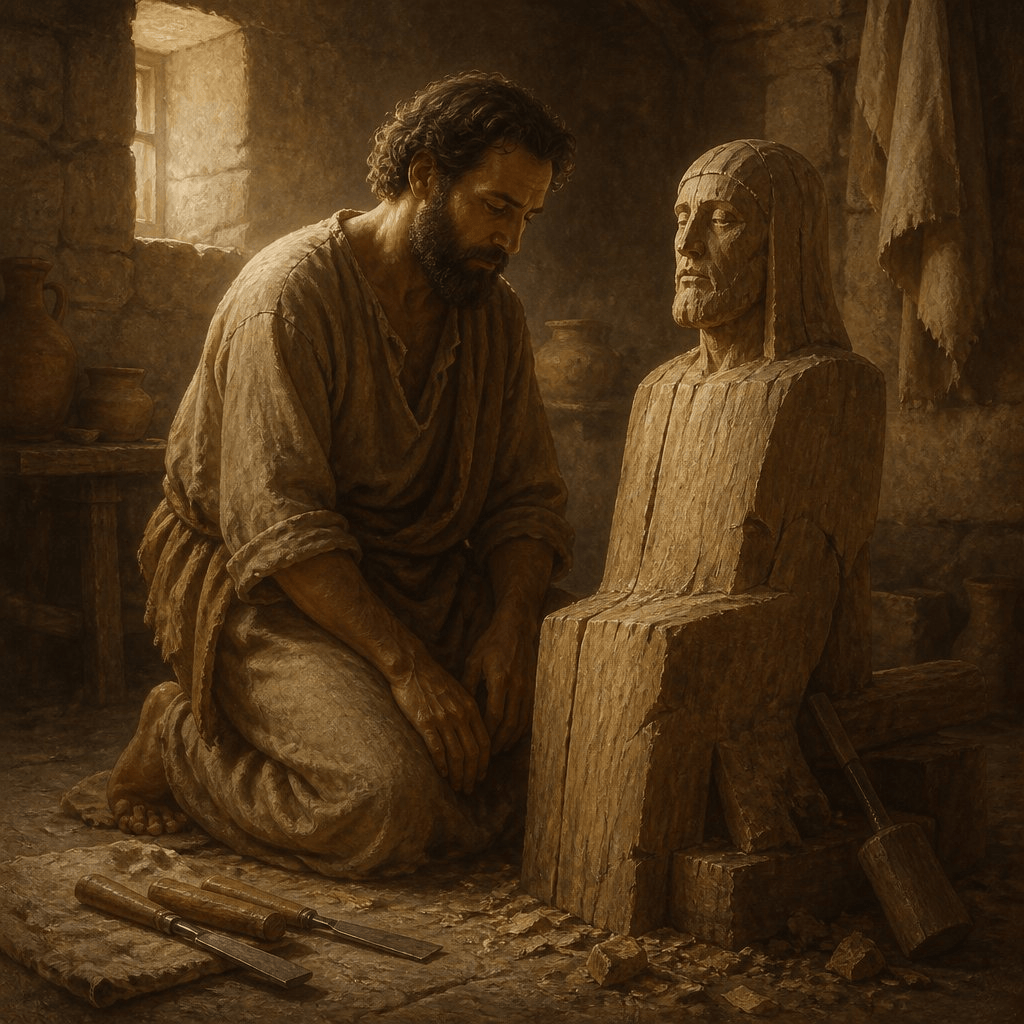
The echoes of our 21st Century trust: Becoming like what we reverence. We who make them will very soon mirror them, as will all who do trust in them. Psalm 115:1-8

Psalm 115:1-8 Complete Jewish Bible

115 Not to us, Adonai, not to us,
but to your name give glory,
because of your grace and truth.

2 Why should the nations ask,
“Where is their God?”
3 Our God is in heaven;
he does whatever pleases him.
4 Their idols are mere silver and gold,
made by human hands.
5 They have mouths, but they can’t speak;
they have eyes, but they can’t see;
6 they have ears, but they can’t hear;
they have noses, but they can’t smell;
7 they have hands, but they can’t feel;
they have feet, but they can’t walk;
with their throats they can’t make a sound.
8 The people who make them will become like them,
along with everyone who trusts in them.

Word of God for the Children of God

Glory be to the Father,
and to the Son, and to the Holy Ghost;
as it was in the beginning,
is now, and ever shall be,
world without end. Amen, amen.

Twenty-First-Century Idol Worship ….

In today’s devotion, we are going to talk about a hot-button issue of the cult of personality—that is, the temptation to place people on pedestals and give them too much influence or power over us.

To frame our discussion properly, we need to go back to Moses’ encounter with God on Mount Sinai.

God gave Moses the Ten Commandments for His people to obey.

Those commandments still play a significant role in the lives of God’s people, although some may seem to play a larger, more obvious role than others.

At first glance, the Second Commandment might seem like the least necessary of the ten today.

We will find the second Commandment in Exodus 20:4-6:

Exodus 20:4-6 Complete Jewish Bible

4 You are not to make for yourselves a carved image or any kind of representation of anything in heaven above, on the earth beneath or in the water below the shoreline. 5 You are not to bow down to them or serve them; for I, Adonai your God, am a jealous God, punishing the children for the sins of the parents to the third and fourth generation of those who hate me, 6 but displaying grace to the thousandth generation of those who love me and obey my mitzvot.

Some people might argue that golden calves and other graven images aren’t twenty-first-century problems.

And while it’s true that most believers today aren’t tempted to smelt gold to create pagan tchotchkes, the second Commandment is still extremely relevant.

The reality is that idols come in all shapes and sizes because people come in all shapes and sizes.

Many well-meaning believers fall head first into the trap of making idols out of people they admire.

Have you ever heard of a sports hero?

How about American Idol?

How about the winners of Survivor?

How about a high energy, ultra rich, ultra influential celebrity …. film, music?

We use the phrases somewhat jokingly: “That person is a sports god” or “I idolize that person. He’s a guitar god.”

But the way too many people look at certain individuals, it could be that they have obsessively, compulsively, shaped and molded a person into their ‘god.’

We can make idols out of people in the church, too.

We can make an idol out of a man or woman of God, someone whom the Lord has powerfully used to bless us.

We can start to admire them too much.

But here’s what we need to remind ourselves: Those people are human just like us. They will be wrong. They will fail us. They will disappoint us. They will give in to temptation. They will struggle in certain areas of their lives just we ourselves do.

The problem is that people become like the gods they worship.

Psalm 115 sternly warns, “Their idols are merely things of silver and gold, shaped by human hands. . . . And those who make idols are just like them, as are all who trust in them” (verses 4, 8).

The only ONE who deserves that position in our lives is God, the Father, God the Son and God the Holy Spirit. He alone is 1000% deserving of our worship.

Reflection question: How can we keep ourselves from elevating people too high too much in our life? And God, Jesus and the Holy Spirit – not nearly enough?

The Echoes of Our Trust: Becoming Like What We Reverence

Psalm 115:8 states Amplified Bible, Classic Edition

8 They who make idols are like them; so are all who trust in and lean on them.

This profound verse serves as a reflective mirror that brings to light the nature of our affections and the broken impulsive state of our hearts.

In a world saturated with distractions and competing allegiances, politics. this scripture calls us to examine precisely what— or whom— we place our trust in.

The context of Psalm 115 paints a vivid picture of the futility of idolatry.

Psalmist contrasts the living God with lifeless idols crafted by human hands.

The idols made of silver and gold are worthless, unable to see, hear, or speak— they possess no genuine power or life.

Those who create these idols, and subsequently trust in them, do so at the risk of becoming blind, deaf, and mute in their own spiritual journeys.

When we rely on anything created by human imagination, than by the Creator, we risk becoming like those very things— powerless and devoid of true life.

Trust is an intimate act.

It isn’t merely a passive acknowledgment of something’s existence; rather, it is an investment of our hearts, minds, and spirits into something we believe can provide for us, protect us, or give us purpose.

The psalmist warns us that our investments shape us.

What we trust will inform our actions, our character, and ultimately, our relationship with God.

When we place our trust in the ephemeral— whether it’s material possessions, social status, or individuals— we run the risk of our mirroring their limitations rather than reflecting the glory of our Creator.

Consider the significance of trust in practical terms.

When we trust in money, we might find ourselves consumed by greed and anxiety, always longing for more and never satisfied.

This anxiety birthed from misplaced trust impacts, how we do interact with others, often twisting our relationships into transactional exchanges rather than genuine bonds of love and grace.

On the contrary, trusting in the living God cultivates confidence and peace, and strength and generosity, marking us as mirrored reflections of His character.

Moreover, as images of God, our identity finds itself shaped by higher ideals and virtues.

In Isaiah 40:31, we are reminded that those who trust in the Lord will renew their strength; they will soar on wings like eagles.

This paints a beautiful contrast to the idea of becoming like the idols we craft.

Instead of becoming powerless like lifeless idols, we can be invigorated and empowered by the Most High.

As we further meditate on Psalm 115:8, let us ask ourselves: what are all those “idolized” commitments of our heart?

What has captured our trust?

Are we turning to our careers, our relationships, our pensions or perhaps the impulsive reckless pursuit of worldly pleasures in times of stress and anxiety?

Do we anchor our trust in God, the Creator who is alive, active, and incessantly working on our behalf?

True trust leads us toward transformation into His likeness.

When we place our faith in God, we become participants in His divine nature (2 Peter 1:4).

Our lives begin to reflect His attributes— love, joy, peace, patience— qualities that cannot be replicated through idols or worldly concerns.

Instead of becoming stagnant imitations of that which cannot fulfill, we’ll become vibrant testimonies of faith, emerging from the depths of His grace.

So today, let this verse sit heavily upon our hearts.

Let it compel us to evaluate our engagements and reassess our trust.

Pray fervently, asking the Holy Spirit to illuminate areas where we may have erected idols, knowingly or unknowingly.

Let us rush toward the living God, anchoring our trust in Him alone, allowing His majestic character to transform our lives and reflect His glory to the world around us.

In doing so, we break free from the voluminous echoes of lifeless idols and step lively into the vibrant abundant life He offers us.
In the name of God, the Father and God the Son and God the Holy Spirit …

Praying ….

Psalm 113 Complete Jewish Bible

113 Halleluyah!

Servants of Adonai, give praise!
Give praise to the name of Adonai!
2 Blessed be the name of Adonai
from this moment on and forever!
3 From sunrise until sunset
Adonai’s name is to be praised.
4 Adonai is high above all nations,
his glory above the heavens.
5 Who is like Adonai our God,
seated in the heights,
6 humbling himself to look
on heaven and on earth.

7 He raises the poor from the dust,
lifts the needy from the rubbish heap,
8 in order to give him a place among princes,
among the princes of his people.

9 He causes the childless woman
to live at home happily as a mother of children.

Halleluyah!

Glory be to the Father,
and to the Son, and to the Holy Ghost;
as it was in the beginning,
is now, and ever shall be,
world without end. Amen, amen.

https://translate.google.com

Preparation for Advent. Idolatry – We Become Who and What we Worship. Idols and Images and God. Psalm 115:1-8

Psalm 115:1-8Amplified Bible

Pagan Idols Contrasted with the Lord.

115 Not to us, O Lord, not to us,
But to Your name give glory
Because of Your lovingkindness, because of Your truth and faithfulness.
2 
Why should the nations say,
“Where, now, is their God?”
3 
But our God is in heaven;
He does whatever He pleases.
4 
The idols [of the nations] are silver and gold,
The work of man’s hands.
5 
They have mouths, but they cannot speak;
They have eyes, but they cannot see;
6 
They have ears, but they cannot hear;
They have noses, but they cannot smell;
7 
They have hands, but they cannot feel;
They have feet, but they cannot walk;
Nor can they make a sound with their throats.
8 
Those who make them will become like them,
Everyone who trusts in them.

The Word of God for the Children of God. Gloria! In Excelsis Deo! Alleluia! Amen.

We do not talk about idols much these days.

And when we do, it’s probably about a pop super­star or an American Idol winner.

Neitzsche who famously once wrote, “God is dead,” also wrote, “If there is a God, how can I bear not to be that God?”  

That is a core issue in our idolatrous hearts.

We would kill God so that we can be God.

It is not that we deny God; we just replace Him with ourselves.

Recently some fans of a rap artist named Kanye wrote a book called “The Book of Yeezus” where they take the Bible and replace God with the rappers name.

The “famed” rapper even has a song called, “I am God.”

This is the reality of an idolatrous heart.

Therefore, we always have a desire to be our own authority, our own god.  

Even to deny God, is to fill that gap with ourselves as the sole determiner of what is true or not. Denying God is in itself an act of making oneself God.

Ancient idols, ancient graven images were nothing more than symbols used to get what we selfishly desired. 

In our modern materialistic society our deities are no longer objects that need to be appeased or placated, but rather things that appease or placate us. 

That is the ultimate goal in idol worship.  

Genesis 11:1-4 NASB

The Tower of Babel

11 Now all the earth [a]used the same language and [b]the same words. 2 And it came about, as they journeyed [c]east, that they found a plain in the land of Shinar and [d] settled there. 3 Then they said to one another, “Come, let’s make bricks and [e] fire them thoroughly.” And they used brick for stone, and they used tar for mortar. 4 And they said, “Come, let’s build ourselves a city, and a tower whose top will reach into heaven, and let’s make a name for ourselves; otherwise we will be scattered abroad over the face of all the earth.”

I have heard it said of idolatry “that it is to embrace an insufficiently educated form, and wholly inadequate view of God or to make God seem more like us.”

The outcome of this idolatrous attitude is preferring to do things for our namesake (Genesis 11:1-4), not the Lord’s.

This idolatry of self-desire is ridiculously rampant and ruinous to the utmost. 

But when the Bible talks about idols, it usually means carved images that stood in for false gods.

The Bible issues strong warnings about that sort of idol.

On their own, idols are powerless.

As Psalm 115:4-7 says, they may have eyes and ears and hands and feet, but they cannot see, hear, feel, or walk!

Yet when people worship idols, they give power to them, destructive power.

That’s why, for example, the Bible warns against greed. Greed makes an idol out of wealth.

And when wealth is worshiped, it has the power to turn people into Scrooge like misers or “Grinch” like mobsters and thieves and joy killers or market frauds.

We have all hear it before – False gods, and their images, are utterly dangerous!

John Calvin famously said that “man’s nature is a perpetual factory of idols.”

I do not believe there is anyone reading this who would not say Mr. Calvin was anything but absolutely right!

What Is Idolatry in the Bible? Its Definition and Significance ….

According to Easton’s Bible Dictionary, Idolatry is “image-worship or divine honour paid to any created object.”

Paul describes the origin of idolatry in Romans 1:21-25: men forsook God, and sank into ignorance and moral corruption (Romans 1:28).

The forms of idolatry are,

  • Fetishism, or the worship of trees, rivers, hills, stones, etc.
  • Nature worship, the worship of the sun, moon, and stars, as the supposed powers of nature.
  • Hero worship, the worship of deceased ancestors, or of heroes.

Idolatry in the Bible

In Scripture, idolatry is regarded as of heathen origin, and as being imported among the Hebrews through contact with heathen nations.

The first allusion to idolatry is in the account of Rachel stealing her father’s teraphim (Genesis 31:19), which were the relics of the worship of other gods by Laban’s progenitors “on the other side of the river in old time” (Joshua 24:2).

During their long residence in Egypt the Hebrews fell into idolatry, and it was long before they were delivered from it (Joshua 24:14; Ezekiel 20:7).

Many a token of God’s displeasure fell upon them because of this sin.

The first, second commandments are directed against idolatry of every form.

Individuals and communities were equally amenable to the rigorous code.

The individual offender was devoted to destruction (Exodus 22:20).

His nearest relatives were not only bound to denounce him and deliver him up to punishment (Deuteronomy 13:20-10), but their hands were to strike the first blow when, on the evidence of two witnesses at least, he was stoned to death (Deuteronomy 17:2-7).

To attempt to seduce others to false worship was a crime of equal enormity.

An idolatrous nation shared the same fate.

No facts are more strongly declared in the Hebrew [Old] Testament than the vigorous extermination of the Canaanites was the punishment of their idolatry, and the calamities of the Israelites were due to the same cause (Jeremiah 2:17).

“A city guilty of idolatry was looked upon as cancer in the state; it was considered to be in rebellion, and treated according to the laws of war. Its inhabitants and all their cattle were put to death.”

Jehovah was the theocratic King of Israel, the civil Head of the commonwealth, therefore to an Israelite idolatry was a state offense (1 Samuel 15:23), treason.

On taking possession of the land by battle, the Jews were commanded to destroy all traces of every kind of the existing idolatry of the Canaanites.

The history of Israel is clearly outlined in the Bible.

For generation after generation, they repeatedly fell prey to being drawn away from the Lord to serve false gods.

This did not only happen to the common people, but to their kings, priests, and prophets, as well. 

And they shall turn away their ears from the truth, and shall be turned unto fables (2 Timothy 4:4).

The sin of idolatry, or worshiping other gods, is in violation of the Law of God.

As a matter of fact, it breaks the first two of the Ten Commandments.

It is important to remember that disobedience is the original sin and therefore encompasses all sin. 

I am the LORD thy God, which have brought thee out of the land of Egypt, out of the house of bondage. Thou shalt have no other gods before Me. Thou shalt not make unto thee any graven image or any likeness of anything that is in heaven above, or that is in the earth beneath, or that is in the water under the earth (Ex. 20:2-4).

I have observed two areas concerning idolatry which I would like to mention:

First how it shows itself in our attitude towards church

Second, how it strains, places pressure upon our understanding of salvation.

1. Our Attitude Towards The Church

Living and worshiping with this culture centered, internet, technology driven idolatrous heart creates a dangerous consumer driven church mentality.  

When it comes to church, often the question is how does this service suit me?

How does the worship make me feel or how does it appease my senses?

Did I find the sermon appealing to my “I need to feel good today” needs?  

Was the message something I felt I wanted to hear?  

In our sinful hearts we have not gotten rid of our idols, we have only Christianized them.  

As I have mentioned earlier in this devotion, John Calvin said that the heart is an “I feel good, I will be good now, I am good” because the sermon said so” idol factory and this truth shows up in the church, moves through the week and the cycle will inevitably be repeated week after week because who expects different.

Keep this in mind, and we learned this in the Garden of Eden from that single conversation between the serpent an Eve: If Satan cannot keep you from your worshipping the true God, then he will do his best to pervert that worship.

One of the greatest perversions of worship is to make it about us.  

This includes those serving in church and those receiving the message.  

When we look at 1 Corinthians 10:31 we see that we are to do all things for the glory of God. It is to lift up God that we worship and serve. When we look at Ephesians 2:10, it shows we were made to do good works not just receive.

Philippians 2:3 states rather succinctly,

“Do nothing from selfishness or empty conceit, but with humility of mind regard one another as more important than yourselves.”  

This is clearly seen in Jesus taking on flesh and humbling Himself to the point of death, for the sake of all mankind.  

Jesus demonstrated this so well when, like a slave He washed the feet of the disciples, in John 13.  

In this same chapter, the disciples were arguing about who would be the greatest in the kingdom, yet Jesus took the role of a servant.  

Even on the Cross our Savior prayed for those that persecuted Him (Luke 23:34) and ministered (Luke 23:43; John 19:26-27).  

“For even the Son of Man did not come to be served, but to serve, and to give His life a ransom for the many” (Mark 10:45).  

The point is, our idolatry makes church about service to us.

It makes worship about what appeases us the only quality worship we want.

True worship is about what we give to God because He alone is worthy, never about what we can get.  

We are called in love to serve the church, seek to serve, not seek to be served.

2. Strains Our Understanding Of Salvation

Having this idolatrous heart wrongfully makes salvation about us and about our ability to save.  

When I studied world religions, the theme of man earning his own way to God came up time and again.  

Every religion in the world is about man working and earning his salvation.

but in Christianity, we have believing with our whole heart, confessing in God and believing on His Son Jesus Christ as Savior as the way of salvation for man.

In other religions, the followers must come to their God to some how appease, earn favor and therefore still serve themselves because the ultimate recipient is the person doing the appeasing.

Systems like these work well to alleviate guilt over sin.  

We all know we are guilty.

I do not have to prove to you that you have done wrong.

I do not have to prove to anyone that they have sin.

I only have to present the evidence from their own life that condemns them.  

We live in a world full of people falling into religious systems or humanistic self-pleasure systems of worship to alleviate or numb the feelings of guilt.

When salvation is idolatrous it looks to put the power to achieve salvation in man’s hands rather than God’s.  

It will make mankind the end goal, or the highest benefactor of that salvation.

Against this is the reality that God saves us.  

In the Hebrew [Old] Testament when God saved His people, it says in Ezekiel 36:21-23 that He did it for His holy Name’s sake.  

In the New Testament in Acts 15:14, it states that God saved people from among the Gentiles “for His name.” 

Throughout Scripture, God desires to save, but the ultimate reason is for His own glory.

God saves us based upon His own purpose and desire.

In response, we who are saved return to Him a sacrifice of praise.

As His children, we praise Him, we thank Him an we pray to Him in worship for all He is and for all He has done and will do for us. Even though we receive the benefits of salvation, the ultimate purpose is to magnify the great name of God.

But then there is Jesus.

Jesus is the EXACT image of God (Colossians 1:15-20, Hebrews 1)

That’s why he can say,

“Anyone who has seen me has seen the Father” (John 14:9).

And that’s not about his eyes, ears, hands, or feet. It’s about power.

Because when we see Jesus, we see the Father’s love.

And there is power in that love.

It’s the ­power that saves the world – (John 3:16-17, 1 John 4:7-21).

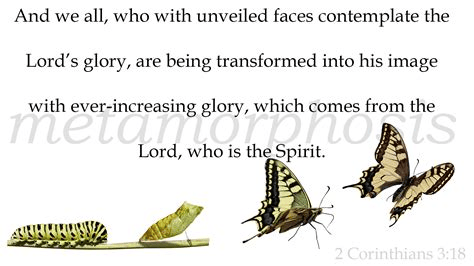
It’s the power that makes us what we were always meant to be: not idols, but images of our heavenly Father.

2 Corinthians 3:1-6NKJV

Christ’s Epistle

3 Do we begin again to commend ourselves? Or do we need, as some others, epistles of commendation to you or letters of commendation from you? 2 You are our epistle written in our hearts, known and read by all men; 3 clearly you are an epistle of Christ, ministered by us, written not with ink but by the Spirit of the living God, not on tablets of stone but on tablets of flesh, that is, of the heart.

The Spirit, Not the Letter

4 And we have such trust through Christ toward God. 5 Not that we are sufficient of ourselves to think of anything as being from ourselves, but our sufficiency is from God, 6 who also made us sufficient as ministers of the new covenant, not of the letter but of the [a]Spirit; for the letter kills, but the Spirit gives life.

We become what we worship. When we worship — or pursue as ultimate — idols, we become powerless, discontent, and disconnected, just like they are.

We become WHO we worship. When we worship – or pursue as ultimate idols, we become powerless, discontent and disconnected, just exactly like they are.

But when we worship Jesus, we are made more and more like him – The way you and I view Jesus determines exactly how you and I will fervently pursue him.

Worship of our Pride and our Selfish Ambition will inevitably melt away before the undeniable greatness of our God who suffered and died and rose again. 

Do we see that as the star of the show, the hero to be praised is Jesus Christ?

When we see this indescribably grand demonstration of God, we can do nothing less than make everything we actually are all about, be about Him and His glory.

Psalm 29New King James Version

Praise to God in His Holiness and Majesty

A Psalm of David.

29 Give[a] unto the Lord, O you mighty ones,
Give unto the Lord glory and strength.
2 [b]Give unto the Lord the glory [c]due to His name;
Worship the Lord in the [d]beauty of holiness.

3 The voice of the Lord is over the waters;
The God of glory thunders;
The Lord is over many waters.
4 The voice of the Lord is powerful;
The voice of the Lord is full of majesty.

5 The voice of the Lord breaks the cedars,
Yes, the Lord splinters the cedars of Lebanon.
6 He makes them also skip like a calf,
Lebanon and Sirion like a young wild ox.
7 The voice of the Lord [e]divides the flames of fire.

8 The voice of the Lord shakes the wilderness;
The Lord shakes the Wilderness of Kadesh.
9 The voice of the Lord makes the deer give birth,
And strips the forests bare;
And in His temple everyone says, “Glory!”

10 The Lord sat enthroned at the Flood,
And the Lord sits as King forever.
11 The Lord will give strength to His people;
The Lord will bless His people with peace.

Let us humbly come before God

Let us humbly receive His Living Word to get the full picture of who He is.

In the name of God, the Father and God the Son and God the Holy Spirit,

Let us Pray,

O Lord, Mighty in Power, Perfect in Your Love, Perfect Author of my life. You say that I should have faith in You so that I will be upheld. Sometimes I do, an sometimes I fail and put more faith in myself than I know is righteous. Mighty Lord. I desire to place all my faith in You. You strengthen me. Your holy force keeps my spirit alive and burning fiercely for You. I know that with You I can overcome anything. Thank You for remaining faithful to Your chosen people. Thank You for guiding me in my life and helping me to become a vessel for Your will. I pray that I continue to put my faith and trust in You because You know all things. You know what the hearts of Your people need, and I know You will help me through whatever this life brings. Amen.

https://translate.google.com/