
Job 7:1-7 New International Version
7 “Do not mortals have hard service(A) on earth?(B)
Are not their days like those of hired laborers?(C)
2 Like a slave longing for the evening shadows,(D)
or a hired laborer waiting to be paid,(E)
3 so I have been allotted months of futility,
and nights of misery have been assigned to me.(F)
4 When I lie down I think, ‘How long before I get up?’(G)
The night drags on, and I toss and turn until dawn.(H)
5 My body is clothed with worms(I) and scabs,
my skin is broken and festering.(J)
6 “My days are swifter than a weaver’s shuttle,(K)
and they come to an end without hope.(L)
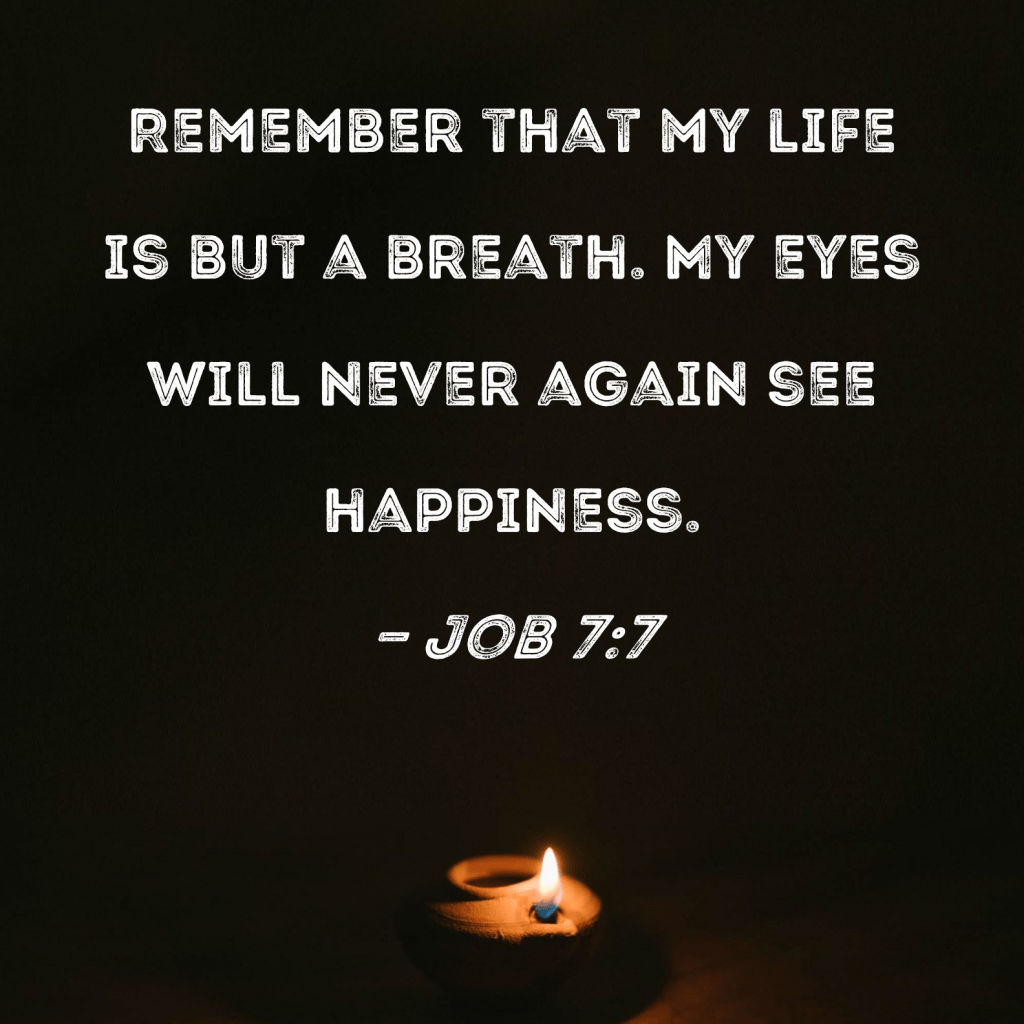
7 Remember, O God, that my life is but a breath;(M)
my eyes will never see happiness again.(N)
The Word of God for the Children of God.
Glory be to the Father,
and to the Son, and to the Holy Ghost;
as it was in the beginning,
is now, and ever shall be,
world without end. Amen, amen.
Having replied to Eliphaz, Job now addresses his complaint toward God.
He pointedly describes his life with several metaphors: the hard life of a day laborer, a slave longing for evening to come, the swiftness of a weaver’s shuttle, a breath, and a vanishing cloud.
Despite the magnitude of his trouble, Job is determined to speak and not keep silent. He primarily accuses God of being overattentive and unrealistic in his expectations, claiming that, unlike the chaos creatures, he is no threat to order and therefore does not warrant God’s around the clock constant attention.
Job confesses that he is a sinner, but he cannot understand why God refuses to forgive him. Still, putting his personal tragedy into the larger context of others’ suffering shows that Job has begun the long painful arduous journey to healing.
In Verses 1-2 of Job 7, Job questions the length of man’s service – especially hard labour. He likens the days of man’s life to that of a hired man at work.
A servant who works so hard in the field desires to rest in the shade of trees at the end of his workday. And a hired man eagerly looks for his wages at the end of the day (day wages). And Job likens himself to the servant and the hired man.
Now that he is facing the toughest trial (which Job likens to hard service) of his life, he is looking for shade and his wages. Job is looking for some much needed relief and rest from his situation.
In Verses 3-5 of Job 7, Job laments that he has been allotted futile months and troublesome nights.
Job’s body is so covered with boils that lying down is useless for he cannot get a moment’s sleep nor rest because his flesh is caked with worms and dust.
And, to keep his aggravation scale at 100/100 his skin continued to break out afresh with boils and worms began to creep in them.
Hence, rightfully, as a human, Job is in utter torment and he neither finds rest during the day nor night.
No human being can handle what he is going through (except God in the flesh – Jesus). Anyone in his place would like to be done with the trial, done with life.
In Verses 6-8 of Job 7, Job talks about the swiftness of his days because they are perceived as hopeless. He compares his life to a breath which has no guarantee of living and is short lived and declares that he will never see any good again.
He also tells that the eyes of those who see him will never see him again.
Moreover, while their eyes are upon him, he will die.
In Verses 9-10 of Job 7, Job compares the clouds in the sky that disappears to the dead man and the grave.
A dead man shall never return to his house and his place shall not know the dead man anymore, his eternal home will be his grave which wont be recalled.
Here the sky is the metaphor for the house and the cloud is the dead man.
The cloud in the sky is never permanent in one place.
Once, it changes form or moves, the sky does not remember the cloud which was once present in that particular location.
In one moment, we can see the cloud and the next moment it is not there.
It is as fleeting as the winds and man’s life is a passing cloud.
Through these verses we see Job’s utter distress.
He has totally given up on life and hope.
According to Job, all was lost.
In Verse 11 of Job 7, Job declares he will not restrain his mouth anymore and he will speak in the anguish of his spirit and he will continue to complain because his soul was bitter.
Job Loathes His Life
12 Am I a sea, or a sea serpent,
That You set a guard over me?
13 When I say, ‘My bed will comfort me,
My couch will ease my complaint,’
14 Then You scare me with dreams
And terrify me with visions,
15 So that my soul chooses strangling
And death rather than my body.
16 I loathe my life;
I would not live forever.
Let me alone,
For my days are but a breath.
In Verses 12-14 of Job 7, Job questions God as to why He has set a guard over Job as if he were as powerful as the sea or the sea serpent (Leviathan).
He also tells that God scared him with dreams and terrifying visions when he went to lie down in his bed or his couch.
Because of all these terrifying dreams and visions coupled with his hopeless situation and suffering, Job says that his soul has chosen strangulation and death rather than the will to continue to live. He chose death rather than life.
In Verse 16, Job openly declares that he loathes his life and he would not live forever. In fact, he wants his suffering to end right then, at that very moment.
He asks God to leave him alone as the rest of his days are as short as a breath.
Observation
Job is like any other human being.
When humans face trials, they automatically question God.
However, Job was undergoing an extreme trial, (the toughest trial of his life and probably even the toughest that any human being in his time had faced).
And in his human nature he questions God. He speaks about his frailty as a human (he points out that he is not as powerful as the sea nor the sea serpent).
He asks why something as frail as a human life, as any human body which is short as a breath, should endure this much suffering.
Some of us might feel the urge to judge Job for questioning God (how dare He questions God) or we might complain that he is lamenting too much about his condition instead of looking to the faith he had and renewing his trust in God.
Most of the chapters of the book of Job are about Job’s long lamentation and harsh questioning.
However, no one can truly understand his trial and suffering except himself.
Job’s questioning is between Job and God.
And the way he questions God shows he must have had a deeper relationship with God in order to have the right, courage to go to Him, and ask Him such pointed questions.
Afterall, it is our sinful human nature during trials to question God for answers.
Because only God has all the answers.
For us today, it helps to remember these are the words of a deeply despondent man. Even those biblical characters with great faith have moments of despair; Moses wanted to die, as did Elijah, David knew he was going to lose his own son.
This brings us to the end of Job 7. I must admit this was a difficult chapter to do a reflection on as most of it is self-explanatory and also is emotionally intense.
We can literally feel the depth of Job’s distress and desperation for his suffering through to end in this chapter.
Additional thoughts ….
Isaiah 53:1-6 New International Version
53 Who has believed our message(A)
and to whom has the arm(B) of the Lord been revealed?(C)
2 He grew up before him like a tender shoot,(D)
and like a root(E) out of dry ground.
He had no beauty or majesty to attract us to him,
nothing in his appearance(F) that we should desire him.
3 He was despised and rejected by mankind,
a man of suffering,(G) and familiar with pain.(H)
Like one from whom people hide(I) their faces
he was despised,(J) and we held him in low esteem.
4 Surely he took up our pain
and bore our suffering,(K)
yet we considered him punished by God,(L)
stricken by him, and afflicted.(M)
5 But he was pierced(N) for our transgressions,(O)
he was crushed(P) for our iniquities;
the punishment(Q) that brought us peace(R) was on him,
and by his wounds(S) we are healed.(T)
6 We all, like sheep, have gone astray,(U)
each of us has turned to our own way;(V)
and the Lord has laid on him
the iniquity(W) of us all.
Perhaps you know how lonely and terrible grief is.
Perhaps you have wondered if God cares.
What gives hope when our hearts break?
What gives hope when our hearts are utterly shattered?
In Jesus, we see the tears and the heart of God.
Jesus had compassion for the people – he fed them by the thousands.
Jesus healed many who came to him.
Jesus healed the women with the issue of twelve years of bleeding.
Jesus’ heart went out to a grieving widow whose son had died (Luke 7:13).
He wept with Mary at her brother’s tomb (John 11:35).
Jesus is gentle with the hurting: “A bruised reed he will not break, and a smoldering wick he will not snuff out” (Matthew 12:20).
Jesus suffered, for our sake, all of the pain and sorrow caused by everyone’s sin.
He fulfilled His promise and was raised to life by His Father – Resurrection!
He promises to remove all mourning and crying and pain when he comes again (Revelation 21:4).
How do we deal with the difficulties we face?
Do they turn us, drive us away from faith or drive us deeper in our faith?
Do we isolate ourselves or seek solace from the community around us?
God never promises life will be easy on this side of eternity, God does promise to be present with us through the Holy Spirit.
He is our comfort as we face the major and minor storms of life; we are held up by the God who is infinitely bigger than the most extreme of our problems.
He also knits us into a community of believers who gather together to hold one another up in times of struggle.
Because He lives …. We never have to go it alone.
Because He lives …. My life is always worth living.
Because He lives …. There will always be the promise of one more tomorrow.

In the name of God, the Father and God the Son and God the Holy Spirit,
Praying ….
Psalm 30
Joy in the Morning
A psalm; a dedication song for the house. Of David.
1 I will exalt you, Lord,
because you have lifted me up(A)
and have not allowed my enemies
to triumph over me.(B)
2 Lord my God,
I cried to you for help, and you healed me.(C)
3 Lord, you brought me up from Sheol;(D)
you spared me from among those
going down[a] to the Pit.(E)
4 Sing to the Lord, you his faithful ones,
and praise his holy name.(F)
5 For his anger lasts only a moment,
but his favor, a lifetime.
Weeping may stay overnight,
but there is joy in the morning.(G)
6 When I was secure, I said,
“I will never be shaken.”(H)
7 Lord, when you showed your favor,
you made me stand like a strong mountain;(I)
when you hid your face, I was terrified.(J)
8 Lord, I called to you;
I sought favor from my Lord:(K)
9 “What gain is there in my death,
if I go down to the Pit?
Will the dust praise you?
Will it proclaim your truth?(L)
10 Lord, listen and be gracious to me;
Lord, be my helper.”(M)
11 You turned my lament into dancing;
you removed my sackcloth
and clothed me with gladness,(N)
12 so that I can sing to you and not be silent.
Lord my God, I will praise you forever.(O)


