
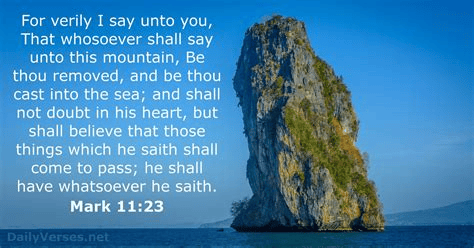
Mark 11:20-26 Legacy Standard Bible
20 (A)And as they were passing by in the morning, they saw the fig tree withered from the roots. 21 And being reminded, Peter *said to Him, “(B)Rabbi, look, the fig tree which You cursed has withered.” 22 And Jesus answered and *said to them, “(C)Have faith in God. 23 (D)Truly I say to you, whoever says to this mountain, ‘Be taken up and cast into the sea,’ and does not doubt in his heart, but believes that what he says [a]is going to happen, it will be granted him. 24 For this reason I say to you, (E)all things for which you pray and ask, believe that you have received them, and they will be granted to you. 25 And whenever you (F)stand praying, (G)forgive, if you have anything against anyone, so that your Father who is in heaven will also forgive you your transgressions. 26 [b][(H)But if you do not forgive, neither will your Father who is in heaven forgive your transgressions.”]
The Word of God for the Children of God.
Glory be to the Father,
and to the Son, and to the Holy Ghost;
as it was in the beginning,
is now, and ever shall be,
world without end. Amen, amen.
In reading our Bibles, we will come across verses that seem straightforward and easy to understand immediately.
On the other hand, there are also verses like this one we will struggle with;
“Whatever you ask in prayer, believe that you have received it, and it will be yours,” says Jesus.
We are tempted essentially to sidestep what these words say.
We try to bury them under a hundred qualifications.
The misapplication of such verses has scared some of us so much, so badly we hardly give any attention to the encouragement and the challenge they contain.
In this bold command, Jesus reminded His followers to trust God, because it is actually faith’s foundation in God that gives that faith significance.
We should not have faith in faith or faith in ourselves, but faith in God alone.
The metaphor employed—someone commanding a mountain to be thrown into the sea—was perhaps familiar to the disciples; similar to a common rabbinic figure of speech for accomplishing something that was seemingly impossible.
The disciples would not have misunderstood Jesus as suggesting that they literally hurl the Mount of Olives into the Dead Sea over 4,000 feet below them.
They would have understood his words as a proverbial statement indicating God wants to do extraordinary things for His children.
We discover vivid proof of Jesus’ teaching on faith and prayer throughout the book of Acts.
Early on, when a lame beggar asked Peter and John for money, Peter told him instead to stand up and walk (Acts 3:6).
Perhaps as he spoke to this man, Peter was remembering Jesus’ words and thinking to himself, “Whatever you ask… have faith … believe…”
When God is the object of our faith, we can have an audacious faith—a faith that believes the impossible to be possible with Him. (Luke 1:37)
We can know that we are speaking to someone who is able to do far more than we can even imagine (Ephesians 3:20-21).
Jesus essentially says to us, I want you to pray in a way that says you actually believe in a God who is too wise to make mistakes, who is too kind to be cruel, and who is too powerful to be subdued by the normal forces of the universe.
Typically, we are quick to set aside these verses with a hundred qualifications.
Nothing is impossible with God!
Since we can never claim to be God, even equal with God, impossible is just that.
Just let them sit there for a minute.
Enjoy the truth that God is able to do things beyond anything you can imagine.
First; Shalom rest in the reality that He knows no impossibility. And then pray.
What is the significance of faith in God according to Mark 11:22-25 KJV?
According to Mark 11:22–25 KJV, Rabbi Jesus teaches that faith in God empowers believers to pray boldly and expect God to act, while also requiring forgiveness toward others.
Empowerment in Prayer
- Bold Requests: Jesus emphasizes that having faith in God allows believers to make bold requests in prayer. He states that if one believes without doubt, they can command mountains to move, symbolizing the power of faith to overcome obstacles.
- Expectation of Action: The passage encourages believers to expect God to act on their behalf when they pray with genuine faith. This expectation is rooted in the belief that God is capable of fulfilling their requests.
Requirement of Forgiveness
- Forgiveness as a Condition: Jesus links the act of prayer with the necessity of forgiveness. He instructs that when praying, one must forgive others to receive forgiveness from God. This highlights the importance of maintaining a pure heart and relationships with others in the context of faith.
How does forgiveness relate to prayer in Mark 11:22-25 KJV?
In Mark 11:22-25 KJV, forgiveness is essential to prayer, as it states that when you stand praying, you must forgive anyone you hold a grudge against so that your Father in heaven may also forgive you your trespasses.
This emphasizes the critical importance of a forgiving heart in the context of seeking God’s forgiveness and answers to prayer.
Faith in God vs. Faith in Prayer
- Focus on God: The teaching stresses that faith should be directed towards God, not merely the act of praying. True faith is rooted in trust in God’s character and His ability to respond to prayers according to His will.
- Faith in God: The passage emphasizes the importance of having faith in God.
- Power of Belief: It teaches that belief without doubt can lead to the fulfillment of one’s words and desires.
- Prayer and Forgiveness: It highlights the necessity of forgiveness in prayer, linking it to receiving forgiveness from God.
Our faith in God is closely tied to our ability to forgive others. As you dwell on these verses, reflect on how forgiveness can unlock the door to powerful prayer and deeper faith. Remember that forgiving others allows God to work freely in your own heart, clearing the way for His blessings.
Questions for Reflection:
- Do I have faith that God can move the ‘mountains’ in my life as I choose to forgive?
- How can I incorporate forgiveness into my daily prayer routine?
- What steps can I take to ensure that unforgiveness does not hinder my relationship with God?

In the name of God, the Father and God the Son and God the Holy Spirit,
Praying …
Who May Dwell on Your Holy Mountain?
A Psalm of David.
15 O Yahweh, who may [a]sojourn (A)in Your tent?
Who may dwell on Your (B)holy mountain?
2 He who (C)walks blamelessly, and works righteousness,
And (D)speaks truth in his heart.
3 He (E)does not slander [b]with his tongue,
Nor (F)does evil to his neighbor,
Nor (G)takes up a reproach against his friend;
4 In [c]whose eyes a reprobate is despised,
But [d]who (H)honors those who fear Yahweh;
He (I)swears to his own hurt and does not change;
5 He (J)does not put out his money [e]at interest,
Nor (K)does he take a bribe against the innocent.
(L)He who does these things will never be shaken.
Glory be to the Father,
and to the Son, and to the Holy Ghost;
as it was in the beginning,
is now, and ever shall be,
world without end. Amen, amen.


