
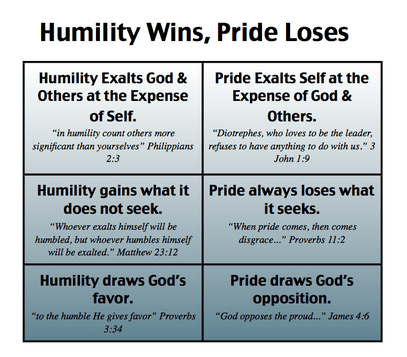
Philippians 2:3-8 Expanded Bible
3 When you do things, do not let ·selfishness [rivalry; selfish ambition] or pride be your guide. Instead, be humble and give more ·honor [regard; value] to others than to yourselves. 4 Do not ·be interested only in your own life [look out for your own interests], but ·be interested in the lives of others [look out for others’ interests].
Be Unselfish like Christ
5 In your lives you must ·think and act like [have the same attitude as] Christ Jesus. [C What follows may be from an early Christian hymn.]
6 ·Christ himself was like God in everything [L Who, being in the form of God].
But he did not think that being equal with God was something to be ·used for his own benefit [or grasped; seized; held on to].
7 But he ·gave up his place with God and made himself nothing [L emptied himself].
He ·became like [L took the form of] a ·servant [slave; bondservant]
and was born ·as a man [L in the likeness of humanity/men].
8 And ·when he was living [L being found in appearance/likeness] as a ·man [human being],
he humbled himself and was fully obedient to God,
even ·when that caused his [to the point of] death—death on a cross.
Word of God for the Children of God
Glory be to the Father,
and to the Son, and to the Holy Ghost;
as it was in the beginning,
is now, and ever shall be,
world without end. Amen, amen.
Consider Others More Significant Than Ourselves
Humility is almost a foreign word in today’s often self-centered world.
Our society today has a tendency to hyper focus on personal happiness and individual freedoms over the good of the community.
Yet it wasn’t terribly different in the days Jesus walked the earth.
Back then, just as today, people scrambled to look after themselves and the needs of their families.
They sought to protect their own interests, and we know how many times Jesus criticized the Pharisees for their hypocrisy and arrogance.
Time and again, Jesus spoke out against the desire to put the self first — taking the best seat at the table or hosting parties knowing others would reciprocate, wearing fancy robes, lapping up adoration, gloating respect bestowed on them.
In his Sermon on the Mount, Jesus taught us we should strive to be humble, noting, “Blessed are the meek, for they shall inherit the earth” (Matthew 5:5).
The original Greek used for “meek” is praus, meaning being gentle of heart and behaving toward others with humility and consideration.
It is the very same thing Paul urges in his letter to the early church in Philippi.
In Philippians 2:3, Paul urges Christians,
3 When you do things, do not let ·selfishness [rivalry; selfish ambition] or pride be your guide. Instead, be humble and give more ·honor [regard; value] to others than to yourselves.
What does this mean? How do we count others as more significant than ourselves, and why should we bother to do so?
In short, Paul is urging us in the same way Jesus did — and we should take his words to heart.
What Is Humility?
Humility is the essence of piety, according to the Encyclopedia of the Bible. The Dictionary of Bible Themes calls it an attitude of lowliness and obedience. Dictionary.com describes it as a modest opinion or estimate of one’s own importance and rank.
In everyday terms, we can understand humility as understanding that we, on our own, aren’t of any special importance, nor are we better than anyone else. No matter our wealth, our physical attractiveness, our intelligence, our status, or any other manner in which we might compare ourselves to others (or even perhaps lift ourselves above others), we’re all on the same level. Indeed, in understanding this, we acknowledge our own low status even further, which helps us lift up others’ needs before our own and consider them as more important than ourselves.
It’s the polar opposite of the messaging we often hear today that lifts up self-focus, self-confidence, self-concern, self-absorption, and self-indulgence.
Here, Paul is telling us to be humble and consider others higher than ourselves. He’s telling us to act like a servant, not a master.
What Is the Context of This Verse?
In the previous chapter, Philippians 1, Paul urges the early church to live in a manner “worthy of the gospel of Christ” (Philippians 1:27) and also to be united, much like one body in perfect balance in the Holy Spirit, even in our suffering.
Now, in Philippians 2, he further urges the church to accomplish this by following Christ’s example of humility.
Be “of the same mind,” verse 2 says, rejecting selfish concerns, wants, or needs.
Be like Jesus, he said, and, “Let each of you look not only to his own interests, but also to the interests of others” (v. 4).
He’s echoing Christ’s words in Mark 12:31 to love your neighbor as yourself.
Then Paul goes further, giving us an example of how Christ modeled this for us.
As Paul said, even though Jesus was divine, God in fully human form, he didn’t act this way.
He acted like a humble slave, born a lowly man, humbling himself by serving others, and ultimately unto dying a horrific and humiliating death on a cross.
That’s what our Savior did, and we need to study and pray and act to follow his example and be this way, too.
Jesus said about Considering Others as Greater Than Ourselves?
Jesus consistently modeled, demonstrated and taught humility throughout his earthly ministry, and this is Paul’s great point.
Not only did Jesus lift up humility as a virtue in the Sermon on the Mount (Matthew 5), but he told us to be like children.
At that time in society, children were of little consequence and assigned the lowest status in society.
Yet in Matthew 18, Jesus called a child over to him and told his disciples they must become like children — lowly.
Jesus said,
Who Is the Greatest?
18 At that time the ·followers [disciples] came to Jesus and asked, “Who is greatest in the kingdom of heaven?”
2 Jesus called a little child to him and stood the child before his ·followers [disciples]. 3 Then he said, “I tell you the truth, you must ·change [turn from your sins; convert; L turn] and become like little children. Otherwise, you will never enter the kingdom of heaven. 4 The greatest person in the kingdom of heaven [L therefore] is the one who makes himself humble [and becomes] like this [little] child.(Matthew 18:1-4).
Humility is a requirement for heaven.
Later, he told them to hear the words of the Pharisees, but don’t behave like them and don’t exalt yourself, for we are all brothers and sisters.
As he said,
11 ·Whoever is your servant is the greatest among you [L The greatest among you will be your servant]. 12 Whoever ·makes himself great [lifts up/exalts himself] will be made humble. Whoever makes himself humble will be ·made great [exalted; lifted up].(Matthew 23:11-12).
Further, the night before his arrest, at the Last Supper, Jesus modeled humility by kneeling to wash the filthy feet of his twelve disciples.
John 13:4-8Expanded Bible
4 So ·during the meal [L from supper] Jesus stood up and took off his outer clothing. Taking a towel, he wrapped it around his waist. 5 Then he poured water into a bowl and began to wash the ·followers’ [disciples’] feet, ·drying [wiping] them with the towel that was wrapped around him. [C This act was considered so demeaning by some people that they only allowed Gentile slaves to do it.]
6 Jesus came to Simon Peter, who said to him, “Lord, are you going to wash my feet?”
7 Jesus answered, “You don’t understand now what I am doing, but you will understand later.”
8 Peter said, “No, you will never wash my feet.”
Jesus answered, “If I don’t wash your feet, you ·are not one of my people [L have no share/part with me].”
His followers were shocked, and Peter objected at first, but Jesus insisted on performing this subservient act.
Then he asked if they understood what he had done, explaining,
“You call me Teacher and Lord, and you are right, for so I am. If I then, your Lord and Teacher, have washed your feet, you also ought to wash one another’s feet. For I have given you an example, that you also should do just as I have done to you. Truly, truly, I say to you, a servant is not greater than his master, nor is a messenger greater than the one who sent him. If you know these things, blessed are you if you do them” (John 13:13-17).
How Can We Have Humility Today?
Humility starts within.
First, understand God is the most important, the highest.
God is our ruler and king, now and forever. We belong to him.
Then, understand what that looks like in our relationship to him.
We are blessed to receive his gift of salvation and are not entitled to this.
We do not deserve it and cannot possibly achieve it on our own.
Recognize and confess our wrongdoings and shortcomings.
Recognize we are not God and never will be.
Finally, in honor of this, model Jesus, even knowing we will never achieve this goal.
Sacrifice yourself for others.
Share what you have.
Give generously of your money, your time, and your talents.
Don’t boast or celebrate your accomplishments.
Serve and help others.
Lift them higher than yourself.
Share your food and your clothing, your money and your home.
Share even if you risk hardship.
Understand that we are all one, and nothing belongs to me alone.
Listen well, ask questions, admit when you’re wrong, and don’t worry about your status or earning respect.
Save respect for the only one worthy: the Lord.
Pray how you can apply all of this to your own life, in whatever setting you work or live.
If we are truly followers of Christ, we are obligated to behave like him.
Jesus behaved with humility, and we must, too, whatever that looks like.
Amen, and thanks be to God for all God’s precious and perfect gifts.
In the name of the Father and of the Son and of the Holy Spirit. Amen
Praying ….
Micah 6:1-8 Expanded Bible
The Lord’s Case
6 Now hear what the Lord says:
“Get up; plead ·your [or my] case in front of the mountains;
let the hills hear your ·story [L voice].
2 Mountains, listen to the Lord’s ·legal case [accusation; indictment].
·Strong [Enduring] foundations of the earth, listen.
The Lord has a ·legal case [accusation; indictment] against his people,
and he will ·accuse [contend with] Israel.”
3 He says, “My people, what did I do to you?
How ·did I make you tired of me [have I wearied you]?
·Tell [Answer] me.
4 I brought you from the land of Egypt [Ex. 12:51]
and ·freed [redeemed] you from slavery;
I sent Moses, Aaron, and Miriam [Ex. 15:20] to you.
5 My people, remember
the evil plans of Balak king of Moab [Num. 22:5]
and what Balaam son of Beor told Balak [Num. 22–24].
Remember what happened from Acacia to Gilgal [Josh. 3:1; 4:19–24]
so that you will know the ·Lord does what is right [righteousness/justice of the Lord]!”
6 You say, “What can I bring with me
when I come before the Lord,
when I bow before ·God on high [the exalted God]?
Should I come before him with burnt offerings [Lev. 1:1–17],
with year-old calves?
7 Will the Lord be pleased with a thousand ·male sheep [rams]?
Will he be pleased with ten thousand rivers of oil?
Should I give my ·first child [firstborn] for ·the evil I have done [my transgression]?
Should I give ·my very own child [L the fruit of my body] for ·my sin [L the sin of my soul]?”
8 The Lord has told you, ·human [T O man], what is good;
he has told you what ·he wants [the Lord requires] from you:
to do what is ·right to other people [just],
love ·being kind to others [mercy; lovingkindness],
and ·live humbly, obeying [walk humbly with] your God.
Glory be to the Father,
and to the Son, and to the Holy Ghost;
as it was in the beginning,
is now, and ever shall be,
world without end. Amen, amen.


