
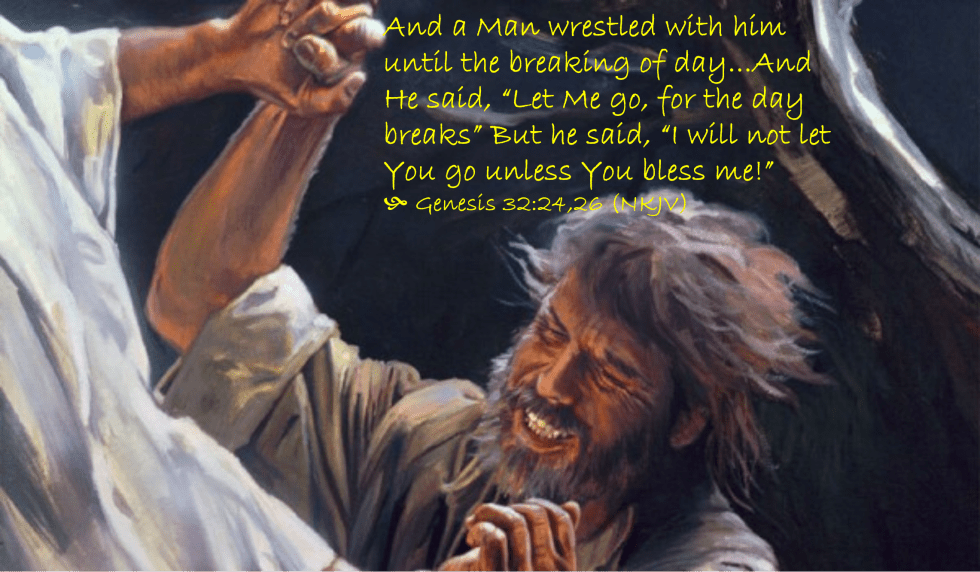
Genesis 32:24-30 New American Standard Bible
Jacob Wrestles
24 Then Jacob was left alone, and a man wrestled with him until daybreak. 25 When the man saw that he had not prevailed against him, he touched the socket of [a] Jacob’s hip; and the socket of Jacob’s hip was dislocated while he wrestled with him. 26 Then he said, “Let me go, for the dawn is breaking.” But he said, “I will not let you go unless you bless me.” 27 So he said to him, “What is your name?” And he said, “Jacob.” 28 Then he said, “Your name shall no longer be Jacob, but [b]Israel; for you have contended with God and with men, and have prevailed.” 29 And Jacob asked him and said, “Please tell me your name.” But he said, “Why is it that you ask my name?” And he blessed him there. 30 So Jacob named the place [c]Peniel, for he said, “I have seen God face to face, yet my [d]life has been [e]spared.”
Word of God for the Children of God.
Glory be to the Father,
and to the Son, and to the Holy Ghost;
as it was in the beginning,
is now, and ever shall be,
world without end. Amen, amen.
Life will often present moments when transformation requires intense engagement with God.
Jacob should have known better.
He knew what it was like to have a brother whom his father loved more than him (Genesis 25:27-28), but he favored his youngest son Joseph over his other sons anyway. Sadly, it led to jealousy and resentment among Joseph’s brothers.
When Joseph’s older brothers looked at him, blood pressures went up, hatred and jealousy filled their hearts. Still, they should have kept their emotions in check if Joseph hadn’t stirred the pot with notions about the dreams he had had.
God had provided the dreams, but Joseph took pride in them. He interpreted those dreams as showing he was better than his brothers, and even his father rebuked him for the self-centered nature of those interpretations.
The meaning of those dreams became clear later (Genesis 41-47), but all that the brothers knew now was that they didn’t want anything to do with Joseph!
In this story we eventually see God can take the human failings of these broken family members to bring about something good, despite the sinful attitudes locked inside each individual’s heart.
We also learn in life God intercedes, leads, guides, directs and works through the troubles in our world and in our hearts to make something new and better.
He is faithful to the purpose and plan that he holds and creates for us.
Jacob’s night-long struggle at Peniel illustrates that change is not always passive; sometimes we must wrestle spiritually to experience breakthrough.
This struggle can be with fear, destiny delays, or internal limitations.
Wrestling with God is not about overpowering Him but about encountering Him in a way that reshapes identity, perspective, and purpose.
It is in the intensity of confrontation, prayer, and dependence that God’s power brings transformation.
The encounter at Peniel shows that the most significant changes often occur during periods of discomfort, vulnerability, and persistence.
By wrestling with God, we are prepared for new identity, divine favour, and renewed purpose in life.
1. RECOGNISING THE NEED FOR DIVINE CHANGE
Transformation begins when we acknowledge areas where God’s intervention is essential.
a) Facing Fear (Genesis 32:7-8)
Jacob recognized the imminent threat of Esau wanting payback and felt fear.
Change often starts with confronting realities beyond our control.
b) Acknowledging Weakness (Genesis 32:9-10)
Jacob admitted his inadequacy and appealed to God’s mercy.
True change begins with humility and dependence on divine power.
c) Seeking Divine Intervention (Genesis 32:11)
Prayer becomes the arena where change is negotiated and requested.
d) Desire for Transformation (Genesis 32:12)
Jacob’s plea reveals that longing for God’s intercession initiates spiritual struggle.
Hannah’s desperate prayer for a child after years of barrenness and scorn in Shiloh demonstrates that determined self-same recognition of need and her persistent pleading lead to divine response (1 Samuel 1:10-20).
2. ENGAGING IN SPIRITUAL STRUGGLE
Spiritual breakthrough often requires persistence, discipline, and resilience in prayer and obedience.
a) Wrestling through the Night (Genesis 32:24)
Jacob physically wrestled with the angel, illustrating the highest intensity of Jacob’s spiritual struggle.
b) Refusing to Let Go (Genesis 32:26)
Persistence at all costs is essential; intercession is often released to those who remains steadfast and refuses to relent in faith.
c) Painful Transformation (Genesis 32:25)
Change can be minimally or hardcore uncomfortable; divine intervention often requires painful surrender and enduring pressure.
d) Seeking God’s Favour (Genesis 32:27)
Jacob’s insistence shows that breakthroughs require intentional engagement with God’s presence.
Moses wrestled in prayer and intercession for Israel, advocating persistently for mercy during rebellion (Exodus 32:11-14).
3. RECEIVING NEW IDENTITY
Transformation brings a redefinition of purpose and identity.
a) Name Change (Genesis 32:28)
Jacob became Israel, meaning “he wrestled with God.”
Divine encounters redefine identity.
b) Empowered for Destiny (Genesis 32:28)
New identity equips for new responsibilities and challenges.
c) Recognition of Divine Authority (Genesis 32:29)
Encounter teaches reverence and dependence on God’s sovereignty.
d) Witness of the Change (Genesis 32:30)
Jacob called the place Peniel, acknowledging God’s transformative power.
Saul of Tarsus became Paul after encountering Christ on the road to Damascus, receiving a new identity and purpose (Acts 9:1-19).
4. WALKING IN THE RESULTS OF STRUGGLE
Breakthrough demands action in alignment with the transformation received.
a) Living with Courage (Genesis 32:31)
Despite being limping from the encounter, Jacob walked forward strengthened in faith.
b) Pursuing Destiny (Genesis 33:1-4)
The struggle prepared him for reconciliation with Esau, illustrating that divine change impacts relationships and destiny.
c) Strengthened Faith (Romans 5:3-5)
Endurance through struggle produces character, hope, and spiritual maturity.
d) Continuous Dependence (Philippians 3:12-14)
Even after breakthrough, persistent faith is necessary to run the race of destiny.
Biblical Example: Daniel’s perseverance in the lions’ den demonstrates walking in faith and victory after trusting God through testing (Daniel 6:16-23).
CONCLUSION
Wrestling with God is not about confrontation in anger but persistent seeking, humility, and surrender.
Jacob’s night long struggle at Peniel resulted in new identity, empowerment, and readiness for destiny.
Believers are encouraged to embrace spiritual struggle, trusting that God meets intensity with transformation. Every heavenly encounter with divine struggle can redefine identity, establish faith, and prepare for destiny fulfilment.
“highly suggested” PRAYER POINTS
1. Father, give me the strength to persist in prayer until breakthrough is achieved in Jesus name.
2. Lord, help me confront areas of my life that require divine transformation in Jesus name.
3. Father, teach me to wrestle with You in faith and humility in Jesus name.
4. Lord, redefine my identity according to Your purpose and glory in Jesus name.
5. Father, empower me to walk forward courageously after every spiritual encounter in Jesus name.
6. Lord, release divine blessings that result from persistence and struggle in Jesus name.
7. Father, help me endure trials with patience and perseverance in Jesus name.
8. Lord, strengthen my faith through every wrestling season in Jesus name.
9. Father, prepare me for destiny fulfillment through divine encounters in Jesus name.
10. Lord, let every struggle result in victory and testimony in Jesus name.
In the name of the Father and of the Son and of the Holy Spirit. Amen
Praying …..
Psalm 16 New King James Version
The Hope of the Faithful, and the Messiah’s Victory
A Michtam of David.
16 Preserve[a] me, O God, for in You I put my trust.
2 O my soul, you have said to the Lord,
“You are my Lord,
My goodness is nothing apart from You.”
3 As for the saints who are on the earth,
“They are the excellent ones, in whom is all my delight.”
4 Their sorrows shall be multiplied who hasten after another god;
Their drink offerings of blood I will not offer,
Nor take up their names on my lips.
5 O Lord, You are the portion of my inheritance and my cup;
You [b]maintain my lot.
6 The lines have fallen to me in pleasant places;
Yes, I have a good inheritance.
7 I will bless the Lord who has given me counsel;
My [c]heart also instructs me in the night seasons.
8 I have set the Lord always before me;
Because He is at my right hand I shall not be moved.
9 Therefore my heart is glad, and my glory rejoices;
My flesh also will [d]rest in hope.
10 For You will not leave my soul in [e]Sheol,
Nor will You allow Your Holy One to [f]see corruption.
11 You will show me the path of life;
In Your presence is fullness of joy;
At Your right hand are pleasures forevermore.
Glory be to the Father,
and to the Son, and to the Holy Ghost;
as it was in the beginning,
is now, and ever shall be,
world without end. Amen, amen.


Examples of Av tuma avoda zara
TIME DILATION IN SURAH AL-KAHF, the Koran tells a vague abstract story which stands in the shadow of Israelite slaves crushed under the oppressive jackboots of Par’o and his Court. Major modern tafsirs such as Fi Zilal al-Qur’an (Sayyid Qutb, Sunni, Egypt) interpret SURAH AL-KAHF through the lenses of Tawhid. Oblivious that the theology of Tawhid violates the 2nd Sinai commandment. The very Name Allah amounts to a Golden Calf word substitution for the Spirit Name revealed for the first time in the 1st Sinai commandment.
In the Book of בראשית multiple Divine Names interchanged with one another. This employment of Divine Name metaphor pronouns duplicates the revelation of the Oral Torah middot Spirit pronouns “אל רחום חנון etc”. Contrast the revelation of Divine Spirits with that of gospel John 1:1 And the word is God … the word אלהים describes the God that brought Israel out of metaphor “the cave” of Egypt; this Golden Calf hence repudiates Word-Translations of the First Commandment שם השם revelation of Divine tohor Spirits which dwell within the metaphor “the [different] cave” of the Yatzir Tov within the heart of the bnai brit Israel – when they dedicate the kre’a shma בכל לבבך\כם tefillah wherein they accept the yoke of tohor middot as the dominant spirits לשמה which rule over their tumah Yatzir Ha’ra middot within their hearts.
Understood, that last abstract description of what distinguishes the שם השם from other Divine Names found in בראשית – quite a mouthful! To restate the above: The שם השם – לא בשמים הוא. Whereas the vision of the other בראשית Divine Names envision the Creator of the Heavens and the Earth; the משל משכן aspect of the Sinai revelation restricts the Sinai first commandment Name strictly limited to Divine Justice expressed through the Sanhedrin courts below upon this Earth – within the borders of the oath sworn land inheritance of the Chosen Cohen people.
This vision invalidates both the Roman NT forgery as well as the Muhammad false prophet, based upon the simple undisputed fact that both Yishmael and Esav reject the revelation of the Torah at Sinai to this day. The God of the Avot, a local tribal God — only the 12 tribes of Israel accept the Torah Sinai revelation. Goyim worship their own God(s) according to the tongue of their cultures and customs. That’s an obvious given. Simply observe how different societies worship their own Gods: China, Japan, Korea, Vietnam, India etc etc etc. The two so-called “daughter religions” spew a belief in some Universal Monotheistic God. Hence they assume the mandate to convert all Humanity with a convert or die ultimatum.
The Koran disparages Jews as the ‘People of the Book’ – people who worship words. Yet substituting the word Allah for the Torah Sinai vision “tohor middot לשמה, live only in this world” – clearly worships words as well. This type of nonsense known as “projectionism”. Contrast the simple Jew who tucks his tzitzit into his pocket when he visits a cemetery! The First Commandment Sinai Spirit Name only lives in the Earth: expressed through fair compensation of damages inflicted upon victims; imposed by righteous judges of Torah common law courts – strictly and only within the borders of Canaan when the Cohen people keep the Pesach\Yovel. Post acceptance of the Torah revelation, Jews do not pray to any God in the Heavens. Rather we dedicate tohor Oral Torah middot “Spirits” as the dominate influencers within our hearts as the meaning of “righteousness pursue”. Hence tefillah known as a “matter of the heart”.
Goyim stick to their “faith” that God dwells in some Heaven above; that religious belief system define this “faith”. The Torah revelation, bases itself emphatically upon the mussar of the NaCH prophets – like unto Moshe the prophet. Torah faith limits itself to the righteous pursuit of justice – among our own people, within the conquered lands of Canaan; the k’vanna of the wisdom time-oriented first Sinai commandment. The bi-polar distinction separates the first from the second Sinai commandments; separation between faith vs faith ultimately defines the k’vanna of the revelation of the 1st and 2nd Sinai commandments; both of which the Goyim “daughter religions” emphatically reject. Impossible to claim that Yishmael served as the korban for Avraham at the Akada, and also claim thereafter – that Muslims accept Muhammad as the last “Torah” prophet.
Unlike the Koran which declares that prophets sent to all peoples and nations, this notion violates the model of Moshe as a prophet. Moshe sent as a מלאך of HaShem to Egypt; at the brit cut between Avram and אל שדי at the brit between the pieces – their אל שדי warned Avram that his future born (O’lam Ha’bah seed) chosen Cohen children would dwell in a land not their own, suffer injustice through judicial oppression/slavery and from there – know redemption: Yovel-freedom – to inherit the land of Canaan as their eternal inheritance obligation. G’lut Mitzrim serves as the Av model of the curse of judicial oppression; Israel therefore did not conquer Canaan, simply as tyrants – no Canaanite king had the power to stand before us. In point of fact some Canaanite kings did blunt the invasion for a time. Rather, the abomination of Par’o, together with his ‘star-court’, this cursed perverted justice directly compares to the post Shoah oath “NEVER AGAIN”.
The Sinai language in Sh’mot and D’varim differ on the language of הזכר vs.שמור. The distinction between the life vs. death – blessing vs curse – 1st vs 2nd Sinai commandments. Therefore all Torah prophets like Moshe exist as sent מלאכים – who command mussar as the tools to enforce the rulings of the Court (established through the mandate of the Torah); whose jurisdiction – limited only within the borders of conquered Canaan – אשר הוציאך מארץ מצרים מבית עבדים – when the Cohen nation remembers and rejoices the Yovel. Clearly the language of the word “Egypt” in the first commandment – לאו דוקא; all lands of exile in all times – contained within the language “Egypt”. Torah commands mussar, not history. The word בראשית inclusive of the entire Torah; this first Book introduces Av wisdom time-oriented commandments as the יסוד of all משנה תורה Sanhedrin common law.
This fundamental distinction, it defines the spirit k’vanna of the 7th Oral Torah middah רב חסד. In opposite and stark contrast, the NT’s apostle Paul (Galatians 2:15 or 3:23). The Paulin incongruity juxtaposes life “under the law” at variance to: life “in Christ”. He argues—that justification and the Spirit—not observance of the Mosaic legal system—constitute the Hope-foundation of righteousness for Goyim believers. By the terms of this interpretation, Goyim become equal heirs to the brit sworn to the Avot – Rom. 11; through belief “in Christ,” and thus participating in the oath sworn to the Avot, that only they alone would father the chosen Cohen people who would inherit the land Canaan. The fundamental flaw in such idol speculation: Moshe directly commanded not to invade or attack the land of Esav or Moav. This negative commandment serves as witness that the vision of the Torah limits the inheritance of the Cohen people strictly and only to Canaan. Jews have no obligation to convert people to accept the Torah.
This NT religion interpretation by the Apostle Paul, it seems to me, that it serves as the basis for how the later Koran likewise employed its own interpretive substitute theology of Tawhid Allah. This Tawḥīd “dogma” emphasizes the belief in the oneness of Allah; upon this “Rock” stands both the Arab and the conquered/converted Islamic theologies of belief in Allah. The follow-up creed, known as the Koranic Prophetic Succession. The idea that prophets sent by Allah to all peoples and culminated with Muhammad. This “canon” comparable to the Roman Catholic succession of Peter! Both this and that set as the “method” to guide humanity. Both religious communities prioritize creed theologies over ethnic or cultural identity. The Sunni Shiite split consequent to the murder of Ali, while the Catholic Protestant split exploded over divorce and church corrupt indulgences. Both religious creeds have fought long bloody wars against themselves and one another.
Different cultures and customs practiced by multiple peoples make their own unique contribution to how they understand their God(s). Israel vision of a local tribal god radically differs from the Muhammadan or earlier Paulin interpretations of faith.
Linguistic cognates express cultures and traditions of unique societies and civilization. The courts of both Arab Islamic Catholic and Protestant countries do not in the least resemble a common law Torah Legislative Review mandated Sanhedrin Federal Court system. ברית does not translate to “covenant”. The former requires שם ומלכות whereas neither “daughter religion” does not understand “covenant” by these Torah preconditions.
שם – The Name revealed in the 1st Sinai commandment. No where duplicated in either the Koran or NT/OT. מלכות – the dedication of Oral Torah middot revealed to Moshe on Yom Kippur – where HaShem remembered His oath to the Avot and annuled His Vow to make Moshe the father of the chosen Cohen people. קרבן – no more a “ritual act” than the Akadah! Prior to the revelation of the Torah, to swear a Torah oath – a bnei brit Israel had to dedicate a korban to swear a Torah oath with שם ומלכות. Time-oriented wisdom commandments require k’vanna. Ritual acts do not require k’vanna any more than to positive or negative Torah commandments. סנקציות – blessings/curses – the first two commandments of the brit of life or death unique to the Cohen brit faith. Legal meaning established through Case/Din judicial precedents, not a dog chasing its own tail vocabulary – word translations; each society has their own cultures and traditions that their language “jargan” communicates among their own people.
Neither Islam nor Xtianity can usurp their claims to Avot lineage. Sarah commanded Avram that only her son Yitzak would inherit the oath brit Cohen people inheritance. Neither JeZeus nor Muhammad 1500 or more year after the fact substitute messiah or Yishmael in the stead of the Avot. Simply not intellectually honest.
Linguistic cognates express cultures and traditions. The 7th Century CE Koran has its values embraced by huge populations. The same applies to the European religion which converted the Roman Empire to embrace the Nicene Creed. But their “mandate” to convert the world, stops when their fists reach the tip of bnai brit noses.
LikeLike