
Isaiah 56:6-7 Names of God Bible
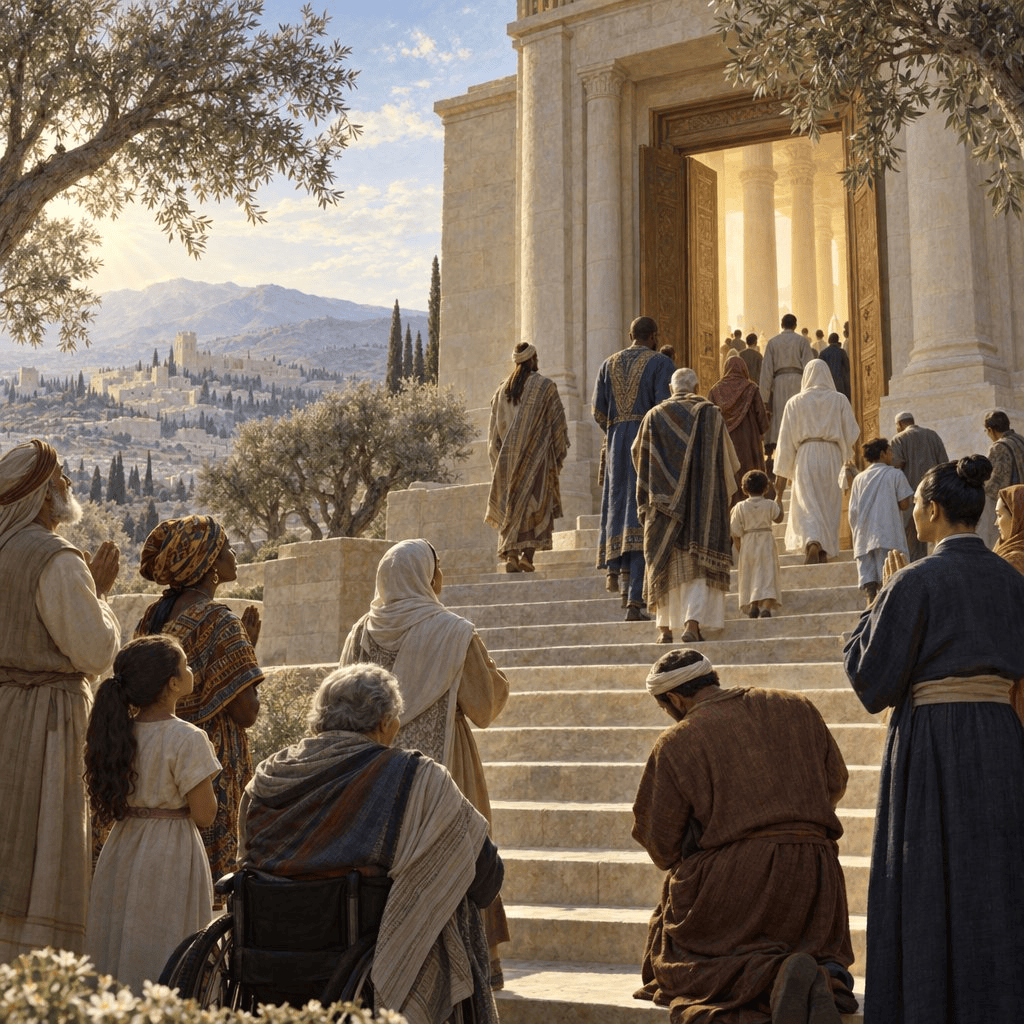
6 And I will remember the foreigners who have joined Yahweh to worship him, to love Yahweh’s name, and to be his servants. All of them will keep the day of worship from becoming unholy and will faithfully observe the conditions of my promise. 7 Then I will bring them to my holy mountain and make them happy in my house of prayer. Their burnt offerings and their sacrifices will be acceptable on my altar, because my house will be called a house of prayer for all nations.
The Word of God for the Children of God
Glory be to the Father,
and to the Son, and to the Holy Ghost;
as it was in the beginning,
is now, and ever shall be,
world without end. Amen, amen.
Joyful in His House: Prayer for All People
“Even them will I bring to my holy mountain, and make them joyful in my house of prayer: their burnt offerings and their sacrifices shall be accepted upon mine altar; for mine house shall be called an house of prayer for all people.” — Isaiah 56:7
Isaiah 56:7 is a window into the heart of God—His desire to draw people near, to welcome them, and to fill them with joy in His presence.
The verse begins with the Lord’s personal promise: “Even them will I bring.”
This is not the language of reluctant tolerance, but of intentional grace.
God is not merely allowing outsiders to approach; He is bringing them Himself.
The journey toward God is never powered only by human willpower.
When the Lord draws, invites, and leads, He is revealing that salvation and belonging are ultimately His work.
If you have felt far off—distant because of sin, pain, history, or a sense of unworthiness—Isaiah 56:7 confronts that despair with a promise: God brings people to Himself.
He says He will bring them “to my holy mountain.”
Mountains in Scripture often represent nearness to God and a place of revelation, worship, and holy encounter.
Yet this is not a mountain made holy by human achievement.
It is “my holy mountain”—holiness belongs to the Lord, and access is granted by Him.
God does not call people to approach because they have made themselves clean enough; He brings them to a place where His holiness defines the atmosphere, and His mercy provides the way.
The invitation into God’s presence is always greater than the fear that we do not belong.
Then comes a surprising promise: “and make them joyful in my house of prayer.”
We might expect words about duty, strictness, or mere acceptance.
But the Lord speaks of joy.
Many people think of prayer as pressure—something we do to prove devotion, to earn favor, or to fix ourselves.
But God’s design for His house is not a room of spiritual performance; it is a place where joy is given.
Joy in God’s house does not mean life is easy; it means God is always near.
It means burdens can be brought into His presence, tears can be poured out honestly, and hope can be renewed.
When God makes someone joyful in His house of prayer, He is replacing the darkness of isolation with acceptance belonging and despair with expectation.
The verse continues: “their burnt offerings and their sacrifices shall be accepted upon mine altar.”
In the Old Testament, offerings represented worship, repentance, gratitude, and dependence.
The stunning word here is “accepted.”
The Lord does not only permit prayer; He receives worship. He does not only hear a cry; He welcomes the one who cries. Acceptance upon God’s altar points to God’s willingness to receive what is offered in genuine heartfelt sincerity.
It also reminds us that true worship is costly—an offering placed before God.
While believers today do not bring burnt offerings in the same way, we still bring sacrifices: “the sacrifice of praise,” surrendered plans, humbled hearts, reconciled relationships, obedient steps taken in faith.
God’s promise is that what is laid before Him in true worship is not ignored; it is accepted.
In the Gospel narrative of Matthew, chapter 21, verse 13, we find these words of our Lord Jesus Christ:
“It is written,” he said to them, “‘My house will be called a house of prayer,’ but you are making it ‘a den of robbers.'”
Jesus entered Jerusalem and was cheered as a king—but not for very long.
In the next scene, Jesus went to the temple courts in Jerusalem.
And as he looked around, he became upset.
As Isaiah the prophet had noted many years earlier, the temple of the Lord was to be “a house of prayer” (Isaiah 56:7).
God wanted it to be a place where people could connect with him.
The temple area was not meant to become a marketplace for selling animals and exchanging currency.
So Jesus overturned the tables and benches there and drove the merchants out.
Continuing in his ministry of drawing people to the Lord, Jesus healed people who came to him at the temple.
Some were blind, and others could not walk, and he healed them.
The temple authorities, however, did not like any of this.
They complained about the disruption, the children shouting “Hosanna” in the temple courts, and asked Jesus, “Do you hear what these children are saying?”
“Yes,” he said, and asked if they knew the words of the psalm that said,
“From the lips of children and infants, you, Lord, have called forth your praise” (see Psalm 8:2).
But the religious leaders did not have the eyes of faith to see Jesus for who he was. Before long, they were plotting to kill him, in a few days they stirred up the deep hatred of the people and had them shouting, “Crucify him! Crucify him!”
We are, dear friends, the house of God, the Temple of the Holy Spirit.
We are the place where His Holy Spirit dwells.
And our Lord has declared that His house will be a house of prayer.
This is not a suggestion, it’s a divine declaration. It’s not a recommendation, it’s a divine proclamation. But what does it mean to be a house of prayer? What does it look like in our daily lives? And how can we live up to this high calling?
Ellen G. White, co-founder of the Seventh Day Adventist church once said;
“Prayer Brings Increased Spiritual Strength—Those who seek God in secret telling the Lord their needs and pleading for help, will not plead in vain. Yes, my friends, prayer is more than a spiritual discipline, it’s a lifeline. It’s more than a religious duty, it’s a spiritual delight.“
Finally, the Lord declares: “for mine house shall be called an house of prayer for all people.” This statement stretches our hearts outward. God’s house is not meant to be a private club for the comfortable, the familiar, or the socially approved. It is “for all people”—a vision of breadth, welcome, and mission. If God calls His house a house of prayer for all people, then prayer cannot be reduced to personal benefit alone. Prayer becomes participation in God’s welcoming purpose. We pray for those who feel excluded. We intercede for those who are far from God. We make room in our hearts, our churches, and our lives for those Christ is drawing.

When the Lord Jesus returns, enters each of our respective churches, how long before He screams these immortal words into our ongoing sacrifice of worship ….? “It is written,” he said to them, “‘My house will be called a house of prayer,’ but you are making it ‘a den of robbers.'”
How long before our pews are summarily launched outside the church doors?
How long before Jesus sets His righteous anger against our altars, pulpits, our music, our offerings of communion, the eucharist, the Lord’s table itself also?
How long before He sets His eyes into the corners of the church where we are all huddling, trying to stay hidden, praying against the possibility of being seen?
What is going through the minds of our Clergy, when Lord Jesus eyeballs them?
Isaiah 56:7 calls us to a deep examination what we believe about God, prayer?
Do we see God as One who brings people in—or as One who keeps people out?
Do we approach prayer as a burden—or as a doorway into healing and His joy?
Do we treat worship as a performance—or as an offering God truly accepts?
And do we view God’s house as “for all people,” including those unlike us, those who hate us, those who have declared themselves as our enemy, those who have failed, who are searching, those who have never felt welcome anywhere else?
Today, pray, repent, seek out His love and forgiveness and come to Him again.
Ask the Lord to search out your heart, test your thoughts, root out that which is points towards the world, determines whether I am slow walking on evil paths?
Then lead, guide direct me on the everlasting path. joyful in His house of prayer.
Bring Him your righteous “sacrifices”—your repentance, your praise, your need, your gratitude, your whole heart. And let your prayer life widen until it begins to reflect God’s own declaration: “an house of prayer for all people.”

In the name of God, the Father and God the Son and God the Holy Spirit ….
Praying ….
Psalm 1
1 Blessed is the person who does not
follow the advice of wicked people,
take the path of sinners,
or join the company of mockers.
2 Rather, he delights in the teachings of Yahweh
and reflects on his teachings day and night.
3 He is like a tree planted beside streams—
a tree that produces fruit in season
and whose leaves do not wither.
He succeeds in everything he does.[a]
4 Wicked people are not like that.
Instead, they are like husks that the wind blows away.
5 That is why wicked people will not be able to stand in the judgment
and sinners will not be able to stand where righteous people gather.
6 Yahweh knows the way of righteous people,
but the way of wicked people will end.
Glory be to the Father,
and to the Son, and to the Holy Ghost;
as it was in the beginning,
is now, and ever shall be,
world without end. Amen, amen.


