
Psalm 67 English Standard Version
Make Your Face Shine upon Us
To the choirmaster: with (A)stringed instruments. A Psalm. A Song.
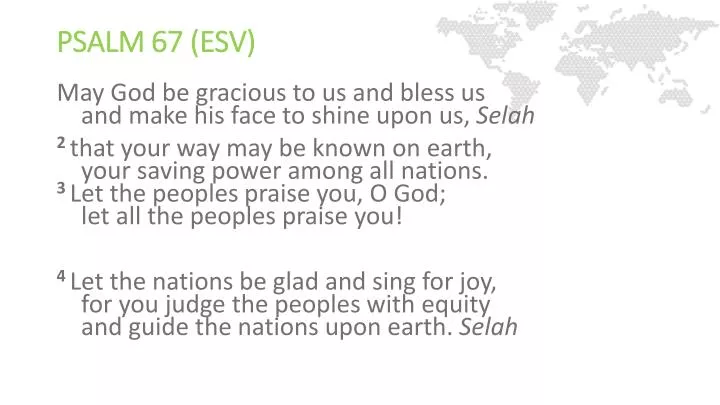
67 May God (B)be gracious to us and bless us
and make his face to (C)shine upon us, Selah
2 that (D)your way may be known on earth,
your (E)saving power among all nations.
3 (F)Let the peoples praise you, O God;
let all the peoples praise you!
4 Let the nations be glad and sing for joy,
for you (G)judge the peoples with equity
and guide the nations upon earth. Selah
5 (H)Let the peoples praise you, O God;
let all the peoples praise you!
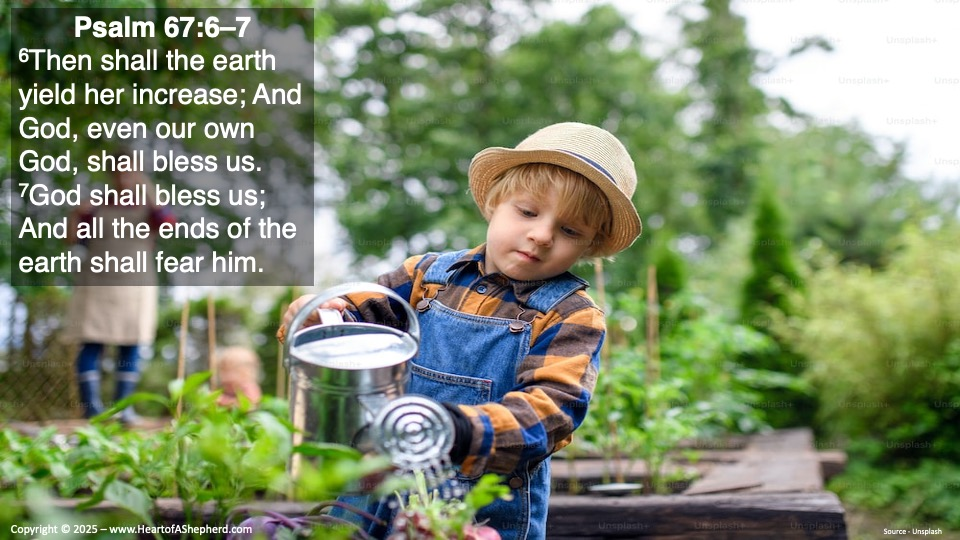
6 The earth has (I)yielded its increase;
God, our God, shall bless us.
7 God shall bless us;
let (J)all the ends of the earth fear him!
Word of God for the Children of God
Glory be to the Father,
and to the Son, and to the Holy Ghost;
as it was in the beginning,
is now, and ever shall be,
world without end. Amen, amen.
In the words of the esteemed Charles Spurgeon,
“The sovereignty of God is the pillow upon which the child of God rests his head at night, giving perfect peace.”
Ah, the sovereignty of God!
It’s an amazing, comforting, and humbling truth that weaves itself through every verse of Psalms 67.
Close your eyes, take a deep breath and let’s read this psalm together again:
“May God be gracious to us and bless us
and make his face shine on us—
so that your ways may be known on earth,
your salvation among all nations.
May the peoples praise you, God;
may all the peoples praise you.
May the nations be glad and sing for joy,
for you rule the peoples with equity
and guide the nations of the earth.
May the peoples praise you, God;
may all the peoples praise you.
The land yields its harvest;
God, our God, blesses us.
God blesses us,
so that all the ends of the earth will fear him.”
Isn’t this Psalm a stirring call to praise?
A reminder of His blessings?
A testament to His grace?
As we stand on the precipice of one more much needed revelation of God?
Now comes the moment to open wide our hearts to God’s truth, deepen our understanding, and strengthen our commitment, our devotion, to Savior God.
With our fullest attention on our sovereign God, to help us to see the beauty of His covenant, the power of His salvation, and the full impact of God’s blessings.
With open hearts, may we praise God, not just with our lips, but with our lives.
Covenantal Commitment
In the heart of Psalms 67, we find a profound truth.
A truth that speaks of a relationship, a bond, a promise.
It’s a promise that God has made with us, His children.
It’s a promise that is not fleeting or temporary, but enduring and eternal. This promise, this bond, this relationship is what we can understand as a covenant.
A commitment: God’s covenant with us is not like any earthly contract or agreement. It’s not a negotiation nor any transaction. It’s a commitment.
A commitment that God makes with us, and a commitment that we are invited to make with Him.
This commitment is not based on our worthiness or our ability to uphold our end of the bargain. It’s based on God’s grace, His love, and His faithfulness.
Verse 1: When we read, “May God be gracious to us and bless us and make his face shine on us,” we see a picture of God’s covenantal commitment.
God’s grace, His blessings, His favor, are not rewards for our good behavior or our religious rituals. They are expressions of His covenantal commitment to us.
Our response to God’s covenantal commitment: It is not about earning favor from humanity. It’s neither about earning His favor nor avoiding His wrath.
It’s about acknowledging, recognizing His grace, receiving His blessings, and reflecting upon His love. It’s about living in a way that makes His ways known on earth and His free offer of eternal salvation known among all the nations.
God’s grace: Grace is a word that we often hear in church, but do we truly understand what it means?
Grace is not just about forgiveness or mercy.
It’s about God’s unmerited favor.
It’s about God choosing to bless us, not because we deserve it, but because He loves us.
In Psalms 67, we witness God’s grace in His desire to bless us and make His face shine on us.
This is not a blessing that we have earned or a favor that we have merited. It’s a blessing that comes from God’s grace, from His covenantal commitment to us.
God’s blessings: Thinking of blessings, we often think of material prosperity or physical health.
But in the context of God’s covenant, blessings have a deeper meaning.
Blessings are not just about what we receive from God.
They are also about what we reflect of God.
When God blesses us, He is not just giving us something.
He is also making us something.
He is making us a reflection of His grace, a testament to His love, and a beacon of His light.
God’s guidance: In the psalm, we read, “for you rule the peoples with equity and guide the nations of the earth.”
This is not just about God’s sovereignty or His control.
It’s about His guidance, His wisdom, and His direction.
God’s guidance is not about dictating our every move or controlling our every decision.
It’s about leading us in His ways, teaching us His truths, and shaping us in His image.
It’s about helping us to navigate the complexities of life, the challenges of faith, and the mysteries of His will.
God’s salvation: In the psalm, we read, “so that your ways may be known on earth, your salvation among all nations.”
This is not just about our personal salvation or individual relationship with God.
It’s about God’s plan for the whole world, His desire for all nations, and His heart, without exception, for every people.
God’s salvation is not just about saving us from sin or delivering us from death.
It’s about bringing us into His kingdom, making us part of His family, freely involving us in His mission.
About His transforming us from mere recipients of His grace into full active participants in His plan.
Calling for Salvation
As we continue to immerse ourselves in the richness of Psalms 67, we find ourselves drawn to the theme of salvation.
The psalmist’s plea for God’s grace and blessings is not just a personal request, but a global one.
The psalmist desires God’s ways be known on earth, His salvation among all nations.
The universal nature of God’s love: The psalmist’s plea for God’s salvation be known among all the nations is a powerful testament, witness to, the universal nature of God’s love.
It’s not confined to a particular group of people, but extends to all nations.
This is a recurring theme in the Bible, a theme underscoring the inclusiveness of God’s love and the expansiveness of His salvation.
Isaiah 45:22: In the book of Isaiah, for instance, we read, “Turn to me and be saved, all you ends of the earth; for I am God, and there is no other.”
Here, God is calling all nations to turn to Him for salvation. It’s a call which transcends all geographical boundaries, cultural differences, and linguistic barriers. It’s a call that resonates with the plea of the psalmist in Psalms 67.
The transformative power of God’s salvation: When God’s salvation is known among all nations, peoples praise Him, nations are glad, and they sing for joy.
This is a vivid picture of the joy and gladness that comes from knowing God’s salvation. It’s a joy that is not fleeting or superficial, but deep and enduring.
Nehemiah 8:10: In the book of Nehemiah, we read, “The joy of the LORD is your strength.”
This joy is not dependent on external circumstances, but it is rooted in the knowledge of God’s salvation. It’s a joy which gives strength, that empowers, a joy that sustains.
It’s the same joy the psalmist envisions when God’s salvation is known among all nations.
The role of God’s people in making His salvation known: The psalmist prays that God’s ways will be made known on earth, His salvation among all nations.
This is not just a prayer, but a mission.
It’s a mission field which requires action, commitment, and perseverance.
Matthew 28:19: In Matthew, Jesus commissions His disciples, saying, “Go and make disciples of all nations.”
This commission is not just for the disciples, but for all followers of Jesus.
It’s a commission aligning with the plea of the psalmist in Psalms 67.
It’s a commission which calls for action, that calls for commitment, that calls for perseverance.
Word study: The Hebrew word for salvation used in Psalms 67 is “Yeshua”.
This word carries the connotation of deliverance, victory, and welfare.
It’s a name that encapsulates the fullness of God’s salvation, a salvation that delivers, a salvation that gives final victory, a salvation that ensures welfare.
Other examples: In the book of Jonah, we read, “Salvation comes from the LORD” (Jonah 2:9).
Here, the same Hebrew word “Yeshua” is used.
This verse underscores the source of salvation, the LORD.
It’s a reminder that salvation is not something we can achieve on our own, but something that comes only from the LORD.
In the book of Psalms, we read, “The LORD is my light and my salvation” (Psalms 27:1). Here, the same Hebrew word “yeshua” is used.
This verse underscores the role of the LORD in our salvation.
He is not just the source of our salvation, but our light and our salvation.
Not just a plea, but a prophecy: It’s a prophecy which looks forward to the day when every knee will bow and every tongue will confess that Jesus Christ is Lord (Philippians 2:10-11).
It’s a prophecy that aligns with the vision of the Apostle John in the book of Revelation, where he sees a great multitude from every nation, tribe, people, and language standing before the throne and before the Lamb (Revelation 7:9).
The urgency of making God’s salvation known among all nations: The psalmist prays God’s ways may be known on earth, His salvation among all nations.
This is not just a prayer, but an urgent divine imperative.
It’s an imperative that requires urgency, a call that cannot be postponed, a call that cannot be ignored.
Romans 1:16: In the book of Romans, the Apostle Paul writes, “I am not ashamed of the gospel, because it is the power of God that brings salvation to everyone who believes.”
This verse underscores the power of the gospel, the power to bring salvation to everyone who believes. It’s a power that requires urgency, a power that cannot be postponed, a power that cannot be ignored.
It’s the same divine imparitive that the psalmist emphasises in Psalms 67.
Consequences of Blessings
Immersing ourselves in the final point of our devotion today, we find ourselves standing at the very threshold of understanding the Consequences of Blessings.
It’s a point woven with the golden threads of God’s love, mercy, and His grace.
It’s a point which echoes with the resounding truth of the Need for Salvation for All.
God’s blessings: They’re not mere tokens of His favor.
They are not just divine gifts that add joy, peace, and abundance to our lives.
They are, in fact, the tangible expressions of His salvation, the visible signs of His redeeming work in our lives, the divine consequences of His salvation, the holy outcomes of His saving grace.
God’s blessings are a testament to His salvation: When God blesses us, He’s not just bestowing good things upon us. He’s affirming His saving work in our lives.
He’s confirming we are His, we’ve been redeemed by His grace, and that we are partakers of His salvation.
God’s blessings are a call to witness: When God blesses us, Its not just enriching our lives.
He’s equipping us to be His witnesses.
He’s empowering us to testify to His goodness.
He is empowering us to proclaim His salvation, and to make His love known.
Twice, we read, “And God, even our own God, shall bless us. 7God shall bless us” (Psalm 67:6b-7a).
When our hearts and thoughts are focused on the LORD, and we offer Him our whole praises and prayers of thanksgiving, He blesses us all two times over!
What an inspiring thought!
In the name of God, the Father and God the Son and God the Holy Spirit ….
Praying ….
84 (0) For the leader. On the gittit. A psalm of the sons of Korach:
2 (1) How deeply loved are your dwelling-places,
Adonai-Tzva’ot!
3 (2) My soul yearns, yes, faints with longing
for the courtyards of Adonai;
my heart and body cry for joy
to the living God.
4 (3) As the sparrow finds herself a home
and the swallow her nest, where she lays her young,
[so my resting-place is] by your altars,
Adonai-Tzva’ot, my king and my God.
5 (4) How happy are those who live in your house;
they never cease to praise you! (Selah)
6 (5) How happy the man whose strength is in you,
in whose heart are [pilgrim] highways.
7 (6) Passing through the [dry] Baka Valley,
they make it a place of springs,
and the early rain clothes it with blessings.
8 (7) They go from strength to strength
and appear before God in Tziyon.
9 (8) Adonai, God of armies, hear my prayer;
listen, God of Ya‘akov. (Selah)
10 (9) God, see our shield [the king];
look at the face of your anointed.
11 (10) Better a day in your courtyards
than a thousand [days elsewhere].
Better just standing at the door of my God’s house
than living in the tents of the wicked.
12 (11) For Adonai, God, is a sun and a shield;
Adonai bestows favor and honor;
he will not withhold anything good
from those whose lives are pure.
13 (12) Adonai-Tzva’ot,
how happy is anyone who trusts in you!
Glory be to the Father,
and to the Son, and to the Holy Ghost;
as it was in the beginning,
is now, and ever shall be,
world without end. Amen, amen.


