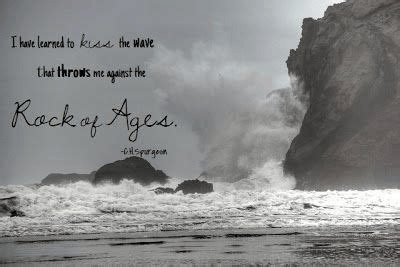
Have I learned to kiss the wave that throws me against the Rock of Ages? Embrace the full depth of God’s love, protection, and provision, even in the midst of all of my not so good times? Psalm 57

Tehillim 57 Orthodox Jewish Bible

57 (For the one directing. Set to Do Not Destroy. Mikhtam of Dovid, when he had fled from Sha’ul into the me’arah [cave]). Channeni, O Elohim, channeni; for my nefesh taketh refuge in Thee; yes, in the tzel (shadow) of Thy wings will I make my refuge, until these devastations pass by.

2 (3) I will cry out unto Elohim Elyon; unto El that fulfilleth all things for me.

3 (4) He shall send from Shomayim, and save me from the disgrace of him that would swallow me up. Selah. Elohim shall send forth His chesed (lovingkindness) and His emes (truth).

4 (5) My nefesh is among lions, and I lie even among them that devour Bnei Adam, whose shinayim (teeth) are spears and khitzim (arrows), and their leshon a sharp cherev.

5 (6) Be Thou exalted, O Elohim, above Shomayim; let Thy kavod be above kol ha’aretz.

6 (7) They have prepared a reshet (net) for my steps; my nefesh is bowed down; they have dug a pit before me, into the midst whereof they are fallen themselves. Selah.

7 (8) My lev is nachon (steadfast), O Elohim, my lev is nachon; I will sing and make music.

8 (9) Awake, my kavod (glory, soul, life); awake, nevel and kinnor; I myself will awake the shachar (dawn).

9 (10) I will give thanks unto Thee, Adonoi, among the peoples; I will sing of Thee among the peoples.

10 (11) For Thy chesed is gadol unto Shomayim, and Thy emes unto the heights.

11 (12) Be Thou exalted, O Elohim, above Shomayim; let Thy kavod be above kol ha’aretz (all the earth).

The Word of God for the Children of God

Glory be to the Father,
and to the Son, and to the Holy Ghost;
as it was in the beginning,
is now, and ever shall be,
world without end. Amen, amen.

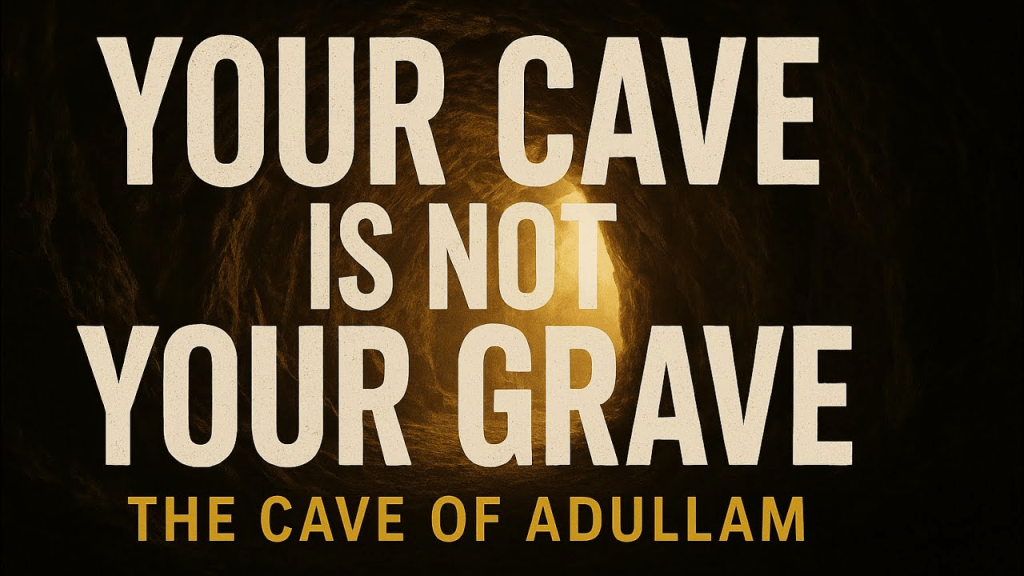
We are diving deeper into the Word of God today, taking a journey back in time to a cave (fortress) in Adullam, where a young David was hiding from King Saul.

Cave of Adullam was originally a stronghold referred to in the Old Testament, near the town of Adullam, where future King David sought refuge from King Saul. The word “cave” is usually used but “fortress”, which also has a similar appearance in writing, is used as well. 

During this period, David passed up several opportunities to kill Saul, who in turn was attempting to kill his young rival, whose followers believed had been chosen by God to succeed King Saul. 

It was in this cave David penned these profound words of Psalm 57, a psalm ringing with faith, hope, and unshakeable trust in God’s protection, provision, and presence.

Charles Spurgeon once said, “I have learned to kiss the wave that throws me against the Rock of Ages.”

Isn’t that so true, church?

Even in our darkest times, God is there.

He’s our rock and our refuge.

He’s the One we can embrace when the waves of life threaten to knock us down.

David, even in this seemingly hopeless situation, found solace and protection in God.

This is a powerful testament to God’s unwavering protection, a theme that resonates throughout the Bible and even in our lives today.

The cave’s symbolism: The cave, in many ways, symbolizes the trials and tribulations we all face.

It’s dark, it’s cold, and it’s isolating.

It’s a place where fear and uncertainty can easily take hold in that darkness.

Yet, it’s in this very place which David found God’s protection.

He was not alone in the cave or fortress; God was with him.

This is a profound reminder for us no matter how dark our circumstances may seem, God is there.

He’s our protector,

He’s our shield,

He’s our fortress.

His presence is a refuge of strength where we can find safety and security.

His protection:

Verse 1 says, “I look to you for protection. I will hide beneath the shadow of your wings until the danger passes by.”

The imagery of hiding beneath God’s wings brings to mind a mother bird shielding her young from predators.

This is the kind of protection God offers us – a protection that is nurturing, comforting, encompassing and secure.

It’s a protection that doesn’t merely shield us from predators, but also provides us with the unshakeable assurance that we are also cared for and utterly loved.

His deliverance:

David was confident that God would not only protect him but also deliver him from his enemies.

This is echoed in verse 3, “He will send help from heaven to rescue me, disgracing those who hound me.”

God’s protection is not passive; it’s active.

He doesn’t just shield us from harm; He fights for us.

He steps into our battles and brings about victory.

Extends to our emotional and spiritual well-being:

In the cave, David was not just hiding from Saul’s physical threats, but he was also wrestling with feelings of fear, anxiety, and despair.

Yet, in the midst of this emotional turmoil, David found peace and comfort in God’s presence.

This reminds us that God’s protection encompasses our whole being. He guards our hearts and minds, providing us with peace that surpasses all understanding.

Our own ‘cave experiences’: We can draw strength from David’s example.

We can look to God for protection, knowing that He is our refuge and strength, an ever-present help in trouble.

We can rest in His promises, confident that He will deliver us from our enemies and provide us with peace in the midst of our storms.

God’s Provision

In the midst of David’s distress, he found solace in the provision of God.

This is a profound truth that we must grasp – God’s provision is not limited to our times of peace and prosperity.

In fact, it is often in the cave, in the midst of our trials and tribulations, that God’s provision becomes most evident.

His purpose:

David cries out to God Most High, “to God who will fulfill his purpose for me.”

Even in the cave, David understood that God had a purpose for his life.

He knew that his current circumstances were not just an accident, but a part of God’s divine plan.

This is a comforting thought for us today.

No matter what we are going through, we can trust that God has a purpose for our lives and He will fulfill it.

His promise:

David declares, “He will send help from heaven to rescue me, disgracing those who hound me. My God will send forth his unfailing love and faithfulness.”

Even in the darkness and hidden depths of the cave, David was confident in God’s promises.

He knew that God would send help from heaven, that He would find him, that He would rescue him, and that His love and faithfulness would never fail.

Watchman Nee once said:

“Outside of Christ, I am weak; in Christ, I am strong. Outside of Christ, I cannot; in Christ, I am more than able.” His strength becomes our strength. His provision becomes our provision. His victory becomes our victory.

He is our God, and He will provide.

God’s Presence

David, in the midst of his fear and uncertainty, was acutely aware of God’s presence with him in the cave.

David’s words reveal a deep sense of God’s nearness, even in the midst of his having to elude Saul’s forces.

David’s confidence in God’s presence:

“I will cry out to God Most High, to God who will fulfill his purpose for me.”

This is a powerful declaration of faith, asserting that God is not only present, but continually active working in David’s life to fulfill His divine purpose.

Even in the deepest recesses of that cave, David understood that God was with him, guiding his steps and working out His plan.

David’s plea for mercy:

This is in the opening verse of the psalm and is a testament to his belief in God’s presence and his reliance on God’s compassion and grace.

He knew that he could always call out to God in his distress and that God would hear him. No matter how dire our circumstances may seem, we can always call out to God, confident in His presence and His willingness to show us all mercy.

His presence is our refuge, our comfort, and our hope.

Conclusion

What a journey David had then, and what a journey our Church has today!

We have walked into David’s cave, touched his cold fear, shared in his faith.

There is a multitude of caves from which we can seek refuge from our enemy.

Prayerfully, we’ve learned that even in the darkest of caves, God’s mercy and God’s protection are unwavering. He is our rock, our refuge, and our rescuer.

So, as we have now received His wisdom, look at what is going on when we go out into the world this week, let’s remember to cling to our Rock of Ages, no matter what fears today’s pursuing armies of Saul may threaten us all with.

Let’s embrace trust in His unfailing mercy and faithfulness, just like David did.

Remember, Saul’s envy, his jealousy, his anger, blood lust can have no effect. God’s true purpose for us will always be fulfilled, even in the midst of our trials.

The God of hope is already inside your cave, filling you with His Presence as you come to renewed faith in Him, warm your heart by the power of the Holy Spirit.
In the name of God, the Father and God the Son and God the Holy Spirit

Tehillim 121 Orthodox Jewish Bible

121 (Shir HaMa’alot) I will lift up mine eyes unto the harim (hills), from whence cometh ezri (my help).

Ezri (my help) cometh from Hashem, Oseh Shomayim v’Aretz.

He will not allow thy regel to slip; He that is shomer over thee will not slumber.

Hinei, He that is shomer over Yisroel shall neither slumber nor sleep.

Hashem is the One shomer over thee; Hashem is thy shade upon thy right hand.

The shemesh shall not strike thee by day, nor the yarei’ach by night.

Hashem shall preserve thee from kol rah; He shall preserve thy nefesh.

Hashem shall be shomer over thy going out and thy coming in from this time forth, and even v’ad olam.

Glory be to the Father,
and to the Son, and to the Holy Ghost;
as it was in the beginning,
is now, and ever shall be,
world without end. Amen, amen.
https://translate.google.com

How Well do we grasp Struggling and Surrendering unto God is the hardest part of the Christian faith? Psalm 57

Psalm 57 Complete Jewish Bible

57 (0) For the leader. Set to “Do Not Destroy.” By David, a mikhtam, when he fled from Sha’ul into the cave:

2 (1) Show me favor, God, show me favor;
for in you I have taken refuge.
Yes, I will find refuge in the shadow of your wings
until the storms have passed.
3 (2) I call to God, the Most High,
to God, who is accomplishing his purpose for me.

4 (3) He will send from heaven and save me
when those who would trample me down mock me. (Selah)
God will send his grace and his truth.

5 (4) I am surrounded by lions,
I am lying down among people breathing fire,
men whose teeth are spears and arrows
and their tongues sharp-edged swords.

6 (5) Be exalted, God, above heaven!
May your glory be over all the earth!
7 (6) They prepared a snare for my feet,
but I am bending over [to avoid it].
They dug a pit ahead of me,
but they fell into it themselves. (Selah)

8 (7) My heart is steadfast, God, steadfast.
I will sing and make music.
9 (8) Awake, my glory! Awake, lyre and lute!
I will awaken the dawn.

10 (9) I will thank you, Adonai, among the peoples;
I will make music to you among the nations.
11 (10) For your grace is great, all the way to heaven,
and your truth, all the way to the skies.

12 (11) Be exalted, God, above heaven!
May your glory be over all the earth!

The Word of God for the Children of God.

Glory be to the Father,
and to the Son, and to the Holy Ghost;
as it was in the beginning,
is now, and ever shall be,
world without end. Amen, amen.

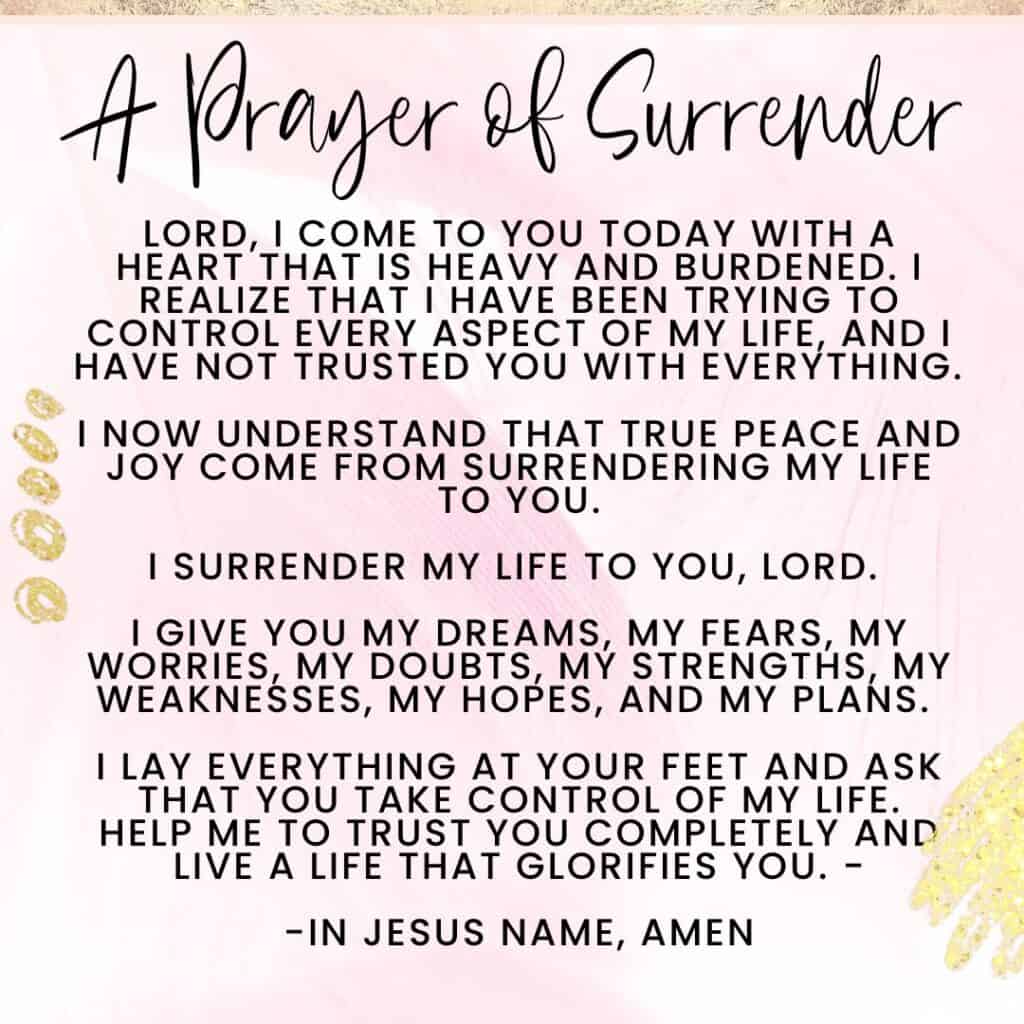
continually surrender to God when a blank canvas is before you. 

2 (1) Show me favor, God, show me favor;
for in you I have taken refuge.
Yes, I will find refuge in the shadow of your wings
until the storms have passed.
3 (2) I call to God, the Most High,
to God, who is accomplishing his purpose for me.

Surrendering to God is an indelible, unavoidable part of the Christian faith.

We know because countless times Scripture reminds us of our need to repent, turn from sin, crucify selfish desires, so we may be attuned to the will of God.

Surrender isn’t just a “one and done” common struggle people face when fully engaged in their trusting of God in the beginning of their faith, but as they grow and experience the most diverse trials, and develop in their walk with Him too. 

While many of us would like the apparent ease of “raising their arms or falling to their knees” surrendering to be a one-and-done phenomenon, it just isn’t.

Surrender is something required day after day.

It’s a continual, progressive, and life-long sacrificial pursuit of chipping away at our hyper graffitied self until all that’s left is Christ and His desires for us. 

To understand surrender, we have to biblically define the task itself: Letting go of our over active self control, yielding to God’s purposes—no matter the cost.

Understanding Surrender to God 

In Mere Christianity, writer, scholar, and theologian C.S. Lewis pens these words:

“Christ says ‘Give me All. I don’t want so much of your time, and so much of your money and so much of your work: I want You. I have not come to torment your natural self, but to kill it. No half-measures are any good. . . Hand over the whole natural self, all the desires which you think innocent as well as the ones you think wicked–the whole outfit. I will give you a new self instead. In fact, I will give you Myself: my own will shall become yours.’”

In Psalms 57:2, the King James Version reads:

“I will cry unto God most high; unto God that performeth all things for me.”

This verse, attributed to David as the author, is a heartfelt plea to God for help and protection. In this verse, David acknowledges the sovereignty and power of God, expresses his ‘white flag’ trust and dependence on Him in times of trouble.

The theme of trust and reliance on God is central to this verse.

David, who often found himself in perilous situations throughout his life, regularly turned to God for guidance and protection.

In this verse, he affirms his faith in God as the “most high” and the one who “performeth all things” for him.

This demonstrates David’s unwavering confidence in God’s ability to intervene, work His healing on his behalf, no matter what circumstances he may be facing.

The context of this verse is crucial to understanding its significance. David composed this psalm while fleeing from King Saul, who was seeking to kill him.

Despite being in a perilous situation, David’s focus remains on God and his unwavering faith in His ability to save and deliver him.

This psalm serves as a reminder that even in the midst of adversity, we can find comfort, strength, in turning to God’s wisdom versus our own, asking for help.

The symbolism of God as the “most high” conveys his supreme authority and power. This title highlights the transcendence of God and serves as a reminder of His ability to rule over all things.

By addressing God as the “most high,” David acknowledges his subordination to Him and affirms his abiding belief in God’s capacity to intervene in his life.

Additionally, the phrase “God that performeth all things for me” emphasizes God’s role as the ultimate provider and sustainer.

This recognition of God’s sovereignty and control over all things reflects David’s unwavering trust in God’s ability to orchestrate events in his favor.

David’s acknowledgment of God’s sovereignty serves as an inspiration for today’s generation of believers, all generations yet to be, to wave their ‘white flag’ trust in God’s providence and faithfulness, even in the face of adversity.

This verse also carries a universal message about the nature of God and His willingness to respond to the prayers of those who seek Him. It serves as a comfort to believers, reminding them they can confidently bring their concerns and needs before God, knowing that He is able and willing to act on their behalf.

Psalms 57:2 is the Psalmist’s powerful declaration of ‘waving his white flag’ trust and reliance on God, even in the midst of challenging circumstances.

David’s unwavering faith and trust in God’s ability to intervene and provide for him serves as a model for believers of all generations to struggle to emulate.

This verse serves as a reminder of the sovereignty and faithfulness of God and encourages believers to turn to Him in times of trouble. Through its themes of struggle, surrender, faith, trust, dependence, and the sovereignty of God, this verse offers that fortress of comfort, strength to those who seek refuge in Him.

While there are numerous examples of surrender in the Scriptures, Jesus in the Garden of Gethsemane and Abraham’s willingness to leave his homeland for a promised land of “milk and honey” sacrifice Isaac are 2 of the most profound.

In Matthew 26:36-46, Jesus’ desires matched God’s.

We often have a misconception that surrender means God will make you do things you hate. I spent years wrestling with the idea of getting out of nursing because I was fearful it was my life’s purpose, God’s will, and I am being selfish.

But friends, the wholehearted desires God’s given us should, can, bring us joy.

If we believe in Jesus and fully trust Him with our lives, our hearts and desires should align with His. Yes, He may ask us to do impossible, scary and confusing things, but never without true reason or cause. Just look at Jesus and Abraham.

Jesus died on the cross for our sins because He loved us and trusted that God must have something better for Him. It wasn’t painless, pretty, enjoyable, or fun for Him to endure. But He surrendered His life to the point of death for us.

Meanwhile, Abraham had been promised a son.

And not just any son, but a son through which his descendants would be named.

When God commanded him to put his promised Isaac on the altar as a sacrifice, he surrendered to God, he didn’t falter. Abraham knew what God had promised but also trusted if this was God’s plan He must have something better in store.

In both of these biblical examples of surrender, we learn that faith plays a role.

Surrender isn’t just about blind obedience but steadfast trust and unwavering respect. It’s our struggle; trusting God’s goodness and sovereignty that as we grow in our relationship with Him, the desires of our hearts will match His.

1. Realize that surrender doesn’t mean throwing your dreams out the window. 

2. Know that God asks us to surrender for our good. 

3. Focus squarely on the Word of God and God’s indelibly faithful promises. 

4. Acknowledge and confess the absolute sovereignty of God in all things.

5. No one is more righteous than God, is smarter or more wiser than God.

6. We can never be perfect, or more perfect or more powerful than God.

7. God’s purpose for us will always be better than any purpose we “design.”

8. God is always going to have His “way” His “truth” and His “life” with us.

9. We can never overpower God nor can we ever outlive him, out create Him.

10. Therefore, cease striving, know that only God is, can be, will be, GOD!

In the name of God, the Father and God the Son and God the Holy Spirit,

Let us Pray,

Psalm 29 Complete Jewish Bible

29 (0) A psalm of David:

(1) Give Adonai his due, you who are godly;
give Adonai his due of glory and strength;
give Adonai the glory due his name;
worship Adonai in holy splendor.

The voice of Adonai is over the waters;
the God of glory thunders,
Adonai over rushing waters,
the voice of Adonai in power,
the voice of Adonai in splendor.

The voice of Adonai cracks the cedars;
Adonai splinters the cedars of the L’vanon
and makes the L’vanon skip like a calf,
Siryon like a young wild ox.

The voice of Adonai flashes fiery flames;
the voice of Adonai rocks the desert,
Adonai convulses the Kadesh Desert.
The voice of Adonai causes deer to give birth
and strips the forests bare —
while in his temple, all cry, “Glory!”
10 Adonai sits enthroned above the flood!
Adonai sits enthroned as king forever!
11 May Adonai give strength to his people!
May Adonai bless his people with shalom!

Glory be to the Father,
and to the Son, and to the Holy Ghost;
as it was in the beginning,
is now, and ever shall be,
world without end. Amen, amen.

https://translate.google.com/