
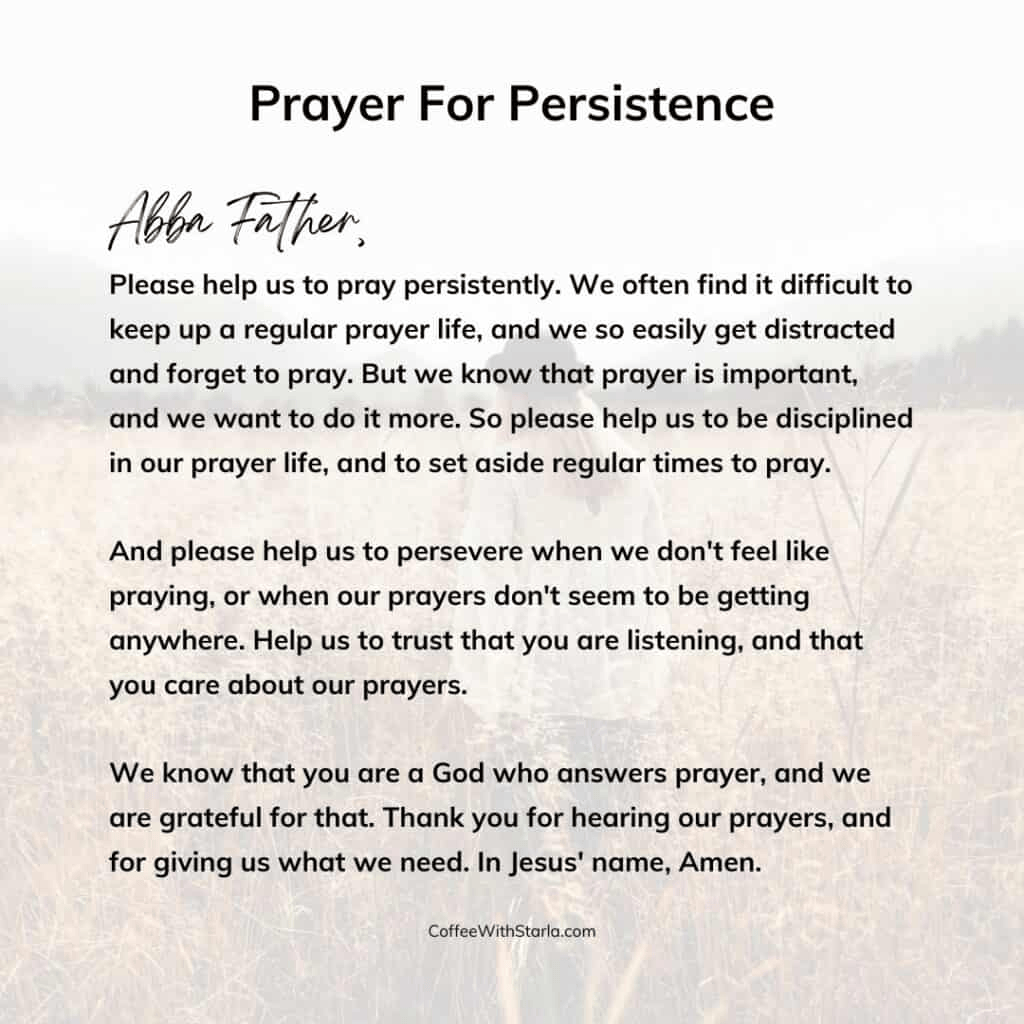
Luke 18:1-8 English Standard Version
The Parable of the Persistent Widow
18 And he told them a parable to the effect that they ought (A)always to pray and not (B)lose heart. 2 He said, “In a certain city there was a judge who (C)neither feared God nor respected man. 3 And there was a widow in that city who kept coming to him and saying, ‘Give me justice against my adversary.’ 4 For a while he refused, afterward he said to himself, (D)‘Though I neither fear God nor respect man, 5 yet because this widow keeps bothering me, I will give her justice, so that she will not beat me down by her continual coming.’” 6 And the Lord said, “Hear what the unrighteous judge says. 7 And (E)will not God give justice to (F)his elect, (G)who cry to him day and night? (H)(I)Will he delay long over them? 8 I tell you, he will give justice to them (J)speedily. Nevertheless, when the Son of Man comes, (K)will he find faith on earth?”
The Word of God for the Children of God
Glory be to the Father,
and to the Son, and to the Holy Ghost;
as it was in the beginning,
is now, and ever shall be,
world without end. Amen, amen.
Today, we will turn our attention to a passage that is both a challenge and a comfort, a call to action and an invitation to rest in the assurance of God’s faithfulness. We find ourselves in the Gospel of Luke, chapter 18, verses 1 to 8.
Have you ever been stuck?
Caught between the proverbial rock and a hard place?
The irresistible force versus the immovable object?
Imagine an adversary is obsessed with making your life extremely difficult.
Certified letters come in the mail, and you are summoned to a court hearing.
You have prayed, and it seems that God is not acting on your behalf.
You ask God, “If you are my Father, why don’t you help me?”
God, “if you are always a righteous judge as scripture proclaims, what gives?”
In the court room, the judge adds insults to injury, claims a procedural error has occurred, the case is thrown out, has zero empathy for you and you leave empty.
And it happens again and again and again and again?
Where do you turn?
Jesus tells a parable about a widow woman in a situation like that, to show his followers that they should “always pray and not give up.”
The woman wanted what she knew was rightfully hers.
And yet she appears to be powerless, without money or connections to bail her out, and she loses case after case.
But she continued to press her case before the judge.
This harsh judge, who didn’t care nor fear what God or people thought, finally relented and acted on her behalf, she finally received what was rightfully hers.
Harnessing Hope through Persistent Prayer
In the heart of the Gospel, we find Rabbi Jesus teaching us about the power of unyielding prayer.
He tells us a parable of a widow, a woman of little means and even less influence in her society, who nonetheless, steadfastly refuses to be silenced.
She is persistent, relentless even, in her pursuit of justice.
Her adversary may be stronger, more wealthy, influential, but she does not let that deter her.
She keeps knocking on the door of the judge, demanding to be heard, refusing to be ignored.
This is the kind of prayer Jesus encourages every single one of us to have.
It’s not a meek whisper, but a bold proclamation.
It’s not a timid request, but a fervent plea.
It’s an active pursuit.
It’s not a fleeting thought, but a constant conversation.
This is the kind of prayer that moves mountains, shakes the heavens, stirs the heart of God.
But what does this kind of prayer look like in our lives?
How do we incorporate, translate, this parable into our daily walk with God?
How do we harness hope through persistent prayer?
In the midst of hopelessness in this world, Jesus promises hope in a far greater heavenly courtroom, where he defends his own.
He says, “Will not God bring about justice for his chosen ones, who cry out to him day and night? Will he keep putting them off? I tell you, no, he will see that they get justice, and quickly.”
Followers of Christ are called to be persistent in their prayer life in the midst of all degrees and measures and magnitudes of adversity, for we all have a mighty, perfectly righteous and always awake Advocate who intercedes to our defense!
In Luke 18:3, we are introduced to a widow who finds herself in a dire situation.
The verse states, “And there was a widow in that city; and she came unto him, saying, Avenge me of mine adversary.”
This passage delves deep into the themes of persistence, persistent faith, the persistent presence of injustice, that malevolence, often pervading our lives.
In biblical times, widows were among the most vulnerable members of society.
Without a husband or male protector, they faced immense struggles, both socially and economically.
The widow of unknown age in this parable represents not just her own plight but also the collective hardships faced by those many who are marginalized.
Her cry, “Avenge me of mine adversary,” is a powerful plea for justice, and it reveals the rawest of emotions, long term desperation which so many people experience when faced with insurmountable oppression or wrongdoing.
As we here reflect on her situation, we can draw a parallel to our own lives.
How many times have we felt utterly powerless against the hardcore adversities or injustices we encounter in our lives?
These adversities may come in various forms—conflicts at our work, broken relationships, financial struggles, or health issues, governmental, political.
Like the widow, we find ourselves constantly seeking justice and relief from those who have wronged us or from circumstances that seem insurmountable.
The widow’s action of constantly, repeatedly coming to the judge is significant.
She does not isolate herself; instead, she seeks help.
This act of reaching out is a powerful reminder for us.
In our struggles, whether cultural, economic, societal, legal, political injustices or close interpersonal battles, we are each called to come forward, to voice our struggles and seek redress, mediation, arbitration, assistance where we can.
The Beatitudes
2 And (C)he opened his mouth and taught them, saying:
3 (D)“Blessed are (E)the poor in spirit, for (F)theirs is the kingdom of heaven.
4 “Blessed are (G)those who mourn, for they shall be comforted.
5 “Blessed are the (H)meek, for they (I)shall inherit the earth.
6 “Blessed are those who hunger and (J)thirst (K)for righteousness, for they shall be satisfied.
7 “Blessed are (L)the merciful, for they shall receive mercy.
8 “Blessed are (M)the pure in heart, for (N)they shall see God.
9 “Blessed are (O)the peacemakers, for (P)they shall be called (Q)sons[a] of God.
10 (R)“Blessed are those who are persecuted for righteousness’ sake, for (S)theirs is the kingdom of heaven.
11 (T)“Blessed are you when others revile you and persecute you and utter all kinds of evil against you falsely (U)on my account. 12 (V)Rejoice and be glad, for your reward is great in heaven, for (W)so they persecuted the prophets who were before you.
It is essential to for us as followers of Christ, to understand vulnerability is not a weakness but a strength.
By acknowledging Jesus’ own admonishments from the Beatitudes, our need for justice or help, we open ourselves to the possibility of divine intervention.
Moreover, the persistence of the widow should not be overlooked.
Throughout the parable, we learn the judge, though initially reluctant to give any measure of help, eventually does respond to her pleas due to her constancy.
In verses that follow, Jesus illustrates the importance of persistent prayer and faith, suggesting that if a persistently unjust judge can be moved by a helpless widows persistence, how much more would a just, a righteous and loving God respond to His children who are persistently crying out, pleading, for His help!
Our Lord is always attentive listens to our cries; attuned to our suffering.
He is a protector of the widows, orphans, and all who are downtrodden.
This gives us immeasurable hope and assurance in the face of adversity.
Explore Faiths
It is also crucial to notice that the widow does not demand vengeance out of anger but seeks justice.
This distinction is vital for us as we navigate our own responses to injustice.
Are we seeking revenge that fuels our bitterness, or are we crying out for justice that can lead to forgiveness, healing and reconciliation, restoration and peace?
In each of our personal journey’s of faith, we are invited to transform our cries for vengeance into prayers for cooperation, friendship, justice, love and mercy.
Finally, the parable challenges us to reflect on our own lives.
James 4:7-10 English Standard Version
7 Submit yourselves therefore to God. (A)Resist the devil, and he will flee from you. 8 (B)Draw near to God, and he will draw near to you. (C)Cleanse your hands, you sinners, and (D)purify your hearts, (E)you double-minded. 9 (F)Be wretched and mourn and weep. Let your laughter be turned to mourning and your joy to gloom. 10 (G)Humble yourselves before the Lord, and he will exalt you.
Are there areas where we are being irrepressible adversaries to others?
Are we listening to those who cry out for help?
Meditating on the persistence of this widow, let us not only seek to be like her in our persistent cries for God’s justice but also be persistently moved to be a persistent voice for the persistently voiceless underdogs in our communities.
Ultimately the widow’s story in Luke 18:3 reminds us that our persistent cries for God’s righteous justice do not go unheard.
Through faith, persistence, seeking God’s perfectly righteous kind of justice, we should 100% persistently hold on to the promises of God who sees our struggles and is always ready to avenge His chosen ones who cry to Him day and night.
With our deeper acknowledgment, recognition, of persistence, go before God, as the widow in the parable in persistently humble prayer, lifting up our needs, pleading the needs of others, allowing our faith to withstand the test of time.

In the name of God, the Father and God the Son and God the Holy Spirit ….
Praying ….
1 Timothy 4:11-16 New American Standard Bible
11 [a](A)Prescribe and teach all of these things. 12 (B)Let no one look down on your youthfulness, but rather in speech, conduct, (C)love, faith, and purity, show yourself (D)an example [b]of those who believe. 13 (E)Until I come, give your attention to the public [c](F)reading, to exhortation, and teaching. 14 Do not neglect the spiritual gift within you, which was granted to you through words of (G)prophecy with (H)the laying on of hands by the [d](I)council of elders. 15 Take pains with these things; be absorbed in them, so that your progress will be evident to all. 16 (J)Pay close attention to yourself and to the teaching; persevere in these things, for as you do this you will (K)save both yourself and those who hear you.
Glory be to the Father,
and to the Son, and to the Holy Ghost;
as it was in the beginning,
is now, and ever shall be,
world without end. Amen, amen.


