Galatians 6:1-3 New Living Translation
We Harvest What We Plant
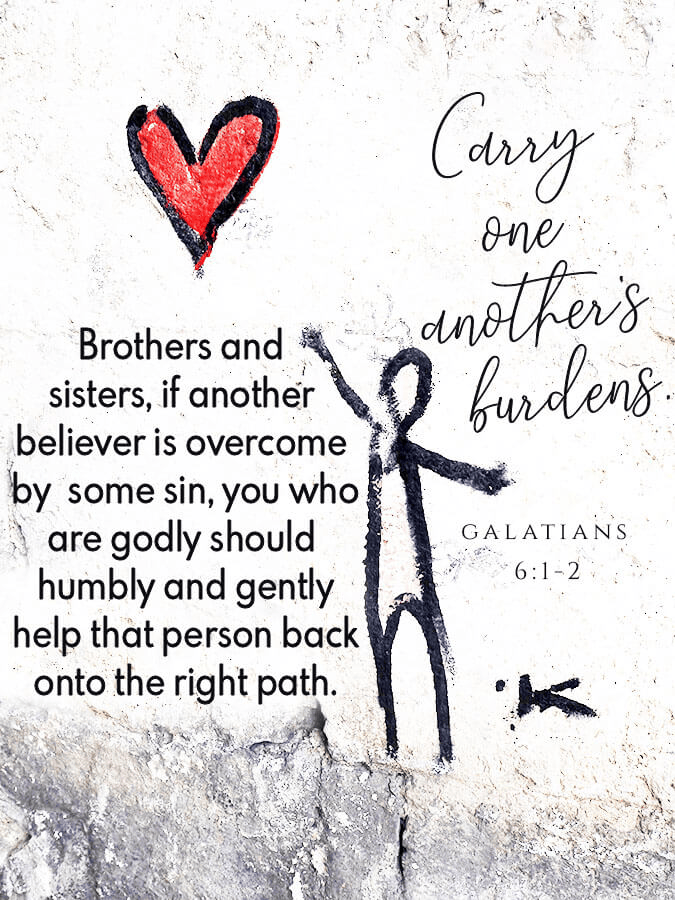
6 Dear brothers and sisters, if another believer[a] is overcome by some sin, you who are godly[b] should gently and humbly help that person back onto the right path. And be careful not to fall into the same temptation yourself. 2 Share each other’s burdens, and in this way obey the law of Christ. 3 If you think you are too important to help someone, you are only fooling yourself. You are not that important.
The Word of God for the Children of God
Glory be to the Father,
and to the Son, and to the Holy Ghost;
as it was in the beginning,
is now, and ever shall be,
world without end. Amen, amen.
In a day and age when intervening in someone’s life is no longer politically or socially correct, these verses ring out like a howitzer barrage on a still night.
Sin is still real and is just as deceptive and deadly as ever.
Yet because we fear being physically beaten, or branded judgmental and self-righteous, we let many being entrapped in sin progress to their spiritual death (Hebrews 2:1-3; 3:12-13; James 1:14-15).
Paul calls us to nonjudgmental, gentle intervention because we recognize the not so subtle gravity of sin, sheer magnitude of that sinner’s need, quickness without procrastination, without feeling arrogant about our righteousness.
We approach the situation humbly because the phrase, “There but for the grace of God go I,” applies to us.
Nevertheless, love doesn’t remain silent when someone’s behavior is self-destructive, evil, taking them to “hell in a handbasket,” as the old saying goes.
Instead, genuine love intervenes humbly, gently, and graciously to redeem.
When a loved one makes a sinful choice, it can be enormously painful to watch.
We are urged by society to tolerate anything that makes a person happy, but that is a cultural expectation, not a Biblical one.
So, we dive head long in with the loving intention of both shedding light on sin and helping and guiding to restore a believer to a right relationship with God.
Galatians 6:1 teaches: “Brothers, if anyone is caught in any transgression, you who are spiritual should restore him in a spirit of gentleness.”
Yet even when our intentions are loving, the response we receive might not be a softened heart.
It might be rejection, anger, or distance.
Sin rarely affects only the person caught in it, and confronting someone we love can be daunting.
We need wisdom to handle those conversations well—and grace to weather the response when it hurts.
We also need other believers.
Scripture reminds us that we were designed to live as the body of Christ:
“Just as a body, though one, has many parts, but all its many parts form one body, so it is with Christ” (1 Corinthians 12:12).
We lift one another up as Paul instructs, both with physical presence, in prayer.
Tempting as it is to keep a loved one’s sin issue private, we cannot help them by ourselves.
That means we do not have to carry every burden alone.
While we should never expose someone’s private struggles carelessly, there are times when seeking other’s prayer and wisdom from a trusted, discreet believer can and will help us carry the burden faithfully.
Not inviting others to pray also robs other believers of a chance to do something wonderful and to be party to the whole drama as it plays out, from the anguish of a person’s sin to (God willing) his or her restoration.
Moreover, when we isolate ourselves, we are more likely to become proud or discouraged, believing that we have some kind of superhuman role to play or forgetting the hope of the gospel.
Other believers remind us Christ is the miracle worker and no one is beyond the reach of His sovereignty.
When we are hurting because a sinner will not turn back to Jesus, we need other Christians to intercede, point us back to the resurrection power of our Savior.
English poet John Donne wrote, “No man is an island unto himself.”
We need to realize we are all members of a larger community of love and faith.
No believer in Christ should think they are totally independent of others.
No Christian should ever think he is on his own.
As in a family, relationships in the body of Christ— the church—function best when there’s a deep-felt awareness and heartfelt concern for others, even while maintaining healthy boundaries.
The common good requires our working to restore relationships that are broken by sin— and doing so with a spirit of gentleness and self-awareness.
Whatever sin a person is guilty of, we must not boast nor judge, “That would never happen to me!”
Such pride is the first step toward a mighty fall.
A humble, gentle inquiry “How may I help?” or “How may I pray for you?” can be the beginning toward gaining someone’s confidence without interfering.
People need to feel safe, privacy, even when being helped in a sinful situation.
Gentle restoration demands respecting the person as one of God’s imagebearers and allowing personal privacy.
Different people have different needs in terms of their personal space.
Healthy relationships allow for various needs.
After all, each one of us is unique.
After all, each one of us has a heartbeat.
Each of our heartbeats do not want, nor need to be, overstressed or burdened.
And we all have burdens to bear.
We can speak the truth assertively and gently.
We can love faithfully.
We can pray continually.
We can seek wise support.
And then we can place the person we love into the hands of the One who loves them even more than we do.

In the name of God, the Gather and God the Son and God the Holy Spirit …
Praying …
Psalm 23
A psalm of David.
1 The Lord is my shepherd;
I have all that I need.
2 He lets me rest in green meadows;
he leads me beside peaceful streams.
3 He renews my strength.
He guides me along right paths,
bringing honor to his name.
4 Even when I walk
through the darkest valley,[a]
I will not be afraid,
for you are close beside me.
Your rod and your staff
protect and comfort me.
5 You prepare a feast for me
in the presence of my enemies.
You honor me by anointing my head with oil.
My cup overflows with blessings.
6 Surely your goodness and unfailing love will pursue me
all the days of my life,
and I will live in the house of the Lord
forever.