Romans 15:4 "For whatever was written in earlier times was written for our instruction, so that through perseverance and the encouragement of the Scriptures we might have hope."
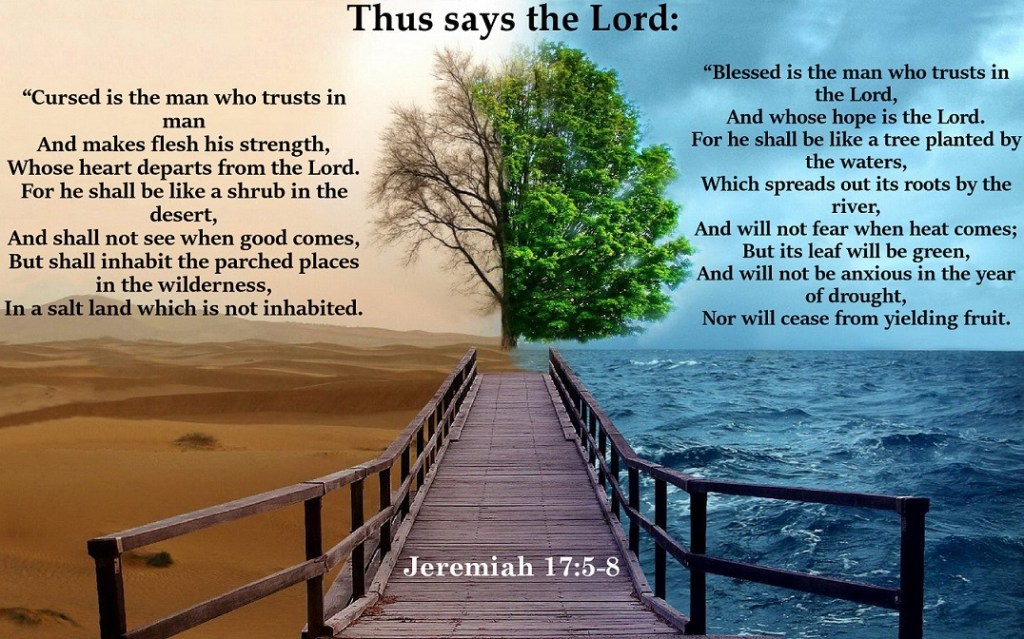
“Cursed is the one who trusts in man,
    who draws strength from mere flesh
    and whose heart turns away from the Lord.
6 That person will be like a bush in the wastelands;
    they will not see prosperity when it comes.
They will dwell in the parched places of the desert,
    in a salt land where no one lives.
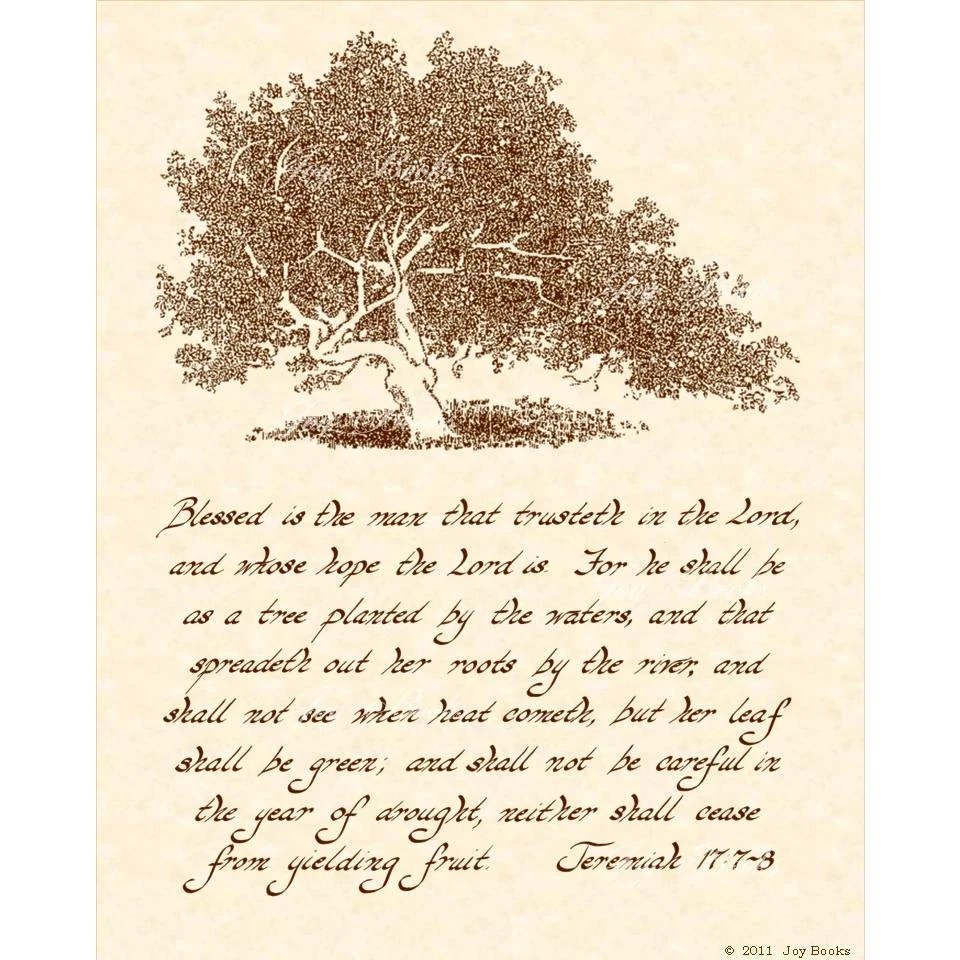
7 “But blessed is the one who trusts in the Lord, whose confidence is in him. 8 They will be like a tree planted by the water that sends out its roots by the stream. It does not fear when heat comes; its leaves are always green. It has no worries in a year of drought and never fails to bear fruit.”
Word of God for the Children of God
Glory be to the Father, and to the Son, and to the Holy Ghost; as it was in the beginning, is now, and ever shall be, world without end. Amen, amen.
5 This is what the Lord says:
This passage of scripture presents two side of a coin.
It shows us what it looks like to place TRUST in God vs. man.
trust – hie for refuge[Strong’s Exhaustive Concordance]
It is not a discouragement from our daily walk alongside God in community because throughout the Word, God calls us to value all of our brethren, live in full accord and bear each other’s burdens.
Rather, this message was intended to teach the people of Israel the danger of trusting, idolizing, worshiping the Asherah poles statues, false temple gods.
Certainly, it can apply to us today, as we can easily make our relationships with worldly sources of our trust our initial hie for refuge in place of God in Christ.
When you encounter trials and troubles, who do you run to first for protection and comfort? Do you first consult God or man? Is your first response, first act of defense, referring to scripture, praying to God or venting to a friend or a crowd?
“Cursed is the one who trusts in man,
who draws strength from mere flesh
and whose heart turns away from the Lord.
6 That person will be like a bush in the wastelands;
they will not see prosperity when it comes.
They will dwell in the parched places of the desert,
in a salt land where no one lives.
cursed – to receive what is harmful[Strong’s Exhaustive Concordance]
Another human cannot sustain you as God can.
We are all just as flawed and weak as each other.
Therefore, placing a relationship above God, the ultimate and eternal source of strength, means forsaking the benefits of a relationship with the Almighty, All-powerful and All-knowing always available heavenly Father.
It also means opening ourselves up to more harm than good.
The one who makes man their primary source:
Will not grow much in their stature (remains as a shrub/bush)
Will not have vision of good and prosperous things (will not see prosperity)
Will not have a source of refreshing (dwell in parched places)
Will curate a life of dryness/barrenness (a salt land)
Your family, friends, business partners, collogues may seriously disappoint you and possibly betray you with their words.
They may not validate or challenge you in the times when you need it most.
They may not always do a great job of reassuring and encouraging you in the face of difficulty.
On the other side, you will develop a life of people pleasing and valuing the word of man more than that of God.
It will not bring you God’s intended growth for your life, simply because no matter how close you are, your fellow men will never know you as well as God.
He knows your innermost thoughts and outermost expressions. He knows your past, present and future self! It is through the intimacy of His knowledge for us that he can provide us with just exactly what we need to flourish and to thrive.
7 “Blessed is the man who trusts in the Lord,
And whose hope is the Lord.
8 For he shall be like a tree planted by the waters,
Which spreads out its roots by the river,
And will not fear when heat comes;
But its leaf will be green,
And will not be anxious in the year of drought,
Nor will cease from yielding fruit."
blessed – to receive what is beneficial[Strong’s Exhaustive Concordance]
When God is the source of our trust and strength, we can be sustained by the One who is stronger than us, greater than us, wiser than us, more reliable than us, kinder than us, more trustworthy, … much better than us, in every sense.
Instead of depending in one who is just as flawed as you are, you depend on the one who is perfect and blameless!
Our shortcomings and weaknesses does not phase Him. He even promises us that His strength is perfected in our weakness. It means that he works best in the areas where we are at our worst.
Psalm 46:1-3 (NLT):
“God is our refuge and strength, always ready to help in times of trouble. So we will not fear when earthquakes come and the mountains crumble into the sea. Let the oceans roar and foam. Let the mountains tremble as the waters surge!”
The one who makes God their source:
Will grow in their stature to great heights (like a tree)
Will dwell where there is a source of refreshing (planted by the waters)
Will grow deeper in their walk with God, be more firm and less shaken (spread its roots)
Will not allow fear to change your character, countenance or appearance in seasons of difficulty (leaves will be green even when the heat comes)
Will not allow anxiety to change your sense of purpose or service in seasons of difficulty (will not cease from yielding fruit)
This is because when God is your source, you always run to him regardless of the circumstance.
You will continue to pray, worship, read his Word and do what you must to remain in His presence.
Psalm 125:1-2 (NLT):
“Those who trust in the Lord are as secure as Mount Zion; they will not be defeated but will endure forever. Just as the mountains surround Jerusalem, so the Lord will surrounds his people, both now and forever.”
It is in his presence, that he challenges us to grow in obedience and surrender, encourages us to refresh our souls and affirms us in our identity in Him that we may stand and know we are safely sheltered, protected and be rooted deeply.
The Lord, the Keeper of Israel.
A Song of Ascents.
121 I will raise my eyes to the mountains; From where will my help come? 2 My help comes from the Lord, Who made heaven and earth. 3 He will not allow your foot to slip; He who watches over you will not slumber. 4 Behold, He who watches over Israel Will neither slumber nor sleep.
5 The Lord is your [a]protector; The Lord is your shade on your right hand. 6 The sun will not [b]beat down on you by day, Nor the moon by night. 7 The Lord will [c]protect you from all evil; He will keep your soul. 8 The Lord will [d]guard your going out and your coming in From this time and forever.
When God is your source, seasons of heat and drought will come, but how you show up in the world, plant your roots in Ministry and what more you choose to contribute to the world to advance, grow, His kingdom will continue to endure.
In essence, when we make God our source, we are sustained regardless of the circumstance and we can yield more success in our spiritual and physical lives!
In the name of the Father and of the Son and of the Holy Spirit. Amen
Praying …
A Psalm of Fearless Trust in God.
A Psalm of David.
27 The Lord is my light and my salvation; Whom should I fear? The Lord is the [a]defense of my life; Whom should I dread? 2 When evildoers came upon me to devour my flesh, My adversaries and my enemies, they stumbled and fell. 3 If an army encamps against me, My heart will not fear; If war arises against me, In spite of this I am confident.
4 One thing I have asked from the Lord, that I shall seek: That I may dwell in the house of the Lord all the days of my life, To behold the [b]beauty of the Lord And to [c]meditate in His temple. 5 For on the day of trouble He will conceal me in His [d]tabernacle; He will hide me in the secret place of His tent; He will lift me up on a rock. 6 And now my head will be lifted up above my enemies around me, And I will offer sacrifices in His tent [e]with shouts of joy; I will sing, yes, I will sing praises to the Lord.
7 Hear, Lord, when I cry with my voice, And be gracious to me and answer me. 8 When You said, “Seek My face,” my heart said to You, “I shall seek Your face, Lord.” 9 Do not hide Your face from me, Do not turn Your servant away in anger; You have been my help; Do not abandon me nor forsake me, God of my salvation! 10 [f]For my father and my mother have forsaken me, But the Lord will take me up.
11 Teach me Your way, Lord, And lead me on a level path Because of my enemies. 12 Do not turn me over to the [g]desire of my enemies, For false witnesses have risen against me, And the violent witness. 13 I certainly believed that I would see the goodness of the Lord In the land of the living. 14 Wait for the Lord; Be strong and let your heart take courage; Yes, wait for the Lord.
Glory be to the Father, and to the Son, and to the Holy Ghost; as it was in the beginning, is now, and ever shall be, world without end. Amen, amen.
5 Thus says the Lord, “Cursed is the man who trusts in and relies on mankind, Making [weak, faulty human] flesh his strength, And whose mind and heart turn away from the Lord. 6 “For he will be like a shrub in the [parched] desert; And shall not see prosperity when it comes, But shall live in the rocky places of the wilderness, In an uninhabited salt land. 7 “Blessed [with spiritual security] is the man who believes and trusts in and relies on the Lord And whose hope and confident expectation is the Lord. 8 “For he will be [nourished] like a tree planted by the waters, That spreads out its roots by the river; And will not fear the heat when it comes; But its leaves will be green and moist. And it will not be anxious and concerned in a year of drought Nor stop bearing fruit.
The Word of God for the Children of God. Gloria! In Excelsis Deo! Alleluia! Amen.
On the surface, spiritual laziness looks like not getting up early enough to pray and read your Bible, but it really goes much, much deeper than that.
When I searched the Internet on this topic, the vast majority of articles and blog posts focused on the necessary disciplines of bible study, Scripture Reading and Prayer time, busy at “work” versus quiet time, going to church, serving others.
And all of those things are critically important in the life in God’s backyard.
However, from personal experience, those disciplines and commitments are almost impossible to stick with unless the root of spiritual laziness is dug up and destroyed.
Not praying regularly, reading the Bible daily, and committing to regular fellowship with other believers are usually symptoms of something buried much deeper in our souls.
It’s kind of like trying to be losing weight. You won’t stick with a diet until your heart, mind, and soul are aligned and motivated to do so. You may persevere for a brief while based on sheer willpower and stubbornness, but it won’t become a lifestyle until the spiritual battle is won within the deepest parts of your being.
So, what is spiritual laziness if it’s not the failure to regularly implementing the classic Christian activities and routines?
To discover this answer, we can turn to the Biblical analogy of trees and fruit, which is used more than a hundred times throughout scripture.
Jeremiah 17:7-8 says, “Blessed is the man who trusts in the Lord, whose trust is the Lord. He is like a tree planted by water, that sends out its roots by the stream, and does not fear when heat comes, for its leaves remain green, and is not anxious in the year of drought, for it does not cease to bear fruit.”
In these verses, we discover that trust in God — a deep, abiding, unwavering, uncompromising trust — is the key to a fruitful life.
That means that not trusting in God for anything and everything — i.e., being worrying, trying to control outcomes, not submitting to God’s sovereignty — is at its core true spiritual laziness.
Therefore, all of those wonderful and incredibly vital habits I mentioned earlier are the fruit of being spiritually active, but they are not the tree itself.
The tree described in Jeremiah is fruitful because it’s rooted in the trust of the Lord, day and night, season after season, storm after storm.
If you and I are feeling mightily slapped in the face right now, please know that I and uncountable numbers of other “Christians” are right there with you.
If I were to reveal my list of weaknesses, laziness has never been in my top 10.
If anything, I am at times too energetic and too driven.
A former supervisor of mine once said to me, “Your level of energy and dedication and devotion to your work makes your co-workers nervous.”
And he did not entirely mean it as any kind of high and glorious complement, and now many years later I have come to understand why – “its unheard of.”
I’ve also realized that what shows up in my work habits is just as spiritually connected as what comes out in my sacred disciplines for the Lord.
Outwardly I appear to have it all together.
My actions indicate a preponderance of fruitful behaviors and activities, but truthfully, they only mask a deep, soul-level weakness — an overwhelming need to outperform, to overdo, to achieve — all because I have unrecognized or unacknowledged or unconfessed, unrepented trust issues with our God.
This is why being busy with the tasks of proper spirituality or duties of religion has in the past left me feeling drained, empty, and disconnected from God. But until recently I never genuinely realized “laziness” had anything to do with it.
If this still doesn’t make sense to you, bear with me for a few moments more.
The connection between laziness and mistrust is simply this: striving to trust God for everything takes great effort, put forth on a continual, consistent basis.
And not just for a few weeks or months.
Trust grows in layers throughout your lifetime.
One decision or trial at a time.
That means trusting Him even when we walk through long seasons of waiting, difficulties, or disappointments.
When we do not trust the Lord, it bubbles out into our lives in the form of busyness, trying to control situations or others, legalism, worrying, anxiety, escapism, the pursuit of accolades, or wealth, grumbling and complaining, and a whole host of other manifestations.
Eugene Peterson, the editor of The Message version of the Bible puts it this way:
“Sloth is most often evidenced in busyness … in frantic running around, trying to be everything to everyone, and then having no time to listen or pray, no time to become the person who is doing these things.”
An August 11, 2012, mental health article in the New York Times titled “The Anxious Idiot” illustrates Peterson’s point beautifully.
“Laziness: it isn’t a characteristic usually associated with the anxious. If anything, people tend to view the anxious as more active and motivated than normal, because they are more haunted by the specter of failure. And yet long experience has taught me that it is laziness … that is the foremost enemy of the anxiety sufferer, for laziness prevents him from countering the very patterns of thought that make him anxious in the first place.”
You may or may not be much of a worrier.
Anxiety may be the last thing you resort to when times get tough.
if we struggle with anger or a need for control, then we also likely struggle with trusting God when difficult people or disturbing situations come into our life.
While the article in the NY Times was written without any spiritual connotations or recommendations, it definitely gets to the heart of the matter: every person has a decisive choice to make when confronted with the daily decisions of life.
We can make the genuine effort to trust in God, genuinely let go of our own desires, and genuinely implement His divine recommendations for a healthy, fruitful life, or we can genuinely slide down the path of least mental resistance into our comfortable, but usually very genuinely detrimental, very bad habits.
This is why Paul says our faith is like running a race.
He doesn’t say it’s like sitting in a meadow on a sunny day having a picnic.
Our participation and consistent effort are required.
Hebrews 12:1-2a says, “Therefore, since we are surrounded by so great a cloud of witnesses, let us also lay aside every weight, and sin which clings so closely, and let us run with endurance the race that is set before us, looking to Jesus, the founder, and perfecter of our faith.”
One of the best parables of the Bible encourages us to risk everything we hold dear in order to walk closely with God.
Matthew 25:14-30 Amplified Bible
Parable of the Talents
14 “For it is just like a man who was about to take a journey, and he called his servants together and entrusted them with his possessions. 15 To one he gave five [a]talents, to another, two, and to another, one, each according to his own ability; and then he went on his journey. 16 The one who had received the five talents went at once and traded with them, and he [made a profit and] gained five more. 17 Likewise the one who had two [made a profit and] gained two more. 18 But the one who had received the one went and dug a hole in the ground and hid his master’s money.
19 “Now after a long time the master of those servants returned and settled accounts with them. 20 And the one who had received the five talents came and brought him five more, saying, ‘Master, you entrusted to me five talents. See, I have [made a profit and] gained five more talents.’ 21 His master said to him, ‘Well done, good and faithful servant. You have been faithful and trustworthy over a little, I will put you in charge of many things; share in the joy of your master.’
22 “Also the one who had the two talents came forward, saying, ‘Master, you entrusted two talents to me. See, I have [made a profit and] gained two more talents.’ 23 His master said to him, ‘Well done, good and faithful servant. You have been faithful and trustworthy over a little, I will put you in charge of many things; share in the joy of your master.’
24 “The one who had received one talent also came forward, saying, ‘Master, I knew you to be a harsh and demanding man, reaping [the harvest] where you did not sow and gathering where you did not scatter seed. 25 So I was afraid [to lose the talent], and I went and hid your talent in the ground. See, you have what is your own.’
26 “But his master answered him, ‘You wicked, lazy servant, you knew that I reap [the harvest] where I did not sow and gather where I did not scatter seed. 27 Then you ought to have put my money with the bankers, and at my return I would have received my money back with interest. 28 So take the talent away from him and give it to the one who has the ten talents.’
29 “For to everyone who has [and values his blessings and gifts from God, and has used them wisely], more will be given, and [he will be richly supplied so that] he will have an abundance; but from the one who does not have [because he has ignored or disregarded his blessings and gifts from God], even what he does have will be taken away. 30 And throw out the worthless servant into the outer darkness; in that place [of grief and torment] there will be weeping [over sorrow and pain] and grinding of teeth [over distress and anger].
We read here about the parable of the talents, which tells the story of a wealthy business owner who gives three employees each a sum of money and asks them to take care of it for him while he is away on a trip.
Two of them immediately invested the money so that it would earn interest.
The third one was fearful of what would happen if he made a mistake, so he simply buried the money for safekeeping.
When the owner returned, this is what happened:
“But his master answered him, ‘You wicked and slothful servant! You knew that I reap where I have not sown and gather where I scattered no seed?” And then the passage closes with this warning: “For to everyone who has will more be given, and he will have an abundance. But from the one who has not, even what he has will be taken away.”
In commenting on this parable, Oswald Chambers said,
“The person who is lazy naturally is always captious (i.e., sully or a whining). ‘I haven’t had a decent chance,’ and the one who is lazy spiritually is captious with God. Lazy people always strike out on an independent line.”
Of course, our definition of independence is different today than it was back then (circa 1900).
Today we typically use the word independence in a much more positive fashion than Chambers intended.
His implication is that lazy believers chart their course separately from God’s recommended path.
Therefore, when it comes to “spiritual matters,” they can all too easily use the excuse of independence — or what they believe to be our unique situation — to justify laziness, rebellion, or fear and so very much more.
Jesus, on the other hand, calls us to be utterly dependent on Him.
As Oswald Chambers further says in his writings, we should never forget that our ability to trust in God and to serve Him with boldness — despite the risks to ourselves — isn’t measured by what we are capable of or what we desire to do.
Instead, our abilities should be grounded in the promises of God never to fail us, leave us, or ask us to do something that He cannot achieve through the power of the Holy Spirit at work in us.
In fact, the greatest miracles of life come when we are at our weakest and trust God to perform His work within us for the benefit of others and His glory.
2 Corinthians 4:7-11 NLT says, “We now have this light shining in our hearts, but we ourselves are like fragile clay jars containing this great treasure. This makes it clear that our great power is from God, not from ourselves.”
So, these verses imply that the weaker or more fearful you and I may be of what God has asked you and I to do, the greater becomes the opportunity for Him to work miracles and display His genuine glory.
Theologically, all of this may sound like solid truth to you, but if you are still wondering what it all means for the day-to-day living and walking with Jesus, perhaps the following words of wisdom from the Book of Proverbs will help you turn these spiritual implications into daily actions.
As with most Biblical truth, there is great irony in God’s command to trust Him in Proverbs 3:5-6, which says simply:
“Trust in the Lord with all your heart and lean not on your own understanding; in all your ways submit to Him, and He will make your paths straight.”
These verses contain two actions for us to follow: trust and submit.
We must genuinely participate in the process.
To bear fruit like the tree, we must remain planted by streams of living water.
Yet to keep ourselves out of spiritual laziness and make the efforts required of this command, we must simultaneously learn to simply rest.
Yes, you and I absolutely read that right.
To overcome laziness, we have to learn to be still.
When we build Sabbath margin into our daily lives — not just on Sunday — we will have the time to breathe, think clearly, and engage our complete being — mind, body, and soul — in genuine pursuit of Rabbi Jesus and Savior Christ.
The tree grows because it is beside the river of life.
We will only grow in Christ when we take the time to drink of His strength and learn of His wisdom.
So, while I said at the beginning of this devotional message that prayer, Bible study, meditation, and worship are the first fruits of trust, they also become the essential building blocks of greater, greatest, trust as we faithfully apply them.
But we will never see them appear, nor be able to taste them as long as we allow busyness to proliferate in our lives, numb us to the real laziness of our hearts.
When we allow laziness to dominate our decisions and motivations, we only end up serving a false god, and not the true King of Glory.
Laziness, or not trusting God, like any other sin feels good for a season.
Other than busyness, it often shows up in forms of escapism, like mindless TV watching, endless smartphone use, endless devotion to video games, endless social media surfing, or a myriad of physical indulgences, coping mechanisms.
But when we look it square in the eye and call it for what it is, we realize it’s all about our trusting or not trusting the unseen God to do what He says He will do.
Today, I would ask you, fellow traveler, where are you and I planted?
Are we putting “a few roots down” near the river of life, while allowing others to seek their comfort in the tainted soils of self-reliance or personal comfort?
If so, ask God to help you find them again, dig them up, and transplant them into His unending goodness and strength.
It won’t happen overnight, but when you wake each morning, His mercies will be new, and God’s miracles will be waiting to sustain us through this “process.”
For Further Reflection and Daily Spiritual Journaling
The questions and readings below can be used for a single-day study or for our re-organization, re-prioritization of our daily quiet time throughout the week.
Day 1 – Describe in your own the words the difference between striving to perform for God (i.e., doing something out of duty or to achieve) and participating in God’s work in your life.
Read Ephesians 2:8-9 and James 2:14-26.
Why do you think you are sometimes motivated toward busyness or performance?
What is God leading us to change? How? Write them out as a prayer to Him.
Day 2 – Read Lamentations 3:22-23. In what ways are you experiencing God’s mercies today or have in the past? How are they new or different to you now than they were yesterday? If you’re in a place of struggle right now, ask God to help you recognize and receive His mercies.
Day 3 – Read, re-read the parable of the talents in Matthew 25:14-30. How are you and I similar to the good servants? In what ways are you and I being like the fearful servant? Journal about why you think that is, and what the Holy Spirit is revealing in your heart.
Day 4 – Take some time to be still before the Lord today.
Begin by reading Proverbs 3:5-6 and then meditating on it.
Ask God to interrupt you and I at any moment with what He wants to whisper to yours and my heart.
For more about “being busy” and practicing stillness and what it means,
Day 5 – Spend some time reflecting on our schedules and our commitments at work, home, church, in your community, and other volunteering roles.
Read Luke 10:38-42.
Luke 10:38-42Amplified Bible
Martha and Mary
38 Now while they were on their way, Jesus entered a village [called Bethany], and a woman named Martha welcomed Him into her home. 39 She had a sister named Mary, who seated herself at the Lord’s feet and was continually listening to His teaching. 40 But Martha was very busy and distracted with all of her serving responsibilities; and she approached Him and said, “Lord, is it of no concern to You that my sister has left me to do the serving alone? Tell her to help me and do her part.” 41 But the Lord replied to her, “Martha, Martha, you are worried and bothered and anxious about so many things; 42 but only one thing is necessary, for Mary has chosen the good part [that which is to her advantage], which will not be taken away from her.”
Go to God in prayer and ask Him to reveal areas where you, I, are too busy like Martha and where you and I need to be more studious and quieter like Mary.
In the name of God, the Father and God the Son and God the Holy Spirit,
Let us Pray,
All-Knowing Father, you authored my life, you know and direct my future. You make all things work together for my good. Pray! Help me to trust you as I think about my future. Give me peace of mind. Whatever happens, I know that you are working for my good and your glory. Help me to live with freedom, knowing that my future is in your mighty hand. I do not know what is around the corner, but nothing can take you by surprise. I face uncertainty but I can be certain that you are in control and that you are good. Through Jesus Christ, our Lord. Amen.