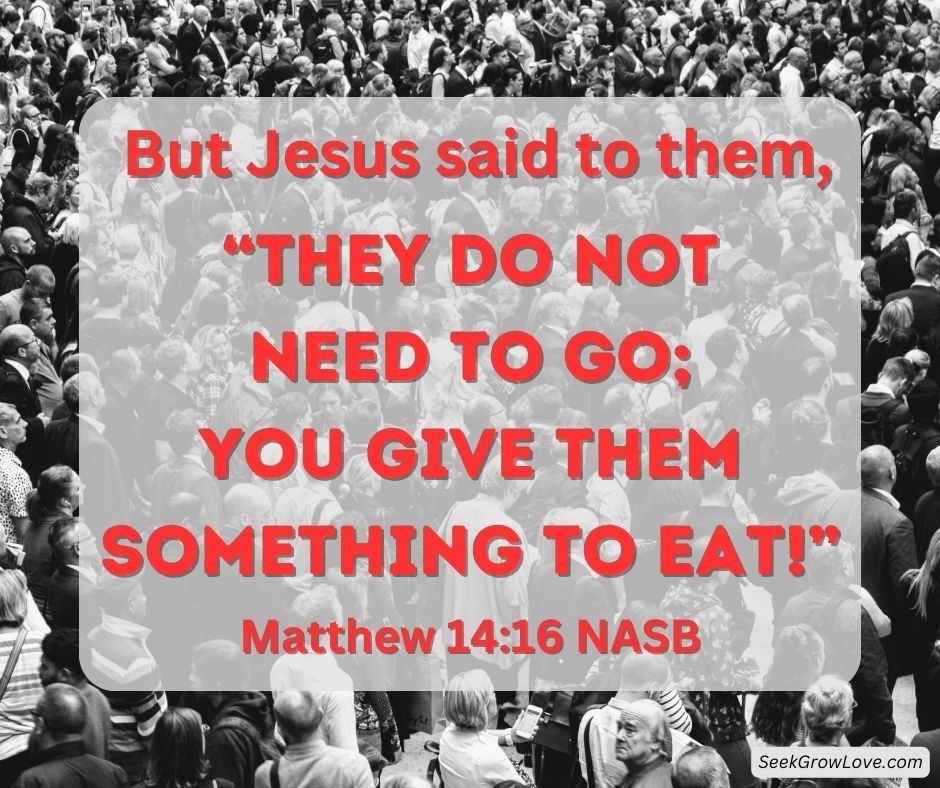
Jesus’ compassion, God’s abundant provision. Public demonstration of grace through action; feeding those 5000 hungry souls. Matthew 14:13-21

Matthew 14:13-21 Revised Standard Version

Feeding the Five Thousand

13 Now when Jesus heard this, he withdrew from there in a boat to a lonely place apart. But when the crowds heard it, they followed him on foot from the towns.  14  As he went ashore he saw a great throng; and he had compassion on them, and healed their sick. 15 When it was evening, the disciples came to him and said, “This is a lonely place, and the day is now over; send the crowds away to go into the villages and buy food for themselves.” 16 Jesus said, “They need not go away; you give them something to eat.” 17 They said to him, “We have only five loaves here and two fish.”  18 And he said, “Bring them here to me.” 19 Then he ordered the crowds to sit down on the grass; and taking the five loaves and the two fish he looked up to heaven, and blessed, and broke and gave the loaves to the disciples, and the disciples gave them to the crowds. 20 And they all ate and were satisfied. And they took up twelve baskets full of the broken pieces left over. 21 And those who ate were about five thousand men, besides women and children.

Word of God for the Children of God

Glory be to the Father,
and to the Son, and to the Holy Ghost;
as it was in the beginning,
is now, and ever shall be,
world without end. Amen, amen.

This story about miraculously feeding more than 5,000 people is usually told from the viewpoint of the disciples.

Except, it is now 2026 and I wonder what it was like to be a person in the crowd.

I try to imagine being surrounded by thousands of people—men and women of all shapes, sizes, and ages.

You would probably also see young children running around as parents tried to corral them along the shoreline.

Teenagers and young adults just hanging out because this is where the crowd is.

And seniors slowly shuffling to find a place close enough to Jesus so they could sit and hear him speak.

It was probably a very similar example of what our contemporary people have called “organized chaos.”

Even Jesus’ disciples didn’t know what to do with the hungry followers (see vv. 15-17).

What was it like to see the calm and measured face of Jesus in the midst of such a hectic scene?

How did Jesus know he could feed all those hungry people with just “five loaves of bread and two fish”?

Jesus knew he could feed the starving crowd because he was and is the Son of God, who not only provided the bread and fish but also created the earth and established everything in it, from the waters where the fish lived to the land that provided miraculous manna from heaven, the grain used to bake bread.

Having faith and trust in His connection to His Father, knowing the power of His Father, would give Jesus the opportunity to invite others to know him too.

Physical hunger is very real in our world today.

Nearly 32% of the world’s population does not have access to a healthy diet. actionagainsthunger.org

Global Food Insecurity Statistics

Current Estimates

  • Total Number of People Facing Hunger: Approximately 673 million people faced hunger in 2024, which represents about 8.3% of the global population.
  • Food Insecurity Levels: Around 2.3 billion people experienced moderate or severe food insecurity in 2024, a significant increase from pre-pandemic levels.

Statistics highlight the ongoing global food insecurity crisis, affecting millions, underscoring the need for urgent action to improve access to nutritious food.

 World Health Organization (WHO) data.unicef.org

However, as tragic, enraging and horrifying as those numbers truly are, an overlooked, undervalued and very different kind of hunger is even far more common: that hunger is identified as spiritual emptiness and insecurity.

It crosses all socio-economic, cultural boundaries, demographics don’t matter.

It encompasses all known social horizons, extends from the poor to the rich, and from the young to the old – no one is immune, everyone is at high risk.

Of course, precise statistics on spiritual hunger are impossible to determine.

But it’s safe to ­assume the number of those who are spiritually hungry in this world is significantly higher than 2.5 billion. Where is the bread and fish now?

In today’s narrative from Matthew, Jesus reaches out to people who are both physically and spiritually hungry.

Taking those five loaves and two fish, he looks to heaven and gives thanks.

After breaking the loaves, he gives them to his disciples to distribute to the large crowd of people.

And the miracle happens!

Everyone eats and is satisfied, and there are baskets of leftovers.

How big were those twelve baskets full of the broken pieces left over?

The exact size of the twelve baskets is not specified, but they were likely small baskets carried by hand, commonly used by travelers to hold their food.

These baskets were known as “cophinus” in the Jewish tradition.

What were the typical dimensions of small hand-carried baskets in ancient times?

Small hand-carried baskets in ancient times varied in size, but they were often designed to be easily manageable, usually around 12 to 18 inches in diameter.

These dimensions allowed for eminently practical use in gathering and carrying and distributing the remaining leftover items more efficiently.

After they ate and were satisfied, what was left over was picked up.

Twelve baskets of broken pieces, one basket for each apostle, now filled with the faith that Jesus will provide.

Not only provision for the apostles but for each and every person they seek to serve and save in the name of Jesus Christ.

For each fish or half loaf distributed, a full basket was returned.

In the Bible, twelve is a perfect number, a symbol of God’s ultimate power and authority or a number of completion.

Having 12 baskets left over tells us this was no error; this is irrefutable proof of the Holy Spirit’s hand in this miracle.

But why was there left-over food?

Why didn’t Jesus just feed the 5,000 and say “Hooray! We had enough food!”

No – he went above and beyond.

His miracle reached beyond the 5,000 men, women and.

It proved to the disciples through their faith in giving of the 5 loaves and 2 fish, their generosity and faith was returned with a blessing of food in abundance.

When giving in sacrificial faith, heartfelt compassion, the Lord provides. 

Now let’s talk about those leftovers that were gathered in broken pieces.

Jesus broke bread, performed the miracle, multiplied the food, fed the people… and the disciples are left picking up the pieces.

I can’t help but compare this to how some of the individuals seeking assistance feel… broken, lost or in pieces, physically and spiritually starving or starved.

Just as no food is left to waste, no food left on our meal plates – no person is left to waste – even a physically, mentally broken person is worth being picked up.

Together, with faith in His provision, as a body of Christ, we can come together and provide. We can use our God given gifts to pick up the broken pieces and put them in our basket – our community – our church – provide spiritual support.

By sharing this miraculous narrative, we as disciples are able to faithfully support the lost, the last and the least as we are taught through the Gospel.

God promised with the coming of the true Shepherd, the wilderness would become a rich pasture where his sheep would be gathered and fed (Ezekiel 34:23-31).

Jesus is the only true Shepherd who miraculously provides for all our needs.

Please accept his invitation if you struggle with hunger in your belly, heart!

Psalm 34:8-10 Amplified Bible

8 
O taste and see that the Lord [our God] is good;
How blessed [fortunate, prosperous, and favored by God] is the man who takes refuge in Him.
9 
O [reverently] fear the Lord, you His saints (believers, holy ones);
For to those who fear Him there is no want.
10 
The young lions lack [food] and grow hungry,
But they who seek the Lord will not lack any good thing.

He alone can satisfy!

In the name of God, the Father and God the Son and God the Holy Spirit …

Praying ….

Psalm 107:1-9 New King James Version

BOOK FIVE

Psalms 107–150

Thanksgiving to the Lord for His Great Works of Deliverance

107 Oh, give thanks to the Lord, for He is good!
For His [a]mercy endures forever.
2 Let the redeemed of the Lord say so,
Whom He has redeemed from the hand of the enemy,
3 And gathered out of the lands,
From the east and from the west,
From the north and from the south.

4 They wandered in the wilderness in a desolate way;
They found no city to dwell in.
5 Hungry and thirsty,
Their soul fainted in them.
6 Then they cried out to the Lord in their trouble,
And He delivered them out of their distresses.
7 And He led them forth by the right way,
That they might go to a city for a dwelling place.
8 Oh, that men would give thanks to the Lord for His goodness,
And for His wonderful works to the children of men!
9 For He satisfies the longing soul,
And fills the hungry soul with goodness.

Glory be to the Father,
and to the Son, and to the Holy Ghost;
as it was in the beginning,
is now, and ever shall be,
world without end. Amen, amen.

https://translate.google.com

I have always pondered why Jesus wept. “When Jesus therefore saw her weeping, and the Jews also weeping which came with her, he groaned in the spirit, and was sorely troubled.” John 11:32-37

John 11:32-37 Authorized (King James) Version

32 Then when Mary was come where Jesus was, and saw him, she fell down at his feet, saying unto him, Lord, if thou hadst been here, my brother had not died. 33 When Jesus therefore saw her weeping, and the Jews also weeping which came with her, he groaned in the spirit, and was troubled, 34 and said, Where have ye laid him? They said unto him, Lord, come and see. 35 Jesus wept. 36 Then said the Jews, Behold how he loved him! 37 And some of them said, Could not this man, which opened the eyes of the blind, have caused that even this man should not have died?

The Word of God for the Children of God.

Glory be to the Father,
and to the Son, and to the Holy Ghost;
as it was in the beginning,
is now, and ever shall be,
world without end. Amen, amen.

I’ve always pondered why Jesus wept.

My confusion about this nugget of information is very telling.

When I examine my confusion, I realize it’s because I don’t believe God to be particularly compassionate even though the Bible tells us that He is.

Many scriptures describe God as compassionate, but the truth is, it’s difficult for me to believe.

I don’t believe God is unnecessarily cruel; He has shown His love to me and others countless times that I can witness and testify to.

I have my doubts of His compassion because He’s perfect and omniscient. If you already know how it all comes about, what is the sense of writing Jesus cried?

My ‘opinion’ on the matter is dead wrong, but I was inspired to write this piece because I am confident others share similar doubts about God’s compassion.

God Keeps Track of Our Tears

The Bible tells us that when we cry, God cares by keeping track of our tears (Psalm 56:8).

We know Jesus was moved to tears when his friend Lazarus died (John 11:35), but Jesus knew He would raise Lazarus from the dead, so why shed tears?

It has legitimately puzzled me for many years now. The death of a loved one is excruciating, but for Jesus to cry has always been odd to me. Not only was He going to raise up Lazarus body, but He was the conqueror of death itself.

The only logical explanation I can come to is that Jesus wept because He has compassion for us.

He is a compassionate God, and His compassion is deeper than I’ll probably ever be able to fathom.

We know that if Jesus has compassion, so does God the Father because He and the Father are one (John 10:30.)

Even though the Bible describes God as compassionate, it can be difficult to see between all the wrath and slaughtering in the Old Testament.

This is the second reason it’s difficult for me to believe He is compassionate.

The evidence is there, but to see it, we need the right lens.

It’s much easier to see God’s compassion in Jesus when He walked on earth, and because of that, many Christians will separate the much older, harder to grasp, text of the Old Testament from the New, which gives us an incomplete picture.

Since it’s more difficult to see God’s compassion in the Old Testament, we’ll start there.

God Is Compassionate

The word compassion shows up 41 times in the Bible.

The first time we see the word is in Exodus 2:6 when Pharaoh’s daughter takes pity (chamal, in Hebrew) on Moses. She spared the baby; she took him in.

She felt bad for Moses and was moved to action. That is what compassion is, feeling for others in their tragic situation and being moved to action.

That action could be a prayer, a hug, an act of service, or, like Jesus, we are moved to tears.

In Exodus 34:6 God is described as compassionate and gracious, slow to anger, and abounding in lovingkindness and truth. The Bible tells us that God is 100% compassionate (Psalm 32, Psalm 103), but can we see it in these stories?

When I learned about the Hebrew word chamal, it made me remember God’s regret in Genesis 6:6-7 (NASB) when He destroyed the earth with a flood.

The scripture says, “The LORD was sorry that He had made man on the earth, and He was grieved in His heart. The LORD said, ‘I will blot out man whom I have created from the face of the land, from man to animals to creeping things and to birds of the sky; for I am sorry that I have made them.’”

I looked up the word “sorry” to see if it meant pity or compassion in Hebrew just like the word chamal.

The Hebrew word used here is nacham, and it often means regret.

The idea, the thought, that God regretted making humans is extremely disturbing because it may lead people to believe that God makes mistakes, which is why we know that can’t be the true meaning because if God makes mistakes, He wouldn’t be the perfect God.

As I suspected, the word can often mean pity or compassion, and that certainly changes things.

I believe that all things work together for good for those who love the Lord and are called according to His purpose (like Romans 8:28 tells us), but in times of suffering, can be mighty difficult to believe in the existence of that compassion.

There is a lot of destruction in the Old Testament, as I mentioned, but when we apply the lesson about destruction in Genesis and see the earth was flooded out of pity and compassion, it begins to change the colors of the lens from which we see compassion.

God is the Creator of all things. He is the one who defines everything.

To see things correctly we must find what is true in His Word.

God’s compassion or pity shown in Genesis is a great example of how it can appear confusing from the surface. But other examples of compassion make more sense to us.

One of those examples is in Jeremiah 14:17-18.

God says to Jeremiah:

“Now, Jeremiah, say this to them: ‘Night and day my eyes overflow with tears. I cannot stop weeping, for my virgin daughter—my precious people—has been struck down and lies mortally wounded. If I go out into the fields, I see the bodies of people slaughtered by the enemy. If I walk the city streets, I see people who have died of starvation. The prophets and priests continue with their work, but they don’t know what they’re doing.’”

In this passage, God feels sorrow for the state of His people being mortally wounded and defiled, even though it was the consequences of their actions.

This example feels extremely similar to Jesus weeping for Lazarus. God knew how things would work out for Israel, yet He took the time to feel sorrow.

I find this comforting.

Sometimes we must suffer because we are called to it like Christ.

Sometimes it’s because we’ve made the wrong choice.

Either way, God has compassion for us, He feels our pain, just like the scripture suggests in Psalm 56:8 (NLT): “You keep track of all my sorrows. You have collected all my tears in your bottle. You have recorded each one in your book.”

Christ Cares for Us

God sees our life in the context of creation: beginning, middle, and end, yet He takes time to feel sorrow for us and with us.

It’s still a difficult concept for me to accept, just like His love for us is difficult for me to accept, but through faith, we believe it.

When you break faith down it seems insane, but it’s by our faith that we have salvation in Christ!

It’s in our best interest to believe in God’s love and compassion for us.

As I’ve already admitted, I struggle with it through painful times, but God tells us to have faith and not doubt Him.

Jesus weeping is supposed to make us pause—and for very good reason.

The fact that He wept over his friend’s temporary death is shocking because Jesus knew Lazarus would be back, but He wept anyway.

I believe now more than ever that He visibly wept to show us how much He cares for every one of us.

He wanted us to see His compassion and trust in it so that we would lean on Him in all things and thereby teach and model for others to aid in recovery.

In the name of God, the Father and God the Son and God the Holy Spirit,

Let us Pray,

Psalm 13 New King James Version

Trust in the Salvation of the Lord

To the Chief Musician. A Psalm of David.

13 How long, O Lord? Will You forget me forever?
How long will You hide Your face from me?
2 How long shall I take counsel in my soul,
Having sorrow in my heart daily?
How long will my enemy be exalted over me?

3 Consider and hear me, O Lord my God;
Enlighten my eyes,
Lest I sleep the sleep of death;
4 Lest my enemy say,
“I have prevailed against him”;
Lest those who trouble me rejoice when I am moved.

5 But I have trusted in Your mercy;
My heart shall rejoice in Your salvation.
6 I will sing to the Lord,
Because He has dealt bountifully with me.

Glory be to the Father,
and to the Son, and to the Holy Ghost;
as it was in the beginning,
is now, and ever shall be,
world without end. Amen, amen.

https://translate.google.com/