
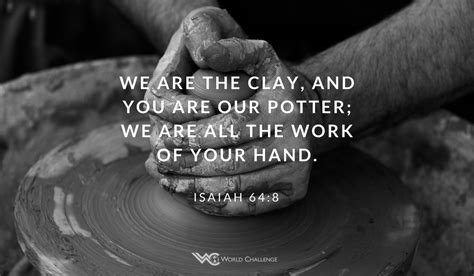
Isaiah 64:8-12 New American Standard Bible
8 But now, Lord, You are our Father;
We are the clay, and You our potter,
And all of us are the work of Your hand.
9 Do not be angry beyond measure, Lord,
Nor remember wrongdoing forever.
Behold, please look, all of us are Your people.
10 Your holy cities have become a wilderness,
Zion has become a wilderness,
Jerusalem a desolation.
11 Our holy and beautiful house,
Where our fathers praised You,
Has been burned by fire;
And all our precious things have become a ruin.
12 Will You restrain Yourself at these things, Lord?
Will You keep silent and afflict us beyond measure?
The Word of God for the Children of God
Glory be to the Father,
and to the Son, and to the Holy Ghost;
as it was in the beginning,
is now, and ever shall be,
world without end. Amen, amen.
This verse and others like it are used often by preachers and teachers.
Many love to use the thought of God being the Potter and we, as His creation, being the clay.
They love to speak on how God can give us a fresh start in life as He remolds us into a new vessel.
The old vessel with its flaws and imperfections is cast into something new and better.
There is nothing wrong with this line of thought.
It is a fine message that often draws people into a closer walk with Jesus Christ.
The old becoming new is a very popular theme in the Word of God.
No man putteth a piece of new cloth unto an old garment, for that which is put in to fill it up taketh from the garment, and the rent is made worse. Neither do men put new wine into old bottles: else the bottles break, and the wine runneth out, and the bottles perish: but they put new wine into new bottles, and both are preserved (Matthew 9:16-17).
At this time though, let us look at another part of this verse.
There are times when part of something becomes so popular that other parts are sometimes overlooked or even forgotten.
The part of the verse that we wish to examine is Thou art our Father.
No one knows our fundamental human needs better than God; He knows our needs for things like forgiveness, hope, love, compassion and peace.
How can we better trust in God to meet those needs?
The first step is to acknowledge the fact that God is our heavenly Father.
Notice, God identifies Himself as a Father to us.
That should say a lot to us as to how He feels.
This is how He chose to characterize His relationship to us.
It’s not just a descriptive term used by preachers or theologians.
God chose Fatherhood from all possible human relationships.
There was something very significant that God wanted to communicate by His choice of this title.
The thing God was trying to communicate was that He wanted our dependence to be on Him.
He desired to show there is no one who loves us more, or in whom we should place more trust, than Him.
God is the perfect example of what a father should be.
Earthly fathers have the perfect model to follow.
They have the Word of God revealing God’s character to mankind.
This should serve as a manual on how parents interact with their children.
Everything a person needs to know about fatherhood is right there in the Bible.
You need to learn how to teach the difference between right and wrong.
The Word of God can help.
If you need help regarding discipline, the Bible has lots to say on the subject.
Many fathers do not use God as a role model, and their children suffer because of it.
God is the only Father they know.
Isaiah 64:8 emphasizes the relationship between God and humanity, portraying God as a nurturing Father and humans as clay shaped by His hands. This verse highlights the themes of creation, dependence, and of divine craftsmanship.
Key Elements of Isaiah 64:8
| Element | Description |
|---|---|
| God’s Role | God is referred to as our Father. |
| Humanity’s Role | Humanity is likened to clay in the potter’s hands. |
| Divine Craftsmanship | We are described as the work of God’s hand. |
Themes in Isaiah 64:8
- Fatherhood of God: The verse begins with an acknowledgment of God as a caring Father, indicating a personal and loving relationship.
- Human Dependence: By comparing humans to clay, it illustrates our dependence on God for shaping and guidance.
- Divine Authority: The potter metaphor signifies God’s authority and ability to mold our lives according to His purpose.
This verse serves as a reminder of the intimate connection between God and His creation, emphasizing trust in His plans and designs for our lives.
Isaiah 64:8 teaches that God is the potter and we are the clay, emphasizing His sovereignty and creative authority over humanity.
This verse illustrates the intimate relationship between God and His creation, highlighting His role in shaping and guiding our lives.
Being ‘clay in the potter’s hands’ in Isaiah 64:8 implies God is the Creator who shapes and molds our lives according to His purpose, emphasizing our need to trust in His guidance and transformation. It highlights the relationship between God and humanity and where we are called to be pliable, receptive to His will.
What do you see when you look upon a lump of clay?
You may be like me and see a dry piece of dirt you can’t do much with.
Now imagine if a potter were to look at that same lump of clay.
What do you think he might see?
I think he would see endless possibilities.
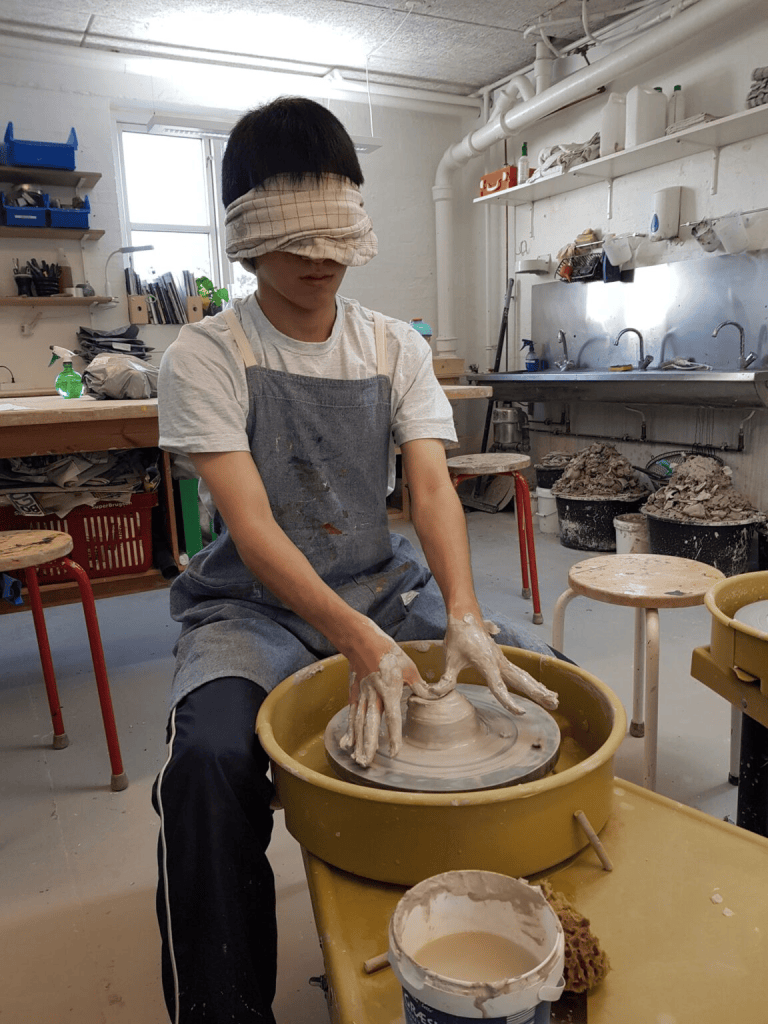
Have you ever seen a potter at work on his wheel?
It is fascinating to watch.
To see a seemingly useless piece of clay formed and fashioned into a beautiful pot is an amazing thing to witness.
Before a potter sits down at his wheel, he prepares the clay by kneading it and making sure there are no air bubbles in sight.
He has a design in mind for this particular piece of clay all while he is doing this.
He knows the exact amount of clay needed for the vessel he will form. As he kneads the clay, he begins to think about the function this vessel will have.
“I need something I can pour various liquids into. This vessel needs to be able to hold the liquid well and pour it out at a whim… I have it! I’ll make a beautiful cup that can fulfill this need.”
Can we picture God being this way before he formed us in our mother’s womb?
The Lord knew exactly what he had in mind before he reached for the clay that he formed you with.
He had a design in mind.
He knew what function he wanted us to fulfill in the earth.
As the skilled potter works, he knows the precise amount of pressure to apply to the clay.
He knows when to add more water, loosen his grip, and he knows where to trim off parts of the clay to form the vessel he has envisioned.
His hands are used to shape and mold.
The piece of clay that once laid lifeless is now coming to life.
It is being fashioned on the wheel into a vessel that will be useful to the potter.
In the name of God, the Father and God the Son and God the Holy Spirit Amen
Praying …
The Lord’s Glory and Mankind’s Dignity.
For the music director; on the Gittith. A Psalm of David.
8 Lord, our Lord,
How majestic is Your name in all the earth,
You who have [a]displayed Your splendor above the heavens!
2 From the mouths of infants and nursing babies You have established [b]strength
Because of Your enemies,
To do away with the enemy and the revengeful.
3 When I [c]consider Your heavens, the work of Your fingers,
The moon and the stars, which You have set in place;
4 What is man that You think of him,
And a son of man that You are concerned about him?
5 Yet You have made him a little lower than [d]God,
And You crown him with glory and majesty!
6 You have him rule over the works of Your hands;
You have put everything under his feet,
7 All sheep and oxen,
And also the animals of the field,
8 The birds of the sky, and the fish of the sea,
Whatever passes through the paths of the seas.
9 Lord, our Lord,
How majestic is Your name in all the earth!
Glory be to the Father,
and to the Son, and to the Holy Ghost;
as it was in the beginning,
is now, and ever shall be,
world without end. Amen, amen.

