
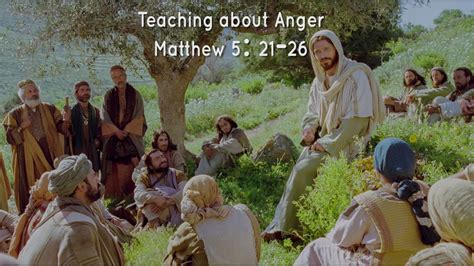
Matthew 5:21-26 New King James Version
Murder Begins in the Heart
21 “You have heard that it was said to those [a]of old, ‘You shall not murder, and whoever murders will be in danger of the judgment.’ 22 But I say to you that whoever is angry with his brother [b]without a cause shall be in danger of the judgment. And whoever says to his brother, ‘Raca!’[c] shall be in danger of the council. But whoever says, [d]‘You fool!’ shall be in danger of [e]hell fire. 23 Therefore if you bring your gift to the altar, and there remember that your brother has something against you, 24 leave your gift there before the altar, and go your way. First be reconciled to your brother, and then come and offer your gift. 25 Agree with your adversary quickly, while you are on the way with him, lest your adversary deliver you to the judge, the judge hand you over to the officer, and you be thrown into prison. 26 Assuredly, I say to you, you will by no means get out of there till you have paid the last penny.
Word of God for the Children of God
Glory be to the Father,
and to the Son, and to the Holy Ghost;
as it was in the beginning,
is now, and ever shall be,
world without end. Amen, amen.
This passage is part of Jesus’ famous Sermon on the Mount, where He addresses the deeper implications of the commandment against murder.
Matthew 5:21-26 is discussing the teachings of Jesus regarding anger and reconciliation. Jesus emphasizes being angry with someone is as serious as murder and instructs we should seek reconciliation before offering gifts at the altar.
Jesus likewise teaches that anger and insults can be as serious as murder in God’s eyes, warning that such displays of unchecked anger leads to judgment.
He urges us to make quick reconciliation with others before offering worship.
There are very serious spiritual implications to be aware of …
- Anger as Sin: Jesus equates anger with murder, highlighting the seriousness of harboring ill feelings.
- Reconciliation: Immediate reconciliation is crucial before engaging in worship, indicating relationships with others are vital to one’s relationship with God.
- Judgment: The passage sternly warns of judgment for unresolved anger and disputes, dramatically stressing the need for strict personal accountability.
This teaching encourages believers to cultivate shalom and resolve conflicts promptly, reflecting the heart of Jesus’ message about love and community.
What implications of anger in Matthew 5:21-26 for modern relationships?
Matthew 5:21-26 emphasizes that anger is equated with murder, highlighting the real seriousness of unresolved anger and the critical need for reconciliation.
Other biblical teachings, such as those in Proverbs and Ephesians, also stress the very real importance of our managing anger and seeking peace, reinforcing the idea that our displays of unchecked anger can lead to destructive outcomes.
A Soft Answer Turns Away Wrath (Proverbs 15:1 New King James Version)
15 A soft answer turns away wrath,
But a harsh word stirs up anger.
Proverbs 12:16 New American Standard Bible
16 A fool’s anger is known at once,
But a prudent person conceals dishonor.
Proverbs 14:29 New American Standard Bible
29 One who is slow to anger has great understanding;
But one who is [a]quick-tempered exalts foolishness.
Proverbs 19:11 New American Standard Bible
11 A person’s discretion makes him slow to anger,
And it is his glory to overlook an offense.
Proverbs 27:3-6 New American Standard Bible
A stone is heavy and the sand weighty,
But the provocation of a fool is heavier than both of them.
4 Wrath is fierce and anger is a flood,
But who can stand before jealousy?
5 Better is open rebuke
Than love that is concealed.
6 Faithful are the wounds of a friend,
But [a]deceitful are the kisses of an enemy.
What historical context influenced Jesus’ teachings on anger and reconciliation in Matthew 5:21-26?
Jesus’ teachings on anger and reconciliation Matthew 5:21-26 were influenced by the Jewish understanding of the law, particularly the commandment against murder, which was repeatedly interpreted by the ancient scholar’s narrowly.
He expanded this interpretation to include the inner condition of anger and contempt, emphasizing the highest importance of reconciliation and those serious, even violent, consequences of unresolved anger in relationships.
Matthew 5:21-26 addresses the seriousness of anger and its consequences, emphasizing that being angry with a brother or sister is subject to judgment, equating it with murder in terms of moral, ethical, spiritual accountability.
Jesus teaches the unrelenting importance of reconciliation, urging individuals to settle disputes quickly to avoid greater consequences, highlighting the need for inner purity and peace in both our individual and community relationships.
Key Teachings
- Anger and Judgment: Jesus equates anger with murder, stating anyone who is angry with a brother or sister is subject to judgment. This highlights the deep seriousness of harboring anger in one’s heart.
- Reconciliation: Jesus instructs if someone recalls a grievance while offering a gift at the altar, they should first reconcile with that offended party before continuing with their offering. underscoring the priority of resolving conflicts.
Consequences of Anger
| Action | Consequence |
|---|---|
| Being angry with a brother | Subject to judgment |
| Insulting a brother (e.g., “Raca”) | Answerable to the court |
| Calling someone a fool | In danger of hellfire |
Practical Application
- Settling Disputes: Jesus advises settling matters quickly with adversaries to avoid escalation and potential legal consequences. This teaches the value of addressing conflicts promptly. (Matthew 5:43-45, Acts 13:9-11, Romans 12:19-21)
- Inner Purity: The passage emphasizes that true righteousness involves not just external actions but also the inner condition of our hearts. Maintaining peace and purity in relationships is essential for establishing fulfilling spiritual lives.
By focusing on these teachings, individuals are encouraged to reflect on their attitudes and actions, striving for reconciliation and inner peace.
In my less than stellar moments of anger, hurt, resentment, or sometimes even out of shear frustration and annoyance, I have called others or thought of them as “stupid,” “uneducated” “hopelessly naive” as the religious leaders of Jesus’ day did when they called a spouse, children also brothers or sisters a “fool.”
According to Jesus, this kind of attitude violates the sixth commandment by showing my deeply rooted contempt for others made in the image of God.
I must confess I am too often guilty of automatically diminishing other people.
I need to continually plead, pray, humble myself, in the presence of God, to forgive me, to create within my heart a much deeper, genuine love for others.

What about you?
In the name of God, the Father and God the Son and God the Holy Spirit. Amen
Psalm 85 Complete Jewish Bible
85 (0) For the leader. A psalm of the sons of Korach:
2 (1) Adonai, you have shown favor to your land;
you have restored the fortunes of Ya‘akov,
3 (2) taken away the guilt of your people,
pardoned all their sin, (Selah)
4 (3) withdrawn all your wrath,
turned from your fierce anger.
5 (4) Restore us, God of our salvation,
renounce your displeasure with us.
6 (5) Are you to stay angry with us forever?
Will your fury last through all generations?
7 (6) Won’t you revive us again,
so your people can rejoice in you?
8 (7) Show us your grace, Adonai;
grant us your salvation.
9 (8) I am listening. What will God, Adonai, say?
For he will speak peace to his people,
to his holy ones —
but only if they don’t relapse into folly.
10 (9) His salvation is near for those who fear him,
so that glory will be in our land.
11 (10) Grace and truth have met together;
justice and peace have kissed each other.
12 (11) Truth springs up from the earth,
and justice looks down from heaven.
13 (12) Adonai will also grant prosperity;
our land will yield its harvest.
14 (13) Justice will walk before him
and make his footsteps a path.
Glory be to the Father,
and to the Son, and to the Holy Ghost;
as it was in the beginning,
is now, and ever shall be,
world without end. Amen, amen.

