Our Walking through our Valley, Our Walking through the Fires; Finishing our struggle, Surrendering unto God. Psalm 51:10-17

Psalm 51:10-17 Common English Bible

10 Create a clean heart for me, God;
    put a new, faithful spirit deep inside me!
11 Please don’t throw me out of your presence;
    please don’t take your holy spirit away from me.
12 Return the joy of your salvation to me
    and sustain me with a willing spirit.
13 Then I will teach wrongdoers your ways,
    and sinners will come back to you.

14 Deliver me from violence, God, God of my salvation,
    so that my tongue can sing of your righteousness.
15 Lord, open my lips,
    and my mouth will proclaim your praise.
16 You don’t want sacrifices.
    If I gave an entirely burned offering,
    you wouldn’t be pleased.
17 A broken spirit is my sacrifice, God.[a]
    You won’t despise a heart, God, that is broken and crushed.

The Word of God for the Children of God.

Glory be to the Father,
and to the Son, and to the Holy Ghost;
as it was in the beginning,
is now, and ever shall be,
world without end. Amen, amen.

Our Continually Struggling to Surrender to God

Psalm 51 was written by King David after he committed the sin of adultery with Bathsheba and had her husband killed to cover his sin (2 Samuel 11).

It has been said of David that he sinned big, but repented bigger.

But only after he was ‘publicly’ caught by Nathan in David’s throne room. One has to wonder how this scripture would read if Nathan never confronts David.

But God, who sees everything no matter how hard or deep we try to hide our actions, was not blind to David’s severest of transgression – his Capital Crime.

God sent Nathan to David’s throne room and fortunately so – lest the wrath of God be meted out without any scriptural announcements – a bolt of lightning strikes David on his throne with no witnesses to testify or witness the event.

David is consigned to a violent death and we probably do not have a lineage that would have been steadfastly honorable, or noteworthy to proclaim as Psalm 51.

Let us shout “Thanks Be to God” for sending Nathan with God’s message of life!

Because now generations of men, women and children are blessed by Psalm 51.

David became for us an inspiring, empowering model to us of what real heart felt repentance looks like. He mightily struggled with his sin, so much so that he took off his crown and regal regalia, and surrendered his throne which God granted to him and walked sullenly to the tabernacle to take a lonely seat before God His Judge for his righteous Judgment – keep the throne or be publicly tried.

He had no promises that God would permit his return to the throne, he might well have done the same as he first did to Saul, to remove His Spirit from Him, essentially permanently remove His support, from which Saul never recovered.

David understood the gravity of his crime against God and understood that God could do the same to his as Saul, and nothing short of absolute surrender would be acceptable sacrifice. Psalm 51 is David’s agonized cry to God for forgiveness.

Psalm 51:17 says, “My sacrifice, O God, is a broken spirit; a broken and contrite heart you, God, will not despise.”

The meaning of this is connected with Verse 16 says, “You do not delight in sacrifice, or I would bring it; you do not take pleasure in burnt offerings.”

David is stating that there is nothing we can offer God to appease Him when we have sinned. When we have strived more mightily to stay in control. More not superficial but well intentioned animal sacrifices were not what God was going to be looking for nor even .00001% accept as our God desires true repentance.

Many people miss this truth. Rather than repent, they try to rush in with their superficial “clean up their act,” give more, pray more, or busy themselves in other religious activity in hopes God will finally “get over” being mad at them.

In Psalm 51, David is saying he knows that God wants none of that. External religious activity cannot replace internal, heartfelt contrition (1 Samuel 16:7).

Psalm 51:17 points out the one and only thing God desires more than any other: brokenness over our own sin. When we agree with God about how bad our sin is, we take the first baby steps toward a sincere heartfelt reconciliation with Him.

As long as we try to “pseudo-surrender” justify, excuse, or rationalize the evil of our own sin bent hearts, we will never find our way back into God’s presence.

Something Jesus Himself made a point of declaring at the start of His Ministry;

Mark 1:14-15 Amplified Bible

Jesus Preaches in Galilee

14 Now after John [the Baptist] was arrested and [a]taken into custody, Jesus went to Galilee, preaching the good news of [the kingdom of] God, 15 and saying, “The  [appointed period of] time is fulfilled, and the kingdom of God is at hand; repent [change your inner self—your old way of thinking, regret past sins, live your life in a way that proves repentance; seek God’s purpose for your life] and believe [with a deep, abiding trust] in the good news [regarding salvation].”

Nothing less than 100% surrender and repentance is our doorway to freedom.

Satan knows this better than us, does everything he can to detract us from it.

He suggests things that our selfish nature likes to hear:

“Your sin wasn’t that bad.” “Compared to others, you’re okay.” “God has forgotten it already. No need to confess it.”

When we listen to the devil’s cunning oily words, we will veer away from the doorway to freedom and remain in bondage. We may feel remorse or regret, but neither is sufficient substitute for true repentance (Genesis 3, Hebrews 12:15-17).

Hebrews 12:15-17 Amplified Bible

15 See to it that no one falls short of God’s grace; that no root of resentment springs up and causes trouble, and by it many be defiled; 16 and [see to it] that no one is immoral or godless like Esau, who sold his own birthright for a single  meal. 17 For you know that later on, when he wanted [to regain title to] his inheritance of the blessing, he was rejected, for he found no opportunity for repentance [there was no way to repair what he had done, no chance to recall the choice he had made], even though he sought for it with [bitter] tears.

David reminds us in Psalm 51 that the only path to forgiveness is a broken heart and a humble spirit (cf. Matthew 5:3).

When we throw ourselves on the mercy of God, He delights to lift us up (Luke 18:13-14). When we openly acknowledge our sin against God, turn from it, and cry out for cleansing, God promises that He will hear us and forgive (1 John 1:9).

It is interesting to note that, although David sinned against Bathsheba and her murdered husband, Uriah, David surrenders this stunning confession to God:

“Against you, you only, have I sinned and done what is evil in your sight” (Psalm 51:4).

David gets straight to the heart of why God so hates sin. It is an abomination, a hardcore heart hardened willful malicious pre-meditated violation of His very nature. We are each created in that image, but our sin mars it (Genesis 3), like a giant smudge of blackest tar on a mirror. Our broken spirit, our contrite heart, invite God to clean that smudge and restore us to right relationship with Him.

Now, Ponder long and hard the 100% authentic state of your “contrite” heart!

Now, Ponder long and hard the words “utter surrender.” then “Before God!”

Then … “prepare ye, prepare ye the way of the Lord, make your paths straight.”

OMG … Stand still, Quit striving against Him, “What will God wrought now?”

In the name of God, the Father and God the Son and God the Holy Spirit,

Let us Pray,

Psalm 139:23-24 Amplified Bible

23 
Search me [thoroughly], O God, (investigate my life) and know my heart;
Test me and know my anxious thoughts;
24 
And see if there is any wicked or hurtful way in me,
And lead me in the everlasting way.

Psalm 19 Amplified Bible

The Works and the Word of God.

To the Chief Musician. A Psalm of David.

19 The heavens are telling of the glory of God;
And the expanse [of heaven] is declaring the work of His hands.

Day after day pours forth speech,
And night after night reveals knowledge.

There is no speech, nor are there [spoken] words [from the stars];
Their voice is not heard.

Yet their voice [in quiet evidence] has gone out through all the earth,
Their words to the end of the world.
In them and in the heavens He has made a tent for the sun,

Which is as a bridegroom coming out of his chamber;
It rejoices as a strong man to run his course.

The sun’s rising is from one end of the heavens,
And its circuit to the other end of them;
And there is nothing hidden from its heat.


The law of the Lord is perfect (flawless), restoring and refreshing the soul;
The statutes of the Lord are reliable and trustworthy, making wise the simple.

The precepts of the Lord are right, bringing joy to the heart;
The commandment of the Lord is pure, enlightening the eyes.

The fear of the Lord is clean, enduring forever;
The judgments of the Lord are true, they are righteous altogether.
10 
They are more desirable than gold, yes, than much fine gold;
Sweeter also than honey and the drippings of the honeycomb.
11 
Moreover, by them Your servant is warned [reminded, illuminated, and instructed];
In keeping them there is great reward.
12 
Who can understand his errors or omissions? Acquit me of hidden (unconscious, unintended) faults.
13 
Also keep back Your servant from presumptuous (deliberate, willful) sins;
Let them not rule and have control over me.
Then I will be blameless (complete),
And I shall be acquitted of great transgression.
14 
Let the words of my mouth and the meditation of my heart
Be acceptable and pleasing in Your sight,
O Lord, my [firm, immovable] rock and my Redeemer.

Glory be to the Father,
and to the Son, and to the Holy Ghost;
as it was in the beginning,
is now, and ever shall be,
world without end. Amen, amen.
https://translate.google.com/

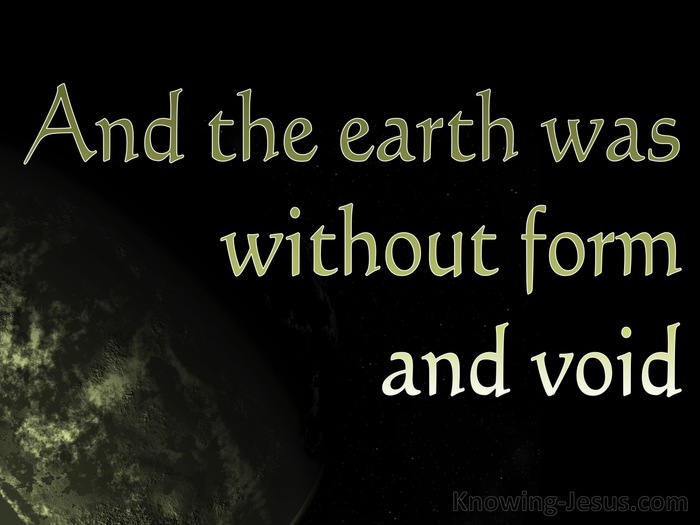
From before the beginning of all Creation, our hopes began in great darkness and greater emptiness and inexorably surges forward, yet today. Genesis 1:1-2

Genesis 1:1-2 Amplified Bible

The Creation

In the beginning God ([a]Elohim) [b]created [by forming from nothing] the heavens and the earth. The earth was [c]formless and void or a waste and emptiness, and darkness was upon the face of the deep [primeval ocean that covered the unformed earth]. The Spirit of God was moving (hovering, brooding) over the face of the waters.

The Word of God for the Children of God.

Glory be to the Father,
and to the Son, and to the Holy Ghost;
as it was in the beginning,
is now, and ever shall be,
world without end. Amen, amen.
Beginnings are important. Backgrounds about characters in novels and movies help us see the start of situations that have helped shaped them. Sometimes we introduce ourselves by telling about our ancestors or about relevant events that have shaped our family history. We pray that we recognize that who we are has a lot to do with the array of situations, the diverse people who came before us.

We ourselves have no memory of our beginnings. Memories do not begin to take shape until we are 4 years old-mine is the memory of my mom making my bed.

However, God was there at our very beginning when we were conceived in the darkness inside our mother’s womb (Psalm 139) in greatest detail, weaving us together within that darkness into who and where we all are walking today.

Similarly, the Bible’s first words about the earth are that it was “formless and empty” and that indescribable “darkness was over the surface of the deep”—a poetic way of saying that the world did not exist before God started creating.

Have you ever been in a cave without any flash lights on? It can be so dark that you can’t see your hands even when you touch your nose. The Bible begins with a darkness that is deeper than that. It’s the deepest darkness the Bible writers could possibly imagine: the depths, empty darkness, of the world not existing.

As we begin our time through this Advent 2024, looking forward to the light of Jesus’ coming, there is something very comforting about the Bible’s beginning.

John 1:1-5 Amplified Bible

The Deity of Jesus Christ

1 In the beginning [before all time] was the Word ([a]Christ), and the Word was with God, and [b]the Word was God Himself. He was [continually existing] in the beginning [co-eternally] with God. All things were made and came into existence through Him; and without Him not even one thing was made that has come into being. In Him was life [and the power to bestow life], and the life was the Light of men. The Light shines on in the [c]darkness, and the darkness did not understand it or overpower it or appropriate it or absorb it [and is unreceptive to it].

However heavy and impossible our current circumstances may feel, the Bible reminds us that our story begins with the God who creates life in the midst of the deepest darkness imaginable. In other words, with God there is always hope the light of our salvation is already there, has always been there, will always be there and there is nothing even the darkest of darkness can do to change that.

Contemplate the Darkness as it was in the beginning of all things before God spoke and Creation responded – How the darkness could do nothing about it.

Contemplate the Hope before God spoke creation into being, the hope that began to be revealed as creation responded and the hope which surged like biggest Tsunami we could ever conceive of in our finite minds that despite the greatest efforts of the darkness to overcome that surging hope, it did not work.

Even in the greatest darkness anyone could conceive today – God has long since proven that hope has existed from the very beginning, Jesus is alive, is eternal!

In the name of God, the Father and God the Son and God the Holy Spirit,

Let us Pray,

Psalm 19 Amplified Bible

The Works and the Word of God.

To the Chief Musician. A Psalm of David.

19 The heavens are telling of the glory of God;
And the expanse [of heaven] is declaring the work of His hands.

Day after day pours forth speech,
And night after night reveals knowledge.

There is no speech, nor are there [spoken] words [from the stars];
Their voice is not heard.

Yet their voice [in quiet evidence] has gone out through all the earth,
Their words to the end of the world.
In them and in the heavens He has made a tent for the sun,

Which is as a bridegroom coming out of his chamber;
It rejoices as a strong man to run his course.

The sun’s rising is from one end of the heavens,
And its circuit to the other end of them;
And there is nothing hidden from its heat.


The law of the Lord is perfect (flawless), restoring and refreshing the soul;
The statutes of the Lord are reliable and trustworthy, making wise the simple.

The precepts of the Lord are right, bringing joy to the heart;
The commandment of the Lord is pure, enlightening the eyes.

The fear of the Lord is clean, enduring forever;
The judgments of the Lord are true, they are righteous altogether.
10 
They are more desirable than gold, yes, than much fine gold;
Sweeter also than honey and the drippings of the honeycomb.
11 
Moreover, by them Your servant is warned [reminded, illuminated, and instructed];
In keeping them there is great reward.
12 
Who can understand his errors or omissions? Acquit me of hidden (unconscious, unintended) faults.
13 
Also keep back Your servant from presumptuous (deliberate, willful) sins;
Let them not rule and have control over me.
Then I will be blameless (complete),
And I shall be acquitted of great transgression.
14 
Let the words of my mouth and the meditation of my heart
Be acceptable and pleasing in Your sight,
O Lord, my [firm, immovable] rock and my Redeemer.

Glory be to the Father,
and to the Son, and to the Holy Ghost;
as it was in the beginning,
is now, and ever shall be,
world without end. Amen, amen.

https://translate.google.com/

Deal with your servant in accordance with your grace, and teach me your laws. I am your servant; pray, give me understanding, give me discernment so that I can know your instruction. Psalm 119: 121-128

Psalm 119:121-128 New American Standard Bible

Ayin

121 I have done justice and righteousness;
Do not leave me to my oppressors.
122 Be a guarantor for Your servant for good;
Do not let the arrogant oppress me.
123 My eyes fail with longing for Your salvation,
And for Your righteous [a]word.
124 Deal with Your servant according to Your graciousness,
And teach me Your statutes.
125 I am Your servant; give me understanding,
So that I may know Your testimonies.
126 It is time for the Lord to act,
For they have broken Your Law.
127 Therefore I love Your commandments
Above gold, yes, above pure gold.
128 Therefore I carefully follow all Your precepts concerning everything,
I hate every false way.

The Word of God for the Children of God.

Glory be to the Father,
and to the Son, and to the Holy Ghost;
as it was in the beginning,
is now, and ever shall be,
world without end. Amen, amen.

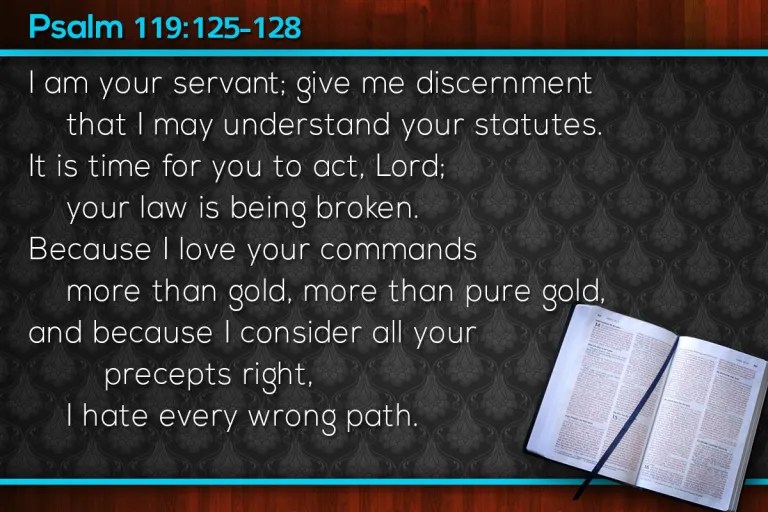
In this section of Psalm 119 we find some of the most memorable words in the entire psalm, as the writer declares that he loves God’s Word “more than gold, more than pure gold.”

But if we lift this Psalmist’s beautiful confession out of its context, we miss a more subtle truth in these verses: the psalmist’s plea to understand God’s Word.

In declaring how he deeply treasures all of God’s Word, the psalmist is not merely offering a beautiful senti­ment. He offers this like evidence in a court of law, as if he is testifying like a plaintiff. Because he loves God’s words above all else and seeks to follow them all, God should rescue him from his oppressors.

Knowing that we sinfully tend to see only our own point of view and that we often fall short, most of us would hesitate to put God on trial in a way like this.

Nevertheless, we can learn so very much from the psalmist’s wise request. He acknowledges his 100% need for help in understanding God’s precious Word.

Though we may not all dare to call God to account in pleading for his help, we all 100% need guidance in discerning the authentic truth of God’s Word. We hear God’s voice most clearly when we wholeheartedly ask him to remove our distractions and as far as the east is from west, reveal himself and his will to us.

And when God does speak to us through his Word—as he certainly will—we must then strive to wholeheartedly apply God’s teaching unto our daily lives.

Hiding God’s Word In Our Hearts

The first half of this stanza showed one reason that the psalmist was certain that God would deliver him. The rest of this passage gives two more reasons.

 Take a look at this passage in Psalm 119:125-128:

God is a loving God. Of course, that goes hand in hand with his holiness and the need for righteousness in our lives. As the psalmist has discovered and revealed in this stanza of Psalm 119, God will deliver his people because of his love; and, in fact, God will deliver the psalmist because of that love.

The psalmist definitely has enemies, and his enemies are the enemies of God.

When we consider the whole of this Psalm, this is perhaps the lowest point in the entirety of Psalm 119, and we see the writer cry out for deliverance. His first reason for requesting that deliverance is because of God’s love, in verse 124.

The second reason the psalmist gives here is because he is God’s servant. The writer is basically declaring, “I belong to you, God! Help me because of that!”

And like any good earthly master, who cares deeply for that which belongs to him, should God do any less than completely care for those who belong to him?

The psalmist also seems to understand that God’s deliverance can be seen in the Word. He asks for deliverance, and he asks for it in the form of discernment to understand God’s statutes completely. You can see this clearly in verse 125.

Finally, the third reason the psalmist gives, in verse 126, is simply because it is time for God to act.

This has nothing to do with the writer’s timeline, or because time is somehow running out before the psalmist will be overwhelmed by those who are against him. No, here, the writer is more concerned with God’s reputation than his own temporary needs. His cry is that God should act because his law is being broken.

This is a quality that is rare in our world.

We tend to place our own needs and values ahead of all else.

But the writer here has shown in what order the priorities should be.

Our desire should be for God, and for his Word, above our own needs.

In the closing verses of this stanza, the writer gives a contrasting statement, one that depicts a deep hatred of what is wrong against a love for what is right.

In our age of relativism, this is a hard statement for many to accept.

We would rather believe that what is right for you may not necessarily be right for me.

We would rather not have a definitive right and wrong, a moral, ethical absolute because it brings with them guilt and conviction.

But that is what the writer gives us here. He states that there is a definite right path and a definite wrong one. There is the whole truth and there is the whole lie. There are things that God detests, that we should detest as well. And there are definitely things that God deeply loves that we should seek after to love also.

There is an absolute truth, and we must hold to it firmly. We must avoid every wrong path and cling to the one thing that is true above all else. We must hate what God hates, or we will never learn to love God fully. And the best way to know what God hates and what God values can be found by reading his Word.

I strongly encourage you the reader to 100% take the time daily to invest in the pursuit of God’s heart. I strongly urge you to spend quality time in his Word on a daily basis. It’s the only way that we can discover the truth and grow in it fully.

In the name of God, the Father and God the Son and God the Holy Spirit,

Let us Pray,

Psalm 19 New American Standard Bible

The Works and the Word of God.

For the music director. A Psalm of David.

19 The heavens tell of the glory of God;
And their expanse declares the work of His hands.
Day to day pours forth speech,
And night to night reveals knowledge.
There is no speech, nor are there words;
Their voice is not heard.
Their [a]line has gone out into all the earth,
And their words to the end of the world.
In them He has placed a tent for the sun,
Which is like a groom coming out of his chamber;
It rejoices like a strong person to run his course.
Its rising is from [b]one end of the heavens,
And its circuit to the [c]other end of them;
And there is nothing hidden from its heat.

The Law of the Lord is [d]perfect, restoring the soul;
The testimony of the Lord is sure, making wise the simple.
The precepts of the Lord are right, rejoicing the heart;
The commandment of the Lord is pure, enlightening the eyes.
The fear of the Lord is clean, enduring forever;
The judgments of the Lord are true; they are righteous altogether.
10 They are more desirable than gold, yes, than much pure gold;
Sweeter also than honey and drippings of the honeycomb.
11 Moreover, Your servant is warned by them;
In keeping them there is great reward.
12 Who can discern his errors? Acquit me of hidden faults.
13 Also keep Your servant back from presumptuous sins;
Let them not rule over me;
Then I will be innocent,
And I will be blameless of great wrongdoing.
14 May the words of my mouth and the meditation of my heart
Be acceptable in Your sight,
Lord, my rock and my Redeemer.

Glory be to the Father,
and to the Son, and to the Holy Ghost;
as it was in the beginning,
is now, and ever shall be,
world without end. Amen, amen.
https://translate.google.com/

But who would dare to discern their own errors? Forgive hidden faults? Who can discern unintentional sins, can satisfy their own Debts? Psalm 19

Psalm 19 Names of God Bible

Psalm 19

For the choir director; a psalm by David.

The heavens declare the glory of El,
    and the sky displays what his hands have made.
One day tells a story to the next.
    One night shares knowledge with the next
without talking,
    without words,
    without their voices being heard.
Yet, their sound has gone out into the entire world,
    their message to the ends of the earth.
    He has set up a tent in the heavens for the sun,
which comes out of its chamber like a bridegroom.
    Like a champion, it is eager to run its course.
        It rises from one end of the heavens.
            It circles around to the other.
                Nothing is hidden from its heat.

The teachings of Yahweh are perfect.
    They renew the soul.
    The testimony of Yahweh is dependable.
    It makes gullible people wise.
The instructions of Yahweh are correct.
    They make the heart rejoice.
    The command of Yahweh is radiant.
    It makes the eyes shine.
The fear of Yahweh is pure.
    It endures forever.
    The decisions of Yahweh are true.
    They are completely fair.
10 They are more desirable than gold, even the finest gold.
    They are sweeter than honey, even the drippings from a honeycomb.
11 As your servant I am warned by them.
    There is a great reward in following them.

12 Who can notice every mistake?
    Forgive my hidden faults.
13 Keep me from sinning.
    Do not let anyone gain control over me.
        Then I will be blameless,
            and I will be free from any great offense.

14 May the words from my mouth and the thoughts from my heart
    be acceptable to you, O Yahweh, my rock and my Go’el.

The Word of God for the Children of God.

Glory be to the Father,
and to the Son, and to the Holy Ghost;
as it was in the beginning,
is now, and ever shall be,
world without end. Amen, amen.

Psalm 19:7-14 Easy-to-Read Version

The Lord’s teachings are perfect.
    They give strength to his people.
The Lord’s rules can be trusted.
    They help even the foolish become wise.
The Lord’s laws are right.
    They make people happy.
The Lord’s commands are good.
    They show people the right way to live.

Learning respect for the Lord is good.
    It will last forever.
The Lord’s judgments are right.
    They are completely fair.
10 His teachings are worth more than pure gold.
    They are sweeter than the best honey dripping from the honeycomb.
11 His teachings warn his servants,
    and good things come to those who obey them.

12 People cannot see their own mistakes,
    so don’t let me commit secret sins.
13 Don’t let me do what I know is wrong.
    Don’t let sin control me.
If you help me, I can be pure
    and free from sin.
14 May my words and thoughts please you.
    Lord, you are my Rock—the one who rescues me.

David, summing up all that he said about the Word of God, declares that the only thing which can interfere with the Word having its full effect is us.

We are the problem.

If we cannot benefit from the Word, it is not because there is anything wrong with it. It is us who are the problem. Who can discern their own errors? 

We are all victims of hidden failure in our lives.

Psalm 139:23-24 Easy-to-Read Version

23 God, examine me and know my mind.
    Test me and know all my worries.
24 Make sure that I am not going the wrong way.[a]
    Lead me on the path that has always been right.[b]

Contemplate for a time if these ancient words of scripture excluded “God”

23 ME, examine me and know my mind.
    ME Test me and know all my worries.
24  ME Make sure that I am not going the wrong way.[a]
    ME Lead me on the path that has always been right.[b]

If we are the only one’s who are examining ourselves …

If we are the only one’s who are trying to know our own minds …

If we are the only one’s testing ourselves to get at the core of our worries?

If we are the only one’s who are investigating our own “wicked ways?”

Then making sure we where smart enough, wise enough, brutally honest enough, tough enough on ourselves, to hardcore “tough love” ourselves, to accept, heartfelt confess, the .0000001% chance we are going the wrong way?

“Knowing” exactly how much a PhD we are in knowing ourselves, caring for ourselves, instantly perfectly completely correcting, and directing ourselves?

What gets accomplished?

Who accomplishes what?

Who makes sure they get all of the credit for what was accomplished?

If we examine ourselves, we usually look fine – in our view of our facts, we are perfectly fine – no worries – no anxieties – as we set off to swim all the oceans?

Everybody, including themselves, thinks what he does is right. We cannot see, refuse to see, our own errors, we won’t acknowledge these errors, yet these hidden errors are constantly affecting us so we cannot see truth the way it is.

How big a 100% fool can we make of ourselves in the privacy of our homes?

Strutting around in public like some fluorescent tie dyed Peacock in full bloom, How big a 100% fool can we put on the world’s biggest most vivid movie screen?

If we aren’t ourselves becoming even .0000001% self conscious of these errors?

Therefore, we desperately need to be delivered from hidden errors by someone eternally, infinitely, more wise, more honest, more sacrificing of self than we are capable of being or would even entertain one thought we would want to be.

That is what severely hinders our desire for the Word — these hidden errors.

The Psalmist faces the fact that something is wrong with us, so he concludes this Psalm with a wonderful prayer: Forgive my hidden faults (Psalms 19:12b).

Are you so fully and completely contrite of heart to confess with all of your soul and all of your so called strength all of your alleged might that is your prayer?

We know what will happen to ourselves, by ourselves, by our indomitable self wills, dare ourselves to pray for that forgiveness, wait on ourselves to answer.

NOTHING OF ANY AUTHENTIC VALUE OR ANYTHING OF ETERNAL WORTH!

Do you know what will happen when you pray that way AND also include God?

One might allow themselves to fantasize that God will take a sponge and wipe around inside you so that you will not even know what those hidden faults were.

But God does not do that.

Isaiah 55:8-11 Easy-to-Read Version

People Cannot Understand God

The Lord says, “My thoughts are not like yours.
    Your ways are not like mine.
Just as the heavens are higher than the earth,
    so my ways are higher than your ways,
    and my thoughts are higher than your thoughts.

10 “Rain and snow fall from the sky
    and don’t return until they have watered the ground.
Then the ground causes the plants to sprout and grow,
    and they produce seeds for the farmer and food for people to eat.
11 In the same way, my words leave my mouth,
    and they don’t come back without results.
My words make the things happen that I want to happen.
    They succeed in doing what I send them to do.

His way of dealing with hidden faults is either to send somebody to point them out to you – someone like Nathan who entered David’s throne unannounced.

To bring them out, shake them out through some circumstance in which they are suddenly confronted with what they have done or said, and suddenly realize that it is 1000% ugly and they have been caught not by man, but by God himself.

2 Samuel 12:1-14 Easy-to-Read Version

Nathan Speaks to David

12 The Lord sent Nathan to David. Nathan went to him and said, “There were two men in a city. One man was rich, but the other man was poor. The rich man had lots of sheep and cattle. But the poor man had nothing except one little female lamb that he bought. The poor man fed the lamb, and the lamb grew up with this poor man and his children. She ate from the poor man’s food and drank from his cup. The lamb slept on the poor man’s chest. The lamb was like a daughter to the poor man.

“Then a traveler stopped to visit the rich man. The rich man wanted to give food to the traveler, but he did not want to take any of his own sheep or cattle to feed the traveler. No, the rich man took the lamb from the poor man and cooked it for his visitor.”

David became very angry with the rich man. He said to Nathan, “As the Lord lives, the man who did this should die! He must pay four times the price of the lamb because he did this terrible thing and because he had no mercy.”

Nathan Tells David About His Sin

Then Nathan said to David, “You are that rich man! This is what the Lord, the God of Israel, says: ‘I chose[a] you to be the king of Israel. I saved you from Saul. I let you take his family and his wives, and I made you king of Israel and Judah. As if that had not been enough, I would have given you more and more. 9  So why did you ignore my command? Why did you do what I say is wrong? You let the Ammonites kill Uriah the Hittite, and you took his wife. It is as if you yourself killed Uriah in war. 10 So your family will never have peace! When you took Uriah’s wife, you showed that you did not respect me.’

11 “This is what the Lord says: ‘I am bringing trouble against you. This trouble will come from your own family. I will take your wives from you and give them to someone who is very close to you. He will have sexual relations with your wives, and everyone will know it![b] 12 You had sexual relations with Bathsheba in secret, but I will punish you so that all the people of Israel can see it.’”[c]

13 Then David said to Nathan, “I have sinned against the Lord.”

Nathan said to David, “The Lord will forgive you, even for this sin. You will not die. 14 But you did things that made the Lord’s enemies lose their respect for him, so your new baby son will die.”

That is the way God cleanses us from hidden faults.

He hardcore pries open the secret places.

Usually he does it through other people, because we cannot see ourselves but other people can see us.

These faults are hidden to us but not to others.

They see them very plainly.

And we can see their hidden faults better than they can.

You say, I don’t see how they can be so blind. 

Well, someone is thinking that very same way about you.

We do not see ourselves.

That is why it is always proper to say, Lord, forgive my hidden faults.

Help me to see myself through the eyes of a friend who loves me enough to tell me the truth.

David closes this psalm with these often quoted words which are so wonderfully penetrating that we should pray them often: 

May these words of my mouth and this meditation of my heart be pleasing in your sight, Lord, my Rock and my Redeemer (Psalms 19:14).

That is a wonderful prayer, is it not?

This is the attitude that will open the Word of God to us.

When you pray that kind of prayer before you read the Word, you will find that God will (gently in God’s way, hardcore our way) talk to us in a marvelous way.

Deliver Me From Evil

Psalm 19:12 Amplified Bible

12 
Who can understand his errors or omissions? Acquit me of hidden (unconscious, unintended) faults.

When I was in grade school, there were many times that I thought a teacher or a parent had eyes in the back of their head.

I could not get away with anything I was not supposed to be doing.

Sometimes my hidden thoughts were identified by those who were not even looking at me. And to prevent me from even trying something out of line, they loudly whispered for all to hear, “Just remember, God sees everything you do.”

Having someone watching our every move can help to keep our secret actions in check, but what about our thoughts and the things we are tempted to say?

When we allow the bright light of God’s law to shine into our inner self, it truly illuminates our hidden faults and lights up a warning.

Without God’s law we are blind to what separates us from God.

The psalmist knows that he cannot see his faults by looking into a mirror.

He looks instead into God’s law and asks God to forgive not only his visible sins but also his hidden faults.

And the God of the Bible does forgive.

Knowing the fact of God’s forgiveness assures the psalmist that he will be blameless in God’s sight. Not completely perfect yet, but blameless now.

In the name of God, the Father and God the Son and God the Holy Spirit,

Let us Pray,

Psalm 40 Amplified Bible

God Sustains His Servant.

To the Chief Musician. A Psalm of David.

40 I waited patiently and expectantly for the Lord;
And He inclined to me and heard my cry.

He brought me up out of a horrible pit [of tumult and of destruction], out of the miry clay,
And He set my feet upon a rock, steadying my footsteps and establishing my path.

He put a new song in my mouth, a song of praise to our God;
Many will see and fear [with great reverence]
And will trust confidently in the Lord.


Blessed [fortunate, prosperous, and favored by God] is the man who makes the Lord his trust,
And does not regard the proud nor those who lapse into lies.

Many, O Lord my God, are the wonderful works which You have done,
And Your thoughts toward us;
There is none to compare with You.
If I would declare and speak of your wonders,
They would be too many to count.


Sacrifice and meal offering You do not desire, nor do You delight in them;
You have opened my ears and given me the capacity to hear [and obey Your word];
Burnt offerings and sin offerings You do not require.

Then I said, “Behold, I come [to the throne];
In the scroll of the book it is written of me.

“I delight to do Your will, O my God;
Your law is within my heart.”


I have proclaimed good news of righteousness [and the joy that comes from obedience to You] in the great assembly;
Behold, I will not restrain my lips [from proclaiming Your righteousness],
As You know, O Lord.
10 
I have not concealed Your righteousness within my heart;
I have proclaimed Your faithfulness and Your salvation.
I have not concealed Your lovingkindness and Your truth from the great assembly.

11 
Do not withhold Your compassion and tender mercy from me, O Lord;
Your lovingkindness and Your truth will continually preserve me.
12 
For innumerable evils have encompassed me;
My sins have overtaken me, so that I am not able to see.
They are more numerous than the hairs of my head,
And my heart has failed me.

13 
Be pleased, O Lord, to save me;
O Lord, make haste to help me.
14 
Let those be ashamed and humiliated together
Who seek my life to destroy it;
Let those be turned back [in defeat] and dishonored
Who delight in my hurt.
15 
Let those be appalled and desolate because of their shame
Who say to me, “Aha, aha [rejoicing in my misfortune]!”
16 
Let all who seek You rejoice and be glad in You;
Let those who love Your salvation say continually,
“The Lord be magnified!”
17 
Even though I am afflicted and needy,
Still the Lord takes thought and is mindful of me.
You are my help and my rescuer.
O my God, do not delay.

Glory be to the Father,
and to the Son, and to the Holy Ghost;
as it was in the beginning,
is now, and ever shall be,
world without end. Amen, amen.
https://translate.google.com/

How well DO we recall how from our childhood we have known the Holy Scriptures, which give us the wisdom that leads to our deliverance through our trusting in Yeshua the Messiah? 2 Timothy 3:14-17

2 Timothy 3:14-17 Amplified Bible

14 But as for you, continue in the things that you have learned and of which you are convinced [holding tightly to the truths], knowing from whom you learned them, 15 and how from childhood you have known the sacred writings (Hebrew Scriptures) which are able to give you the wisdom that leads to salvation through faith which is in Christ Jesus [surrendering your entire self to Him and having absolute confidence in His wisdom, power and goodness]. 16 All Scripture is God-breathed [given by divine inspiration] and is profitable for instruction, for conviction [of sin], for correction [of error and restoration to obedience], for training in righteousness [learning to live in conformity to God’s will, both publicly and privately—behaving honorably with personal integrity and moral courage]; 17 so that the [a]man of God may be complete and proficient, outfitted and thoroughly equipped for every good work.

The Word of God for the Children of God.

Glory be to the Father,
and to the Son, and to the Holy Ghost;
as it was in the beginning,
is now, and ever shall be,
world without end. Amen, amen.

The authority, sufficiency, infallibility, and inerrancy of Scripture are doctrines that are absolutely foundational to the ongoing work of God and His church.

We well can we authentically engage a slowly disintegrating, lost and hurting world with the gospel truth unless we are 100% convinced of its divine origin.

As Bishop J.C. Ryle (1816-1900) wrote, without the Bible as a “divine book to turn to as the basis of their doctrine and practice,” Christians “have no solid ground for present peace or hope, and has no right to claim the attention of mankind.”[1]

1 Bible Inspiration: Its Reality and Nature(William Hunt, 1877), p 6.

Apostle Paul towards the end of his life, addressed this very issue when he sternly reminded Timothy that “all Scripture is breathed out by God.”

In other words, the Bible is not a human product infused with divinity; it’s a divine gift produced through human instrumentality. Its every book, chapter, sentence, word and syllable was originally given by God’s inspiration.

The doctrine of Scripture, like many other Christian doctrines, can be hugely challenging to grapple with.

But the fact that something is difficult to understand does not undermine its depths of authentic hardcore truthfulness.

Furthermore, when it comes to the doctrine of Scripture, there are matters that we can consider objectively.

For example, it’s easy to see that the Bible is a completely harmonious work.

While it was written by more than thirty authors over a period of about fifteen hundred years, all the writers tell the same story, giving the same account of this world, the character of its Creator, and the problem of the human heart, and broken spirit all pointing to the same wonderful way of salvation through the sacrifice of the Lamb of God—all the way from Genesis through Revelation!

The Bible also transcends time, culture, gender, wealth, power and intellect.

Some books may fit a certain person, a certain era, or a certain place, but there is no other book that perfectly stands up to the challenges of every day and of every age and to the myriad and myriad of questions that confronts life itself.

The brightest minds, the greatest thinkers, charismatic of speakers, cannot exhaust the riches of God’s word, and yet, at the same time, even young girls and boys can read their Bibles and discover its truth transforming their lives.

Try to plumb for yourselves the utter depths of Genesis 1:1 Amplified Bible

The Creation

1 In the beginning God ([a]Elohim) [b]created [by forming from nothing] the heavens and the earth.

Your efforts may be so vast, so comprehensive, so mind boggling, so fully enriching, so empowering, overwhelming, you may never get to verse 2.

The earth was [a]formless and void or a waste and emptiness, and darkness was upon the face of the deep [primeval ocean that covered the unformed earth]. The Spirit of God was moving (hovering, brooding) over the face of the waters.

Once you look up at a clear star filled night sky or through a telescope, at the pictures from the Hubble and James Webb Space telescopes, try to calculate what it means to go from one end of the universe to the other or trying to find the exact center of an ever expanding universe then hearing that it would take you tens of trillions of light years (look that up) if not more to accomplish it.

Who else but God, the Father and God the Son and God the Holy Spirit can ever hope to speak of it in such a way that the finite intellect and wisdom of mankind can grasp even .01% what our own finite eyes can observe and thoughts grasp?

Psalm 19 Amplified Bible

The Works and the Word of God.

To the Chief Musician. A Psalm of David.

19 The heavens are telling of the glory of God;
And the expanse [of heaven] is declaring the work of His hands.

Day after day pours forth speech,
And night after night reveals knowledge.

There is no speech, nor are there [spoken] words [from the stars];
Their voice is not heard.

Yet their voice [in quiet evidence] has gone out through all the earth,
Their words to the end of the world.
In them and in the heavens He has made a tent for the sun,

Which is as a bridegroom coming out of his chamber;
It rejoices as a strong man to run his course.

The sun’s rising is from one end of the heavens,
And its circuit to the other end of them;
And there is nothing hidden from its heat.


The law of the Lord is perfect (flawless), restoring and refreshing the soul;
The statutes of the Lord are reliable and trustworthy, making wise the simple.

The precepts of the Lord are right, bringing joy to the heart;
The commandment of the Lord is pure, enlightening the eyes.

The fear of the Lord is clean, enduring forever;
The judgments of the Lord are true, they are righteous altogether.
10 
They are more desirable than gold, yes, than much fine gold;
Sweeter also than honey and the drippings of the honeycomb.
11 
Moreover, by them Your servant is warned [reminded, illuminated, and instructed];
In keeping them there is great reward.
12 
Who can understand his errors or omissions? Acquit me of hidden (unconscious, unintended) faults.
13 
Also keep back Your servant from presumptuous (deliberate, willful) sins;
Let them not rule and have control over me.
Then I will be blameless (complete),
And I shall be acquitted of great transgression.
14 
Let the words of my mouth and the meditation of my heart
Be acceptable and pleasing in Your sight,
O Lord, my [firm, immovable] rock and my Redeemer.

The authority, sufficiency, infallibility, and inerrancy of Scripture are the grounds on which we must stand; and we have divine help in order to do so.

The same Spirit that inspired the word of God illumines the word of God and illuminates our sin darkened wisdom, convinces us that it is 100% the word of God, given to us so that we may believe in Him who is the Word made flesh.

It is as the Spirit does this work in you that your belief in the divine authorship of Scripture is undergirded and moves from only being an intellectual assent to becoming a doctrine raising to becoming an active starvation level hunger for more of the word—and more of the one who is both its author and its subject.

The Power of the Word of God, the Word of Truth

Acts 6:5-8 Amplified Bible

The suggestion pleased the whole congregation; and they selected [a]Stephen, a man full of faith [in Christ Jesus], and [filled with and led by] the Holy Spirit, and Philip, Prochorus, Nicanor, Timon, Parmenas, and Nicolas (Nikolaos), a proselyte (Gentile convert) from Antioch. They brought these men before the apostles; and after praying, they laid their hands on them [to dedicate and commission them for this service].

And the message of God kept on growing and spreading, and the number of disciples continued to increase greatly in Jerusalem; and a large number of the priests were becoming obedient to the faith [accepting Jesus as Messiah and acknowledging Him as the Source of eternal salvation].

Now Stephen, full of grace (divine blessing, favor) and power, was doing great wonders and signs (attesting miracles) among the people.

It is tucked away almost like a fleeting footnote within the biblical story of the rapid growth of the church of Christ in the first months after Jesus’ death, resurrection, and ascension to heaven.

And yet, recalling the rejection and betrayal Jesus experienced from his very own people, these so few words in today’s verse come as a surprise: “a large number of priests became obedient to the faith.”

Perhaps for a while these priests had gone along with the efforts of their leaders, thinking that if they could force people to stop talking about Jesus, the whole matter would just go away.

Perhaps for a while they had tried to go along with covering up the evidence of Jesus’ resurrection.

It was probably very difficult for some of these priests to change; after all, they had spent their whole lives serving in the temple worship, bringing sacrifices and doing many other rituals on behalf of the people. But now they were called to fulfill new previously unknown roles as believers in Jesus, whom they had opposed but who was also acknowledged the Messiah they had been waiting for.

This little footnote note reminds us how the penetrating virus of self-deception can be overwhelmed and healed by the medicine of simply admitting the truth.

As Jesus himself promised, “The truth will set you free” (John 8:32).

Are you ready acknowledge Jesus as God’s Messiah? 

Are we ready to acknowledge the Word of God as being 100% authentic?

In the name of God, the Father and God the Son and God the Holy Spirit,

Let us Pray,

Psalm 29

A psalm by David.

Give to Yahweh, you heavenly beings.
    Give to Yahweh glory and power.
Give to Yahweh the glory his name deserves.
    Worship Yahweh in his holy splendor.

The voice of Yahweh rolls over the water.
    The El of glory thunders.
        Yahweh shouts over raging water.
The voice of Yahweh is powerful.
    The voice of Yahweh is majestic.
The voice of Yahweh breaks the cedars.
    Yahweh splinters the cedars of Lebanon.
        He makes Lebanon skip along like a calf
            and Mount Sirion like a wild ox.
The voice of Yahweh strikes with flashes of lightning.
The voice of Yahweh makes the wilderness tremble.
    Yahweh makes the wilderness of Kadesh tremble.
The voice of Yahweh splits the oaks[a]
    and strips the trees of the forests bare.
        Everyone in his temple is saying, “Glory!”

10 Yahweh sat enthroned over the flood.
    Yahweh sits enthroned as Melek forever.
11 Yahweh will give power to his people.
    Yahweh will bless his people with peace.

Glory be to the Father,
and to the Son, and to the Holy Ghost;
as it was in the beginning,
is now, and ever shall be,
world without end. Amen, amen.
https://translate.google.com/

From Generation to Generation, One Great Cloud of Witnesses to Another; Praise God to the Heights of Heaven! Psalm 145

Psalm 145 Names of God Bible

Psalm 145[a]

A song of praise by David.

I will highly praise you, my Elohim, the Melek.
    I will bless your name forever and ever.
I will bless you every day.
    I will praise your name forever and ever.

Yahweh is great, and he should be highly praised.
    His greatness is unsearchable.
One generation will praise your deeds to the next.
    Each generation will talk about your mighty acts.
I will think about the glorious honor of your majesty
    and the miraculous things you have done.
People will talk about the power of your terrifying deeds,
    and I will tell about your greatness.
They will announce what they remember of your great goodness,
    and they will joyfully sing about your righteousness.
Yahweh is merciful, compassionate, patient,
    and always ready to forgive.
Yahweh is good to everyone
    and has compassion for everything that he has made.
10 Everything that you have made will give thanks to you, O Yahweh,
    and your faithful ones will praise you.
11 Everyone will talk about the glory of your kingdom
    and will tell the descendants of Adam about your might
12 in order to make known your mighty deeds
    and the glorious honor of your kingdom.
13 Your kingdom is an everlasting kingdom.
    Your empire endures throughout every generation.

14 Yahweh supports everyone who falls.
    He straightens the backs of those who are bent over.
15 The eyes of all creatures look to you,
    and you give them their food at the proper time.
16 You open your hand,
    and you satisfy the desire of every living thing.
17 Yahweh is fair in all his ways
    and faithful in everything he does.
18 Yahweh is near to everyone who prays to him,
    to every faithful person who prays to him.
19 He fills the needs of those who fear him.
    He hears their cries for help and saves them.
20 Yahweh protects everyone who loves him,
    but he will destroy all wicked people.

21 My mouth will speak the praise of Yahweh,
    and all living creatures will praise his holy name
        forever and ever.

The Word of God for the Children of God.

Glory be to the Father,
and to the Son, and to the Holy Ghost;
as it was in the beginning,
is now, and ever shall be,
world without end. Amen, amen.

David’s Generational Psalm of Praise

A. The Psalmist David, speaking on our behalf, on behalf of all generations to come, makes a vow to bless the name of the LORD “forever and ever” (Psalm 145:1); “Every day” to bless Him; to praise His name “for ever and ever” (Psalm 145:2). This is the only Psalm in the book with the words “of praise” in its title.

A lone voice opens the Psalm:

“I” will extol thee; “I” will bless (Psalm 145:1); “I” will bless; “I” will praise (Psalm 145:2).

“I” will speak and declare (Psalm 145:5-6).

The singer refers to the LORD as “my God, O king” (Psalm 145:1), and speaks “of the glorious honour of thy majesty” (Psalm 145:5).

This song of repeated praise is addressed to no earthly king, but to One King whose kingdom ‘is an everlasting kingdom’ (Psalm 145:13).

It is wonderful when, in our alone times with God, in our study and our prayer times, in our worship times, in our fellowship times, meal times, husband and wife times, family times, camping under the stars, we become thus enamored with singing His praises: but what we’ll discover about God, what we discover God to be, is not only for our alone times, but is also to be shared with others.

This is the role of ours and heavens testimony. “Generations” shall praise and declare, one to another (Psalm 145:4). We must not only pray for our children, and children’s children, etc.; but must teach them the great works of God, and obediently pass on to them the mantle of praise down through the generations.

Deuteronomy 6:4-9 Names of God Bible

Listen, Israel: Yahweh is our ElohimYahweh is the only God. Love Yahweh your  Elohim with all your heart, with all your soul, and with all your strength. Take to heart these words that I give you today. Repeat them to your children. Talk about them when you’re at home or away, when you lie down or get up. 8 Write them down, and tie them around your wrist, and wear them as headbands as a reminder. Write them on the doorframes of your houses and on your gates.

The word ‘men’ is not in the Hebrew of Psalm 145:6a, but by the next verse there is a reference to a plurality of persons – “they” – who shall utter and sing (Psalm 145:7).

https://www.blueletterbible.org/kjv/psa/145/6/t_conc_623006

Let the congregation of the Lord’s people, join in the praises of our great God!

https://www.blueletterbible.org/kjv/psa/145/7/t_conc_623007

The reasons for praise are based in the Person, the virtues, and the works of the LORD. He is my God and King (Psalm 145:1; cf. Revelation 19:16).

When we “bless” the LORD (Psalm 145:2) we add nothing to Him, but He shelters us with His Presence (Psalm 145:18Revelation 7:15).

The “great” LORD, whose “greatness is unsearchable” is still “greatly to be praised” (Psalm 145:3; cf. Job 5:9Romans 11:33).

We must adopt the attitude: I will praise Him, no matter what (Philippians 4:4)!

His “works” of Creation and Providence are matched by His “mighty acts” (Psalm 145:4; cf. Exodus 12:26-27 and the miracles of Jesus).

https://www.blueletterbible.org/kjv/psa/145/4/t_conc_623004

The “glorious honor” of His majesty is shown forth in His “wondrous works” (Psalm 145:5; cf. Creation story (Genesis 1,2) the Incarnation, the Cross, the Resurrection of Jesus, His Ascension, His intercession at the right hand of God, His Coming in Glory; also, the day of Pentecost the shedding abroad of the Holy Spirit).

“The LORD is gracious, full of compassion, slow to anger, and of great mercy” (Psalm 145:8).

https://www.blueletterbible.org/kjv/psa/145/9/t_conc_623008

This is similar to the self-revelation of the LORD unto Moses (cf. Exodus 34:6).

It is an integral part of Israel’s understanding of their God (cf. Numbers 14:18Nehemiah 9:17Jonah 4:2).

The last Hebrew word in Psalm 145:8, ‘hesed,’ speaks of covenant love, God not dealing with us as we deserve, but dealing with us as we are in Christ Jesus.

The long-suffering of God is the last thread of hope for a perishing generation (cf. 2 Peter 3:9).

We encounter a word which is translated “all” or “every” seventeen times throughout this Psalm.

There is a sense of inclusiveness here, but also the particularity of “each” (Psalm 145:9).

https://www.blueletterbible.org/kjv/psa/145/9/t_conc_623009

To say that the LORD is good to “all” could be quite general: to say that His tender mercies, or compassion, are over “all” His works, or “all” that He has made, is more specific, much, much deeper in its “heart-soul” implications.

We read in the New Testament about the whole Creation groaning (cf. Romans 8:22), eagerly awaiting the revelation of the children of God (cf. Romans 8:19).

Not only so, but those who have the firstfruits of the Spirit (Christians) are also groaning within ourselves as we await the redemption of the body (cf. Romans 8:23). Even the sufferings of the present time become more endurable when we consider the glory of our Savior God yet to be revealed in us (cf. Romans 8:18).

This psalm shows us the other side of that coin.

All of Creation shall praise the LORD, all His faithful shall bless Him (Psalm 145:10). This “all” is comprehensive, it is extensive, but it also comes down to the level of the ‘each’ as well as the ‘every’ on the uniquely individual level.

As David says in Psalm 103:1, ‘Bless the LORD, O my soul, and all that is within me bless His holy Name!’

Psalm 103:1-5 Names of God Bible

Psalm 103

By David.

Praise Yahweh, my soul!
    Praise his holy name, all that is within me.
Praise Yahweh, my soul,
    and never forget all the good he has done:
        He is the one who forgives all your sins,
            the one who heals all your diseases,
            the one who rescues your life from the pit,
            the one who crowns you with mercy and compassion,
            the one who fills your life with blessings
                so that you become young again like an eagle.

As well as praise, there is conversation (Psalm 145:11).

https://www.blueletterbible.org/kjv/psa/145/11/t_conc_623011

The Creation speaks forth God’s glory (Psalm 19:1).

https://www.blueletterbible.org/kjv/psa/19/1/t_conc_497001

It is also the case that those who are His saints, His faithful, do speak to one another the Word of God (cf. Malachi 3:16Ephesians 5:19Colossians 3:16).

Sharing our testimony is part and parcel of the Christian life.

Sharing heaven’s testimony is part and parcel of the Christian witness.

Psalm 29 Names of God Bible

Psalm 29

A psalm by David.

Give to Yahweh, you heavenly beings.
    Give to Yahweh glory and power.
Give to Yahweh the glory his name deserves.
    Worship Yahweh in his holy splendor.

The voice of Yahweh rolls over the water.
    The El of glory thunders.
        Yahweh shouts over raging water.
The voice of Yahweh is powerful.
    The voice of Yahweh is majestic.
The voice of Yahweh breaks the cedars.
    Yahweh splinters the cedars of Lebanon.
        He makes Lebanon skip along like a calf
            and Mount Sirion like a wild ox.
The voice of Yahweh strikes with flashes of lightning.
The voice of Yahweh makes the wilderness tremble.
    Yahweh makes the wilderness of Kadesh tremble.
The voice of Yahweh splits the oaks[a]
    and strips the trees of the forests bare.
        Everyone in his temple is saying, “Glory!”

10 Yahweh sat enthroned over the flood.
    Yahweh sits enthroned as Melek forever.
11 Yahweh will give power to his people.
    Yahweh will bless his people with peace.

This conversation is not only for the mutual encouragement, edification of those within the church (1 Thessalonians 5:11), but also for those who are outside the church.

https://www.blueletterbible.org/kjv/1th/5/11/t_conc_1116011

“The sons of men” (Psalm 145:12) is also a comprehensive expression, meaning (as some translations have it) “all people”!

https://www.blueletterbible.org/kjv/psa/145/12/t_conc_623012

Those who study Creation may well conclude that there is, after all, a God (and praise His Name, many have); but those who are exposed to genuine Christian conversation have an even better opportunity of discovering just Who He is!

There is also a comprehensiveness of God’s kingdom (Psalm 145:13).

https://www.blueletterbible.org/kjv/psa/145/13/t_conc_623013

It is both eternal and extensive (cf. Psalm 72:17).

Psalm 72:17-19 Names of God Bible

17 May his name endure forever.
    May his name continue as long as the sun shines.
    May all nations be blessed through him and call him blessed.

18 Thank Yahweh Elohim, the Elohim of Israel,
    who alone does miracles.
19 Thanks be to his glorious name forever.
    May the whole earth be filled with his glory.
    Amen and amen!

This is the same ‘kingdom of God’, or ‘kingdom of heaven’ about which Jesus speaks; and it belongs to Him, and all who are found in Him (cf. 2 Peter 1:11).

The LORD cares for the weak and vulnerable (Psalm 145:14).

He heard the cry of the children of Israel in their captivity and set His mind to deliver them (cf. Exodus 3:7-8).

Thereafter He taught His people to care for strangers, widows, and orphans – and the poor (cf. Exodus 22:21-23Exodus 22:25).

This care is continued in the church (cf. Hebrews 13:2James 1:27Galatians 2:9-10).

The LORD cares for those of His own who may otherwise fall (cf. Psalm 73:1-2).

He works ‘all’ things together for good (cf. Romans 8:28), for the good of His ‘peculiar’ people (cf. 1 Peter 2:9).

Whether they know it or not, all flesh is dependent upon the LORD for their daily provision (Psalm 145:15).

Whether they will acknowledge it or not, no man can find sufficient sustenance without the LORD.

It is better therefore to seek Him first, knowing that He will add to us ‘all these things’ (Matthew 6:33).

If God provides for the birds of the air, how much more for you (Matthew 6:25-27). It is good, therefore, to acknowledge God’s hand in all these things, and to gratefully receive His bountiful provision (Psalm 145:16).

Our trust in the LORD is not based in our individual ability to believe, but in His perfections. He is righteous in all His ways: He is just. He is kind in all He does:

He is holy (Psalm 145:17).

It is good that we can view the LORD as a God who is not only transcendent, but also immanent.

He is present within His Creation.

He is “near” to all who call upon Him (Psalm 145:18).

We should, therefore, ‘Seek the LORD while He may be found, call upon Him while He is near’ (Isaiah 55:6).

The one true God, God of all integrity (Deuteronomy 32:4John 14:61 John 5:20Revelation 19:11) draws “nigh” unto all who call upon Him “in truth” with a matching integrity of heart (Psalm 145:18).

It is of the LORD’s mercy that He also hears our petitions (Psalm 145:19).

This is particularly addressed to “those who fear Him” – those who revere His Name.

We may not all presumptuously or blasphemously call out His Name at every approach of trouble: but when we nurture a relationship with him, He is there for us, always.

He grants our desires because our desires are consistent with His. He hears our cry because we are His people. He ‘saves to the uttermost’ all that come to God via Jesus Christ, who forever lives to make intercession for us (Hebrews 7:25).

The LORD preserves all who love Him (Psalm 145:20). This is the other side of our own perseverance: ‘he who endures to the end shall be saved’ (Matthew 24:13). Yet we may not presume upon His grace: the God who is slow to anger (Psalm 145:8), is also the God who will punish the unrepentant (2 Peter 2:9).

The “each” and “every” of God’s 100x% comprehensive care find their final expression as the Psalmist speaks the praise of the LORD, and “all flesh” replies by “blessing” (speaking well of) His holy Name (Psalm 145:21). The groaning Creation (Romans 8:22) at last finds relief in the “for ever and ever.” Amen.

In the name of God, the Father and God the Son and God the Holy Spirit,

Let us Pray,

Psalm 19 Names of God Bible

Psalm 19

For the choir director; a psalm by David.

The heavens declare the glory of El,
    and the sky displays what his hands have made.
One day tells a story to the next.
    One night shares knowledge with the next
without talking,
    without words,
    without their voices being heard.
Yet, their sound has gone out into the entire world,
    their message to the ends of the earth.
    He has set up a tent in the heavens for the sun,
which comes out of its chamber like a bridegroom.
    Like a champion, it is eager to run its course.
        It rises from one end of the heavens.
            It circles around to the other.
                Nothing is hidden from its heat.

The teachings of Yahweh are perfect.
    They renew the soul.
    The testimony of Yahweh is dependable.
    It makes gullible people wise.
The instructions of Yahweh are correct.
    They make the heart rejoice.
    The command of Yahweh is radiant.
    It makes the eyes shine.
The fear of Yahweh is pure.
    It endures forever.
    The decisions of Yahweh are true.
    They are completely fair.
10 They are more desirable than gold, even the finest gold.
    They are sweeter than honey, even the drippings from a honeycomb.
11 As your servant I am warned by them.
    There is a great reward in following them.

12 Who can notice every mistake?
    Forgive my hidden faults.
13 Keep me from sinning.
    Do not let anyone gain control over me.
        Then I will be blameless,
            and I will be free from any great offense.

14 May the words from my mouth and the thoughts from my heart
    be acceptable to you, O Yahweh, my rock and my Go’el.

What is a go el in Hebrew?

redeemer, reclaimant. especially : a next of kin upon whom according to ancient Hebrew custom devolved certain family rights and duties including the avenging of a murdered kin’s blood and the redemption of the person or the property of a relative in debt or helpless circumstances.

Glory be to the Father,
and to the Son, and to the Holy Ghost;
as it was in the beginning,
is now, and ever shall be,
world without end. Amen, amen.

https://translate.google.com/

My God! My God! My ABBA Father, My Savior, How Great Art Thou on Earth as You are in Heaven? Psalm 19

Psalm 19 Complete Jewish Bible

19 (0) For the leader. A psalm of David:

2 (1) The heavens declare the glory of God,
the dome of the sky speaks the work of his hands.
3 (2) Every day it utters speech,
every night it reveals knowledge.
4 (3) Without speech, without a word,
without their voices being heard,
5 (4) their line goes out through all the earth
and their words to the end of the world.

In them he places a tent for the sun,
6 (5) which comes out like a bridegroom from the bridal chamber,
with delight like an athlete to run his race.
7 (6) It rises at one side of the sky,
circles around to the other side,
and nothing escapes its heat.

8 (7) The Torah of Adonai is perfect,
restoring the inner person.
The instruction of Adonai is sure,
making wise the thoughtless.
9 (8) The precepts of Adonai are right,
rejoicing the heart.
The mitzvah of Adonai is pure,
enlightening the eyes.
10 (9) The fear of Adonai is clean,
enduring forever.
The rulings of Adonai are true,
they are righteous altogether,
11 (10) more desirable than gold,
than much fine gold,
also sweeter than honey
or drippings from the honeycomb.
12 (11) Through them your servant is warned;
in obeying them there is great reward.

13 (12) Who can discern unintentional sins?
Cleanse me from hidden faults.
14 (13) Also keep your servant from presumptuous sins,
so that they won’t control me.
Then I will be blameless
and free of great offense.

15 (14) May the words of my mouth
and the thoughts of my heart
be acceptable in your presence,
Adonai, my Rock and Redeemer.

Glory be to the Father,
and to the Son, and to the Holy Ghost;
as it was in the beginning,
is now, and ever shall be,
world without end. Amen, amen.

There’s nothing quite like a triumphant hymn to truly make you feel closer to the Lord. When you sing out those lyrics, it’s almost like His power, strength and majesty and love just wash over us. And one of the most powerful hymns of all time is ‘How Great Thou Art.’ I just love hearing this amazing hymn and now that I know the story behind the song, it makes it that much more beautiful.

The hymn “How Great Thou Art” is a timeless worship song, cherished by generations of believers for its inspiring description of God’s greatness.

Its verses resonate deeply in our souls, leading us into genuine moments of awe as we contemplate the wonder of who God is and how God works in our world.

“How Great Thou Art” is a classic hymn that remains popular today because it invites us to marvel in fresh ways at our Creator’s beautifully designed creation, His majesty, His Power and his inspiring, wonderful presence in our lives.

Each verse of this song serves as one gateway after another to understanding God more deeply and celebrating our great God in worship. When we sing the beloved hymn “How Great Thou Art,” we can grow closer to our great God.

The hymn originated as a poem written by Swedish pastor Carl Boberg in 1885.

Boberg was inspired to write the poem after experiencing a wondrous sight in nature: a sudden thunderstorm followed by a clear, beautiful view over a bay.

The poem was set to music in Sweden, and the song later went through various translations. In the 20th century, British missionary Stuart Hine translated the hymn into English and expanded it with additional verses. Hine’s version of “How Great Thou Art” became popular around the world after George Beverly Shea sang it during Reverend Billy Graham’s evangelistic crusades in the 1950s.

Just as a subtle or most likely, not so subtle reminder, here are some truths for us to contemplate an awesome God, “How Great Thou Art,” reveals about God.

1. God’s indescribable glory in creation.

The opening lines of “How Great Thou Art” exclaim:

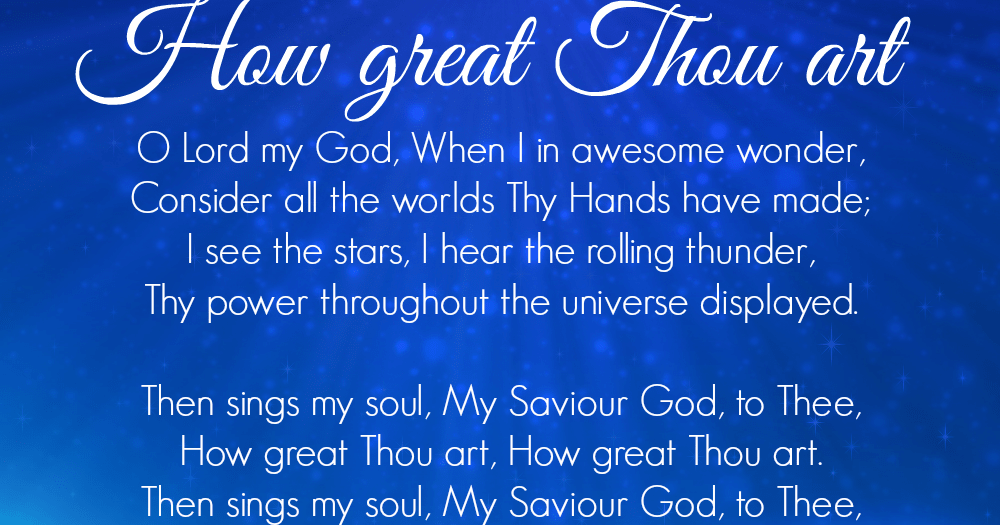
“O Lord my God,/when I in awesome wonder,/consider all the worlds thy hands have made./I see the stars/I hear the rolling thunder,/Thy power throughout the universe displayed.”

This echoes Psalm 19:1, which declares: “The heavens declare the glory of God; the skies proclaim the work of his hands.”

It also evokes the imagery revealed in Psalm 29:3-4: “The voice of the Lord is over the waters; the God of glory thunders, the Lord thunders over the mighty waters. The voice of the Lord is powerful; the voice of the Lord is majestic.”

As we enjoy God’s creation – from the sparkling stars to the powerful thunder, to the forest glades we each wander through – we can’t help but marvel at the wondrous beauty of its precise design and power.

 Nature itself is evidence of God’s glory and creativity. Romans 1:20 points out:

“For since the creation of the world God’s invisible qualities – his eternal power and divine nature – have been clearly seen, being understood from what has been made, so that people are without excuse.” 

Psalm 104:24 celebrates God’s creative power: “How many are your works, LORD! In wisdom you made them all; the earth is full of your creatures.” 

Job 9:10 says about God: “He performs wonders that cannot be fathomed, miracles that cannot be counted.”

Throughout the entire song, “How Great Thou Art” emphasizes the importance of noticing the wonder of God’s work around us. Every single part of God’s creation shows us something valuable about God that can inspire us with awe. Singing “How Great Thou Art” can motivate us to spend time in nature as often as possible, experiencing environments that help us discover God’s greatness.

2. God’s holiness and righteousness.

Another profound truth “How Great Thou Art” reveals about God is his perfect holiness and righteousness.

The awe expressed in the hymn’s refrain, “Then sings my soul, My Savior God, to Thee,/How great Thou art, How great Thou art!” reminds us of the vision of God’s holiness the Bible describes in Isaiah 6:3, where the seraphim angels call to one another:

“Holy, holy, holy is the Lord Almighty; the whole earth is full of his glory.”

God’s holiness means that he is absolutely uncorrupted by sin and completely morally pure.

Psalm 145:17 “The Lord is righteous in all his ways and faithful in all he does.”

The hymn’s refrain captures the reverent awe we feel when we think about God’s great holiness and righteousness.

In 2 Corinthians 5:21, we see that God’s holiness and righteousness are accessible to us through relationships with Jesus: “God made him who had no sin to be sin for us, so that in him we might become the righteousness of God.”

This profound truth should inspire us to praise God like the hymn’s refrain does. It aught also to motivate us all to live lives that reflect God’s character by growing to be more holy ourselves.

Ephesians 4:24 encourages us to: “… put on the new self, created to be like God in true righteousness and holiness.” The refrain of “How Great Thou Art” calls us to strive for a greater, deeper, reverence for God’s majesty. It highlights a grateful response to God’s perfect nature, inspires us to make that response our own.

3. God’s constant presence with us.

“How Great Thou Art” reflects on God’s constant presence with us as it describes experiencing the extraordinary presence of God during ordinary moments like walking in nature: “When through the woods and forest glades I wander,/and hear the birds sing sweetly in the trees./ When I look down, from lofty mountain grandeur/And see the brook, and feel the gentle breeze.”

In Psalm 23:4, King David also uses the imagery of walking to describe the power of God’s constant presence:

“Even though I walk through the darkest valley, I will fear no evil, for you are with me; your rod and your staff, they comfort me.”

Throughout the Bible, God promises us to be present with us.

In Exodus 33:14, God assures Moses, “My presence will go with you, and I will give you rest.”

In Matthew 28:20, Jesus promises his disciples: “…And surely I am with you always, to the very end of the age.” 

God’s presence is a tangible reality we each can experience regularly through reading,  study, prayer, meditation, other spiritual disciplines and practices.

In fact, if we have saving relationships with Jesus, God’s Holy Spirit comes to live right inside our souls, as 1 Corinthians 3:16 points out: “Don’t you know that you yourselves are God’s temple and that God’s Spirit dwells in your midst?”

Psalm 139 beautifully describes God’s presence with us everywhere, pointing out in verses 7-10:

“Where can I go from your Spirit? Where can I flee from your presence? If I go up to the heavens, you are there; if I make my bed in the depths, you are there. If I rise on the wings of the dawn, if I settle on the far side of the sea, even there your hand will guide me, your right hand will hold me fast.”

In its refrain, “How Great Thou Art” encourages us all to notice God’s loving presence with us wherever we go – even unto the furthest reaches of eternity.

4. God’s plan to save us.

One of the most moving verses in “How Great Thou Art” declares: “And when I think that God, his Son not sparing, sent him to die, I scarce can take it in./That on the cross, my burden gladly bearing,/He bled and died to take away my sin.”

This verse reminds us of what is perhaps the most famous Bible verse of all, John 3:16: “For God so loved the world that he gave his one and only Son, that whoever believes in him shall not perish but have eternal life.”

John 3:17 Complete Jewish Bible

17 For God did not send the Son into the world to judge the world, but rather so that through him, the world might be saved.

The timeless hymn’s reflection on God’s profound love for us through Jesus’s coming and ultimate sacrifice invites each and every single one of us to feel a reverent awe at God’s wondrous plan to save our souls from sin and death.

Jesus’ death on the cross made it possible for humanity to connect with God again, as 2 Corinthians 5:17-18:

“Therefore, if anyone is in Christ, the new creation has come: The old has gone, the new is here! All this is from God, who reconciled us to himself through Christ and gave us the ministry of reconciliation.”

In Ephesians 1:7-8, The Bible highlights the enormous generosity of God’s grace through his plan to save us:

“In him we have redemption through his blood, the forgiveness of sins, in accordance with the riches of God’s grace that he lavished on us…”.

Isaiah 53:5 prophesies about Jesus’ healing work for us on the cross:

“But he was pierced for our transgressions, he was crushed for our iniquities; the punishment that brought us peace was on him, and by his wounds we are healed.” 

Jesus offers forgiveness from sins to all who place their faith in him, fulfilling God’s plan to save us.

Singing “How Great Thou Art” can help us focus on the greatest gift of all that God has given us through Jesus, the world’s Savior. Just like the song says, we “scarce can take it in,” but it’s still important to remember it on a regular basis.

5. God’s Unchanging promise of eternal life.

“How Great Thou Art” concludes with a triumphant declaration of hope:

“When Christ shall come with shout of acclamation/And take me home, what joy shall fill my heart./ Then I shall bow, in humble adoration,/And then proclaim: ‘My God, how great Thou art!’”

This evokes the promise of Revelation 21:4, which envisions our future joy in heaven, saying about God:

“He will wipe every tear from their eyes. There will be no more death or mourning or crying or pain, for the old order of things has passed away.”

Jesus describes our eternal life with him when he says in John 14:2-3:

“My Father’s house has many rooms; if that were not so, would I have told you that I am going there to prepare a place for you? And if I go and prepare a place for you, I will come back and take you to be with me that you also may be where I am.” 

Titus 1:2 assures us that we have “…the hope of eternal life, which God, who does not lie, promised before the beginning of time.”

When we sing the song “How Great Thou Art,” we joyfully celebrate the reality of this unending hope. “How Great Thou Art” reminds us that our great God has prepared great joy for us to experience in heaven with him for eternity. 

In conclusion, “How Great Thou Art” is an incredibly stirring powerful worship hymn that resoundingly declares and proclaims and celebrates God’s greatness.

It invites us to

explore the wonders of God’s glory displayed in creation,

explore God’s perfect holiness and righteousness,

explore God’s constant presence with us,

explore God’s loving plan to save us,

discover God’s promise of eternal life for all who choose relationships with him.

As we sing “How Great Thou Art,” we cannot help but to perceive, to receive so much more of God’s awe-inspiring greatness and worship him with gratitude.

In the name of God, the Father and God the Son and God the Holy Spirit,

Let us Pray,

Psalm 29 Complete Jewish Bible

29 (0) A psalm of David:

(1) Give Adonai his due, you who are godly;
give Adonai his due of glory and strength;
give Adonai the glory due his name;
worship Adonai in holy splendor.

The voice of Adonai is over the waters;
the God of glory thunders,
Adonai over rushing waters,
the voice of Adonai in power,
the voice of Adonai in splendor.

The voice of Adonai cracks the cedars;
Adonai splinters the cedars of the L’vanon
and makes the L’vanon skip like a calf,
Siryon like a young wild ox.

The voice of Adonai flashes fiery flames;
the voice of Adonai rocks the desert,
Adonai convulses the Kadesh Desert.
The voice of Adonai causes deer to give birth
and strips the forests bare —
while in his temple, all cry, “Glory!”
10 Adonai sits enthroned above the flood!
Adonai sits enthroned as king forever!
11 May Adonai give strength to his people!
May Adonai bless his people with shalom!

Glory be to the Father,
and to the Son, and to the Holy Ghost;
as it was in the beginning,
is now, and ever shall be,
world without end. Amen, amen.

https://translate.google.com/

The Fullness of God’s glory is on tour across the skies, God-craft on exhibit across the greatest horizon. Psalm 19

Psalm 19 Complete Jewish Bible

19 (0) For the leader. A psalm of David:

2 (1) The heavens declare the glory of God,
the dome of the sky speaks the work of his hands.
3 (2) Every day it utters speech,
every night it reveals knowledge.
4 (3) Without speech, without a word,
without their voices being heard,
5 (4) their line goes out through all the earth
and their words to the end of the world.

In them he places a tent for the sun,
6 (5) which comes out like a bridegroom from the bridal chamber,
with delight like an athlete to run his race.
7 (6) It rises at one side of the sky,
circles around to the other side,
and nothing escapes its heat.

8 (7) The Torah of Adonai is perfect,
restoring the inner person.
The instruction of Adonai is sure,
making wise the thoughtless.
9 (8) The precepts of Adonai are right,
rejoicing the heart.
The mitzvah of Adonai is pure,
enlightening the eyes.
10 (9) The fear of Adonai is clean,
enduring forever.
The rulings of Adonai are true,
they are righteous altogether,
11 (10) more desirable than gold,
than much fine gold,
also sweeter than honey
or drippings from the honeycomb.
12 (11) Through them your servant is warned;
in obeying them there is great reward.

13 (12) Who can discern unintentional sins?
Cleanse me from hidden faults.
14 (13) Also keep your servant from presumptuous sins,
so that they won’t control me.
Then I will be blameless
and free of great offense.

15 (14) May the words of my mouth
and the thoughts of my heart
be acceptable in your presence,
Adonai, my Rock and Redeemer.

The Word of God for the Children of God.

Glory be to the Father,
and to the Son, and to the Holy Ghost;
as it was in the beginning,
is now, and ever shall be,
world without end. Amen, amen.

Then Sings My Soul, My Savior God to Thee …

The hymn “How Great Thou Art” is a timeless worship song, cherished by generations of believers for its inspiring description of God’s greatness.

Its verses resonate deeply in our souls, leading us into moments of awe as we contemplate the wonder of who God is and how God works in our world.

“How Great Thou Art” is a classic hymn that remains popular today because it invites us to marvel in fresh ways at our Creator’s beautifully designed creation and his wonderful presence in our lives.

Each verse of this song serves as a gateway to understanding God more deeply and celebrating our great God in worship. When we are all singing this most beloved hymn “How Great Thou Art,” we truly grow closer to our great God.

The hymn originated as a poem written by Swedish pastor Carl Boberg in 1885. Boberg was inspired to write the poem after experiencing a wondrous sight in nature: a sudden thunderstorm followed by a clear, beautiful view over a bay.

The poem was set to music in Sweden, and the song later went through various translations. In the 20th century, British missionary Stuart Hine translated the hymn into English and expanded it with additional verses. Hine’s version of “How Great Thou Art” became popular around the world after George Beverly Shea sang it during the Billy Graham’s evangelistic crusades in the 1950s.

Here are five truths “How Great Thou Art” reveals about God.

1. God’s great glory in creation.

The opening lines of “How Great Thou Art” exclaim:

“O Lord my God,/when I in awesome wonder,/consider all the worlds thy hands have made./I see the stars/I hear the rolling thunder,/Thy power throughout the universe displayed.”

This echoes Psalm 19:1, which declares: “The heavens declare the glory of God; the skies proclaim the work of his hands.”

It also evokes the imagery in Psalm 29:3-4: “The voice of the Lord is over the waters; the God of glory thunders, the Lord thunders over the mighty waters. The voice of the Lord is powerful; the voice of the Lord is majestic.”

As we enjoy God’s creation – from the sparkling stars to the powerful thunder – we can’t help but marvel at the wondrous beauty of its precise design, power. 

Nature itself is evidence of God’s glory and creativity. 

Romans 1:20 points out: “For since the creation of the world God’s invisible qualities – his eternal power and divine nature – have been clearly seen, being understood from what has been made, so that people are without excuse.”

Psalm 104:24 celebrates God’s creative power: “How many are your works, LORD! In wisdom you made them all; the earth is full of your creatures.” 

Job 9:10 says about God: “He performs wonders that cannot be fathomed, miracles that cannot be counted.”

Throughout the entire song, “How Great Thou Art” emphasizes the importance of noticing the wonder of God’s work around us.

Every single part of God’s creation shows us something valuable about God that can inspire us with awe.

Singing “How Great Thou Art” can motivate us to spend time in nature as often as possible, experiencing environments that help us discover God’s greatness.

2. God’s holiness and righteousness.

Another profound truth “How Great Thou Art” reveals about God is his perfect holiness and righteousness.

The awe expressed in the hymn’s refrain, “Then sings my soul, My Savior God, to Thee,/How great Thou art, How great Thou art!” reminds us of the vision of God’s holiness the Bible describes in Isaiah 6:3, where the seraphim angels call to one another: “Holy, holy, holy is the Lord Almighty; the whole earth is full of his glory.”

God’s holiness means that he is absolutely uncorrupted by sin and completely morally pure.

As Psalm 145:17 says: “The Lord is righteous in all his ways and faithful in all he does.” The hymn’s refrain captures the full reverent awe we feel when we think, search Scriptures and meditate about God’s great holiness and righteousness.

In 2 Corinthians 5:21, we read that God’s holiness and righteousness are accessible to us through relationships with Jesus: “God made him who had no sin to be sin for us, so that in him we might become the righteousness of God.”

This profound truth should inspire us to praise God like the hymn’s refrain does. It should also motivate us to live lives that reflect God’s character by growing to be more holy ourselves. (1 Peter 1:15-16)

15 But like the Holy One who called you, be holy yourselves in all your conduct [be set apart from the world by your godly character and moral courage]; 16  because it is written, “You shall be holy (set apart), for I am holy.”

Ephesians 4:24 encourages us to: “… put on the new self, created to be like God in true righteousness and holiness.” The refrain of “How Great Thou Art” calls us to a deeper reverence for God’s majesty. It highlights a grateful response to God’s perfect nature and inspires us, motivates us, to make that response our own.

3. God’s constant presence with us.

“How Great Thou Art” reflects on God’s constant presence with us as it describes experiencing the extraordinary presence of God during ordinary moments like walking in nature: “When through the woods and forest glades I wander,/and hear the birds sing sweetly in the trees./ When I look down, from lofty mountain grandeur/And see the brook, and feel the gentle breeze.”

In Psalm 23:4, King David also uses the imagery of walking to describe the power of God’s constant presence: “Even though I walk through the darkest valley, I will fear no evil, for you are with me; your rod and your staff, they comfort me.”

Throughout the Bible, God promises us to be present with us.

In Exodus 33:14, God assures Moses, “My presence will go with you, and I will give you rest.”

In Matthew 28:20, Jesus promises his disciples: “…And surely I am with you always, to the very end of the age.” 

God’s presence is a tangible reality we can experience regularly through prayer, meditation, and other spiritual practices.

In fact, if we have saving relationships with Jesus, God’s Holy Spirit comes to live right inside our souls, as 1 Corinthians 3:16 points out: “Don’t you know that you yourselves are God’s temple and that God’s Spirit dwells in your midst?”

Psalm 139 beautifully describes God’s presence with us everywhere, pointing out in verses 7-10: “Where can I go from your Spirit? Where can I flee from your presence? If I go up to the heavens, you are there; if I make my bed in the depths, you are there. If I rise on the wings of the dawn, if I settle on the far side of the sea, even there your hand will guide me, your right hand will hold me fast.”

In its refrain, “How Great Thou Art” encourages us to notice God’s loving presence with us wherever we go.

4. God’s plan to save us.

One of the most moving verses in “How Great Thou Art” declares: “And when I think that God, his Son not sparing, sent him to die, I scarce can take it in./That on the cross, my burden gladly bearing,/He bled and died to take away my sin.”

This verse reminds us of what is perhaps the most famous Bible verse of all, John 3:16: “For God so loved the world that he gave his one and only Son, that whoever believes in him shall not perish but have eternal life.”

The hymn’s reflection on God’s profound love for us through Jesus’s ultimate sacrifice invites us to feel awe at God’s wondrous plan to save our souls from sin and death.

Jesus’ death on the cross made it possible for humanity to connect with God again, as 2 Corinthians 5:17-18:

“Therefore, if anyone is in Christ, the new creation has come: The old has gone, the new is here! All this is from God, who reconciled us to himself through Christ and gave us the ministry of reconciliation.”

In Ephesians 1:7-8, The Bible highlights the enormous generosity of God’s grace through his plan to save us:

“In him we have redemption through his blood, the forgiveness of sins, in accordance with the riches of God’s grace that he lavished on us…”.

Isaiah 53:5 prophesies about Jesus’ healing work for us on the cross:

“But he was pierced for our transgressions, he was crushed for our iniquities; the punishment that brought us peace was on him, and by his wounds we are healed.”

Jesus offers forgiveness from sins to all who place their faith in him, fulfilling God’s plan to save us.

Singing “How Great Thou Art” can help us focus on the greatest gift of all that God has given us through Jesus, the world’s Savior. Just like the song says, we “scarce can take it in,” but it’s still important to remember it on a regular basis.

5. God’s promise of eternal life.

“How Great Thou Art” concludes with a triumphant declaration of hope:

“When Christ shall come with shout of acclamation/And take me home, what joy shall fill my heart./ Then I shall bow, in humble adoration,/And then proclaim: ‘My God, how great Thou art!’”

This evokes the promise of Revelation 21:4, which envisions our future joy in heaven, saying about God:

“He will wipe every tear from their eyes. There will be no more death or mourning or crying or pain, for the old order of things has passed away.”

Jesus describes our eternal life with him when he says in John 14:2-3:

“My Father’s house has many rooms; if that were not so, would I have told you that I am going there to prepare a place for you? And if I go and prepare a place for you, I will come back and take you to be with me that you also may be where I am.” 

Titus 1:2 assures us that we have “…the hope of eternal life, which God, who does not lie, promised before the beginning of time.”

When we sing the song “How Great Thou Art,” we joyfully celebrate the reality of this hope. “How Great Thou Art” reminds us that our great God has prepared great joy for us to experience in heaven with him for eternity. 

In conclusion, “How Great Thou Art” is a powerful worship hymn that declares and celebrates God’s greatness.

It beckons us, it invites us, it empowers us. to explore, to discover, the wonders of God’s glory displayed in creation, God’s perfect holiness and righteousness, God’s constant presence with us, God’s loving plan to save each of us, and also God’s total promise of eternal life for all who choose relationships with him.

As we sing “How Great Thou Art,” we can perceive so much more of God’s awe-inspiring greatness and worship him with reverence and with gratitude.

Gather with your friends, start a hymn sing to the tune “row, row your boat.”

Lose yourself, fully and completely and utterly in the fullness of our God …

In the name of God the Father and God the Son and God the Holy Spirit,

Let us Pray,

Psalm 29 Complete Jewish Bible

29 (0) A psalm of David:

(1) Give Adonai his due, you who are godly;
give Adonai his due of glory and strength;
give Adonai the glory due his name;
worship Adonai in holy splendor.

The voice of Adonai is over the waters;
the God of glory thunders,
Adonai over rushing waters,
the voice of Adonai in power,
the voice of Adonai in splendor.

The voice of Adonai cracks the cedars;
Adonai splinters the cedars of the L’vanon
and makes the L’vanon skip like a calf,
Siryon like a young wild ox.

The voice of Adonai flashes fiery flames;
the voice of Adonai rocks the desert,
Adonai convulses the Kadesh Desert.
The voice of Adonai causes deer to give birth
and strips the forests bare —
while in his temple, all cry, “Glory!”
10 Adonai sits enthroned above the flood!
Adonai sits enthroned as king forever!
11 May Adonai give strength to his people!
May Adonai bless his people with shalom!

Glory be to the Father,
and to the Son, and to the Holy Ghost;
as it was in the beginning,
is now, and ever shall be,
world without end. Amen, amen.

https://translate.google.com/

Where Exactly Is Our Hope Placed? Temporary Centrality of Our Hope Only In Ourselves. Proverbs 11:4-8

In a worship song from the early 2000s, singer/songwriter Brian Doerksen sings, “Jesus, hope of the nations/ Jesus, comfort for all who mourn/ You are the source of heaven’s hope on earth.”

Looking outward into the world for all of the hope to be found and mined from the ground in all of the far reaching places we have ever traveled on this planet?

Looking upward into the heavens and the uncountable number of far reaching constellations of stars and planets we can never hope to reach – we are limited to this time – to this place – unto these bodies – to these tents which wear out.

But, why should we seek to limit ourselves and where we look for our hope, to look in all the places where the only thing likely to be found is disappointment?

If the only thing we believe we can ever find in life is one disappointment after the other, how is we can continue to justify our personal search for true hope?

Proverbs 11:4-8 The Message

A thick bankroll is no help when life falls apart,
    but a principled life can stand up to the worst.

Moral character makes for smooth traveling;
    an evil life is a hard life.

Good character is the best insurance;
    crooks get trapped in their sinful lust.

When the wicked die, that’s it—
    the story’s over, end of hope.

A good person is saved from much trouble;
    a bad person runs straight into it.

The Word of God for the Children of God.

Adeste Fideles! Laeti Triumphantes! Venite Adoremus! Dominum.

Gloria! In Excelsis Deo! Alleluia, Alleluia, Alleluia, Amen.

Where is Your Hope?

There is a well known country song with the title of “I’ve Been Everywhere.”

Some of the places which account for having “been everywhere” include:

I’ve been to Reno, Chicago, Fargo, Minnesota
Buffalo, Toronto, Winslow, Sarasota
Wichita, Tulsa, Ottawa, Oklahoma
Tampa, Panama, Mattawa, La Paloma
Bangor, Baltimore, Salvador, Amarillo
Tocapillo, Baranquilla, and Perdilla, I’m a killer

I’ve been to Boston, Charleston, Dayton, Louisiana
Washington, Houston, Kingston, Texarkana
Monterey, Faraday, Santa Fe, Tallapoosa
Glen Rock, Black Rock, Little Rock, Oskaloosa
Tennessee to Tennessee Chicopee, Spirit Lake
Grand Lake, Devils Lake, Crater Lake, for Pete’s sake

I’ve been to Louisville, Nashville, Knoxville, Ombabika
Schefferville, Jacksonville, Waterville, Costa Rica
Pittsfield, Springfield, Bakersfield, Shreveport
Hackensack, Cadillac, Fond du Lac, Davenport
Idaho, Jellico, Argentina, Diamantina,
Pasadena, Catalina, see what I mean

I’ve been to Pittsburgh, Parkersburg, Gravelburg, Colorado
Ellensburg, Rexburg, Vicksburg, El Dorado
Larimore, Atmore, Haverstraw, Chatanika
Chaska, Nebraska, Alaska, Opelika
Baraboo, Waterloo, Kalamazoo, Kansas City
Sioux City, Cedar City, Dodge City, what a pity

I’ve been everywhere, man
Crossed the desert’s bare, man
I’ve breathed the mountain air, man
Of travel I’ve had my share, man
I’ve been everywhere

Where exactly in all of those places the song writer has claimed to have been, where exactly was their hope for what ever it was they hoped for, searched for, which compelled them, moved them from one geographical locale to another?

In a worship song from the early 2000s, singer/songwriter Brian Doerksen sings, “Jesus, hope of the nations/ Jesus, comfort for all who mourn/ You are the source of heaven’s hope on earth.”

Looking outward into the world for all of the hope to be found and mined from the ground in all of the far reaching places we have ever traveled on this planet?

Looking upward into the heavens and the uncountable number of far reaching constellations of stars and planets we can never hope to reach – we are limited to this time – to this place – unto these bodies – to these tents which wear out.

But, why should we seek to limit ourselves and where we look for our hope, to look in all the places where the only thing likely to be found is disappointment?

If the only thing we believe we can ever find in life is one disappointment after the other, how is we can continue to justify our personal search for true hope?

Recognizing God’s Sovereignty, Letting God Be True

Luke 12:16-21 English Standard Version

16 And he told them a parable, saying, “The land of a rich man produced plentifully, 17 and he thought to himself, ‘What shall I do, for I have nowhere to store my crops?’ 18 And he said, ‘I will do this: I will tear down my barns and build larger ones, and there I will store all my grain and my goods. 19 And I will say to my soul, “Soul, you have ample goods laid up for many years; relax, eat, drink, be merry.”’ 20 But God said to him, ‘Fool! This night your soul is required of you, and the things you have prepared, whose will they be?’ 21 So is the one  who lays up treasure for himself and is not rich toward God.”

In actuality for all of their bravado, sinners have a little fun – while alive.

They make huge plans for pleasure and posterity.

They expect and hope to do bigger and better things.

They plan to get everything rolling along more perfectly.

Then they die.

Then they have nothing but a casket to show for it.

Then they are nothing – except the book of memories from their funerals.

Death is the great equalizer.

It mercilessly rips from the rich all their wealth; it tears from the strong any athletic prowess; it corrupts the face, body, and hair of the beautiful; it removes the wits and memories of the intelligent; it neuters the authority and power of leaders; it takes from parents their beloved children; it leaves homeless those who loved their fine homes.

No matter what the sinners expected or hoped to do, Our Sovereign God sends His Shepherd to us on our deathbeds and just like that, God takes it all away.

And still we sinners must somehow still find and focus on these words of hope:

Job 1:20-21 English Standard Version

20 Then Job arose and tore his robe and shaved his head and fell on the ground and worshiped. 21 And he said, “Naked I came from my mother’s womb, and naked shall I return. The Lord gave, and the Lord has taken away; blessed be the name of the Lord.”

Instead of focusing on the ‘hope’ found from these words: “Curse God and Die.”

From the Parable in Luke’s Narrative, Jesus told of a rich man who planned new barns to hold his great wealth, and he said to himself, “Soul, thou hast much goods laid up for many years; take thine ease, eat, drink, and be merry.”

But God said to him, “Thou fool, this night thy soul shall be required of thee: then whose shall those things be, which thou hast provided?” (Luke 12:16-21).

Worldly men and woman arrive in life very naked and ignorant, and without exception, they leave the same helpless way – ignorant of what heaven holds.

Ignorant of what incomparable, indescribable, hope the Hope of Heaven has.

Yet they will still waste their lives chasing goals that disappear in one second – the second they die.

They see others die and take nothing with them, yet they keep running as fast as they can on the unmerciful treadmill of ambition, greed, and covetousness until it lets them go, hurls them and sends them off into their death and hell.

Psalm 14:1 New King James Version

Folly of the Godless, and God’s Final Triumph

To the Chief Musician. A Psalm of David.

14 The fool has said in his heart,
“There is no God.”
They are corrupt,
They have done abominable works,
There is none who does good.

One just wants to shout: “Curse God and Die,”

What fools!

Then they have nothing.

Then they are nothing.

Are such words too harsh?

Are such words not harsh enough?

They are nothing compared to the shock of the first second in hell.

In a horrible flash of understanding, every sinner will know there is a God, that their whole earthly life was a waste, that they’ll have an eternity of unbearable torment ahead.

They will not think for a second about the legacy of their big plans on earth, for in an instant they’ll be entirely gone – and remembered by only a precious few.

Why do we think strong warnings about such a future are unabashedly harsh?

Am I deceived by my illusion of the importance of my personal sovereignty?

Are you also deceived of the importance of your own personal sovereignty?

The world is insane!

They set goals of high salaries, prestigious positions, large houses, fancy cars, fine clothes, the most expensive schools for their children, and other ambitions.

Some of them say, even more will find their bully pulpits and charismatically preach and teach and so live like, “He who dies with the most toys – wins.”

They chase after their neighbors “accomplishments” daily to make sure they are not left behind in the mad rush to accumulate things, experience pleasure.

Then “here today then gone tomorrow” they lose everything in one second.

Consider what David wrote about this madness in Psalm 39.

He wrote, “Surely every man walketh in a vain shew: surely they are disquieted in vain: he heapeth up riches, and knoweth not who shall gather them” (Psalm 39:6).

Solomon, after experimenting with more than you can even imagine, added this summary: “I have seen all the works that are done under the sun; and, behold, all is vanity and vexation of spirit” (Ecclesiastes 1:14).

Believe it!

Consider what David wrote in Psalm 49.

Psalm 49:16-20 English Standard Version

16 Be not afraid when a man becomes rich,
    when the glory of his house increases.
17 For when he dies he will carry nothing away;
    his glory will not go down after him.
18 For though, while he lives, he counts himself blessed
    —and though you get praise when you do well for yourself—
19 his soul will go to the generation of his fathers,
    who will never again see light.
20 Man in his pomp yet without understanding is like the beasts that perish.

There the Lord ridiculed the insanity of the rich and their ambitions.

It is a sermon to warn all men of the vanity of worldly riches.

Whether a man or a woman is wise or foolish, they die, and they cannot take anything with him.

There is nothing a rich man or woman can do to buy their way out of death.

Everything sinners hope for and plan for ends at death – their expectations and hopes perish.

All they valued is totally wiped out by the reality of the grave they’ll rest in.

They will never again be able to travel across the vast expanses of the earth, watch another Super Bowl, attend a World Series, or bet on March Madness.

But righteous people have eternal hope in their death (Proverbs 10:28; 14:32), for their expectation is of another world that infinitely far outstrips this world by every degree and measure as light is infinitely superior to chaos and darkness.

Centrality of Hope Found Only in the Resurrection

1 Corinthians 15:51-58 New King James Version

51 Behold, I tell you a [a]mystery: We shall not all sleep, but we shall all be changed— 52 in a moment, in the twinkling of an eye, at the last trumpet. For the trumpet will sound, and the dead will be raised incorruptible, and we shall be changed. 53 For this corruptible must put on incorruption, and this mortal must put on immortality. 54 So when this corruptible has put on incorruption, and this mortal has put on immortality, then shall be brought to pass the saying that is written: “Death is swallowed up in victory.”

55 “O[b] Death, where is your sting?
O Hades, where is your victory?”

56 The sting of death is sin, and the strength of sin is the law. 57 But thanks be to God, who gives us the victory through our Lord Jesus Christ.

58 Therefore, my beloved brethren, be steadfast, immovable, always abounding in the work of the Lord, knowing that your labor is not in vain in the Lord.

As believers in Jesus Christ, we recognize and worship Jesus Christ as the only true hope of the world, and yet it remains undeniably astounding how often we still pin the length, breadth, depths and heights of our hopes on ­human beings.

In all of our history books, it is clear that people are more inclined to find hope in sinful leaders, politicians, and celebrities rather than upon the one true God.

Why do we do this?

Proverbs 11:4-8 continually warns readers even today that placing ‘forever’ hope in humans is futile because human power will 100% come to nothing.

As the apostle Paul tells us, “There is no authority except that which God has established” (Romans 13:1).

By saying this, Paul is assuring believers that in all situations, even in the midst of national turmoil and global crises, God forever remains the only one who has all the Sovereignty and will 100% perpetually hold on to all of God’s ­authority.

Jeremiah 29:10-14 English Standard Version

10 “For thus says the Lord: When seventy years are completed for Babylon, I will visit you, and I will fulfill to you my promise and bring you back to this place. 11  For I know the plans I have for you, declares the Lord, plans for welfare[a] and not for evil, to give you a future and a hope. 12 Then you will call upon me and come and pray to me, and I will hear you. 13 You will seek me and find me, when you seek me  with all your heart. 14 I will be found by you, declares the Lord, and I will restore your fortunes and gather you from all the nations and all the places where I have driven you, declares the Lord, and I will bring you back to the place from which I sent you into exile.

Any human who has “power” has it only because God allows it to be so.

In other words, our hopes and desires must be found, must lie, must rely on and with the only One who created and sits upon the throne of the universe.

Our prayers must be oriented toward Christ, for he is truly the only hope—

The only one with the Authority and the Sovereignty and the Power who can change our minds, transform hearts, disperse powers, and bring restoration.

Children of God, make no boast of tomorrow, for you do not know what will happen tomorrow (Proverbs 27:1).

Proverbs 27:1 New King James Version

My Son, Be Wise

27 Do not boast about tomorrow,
For you do not know what a day may bring forth.

While God allows us to make business plans, God expects us to do so in prudent wisdom, because we will not even, ever, know if we will be alive tomorrow, so we are to submit your plans to God’s will with these words: “For that ye ought to say, If the Lord will, we shall live, and do this, or that” (James 4:15).

We need the breath of life and the breath of God, for any of our plans to work.

In the name of God the Father and God the Son and God the Holy Spirit,

Let us Pray,

Psalm 19 The Message

19 1-2 God’s glory is on tour in the skies,
    God-craft on exhibit across the horizon.
Madame Day holds classes every morning,
    Professor Night lectures each evening.

3-4 Their words aren’t heard,
    their voices aren’t recorded,
But their silence fills the earth:
    unspoken truth is spoken everywhere.

4-5 God makes a huge dome
    for the sun—a superdome!
The morning sun’s a new husband
    leaping from his honeymoon bed,
The daybreaking sun an athlete
    racing to the tape.

That’s how God’s Word vaults across the skies
    from sunrise to sunset,
Melting ice, scorching deserts,
    warming hearts to faith.

7-9 The revelation of God is whole
    and pulls our lives together.
The signposts of God are clear
    and point out the right road.
The life-maps of God are right,
    showing the way to joy.
The directions of God are plain
    and easy on the eyes.
God’s reputation is twenty-four-carat gold,
    with a lifetime guarantee.
The decisions of God are accurate
    down to the nth degree.

10 God’s Word is better than a diamond,
    better than a diamond set between emeralds.
You’ll like it better than strawberries in spring,
    better than red, ripe strawberries.

11-14 There’s more: God’s Word warns us of danger
    and directs us to hidden treasure.
Otherwise how will we find our way?
    Or know when we play the fool?
Clean the slate, God, so we can start the day fresh!
    Keep me from stupid sins,
    from thinking I can take over your work;
Then I can start this day sun-washed,
    scrubbed clean of the grime of sin.
These are the words in my mouth;
    these are what I chew on and pray.
Accept them when I place them
    on the morning altar,
O God, my Altar-Rock,
    God, Priest-of-My-Altar.

Creator God, you made every living thing, and you hold all things together. Lord, bring restoration to this world that desperately needs your leadership and authority.

Adeste Fideles! Laeti Triumphantes! Venite Adoremus! Dominum.

Gloria! In Excelsis Deo! Alleluia, Alleluia, Alleluia, Amen.

https://translate.google.com/

Come! Please Look For Yourselves! To Witness The Stone is Now Rolled Away, Testify Death Is Now Utterly Defeated! Luke 24:1-8

Luke 24:1-8 New King James Version

He Is Risen

24 Now on the first day of the week, very early in the morning, they, [a]and certain other women with them, came to the tomb bringing the spices which they had prepared. But they found the stone rolled away from the tomb. Then they went in and did not find the body of the Lord Jesus. And it happened, as they were [b]greatly perplexed about this, that behold, two men stood by them in shining garments. Then, as they were afraid and bowed their faces to the earth, they said to them, “Why do you seek the living among the dead? He is not here, but is risen!  Remember how He spoke to you when He was still in Galilee, saying, ‘The Son of Man must be delivered into the hands of sinful men, and be crucified, and the third day rise again.’ ” And they remembered His words.

The Word of God for the Children of God.

Adeste Fidelis! Laeti Triumphantes! Venite Adoremus! Dominum.

Gloria! In Excelsis Deo! Alleluia, Alleluia, Alleluia, Amen.

There is a new song of Triumph coming forth from the Heavens above.

Psalm 19 The Message

19 1-2 God’s glory is on tour in the skies,
    God-craft on exhibit across the horizon.
Madame Day holds classes every morning,
    Professor Night lectures each evening.

3-4 Their words aren’t heard,
    their voices aren’t recorded,
But their silence fills the earth:
    unspoken truth is spoken everywhere.

4-5 God makes a huge dome
    for the sun—a superdome!
The morning sun’s a new husband
    leaping from his honeymoon bed,
The daybreaking sun an athlete
    racing to the tape.

That’s how God’s Word vaults across the skies
    from sunrise to sunset,
Melting ice, scorching deserts,
    warming hearts to faith.

7-9 The revelation of God is whole
    and pulls our lives together.
The signposts of God are clear
    and point out the right road.
The life-maps of God are right,
    showing the way to joy.
The directions of God are plain
    and easy on the eyes.
God’s reputation is twenty-four-carat gold,
    with a lifetime guarantee.
The decisions of God are accurate
    down to the nth degree.

10 God’s Word is better than a diamond,
    better than a diamond set between emeralds.
You’ll like it better than strawberries in spring,
    better than red, ripe strawberries.

11-14 There’s more: God’s Word warns us of danger
    and directs us to hidden treasure.
Otherwise how will we find our way?
    Or know when we play the fool?
Clean the slate, God, so we can start the day fresh!
    Keep me from stupid sins,
    from thinking I can take over your work;
Then I can start this day sun-washed,
    scrubbed clean of the grime of sin.
These are the words in my mouth;
    these are what I chew on and pray.

Accept them when I place them
    on the morning altar,
O God, my Altar-Rock,
    God, Priest-of-My-Altar.

Except, who is listening to these raucous words of song and triumph?

The heavens sing their words of the Glory and Triumph of God!

They emanate from the deepest reaches of heaven down to the earth below.

They begin echoing outward unto a sleeping humanity from a place of death.

Hushed and Quiet though they may be in this moment at that place of death, they are none the less quite real and quite audible to those who will come to it.

The song will come unexpectedly to those whose hearts and whose souls were prepared to be curious about it, receive it and see it and then utterly believe it!

In this place of uncleanness and death, there is a sure and certain witness here!

In this place of darkness and stench, there is a sure and certain testimony here!

Let us now lend our eyes and ears to what this witness and testimony might be.

“Welcome to this Happy morning!”

“Welcome all ye curious ones!”  

“Welcome all ye despondent ones!”

“Welcome all ye silent and tearful and mournful ones!”

“Welcome all ye defeated, downtrodden and broken ones!”

“Welcome all ye faith-filled and faithful and hope-filled hopeful ones!”

“It is wonderful to gather in our beautiful Kingdom of God to celebrate the glory and triumph of God and the Resurrection of our Lord and Savior Jesus Christ.”

Yes! there is, emanating from here a new, fresh song of witness and testimony.  

Except, no one in particular is hearing, even listening to the words of welcome.

In fact, if we were to look at this place in that moment, we would see nobody.

Perhaps because the deafening silence of the glorious words “He is not here!” “praise God” are coming from an empty tomb which has been beckoning others where no others are paying attention, in close proximity or listening distance.

The expectancy of the glorious and triumphant message found from within the empty tomb is not one that is even the least bit anticipated, shared nor shouted.

The “Behold, Our God Wins!” witness and the living breathing testimony of the empty tomb sits all alone in a darkened silence in a place of the unclean dead.

Now, finally – a group of women come over the hill and down a path leading to the tomb of the one whom in life had been believed to be their “Messiah King.”

Three days ago, he had been brutally killed, humiliated as the ultimate criminal.

Because of Sabbath rules, he had been hastily buried and sealed behind a rock.

The women came bearing spices which they had prepared to finish preparing the not so pleasant smelling body of their dead best friend and their king.

But instead of finding a sealed tomb they came upon an open one.

Amazingly, unexpectedly, the stone had somehow been rolled off to the side.

Curious and probably just a wee bit afraid of what they would or would not find, they enter the tomb of their Rabbi and find it empty – there was just no corpse.

The women had come to anoint his body for the burial when they suddenly encountered a pair of angels asking this question – “so, why are you here?”

Followed up by the good news, “He is not here; he has risen!

What a great and wholly unexpected sequence of “GOD” events for their souls.

Such wonderful good news.

The faith-filled faithful of God went to the tomb before all others were awake.

With their whole selves, in the darkness, their eyes beheld an open tomb and a rock much too heavy for them to remove by themselves rolled off to the side.

Instead of running away and screaming into the night to tell somebody else, the curiosity of the words to a new song reached their souls, so they all went inside.

They lingered inside and witnessed to an unanticipated, unexpected, emptiness inside the tomb of their fallen Rabbi they could not understand nor easily grasp.

As they were all greatly perplexed by this sequence of events, they clearly see the two men in shiny garments standing there, they clearly hear their words:

Then, as they were afraid and bowed their faces to the earth, they said to them, “Why do you seek the living among the dead? He is not here, but is risen!  Remember how He spoke to you when He was still in Galilee, saying, ‘The Son of Man must be delivered into the hands of sinful men, and be crucified, and the third day rise again.’ ”

“He is NOT here!”

“But, IS Risen!”

Jesus is alive!

Death is defeated!

Witness to, Testify that, The Stone Was Rolled Away

Luke 24:5-8 The Message

4-8 They were puzzled, wondering what to make of this. Then, out of nowhere it seemed, two men, light cascading over them, stood there. The women were awestruck and bowed down in worship. The men said, “Why are you looking for the Living One in a cemetery? He is not here, but raised up. Remember how he told you when you were still back in Galilee that he had to be handed over to sinners, be killed on a cross, and in three days rise up?” Then they remembered Jesus’ words.

The gospel of Luke opened with angels delivering messages to Zacharias, Mary, some shepherds quietly going about their everyday duties protecting the sheep.

And to the shepherds, it was a melodious message of great joy for all people.

The message delivered here was also a message of great joy to all people.

Death had been conquered.

Jesus had defeated the power of death.

No longer do we have to fear death.

Where, O death, is your victory? Where, O death, is your sting?(1 Corinthians. 15:55).

Implications: the Witness and Testimony of a Rock Rolled Away

When we consider Jesus as Messiah, most of us think immediately in personal terms: Jesus is my Messiah. He forgives my sins. He lives in me. 

All of which, of course, is true.

But 1st-century Jewish expectations concerning the messiahship of Jesus were far broader than that.

If we had talked with a 1st-century Jew about his or her messianic expectations, we would have discovered hopes that were, in a sense far grander in their scope.

The Jews anticipated that their long-awaited Messiah would come to defeat the pagans who held sway over them, to decisively conquer their enemies, then to rebuild the temple, and to once again establish God’s just rule upon the earth.

Theirs was a nationalistic hope—a hope that the Messiah would come and vindicate the nation of Israel.

Jesus’ arrival, together with the miracles He performed, stories He told, and the prophecies He fulfilled, built to a great crescendo of high expectation among His followers, that Jesus was in fact sent of God as their true conquering king.

But just when they began to think that He really would be the one to politically redeem the people of Israel, at Calvary they saw all of their messianic hopes hanging up on a Roman gibbet, a gallows, an ugly instrument of pain and death.

And when Jesus cried out, “It is finished” (John 19:30), many of them must have quite literally agreed – any hope for their future of prosperity – was “finished.”

Now the question beckons us: How, then, did this group of believers, whose messianic hopes had been buried in a Palestinian tomb, not only continue to believe that Jesus was the Messiah but stand in the streets near where He had been executed and make an unashamed declaration of His messiahship?

The answer comes reverberating through the pages of the New Testament is found in the witness of an immovable rock having been summarily removed, somebody physically entering an empty tomb: the bodily resurrection of Jesus!

The angelic announcement to the women who had brought spices to embalm a corpse provoked a radical reassessment of what the believers had witnessed on the past Friday and a complete change in their view of their lives and futures.

When the Messiah reappeared among them, as alive as ever, these previously sad, sorrowful, defeated, brokenhearted disciples were radically transformed into bold, joyful witnesses with the loudest heartfelt songs of God’s triumph.

They now have a sure and certain witness, bearing testimony to the reality of Christ resurrected with a body that could be seen, handled, and touched, and yet also possessing capacities to do what His pre-resurrection body had not done.

His earthly work of salvation was finished;

His life and His reign were most certainly not!

By His Resurrection,

By God’s own Authority and only through God’s power,

His life and His reign were most certainly never going to end

Only in the disciples’ actions that night, seeing the rock moved away, their display of courage and not fear, to physically enter the tomb, enter, witness its emptiness, exit the tomb, hear the words of the two white clad angels, their recognition of His risen presence did Christ’s messiahship finally make sense.

Indeed, what the early Jewish believers discovered when they “found the stone rolled away from the tomb” (Luke 24:2) and saw “Jesus himself stood among them” entering through a locked and sealed door and into the Upper Room (v 36) was that an eternal hope, joy, and triumphant power ignited within their hearts.

And these remain available to all who put their trust in Jesus, the resurrected Messiah.

It is the triumph of the resurrection, and only the triumph of the resurrection, changes our witness of sadness, sorrow, and defeat into hope, joy, and power.

It is the resurrection, and only the resurrection, that declares that our Messiah will defeat His enemies, will restore His people, and will rule from sea to sea.

The Glory of God, The Triumph of God that morning, The resurrection of Jesus our Lord, Savior will change everything about how you go about your day today.

In the name of God, the Father and God the Son and God the Holy Spirit,

Let us Pray,

We Are One with the Risen Christ

Lord of life, we lift our hearts to you. As the dawn breaks, may we carry the unity we share into every moment knowing that we are one with the risen Christ. Lord, we lift our eyes to you. As the sunrises, may this moment stay with us, reminding us to look for the beautiful colors of promise in your word. Lord, we lift our prayers to you. As the dew air falls, may we breathe this morning in and know that like the earth, you sustain us, keep us and work within us always. And so, we lift our voices to you. We celebrate the greatest day in history, when Jesus rose from death, defeated darkness and bathed the world in stunning resurrection light. May we ever live to praise you! Thank you Lord of my my life and my Salvation that, in you, I no longer need to fear death and its great unknown. Instead, I can face it with confidence, knowing that you have truly defeated it. And, that on the other side of death, I will be with you forever.

Adeste Fidelis! Laeti Triumphantes! Venite Adoremus! Dominum.

Gloria! In Excelsis Deo! Alleluia, Alleluia, Alleluia, Amen.

https://translate.google.com/