Romans 15:4 "For whatever was written in earlier times was written for our instruction, so that through perseverance and the encouragement of the Scriptures we might have hope."
Get up early in the morning and witness the sunrise. Stay up late at night and behold the colors of the sunset arrayed against the far, untouchable horizon. The magnificence of the immense universe declares the wonderful handiwork of our Creator God. It forever tells of the amazing work of His creative hand.
It speaks to every single person who has ever lived on this terrestrial globe… of a caring God, Who, in the beginning, created the heavens; formed the earth and spoke, fashioned all that was made in those six astonishing days of creation.
Not one person could be indifferent to the heavenly glories of the day-time sky and the countless wonders of the stunning night-time sphere… as we gaze on the sun and moon and countless array of twinkling stars, which God in His own grace placed into the heavens on the third day of creation.
And God placed them there for signs and seasons… for endless days and for years. They were created to shed their radiant glow and life-giving warmth onto the earth. They were fashioned to rule the day and establish the night, as a perpetual reminder of God’s eternal goodness and His immeasurable greatness.
I need no other encouragement or motivation to know with all of my heart and with all of my soul and all of my mind and strength – to 100% believe in God.
Psalm 19:1-6 Authorized (King James) Version
Psalm 19
To the chief Musician, A Psalm of David.
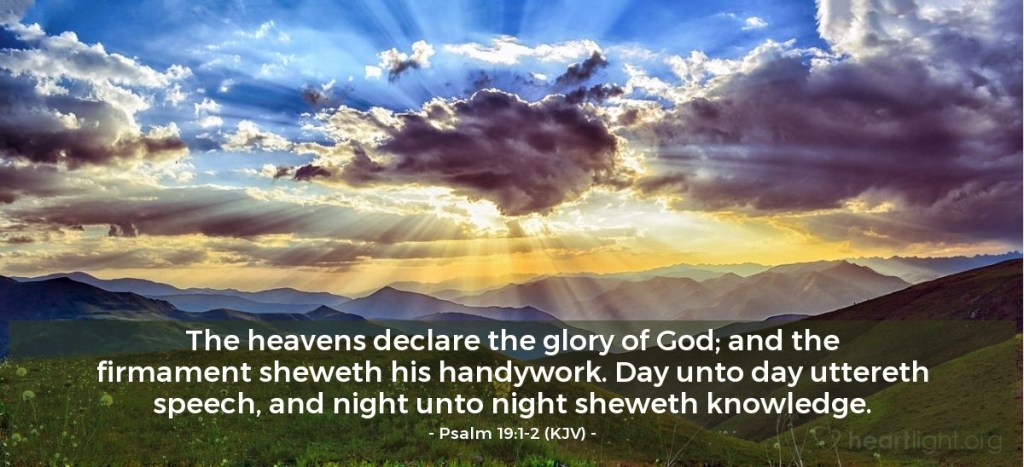
1 The heavens declare the glory of God; and the firmament sheweth his handywork. 2 Day unto day uttereth speech, and night unto night sheweth knowledge. 3 There is no speech nor language, where their voice is not heard. 4 Their line is gone out through all the earth, and their words to the end of the world. In them hath he set a tabernacle for the sun, 5 which is as a bridegroom coming out of his chamber, and rejoiceth as a strong man to run a race. 6 His going forth is from the end of the heaven, and his circuit unto the ends of it: and there is nothing hid from the heat thereof.
The Word of God for the Children of God. Gloria! In Excelsis Deo! Alleluia! Amen.
Psalm 19 is one of the more well-known, beloved psalms—it’s been one of my favorites for as long as I can remember. After studying it a bit more closely, I came away with not only a better appreciation of the psalm itself, but for the true glory of God, which is the David’s whole reason for writing the psalm.
In this psalm, David sits down against the whole backdrop of his native land, from sunrise to sunset he contemplates everything which is before him, listens to what all of creation says about the glory of God, what the Scriptures teach us about the righteousness of God, and how we ought to respond in our prayers.
The Heavens Declare the Glory of God
David opens his psalm by observing the ceaseless speech of creation to glorify God:
1The heavens declare the glory of God, and the sky above proclaims his handiwork.
2Day to day pours out speech, and night to night reveals knowledge.
The ESV has a great English version of Psalm 19, but there is always a lot lost in translation, no matter how faithful you can be to the text.
Look at the tremendously vivid verbs David selects to describe how creation announces the glory of God:
“The heavens declare the glory of God…” would be more literally translated recount, because it’s the word used for actual counting and numbering. When you say that someone recounts a story, however, there’s a sense that they are including every part of the story, bit by bit. All of the heavens have not merely declared the glory of God; they are enumerating every single wondrous detail of God’s glory.
“Day to day pours out speech…” is a very good word equivalent, because this word is used in Proverbs 18:4 to describe a flowing river.
“Night to night reveals knowledge…” property means “breathes out.” The exhaled breath of the night’s speech forms a gentler parallel image to the rushing water of the day’s speech.
Overall, the point of the first two verses is to declare the ceaselessnature of creation’s speech. There is never a silent moment during day or night when creation ceases to pour forth and breathe out its unified witness to God’s glory.
So, we might ask a brief question at this point: Why don’t we hear it? Is this speech bottled up in some kind of soundproof area so that we can’t hear it?
Not at all. Over the next few verses, David insists that the reach of creation’s voice is universal, so that there is no one who fails to hear it.
Creation’s Voice Praises God Through All the Earth
David continues his psalm:
3There is no speech, nor are there words, whose voice is not heard.
4Their voice goes out through all the earth, and their words to the end of the world. In them he has set a tent for the sun,
5which comes out like a bridegroom leaving his chamber, and, like a strong man, runs its course with joy.
6Its rising is from the end of the heavens, and its circuit to the end of them, and there is nothing hidden from its heat.
Notice the insistence on the reach of creation’s voice:
“There is no speech, nor are there words, whose voice is not heard” (v. 3)
“Their voice goes out through all the earth” (v. 4)
“Their words [go out] to the end of the world” (v. 4)
The course of the sun “is from the end of the heavens, and its circuit to the end of them, and there is nothing hidden from its heat” (v. 6)
If creation’s single message is to announce the glory of God, and if creation’s voice reaches to the ends of the earth and beyond—so that there is absolutely nothing hidden from its reach—question then, how is it that we go through our lives mostly numb and oblivious to what creation is shouting at us at all times?
Certainly, there are points in life where a sunrise or a sunset catches our breath, or where we experience the overwhelming joy of looking out across a region of mountains after hiking to the top of one of the peaks, or perhaps where we are humbled to feel small in comparison to the vastness of all the world’s oceans.
But I believe that David clearly (heavenly) has something more in mind here.
All of creation is always declaring to us God’s glory. Every single microscopic organism and every furious tornado recounts the detail, creativity, and power of our Creator. For those who have eyes to see. for those who have ears to hear, let them be thoroughly still, to hear this sermon of praise to our God in heaven.
Why Christians Should Love God’s Creation
If this is true, then here are a few things we should consider in response.
First, this probably means that most of us need to get outside more often—and I’m thinking primarily about myself.
I’d much prefer to be in the artificially created comforts of my heated and air-conditioned home, sheltered from the rawness of nature, but I should probably consider how that short-circuits my ability to understand God.
Creating a carefully tamed environment to live out my days probably is not the single best teacher for understanding God as he is.
Second, this is a great motivation for Christians to pursue science, especially younger Christians who are trying to decide what to do with their lives.
In the current intellectual climate, many Christians are inherently suspicious of science, but Psalm 19 gives us a firm theological foundation for doing science, because science is the systematic exploration of God’s glory in creation.
In point of fact, the scientific revolution would never have happened without Christianity, because it was Christian theology that drove many of the first scientists to desire to discover horizons, exploring God’s world more closely.
The confusion today is that too many scientists actually promulgate a kind of philosophy (or even a religion) which takes as its first principle the belief that Psalm 19 isn’t true—that creation has nothing to do with proclaiming the glory of God. But as Bible believing Christians, I pray we know differently. Our science enlarges possibilities, expands our reach, view of God rather than shrinking it.
Finally, we need to make a mental note to allow ourselves to listen to creation’s praise of God. We are so busy in our lives that we fail to notice some spectacular beauty and wonder and terror within creation most of the time. Every second of every minute of every hour of every day and every night Creation is preaching to us a sermon every day of the week, if we would but listen to it – we’d know God!
As Christians, we should love creation, because creation is God’s handiwork.
In the name of God, the Father and God the Son and God the Holy Spirit,
Let us Pray,
Heavenly Father, when I look into the heavens and see the splendour of Your handiwork and the glories of Your creative power, I am moved as was David to proclaim Your glory and to declare the wonderful works of Your mighty hand. But when I look to the cross of Calvary and see Christ: – born, died, buried and resurrected to life… so that by faith in Him I might be reconciled back to God; be forgiven of my sins and become Your child and heir – I am lost in wonder love and praise, speak to me again and again, enlighten, illuminate me once more. Gloria! In Excelsis Deo! Alleluia! Alleluia! Alleluia! AMEN.
God our Creator, God the Author of our very lives reveals Himself to us in two ways—through the immeasurable expanse of nature and in His written Word.
What do we feel when we encounter God? How do we feel in recitation of this psalm?
We stand in awe of God’s creation and the God who is behind it all. At the same time, our hearts are filled with wonder, admiration, delight, and appreciation for the Word of God. Opening the Bible is like entering a cavern filled with gold, silver, and precious jewels. As we behold the glory, beauty, and holiness of our God, can we not help but be humbled? We hardly belong here. But yet we are all here by the grace of God for His glory. But that is where God’s salvation comes in to play. The psalm ends with confession of sins, a prayer for God’s cleansing, a prayer that our thoughts and our words are pleasing and glorifying unto God.
Psalm 19 The Message
19 1-2 God’s glory is on tour in the skies, God-craft on exhibit across the horizon. Madame Day holds classes every morning, Professor Night lectures each evening.
3-4 Their words aren’t heard, their voices aren’t recorded, But their silence fills the earth: unspoken truth is spoken everywhere.
4-5 God makes a huge dome for the sun—a superdome! The morning sun’s a new husband leaping from his honeymoon bed, The daybreaking sun an athlete racing to the tape.
6 That’s how God’s Word vaults across the skies from sunrise to sunset, Melting ice, scorching deserts, warming hearts to faith.
7-9 The revelation of God is whole and pulls our lives together. The signposts of God are clear and point out the right road. The life-maps of God are right, showing the way to joy. The directions of God are plain and easy on the eyes. God’s reputation is twenty-four-carat gold, with a lifetime guarantee. The decisions of God are accurate down to the nth degree.
10 God’s Word is better than a diamond, better than a diamond set between emeralds. You’ll like it better than strawberries in spring, better than red, ripe strawberries.
11-14 There’s more: God’s Word warns us of danger and directs us to hidden treasure. Otherwise, how will we find our way? Or know when we play the fool? Clean the slate, God, so we can start the day fresh! Keep me from stupid sins, from thinking I can take over your work; Then I can start this day sun-washed, scrubbed clean of the grime of sin. These are the words in my mouth; these are what I chew on and pray. Accept them when I place them on the morning altar, O God, my Altar-Rock, God, Priest-of-My-Altar.
The Word of God for the Children of God. Gloria! In Excelsis Deo! Alleluia! Amen.
In his famous dissertation The End for Which God Created the World, Jonathan Edwards, the great American theologian, proclaimed God’s ultimate end is the manifestation of His glory. This glory is God’s unique excellence—the totality of His intrinsic perfections on display. We cannot pursue life’s ultimate purpose until we realize God created us to discover and declare His glory (1 Cor. 10:31).
The overarching theme of Psalm 19 is the glory of God displayed through the world He created (19:1–6) and the Word He spoke (19:7–14)—or through what we call natural and special revelation. All of creation declares the glory of God!
God’s Glory Is Declared Through His World
Psalm 19:1 The heavens declare the glory of God; and the firmament sheweth his handywork.
The Psalmist David begins by asserting that all of creation displays the glory of God. The entire heavenly panorama—the sun, stars and planets—is telling the story of His glory. The endless expanse of His creation is the work of His skillful hands. All nature shouts that God alone is divine, all-powerful, and all-wise.
Psalm 19:2–3 Authorized King James Version Day unto day uttereth speech, and night unto night sheweth knowledge. There is no speech nor language, where their voice is not heard.
Every hour of everyday God’s message gushes forth like a mighty spring of water. Volumes are being communicated 24/7 about the knowledge of God. There is no language on earth that doesn’t hear God’s voice. He is not silent! If anyone claims to be an atheist, it is because he is deaf to the voice of creation.
Nevertheless, He left not himself without witness, in that he did good, and gave us rain from heaven, and fruitful seasons, filling our hearts with food and gladness. (Acts 14:17)
Psalm 19:4–6 Authorized King James Version Their line is gone out through all the earth, and their words to the end of the world. In them hath he set a tabernacle for the sun, which is as a bridegroom coming out of his chamber, and rejoiceth as a strong man to run a race. His going forth is from the end of the heaven, and his circuit unto the ends of it: and there is nothing hid from the heat thereof.
The Psalmist David brilliantly uses the sun to illustrate how nature reveals God’s wisdom. The psalmist describes the heavens above the earth as a huge tent with the sun lighting the space like a torch. When the sun rises in the morning, its radiant brilliance is like a bridegroom who comes out of his tent beaming with happiness. And when the sun moves in its circuit around the earth, it is like an Olympic winner who genuinely enjoys running his course.
By pointing to the sun as God’s creative handiwork, David also dismantles the idol worship of the day represented in the sun gods. The Heavens declare the Glory of a living God not a god represented by our handiwork. (Acts 17:22-29)
God’s Glory Is Declared Through His Word
We can know that God exists through creation, but general revelation is insufficient for knowing the fullness of God’s character. It is only through Scripture that we are able to more fully comprehend the nature of God.
In Psalm 19:7–9 David gives us, as described by Spurgeon, “six descriptive titles of the word, six characteristic qualities mentioned, and six divine effects declared.” It is as if David picks up a diamond, turns in six different ways, and expresses the brilliance of each facet. https://archive.spurgeon.org/treasury/ps019.php
Psalm 19:7 The law of the Lord is perfect, converting the soul: the testimony of the Lord is sure, making wise the simple.
Authorized King James Version
The Hebrew word for law is Torah. It refers to the first five books of the Old Testament (Genesis through Deuteronomy). However, it doesn’t refer merely to laws, but rather to the doctrines or teachings emanating from these books. The law is fully sufficient (“perfect”) for all the needs of the spiritual life of God’s children and is effective to turn back and restore (“converting”) us when we sin and stray from God. (Exodus 15:22-26)
Psalm 19:7 Authorized King James Version The testimony of the Lord is sure, making wise the simple.
A testimony is a principle found in the law that requires obedience and serves as a warning if not kept. These regulations are pure, right and reliable. The Bible’s narratives consistently show what happens when people obey and disobey God. God gave His children these testimonies to guide the young and the naïve into and unto all God’s greater and greatest wisdom concerning our righteous living.
Psalm 19:8 Authorized King James Version The statutes of the Lord are right, rejoicing the heart:
When a doctor gives you the right medicine to deal with your sickness, it makes you happy. In an even more important way, God’s precepts are true medicine for our souls. They are right for us and bring joy and happiness when followed.
Thy words were found, and I did eat them; and thy word was unto me the joy and rejoicing of mine heart. (Jeremiah 15:16)
Psalm 19:8 The commandment of the Lord is pure, enlightening the eye.
Authorized King James Version
God’s commands are pure, directing our lives morally and doctrinally into the light of God. Otherwise, we stumble along in darkness. As the psalmist prayed, “Thy word is a lamp unto my feet, and a light unto my path” (Psalm 119:105).
Psalm 19:9 The fear of the Lord is clean, enduring for ever:
When we spend quality time deep in the Word of God, it creates within us a reverential respect for God and a deep hatred for sin. This attitude toward sin is not hopelessly old-fashioned but eternally relevant for all people in all times.
Psalm 19:9 The judgments of the Lord are true and righteous altogether.
God’s declarations about what is right and wrong are reliable and trustworthy. You can build and mature your life on all the divine standards of the Scriptures.
Psalm 19:10–11 More to be desired are they than gold, yea, than much fine gold: sweeter also than honey and the honeycomb. Moreover by them is thy servant warned: and in keeping of them there is great reward.
David ends this section by stating the immeasurable value of the Word of God.
As we feed or souls on God’s truth, we discover that our souls are satisfied and delighted. It’s like having the sweet taste of honey perpetually in our mouths.
As we dig into God’s truth, we find that what we are mining is the purest gold possible. The Bible enriches those who engage in studying it and learning it. God’s Word too also protects us by admonishing us to avoid the destructive lifestyles and pathways of sin. Finally, God promises abundant, rewarding consequences if we but make a deliberate choice to strive to keep His Word by weaving it in and throughout our lives, preserving, protecting and obeying it.
Conclusion: Our Declaring the Glory of God
David’s eloquent conclusion to Psalm 19 links back to its introduction—God’s perfections have been put on display. He concludes with His desire to conform to that glory and not one single ounce of his own. As David turns his eyes from the world and the Word back to himself. Suddenly he becomes acutely aware of his own limitations and sinfulness. In light of this astonishing knowledge of God, David realizes what little knowledge he has of himself compared to God.
So the psalm concludes with a penetrating question and an earnest prayer.
Psalm 19:12 Who can understand his errors?
Ask yourselves these questions, as David came to question his place in the universe, and coming to the conclusion of his own insignificance, can anyone really comprehend God’s glorious perfections? Can anyone truly discern his own mistakes in the light of his ignorance of God’s glory? The starting point of conforming to God’s glory is our answering of David’s question with humility.
Psalm 19:12 Cleanse thou me from secret faults.
When we properly view ourselves in the light and glory of God’s perfections, we are “awakened” to the reality that we cannot hide our secrets. God knows, God comprehends, and God also judges everything about us. So, our earnest prayer should be for a deep, deeper still, cleansing of our own internal spiritual toxins.
Psalm 19:13 Keep back thy servant also from presumptuous sins; let them not have dominion over me.
Authorized King James Version
Knowing ourselves should also lead to fearing ourselves, just as Paul cried out, “O, wretched man that I am” (Romans 7:24). We must depend on God to protect us from ourselves! Knowing our flesh is weak, even when our spirit is willing (Matthew 26:41), we should echo what Christ taught us to pray, “Lead us [me] not into temptation, but deliver us [me] from evil” (Matthew 6:13).
Presumptuous sins are rooted in pride. The viewpoint of our flesh is “I can handle this. I can do this all on my own!” Self-reliance causes many failures. Therefore, our greatest protection from sin is glorious humility before God.
Psalm 19:14 Let the words of my mouth, and the meditations of my heart, be acceptable in thy sight, O Lord, my strength, and my redeemer.
David’s earnest prayer here is for internal spiritual transparency before God. Hypocrisy is the religious man’s favorite sin. It is disingenuous to live one way before man, another way before God. David, even through his great mistakes, was passionate about living sincerely before God. He prayed that his verbal communications and internal meditations would be pleasing in God’s sight!
In the end this would not be possible without God’s being our strength (rock), our deliverer and restorer (Redeemer).
Where can you rest your heart? Where can you find some respite for your own soul? Let me suggest that Psalm 19 helps. There are two voices, two qualities, and two responses that can bring the spirit of Psalm 19 to truest life for you.
1. Seek the Two Powerful Voices of God
The first voice is the heavens or the firmament. Psalm 19:1-6 teach the heavens speak daily and speak every language on earth. There is not one person who does not hear the voice. It further describes the heavens as the tent for the sun.
Every person alive is under its influence as it daily makes its way across the sky.
So, what does it say? It declares the glory of God – it points people to God’s eternal power and divine nature (Romans 1:20).
Every day as we go outside and see or feel the effects of the sun on our faces, it is a blessed and true reminder to us of God’s eternal power, His divine nature.
Our response is to recognize the glory of God.
The second voice is the Word of God – the Bible. Psalm 19:7-9 states that as we read and study God’s Word, it transforms us. It restores us, makes us wiser, rejoices the heart, enlightens the eyes, helps us with truth and righteousness.
God’s Word tells us the story of mankind’s creation and fall, the possibility of redemption only in Jesus Christ, and future redemption. Through it we receive wisdom, grow in discernment, and are transformed into the image of God.
2. Explore the Two Qualities of God’s Word
The first quality is intrinsic value. Psalm 19:10 states, “They [God’s words] are of greater value than gold, than even a great amount of pure gold; they bring greater delight than honey, than even the sweetest honey from a honeycomb.”
The psalmist used two very valuable objects to describe the intrinsic value of the Bible. It is of far greater worth than a great amount of the finest gold. In addition, it is sweeter – and thus more desirable – than the finest honey. When the Bible was written, before modern times with all the sweets available today, honey was a delicacy. Here, the psalmist says that God’s words are even of greater delight than that.
The second quality is personal value. Psalm 19:11 teaches that by them you are warned (or in other words, reminded, instructed, and exhorted) and in keeping them through obedience there is a great reward.
So, the Bible provides you two incredible benefits – you receive a warning to help you guard your heart and life, plus you receive great rewards when you follow what the Bible teaches. This instruction and reward, of course, begins with Jesus – the warning of rejecting Him and the reward of accepting Him to receive forgiveness of sin. However, the instruction and reward are actually so much greater as the Bible’s teachings touch every part of life.
3. Respond Daily in Two Life-Changing Ways to God’s Word
The first response is the PRAYER of personal repentance. In Psalm 19:12-13 the psalmist prays the following prayer, “Who can know all his errors? Cleanse me for the sins I am unaware of. Plus, keep me from committing flagrant sins, and do not let those sins control me. Then I will be blameless and innocent of blatant rebellion.”
In this prayer, there is a sense of self-awareness and self-reflection. The idea is that you read God’s Word and then use its teachings to carefully consider your heart and life. You desire to follow God in every way. Therefore, you ask God to cleanse you from those sins you are unaware of that exist and to keep you from allowing the sins you are aware of to control and dominate you.
The second response is the prayer of personal surrender. The prayer of Psalm 19:14 is a PRAYER for all of us to pray each and every day after we have stopped to read and consider God’s voice in the Scriptures. “Let the words of my mouth, and the meditation of my heart be acceptable in Your sight, O Lord, my strength and my Redeemer.”
In this simple, yet ever so eloquent prayer, you essentially dedicate your words and your thoughts to God throughout your day.
Your goal is that God will be glorified and honored in all that you think and all that you say. By implication, this prayer means that there are no thoughtless moments or no idle words. Instead, you purposefully engage your mind throughout the day and intentionally use your words to bring honor to God.
Your thoughts reflect an unyielding spirit of worship (Psalm 42) that comes from your love of Christ; your words demonstrate a love of Christ and love of others as they seek to encourage, enrich, and embolden others.
Furthermore, this prayer reflects a humility that recognizes from Whom your strength actually comes – the power that only God provides in Christ through the indwelling Spirit.
Feel Renewed in Your Response to Our World
As I personally, studiously reflect on Psalm 19, I want to live today in awareness of the two voices of God, two qualities of the Word, and the two responses to the Word. As you do this and daily become aware of God’s voice, the quality of God’s Word, and appropriate responses in prayer, your life will most definitely change.
It is impossible to reflect on God and His Word, to increasing desire His Word, and to pray in reflection of God’s Word without changing to become more like Christ.
What are some helpful ways you can remind yourself of this?
Go outside at the crack of dawn and the darkest night and walk around some. Look at the sun, trees, grass, stars, sky. Remind yourself of God’s voice. Take along your Bible or your Bible app and read some of your favorite Scriptures.
Write out the prayer of Psalm 19:12-14. Try to read it every morning in prayer to God, try rehearsing it throughout your day, read it before bed as a nighttime prayer (at night you might add “and the dreams of my night” to the prayer).
Before long, you will have memorized it, and it will become a daily part of your prayer life. And along the way, will give all the glory you stored up for yourself and in turn heave it upon the God of all Creation, the Author of each of our lives.
In the name of God, the Father and God the Son and God the Holy Spirit,
Let us Pray,
Your work, O God, is glorious. You light up the sunrise, and spread out the sunset. You place the distant stars throughout the universe, and kindle the sun to warm the earth. There is no work as wonderful as yours, Lord. Nothing on earth compares with your craftsmanship.
Yet, in your inscrutable wisdom, you have created human beings as workers, as those who uniquely bear your divine image. We have been honored to share in your divine work, helping this world to be fruitful, guarding it from damage and distress.
Indeed, I am a worker, made to be like you, reflecting your image along with all people. My work will never be anything as amazing as your work, O God. But may what I do through my work, in some small way, reflect your glory, your love, your truth, your beauty.
Gloria! In Excelsis Deo! Alleluia! Alleluia! Alleluia! Amen.


 Loving God, Living God, Loving Hope, Living Hope, Loving Living Life His Way! "Many things are possible for the person who has hope. Even more is possible for the person who has faith. And still more is possible for the person who knows how to love. But everything is possible for the person who practices all three virtues." - Brother Lawrence (1605-1691), Practicing the Presence of God (1692).