Romans 15:4 "For whatever was written in earlier times was written for our instruction, so that through perseverance and the encouragement of the Scriptures we might have hope."
31 For who is God, but the Lord? And who is a rock, except our God?— 32 the God who equipped me with strength and made my way blameless. 33 He made my feet like the feet of a deer and set me secure on the heights. 34 He trains my hands for war, so that my arms can bend a bow of bronze. 35 You have given me the shield of your salvation, and your right hand supported me, and your gentleness made me great. 36 You gave a wide place for my steps under me, and my feet did not slip.
The Word of God for the Children of God.
Glory be to the Father, and to the Son, and to the Holy Ghost; as it was in the beginning, is now, and ever shall be, world without end. Amen, amen.

Tozer’s powerful line quoted in sermons & books, ‘What comes into our minds when we think about God is the most important thing about us. ‘ It’s a simple but sharp wake-up call for us to examine the connection between our ‘theology’ (conscious or unconscious), and too everything else about our “Christian” lives.
With that being said, it will always be true that the Word of God encourages all believers to fully rely on God’s strength and His guidance in facing life’s battles, towards enlightening understanding the enemy’s tactics, and achieving victory.
Psalm 18:34-35
34 He teaches my hands to war, so that my arms bend a bow of bronze. 35 You have also given me the shield of your salvation. Your right hand sustains me. Your gentleness has made me great.
The Bible says that we are to fight the good fight of faith and to put on the full armor of God so that we can stand strong and uptight and faithful against the enemy. It also says that the kingdom of God suffers violence and the war-like take it by force. There is no question that there is a raging battle going on in the earthly, spiritual realms and we are called to take our stand, to resist the enemy.
In Psalm 18’s Davidic promise, King David paints an intimate picture of how God Himself intercedes in the affairs of mankind and trains David for battle.
I am seriously encouraged by the NIV Bible translation of Psalm 18:34-35 …
34 He trains my hands for battle; my arms can bend a bow of bronze.35 You give me your shield of victory, and your right hand sustains me; you stoop down to make me great. (NIV)
What a picture of strength intimacy!
God gets intimately, personally involved, up close, face to face and eye to eye.
Even in the midst of preparations for battle, David speaks of a God that gently trains him and sustains him and even stoops down from heaven to make him great. No matter what battle we are facing today, be comforted in knowing that it is God Himself that will put His face to ours, put His Hands on us, equip us to fight the good fight, for every battle belongs to the Lord. He will stoop down beside us, give us His shield of victory and His gentleness will make you great!
On all those battlefields, in hand to hand, eye to eye, combat, on the high seas, and in more contemporary times, in the air – jet plane to jet plane, computers to computers, in the invisible face of terrorism which can explode on the scene at anytime anywhere, to ordinary service men and women who signed their name on the dotted line to serve their country, even during peace time when there are no declared wars – God is always close to those He prepares for war.
In this verse, David reflects on how God equips and empowers him for battle.
He fully acknowledges that it is God and God alone who teaches him the skills of warfare, gives him the strength to persevere, a profound recognition that all of his physical and spiritual capabilities and victories stem from divine assistance.
What does it mean – David: “so that my arms can bend a bow of bronze” mean?
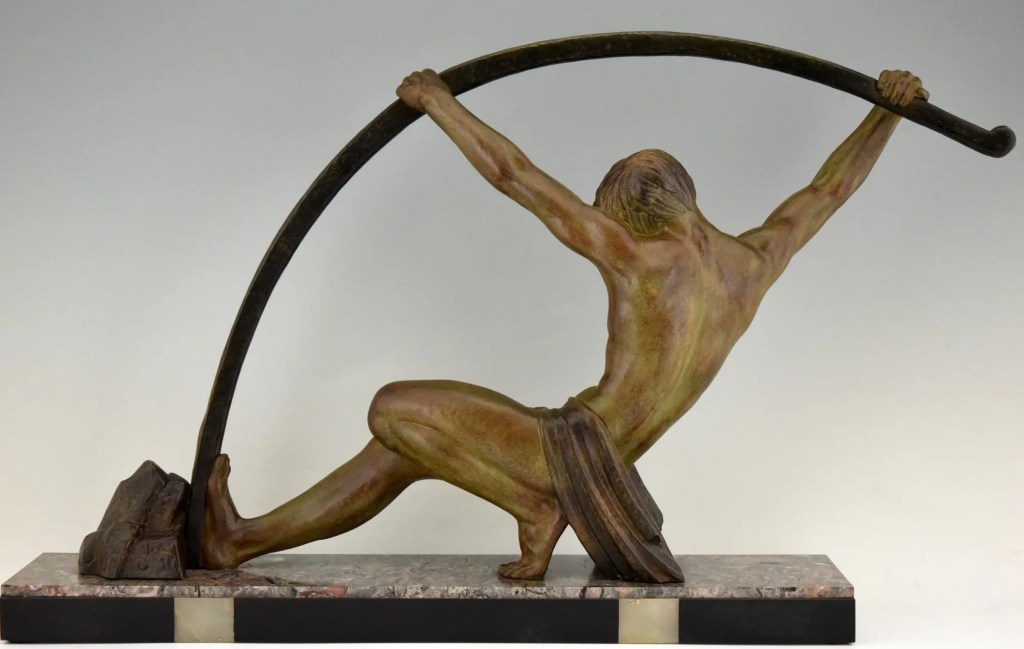
The image comes from Psalm 18, “He trains my hands for war, so that my arms can bend a bow of bronze.”
First logical question to ask ourselves is “Does bronze bend or break?”
Please realize that Bronze is a very sturdy and strong material that does not bend very easily. Its high corrosion resistance also makes it very durable.
Since it’s nearly impossible for someone, anyone, to bend a rod of bronze, I now believe that the bending of the bow symbolizes for the reader the supernatural strength, God alone grants which enables people to do what seems impossible.
Psalm 18:32-34 New American Standard Bible 1995
32 The God who girds me with strength And [a]makes my way [b]blameless? 33 He makes my feet like hinds’ feet, And sets me upon my high places. 34 He trains my hands for battle, So that my arms can bend a bow of bronze.
What is the meaning of Psalms 18:32-34?
This means that whatever battles you and I have in our lives, bear in mind that God and God alone has trained our hands to war, and makes our arms to bend a bow of bronze and fire… any issues that we might have: sickness, challenges, poverty, (you name it) and beside all this, God will always keeps our way secure!
In the name of God, the Father and God the Son and God the Holy Spirit,
Let us Pray,
Psalm 29 New American Standard Bible 1995
The Voice of the Lord in the Storm.
A Psalm of David.
29 Ascribe to the Lord, O [a]sons of the mighty, Ascribe to the Lord glory and strength. 2 Ascribe to the Lord the glory [b]due to His name; Worship the Lord in [c]holy array.
3 The voice of the Lord is upon the waters; The God of glory thunders, The Lord is over [d]many waters. 4 The voice of the Lord is powerful, The voice of the Lord is majestic. 5 The voice of the Lord breaks the cedars; Yes, the Lord breaks in pieces the cedars of Lebanon. 6 He makes Lebanon skip like a calf, And Sirion like a young wild ox. 7 The voice of the Lord hews out [e]flames of fire. 8 The voice of the Lord [f]shakes the wilderness; The Lord shakes the wilderness of Kadesh. 9 The voice of the Lord makes the deer to calve And strips the forests bare; And in His temple everything says, “Glory!”
10 The Lord sat as King at the flood; Yes, the Lord sits as King forever. 11 [g]The Lord will give strength to His people; [h]The Lord will bless His people with peace.
Glory be to the Father, and to the Son, and to the Holy Ghost; as it was in the beginning, is now, and ever shall be, world without end. Amen, amen.
17 When the righteous cry for help, the Lord hears, and delivers them out of all their troubles. 18 The Lord is near to the brokenhearted, and saves the crushed in spirit.
19 Many are the afflictions of the righteous; but the Lord delivers him out of them all. 20 He keeps all his bones; not one of them is broken.
The Word of God for the Children of God.
Glory be to the Father, and to the Son, and to the Holy Ghost; as it was in the beginning, is now, and ever shall be, world without end. Amen, amen.
On the radio the other day I heard a familiar song about how heartbreak feels.
There are probably hundreds, if not thousands, if not more of songs written throughout history about broken hearts and lost loves. Have you ever wondered why musicians and music producers keep writing about that same thing?
Songs like Psalm 13.
Songs like Psalm 137.
Which are the psalms of lament in the Word of God?
Maybe people of whatever time frame -ancient or contemporary, do not tire of those types of songs because everyone can relate to them in some way. Nearly everyone has experienced those hard feelings of emptiness after a breakup, or they have asked themselves “What went so wrong?” after losing their love.
Thankfully God’s Word provides some guidelines to help us hard answer our questions and give us peace of mind when heartache and heartbreak happen.
Psalms of Lament
The psalms of lament are songs and poems in which the psalmist cries out to God in times of deep distress and despair.
In Psalms of lament, the psalmist asks God for intervention to deliver him from suffering, sorrow, great loss, failures, and enemies.
These petitions often give way to the Psalmists expressions of trust in God to act in the psalmist’s favor, leading to hope and joy, faith and peace and love.
There are more psalms of lament than any other type of Psalm.
These Psalms fall into the broad categories of individual or communal (or sometimes both).
Their basic structure includes:
Address to God
Description of complaint
Request for God’s help
Expression of trust in God
Psalm 13
For the choir director. A Psalm of David.
1 How long, O Lord? Will You forget me forever? How long will You hide Your face from me?
2 How long shall I take counsel in my soul, Having sorrow in my heart all the day? How long will my enemy be exalted over me?
3 Consider and answer me, O Lord my God; Enlighten my eyes, or I will sleep the sleep of death,
4 And my enemy will say, “I have overcome him,” And my adversaries will rejoice when I am shaken.
5 But I have trusted in Your lovingkindness; My heart shall rejoice in Your salvation.
6 I will sing to the Lord, Because He has dealt bountifully with me.
When we hurt, Scripture can provide comfort.
It also gives us a way to express how we feel, especially when we don’t know what to say or how to say it.
Much of that language can be found in the Psalms, and many psalms were written by people who shared their feelings candidly and honestly.
David, the writer of Psalm 34, didn’t have to search long for peace, and neither do we. God is near to those who hurt, and we can trust today that the One who gave the sun its ability to shine, who told the waters how far they could go, and who constantly watches over the universe is also near to you—and he’s saying,
“I’ve got this, and I’ve got you.”
Why You Can Be Sure ‘the Lord Is Close to the Brokenhearted’ (Psalm 34:18)
When emotions are strong, I find comfort when reading Psalms.
The heart of a Psalmist is familiar with suffering and consistent in hope.
This pattern emerges time and time again.
The writer expresses an honest struggle, makes a request, and ends with a choice to trust in God.
Some Psalms focus on lament, which means to grieve the loss of something or someone.
Some focus on praise.
But many combine the two, even when several verses reveal the pain of suffering.
One of my favorites is Psalm 34.
The New Living Translation says, “The LORD is close to the brokenhearted; he rescues those whose spirits are crushed.”
Eugene Peterson interprets this verse the Message as, “If your heart is broken, you’ll find God right there; if you’re kicked in the gut, he’ll help you catch your breath.”
What Does Psalm 34:18 Mean for the Brokenhearted?
A brokenhearted person can literally feel the pain of brokenness.
We have physiological responses to loss, grief, and hurtful situations.
Emotional pain can be felt in a very real way, in the body, the mind, and the heart.
Our bodies are actually wired in such a way that emotional pain affects us physically. This is one reason it’s so vital to get honest with our emotions and pursue healing because it impacts all of who we are and how we live.
Brokenheartedness can feel so intense because we do not have what we once did, or what we thought we should have. We have lost something or someone. Also, we may feel all alone. Our body reacts to grief, anger, sadness, and fear.
When we are in this place, our need for something beyond ourselves becomes more evident.
Our enemy would love to keep us from knowing God’s love deeply and receiving the courage we need to move forward when life is hard.
God loves to help us know Him and know His presence with us, especially when life is hard.
Psalm 34:18 reminds us God is not only present with us, but near.
Near to the pain we feel.
Near to the loss we can’t fill.
Near to the needs we have and can’t yet express.
For the brokenhearted, God gives nearness.
God is not removed from knowing about the pain, or from our experience of pain. He is always available and close to those who suffer.
Not only is He near, but he stays with us and will help us get through.
He is not surprised or deterred, no matter how deep the brokenness feels.
God gives us the courage we need to breathe again.
Emotional pain sometimes leaves us speechless.
This Psalm provides words to remind our hearts and talk to God when we cannot find the words ourselves.
God’s presence with us in our messy moments is of great comfort.
What Does Psalm 34:18 Mean for the Crushed in Spirit?
I love the way Eugene Peterson describes how God saves, or rescues, us when our spirits are crushed.
When we feel kicked in the gut, He helps us catch our breath.
When everything has been knocked out of us, and we are depleted, He has what we need to take that first step of getting up again.
God sees and knows the impact of a soul that’s weary and worn.
Consider the following verses:
Proverbs 18:14 “The human spirit can endure in sickness, but a crushed spirit who can bear?”
Proverbs 17:22 “A cheerful heart is good medicine, but a crushed spirit dries up the bones.”
Proverbs 15:13 “A happy heart makes the face cheerful, but heartache crushes the spirit.”
These verses help me feel seen by God because He gets what it feels like to be crushed in spirit.
He’s been there, all alone at the Garden of Gethsemane preparing to suffer and die for us.
He knows it is painful.
It can feel like you’re emptied out, dried up because there’s nothing left to give.
It’s time to receive.
God rescues, or liberates, us from great pain and a weakened spirit, through His great love for each of us.
He sees the distraught places in our hearts and offers to fill them up again.
When we breakthrough to God, receive His love and the gift of His presence, our hearts are calmed, our hearts are sated, which frees us to finally move forward.
What Else Can We Glean from Psalm 34?
Encouragement and praise permeate Psalm 34, especially for the worn-down individual.
Verse 2, “I will glory in the Lord; let the afflicted hear and rejoice.”
Verses 6-7, “This poor man called, and the Lord heard him; he saved him out of all his troubles. The angel of the Lord encamps around those who fear him, and he delivers them.”
Verse 15, “The eyes of the Lord are on the righteous, and his ears are attentive to their cry;”
Verse 17, “The righteous cry out, and the Lord hears them; he delivers them from all their troubles.”
David also invites us to “taste and see that the Lord is good” (verse 8).
Because when we seek refreshment for weariness, we find goodness in God that renews us, restores us, refreshes us. And it’s available as often as we all need it.
God listens. God hears. God acts decisively.
And He is near – as close as the next breath you take.
In the name of God, the Father and God the Son and God the Holy Spirit,
Let us Pray,
Psalm 23 Revised Standard Version
The Divine Shepherd
A Psalm of David.
23 The Lord is my shepherd, I shall not want; 2 he makes me lie down in green pastures. He leads me beside still waters;[a] 3 he restores my soul.[b] He leads me in paths of righteousness[c] for his name’s sake.
4 Even though I walk through the valley of the shadow of death,[d] I fear no evil; for thou art with me; thy rod and thy staff, they comfort me.
5 Thou preparest a table before me in the presence of my enemies; thou anointest my head with oil, my cup overflows. 6 Surely[e] goodness and mercy[f] shall follow me all the days of my life; and I shall dwell in the house of the Lord for ever.[g]
Glory be to the Father, and to the Son, and to the Holy Ghost; as it was in the beginning, is now, and ever shall be, world without end. Amen, amen.
18 So the Lord is waiting to show his mercy to you. He wants to rise and comfort you. The Lord is the God who does the right thing, so he will bless everyone who waits for his help.
19 You people who live in Jerusalem on Mount Zion will not continue crying. The Lord will hear your crying, and he will comfort you. When he hears you, he will help you.
20 The Lord might give you sorrow and pain like the bread and water you eat every day. But God is your teacher, and he will not continue to hide from you. You will see your teacher with your own eyes. 21 If you wander from the right path, either to the right or to the left, you will hear a voice behind you saying, “You should go this way. Here is the right way.”
The Word of God for the Children of God.
Glory be to the Father, and to the Son, and to the Holy Ghost; as it was in the beginning, is now, and ever shall be, world without end. Amen, amen.

Good morning, church family! Today, we’re going to dive into a passage from the book of Isaiah, one that speaks to the very heart of our walk with Jesus.
It’s about God’s favor in times of trouble, His promise of comfort and restoration, and His blessing of divine guidance. These are themes that resonate deeply, especially in these uncertain and challenging times.
Reverend Charles Spurgeon once said, “God is too good to be unkind and He is too wise to be mistaken. And when we cannot trace His hand, we must trust His heart.”
I have to ask, Isn’t that a powerful reminder of God’s unfailing love, wisdom?
God’s Favour in Times of Trouble
In the midst of our trials and tribulations, it is often difficult to perceive God’s favor. Yet, the scripture passage from Isaiah 30:18-21 assures us that God’s favor is not absent in times of trouble, but rather, it is most profoundly present.
The first verse, “Therefore the Lord waits to be gracious to you, and therefore he exalts himself to show mercy to you,” is a powerful testament to God’s enduring love and favor towards us, even in our darkest hours.
Favor definition: The Hebrew word for favor, ‘hen’, connotes grace, kindness, and acceptance. It is a divine attribute that God bestows upon His people, not because we have earned it, but because of His utterly boundless love and mercy.
This favor is not a guarantee of a trouble-free life, but rather, it is the assurance of God’s living presence, guidance, and sustenance in the midst of our troubles.
Not a passive concept: It is not a mere comforting thought to hold onto when we are in distress. Rather, it is an active, dynamic force that propels us forward, enabling us to navigate through our trials with courage, resilience, and hope.
It is God’s favor that gives us the strength to endure, the wisdom to understand, the wisdom to stop, be still, sit still stay still and the faith to trust in His divine plan, even when the sum of our circumstances seem bleak and insurmountable.
God’s favor in times of trouble and uncertainty manifests itself in various ways:
For some, it may be the sudden provision of resources in times of need. For others, it may be the unexpected help from a stranger, the comforting words from a friend, or the inner peace that surpasses all understanding. (John 14:27)
Yet, for all, God’s sure and trustworthy promise of favor is the assurance of His utterly unfailing love, His unwavering presence, and His unchanging promises.
A transformative force:
It not only sustains us in our trials but also shapes us through them.
It molds our character, refines our faith, and deepens our dependence on God.
Through the fires of the very hottest of furnaces of affliction, we are so slowly, inexorably, transformed into vessels of honour, newly fit for the Master’s use.
Proverbs 27:17 Easy-to-Read Version
17 As one piece of iron sharpens another, so friends keep each other sharp.
A testament to His divine justice:
As the scripture says, “For the Lord is a God of justice; blessed are all those who wait for him.” God’s justice is not merely punitive; but it is also restorative.
He brings good out of evil, hope out of despair, strength from weakness, and life out of death.
His favor is His divine response to our human predicament, a testament to His commitment to restore, redeem, and renew all things in His time, in His way.
Not a magic wand that instantly removes our troubles;
Rather, it is the divine assurance that in the midst of our troubles, we are not alone, we are not forgotten, and we are not defeated. It is the divine promise that though we may walk through the valley of the shadow of death, we need fear no evil, for God is with us, His rod and His staff, they always comfort us.
The Promise of Comfort and Restoration
2 Corinthians 13:5-10 Amplified Bible
5 Test and evaluate yourselves to see whether you are in the faith and living your lives as [committed] believers. Examine yourselves [not me]! Or do you not recognize this about yourselves [by an ongoing experience] that Jesus Christ is in you—unless indeed you fail the test and are rejected as counterfeit? 6 But I hope you will acknowledge that we do not fail the test nor are we to be rejected. 7 But I pray to God that you may do nothing wrong. Not so that we [and our teaching] may appear to be approved, but that you may continue doing what is right, even though we [by comparison] may seem to have failed. 8 For we can do nothing against the truth, but only for the truth [and the gospel—the good news of salvation]. 9 We are glad when we are weak [since God’s power comes freely through us], but you [by comparison] are strong. We also pray for this, that you be made complete [fully restored, growing and maturing in godly character and spirit—pleasing your heavenly Father by the lives you live]. 10 For this reason I am writing these things while absent from you, so that when I come, I will not need to deal so severely [with you], in my use of the authority which the Lord has given me [to be used] for building you up and not for tearing you down.
The promises of comfort and restoration are not just a soothing balm for our present pain, but those promises of comfort and restoration also carries with them the solemn assurance of a future restoration that God has planned for us.
God, our Single, Only Greatest Best Friend Forever
Psalm 25:12-18 English Standard Version
12 Who is the man who fears the Lord? Him will he instruct in the way that he should choose. 13 His soul shall abide in well-being, and his offspring shall inherit the land. 14 The friendship[a] of the Lord is for those who fear him, and he makes known to them his covenant. 15 My eyes are ever toward the Lord, for he will pluck my feet out of the net.
16 Turn to me and be gracious to me, for I am lonely and afflicted. 17 The troubles of my heart are enlarged; bring me out of my distresses. 18 Consider my affliction and my trouble, and forgive all my sins.
I will often picture God sitting on an ornate throne made of rare metals, adorned with priceless jewels, and upholstered in the finest fabric.
Some Bible passages portray God in a similar way.
But, what if, for a moment, we close our eyes, quiet our souls, and imagine God differently? What if God—still in all his glory and splendor—isn’t sitting in lavishness associated with royalty but instead is sitting at the corner booth in a local coffee shop, or on the couch in your family room, eagerly waiting for you?
What if God, who is so excited to see you, suddenly, upon seeing you, leaps from his seated position and embraces you, hugs, like a friend who longs to hear how you are doing and what you have been up to? Would you run away or stay still?
While you are sharing a meal, what if God, in both his divine and human nature, gives you his undivided attention as you sit in a corner booth in Burger King and invites you to share with him your life, your story, your joys, your concerns too?
What if . . . ?
How do you see God today?
Or, maybe a better question: How do you need to see God today?
The beauty of God is that he is not only the King of all creation but also the single most patient most attentive of best friends who will always be near.
In the name of God, the Father and God the Son and God the Holy Spirit,
Let us Pray,
Psalm 8 Complete Jewish Bible
8 (0) For the leader. On the gittit. A psalm of David:
2 (1) Adonai! Our Lord! How glorious is your name throughout the earth! The fame of your majesty spreads even above the heavens!
3 (2) From the mouths of babies and infants at the breast you established strength because of your foes, in order that you might silence the enemy and the avenger.
4 (3) When I look at your heavens, the work of your fingers, the moon and stars that you set in place — 5 (4) what are mere mortals, that you concern yourself with them; humans, that you watch over them with such care?
6 (5) You made him but little lower than the angels, you crowned him with glory and honor, 7 (6) you had him rule what your hands made, you put everything under his feet — 8 (7) sheep and oxen, all of them, also the animals in the wilds, 9 (8) the birds in the air, the fish in the sea, whatever passes through the paths of the seas.
10 (9) Adonai! Our Lord! How glorious is your name throughout the earth!
Glory be to the Father, and to the Son, and to the Holy Ghost; as it was in the beginning, is now, and ever shall be, world without end. Amen, amen.
63 (0) A psalm of David, when he was in the desert of Y’hudah:
2 (1) O God, you are my God; I will seek you eagerly. My heart thirsts for you, my body longs for you in a land parched and exhausted, where no water can be found. 3 (2) I used to contemplate you in the sanctuary, seeing your power and glory; 4 (3) for your grace is better than life. My lips will worship you. 5 (4) Yes, I will bless you as long as I live; in your name I will lift up my hands. 6 (5) I am as satisfied as with rich food; my mouth praises you with joy on my lips 7 (6) when I remember you on my bed and meditate on you in the night watches.
8 (7) For you have been my help; in the shadow of your wings I rejoice; 9 (8) my heart clings to you; your right hand supports me.
10 (9) But those who seek to destroy my life — may they go to the lowest parts of the earth. 11 (10) May they be given over to the power of the sword; may they become prey for jackals.
12 (11) But the king will rejoice in God. Everyone who swears by him will exult, for the mouths of liars will be silenced.
The Word of God for the Children of God.
Glory be to the Father, and to the Son, and to the Holy Ghost; as it was in the beginning, is now, and ever shall be, world without end. Amen, amen.
Parched Throat and All: I am Longing for God
(1) O God, you are my God; I will seek you eagerly. My heart thirsts for you, my body longs for you in a land parched and exhausted, where no water can be found.
“Earnestly I seek you.”
“Eagerly I seek you.”
Those dried cracked parched barely audible pleas struggling for expression from the body of someone too long wandering a desert, a heart of Psalm 63.
Though we might not use such poetic language, we can understand what the psalmist is saying here. he is wandering in sun baked sands with no water.
It strikes me that in these words the psalmist is exposing his heart.
He is not asking God for health for himself or his kids; he’s not asking for extra income or a happier marriage.
The psalmist is focusing on his relationship with God.
He longs to see the power of God in worship, take His refreshment of water, reflects on God in the dark of the night, and sings all about God’s protection.
Personally I do not wander around in deserts.
However, there are substantial populations across the globe who do and I can envision them looking at the great expanses of sun dried and wind baked sands.
Where is their next canteen to be filled with life giving water?
In every desert their is water – but one has to be educated on how to find it.
Where is the life giving drinkable water to fill their canteens to sate their thirst?
Search me, O’ God and know my utterly dried out, parched and cracked heart.
Test me, investigate me, and my barely audible, barely able to be spoken heart.
O’ God, see if there is even one tiny drop of any wicked waters remaining in me.
Is there even 1 cold drop of water remaining anywhere to moisten my tongue?
These desperate Psalmist words seeking any kind of expressible refreshment.
I wonder whether we show this kind of desire for God as clearly as the psalmist?
It probably depends on our measure of thirst, how close is it to being a grave threat to our staying alive, level of faith, where we are in our spiritual journey.
I know I am far less “thirsty” for God when I am physically well, when my work, and family are doing fine, when things in our homes are moving right along.
Yet I don’t want my “growing thirst” to even 1% depend on my circumstances.
If desiring God is a good thing, then I have to nurture that desire. My heart really needs to understand the “dry and weary land” in which I live. When I know the arid turf that I call home, I am prepared to pursue the things of real refreshment. As my soul thirsts for God, I will then also drink at the right place.
That is something I earnestly and most eagerly pray for.
A Psalm of David, when he was in the wilderness of Judah – King David had probably wrote this psalm when he was on the run from his son, Absalom. The lesson here is that the situation should not determine whether you call on God or not. Wherever whenever, why ever you are, no matter the situation, good or bad, you should most earnestly desire to communicate with God all the time.
O God, thou art my God – You are a child of God by grace through Jesus Christ. There are assurances, blessings, promises available through Christ. Embrace Christ and you have access to the father. Be bold, enjoy the benefits of sonship.
early will I seek thee – Seeking God early shows eagerness on the part of the one who prays. A good example to follow is Jesus Christ who many times rose up early, went to a secluded place to pray. All His prayers were answered as we found out. Yes you are to pray without ceasing but eagerly learning to commit your day into the hands of your God can only be refreshment, beneficial to you.
my soul thirsteth for thee, my flesh longeth for thee in a dry and thirsty land, where no water is – Your most earnest and eager quest for God is meant to be all consuming because God is the all in all. There is no situation that He can’t change, cannot give refreshment to. The presence of God or the hand of God on any particular matter is all that is needed. When your lasered focus is solely on God without giving allowance for backup, God knows and always comes good.
He is in charge of the showers of blessing from heaven which will cause every desert situation to be Category 5 flooded in Jesus name. He is waiting for you.
In the name of God, the Father and God the Son and God the Holy Spirit,
Let us Pray,
Psalm 23 Authorized (King James) Version
Psalm 23
A Psalm of David.
1 The Lord is my shepherd; I shall not want. 2 He maketh me to lie down in green pastures: he leadeth me beside the still waters. 3 He restoreth my soul: he leadeth me in the paths of righteousness for his name’s sake. 4 Yea, though I walk through the valley of the shadow of death, I will fear no evil: for thou art with me; thy rod and thy staff they comfort me. 5 Thou preparest a table before me in the presence of mine enemies: thou anointest my head with oil; my cup runneth over. 6 Surely goodness and mercy shall follow me all the days of my life: and I will dwell in the house of the Lord for ever.
Glory be to the Father, and to the Son, and to the Holy Ghost; as it was in the beginning, is now, and ever shall be, world without end. Amen, amen.
1 The heavens declare the glory of El, and the sky displays what his hands have made. 2 One day tells a story to the next. One night shares knowledge with the next 3 without talking, without words, without their voices being heard. 4 Yet, their sound has gone out into the entire world, their message to the ends of the earth. He has set up a tent in the heavens for the sun, 5 which comes out of its chamber like a bridegroom. Like a champion, it is eager to run its course. 6 It rises from one end of the heavens. It circles around to the other. Nothing is hidden from its heat.
7 The teachings of Yahweh are perfect. They renew the soul. The testimony of Yahweh is dependable. It makes gullible people wise. 8 The instructions of Yahweh are correct. They make the heart rejoice. The command of Yahweh is radiant. It makes the eyes shine. 9 The fear of Yahweh is pure. It endures forever. The decisions of Yahweh are true. They are completely fair. 10 They are more desirable than gold, even the finest gold. They are sweeter than honey, even the drippings from a honeycomb. 11 As your servant I am warned by them. There is a great reward in following them.
12 Who can notice every mistake? Forgive my hidden faults. 13 Keep me from sinning. Do not let anyone gain control over me. Then I will be blameless, and I will be free from any great offense.
14 May the words from my mouth and the thoughts from my heart be acceptable to you, O Yahweh, my rock and my Go’el.
The Word of God for the Children of God.
Glory be to the Father, and to the Son, and to the Holy Ghost; as it was in the beginning, is now, and ever shall be, world without end. Amen, amen.
Psalm 19:7-14 Easy-to-Read Version
7 The Lord’s teachings are perfect. They give strength to his people. The Lord’s rules can be trusted. They help even the foolish become wise. 8 The Lord’s laws are right. They make people happy. The Lord’s commands are good. They show people the right way to live.
9 Learning respect for the Lord is good. It will last forever. The Lord’s judgments are right. They are completely fair. 10 His teachings are worth more than pure gold. They are sweeter than the best honey dripping from the honeycomb. 11 His teachings warn his servants, and good things come to those who obey them.
12 People cannot see their own mistakes, so don’t let me commit secret sins. 13 Don’t let me do what I know is wrong. Don’t let sin control me. If you help me, I can be pure and free from sin. 14 May my words and thoughts please you. Lord, you are my Rock—the one who rescues me.
David, summing up all that he said about the Word of God, declares that the only thing which can interfere with the Word having its full effect is us.
We are the problem.
If we cannot benefit from the Word, it is not because there is anything wrong with it. It is us who are the problem. Who can discern their own errors?
We are all victims of hidden failure in our lives.
Psalm 139:23-24 Easy-to-Read Version
23 God, examine me and know my mind. Test me and know all my worries. 24 Make sure that I am not going the wrong way.[a] Lead me on the path that has always been right.[b]
Contemplate for a time if these ancient words of scripture excluded “God”
23 ME, examine me and know my mind. ME Test me and know all my worries. 24 ME Make sure that I am not going the wrong way.[a] ME Lead me on the path that has always been right.[b]
If we are the only one’s who are examining ourselves …
If we are the only one’s who are trying to know our own minds …
If we are the only one’s testing ourselves to get at the core of our worries?
If we are the only one’s who are investigating our own “wicked ways?”
Then making sure we where smart enough, wise enough, brutally honest enough, tough enough on ourselves, to hardcore “tough love” ourselves, to accept, heartfelt confess, the .0000001% chance we are going the wrong way?
“Knowing” exactly how much a PhD we are in knowing ourselves, caring for ourselves, instantly perfectly completely correcting, and directing ourselves?
What gets accomplished?
Who accomplishes what?
Who makes sure they get all of the credit for what was accomplished?
If we examine ourselves, we usually look fine – in our view of our facts, we are perfectly fine – no worries – no anxieties – as we set off to swim all the oceans?
Everybody, including themselves, thinks what he does is right. We cannot see, refuse to see, our own errors, we won’t acknowledge these errors, yet these hidden errors are constantly affecting us so we cannot see truth the way it is.
How big a 100% fool can we make of ourselves in the privacy of our homes?
Strutting around in public like some fluorescent tie dyed Peacock in full bloom, How big a 100% fool can we put on the world’s biggest most vivid movie screen?
If we aren’t ourselves becoming even .0000001% self conscious of these errors?
Therefore, we desperately need to be delivered from hidden errors by someone eternally, infinitely, more wise, more honest, more sacrificing of self than we are capable of being or would even entertain one thought we would want to be.
That is what severely hinders our desire for the Word — these hidden errors.
The Psalmist faces the fact that something is wrong with us, so he concludes this Psalm with a wonderful prayer: Forgive my hidden faults (Psalms 19:12b).
Are you so fully and completely contrite of heart to confess with all of your soul and all of your so called strength all of your alleged might that is your prayer?
We know what will happen to ourselves, by ourselves, by our indomitable self wills, dare ourselves to pray for that forgiveness, wait on ourselves to answer.
NOTHING OF ANY AUTHENTIC VALUE OR ANYTHING OF ETERNAL WORTH!
Do you know what will happen when you pray that way AND also include God?
One might allow themselves to fantasize that God will take a sponge and wipe around inside you so that you will not even know what those hidden faults were.
But God does not do that.
Isaiah 55:8-11 Easy-to-Read Version
People Cannot Understand God
8 The Lord says, “My thoughts are not like yours. Your ways are not like mine. 9 Just as the heavens are higher than the earth, so my ways are higher than your ways, and my thoughts are higher than your thoughts.
10 “Rain and snow fall from the sky and don’t return until they have watered the ground. Then the ground causes the plants to sprout and grow, and they produce seeds for the farmer and food for people to eat. 11 In the same way, my words leave my mouth, and they don’t come back without results. My words make the things happen that I want to happen. They succeed in doing what I send them to do.
His way of dealing with hidden faults is either to send somebody to point them out to you – someone like Nathan who entered David’s throne unannounced.
To bring them out, shake them out through some circumstance in which they are suddenly confronted with what they have done or said, and suddenly realize that it is 1000% ugly and they have been caught not by man, but by God himself.
2 Samuel 12:1-14 Easy-to-Read Version
Nathan Speaks to David
12 The Lord sent Nathan to David. Nathan went to him and said, “There were two men in a city. One man was rich, but the other man was poor. 2 The rich man had lots of sheep and cattle. 3 But the poor man had nothing except one little female lamb that he bought. The poor man fed the lamb, and the lamb grew up with this poor man and his children. She ate from the poor man’s food and drank from his cup. The lamb slept on the poor man’s chest. The lamb was like a daughter to the poor man.
4 “Then a traveler stopped to visit the rich man. The rich man wanted to give food to the traveler, but he did not want to take any of his own sheep or cattle to feed the traveler. No, the rich man took the lamb from the poor man and cooked it for his visitor.”
5 David became very angry with the rich man. He said to Nathan, “As the Lord lives, the man who did this should die! 6 He must pay four times the price of the lamb because he did this terrible thing and because he had no mercy.”
Nathan Tells David About His Sin
7 Then Nathan said to David, “You are that rich man! This is what the Lord, the God of Israel, says: ‘I chose[a] you to be the king of Israel. I saved you from Saul. 8 I let you take his family and his wives, and I made you king of Israel and Judah. As if that had not been enough, I would have given you more and more. 9 So why did you ignore my command? Why did you do what I say is wrong? You let the Ammonites kill Uriah the Hittite, and you took his wife. It is as if you yourself killed Uriah in war. 10 So your family will never have peace! When you took Uriah’s wife, you showed that you did not respect me.’
11 “This is what the Lord says: ‘I am bringing trouble against you. This trouble will come from your own family. I will take your wives from you and give them to someone who is very close to you. He will have sexual relations with your wives, and everyone will know it![b]12 You had sexual relations with Bathsheba in secret, but I will punish you so that all the people of Israel can see it.’”[c]
13 Then David said to Nathan, “I have sinned against the Lord.”
Nathan said to David, “The Lord will forgive you, even for this sin. You will not die. 14 But you did things that made the Lord’s enemies lose their respect for him, so your new baby son will die.”
That is the way God cleanses us from hidden faults.
He hardcore pries open the secret places.
Usually he does it through other people, because we cannot see ourselves but other people can see us.
These faults are hidden to us but not to others.
They see them very plainly.
And we can see their hidden faults better than they can.
You say, I don’t see how they can be so blind.
Well, someone is thinking that very same way about you.
We do not see ourselves.
That is why it is always proper to say, Lord, forgive my hidden faults.
Help me to see myself through the eyes of a friend who loves me enough to tell me the truth.
David closes this psalm with these often quoted words which are so wonderfully penetrating that we should pray them often:
May these words of my mouth and this meditation of my heart be pleasing in your sight, Lord, my Rock and my Redeemer (Psalms 19:14).
That is a wonderful prayer, is it not?
This is the attitude that will open the Word of God to us.
When you pray that kind of prayer before you read the Word, you will find that God will (gently in God’s way, hardcore our way) talk to us in a marvelous way.
Deliver Me From Evil
Psalm 19:12 Amplified Bible
12 Who can understand his errors or omissions? Acquit me of hidden (unconscious, unintended) faults.
When I was in grade school, there were many times that I thought a teacher or a parent had eyes in the back of their head.
I could not get away with anything I was not supposed to be doing.
Sometimes my hidden thoughts were identified by those who were not even looking at me. And to prevent me from even trying something out of line, they loudly whispered for all to hear, “Just remember, God sees everything you do.”
Having someone watching our every move can help to keep our secret actions in check, but what about our thoughts and the things we are tempted to say?
When we allow the bright light of God’s law to shine into our inner self, it truly illuminates our hidden faults and lights up a warning.
Without God’s law we are blind to what separates us from God.
The psalmist knows that he cannot see his faults by looking into a mirror.
He looks instead into God’s law and asks God to forgive not only his visible sins but also his hidden faults.
And the God of the Bible does forgive.
Knowing the fact of God’s forgiveness assures the psalmist that he will be blameless in God’s sight. Not completely perfect yet, but blameless now.
In the name of God, the Father and God the Son and God the Holy Spirit,
Let us Pray,
Psalm 40 Amplified Bible
God Sustains His Servant.
To the Chief Musician. A Psalm of David.
40 I waited patiently and expectantly for the Lord; And He inclined to me and heard my cry. 2 He brought me up out of a horrible pit [of tumult and of destruction], out of the miry clay, And He set my feet upon a rock, steadying my footsteps and establishing my path. 3 He put a new song in my mouth, a song of praise to our God; Many will see and fear [with great reverence] And will trust confidently in the Lord.
4 Blessed [fortunate, prosperous, and favored by God] is the man who makes the Lord his trust, And does not regard the proud nor those who lapse into lies. 5 Many, O Lord my God, are the wonderful works which You have done, And Your thoughts toward us; There is none to compare with You. If I would declare and speak of your wonders, They would be too many to count.
6 Sacrifice and meal offering You do not desire, nor do You delight in them; You have opened my ears and given me the capacity to hear [and obey Your word]; Burnt offerings and sin offerings You do not require. 7 Then I said, “Behold, I come [to the throne]; In the scroll of the book it is written of me. 8 “I delight to do Your will, O my God; Your law is within my heart.”
9 I have proclaimed good news of righteousness [and the joy that comes from obedience to You] in the great assembly; Behold, I will not restrain my lips [from proclaiming Your righteousness], As You know, O Lord. 10 I have not concealed Your righteousness within my heart; I have proclaimed Your faithfulness and Your salvation. I have not concealed Your lovingkindness and Your truth from the great assembly.
11 Do not withhold Your compassion and tender mercy from me, O Lord; Your lovingkindness and Your truth will continually preserve me. 12 For innumerable evils have encompassed me; My sins have overtaken me, so that I am not able to see. They are more numerous than the hairs of my head, And my heart has failed me.
13 Be pleased, O Lord, to save me; O Lord, make haste to help me. 14 Let those be ashamed and humiliated together Who seek my life to destroy it; Let those be turned back [in defeat] and dishonored Who delight in my hurt. 15 Let those be appalled and desolate because of their shame Who say to me, “Aha, aha [rejoicing in my misfortune]!” 16 Let all who seek You rejoice and be glad in You; Let those who love Your salvation say continually, “The Lord be magnified!” 17 Even though I am afflicted and needy, Still the Lord takes thought and is mindful of me. You are my help and my rescuer. O my God, do not delay.
Glory be to the Father, and to the Son, and to the Holy Ghost; as it was in the beginning, is now, and ever shall be, world without end. Amen, amen.
(1) Adonai, you have probed me, and you know me. 2 You know when I sit and when I stand up, you discern my inclinations from afar, 3 you scrutinize my daily activities. You are so familiar with all my ways 4 that before I speak even a word, Adonai, you know all about it already. 5 You have hemmed me in both behind and in front and laid your hand on me. 6 Such wonderful knowledge is beyond me, far too high for me to reach.
The Word of God for the Children of God.
Glory be to the Father, and to the Son, and to the Holy Ghost; as it was in the beginning, is now, and ever shall be, world without end. Amen, amen.

Sometimes it may seem like we can’t see the path just ahead of us, and we’re afraid to take the next step which for us may just become the first step into the right direction to God. Rest assured and be encouraged knowing that God knows your path, He knows your lying down, and He is acquainted with all your ways.
The ancient words of the Psalmist from Psalm 119:105 tells us that God’s Word is “a lamp for my feet, a light on my path.” If we’ve ever held a candle-lit lamp, along a dark rainy path at midnight, we understand it doesn’t provide a whole lot of light. Rather, provides just enough light for the steep steps in front of us.
That’s the beauty of having a relationship with God. We don’t need to see all the steepest steps waiting for us ahead in the dark; we can trust God’s in complete control, will provide the level of light we require. Just like we’re told in Psalm 139:3-4, God knows all our paths, He knows all our ways. We can rest in that.
“You comprehend my path and my lying down, and are acquainted with all my ways. For there is not a word on my tongue, but behold, O LORD, You know it altogether.” Psalm 139:3-4
139 6 Such wonderful knowledge is beyond me, far too high for me to reach.
Psalm 139:3 in the King James Version reads, “Thou compassest my path and my lying down, and art acquainted with all my ways.”
This verse comes from a larger passage known as “A Psalm of David,” in which David exuberantly sings, praises, the omniscience and omnipresence of God.
In this particular verse, David expresses awe and gratitude for God’s intimate knowledge, watchfulness and understanding of every single aspect of his life.
The theme of God’s omniscience is central to this verse.
To “compassest my path and my lying down, and art acquainted with all my ways” suggests God is intimately familiar with every moment and aspect of one’s life.
The image of God “compassing” or surrounding one’s path and lying down indicates a continuous presence, encompassing every part of our existence.
This portrayal of God as all-knowing and ever-present is a #1 source of comfort and reassurance for believers, as it demonstrates God’s unceasing attentiveness and limitless resources for caring for His creation – 24 hours a day, everyday.
The context of this verse is also significant.
David, the author of this Psalm, was a man who experienced both triumph and tribulation throughout his life.
He was well acquainted with the lightning quick challenges and uncertainties of life, as well as the great faithfulness and great provision of God.
In this Psalm, David reflects on God’s unwavering presence and guidance, even in the midst of adversity. This verse serves as a reminder for us even today that no single aspect of our lives ever escapes God’s attention, and He is intimately involved in all details, whether in times of joy or sorrow or in deep background.
Additionally, the symbolism used in this verse emphasizes the depth of God’s knowledge and understanding of His people.
The imagery of God always being intimately acquainted with “all my ways” illustrates His profound familiarity with our thoughts, actions, and intentions.
This symbolizes not only God’s omniscience but also His deeply personal investment in the lives of His children.
This depiction of God as intimately involved in the intricacies of our lives underscores the intimacy of the relationship between God and His people.
In contemporary times, the message of Psalm 139:3 continues to offer us all encouragement and reassurance to believers. In a world filled with uncertainty and challenges, the knowledge that God is intimately acquainted with every aspect of our lives provides comfort and strength. It serves as a reminder that we are never alone, and God’s presence encompasses every step we take.
In conclusion, Psalm 139:3 in the King James Version encapsulates the profound truth of God’s never-failing presence and knowledge of His people.
This verse highlights the theme of God’s omniscience, the context of David’s exuberant reflections on God’s unrelenting faithfulness, and the symbolism of God’s intimate understanding of His people – from our conception unto death.
It continues to resonate with believers today, serving as a reminder of God’s unwavering care and 10000% involvement in the lives of all of His children.
God knows our ways, our condition, and our conduct. The Hebrew verb zarah, translated as “search out,” or “scrutinize,” is used of a farmer winnowing his crops to separate the wheat from the chaff. In other words, God examines our ways, 100% investigates our ways so thoroughly that he doesn’t miss a thing.
Thou compassest my path and my lying down
His walk in the daytime, and every step he took, and his lying down at night. It denotes his perfect knowledge of all his actions, day and night; surrounds every single path of man, wide and narrow that they can’t ever escape his knowledge.
1. What emotions or thoughts does God’s omniscience stir in you?
2. How does the omnipresence of God provide comfort in times of loneliness or hardship?
3. How do you respond to the concept of God knowing every detail of your life?
4. How does knowing you are “fearfully and wonderfully made” impact your sense of self-worth?
5. In what ways have you experienced God’s presence in your own life?
6. How does understanding God’s intimate knowledge of you influence your decisions and actions?
7. If God knows our every thought, why do you think prayer is important?
8. David invites God to search and test him. How comfortable are you with this idea and why?
9. What does it mean to be led in the ‘everlasting way’? How does this apply to your life?
10. How can you apply the self-examination David exhibits in your own spiritual journey?
11. David speaks of darkness not being dark to God. How does this alter your perspective of ‘dark’ times in your life?
12. How can you better recognize and appreciate God’s presence in all places and circumstances of your life?
13. How does acknowledging that God knew your unformed substance impact your view on the sanctity of life?
14. How does this Psalm encourage you to respond to those who are hostile towards God or His people?
15. How does understanding God’s omniscience influence your understanding of sin and forgiveness?
16. What can you learn from David’s attitude towards God in this Psalm? How can you adopt a similar mindset?
17. What steps can you take to ensure your words and thoughts are pleasing to God, knowing He is always aware of them?
18. How does the truth of God’s constant presence influence your actions when you’re alone or think no one is watching?
19. How can we apply the concept of being ‘fearfully and wonderfully made’ in our interactions with others?
20. In what ways does the truth of Psalm 139 shape your approach to life’s challenges and opportunities?
In the name of God, the Father and God the Son and God the Holy Spirit,
Let us Pray,
Psalm 121 Complete Jewish Bible
121 (0) A song of ascents:
(1) If I raise my eyes to the hills, from where will my help come? 2 My help comes from Adonai, the maker of heaven and earth. 3 He will not let your foot slip — your guardian is not asleep. 4 No, the guardian of Isra’el never slumbers or sleeps.
5 Adonai is your guardian; at your right hand Adonai provides you with shade — 6 the sun can’t strike you during the day or even the moon at night.
7 Adonai will guard you against all harm; he will guard your life. 8 Adonai will guard your coming and going from now on and forever.
Glory be to the Father, and to the Son, and to the Holy Ghost; as it was in the beginning, is now, and ever shall be, world without end. Amen, amen.
(1) How blessed are those whose offense is forgiven, those whose sin is covered! 2 How blessed those to whom Adonai imputes no guilt, in whose spirit is no deceit!
3 When I kept silent, my bones wasted away because of my groaning all day long; 4 day and night your hand was heavy on me; the sap in me dried up as in a summer drought. (Selah)
5 When I acknowledged my sin to you, when I stopped concealing my guilt, and said, “I will confess my offenses to Adonai”; then you, you forgave the guilt of my sin. (Selah)
6 This is what everyone faithful should pray at a time when you can be found. Then, when the floodwaters are raging, they will not reach to him.
The Word of God for the Children of God.
Glory be to the Father, and to the Son, and to the Holy Ghost; as it was in the beginning, is now, and ever shall be, world without end. Amen, amen.
Sin, Guilt and Your Health – A Health Devotional.
This morning, during my quiet time with God, I was reading Psalm 32 and was reminded of the connection between sin, guilt and health. In this Psalm, David writes when he tried to hide his adultery, sending Uriah to his death, refused to confess his sin that he felt weak and miserable and that he groaned all day long. He also writes that his strength evaporated like water in the dry summer heat.
After reading two other Psalm 32 devotionals, I knew that I wanted to write on this topic of sin, guilt and our health and the interrelationship between them.
Sin, Guilt and Health – What the Bible Says
Psalm 32:1-6 Amplified Bible
Blessedness of Forgiveness and of Trust in God.
Blessed [fortunate, prosperous, favored by God] is he whose transgression is forgiven, And whose sin is covered. 2 Blessed is the man to whom the Lord does not impute wickedness, And in whose spirit there is no deceit.
3 When I kept silent about my sin, my body wasted away Through my groaning all the day long. 4 For day and night Your hand [of displeasure] was heavy upon me; My [b]energy (vitality, strength) was drained away as with the burning heat of summer. Selah. 5 I acknowledged my sin to You, And I did not hide my wickedness; I said, “I will confess [all] my transgressions to the Lord”; And You forgave the guilt of my sin. Selah. 6 Therefore, let everyone who is godly pray to You [for forgiveness] in a time when You [are near and] may be found; Surely when the great waters [of trial and distressing times] overflow they will not reach [the spirit in] him.
Those who work in the fields of psychology, psychiatry, and social services are often confronted with a strong correlation between what is happening in a person’s heart and mind and what is being displayed in that person’s body.
God’s word speaks into this connection and then goes deeper, for it tells us that there is a connection between the state of our body and the state of our soul.
In Psalm 32, David speaks very personally to God, acknowledging the heaviness he experienced when he hid in the shadows and refused to confess his sin against Bathsheba and the murder of her husband, Uriah (see 2 Samuel 11).
And through David, the Spirit teaches us that there is a link between a tortured conscience and lack of repentance, and our physical wellbeing.
Those who were in David’s immediate company may not have been aware of what was going on inside him spiritually, but they could not have avoided the rather obvious manifestations of what was happening to him physically.
The description he provides adds to the account he gives elsewhere: “My heart throbs; my strength fails me, and the light of my eyes—it also has gone from me. My friends and companions stand aloof from my plague, and my nearest kin stand far off” (Psalm 38:10-11). It’s a quite devastating picture.
David recognized his condition for what it was: a punishment.
The Bible makes it clear that there is a natural outcome to lust, excess, and a disregard for the commands of God (see Romans 1:24-25)—all of which David was guilty of. Mood swings, frailty, weight loss, sleeplessness, a deepening sense of rejection, melancholy, anxiety, and despair often haunt individuals who are seeking to hide their “secret” sin from God and deny it to themselves.
What restored David was not a health kick or getting to bed earlier but rather dealing with the root cause—his sin: “I acknowledged my sin to you … and you forgave the iniquity of my sin” (Psalm 32:5).
God kept His hand heavy upon David until Nathan showed up and told him a story which convicted him.
Then David left his throne, placed his sin into God’s hands and asked Him to help him deal with it. It is a blessing to us when God does not allow us to forget our sin—when we feel physical heaviness because of our spiritual sickness.
It is His means of bringing us to do what we most need: to confess it and ask for forgiveness for it.
Fortunately we have a God who loves us incredibly and because of this, he freely reveals his mercy, he forgives us of our sins when we confess our wrongdoings.
Because of the magnitude of his mercy and his forgiveness of our sins, believers should be able to freely surrender over any guilt or shame that they feel.
God does not want us to experience the heaviness associated with chronic guilt.
His desire is that we live in peace and joy which is available to us when we confess our wrongdoings and believe that God gives us mercy, forgives us.
Peace and joy are health-promoting compared to chronic guilt which can be damaging to our health in more ways than anyone dares to acknowledge.
Are we harboring sin?
Do not cloak it; confess it. David experienced liberating relief from his pain and distress when he sought God’s forgiveness.
You too can know that joy, for the promise of God’s word is that
“if we confess our sins, he is faithful and just to forgive us our sins and to cleanse us from all unrighteousness” (1 John 1:9).
A Few Questions to Reflect On:
Are you holding on to guilt and shame because of some past or current sin in your life?
Are you perhaps weak and miserable or plagued with a chronic health related condition – Headaches, High Blood Pressure, tiredness, fatigue, heart ailments that could be caused by the physical strains of coping with long-term guilt?
As soon as possible, to rule out any potentially serious disorder, go see your Primary Care Medical Team for proper assessment, evaluation and treatment
How about issues of anxiety, mood disorders, depression, post traumatic stress disorder, mood swings, irritability, shorter than usual temper control etcetera.
As soon as possible, seek out Licensed Professional Mental Health providers for a proper clinical assessment, evaluation, and therapeutic treatment modalities.
Relieving The Burden of our Guilt and God’s Grace
Psalm 32:6 Amplified Bible
6 Therefore, let everyone who is godly pray to You [for forgiveness] in a time when You [are near and] may be found; Surely when the great waters [of trial and distressing times] overflow they will not reach [the spirit in] him.
Psalm 32 reminds me that a moral compass is embedded within everyone’s heart. When we do not chart our lives by that compass, we feel genuine guilt.
David spoke to that reality in Psalm 32. He had made a total mess of his life. His moral failures included adultery, conspiracy and murder. David acknowledged that when we mess up, we are eaten up inside if we keep quiet until a someone tells us a story, we convict ourselves. David had an inner urge to confess his sin.
Once confronted by Nathan, thus came his release. David confessed his sin to the Lord. Yes, there were people in his life with whom David needed to come clean. But only God could grant the full pardon his soul craved. When we mess up, our guilt is first of all toward our Creator, whose law we have violated.
How do you find real forgiveness?
If you have not confessed sins which you feel guilty of, I urge you to prayerfully make that confession to God so you and those around you or those you will soon meet, can return to feeling peaceful and joyful, which is God’s will for your life.
In the name of God, the Father and God the Son and God the Holy Spirit,
Let us Pray,
Psalm 42 Complete Jewish Bible
Book II: Psalms 42–72
42 (0) For the leader. A maskil of the descendants of Korach:
2 (1) Just as a deer longs for running streams, God, I long for you. 3 (2) I am thirsty for God, for the living God! When can I come and appear before God?
4 (3) My tears are my food, day and night, while all day people ask me, “Where is your God?” 5 (4) I recall, as my feelings well up within me, how I’d go with the crowd to the house of God, with sounds of joy and praise from the throngs observing the festival.
6 (5) My soul, why are you so downcast? Why are you groaning inside me? Hope in God, since I will praise him again for the salvation that comes from his presence. 7 (6) My God, when I feel so downcast, I remind myself of you from the land of Yarden, from the peaks of Hermon, from the hill Mizar. 8 (7) Deep is calling to deep at the thunder of your waterfalls; all your surging rapids and waves are sweeping over me. 9 (8) By day Adonai commands his grace, and at night his song is with me as a prayer to the God of my life. 10 (9) I say to God my Rock, “Why have you forgotten me? Why must I go about mourning, under pressure by the enemy? 11 (10) My adversaries’ taunts make me feel as if my bones were crushed, as they ask me all day long, ‘Where is your God?’ ”
12 (11) My soul, why are you so downcast? Why are you groaning inside me? Hope in God, since I will praise him again for being my Savior and God.
Glory be to the Father, and to the Son, and to the Holy Ghost; as it was in the beginning, is now, and ever shall be, world without end. Amen, amen.
1 I will highly praise you, my Elohim, the Melek. I will bless your name forever and ever. 2 I will bless you every day. I will praise your name forever and ever.
3 Yahweh is great, and he should be highly praised. His greatness is unsearchable. 4 One generation will praise your deeds to the next. Each generation will talk about your mighty acts. 5 I will think about the glorious honor of your majesty and the miraculous things you have done. 6 People will talk about the power of your terrifying deeds, and I will tell about your greatness. 7 They will announce what they remember of your great goodness, and they will joyfully sing about your righteousness. 8 Yahweh is merciful, compassionate, patient, and always ready to forgive. 9 Yahweh is good to everyone and has compassion for everything that he has made. 10 Everything that you have made will give thanks to you, O Yahweh, and your faithful ones will praise you. 11 Everyone will talk about the glory of your kingdom and will tell the descendants of Adam about your might 12 in order to make known your mighty deeds and the glorious honor of your kingdom. 13 Your kingdom is an everlasting kingdom. Your empire endures throughout every generation.
14 Yahweh supports everyone who falls. He straightens the backs of those who are bent over. 15 The eyes of all creatures look to you, and you give them their food at the proper time. 16 You open your hand, and you satisfy the desire of every living thing. 17 Yahweh is fair in all his ways and faithful in everything he does. 18 Yahweh is near to everyone who prays to him, to every faithful person who prays to him. 19 He fills the needs of those who fear him. He hears their cries for help and saves them. 20 Yahweh protects everyone who loves him, but he will destroy all wicked people.
21 My mouth will speak the praise of Yahweh, and all living creatures will praise his holy name forever and ever.
The Word of God for the Children of God.
Glory be to the Father, and to the Son, and to the Holy Ghost; as it was in the beginning, is now, and ever shall be, world without end. Amen, amen.

David’s Generational Psalm of Praise
A. The Psalmist David, speaking on our behalf, on behalf of all generations to come, makes a vow to bless the name of the LORD “forever and ever” (Psalm 145:1); “Every day” to bless Him; to praise His name “for ever and ever” (Psalm 145:2). This is the only Psalm in the book with the words “of praise” in its title.
A lone voice opens the Psalm:
“I” will extol thee; “I” will bless (Psalm 145:1); “I” will bless; “I” will praise (Psalm 145:2).
“I” will speak and declare (Psalm 145:5-6).
The singer refers to the LORD as “my God, O king” (Psalm 145:1), and speaks “of the glorious honour of thy majesty” (Psalm 145:5).
This song of repeated praise is addressed to no earthly king, but to One King whose kingdom ‘is an everlasting kingdom’ (Psalm 145:13).
It is wonderful when, in our alone times with God, in our study and our prayer times, in our worship times, in our fellowship times, meal times, husband and wife times, family times, camping under the stars, we become thus enamored with singing His praises: but what we’ll discover about God, what we discover God to be, is not only for our alone times, but is also to be shared with others.
This is the role of ours and heavens testimony. “Generations” shall praise and declare, one to another (Psalm 145:4). We must not only pray for our children, and children’s children, etc.; but must teach them the great works of God, and obediently pass on to them the mantle of praise down through the generations.
Deuteronomy 6:4-9 Names of God Bible
4 Listen, Israel: Yahweh is our Elohim. Yahweh is the only God. 5 Love Yahweh your Elohim with all your heart, with all your soul, and with all your strength. 6 Take to heart these words that I give you today. 7 Repeat them to your children. Talk about them when you’re at home or away, when you lie down or get up. 8 Write them down, and tie them around your wrist, and wear them as headbands as a reminder. 9 Write them on the doorframes of your houses and on your gates.
The word ‘men’ is not in the Hebrew of Psalm 145:6a, but by the next verse there is a reference to a plurality of persons – “they” – who shall utter and sing (Psalm 145:7).
The “glorious honor” of His majesty is shown forth in His “wondrous works” (Psalm 145:5; cf. Creation story (Genesis 1,2) the Incarnation, the Cross, the Resurrection of Jesus, His Ascension, His intercession at the right hand of God, His Coming in Glory; also, the day of Pentecost the shedding abroad of the Holy Spirit).
“The LORD is gracious, full of compassion, slow to anger, and of great mercy” (Psalm 145:8).
This is similar to the self-revelation of the LORD unto Moses (cf. Exodus 34:6).
It is an integral part of Israel’s understanding of their God (cf. Numbers 14:18; Nehemiah 9:17; Jonah 4:2).
The last Hebrew word in Psalm 145:8, ‘hesed,’ speaks of covenant love, God not dealing with us as we deserve, but dealing with us as we are in Christ Jesus.
The long-suffering of God is the last thread of hope for a perishing generation (cf. 2 Peter 3:9).
We encounter a word which is translated “all” or “every” seventeen times throughout this Psalm.
There is a sense of inclusiveness here, but also the particularity of “each” (Psalm 145:9).
To say that the LORD is good to “all” could be quite general: to say that His tender mercies, or compassion, are over “all” His works, or “all” that He has made, is more specific, much, much deeper in its “heart-soul” implications.
We read in the New Testament about the whole Creation groaning (cf. Romans 8:22), eagerly awaiting the revelation of the children of God (cf. Romans 8:19).
Not only so, but those who have the firstfruits of the Spirit (Christians) are also groaning within ourselves as we await the redemption of the body (cf. Romans 8:23). Even the sufferings of the present time become more endurable when we consider the glory of our Savior God yet to be revealed in us (cf. Romans 8:18).
This psalm shows us the other side of that coin.
All of Creation shall praise the LORD, all His faithful shall bless Him (Psalm 145:10). This “all” is comprehensive, it is extensive, but it also comes down to the level of the ‘each’ as well as the ‘every’ on the uniquely individual level.
As David says in Psalm 103:1, ‘Bless the LORD, O my soul, and all that is within me bless His holy Name!’
Psalm 103:1-5 Names of God Bible
Psalm 103
By David.
1 Praise Yahweh, my soul! Praise his holy name, all that is within me. 2 Praise Yahweh, my soul, and never forget all the good he has done: 3 He is the one who forgives all your sins, the one who heals all your diseases, 4 the one who rescues your life from the pit, the one who crowns you with mercy and compassion, 5 the one who fills your life with blessings so that you become young again like an eagle.
As well as praise, there is conversation (Psalm 145:11).
It is also the case that those who are His saints, His faithful, do speak to one another the Word of God (cf. Malachi 3:16; Ephesians 5:19; Colossians 3:16).
Sharing our testimony is part and parcel of the Christian life.
Sharing heaven’s testimony is part and parcel of the Christian witness.
Psalm 29 Names of God Bible
Psalm 29
A psalm by David.
1 Give to Yahweh, you heavenly beings. Give to Yahweh glory and power. 2 Give to Yahweh the glory his name deserves. Worship Yahweh in his holy splendor.
3 The voice of Yahweh rolls over the water. The El of glory thunders. Yahweh shouts over raging water. 4 The voice of Yahweh is powerful. The voice of Yahweh is majestic. 5 The voice of Yahweh breaks the cedars. Yahweh splinters the cedars of Lebanon. 6 He makes Lebanon skip along like a calf and Mount Sirion like a wild ox. 7 The voice of Yahweh strikes with flashes of lightning. 8 The voice of Yahweh makes the wilderness tremble. Yahweh makes the wilderness of Kadesh tremble. 9 The voice of Yahweh splits the oaks[a] and strips the trees of the forests bare. Everyone in his temple is saying, “Glory!”
10 Yahweh sat enthroned over the flood. Yahweh sits enthroned as Melek forever. 11 Yahweh will give power to his people. Yahweh will bless his people with peace.
This conversation is not only for the mutual encouragement, edification of those within the church (1 Thessalonians 5:11), but also for those who are outside the church.
Those who study Creation may well conclude that there is, after all, a God (and praise His Name, many have); but those who are exposed to genuine Christian conversation have an even better opportunity of discovering just Who He is!
There is also a comprehensiveness of God’s kingdom (Psalm 145:13).
It is both eternal and extensive (cf. Psalm 72:17).
Psalm 72:17-19 Names of God Bible
17 May his name endure forever. May his name continue as long as the sun shines. May all nations be blessed through him and call him blessed.
18 Thank Yahweh Elohim, the Elohim of Israel, who alone does miracles. 19 Thanks be to his glorious name forever. May the whole earth be filled with his glory. Amen and amen!
This is the same ‘kingdom of God’, or ‘kingdom of heaven’ about which Jesus speaks; and it belongs to Him, and all who are found in Him (cf. 2 Peter 1:11).
The LORD cares for the weak and vulnerable (Psalm 145:14).
He heard the cry of the children of Israel in their captivity and set His mind to deliver them (cf. Exodus 3:7-8).
Thereafter He taught His people to care for strangers, widows, and orphans – and the poor (cf. Exodus 22:21-23; Exodus 22:25).
This care is continued in the church (cf. Hebrews 13:2; James 1:27; Galatians 2:9-10).
The LORD cares for those of His own who may otherwise fall (cf. Psalm 73:1-2).
He works ‘all’ things together for good (cf. Romans 8:28), for the good of His ‘peculiar’ people (cf. 1 Peter 2:9).
Whether they know it or not, all flesh is dependent upon the LORD for their daily provision (Psalm 145:15).
Whether they will acknowledge it or not, no man can find sufficient sustenance without the LORD.
It is better therefore to seek Him first, knowing that He will add to us ‘all these things’ (Matthew 6:33).
If God provides for the birds of the air, how much more for you (Matthew 6:25-27). It is good, therefore, to acknowledge God’s hand in all these things, and to gratefully receive His bountiful provision (Psalm 145:16).
Our trust in the LORD is not based in our individual ability to believe, but in His perfections. He is righteous in all His ways: He is just. He is kind in all He does:
He is holy (Psalm 145:17).
It is good that we can view the LORD as a God who is not only transcendent, but also immanent.
He is present within His Creation.
He is “near” to all who call upon Him (Psalm 145:18).
We should, therefore, ‘Seek the LORD while He may be found, call upon Him while He is near’ (Isaiah 55:6).
The one true God, God of all integrity (Deuteronomy 32:4; John 14:6; 1 John 5:20; Revelation 19:11) draws “nigh” unto all who call upon Him “in truth” with a matching integrity of heart (Psalm 145:18).
It is of the LORD’s mercy that He also hears our petitions (Psalm 145:19).
This is particularly addressed to “those who fear Him” – those who revere His Name.
We may not all presumptuously or blasphemously call out His Name at every approach of trouble: but when we nurture a relationship with him, He is there for us, always.
He grants our desires because our desires are consistent with His. He hears our cry because we are His people. He ‘saves to the uttermost’ all that come to God via Jesus Christ, who forever lives to make intercession for us (Hebrews 7:25).
The LORD preserves all who love Him (Psalm 145:20). This is the other side of our own perseverance: ‘he who endures to the end shall be saved’ (Matthew 24:13). Yet we may not presume upon His grace: the God who is slow to anger (Psalm 145:8), is also the God who will punish the unrepentant (2 Peter 2:9).
The “each” and “every” of God’s 100x% comprehensive care find their final expression as the Psalmist speaks the praise of the LORD, and “all flesh” replies by “blessing” (speaking well of) His holy Name (Psalm 145:21). The groaning Creation (Romans 8:22) at last finds relief in the “for ever and ever.” Amen.
In the name of God, the Father and God the Son and God the Holy Spirit,
Let us Pray,
Psalm 19 Names of God Bible
Psalm 19
For the choir director; a psalm by David.
1 The heavens declare the glory of El, and the sky displays what his hands have made. 2 One day tells a story to the next. One night shares knowledge with the next 3 without talking, without words, without their voices being heard. 4 Yet, their sound has gone out into the entire world, their message to the ends of the earth. He has set up a tent in the heavens for the sun, 5 which comes out of its chamber like a bridegroom. Like a champion, it is eager to run its course. 6 It rises from one end of the heavens. It circles around to the other. Nothing is hidden from its heat.
7 The teachings of Yahweh are perfect. They renew the soul. The testimony of Yahweh is dependable. It makes gullible people wise. 8 The instructions of Yahweh are correct. They make the heart rejoice. The command of Yahweh is radiant. It makes the eyes shine. 9 The fear of Yahweh is pure. It endures forever. The decisions of Yahweh are true. They are completely fair. 10 They are more desirable than gold, even the finest gold. They are sweeter than honey, even the drippings from a honeycomb. 11 As your servant I am warned by them. There is a great reward in following them.
12 Who can notice every mistake? Forgive my hidden faults. 13 Keep me from sinning. Do not let anyone gain control over me. Then I will be blameless, and I will be free from any great offense.
14 May the words from my mouth and the thoughts from my heart be acceptable to you, O Yahweh, my rock and my Go’el.
What is a go el in Hebrew?
: redeemer, reclaimant. especially : a next of kin upon whom according to ancient Hebrew custom devolved certain family rights and duties including the avenging of a murdered kin’s blood and the redemption of the person or the property of a relative in debt or helpless circumstances.
Glory be to the Father, and to the Son, and to the Holy Ghost; as it was in the beginning, is now, and ever shall be, world without end. Amen, amen.
16 Preserve me, O God, for in you I take refuge. 2 I say to the Lord, “You are my Lord; I have no good apart from you.”
3 As for the saints in the land, they are the excellent ones, in whom is all my delight.[b]
4 The sorrows of those who run after[c] another god shall multiply; their drink offerings of blood I will not pour out or take their names on my lips.
5 The Lord is my chosen portion and my cup; you hold my lot. 6 The lines have fallen for me in pleasant places; indeed, I have a beautiful inheritance.
7 I bless the Lord who gives me counsel; in the night also my heart instructs me.[d] 8 I have set the Lord always before me; because he is at my right hand, I shall not be shaken.
9 Therefore my heart is glad, and my whole being[e] rejoices; my flesh also dwells secure. 10 For you will not abandon my soul to Sheol, or let your holy one see corruption.[f]
11 You make known to me the path of life; in your presence there is fullness of joy; at your right hand are pleasures forevermore.
The Word of God for the Children of God.
Glory be to the Father, and to the Son, and to the Holy Ghost; as it was in the beginning, is now, and ever shall be, world without end. Amen, amen.
“How lovely is your dwelling place, O Lord of hosts! My soul longs, yes, faints for the courts of the Lord; my heart and flesh sing for joy to the living God.” Psalm 84:1-2
Throughout Scripture we see countless examples of God meeting with man and countless lives being transformed as the result. These examples are in Scripture to stir our faith and fill us with a desire to meet with our Creator. When we read about the life of David, we should each be filled with a longing to live as he did, a heart and soul which is centered around, #1, meeting with our heavenly Father.
The meetings between God and David shaped human history forever.
David knew what it was to be in the presence of God. In fact, being in God’s presence was his fuel, greatest joy, and source of courage.
In Psalm 16:11 David writes, “You make known to me the path of life; in your presence there is fullness of joy; at your right hand are pleasures forevermore.”
In verse 5 writes, “The Lord is my chosen portion and my cup; you hold my lot.”
David was a very flawed man who still consistently chose to meet with God over obsessing, filling his days with the fleeting, unsatisfying things of the world.
He centered his life around meeting with God, it consistently, continually had changed his heart, and his soul, learning – sometimes the in the very hardest of ways, God is always and forever sovereign over man, God utterly detests all sin and calls his children to repentance to restored their right relationship with God and it forever changed the history of not only his generations, but countless too more generations to come. David’s heart like ours strays but God’s stays True.
In 1 Samuel 17:34-37, we see a glimpse into the impact of David meeting with God early in his life. Scripture says,
But David said to Saul, “Your servant used to keep sheep for his father. And when there came a lion, or a bear, and took a lamb from the flock, I went after him and struck him and delivered it out of his mouth. And if he arose against me, I caught him by his beard and struck him and killed him. Your servant has struck down both lions and bears, and this uncircumcised Philistine shall be like one of them, for he has defied the armies of the living God.” And David said, “The Lord who delivered me from the paw of the lion and from the paw of the bear will deliver me from the hand of this Philistine.” And Saul said to David, “Go, and the Lord be with you!”
Out on the fields, David learned of God’s power and desire for deliverance.
He learned quickly what it was to meet with God in the daily work of life. He learned even in the night time, guarding his fathers flocks, God counseled him, God upheld him, God taught him his shepherding craft, counseled about life.
And he carried that knowledge with him into every battle, trial, and failure.
We see it in Psalm 16:1-2 where David prays, “Preserve me, O God, for in you I take refuge. I say to the Lord, ‘You are my Lord; I have no good apart from you.’”
King David, the greatest king that ever sat on the throne of Israel, claimed, “I have no good apart from you.”
David, about whom 1 Chronicles 29:28 says, “Then he died at a good age, full of days, riches, and honor,”claimed he had no good apart from the Lord.
David knew that God’s counsel, God’s presence was the best part of life.
He knew that meeting with his heavenly Father was far greater than any victory, possession, status, or honor. And it was for that reason that he lived a life full of the very thing he sought: his heart in the presence of the living God.
Your heavenly Father longs to meet with you as he did David.
He loves you the same as he loved David.
And through the powerful sacrifice of Jesus, you have even greater access to the heart of God.
You have God, the Holy Spirit dwelling within you.
Choose today to seek meeting with God above all else.
Center your life around the presence of your heavenly Father the way David did.
1 Kings 3:3-15 New American Standard Bible 1995
3 Now Solomon loved the Lord, walking in the statutes of his father David, except he sacrificed and burned incense on the high places. 4 The king went to Gibeon to sacrifice there, for that was the great high place; Solomon offered a thousand burnt offerings on that altar. 5 In Gibeon the Lord appeared to Solomon in a dream at night; and God said, “Ask what you wish Me to give you.”
Solomon’s Prayer
6 Then Solomon said, “You have shown great lovingkindness to Your servant David my father, according as he walked before You in [a]truth and righteousness and uprightness of heart toward You; and You have [b]reserved for him this great lovingkindness, that You have given him a son to sit on his throne, as it is this day. 7 Now, O Lord my God, You have made Your servant king in place of my father David, yet I am but a little child; I do not know how to go out or come in. 8 Your servant is in the midst of Your people which You have chosen, a great people who are too many to be numbered or counted. 9 So give Your servant [c]an understanding heart to judge Your people to discern between good and evil. For who is able to judge this [d]great people of Yours?”
God’s Answer
10 [e]It was pleasing in the sight of the Lord that Solomon had asked this thing. 11 God said to him, “Because you have asked this thing and have not asked for yourself [f] long life, nor have asked riches for yourself, nor have you asked for the life of your enemies, but have asked for yourself [g]discernment to understand justice, 12 behold, I have done according to your words. Behold, I have given you a wise and discerning heart, so that there has been no one like you before you, nor shall one like you arise after you. 13 I have also given you what you have not asked, both riches and honor, so that there will not be any among the kings like you all your days. 14 If you walk in My ways, keeping My statutes and commandments, as your father David walked, then I will prolong your days.”
15 Then Solomon awoke, and behold, it was a dream. And he came to Jerusalem and stood before the ark of the covenant of the Lord, and offered burnt offerings and made peace offerings, and made a feast for all his servants.
Both day and night, awake or on the job or even asleep, strive to 100% live for transformational encounters with God and watch as the things of this world fall into proper place, acknowledging your propensity to sin, then repent from that sin, turning back to God as God is showing to you the pathway to life providing you with transcendent peace, joy, purpose, in the midst of any circumstance.
Guided Prayer:
1. Meditate on David’s longing for the presence of God. Allow Scripture to fill you with a desire to meet with your heavenly Father as David did.
“The Lord is my chosen portion and my cup; you hold my lot.” Psalm 16:5
“You make known to me the path of life; in your presence there is fullness of joy; at your right hand are pleasures forevermore.” Psalm 16:11
“Preserve me, O God, for in you I take refuge. I say to the Lord, ‘You are my Lord; I have no good apart from you.’” Psalm 16:1-2
2. Allow these other Scriptures to fill you with faith to encounter the presence of God. The Holy Spirit of God is dwelling within you, ready to lead you into a transformational encounter with your heavenly Father.
“You will seek me and find me, when you seek me with all your heart.” Jeremiah 29:13
“Where shall I go from your Spirit? Or where shall I flee from your presence?” Psalm 139:7
“Or do you not know that your body is a temple of the Holy Spirit within you, whom you have from God? You are not your own, for you were bought with a price.”1 Corinthians 6:19-20
3. Take time to meet with God. Ask him to reveal his nearness to you. Ask him to give you a passion for his presence like David had. Choose to center your life around the goodness of his nearness today.
“For a day in your courts is better than a thousand elsewhere. I would rather be a doorkeeper in the house of my God than dwell in the tents of wickedness.” Psalm 84:10
How much better would our lives be if we simply chose to center them around meeting with the eternal, living, and active God of love?
What would it be like to seek his counsel throughout our days?
What would it be like to live wholly loved, liked, set free, and filled with his presence? Through Jesus, more has been made available to us than we know.
We’ve been granted access to the fullness of life, love, and freedom. All that is required of us is to make space in our days and seek meeting with God above all else. May we as the bride of Christ choose to love our bridegroom above all else.
In the name of God, the Father and God the Son and God the Holy Spirit,
Let us Pray,
Psalm 23 King James Version
23 The Lord is my shepherd; I shall not want.
2 He maketh me to lie down in green pastures: he leadeth me beside the still waters.
3 He restoreth my soul: he leadeth me in the paths of righteousness for his name’s sake.
4 Yea, though I walk through the valley of the shadow of death, I will fear no evil: for thou art with me; thy rod and thy staff they comfort me.
5 Thou preparest a table before me in the presence of mine enemies: thou anointest my head with oil; my cup runneth over.
6 Surely goodness and mercy shall follow me all the days of my life: and I will dwell in the house of the Lord for ever.
Glory be to the Father, and to the Son, and to the Holy Ghost; as it was in the beginning, is now, and ever shall be, world without end. Amen, amen.
10 Why, Adonai, do you stand at a distance? Why do you hide yourself in times of trouble? 2 The wicked in their arrogance hunt down the poor, who get caught in the schemes they think up.
3 For the wicked boasts about his lusts; he blesses greed and despises Adonai. 4 Every scheme of the wicked in his arrogance [says], “There is no God, [so] it won’t be held against me.” 5 His ways prosper at all times. Your judgments are way up there, so he takes no notice. His adversaries? He scoffs at them all. 6 In his heart he thinks, “I will never be shaken; I won’t meet trouble, not now or ever.” 7 His mouth is full of curses, deceit, oppression; under his tongue, mischief and injustice. 8 He waits near settlements in ambush and kills an innocent man in secret; his eyes are on the hunt for the helpless. 9 Lurking unseen like a lion in his lair, he lies in wait to pounce on the poor, then seizes the poor and drags him off in his net. 10 Yes, he stoops, crouches down low; and the helpless wretch falls into his clutches. 11 He says in his heart, “God forgets, he hides his face, he will never see.”
12 Arise, Adonai! God, raise your hand! Don’t forget the humble! 13 Why does the wicked despise God and say in his heart, “It won’t be held against me”? 14 You have seen; for you look at mischief and grief, so that you can take the matter in hand. The helpless commits himself to you; you help the fatherless. 15 Break the arm of the wicked! As for the evil man, search out his wickedness until there is none left.
16 Adonai is king forever and ever! The nations have vanished from his land. 17 Adonai, you have heard what the humble want; you encourage them and listen to them, 18 to give justice to the fatherless and oppressed, so that no one on earth will strike terror again.
The Word of God for the Children of God.
Glory be to the Father, and to the Son, and to the Holy Ghost; as it was in the beginning, is now, and ever shall be, world without end. Amen, amen.
Having consistent and transformational encounters with God while on earth is meant to be foundational to the Christian life. Our God has not left us. Our God has not changed, cannot be changed, will not change, will never be changed. He is, was and forever be the same God – today, yesterday and every last tomorrow.
Through the sacrifice of Jesus, we’ve been filled with the very Spirit of God who longs to reveal to us daily the nearness and love of our heavenly Father. We are never left alone. There is nowhere we can flee from the presence of our God. It is likewise true God can always be found-sometimes in the most common places.
However, as much the Hebrews 13:8 remains forever true and unchangeable, it is more than well established through the Word of God that while things will always proceed according to God’s plan, humankind’s plan always, inevitably, falls apart and humanity struggles to regain the degree and measure of control they falsely believe they exercise over divine providence, and God ‘vanishes.’
Humankind inevitably will become all kind of flustered, frustrated and frayed.
10 Why do You stand far away, O Lord? Why do You hide [Yourself, veiling Your eyes] in times of trouble?Psalm 10:1
The pitiful cries that are recorded in this Psalm 10 could be the words of many believers today.
Times of deepest troubles and severe persecution are touching every member of the Body of Christ in one way or another, many are repeatedly crying out: “Lord, why do you stand far off? Why do you (always) hide yourself in times of trouble?”
What the Psalmist recorded 3000 years ago, mirrors the happenings of today, as many continue to ask, “Why does the Lord our God seem to remain silent while the innocents suffer? Why are those arrogant, evil men permitted to go unchallenged?”
We may not or never understand the full plans and purposes of God, but He has already appointed a time, a time known only to Him, to judge evil, the wicked.
We may be grieved by the wars, the atrocities, the incredible measures and degrees and divisiveness that are taking place today, but God has appointed a day to finish transgression, put an end to sin, to atone for wickedness, to bring in everlasting righteousness, to set His King upon His holy Hill in Jerusalem.
For two thousand years, God has been pouring out grace upon grace, upon grace not willing that any should perish. But the day is coming when wicked and evil man will be called to a final account of their sins, day of wrath is surely coming when nations will be judged, and God will wipe away every tear from our eyes.
Jesus taught us in John 4:23, “But the hour is coming, and is now here, when the true worshipers will worship the Father in spirit and truth, for the Father is seeking such people to worship him.” Your heavenly Father is seeking your worship. He longs for it. He so places highest values on your love, adoration that he would send his Son to die that the path to encountering him would be made available.
You, me, we, were first and foremost created to worship. You, me, we were all created to receive the love of your Creator and in response give him your heart.
You, me, we, will never feel as whole as when our hearts is connected to our Heavenly Father’s heart and you, me, we are giving, receiving love in worship.
Psalm 29 Complete Jewish Bible
29 (0) A psalm of David:
(1) Give Adonai his due, you who are godly; give Adonai his due of glory and strength; 2 give Adonai the glory due his name; worship Adonai in holy splendor.
3 The voice of Adonai is over the waters; the God of glory thunders, Adonai over rushing waters, 4 the voice of Adonai in power, the voice of Adonai in splendor.
5 The voice of Adonai cracks the cedars; Adonai splinters the cedars of the L’vanon 6 and makes the L’vanon skip like a calf, Siryon like a young wild ox.
7 The voice of Adonai flashes fiery flames; 8 the voice of Adonai rocks the desert, Adonai convulses the Kadesh Desert. 9 The voice of Adonai causes deer to give birth and strips the forests bare — while in his temple, all cry, “Glory!” 10 Adonai sits enthroned above the flood! Adonai sits enthroned as king forever! 11 May Adonai give strength to his people! May Adonai bless his people with shalom!
The Christian life is to be marked by disciplined heartfelt, genuine worship: worship filled with God’s presence and intimate nearness and nearness to the heartbeat of God that responds to a true encounter with the heart of God.
If that type of worship is new to you, that’s okay!
If the idea of encountering God in worship is new to you, there is joy and grace at the place of new beginnings.
Don’t allow your past to dictate the possibilities of your future.
Don’t allow past experiences where worship might not have been filled with encountering Jesus make you believe our future times of our worship won’t be marked by the power and intimacy and God’s presence. (Isaiah 6:1-10)
Where else Do We See the Gospel in the Psalms?
Asking how we see the gospel in the book of Psalms feels a little like asking, “How do we see the gospel in The Methodist Hymnal.”
Isn’t it there in every single song (hopefully)?
Of course, the Old Testament is different. But this is a book of music which Old Testament believers would have used to express their faith in the living God.
In order to see the gospel in Psalms do we need to analyze every single chapter?
Are these not individual songs?
Or is there a unified theme to the Psalms which also points to the gospel?
I will argue that the Psalms not only point us to Jesus individually, the Book of Psalms as a compilation which will also point us to the finished work of Christ.
How Do You Find the Gospel in the Old Testament?
I suppose before understanding how to find the gospel in the OT, it’d be helpful for us to define the gospel.
The simplest definition is one given by JI Packer: God saves sinners.
If you’d like to put a bit more meat on your gospel presentation, I use two different frameworks with four points each.
The first is God—Man—Christ—Response.
The second is more of a story: Creation—Fall—Redemption—Glory.
The first presentation centers upon God’s character and how humanity fails to meet God’s holy standard, as such the judgment of God is upon us.
But the good news is that Jesus Christ fixes this by fulfilling what is required through his life, death and resurrection.
Our only fitting response, then, is to respond to Him in repentance and faith.
When this happens, we are united to Christ and his record becomes our record.
The second presentation centers upon the overarching story of the Bible.
God lovingly created us to love Him and enjoy Him forever.
We were made for rest, rule, and relationship.
But we made shipwreck of this, and so rather than having the blessings of obedience we are under the curse of disobedience.
Rather than having peace (rest), purpose (ruling), and healthy relationship we often experience the opposite.
Ultimately, we are alienated from God. But thankfully God sent His Son, Jesus Christ, to bear our curse and to fulfill what God intended for humanity.
As such we now experience the blessings of Jesus’ obedience in our place.
He restores the rest, rule, and relationship we were created to enjoy.
Someday everything will be ultimately restored and we will live in a new heaven and a new earth.
We could write entire books focusing on these various themes of the gospel.
But every gospel story follows this basic skeleton.
No matter where you find yourself in the Old Testament (or New Testament) you can find one of these various threads.
Every place in Scripture is either telling you something about God, something about our rebellion, something about His rescue, or something about our future restoration.
If you can spot this, then you can fill out the rest of the story.
The Gospel in Psalms
For my studies, I have often compared the book of Psalms to a hymnbook.
That’s not entirely true.
It was a collection of poems throughout the history of Israel, many of which were set to music.
Most believe the 150 Psalms were compiled at some point after the Babylonian exile. How were they compiled? Did an ancient exiled editor just randomly pick a few poems, stick them together willy dilly, and then give them numbers?
Or was there an intentional structure?
The first clue that there is an intentional structure is that many have headings.
In fact, we notice that there are five Books of the Psalms. This is likely intentional and connected to the Pentateuch (the first five books of the Old Testament). We also see that each of these books ends with a doxology.
This structure can help us understand the overall theme of the book of Psalms.
Taking the first two books as a bit of a thesis, I appreciate the summary given by The Bible Project.
They say, it is “the prayer book of God’s people as they strive to be faithful to the Torah as they wait for the Messianic Kingdom.”
How do these five books of Psalms support that theme?
And more importantly how does the story of the Psalms point to Christ?
Book I
Almost all of the psalms of Book I are attributed to David.
They carry a strong theme of fidelity to the Torah and the nature of the Davidic King and kingdom.
But they are often set in the middle of distressing situations.
Saul’s pursuit of David plays a prominent role throughout these.
And yet through this distress, we see a settled disposition to trust in the Lord.
The theme here is that of confrontation with the results of the fall.
The seed of the woman will crush the head of the serpent.
We see this theme played out through the conflict of Book I.
Book II
In Book II we are introduced to the Sons of Korah (Ps. 42-49), one psalm of Asaph (50), and then another group of psalms attributed to David (51-71).
It closes with a psalm of Solomon (72).
In this book, the posture towards the world is a bit different. Rather than a confrontation we see more of an invitation. Here the Abrahamic blessing is extended through the reign of the Messiah’s kingdom. But it is still set within a background of lament and longing and an underlying desire for repentance.
Book III
In Book III it is as if all the wheels come off of the locomotive.
The psalms further darken until they reach their climax in Psalm 88.
That is the psalm of lament where there is no positive turn.
It is only darkness.
But the book ends with a bit of a higher note in Psalm 89 as it points toward the promise of a messianic kingdom, but now it does so in light of the exile and the collapse of the Davidic Kingdom. How can the Messiah come through this?
How can a king sit on David’s throne when the people are divided, scattered?
Book IV
Book IV, opening with Psalm 90, seems like a response to the questions and the problems which the fall of the Davidic kingdom brings.
Psalm 90 goes back to Moses and his call of repentance after the incident of the golden calf.
This is likely where the people are during the time when these psalms are compiled. There is an obvious theme here of the truth that “the Lord reigns.”
That is the answer to the exile. God is still able to bring that which He promised.
Book V
Book V has within it two sub-books: the Hallel and the Songs of Ascent.
These point to the promise of a new Exodus. Positioned within the middle of these sub-books is Psalm 119 — that really long psalm all about delight in the Torah. Once again, we see the original theme of the book of the Psalms.
The whole thing concludes with five Hallelu-Yah’s (Praise the Lord) — pointing to God’s coming rule and reign.
The Psalms are a recasting of the history of Israel (really of all of humanity).
It tells the story of the gospel. God has decisively crushed the head of the serpent, but we are not yet there. We do not yet fully live in this redemption.
Therefore, we have some of the same struggles as the psalmist did. We have seasons of lament, where we are honest with God about our grief.
And we also have times of praise, prayer and worship — when the kingdom appears to be vividly breaking into our here and now.
The gospel is in the structure of the Psalms through pointing to the coming Rescuer. Each of the Psalms point to Jesus. He is the long awaited for King.
He is the hope of the nations.
The Gospel in Psalm 88
Psalm 88 Complete Jewish Bible
88 (0) A song. A psalm of the sons of Korach. For the leader. Set to “Sickness that Causes Suffering.” A maskil of Heiman the Ezrachi.
2 (1) Adonai, God of my salvation, when I cry out to you in the night, 3 (2) let my prayer come before you, turn your ear to my cry for help! 4 (3) For I am oversupplied with troubles, which have brought me to the brink of Sh’ol. 5 (4) I am counted among those going down to the pit, like a man who is beyond help, 6 (5) left by myself among the dead, like the slain who lie in the grave — you no longer remember them; they are cut off from your care.
7 (6) You plunged me into the bottom of the pit, into dark places, into the depths. 8 (7) Your wrath lies heavily on me; your waves crashing over me keep me down. (Selah) 9 (8) You separated me from my close friends, made me repulsive to them; I am caged in, with no escape; 10 (9) my eyes grow dim from suffering.
I call on you, Adonai, every day; I spread out my hands to you. 11 (10) Will you perform wonders for the dead? Can the ghosts of the dead rise up and praise you? (Selah) 12 (11) Will your grace be declared in the grave, or your faithfulness in Abaddon? 13 (12) Will your wonders be known in the dark, or your righteousness in the land of oblivion?
14 (13) But I cry out to you, Adonai; my prayer comes before you in the morning. 15 (14) So why, Adonai, do you reject me? Why do you hide your face from me?
16 (15) Since my youth I have been miserable, close to death; I am numb from bearing these terrors of yours. 17 (16) Your fierce anger has overwhelmed me, your terrors have shriveled me up. 18 (17) They surge around me all day like a flood, from all sides they close in on me. 19 (18) You have made friends and companions shun me; the people I know are hidden from me.
Psalm 88 is horribly depressing.
Unlike the other psalms of lament, there is not a glimmer of hope here.
I believe this is an expression of what happens when the curses of Deuteronomy 28 fall upon a people.
It is precisely the situation which the exilic community is facing.
And with all of this pain comes deep questions.
There are two questions which are crying out during an exile.
If the curse of the Law has fallen upon them, has their sin cut them off from God forever? How can an unholy people ever expect to return to a right relationship with God? Could they ever come back to the land? (That’s all one question, but trauma tends to ask the same question in multiple says).
But these questions are cast against the background of God’s promises.
How can this be?
Has God cut them off forever?
Will they ever again be recipients of these great promises?
What does this mean for God’s name throughout the world?
Does this now mean that Babylon is more powerful?
Are they the victors? Did the serpent win?
Ever feel this way yourself?
I know I’ve had very dark nights of the soul.
I have felt in my bones the pain of Psalm 88. On one particularly low occasion I found myself praying Psalm 88. I felt like the psalm was written for me.
This is my situation.
This embodies my hurt.
But then I started to think of Christ.
Wait…Psalm 88 isn’t my psalm, it’s His.
If anyone can pray Psalm 88 it is Christ who drank of the curse on our behalf.
Jesus truly did bear in His body the full weight of the Deuteronomic curse.
Even though I’ve felt Psalm 88, and even though I may go through seasons where I can pray this and identify with it, I haven’t experienced it as deeply as Christ. He has gone several echelons deeper into the pit than I will ever go.
This is good news because the story doesn’t end with Psalm 88. We’re meant to read it with Psalm 89. And Psalm 89 invites us to hope in the coming Messiah.
That coming Messiah is Jesus — the resurrected One. As He shares in the death of Psalm 88, which our sin has brought about, He ultimately conquered death.
He did not stay in the grave. And through our union with Him, we won’t either!
In the name of God, the Father and God the Son and God the Holy Spirit,
Let us Pray,
Psalm 89 Complete Jewish Bible
89 (0) A maskil of Eitan the Ezrachi:
2 (1) I will sing about Adonai’s acts of grace forever, with my mouth proclaim your faithfulness to all generations; 3 (2) because I said, “Grace is built to last forever; in the heavens themselves you established your faithfulness.”
4 (3) You said, “I made a covenant with the one I chose, I swore to my servant David, 5 (4) ‘I will establish your dynasty forever, build up your throne through all generations.’” (Selah)
6 (5) Let the heavens praise your wonders, Adonai, your faithfulness in the assembly of the angels. 7 (6) For who in the skies can be compared with Adonai? Which of these gods can rival Adonai, 8 (7) a God dreaded in the great assembly of the holy ones and feared by all around him?
9 (8) Adonai Elohei-Tzva’ot! Who is as mighty as you, Yah? Your faithfulness surrounds you. 10 (9) You control the raging of the sea; when its waves rear up, you calm them. 11 (10) You crushed Rahav like a carcass; with your strong arm you scattered your foes. 12 (11) The heavens are yours, and the earth is yours; you founded the world and everything in it. 13 (12) You created north and south; Tavor and Hermon take joy in your name.
14 (13) Your arm is mighty, your hand is strong, your right hand is lifted high. 15 (14) Righteousness and justice are the foundation of your throne; grace and truth attend you.
16 (15) How happy are the people who know the joyful shout! They walk in the light of your presence, Adonai. 17 (16) They rejoice in your name all day and are lifted up by your righteousness, 18 (17) for you yourself are the strength in which they glory. Our power grows by pleasing you, 19 (18) for our shield comes from Adonai — our king is from the Holy One of Isra’el.
20 (19) There was a time when you spoke in a vision; you declared to your loyal [prophets], “I have given help to a warrior, I have raised up someone chosen from the people. 21 (20) I have found David my servant and anointed him with my holy oil. 22 (21) My hand will always be with him, and my arm will give him strength. 23 (22) No enemy will outwit him, no wicked man overcome him. 24 (23) I will crush his foes before him and strike down those who hate him. 25 (24) My faithfulness and grace will be with him; through my name his power will grow. 26 (25) I will put his hand on the sea and his right hand on the rivers. 27 (26) He will call to me, ‘You are my father, my God, the Rock of my salvation.’ 28 (27) I will give him the position of firstborn, the highest of the kings of the earth. 29 (28) I will keep my grace for him forever, and in my covenant be faithful with him. 30 (29) I will establish his dynasty forever, and his throne as long as the heavens last.
31 (30) “If his descendants abandon my Torah and fail to live by my rulings, 32 (31) if they profane my regulations and don’t obey my mitzvot, 33 (32) I will punish their disobedience with the rod and their guilt with lashes. 34 (33) But I won’t withdraw my grace from him or be false to my faithfulness. 35 (34) I will not profane my covenant or change what my lips have spoken. 36 (35) I have sworn by my holiness once and for all; I will not lie to David — 37 (36) his dynasty will last forever, his throne like the sun before me. 38 (37) It will be established forever, like the moon, which remains a faithful witness in the sky.” (Selah)
39 (38) But you spurned your anointed one, rejected and vented your rage on him. 40 (39) You renounced the covenant with your servant and defiled his crown in the dust. 41 (40) You broke through all his defenses and left his strongholds in ruins. 42 (41) All who pass by plunder him; he is an object of scorn to his neighbors. 43 (42) You raised up the right hand of his foes and made all his enemies rejoice. 44 (43) You drive back his drawn sword and fail to support him in battle. 45 (44) You brought an end to his splendor and hurled his throne to the ground. 46 (45) You cut short the days of his youth and covered him with shame. (Selah)
47 (46) How long, Adonai? Will you hide yourself forever? How long will your fury burn like fire? 48 (47) Remember how little time I have! Was it for no purpose that you created all humanity? 49 (48) Who can live and not see death? Who can save himself from the power of the grave? (Selah) 50 (49) Where, Adonai, are the acts of grace you once did, those which, in your faithfulness, you swore to David? 51 (50) Remember, Adonai, the taunts hurled at your servants, which I carry in my heart [from] so many peoples! 52 (51) Your enemies, Adonai, have flung their taunts, flung them in the footsteps of your anointed one.
53 (52) Blessed be Adonai forever. Amen. Amen.
Glory be to the Father, and to the Son, and to the Holy Ghost; as it was in the beginning, is now, and ever shall be, world without end. Amen, amen.