
Isaiah 43:22-28 Christian Standard Bible
22 “But, Jacob, you have not called on me,
because, Israel, you have become weary of me.
23 You have not brought me your sheep for burnt offerings
or honored me with your sacrifices.
I have not burdened you with offerings
or wearied you with incense.[a]
24 You have not bought me aromatic cane with silver,
or satisfied me with the fat of your sacrifices.
But you have burdened me with your sins;
you have wearied me with your iniquities.
25 “I am the one, I sweep away your transgressions
for my own sake
and remember your sins no more.
26 Remind me. Let’s argue the case together.
Recount the facts, so that you may be vindicated.
27 Your first father sinned,
and your mediators have rebelled against me.
28 So I defiled the officers of the sanctuary,
and set Jacob apart for destruction
and Israel for scorn.
Word of God for the Children of God
Glory be to the Father,
and to the Son, and to the Holy Ghost;
as it was in the beginning,
is now, and ever shall be,
world without end. Amen, amen.
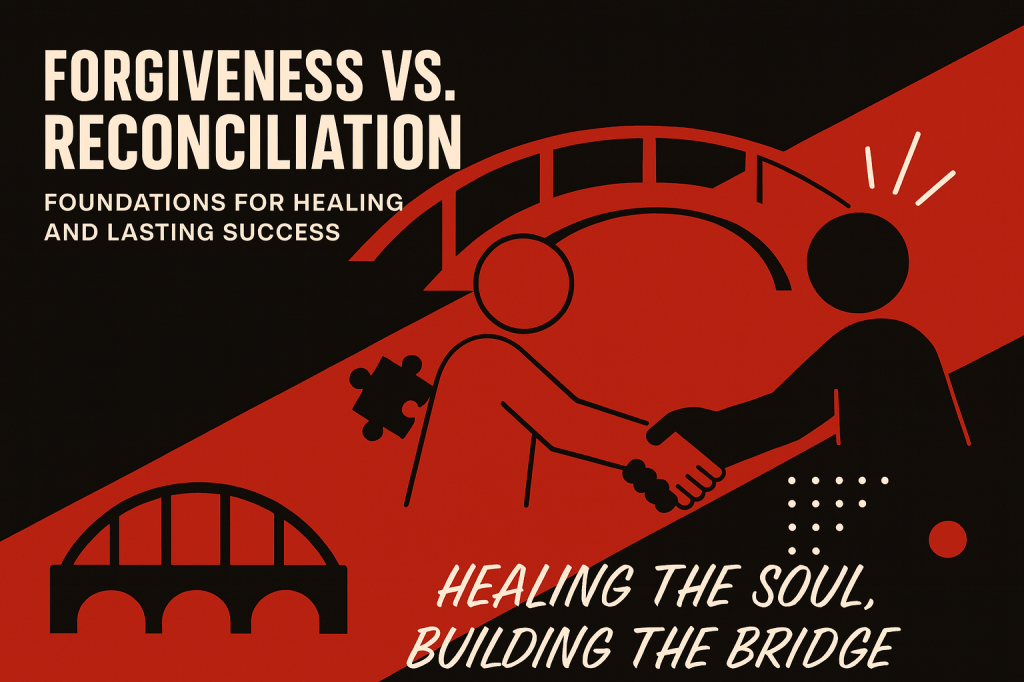
Forgiveness is a fundamental aspect of the Christian faith, and it’s often misunderstood as being synonymous with reconciliation and forgetting. However, the Bible teaches that these three concepts are distinct and should not be conflated.
Forgiveness: Letting Go of the Debt
Forgiveness is the act of releasing someone from the debt they owe us.
When we forgive, we choose to absorb the cost of the hurt or offense, rather than demanding payment or revenge.
This is exemplified in the Lord’s Prayer, where Jesus teaches us to pray, “Forgive us our debts, as we also have forgiven our debtors” (Matthew 6:12).
The biblical account of Joseph’s life, we see a powerful example of forgiveness.
Despite being sold into slavery by his brothers, Joseph chooses to forgive them, “You intended to harm me, but God intended it for good” (Genesis 50:20).
Joseph’s forgiveness didn’t mean he forgot what his brothers had done, but rather that he released them from the debt they owed him.
Reconciliation: Restoring Relationships
Reconciliation, on the other hand, involves the restoration of a broken relationship.
While forgiveness is a necessary step towards reconciliation, it’s not the same thing.
Reconciliation requires effort and commitment from both parties to rebuild trust and communication.
In the New Testament, we see an example of reconciliation in the story of Zacchaeus.
After Jesus forgives Zacchaeus and eats with him, Zacchaeus makes amends for his past wrongdoings by giving half of his possessions to the poor and repaying those he had cheated (Luke 19:1-10).
This act of restitution is a key part of the reconciliation process.
Forgetting: A Divine Privilege
Forgetting, in the biblical sense, is not about erasing memories or ignoring past hurts. Rather, it’s about God’s ability to remove our sins from His memory.
The prophet Isaiah writes, “I, even I, am he who blots out your transgressions, for my own sake, and remembers your sins no more” (Isaiah 43:25).
While humans can’t literally forget past hurts, we can choose to not dwell on them or hold them against others.
This is an act of trust in God’s sovereignty and justice.
Healer of Broken Relationships
Reconciliation: the restoration of friendly relations. the action of making one view or belief compatible with another.
What is biblical reconciliation?
“Reconciliation” in our everyday experience suggests the restoration of friendship or harmony between individuals or groups that have been separated from one another by bitter conflict.
Biblically, “reconciliation” is used more frequently to describe humanity’s relationship with God.
What does God say about reconciliation?
2 Corinthians 5:18-21
All this is from God, who reconciled us to himself through Christ and gave us the ministry of reconciliation: that God was reconciling the world to himself in Christ, not counting people’s sins against them. And he has committed to us the message of reconciliation.
2 Corinthians 5:16-20 Modern English Version
16 So from now on we do not regard anyone according to the flesh. Yes, though we have known Christ according to the flesh, yet we do not regard Him as such from now on. 17 Therefore, if any man is in Christ, he is a new creature. Old things have passed away. Look, all things have become new. 18 All this is from God, who has reconciled us to Himself through Jesus Christ and has given to us the ministry of reconciliation, 19 that is, that God was in Christ reconciling the world to Himself, not counting their sins against them, and has entrusted to us the message of reconciliation. 20 So we are ambassadors for Christ, as though God were pleading through us. We implore you in Christ’s stead: Be reconciled to God.
Sin involves not only violating a command but also betraying a relationship.
Not only do we need Jesus Christ to receive the punishment we deserve, but we also need someone to heal our broken relationships.
If a spouse has an affair, the other spouse feels hurt and distrusts, and even if they wants to restore their relationship, trust too must be restored.
In our sins we betray God.
Genesis 6:5-6 says, “The Lord saw how great the wickedness of the human race had become on the earth, and that every inclination of the thoughts of the human heart was only evil all the time. The Lord regretted that he had made human beings on the earth, and his heart was deeply troubled.”
Can couples who have endured the pain of betrayal be reconciled?
Sometimes.
Those who survive betrayal to have a loving, trust-filled relationship almost always need someone to help them reconcile.
Similarly, because we have betrayed God, we need someone to reconcile us to God.
The broken relationship between each of us and God can be restored and healed through the work of Jesus on the Cross.
He came to make all things new, including our relationship with God.
Jesus, our reconciler, draws us back to God even when we want to run the other way.
In conclusion, forgiveness, reconciliation, and forgetting are distinct concepts in the biblical narrative.
Forgiveness is the act of releasing someone from the debt they owe us, while reconciliation involves the restoration of a broken relationship.
Forgetting, in the biblical sense, is a divine privilege that only God can exercise.
As Christians, we’re called to forgive others as God has forgiven us (Ephesians 4:32).
While this doesn’t necessarily mean reconciliation or forgetting, it does mean releasing others from the debt they owe us and implicitly trusting our perfectly just, righteous God to handle all matters of justice and relational restoration.
In the name of the Father and of the Son and of the Holy Spirit. Amen
Praying …
Psalm 121New King James Version
God the Help of Those Who Seek Him
A Song of Ascents.
121 I will lift up my eyes to the hills—
From whence comes my help?
2 My help comes from the Lord,
Who made heaven and earth.
3 He will not allow your foot to [a]be moved;
He who keeps you will not slumber.
4 Behold, He who keeps Israel
Shall neither slumber nor sleep.
5 The Lord is your [b]keeper;
The Lord is your shade at your right hand.
6 The sun shall not strike you by day,
Nor the moon by night.
7 The Lord shall [c]preserve you from all evil;
He shall preserve your soul.
8 The Lord shall preserve[d] your going out and your coming in
From this time forth, and even forevermore.
Glory be to the Father,
and to the Son, and to the Holy Ghost;
as it was in the beginning,
is now, and ever shall be,
world without end. Amen, amen.

