
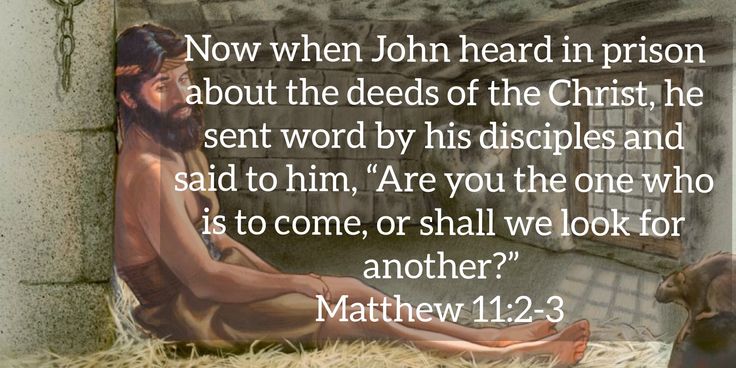
Matthew 11:1-6 New American Standard Bible
John’s Questions
11 When Jesus had finished [a]giving instructions to His twelve disciples, He went on from there to teach and [b]preach in their cities.
2 Now while in prison, John heard about the works of Christ, and he sent word by his disciples, 3 and said to Him, “Are You the Coming One, or are we to [c]look for someone else?” 4 Jesus answered and said to them, “Go and report to John what you hear and see: 5 those who are blind receive sight and those who limp walk, those with leprosy are cleansed and those who are deaf hear, the dead are raised, and the poor have the [d]gospel preached to them. 6 And blessed is [e]any person who does not [f] take offense at Me.”
Word of God for the Children of God
Glory be to the Father,
and to the Son, and to the Holy Ghost;
as it was in the beginning,
is now, and ever shall be,
world without end. Amen, amen.
John was disillusioned when he questioned whether Jesus was the Messiah.
Studying this incident will assist us to avoid becoming disillusioned in Christ.
Who among us will ever dare to be honest enough to admit that more times than they can count, they have felt imprisoned at the ironclad intersection of their expectations and disappointments?
Matthew 11:1-6 sits at the intersection of Expectation and Disappointment.
You had your life mapped out, but somehow things didn’t turn out as you had planned.
Then you saw your doctor for your annual routine physical examination.
You thought everything was going swimmingly, but then there came that dark and rainy moment when your doctor told you you needed an urgent surgery if you were to survive until next month. Tests found several masses in your lungs.
Your life was transformed by the new reality and your dreams died that day. The surgery would mean long weeks of being in bed and weeks of therapy after the surgery. It meant pain—intense, constant pain whether you had the surgery or not. You are imprisoned at the intersection of Expectation and Disappointment.
You thought your marriage would last forever, only to see your spouse walk out.
Your marriage crumbled, and you were left to pick up the pieces.
Now, you work multiple jobs at an income that is never quite enough, and you struggle to raise your children without any tangible help of your husband.
You have cried enough tears to fill an ocean and you wonder if your children will ever fully recover from the devastation they have just suddenly experienced.
Still, you realize that you’re the only person left standing between your children and self-destruction.
You are imprisoned at the intersection of Expectation and Disappointment.
You thought you were set to enjoy your golden years but changing markets have all of a sudden forced you to scramble in order to survive.
Retirement!
Ha!
You’re working more now than ever.
You had hoped to take life easy, but now you’re working just to make ends meet.
You set aside what you thought would be needed, but somehow it hasn’t proven to be enough.
Those who sit at their dinner table to consume what they have thought to be sufficient now have to survive on a budget which is proving to be inadequate.
You didn’t expect to be forced to care for ageing parents, but someone has to sacrifice so your aging mother or father can have the medical care they need.
Modern medicine is a two-edged sword, extending our lives but imposing new necessities on our children.
Thus, you are saddled with the responsibility of caring for your parents at the time when you know you should be planning or preparing for your own future.
You stand imprisoned at the intersection of Expectation and Disappointment.
If we could only know what God has planned for us, we could perhaps be courageous. We can’t know what God will be doing, and so we feel that we must grapple with a dark unknown rather than walking with confidence through our chaotic situation. We are too “Christian” to admit that we sometimes struggle with doubt, but in our heart, we experience so very often times when we ask, “Is this really what life is all about?”
At such times, we are imprisoned at the intersection of Expectation and Disappointment.
You’ve been praying, and no answer comes.
You cannot help but wonder whether God hears you when you pray?
Does God care about your struggles?
Because the response of the Holy One seems non-existent, you find yourself questioning God; even find yourself asking, “Did Jesus really die for my sins?
If I am forgiven, why am I having such a hard time?
Why is there so much confusion in my life, if God is in control?”
Confusion seems to grow constantly, and you can’t help but wonder why God seems to ignore you.
It is almost as though He is unaware of who you are or what you are going through.
You are imprisoned at the intersection of Expectation and Disappointment.
Questions come flooding into our minds: Why is there so much hurt in the world if God is good?
He could make things right if He wanted to do so.
He has the power.
Why doesn’t He do something?
The question sticks in our throat, but we are too tight lipped, stiff necked, embarrassed to let it pass beyond our lips.
Admit it!
Confess it!
We find ourselves to be imprisoned at our intersections of Expectations and Disappointments
We don’t want people to know that we have been locked up in the dungeon of doubt.
Has it all been worth it?
Has my sacrifice, my struggle, my sorrow made any difference?
Does Jesus care .001% that I am seemingly unable to move beyond my present condition of living in this rut that defines my life at the present?
You are imprisoned at the center in a jail of Expectation and Disappointment.
The message this day is for Christians, for followers of the Christ who have experienced disappointment or for those who will soon enter into despair.
13 How long, Lord? Will You forget me forever?
How long will You hide Your face from me?
2 How long am I to feel anxious in my soul,
With grief in my heart all the day?
How long will my enemy be exalted over me? (Psalm 13:1-2)
The Psalmist’s message is also intended to offer an authentic expression of hope for the afflicted soul, when everything seems hopeless, hope in Christ.
5 But I have trusted in Your faithfulness;
My heart shall rejoice in Your salvation.
6 I will sing to the Lord,
Because He has looked after me. (Psalm 13:5-6)
The message is intended to be a source of encouragement for the people of God when imprisoned at the center of a dangerously rutted intersection called “my Expectations and my Disappointments.” Praying for any Help in this trouble.
Faith, the Scripture tells us, is active and relational.
It reaches beyond the visible, tangible world into the reality of God’s promises.
Religion, on the other hand, often remains visible—it is what you do, not whom you trust.
Illustration: Imagine two people standing on opposite sides of a wide creek of unknown depths. Religion may give you a map, a rope, and rules about how to cross it. Faith is taking the step because you trust the one who builds the bridge.
Dr. John Piper wrote, “Faith is not mere belief; it is a life surrendered to the will of God because we trust Him completely.”
Here, Piper reminds us true faith is personal surrender, not checklists of duties. Religion without faith can mark boxes but does nothing to transform the heart.
1: Faith is Relational, Religion is Ritual
Consider Micah 6:6-8 (NLT):
“With what shall I come before the Lord and bow down before the exalted God? Shall I come before him with burnt offerings, with year-old calves? Will the Lord be pleased with thousands of rams, with ten thousand rivers of olive oil? Should I offer my firstborn for my rebellion, the fruit of my body for the sin of my soul? He has told you, O man, what is good, and what does the Lord require of you: Only to do justice, to love mercy, and to walk humbly with your God.”
The prophet Micah addresses Israel, who had become experts at religious ritual—sacrifices, festivals, offerings—yet their hearts far were distant from God.
The Hebrew word used here for “walk” here, ‘halak,’ implies a daily lifestyle of focusing on ongoing relationships, obedience, not merely ritual performances.
Faith focuses on relationship: “walk humbly with your God.”
Religion focuses on ritual: “burnt offerings, rivers of olive oil.”
Modern believers often fall into “religious checklists”: attending church, volunteering, giving, but lacking deep, trusting relationship with Jesus.
Faith invites us into an intimacy with God—through prayer, Scripture, study, obedience—not simply participation in activities.
2: Faith Impacts the Heart, Religion Controls Behavior
Let’s turn to Romans 10:9-10 (NLT):
“If you openly declare that Jesus is Lord and believe in your heart that God raised him from the dead, you will be saved. For it is by believing in your heart that you are made right with God — and it is by openly declaring your faith that you are saved.”
Paul writes to the Roman church, a mixture of Jews and Gentiles steeped in both cultural and religious practices. The Greek word for “believe” here is ‘pisteuo‘, which conveys personal trust and commitment, not just intellectual assent.
Religion might prescribe outward actions—attendance, fasting, charity—but faith reaches the heart.
Faith is internal trust in Christ, resulting in external obedience. Paul clearly emphasizes a holistic transformation: belief leads to confession, confession leads to salvation, and salvation changes life.
In today’s world, it is easy to confuse being “religious” with being “right with God.”
One might pray, tithe, volunteer—but without heart-level trust in Jesus, these acts are empty.
True faith begins in the heart, flows outward, produces a life that honors God.
“Religion is what you do; faith is what God does in you.”
This is profound. Religion without faith produces mere action; faith without religion produces authentic devotion that transforms communities and lives.
3: Faith Produces Freedom, Religion Can Produce Bondage
Consider Galatians 5:1 (NLT):
“So Christ has truly set us free. Now make sure that you stay free, and don’t get tied up again in slavery to the law.”
Paul addresses believers who were tempted to return to legalistic observances—rituals, laws, and human traditions.
The Greek word for “slavery” here is ‘douleia‘, implying bondage, not simply obligation. Religion without faith often enslaves; faith liberates.
Religion can become burdensome with too many “hair-splitting” rules; faith produces joyful obedience.
Faith rests in Christ’s work; religion rests on human effort.
In the 21st century, believers are pressured by social expectations: “If you’re spiritual, do this, say that, attend here.”
True discipleship, born of faith, is freedom.
You are no longer bound by fear of judgment but empowered by the love of Christ.
A friend once described his faith journey like this:
“I spent years following religious rules, always anxious I’d fail God. When I finally trusted Jesus, I realised obedience was no longer a chain—it was wings.”
Charles Stanley said, “True faith never imprisons; it always liberates because it rests in the grace of God, not the efforts of man.”
Faith liberates.
Religion can constrict.
Understanding this is critical for authentic discipleship.
In the Name of God: Father, Son, and Holy Spirit
Praying …
The Lord Rescues People from Many Troubles.
107 Give thanks to the Lord, for He is good,
For His mercy is everlasting.
2 The redeemed of the Lord shall say so,
Those whom He has redeemed from the hand of the enemy
3 And gathered from the lands,
From the east and from the west,
From the north and from the [a]south.
10 There were those who lived in darkness and in [i]the shadow of death,
Prisoners in misery and [j]chains,
11 Because they had rebelled against the words of God
And rejected the plan of the Most High.
12 Therefore He humbled their heart with labor;
They stumbled and there was no one to help.
13 Then they cried out to the Lord in their trouble;
He saved them from their distresses.
14 He brought them out of darkness and [k]the shadow of death
And broke their bands apart.
15 They shall give thanks to the Lord for His mercy,
And for His [l]wonders to the sons of mankind!
16 For He has shattered gates of bronze
And cut off bars of iron.
Glory be to the Father,
and to the Son, and to the Holy Ghost;
as it was in the beginning,
is now, and ever shall be,
world without end. Amen, amen.

