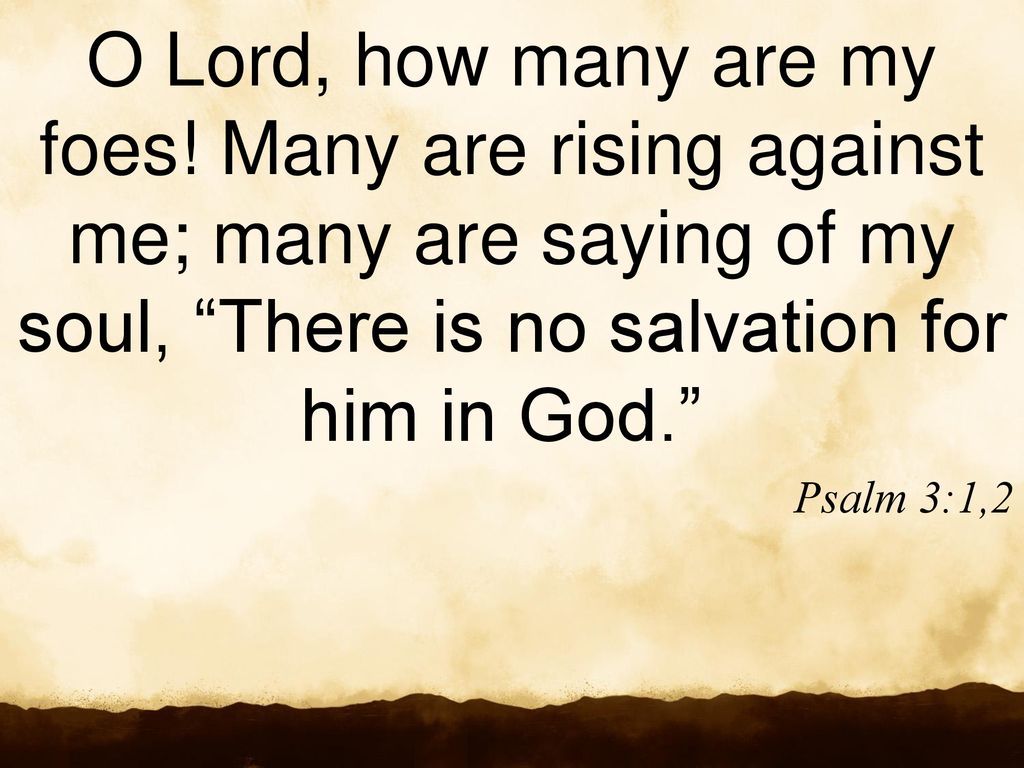
“O Lord, how many are my foes? Many are now rising against me!” Psalm 3

Psalm 3 New American Standard Bible 1995

Morning Prayer of Trust in God.

A Psalm of David, when [a]he fled from Absalom his son.

O Lord, how my adversaries have increased!
Many are rising up against me.
Many are saying [b]of my soul,
“There is no [c]deliverance for him in God.” [d]Selah.

But You, O Lord, are a shield about me,
My glory, and the One who lifts my head.
I was crying to the Lord with my voice,
And He answered me from His holy [e]mountain. Selah.
[f]I lay down and slept;
I awoke, for the Lord sustains me.
I will not be afraid of ten thousands of people
Who have set themselves against me round about.

Arise, O Lord; save me, O my God!
For You [g]have smitten all my enemies on the [h]cheek;
You [i]have shattered the teeth of the wicked.
[j]Salvation belongs to the Lord;
Your blessing [k]be upon Your people! Selah.

The Word of God for the Children of God.

Glory be to the Father,
and to the Son, and to the Holy Ghost;
as it was in the beginning,
is now, and ever shall be,
world without end. Amen, amen.

When Opposition Comes (and It Will)

Of all the things that are uncertain in this life, there is something we can be sure of—opposition.

Opposition will always come, in one form or another, and we won’t always be prepared for it.

In the work place, it may come as a challenge to our ideas or strategies.

In our families, it may be against our parenting styles, it may be a retaliation against our principles, it may be the children demanding their own bedtimes.

And in faith, as Jesus lived, opposition may come as a mockery or even a threat.

King David truly knew the severity of opposition and experienced it regularly throughout his reign. More than once, he fled into the mountains, fearing for his life. Frequently, he cried out to God over the extreme opposition he faced.

The title of Psalm 3 is “A Psalm of David When he fled from his son Absalom.”

“Many are my foes! Many are rising against me!”

David’s experiences with his adversaries were most likely far greater than anything we have experienced or will experience.

But no matter what, we can be sure of this: God is our Great Defender.

There is no greater defense than that of our Father in heaven.

And He urges us to allow Him to deal with our opposer instead of taking matters into our own hands.

Faith—Overcoming Evil

Romans 12:17-21 New American Standard Bible 1995

17 Never pay back evil for evil to anyone. [a]Respect what is right in the sight of all men. 18 If possible, so far as it depends on you, be at peace with all men. 19 Never take your own revenge, beloved, but [b]leave room for the wrath of God, for it is written, “Vengeance is Mine, I will repay,” says the Lord. 20 “But if your enemy is hungry, feed him, and if he is thirsty, give him a drink; for in so doing you will heap burning coals on his head.” 21 Do not be overcome by evil, but overcome evil with good.

If you’re anything like me, it’s easy to jump into “defense” mode.

It can be difficult to let things roll off my back, especially when I feel wronged.

Yet, so often in my rehearsed plans of retaliation, I sense the gentle voice of the Spirit saying, “Peace…be still. Let Me go before you in this.”

It began as a peaceful march to protest the killing of George Floyd.

But as the darkness deepened, it became a dark night of riotous behavior.

Images of angry people smashing store fronts, of police cars ablaze, and of businesses going up in flames brought me to my knees in earnest prayer and disturbed my anxious sleep. What I saw was way beyond bad, frightening, evil.

In the morning I checked as much of the news as I could access by internet.

The rioters were gone, but they had left a disturbing mess: smashed windows, burned cars, rocks and bricks and vile graffiti, sad ruins in the heart of the city.

A reporter surveying the damage approached a young mother with two children.

He asked her, “Why are you here this morning?” She said, “We saw the news; we decided that this city needs someone to show the love of God.”

Others were there too—sweeping glass shards, trying to restore order to chaos.

The mom and her children, who were perhaps about 5 and 7 years old, were there with buckets, their brushes and soap, trying to erase stubborn graffiti.

To me, they sacrificed their time, they brought some light into the darkness, some of God’s love into a broken place where the evidence of evil was very real.

In that mother and her little ones, I saw the presence of the resurrected Jesus.

She and her children were being the church, Christ’s body—overcoming evil by doing good.

As I watched, my anger was transformed, replaced by warm and grateful tears welled up from within me in a prayer of thanks to God.

When we surrender our will to the Father, no matter how justified we feel, there will be an unexplainable peace that comes.

Surrendering all of our “fists-in-the-air” attitudes and plans of pay-back will always result in a better outcome—an outcome that is surrounded by certainty that reminds us, “God’s got this.”

The more we live out our faith in Christ, the more people will oppose what they don’t fully understand.

It’s a way of retaliating against something that challenges them in some way.

If you and I are actively living out our faith, walking in the fruit of the Spirit and showing God’s love, that will be a challenge for some.

And in that challenge, we may find ourselves greatly opposed.

Harsh words, divisive questions, and rude comments might be the ways in which people come against us.

But just as David, in Psalm 3, took those oppositions to the Lord, we, too, can release them to our Mighty Defender.

Psalm 3:3-6 New American Standard Bible 1995

But You, O Lord, are a shield about me,
My glory, and the One who lifts my head.
I was crying to the Lord with my voice,
And He answered me from His holy [a]mountain. Selah.
5 [b]I lay down and slept;
I awoke, for the Lord sustains me.
I will not be afraid of ten thousands of people
Who have set themselves against me round about.

For in the end, as David knew from vast measures and degrees of experience his whole life long, God, and only God, can right those wrongs of unjust opposition.

In the name of God, the Father and God the Son and God the Holy Spirit,

Let us Pray,

Psalm 121 New American Standard Bible 1995

The Lord the Keeper of Israel.

A Song of Ascents.

121 I will lift up my eyes to the mountains;
From where shall my help come?
My help comes from the Lord,
Who made heaven and earth.
He will not allow your foot to slip;
He who keeps you will not slumber.
Behold, He who keeps Israel
Will neither slumber nor sleep.

The Lord is your keeper;
The Lord is your shade on your right hand.
The sun will not smite you by day,
Nor the moon by night.
The Lord will [a]protect you from all evil;
He will keep your soul.
The Lord will [b]guard your going out and your coming in
From this time forth and forever.

Glory be to the Father,
and to the Son, and to the Holy Ghost;
as it was in the beginning,
is now, and ever shall be,
world without end. Amen, amen.

https://translate.google.com

How long, O Lord? Will you forget me forever? The Lie of Isolation Psalm 13

Psalm 13 New American Standard Bible 1995

Prayer for Help in Trouble.

For the choir director. A Psalm of David.

13 How long, O Lord? Will You forget me forever?
How long will You hide Your face from me?
How long shall I take counsel in my soul,
Having sorrow in my heart all the day?
How long will my enemy be exalted over me?

Consider and answer me, O Lord my God;
Enlighten my eyes, or I will sleep the sleep of death,
And my enemy will say, “I have overcome him,”
And my adversaries will rejoice when I am shaken.

But I have trusted in Your lovingkindness;
My heart shall rejoice in Your salvation.
I will sing to the Lord,
Because He has dealt bountifully with me.

The Word of God for the Children of God.

Glory be to the Father,
and to the Son, and to the Holy Ghost;
as it was in the beginning,
is now, and ever shall be,
world without end. Amen, amen.

People say time flies when you’re having fun.

But when things shift into a minor key, life seems to move in slow motion.

We find ourselves thinking, “Where is God now? I don’t know if I’m ever going to get out of these circumstances. And I don’t know how I can endure them.”

Our reading today, Psalm 13, contains a recurring question: “How long? How long?” David’s circumstances aren’t described, but he clearly feels forgotten and forsaken—a feeling we all can relate to.

It’s circumstance akin to what we feel when we lose a loved one or when we feel we are stuck in life drudgery, that we must walk through a valley of trial alone.

To be isolated from human relationships is, without question, crushing.

But what David writes and sings of here in Psalm 13 is even more significant.

He’s expressing a bottomless feeling of isolation from God Himself.

This sentiment is shared by many of God’s people throughout Scripture.

In Isaiah, God’s exiled people cry out, “The LORD has forsaken me; my Lord has forgotten me” (Isaiah 49:14).

Christian pilgrims—genuine followers and servants of Jesus—do sometimes feel like saying, “I believe the Lord has actually forgotten us.

If He has not forgotten us, if He was still with us, how would we be in this predicament?

If He truly was watching over us, surely we would not have to endure these ceaseless, unyielding trials.

Yet in David’s emerging depression, we discover that his perception (as is often the case with our own) does not reflect reality.

And David has the spiritual maturity and humility to acknowledge that what he feels is true does not align with what he knows is actually true.

So he reminds himself of God’s steadfast love, His salvation, and His generosity—and David resolves to rejoice in those things instead even as he struggles and suffers (Psalm 13:5-6).

This is the hope-filled tension of the Christian life.

As we get stuck, as we stare long and hard into the drudgery of life and ministry and mission and church in the 21st century, and wonder of God, do we see hope?

We keep asking, “How long, Lord? Where are you, God?” even as we remind our own hearts that God has not stopped loving us, delivering us, or working in us?

Where is Your Hope?

Proverbs 11:4-8 New American Standard Bible 1995

Riches do not profit in the day of wrath,
But righteousness delivers from death.
The righteousness of the blameless will smooth his way,
But the wicked will fall by his own wickedness.
The righteousness of the upright will deliver them,
But the treacherous will be caught by their own greed.
When a wicked man dies, his expectation will perish,
And the hope of strong men perishes.
The righteous is delivered from trouble,
But the wicked [a]takes his place.

In a worship song from the early 2000s, singer/songwriter Brian Doerksen sings, “Jesus, hope of the nations/ Jesus, comfort for all who mourn/ You are the source of heaven’s hope on earth.”

As believers in Christ, we recognize and worship Jesus as the true hope of the world, and yet it’s astounding how often we pin our hopes on ­human beings.

In all of our history books, it is clear that people are inclined to find more hope in their leaders, politicians, and celebrities rather than in the one true God.

Why do we do this?

These timely timeless words from Proverbs warns that placing hope in humans is infinitely worse than futile because any human power will come to nothing.

As the apostle Paul tells us, “There is no authority except that which God has established” (Romans 13:1).

By saying this, Paul is assuring believers that in all situations, even in the midst of national turmoil’s and global crises, God is the # One who holds all ­authority.

Any human who has “power” has it only because God allows it to be so.

In other words, our hopes and desires must lie with the One who is on the throne of the universe.

Our prayers must be exclusively oriented toward Jesus Christ, for he is truly the only hope—the only resurrected one, the one who can change minds, transform hearts, disperse principalities and powers, can bring restoration and revival.

Do not believe the lie of abandonment that your emotions can feed you.

Please just make an honest and concerted effort to rest in God’s comforting response to His forgetful people:

“Can a woman forget her nursing child, that she should have no compassion on the son of her womb? Even these may forget, yet I will not forget you. Behold, I have engraved you on the palms of my hands; your walls are continually before me” (Isaiah 49:15-16).

God’s care for His children is like the sun: it’s constant.

Even when the clouds obscure it, it’s still there.

It’s always going to be “still there.”

Will you trust in God’s constancy today?

When you are next feeling forsaken, know that God looks at His hands, engraved with each and every one of His children’s names, and He says, 

There you are. Do you see now that I have not forgotten you?” (John 19:30)

30 Therefore when Jesus had received the sour wine, He said, “It is finished!” And He bowed His head and gave up His spirit.

In the name of God, the Father and God the Son and God the Holy Spirit,

Let us Pray,

Psalm 24 New American Standard Bible 1995

The King of Glory Entering Zion.

A Psalm of David.

24 The earth is the Lord’s, and [a]all it contains,
The world, and those who dwell in it.
For He has founded it upon the seas
And established it upon the rivers.
Who may ascend into the hill of the Lord?
And who may stand in His holy place?
He who has clean hands and a pure heart,
Who has not lifted up his soul [b]to falsehood
And has not sworn deceitfully.
He shall receive a blessing from the Lord
And [c]righteousness from the God of his salvation.
6 [d]This is the generation of those who seek Him,
Who seek Your face—even Jacob. [e]Selah.

Lift up your heads, O gates,
And be lifted up, O [f]ancient doors,
That the King of glory may come in!
Who is the King of glory?
The Lord strong and mighty,
The Lord mighty in battle.
Lift up your heads, O gates,
And lift them up, O [g]ancient doors,
That the King of glory may come in!
10 Who is this King of glory?
The Lord of hosts,
He is the King of glory. Selah.

Glory be to the Father,
and to the Son, and to the Holy Ghost;
as it was in the beginning,
is now, and ever shall be,
world without end. Amen, amen.

https://translate.google.com

It’s One and Done! Now and Forever, Jesus has Removed All of Our Shame. Psalm 25

Psalm 25 New American Standard Bible 1995

Prayer for Protection, Guidance and Pardon.

A Psalm of David.

25 To You, O Lord, I lift up my soul.
O my God, in You I trust,
Do not let me be ashamed;
Do not let my enemies exult over me.
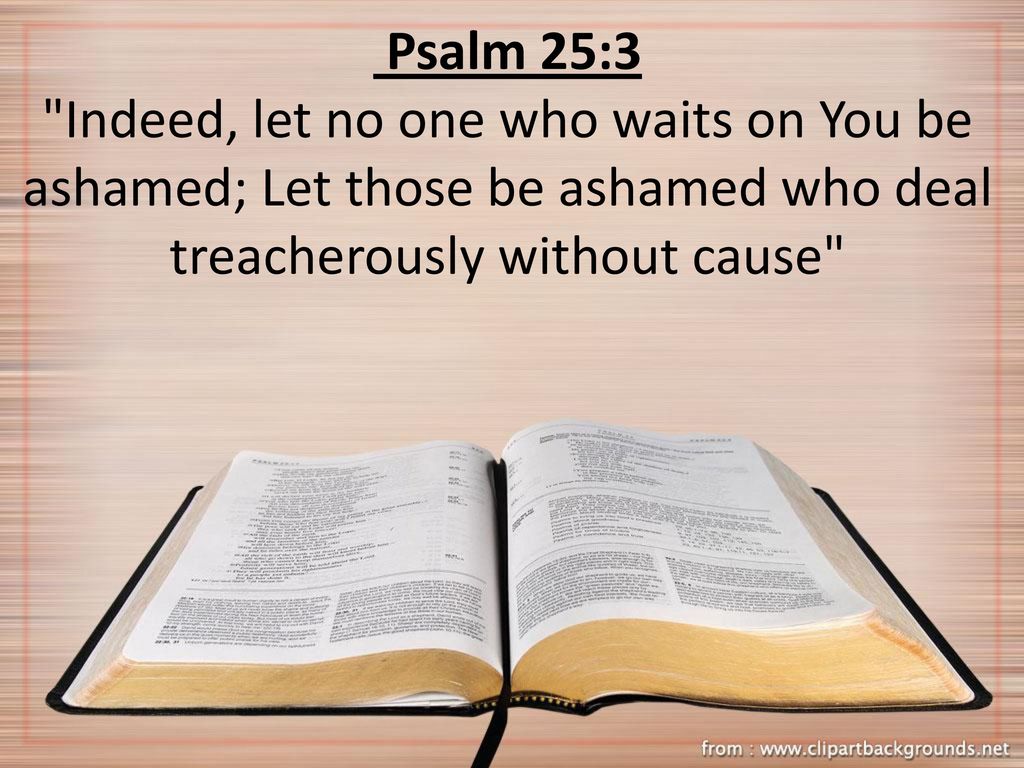
Indeed, none of those who wait for You will be ashamed;
[a]Those who deal treacherously without cause will be ashamed.

Make me know Your ways, O Lord;
Teach me Your paths.
Lead me in Your truth and teach me,
For You are the God of my salvation;
For You I wait all the day.
Remember, O Lord, Your compassion and Your lovingkindnesses,
For they have been [b]from of old.
Do not remember the sins of my youth or my transgressions;
According to Your lovingkindness remember me,
For Your goodness’ sake, O Lord.

Good and upright is the Lord;
Therefore He instructs sinners in the way.
He leads the [c]humble in justice,
And He teaches the [d]humble His way.
10 All the paths of the Lord are lovingkindness and truth
To those who keep His covenant and His testimonies.
11 For Your name’s sake, O Lord,
Pardon my iniquity, for it is great.

12 Who is the man who fears the Lord?
He will instruct him in the way he should choose.
13 His soul will abide in [e]prosperity,
And his [f]descendants will inherit the [g]land.
14 The [h]secret of the Lord is for those who fear Him,
[i]And He will make them know His covenant.
15 My eyes are continually toward the Lord,
For He will [j]pluck my feet out of the net.

16 Turn to me and be gracious to me,
For I am lonely and afflicted.
17 [k]The troubles of my heart are enlarged;
Bring me out of my distresses.
18 Look upon my affliction and my [l]trouble,
And forgive all my sins.
19 Look upon my enemies, for they are many,
And they hate me with violent hatred.
20 Guard my soul and deliver me;
Do not let me be ashamed, for I take refuge in You.
21 Let integrity and uprightness preserve me,
For I wait for You.
22 Redeem Israel, O God,
Out of all his troubles.

The Word of God for the Children of God.

Glory be to the Father,
and to the Son, and to the Holy Ghost;
as it was in the beginning,
is now, and ever shall be,
world without end. Amen, amen.

From Matthew Henry’s Commentary on Psalm 25:3 …

“In worshipping God, we must lift up our souls to him. It is certain that none who, by a believing attendance, wait on God, and, by a believing hope, wait for him, shall be ashamed of it. The most advanced believer both needs and desires to be taught of God. If we sincerely desire to know our duty, with resolution to do it, we may be sure that God will direct us in it. The psalmist is earnest for the pardon of his sins. When God pardons sin, he is said to remember it no more, which denotes full remission. It is God’s goodness, and not ours, his mercy, and not our merit, that must be our plea for the pardon of sin, and all the good we need. This plea we must rely upon, feeling our own unworthiness, and satisfied of the riches of God’s mercy and grace. How boundless is that mercy which covers for ever the sins and follies of a youth spent without God and without hope! Blessed be the Lord, the blood of the great Sacrifice can wash away every stain.” https://www.christianity.com/bible/esv/psalm/25-3

Shame is different from guilt.

Shame: a painful feeling of humiliation or distress caused by the consciousness  of wrong or foolish behavior.

Guilt: the fact of having committed a specified or implied offense or crime. The fact of having committed a breach of conduct especially violating law and which is involving a specific penalty according to the seriousness of that breach of law.

If you are guilty, you did something wrong, and you realize you are responsible for it.

You can feel shame from being guilty, but feelings of shame are not always tied to guilt.

Shame has more to do with a lack of self-worth, and that can come from not measuring up to a standard, from feeling insecure, from being bullied or abused in various ways, from public disgrace, ridicule, and more.

When you are ashamed, you may or may not have done something wrong, but when others see you, you feel exposed, dirty, vulnerable, unworthy of respect.

When Adam and Eve fell into sin, they realized they had done wrong.

They saw that they were naked and vulnerable.

They were exposed and felt shame.

They tried to cover up and hide behind trees. But they couldn’t hide from God—and that was a good thing, because God loved them and valued them, despite what they had done wrong. God loves us all too, despite any bad we have done.

Matthew 26:26-29 New American Standard Bible 1995

The Lord’s Supper Instituted

26 While they were eating, Jesus took some bread, and [a]after a blessing, He broke it and gave it to the disciples, and said, “Take, eat; this is My body.” 27  And when He had taken a cup and given thanks, He gave it to them, saying, “Drink from it, all of you; 28 for this is My blood of the covenant, which is poured out for many for forgiveness of sins. 29 But I say to you, I will not drink of this fruit of the vine from now on until that day when I drink it new with you in My Father’s kingdom.”

John 19:28-30 New American Standard Bible 1995

28 After this, Jesus, knowing that all things had already been accomplished, to fulfill the Scripture, *said, “I am thirsty.” 29 A jar full of sour wine was standing there; so they put a sponge full of the sour wine upon a branch of hyssop and brought it up to His mouth. 30 Therefore when Jesus had received the sour wine, He said, “It is finished!” And He bowed His head and gave up His spirit.

Jesus came to permanently take away the guilt and shame of our sin.

And he did that by taking on the most shameful death possible: crucifixion on a Roman cross.

He hung there naked, in public disgrace, exposed to the abuse of the jeering crowd.

And yet he was innocent.

Luke 23:46-48 New American Standard Bible 1995

46 And Jesus, crying out with a loud voice, said, “Father, into Your hands I commit My spirit.” Having said this, He breathed His last. 47 Now when the centurion saw what had happened, he began praising God, saying, “Certainly this man was [a]innocent.” 48 And all the crowds who came together for this spectacle, when they observed what had happened, began to return, [b]beating their breasts.

“He endured the cross, scorning its shame” (Hebrews 12:2), so that we can be, now and forever more, permanently freed from all shame, live fully with him.

Now, because of Jesus, we are forever clean.

In the name of God, the Father and God, the Son and God the Holy Spirit,

Let us Pray,

Psalm 119:25-32 New American Standard Bible 1995

Daleth.

25 My soul cleaves to the dust;
Revive me according to Your word.
26 I have told of my ways, and You have answered me;
Teach me Your statutes.
27 Make me understand the way of Your precepts,
So I will meditate on Your wonders.
28 My soul [a]weeps because of grief;
Strengthen me according to Your word.
29 Remove the false way from me,
And graciously grant me Your law.
30 I have chosen the faithful way;
I have [b]placed Your ordinances before me.
31 I cling to Your testimonies;
O Lord, do not put me to shame!
32 I shall run the way of Your commandments,
For You will enlarge my heart.

My Lord and My Savior Jesus, My Alpha and My Omega, My first and last, thank you for taking on the shame of all the world to free us from shame forever. In your name,

Glory be to the Father,
and to the Son, and to the Holy Ghost;
as it was in the beginning,
is now, and ever shall be,
world without end. Amen, amen.

https://translate.google.com

The LORD God called out to the man, “Where are you?” Genesis 3:9

Genesis 3:8-10 New American Standard Bible 1995

They heard the sound of the Lord God walking in the garden in the [a]cool of the day, and the man and his wife hid themselves from the presence of the Lord God among the trees of the garden. Then the Lord God called to the man, and said to him, “Where are you?” 10 He said, “I heard the sound of You in the garden, and I was afraid because I was naked; so I hid myself.”

The Word of God for the Children of God.

Glory be to the Father,
and to the Son, and to the Holy Ghost;
as it was in the beginning,
is now, and ever shall be,
world without end. Amen, amen.
“Where are you?”

God asks Adam as he quietly strolls through the garden as if he is automatically expecting to encounter the eagerness of Adam, the sight of Adam seeing Him.

But, something is off, the automatic encounter does not seem to be automatic.

What are we to make of this happenstance, the absence of this automatic sight?

The absence of this “naturally” automatic encounter between man and God?

Perhaps these questions are not much about where Adam and Eve are hiding?

Perhaps something significantly bigger than that is happening here?

Please consider …

Genesis 1 and 2 give the glorious account of our creative God busy creating everything—including us human beings.

Then Genesis 3 tells of Adam and Eve’s disobedience, their fall into sin, which now infects all of us.

The fruit looked delicious and desirable, but all it revealed was that they were naked. They tried to hide from God in their shame, making simple garments of fig leaves. Where were they? To answer God’s question, they were both lost and they did not even have the awareness to know it and less awareness to act on it.

God’s footsteps echoed in the garden, and his voice boomed, “Where are you?” God knew, they did not know it – God knew they needed to know they were lost.

God began to quietly enlighten them …

“Who told you that you were naked?”

God asked.

Not roared lest the undefinable power of his anger rips them limb from limb. (Psalm 29:1-9)

The Voice of the Lord in the Storm.

A Psalm of David.

29 Ascribe to the Lord, O [a]sons of the mighty,
Ascribe to the Lord glory and strength.
Ascribe to the Lord the glory [b]due to His name;
Worship the Lord in [c]holy array.

The voice of the Lord is upon the waters;
The God of glory thunders,
The Lord is over [d]many waters.
The voice of the Lord is powerful,
The voice of the Lord is majestic.
The voice of the Lord breaks the cedars;
Yes, the Lord breaks in pieces the cedars of Lebanon.
He makes Lebanon skip like a calf,
And Sirion like a young wild ox.
The voice of the Lord hews out [e]flames of fire.
The voice of the Lord [f]shakes the wilderness;
The Lord shakes the wilderness of Kadesh.
The voice of the Lord makes the deer to calve
And strips the forests bare;
And in His temple everything says, “Glory!”

Like naïve naughty children, they automatically tried to use the blame game.

“The woman you put here gave me the fruit,” whimpered Adam.

“The serpent (you made) fooled me,” Eve whined.

Today in such moments and our circumstances God still asks, “Where are you?”

Today, in such moments and our circumstances, God is yet looking and he is always in our immediate neighborhood, always very close by, still strolling.

I heard it when I was in my hospital room, looking at the digital clock on the wall counting down the seconds and the minutes until my open heart surgery.

My heart was in desperate need of the kind of repair only my surgeons could give me, there was no place to hide, any running could give me a heart attack.

I was out of options, had no control over my life, lost, vulnerable, and scared.

I picked up my phone and went to my bible app and started at the beginning.

God strolled into my garden where my very life hung in the balance, where as I was reading Genesis 3 that one haunting question suddenly turned comforting.

He was not out to get me into chastising me but to remind me the promise that he’d provided a Savior, his Son. “Stay where you are. I’ve sent my Son for you!”

In that life or death moment, in the indescribable magnitude of my uncertainty, God strolled in unannounced through His Holy Scriptures and God assured me.

Psalm 29:10-11 New American Standard Bible 1995

10 The Lord sat as King at the flood;
Yes, the Lord sits as King forever.
11 [a]The Lord will give strength to His people;
[b]The Lord will bless His people with peace.

Do you know this God, do we know this timeless and immutable truth from the Word of God, spoken from the mouth of God, who always desires to be with us?

Psalm 29:1-2 New American Standard Bible 1995

The Voice of the Lord in the Storm.

A Psalm of David.

29 Ascribe to the Lord, O [a]sons of the mighty,
Ascribe to the Lord glory and strength.
Ascribe to the Lord the glory [b]due to His name;
Worship the Lord in [c]holy array.

Do we ever so “naturally” automatically turn to the Word of God to hear Him speak to us, to so automatically glorify his immediate proximity to our lives?

Blessedly Assured, Reassured, Standing in Plain Sight on the Promises of God?

In the name of God, the Father and God the Son and God the Holy Spirit,

Let us Pray,

Psalm 23 Authorized (King James) Version

Psalm 23

A Psalm of David.

The Lord is my shepherd; I shall not want.
He maketh me to lie down in green pastures:
he leadeth me beside the still waters.
He restoreth my soul:
he leadeth me in the paths of righteousness for his name’s sake.
Yea, though I walk through the valley of the shadow of death,
I will fear no evil: for thou art with me;
thy rod and thy staff they comfort me.
Thou preparest a table before me in the presence of mine enemies:
thou anointest my head with oil; my cup runneth over.
Surely goodness and mercy shall follow me all the days of my life:
and I will dwell in the house of the Lord for ever.

Glory be to the Father,
and to the Son, and to the Holy Ghost;
as it was in the beginning,
is now, and ever shall be,
world without end. Amen, amen.
https://translate.google.com

Stuck in Life? Never Give Up through the Unanswered Prayers! Luke 18:1-8

Luke 18:1-8 New American Standard Bible 1995

Parables on Prayer

18 Now He was telling them a parable to show that at all times they ought to pray and not to lose heart, saying, “In a certain city there was a judge who did not fear God and did not respect man. There was a widow in that city, and she kept coming to him, saying, ‘[a]Give me legal protection from my opponent.’ For a while he was unwilling; but afterward he said to himself, ‘Even though I do not fear God nor respect man, yet because this widow bothers me, I will [b] give her legal protection, otherwise by continually coming she will [c]wear me out.’” And the Lord said, “Hear what the unrighteous judge *said; now, will not God bring about justice for His elect who cry to Him day and night, [d]and will He delay long over them? I tell you that He will bring about justice for them quickly. However, when the Son of Man comes, will He find [e]faith on the earth?”

The Word of God for the Children of God.

Glory be to the Father,
and to the Son, and to the Holy Ghost;
as it was in the beginning,
is now, and ever shall be,
world without end. Amen, amen.

Have you ever been stuck?

Not behind a massive traffic jam, or in the mud or a blizzard or snow drift – but stuck in life – you cannot go backwards, the present is super glued to the floors.

Imagine you have an adversary who is making your life extremely difficult.

Certified letters come in the mail, and you are summoned to a court hearing.

You receive a letter in the mail and it is the tax man wondering about the math.

You are in a job, there is either no or very limited prospects for advancement.

You are a Pastor and your church is not growing, the congregation is dwindling, the building is in need of uncountable numbers of both minor and major repairs and there is little to no prospect of the budget supporting repairs and the salary.

Pick your own scenario and create that one worst possible story surrounding it.

You have prayed, and it seems that God is not acting on your behalf.

You ask God, “If you are my Father, why don’t you help me?”

In the court room, the judge adds insults to your injury and has no empathy for you – you know the tax man will not be any kind of empathetic or sympathetic.

Where do you turn?

Jesus told a parable about a woman in a situation like that, to show his followers that they should “always pray and not give up.”

The woman wanted what was rightfully hers.

And yet she appeared to be powerless, without money or connections to bail her out, and she lost case after case – but she still continued to bother the judge.

This harsh judge, who didn’t care what God or people thought, relented, finally surrendered and acted on her behalf, and she received what was rightfully hers.

In the midst of hopelessness in this world, Jesus promises hope in a far greater courtroom, where he defends his own.

He says,

“Will not God bring about justice for his chosen ones, who cry out to him day and night? Will he keep putting them off? I tell you, he will see that they get justice, and quickly.”

Followers of Christ are called to be persistent in the midst of adversity, for we have a mighty Advocate who comes to our defense!

Never Give Up through Unanswered Prayers

Luke 18:1-8 The Message

The Story of the Persistent Widow

18 1-3 Jesus told them a story showing that it was necessary for them to pray consistently and never quit. He said, “There was once a judge in some city who never gave God a thought and cared nothing for people. A widow in that city kept after him: ‘My rights are being violated. Protect me!’

4-5 “He never gave her the time of day. But after this went on and on he said to himself, ‘I care nothing what God thinks, even less what people think. But because this widow won’t quit badgering me, I’d better do something and see that she gets justice—otherwise I’m going to end up beaten black-and-blue by her pounding.’”

6-8 Then the Master said, “Do you hear what that judge, corrupt as he is, is saying? So what makes you think God won’t step in and work justice for his chosen people, who continue to cry out for help? Won’t he stick up for them? I assure you, he will. He will not drag his feet. But how much of that kind of persistent faith will the Son of Man find on the earth when he returns?”

Some believe if you ask God once, you don’t need to ask Him again.

However, Jesus taught His disciples to always pray and not give up (Luke 18:1).

In one of His parables on prayer, Jesus proposed what you might do if a friend comes to you in the middle of the night seeking food for an unexpected guest.

You might be tempted to tell him to go away because it’s late, and you and your family are in bed.

However, because he’s your friend and has so boldly approached and asked you for help, you most likely will get up and give him all He needs (Luke 11:5-8).

Luke 11:5-8 New American Standard Bible 1995

Then He said to them, “[a]Suppose one of you has a friend, and goes to him at midnight and says to him, ‘Friend, lend me three loaves; for a friend of mine has come to me from a journey, and I have nothing to set before him’; and from inside he answers and says, ‘Do not bother me; the door has already been shut and my children [b]and I are in bed; I cannot get up and give you anything.’ I tell you, even though he will not get up and give him anything because he is his friend, yet because of his [c]persistence he will get up and give him as much as he needs.

In summing it up, Jesus said, 

“So I say to you; Ask and it will be given to you; seek and you will find; know and the door will be opened to you. For everyone who asks receives; the one who seeks finds; and to the one who knocks, the door will be opened” (Luke 11: 9,10).

Jesus tells in another parable of a godless judge’s dealings with a widow who refused to accept his unwillingness to grant her justice from her adversary.

After relentlessly pursuing the judge with her case, he gave into her merely because she refused to give up.

To His followers, Jesus reassures that if an unjust judge who doesn’t fear God will bring about justice to a widow simply because she kept bothering him, how much more will God do for His chosen ones who cry out to Him day and night?(Luke 18:2-8).

Philippians 2:1-4 New American Standard Bible 1995

Be Like Christ

2 Therefore if there is any encouragement in Christ, if there is any consolation of love, if there is any fellowship of the Spirit, if any [a]affection and compassion, make my joy complete [b]by being of the same mind, maintaining the same love, united in spirit, intent on one purpose. Do nothing [c]from [d] selfishness or empty conceit, but with humility of mind  regard one another as more important than yourselves; do not merely look out for your own personal interests, but also for the interests of others.

Jesus also urges in Matthew 7:7 to, “Ask and it will be given to you; seek and you will find; knock and the door will be opened to you.”

So instead of seeing unanswered prayer as a reason to stop praying, view it as a motivator to not ever give up.

As Romans 12:9-13 admonishes us …

Romans 12:9-13 New American Standard Bible 1995

Let love be without hypocrisy. Abhor what is evil; cling to what is good. 10 Be devoted to one another in brotherly love; [a]give preference to one another in honor; 11 not lagging behind in diligence, fervent in spirit, serving the Lord; 12  rejoicing in hope, persevering in tribulation, devoted to prayer, 13 contributing to the needs of the [b]saints, [c]practicing hospitality.

As Thessalonians 5:17 encourages, “Pray continually.”

Keep Praying!

If you’ve been struggling with unanswered prayers, find comfort in knowing God has not forgotten you.

So instead of withdrawing from Him when it seems like He isn’t answering, consider what He might be teaching you during these times, knowing as you draw closer to Him, He will draw closer to you (James 4:8).

How Can We Get Close to God?

James 4:8 New American Standard Bible 1995

Draw near to God and He will draw near to you. Cleanse your hands, you sinners; and purify your hearts, you double-minded.

What do you do when you can’t find God?

The Christian author C. S. Lewis searched for God during the illness of his wife without finding him.

In his book A Grief Observed, Lewis wrote, “Meanwhile, where is God? … Go to him when your need is desperate … and what do you find? A door slammed in your face, and a sound of bolting and double-bolting on the inside. After that, silence. You may as well turn away.”

Many believers have searched for God without being able to find him.

David, who wrote of the wonderful comfort of God in Psalm 23, also cried out in Psalm 22:1, “My God, my God, why have you forsaken me?” Jesus said those same words on the cross (Matthew 27:46).

If for some reason you can’t seem to find God, let him know you can’t find him—and then listen.

God is right where he always is.

C.S. Lewis found that perhaps his own cries deafened him “to the voice [he] hoped to hear.”

He wrote later, “I have gradually been coming to feel that the door is no longer shut and bolted. Was it my own frantic need that slammed it in my face?”

Accept God’s invitation: “Come near to God and he will come near to you.”

Come as you are, empty handed, with weary souls, and with a simple prayer.

Psalm 23 Authorized (King James) Version

Psalm 23

A Psalm of David.

The Lord is my shepherd; I shall not want.
He maketh me to lie down in green pastures:
he leadeth me beside the still waters.
He restoreth my soul:
he leadeth me in the paths of righteousness for his name’s sake.
Yea, though I walk through the valley of the shadow of death,
I will fear no evil: for thou art with me;
thy rod and thy staff they comfort me.
Thou preparest a table before me in the presence of mine enemies:
thou anointest my head with oil; my cup runneth over.
Surely goodness and mercy shall follow me all the days of my life:
and I will dwell in the house of the Lord for ever.

God is where we are.

Says Jesus in John 6:37, “Whoever comes to me I will never drive away.”

It’s a sure promise!

Do You Believe This?

In the name of God, the Father and God the Son and God the Holy Spirit,

Let us Pray,

Psalm 13 New American Standard Bible 1995

Prayer for Help in Trouble.

For the choir director. A Psalm of David.

13 How long, O Lord? Will You forget me forever?
How long will You hide Your face from me?
How long shall I take counsel in my soul,
Having sorrow in my heart all the day?
How long will my enemy be exalted over me?

Consider and answer me, O Lord my God;
Enlighten my eyes, or I will sleep the sleep of death,
And my enemy will say, “I have overcome him,”
And my adversaries will rejoice when I am shaken.

But I have trusted in Your lovingkindness;
My heart shall rejoice in Your salvation.
I will sing to the Lord,
Because He has dealt bountifully with me.

Lord Jesus, thank you for giving us hope in our dark times as we wrestle against adversaries. Hear our prayer and act quickly on our behalf. Lord our God, show us your presence in our lives. Savior Jesus, Help us to trust that you will never let go of us. BFF Jesus, As you have always promised, you will never forsake us. Alleluia Amen

https://translate.google.com

Practices that Sustain Community: Living Truthfully. Psalm 86:11-13

Psalm 86:11-13 New American Standard Bible 1995

11 Teach me Your way, O Lord;
I will walk in Your truth;
Unite my heart to fear Your name.
12 I will give thanks to You, O Lord my God, with all my heart,
And will glorify Your name forever.
13 For Your lovingkindness toward me is great,
And You have delivered my soul from the [a]depths of [b]Sheol.

The Word of God for the Children of God.

Glory be to the Father,
and to the Son, and to the Holy Ghost;
as it was in the beginning,
is now, and ever shall be,
world without end. Amen, amen.

It’s another beautiful day to gather together, to connect, to learn, and to grow in our faith.

This devotion explores the importance of embracing and living in truth, as it shapes our lives, guides us, and ultimately sets us free.

Today, we are here to talk about living with truth and authenticity in our Christian lives.

Now, I know that’s a big topic.

It’s something we all grapple with, in big ways and small.

But it’s also something that’s so crucial to our faith, to our walk with God, and to our relationships with each other.

The late great Christian author, Ethicist, Dr. Christine D. Pohl said it well:

“We don’t always notice how profoundly our expectations, desires, and practices are … shaped by our culture. We bring the values of self-actualization, individual success, consumption, and personal freedom—and the choices that result from them—to church life, just as we bring them into family and work. . . This is not a promising recipe for strong or lasting communities.”

And how true that is.

We bring many false narratives from the world into our community here.

We bring the values and the ideologies of a culture that is far from God into a community that is meant to represent the nature of God.

A community of forgiveness, kindness, and truth-telling.

Let’s take a look at the Scriptures that will guide our devotion today.

The first is from Psalm 86:11, “Teach me your way, Lord, that I may rely on your faithfulness; give me an undivided heart, that I may fear your name.”

The second is from John 8:31-32, “To the Jews who had believed him, Jesus said, ‘If you hold to my teaching, you are really my disciples. Then you will know the truth, and the truth will set you free.'”

These passages remind us that truth isn’t just something we know.

It’s something we live.

It’s something we hold to.

It’s something that shapes us and frees us.

It’s something that God teaches us, and something that we’re called to live out in our lives and in our communities.

So, let’s talk about the importance of living truthfully…

The Importance of Living Truthfully

Living truthfully is a calling that echoes throughout the Scriptures.

It’s a calling that’s woven into the very fabric of our faith.

It’s a calling that’s as relevant today as it was two thousand years ago.

It’s a calling that challenges us, that shapes us, that frees us.

When we think about living truthfully, we often think about honesty.

We think about telling the truth, about not lying or deceiving.

And that’s certainly part of it.

But living truthfully is about so much more than just honesty.

It’s also about authenticity.

It’s also about integrity.

It’s about being true to who we are, to who God has created us to be.

In Psalm 86:11, the psalmist prays, “Teach me your way, Lord, that I may rely on your faithfulness; give me an undivided heart, that I may fear your name.”

This is a prayer for truthfulness.

It’s a prayer for a heart that’s undivided, a heart that’s fully committed to God, a heart that’s authentic and true.

And then in John 8:31-32, Jesus tells his followers,

“If you hold to my teaching, you are really my disciples. Then you will know the truth, and the truth will set you free.”

Here, Jesus is talking about a truth that’s more than just facts or information.

He’s talking about a truth that’s lived, a truth that’s embodied, a truth that unleashes us, a truth sets us free.

So, what does this look like in our lives?

How do we live truthfully?

First, living truthfully means living with integrity.

Integrity is about being the same person in all situations.

It’s about being the same person on Sunday morning as you are on Saturday night and continuing being that self same person on Monday thru Friday too.

It’s about being the same person in public as you are in private.

It’s about living in a way that’s consistent with our beliefs, with our values, with our faith.

Second, living truthfully means living authentically.

Authenticity is about being true to who we are.

It’s about not pretending, not putting on a mask, not trying to be someone or something we’re not.

It’s about being gut honest with ourselves, with God, and with others about our strengths, our weaknesses, our successes, our failures, our hopes, our fears.

Third, living truthfully means living transparently.

Transparency is about being open, being vulnerable, being real.

It’s about letting others see us as we really are, not as we wish we were. It’s about sharing our struggles, our doubts, our questions, our joys, our victories.

Finally, living truthfully means living faithfully.

Being faith-filled, faithful to God, the Father, God the Son, and Holy Spirit.

Faithfulness is about being true to our commitments, our promises, our word.

It’s about being reliable, being trustworthy, being dependable.

It’s about showing up, sticking it out, staying the course.

Living truthfully is not even minimally easy.

It’s not even minimally comfortable.

It’s not even minimally convenient.

But it’s absolutely, maximally, utterly, worth it.

It’s worth it because it’s what we’re called to do.

It’s worth it because it’s what brings us closer to God.

It’s worth it because it’s what sets us free.

In the name of God, the Father and God the Son and God the Holy Spirit,

Let us Pray,

Dear Heavenly Father, we come before you today, eager to learn, eager to grow. We ask that you would guide our conversations, that you would open our hearts to your truth, and that you would help us to live it out in our lives. We ask for your wisdom, your guidance, and your love as we study, talk about these important topics. Amen.

A Psalm of Supplication and Trust.

A Prayer of David.

86 Incline Your ear, O Lord, and answer me;
For I am afflicted and needy.
Preserve my [a]soul, for I am a godly man;
O You my God, save Your servant who trusts in You.
Be gracious to me, O Lord,
For to You I cry all day long.
Make glad the soul of Your servant,
For to You, O Lord, I lift up my soul.
For You, Lord, are good, and ready to forgive,
And abundant in lovingkindness to all who call upon You.
Give ear, O Lord, to my prayer;
And give heed to the voice of my supplications!
In the day of my trouble I shall call upon You,
For You will answer me.
There is no one like You among the gods, O Lord,
Nor are there any works like Yours.
All nations whom You have made shall come and worship before You, O Lord,
And they shall glorify Your name.
10 For You are great and do [b]wondrous deeds;
You alone are God.

11 Teach me Your way, O Lord;
I will walk in Your truth;
Unite my heart to fear Your name.
12 I will give thanks to You, O Lord my God, with all my heart,
And will glorify Your name forever.
13 For Your lovingkindness toward me is great,
And You have delivered my soul from the [c]depths of [d]Sheol.

14 O God, arrogant men have risen up against me,
And [e]a band of violent men have sought my [f]life,
And they have not set You before them.
15 But You, O Lord, are a God merciful and gracious,
Slow to anger and abundant in lovingkindness and [g]truth.
16 Turn to me, and be gracious to me;
Oh grant Your strength to Your servant,
And save the son of Your handmaid.
17 Show me a sign for good,
That those who hate me may see it and be ashamed,
Because You, O Lord, have helped me and comforted me.

Glory be to the Father,
and to the Son, and to the Holy Ghost;
as it was in the beginning,
is now, and ever shall be,
world without end. Amen, amen.

https://translate.google.com

Free Indeed! Liberated By Truth: The Path To True Freedom. John 8:31-32

John 8:31-32 New American Standard Bible 1995

The Truth Will Make You Free

31 So Jesus was saying to those Jews who had believed Him, “If you continue in My word, then you are truly disciples of Mine; 32 and you will know the truth, and the truth will make you free.”

The Word of God for the Children of God.

Glory be to the Father,
and to the Son, and to the Holy Ghost;
as it was in the beginning,
is now, and ever shall be,
world without end. Amen, amen.

Sometimes the Bible is described as a long range telescope.

A tele­scope is not something to look at but an instrument to look through.

When we do, what is far away or hard to see becomes clearer, focused, to us.

When we look at life, time and history through the lens of the Bible, what once seemed distant and hard to understand comes into focus.

Through Scripture we are brought close to God.

Through Scripture we are brought near to events that happened thousands of years ago.

We zoom in, for example, on the life of Christ, who be­came human and came to live among us (John 1:14).

John 1:14 The Message

14 The Word became flesh and blood,
    and moved into the neighborhood.
We saw the glory with our own eyes,
    the one-of-a-kind glory,
    like Father, like Son,
Generous inside and out,
    true from start to finish.

Jesus wanted the people of his day to believe in him as the One who reveals the truth about God and what God is doing in this world.

But instead they wanted to hang on to old legalisms, refusing to admit that they were slaves to sin and could not keep the law perfectly.

Jesus repeatedly urged them to accept him as the eternal truth and life who could bring them out of this slavery and give them new life forever with God.

Are we any different?

As we daily encounter the Word of God, we must accept God on his terms, not ours.

By relying on the Spirit’s help, God speaks to us and breathes into us his life and truth.

That truth sets us free-free to serve him in our daily work, play, relationships, and every other facet of life.

Liberated by Truth: The Path to True Freedom

John 8:31-32 English Standard Version

The Truth Will Set You Free

31 So Jesus said to the Jews who had believed him, “If you abide in my word, you are truly my disciples, 32 and you will know the truth, and the truth will set you free.”

In the words of Jesus found in John 8:31-32, we discover a profound invitation to true freedom—a freedom rooted in the transformative power of His truth.

Let us embark on a journey to understand the liberating truth that sets us free and transforms our lives.

Point 1: Abiding in Truth

 John 8:31 (NLT) “Jesus said to the people who believed in him, ‘You are truly my disciples if you remain faithful to my teachings.'”

Jesus establishes the foundational principle for true discipleship—abiding in His teachings.

The transformative truth is that genuine discipleship involves a continuous commitment to live according to the truth revealed by Christ.

It’s not merely hearing the words but faithfully practicing them, allowing the truth to permeate every aspect of our lives.

A.W. Tozer emphasizes the transformative nature of abiding in truth, saying,

“The truth is not something outside of us. It is written in our hearts. The truth is in the inward parts. It is in our hearts.”

James 1:22 (NLT) – “But don’t just listen to God’s word. You must do what it says. Otherwise, you are only fooling yourselves.”

Point 2: Discovering True Freedom

John 8:32 (NLT) “And you will know the truth, and the truth will set you free.”

Jesus declares a profound promise—that knowing the truth leads to genuine freedom.

The transformative truth is that the freedom He speaks of goes beyond external circumstances; it’s a liberation of the soul.

True freedom is found in understanding and embracing the reality of Christ’s teachings, which transcends the limitations imposed by sin and falsehood.

J.I. Packer reflects on the transformative power of truth, stating, “There is no change of heart without a change of mind.”

Galatians 5:1 (NLT)“So Christ has truly set us free. Now make sure that you stay free and don’t get tied up again in slavery to the law.”

Point 3: Walking in the Light of Truth

Scripture: John 8:12 (NLT)

“Jesus spoke to the people once more and said, ‘I am the light of the world. If you follow me, you won’t have to walk in darkness, because you will have the light that leads to life.'”

Jesus identifies Himself as the light of the world, and following Him means walking in the light of truth.

The transformative truth is that Christ’s teachings illuminate the path of life, dispelling the darkness of ignorance and sin.

Walking in this light not only brings freedom but also leads to the fullness of life found in Him.

John Piper emphasizes the transformative impact of walking in Christ’s light, saying,

“Following Jesus means we abide in His word, and in His word, we find the light that leads to eternal life.”

Psalm 119:105 (NLT)“Your word is a lamp to guide my feet and a light for my path.”

John 8:31-32 reveals the transformative truth that leads us to true freedom—abiding in Christ’s teachings, discovering freedom through truth, and walking in the light of His word.

As we embrace this truth, may we experience the liberating power that sets us free and transforms us into disciples who faithfully follow the path of Christ.

May the grace of our Lord Jesus Christ continually lead us into the freedom that comes from walking in His truth. Amen.

In the name of God, the Father and God the Son and God the Holy Spirit,

Let us Pray,

Psalm 119:9-16 New American Standard Bible 1995

Beth.

How can a young man keep his way pure?
By keeping it according to Your word.
10 With all my heart I have sought You;
Do not let me wander from Your commandments.
11 Your word I have treasured in my heart,
That I may not sin against You.
12 Blessed are You, O Lord;
Teach me Your statutes.
13 With my lips I have told of
All the ordinances of Your mouth.
14 I have rejoiced in the way of Your testimonies,
[a]As much as in all riches.
15 I will meditate on Your precepts
And [b]regard Your ways.
16 I shall [c]delight in Your statutes;
I shall not forget Your word.

Glory be to the Father,
and to the Son, and to the Holy Ghost;
as it was in the beginning,
is now, and ever shall be,
world without end. Amen, amen.

https://translate.google.com

God Promises Freedom. Galatians 5:1

Galatians 5:1-15 English Standard Version

Christ Has Set Us Free

For freedom Christ has set us free; stand firm therefore, and do not submit again to a yoke of slavery.

Look: I, Paul, say to you that if you accept circumcision, Christ will be of no advantage to you. I testify again to every man who accepts circumcision that he is obligated to keep the whole law. You are severed from Christ, you who would be justified[a] by the law; you have fallen away from grace. For through the Spirit, by faith, we ourselves eagerly wait for the hope of righteousness. For in Christ Jesus neither circumcision nor uncircumcision counts for anything, but only faith working through love.

You were running well. Who hindered you from obeying the truth? This persuasion is not from him who calls you. A little leaven leavens the whole lump. 10 I have confidence in the Lord that you will take no other view, and the one who is troubling you will bear the penalty, whoever he is. 11 But if I, brothers,[b] still preach [c] circumcision, why am I still being persecuted? In that case the offense of the cross has been removed. 12 I wish those who unsettle you would emasculate themselves!

13 For you were called to freedom, brothers. Only do not use your freedom as an opportunity for the flesh, but through love serve one another. 14 For the whole law is fulfilled in one word: “You shall love your neighbor as yourself.” 15 But if you bite and devour one another, watch out that you are not consumed by one another.

The Word of God for the Children of God.

Glory be to the Father,
and to the Son, and to the Holy Ghost;
as it was in the beginning,
is now, and ever shall be,
world without end. Amen, amen.

Freedom Found in Faith

As we immerse ourselves in the profound wisdom of Apostle Paul’s letter to the Galatians, we are immediately confronted with the idea of liberty.

This liberty, Paul tells us, is not a worldly freedom, but a spiritual one.

It’s a freedom that Christ has granted us, a freedom that we are urged to stand firm in.

This is not a freedom that comes from our own efforts or deeds, but a freedom that is found in faith.

In the world we live in, we often associate freedom with the ability to do as we please.

But the freedom that Paul speaks of is not a license for self-indulgence.

It’s a freedom from the bondage of sin, a freedom from the law, a freedom that allows us to live in the Spirit.

This freedom is not something we earn or achieve, but something we receive through faith in Christ.

Paul warns us not to become entangled again with the yoke of bondage.

This bondage, he explains, is the law.

The law, in this context, refers to the Old Testament laws that the Jews were required to follow.

These laws were numerous and meticulous, covering every aspect of life.

But they were also impossible to keep perfectly.

As a result, those who tried to live by the law were constantly in a state of guilt and condemnation.

But Christ has set us free from this bondage.

Through His death and resurrection, He has fulfilled the law on our behalf.

We are no longer required to live by the law, but by faith in Christ.

This faith is not a passive belief, but an active trust in Christ’s finished work on the cross.

It’s a faith that acknowledges our inability to save ourselves and our total dependence on Christ for salvation.

As we live by this faith, we experience a freedom that is both liberating and transforming.

We are liberated from the guilt and condemnation of the law, and we are transformed into the likeness of Christ.

This transformation is not a result of our own efforts, but the work of the Holy Spirit in us.

As we yield to the Holy Spirit, we begin to bear the fruit of the Spirit, which includes these: love, joy, peace, patience, kindness, goodness, faithfulness, gentleness, and self-control. (Galatians 5:22-23)

This freedom, however, is not an excuse for self-indulgence.

Paul warns us not to use our freedom as an opportunity for the flesh.

The flesh, in this context, refers to our sinful nature, our natural inclination to sin.

If we use our freedom as an excuse to indulge in sinful behaviors, we are not truly living in the freedom that Christ has given us.

Instead, we are abusing this freedom and turning it into a form of bondage.

Instead, Paul urges us to use our freedom to serve one another in love.

This is the essence of Christian freedom.

It’s not freedom for self, but freedom for others.

It’s a freedom that compels us to love our neighbors as ourselves, to put their needs above our own, to serve them with the love of Christ.

This is the freedom that Christ has called us to, a freedom that is found in faith, a freedom that is lived out in love.

True Faith Leads to Freedom Leads to Humble Service

Galatians 5:13-15 The Message

13-15 It is absolutely clear that God has called you to a free life. Just make sure that you don’t use this freedom as an excuse to do whatever you want to do and destroy your freedom. Rather, use your freedom to serve one another in love; that’s how freedom grows. For everything we know about God’s Word is summed up in a single sentence: Love others as you love yourself. That’s an act of true freedom. If you bite and ravage each other, watch out—in no time at all you will be annihilating each other, and where will your precious freedom be then?

Paul was astonished at how quickly the Galatian believers were giving up on the gospel he had brought.

And it wasn’t for an easier freedom; people were going back to being burdened with rules and rituals.

Apostle Paul’s message: the freedom bought by Christ’s blood must not be forsaken so quickly and so readily.

It’s infinitely too precious!

It’s a freedom designed to lead to showing Christ’s love to others by humbly serving in whatever ways we are gifted.

Living as people who are freed in Christ, we’re called to walk the “narrow road,” avoiding the ditches of legalism on one side. lawlessness on the other.

Either ditch leads us astray.

Either ditch leads us directly into the stagnant waters and the mud within it.

There might even me a million mosquitos per square inch and a snake or two!

Freed from sin’s yoke, we’re free to serve neighbors—showing Christ’s love!

In doing so, we humbly honor God for the precious freedom we have in Christ.

When we serve one another in love, we’re following Christ’s example and we are obeying his command (John 13:34-35).

John 13:34-35 New American Standard Bible 1995

34 A new commandment I give to you, that you love one another, even as I have loved you, that you also love one another. 35 By this all men will know that you are My disciples, if you have love for one another.”

This can include a willingness to literally go the extra mile and take someone to an appointment for example.

Or to mentor a teenager, young adult, or do outreach, or teach Sunday school.

Or to serve in another way we are gifted.

Fueled by grace, our freedom leads to serving others gracefully.

Led by God’s Spirit, we’ll find ways to express our freedom by being a blessing.

And in doing so, we too are blessed!

In the name of God, the Father and God the Son and God the Holy Spirit,

Let us Pray,

Psalm 40 The Message

40 1-3 I waited and waited and waited for God.
    At last he looked; finally he listened.
He lifted me out of the ditch,
    pulled me from deep mud.
He stood me up on a solid rock
    to make sure I wouldn’t slip.
He taught me how to sing the latest God-song,
    a praise-song to our God.
More and more people are seeing this:
    they enter the mystery,
    abandoning themselves to God.

4-5 Blessed are you who give yourselves over to God,
    turn your backs on the world’s “sure thing,”
    ignore what the world worships;
The world’s a huge stockpile
    of God-wonders and God-thoughts.
Nothing and no one
    compares to you!
I start talking about you, telling what I know,
    and quickly run out of words.
Neither numbers nor words
    account for you.

Doing something for you, bringing something to you—
    that’s not what you’re after.
Being religious, acting pious—
    that’s not what you’re asking for.
You’ve opened my ears
    so I can listen.

7-8 So I answered, “I’m coming.
    I read in your letter what you wrote about me,
And I’m coming to the party
    you’re throwing for me.”
That’s when God’s Word entered my life,
    became part of my very being.

9-10 I’ve preached you to the whole congregation,
    I’ve kept back nothing, God—you know that.
I didn’t keep the news of your ways
    a secret, didn’t keep it to myself.
I told it all, how dependable you are, how thorough.
    I didn’t hold back pieces of love and truth
For myself alone. I told it all,
    let the congregation know the whole story.

11-12 Now God, don’t hold out on me,
    don’t hold back your passion.
Your love and truth
    are all that keeps me together.
When troubles ganged up on me,
    a mob of sins past counting,
I was so swamped by guilt
    I couldn’t see my way clear.
More guilt in my heart than hair on my head,
    so heavy the guilt that my heart gave out.

13-15 Soften up, God, and intervene;
    hurry and get me some help,
So those who are trying to kidnap my soul
    will be embarrassed and lose face,
So anyone who gets a kick out of making me miserable
    will be heckled and disgraced,
So those who pray for my ruin
    will be booed and jeered without mercy.

16-17 But all who are hunting for you—
    oh, let them sing and be happy.
Let those who know what you’re all about
    tell the world you’re great and not quitting.
And me? I’m a mess. I’m nothing and have nothing:
    make something of me.
You can do it; you’ve got what it takes—
    but God, don’t put it off.

Glory be to the Father,
and to the Son, and to the Holy Ghost;
as it was in the beginning,
is now, and ever shall be,
world without end. Amen, amen.

https://translate.google.com

Gloating: When we simply cannot get along, or simply refuse to get along with someone. Proverbs 24:17-18

Proverbs 24:17-18 New International Version

Saying 28

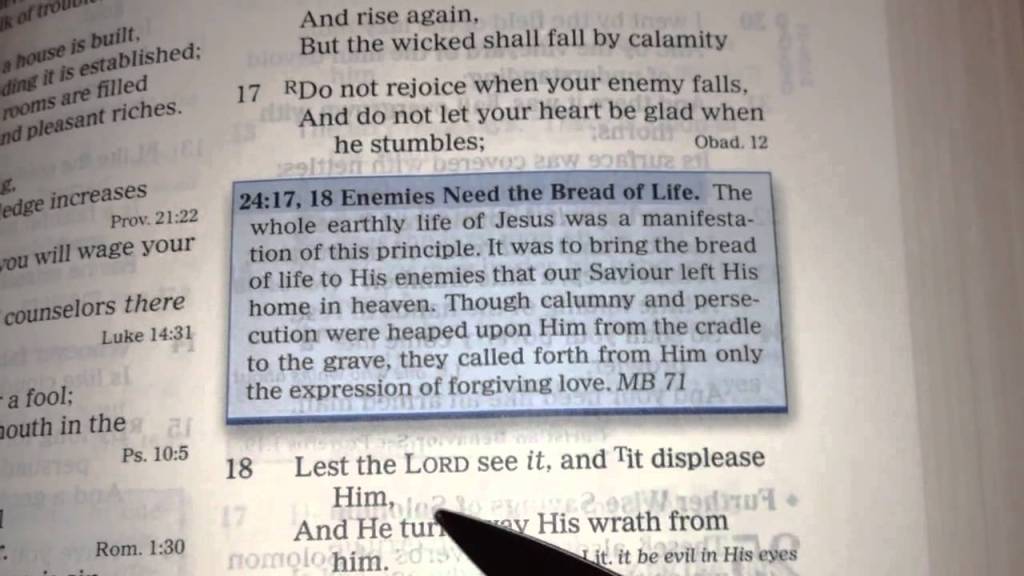
17 Do not gloat when your enemy falls;
    when they stumble, do not let your heart rejoice,
18 or the Lord will see and disapprove
    and turn his wrath away from them.

The Word of God for the Children of God.

Glory be to the Father,
and to the Son, and to the Holy Ghost;
as it was in the beginning,
is now, and ever shall be,
world without end. Amen, amen.

Love Thy Neighbor as You Love Thy God and Savior?

We don’t often think of people in terms of enemies and foes, and so when we come to read and study verses like these in Proverbs it may be hard to relate.

For this reason, let me bring it down to a level you may understand.

Are there people in your life who you just don’t like or really can’t get along with or refuse to get along with? Does that hit a more realistic nerve for you? 

While you may not call someone an enemy, I can be certain you the reader can name some people in your life you just don’t any have warm, fuzzy feelings for.

In all walks of life, you are going to encounter people that are hard to like and hard to root for and easier to hate with every kind of passion you can think of.

I usually get along with everyone yet there was this one person who really got so deep under my skin to the point that I just did not want to be around him.

I will spare you the details of why this person impacted me in this fashion.

Recently I discovered that life did not work out so well for this person, and when I heard what happened, my first reaction was, I am not very surprised.

I didn’t realize it at that moment but what I was doing was gloating.

One definition of gloating is when you find some kind of pleasure in someone else’s misfortune, to show in an annoying way that you are proud of your own success or excessively, expressively happy about someone else’s failure and I didn’t want to admit it at the time, but that is exactly what I was doing. 

The hypocritical nature of gloating is sometimes we wrap our gloating and mix it with highest praise, even mightily thanking God for the calamity or trouble of the person we don’t like because they we feel they mightily deserved all of it.

After all, they messed with me, and I am a child of the king.

Yet when we lay our hearts before Scripture and come to verses like these in Proverbs 24:17-18, we realize that is not the way God desires us to respond.

When we do behave in this manner our response could have the opposite effect.

“Do not gloat when your enemy falls;
when they stumble, do not let your heart rejoice, 
 
for the Lord will see and disapprove
 and turn his wrath away from them.” – Proverbs 24:17-18

To say this as plainly as possible, God is not pleased when we gloat over our enemies.

How should you respond to those you don’t like?

Thankfully the Bible lays out an essential framework for how to address those we don’t like, we refuse to get along with or who are our sworn enemies.

“You have heard that it was said, ‘Love your neighbor and hate your enemy.’ But I tell you, love your enemies and pray for those who persecute you.” – Matthew 5:43-44

“But now you must also rid yourselves of all such things as these: anger, rage, malice, slander, and filthy language from your lips.” – Colossians 3:8

Jesus commands you to love and pray for those who persecute you.

Paul instructs us to get rid of all malice, and one of the definitions of malice is to gloat over someone else’s misfortune.

When we lay the cards on the table, gloating is sinful.

The interesting thing about this type of sin is no one around you would ever know unless you opened your mouth and told them.

Gloating and malice are things we keep in our hearts; and while we can hide them from others, God sees what lives there. (2 Samuel 11)

Intersecting Faith and Life:

Proverbs 24:17-18 The Message

28

17-18 Don’t laugh when your enemy falls;
    don’t gloat over his collapse.
God might see, and become very provoked,
    and then take pity on his plight.

Here is a hard test of character.

Here is strong evidence if you are a child of God.

Here is a real measure of godliness and wisdom.

Here is a challenge for your faith, whether you want one or not.

Think now.

Are you happy when bad things happen to your enemies?

God commands you to love your personal enemies, and it is one of the chief measures of a true Christian.

Such love includes being grieved when your enemy falls or stumbles in life.

If you are glad or rejoice when he is hit by adversity, you have sinned.

In this proverb, the Lord God offers a simple rule for spiritual victory in your life.

Read on.

The proverb is not complete by itself, for the next verse, verse 18, explains the consequences of rejoicing at his troubles, “Lest the LORD see it, and it displeases him, and he turn away his wrath from him” (Proverbs 24:18).

God may switch from your side to your enemy’s side, if He detects you gloating about pain or trouble in your enemy’s life.

Beware!

If you are happy when bad things happen to your enemy, the Lord will see your selfish and vengeful glee; He will be angry at your wicked attitude; and He may lift His punishment of your enemy (Proverbs 24:18).

You will have stooped lower than your enemy, all the way to murderous thoughts of the heart – at those, A holy and righteous God cannot stand by.

Revenge is sin; vengeance is God’s (Romans 12:17-21).

But the proverb is not that simple.

The Preacher will not let you escape just because you have not actively sought to injure an enemy.

The wisdom of God is broader, more comprehensive than that (Psalm 119:96).

Solomon is going after your secret malignant thoughts that enjoy seeing your enemies in pain or trouble (Proverbs 24:9).

Do you rejoice – in your thoughts – when your enemy falls?

Are you glad – in your secret heart – when your enemy stumbles?

Do you feel a sense of vindication and pleasure at hearing of his or her misfortune?

These are the sins Solomon condemned.

Ah, dear reader, the glorious light of God’s word shines deep – all the way to your inner feelings. (Hebrews 4:12)

How do enemies fall and stumble?

They can fall and stumble into sin, which gives you no right to joy, because love “rejoiceth not in iniquity, but rejoiceth in the truth” (I Corinthians 13:6).

If you care about someone, even in the least degree, you would not be glad to hear of their involvement in sin, for you should have the desire for all men to live righteously.

Enemies can fall and stumble into earthly troubles.

They may lose a job, get a divorce, have problems with their children, contract a disease, have an automobile accident, lose their dog, or catch the flu or a cold.

Wicked men secretly smile in their malicious hearts, for there are few things sweeter to the depraved soul of man than to see his enemy having troubles.

There is a right way to exact holy revenge or retribution on your enemy.

Are you ready for the secret of inspired wisdom?

Treat your enemy with love and kindness, even in your thoughts, and let the Lord deal with him (Proverbs 25:20-21; 20:22).

You prove a righteous heart; the Lord is pleased by your actions; and your enemy will face your angry Father.

Dealing With This All-Too-Common sin called Gloating

Let’s deal with this issue by doing something practical.

Think about anyone in your life you either don’t really like or that you would consider an enemy.

Write their name down and spend the next week praying for that person or people if there is more than one.

I know what you may be thinking, but you don’t know how they are, you don’t know what they have done, or you don’t know what it is like to deal with them.

You are probably right about that, but God’s Word puts no qualifiers on this.

We are to love them, pray for them, hold no malice in our hearts toward them.

Here is why this is important for you.

It is your own heart that is at stake.

When you refuse to get along with them, or harbor malice and gloat over that person’s misfortune, you allow that person to keep a measure and degree of control over you, and you give room for bitterness to take root in your heart.

However, when you pray for them and love them, they no longer have influence over your life. 

Who is that enemy of yours?

Do they work at your job?

Are they your neighbors?

Do they live in your neighborhood?

Do they go to your church?

Are they in your family?

Are they yourselves – are you the one who hates yourself the most?

Wherever they are, love them and pray for them.

James 5:16 New American Standard Bible 1995

16 Therefore, confess your sins to one another, and pray for one another so that you may be healed. The effective [a]prayer of a righteous man can accomplish much.

I can’t guarantee this will change them, but one thing it will definitely do is it will definitely change you, and just maybe that is what God was after all along.

In the name of God, the Father and God the Son and God the Holy Spirit,

Let us Pray,

Psalm 23 New American Standard Bible 1995

The Lord, the Psalmist’s Shepherd.

A Psalm of David.

23 The Lord is my shepherd,
[a]shall not want.
He makes me lie down in green pastures;
He leads me beside [b]quiet waters.
He restores my soul;
He guides me in the [c]paths of righteousness
For His name’s sake.

Even though I walk through the [d]valley of the shadow of death,
I fear no [e]evil, for You are with me;
Your rod and Your staff, they comfort me.
You prepare a table before me in the presence of my enemies;
You [f]have anointed my head with oil;
My cup overflows.
6 [g]Surely goodness and lovingkindness will follow me all the days of my life,
And I will [h]dwell in the house of the Lord [i]forever.

Glory be to the Father,
and to the Son, and to the Holy Ghost;
as it was in the beginning,
is now, and ever shall be,
world without end. Amen, amen.

https://translate.google.com

How to Listen Well: Keeping Those Lines Of Communication Wide Open. Proverbs 18:13

Proverbs 18:13 New American Standard Bible 1995

13 He who gives an answer before he hears,
It is folly and shame to him.

The Word of God for the Children of God.

Glory be to the Father,
and to the Son, and to the Holy Ghost;
as it was in the beginning,
is now, and ever shall be,
world without end. Amen, amen.

Talking About Listening

James 1:19-24 New American Standard Bible 1995

19 [a]This you know, my beloved brethren. But everyone must be quick to hear, slow to speak and slow to anger; 20 for the anger of man does not achieve the righteousness of God. 21 Therefore, putting aside all filthiness and all [b]that remains of wickedness, in [c]humility receive the word implanted, which is able to save your souls. 22 But prove yourselves doers of the word, and not merely hearers who delude themselves. 23 For if anyone is a hearer of the word and not a doer, he is like a man who looks at his [d]natural face in a mirror;  24  for once he has looked at himself and gone away, [e]he has immediately forgotten what kind of person he was.

It doesn’t seem to matter how often we’re reminded that God made us with two ears and one mouth.

Some folks are just not good at listening! We talk to them, and before our story is half done, they’re responding with a better story of their own. How annoying!

When we listen too little and talk too much, we show that we think our ideas are more important than the ideas of others.

But James grabs us by the elbow, turns us aside, and warns us, “Everyone should be quick to listen, [and] slow to speak …”

We may think we’ve had a wonderful conversation with someone—until we are asked what they’ve said.

If we can’t recall, that’s probably a danger sign.

Someone else may have been a good listener, but we weren’t.

James’s letter is about applying our faith and making sure that we live out our faith in line with God’s will.

Words about being saved by grace and not by works are wonderful, but our faith, if it’s real, will come to expression in what we say and do.

Jesus teaches this in his parables.

James applies it to our need to treat people well in all our relationships.

Are we quick to become angry because we haven’t bothered to listen carefully?

If so, we’d listen better by hearing both the words and the heart of the person who is talking.

That takes both ears!

I try to listen more than I talk.

Growing up, I started that practice because I was shy.

Now, I’ve overcome my shyness and enjoy talking as well as listening.

But I still try to listen more than I talk, because I’ve learned that listening –really listening – to people is vitally important.

When I listen to people well, God’s love flows through me, and people get the message that they matter.

Listening is a valuable gift I can give people.

It’s also a valuable gift to me, because of what I learn from others when I truly listen to them. 

Listening is not a passive act; it’s an active engagement of the heart and mind.

It requires intentionality, humility, a willingness to set aside our agendas, and an openness to learning.

Listening honors the inherent worth and dignity of the people speaking.

It recognizes their humanity, their experiences, and their perspective.

It’s a vital part of living the grace filled loving lives God wants us to live.

When we listen well, we cultivate connections, spread kindness, and pave the way for healing relationships. 

However, in our fallen world, too many people talk more than they listen.

They “answer before listening”, as Proverbs 18:13 says.

In this tech crazed stressful world, it can be tempting to rush to judgment, to interject with our own opinions, or to allow anger to affect our interactions.

Yet, the Bible reminds us of the importance of listening, in Proverbs 18:13 and in other verses, such as James 1:19-20:

“My dear brothers and sisters, take note of this: Everyone should be quick to listen, slow to speak and slow to become angry, because human anger does not produce the righteousness that God desires.”

When we fail to listen, we not only dishonor others but also diminish ourselves, since we miss out on opportunities to grow in holiness through listening well.

So, how can we learn to listen well?

It begins by recognizing we don’t have all the answers and others have valuable insights to offer and from there, we can start to build listening skills like these: 

Being present:

When someone is speaking to us, we should give them our full attention.

That means putting away distractions like phones or laptops and maintaining eye contact to show that we are fully engaged.

Giving someone the gift of our full attention is a powerful act of love. 

-Practicing empathetic listening:

It’s important to understand not only the words being spoken but also the emotions and experiences underlying them.

So, we need to pay attention to nonverbal cues in the people speaking, such as body language and tone of voice.

Those cues can often convey more than words alone.

Also, our own body language and tone of voice can affect the quality of our listening.

We can maintain an open posture and friendly tone of voice, nod occasionally to show we’re following along and avoid fidgeting. 

-Practicing patience:

We should allow space for people to express themselves fully and without interruption.

Avoid the urge to jump in with our own thoughts or opinions before they have finished speaking.

Rather than planning what we’re going to say in response, focus on what messages the people who are speaking are communicating to us. 

-Suspending judgment:

Instead of immediately forming opinions or mentally preparing our response while the other person is speaking, try to suspend all judgment and truly listen with an open mind.

This allows for a deeper understanding of the speaker’s perspective. 

-Asking clarifying questions:

If something is unclear or we need more context, we shouldn’t hesitate to ask clarifying questions.

This demonstrates our genuine interest in understanding other people’s points of view.

Seek to learn from other people’s perspectives. 

-Reflecting on what we’ve heard:

Summarize or paraphrase what we’ve heard to ensure that we’ve understood correctly.

This not only confirms our understanding but also shows respect for people’s messages.

As we carefully reflect on what we’ve learned, we may experience a wide range of emotional responses.

Even if the messages we hear are challenging, tough for us to listen to, it’s important to make sure we connect to the person and hear people accurately. 

The more we ask the Holy Spirit to help us, the more we can learn to listen well, because the Spirit will help us develop the qualities that make us good listeners – qualities such as love, patience, peace, goodness, gentleness, self-control.

We need to pray for help to truly listen when people talk with us and try to listen more than we talk.

We’ll be blessed by what we learn as a listener, while also blessing others in the process! 

In the name of God, the Father and God the Son and God the Holy Spirit,

Let us Pray,

Dear God, please give me the grace to listen well – to hear not only with my ears but also with my heart. Help me set aside my own agenda so I can fully focus on the messages other people are trying to communicate to me. Please give me the patience to listen without interruption, the empathy to understand deeply, and the love to respond with kindness and compassion. May I listen well to you, too, so I can notice your presence with me and practice discernment as you lead me. Thank you, God.

Glory be to the Father,
and to the Son, and to the Holy Ghost;
as it was in the beginning,
is now, and ever shall be,
world without end. Amen, amen.

https://translate.google.com