Romans 15:4 "For whatever was written in earlier times was written for our instruction, so that through perseverance and the encouragement of the Scriptures we might have hope."
Author: Thomas E Meyer Jr
Formerly Homeless Sinner
Now, Child of God, Saved by Grace.
God wants us to seek him with our whole heart and the whole of our soul and with every last ounce of strength we have within. In fact, he made us to seek him! Sadly, however, we too often seek God along with the other things which draw our eyes away for a moment. We must never let anything detract from God having the first command of our heart. Only God is worthy of our full devotion.
Jeremiah 29:13-14 New American Standard Bible
13 And you will seek Me and find Me when you search for Me with all of your heart. 14 I will let Myself be found by you,’ declares the Lord, ‘and I will restore your fortunes and gather you from all the nations and all the places where I have driven you,’ declares the Lord, ‘and I will bring you back to the place from where I sent you into exile.’
The Word of God for the Children of God. Gloria! In Excelsis Deo! Alleluia! Amen.
The vast promises of God pepper the pages of scripture like crystal droplets of sparkling rain, sprinkling life into a dry and dusty desert and scattering hope into the sin hardened hearts of all God’s people. The promises of God tumble and glimmer through the Word of God like a myriad of twinkling stars, peeping through the glowering skies of doubt and sorrow – refreshing the soul, giving a song of hope to the faint-hearted, and providing encouragement to the weary.
Though the true context of this verse is Israel’s Babylonian captivity and their eventual restoration and redemption, this precious verse sings o us an eternal principle and timeless promise – that the Lord God is ever near to all who seek Him, and those that search for Him aright, are certain of finding Him. This is a verse that promises all those who seek the Lord with their whole heart and soul, in spirit and in truth, will be sure to find Him, for the Lord God has promised, “you shall seek Me, and find Me, when you shall search for Me with all your heart.”
Israel had been carried into captivity as a consequence of their sin and apostasy, and the people are being strongly encouraged by Jeremiah to prepare for quite a prolonged and painful sojourn into the ancient lands of their enemy Babylon.
Even with this stunning turn of events in the lives of the Israelites, they were also being exhorted to look beyond the coming exile unto a new, brighter hope and to build houses, grow crops, get married, and have children, because God had ordained that the punishment, they justly deserved would last for 70 years. With his whole heart and with his whole soul, Jeremiah was asking the people to look to God’s promised time of restoration, write a new song: of a living hope.
No small encouragement to be sure since what was before them was a long and hard journey to a faraway land of a conquering enemy. It was a hard sell for God’s Prophet to make considering the impossible to describe deepest anguish that rested and burned within their hearts and within their souls (Psalm 137).
This anguish and this burning were, by any undefinable measure, not feelings which would soon go away or find any quick and lasting resolution. These are memories which will never be forgotten and quite possibly never be forgiven. It would take generations to find one reason to write any new chapters or verses.
Truth be told, some would die in the land of their captivity, many would never see their homeland again, but God had plans for His people. He had plans for their good and not their harm, peace and good will. He had plans to prosper and to care for them and to give them a new song, a secure future and a great hope. He had plans for His Children to gain a fresh perspective of God’s love for them. In the end, after those seventy years, God’s process of restoration would begin.
But during their exile, when they were separated from their promised land, the people were not to forget the Lord. They were to continue to trust Him and to teach all of their children to do the same. And they were given a very special and encouraging promise, “You will seek Me and you will find Me… when you search for Me with all your heart.” God would not be lost to His people forever, but they must set, reset, their hearts to search diligently for the Lord – to search for Him with ALL their hearts, ALL their souls, ALL their minds, and ALL their strength.
The song of promise given to Israel by Jeremiah 29:10-14 was that those who earnestly sought the Lord would find Him. They would discover Him to be the godly Way, the singular Truth, and the Path of Life to perfect peace with God.
They were given the assurance those who diligently and conscientiously look for Him, WILL find Him. They will find Him to be the only Way, the singular Truth, and Life eternal. Those that sincerely search for the Lord will gain the abundant Life He promises – a life which only comes through faith in Christ.
The majority of Israel have yet to discover that the One for Whom they are to diligently seek is the Lord Jesus Christ. He is their Messiah, Who came to rescue them at God’s appointed time as foretold by His Scripture. He is their Kinsman-Redeemer and their Dayspring from on High. He is the prophet of the Most High God and a light to lighten the Gentiles. He is the glory of His people Israel and the One Who will 100% heal their soul and guide their feet into the way of peace.
He is the Logos! The Word made flesh Who came to dwell among His people, to shine light into their darkened hearts (John 1:1-5). He came to His own people at God’s appointed time – but they did not recognise Him as the only Way, the singular Truth, and One Life eternal and He was rejected and cruelly crucified.
As Christians, we already know Him as Jesus our Savior, for Jesus Christ died to bridge the unbridgeable gap between a holy God and the imperfect race of man.
We are promised a much deeper knowledge and closer communion with Him, if, with our whole hearts, our whole souls, and our whole minds we’ll 100% plough into the searchable depths of His Word, reach into the heights of His Truth, look steadily into the Light of His Countenance – the face of our Lord Jesus Christ.
We have been promised when we seek Him and search for Him with ALL our heart will find Him. Let us, therefore, with wholeness of heart, fervency of our spirit, sincerity of soul, diligence of mind, freely abandon the good to search for the very best, knowing that ALL who seek the Lord, will find Him to be rest for their soul, healing for their heart, hope for the future, and His life everlasting.
Holy! Holy! Holy! Lord God Almighty! In the morning, in the afternoon, in the evening, ALL day long My Song of life Raises unto Thee! Praise God that ALL who seek Him and search for Him have been promised, in His WORD, that He will be everything they need, when they search for Him with their whole heart.
1. There’s within my heart a melody Jesus whispers sweet and low: Fear not, I am with thee, peace, be still, in all of life’s ebb and flow. Refrain: Jesus, Jesus, Jesus, sweetest name I know, fills my every longing, keeps me singing as I go. – Luther B. Bridgers, 1910
In the name of God, the Father and God the Son and God the Holy Spirit,
Let us pray,
Righteous God and Holy Father, please bless me with an undivided heart, one that seeks you as the first and ordering priority of my life. Forgive me, my dear Lord, for letting other things distract my focus from you and interfere with my service to your Kingdom. Fill me with a holy passion for Kingdom matters above all other concerns and interests. In Jesus’ name I pray. Alleluia! Alleluia! Amen.
No matter how hard we try to perceive the awesomeness of God, he is still God, and we are not. We must forever remember that the original, and still primary, sin was seeking to become equal to God. We are to know God, and we should daily seek to know all we can about God, but we can never fully know everything about him or become equal to him. Trying too hard to become equal to God and losing our sense of reverence and awe for God, are at the very heart of all sin.
While we should continuously seek and try to put on God’s righteous character, gracious compassion, and faithful lovingkindness, in humility we recognize too that we approach his majesty, righteousness, wisdom, or holiness on our own.
This is both exciting and frustrating because there is simply too much. But the promise remains true that one day we will be like him and see him as he is (1 John 3:1-3) and know fully even as we are fully known (1 Corinthians 13:11-12).
Isaiah 55:6-9 English Standard Version
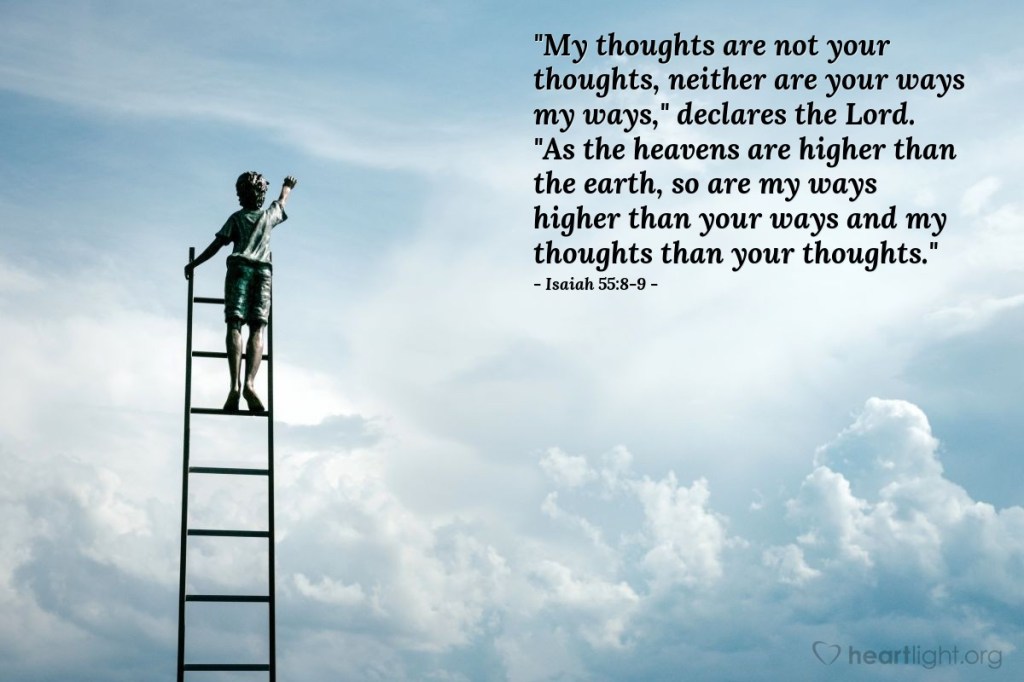
6 “Seek the Lord while he may be found; call upon him while he is near; 7 let the wicked forsake his way, and the unrighteous man his thoughts; let him return to the Lord, that he may have compassion on him, and to our God, for he will abundantly pardon. 8 For my thoughts are not your thoughts, neither are your ways my ways, declares the Lord. 9 For as the heavens are higher than the earth, so are my ways higher than your ways and my thoughts than your thoughts.
The Word of God for the Children of God. Gloria! In Excelsis Deo! Alleluia! Amen.
Jesus walked among us but for a short time. Along the way, the Gospels tell us, he calmly walked into the lives of twelve men while they were going about their everyday lives. He did not advertise he was coming among ordinary men. There were no billboards or television commercials or social media advertisements or any job search web pages. No one was ever even asked to submit any resumes. It is true there were no e-mail addresses or phone numbers to arrange interviews, to examine resumes to ask probing questions or to even verify any references.
Jesus, the Itinerant Rabbi just quietly and calmly walked among men. He called twelve men to be his students. He told twelve men he was going to be teacher. These twelve men, without asking questions, left their occupations, left their understanding of how things of this earth and things of their God were and in ways we cannot comprehend today, they became students of God’s own ways.
They would gladly follow close behind, “eat the dust of their Rabbi!” to learn more about the incomprehensible ways of their God. They would long to feast upon every word, every thought, every utterance, every action of this Rabbi. he taught them with an authority no one had ever experienced before, and no one would ever experience again. They would see the miraculous, be mightily tested and challenged to think outside the Temple box and believe great and mighty and unknowable things their finite minds could never hope to comprehend.
God wanted to be known among men for who He REALLY was, not some bizarre contrivance from the over rationalized thoughts, over regulated, and unspoken rules and traditions which other learned men had long since placed before them and blindly expected them to follow. God was looking for some minds, thoughts of men which He could take hold of, which He could transform into His image. He sent His Son to be Rabbi and Teacher. Give them the incomprehensible God.
Rabbi Jesus was teaching them the unknowable, unreachable, and unsearchable things of His Father in Heaven. Jesus now had these twelve under his tutelage. These twelve struggled mightily for the three years they were with them. It was an impossible task to undertake a PhD +++ in God, in such a short span of time.
The truth is that any task in life – is easy if you know the answers, procedures, and skills necessary. Not knowing the correct answer is what makes a test hard. Not knowing any of the necessary procedures and skills required is what makes a complex task hard. Not knowing what to do is, so often, what makes life hard.
The problem is not the test, task, or life at hand; the problem is in simply not knowing. Ignorance – not an insult, but the simple absence of knowledge which is important to us – is not always bliss. It is both a daunting, terrifying thing. Is there an answer to knowing the unknowable, the unsearchable things of God?
The Answer: Found in Context
A few verses before, in Isaiah 55:6, the Lord through Isaiah instructed His people to, “seek the LORD while he may be found” (ESV) – reminding us that the gift of salvation is not extended to us, as individuals, forever. We must accept God’s invitation to seek, to look for grace prior to the end of our lives – and the coming day of judgment. God’s gracious nature is eternal, but our lives on earth are not. God lovingly but clearly declares this reality in this remarkable verse.
Then, in Isaiah 55:7-8, immediately before our passage for this devotion, God calls His people to repentance and trust in Him – the key to salvation. “Let the wicked forsake his way, and the unrighteous man his thoughts; let him return to the LORD, that he may have compassion on him, and to our God, for he will abundantly pardon.” God’s plan of salvation is neither locked away, secret or hidden; it has been boldly, triumphantly, and resoundingly declared throughout all the ages.
Salvation comes by turning from sin – rebellion and opposition to God, His plan, and His purposes – and turning to Him in faith and trust. In a hard world seemingly full of things so unknowable, unsearchable, complicated, complex, and difficult to understand, God, in His infinite wisdom and grace, has made attainable, the way of salvation joyously simple – to repent, and to trust Him.
The Relationship Between Trust and Knowledge
Trust. What a remarkably simple thing, and yet something with which so many people struggle. In a very real way, trust is founded in knowledge. And, like so many of the problems we encounter in life, the problem with trust is the lack of knowledge concerning it. We often think of trusting as the opposite of knowing – that is, trusting somebody requires commitment without knowledge.
For example, I trust somebody to keep something in confidence, regardless of whether or not I know that they’ll actually keep a secret. I trust somebody to show up to an event or perform a task, regardless of whether or not I know that they’ll actually show up or do what they’ve committed to do.
However, to think of trust in this way is actually to miss the whole point of trust. The very concept of trust is built on knowledge. We trust in someone because, based on our knowledge of that person, we believe that they are worthy of our trust.
While trust is an action unto itself, it is an action founded in knowledge.
More specifically, trust requires the knowledge of mutual commitment.
Trust requires the knowledge of mutual understanding. Trust, ultimately, requires the knowledge of a mutual expression of love. All of these things are what God desires in His relationship with each of us.
The problem most people have with trust is the fear that their commitment, understanding, and love will not be returned – the absence of knowledge that the other individual will hold up their end of the “bargain.”
God has taken that fear out of the equation by reminding us that He has already expressed each of these things in an ultimate and complete fashion.
Commitment
The ultimate expression of God’s commitment was the giving of His only begotten Son. As John 3:16 so powerfully declares, “For God so loved the world, that he gave his only Son, that whoever believes in him should not perish but have eternal life” (ESV).
Further, Psalm 55:2 reminds us, “Cast your burden on the Lord, and he will sustain you; he will never permit the righteous to be moved.” (ESV).
Jesus told us in Matthew 6:26, “Consider the birds of the sky: They don’t sow or reap or gather into barns, yet your heavenly Father feeds them. Aren’t you worth more than they?” (CSB).
All throughout the Bible, we are reminded of God’s care and commitment for us as His children. God has already given His commitment. He calls on us to freely choose to commit 100% of our thoughts and actions unto Him alone in return.
Understanding
The ultimate expression of God’s understanding can be seen in how well He knows and understands His creation and, above all, His people.
As the LORD declared to the prophet Jeremiah, “Before I formed you in the womb I knew you, and before you were born, I consecrated you; I appointed you a prophet to the nations.” (Jeremiah 1:5 ESV).
While this verse is directed toward Jeremiah specifically, the principles behind it are echoed in numerous other passages, accounts, and teachings throughout Scripture. God knows and understands us more deeply than any other human being possibly can.
In truth, God knows us better than we know ourselves! Psalm 139 conveys this truth in breath-taking terms. For example, the Psalmist declares:
“O Lord, you have searched me and known me!
You know when I sit down and when I rise up;
you discern my thoughts from afar.
You search out my path and my lying down
and are acquainted with all my ways.” -Psalm 139:1-3 (ESV)
Love
God has shown His love for His people countless times all throughout the Bible and human history, but in no event was God’s love for His people shown more clearly than in what happened at the cross of Calvary.
As Romans 5:8 declares, “But God proves his own love for us in that while we were still sinners, Christ died for us.” (CSB). Further, Scripture reminds us that God’s love was not a one-time deal; it continues throughout the ages.
As the Psalmist declared, “Give thanks to the God of heaven, for his steadfast love endures forever.” (Psalm 136:26 ESV).
Conclusion: The God Who Knows and Loves
1 Corinthians 2:6-12 English Standard Version
Wisdom from the Spirit
6 Yet among the mature we do impart wisdom, although it is not a wisdom of this age or of the rulers of this age, who are doomed to pass away. 7 But we impart a secret and hidden wisdom of God, which God decreed before the ages for our glory. 8 None of the rulers of this age understood this, for if they had, they would not have crucified the Lord of glory. 9 But, as it is written,
“What no eye has seen, nor ear heard, nor the heart of man imagined, what God has prepared for those who love him”—
10 these things God has revealed to us through the Spirit. For the Spirit searches everything, even the depths of God. 11 For who knows a person’s thoughts except the spirit of that person, which is in him? So also no one comprehends the thoughts of God except the Spirit of God. 12 Now we have received not the spirit of the world, but the Spirit who is from God, that we might understand the things freely given us by God.
Why did God send His Son into the affairs of mankind? Why did God choose to make the way of salvation so simple? Why did God choose to call us to simply trust in Him? Why did God prove his commitment, understanding, and love for us up front, rather than requiring us to “go first”? He desired to be known.
Because He is both the God who knows and deeply desires to be known and made known among us and the God who loves. The call to trust Him brings us inescapably face-to-face with the reality of knowing and loving Him in return.
“For as the heavens are higher than the earth,
so are my ways higher than your ways
and my thoughts than your thoughts.” (Isaiah 55:9 ESV)
In a 21st century sense, being Christian with an Isaiah 55:6-9 mindset is not unlike, solely for the sake of God’s glory, edifying God’s Kingdom, inserting ourselves and our thought processes squarely into this historical quote.
“We, who are the unwilling, led by the unknowing, who are doing the impossible for the ungrateful. We have done so much, for so long, with so very little, we are now qualified to do anything with nothing.”
― Konstantin Josef Jireček
Is that really what we want to pray for in these most unsearchable of times?
In the name of God, the Father and God the Son and God the Holy Spirit,
Let us pray, (if we dare ….)
Tender Shepherd, thank you for being so patient with me when I cannot fully understand and appreciate your holy and transcendent character. Thank you for sending Jesus so I can know you better and trust you to know me better than I know myself. I look forward to seeing you face to face when Jesus comes to bring me home. Until that day, please know I love you. In the name of Jesus, I offer all of my thoughts, thanks and praise. Alleluia! Alleluia! Alleluia! Amen.
God’s tireless Prophet Jeremiah enduringly wrote some 2650 years ago; blessed is the man who trusts in the Lord, and whose hope is in the Lord. For he shall be like a tree planted by the waters, which spreads out its roots by the river, and he will not fear when heat comes; but its leaf will be green and will not be anxious in the year of drought, nor will cease from yielding fruit.(Jeremiah 17:7-8 NKJV)
The person who loves God is like a tree with deep roots. During a drought, when all the other trees are perishing, the single tree planted by the river will remain healthy and strong – drawing its nourishment from all the waters flowing by it. There is no anxiety, for the commitment of that single tree reaches far beyond the circumstances, life threatening effects, of the drought which surrounds it.
If we are to succeed in the midst of the swirling circumstances which threaten to continually define and continuously overwhelm our day-to-day existence, and if we are not trying to quit on God or our neighbors or ourselves when the going gets tough, we need to get our roots planted by the rivers of living water steadily flowing forever down unto us from the very throne room of God itself.
We need to set a covenant goal to commit our life unto our Savior Jesus Christ. A covenant commitment which plants, then grows stronger, matures far beyond than what overwhelms us, until only the commitment to Christ remains known.
Galatians 6:9-10 The Message
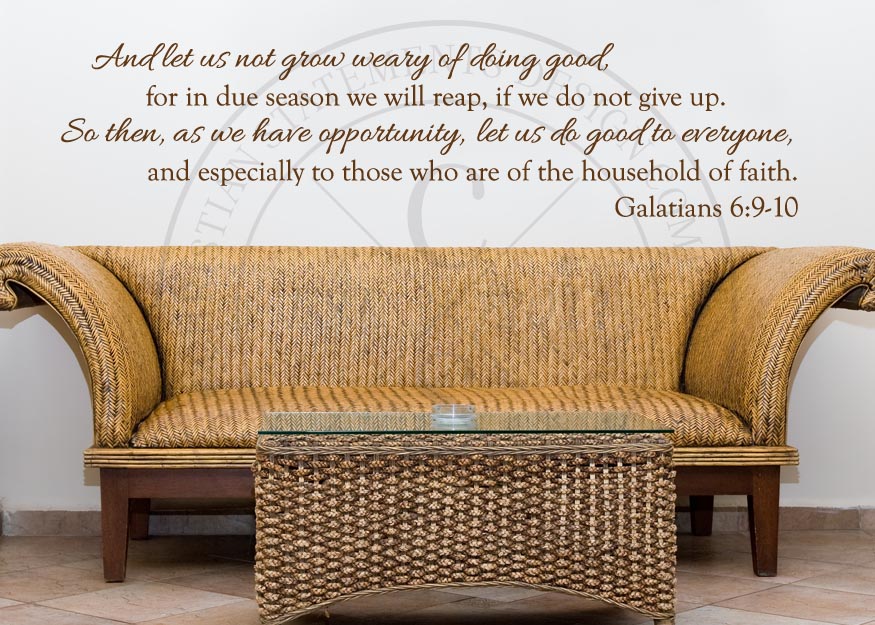
9-10 So let’s not allow ourselves to get fatigued doing good. At the right time we will harvest a good crop if we don’t give up or quit. Right now, therefore, every time we get the chance, let us work for the benefit of all, starting with the very people closest to us in the community of faith.
The Word of God for the Children of God. Gloria! In Excelsis Deo! Alleluia! Amen.
The major theme of Paul’s letter to the Galatians is that we are saved by faith, and not by works. Yet what I do as a believer is important. True salvation is not just my accepting Jesus into my heart with an eye toward heaven in the future. It is an ongoing relationship with Jesus as my Lord. And that is what is reflected clearly in this closing instruction in Paul’s letter to the churches of Galatia.
Do not become weary in doing good to all. Especially to other believers. We are summoned, “Called to Do Good” But what does that mean to ‘Do Good’?
What Does it Mean to Do Good?
‘Doing good’ is not the same thing as doing no harm. Doing no harm is a quiet passive activity – it is staying seated upon our couches in our living rooms. But doing good is all active. It is something that takes effort on my part. Something that I could grow weary of. And something that is directed toward other people.
Doing good means that when I see an opportunity to help another person, I take it. It may be something simple and with little cost. Or it may be more costly and time consuming too. Doing good simply means that I do what I can to help you.
For God so loved the world, He sent His Son to us to continually love us, not to continuously condemn us. He came unto us that we might find goodness and abundance beyond our ability to comprehend or to receive in one lifetime. This instruction to do commit to a lifestyle of being abundantly good, sharing all of God’s abundant goodness is all inclusive, all of the time, has all people in mind.
Even those who are not believers. And even those that I may not get along with. If I can do good for someone, regardless of my relationship to them, I should.
But it is especially true for those within the family of believers. They are the ones I should care most about. I should actively seek out, look for ways to do good; to be helpful and hopeful and joyous to them. As you live your life with Christ, be doing good to all people, especially within the community of faith.
The simple gospel of grace is to come to Christ and believe – for we are saved by grace alone and not by doing good works, lest any may should boast. But once we do believe and are saved, we should then become a true disciple and take up our cross, follow daily after Jesus – for this is God’s desire for all His children.
If we are going to root ourselves in Christ, if we are to truly grow in grace and mature in the faith, we are to do the good works that God has already prepared for us to do. If we are to mature in the faith and press onward to the goal of our calling, we ought to be living our lives as unto the Lord – and “not lose heart in doing good, for in due time, God’s time, we will reap, if we do not grow weary.”
“Give me one hundred preachers who fear nothing but sin, and desire nothing but God, and I care not a straw whether they be clergymen or laymen; such alone will shake the gates of hell and set up the kingdom of heaven on Earth.” ― John Wesley
“Do all the good you can, By all the means you can, In all the ways you can, In all the places you can, At all the times you can, To all the people you can, As long as ever you can.” ― John Wesley
In the name of God, the Father and God the Son and God the Holy Spirit,
Let us pray,
Loving Father, I want to press on in my Christian life, to become more and more like the Lord Jesus. I know that it will require me to put my hand to the plough and press on, with the patient endurance that only comes from You. I pray that I may not lose heart or fatigue or growing weary in doing the good works which You have prepared for me to do. Thank You that in due time I may reap a fruitful reward, if I do not give up on you. In Jesus’ name, Alleluia! Alleluia! AMEN.
An anthropologist once visited a primitive village in Western Africa to study the customs of the very primitive people who lived there. When he returned to the U.S., he sent back a sun dial to those people to express his real thanks for their practical cooperation. The natives were delighted with their gift, and they were concerned that nothing happen to it, so they immediately built a thatched roof over it to protect it. In so doing, however, they made it of no practical value.
The foolishness of this is obvious to us all, but James says the foolishness is not always obvious to Christian people when they do the very same thing with their religion. They will take it home after church on Sunday, and they hang it in the closet with their Sunday clothes, and there it stays until the next week. It is as worthless as a sun dial under a roof. James warns us that if our Christianity is not practical, and we only hear and do not do, then we are deceiving ourselves.
James 1:26-27 Easy-to-Read Version
The True Way to Worship God
26 You might think you are a very religious person. But if your tongue is out of control, you are fooling yourself. Your careless talk makes your offerings to God worthless. 27 The worship that God wants is this: caring for orphans or widows who need help and keeping yourself free from the world’s evil influence. This is the kind of worship that God accepts as pure and good.
The Word of God for the Children of God. Gloria! In Excelsis Deo! Alleluia! Amen.
A Christianity that is not real or practical is not a real, practical Christianity. If it does not control your conduct, and it does not change your character, and make you more sensitive to the will of God and the world’s need, then you better stop and ask some very serious questions about the practical reality of your religion.
In these last two verses of chapter 1 James has a lesson for us on how to test the reality of our religion. If your religion does not really change you, then you had better change the practical applications of your religion. James implies there are three questions that we must be able to answer with a definite “yes” if we are to be confident that our religion is not vain, but of real and practical value to God, to the real world, and to our real and practical selves living in the “real” world.
The first question that grows out of what James says is-
I. AM I PRUDENT IN MY SPEECH? Verse 26.
James is saying in a different way what Jesus said when He made the statement, “It is not what goes into a man but what comes out of him that defiles him.”
Jesus was referring to the tongue just as James is.
The Bible makes it quite clear that one of the greatest responsibilities which men have is the wise use of their tongue.
Jesus said, “By your words you shall be justified and by your words you shall be condemned.”(Matthew 12:37)
A real Christian is one who does not say, “I have freedom of speech, and so I can use my tongue as I please.” A real and practical Christian – He is one who will freely present his body a living sacrifice unto God, and that includes his tongue. He is one who is truthful with his tongue, and practical and wise with his words.
A man who can go to church on Sunday and then curse on Monday and tell a few dirty stories at the office or plant on Monday is only deceiving himself, “for out of the abundance of the heart the mouth speaks.”
If that is what comes out of his mouth, we know his heart is filled with the language of the world and not that of the Word of God.
James is saying that the man’s religion is vain, and it has no real value to anyone. He is a double minded man who will receive nothing from the Lord.
It is amazing how many people are deceived at this point. Out of the very same mouth comes both sweet and bitter. I have known men who could talk about their church work, and of how they help the church in so many ways, and then a few minutes later hear them using filthy language and do so with no respect for others in their presence.
He thinks he is very religious, but James would say because he cannot bridle his tongue, he fails the test of real religion. A foul and filthy tongue characterized the ancient world, the Christians who were won out from this type of society had a difficult time in keeping their tongues committed to the glory of Christ.
This same problem exists today, where foul language is even very common in the public schools, in modern so-called movies, as well as the workplace. It is easy for the Christian to get caught up in the common expressions of the world and thereby cease to be different from the world.
This can totally ruin your real and practical testimony and witness, make your religious commitment of no real or practical value.
The Apostle Paul was concerned about this problem also, and he wrote to the followers at Colossians and said in 3:8-10,
“But now you must rid yourselves of all such things as these: Anger, rage, malice, slander and filthy language from your lips. Do not lie to each other, since you have taken off your old self with its practices and have put on a new self,which is being renewed in knowledge in the image of its Creator.”
This brings us to the basic idea that James is getting at. It has to do with the use of our tongue in relationship to other Christians. When Paul says we are to put away anger, wrath, malice, and lie not to one another, he is saying what James means when he says we must bridle our tongue.
William Penn put it this way: “Men who fight about religion have no religion to fight about.”
We mentioned before that the Christians to whom James is writing were caught up in a great deal of real religious controversy. And real unbridled tongue could cause much damage. A tongue not under the control of reason and the Holy Spirit will race wildly across the field of a man’s character, kicking, bucking, and trampling it without pity, and the result will be a real victory for Satan.
Most all great men of God suffer much sorrow because of the severe criticism they receive from Christians. The speed with which Christians are ready to blast out at other Christians is the speed by which they make themselves useless to God, the world, themselves. All the good a person may do vanishes rapidly when the tongue is filled with malice and contempt for a brother or sister in Christ.
A critical and malicious tongue is a sign of self-righteousness. When a Christian becomes satisfied with his own attainment, he really tends to become critical of others. He feels if only others could be as wonderful as he is the church could get somewhere.
So, he builds a fence around his religion to protect it. He becomes narrow and bigoted, and he sets out to straighten the world according to his standard. The end result is that he does more harm than good, and his religion is as worthless as a sun dial covered over by a thatched hut without the sun and its real light.
He is trying to be a Christian without the spirit of Christ. There are many more areas where the unbridle tongue is a curse. It is clear what James is getting at, and we must be able to say that we are aware of the power of the tongue, and that we will strive to use its power according to the will of God.
If we cannot say that we had better, ask God really quick to forgive us and help us to gain the victory in this area, or our life will count for practically nothing in the kingdom of God. We may still be saved by faith in Christ, but it will be sad that all of our works will be consumed by fire, for they will not stand the test.
The second question is
II. AM I PRACTICAL IN MY SERVICE? v. 27
Before we can answer this question, we must understand what James means by religion. This is one of the most misunderstood verses in the Bible. Many have used it to deny the basic truths of Christianity itself.
They say that religion is really and practically about our real, and practical good works, and so we can start an orphan or widow’s home, or do social work for the needy and widows, and we will get to heaven according to the Bible.
But though this seems to be logically based on this verse, we know it contradicts the rest of the Bible, and the rest of the letter of James itself. Realize, there is no salvation apart from faith in Christ.
James knows that, and in Chapter 2 verse 1 he speaks of the faith of our Lord Jesus Christ. In Chapter 1:1, he is the servant, and all through the chapter he stresses prayer and the Word of God which is able to save souls. Why is all this left out when he tells us what pure religion is? We would expect him to include all these fundamental truths.
The problem is not with James, but with our context and with our language.
The practical words that James used really meant “The external service of God, and not one’s inner state before God.”
I believe James here is referring to the real and practical results of our faith in Christ, prayer, and fellowship with Christ. He is saying that if these things are real, we will be able to know it because it will show itself in our practical service. True religion is not seen in ritual observance but is deeply inside our real trust of our Savior Jesus and inside our own practical obedience to the Word of God.
What James is saying can be illustrated by really saying the same thing about a mother’s love. If I said, “Pure motherly love and undefiled before God is to wash and feed her child.” I would not mean by this that love is merely a matter of keeping a child clean and fed. I would mean that if the love of a mother is real it would show itself in a practical way in her care for her child’s basic need.
This is not the whole of love, but it is the practical result that proves the love is real. So, to really have a sympathetic concern for human need is not the whole of being a Christian, but it is the real and practical result that must be seen to know that the vital factor of faith in Christ is real.
In other words, being real and practical and good will show itself in doing good. As John said, if you can see a brother in real need and have no real compassion, how does the love of God dwell in you?
The world was filled with impractical religion then, and it always has been.
Christianity is the only pure and undefiled religion, for if God’s Word is obeyed and put into practice it will lead to the compassion of God, which, in turn, leads to vital service that makes a difference in this world of endless needs. People can come to a temple offer sacrifices, burn incense, bow and pray, and lay in “real and true” submission before God, or go through any number of practices of ritualistic religion, but if they do not go out and serve God in a real practical manner, all of this is vain and worthless.
Masses of people think they are religious because of their ritual before God, but they never show the compassion of God in the real world. Here, James says that if there is no real and practical service that grows out of one’s religion, it is not the Christian religion, but is instead a really cheap and impractical imitation.
The particular examples that James used to illustrate Christian service are the two that are used all through the Bible. In the ancient world the orphans and widows were the subjects of great injustice. There were no orphan homes, and no social security to help widows. They were often at the mercy of anyone who sought to do them harm or take their property by any means necessary.
Jesus sharply rebuked all the Pharisees who thought of themselves as the most religious of persons. He said, “Woe unto you Scribes and Pharisees, hypocrites! For you devour widows’ houses, and for a (real) pretense make long prayers.” (Matthew. 23:14). This was a long-time practice, and they were blind to how really inconsistent it was with the nature of God.
It is really amazing to me how often people in the Old Testament had to be commanded, reminded, not to oppress the widows and the fatherless. They were constant victims of an ungodly world.
One of the characteristics that God proclaims of Himself over and over is His concern for the orphans and widows.
In Deuteronomy. 10:17-18, “For the Lord your God is God of gods and Lord of lords, the great God, mighty and awesome, who shows no partiality and accepts no bribes. He defends the cause of the fatherless and the widow….”
Keep in mind that James was the brother of Jesus, and his mother Mary was a widow. Joseph died leaving her to raise her family as a single parent. James was using the most common examples of human need in the world of his day.
He does not limit Christian compassion to these examples, but he uses them to illustrate that a religion that does nothing to help the needs of those who are in need of help is not any religion but can be called Christian. Throughout history, real Christians have been shown the greatest source of compassion in history.
If we keep our “real and practical” Christianity a matter of theology, feelings, and ideas, and never get “genuinely real and genuinely practical,” we are not real nor practical nor spiritual from God’s point of view.
We have looked at two test questions:
Are we prudent in our speech and are we practical in our service? If we can say yes to the first, but not to the second, our religion is not realistic enough to even minimally please God. And if we can say yes to both, but not to the third, we are still seriously and severely and catastrophically falling short of the glory of God,
and the third test is this-
III. AM I PURE IN MYSELF? v. 27.
To make our real religion practical we have to get out into the world to meet its needs, but James wants to make it clear we must be in the world but not of it. In other words, don’t become contaminated by the world as you seek to lift it. This means we need a constant reliance upon God.
The sacrifices of the Old Testament were to be without spot or blemish, and so in the New Testament we are to present our bodies a living sacrifice, holy and acceptable and without blemish unto God. The only way we can keep from being spotted by the world is by a careful walk and constant confession.
The Christian who is careless about the purity of his or her life has not quite understood the price that was paid to redeem him from the present evil world. There is a lack of realism in his and her religion, and it does not ring true.
The only one who can ever lift the world is the one who is above it. This does not mean to shut self-off from the world, but, like Christ, to be so busy doing good there is no time to get involved with the real world on its level of corruption.
As Phillips Brooks said,“The life of Christ was like an open stream that keeps the sea from flowing up into it by the eager force with which it flows down into the sea.”What a real masterpiece of what the practical Christian life should be-a real stream of practical activity flowing into the ocean of the world’s needs with none of the salinity of the world’s ocean waters getting near or into the stream.
True purity is gained by being “real” and genuinely positive, and not by doing nothing so as to avoid doing wrong. He who stays pure by doing nothing is evil, nonetheless, for he is a hearer and not a doer, and only deceives himself if he thinks he pleases God. God demands of us all a positive and practical purity.
We have asked three questions: Am I prudent in my speech? Am I practical in my service? Am I pure in myself? These questions test the reality of our religion. If we pass this test, it means we represent the only religion that is from above.
God does not and will not ever lower his standard to fit man. He promises His grace and power to help them grow to His standard if they hunger and thirst after His righteousness. We could never fully reach that standard. Christ was the only perfect Christian. Paul never attained it, but he kept pressing on.
All of us, without one exception, are, and will forever remain really imperfect and impractical Christians, but if our life is a constant striving to be able to say yes to the three questions we have looked at, we are real Christians, and we are practical Christians, and our religion is really, genuinely pleasing to our Lord.
In the name of God, the Father and God the Son and God the Holy Spirit,
Let us pray,
Father, my Guide and Guardian, illuminate my mind so I can understand how you want me to live. Your word tells me that people of integrity who follow your instructions are joyful. You have said that those who obey your laws and search for you with all their hearts are blessed and happy. I want that joy! Holy Spirit, please guard me against allowing evil to influence what I believe and do. Help me walk only in your paths. May my real actions (Acts 3:1-10) consistently reflect what you have said is right and good. Alleluia! Alleluia! Alleluia! Amen.
Why must we endure trials? The truth is that even Christ had to suffer. Jesus Christ was born perfect and never sinned, but to be prepared for what God had sent him to do, he had to suffer. Luke 24:26 says it was “necessary.” Hebrews 2:18 says that Christ “suffered” when he was tempted. Hebrews 5:8-9 says, “Son though he was, he learned obedience from what he suffered and once made perfect, he became the source of eternal salvation for all who obey him.”
For God so LOVED the world! He sent His Son – not to condemn but to offer life – life in an unimaginable abundance! If Christ suffered, why would we not, and for the same reason? Peter said we are in the furnace of affliction to be purified (1 Peter 1:7). God is our good Father, and a good Father disciplines his children whom he loves (Proverbs 3:12). If you are not facing trial, you will. Accept it!!! Walk through it! faithfully, obediently trusting God. let Savior God work in you!!!
James 1:12-18 New American Standard Bible
12 Blessed is a man who perseveres under trial; for once he has [a]been approved, he will receive the crown of life which the Lord has promised to those who love Him. 13 No one is to say when he is tempted, “I am being tempted [b]by God”; for God cannot be tempted [c]by evil, and He Himself does not tempt anyone. 14 But each one is tempted when he is carried away and enticed by his own lust. 15 Then when lust has conceived, it gives birth to sin; and sin, when it has run its (full) course, brings forth death. 16 Do not be [d]deceived, my beloved brothers and sisters. 17 Every good thing given, and every perfect gift is from above, coming down from the Father of lights, with whom there is no variation or [e]shifting shadow. 18 In the exercise of His will He gave us birth by the word of truth, so that we would be [f]a kind of first fruits [g]among His creatures.
The Word of God for the Children of God. Gloria! In Excelsis Deo! Alleluia! Amen.
We are definitely living in uncertain times. There is much going on around us which is not even minimally pleasing to any of our six senses. There is much going on around us which we do not understand, and much which others would rather we not try to understand – just accept and muddle through as best as we can figure out for ourselves and those within our limited spheres of influence.
From the midst of all that which surrounds us and threatens to envelop us, we seek out, receive the greater wisdom and truth from the Word of God. We read now and should prepare ourselves to receive our God’s encouragement to His Children from James 1:12-18. Such should serve as a protection for us. It should guard us from having distorted views of God and of our situation. James offers three reminders that should help us think rightly about God in times of trial.
As We Face Trials, We Must Remember that God Has Promised a Good Reward for Those Who Love Him (1:12)
A blessed people– We don’t usually equate suffering with being blessed, but this is the adjective James uses to describe those who remain firm in their faith and confident in God amid trials.
The promise of God– While this verse has much to say about our response to suffering, the main focus is on the promise of God. God has promised eternal life to those who love Him (the crown of life).
Remaining steadfast– The call to steadfastness is a call to faith and trust in God. While this may seem to imply a works based salvation, we know from Scripture that our love for God and our enduring faith are both gifts from Him given by His grace.
As we Face Trials, We Must Remember that God does not use Trials to Tempt Us to Sin (1:13-15)
Let no one say– James understands human nature well and he knows that when the pressure is really and heavily upon us, we will be tempted to sin. Amid that temptation we may also be inclined to point the finger at God and to accuse Him of being the source of our temptation. James wants to impart wisdom to us to understand God rightly. He warns us against accusing God of being a tempter.
The character of God – God is holy (vs. 13)– In order to prove his point James speaks and writes and he appeals to the holiness of God. Because God is holy and cannot sin, He cannot be tempted, and He will not tempt anyone to sin.
The actual source of temptations – Our own desires (vs. 14) – In verse 14 James explains our temptation to sin does not come from outside of us. Temptation is not an outside force, but an inner battle. The source of our temptations is the evil desires of our hearts. (Mark 7:14-1521-23; Romans 7:18-25; Jeremiah 17:9)
The results of giving into evil desires – Sin and death (vs. 15) – Reverend Dr. Daniel Doriani, Professor of Biblical and Systematic Theology at Covenant Theological Seminary – [James] personifies evil, saying temptations and desires come together to “conceive.” Their offspring is named “sin.” Sin grows up and sin becomes a parent too. The name of its child is “death.” As surely as our physical conception leads to birth, this kind of ‘sin’ conception “gives birth to death.”
As We Face Trials, We Must Remember that God is the Giver of Good Gifts (1:16-18)
The character of God as the giver of good gifts(vs. 16-17) – God is holy. Since He is holy everything that comes from Him is good and perfect and that even extends to our trials. Even our trials can be seen as good gifts that God allows in order to produce something greater in us. God does not give us anything that is intended to harm us or cause us to sin; everything that comes from His hand is intended grow us and to mature us and strengthen us with God’s own wisdom.
The unchanging God– In times that are uncertain and inconsistent we can find a living hope in recognizing God’s unchanging and never wavering character.
God’s greatest gift – Our salvation (vs. 18) – As James brings this section to a close, he ends with the reminder of the greatest gift that God has given, namely our salvation. Our world is cursed by sin and struggles, but God has promised to make all things new. We are a kind of firstfruits as even now God is making us more and more into the image of His Son.
Summary – We are living in an unprecedented time and now more than ever we must strive to think rightly about God and His dealing with us. Regardless of what we face we can be confident in what God has promised, that He remains the giver of every good and perfect gifts. We can also be sure, certain, that any temptation to sin is not from Him, but from our own hearts. Thankfully we know that in Christ we can have victory over the sinful desires of our hearts.
Jesus said the greatest commandment is to “Love the Lord your God with all your heart and with all your soul and with all your mind” (Matthew 22:37).
He said that the whole law is summed up in this one command, especially combined with the covenant command of loving your neighbor as yourself.
Indeed, can sin be committed without first breaking this Great Commandment? For those who love the Lord, there is the promise of the “crown of life.” “The crown of life” seems most likely to be another term for abundant life, eternal life, and heavenly reward. Some make distinctions between different crowns listed throughout Scriptures, but it seems to generally mean eternal reward.
James notes that this reward is available only to those who love God. The question then becomes, what does it mean to love God? This answer can be found in three passages within Deuteronomy.
1) Maintaining Fullness of Heart (Deuteronomy 6:5; also, Matthew 23:37; Mark 12:30; and Luke 10:27) – In this verse, we see one must love God with their whole heart. This is a complete commitment and one’s love of God cannot be defined by a partial undertaking.
When Christ called people to follow Him, it was exhaustive, requiring that one give their whole life (Luke 14:25-33). This call included the entirety of one’s heart. Therefore, one is to have a whole heart directed towards Him. Your heart cannot be divided between two worlds, which means that even the smallest corner must be given over to Him in service and sacrifice (See Romans 12:1-2).
2) Maintaining His Ways (Deuteronomy 10:12) – The people of God are called to walk according to the precepts of God. God has outlined His will for every believer, and if one loves Him, they will indeed walk according to that will.
The idea of walk here indicates this is to be a steadfast way of life. Walking according to the ways of God is not something that one chooses to do only part of the time. Remembering each of us continuously battles our sinful nature, each person must make it a priority to put the ways of God first, so that God is made known by the way in which one lives.
3) Maintaining His Word (Deuteronomy 11:1) – Finally, one who loves God will keep the charge of God, the statutes of God, rules of God, and commandments of God. As one who loves God, a believer will keep His law.
Throughout the Bible, the authors (through divine inspiration of course!) refer to it as the law. Being all sufficient (2 Timothy 3:16) the Scripture is meant to be both a guideline and the authority for how you live. Therefore, be in it daily and seek just how to live it, doing so in an act of obedience because you love God.
James has issued the call to persevere through trials, knowing that a person will be made complete through them, noting that they will receive the crown of life.
This crown of life is the motivation of obedience for every believer, not because they desire to have a crown, but because they desire to be in the presence of the true and holy God. Therefore, maintain His ways as outlined in His word, with a fullness of heart. May God, know we love Him by our deeds of trust, obedience.
In the name of God, the Father and God the Son and God the Holy Spirit,
Let us Pray,
The Prayer of St. Patrick, Patron Saint of Ireland
I arise today Through a mighty strength, the invocation of the Trinity, Through belief in the Threeness, Through confession of the Oneness of the Creator of creation. I arise today Through the strength of Christ’s birth with His baptism, Through the strength of His crucifixion with His burial, Through the strength of His resurrection with His ascension, Through the strength of His descent for the judgment of doom. I arise today Through the strength of the love of cherubim, In the obedience of angels, In the service of archangels, In the hope of resurrection to meet with reward, In the prayers of patriarchs, In the predictions of prophets, In the preaching of apostles, In the faith of confessors, In the innocence of holy virgins, In the deeds of righteous men. I arise today, through The strength of heaven, The light of the sun, The radiance of the moon, The splendor of fire, The speed of lightning, The swiftness of wind, The depth of the sea, The stability of the earth, The firmness of rock. I arise today, through God’s strength to pilot me, God’s might to uphold me, God’s wisdom to guide me, God’s eye to look before me, God’s ear to hear me, God’s word to speak for me, God’s hand to guard me, God’s shield to protect me, God’s host to save me From snares of devils, From temptation of vices, From everyone who shall wish me ill, afar and near. I summon today All these powers between me and those evils, Against every cruel and merciless power that may oppose my body and soul, Against incantations of false prophets, Against black laws of pagandom, Against false laws of heretics, Against craft of idolatry, Against spells of witches and smiths and wizards, Against every knowledge that corrupts man’s body and soul; Christ to shield me today Against poison, against burning, Against drowning, against wounding, So that there may come to me an abundance of reward. Christ with me, Christ before me, Christ behind me, Christ in me, Christ beneath me, Christ above me, Christ on my right, Christ on my left, Christ when I lie down, Christ when I sit down, Christ when I arise, Christ in the heart of every man who thinks of me, Christ in the mouth of everyone who speaks of me, Christ in every eye that sees me, Christ in every ear that hears me. I arise today Through a mighty strength, the invocation of the Trinity, Through belief in the Threeness, Through confession of the Oneness of the Creator of creation.
We cannot trust a person until we know him or her. It is the same with God too. How well do you actually know God and how well do you genuinely know God? How have you experienced God working in you through those difficult places? Do you 100% believe there is even a 0.1% chance of breakthrough in your life? I pray you will come to find out the truth of “breakthrough!” This devotional will throw light on knowing and trusting God through all the situations of our life.
Psalm 91:1-2 New American Standard Bible
Security of One Who Trusts in the Lord.
91 One who dwells in the shelter of the Most High Will lodge in the shadow of the Almighty. 2 I will say to the Lord, “My refuge and my fortress, My God, in whom I trust!”
The Word of God for the Children of God. Gloria! In Excelsis Deo! Alleluia! Amen.
For those of us who were born and brought up in Christian homes, Psalm 91 is a familiar one, which many of us may have read or even memorized as a child. Nonetheless, in this devotional we will explore as to what it means to trust in God as the Psalmist declared about God in the above-mentioned verse.
Truth be Revealed, we will only truly trust a person only when we get to know him or her. It is the same with God, we can trust Him only when we know who He is, and only when we are able to comprehend His divine attributes. When Jesus lived here on earth, he chose twelve men to be His disciples. A closer look at their lives will perhaps help us understand why they decided to trust in Jesus.
1. Peter, the fisherman
Peter was a fisherman by profession, but the day he met Jesus who filled his empty nets with a miraculous and bountiful catch, Peter chose to follow and trust Jesus immediately without any hesitation. The reason Peter gave up his livelihood which included his boat and nets to follow after Jesus, was because Peter instantly trusted Jesus. Peter believed that if he made Jesus his Master, He would take care of him, and provide him with all that he ever needed.
2. Matthew, the tax collector
Levi/Matthew who was another disciple, was a tax collector for the Roman government. Matthew always sought to align himself with the powerful and when he heard the call of Jesus, he understood that Jesus was much greater than the Roman Government that he was working for. So, at the call of Jesus, he too surrendered his riches and left everything as it was and followed after Jesus.
Every disciple of Jesus who followed Him did so because they curious what might be waiting if they trusted Him, as a result heeded His call to follow Him.
We too have at some point in our life must make a decision to trust someone. I am not an island; you are not an island unto ourselves. To get through this life feeling as though we are not and never were alone, and never have to be alone, we must (timidly) step forth in faith, baby-steps to trust on at least one front. Humanity is too likely to repeatedly let us down, serving their own interests,
We look to the examples set forth by God through His Scriptures to follow Jesus and to be “hip to hip” alongside His disciples. The point that each of us need to ponder is whether we have learnt to completely trust Him in all circumstances.
Trusting Jesus through the storms
We read in Matthew 8:23-24(NRSV), “23 And when he got into the boat, his disciples followed him. 24 A windstorm arose on the sea, so great that the boat was being swamped by the waves; but he was asleep.
Some of the disciples of Jesus who accompanied Him on the boat that day were seasoned fishermen who had probably encountered many fierce storms in the very same sea. Strangely, the storm that challenged them that day seemed to be unlike any that they had seen before. The winds were so fierce and the waves so boisterous that they were quickly overwhelmed with the fear of sudden death. In the midst of such a raging storm, Jesus was fast asleep in that same boat.
When the disciples set out with Jesus, they got into the boat following Jesus.
We read in Matthew 8:23 that the disciples simply did so because Jesus went on board a fishing boat. When the storm raged on with intensity, and threatened their very lives, they might have wondered if they did the right thing to follow Jesus into that boat. They had probably decided to follow Jesus with hope that they would have absolute safety and personal security, no storms whatsoever.
But the storm they encountered, proved to be contradictory to their belief.
There may be those who are stressed out with such incredible hardships and are praying, wondering as to why the Lord has not intervened or revealed Himself, to somehow, in some way ease or even miraculously eliminate their situation.
Do keep in mind that we have a God who is altogether trustworthy. Our many difficulties might make us speculate if we made the right decision to follow Jesus. Our Savior Jesus wants to assure such people that there is no need to be perturbed, for the Lord is with us all the time.
For others who might pontificate that they are weak in their faith, let us be comforted that even the disciples of Jesus, who were with Him, and saw all the wonders He performed, were completely perplexed in the midst of that storm.
We read in Matthew 8:25 (NRSV),“25 And they went and woke him up, saying, “Lord, save us! We are perishing!”
Jesus and the disciples were all in the exact same boat, but the way they each addressed Jesus was as if He were somewhere else, and not with them in their crisis. That is why they said to Jesus, “Master, save us, we are drowning!”
What they failed to realize was that Jesus was in their boat, and as long as He was there, there would be no way that their boat would drown, and they would not die without fulfilling their life’s mission. Jesus woke up, got up and ordered the winds “to be still,” the waves “to be still,” they immediately calmed down.
In the midst of our fears, let us say along with the Psalmist, ‘my God, in whom I (with maximum possible confidence) trust’ for when we affirm this over and over again, our faith will “grow up,” and our hearts will be filled with courage.
We read in Psalm 107:1-3 (NRSV),
Thanksgiving for Deliverance from Many Troubles
1 O give thanks to the Lord, for he is good; for his steadfast love endures forever. 2 Let the redeemed of the Lord say so, those he redeemed from trouble 3 and gathered in from the lands, from the east and from the west, from the north and from the south.[a]
This is the word of steadfast and immovable encouragement from the Lord that we should trust Him completely in all life’s situations for all our breakthroughs.
The truths which are so intricately intertwined within this beautiful Psalm 91 are precious promises that every one of God’s blood-bought children are able to claim as their own. However, the majority of theologians correctly identify this section as a Messianic psalm… for our Lord and Savior Jesus is the only One Who truly dwells in the shelter of the Most High. He is the Man of men, Who abides forever in the shadow of the Almighty.
When the eternal Son of God was born into His own creation as the perfect Son of Man, He lived His life dwelling in the shelter of the Most High God. He abodes in the shadow of the Almighty.
He depended entirely on the Father as His refuge, strength and fortress and demonstrated to us all how a man should live – by trusting God in all things.
In many respects, the Lord Jesus is the only Man Who can legitimately claim God as His refuge and fortress – His God in Whom He trusted implicitly. But praise God that even when we fail, “GOD IS still our refuge and our strength,” because of our position IN Christ.
Our Lord and Savior Jesus is the one and the only Person Who could honestly claim God as His refuge and fortress – and He did this on our account because He went to the Cross for us – in obedience to His Father’s will.
Ephesians 2:8-10 We who are saved by grace through faith, find our everlasting refuge in Christ, Who took the ultimate punishment for our sin and became our strong Fortress, strength, our everlasting Refuge, and the Rock of our salvation.
Jesus is the only One who can legitimately confess that the Lord is My God, in Whom I place my trust, and Who will deliver me from the snare of the fowler and the deadly pestilence.
Throughout His earthly life, the Lord Jesus was hidden under the shadow of His Father’s wings, in Whom He sought ultimate refuge. God was His hiding place Who preserved Him from all trouble, and because we are IN Christ, we can also sing songs of deliverance for God’s faithfulness and favour towards us. We can also claim and trust our God to be our mighty Shield and an eternal Bulwark.
Throughout His earthly life, the Lord Jesus maintained ongoing and never-failing fellowship with His Father. He only did the things which He heard from His Father. He only did those things that He saw His Father doing.
Throughout His earthly ministry, the Lord Jesus was ready and willing to say, “Thy Will, not Mine be done.” He was 100% able to trust the Lord with every circumstance of His life, for His undivided hope was in God.
Jesus was free from every fear because His trust was in God, and in the power of the Almighty, He fulfilled all righteousness and became qualified to become the perfect, sinless sacrifice for the sake of mankind.
And we are called to imitate the way He lived. We are to hide under the shadow of His wings every moment of the day and say to Him – You are my Refuge and Fortress. You are my God, in Whom I trust.
Although the Lord Jesus was fully God, in full trust, he literally surrendered all He was and had. He lived His entire life as a Man. He lived His life and faced His death in utter and total dependence upon His heavenly Father for everything.
Although the Lord Jesus was the eternal God, He lived His life as a perfect Man, setting an example to every member of the human race… showing every child of God how our heavenly Father expects each one of us to live.
Can there be any doubt left that the man who penned this Messianic psalm was himself absolutely convinced of the wonderful security that is found in the Lord his God because his faith was credited to him as righteousness, and he could legitimately confess that his trust was in the Most High God – the Almighty King of all Creation Who is a thousand times a thousand times magnified as the Sovereign Ruler of all, the Divine Protector of those that believe on His name.
But the psalmist was inspired to write words that would look forward to the God-Man, Who was wounded for our transgressions and bore the sin of the world on His shoulders, so that all who trust in Him can identify with His death, burial, and resurrection to a new life, and state confidently 100%, “He who dwells in the shelter of the Most High, will abide in the shadow of the Almighty. I will say to the LORD, ‘You are my refuge and my fortress, my God, in whom I trust!”
In the name of God, the Father and God the Son and God the Holy Spirit,
Let us pray,
O Lord, my God, I am here to say thank you that your work is perfect, your ways are 100% just, you are a God of faithfulness. You have said that in all things at all times, you will supply all that I need. Please help me to trust in your power to bring breakthroughs in situations where I cannot find a solution. Be exalted far above me and far above the heavens, O Savior God. Let Your glory be above all the earth. Through Jesus Christ, our Lord, Alleluia! Alleluia! Alleluia! Amen.
Well, I hope we have decided that we will sit in God’s witness chair and let Him have free reign and ask whatever question He wants. And we have decided we are going to give Him all the answers He requires into the depths with which he needs. The questions will undoubtedly be tough and probing and quite rigorous. This questioning will by no means be comfortable – nor is it ever meant to be so for our sakes. Who knows how long we’ll be sitting there, how many questions we will be barraged by? But we have chosen to stay seated in the witness seat.
The question is … Why should we willingly stay seated for such in-depth times.
Psalm 139:23-24 New Revised Standard Version
23 Search me, O God, and know my heart; test me and know my thoughts. 24 See if there is any wicked[a] way in me, and lead me in the way everlasting.[b]
The Word of God for the Children of God. Gloria! In Excelsis Deo! Alleluia! Amen.
Psalm 139 begins with David’s acknowledgement that God has “examined” his heart. The Lord knows everything about him (Ps. 139:1). Nothing about David or his life can be hidden from God, who knows even what David will say before he says it (Ps. 139:4). If he tried to escape from the Lord, in every place God would be present (Ps. 139:7-13). In fact, God knew David even in his mother’s womb as he knit him together wonderfully (Ps. 139:13-16).
The first eighteen verses of Psalm 139 celebrate the Lord’s intimate knowledge of David. Verse 19 changes the subject abruptly: “O God, if only you would destroy the wicked! Get out of my life, you murderers!” (Ps. 139:19). It’s as if the memory of those who sought David’s life interrupted his celebration of God’s presence and filled his heart with a sudden rush, hatred for his enemies.
Then Psalm 139 takes another unexpected turn, concluding with a prayer for the Lord to examine David’s heart: “Search me, O God, and know my heart; test me and know my anxious thoughts. Point out anything in me that offends you and lead me along the path of everlasting life” (Ps. 139:23-24). Perhaps David realized that his hatred exceeded an appropriate zeal for justice, love for God.
Perhaps he remembered that, like his enemies, he himself had done things that badly dishonored the Lord. So, he invited God to search him and reveal anything offensive. “Put me in your witness chair! O God of my salvation!!!” The implied understanding is that David would repent of those sins in order that God might “examine [him] lead [him] along the path of everlasting life” (Ps. 139:24).
With a reluctant heart I confess I need God to search me in this way. Don’t you? Though a part of me resists dealing with what is wrong in my heart, I know that I need to see my sin as God sees it, so that I might confess and be forgiven, and so that I might find hope, turn from my sin to follow the Lord more completely.
The great unknown from sitting in His witness chair. How does God reveal my sin to me? In many ways: through reading Scripture, through hearing the Word of God preached, through the challenging love of friends, and through the still small voice of the Spirit. In asking God to search me, I am inviting him also to open my heart so that I might receive the conviction of his Spirit. I am saying, “Go ahead! Point out anything in me that offends you, and I will listen to you!”
David’s “disquieting thoughts” are those thoughts that caused him to become troubled, or anxious. Again, the challenge is whether we are at peace with our thought life. When the light of God’s truth is shone upon our lives, do we or do we not squirm and hide, or do we or do we not stand up with confidence? Do we or do we not want our sin to be illuminated by our Heavenly Father, so He might lead us away from that path to the eternal path? Or do we or do we not want to hide our sin away from God, and protect it from the Lord’s cleansing grace?
The challenge of Psalm 139? We need to be willing to let go of all that disquiets us–every sinful thought, desire, and motive. Our chief desire is not only to have a blameless reputation before men, but more importantly, to have a character that glorifies God in its reflection of His goodness and purity. This requires us exposing ourselves to His refining fire, allowing Him to search out our hearts and draw out of us the remaining sin in our lives. It won’t be pleasant, but it’s necessary if we are to be sanctified and useful unto the Lord in His kingdom.
QUESTIONS FOR REFLECTION:
Can I really be ready? Take my life and let it be, consecrated Lord to thee ….
Search my heart, O God! Take my life and let it be, consecrated unto thee ….
Ask any question, O God! Take my life and let it be, consecrated unto thee ….
Ask all questions, O God! Take my life and let it be, consecrated unto thee ….
I am fearful an anxious but, go right on ahead and ask your questions anyway!
Take my life and let it be, consecrated Lord to thee ….
Take my moments and my days; let them flow in ceaseless praise. Take my hands, and let them move at the impulse of thy love. Take my feet, and let them be swift and beautiful for thee.
2. Take my voice, and let me sing always, only, for my King. Take my lips, and let them be filled with messages from thee. Take my silver and my gold; not a mite would I withhold. Take my intellect, and use every power as thou shalt choose.
3. Take my will, and make it thine; it shall be no longer mine. Take my heart, it is thine own; it shall be thy royal throne. Take my love, my Lord, I pour at thy feet its treasure-store. Take myself, and I will be ever, only, all for thee.
Take your place upon God’s witness stand …. contemplate His questions ….
Have there been times in your life when God has revealed things to you that were hard, but essential, for you to hear? What helps you to attend to the all- convicting voice of God’s Spirit? Are you ready for God to point out anything in your life that offends him? What might help you to get ready, if you’re not?
In the name of God, the Father and God the Son and God the Holy Spirit,
Let us pray,
O Lord my God, my eternal Father, thank you that you are my ever-present help in times of trouble. Help me to trust in what is unseen. Remind me of the truth of your power, that you surround me, and you are fighting for me. Never give up on me! Give me favor and breakthrough in my life. You are the Sovereign King of all ages, immortal, invisible, the only wise God. To you be honor and glory forever and ever. Through Jesus Christ, our Savior, Alleluia! Alleluia! Amen.
Relationships take time. And as time passes, as growth takes place, as maturity enters in, we can decide whether we want to go to the next level with a person and eventually, “safely” come to that uniquely “safe” place, open up to them.
This doesn’t have to be a husband or wife thing. It applies to every relationship.
Hopefully, over a period of time, we will all have someone we can safely tell our deepest, most sensitive secrets to. Someone we know can keep our confidence.
Such friends like these seem to know when there is something wrong with us, even when others don’t. They have been our friends for so long they can sense our mood, they can sense our innermost thoughts without even talking to us.
With an acquaintance, it’s different. We might tell them a little about our life, but we usually keep them from knowing all of the good stuff going on within us. We establish “safe zones,” weave our safety nets, protect ourselves and them.
Ironically, we will sometimes try to weave our “safety nets” underneath Jesus.
The further irony becomes our lack of awareness, God does know us. We cannot pretend we are something we are not with him. He knows us — inside and out, through and through. Ironically such knowledge as that should liberate us to share a remarkable degree of intimacy with him, but most of us run away from such a close relationship with our Father. Do we really want such a connection?
We declare to ourselves that it is no longer “safe” to be either around God. Yet, IF our “sincerest” “safest” desire, is to indeed become more like him, the only way to be transformed is by “risking our personal safety,” inviting him in to unceremoniously cross-examine all our hearts, our motivations, our desires!
Are we really, actually, genuinely, ready to risk such an “unsafe” eventuality?
I am not so sure we are if we were to seriously examine what God is saying here.
Psalm 139:23-24The Message
23-24 Investigate my life, O God, find out everything about me; Cross-examine and test me, get a clear picture of what I’m about; See for yourself whether I’ve done anything wrong— then guide me on the road to eternal life.
The Word of God for the Children of God. Gloria! In Excelsis Deo! Alleluia! Amen.
Standing Toe to Toe with God … (Job Chapter 19)(Psalm 13 NRSV)
Standing Face to Face with God …. (Psalm 27:7-11 NRSV)(Jonah 1 – 2 NRSV)
“Investigate my life, O God,”
(What!?! Wait a Minute! Cringing and cowering)
“Find out EVERYTHING about me; “
(“Hold on, there … STOP!” Cringing, and cowering and gasping)
“Cross – Examine AND Test me,”
(“You mean put me on the witness stand? I was only joking around!”)
“Get a clear picture of what I am about”
(You mean me raising my right hand, making me swear an oath on a Bible?)
“See for yourself whether I have done anything ‘wrong’ ….”
(“I mean, you are actually taking me super-duper serious, right now, God?)
THEN and ONLY then, if there is anything left of me worthy enough,
(Me and my big mouth have always gotten me into a whole lot of serious trouble, but I would never, ever even remotely imagine anything like this!)
“Then Guide Me on the Road to Eternal life ….”
(“On second thought, maybe, just maybe it might all be worth it after all!”)
In the name of God, the Father and God the Son and God the Holy Spirit,
Let us Pray (“Yes! Lord! Absolutely? or Nope! No Way! No How! or …?”)
Take My Life, and Let It Be by Frances R. Havergal, 1836-1879
1. Take my life, and let it be consecrated, Lord, to thee. Take my moments and my days; let them flow in ceaseless praise. Take my hands, and let them move at the impulse of thy love. Take my feet, and let them be swift and beautiful for thee.
2. Take my voice, and let me sing always, only, for my King. Take my lips, and let them be filled with messages from thee. Take my silver and my gold; not a mite would I withhold. Take my intellect, and use every power as thou shalt choose.
3. Take my will, and make it thine; it shall be no longer mine. Take my heart, it is thine own; it shall be thy royal throne. Take my love, my Lord, I pour at thy feet its treasure-store. Take myself, and I will be ever, only, all for thee.
King David’s desire toward the end of his life was to build a great Temple for the Lord. Except, God said “No! David, You are not the one who will build it!” He was required to forgo the longings of his heart in favour of his son, whom God had decided would be the man to erect the House of God – for His greater glory.
God’s call on David’s life was to fight the enemies of His people and to establish peace in the Promised Land, and so to unify a nation. King David was permitted to make preparations for the foundation of the Temple, but the building and beautifying of the House of the Lord was to be carried out by his son, Solomon.
We all have great hopes and dreams for our futures. But sometimes – it is NO! It is not meant to be. It is not for lack of want nor any lack for giving our efforts, it that sometimes our greatest dreams must be passed on to others to be fulfilled. It breaks our hearts to have to surrender them to another – unless it’s unto God.
2 Samuel 7:18-29 The Message
18-21 King David went in, took his place before God, and prayed: “Who am I, my Master God, and what is my family, that you have brought me to this place in life? But that’s nothing compared to what’s coming, for you’ve also spoken of my family far into the future, given me a glimpse into tomorrow, my Master God! What can I possibly say in the face of all this? You know me, Master God, just as I am. You’ve done all this not because of who I am but because of who you are—out of your very heart! —but you’ve let me in on it.
22-24 “This is what makes you so great, Master God! There is none like you, no God but you, nothing to compare with what we’ve heard with our own ears. And who is like your people, like Israel, a nation unique in the earth, whom God set out to redeem for himself (and became most famous for it), performing great and fearsome acts, throwing out nations and their gods left and right as you saved your people from Egypt? You established for yourself a people—your very own Israel!—your people permanently. And you, God, became their God.
25-27 “So now, great God, this word that you have spoken to me and my family, guarantee it permanently! Do exactly what you’ve promised! Then your reputation will flourish always as people exclaim, ‘The God-of-the-Angel-Armies is God over Israel!’ And the house of your servant David will remain sure and solid in your watchful presence. For you, God-of-the-Angel-Armies, Israel’s God, told me plainly, ‘I will build you a house.’ That’s how I was able to find the courage to pray this prayer to you.
28-29 “And now, Master God, being the God you are, speaking sure words as you do, and having just said this wonderful thing to me, please, just one more thing: Bless my family; keep your eye on them always. You have already as much as said that you would, Master God! Oh, may your blessing be upon my family permanently!”
The Word of God for the Children of God. Gloria! In Excelsis Deo! Alleluia! Amen.
The way David responded to God’s correction and the new Word from the Lord is a good example to follow for any Christian. For David could then be humbled, thoroughly overwhelmed by a tall sense of God’s grace, goodness and promises.
While David’s proposal has been turned aside, God’s acceptance of David’s desire is not denied. God takes the desire of David’s heart to build Yahweh’s house and sovereignly declares that He will build an everlasting house for David. While God had other plans for David’s life, God has dramatically and astoundingly promised to respond to the desire of David’s heart by making an everlasting covenant promise to him.
It was with great gratitude and awe that David learned of God’s gracious plans for him and his descendants. For he is overwhelmed at the magnitude of the Lord’s promise. His emotions tumble over one another as they seek expression.
There is thankfulness, delight, gratitude, and praise. God has superseded, reciprocated, to the prayer request of David’s heart (Psalm 37:4) and has done so in ways that far exceeded his wildest dreams. [Knowing that only God could do it David addressed Him as ‘Adonai Yahweh Sovereign Lord (NIV, LORD God, NASB) seven times (vv. 18-20, 22, 28-29).]
The Lord still delights to abundantly honor those who serve Him. Often, we react to a negative response from Him or life in ways He never intended. We then blindly ignore His numerous blessings that He has lavished and continues to lavish upon us as we bemoan our supposed loss.
The way David responded to God’s correction and the new Word from the Lord is a good example to follow for any Christian. For David could then be over-whelmed by a sense of God’s grace. He humbles himself before God and called himself the servant of God ten times. His prayer of praise and thanksgiving acknowledges the Sovereignty of God and the magnitude of His promises.
The covenant God had just established with David was unconditional. All David had to do was to affirm it and let God do the work. So, David pours out his heart before the Lord in thanksgiving for God’s promises to him and his people.
I. PRAISE FOR THE PRESENT PROMISE, 18-21.
II. PRAISE FOR THE PAST PROVIDENCE, 22-24.
III. PRAYER FOR THE FUTURE PROMISE, 25-29.
David’s initial response to this magnificent revelation concerning the covenant of eternal kingship was to acknowledge the Lord’s graciousness in bestowing it (vv.18-21). David is so overwhelmed all he can do in verse 18 is leave his palace, go before the Lord to sit down and wonder about the majesty of the moment. “Then David the king went in and sat before the Lord, and he said, “Who am I, O Lord God, and what is my house, that You have brought me this far?”
David has just heard God tell him the answer is no. God states in verse 10 that, “I have a plan to establish a center of worship, but not now, and not by you.” You’re not going to fulfil your dream. I’m going to honor you though, because such a noble dream was in your heart, but it is not part of My plan for your life.
David does not question the veracity of Nathan’s visionary words. He accepts them as coming personally from the Lord. He requires no further confirmation of God’s will. He goes and in humility sits in the presence of the Lord. Then in wonderment asks, “Why would You allow me to be a part of this grand plan?”
There is a genuine sense of humility. David picked up on God’s reminder that He had taken him “from the sheepfold” (v. 8) and then quietly raised the question many reflective Christians raise: “Who am I that You have brought me this far?”
Separating himself, now sitting before the Lord, David’s mind ran back to the beginning, to Samuel’s visit to his father’s house. He was overwhelmed at the memory of all the good things which God had done from that day on to bring him to the throne in Jerusalem and to bring peace and prosperity to Israel.
In these most uncertain of 21st century days, one of our great temptations is to take for granted the presence of the blessings of God. It is good for our spiritual life to leave our comforts, sit before God, remember how far He has brought us.
David softened God’s “forever” in verse 16 to “a far distant future” in verse 19. “And yet this was insignificant in Your eyes, O Lord God, for You have spoken also of the house of Your servant concerning the distant future. And this is the way of man, O Lord God.”
As David sits in God’s presence, he sees himself as he really is and the king recognizes his weakness, his insignificance. Thus, he is overwhelmed with a sense of gratitude for God’s promises. It was God’s grace which had brought David this far-from the sheep’s pen to Israel’s throne-and now God had spoken about his descendants far into the future. Only as we realize our shortcomings can we then be struck with awe and wonder that God would bless us as He has.
David had lived through several periods of great intrigue and uncertainty, not sure whether he would remain king over Israel. And now he has God’s promise that one of his descendants would be king forever and ever over God’s people.
Contemplate for a while the absolute magnitude of that promise within your very own circumstance. If that promise of God was now YOURS to live into!
In verse 20 David acknowledges he doesn’t know what to say in response to God’s promise. “Again, what more can David say to You? For You, Lord God, know Your servant!”
A poet and a songwriter, David was a very verbal man. But here he was tongue-tied, silenced by God’s grace and kindness.
But in his being still before the Lord the realization of God’s covenant promise is being prayed over and processed and sinking in deeper and deeper still.
Able to keep quiet no longer, praise begins to flow from David’s heart in verse 2.
“For the sake of Your word, and according to Your own heart, You have done all this greatness to let Your servant know.
David is overwhelmed.
He says Lord, You have blessed my life beyond my worth and You have blessed my house beyond my earthly vision and comprehension. You have brought me from leading my dad’s sheep to giving me this magnificent throne? Who am I?“
You know, it’s important that every once in a while, we sit down, take a long look at our short lives, and just count our many blessings.
Who are we to have been protected from the snows and rains that fell, the ice and the mud that slid or the floods that drowned -leaving hundreds homeless?
Who are we that He has blessed our house, in our neighborhood, in our little community and kept it safe? Warm in the winter and cool in the summer.
Who am I, Lord, that You should give me health and strength to be able to go to school, hold a job or pursue this career or get this degree?
Or to have parents, siblings who have encouraged me? To find my soulmate for life or to have children and to watch them grow. Who am I? . . .to be so blessed?
“Fulfilled dream or no dream, I’m a blessed person,” says David. Here is more evidence that David was a man after God’s own heart.
What a powerful moment. What a statement of praise David offers to God, even when he has just received what must have been huge disappointment for him.
II. PRAISE FOR THE PAST PROVIDENCE, 22-24.
Next David praises God’s incomparable sovereignty which has been evidenced particularly in God’s selection of and marvelous provision for Israel in the past (vv. 23-24).
Verse 22 thanks and praises God for who He is, as demonstrated by His works on behalf of Israel and David. “For this reason, You are great, O Lord God; for there is none like You, and there is no God besides You, according to all that we have heard with our ears.”
All praises be unto our Creator God who has revealed himself down through history, particularly Israel’s history as we read it here in our biblical text.
God alone is God. There is no other true god; there is no God like Him. There can never be another God like Him. He is the great and awesome God. This is in full and maximum possible accord with all that we have heard of Him, from Him.
God has done great things for David, but these were not done for David.
God has worked in David and through David, to bring about the fulfillment of His promises to the nation Israel.
Verses 23 and 24 recount the greatness of God as revealed in His acts on behalf of His people, Israel. “And what one nation on the earth is like Your people Israel, whom God went to redeem for Himself as a people and to make a name for Himself, and to do a great thing for You and awesome things for Your land, before Your people whom You have redeemed for Yourself from Egypt, from nations and their gods? [24] “For You have established for Yourself Your people Israel as Your own people forever, and You, O Lord, have become their God.
David has recovered sufficiently to compare the God of Israel with the gods of the other nations as he places God’s gifts to him in a historical context. David understood that these promises had come to him and his descendants that Israel might benefit from them. God design has always been that through the nation of Israel the whole world would be blessed (Gen. 12:1-3).
God is the Lord of all nations, but He did great things for Israel, His chosen people. David recognized the wonderful truth that God had chosen Israel to be His people forever! [Wiersbe, Warren. The Bible Exposition Commentary. Joshua-Esther. David Cook. 2003. Colorado Springs, CO. p.325].
III. PRAYER FOR THE FUTURE PROMISE, 25-29.
Then David prayed his heart out that the promise God had made might indeed find its fulfillment to the glory of His of His own holy name—so that His name would be great forever (vv. 25-29)
In verse 25 David begins to lay before God the promises that God has made to him. “Now therefore, O Lord God, the word that You have spoken concerning Your servant and his house, confirm it forever, and do as You have spoken,
God gave the promise, David believed it and prayed for the Lord to fulfill it.
The Lord intends when He promises something we should confirm that we understood it and remind Him of it. God’s promises were never meant to be wasted but to be used.
Whenever God gives a promise, if a man does not use that promise, the promise fails in effect to that man, and God’s greatest intention it contained is in some measure, sadly, frustrated. God sent the promise for He desires it to be used.
If I receive a Promissory note, it is a promise for a certain amount of money, I take it and use it. But dear friends too often we do not cash in God’s promises.
Nothing pleases God better than to see His promises put into circulation.
He loves to see His children bring them up to him, and say, “Lord, fulfill Your promise.”[Spurgeon, Charles.] [Vv. 22 and 25 use “Yahweh Elohim,” the God of power.]
Verse 26 indicates that it glorifies God when He fulfills His promises. “That Your name may be magnified forever, by saying, ‘The Lord of Hosts is God over Israel’; and may the house of Your servant David be established before You.”
David reminds himself again of the true greatness of God as reflected in His promises. He asks for the house of God’s servant to be established before God and for God to be magnified through Israel.
That God’s name be magnified forever is the desire of ever faithful believer. I pray it is the desire of your life also (1 Corinthians 10:31).
David confesses in verse 27 that it is because of the word he has had the courage to ask such request of God. “For You, O Lord of Hosts, the God of Israel, have made a revelation to Your servant, saying, ‘I will build you a house’; therefore, Your servant has found courage to pray this prayer to You.
The thrust of verse 28 is the accepting of God’s will and a final pleading that God makes good on His true words. “Now, O Lord God, You are God, and Your words are truth, and You have promised this good thing to Your servant.
In true humility, David desired no more than God’s word, he expected no less.
Even though it was mightily disappointing to David that he wasn’t going to be allowed to build a house for God, he focuses on the centrality of what God’s will for him was. “Thy Kingdom comes. Thy will be done! O Lord Amen” Our prayer should be: “Your will, nothing more, nothing less, nothing else. Amen.”
In 1902 ADELAIDE POLLARD was hoping to go to Africa as a missionary. Despite her best efforts she was unable to raise the funds needed to make that journey.
In her great discouragement she attended a local prayer meeting. And as she sat there, she overheard another elderly woman quietly praying, “It really does not matter what You do with us, Lord, just have Your own way with our lives.”
Those words burned into the heart and mind of Adelaide Pollard. And she long pondered those words: “It really doesn’t matter what You do with us, Lord, just have Your own way with our lives.”
Before she went to bed that night.
Ms. Adelaide Pollard wrote four stanzas of a poem.
What was the poem?
‘Have Thine own way, Lord! Have Thine own way!’
Have Thine own way, Lord! Have Thine own way!
Thou art the Potter, I am the clay.
Mold me and make me after Thy will,
While I am waiting, yielded and still.
Have Thine own way, Lord! Have Thine own way!
Search me and try me, Master, today!
Whiter than snow, Lord, wash me just now,
As in Thy presence humbly I bow.
Have Thine own way, Lord! Have Thine own way!
Wounded and weary, help me, I pray!
Power, all power, surely is Thine!
Touch me and heal me, Savior divine.
Have Thine own way, Lord! Have Thine own way!
Hold o’er my being absolute sway!
Fill with Thy Spirit ’till all shall see
Christ only, always, living in me.
IN CLOSING
In our passage from 2 Samuel 7, David receives grace by receiving God Promise.
First, he humbled himself and gave praise for the promise, then he prays into the promise. Guess what, friends? That’s a winning combination. When you read the Scriptures, give praise for what you are reading, then pray it through!
My prayer is that you would marvel that God has built you a house, that He lives in your heart, and that He’ll build your house to the glory of His Son.
Perhaps instead of asking “why?” or “why not?” concerning the “woes” of our “broken dreams” we should be humbly asking and praying “what?” as in, “OK, God, what do you want me to do with this situation?” or “OK, Very well! Lord. What do you require, what do you need me to do now in light of your answer?”
Our attitude in responding to God will make all of the difference of receiving His blessing or not receiving it.
If we realize that sometimes the answer is “no” and understand that it is “no” for our own good, we, too, can begin to praise God for His blessings on our lives!!!
In the name of God, the Father and God the Son and God the Holy Spirit,
Let us pray,
As we are gathered here today, we ask you, our living God, to shower onto us the blessings of your great wisdom and your knowledge. We pray that as we listen, as we hearken unto your word, we may have the ability to clearly see what God has called us to do. We seek to live to fulfill your purpose so that we can see your kingdom. Illuminate our darkened eyes, reveal to us your glory. Alleluia! Amen.
The world is all too often a hostile place for believers. Goliaths no longer try to hide themselves from public view or from public judgement. They stand tall in their perceived invulnerability; surround, abound around every street corner. Goliath says, “you cannot touch me! “You cannot beat me!” “You are nothing!” We are intimidated by the sheer force of their size, their strength, their words. We shake and we quake in our boots – too easily accept unconditional defeat!
God wants his spiritual children to know, however, that they are not alone. He lives in us with His Son, our Savior Jesus, through his Spirit. We can be assured, therefore, that no matter what evil design someone else may have, the Holy Spirit of God is greater, more powerful, and more glorious. The victory is ours because God’s presence in us is infinitely greater than any force we will ever face. We have our victory assured over all forces, powers, spirits, or opponents.
The Question remains to be answered – if we are to claim such an overwhelming victory through God, the Father and God the Son and God the Holy Spirit, if we are to claim it and own it and possess it as the greatest gift, treasure, there is, to fully live into everything God has set aside for those who believe and conquered, then whose eyes do we look through whose perspective do we make all our own?
Our perspective through our finite eyes and limited wisdom and understanding?
Defined by our shame? Our Guilt? Our brokenness? Our weaknesses? Mistakes?Someone else’s opinion thrust upon us by those rampaging, ranting Goliaths?
God’s perspective through God’s eyes, knowledge and wisdom? (Psalm 139)
1 John 4:4-6 Authorized (King James) Version
4 Ye are of God, little children, and have overcome them: because greater is he that is in you, than he that is in the world. 5 They are of the world: therefore, speak they of the world, and the world heareth them. 6 We are of God: he that knoweth God heareth us; he that is not of God heareth not us. Hereby know we the spirit of truth, and the spirit of error.
The Word of God for the Children of God. Gloria! In Excelsis Deo! Alleluia! Amen.
Whether we like it or not, or realize, admit it or not, in our humanity, we are finite. We have a beginning; we have an end. It is the natural flow of our lives and is seen in everything from a good day’s work to a bedtime story for our kids. But when we brush up against eternity, we find that it has neither beginning, nor an ending. It always was, and it always will be. Such is the nature of love.
Scripture tells us in 1 John 4 that God is love. Therefore, since we know that God is eternal, we can reasonably assume that God’s love is also eternal. Love begins and love ends with God. But God is not stingy with this love. He longs to share Himself with every person on the face of the earth, and the tangible expression of that love is His Church, redeemed by the blood of His Son, our Savior, Jesus.
When you and I go to the source of love and find that we are indeed beloved by the God of the universe, it changes everything. Once our hearts are filled with His love and truth, we are given new eyes for others, and can’t help but want to share the priceless treasure we have found!
In his groundbreaking book, The Life of the Beloved: Spiritual Living in a Secular World, Henri Nouwen says this,
“When we claim and constantly reclaim the truth of being the chosen ones, we soon discover within ourselves a deep desire to reveal to others their own chosenness. Instead of making us feel that we are better, more precious or valuable than others, our awareness of being chosen opens our eyes to the chosenness of others. That is the great joy of being chosen: the discovery that others are chosen as well. In the house of God there are many mansions. There is a place for everyone – a unique, special place. Once we deeply trust that we ourselves are precious in God’s eyes, we are able to recognize the preciousness of others and their unique places in God’s heart.”
Whatever you and I are facing in life, or whatever is coming in your future, God has already given you the steadfast faith, the living hope and deepest love for it. It may not look like it now, and you may not feel like you have what it takes to overcome, but faith in God is never based on our circumstances or how we feel.
The enemy would like for you to believe that you don’t have a chance in life, that you’re a loser, too weak, too poor, too whatever. But God has a different perspective of you (Psalm 139). God sees you through the eyes of love. He sees not what you can be, but what He has invested in you, not what you or others may see from the egregiously limited perspective we have “worldly” learned.
Seeing yourself the way God sees you leads to a life of overwhelming victory. Living into that vision God has always had of us offers to us many challenges.
But it takes faith. You can’t just hear that God loves you and sees you as His child, you have to believe it. It takes faith to move forward and overcome the challenges of life. And faith does you no good if you don’t know how to release it, how to unleash it. You have to release your 100% faith in order for it to work.
We release faith through our words, actions and, of course, through prayer. It’s up to us to act.
1 John 4:4 is a scripture we quote a lot, and almost anytime I say this verse in a church or meeting, everybody claps and cheers. But how many people really do believe these words; “He who is in you is greater than he who is in the world?”
The truth is, the One in you is greater and He loves you. So, stretch your faith today, stretch your hopes today and stretch your love today and see yourself the exact way God sees you. It doesn’t matter what the enemy wants you to see or how things might look. Our faith overcomes through the One who lives in us!
In the name of God, the Father and God the Son and God the Holy Spirit,
Let us pray,
Father, my Guide, illuminate my mind so I can understand how you want me to live. Your word tells me that people of integrity who follow your instructions are joyful. You have said that those who obey your laws and search for you with all their hearts are blessed and happy. I want that joy! Holy Spirit, please guard me against allowing evil to influence what I believe and do. Help me walk only in your paths. May my actions consistently reflect what you have said is right and good. Alleluia! Alleluia! Alleluia! Amen.