1 Samuel 15:22-23 Complete Jewish Bible
22 Sh’mu’el said,
“Does Adonai take as much pleasure
in burnt offerings and sacrifices
as in obeying what Adonai says?
Surely obeying is better than sacrifice,
and heeding orders than the fat of rams.
23 “For rebellion is like the sin of sorcery,
stubbornness like the crime of idolatry.
Because you have rejected the word of Adonai,
he too has rejected you as king.”
Word of God for the Children of God
Glory be to the Father,
and to the Son, and to the Holy Ghost;
as it was in the beginning,
is now, and ever shall be,
world without end. Amen, amen.
When God tells us to do something by instructions in His Word or by His Spirit how do we respond?
Obedience on our part is really an act of practical acknowledgement of God’s authority and will over our lives.
Included in that is our submitting our will to His will and way of doing things.
To be disobedient is to yield to our will or self will over God’s will.
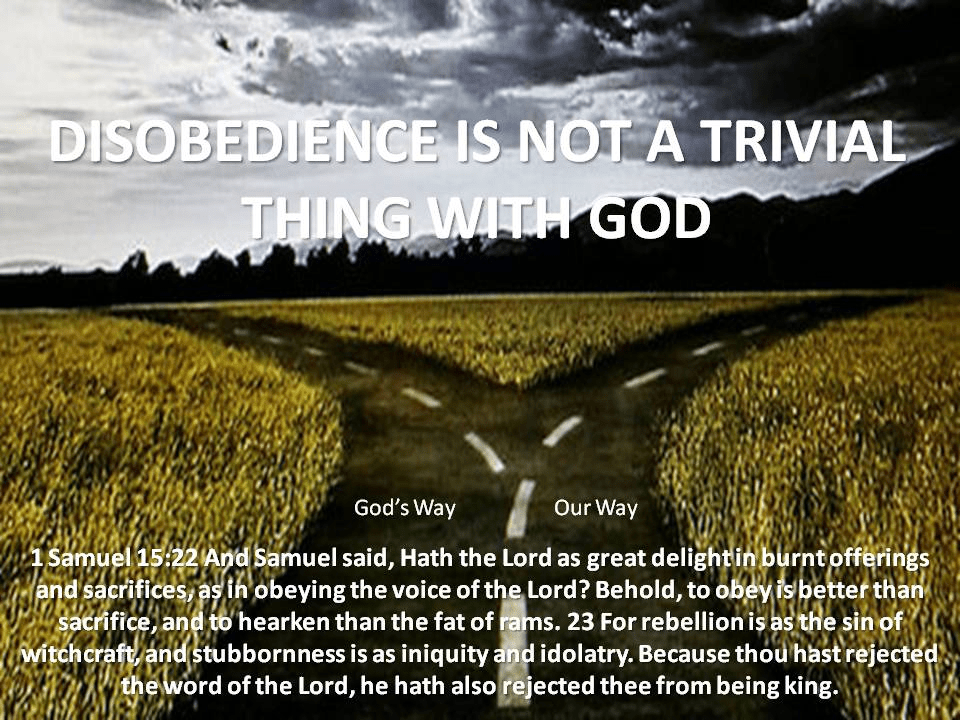
It is not a trivial thing to God when we disobey Him.
It is in effect substituting our way for God’s way.
Our disobedience not only displeases God but it can cause loss and even permanent consequences we’ll have to learn how to live with.
In the Garden of Eden, God gave Adam and Eve one simple rule; they had only one simple rule to follow, yet they still managed to break it.
Ultimately, they rejected God’s authority.
We all must make a personal decision to accept or reject God’s authority—and that includes those He’s put in authority over us.
It is those who don’t believe they are accountable to anyone who live their lives haphazardly, unconcerned with rules; they don’t believe there is any sound and valid reason to obey rules.
We live in a society that emphasizes personal freedom.
Any restriction is viewed with disdain.
Rules, they say, create bondage.
But the fact is a world without rules would be a very scary place to live.
It wouldn’t take long before we would self-destruct.
Can we imagine what our country would be like if we didn’t have a Constitution?
Can you conceive any major corporation functioning successfully without any kind of mission statement?
These guidelines determine how we live and interact with others.
Picture a world cup professional soccer game with no rules.
It might seem like fun at first, but before long, players are likely to get seriously hurt, seriously chaotic, dangerous, which is why we have rules in the first place.
God’s one rule, or instruction, to Adam and Eve was for their protection.
Consider what it would be like to drive without rules.
Deaths would skyrocket.
Or what if doctors didn’t have to abide by strict standards?
I sure wouldn’t want any surgeon operating on me if that were the case.
While people generally expect rules in many areas, a willingness to obey them is another matter entirely.
We seem to be born with a heart that rebels.
But God expects obedience.
“Does the LORD delight in burnt offerings and sacrifices as much as in obeying the LORD? To obey is better than sacrifice, and to heed is better than the fat of rams” (1 Samuel 15:22, NIV).
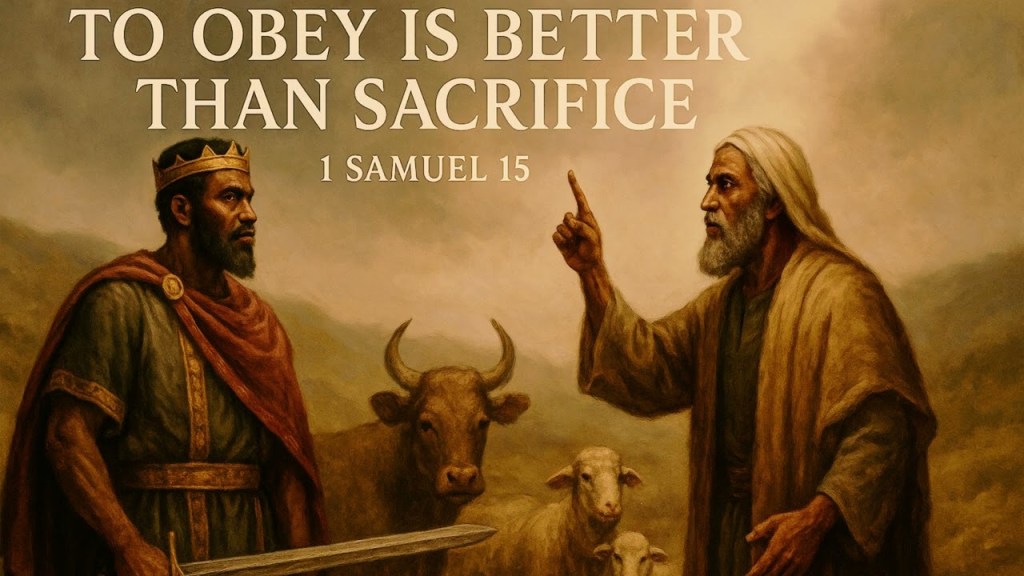
The prophet Samuel had just anointed Saul to be King over His people with the command to listen and obey the words from the Lord to him.
The specific word was to utterly destroy Amalek, all with him, and all they had, sparing nothing.
In the past Amalek had opposed God’s people’s entry into Canaan’s Land by attacking the weak, faint, and those lagging behind in the advance.
God was saying in destroying Amalek He hates what fights against His plan advancing in His people’s lives and what comes against their weaknesses and vulnerabilities.
Instead of fully obeying God, Saul partially obeys and spares the King Agag, and the best of the sheep, oxen, fatlings, lambs, and all that was good.
23 “For rebellion is like the sin of sorcery,
stubbornness like the crime of idolatry.
Because you have rejected the word of Adonai,
he too has rejected you as king.”
Many people consider the Bible to be little more than a book of rules they have no desire, nor reason or rationale to follow.
Yes, the Bible does have certain “rules,” but they are for our benefit.
When you buy a new vehicle, it comes with an owner’s manual.
The manual is written by the people who designed the car to help you know how to use it, how to maintain it, and how to keep you safe.
For Christians, the Bible is our “owner’s manual.”
And just as with a new vehicle, if we don’t do what the “manual” says, we can’t expect things to go nearly as well in our Christian walk.
Rules have a negative connotation, but the giving of the Law was a loving act.
The Israelites, after 400 years of slavery, did not know how to peacefully govern themselves or how to relate to God.
The Law was given as a guide for living so that life would ultimately go well.
Had the Law not been given, the Israelites would have essentially still been in bondage.
How can we tell if we are an obedient child of God?
If you are, then you are.
If you have to be, then you are not.
If you have to obey rules in order to be obedient, then you are not.
“The law is not made for a righteous person, but for the lawless and insubordinate.” (1 Timothy 1:9).
(God) made (Jesus) who knew no sin to be sin for us, that we might become the righteousness of God in him.” (2 Corinthians 5:21).
If you are an obedient child, recognize the new you.
Identify with it.
Obedience should never be activated because we want something in return.
We obey, not so that God will show favor to us, but because God has already shown favor to us.
We tend to obey those we love, trust, and respect.
Such characteristics foster allegiance.
When we regularly contemplate all that the Lord has already done, our love, trust, and respect will increase, thus increasing our desire to obey as well.
When love is our central, primary motivation, God’s “rules” are not a heavy yoke but a natural response.
Obedience is our response of gratitude toward the One who always has our best interests at heart.
Love motivates us to obey, and as a result, we experience love more fully. Behind every act of Christian obedience is the reality of the Almighty God.
God gave us rules to live by; He also gave us free will.
The choice is ours to make.
While God expects obedience, He will not force us to obey Him.
Disobedience Will Weaken Our Relationship With The Lord
Disobedience not only leads to failure but also affects our fellowship with God.
In John 21:4-5, Jesus stood on the shore, unrecognized by the disciples, and asked, “Children, have ye any meat?” (John 21:5).
Their response, “No,” admitted their failure, and Jesus’ question was not to gather information but to stir their consciences.
Term “children” reflects a general address, not the intimate call of “disciples” or “friends,” signaling a strained connection due to their disobedience.
When Samuel asked Saul, “Why did you not obey the Lord?” Saul lied, saying that everything he did was for God.
Did you notice that King Saul did not obey the Lord’s commands but says he did in verse 20.
He thought that partial obedience was still obedience.
Of course, Samuel already knew what Saul had done and why Saul had done it, and this was an opportunity for Saul to come clean to confess and to repent.
When, like Saul, we choose our own path—whether returning to old habits, neglecting our God-given roles, or ignoring His call to obedient service—it creates an ever widening, darker distance in our relationship with Him.
When we believe in God and desire to follow Him but only do it half way that is partial obedience.
King Saul partially obeyed the Lord and choose what he wanted to do instead.
He kept King Agag as a trophy to parade before the people as a symbol of their victory and they only kept the best of the sheep and cattle and killed the rest.
To compound this sin of disobedience, Saul tries to put the blame on his men.
He said his soldiers brought back the best sheep to use as sacrifices.
God tells King Saul what he thought of his partial obedience in verse 22.
You thought to bring the best sheep as sacrifices to me, said the Lord, but I’d rather have total obedience.
Don’t try to cover your disobedience with an excuse.
As a result, God removed the throne from King Saul and his descendants.
Later Samuel anointed David king but he had to wait 14 years before Saul to died in battle.
During those 14 years, Saul tried to kill David repeatedly and remove him as the future king.
His plans always failed as God protected David, his kingship was established.
During times of growing disobedience, prayers may feel like they “don’t even leave the room.” While salvation remains secure (John 10:28-29), disobedience weakens the intimacy of our walk with Christ, leaving us spiritually unfulfilled.
To obey or not to obey—that is the question
We must honestly confess, answer countless times over throughout our lives.
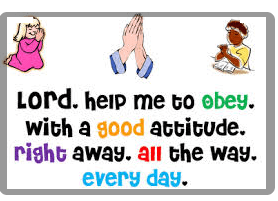
In the name of the Father and of the Son and of the Holy Spirit. Amen
Praying through …
Isaiah 1:13-20 The Message
13-17 “Quit your worship charades.
I can’t stand your trivial religious games:
Monthly conferences, weekly Sabbaths, special meetings—
meetings, meetings, meetings—I can’t stand one more!
Meetings for this, meetings for that. I hate them!
You’ve worn me out!
I’m sick of your religion, religion, religion,
while you go right on sinning.
When you put on your next prayer-performance,
I’ll be looking the other way.
No matter how long or loud or often you pray,
I’ll not be listening.
And do you know why? Because you’ve been tearing
people to pieces, and your hands are bloody.
Go home and wash up.
Clean up your act.
Sweep your lives clean of your evildoings
so I don’t have to look at them any longer.
Say no to wrong.
Learn to do good.
Work for justice.
Help the down-and-out.
Stand up for the homeless.
Go to bat for the defenseless.
Let’s Argue This Out
18-20 “Come. Sit down. Let’s argue this out.”
This is God’s Message:
“If your sins are blood-red,
they’ll be snow-white.
If they’re red like crimson,
they’ll be like wool.
If you’ll willingly obey,
you’ll feast like kings.
But if you’re willful and stubborn,
you’ll die like dogs.”
That’s right. God says so.
Glory be to the Father,
and to the Son, and to the Holy Ghost;
as it was in the beginning,
is now, and ever shall be,
world without end. Amen, amen.