Merry Christmas! Celebrate the birth of Jesus, emphasize the hope which it brings to man, the manifestation of God’s most extraordinary act of love. Matthew 1:18-23

Matthew 1:18-25 English Standard Version

The Birth of Jesus Christ

18 Now the birth of Jesus Christ[a] took place in this way. When his mother Mary had been betrothed[b] to Joseph, before they came together she was found to be with child from the Holy Spirit. 19 And her husband Joseph, being a just man and unwilling to put her to shame, resolved to divorce her quietly. 20 But as he considered these things, behold, an angel of the Lord appeared to him in a dream, saying, “Joseph, son of David, do not fear to take Mary as your wife, for that which is conceived in her is from the Holy Spirit. 21 She will bear a son, and you shall call his name Jesus, for he will save his people from their sins.” 22 All this took place to fulfill what the Lord had spoken by the prophet:

23 “Behold, the virgin shall conceive and bear a son,
    and they shall call his name Immanuel”

(which means, God with us). 24 When Joseph woke from sleep, he did as the angel of the Lord commanded him: he took his wife, 25 but knew her not until she had given birth to a son. And he called his name Jesus.

The Word of God for the Children of God.

Glory be to the Father,
and to the Son, and to the Holy Ghost;
as it was in the beginning,
is now, and ever shall be,
world without end. Amen, amen.

Christmas Greetings, beloved family of Christ.

As we gather together in His name, let us cast our minds back to that humble stable in Bethlehem, where the world first met its Savior.

A night of profound significance, a night when the divine intersected with the ordinary, a night when the heavens echoed with angelic voices singing, “Glory to God in the highest.” This is the night we celebrate at Christmas, the night when all of God’s love was made manifest in the form of a tiny, vulnerable baby.

The great theologian J.I. Packer once wrote, “The Christmas message is that there is hope for a ruined humanity–hope of pardon, hope of peace with God, hope of glory–because at the Father’s will Jesus became poor, and was born in a stable so that thirty years later He might hang on a cross.”

This, dear friends, is the hope we cling so tightly to, the hope we mightily celebrate, the hope we so eagerly share with a world in desperate need of it.

Let us now turn our hearts and minds to the Scripture passage that tells us of this miraculous event from Matthew 1:18-23 Amplified Bible .

Conception and Birth of Jesus

18 Now the birth of Jesus Christ was as follows: when His mother Mary had been  [a]betrothed to Joseph, before they came together she was found to be with child by [the power of] the Holy Spirit. 19 And Joseph her [promised] husband, being a just and righteous man and not wanting to expose her publicly to shame, planned to send her away and divorce her quietly. 20 But after he had considered this, an angel of the Lord appeared to him in a dream, saying, “Joseph, descendant of David, do not be afraid to take Mary as your wife, for the Child who has been [b]conceived in her is of the Holy Spirit. 21 She will give birth to a Son, and you shall name Him Jesus (The Lord is salvation), for He will [c]save His people from their sins.” 22 All this happened in order to fulfill what the Lord had spoken through the [d]prophet [Isaiah]: 23 “Behold, the [e]virgin shall be with child and give birth to a Son, and they shall call His name Immanuel”—which, when translated, means, “God with us.”  24 Then Joseph awoke from his sleep and did as the angel of the Lord had commanded him, and he took Mary [to his home] as his wife, 25 but he kept her a virgin until she had given birth to a Son [her firstborn child]; and he named Him Jesus (The Lord is salvation).

This passage from Matthew’s narrative, dear friends, is the cornerstone of our faith, the foundation upon which we build our lives. It tells us not only of the long promised coming birth of our Savior, but also of the extraordinary love of our God, who would send His only Son to save a world that did not know Him.

Let us pray. Loving Heavenly Father, we thank You as much as our lungs allow for the gift of Your Son, Jesus Christ, who came as a baby in a manger to save us from our sins. As we reflect on the significance of His birth, fill our hearts with Your love, and may the joy of this season inspire us to serve You with renewed passion and commitment. We ask this in the name of Jesus, Alleluia! amen.

Now, let us consider this wondrous manifestation of God’s love through Christmas, the motivation behind our celebration, our mission to serve God.

May the Holy Spirit lead, guide and direct our thoughts and our steps and open unto and into our hearts the most profound truths contained in these themes.

Manifestation of God’s Love through Christmas

The birth of Jesus Christ, our Savior, is a profound demonstration of God’s love for us. This love is nothing which can be classed as ordinary, but extraordinary, transcending human comprehension. It’s a love that chose to leave the glory of heaven, sent of God to be born in a cold humble stable, to live among us, and ultimately to die for us. This is the love that Christmas brings into sharp focus.

God’s love is manifested in the very act of Jesus’ incarnation.

The Word became flesh and dwelt among us.

This was no ordinary birth. It was the birth of the King of Kings in the most humble of circumstances possible. This act of highest humility is a powerful demonstration of God’s immeasurable love. It shows us God is not a distant, detached deity, but a loving Father who is intimately involved in all our lives.

The birth of Immanuel, God with us, God within us also reveals God’s boundless love in its sacrificial nature. Jesus was born to save us from our sins. His birth set in motion a series of events that would lead all mankind to the cross. Even as we celebrate His birth with the most expensive of gifts, we dare not forget the shadow of the cross which looms in the background.

This is love in its purest form – love that is willing to sacrifice everything, even life itself, for the sake of God’s beloved children, save each of us from our sins.

Motivation behind Our Celebration – EXHORT His Humility

As we reflect on the birth of Jesus, we are reminded of the motivation behind our celebration, we look to Paul’s own words from his prison letter to Philippi.

Philippians 2:1-2 Amplified Bible

Be Like Christ

2 Therefore if there is any encouragement and comfort in Christ [as there certainly is in abundance], if there is any consolation of love, if there is any fellowship [that we share] in the Spirit, if [there is] any [great depth of] affection and compassion,  make my joy complete by being of the same mind, having the same [a]love [toward one another], knit together in spirit, intent on one purpose [and living a life that reflects your faith and spreads the gospel—the good news regarding salvation through faith in Christ].

Our passage begins with an emphatic linking word, “Therefore”, tying these verses to those preceding them. In brief, Paul calls for Christians to meet the various needs of others rather than obsessing over their own. The energy and source for this encouragement is what we have received in Christ (2:1-2). We, in unity of purpose, to emulate him by putting others ahead of ourselves (2:3-4).

The added dimension of this exhortation is that the original recipients of this epistle were suffering for their faith (1:28-29).

They were locked in conflict not dissimilar from Paul’s own experiences (1:30; also see 1:12-18). This context of greatest hardship makes Paul’s challenge to value others above ourselves and be concerned for their interests even more astonishing. For Christians, whatever the season, are called to always look out for others, even when we feel entitled to in need of care from others.

How can we do that? Because, if we are honest, most of us instinctively look 1st after our own interests – be better than others, gifts having the most advanced technology, just as we easily love ourselves – and this is typically heightened when we are facing challenges or hardships. Paul’s answer is that we should generously share what is ours in Christ, both experientially, from his example.

Firstly, whatever “encouragement…comfort…tenderness [and] compassion” we enjoy in Christ should be shared with others (2:1-2).

I take it this is what Paul means by calling for us to be “like-minded…being one in spirit and of one mind.”

Christ’s perfect love for us means we are incomparably blessed and reassured.

Therefore let us offer the encouragement and comfort we have experienced to others.

The temptation for us, especially when we are struggling, is to retreat into God as our refuge and strength instead of steadfastly urging others to do the same.

Understanding that God provides peace amid turmoil as we seek Him in our prayers (4:6-7) is a glorious reality both to take hold for yourself and proclaim to others. What we have, know in Christ, is a treasure to be shared not hoarded.

Secondly, this passage corrects the thinking that severely limits our service and encouragement of others only to seasons when we are comfortable and settled.

Remember that the Christians Paul originally addressed at Philippi were being heavily persecuted for their faith. Yet he exhorts them to encourage each other.

And in addition to sharing with others the wonderful experience of Christ’s love he additionally challenges them to follow Christ’s example: “have the same mindset as Christ Jesus” (2:5). Jesus Christ did “nothing out of selfish ambition or vain conceit” but with incredible humility valued others above himself (2:3) and carried His cross, unflaggingly looked to their interests (2:4)—to your interests.

Our Lord exhibited an astounding other-person centeredness that Christians have long exhorted, marveled and preached at, but too often failed to emulate.

If anything, this passage challenges us who rest secure in Christ’s love but do not act to comfort others with it; those of us who rejoice in and sing about his wonderful love for us but do not likewise exhort, nor encourage others with it.

This Christmas Day, this Christmas season, May God help us to have the same mind as Christ—even when we believe that others should be looking after us, even as we feel entitled to first celebrate and feast on our Christian experience.

In the name of God, the Father and God the Son and God the Holy Spirit,

Let us Pray,

Psalm 150 Amplified Bible

A Psalm of Praise.

150 Praise the Lord!
Praise God in His sanctuary;
Praise Him in His mighty heavens.

Praise Him for His mighty acts;
Praise Him according to [the abundance of] His greatness.


Praise Him with trumpet sound;
Praise Him with harp and lyre.

Praise Him with tambourine and dancing;
Praise Him with stringed instruments and flute.

Praise Him with resounding cymbals;
Praise Him with loud cymbals.

Let everything that has breath and every breath of life praise the Lord!
Praise the Lord! (Hallelujah!)

Glory be to the Father,
and to the Son, and to the Holy Ghost;
as it was in the beginning,
is now, and ever shall be,
world without end. Amen, amen.
https://translate.google.com/

Come, O’ faithful ones, and hear, all you who revere God; let me tell you what he has done for me. Psalm 66

Psalm 66 New American Standard Bible 1995

Praise for God’s Mighty Deeds and for His Answer to Prayer.

For the choir director. A Song. A Psalm.

66 Shout joyfully to God, all the earth;
Sing the glory of His name;
Make His praise glorious.
Say to God, “How awesome are Your works!
Because of the greatness of Your power Your enemies will [a]give feigned obedience to You.
“All the earth will worship You,
And will sing praises to You;
They will sing praises to Your name.” [b]Selah.

Come and see the works of God,
Who is awesome in His deeds toward the sons of men.
He turned the sea into dry land;
They passed through the river on foot;
There let us rejoice in Him!
He rules by His might forever;
His eyes keep watch on the nations;
Let not the rebellious exalt themselves. Selah.

Bless our God, O peoples,
And [c]sound His praise abroad,
Who [d]keeps us in life
And does not allow our feet to [e]slip.
10 For You have tried us, O God;
You have refined us as silver is refined.
11 You brought us into the net;
You laid an oppressive burden upon our loins.
12 You made men ride over our heads;
We went through fire and through water,
Yet You brought us out into a place of abundance.
13 I shall come into Your house with burnt offerings;
I shall pay You my vows,
14 Which my lips uttered
And my mouth spoke when I was in distress.
15 I shall offer to You burnt offerings of fat beasts,
With the smoke of rams;
I shall make an offering of [f]bulls with male goats. Selah.

16 Come and hear, all who [g]fear God,
And I will tell of what He has done for my soul.
17 I cried to Him with my mouth,
And [h]He was extolled with my tongue.
18 If I [i]regard wickedness in my heart,
The Lord [j]will not [k]hear;
19 But certainly God has heard;
He has given heed to the voice of my prayer.
20 Blessed be God,
Who has not turned away my prayer
Nor His lovingkindness from me.

The Word of God for the Children of God.

Glory be to the Father,
and to the Son, and to the Holy Ghost;
as it was in the beginning,
is now, and ever shall be,
world without end. Amen, amen.
We have needs which God meets. Quite often, with and in as much gratitude as we can muster we are led to give thanks after giving honor and adoration to God in our prayers for blessings received. We give thanks for all the amazing things God has done—for this world, for his people, and for us in our personal lives.

Notice how Psalm 66 moves from adoration to thanksgiving.

In the first four verses the psalmist declares how awesome and glorious God is.

Then in verse 5 we see a transition to “come and see what God has done.” From this point on, the psalm reads like an inventory of God’s gifts and amazing help.

The psalmist describes how God continually saves and never stops watching over his people, even in the context of anxiety, fear, trouble, disappointments, and psalmist shouts thanks for what God has done for him personally as well.

The ancient words of Psalm 66 teaches us the value of being specific when we give thanks to God. Many people like to keep a personal “thanks be to God” prayer journal that helps them pay attention to what God is doing in their lives.

As the Psalmist did here in Psalm 66, they keep a running list of God’s blessings and His mercy, love, for them, and they review their list in thanksgiving to God.

In our own personal prayer life (if we actually have disciplined ourselves to have one), do we even .01% acknowledge, recognize gratitude grows in many ways?

God is incredibly gracious and generous.

As we read in James 1:17, “Every good and perfect gift is from above, coming down from the Father. . . .”

The One who gives so abundantly, so much of Himself to us, without caveats, is in my own personal belief, is truly most worthy to receive our abundant thanks.

Psalms 66:20 in the King James Version of the Bible reads: “Blessed be God, which hath not turned away my prayer, nor his mercy from me.”

This verse is a resounding declaration of the Psalmists praise and thanksgiving to God for not rejecting the psalmist’s prayers, for continuing to show mercy.

The book of Psalms is a compilation of 150 poetic songs and prayers and pleas the Psalmist’s raised, that were used in worship and praise in ancient Israel.

The psalms cover a wide range of deep emotions and themes, including praise, thanksgiving, lament, and petition. Psalms 66, in particular, is a psalm of high magnitude thanksgiving and wall shaking praise for deliverance from trouble.

The verse at hand expresses the psalmist’s gratitude for God’s faithfulness in hearing and answering prayers.

It acknowledges the mercy and compassion of God, as well as the fact that He has not and will not forsaken or turned away from the psalmist’s cries for help.

This verse reflects the psalmist’s strength of faith, deepest trust in God and his recognition of God’s constant, continual continued presence, grace in his life.

The theme of gratitude and thanksgiving is central to this verse.

It vividly highlights the psalmist’s recognition of the blessings and deliverance that have come from God alone. The act of praising God for His faithfulness in answering prayers and showing mercy serves as an empowering reminder to all believers to express gratitude for all God’s goodness and provision in their lives.

The context of this verse within the larger psalm is also significant.

In the preceding verses, the psalmist recounts a time of distress and trouble when he called out to God for help.

He describes how God has brought him through the trials and has answered his prayers setting the stage for the declaration of praise and thanksgiving in verse 20, as our psalmist reflects on the faithfulness of God in answering to petitions.

The symbolism of verse 20 lies in the essential contrast between the continual faithfulness of God and the never ending tiresome fickleness of human nature.

The psalmist juxtaposes the unwavering nature of God’s mercy and the innate tendency of humanity to forget or neglect the goodness of God. The image of God not turning away the psalmist’s prayer signifies His steadfastness and His 100% willingness to hear, to listen and to respond to the cries of His people.

In a broader theological sense, this verse also points to the character of God as being merciful and compassionate. It emphasizes the idea that God is a loving and caring deity who is attentive to the needs and pleas of His people.

This is a critical source of comfort and reassurance for believers, as it affirms the Psalmist’s belief in God’s loving-kindness and His willingness to extend, unconditionally, His grace and mercy with no boundaries, to those who seek.

In conclusion, the ancient words of Psalms 66:20 is a verse of highest gratitude and maxed out praise, expressing the psalmist’s deepest thankfulness for God’s faithfulness in answering prayers and showing mercy.

It serves readers of all ages, of all generations as a reminder to all believers of the importance of acknowledging, praising God for His goodness and provision.

The verse also highlights the symbolic contrast between God’s unwavering mercy and the fickle nature of humanity, as well as pointing to the character of God as loving and compassionate. It is an incredibly inspiring, and an incredibly powerful statement of hope, trust and reliance on God’s faithfulness and grace.

If we were the modern contemporary Psalmist and were inspired to be thankful to God for blessings given and blessings received, how would our own Psalm 66 read? How would future generations of Psalmist’s be empowered, inspired to write theirs’s? And we the readers and writers of devotionals, to just HUG GOD?

In the name of God, the Father and God the Son and God the Holy Spirit,

Let us Pray,

Psalm 150 Complete Jewish Bible

150 Halleluyah!

Praise God in his holy place!
Praise him in the heavenly dome of his power!
Praise him for his mighty deeds!
Praise him for his surpassing greatness!

Praise him with a blast on the shofar!
Praise him with lute and lyre!
Praise him with tambourines and dancing!
Praise him with flutes and strings!
Praise him with clanging cymbals!
Praise him with loud crashing cymbals!
Let everything that has breath praise Adonai!

Halleluyah!

Glory be to the Father,
and to the Son, and to the Holy Ghost;
as it was in the beginning,
is now, and ever shall be,
world without end. Amen, amen.

https://translate.google.com/

What is God Like? He is Merciful and Gracious, Slow to Anger, Abounding in Steadfast Love, in Goodness, and Truth. Exodus 34:5-9

Exodus 34:5-9Amplified Bible

Then the Lord descended in the cloud and stood there with Moses as he proclaimed the Name of the Lord. Then the Lord passed by in front of him, and proclaimed, “The Lord, the Lord God, compassionate and gracious, slow to anger, and abounding in lovingkindness and truth (faithfulness); keeping mercy and lovingkindness for thousands, forgiving iniquity and transgression and sin; but He will by no means leave the guilty unpunished, visiting (avenging) the iniquity (sin, guilt) of the fathers upon the children and the grandchildren to the third and fourth generations [that is, calling the children to account for the sins of their fathers].” Moses bowed to the earth immediately and worshiped [the Lord]. And he said, “If now I have found favor and lovingkindness in Your sight, O Lord, let the Lord, please, go in our midst, though it is a stiff-necked (stubborn, rebellious) people, and pardon our iniquity and our sin, and take us as Your possession.”

The Word of God for the Children of God.

Adeste Fidelis. Venite Adoremus. Dominum.

Gloria. In Excelsis Deo. Alleluia, Alleluia, Alleluia, Amen.

What is God Like?

A little boy was working hard on drawing a picture from his Sunday School and his daddy came up from behind, asked him what he was working so hard on.

The son replied, “Drawing a picture of God.”

His daddy said, “You can’t do that, son, Nobody knows what God looks like.”

But the little boy remained undeterred, continued to draw for several minutes.

Without stopping his work, he looked at his picture with satisfaction and said very matter-of-factly, held it in his daddy’s face : “They will in a few minutes.”

We may never know what God’s physical features are, but from the beginning, He does reveal His attributes to us so we can each know what He is about, like.

In Exodus 34:6-7, rather than painting a picture a visual description of God, he writes a list about God’s invisible qualities.

From this, we learn God is merciful and gracious.

Keeping mercy and lovingkindness for the thousands.

He is slow to anger and abounding in steadfast love.

He is abounding in goodness and truth

He is longsuffering and willing to forgive.

Forgiving iniquity, transgression and sin.

We also learn that God will not spare the wicked from punishment.

We also learn that God expects us to automatically respond to who He is with an attitude of repentance and with worship that is worthy of being in His Presence.

“Show Me Your Ways Lord, That I May Find Favor”

Exodus 33:12-13Amplified Bible

Moses Intercedes

12 Moses said to the Lord, “See, You say to me, ‘Bring up this people,’ but You have not let me know whom You will send with me. Yet You have said, ‘I know you by name, and you have also found favor in My sight.’ 13 Now therefore, I pray you, if I have found favor in Your sight, let me know Your ways so that I may know You [becoming more deeply and intimately acquainted with You, recognizing and understanding Your ways more clearly] and that I may find grace and favor in Your sight. And consider also, that this nation is Your people.”

In Exodus 33:12-13, Moses asked God to teach him more about God’s ways.

Moses said,

“See, You say to me, ‘Bring up this people.’ But You have not let me know whom You will send with me. Yet You have said, ‘I know you by name, and you have also found grace in My sight.’ Now therefore, I pray, if I have found grace in Your sight, show me now Your way, that I may know You and that I may find grace in Your sight.”

In gracious response to Moses’ request for God to show him more about who He was, God shows Moses favor, God passes by Moses and proclaims the attributes about Himself, revealing to a much humbled Moses more about His character.

God wanted Moses (and us) to know that He is not an angry, impersonal God.

Instead, He is a God that loves us, unconventionally, while also being a just God who will hold His Children to account for their words and deeds and punish sin.

The result of God’s revelation to Moses was that Moses bowed to the ground at once and worshiped God because Moses knew all he needed to accomplish the task God had called him to do was to be in and remain in, the presence of God.

“Hear My Cry Lord, Show Me More of Your Ways”

When was the last time we cried out to God and said,

“Lord show me more of your ways?”

Just as God answered Moses, God will answer us today.

It might be through the Words of truth and life found through scripture that you read and study or in a sermon from your pastor or a song on the radio.

When our desire to know more about God is a longing that is from the heart, God will most abundantly, decisively, definitely and directly reveal Himself.

Where are the “Crying Christians?”

Isaiah 2:2-3 Amplified Bible


Now it will come to pass that
In the last days
The mountain of the house of the Lord
Will be [firmly] established as the [a]highest of the mountains,
And will be exalted above the hills;
And all the nations will stream to it.

And many peoples shall come and say,
“Come, let us go up to the mountain of the Lord,
To the house (temple) of the God of Jacob;
That He may teach us His ways
And that we may walk in His paths.”
For the law will go out from Zion
And the word of the Lord from Jerusalem.

“All nations” is one of my favorite phrases in the Bible.

God is an inclusive God. When he established a beachhead in our fallen world by starting a little nation called Israel, he was already thinking big.

God’s plan was to reach out through Israel to call all nations to himself.

Now, in 2023, Revival has broken out quite literally all over the world.

Thousands upon thousands are responding … they are crying out to God …

Onto the street Corners, into the streets of cities all across the globe …

Into College Campuses …

Into Churches whose pews had more accumulated dust than congregants.

Into malls and supermarkets …

Into the maximum security prisons …

Into the incarcerated for life hearts of violent life long criminals …

Into countries where Jesus Christ is not necessarily the most favored name.

The Word of God for the Children of God goes forth …

Repentance and Baptisms …

“Show us Your Ways, O’ Lord, that we may find Grace and Favor IN THY sight.”

Transformations …

The Message of Salvation through Christ and Christ alone.

God has a Plan …

Jeremiah 29:11-14Amplified Bible

11 For I know the plans and thoughts that I have for you,’ says the Lord, ‘plans for peace and well-being and not for disaster, to give you a future and a hope. 12 Then you will call on Me and you will come and pray to Me, and I will hear [your voice] and I will listen to you. 13 Then [with a deep longing] you will seek Me and require Me [as a vital necessity] and [you will] find Me when you search for Me with all your heart. 14 I will be found by you,’ says the Lord, ‘and I will restore your fortunes and I will [free you and] gather you from all the nations and from all the places where I have driven you,’ says the Lord, ‘and I will bring you back to the place from where I sent you into exile.’

Jeremiah 29:13 says,

“You will seek me and find me, when you seek me with all your heart.”

How bad do you really want to know more about the Exodus 34:6-7 God?

How badly do you want people to know more about the Exodus 34:6-7 God?

How much do you long for the presence of the Exodus 34:6-7 God to lead you to what He’s called you to do?

With what effort do you seek the Goodness and Mercy, the Slow to Anger and abounding in Steadfast Love, the Faithful and Forgiving and Max Truth of God?

What effort do you bring your Worship, cry out to God: “Show Me Your Ways?”

What strength of plea arises from your heart and soul: “If I have found Favor?”

What percentage of your prayer life includes … “That I May Know God’s Grace?”

What percentage of your heart is “firmly prostrated” before the Lord, your God?

What percentage of thy soul is “squarely grounded” in the life of Savior Christ?

Percentage of thy only hope is saturated in nothing less than the blood of Jesus?

God’s promise of a gospel that reaches “to the ends of the earth” is being realized (Acts 1:8).

All nations are streaming toward the mountain of the Lord’s temple—not by pilgrimage to a physical temple in Jerusalem, but by coming to Jesus, the one alone who fulfills the temple’s deepest meaning of God’s presence among us.

Praise God for the amazing things He alone is doing right now within us.

Praise God for the amazing things He alone is doing right now among us.

Praise God for the amazing things He alone is doing within our homes.

Praise God for the amazing things He alone is doing within our families.

Praise God for the amazing things He alone is doing among our friends.

Praise God for the amazing things He alone is doing among our neighbors.

Praise God for the amazing things He alone is doing within our schools.

Praise God for the amazing things He alone is doing upon, within our streets.

Praise God for the amazing things He alone is doing upon, within our prisons.

Praise God for the amazing things He alone is doing within our communities.

Praise God for all the amazing things He alone is doing within our country.

Praise God for the amazing things He alone is doing right now in our world.

And thank Him that in a tragically shrinking world we can yet experience, be a thriving community with fellow believers from across all cultures and nations.

In the name of God, the Father and God the Son and God the Holy Spirit,

Let us Pray,

Psalm 150 The Message

150 1-6 Hallelujah!
Praise God in his holy house of worship,
    praise him under the open skies;
Praise him for his acts of power,
    praise him for his magnificent greatness;
Praise with a blast on the trumpet,
    praise by strumming soft strings;
Praise him with castanets and dance,
    praise him with banjo and flute;
Praise him with cymbals and a big bass drum,
    praise him with fiddles and mandolin.
Let every living, breathing creature praise God!
    Hallelujah!

Adeste Fidelis. Venite Adoremus. Dominum.

Gloria. In Excelsis Deo. Alleluia, Alleluia, Alleluia, Amen.

https://translate.google.com/

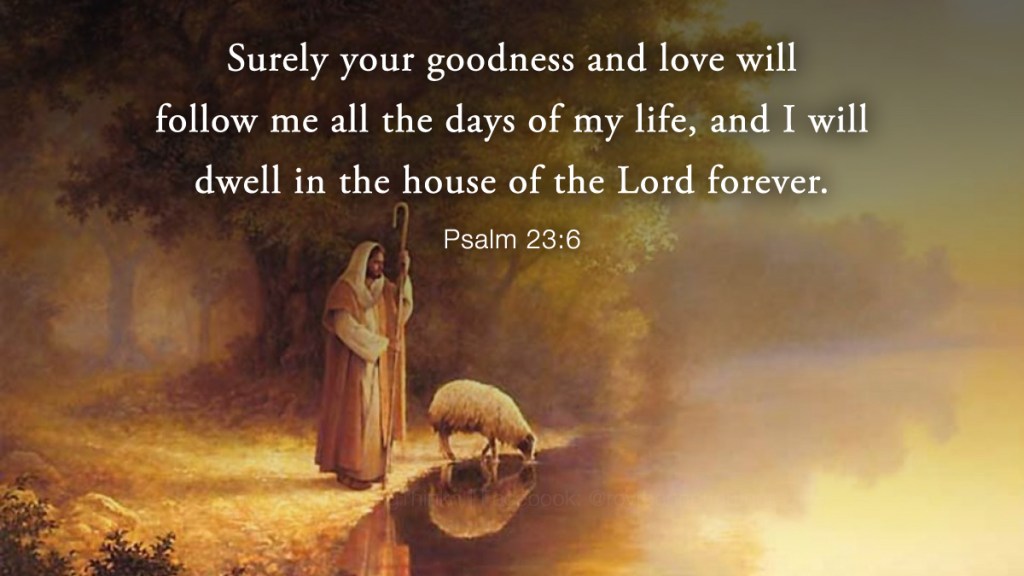
Our Gracious Host Forever Following, and Our Vigilant Shepherd is Forever Keeping Us Safe Inside His Dwelling Place. Psalm 23:6

Psalm 23 King James Version

23 The Lord is my shepherd; I shall not want.

He maketh me to lie down in green pastures: he leadeth me beside the still waters.

He restoreth my soul: he leadeth me in the paths of righteousness for his name’s sake.

Yea, though I walk through the valley of the shadow of death, I will fear no evil: for thou art with me; thy rod and thy staff they comfort me.

Thou preparest a table before me in the presence of mine enemies: thou anointest my head with oil; my cup runneth over.

Surely goodness and mercy shall follow me all the days of my life: and I will dwell in the house of the Lord for ever.

The Word of God for the Children of God.

Adeste Fidelis! Venite Adoremus! Dominum.

Gloria! In Excelsis Deo! Alleluia! Alleluia! Alleluia! Alleluia! Amen.

https://www.blueletterbible.org/kjv/psa/23/6/t_conc_501006

Throughout Psalm 23, David reveals the intimate, personal nature of his close relationship with the Lord.

David has said “me” a total of six times, “I” four times, and “my” seven times.

In this beloved psalm, David writes a total of seventeen personal references in only six verses, making this passionate song of trust intensely, self-disclosing.

We expect this emphasis, because walking with the LORD by faith involves, first and foremost, a close fellowship with Him.

At its essence, true spirituality is not about going through the empty motions of bare religion.

Nor is it about the mere external activities of longstanding rituals.

Rather, a life with God is about knowing Him and loving His Son, Jesus Christ, in intimate, personal communion. 

As we approach the last verse, verse 6, Psalm 23 steadily builds to this closing crescendo.

David writes, “Surely goodness and lovingkindness will follow me all the days of my life, and I will dwell in the house of the LORD forever” (verse 6).

Here, David builds upon the vivid analogy that he used in the previous verse.

In this context, he sees himself as a special guest in a grand banquet hall, where he is being served a feast by the LORD Himself. 

However, this dining hall is located in a very special place.

It is found in a royal palace—but not merely a worldly ruler’s palace.

It is found in the dwelling place of the highest of nobility—in “the house of the LORD.”

“Surely Goodness and Lovingkindness”

David begins with this emphatic word, “Surely” (ak).

This word could be translated as “indeed,” “absolutely,” “beyond any doubt,” or even “only.”

There is no place for any equivocation in David’s mind about what he says next.

He is deeply persuaded of what he is about to affirm.

This steadfast conviction should mark every believer.

David says that “goodness” (lob) will follow him.

This word speaks of the abundant blessings and lavish benefits God has bestowed upon him.

In this word is evidenced the spiritual prosperity that he has experienced in following the Lord – All that David has needed, God has always provided. 

David also confesses that the “lovingkindness” (hesed) of the LORD has followed him.

This is the Lord’s unconditional, loyal, royal love for David—and for all who put their trust in Him.

This word comes from the Hebrew root (hasad) that means ‘to bend down, to bow down.’

This describes God’s condescending love as He reaches all the way down from heaven to where exactly David is.

Could there be anything greater given to David’s life than the “goodness and lovingkindness” of the LORD?

God has given him the very best portion in His great love.

His steadfast, covenantal love for His own people never wavers, even in the furnace of affliction.

God gave each of us the very best portion of His great love – His Son Jesus.

John 3:16-17 King James Version

16 For God so loved the world, that he gave his only begotten Son, that whosoever believeth in him should not perish, but have everlasting life.

17 For God sent not his Son into the world to condemn the world; but that the world through him might be saved.

“Will Follow Me”

David adds that the Lord’s goodness and lovingkindness “will follow me.”

“Follow” (radap) means ‘to pursue after, to chase after, to run after.’

He knows that God’s mercy and grace are in close pursuit of his life.

No matter wherever he goes, he cannot get away from these ever-following assurances.

Regardless of whatever he does, he cannot escape them.

They will never let him go, even when circumstances seem to deny their reality.

These two attributes of God—“goodness and lovingkindness”—actually represent God Himself, who is continually pursuing David.

It is the figure of speech known as personification, which assigns humanlike qualities to inanimate objects.

To be sure, these two attributes represent God, who is personally following David and caring for his every need. 

By this testimony, David states that God is relentless in His love toward him.

David is assured though he will falter and fail, God will never give up on him.

Regardless of how he may disappoint the LORD, he is persuaded that God will never stop pursuing and caring for him.

Even if he trips and falls, he knows God will never distance Himself from him. 

Instead, God will pick up His servant and continue to walk with him.

David will testify elsewhere, “The steps of a man or established by the LORD, and He delights in his way. When he falls, he will not be hurled headlong, because the LORD is the One who holds his hand” (Psalm 37:23-24).

This is an irrevocable promise firmly established in God’s own faithfulness.

“All the Days of My Life”

God’s love for David will follow him “all the days of my life.”

This tender affection and unchanging allegiance of God will be a never-ending pursuit of David to the end of his days. 

His devotion toward God will surely fluctuate.

There will be times when it will strengthen or subside.

But God’s love for him is ever strong and steadfast.

God’s loyal love for David does not depend upon his love in return.

God’s love for David depends upon God Himself, who never weakens or wavers.

This is why God’s lovingkindness is always following after David.

Likewise, this same love of God is always in hot pursuit of every believer.

This divine love never takes a day off.

It never rests, never sleeps, never stops, never stumbles (Psalm 121:4).

Even in the midst of trying times, the love of God never goes on sabbatical, never takes a vacation.

It is ever strong toward us, ever sure. 

“And I Will Dwell in the House of the Lord”

The last line begins with the word “and,” which indicates that what follows is inseparably connected with what preceded it.

With great certainty, David knows that he will “dwell in the house of the Lord.”

“Dwell” (yasab) means ‘to sit down and stay.’

It conveys the idea of making one’s own abode or home.

This is to say, David will always be at home in the Lord’s presence, always in personal relationship with Him, no matter where he goes.

David pictures this meal in which God serves him as taking place “in the house of the Lord.”

Of course, the temple in Jerusalem has not yet been built by his son Solomon.

Instead, this “house” represents the intimate fellowship that David enjoys with the Lord as he lives in the very presence of God each day.

David is pointing his readership to the close communion, intimate interaction that he has with the Lord.

“Forever”

The relationship between David and the Lord will last “forever.”

What starts in this lifetime will never come to an end.

The word “forever” here means literally ‘for the length of days, for prolonged, never-ending days.’

Once David began this relationship with the Lord, he knew it would never be severed.

In the words of this analogy, once David moves into the house of the Lord, he will never move out.

This is the eternal security of every believer.

The Lord Himself is their dwelling place.

Once they dwell in the house of the Lord, they will always be living in the fullness of His love and grace. 

David wants us to know that the Lord who pursues us with lovingkindness is He who keeps us forever.

The Lord who is ever following us is ever keeping us.

Once God begins His pursuit of us, He will never let us go.

No believer can be separated from the love of God, our great Shepherd, Host, and King.

Jehovah God is dwelling within us exactly right now so that we may dwell with Him, both now and forever more.

Let all of His Children raise up!

Bless His holy name!

Jehovah Ra’a, the Lord is our Shepherd, is with us and exactly right beside us, both now and forever more.

Let all of sheep of His pasture turn their heads and give their fullest attention!

Bless His holy name!

The essential truth of our Christian life is that God has come to save us and live in us as “‘Immanuel,’ which translated means, ‘God with us’” (Matthew 1: 23).

This is the essential truth of our ministering to the Lord as well.

Forever we are Safe, Sitting in His sanctuary, abiding and residing in His house

Ministering unto the Lord, from within the sanctuary our inner temple, this is our response to the truth of Immanuel.

Because God is with us, abiding in us, and calling us to abide in Him, indeed to become one with Him, even as He and the Father are one (John 15:4, 10:14-15, 17:21-24), we joyfully, innately, instinctively, obediently, we respond, as God’s Own New Covenant priesthood (Revelation 1:5-6, 5:9-10, 1 Peter 2:5-9).

“Ministering to the Lord” (Acts 13:2) is surely what we know we must do, what our spirit within desperately, longingly yearns for, because God does live within us.

So it is a right and good and joyful thing for us to frequent the temple of the Holy Spirit within us (1 Corinthians 3:16), our “inner room” (Matthew 6:6), so we may be with our Lord in His presence, offering praise and adoration, stillness and reflection, gratitude and humility, even as He securely envelopes us in His Own “goodness and lovingkindness.”

The simple point I make here is that the more quality time and frequency we spend in God’s house now, dwelling within us, the more consistently sure we will be, every day, that “I will dwell in the house of the Lord forever.” Amen.

Love and dwell with our Lord now and looking forward to our joy of loving Him and our joy of dwelling with Him forever, always remembering with 100% joy that, “we love, because He first loved us” (1 John 4:19), we live because He lives.

We praise, thank, and bless You Lord God. Yes Lord, we gratefully and joyfully dwell in Your house today.

“Surely goodness and lovingkindness will follow me all the days of my life, and I will dwell in the house of the Lord forever.” Hallelujah!

In the name of God, the Father and God the Son and God the Holy Spirit,

Let us Pray,

Psalm 150The Message

150 1-6 Hallelujah!
Praise God in his holy house of worship,
    praise him under the open skies;
Praise him for his acts of power,
    praise him for his magnificent greatness;
Praise with a blast on the trumpet,
    praise by strumming soft strings;
Praise him with castanets and dance,
    praise him with banjo and flute;
Praise him with cymbals and a big bass drum,
    praise him with fiddles and mandolin.
Let every living, breathing creature praise God!
    Hallelujah!

Adeste Fidelis! Venite Adoremus! Dominum.

Gloria! In Excelsis Deo! Alleluia! Alleluia! Alleluia! Amen.

https://translate.google.com/