
Whatever You do for God, Do it All with Gusto! Because He “Anoints” Our Heads With Oil and All of Our Cups Overflow! Psalm 23:5, Ecclesiastes 9:7-10

Psalm 23:5 New International Version

You prepare a table before me
    in the presence of my enemies.
You anoint my head with oil;
    my cup overflows.

Ecclesiastes 9:7-10New International Version

Go, eat your food with gladness, and drink your wine with a joyful heart, for God has already approved what you do. Always be clothed in white, and always anoint your head with oil. Enjoy life with your wife, whom you love, all the days of this meaningless life that God has given you under the sun—all your meaningless days. For this is your lot in life and in your toilsome labor under the sun. 10 Whatever your hand finds to do, do it with all your might, for in the realm of the dead, where you are going, there is neither working nor planning nor knowledge nor wisdom.

The Word of God for the Children of God.

Adeste Fidelis! Venite Adoremus! Dominum.

Gloria! In Excelsis Deo! Alleluia! Alleluia! Alleluia! Amen.

In this psalm, we see a beautiful portrait of God as our good and faithful Shepherd Who leads us by still waters and guides us into the way of peace.

He is, indeed, worthy of our worship and praise.

He is the One Who upholds and protects, Who blesses and comforts, Who bountifully provides good things for us in the presence of our enemies.

Enemies, up to and including ourselves as our own worst enemies.

And He is the One Who intercedes for us in heavenly places.

The picture is painted in this well-loved psalm of David, is that of our faithful God, our merciful and gracious Saviour, our good and caring Shepherd Who keeps us, protects us, provides for us through all the changing scenes of life.

Our faithful, and merciful God first identified Himself as Jehovah-Jireh, our gracious Provider, to Abraham when he was halted, by the Lord, from offering up his son, first born son, Isaac, as his sacrifice of abiding love and obedience.

And throughout both testaments, we discover God as the One Who provides rain and sunshine for the earth, nourishment for the flowers and ravens, a father for the fatherless, a righteous judgment for the widow, a friend for the friendless.

Our faithful God is the one who fed the hungry multitude, provides comfort for the broken-hearted, gives succor to the weak, strength to the weary, hope to the afflicted, salvation to all who trust in Christ Jesus for the forgiveness of sins, for while we were yet His enemies, grievous unrelenting sinners, God in His grace provided a Kinsman-Redeemer to save His people from their sins.

Our good and loving God supplies all our needs, according to His riches in glory, through Christ Jesus our Savior.

And here in this well-loved and oft-repeated psalm of David, we discover:

“The Lord has prepared a table before us in the presence of our enemies. He has anointed our head with oil, our cup of overflows with His goodness and love.”

Though we may be afflicted on all sides… pressured, perplexed, and persecuted for righteousness sake, we are not forgotten nor abandoned by our Heavenly Lord… for Jesus is with us always and forever, even to the end of the age.

He has prepared a table before us, in the presence of those that hate and despise us, He has covered it with all we need and every spiritual blessing – which He Himself had purchased for us through His own life’s blood, on Calvary’s Cross.

Though we live in the combat-zone of this fallen world system, we have peace with God through our Lord Jesus Christ… and the peace of God which guards our hearts in the midst of an abundantly, severely crooked and perverse generation.

The anointing oil that is being continuously poured over our heads is the soothing ointment of His incomparable never-ending love.

It is a precious promise to all His children, for we have been made kings and priests and prophets of the living God – and have an eternal guarantee that His Word is faithful and true and all of His promises are ‘Yes’ and ‘Amen’ in Christ.

Surely, in the company of all of God’s angels and with David we can proclaim,

“My cup of blessing runneth over,” for His grace is limitless, His love is boundless, His charity and mercy endures from one generation to another.

Why such an inconceivable magnitude of maximum Joy?

Because together, in the presence of our Great Shepherd, we have just seen, and envisioned and witnessed and can now testify to all the prophetic descriptions of heavenly places like green pastures, quiet waters, and paths of righteousness.

By the Word of God for the Children of God, our heads have been anointed with His oil of abundant life and incomprehensible love and now our cups overflow.

We have seen through the Word of God for His Children, the strong, steady hand of the ever vigilant shepherd at work with his shepherd’s rod and staff.

By the Word of God for His Children, We have received the invitation to the table of the Lord which is prepared for his precious flock before our enemies.

And now there is one more activity we need to plumb, to see in this final scene.

“He Anoints My Head With Oil”

This may seem like an odd custom since it is something that never occurs much anymore in our own time and culture, in our faith traditions and in our church.

Maybe this custom of pouring oil over the head needs a little more explanation.

First of all, we are not talking about the kind of oil that comes from petroleum.

The 1st century people in the Bible did not drill any oil out of the ground, they did not even know what petroleum oil was, nor would they have any use for it.

So, please do not think at all about oil in the Bible as anything like we use today.

We are not talking about motor oil; it’s not the 5W-30 synthetic blend you find at the Valvoline shop or any local vehicle repair establishments down the road.

The region around the Mediterranean is perfect climate for growing olive trees.

The most common oil in Israel was olive oil used for cooking.

There were also other plant-based oils used mostly as perfumes and medicines from such sources as myrrh and nard.

It is probably the closest equivalent to what we use today as “Essential Oils” (if you are familiar with the use that term).

Let’s also remember that the people back in Bible times did not all have showers in their homes, and there was no such thing as shampoo and perm in that time.

The use of fragrant oils in their hair was a common way of what people in that day would have considered basic hygiene.

Not that people would do this every day as we might consider hygiene to be part of our regular habits; it was more the mark of a special occasion in their time.

Putting fragrant perfume in hair was considered part of the expectation to be presentable before coming to a party, other type of important social gathering.

That’s the launching point we are taking today in order to consider how this last scene of Psalm 23 applies into our world today.

Jump with me, then, to the Book of Ecclesiastes for another brief glimpse at how this cultural custom of ointment poured in a person’s hair shows up.

Ecclesiastes 9:7-10 New International Version

Go, eat your food with gladness, and drink your wine with a joyful heart, for God has already approved what you do. Always be clothed in white, and always anoint your head with oil. Enjoy life with your wife, whom you love, all the days of this meaningless life that God has given you under the sun—all your meaningless days. For this is your lot in life and in your toilsome labor under the sun. 10 Whatever your hand finds to do, do it with all your might, for in the realm of the dead, where you are going, there is neither working nor planning nor knowledge nor wisdom.

Perhaps it is helpful to explain that anointing with oil had several other uses and meanings in the Bible.

This may help clear up any confusion for people who may be familiar with many of the other places in scripture that anointing with oil occurs.

It shows up as a medicinal practice for healing since they thought that fragrant oils had significantly positive medical benefits.

It also shows up as a symbolic declaration of royalty; kings would be anointed as a part of the Coronation sequence.

It also would take place as part of the burial ritual whenever somebody in those ancient of days and that time passed away.

I do not think the anointing with oil mentioned in Psalm 23 has anything to do with these functions of ointment.

Context of Psalm 23:5 makes it clear anointing with oil is understood as basic hygiene people would do as preparation for joining a special social occasion.

And this is certainly the same function of anointing we see in Ecclesiastes 9:8.

For this devotional today, then, let’s dig into what is happening in these few verses in Ecclesiastes as a way of helping us understand what David means by this scene in which the shepherd is seen anointing his flock of sheep with oil.

Ecclesiastes can be a difficult book of the Bible to contextually understand.

I can see where this passage from chapter 9 might be easily misunderstood.

At eye level the way it comes at us translated into the English language, it might seem like a kind of an off-putting and depressing outlook on our everyday life.

One big proverbial hardcore slap in the face saying “You might as well just go eat your dinner because your meaningless, ridiculous life isn’t going anywhere else.”

Of course, through revelation from the Holy Spirit, there’s definitely something much different going on in this passage; and it is not have a depressing outlook.

The key here is that we cannot get hung up on a few English words which don’t do the best job of conveying to readers all the richness of the Hebrew language.

Let me pull at two examples of difficult Hebrew words in Ecclesiastes, and one Hebrew word from Psalm 23.

In the book of Ecclesiastes, our NIV Bibles repeat the theme of “meaningless” over and over again (an eye popping 33 times) throughout the entire book.

Other English translations use the word “vanity” as the repeated theme.

The Hebrew word is hebel.

It literally comes from the same Hebrew root as “a breath.”

Hebel carries with it the nuance of being incredibly insignificant or extremely momentary.

I would say that in the context of Ecclesiastes, the word “momentary” would be a much better English word to use in order to capture what the wisdom writer is really trying to say about the experience of human life when compared to God.

It is not that life is meaningless in the sense that human life has no purpose.

It is more the point of Ecclesiastes to show human life is so very momentary when placed in comparison and contrast directly next to the eternity of God.

Hang onto that one. we will pull it back in a minute to consider how the brief and limited experience of human life plays into understanding this passage.

The other Hebrew word in Ecclesiastes I want us to consider here is heleq.

The NIV translates this into English as “lot.”

Verse 10 says that our lot in life and in all our toilsome work is simply to enjoy our family and a meal.

I think the word “lot” might just make it sound like a random fate over which we have absolutely no control.

An English dictionary defines lot as fate, predicament, plight, or doom.

It is generally considered a negative thing.

But this is not the meaning of the Hebrew word heleq.

It refers instead to something which we can better be defined as “portion, distribution, allocation, or share.”

The wisdom writer in Ecclesiastes is pointing out that even in this human life which is so very momentary and comparatively brief next to the eternity of God, in grace, Jehovah Jireh still freely, gifts, gives out a portion/share of goodness.

The writer of Ecclesiastes identifies this portion/share of goodness from God coming in the simple little things of life.

Enjoying the blessing of good food and drink in the company of family and friends is the example of goodness to which the writer refers in this chapter.

And about these simple enjoyments, the wisdom writer says in verse 8.

Always be clothed in white, and always anoint your head with oil. 

Here again, the wearing of bright clothing and pouring of fragrant ointment in the hair is an expression of a special social occasion.

This kind of celebration didn’t happen every day.

But the point of Ecclesiastes here is to say treat every single day like that.

Life is so very momentary, take each new day as a precious gift from God.

And each new day which we receive from God contains the portion/share of his blessing for us to enjoy.

Treat every single day as a singularly unique, singularly special example of God’s grace, because these unique and special examples of God’s grace show up most often every single day in the simple, most ordinary little things of life.

Look at how Eugene Peterson translates these verses from Ecclesiastes in his Message version of the Bible.

Ecclesiastes 9:7-10The Message

7-10 Seize life! Eat bread with gusto,
Drink wine with a robust heart.
Oh yes—God takes pleasure in your pleasure!
Dress festively every morning.
Don’t skimp on colors and scarves.
Relish life with the spouse you love
Each and every day of your precarious life.
Each day is God’s gift. It’s all you get in exchange
For the hard work of staying alive.
Make the most of each one!
Whatever turns up, grab it and do it. And heartily!
This is your last and only chance at it,
For there’s neither work to do nor thoughts to think
In the company of the dead, where you’re most certainly headed.

This is why verse 10 can go on to say, in a more contemporary sense: “Go ahead! Do not fear! Whatever your hand finds to do, do it with all your might for God.”

“There is only one way to go, in whatever you do for God,

Whatever You Do For God … Just Max it out! Go for the Gusto!

Do not ever underestimate exactly how much God is right there with you even in the small or inconsequential, ordinary or less than ordinary, things of this life.

How frequently do we fail to realize, or do we take for granted the ways in which all of the tiny simple blessings, the miracles of each and every day stack up to be a never ending stream of Jehovah Jireh’s faithful and abiding provision of grace.

But, the often unspoken truth of the matter is we do miss it because so often we will see these things as so tiny and ordinary and insignificant and momentary.

Yet this is exactly the place in our everyday lives where God chooses to meet us.

Even though Ecclesiastes points to this daily provision of blessing as our “lot in life” (our portion/share), it stacks up day after day, week after week, and month after month, year after year becoming an extraordinary gift beyond measure.

Our proper place then is to see each new day as an extension of that gift from God. “Always be clothed in white, and always anoint your head with oil.”

Always treat each and every new day as a remarkably special gift from God.

Bringing it back to god and Psalm 23 now.

The seventh and final scene is one of embracing the LORD as our shepherd each and every day.

It is a recognition of just how incredibly remarkable it is that the eternal creator of the universe who have existed forever and ever beyond our brief momentary lives, that this God, Jehovah Jireh chooses to make himself our shepherd.

That Jehovah God redeems us in his love which, through grace, portions itself our to us each and every day.

Here’s a secret.

The word anointing never actually shows up in Psalm 23.

Yes, I know we have been focusing this entire last scene on a line from Psalm 23 which says he anoints my head with oil.

The Hebrew word for anointing is mashach.

https://www.blueletterbible.org/kjv/1ki/19/16/t_conc_310016

https://www.blueletterbible.org/lexicon/h4886/kjv/wlc/0-1/

But that’s not the word which David uses here in Psalm 23.

https://www.blueletterbible.org/kjv/psa/23/1/t_conc_501005

https://www.blueletterbible.org/lexicon/h1878/kjv/wlc/0-1/

It is a much more obscure Hebrew word, dashen, which only shows up eleven times in the entire Bible.

Most of those times it is translated into English as “fatten” or “make fat.” It carries the idea of making something bigger or more abundant.

Do you see what David is actually saying here in Psalm 23?

The LORD is my shepherd who dashen [anoints?] my head with oil.

No; we are to understand that it’s far, far, more deeper than that.

The LORD is my shepherd who dashen [abundantly pours out an excessively lavish amount] of oil upon my head.

Contemplating the depths of David’s heart and soul at its writing, perhaps this is why David chose to finish the verse of Psalm 23:5 with “my cup overflows.”

Let’s find an application by connecting these two passages from Psalm 23 and Ecclesiastes 9.

Perhaps we all find ourselves from time to time stuck waiting for something better.

Like so many of you, I’m waiting right now for a time when we can all have more economic certainty, lower inflation rates, better housing markets.

I would love to be able to fulfill a life long dream of building a log cabin for my retirement from plans my late father drew up when he was preparing to retire.

He never got a chance to fulfill those dreams because he got sick and died.

I would love to fulfill that legacy for my family, but interest rates are too high.

Maybe it’s waiting for our health to stabilize, a job promotion; maybe it is waiting to be done with school; maybe, like me, it’s waiting for retirement.

We can always make a million excuses why we might think the ‘real’ anointing of God’s blessing in our lives has not yet arrived.

We get trapped into thinking the anointing of God’s blessing is some kind of heavenly lottery which at some point is going to just dump upon us because scripture tells us that the blessing of God is extravagantly abundant.

So that’s what we expect: extravagant abundance.

And then real life intrudes and our lives are stuck waiting for it to “unstuck.”

Scripture is not wrong. God’s blessing is extravagantly abundant.

But what we should also see from scripture today is that the blessing of God is portioned out to be exactly what we need for each and every day.

The extravagant abundance of God’s blessing is not something for which you have to wait.

You and I have got it already.

You and I are receiving it right now.

And God constantly weaves his blessing into all the tiny ordinary pieces and places of everyday life.

The poet of Ecclesiastes says,

“whatever your hand find to do, do it with all your might.”

Do not miss the opportunity to treat each and every new day as a miracle gift from God filled with exactly what it is you and I need from God, to live in his will and thrive abundantly as a disciple of His Son and our Savior Jesus.

It may look small and ordinary and insignificant and momentary.

But day after day, week after week, month after month, year after year it piles up into a lifelong testimony which declares:

Psalm 23 Amplified Bible

The Lord, the Psalmist’s Shepherd.

A Psalm of David.

23 The Lord is my Shepherd [to feed, to guide and to shield me],
I shall not want.


He lets me lie down in green pastures;
He leads me beside the still and quiet waters.


He refreshes and restores my soul (life);
He leads me in the paths of righteousness
for His name’s sake.


Even though I walk through the [sunless] [a]valley of the shadow of death,
I fear no evil, for You are with me;
Your rod [to protect] and Your staff [to guide], they comfort and console me.


You prepare a table before me in the presence of my enemies.
You have anointed and refreshed my head with [b]oil;
My cup overflows.


Surely goodness and mercy and unfailing love shall follow me all the days of my life,
And I shall dwell forever [throughout all my days] in the house and in the presence of the Lord.

The whole Psalm 23:5 experience serves to strengthen our faith, draw us closer to our heavenly Father, and to envision and realize just how faithful He truly is.

In the name of God, the Father and God the Son and God the Holy Spirit,

Let us Pray,

Heavenly Father, how I praise and thank You for Your Word and the comfort and strength it gives me. Thank You that You are my Shepherd and my Provider. Thank You that You are with me through the darkest days as well as during the sunny times, and thank You that You have provided all that I need, according to Your riches in glory. Thank You that You are my God and Saviour. You have, indeed, prepared an overflowing table before me in the presence of my enemies and have anointed my head with the oil of abundant, eternal gladness. My cup overflows with Your never-ending blessings, for which I give praise and shout “thank You!” In Jesus’ name.

Adeste Fidelis! Venite Adoremus! Dominum.

Gloria! In Excelsis Deo! Alleluia! Alleluia! Alleluia! Amen.
https://translate.google.com/

What is the Witness of Our Churches? Churches With No Heart for, Nor any Memory of their ‘FIRST’ Love for God? Revelation 2:1-7

Revelation 2:1-7Amplified Bible

Message to Ephesus

“To the angel (divine messenger) of the church in [a]Ephesus write:

“These are the words of the One who holds [firmly] the seven stars [which are the angels or messengers of the seven churches] in His right hand, the One who walks among the seven golden lampstands (the seven churches):

‘I know [b]your deeds and your toil, and your patient endurance, and that you cannot tolerate those who are evil, and have tested and critically appraised those who call themselves apostles (special messengers, personally chosen representatives, of Christ), and [in fact] are not, and have found them to be liars and impostors; 3 and [I know that] you [who believe] are enduring patiently and are bearing up for My name’s sake, and that you have not grown weary [of being faithful to the truth]. But I have this [charge] against you, that you have left your first love [you have lost the depth of love that you first had for Me]. So remember the heights from which you have fallen, and repent [change your inner self—your old way of thinking, your sinful behavior—seek God’s will] and do the works you did at first [when you first knew Me]; otherwise, I will visit you and remove your lampstand (the church, its impact) from its place—unless you repent. Yet you have this [to your credit], that you hate the works and corrupt teachings of the [c]Nicolaitans [that mislead and delude the people], which I also hate. He who has an ear, let him hear and heed what the Spirit says to the churches. To him who [d]overcomes [the world through believing that Jesus is the Son of God], I will grant [the privilege] to eat [the fruit] from the tree of life, which is in the Paradise of God.’

The Word of God for the Children of God.

Adeste Fidelis! Venite Adoremus! Dominum.

Gloria! In Excelsis Deo! Alleluia! Alleluia! Alleluia! Amen.
Throughout the first century A.D., Jesus’ followers fanned out across the Roman Empire to spread the good news of God’s salvation in Christ.

They formed communities to support and encourage each other in life, faith, and witness.

Yet by the end of the first century, persecution came to many Christians in Asia Minor (modern-day Turkey), and they needed support.

The Apostle John, the one whom Jesus loved to the utmost, one of the exiled leaders, took the people into his heart, wrote the book of Revelation to them.

It’s filled with words meant to encourage the hearts of men and visions of eternal hope from Jesus to the churches, whom he calls golden lampstands.

What a comfort to know Christ the King walks among the churches he loves.

In the first of seven messages to different churches, Jesus tells the church in Ephesus that he knows their deeds, hard work, and perseverance.

He also directly challenges them, giving compliments before critique.

That’s a pattern we can definitely follow in our families, schools, workplaces, and churches: which is to edify, build each other up before naming challenges.

Church communities are filled with blessing because Jesus walks among us!

Christians which gather together, Koinonia, Fellowship, Care for each other, hear biblical preaching and teaching, Love God, praise God, and pray together.

We host programs, help community causes, and contribute to Local missions causes which demonstrate how much we love God, our neighbors and selves, we serve and respond to natural disasters international relief and World missions.

IDEALLY …. WE LOVE GOD AS MUCH AS WE LOVE NEIGHBORS AND SELVES!

WE ALL CALL THESE CHURCHES ONE’S WE LOOK TO BE CONNECTED WITH!

FIRST, WE SAY THESE CHURCHES ARE INTENSELY IN LOVE WITH GOD!

SECOND, WE SAY THESE CHURCHES ARE INTENSELY IN LOVE WITH PEOPLE!

But ….

And envision this very real possibility ….

Exceedingly and Abundantly and Carefully and Critically and Realistically,

Diligently, Prudently, with 20/20 Hindsight and with Prophetic Foresight,

A church which seems to model exactly the opposite of that Ideal Church?

What About A Church Which Exhibits No Heart, No Love for God?

Love is definitely a many splendored thing or at least the essence of the words and lyrics were popularized into culture by the movie of the same name in 1955.

Crooner Andy Williams and the Four Aces continued to make the song popular.

While love can, and indeed, should absolutely be viewed as a “many splendored thing,” ultimately it’s defined, splendored by what a person does with that love.

Saying one loves another is an important step to building a relationship but love is found and demonstrated in and through our daily actions, not just by words.

Many Splendored Love is an infinitely deeper emotion than just liking a person.

To like another is to share in common pursuits on a casual basis but love is a bond which cements a multitude of hearts into one with steadfast, immovable devotion, deep abiding care, absolute fidelity, commitment, and allegiance.

It is important in marriage to be friends but marriage is deeper when love is at the root of all feelings – which is especially true with our relationship with God.

We so casually say and preach it is easy to like God and to view Him as a friend.

This does not require any commitment or allegiance.

Having a friendship with God likes various aspects of His character but never covenant obligates the individual to a linked mutual commitment of devotion.

Many people are friends of God but never grow to love Him.

Sometimes, relationships blossom with passionate love but wane in time and space to become a “manufactured” vision of 2 people living in the same house.

Love fades into Friendship which gradually, subtly, “takes over” and while the relationship is, remains “civil”, there is little prophetic vision or no true love.

Proverbs 29:18 Amplified Bible

18 
Where there is no vision [no revelation of God and His word], the people are unrestrained;
But happy and blessed is he who keeps the law [of God].

The growing trouble with many in the church is they are more comfortable being friends of God rather than having a “deeply devoted” love for Him.

What little is known about the church in Ephesus comes from the writings of Luke, Paul, and John.

Dr. Luke describes the history of the church in the Acts of the apostles, Paul writes a wonderful letter to the saints at Ephesus and Apostle John’s revelation reveals the church in Ephesus had gone through many changes over the years.

The beginning of the Ephesian church was filled with great promise and hope.

Paul spent three years working with the people of God in this great city and there were many saved through the preaching of the gospel.

The letter of Ephesians is a treatise on the majesty of the church and character, testimony and witness of the Church there and witness of its kingdom citizens.

In the final book of the Bible, Jesus commends the saints in Ephesus for their work, their diligent labor, and patience in defending the cause of Savior Christ.

They had preserved through difficult times and were to be commended.

However, the church had lost something over the years that threatened its existence – The church at Ephesus had fallen out of love with the Lord God.

There is no doubt the church was doing all the right things in the right way.

It was evident they were a working group, laboring mightily in the work of the kingdom and withstanding all those who would oppose the teachings of Christ.

While these were indeed very commendable traits, what they lacked was the love they once had – The Lord challenged them because of their lack of love. 

Sometimes in marriage, love will decline and grow tired.

Two people live together in the same place but have little or no interest in the needs, the hopes, the dreams, the wants, the deep requirements of the other.

This can likewise happen to the Children of God.

They can like God and obey His commandments but have no real love for Him.

Their hearts are filled with the socio-cultural, socio-economic, socio-political world and they have a deeper, greater interest in worldly matters than spiritual.

Love, as a “many splendored thing” must absolutely, be cultivated daily.

Steadfast, Immovable Devotion for the Lord does not come by simple osmosis but a very constant, hardcore, effort to learn more, grow more and love more.

It must be continually built upon through a heart of seeking the love of God.

Revelation 2:4-7 The Message

4-5 “But you walked away from your first love—why? What’s going on with you, anyway? Do you have any idea how far you’ve fallen? A Lucifer fall!

“Turn back! Recover your dear early love. No time to waste, for I’m well on my way to removing your light from the golden circle.

“You do have this to your credit: You hate the Nicolaitan business. I hate it, too.

“Are your ears awake? Listen. Listen to the Wind Words, the Spirit blowing through the churches. I’m about to call each conqueror to dinner. I’m spreading a banquet of Tree-of-Life fruit, a supper plucked from God’s orchard.”

It is easy to fall out of love with the Lord when the spiritual becomes routine.

A church leaving their first love is forgetting the grace of God and His mercy.

Regaining the first full measure of God’s first love comes from committing our spirit once again to knowing, understanding, longing to be drawn closer to God.

Jesus knows each church community and each person in it.

He knows every single one of our strengths.

He knows every single one of our faults, failures, failings and weaknesses.

The community of believers at Ephesus received praise from Jesus for their persevering in the truth.

Yet there was a definite character flaw needing their immediate attention.

They had lost their first love.

This is a powerful revelation.

Church communities can be faithful defenders of God’s truth, but their first love for God can become clouded with cultural minutiae can also grow cold.

“God Splendored” Love is what happens when the amazing grace, mercy, and love of God wash over us, cleansing us, flooding our souls, and making us new.

It seems incredible, almost impossible to wrap our hearts and souls around, but God absolutely loves us without limit, though we do not deserve any of his love.

Every church community and every member of it needs to labor in the utmost, linger to the outermost tolerance and live in the wonder of God’s gracious love.

We need to always strive to envision new ways to remember and celebrate this “God splendored” love in our studies, the songs we sing, the prayers we raise, the stories we share, the sacraments we celebrate, the care we give to others.

Jesus uses a word in this letter that brings us back to the way he started his public ministry: “repent.”

This is a call to turn around, change direction, and get back on course.

For church communities to be Spirit-filled, “golden lampstands,” the passion of God’s very first love for each of us needs to be pulsing throughout our veins.

The more “many splendored” deposits of God’s first love for us, made into the divine love bank, the greater the eternal dividends received from our Lord God.

It takes much labor and even greater sacrifices to make a marriage “work,” to never let our “first love” diminish, never allow “splendored” love to grow stale.

It is unacceptable to leave behind the first love experienced in the family of God.

Let us pray to the Holy Spirit, to revive our first vision of our first love for God!

Let our first love for God grow more and more, draw closer unto God every day.

In the name of God, the Father and God the Son and God the Holy Spirit,

Let us Pray,

God who is Love, Lord of All, life is a journey full of stumbling blocks and challenges. With each hurdle, there is growth. With each setback, a valuable lesson. Lord, I ask that You give us the wisdom and presence of mind to learn from our mistakes and pitfalls. by thy Holy Spirit, Remind me and Your Church of our very first love for You, Help us to approach these things with maturity, so that we can live closer to You.

Adeste Fidelis! Venite Adoremus! Dominum.

Gloria! In Excelsis Deo! Alleluia! Alleluia! Alleluia! Amen.
https://translate.google.com/

Is there Christianity without our Living, Loving, the Life of Christ? John 13:34-35

John 13:34-35 Amplified Bible

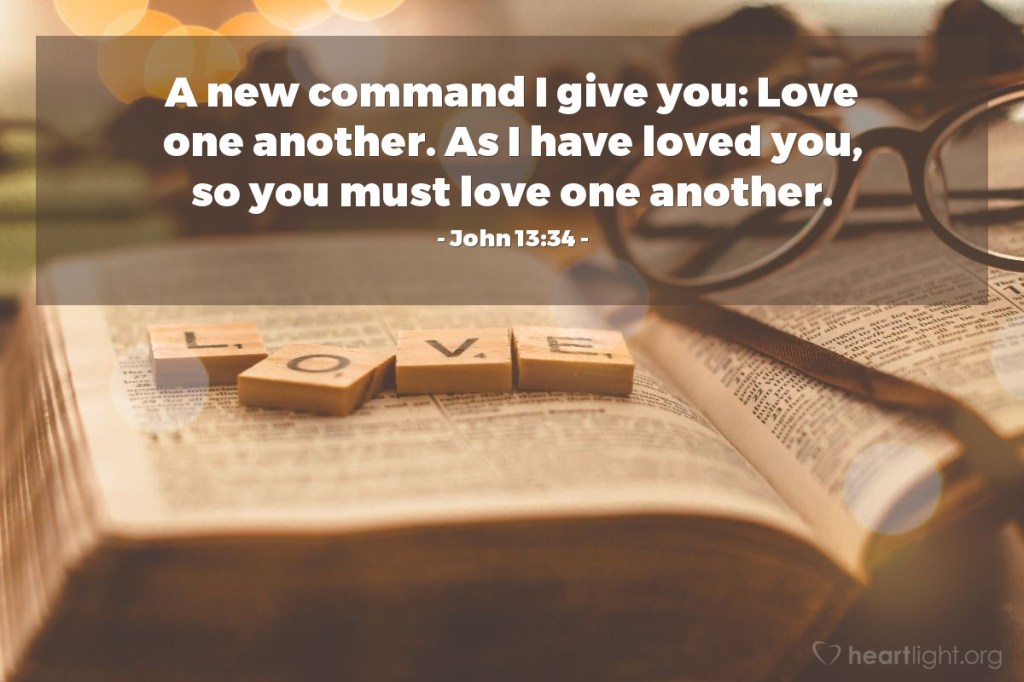
34 I am giving you a new commandment, that you [a]love one another. Just as I have loved you, so you too are to love one another. 35 By this everyone will know that you are My disciples, if you have love and unselfish concern for one another.”

The Word of God for the Children of God.

Adeste Fidelis! Venite Adoremus! Dominum.

Gloria! In Excelsis Deo! Alleluia! Alleluia! Alleluia! Amen.

There is something Jesus said that I want you to seriously think about.

Jesus said to those who followed Him: “By this all will know that you are My disciples, if you have love for one another.

As we see a war-torn nations–a nations which are economically, socially, and politically sick and pained with out of control poverty, oppressed, confused and bewildered–we have to believe that this is the hour for the church to speak out.

This is the hour for the the Body of Christ, the church, to show forth the love and grace of God in Christ!

This is the hour for the nations to hear Christ saying throughout the church, “I am the way, the truth, and the life” (John 14:6).

There is something Jesus said I want you to seriously, severely think a lot about.

Jesus said to those who followed Him: “By this all will know that you are My disciples, if you have love for one another” (John 13:35).

That verse of Scripture is tremendously important at this hour in history.

In another part of the Bible we find the same thing stated by John:

“Beloved, let us love one another, for love is of God; and everyone who loves is born of God and knows God. He who does not love does not know God, for God is love. In this the love of God was manifested toward us, that God has sent His only begotten Son into the world, that we might live through Him. In this is love, not that we loved God, but that He loved us and sent His Son to be the propitiation for our sins” (1 John 4:7-10).

The Bible repeatedly declares in no uncertain terms we who follow Jesus Christ should be just as much in love with each other, without exception, as God was in love with us when He sent His Son to die on the cross.

I want you to see what it means to love as God loves, because the Bible says, “God is love” (1 John 4:16).

The basic attribute of God is holiness, but love is another basic attribute of God.

It is a part of God’s nature to love, and all who know Jesus Christ as Savior also have this supernatural love instilled within their hearts by the Holy Spirit.

The greatest demonstration of the fact we are Christians is we love one another.

1 Corinthians 13, we have first a description of a man who does not possess love.

The Apostle Paul emphatically says,

“Though I speak with the tongues of men and of angels, but have not love, I have become sounding brass or a clanging cymbal” (1 Corinthians 13:1).

The Late Reverend Dr. Billy Graham puts it succinctly ….

“In other words, suppose I could speak with the oratorical strength of a William Jennings Bryan. Suppose I could speak with cryptic language like Winston Churchill. Suppose I could speak with the power of Franklin Roosevelt, in which he used to sway an entire nation in war and in peace. Suppose I could sing opera like the great Enrico Caruso. Suppose I had a thousand tongues that could speak a thousand languages all at the same time. The Bible says all that is nothing, and I am nothing, unless I have this divine, supernatural love that God gives.

The apostle Paul goes on to write,

Though I have the gift of prophecy, and understand all mysteries and all knowledge … but have not love, I am nothing” (1 Corinthians 13:2).

“I could be a man of tremendous knowledge; I could understand all the mysteries and all of history, and be able to put all the patterns together. I could know the Bible from one end to the other; memorize thousands of verses of Scripture. I could be a great Bible teacher; I could even be a preacher from the pulpit–and have not love. I know people in this country who are conservative in their theology–people who would die contending for the inspiration of the Bible–and yet there is so little love. I might know the Bible from Genesis to Revelation, but if I had not love, it would mean absolutely nothing in the sight of God.

“I might be a man of great faith. The Bible says that I might have faith so that I could move mountains, but if I have not love, it is nothing. Suppose I could stand here today and say to that mountain, “Move into the sea,” and it would move! You would say, “Well, Billy Graham is certainly a man of tremendous faith to pray a mountain into the sea.” The Bible says that is absolutely nothing unless my faith is tempered with love.”

“I could be a man of great charity. The Bible says, “though I bestow all my goods to feed the poor … it profits me nothing” (1 Corinthians 13:3) unless I have this divine love that God gives. I could give everything I have to charity, but if the motive were not divine love, it means nothing in the sight of almighty God.”

Here in this country we give billions of dollars away, but sometimes I wonder if our motive is not selfish. We are always asking the other nations and the other people, “What return is America going to get?” The motive of all giving and all charity should be love. I could also be a man of consuming zeal. Paul continues, “though I give my body to be burned, but have not love, it profits me nothing” (1 Corinthians 13:3). Suppose I were like many Korean pastors during the Korean War. Seventeen hundred Korean pastors paid with their blood for their faith in Jesus Christ. Suppose I died at a stake or was shot for my faith in Jesus Christ. You would say, “Billy Graham is a man of consuming zeal. He died as a martyr.” God says it is nothing, unless I am filled with the love of God.”

What a brilliant life this man lived–this mythical man the Bible describes. He was a man of eloquence, knowledge, power, charity, zeal, but the Bible says he was absolutely nothing without love.”

“What a powerful thing love must be! How much stock God puts in love.”

“You say, “Well, Billy, what do you mean by love? What is a demonstration of love?” We have it demonstrated in 1 Corinthians 13. This might cut some of us to the heart. It is going to probe down deep, because one thing that the church of Christ in America lacks is the demonstration of love, and Jesus said, “By this all will know that you are My disciples, if you have love for one another” (John 13:34-35).

This love that the Bible is talking about in 1 Corinthians 13 “suffers long” (verse 5). In other words, it is patient. It is kind. It “does not envy.” There is no jealousy in this divine love that God gives. It “does not parade itself.” It is “not puffed up,” gives itself no airs. It is a love that demands humility. It never pushes itself to the top, never tries to promote itself, never tries to advertise itself. It is always in the background, truly humble. The thing that we need in the church today is genuine, old-fashioned humility.

Then, again in 1 Corinthians 13:5, the Bible says love “does not behave rudely.” It is always courteous and gracious at every turn. It “seeks not its own,” is never selfish. God looks after you, and you are to look after others, the Bible says. It is not easily provoked–not touchy or irritable. If people have to handle you with kid gloves, have to watch out what they say to you, you don’t know anything about this love that God is talking about.”

Love “thinks no evil” (1 Corinthians 13:5). It never holds a grudge–never has malice. It rejoices not in iniquity, but in the truth (1 Corinthians 13:6). It is never glad when another falls. I know so many Christians today who, when they hear that another Christian has fallen, say, “Isn’t that too bad?” but they don’t mean it! They are happy that the other Christian has fallen because that places them just a little higher on the ladder of estimation in other people’s eyes.”

“Then the Bible says that this love “bears all things, believes all things, hopes all things, endures all things” (1 Corinthians 13:7). It is slow to expose the evils and faults in others. It is eager to believe the best, and it is always hopeful and optimistic concerning the future. The Bible teaches that love is greater than faith and hope (1 Corinthians 13:13). Love is the greatest thing in all the world.

I will never forget when singer and composer Redd Harper came to Christ in Hollywood. He said that to him the most amazing and thrilling thing after he came to Christ was this fact: “I found that I loved everybody, no matter what race or color or creed they might be. I just wanted to go hug the whole world.”

“When radio broadcaster Stuart Hamblen came to Christ, he said the same thing: “I fell in love with the whole world. There were certain people who had different racial characteristics from myself that I did not like before I was converted, but after I gave my heart to Christ, I fell in love with every one of them.”

Only this divine love that God gives will make us love others, and before we have revival in America we must have that kind of love among God’s people.”

However, the greatest demonstration of love was God sending His own Son to die for you. You did not deserve to have Him die for you. You are a sinner!”

“The Bible says that you know nothing about this love if you are outside of Christ. It is impossible for you to have this divine love, because it is a gift of God only to those who love Christ.”

But–God loves you! It makes no difference how deep in the mire of sin and transgression you have gone. God loves you today! He proved it by sending His Son, Jesus Christ, to die for you on the cross.”

“At this exact moment you can receive Christ into your heart. God will give you this supernatural love until you too love the whole world. That is the solution to the international problems that we face at this hour. It is the solution to your personal problems–to let Jesus Christ come in. When Jesus Christ comes in, His love comes in, His Life enters in, the love of God shines out everywhere you are.

Romans 5:8-10Amplified Bible

But God clearly shows and proves His own love for us, by the fact that while we were still sinners, Christ died for us. Therefore, since we have now been justified [declared free of the guilt of sin] by His blood, [how much more certain is it that] we will be saved from the [a]wrath of God through Him. 10 For if while we were enemies we were reconciled to God through the death of His Son, it is much more certain, having been reconciled, that we will be saved [from the consequences of sin] by His life [that is, we will be saved because Christ lives today].

I am reminded of the comprehensiveness of these words by so renowned a preacher, teacher, the stature, influence of Late Reverend Dr. Billy Graham.

Indeed, when I remind myself of them from time to time by reading, listening to his evangelistic crusades on the internet and You Tube, I am reminded of one more truth – as much as these words continually reach me, and I pray would too reach you the reader of this blog, “If I had not the love of Jesus in my heart ….?”

The same love of Jesus which He had in His Heart to do what He did for us …..

Even though we were at constant enmity with each other and with Him too …..

What then is “My Christianity?”

What then is my “Sermon in Shoes?”

— Turn the Volume of Your Computer or Your Phone to MAXIMUM! —

MY CHRISTIANITY ABSENT MY LIVING THE LOVE OF CHRIST.
MY CHRISTIANITY ABSENT MY LOVING THE LIVING CHRIST?

Christianity absent Living and Loving the Living Love of Christ is pointless! 

It is infinitely worse than nothing, it negatively affects the world around us. 

Have you ever had someone talk at you? 

Not talk to you or with you, but at you. 

Where it becomes evident that the person that is supposed to be conversing with you is not actually involving you in the exchange. 

They are just expressing their love of and preoccupation with themselves all over you. 

It is like a verbal vomiting attack. 

They have no interest in any response from you or your feeling about what they are saying.

They are just in getting their “two cents worth” out of what they want to say.

How does that make you feel?

It is really hard to have any interest in the subject that person is talking at you about, right? 

You want to pull the ripcord and get out of there as quickly as you can. 

Loved is just about the last emotion that comes to mind, isn’t it? 

This is Christianity without love. 

It is lots of words and thoughts coming at people, but it is missing the part that makes it alive and vibrant.

Have you ever heard a really unpleasant noise? 

Like hearing someone scratch their nails on a chalkboard or the sound of a dentist’s drill in your ear as they stand over you and drill out your tooth. 

It is terrible, terrifying, annoying and effects you down to your very bones. 

The louder it gets the worse it is.

This is the picture of religion without love from the Bible. 

Christianity is no exception. 

It is an expression of selfishness that comes off as really monstrously bothersome, unpleasant, unsettling and unnerving to those around. 

Yikes, it sounds kind of harsh, doesn’t it?

1 Corinthians 13:1-3Amplified Bible

The Excellence of Love

13 If I speak with the tongues of men and of angels, but have not [a]love [for others growing out of God’s love for me], then I have become only a noisy gong or a clanging cymbal [just an annoying distraction]. And if I have the gift of prophecy [and speak a new message from God to the people], and understand all mysteries, and [possess] all knowledge; and if I have all [sufficient] faith so that I can remove mountains, but do not have love [reaching out to others], I am nothing. If I give all my possessions to feed the poor, and if I surrender my body [b]to be burned, but do not have love, it does me no good at all.

This is the idea that Paul is getting at in his first letter to the church at Corinth.

Paul is often called the Apostle to the Gentiles but it is even more obvious from his writings in this thirteenth chapter, that love is equally as important to him.

SAVIOR JESUS WITHOUT LOVE … IS NOT SAVIOR JESUS

Religiosity without love is nothing! 

It is also really annoying! 

This is what Paul says in these verses.

C’mon, say what you really mean Paul!

He compares loveless Christianity to two really annoying discordant sounds of his day.  

We don’t hear noisy gongs or clanging cymbals much today but the idea is something making a ton of noise and is deafening, jarring and irritating. 

Think of perhaps a fire engine’s siren, though less rhythmic. 

If the Apostle was writing today, he might have written if you don’t have love it is like a thousand nails moving up and down and all over upon the chalkboard. 

It is a sound that is clear and not easily misunderstood. 

One that is so wrong that no matter how loud you make it doesn’t come close to getting any better or less bothersome and irritating – it is just louder bad noise.

Paul was writing to Christians who were noisy gongs. 

Their lives had become so caught up in themselves they had lost sight of love in the following of Jesus. 

Their church was acting like 1000 ancient religious nails on the chalkboard.

Much like a person talking at you, they had made everything about them and their expressions of self. 

They were supposed to be following Jesus but in fact, their church was about their pride. 

Their faith was self-centered and self-serving.

Church became a contest to see who could speak the loudest or in the best tongue.

Without His Love, No One Sees Jesus…Even in Church

Since they made life all about them rather than Jesus, it was impossible for them to demonstrate true love for others. 

Loving yourself that much precludes loving others with any authenticity. 

You just care too much about taking care of yourself to care much for others.

The flesh is a greedy beast to feed.

The Corinthians were so prideful and self-focused in their walks with Jesus, even their use of the gifts of the Holy Spirit was worthless. 

Paul says it is nothing to prophesy or speak in tongues if we don’t have love.

Even worse, their actions were like the noisy gong or clanging cymbal. 

They were creating an unmistakable, discordant, and annoying impression for everyone around them. 

Paul goes so far as to say that it would have been better if they did not meet as a church for all the damage they were doing.

For their lack of love, they were changing the beauty of God’s own gifts given through His will through His Spirit into something worthless and off-putting.

What was meant to be the Body of Christ moving perfectly together throughout the known world to testify to God’s glory became one uncoordinated hot mess.  

Simultaneous Love for the Lord and love for each other is what is supposed to keep the Body of Christ in harmony. 

Since it was nowhere to be found, the Corinthian church was stumbling around like a newborn colt. 

They were doing a lot but not everyone would call it beautiful at the same time.

The Love of Christ, Love of His Life is Supposed to be our Calling Card

John 13:34-35Amplified Bible

34 I am giving you a new commandment, that you [a]love one another. Just as I have loved you, so you too are to love one another. 35 By this everyone will know that you are My disciples, if you have love and unselfish concern for one another.”

We may be shocked by this idea, or not shocked enough by this idea, but look around at some portions of the church today. 

You don’t have to go far on the internet to see pastors preaching with such anger and hatred, that what comes across is quite ugly and lacking in power.

There are others who are doctrinally sound but so intellectually focused that the Gospel that they preach comes across as being cold, aloof and forbidding. 

They have the truth of the Bible but without the love of God, it is creating and introducing and delivering a really confusing picture into where chaos reigns. 

They have lost sight of God’s love so they have completely lost the message brought to us by Jesus Himself.  For God so loved the world He sent His Son.

God is love. 

Jesus is God and is also therefore love. 

Jesus was sent into this world as a man because God so loved the world. 

Jesus said that the greatest commandments were to love God and love our neighbors while we are loving ourselves as God sacrificially first loved us. 

Jesus said that the world would know us as disciples by our love. 

Love is so essential to who God is and to what we are as Christians that Paul makes his really strong statement. 

Without love, even Christianity is nothing. 

We can never lose sight of love and still live the life that Jesus has for us in Him.

God is love. 

A life lived absent the first love of Christ, is a life without God prominently in it. 

So if we have gotten far down a path that looks like Christianity but is not filled with love, do a 180 degree turn – dare to turn around – to face God – facing you. 

If we are working really hard for the church but are doing it in anger and spite and resentment, or out of our “duty and obligation – that is, works” stop it. 

If we are so busy with “serving others” we have no time to love the people we are supposed to be serving…just stop. 

It profits us nothing and creates a jarring discordant sound. 

Only start again when we are able to say for certain that it is the love of Jesus compelling us and the love of the Holy Spirit coming through us.

No matter what it looks like to our eyes, if we don’t have love we are nothing.

Why? 

Great Question … I am very glad you asked it in such a Kairos timely manner!

1 John 4:7-8Amplified Bible

God Is Love

Beloved, let us [unselfishly] [a]love and seek the best for one another, for love is from God; and everyone who loves [others] is born of God and knows God [through personal experience]. The one who does not love has not become acquainted with God [does not and never did know Him], for God is love. [He is the originator of love, and it is an enduring attribute of His nature.]

Because Scripture is clear – if there is no love then Savior Jesus is not with us. 

He is love and brings love wherever He walks.

He is love and brings love wherever He Talks.

He is love and brings love wherever He Ministers to God’s Children.

We all want to be something, someone like Christ in the Body of Christ, right?

RIGHT?

How do you recognize Jesus’ followers?

How do you find Christians?

Jesus said they love each other just as he loved the disciples.

In the immediate context this means he is willing to give sacrificially and extravagantly by dying for them at the cross, and he is also willing to love selflessly and practically by washing every single one their “filthy” feet.

His ministry reveals he will do almost anything in between extravagant and practical.

Imagine if we all gathered in fellowship to read and study and pray the Gospels and committed to love each other in the same way Jesus first showed his love!

Envision that first Love displayed through yourselves and the Body of Christ.

What do you anticipate seeing?

What do you expectantly hope and pray to see?

What do you actually see?

BETTER YET … WHO DO YOU SEE?

So, for the sake of God, the Father and God the Son and God the Holy Spirit,

Go Live and Live greatly! 

Go Love and Love greatly!

In the name of God, the Father and God the Son and God the Holy Spirit,

Let us Pray,

Father of all Charity and Compassion and God of all grace, I thank you for teaching me to love through the words and teachings and example of my SAVIOR Jesus. May my words and actions reflect his love toward your people today, tomorrow, and until you bring us all home to you. In the name of Christ, my Great Example, I pray. Amen.

Adeste Fidelis! Venite Adoremus! Dominum.

Gloria! In Excelsis Deo! Alleluia! Alleluia! Alleluia! Amen.

https://translate.google.com/

Marking out our Pathways to Solitude. “Alone Time,” Making Time with God, Having our Time with God. Luke 5:14-16

Luke 5:14-16 The Message

14-16 Jesus instructed him, “Don’t talk about this all over town. Just quietly present your healed self to the priest, along with the offering ordered by Moses. Your cleansed and obedient life, not your words, will bear witness to what I have done.” But the man couldn’t keep it to himself, and the word got out. Soon a large crowd of people had gathered to listen and be healed of their sicknesses. As often as possible Jesus withdrew to out-of-the-way places for prayer.

The Word of God for the Children of God.

Adeste Fidelis! Venite Adoremus! Dominum.

Gloria! In Excelsis Deo! Alleluia! Alleluia! Alleluia! Amen.

Sometimes we each find that our hearts and our souls get crowded out by life.

This way, that way, every way, by someway outside of our sphere of influence, life envelops us, immerses us in tornado force whirlwinds and deep whirlpools.

Surrounded By Souls – A Poem

I’m in touch with the thought, the idea’s in my mind,
This fleeting dream, doesn’t leave me behind.


I need to hold on, to these glimpses of pure life,
To bypass the confusion, the agony, the strife.


The simple life is there, just there, now gone,
Between the bursts of light, I think I’m alone.


But alone in the sense of being comfortable with me,
Not lost in a desert of all that I see.


But now I feel that I’m not alone at all,
The world’s full of souls, I just need to call.

Alan Bruce Thompson

Why “Alone Time” With God?

Why should we spend time alone with God?

Why is meeting with God in the “solitary places” so important?

Until we gain an understanding of the immense value and the opportunity of encountering the shekinah Glory, the presence of our Living God, we will never consistently engage in this foundational, vital practice: “Time Alone With God.”

As we prayerfully come together, discover God’s heart to meet with us in order that we might experience the depths of his love, I pray that our lives would be marked by a new grace to consistently and powerfully encounter the living God.

Luke 5:14-16 Amplified Bible

14 Jesus ordered him to tell no one [that he might happen to meet], “But go and show yourself to the priest, and make an offering for your purification, just as Moses commanded, as a testimony (witness) to them [that this is a work of Messiah].” 15  But the news about Him was spreading farther, and large crowds kept gathering to hear Him and to be healed of their illnesses. 16 But Jesus Himself would often slip away to the wilderness and pray [in seclusion].

Why is time alone with God so important?

Why can’t just going to church, a community group, or a Bible study be enough?

Those of you who have grown up in church or have been going to church for many years have been told and repeatedly taught that time exclusively spent alone with God is indescribably vital to our connection, relationship with him.

Many of you, including me, however, were never given a reason why.

And in order for us to consistently and effectively engage in this abundantly life giving, life sustaining crucial practice, must understand why it is so important.

Here’s what we learn from Scripture about having time alone with God.

Scripture makes it abundantly clear that Jesus spent time alone with his heavenly Father. 

Luke 5:16 states, “Jesus often withdrew to lonely places and prayed.” 

Mark 1:35 states, “And rising very early in the morning, while it was still dark, he departed and went out to a desolate place, and there he prayed.” 

Often in Scripture, Jesus withdrew from the crowd to pray.

So the first reason to spend time alone with God is because Jesus did.

If Jesus needed time alone with his heavenly Father, we can all be sure we need it even more.

Jesus walked in God’s presence constantly.

Jesus constantly responded to God’s will for his life.

He is our perfect example.

And even still, He needed time alone with God.

God–seekers welcome lonely places at times.

They will sometimes go miles in any direction just to find a place where open sky, wide spaces, and the starry heavens and winds are their only companions.

Even though God’s presence is clearly to be found among his children (as our Lord promised when two or three gather in his name—Matthew 18:20), God also meets us in those far away places, miles from humanity, in times of solitude.

Jesus often sought solitude.

He began his ministry by spending forty days in the desert (Matthew 4:1–11).

He spent a whole night in the desert hills before calling his twelve disciples (Luke 6:12–15).

After a powerful healing mission, he called his disciples to come with him “to a quiet place” (Mark 6:31).

For his transfiguration, he found a lonely mountain (Matthew 17:1–8).

And to find strength to face his death for us, he sought out the solitude of the Garden of Gethsemane (Matthew 26:36–46).

Solitude rescues the lonely from loneliness.

As Richard Foster, a teacher and writer on Christian spirituality, points out, “Loneliness is inner emptiness; solitude is inner fulfillment.”

Solitude is the discipline of tuning our hearts to hear nothing but the voice of God, whether it comes to us in a whisper or a roar.

When we “pick ourselves up” to move into solitude, we seek to silence all other voices which clamor for all our attention, just to be attuned to hear God’s voice.

Psalm 19:1-5The Message

19 1-2 God’s glory is on tour in the skies,
    God-craft on exhibit across the horizon.
Madame Day holds classes every morning,
    Professor Night lectures each evening.

3-4 Their words aren’t heard,
    their voices aren’t recorded,
But their silence fills the earth:
    unspoken truth is spoken everywhere.

4-5 God makes a huge dome
    for the sun—a superdome!
The morning sun’s a new husband
    leaping from his honeymoon bed,
The daybreaking sun an athlete
    racing to the tape.

We also see from Jesus’ example that time alone with God empowers us and inspires, refreshes, invigorates us, to carry out God’s purpose for our life.

It was after withdrawing into the wilderness in Luke 4 that we read he began performing miracles.

Jesus entered the Garden of Gethsemane filled with grief and sorrow, asking God for a way other than his own death to achieve salvation for his people.

After spending time alone with God, he came out of the garden empowered to endure the worst atrocity in history.

Spending time alone with God empowers us, quickens us to live a life filled with a knowledge of God’s purposes and the ability to faithfully see them through.

Lastly, Jesus is clear in Matthew 6:5-6 how we are to pray.

Scripture says, 

“And when you pray, you must not be like the hypocrites. For they love to stand and pray in the synagogues and at the street corners, that they may be seen by others. Truly, I say to you, they have received their reward. But when you pray, go into your room and shut the door and pray to your Father who is in secret. And your Father who sees in secret will reward you.” 

God rewards time spent alone with him in prayer.

It’s by praying in secret we clearly and tangibly encounter God’s love for us.

It’s by spending meaningful, quality time alone, in solitude, in quiet, thru engaging in quiet conversation with the Spirit that we learn what his voice sounds like, who it is we are responding with the entirety of our lives to.

It is only by asking God questions we come to discover His solitary, abundant will.

And it’s by spending time alone with him that our lives gradually become laser focused, centered not around our lonely, but around his nearness and goodness.

All of the money in the world cannot buy the rewards God longs to give you.

All the favor of men will not satisfy your insatiable desire to be fully known and fully loved more and greater and best by someone, something other than “self.”

God’s desire to spend time alone with you is not meant to add stress or pressure to your life but to relieve you from it.

He is not a God who is after you religiously checking off a quiet time box, but a good, good Father who longs to fill our lives with his grace, power, and love. 

Receive right now, in this exact and exacting the best gift you could be offered, one-on-one communion, one-on-one Koinonia, with your heavenly Father.

In the name of God, the Father and God the Son and God the Holy Spirit,

Guided Prayer:

1. Wherever you are, find a place to get alone and pray.

Seek out a place that you can find solitude that will be uninterrupted.

“Jesus often withdrew to lonely places and prayed.” Luke 5:16

“And rising very early in the morning, while it was still dark, he departed and went out to a desolate place, and there he prayed.” Mark 1:35

2. Read and pray through this Scripture.

May God give you a revelation of his provision and love for you as you pray Jesus’s model prayer.

“Our Father in heaven,
hallowed be your name.
Your kingdom come,
your will be done,
on earth as it is in heaven.
Give us this day our daily bread,
and forgive us our debts,
as we also have forgiven our debtors.
And lead us not into temptation,
but deliver us from evil.” – Matthew 6:9-13

3. Engage in conversation with God. 

Ask him how he feels about you.

Come before him with anything which is weighing you down and lay your burdens at his feet.

Rest in the peace that comes from his singularly unique, peaceful presence.

“Come to me, all who labor and are heavy laden, and I will give you rest. Take my yoke upon you, and learn from me, for I am gentle and lowly in heart, and you will find rest for your souls. For my yoke is easy, and my burden is light.” Matthew 11:28-30

Father God, giver of every good and perfect gift, by thy grace and mercy, give me a heart that welcomes solitude and quiet places as openings for your voice to be heard and your glory to shine. Keep me quiet, keep me quietly in tune with you, I pray.

Adeste Fidelis! Venite Adoremus! Dominum.

Gloria! In Excelsis Deo! Alleluia! Alleluia! Alleluia! Amen.

https://translate.google.com/