The Fourth Commandment: Our Rest, Our Witness. Remember the Sabbath. Exodus 20:8-11

Exodus 20:8-11 Amplified Bible

“Remember the Sabbath (seventh) day to keep it holy (set apart, dedicated to God). Six days you shall labor and do all your work, 10 but the seventh day is a Sabbath [a day of rest dedicated] to the Lord your God; on that day you shall not do any work, you or your son, or your daughter, or your male servant, or your female servant, or your livestock or the temporary resident (foreigner) who stays within your [city] gates. 11 For in six days the Lord made the heavens and the earth, the sea and everything that is in them, and He rested (ceased) on the seventh day. That is why the Lord blessed the Sabbath day and made it holy [that is, set it apart for His purposes].

The Word of God for the Children of God.

Adeste Fidelis. Venite Adoremus. Dominum.

Gloria. In Excelsis Deo. Alleluia, Alleluia, Alleluia, Amen.

Keep the Sabbath [verse 8]

Remember the Sabbath day, to keep it holy. Exodus 20:8

Throughout history there have been well-meaning, earnest Christians who have, perhaps without their ever knowing it, who have come to functionally believe the Ten Commandments are really only the Nine Commandments.

Somewhere along the way, some have decided the fourth commandment is not like the rest of the commandments but rather as a relic that belongs in the past.

In truth, though, the ancient command to remember the Sabbath and keep it holy has abiding significance for us all, even today.

Why has this simple command fallen on such hard times?

Some have claimed that its regulations and penalties were tied to the old covenant, so it must no longer be relevant.

Yet we do not treat the other commandments this way.

Others have said that the way Jesus spoke of being “lord of the Sabbath” (Matthew 12:8) diminished the commandment’s significance and force.

What about Jesus’ apparent intent here?

What the man Rabbi Jesus sought to overturn was not the Sabbath itself but the host of hypocritical external rules of the Pharisees.

I have long suspected what keeps most Christians from thinking of the fourth commandment as we ought to is simply that we do not like its implications.

We do not like, nor appreciate all of the subtle and not so subtle ways it intrudes into our lives, into our leisure and whatever else takes precedence in our hearts.

So we act as though this command is in a different category from the other nine.

However, If we truly want to grasp the significance of the Sabbath and respond to it in a God-honoring way, we must all embrace, as a conviction, the real truth that God has intentionally set aside the Sabbath day as distinct from the rest.

This was the case in the week of creation, with God resting on the seventh day and declaring it sanctified.

The church, in the age of the new covenant, then changed the day from the seventh day of the week to the first day to mark the resurrection of Christ.

In both cases, we see that the distinction of the day is woven into God’s work of creation and redemption.

With that conviction in place, we can see that the day is not simply a day set apart from other days, but it is, in Gospel Truth, a day set apart unto the Lord.

By not seeing it this way, we’ll be tempted to view our spiritual exercises on the Lord’s Day as something to “get over with” in order to “get on with” our week.

If this is our mentality, we stand condemned by the fourth commandment.

The Sabbath ought to be treasured for what it is: a gift of a day on which we enjoy, uninterrupted by leisure commitments or (if possible) by employment, the privilege of God’s presence, the study of God’s word, and the fellowship of God’s people.

Seen like that, this command becomes an invitation: not only to just something we should do but something we will each come to learn how to love to do.

If this is not how you have been viewing God’s Sabbath, then ask yourself:

What’s preventing you from honoring the Lord’s Day?

Take stock of your habits and receive the gift of the Sabbath.

From that next Sunday, be sure that your priority is not to make the Lord’s Day convenient but to make the Lord’s day exclusively about God, to keep it holy.

Keep the Sabbath [verses 9-10]

Six days you shall labor and do all your work, 10 but the seventh day is a Sabbath [a day of rest dedicated] to the Lord your God; on that day you shall not do any work, you or your son, or your daughter, or your male servant, or your female servant, or your livestock or the temporary resident (foreigner) who stays within your [city] gates. [verses 9, 10]

Having established the fourth commandment remains what it has always been—a commandment of the Lord—and as such it is relevant to our lives, we can now turn our hearts, souls, minds, to thinking profitably about how to keep it.

But we must be careful as we get specific about honoring the Sabbath.

The Lord Jesus, after all, had some very harsh, strong words for the Pharisees regarding the way their moral specificity had become a means not of obedience but of self-righteousness (Mark 2:23 – 3:6).

With “quaking and trembling knees” and maturing humility, let’s take some quality time to consider how are we to remember the Sabbath and keep it holy.

Let us try to explore: How do we prevent worldly concerns—those of leisure, recreation, and work—from infringing on our enjoyment and worship of God?

Let’s think first of public worship.

What kinds of conversations do you typically have prior to the worship service?

Are they concerned at any point with exclusively the things of God, or only ever with sports – making it to the home team game, family, and every other thing?

It takes a conscious and a thoroughly intentional act of the will to give eternal matters the very highest measure of maxed priority in our minds and mouths.

If you were to determine that in your preparation for worship you would set aside every priority which looms, loomed so large on other days, I guarantee the focus of your time at church would be changed.

The same goes for after the service.

When the last song has been sung and the service is over, how long does it take for your mind and conversation to return to worldly matters?

If we were instead to:

commit to spending time after the service speaking to one another about the greatness of God, the truth of His word, and the wonder of His dealings with us,

and praying with one another about the week ahead and the trials we face, then we would begin to understand better the “one another” passages in the New Testament about:

encouraging one another (Hebrews 10:25),

speaking the truth to one another (Ephesians 4:25), and

building one another up (1 Thessalonians 5:11)

—for we would then be prioritizing ourselves to actually living them out.

Similarly, in our private affairs on the Lord’s Day, spiritual improvement should still take priority.

That may mean additional family worship, reading edifying books, prayer, discussion of what was preached that morning, and more—but whatever it means, we should make it our aim not to let the cares of the other six days push into our efforts of growing our spiritual enjoyment of the first day of the week.

If we want to profit from keeping the Sabbath, and if we want to take the fourth commandment more seriously, then our convictions must fuel our actions, and our daily aspirations must turn into daily practices.

Avoid making unique rules that only serve to foster self-righteousness, but consider whether anything worldly needs to change, be re-prioritized Godly.

How would, should, could you change to keep the Sabbath holy the next time Sunday comes round, then Monday, then Tuesday then Wednesday and so on?

Our Sabbath Rest as Our Witness

[sermon illustrations]

The college student broke down in tears over his coffee.

Driven by competition for limited space in a pre-law program, he had just poured himself into studying virtually nonstop, eight hours a day seven days a week. After seven months he found he lost the ambition for learning—and nearly for life itself.

Driven by the desire for promotion and the prospect for more money for him an his growing family, [……….] takes extra work home every single night to get the one up on his fellow workers – he stays up till midnight every night for weeks. Taking no time for dinner with his wife or leisure time his young kids, he hears them crying.

Our reading today states that “in six days the LORD made the heavens and the earth … but he rested on the seventh day.”

The ambition and creativity we bring to work is a reflection of our mindset on our Creator’s sovereignty over our lives and over the lives we genuinely value.

It’s part of how we reflect his image and a big part of how we serve as witnesses for him.

God also rested on the seventh day, however, and he calls us to do the same.

For us, good work hinges on good rest.

Without good rest our good work suffers.

The discipline of regular rest is a witness in our fast-paced world, especially when that time is focused on enjoying our Creator.

It speaks of God’s love to command what’s good for us.

Our ambitions would otherwise serve only to distract us from him and drive us into the ground if we let them.

How will you take our rest the rest of this week and this next weekend?

For the sake of good work later, let’s rest.

For the sake of sanity, let’s rest.

For the sake of glory to God in regular worship and fellowship, let’s rest.

God blesses those who “work hard” at resting in the Lord Jesus Christ.

Let’s trust him to establish the work and rest of our hands (see Psalm 90:17).

In the name of God, the Father and God the Son and God the Holy Spirit,

Let us Pray,

God, grant us and all our loved ones true rest on this Sabbath Day. May Your Holy and Sacred Presence drive out from among us anger and fear, worry and regret. Send your blessing upon us, that we may be people of the Word. Lord of work and of rest, thank you for these gifts. Help us to work hard and rest well. Please provide work where we need it. Please also bless whatever years of retirement rest we may have.

Adeste Fidelis. Venite Adoremus. Dominum.

Gloria. In Excelsis Deo. Alleluia, Alleluia, Alleluia, Amen.
https://translate.google.com/

Blessings From God’s Word: Bless Me and Revive Me, O’ God. Make Your Face to Shine Bright Upon Me, Your Servant. Psalm 119:129-136

Psalm 119:129-136 Amplified Bible

Pe.

129 
Your testimonies are wonderful;
Therefore my soul keeps them.
130 
The unfolding of Your [glorious] words give light;
Their unfolding gives understanding to the simple (childlike).
131 
I opened my mouth and panted [with anticipation],
Because I longed for Your commandments.
132 
Turn to me and be gracious to me and show me favor,
As is Your way to those who love Your name.
133 
Establish my footsteps in [the way of] Your word;
Do not let any human weakness have power over me [causing me to be separated from You].
134 

Redeem me from the oppression of man;
That I may keep Your precepts.
135 
Make Your face shine [with pleasure] upon Your servant,
And teach me Your statutes.
136 
My eyes weep streams of water
Because people do not keep Your law.

The Word of God for the Children of God.

Adeste Fidelis. Venite Adoremus. Dominum.

Gloria, In Excelsis Deo, Alleluia, Alleluia, Alleluia, Amen.

Blessings From God’s Word …

Make your face shine with pleasure on your servant and teach me your decrees.

—  Psalm 119:135

The words of the Psalmist from verse 135 “Make your face shine on your servant” echoes the great blessing found in the High Aaronic prayer Numbers 6:24-26.

There God explains how to give his people a blessing, saying:

“The Lord bless you and keep you; the Lord make his face shine on you and be gracious to you; the Lord turn his face toward you and give you peace.”

Here God conveys to his people that He has turned His face upon them, sees them and promises to be gracious to them, to love and vigilantly protect them.

In our reading from the Psalms for today, the psalmist sees the light of God’s Word, and his passion for God grows, leading to a greater thirst for God’s Word.

As he reads and meditates, ponders and absorbs, the writer’s understanding of God’s love, mercy, and compassion deepens and his longing for God increases.

The intensity of his passion for God leads him even to pant for God’s Word!

Another important thing to note here is that the psalmist calls himself God’s servant.

Connecting God’s blessing with service, the psalmist reminds us that blessings do not stop when they land on our doorstep.

God blesses us—his servants—so that we can serve and be a blessing to the people around us.

Go ahead and ask God for his blessing, because God wants to bless you.

He also wants us to be keenly attentive to his Word, to praise Him, to pray and to worship Him and to learn His statutes, to revive, actively serve in his world.

Teach Me Your Statutes, O God …

God’s word is a treasure filled with fine riches that teach us about the God who created us and how to live in a way that pleases Him.

Often, we can disconnect God’s word from our lives and make reading His word a mere intellectual pursuit or religious practice.

Psalm 119 is a beautiful prayer that asks God to deeply connect the psalmist’s life with the word of God.

One of the most oft repeated phrases the psalmist passionately prays is for God to teach him to live by his statutes, which appears Psalm 119 at least ten times:

Blessed are you, O LORD; teach me your statutes!” Psalm 119:12

Open my eyes, that I may behold wondrous things out of your law.Psalm 119:18

When I told of my ways, you answered me; teach me your statutes!” Psalm 119:26

Teach me, O LORD, the way of your statutes; and I will keep it to the end.” Psalm 119:33 

The earth, O LORD, is full of your steadfast love; teach me your statutes!” Psalm 119:64

You are good and do good; teach me your statutes.Psalm 119:68

Your hands have made and fashioned me; give me understanding that I may learn your commandments.Psalm 119:73

Deal with your servant according to your steadfast love, and teach me your statutes.Psalm 119:124

I am your servant; give me understanding, that I may know your testimonies!Psalm 119:25

Make your face shine upon your servant, and teach me your statutes.Psalm 119:135

Let my cry come before you, O LORD; give me understanding according to your word! Psalm 119:169

We could, would, should be all be the wiser to make these verses (and the whole psalm) an essential element of our daily prayer life, our heart cry to our Savior.

Ah, the Sweetest Mystery of Life …

Ecclesiastes 8:16-9:6Amplified Bible

16 When I applied my mind to know wisdom and to see the activities [of mankind] that take place upon the earth—how some men seem to sleep neither day nor night— 17 and I saw all the work of God, I concluded that man cannot discover the work that is done under the sun. Even though man may labor in seeking, he will not discover; and [more than that], though a wise man thinks and claims he knows, he will not be able to find it out.

Men Are in the Hand of God

For I have taken all this to heart, exploring and examining it all, how the righteous (those in right standing with God) and the wise and their deeds are in the hands of God. No man knows whether it will be love or hatred; anything awaits him.

It is the same for all. There is one fate for the righteous and for the wicked; for the good, for the clean and for the unclean; for the man who offers sacrifices and for the one who does not sacrifice. As the good man is, so is the sinner; as he who swears an oath is, so is he who is afraid to swear an oath. This evil is in all that is done under the sun, that one fate comes to all. Also, the hearts of the sons of men are full of evil, and madness is in their hearts while they live, and afterwards they go to the dead. [There is no exemption,] but whoever is joined with all the living, has hope; surely a live dog is better than a dead lion. For the living know that they will die; but the dead know nothing, and they no longer have a reward [here], for the memory of them is forgotten. Indeed their love, their hatred and their zeal have already perished, and they will no longer have a share [in this age] in anything that is done under the sun.

The Searcher’s claim is quite clear: life is too complicated, too vast, too filled with conflicting elements for any one of us to figure out all the answers.

Though we stay up all night and day, trying to think through and understand the complicated events that bring to pass the circumstances of our lives, we will never fully understand.

The Bible attaches no stigma to trying to understand life.

Rather, the pursuit of knowledge is everywhere encouraged in Scripture.

We must never adopt the attitude of anti-intellectualism that characterizes some segments of Christianity today.

We are to reason and think about what God is doing and what life gives us.

But we must always remember that no matter how much we try to think about life, mysteries will still remain.

We do not have enough data, nor do we have enough ability to see life in its totality to answer all the questions.

We must be content with some degree of mystery.

Though the wisest man of the ancient world wrote these words, he admits that humans cannot know all the answers.

He even says that diligence in labor will not unravel life’s mysteries: Despite all his efforts to search it out, man cannot discover its meaning. 

We will still be left collectively knitting our brows, collectively scratching our heads, and asking the eternally unanswerable question: “Why, Me, Lord”?

Even when people claim to know the answers behind what happens to us, they are really only deceiving themselves.

Many people are unwilling to accept the truth of the precepts of Scripture until they can “come to fully, completely, utterly,” understand everything in it.

But if you and I are waiting for that, you will never make it -“failure to thrive” .

Although this book Ecclesiastes was written almost 2,500 years ago, it is still true, even in our age of advanced knowledge, no one can find all the answers.

We must diligently search out the statutes of God – through prayer and study.

When you and I think about our own life, about how many of the things that have happened to us have been determined by events over which we had zero control—events that had to fall together in a certain pattern before they could ever come to pass [by God’s Plan]—you, I, can see how true these words are.

No one can find out all the answers.

The sweetest mystery to life is that the destiny of our lives may all hung upon a simple decision to go or not to go to a church on a particular Sunday because we had some sort of “issue, grievance, grudge etcetera,” against the church itself.

Learning something about God’s precepts for our “Christian living” may just be revealed on that day during the course of praise, worship, reading of scripture.

We have to continuously place ourselves directly in the path of the Word of God.

We have to continuously stay passionate about letting God work in us and also through us by means of the unmatched power of His transformative Word.

How can we understand that strange merging of simplicity and complexity?

The Searcher of Ecclesiastes continuously and constantly argues that life is too complicated without the Word of God, for us ever to answer all the questions.

We will inevitably run out of brain power when, all by ourselves, we keep trying to be “a Sermon in Shoes Christian” finding our answers to the mystery of life.

Is understanding everything in Scripture necessary before accepting it as truth?

A Puzzle and a Song …

Romans 11:30-12:3Amplified Bible

30 Just as you once were disobedient and failed to listen to God, but have now obtained mercy because of their disobedience, 31 so they too have now become disobedient so that they too may one day receive mercy because of the mercy shown to you. 32 For God has imprisoned all in disobedience so that He may show mercy to all [Jew and Gentile alike].

33 Oh, the depth of the riches and wisdom and knowledge of God! How unsearchable are His judgments and decisions and how unfathomable and untraceable are His ways! 34 For who has known the mind of the Lord, or who has been His counselor? 35 Or who has first given to Him that it would be paid back to him? 36 For from Him [all things originate] and through Him [all things live and exist] and to Him are all things [directed]. To Him be glory and honor forever! Amen.

Dedicated Service

12 [a]Therefore I urge you, [b]brothers and sisters, by the mercies of God, to present your bodies [dedicating all of yourselves, set apart] as a living sacrifice, holy and well-pleasing to God, which is your rational (logical, intelligent) act of worship. 2 And do not be conformed to this world [any longer with its superficial values and customs], but be [c]transformed and progressively changed [as you mature spiritually] by the renewing of your mind [focusing on godly values and ethical attitudes], so that you may prove [for yourselves] what the will of God is, that which is good and acceptable and perfect [in His plan and purpose for you].

For by the grace [of God] given to me I say to everyone of you not to think more highly of himself [and of his importance and ability] than he ought to think; but to think so as to have sound judgment, as God has apportioned to each a degree of faith [and a purpose designed for service].

I love puzzles but it bothers me and it frustrates me to no end the challenge of sitting still long enough and putting together any 1,000-piece jig­saw puzzle.

Like my wife, some people will go online, just to do the most complex Sudoku.

She has developed a system whereby she just systematically “breezes through.”

That is not me, either …

I like Sudoku … but I cannot just “breeze through” them like she does.

I watch her, admire her ability to “order and sort out” all of the numbers.

I just need take my time and pray I finish without too many mistakes.

Too many mistakes … I just shut the game down as quickly as possible.

Revealing that sometimes our puzzles can end up puzzling us.

That’s how it was for the apostle Paul.

Paul wrestled with a very personal problem.

By God’s grace he had come to know Jesus as his Savior.

As he went about doing his missionary work, many Gentiles came to faith in Jesus as Lord.

But many of his own Jewish people rejected Jesus.

It was mind boggling to him.

Were they not God’s special people chosen to share God’s love with the world?

Nevertheless, Paul was so confident of God’s great mercy he broke into song.

Paul confesses that we can never fully grasp God’s eternal plan.

Our efforts to understand God, define him, or reduce him to our level will ultimately fail.

God owes us no explanation; nor is he accountable to us—for he is God.

There is something we can do—in fact, two things.

First, Paul implies that we should keep praising God because all glory belongs to him forever.

Then Paul goes on to say that the only reasonable response to all this is to offer ourselves in complete service to God and to be completely available for his use.

Are we doing that?

By Praise and Worship, by Prayer and Meditation and Study of God’s Word,

Are we looking to God for answers to even the most uncomplicated of puzzles?

“Reviving” the “Lost Art” of “Knowing God better than we Know Ourselves?”

Do you desire to continually learn and be taught God’s word and statues?

Does your heart yearn to be taught the path of God and to fix the gaze of your heart and your soul upon Him?

How say Ye to this …?

In the name of God, the Father and God the Son and God the Holy Spirit,

Let us Pray, ….

Lord, often we are as puzzled as the Psalmist, the Teacher and the Apostle Paul about the host of ways you deal with us. Even so, may we stand in awe of your amazing grace and respond to you with songs of praise and acts of service. Lord, cause us to continually grow in our understanding and learning of your statutes, making us wise and obedient to you. Cause us to fear your name and pursue an obedient and joyful life as Bible-saturated people who look to you for wisdom, grace, and life. Teach us your statutes and may our lives be characterized by joyful obedience to your word and by demonstrating constant dependence on you. And may you fill us ever more increasingly with your Holy Spirit, who alone, can truly teach us all your statutes.

Adeste Fidelis. Venite Adoremus. Dominum.

Gloria. In Excelsis Deo. Alleluia, Alleluia, Alleluia, Amen.
https://translate.google.com/

A New Position, A New Reality, A New Focus, A New Perspective – Heavens!!

The death, burial and resurrection of Jesus Christ are at the center of everything which we believe as Christians (1 Corinthians 15:1-5). Without this sacrificial example of life, death of Jesus and His victorious resurrection we have no hope.

As we come to Colossians 3 Paul is eager for the Colossians and all Christians to understand the correlation between the physical death and resurrection of Jesus and the spiritual realities we live and love into, experience as those who believe.

When we come to faith in Jesus our old nature, our old perceptions of self, is put to death. Just as Jesus lived and died, we live and die. In the same way, just as Jesus rose from the dead, we are raised with Him. Through faith we died and through faith we are raised to new life in Him (Romans 6:1-11; Colossians 2:12-13).

All that being said, in Colossians 3 Paul’s whole purpose goes beyond helping us come to understand our position in Christ; he desperately wants believers to understand how this new position should impact the way we live. As those who have a new position and a new reality, we should have a new focus. Our position in Christ as our Lord and Savior should change our affections and our desires.

Colossians 3:1-4The Message

He Is Your Life

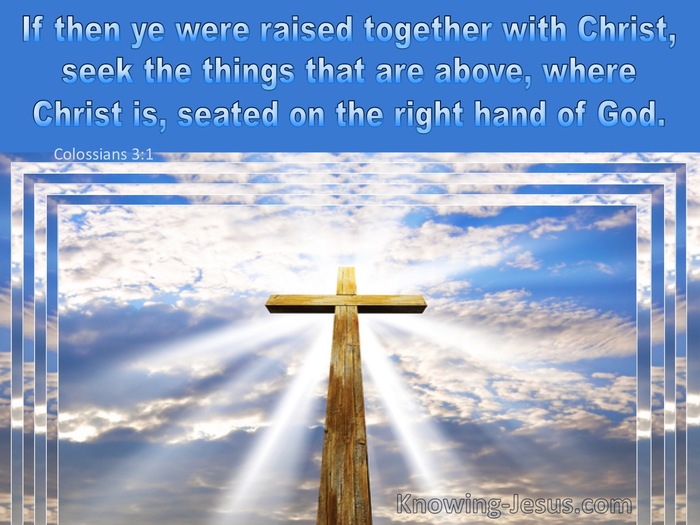
1-2 So if you’re serious about living this new resurrection life with Christ, act like it. Pursue the things over which Christ presides. Don’t shuffle along, eyes to the ground, absorbed with the things right in front of you. Look up and be alert to what is going on around Christ—that’s where the action is. See things from his perspective.

3-4 Your old life is dead. Your new life, which is your real life—even though invisible to spectators—is with Christ in God. He is your life. When Christ (your real life, remember) shows up again on this earth, you’ll show up, too—the real you, the glorious you. Meanwhile, be content with obscurity, like Christ.

The Word of God for the Children of God. Gloria! In Excelsis Deo! Alleluia! Amen.

Our Calling from the Throne Room of Creator God: A New Perspective (3:1-2)

As the passage begins Paul makes it clear who his audience is: He’s addressing those who have been raised to new life in Christ. With this established Paul describes the perspective or the focus of those who are in Christ.

Check Your Heart at the Gates of Heaven: What are you pursuing? (vs. 1)

  • Seek the Things– The call is to evaluate your affections. What do you long for, what are you pursuing, what do you desire?
  • That Are Above – Paul defines “above” as the place where Christ is, or more correctly, the position He holds. Savior Christ holds the position of all rule and authority (Ephesians 1:20-23).
  • To seek the things that are above is a call for the Colossians to set their hearts and to orient their minds in light of the ultimate and eternal rule of Christ. Pursue things that are eternal (Matthew 6:33; Matthew 16:13-20; Mark 8:27-30; Luke 9:18-21; Ephesians 1:13-23; Philippians chapter 2; Philippians 3:12-16).

Check Your Mind at the Gates of Heaven: What are you focused on? (vs. 2)

  • How do we seek the things that are above? The next part of the passage gives the answer: it begins by setting our minds on eternal things. As we set our minds on eternal things our pursuits and desires and ambitions (what we seek) will follow.
  • If we are going to faithfully pursue eternal things, we must guard our hearts and our minds and our souls and fight to keep our attention on the things of Christ (Psalm 90:10-12; Proverbs 4:23, 15:11, 21:2; Ezekiel 36:25-28; Matthew 5:8, 6:19-22, Romans 12:1-3; 2 Corinthians 3:1-6; Philippians 3:17-4:1). 

The Reason for placing ourselves at Heaven’s gate: A New Position (3:3-4)

After explaining the call Paul returns to the reason for his admonition: our new perspective is a result of our new position.

  • Our Present Position (vs. 3) As those who are in Christ, we have been united with Him in His death and resurrection; we are “in Him.” Because of our union with Him Christ lives in and through us (Galatians 2:19-21). We have been crucified with Him and we have died with Him and now our whole lives are His, therefore everything we do and say should be impacted by our identity in Him.
  • Our Future Position (vs. 4) Even though we have been given a new position in Christ we are still constrained by the flesh, but this is only temporary. One day Christ will return, and we will join Him in glory (1 Corinthians 15:50-58).

We are Standing at Heaven’s Gate looking for our Direction and Application

  • When live in light of who we are in Christ and set our minds on things above it will keep us from loving the world too much and creating idols out of things that will ultimately let us down. (Matthew 5:1-12, 13-16, Mark 4:21-25)
  • When we live in light of who we are in Christ and set our minds on things above we will be guarded against despair when the pressures of life are hard to bear (John 16:29-33, John 17, John 21).
  • When we live in light of who we are in Christ and set our minds on things above we have an anchor for our souls secured in God’s throne room, have strength when the world opposes us and what we believe (Hebrews 6:13-20, 12:1-3.)
  • When we live in light of who we are in Christ and set our minds on things above it will motivate us in our fight against sin (1 John 3:1-3; Romans 6:1-12).
  • When we live in light of who we are in Christ and set our minds on things above we will be more ready and willing to tell others of the hope that we have in Him and of their need for Him (1 Peter 1:13-23).

In the name of God, the Father and God the Son and God the Holy Spirit,

Let us Pray,

Holy God, I ask you to raise me. Teach me like a parent teaches a child. Open my eyes so I seek heavenly things, not earthly things. Change my focus so that I see Christ, and not sin. Love me and nurture me as I grow. Guide me through trials and temptation. In Jesus’ name, Alleluia! Alleluia! Alleluia! Amen.

https://translate.google.com/