How, in what ways have we forgotten God in our worship? The When and What of Praising God. Psalm 96:1-3

Psalm 96:1-3 The Message

96 1-2 Sing God a brand-new song!
Earth and everyone in it, sing!
Sing to God—worship God!

2-3 Shout the news of his victory from sea to sea,
Take the news of his glory to the lost,
News of his wonders to one and all!

Word of God for the Children of God

Glory be to the Father,
and to the Son, and to the Holy Ghost;
as it was in the beginning,
is now, and ever shall be,
world without end. Amen, amen.

The other day I was driving to my Doctor’s appointment downtown and as our Lord so kindly saw fit, I drove through six consecutive downtown green lights.

I never had to stop or even slow down!

Upon arrival at the hospital, I immediately took satisfaction this rare sliver of grace the Lord extended to me. I’ve even told other people about it. How often does one make six straight green lights over a stretch of rush hour city driving?

I couldn’t help but reflect about all those providential green lights–how much more impactful are the glorious deeds spoken of God extolled in Psalm 96:1-3.

Are we, should we be, regularly be telling, singing, of God’s awesomeness?

We are told to sing (three times), to tell, and to declare the glory of our great God–each of these in the imperative, which means we are commanded to do so.

This command is carried out “from day to day” so we are to continuously praise God.

This applies to when the little things are good–like making six green lights–just as much as when the big things are bad, like what Job experienced (Job 1:20-21; 2:10).

We are to sing, tell, and declare the glory of our great God “among the nations” and “among all the peoples.”

This means His praise should be on our lips while in line at the grocery store, sitting next to our classmates, co-workers, and interacting with our spouses, children, and family members.

Our praising of God should not be limited to church morning or our private prayer lives.

It should flow out of us as naturally as water comes out of the ground.

The psalmist leaves no doubt about what the content of our praise should be:

God’s salvation, God’s glory, and God’s marvelous works.

At the time of this psalm’s writing, the ultimate act fitting this bill would have been God’s deliverance of His people from Pharaoh and into the Promised Land.

But that was only a pointer to the true deliverance, the true land of rest, the true salvation in Jesus Christ.

Thus, our songs of praise, telling of His salvation, declarations of His wonderful works, should always culminate in extolling the person, work of Jesus Christ.

It is Jesus who took the Father’s wrath (Psalm 75:7-8; John 18:11), it is Jesus who paid our debt (Colossians 2:14), it is Jesus who gives us His righteousness (2 Corinthians 5:21), and yes, it is Jesus who enabled me to make 6 consecutive green lights (Proverbs 16:33).

As a follower of Christ, He should be the primary subject of our continual praise, Raise up! May we be an inspired people of relentless praise of the One true God!

In the name of God, the Father the Son and the Holy Spirit

Praying …

Psalm 148

Creation’s Praise of the Lord

Hallelujah!
Praise the Lord from the heavens;
praise him in the heights.
Praise him, all his angels;
praise him, all his heavenly armies.
Praise him, sun and moon;
praise him, all you shining stars.
Praise him, highest heavens,
and you waters above the heavens.
Let them praise the name of the Lord,
for he commanded, and they were created.
He set them in position forever and ever;
he gave an order that will never pass away.

Praise the Lord from the earth,
all sea monsters and ocean depths,
lightning[a] and hail, snow and cloud,
stormy wind that executes his command,
mountains and all hills,
fruit trees and all cedars,
10 wild animals and all cattle,
creatures that crawl and flying birds,
11 kings of the earth and all peoples,
princes and all judges of the earth,
12 young men as well as young women,
old and young together.
13 Let them praise the name of the Lord,
for his name alone is exalted.
His majesty covers heaven and earth.
14 He has raised up a horn for his people,
resulting in praise to all his faithful ones,
to the Israelites, the people close to him.
Hallelujah!

Glory be to the Father,
and to the Son, and to the Holy Ghost;
as it was in the beginning,
is now, and ever shall be,
world without end. Amen, amen.

https://translate.google.com/

Feasting or Snacking or Nibbling or on a Hunger Strike? Their delight is in the law of the Lord, and on his law they meditate both day and at night. Psalm 1

Psalm 1 The Message

How well God must like you—
    you don’t walk in the ruts of those blind-as-bats,
    you don’t stand with the good-for-nothings,
    you don’t take your seat among the know-it-alls.

2-3 Instead you thrill to God’s Word,
    you chew on Scripture day and night.
You’re a tree replanted in Eden,
    bearing fresh fruit every month,
Never dropping a leaf,
    always in blossom.

4-5 You’re not at all like the wicked,
    who are mere windblown dust—
Without defense in court,
    unfit company for innocent people.

God charts the road you take.
The road they take leads to nowhere.

Word of God for the Children of God

Glory be to the Father,
and to the Son, and to the Holy Ghost;
as it was in the beginning,
is now, and ever shall be,
world without end. Amen, amen.

Finding, embracing our Happiness in What We Avoid

Psalm 1

The Two Ways

How happy is the one who does not
walk in the advice of the wicked
or stand in the pathway with sinners
or sit in the company of mockers!
Instead, his delight is in the Lord’s instruction,
and he meditates on it day and night.
He is like a tree planted beside flowing streams[a]
that bears its fruit in its season,
and its leaf does not wither.
Whatever he does prospers.

The wicked are not like this;
instead, they are like chaff that the wind blows away.
Therefore the wicked will not stand up in the judgment,
nor sinners in the assembly of the righteous.

For the Lord watches over the way of the righteous,
but the way of the wicked leads to ruin.

Happiness includes having the courage to avoid destructive situations. We can draw the line in uncertain friendships. We can walk away from compromising situations. We can say no to opportunities that could lead to wrongdoing.

This is how God describes his followers who seek to honor him and to live by his Word. When we are supplied with wisdom from God, we can avoid misfortunes, regrets, and many troubles by learning to exactly how say no before it’s too late.

Rather than walking in step with the wicked, “those who belong to Christ Jesus” can “keep in step with the Spirit” (Galatians 5:24-25).

In Christ, we are given new life and “called to be free” (5:13).

It doesn’t mean we are free to follow our old sinful nature. Rather, we are called to “serve one another humbly in love” (5:13), following the whole law of God.

If we walk in the way of the wicked, stand proudly with sinners, or sit dutifully among mockers, we will be just like them, and we will not enjoy the happiness of life that God wants for us.

We will be blown away like dust in the wind, for “the way of the wicked leads to destruction.”

Psalm 1 is often described as teaching about the two ways: the way of godly wisdom, and the way of foolish wickedness. “Blessed [or happy] is the one who . . .” avoids the way of wickedness but delights in the way of the Lord.

God’s truth will always outweigh and outlive all its detractors.

As the prophet Isaiah proclaims, “The grass withers, the flower fades, but the word of our God will stand forever” (Isaiah 40:8).

As the Psalter opens, we find that the blessed person—the truly happy one—delights in the enduring truth of God’s word.

The very words of the Lord are precious to them; each word tastes sweeter than honey (Psalm 19:10).

Yet such a person doesn’t only delight in the law of the Lord; they also meditate upon it.

Meditation is akin to the process of digestion.

It is possible, in physical terms, just to stick food in your mouth and do nothing with it, but that will add nothing of nutritional value to your body.

We risk the same with God’s word if we come to it Sunday by Sunday and turn to it day by day without intentional meditation.

Often we feel as if our lives are racing by at 100 miles an hour.

Daily time in God’s word becomes a chore to complete, just to say we’ve done it.

Instead, we need to continually find ways to store up God’s word in our hearts (Psalm 119:11).

We need consciously to take time to chew it over, to ask throughout the day, What does this verse really mean? How should it shape my thoughts and actions in this situation? What is it showing me about the glory of God? How might God use it to conform me to the image of Christ?”

We are not called to snack on the Scriptures but to feast on them.

There is no end to God’s excellencies, there is no end to the riches of His word.

What will it mean for you to meditate on it?

By prayer, seek the help of the Spirit of God to harness your heart and mind to the text.

Carefully consider what the Bible has to say.

Ponder it.

Probe it.

Chew on it

throughout the day to release as many soul-nourishing nutrients as you can.

Psalm 139:23-24 Christian Standard Bible

23 Search me, God, and know my heart;
test me and know my concerns.
24 See if there is any offensive[a] way in me;
lead me in the everlasting way.

What does Psalm 1:2 teach us?

It explains that in which true blessedness –deep, rich, real, God-bestowed, God-centered happiness– consists. And it does so in the very first sentence.

Psalm 1:1-2 “Blessed is the man” . . . [whose] “delight is in the law of the Lord.”

Notice there is no opposition of blessing and obedience, or of delight and duty.

What is the simple explanation of Psalm 1?

Psalm 1 is called a wisdom psalm because we learn that happiness results from our choice to follow God’s direction of life.

In this psalm the writer sets forth two ways or two directions in life.

One is the right way that leads to happiness, and the other is the wrong way that leads to misery.

What is the moral of Psalms 1?

Psalm 1 proclaims truths echoed in the book of Proverbs: that 

following the wisdom of God is the best and wisest way to live.

Like Proverbs, this psalm declares that those who obey God’s teachings can avoid serious consequences arising from committing to sin and disobedience.

What is the warning in Psalm 1?

This Psalm has a warning and a promise.

The warning describes the downward journey of a person who would rather listen to the chorus of this world rather than the word of God.

While the great promise of His happiness is for the righteous only.

And as you meditate on the law of your Lord, ask God not just to increase your knowledge of Him but o change you from the inside out to be more like His Son.

As you see His word go to work in your heart and mind and life, you will come more and more to experience continuous delight in reading it and living by it.

In the name of God, the Father the Son and the Holy Spirit

Praying ….

Psalm 32

The Joy of Forgiveness

Of David. A Maskil.

How joyful is the one
whose transgression is forgiven,
whose sin is covered!
How joyful is a person whom
the Lord does not charge with iniquity
and in whose spirit is no deceit!

When I kept silent, my bones became brittle
from my groaning all day long.
For day and night your hand was heavy on me;
my strength was drained[a]
as in the summer’s heat.Selah
Then I acknowledged my sin to you
and did not conceal my iniquity.
I said, “I will confess my transgressions to the Lord,”
and you forgave the guilt of my sin. Selah

Therefore let everyone who is faithful pray to you immediately.[b]
When great floodwaters come,
they will not reach him.
You are my hiding place;
you protect me from trouble.
You surround me with joyful shouts of deliverance. Selah

I will instruct you and show you the way to go;
with my eye on you, I will give counsel.
Do not be like a horse or mule,
without understanding,
that must be controlled with bit and bridle
or else it will not come near you.

10 Many pains come to the wicked,
but the one who trusts in the Lord
will have faithful love surrounding him.
11 Be glad in the Lord and rejoice,
you righteous ones;
shout for joy,
all you upright in heart.

Glory be to the Father,
and to the Son, and to the Holy Ghost;
as it was in the beginning,
is now, and ever shall be,
world without end. Amen, amen.

https://translate.google.com/

Engine of Repentance: Let us all take a good look at the way we are living, let us all reorder our lives under God. Lamentations 3:37-42

Lamentations 3:37-42 The Message

God Speaks Both Good Things and Hard Things into Being

37-39 Who do you think “spoke and it happened”?
    It’s the Master who gives such orders.
Doesn’t the High God speak everything,
    good things and hard things alike, into being?
And why would anyone gifted with life
    complain when punished for sin?

40-42 Let’s take a good look at the way we’re living
    and reorder our lives under God.
Let’s lift our hearts and hands at one and the same time,
    praying to God in heaven:
“We’ve been contrary and willful,
    and you haven’t forgiven.

Word of God for the Children of God

Glory be to the Father,
and to the Son, and to the Holy Ghost;
as it was in the beginning,
is now, and ever shall be,
world without end. Amen, amen.
How often do we actually take the time to humbly examine our ways?

Seriously. This is a serious question for these serious days we are navigating!

Think about it.

How often do we sit down and put our lives under God’s microscope?

We can glance over our everyday lives and not think much about them.

Yet, if we consider each passing thought, each insensitive or thoughtless word that comes spewing out of our mouth, every careless action that we do out of habit, how would they hold up against the Word?

Don’t we think, don’t we .01% believe it might be a good idea to actually make it a practice to regularly scrutinize our lives?

Yes, I said “”scrutinize”.

To judge ourselves.

Not in the way of condemning ourselves, but rather in the way of cleaning out our lives.

Even Paul said in 1 Corinthians 11:29-32.

1 Corinthians 11:29-32 The Message

29-32 If you give no thought (or worse, don’t care) about the broken body of the Master when you eat and drink, you’re running the risk of serious consequences. That’s why so many of you even now are listless and sick, and others have gone to an early grave. If we get this straight now, we won’t have to be straightened out later on. Better to be confronted by the Master now than to face a fiery confrontation later.

How do you know if someone has truly repented?

Does it involve more than simply feeling sorry?

One of the most common misconceptions about biblical repentance is that it is primarily an emotion.

We tend to measure the legitimacy of repentance by how badly the person feels about themselves. Lamentations offers a different view.

The mark of genuine repentance is more a matter of understanding than emotion.

Verse 40 describes the nature of true repentance: “Let us examine our ways and test them, and let us return to the LORD.”

Many people who are not yet Christians may have a hard time imagining themselves accepting Christ.

Maybe they have had some bad experiences with Christians in the past and can’t imagine themselves being one of “them.”

Perhaps they carry hurts or shame and they can’t imagine letting go of what happened a long time ago.

In situations like that, it can be helpful to provide someone with chances to “borrow” your faith for a while to try it on.

For instance, offering to pray for someone can be a great way to let people embrace your faith without strings attached.

You could say something like,

“When I’m feeling stressed, I find that prayer (just talking to God) really helps. Would you like me to pray for you?”

Most people are fairly open to being prayed for by someone else, even if they haven’t prayed much or aren’t sure what they believe about God or prayer.

Each situation of prayer and conversation about God registers in a person’s mind as a little faith experience.

Every time someone hears a good rumor of things God has done, or every time God’s Word somehow influences their own life story, they’ll begin to imagine what God might do in their whole life. And that’s a step in the right direction.

Repentance begins when we carefully consider our attitudes and actions, agree with God’s assessment, and then maybe turn ourselves around to face the Lord.

What is more, the engine that drives true repentance is hope.

The nature of this hope is expressed in verses 31–32.

It is the conviction that “no one is cast off by the Lord forever” if they come to Him in true repentance.

This assurance springs from God’s own compassion, an “unfailing love” that cannot be exhausted.

God’s unfailing love provides the theological framework for understanding the afflictions and sorrows that will continue to be the subject of this devotional.

Although there is a divine hand behind them (vv. 37–39),

God takes no pleasure in the injustices inflicted by the agents who enact His discipline or from the suffering experienced by His people (vv. 33–36).

Repentance is not stoic resignation that dispassionately accepts suffering.

Nor is it necessarily a kind of spiritual depression that fills us with self- loathing. Repentance is a biblically informed view of ourselves that has been enlightened by God’s goodness and holiness. We may be grieved by what we learn, but the ultimate goal is to compel us to lift our gaze to God’s mercy.

Go Deeper

Have you confused repentance with regret?

Have you spent so much time dwelling on your regret you have forgotten grace?

Psalm 32:1-2 New King James Version

The Joy of Forgiveness
A Psalm of David. A [a]Contemplation.

32 Blessed is he whose transgression is forgiven,
Whose sin is covered.
Blessed is the man to whom the Lord does not [b]impute iniquity,
And in whose spirit there is no deceit.

In the name of God, the Father the Son and the Holy Spirit ….

Praying …

Psalm 32 New King James Version

The Joy of Forgiveness
A Psalm of David. A [a]Contemplation.

32 Blessed is he whose transgression is forgiven,
Whose sin is covered.
Blessed is the man to whom the Lord does not [b]impute iniquity,
And in whose spirit there is no deceit.

When I kept silent, my bones grew old
Through my groaning all the day long.
For day and night Your hand was heavy upon me;
My vitality was turned into the drought of summer. Selah
I acknowledged my sin to You,
And my iniquity I have not hidden.
I said, “I will confess my transgressions to the Lord,”
And You forgave the iniquity of my sin. Selah

For this cause everyone who is godly shall pray to You
In a time when You may be found;
Surely in a flood of great waters
They shall not come near him.
You are my hiding place;
You shall preserve me from trouble;
You shall surround me with songs of deliverance. Selah

I will instruct you and teach you in the way you should go;
I will guide you with My eye.
Do not be like the horse or like the mule,
Which have no understanding,
Which must be harnessed with bit and bridle,
Else they will not come near you.

10 Many sorrows shall be to the wicked;
But he who trusts in the Lord, mercy shall surround him.
11 Be glad in the Lord and rejoice, you righteous;
And shout for joy, all you upright in heart!

Glory be to the Father,
and to the Son, and to the Holy Ghost;
as it was in the beginning,
is now, and ever shall be,
world without end. Amen, amen.

https://translate.google.com/

That Darkness is My Closest Friend. The Darkness is My Only Best Friend.  The Only ‘Friend’ I have is Darkness. Psalm 88

Psalm 88 Young’s Literal Translation

88 A Song, a Psalm, by sons of Korah, to the Overseer, `Concerning the Sickness of Afflictions.’ — An instruction, by Heman the Ezrahite. O Jehovah, God of my salvation, Daily I have cried, nightly before Thee,

My prayer cometh in before Thee, Incline Thine ear to my loud cry,

For my soul hath been full of evils, And my life hath come to Sheol.

I have been reckoned with those going down [to] the pit, I have been as a man without strength.

Among the dead — free, As pierced ones lying in the grave, Whom Thou hast not remembered any more, Yea, they by Thy hand have been cut off.

Thou hast put me in the lowest pit, In dark places, in depths.

Upon me hath Thy fury lain, And [with] all Thy breakers Thou hast afflicted. Selah.

Thou hast put mine acquaintance far from me, Thou hast made me an abomination to them, Shut up — I go not forth.

Mine eye hath grieved because of affliction, I called Thee, O Jehovah, all the day, I have spread out unto Thee my hands.

10 To the dead dost Thou do wonders? Do Rephaim rise? do they thank Thee? Selah.

11 Is Thy kindness recounted in the grave? Thy faithfulness in destruction?

12 Are Thy wonders known in the darkness? And Thy righteousness in the land of forgetfulness?

13 And I, unto Thee, O Jehovah, I have cried, And in the morning doth my prayer come before Thee.

14 Why, O Jehovah, castest Thou off my soul? Thou hidest Thy face from me.

15 I [am] afflicted, and expiring from youth, I have borne Thy terrors — I pine away.

16 Over me hath Thy wrath passed, Thy terrors have cut me off,

17 They have surrounded me as waters all the day, They have gone round against me together,

18 Thou hast put far from me lover and friend, Mine acquaintance [is] the place of darkness!

Word of God for the Children of God

Glory be to the Father,
and to the Son, and to the Holy Ghost;
as it was in the beginning,
is now, and ever shall be,
world without end. Amen, amen.

No sadder psalmPsalm 88 is regarded as the saddest psalm, the most desolate of all 150 psalms. It is considered the most despairing and bleak passage in the Bible with its sobering themes of unrelenting darkness, sufferingagonyhelplessness, even  hopelessness, due to the apparent absence of God

It is a profound expression of anguish and despair. It has no uplifting or hopeful themes like many other psalms. Yet it is significant as an individual lament psalm where the psalmist knows nothing but sorrow and agony. But even in the darkness of his grief he turns to God for deliverance (Ps 88:1).

The bleakest of all the prayers in the psalms.

Psalm 88 is written by one who is ill for a long time, friendless, near to death and ends in darkness (Ps 88:18), in contrast to most psalms that end with a note of confidence or praise (Ps 13:1-2, 5-6; 22:1-2, 30-31).

It is a “psalm without hope,” a poignant, unrelenting and intense lament, expressing deep distressdespairanguish, a profound sense of abandonment.

He pours out his soul in a raw and honest prayer.

He describes his overwhelming suffering, both outward and inward, his physical and emotional afflictions, and a feeling of profound darkness and of being forsaken by both God and human companions.

Throughout the psalm, he questions God’s apparent absence and the purpose of his afflictions.

The tone remains bleak, and the psalm concludes with a sense of isolation, lonelinessdespair and darkness, making it a most somber and desolate psalm.

Unlike many other psalms of lament, Psalm 88 lacks any clear resolution or any expression of hope, highlighting the raw, unremitting nature of the psalmist’s suffering.

Hoping without hope.

The psalmist has almost given up on God, but not completely, as he still prays and hopes that God will save him from his predicament.

But it’s still a prayer as the psalmist continues to turn to God to voice his sheer anguish and call for help.

It is a model prayer for anyone who seems to have met with silence from God.

Skip it

Psalm 88 is skipped over by most pastors, who prefer Bible passages that are full of singing God’s praises and speaking of God’s goodness.

But Psalm 88 does the very opposite!

The author of this psalm does not speak of God positively at all.

In fact, he is blaming and accusing God for his whole life situation, being quite sarcastic, questioning God’s goodness, and more or less rebuking God out of his anguish and frustration!

It is one of the rawest, most insightful, and most human chapters of the Bible.

And in its rawest presentation it is absolutely beautiful, unbelievably grabbing at every single heart string God weaved into us and even strangely comforting.

No ComfortNo Hope and No Answers

The darkness deepens.

The darkest depths.

Darkness is my closest friend.

Darkness without light; trust without hope.

A prayer in the darkness of despair.

The darkness of the soul: patient faith, faithful patience.

A petition to be saved from death.

A cry from the grave.

A cry of pain and sorrow.

A desperate prayer from deep affliction.

A sermon for sufferers.

How to deal with dark times?

Facing the deepest darkness of despair and abandonment?

Contemplating the hidden God as the hostile God?

Life without Comfort (Ps 88:1-9). Complaints against God’s action.

Death without Hope (Ps 88:10-12). Challenges to God’s wisdom.

Questions without Answers (Ps 88:13-18). Charges against God’s conduct.

    While still praying and crying out to God to save him (Ps 88:1, 9, 13), the psalmist’s existential reality is as follows:

    1. Sleepless (Ps 88:1-2).
    2. Overwhelmed (Ps 88:3-5).
    3. Ruined (Ps 88:6-9).
    4. Dying (Ps 88:10-12).
    5. Rejected (Ps 88:13-14).
    6. Darkness (Ps 88:15-18).

    consider also these additional Questions:

    • Can you live a life without comfort (1-9)?
    • Can you die without hope (10-12)?
    • Can you live with questions without answers (13-18)?
    • Can you live when there is no light at the end of the tunnel?
    • Can you go on trusting God when you feel abandoned by God (and friends)?
    • Can you live by faith when the future seems dark and bleak?
    • Can you express raw, honest emotions of anger and frustration towards God during difficult times? Or just be thankful?

    In the name of God, the Father the Son and the Holy Spirit

    Praying …

    Psalm 86 Complete Jewish Bible

    86 (0) A prayer of David:

    (1) Listen, Adonai, and answer me,
    for I am poor and needy.
    Preserve my life, for I am faithful;
    save your servant,
    who puts his trust in you
    because you are my God.
    Take pity on me, Adonai,
    for I cry to you all day.

    Fill your servant’s heart with joy,
    for to you, Adonai, I lift my heart.
    Adonai, you are kind and forgiving,
    full of grace toward all who call on you.
    Listen, Adonai, to my prayer;
    pay attention to my pleading cry.
    On the day of my trouble I am calling on you,
    for you will answer me.

    There is none like you among the gods, Adonai;
    no deeds compare with yours.
    All the nations you have made
    will come and bow before you, Adonai;
    they will honor your name.
    10 For you are great, and you do wonders;
    you alone are God.

    11 Adonai, teach me your way,
    so that I can live by your truth;
    make me single-hearted,
    so that I can fear your name.
    12 I will thank you, Adonai my God,
    with my whole heart;
    and I will glorify your name forever.
    13 For your grace toward me is so great!
    You have rescued me from the lowest part of Sh’ol.

    14 God, arrogant men are rising against me,
    a gang of brutes is seeking my life,
    and to you they pay no attention.
    15 But you, Adonai,
    are a merciful, compassionate God,
    slow to anger
    and rich in grace and truth.
    16 Turn to me, and show me your favor;
    strengthen your servant, save your slave-girl’s son.
    17 Give me a sign of your favor,
    so that those who hate me
    will see it and be ashamed,
    because you, Adonai,
    have helped and comforted me.

    Glory be to the Father,
    and to the Son, and to the Holy Ghost;
    as it was in the beginning,
    is now, and ever shall be,
    world without end. Amen, amen.

    https://translate.google.com/

    God Tames the Surging Sea: “God is ruler over the surging sea: When its waves rise up, God’s voice alone, who speaks to them, making them still.” Psalm 89:8-13

    Psalm 89:8-13 New King James Version

    O Lord God of hosts,
    Who is mighty like You, O Lord?
    Your faithfulness also surrounds You.
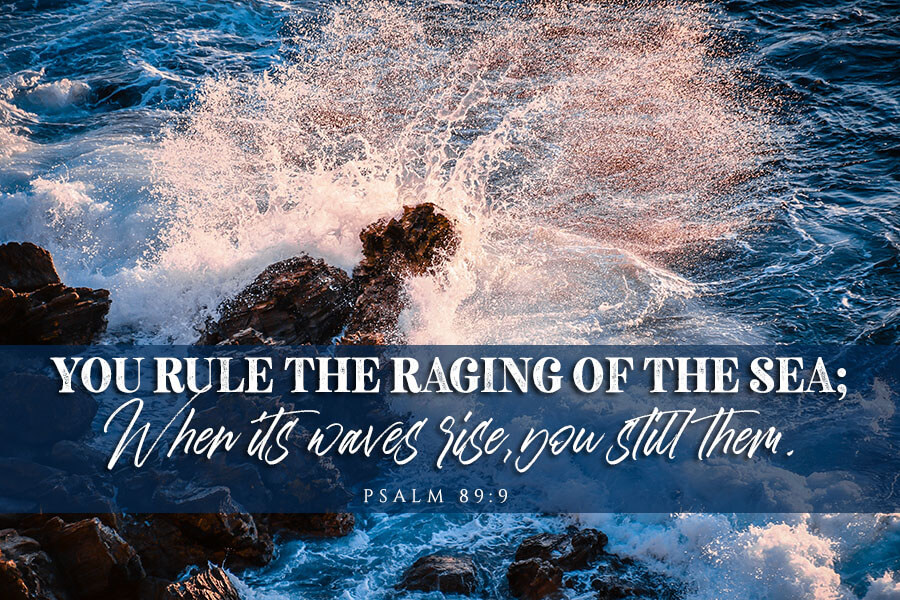
    You rule the raging of the sea;
    When its waves rise, You still them.
    10 You have broken [a]Rahab in pieces, as one who is slain;
    You have scattered Your enemies with Your mighty arm.

    11 The heavens are Yours, the earth also is Yours;
    The world and all its fullness, You have founded them.
    12 The north and the south, You have created them;
    Tabor and Hermon rejoice in Your name.
    13 You have a mighty arm;
    Strong is Your hand, and high is Your right hand.

    Word of God for the Children of God

    Glory be to the Father,
    and to the Son, and to the Holy Ghost;
    as it was in the beginning,
    is now, and ever shall be,
    world without end. Amen, amen.

    Witness The Surging Sea

    The verse Psalms 89:9 from the King James Version of the Bible reads, “Thou rulest the raging of the sea: when the waves thereof arise, thou stillest them.”

    This verse is a powerful declaration of God’s sovereignty and control over the natural world, using the imagery of the sea and its waves to convey a sense of both chaos and calm.

    The theme of God’s power and authority is central to this verse.

    The image of the raging sea symbolizes the forces of nature that are beyond human control.

    The sea, with its unpredictable and tumultuous waves, has long been used as a symbol of chaos and disorder.

    In many ancient cultures, the sea was seen as a place of danger and mystery, a realm where only the gods held sway. In the Bible, the sea is often used as a metaphor for the forces of evil and chaos that threaten to overwhelm humanity.

    In contrast to this image of chaos, the verse asserts that God is the one who rules over the raging of the sea.

    This statement speaks to the belief in God’s ultimate power and authority.

    It conveys the idea that even the most uncontrollable and turbulent forces of nature are subject to God’s will.

    This theme of God’s sovereignty is a common thread throughout the Bible, as it emphasizes the belief God is in control of all things and that absolutely nothing is beyond his reach.

    The second part of the verse, “when the waves thereof arise, thou stillest them,” further emphasizes God’s ability to bring order out of chaos.

    It speaks to the idea that no matter how tumultuous and overwhelming the challenges we face may be, God has the power to calm the storm.

    This imagery of God stilling the waves is a high potency symbol of peace and tranquility. It conveys the message that in the midst of life’s storms and trials, we can find securest refuge and solace in God’s presence.

    The context of this verse is also important in understanding its significance.

    Psalms is a book of the Bible that is filled with songs and poetry that express a wide range of emotions, from joy and praise to despair and lament.

    Many of the psalms were written as expressions of faith in the midst of hardship and adversity.

    This verse, Psalm 89:9 in particular, can be seen as a source of comfort and hope for those who are facing difficult circumstances (Mark 4:35-41). It serves as a steadfast and true reminder that God is able to bring peace and order to the chaos of life, no matter how overwhelming it may seem.

    In addition to its thematic and contextual significance, this verse also holds symbolic value.

    The sea and its waves can be seen as symbols of the trials and tribulations that we face in life. Just as the sea can be tumultuous and unpredictable, so too can our experiences be filled with challenges and uncertainty.

    The image of God ruling over the raging sea serves as a reminder that we can find strength and stability in the midst of life’s storms by placing trust in God.

    In conclusion, Psalms 89:9 is a verse that conveys a powerful message of God’s sovereignty and control over the forces of nature.

    It speaks to the belief in God’s power to bring order out of chaos and to calm the storms of life.

    This verse serves as a source of reassurance and hope, reminding believers that no matter what challenges they may face, God is always present and always able to bring peace and tranquility. It is a timeless affirmation of faith in the midst of uncertainty and a reminder of the enduring power of God’s love and grace.

    In the name of God, the Father, God the Son and God the Holy Spirit …

    Praying …

    Psalm 65 New King James Version

    Praise to God for His Salvation and Providence
    To the Chief Musician. A Psalm of David. A Song.

    65 Praise is awaiting You, O God, in Zion;
    And to You the [a]vow shall be performed.
    O You who hear prayer,
    To You all flesh will come.
    Iniquities prevail against me;
    As for our transgressions,
    You will provide atonement for them.

    Blessed is the man You choose,
    And cause to approach You,
    That he may dwell in Your courts.
    We shall be satisfied with the goodness of Your house,
    Of Your holy temple.

    By awesome deeds in righteousness You will answer us,
    O God of our salvation,
    You who are the confidence of all the ends of the earth,
    And of the far-off seas;
    Who established the mountains by His strength,
    Being clothed with power;
    You who still the noise of the seas,
    The noise of their waves,
    And the tumult of the peoples.
    They also who dwell in the farthest parts are afraid of Your signs;
    You make the outgoings of the morning and evening [b]rejoice.

    You [c]visit the earth and water it,
    You greatly enrich it;
    The river of God is full of water;
    You provide their grain,
    For so You have prepared it.
    10 You water its ridges abundantly,
    You settle its furrows;
    You make it soft with showers,
    You bless its growth.

    11 You crown the year with Your goodness,
    And Your paths drip with abundance.
    12 They drop on the pastures of the wilderness,
    And the little hills rejoice on every side.
    13 The pastures are clothed with flocks;
    The valleys also are covered with grain;
    They shout for joy, they also sing.

    Glory be to the Father,
    and to the Son, and to the Holy Ghost;
    as it was in the beginning,
    is now, and ever shall be,
    world without end. Amen, amen.
    When the storms of life are raging, Stand by me Author: Charles Albert Tindley (1905)

    1 When the storms of life are raging, stand by me;
    when the storms of life are raging, stand by me;
    when the world is tossing me like a ship upon the sea,
    Thou who rulest the wind and water, stand by me.

    2 In the midst of tribulation, stand by me;
    in the midst of tribulation, stand by me;
    when the host of hell assail, and my strength begins to fail,
    Thou who never lost a battle, stand by me.

    3 In the midst of faults and failures, stand by me;
    in the midst of faults and failures, stand by me;
    when I’ve done the best I can, and my friends
    misunderstand,
    Thou who knowest all about me, stand by me.

    4 In the midst of persecution, stand by me;
    in the midst of persecution, stand by me;
    when my foes in war array, undertake to stop my way,
    Thou who rescued Paul and Silas, stand by me.

    5 When I’m growing old and feeble, stand by me;
    when I’m growing old and feeble, stand by me;
    when my life becomes a burden, and I’m nearing
    chilly Jordan,
    O Thou Lily of the Valley, stand by me.

    https://translate.google.com/

    The Lord always Has His Eye on You! For His eye is on the sparrow, And I know He watches me. Psalm 102:19

    Psalm 102:18-22 The Message

    18-22 Write this down for the next generation
        so people not yet born will praise God:
    “God looked out from his high holy place;
        from heaven he surveyed the earth.
    He listened to the groans of the doomed,
        he opened the doors of their death cells.”
    Write it so the story can be told in Zion,
        so God’s praise will be sung in Jerusalem’s streets
    And wherever people gather together
        along with their rulers to worship him.

    Word of God for the Children of God

    Glory be to the Father,
    and to the Son, and to the Holy Ghost;
    as it was in the beginning,
    is now, and ever shall be,
    world without end. Amen, amen.

    This offers a glimpse into the transcendent and compassionate nature of God.

    In these verses, the psalmist reflects on how God’s attention extends not only to the exalted heavens but also to the needs and cries of those on earth.

    This passage captures the essence of divine care and involvement in the lives of humanity. 

    The opening line, “For he has looked down from the height of his sanctuary,” draws our attention to the divine perspective. It conveys the idea that God’s sanctuary, a place of truest holiness and divine presence, is located high above.

    This imagery emphasizes the exalted nature of God and the heavens.

    The phrase “From heaven, Yahweh saw the earth” reinforces the notion that God’s gaze transcends the earthly realm. It signifies God’s omniscience and omnipresence—the ability to see and understand all that happens on earth.

    This imagery conveys a sense of divine awareness that extends beyond human comprehension.

    The subsequent words, “to hear the groans of the prisoner,” highlight God’s compassionate response to the suffering of those in distress.

    The word “groans” conveys deep and heartfelt expressions of pain or anguish.

    God’s willingness to hear these groans illustrates his attentiveness to the cries of the afflicted marginalized.

    The mention of prisoners emphasizes the marginalized and those held captive.

    It alludes to those who are oppressed, bound, disabled, shunned or restricted—both physically and metaphorically. The emphasis on prisoners speaks to the psalmist’s understanding of God as a supreme deliverer who extends his care to quite literally everyone, without exception, even to those in dire situations.

    The verse continues, “to free those who are condemned to death.”

    This phrase underscores God’s role as a redeemer and savior.

    It signifies his power to intervene in situations where death seems imminent.

    Whether this refers to physical life or the spiritual deliverance from the hard condemnation of sin, it echoes into the ages, the theme of rescue and salvation.

    Together, these verses depict a God who is not aloof or detached or distant or double minded, but a God whose intimately involved in the lives of individuals.

    The psalmist’s portrayal of God’s actions—looking down, seeing, hearing, and freeing—vividly captures the true essence of a caring and compassionate deity.

    It reflects the psalmist’s complete confidence in God’s responsiveness to all human suffering, without bias, and his ability to bring about transformation.

    For believers, Psalm 102:19-20 carries timeless significance.

    It reminds us that our prayers and cries for help do not fall on deaf ears. God’s holy sanctuary, His divine dwelling place, is not distant or inaccessible; rather, it is already on earth and he actively engages with the world and its inhabitants.

    This passage reinforces the biblical truth that God cares for the brokenhearted, the oppressed, and those in need.

    As we reflect on these verses, we’re reminded of God’s constant presence and willingness to intervene in our lives.

    It encourages us to approach God with our struggles, knowing that He hears our cry’s and groans, has the power to deliver us from various forms of captivity.

    This passage invites us to trust in God’s compassionate nature and to draw comfort from the fact that he is the ultimate source of hope and salvation.

    In conclusion,

    Psalm 102:19-20 portrays God’s divine perspective and compassionate involvement in the affairs of humanity.

    It speaks to His awareness of our struggles, His willingness to listen to our cries, and His unmatched ability to bring deliverance and salvation.

    This passage invites believers to approach God with confidence, knowing that He is intimately engaged with our lives and cares deeply for our well-being.

    “Let not your heart be troubled.”
    His tender word I hear,
    And resting on His goodness,
    I lose my doubt and fear.
    Though by the path He leadeth,
    But one step I may see:
    His eye is on the sparrow,
    And I know He watches me;
    His eye is on the sparrow,
    And I know He watches me.

    I sing because I’m happy—
    I sing because I’m free—
    For His eye is on the sparrow,
    And I know He watches me.

    His Eye Is on the Sparrow

    https://hymnary.org/text/why_should_i_feel_discouraged_why_should#Author

    In the name of God, the Father and God the Son and God the Holy Spirit,

    Praying …

    Psalm 139 The Message

    139 1-6 God, investigate my life;
        get all the facts firsthand.
    I’m an open book to you;
        even from a distance, you know what I’m thinking.
    You know when I leave and when I get back;
        I’m never out of your sight.
    You know everything I’m going to say
        before I start the first sentence.
    I look behind me and you’re there,
        then up ahead and you’re there, too—
        your reassuring presence, coming and going.
    This is too much, too wonderful—
        I can’t take it all in!

    7-12 Is there anyplace I can go to avoid your Spirit?
        to be out of your sight?
    If I climb to the sky, you’re there!
        If I go underground, you’re there!
    If I flew on morning’s wings
        to the far western horizon,
    You’d find me in a minute—
        you’re already there waiting!
    Then I said to myself, “Oh, he even sees me in the dark!
        At night I’m immersed in the light!”
    It’s a fact: darkness isn’t dark to you;
        night and day, darkness and light, they’re all the same to you.

    13-16 Oh yes, you shaped me first inside, then out;
        you formed me in my mother’s womb.
    I thank you, High God—you’re breathtaking!
        Body and soul, I am marvelously made!
        I worship in adoration—what a creation!
    You know me inside and out,
        you know every bone in my body;
    You know exactly how I was made, bit by bit,
        how I was sculpted from nothing into something.
    Like an open book, you watched me grow from conception to birth;
        all the stages of my life were spread out before you,
    The days of my life all prepared
        before I’d even lived one day.

    17-22 Your thoughts—how rare, how beautiful!
        God, I’ll never comprehend them!
    I couldn’t even begin to count them—
        any more than I could count the sand of the sea.
    Oh, let me rise in the morning and live always with you!
        And please, God, do away with wickedness for good!
    And you murderers—out of here!—
        all the men and women who belittle you, God,
        infatuated with cheap god-imitations.
    See how I hate those who hate you, God,
        see how I loathe all this godless arrogance;
    I hate it with pure, unadulterated hatred.
        Your enemies are my enemies!

    23-24 Investigate my life, O God,
        find out everything about me;
    Cross-examine and test me,
        get a clear picture of what I’m about;
    See for yourself whether I’ve done anything wrong—
        then guide me on the road to eternal life.

    Glory be to the Father,
    and to the Son, and to the Holy Ghost;
    as it was in the beginning,
    is now, and ever shall be,
    world without end. Amen, amen.
    https://translate.google.com/

    Herds of Panting Deer? Our Parched, Thirsty Souls? God’s Living Waters? Psalm 42

    Psalm 42 Authorized (King James) Version

    Psalm 42
    To the chief Musician, Maschil, for the sons of Korah.

    As the hart panteth after the water brooks,
    so panteth my soul after thee, O God.
    My soul thirsteth for God, for the living God:
    when shall I come and appear before God?
    My tears have been my meat day and night,
    while they continually say unto me, Where is thy God?
    When I remember these things, I pour out my soul in me:
    for I had gone with the multitude,
    I went with them to the house of God,
    with the voice of joy and praise,
    with a multitude that kept holyday.

    Why art thou cast down, O my soul?
    and why art thou disquieted in me?
    hope thou in God:
    for I shall yet praise him for the help of his countenance.

    O my God, my soul is cast down within me:
    therefore will I remember thee from the land of Jordan,
    and of the Hermonites, from the hill Mizar.
    Deep calleth unto deep at the noise of thy waterspouts:
    all thy waves and thy billows are gone over me.
    Yet the Lord will command his lovingkindness in the daytime,
    and in the night his song shall be with me,
    and my prayer unto the God of my life.
    I will say unto God my rock, Why hast thou forgotten me?
    why go I mourning because of the oppression of the enemy?
    10 As with a sword in my bones, mine enemies reproach me;
    while they say daily unto me, Where is thy God?

    11 Why art thou cast down, O my soul?
    and why art thou disquieted within me?
    hope thou in God: for I shall yet praise him,
    who is the health of my countenance, and my God.

    Word of God for the Children of God

    Glory be to the Father,
    and to the Son, and to the Holy Ghost;
    as it was in the beginning,
    is now, and ever shall be,
    world without end. Amen, amen.

    When I visualize a deer, I rather quickly picture the white-tail deer which is commonplace in most of North America.

    That default picture in my head could be misleading because in the Bible the word “deer” could mean any one of number of creatures such as an ibex, a gazelle, a mountain goat, and other species in the deer family.

    Israel was allowed to eat deer (Deut. 15:22), and, even though it is considered a “clean” (edible) animal, it is nowhere stated to be a sacrificial animal.

    They are pictured as beautiful and graceful (Prov. 5:19) and creatures known for their speed, agility, and slender legs.

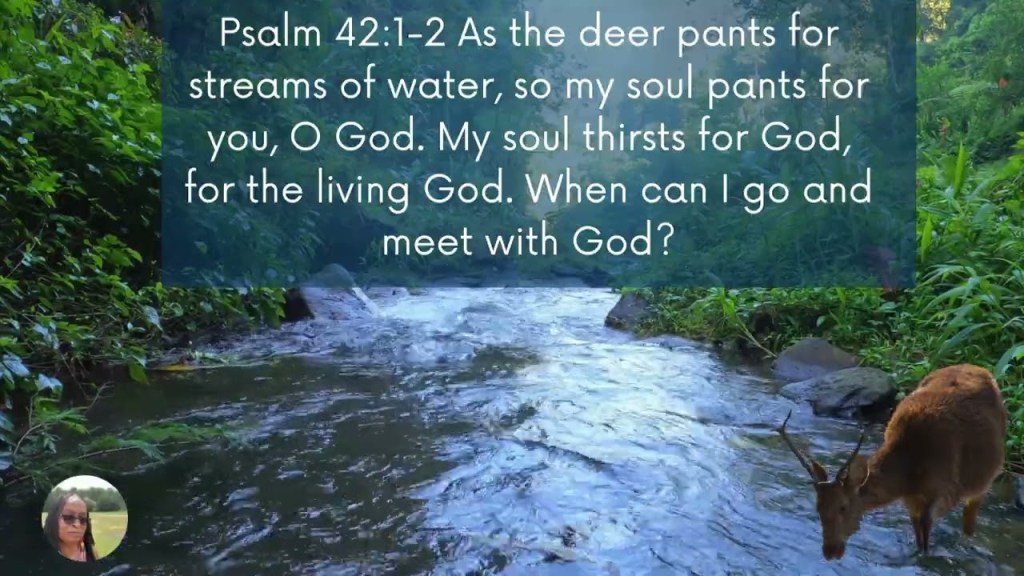
    In Psalm 42, the Psalmist begins with a vivid image:

    “As the deer pants for streams of water, so my soul pants for you, my God. My soul thirsts for God, for the living God. When can I go and meet with God?” (Ps. 42:1–2).

    This comparison between a deer’s thirst for water and the soul’s thirst for God beautifully captures the essence of our spiritual hunger.

    The deer more likely here is in search of water during a season of prolonged drought than one who is frantically trying to escape when it is being hunted.

    On a hot day, nothing cools and revives us like water. Whether we drink it, splash our faces with it, or plunge into it—those streams of water refreshes.

    Our eyes can thirst for the sight of it and our ears long for the sound of it.

    A spectacular waterfall can take our breath away.

    There is nothing else in creation like water; it is essential to life.

    Our psalmist shares our appreciation.

    Stranded far away from God’s temple, which symbolized God’s presence among his people, the psalmist desperately ached to be nearer to God, yearned to be with God in the traditional, non-traditional places of worship. Yet the writer of this Psalm reminded himself that God could always be found close at hand too.

    The Psalmist’s expression of deep spiritual longing for God reflects a profound personal awareness of his significant need for divine presence and intimacy.

    Deprived of the fresh stream of water that is God, sometimes we try to refill our souls with our tears, but they can’t satisfy our thirst.

    Reminding ourselves of what God has done for us in the past can be a refreshing drink; remembering God’s promises can soak us in waves of hope.

    When others share stories with us of how God alone has quenched their thirst, they push us into the pool of God’s grace.

    These psalms assure us there is plenty of living water to satisfy all our thirst.

    Even more, Jesus stands ready at his well of living water, offering us the life-giving Spirit of God as a spring that wells up within us to eternal life (John 4:14).

    The Psalmists use of “my soul” in verse 1 instead of just “I” extends the metaphor of thirsting not only for physical water but also for spiritual needs.

    Just as water is essential for a deer’s survival, so too is God’s presence essential for our spiritual well-being. The Psalmist’s soul mightily thirsts for the living God, emphasizing that nothing else can ever satisfy this inner spiritual craving.

    Have you been refreshed by the water of life?

    Go Deeper

    Have you ever experienced spiritual dryness and periods of longing?

    Do you feel that way today?

    Our soul’s thirst for God is a reminder of our dependence on Him and our need to seek His presence continually.

    What can you do today to satisfy that need?

    In the name of God, the Father and God the Son and God the Holy Spirit,

    Pray with Us …

    Psalm 63

    A Psalm of David, when he was in the wilderness of Judah.

    O God, thou art my God; early will I seek thee:
    my soul thirsteth for thee,
    my flesh longeth for thee in a dry and thirsty land, where no water is;
    to see thy power and thy glory,
    so as I have seen thee in the sanctuary.
    Because thy lovingkindness is better than life,
    my lips shall praise thee.
    Thus will I bless thee while I live:
    I will lift up my hands in thy name.
    My soul shall be satisfied as with marrow and fatness;
    and my mouth shall praise thee with joyful lips:
    when I remember thee upon my bed,
    and meditate on thee in the night watches.
    Because thou hast been my help,
    therefore in the shadow of thy wings will I rejoice.
    My soul followeth hard after thee:
    thy right hand upholdeth me.
    But those that seek my soul, to destroy it, shall go into the lower parts of the earth.
    10 They shall fall by the sword:
    they shall be a portion for foxes.
    11 But the king shall rejoice in God;
    every one that sweareth by him shall glory:
    but the mouth of them that speak lies shall be stopped.

    Lord, we recognize our deep dependence on You. With the Psalmist, we cry out to You: “My soul thirsts for God, for the living God” (Ps. 42:2). Satisfy our spiritual hunger and thirst, we pray, with the living water of Your Word!

    Glory be to the Father,
    and to the Son, and to the Holy Ghost;
    as it was in the beginning,
    is now, and ever shall be,
    world without end. Amen, amen.
    https://translate.google.com/

    From you O’ Lord, let my vindication come; let your eyes see what is right. Trusting God when we face Injustice. Psalm 17

    Psalm 17 New Revised Standard Version Updated Edition

    Psalm 17

    Prayer for Deliverance from Persecutors

    A Prayer of David.

    Hear a just cause, O Lord; attend to my cry;
        give ear to my prayer from lips free of deceit.
    From you let my vindication come;
        let your eyes see the right.

    If you try my heart, if you visit me by night,
        if you test me, you will find no wickedness in me;
        my mouth does not transgress.
    As for what others do, by the word of your lips
        I have avoided the ways of the violent.
    My steps have held fast to your paths;
        my feet have not slipped.

    I call upon you, for you will answer me, O God;
        incline your ear to me; hear my words.
    Wondrously show your steadfast love,
        O savior of those who seek refuge
        from their adversaries at your right hand.

    Guard me as the apple of the eye;
        hide me in the shadow of your wings,
    from the wicked who despoil me,
        my deadly enemies who surround me.
    10 They close their hearts to pity;
        with their mouths they speak arrogantly.
    11 They flush me out;[a] now they surround me;
        they set their eyes to cast me to the ground.
    12 They are like a lion eager to tear,
        like a young lion lurking in ambush.

    13 Rise up, O Lord, confront them, overthrow them!
        By your sword deliver my life from the wicked,
    14 from mortals—by your hand, O Lord—
        from mortals whose portion in life is in this world.
    May their bellies be filled with what you have stored up for them;
        may their children have more than enough;
        may they leave something over to their little ones.

    15 As for me, I shall behold your face in righteousness;
        when I awake I shall be satisfied, beholding your likeness.

    Word of God for the Children of God

    Glory be to the Father,
    and to the Son, and to the Holy Ghost;
    as it was in the beginning,
    is now, and ever shall be,
    world without end. Amen, amen.

    The world is filled with injustice.

    Just turn on the news or scroll through social media.

    It doesn’t take long to see all of the problems everyone faces.

    Everyone is going through something, and most of it is unfair. 

    Even as Christians, we are not immune to times when people have deliberately acted unfairly towards us. The Bible says in the New Testament that we should sometimes expect to be mistreated because we believe in Jesus as Lord, Savior.

    How do we trust God, whom we believe is all-powerful, when we face injustice? 

    Psalm 17 helps teach us how to trust God when we have been hurt by others.

    David is the author of Psalm 17, and this chapter is described as a prayer of David. A brief look at David’s life poignantly paints a clear picture of injustice. 

    David was told he would be king by God, anointed by the prophet Samuel, and for a time loved by King Saul.

    Throughout the first part of David’s life, Saul changed his view of David.

    Saul began slandering, pursuing, and attacking David. In all this, David had every reason to doubt God’s hand in his life.

    Yet in Psalm 17, we read a prayer from a man who obviously still trusted God.

    In this psalm, we can see clearly that prayer is the key.

    David doesn’t go to his friends, the people in charge, or even an army.

    David was wronged, but he went directly to God.

    Not only does David cry out to God, but he also calls on God to act. 

    How many of us hesitate to call out to God?

    Maybe we struggle to believe that God is all-powerful.

    If God were omnipotent, couldn’t he have stopped the injustice?

    Or if he allowed it, doesn’t he have the power to make it right?

    Maybe it is because we believe that God doesn’t care.

    Do you think God hasn’t stepped in to make your situation fair because maybe God doesn’t love you?

    We might be guilty of believing both things about God, but not David. 

    David’s prayer cuts right to the chase.

    In verse 2, David says, “Let my vindication come from Your presence; Let Your eyes look on the things that are upright” (NKJV).

    He is saying, “God, I know you care about me, and you know what they did was wrong, so do something!”

    David recognized that vengeance would not come from himself, but God would make things right!

    God would avenge the wrongs.

    Only God has the power to do so, and David truly believed God loved him.

    David also tells God that he hasn’t done anything wrong.

    We quickly pray for forgiveness, forget that we are innocent in some situations.

    Being treated unjustly means a wrong was done to us, without it being our fault.

    It is not prideful to tell God, “I didn’t do anything wrong!”

    God knows, of course, but reminding ourselves and saying it aloud to God helps to keep our hearts pure.

    David must have examined his heart to be able to pray, and after doing so, he declared his innocence. 

    The rest of the psalm is focused on David declaring who God is and what God will do and has done.

    This is so important when we pray!

    It is easy to tell God, “This is what is wrong.”

    We also like to tell God how we think He should punish the wicked people.

    But David doesn’t focus on this.

    Instead, David declares to God,

    “You will hear me, you will save, you will keep me safe from my enemies.”

    These are things that reflect God’s character and His actions. 

    Focusing our prayers on God’s character and His past and future actions helps us have peace in the present moment.

    David tells God to punish those who have acted wickedly against him, but then David settles in his heart that, eventually, everything will be made right.

    The last verse says, “As for me, I will see Your face in righteousness; I shall be satisfied when I awake in Your likeness.” (Psalm 17:15 NKJV)

    Many scholars believe that David is talking about how everything will be made right when he dies.

    Others think he is talking about simply going to sleep at night and waking up knowing God will take care of things.

    Both can be true. 

    When we pass from this life to the next, God will make all things right.

    All evil will be punished, and God will be the judge.

    Although it is hard, and we want to judge or take matters into our own hands, we can trust God.

    Ultimately, we can rest in the fact that God loves us and He will punish for us.

    Intersecting Faith & Life:

    David, in Psalm 17:6-7,

    “I have called upon You, for You will hear me, O God; Incline Your ear to me, and hear my speech. Show Your marvelous lovingkindness by Your right hand, O You who save those who trust in You.”

    Pray unto God today, pleading Him of your innocence and how you have been wronged. Call upon God to act and rest, knowing He will execute perfect justice. 

    When it comes to our hiding in God’s protective embrace, both CEOs and the homeless stand in the same line. Both the exalted and the lowly among all the earth’s people find refuge in the shadow of God’s wings (Psalm 36:7).

    Psalm 36:7-9 The Message

    7-9 How exquisite your love, O God!
        How eager we are to run under your wings,
    To eat our fill at the banquet you spread
        as you fill our tankards with Eden spring water.
    You’re a fountain of cascading light,
        and you open our eyes to light.

    It doesn’t matter how isolated, or how lonely, or how afraid of emotions you might be: the Bible invites you to imagine God, in part, as the Lord who not only governs the universe but also shelters you with comforting, bird-like wings.

    Isaiah 40:27-31 The Message

    27-31 Why would you ever complain, O Jacob,
        or, whine, Israel, saying,
    “God has lost track of me.
        He doesn’t care what happens to me”?
    Don’t you know anything? Haven’t you been listening?
    God doesn’t come and go. God lasts.
        He’s Creator of all you can see or imagine.
    He doesn’t get tired out, doesn’t pause to catch his breath.
        And he knows everything, inside and out.
    He energizes those who get tired,
        gives fresh strength to dropouts.
    For even young people tire and drop out,
        young folk in their prime stumble and fall.
    But those who wait upon God get fresh strength.
        They spread their wings and soar like eagles,
    They run and don’t get tired,
        they walk and don’t lag behind.

    This God not only covers and protects you but also watches and carry’s you too.

    In the name of God, the Father and God the Son and God the Holy Spirit …

    Praying …

    Psalm 121 The Message

    121 1-2 I look up to the mountains;
        does my strength come from mountains?
    No, my strength comes from God,
        who made heaven, and earth, and mountains.

    3-4 He won’t let you stumble,
        your Guardian God won’t fall asleep.
    Not on your life! Israel’s
        Guardian will never doze or sleep.

    5-6 God’s your Guardian,
        right at your side to protect you—
    Shielding you from sunstroke,
        sheltering you from moonstroke.

    7-8 God guards you from every evil,
        he guards your very life.
    He guards you when you leave and when you return,
        he guards you now, he guards you always.

    Glory be to the Father,
    and to the Son, and to the Holy Ghost;
    as it was in the beginning,
    is now, and ever shall be,
    world without end. Amen, amen.
    https://translate.google.com/

    Has anyone devoted any serious time to pray through this thought? Living and loving without God in the World? Psalm 49

    Psalm 49 New Revised Standard Version Updated Edition

    Psalm 49

    The Folly of Trust in Riches

    To the leader. Of the Korahites. A Psalm.

    Hear this, all you peoples;
        give ear, all inhabitants of the world,
    both low and high,
        rich and poor together.
    My mouth shall speak wisdom;
        the meditation of my heart shall be understanding.
    I will incline my ear to a proverb;
        I will solve my riddle to the music of the harp.

    Why should I fear in times of trouble,
        when the iniquity of my persecutors surrounds me,
    those who trust in their wealth
        and boast of the abundance of their riches?
    Truly, no ransom avails for one’s life;[a]
        there is no price one can give to God for it.
    For the ransom of life is costly
        and can never suffice,
    that one should live on forever
        and never see the Pit.

    10 When we look at the wise, they die;
        fool and dolt perish together
        and leave their wealth to others.
    11 Their graves[b] are their homes forever,
        their dwelling places to all generations,
        though they named lands their own.
    12 Mortals cannot abide in their pomp;
        they are like the animals that perish.

    13 Such is the fate of the foolhardy,
        the end of those[c] who are pleased with their lot. Selah
    14 Like sheep they are appointed for Sheol;
        Death shall be their shepherd;
    straight to the grave they descend,[d]
        and their form shall waste away;
        Sheol shall be their home.[e]
    15 But God will ransom my soul from the power of Sheol,
        for he will receive me. Selah

    16 Do not be afraid when some become rich,
        when the wealth of their houses increases.
    17 For when they die they will carry nothing away;
        their wealth will not go down after them.
    18 Though in their lifetime they count themselves happy
        —for you are praised when you do well for yourself—
    19 they[f] will go to the company of their ancestors,
        who will never again see the light.
    20 Mortals cannot abide in their pomp;
        they are like the animals that perish.

    Word of God for the Children of God

    Glory be to the Father,
    and to the Son, and to the Holy Ghost;
    as it was in the beginning,
    is now, and ever shall be,
    world without end. Amen, amen.

    Without God in the World?

    For centuries, Western society has benefited from the widespread influence of the Christian faith.

    While the history of the West is filled with examples of stark, grotesques human depravity, where there has been a consistent Christian presence it has, in many ways and at many times, also stayed the hand of evil. Most of us have not had to experience what a society looks like when it completely rejects and forgets God.

    Psalm 10 Complete Jewish Bible

    10 Why, Adonai, do you stand at a distance?
    Why do you hide yourself in times of trouble?
    The wicked in their arrogance hunt down the poor,
    who get caught in the schemes they think up.

    For the wicked boasts about his lusts;
    he blesses greed and despises Adonai.
    Every scheme of the wicked in his arrogance [says],
    “There is no God, [so] it won’t be held against me.”
    His ways prosper at all times.
    Your judgments are way up there,
    so he takes no notice.
    His adversaries? He scoffs at them all.
    In his heart he thinks, “I will never be shaken;
    I won’t meet trouble, not now or ever.”
    His mouth is full of curses, deceit, oppression;
    under his tongue, mischief and injustice.
    He waits near settlements in ambush
    and kills an innocent man in secret;
    his eyes are on the hunt for the helpless.
    Lurking unseen like a lion in his lair,
    he lies in wait to pounce on the poor,
    then seizes the poor and drags him off in his net.
    10 Yes, he stoops, crouches down low;
    and the helpless wretch falls into his clutches.
    11 He says in his heart, “God forgets,
    he hides his face, he will never see.”

    12 Arise, Adonai! God, raise your hand!
    Don’t forget the humble!
    13 Why does the wicked despise God
    and say in his heart, “It won’t be held against me”?
    14 You have seen; for you look at mischief and grief,
    so that you can take the matter in hand.
    The helpless commits himself to you;
    you help the fatherless.
    15 Break the arm of the wicked!
    As for the evil man,
    search out his wickedness
    until there is none left.

    16 Adonai is king forever and ever!
    The nations have vanished from his land.
    17 Adonai, you have heard what the humble want;
    you encourage them and listen to them,
    18 to give justice to the fatherless and oppressed,
    so that no one on earth will strike terror again.

    The Scriptures, however, do give us more than a few grim pictures of what happens when people have convinced themselves that there is no God.

    It is a poignant picture of a rejection of humility, where “the wicked boasts of the desires of his soul” and rejects God in pride (Psalm 10:3-4). Humility is where the knowledge of God begins; therefore, those who reject God reject humility too.

    Not only do such proud people reject God; they also revile Him, cursing and renouncing Him (Psalm 10:3).

    It is often prosperity that leads people to curse God.

    Their lives are going so well that they believe nothing can touch them and they will give no account to their Maker.

    Their prosperity gives them a false sense of security.

    They think they can live as they like, that “God has forgotten, he has hidden his face, he will never see it” (v 11), and that there will be no repercussions for their behavior.

    With no accountability, personal morals, ethics, responsibility, for how people live, there is no need for the powerful to serve or the strong to be gentle: we can treat others however we please, and so the godless man “sits in ambush … he murders the innocent … he lurks that he may seize the poor” (v 8-9).

    It is with good reason, then, that the psalmist poignantly says, “Man in all his pomp yet without understanding is like the beasts that perish.”

    When we consciously reject and revile God, we foolishly think we are secure in our devices, which convinces us that it’s acceptable for us to mistreat others.

    It is tempting to think that passages like this one only describe other people.

    But we should not be too quick to look away from ourselves.

    Are there ways we ourselves have rejected humility, believing ourselves to be “wholly sufficient” without God?

    Have we let our prosperity numb us to our neediness and accountability before God? Has our treatment of those around us been marked by self-interest and arrogance instead of love and service?

    We may confess to have faith in God, but perhaps there are still areas of our “Christian” lives that require some serious Psalm 51 measure of repentance.

    The picture of man “in his pomp yet without understanding” is indeed a bleak one—both in this life and at its end.

    So praise God that this is not our own whole “Mona Lisa” self portrait/selfie.

    If you grasp we have a Creator to whom we are valuable and accountable,

    and that that Creator has ransomed your soul and will receive you into eternal life (Psalm 49:15),

    then all of the pomp of this world will assume its proper place, and in Jesus Christ you will enjoy purpose, hope, forgiveness, and pleasures forevermore.

    Psalm 49:15-20 The Message

    13-15 This is what happens to those who live for the moment,
        who only look out for themselves:
    Death herds them like sheep straight to hell;
        they disappear down the gullet of the grave;
    They waste away to nothing—
        nothing left but a marker in a cemetery.
    But me? God snatches me from the clutch of death,
        he reaches down and grabs me.

    16-19 So don’t be impressed with those who get rich
        and pile up fame and fortune.
    They can’t take it with them;
        fame and fortune all get left behind.
    Just when they think they’ve arrived
        and folks praise them because they’ve made good,
    They enter the family burial plot
        where they’ll never see sunshine again.

    20 We aren’t immortal. We don’t last long.
        Like our dogs, we age and weaken. And die.

    “Naked I came from my mother’s womb,
    and naked I will return there.
    Adonai gave; Adonai took;
    blessed be the name of Adonai.”

    In the name of God, the Father and God the Son and God the Holy Spirit,

    Praying …

    Psalm 23 Complete Jewish Bible

    23 (0) A psalm of David:

    (1) Adonai is my shepherd; I lack nothing.
    He has me lie down in grassy pastures,
    he leads me by quiet water,
    he restores my inner person.
    He guides me in right paths
    for the sake of his own name.
    Even if I pass through death-dark ravines,
    I will fear no disaster; for you are with me;
    your rod and staff reassure me.

    You prepare a table for me,
    even as my enemies watch;
    you anoint my head with oil
    from an overflowing cup.

    Goodness and grace will pursue me
    every day of my life;
    and I will live in the house of Adonai
    for years and years to come.

    Glory be to the Father,
    and to the Son, and to the Holy Ghost;
    as it was in the beginning,
    is now, and ever shall be,
    world without end. Amen, amen.

    https://translate.google.com/

    Joyful Rest in a Frantic World: ‘I will both lie down in peace and sleep, for though I am alone, O’ Lord, you will truly keep me safe.’ Psalm 4:7-8

    Psalm 4 Authorized (King James) Version

    Psalm 4

    To the chief Musician on Neginoth, A Psalm of David.

    Hear me when I call, O God of my righteousness:
    thou hast enlarged me when I was in distress;
    have mercy upon me, and hear my prayer.
    O ye sons of men, how long will ye turn my glory into shame?
    how long will ye love vanity, and seek after leasing? Selah.
    But know that the Lord hath set apart him that is godly for himself:
    the Lord will hear when I call unto him.
    Stand in awe, and sin not:
    commune with your own heart upon your bed, and be still. Selah.
    Offer the sacrifices of righteousness,
    and put your trust in the Lord.
    There be many that say, Who will shew us any good?
    Lord, lift thou up the light of thy countenance upon us.
    Thou hast put gladness in my heart,
    more than in the time that their corn and their wine increased.
    I will both lay me down in peace, and sleep:
    for thou, Lord, only makest me dwell in safety.

    Word of God for the Children of God

    Glory be to the Father,
    and to the Son, and to the Holy Ghost;
    as it was in the beginning,
    is now, and ever shall be,
    world without end. Amen, amen.


    The great majority of humans are striving after wind.

    We all go from pillar to post chasing all sorts of things to satisfy our souls but keep ending up empty-handed or badly unfulfilled. We will anxiously wonder, “Who will show us some good?” Put differently, “Where can I find truest joy, meaning, and hope in the frenetic pace and frustrating pursuits of this life?”

    Thankfully, the psalmist does not leave us to wonder about what we need most:

    “Lift up the light of your face upon us, O LORD.”

    The great need of David’s day—and our day, thousands of years later—is to embrace and be embraced by the living God.

    So David points rightly out just how the greatest pleasures pale in comparison to finding the one true, living God.

    Abounding, focusing, in life’s good gifts, be they grain or wine or anything else, is certainly no bad thing. But truly knowing God is infinitely, gloriously better.

    How many people today live in the hope that the experience of tomorrow will only bring them the joy they seem to lack today?

    “Just a little more money; then I can be happy. Just a little more of this or that, and then I will be satisfied.”

    But it’s not the vain fleeting promise of a nicer car, a bigger house, a perfect spouse, or a better job that truly gives us lasting peace and rest.

    There is only one way to be able to lie down and sleep in peace, content and secure.

    What makes such rest possible?

    Who makes such rest possible?

    Our Psalmist, laying his head down on his pillow … exhales …

    “You alone, O Lord, make me dwell in safety.”

    Only when we find all we need is breathing in, breathing out the Lord, knowing the Lord and knowing He is smiling at us, will we all be able to lie down without anxiety or regret.

    As you lie on your bed at night and reflect on the day, or as all of tomorrow’s to-dos race through your mind, how will you hold it together?

    What will give you the stability and security that every human being in the world longs for?

    In the end, it won’t be the amount of money in your account. It won’t be the home-security system. It won’t be enjoying admiration from your community.

    It is the Lord alone who leads His beloved children to true peace, rest, and security.

    In the arms of the Good Shepherd, you can dwell in safety and rest in peace.

    Be sure, when you lie down tonight or when worries rear their heads today, to remember that the Lord loves you and is looking after you (Psalm 23, 121).

    This is where authentic rest and genuine peace are truly, eternally to be found.

    Oh Lord, my God
    When I, in awesome wonder
    Consider all the worlds Thy hands have made
    I see the stars, I hear the rolling thunder
    Thy power throughout the universe displayed

    Then sings my soul, my Savior God to Thee
    How great Thou art, how great Thou art
    Then sings my soul, my Savior God to Thee
    How great Thou art, how great Thou art

    And when I think that God, His Son not sparing
    Sent Him to die, I scarce can take it in
    That on the cross, my burden gladly bearing
    He bled and died to take away my sin

    Then sings my soul, my Savior God to Thee
    How great Thou art, how great Thou art
    Then sings my soul, my Savior God to Thee
    How great Thou art, how great Thou art

    When Christ shall come, with shout of acclamation
    And take me home, what joy shall fill my heart
    Then I shall bow, in humble adoration
    And then proclaim, my God, how great Thou art

    Then sings my soul, my Savior God to Thee
    How great Thou art, how great Thou art
    Then sings my soul, my Savior God to Thee
    How great Thou art, how great Thou art
    How great Thou art, how great Thou art

    Source: Musixmatch

    Songwriters: Stuart Keene Hine

    How Great Thou Art lyrics © Kassner Associated Publishers Ltd., Pt. Nadaku Musik, Manna Music Inc, Stuart Hine Trust, Emerald Music (ireland) Ltd

    In the name of God, the Father and God the Son and God the Holy Spirit,

    Praying …

    Psalm 121 (AKJV)

    A Song of degrees.

    I will lift up mine eyes unto the hills,
    from whence cometh my help.
    My help cometh from the Lord,
    which made heaven and earth.
    He will not suffer thy foot to be moved:
    he that keepeth thee will not slumber.
    Behold, he that keepeth Israel
    shall neither slumber nor sleep.

    The Lord is thy keeper:
    the Lord is thy shade upon thy right hand.
    The sun shall not smite thee by day,
    nor the moon by night.
    The Lord shall preserve thee from all evil:
    he shall preserve thy soul.
    The Lord shall preserve thy going out and thy coming in
    from this time forth, and even for evermore.

    Glory be to the Father,
    and to the Son, and to the Holy Ghost;
    as it was in the beginning,
    is now, and ever shall be,
    world without end. Amen, amen.

    https://translate.google.com/