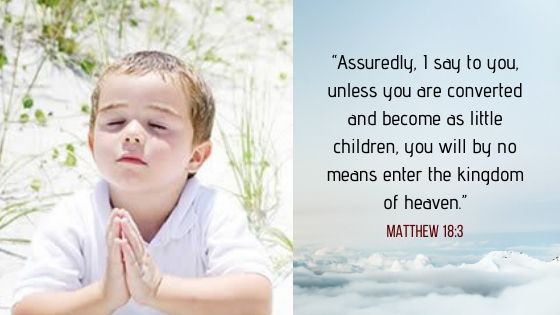
Growing Up to Become a Child – Descriptions of a Childlike Faith. Matthew 18:1-5

Matthew 18:1-6Amplified Bible

Rank in the Kingdom

18 At that time the disciples came to Jesus and asked, “Who is greatest in the kingdom of heaven?” He called a little child and set him before them, and said, “I assure you and most solemnly say to you, unless you repent [that is, change your inner self—your old way of thinking, live changed lives] and become like children [trusting, humble, and forgiving], you will never enter the kingdom of heaven. Therefore, whoever [a]humbles himself like this child is greatest in the kingdom of heaven. Whoever receives and welcomes one [b] child like this in My name receives Me; but whoever causes one of these little ones who believe in Me to stumble and sin [by leading him away from My teaching], it would be better for him to have a heavy millstone [as large as one turned by a donkey] hung around his neck and to be drowned in the depth of the sea.

The Word of God for the Children of God.

Adeste Fidelis! Venite Adoremus! Dominum.

Gloria! In Excelsis Deo! Alleluia! Alleluia! Alleluia! Amen.

Growing Up to Become a Child

What does the man, Rabbi Jesus, mean by saying to his disciples that we each need to “change and become like the little children who are among us”?

One clue we have here is that Jesus is responding to the question “Who is the greatest in the kingdom of heaven?”

And he replies, “Whoever takes the lowly position of this child is the greatest in the kingdom of heaven.”

In the Gospel narratives about Jesus and his disciples (Matthew, Mark, Luke, and John), we somehow find that the disciples often argued over which of them was, is and is about to become greatest; they seem to have been a competitive group.

And it seems they were thinking of greatness in terms of authority, leadership, knowledge, ­power, influence, “one above equals,” thrones and of other things.

So Jesus is seemingly telling all of his disciples that they need to change their attitudes about greatness and to become lowly and humble like little children.

Jesus’ followers, whether ancient or contemporary need to die to their selfish ambitions, realize that, just as little children depend on parents and caregivers, we are all totally dependent on Father God for all our needs and future living.

Here’s another hypothetical thought. A man in his sixties said, “Last week my five-year-old grandson said he wanted to be a firefighter when he grew up. I replied, ‘And when I grow up, I want to be a five-year-old boy.’ My grandson stared at me with wide, wondering eyes.”

Have you looked around at your own children or grandchildren and pictured yourself having such a “wide eyed wondering hypothetical conversation?”

Have you looked around at God’s world with “wide, wondering eyes” lately?

That’s something which I long for when I look at my own almost nine year old grandson when hear the clarion call to change and to become like a little child.

Descriptions of a Childlike Faith

Rabbi Jesus’ statement to His disciples in Matthew 18:3 about them not entering the kingdom of heaven unless they are converted and become as little children speak volumes and volumes of truth of the importance of living a childlike faith.

But what is childlike faith?

What makes one’s faith childlike?

Faith which is Rooted in Security

During the days of childhood, one learns how to survive and prosper, how to live under authority, how to live, love and share, and how to serve and praise.

A well-cared-for child has no worries about house or car or any credit card payments, no anxious moments over getting married to the right one, career or job opportunities, no apprehensions about failure, no thoughts of vengeance.

David exemplified this kind of faith while he was on the run from Saul.

Psalm 131:1-2Amplified Bible

Childlike Trust in the Lord.

A Song of [a]Ascents. Of David.

131 Lord, my heart is not proud, nor my eyes haughty;
Nor do I involve myself in great matters,
Or in things too difficult for me.


Surely I have calmed and quieted my soul;
Like a weaned child [resting] with his mother,
My soul is like a weaned child within me [composed and freed from discontent].

In Psalm 131:1-2, David compared the calmness and serenity he had in the Lord to that of a weaned child with his mother.

Composed, content with God and the works He was doing in his life, David did not concern himself with great matters such as any selfish ambition and self-promotion – rather, he found serenity and security in his relationship with God.
Surely goodness and mercy and unfailing love shall follow me all the days of my life,
And I shall dwell forever [throughout all my days] in the house and in the presence of the Lord. (Psalm 23:6)

To have a childlike faith is to find serenity and security in our relationship with God no matter the circumstance.

Faith Which Praises

Jesus loved children. He loved to use children to teach hard-headed and hard-hearted grown-ups about faith and praise.

While preaching in the region of Judea, Christ was encircled by a great crowd.

Matthew 19:13-15Amplified Bible

Jesus Blesses Little Children

13 Then children were brought to Jesus so that He might place His hands on them [for a blessing] and pray; but the disciples reprimanded them. 14 But He said, “Leave the children alone, and do not forbid them from coming to Me; for the kingdom of heaven belongs to such as these.” 15 After placing His hands on them [for a blessing], He went on from there.

He later reminded the priests and scribes that “the mouth of babes and nursing infants” would offer praise fitting for God’s Anointed (Matthew 21:16).

When Jesus entered Jerusalem riding on a colt, a very great multitude that included children cried out saying, “Hosanna to the Son of David! Blessed is He who comes in the name of the Lord! Hosanna in the highest” (Matthew 21:9)!

The sound of the children praising Jesus in the temple courts made the chief priests and scribes indignant.

In response, Jesus quoted from Psalm 8:2.

God does not only want prayer in His house, He also delights in praise.

To have a childlike faith is to have a heart that always longs to praise and glorify God in each and every life’s circumstance.

Faith Which Believes

Jesus used the lad with the five barley loaves and the two small fish to feed five thousand people (John 6:9).

To show His power over death, Jesus used a little girl. Jairus, a ruler in the synagogue, fell at Jesus’ feet begging Him to come to his house and save his dying twelve-year-old daughter.

Jesus agreed and tried to make His way with Jairus, but the surrounding crowd made the trip difficult.

Word came that Jairus’ daughter had died.

But Jesus responded, “Do not be afraid, only believe and she will be made well” (Luke 8:50).

At the house, as the parents wept over their loss, Jesus said, “She is not dead but sleeping” (Luke 8:52).

Through tears, the people laughed at the impossibility of what they heard.

Jesus then asked everyone to leave the room, and then He said, “Little girl, arise” (Luke 8:54), and she did!

Romans 4:17 says that “God gives life to the dead and calls those things which do not exist as though they did.”

Jesus spoke to the girl with the power of God, and she was raised from the dead.

Jairus’ faith definitely played a part in the miracle healing of his daughter just like the faith of the woman who had been bleeding for 12 years had made her well (Luke 8:43-48).

Nothing is impossible with God if we would just believe.

This is what it means to have childlike faith.

Faith Which is Humble

Another time, Jesus used a child to teach humility.

In Matthew 18:1-5, we read how the disciples came to Jesus asking, “Who then is the greatest in the kingdom of heaven?” and how did Jesus respond?

He called a little child to Him, set the little child in the midst of them, and said, “Assuredly I say to you, unless you are converted and become as little children, you will by no means enter the kingdom of heaven.”

He then went on to say, “Therefore whoever humbles himself as this little child is the greatest in the kingdom of heaven. And whoever receives one little child like this in My name receives Me.”

The fact that Jesus had been sharing with the disciples that truth about His approaching suffering and death did not affect them for they were thinking only of, about themselves and what position they would have in His Kingdom.

So self-absorbed were the disciples in this matter that they actually argued with each other in the presence of Rabbi Jesus himself (Luke 9:46).

Pride – the very sin that caused Satan to be cast down from heaven is what’s causing people to think of themselves more highly than others.

When Christians are living for themselves and not for others, conflict and division are bound to result (James 4:1-2).
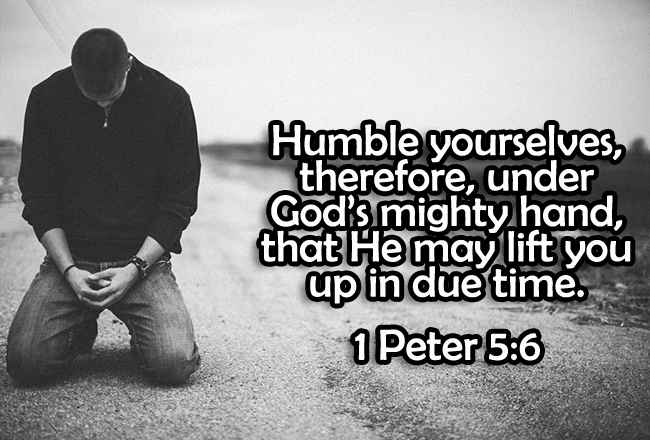
True humility means knowing ourselves, accepting ourselves, and being ourselves – our best self – to the glory of God ALONE!.

It means avoiding two extremes:

Thinking less of ourselves than we ought to (as did Moses when God called him, Exodus 3:11), or thinking more of ourselves than we should (Romans 12:3).

The truly humble person does not deny the gifts God has given him or her but uses them to the glory of God.

The truly humble person also helps to build up others, not to tear them down.

Hebrews 12:1-3Amplified Bible

Jesus, the Example

12 Therefore, since we are surrounded by so great a cloud of [a]witnesses [who by faith have testified to the truth of God’s absolute faithfulness], stripping off every unnecessary weight and the sin which so easily and cleverly entangles us, let us run with endurance and active persistence the race that is set before us, [looking away from all that will distract us and] focusing our eyes on Jesus, who is the Author and Perfecter of faith [the first incentive for our belief and the One who brings our faith to maturity], who for the joy [of accomplishing the goal] set before Him endured the cross, [b]disregarding the shame, and sat down at the right hand of the throne of God [revealing His deity, His authority, and the completion of His work].

Just consider and meditate on Him who endured from sinners such bitter hostility against Himself [consider it all in comparison with your trials], so that you will not grow weary and lose heart.

This person is a stepping-stone, not a stumbling block.

This person is a building block not a stumbling block.

Thus, we must seek to remove from our lives anything that makes us stumble.

If we don’t, we will cause others to stumble as well.

Which Jesus Himself said was not a very good, very healthy, very wise, idea.

Matthew 18:6Amplified Bible

but whoever causes one of these little ones who believe in Me to stumble and sin [by leading him away from My teaching], it would be better for him to have a heavy millstone [as large as one turned by a donkey] hung around his neck and to be drowned in the depth of the sea.

An unspoiled child has the characteristics that make for humility: trust, dependence, a desire to make others happy, and an absence of boasting or selfish desires to be greater than others.

By our nature, we are all rebels who want to be celebrities instead of servants.

And so we need a great deal of teaching for us to learn the lesson of humility.

Concluding Thoughts ….

As Christians, we are encouraged to have childlike faith.

To have faith like a child is to completely embrace, trust our heavenly Father’s goodness, care, provision, leadership, His security, vigilance and protection.

Have you experienced the peace of a well-cared-for child in letting Jesus take care of your worries?

Have you found the healing that faith in Jesus brings?

Have you praised His name with the joy of a child?

Have you answered Jesus’ call in childlike faith, asking Him to be your Savior?

In the name of God, the Father and God the Son and God the Holy Spirit,

Let us Pray,

Psalm 17The Message

17 1-2 Listen while I build my case, God,
    the most honest prayer you’ll ever hear.
Show the world I’m innocent—
    in your heart you know I am.

Go ahead, examine me from inside out,
    surprise me in the middle of the night—
You’ll find I’m just what I say I am.
    My words don’t run loose.

4-5 I’m not trying to get my way
    in the world’s way.
I’m trying to get your way,
    your Word’s way.
I’m staying on your trail;
    I’m putting one foot
In front of the other.
    I’m not giving up.

6-7 I call to you, God, because I’m sure of an answer.
    So—answer! bend your ear! listen sharp!
Paint grace-graffiti on the fences;
    take in your frightened children who
Are running from the neighborhood bullies
    straight to you.

8-9 Keep your eye on me;
    hide me under your cool wing feathers
From the wicked who are out to get me,
    from mortal enemies closing in.

10-14 Their hearts are hard as nails,
    their mouths blast hot air.
They are after me, nipping my heels,
    determined to bring me down,
Lions ready to rip me apart,
    young lions poised to pounce.
Up, God: beard them! break them!
    By your sword, free me from their clutches;
Barehanded, God, break these mortals,
    these flat-earth people who can’t think beyond today.

I’d like to see their bellies
    swollen with famine food,
The weeds they’ve sown
    harvested and baked into famine bread,
With second helpings for their children
    and crusts for their babies to chew on.

15 And me? I plan on looking
    you full in the face. When I get up,
I’ll see your full stature
    and live heaven on earth.

Adeste Fidelis! Venite Adoremus! Dominum.

Gloria! In Excelsis Deo! Alleluia! Alleluia! Alleluia! Amen.

https://translate.google.com/

What Is this Spiritual Gift of Faith? 1Corinthians 12:4-11

1 Corinthians 12:4-11Amplified Bible

Now there are [distinctive] varieties of spiritual gifts [special abilities given by the grace and extraordinary power of the Holy Spirit operating in believers], but it is the same Spirit [who grants them and empowers believers]. And there are [distinctive] varieties of ministries and service, but it is the same Lord [who is served]. And there are [distinctive] ways of working [to accomplish things], but it is the same God who produces all things in all believers [inspiring, energizing, and empowering them]. But to each one is given the manifestation of the Spirit [the spiritual illumination and the enabling of the Holy Spirit] for the common good. To one is given through the [Holy] Spirit [the power to speak] the message of wisdom, and to another [the power to express] the word of knowledge and understanding according to the same Spirit; to another [wonder-working] faith [is given] by the same [Holy] Spirit, and to another the [extraordinary] gifts of healings by the one Spirit; 10 and to another the working of [a]miracles, and to another prophecy [foretelling the future, speaking a new message from God to the people], and to another discernment of spirits [the ability to distinguish sound, godly doctrine from the deceptive doctrine of man-made religions and cults], to another various kinds of [unknown] tongues, and to another interpretation of tongues. 11 All these things [the gifts, the achievements, the abilities, the empowering] are brought about by one and the same [Holy] Spirit, distributing to each one individually just as He chooses.

The Word of God for the Children of God.

Adeste Fidelis! Venite Adoremus! Dominum.

Gloria! In Excelsis Deo! Alleluia! Alleluia! Alleluia! Amen.

Spiritual Gift of Faith

Today, let’s learn something about the spiritual gift of faith.

Your first reaction to this might be, “How can faith be a gift?

Aren’t we all supposed to have faith as believers in Jesus Christ?”

Faith is absolutely a gift!

It is specifically mentioned as a spiritual gift in scripture (1 Corinthians 12:9).

Because it is a spiritual gift, that means not everyone has the gift of faith.

And that’s okay.

We can all strive for faith, but for some people the confidence in the truth of God comes more naturally than to others.

Do you know a person who can continue to trust in God no matter what comes their way?

A person who can see where God is working in your life when you can’t see it?

People with the spiritual gift of faith are unshakeable in their reliance on God’s promises and are a source of encouragement for the rest of us when we feel like embracing the world or giving up on God or think that God has given up on us.

Here is how we can define the gift of faith:

Faith is the exceptional ability to hold fast to the truth of God in Jesus Christ in spite of pressures, problems, and obstacles to faithfulness.

Much more than just belief, faith is a gift which empowers an individual or a group of people to hold fast to its identity in Christ in the face of any challenge.

The gift of faith enables believers to rise above pressures and problems that might otherwise cripple them.

Faith is characterized by an unshakable trust in Jehovah God to deliver on God’s promises, no matter what.

The gift of faith inspires those who might be tempted to give up to hold on.

Those gifted with Faith create a foundation upon which true community can be built and sustained.

It is critical for people possessing the gift of Faith to make, take opportunities to share their beliefs, their learning, most importantly, their life experiences.

Faith stories have powerful and transforming effects.

Faith is a prominent gift in witnessing congregations, where personal stories are shared in group settings, worship, Sunday school classes, or Bible studies.

Faith is the exceptional ability to hold fast to the truth of God in Jesus Christ in spite of pressures, problems, and obstacles to faithfulness.

Our Bible gives us many examples of individuals with the spiritual gift of faith.

Hebrews 11:1-12 The Message

Faith in What We Don’t See

11 1-2 The fundamental fact of existence is that this trust in God, this faith, is the firm foundation under everything that makes life worth living. It’s our handle on what we can’t see. The act of faith is what distinguished our ancestors, set them above the crowd.

By faith, we see the world called into existence by God’s word, what we see created by what we don’t see.

By an act of faith, Abel brought a better sacrifice to God than Cain. It was what he believed, not what he brought, that made the difference. That’s what God noticed and approved as righteous. After all these centuries, that belief continues to catch our notice.

5-6 By an act of faith, Enoch skipped death completely. “They looked all over and couldn’t find him because God had taken him.” We know on the basis of reliable testimony that before he was taken “he pleased God.” It’s impossible to please God apart from faith. And why? Because anyone who wants to approach God must believe both that he exists and that he cares enough to respond to those who seek him.

By faith, Noah built a ship in the middle of dry land. He was warned about something he couldn’t see, and acted on what he was told. The result? His family was saved. His act of faith drew a sharp line between the evil of the unbelieving world and the rightness of the believing world. As a result, Noah became intimate with God.

8-10 By an act of faith, Abraham said yes to God’s call to travel to an unknown place that would become his home. When he left he had no idea where he was going. By an act of faith he lived in the country promised him, lived as a stranger camping in tents. Isaac and Jacob did the same, living under the same promise. Abraham did it by keeping his eye on an unseen city with real, eternal foundations—the City designed and built by God.

11-12 By faith, barren Sarah was able to become pregnant, old woman as she was at the time, because she believed the One who made a promise would do what he said. That’s how it happened that from one man’s dead and shriveled loins there are now people numbering into the millions.

  • Verse 4 – By faith, Abel brought a better sacrifice to God than Cain
  • Verse 5 – By faith, Enoch skipped death
  • Verse 7 – By faith, Noah built a ship
  • Verse 8 – By faith, Abraham said yes to God
  • Verse 11 – By faith, barren Sarah became pregnant
Faith in Scripture ….

Mark 9:23 (NRSV)
Jesus said to him, “If you are able!—All things can be done for the one who believes.”

Luke 8:48 (NRSV)
He said to her, “Daughter, your faith has made you well; go in peace.”

Luke 17:19 (NRSV)
Then he said to him, “Get up and go on your way; your faith has made you well.”

Luke 18:42 (NRSV)
Jesus said to him, “Receive your sight; your faith has saved you.”

Romans 4:18-21 (NRSV)
Hoping against hope, he believed that he would become “the father of many nations,” according to what was said, “So numerous shall your descendants be.” He did not weaken in faith when he considered his own body, which was already as good as dead (for he was about a hundred years old), or when he considered the barrenness of Sarah’s womb. No distrust made him waver concerning the promise of God, but he grew strong in his faith as he gave glory to God, being fully convinced that God was able to do what he had promised.

God gives us believers gifts of the Holy Spirit.

We do not know why exactly God’s will is for us to have any of these gifts, but we are thankful for any blessings, gifting’s, and corrections that He gives us.

Faith — it is a gift, and all we need is about the size of a mustard seed (Matthew 17:20).

To each and every one of us, a measure of faith has been assigned by God (Romans 12:3).

Moses had faith to lead Israel to the Promised Land, Sarah had faith that she would conceive even in her old age, and Noah had faith that God had spoken to him to build the ark even when everyone thought he was crazy (Hebrews 11).

There isn’t any formula that is alongside this gift of faith, and to think that there would be, it would be much more difficult to have faith.

Believing in faith is easy, but in our finite minds, thoughts barricade what is truly simple.

For by grace you have been saved through faith. And this is not your own doing; it is the gift of God, not a result of works, so that no one may boast (Ephesians 2:8-9).

Faith without proof

There are miracles everywhere mentioned in the New Testament.

Many people today have seen what the goodness of God can do through miracles.

In Mark 2, Jesus was in a crowded house in Capernaum.

There were four men carrying a paralytic man, trying to reach Jesus.

They had to make a hole in the roof of the house in order to bring the paralyzed man to be healed by Jesus.

This act was an act of faith by the four men, and Jesus saw their faith in the man being healed of his affliction.

Well, the man not only got healed but his sins were forgiven.

Miracles are a wondrous gift, but having faith without seeing is believing that it is possible even though it seems impossible (2 Corinthians 5:7).

“Now faith is the substance of things hoped for, the evidence of things not seen” (Hebrews 11:1). 

Our hope is in Christ alone.

Without faith, there is no hope.

We have faith that when winter begins to thaw, and all the snow begins to fade away, that the seeds that were planted in the previous season shall burst forth.

Springtime is a time of refreshment, a time of anticipated, expectant joy to see what was planted, will be planted and is to soon come up from the cold ground.

We don’t see the seeds with our own eyes, but by faith, we have the hope to see green leaves, diverse colors of flowers coming up to bring out joy and harvest.

Childlike Faith ….

Matthew 18:1-6 Amplified Bible

Rank in the Kingdom

18 At that time the disciples came to Jesus and asked, “Who is greatest in the kingdom of heaven?” He called a little child and set him before them, and said, “I assure you and most solemnly say to you, unless you repent [that is, change your inner self—your old way of thinking, live changed lives] and become like children [trusting, humble, and forgiving], you will never enter the kingdom of heaven. Therefore, whoever [a]humbles himself like this child is greatest in the kingdom of heaven. Whoever receives and welcomes one [b] child like this in My name receives Me; but whoever causes one of these little ones who believe in Me to stumble and sin [by leading him away from My teaching], it would be better for him to have a heavy millstone [as large as one turned by a donkey] hung around his neck and to be drowned in the depth of the sea.

Children are like sponges.

Children are naturally inquisitive about almost everything in their little world.

They max out their efforts absorbing everything they can see, smell, taste, and touch, and hear.

In a classroom, it is a teacher’s job to assure that the children are learning what is being taught.

Children learn from their families as to what is wrong and what is right.

But what they are the best at is having faith.

Think about the inquisitiveness of your own children right now.

What are they constantly getting themselves into?

What holds their “undivided” attention?

What is their “wish-list?”

What are their dreams?

As it might be applicable, be observant and give an answer to those questions for those of us who have grandchildren or great grandchildren inside our lives.

Think about when you were a child, what did you have hope for?

I hoped that I could see the world that God created.

As I got older, I realized what goes into making those dreams come true.

I then began to see that it may not ever happen, and my faith became less in that area of my life.

I let my fears become more and more of my reality because I didn’t truly believe that I could travel the world.

But, perhaps, one season, by God’s Grace, that dream of travel will come true.

I believe and have faith God will bring me to places that He wills for my life. 

In Romans 10:17, the Bible states, “So faith comes from hearing, and hearing through the word of Christ.” 

Our thoughts can be louder than the Word of God if we let them.

The Holy Spirit within us shows us what is truth and what is not.

The gift of faith is truth and grace that has been given to us through the sacrifice of Jesus Christ.

The spiritual gift of faith is steadfastly believing the truth, God’s truth alone.

No matter what happens whether you receive what you are believing in or not, your confidence cannot be swayed.

The fear, worry, and circumstances do not determine your level of faith.

If God has given you this spiritual gift of faith, then trust, without doubt, that He will absolutely do as He absolutely wills for your life.

In the name of God, the Father and God the Son and God the Holy Spirit,

Let us Pray,

All-Powerful Father, I bow before You because You are awesome and worthy of all the praise. Your word declares that I can do all things through You who strengthens me! I put all my trust in You. You alone are my God. You alone are my joy. You are my heart and my soul. You are the grass under my feet and the sky above. You are seen and unseen, Father. Keep me at Your right hand forever, fill me with Your grace, and make me Yours all the days of my life. Father, we thank you for everything, and we love you with all that we are. I pray that those that have been given this spiritual gift of faith will never waiver. I pray that we will trust and believe you always God. 

 Adeste Fidelis! Venite Adoremus! Dominum.

Gloria! In Excelsis Deo! Alleluia! Alleluia! Alleluia! Amen.

https://translate.google.com/

For We Walk by Faith and Not by Sight. 2 Corinthians 5:6-10

2 Corinthians 5:6-10Amplified Bible

6 So then, being always filled with good courage and confident hope, and knowing that while we are at home in the body we are absent from the Lord— for we walk by faith, not by sight [living our lives in a manner consistent with our confident belief in God’s promises]— we are [as I was saying] of good courage and confident hope, and prefer rather to be absent from the body and to be at home with the Lord. 9 Therefore, whether we are at home [on earth] or away from home [and with Him], it is our [constant] ambition to be pleasing to Him. 10 For we [believers will be called to account and] must all appear before the [a]judgment seat of Christ, so that each one may be repaid for what has been done in the body, whether good or [b]bad [that is, each will be held responsible for his actions, purposes, goals, motives—the use or misuse of his time, opportunities and abilities].

The Word of God for the Children of God.

Adeste Fidelis! Venite Adoremus! Dominum.

Gloria! In Excelsis Deo! Alleluia! Alleluia! Alleluia! Amen.

What does it mean to live by Faith?

Those words seem simple enough, yet it may be a lot tougher than we think.

It requires tremendous courage and strength.

Preaching the gospel to the world brought Paul and his co-workers much suffering.

Yet they continued the work contending for the faith.

They refused to quit and “pressed toward the mark of the high calling of God in Christ Jesus.” (Philippians 3:14)

Living in the end times requires living by faith and not by what we see going on around us.

Yet it is a journey of tremendous hope, blessing and reward.

Walking by faith and not by sight requires you to trust God, not knowing where you are at times in the larger scope of God’s plan and purpose.

Take the example of Abraham, “when called to go to a place he would later receive as his inheritance, obeyed and went, even though he did not know where he was going”. (Hebrews 11:8)

That’s walking by faith.

Walking by faith requires a strong determination to follow God’s plan as outlined in the bible, regardless what life throws your way.

Like 2 Corinthians 4:18 urges us, “So we fix our eyes not on what is seen, but on what is unseen, since what is seen is temporary, but what is unseen is eternal.”

It is a deep trust in what cannot be seen that provides hope.

Paul wrote to the church at Corinth that “we walk by faith and not by sight” (2 Corinthians 5:7).

Jesus stated, “Blessed are those who have not seen and yet have believed” (John 20:29).

Jesus ascended and left his Spirit as a guarantee.

Walking by faith is sometimes lonely, except for the presence of Christ by his Spirit, left to all believers as a “guarantee” (2 Corinthians 5:5).

Christians are frequently called to stand firm in spite of the isolated place their faith leads them to.

Our faith is reasonable, but there are aspects of the gospel we accept on faith and are unable to see.

What are these invisible things?

And what is the walk of faith?

The Second Letter to Corinth

First of all, here is some context for 2 Corinthians 5:7.

Paul’s relationship with the church at Corinth was a difficult one.

Paul had led them to faith with the assistance of mature believers in Christ, but when Paul was gone the church was easily swayed by outsiders who opposed his teaching.

In Paul’s absence, they fell apart and it was easy for opponents to convince the church that his suffering was a sign that Paul’s faith was actually folly.

If Jesus Christ has really come to save sinners, how could the apostle’s life be so horrendous?

To Paul’s mind, his way of life represented faith.

How else could someone suffer so much, if not for the reasonable expectation of eternal gain? (ESV Study Bible, Introduction to 2 Corinthians).

The Corinthian church was struggling, and Apostle Paul’s letter suggests a big part of the problem was the followers trusting the Holy Spirit to work in their lives and coming to that place in their life of trusting in the promise of Heaven.

Faith is trust.

Fabulous Adventures In Trusting Him!

Fantastic Adventures In Trusting Him!

Fulfilling Adventures In Trusting Him!

Futuristic Adventures In Trusting Him!

But faith in Christ does not come in the exact instant we snap our fingers.

Time and effort, trials and tribulations, radically counter cultural responses.

Faith not in what we see ‘Now’ but what we cannot see in Eternity

2 Corinthians 5:1-5Amplified Bible

The Temporal and Eternal

5 For we know that if the earthly tent [our physical body] which is our house is torn down [through death], we have a building from God, a house not made with hands, eternal in the heavens. For indeed in this house we groan, longing to be clothed with our [immortal, eternal] celestial dwelling, so that by putting it on we will not be found naked. For while we are in this tent, we groan, being burdened [often weighed down, oppressed], not that we want to be unclothed [separated by death from the body], but to be clothed, so that what is mortal [the body] will be swallowed up by life [after the resurrection]. Now He who has made us and prepared us for this very purpose is God, who gave us the [Holy] Spirit as a pledge [a guarantee, a down payment on the fulfillment of His promise].

What does the gospel tell us which we cannot prove by way of anything other than faith?

For one thing, we cannot see what awaits the faithful around the next bend in their roadways, over the next mountain— eternal life in the Kingdom of God.

Apostle Paul is confident: “For we know that if the tent that is our earthly home is destroyed, we have a building from God” (verse 1).

That building is the individual body, the church body, a real Kingdom, invisible to us for now. “We know,” says Paul; not “we believe,” or “we imagine.”

The original Greek uses “eidó,” which means “be aware, behold, consider, perceive.” “Knowing” in this sense combines knowledge with an intelligent perception of an idea, which cannot be physically represented —just yet.

Paul based his belief in eternal life on sound, objective evidence as well as his subjective, personal experience of Christ.

His suffering could have become a distraction from this truth — it certainly was for the Corinthians.

To Paul, his counter cultural response to immediate suffering was supposed to demonstrate his deep trust in what could not be seen, provide a reason to hope.

Christians “look not to the things that are seen but to the things that are unseen. For the things that are seen are transient, but the things that are unseen are eternal” (2 Corinthians 4:18).

A Connecting Faith

Christ’s message of eternal salvation through his death and resurrection was explosive.

Master Pharisee Saul, before becoming Paul, had originally sought to persecute these blasphemers, run them all to ground, imprison them all until he realized that the Old Testament had been leading Israel unto the empty tomb all along.

When Apostle Paul described the body as a “tent” (2 Corinthians 5:1), he was also connecting the new church with the Old Testament.

God’s people had frequently been sojourners, both in the days before Solomon and during Jesus’ ministry.

Moses and the Israelites followed a pillar of smoke and a pillar of fire, setting up temporary Sukkoth shelters to cover themselves against cold desert nights.

They had nowhere to permanently call “home” until Solomon built the temple.

The body as a “tent” evokes the Israelite’s trust God would meet their needs day by day.

A tent is impermanent, just like a body is temporary, but once this covering is shed God provides something eternally better.

Faith in the Spirit

2 Corinthians 3:15-18Amplified Bible

15 But to this day whenever Moses is read, a veil [of blindness] lies over their heart; 16 but whenever a person turns [in repentance and faith] to the Lord, the veil is taken away. 17 Now the Lord is the Spirit, and where the Spirit of the Lord is, there is liberty [emancipation from bondage, true freedom]. 18 And we all, with unveiled face, continually seeing as in a mirror the glory of the Lord, are progressively being transformed into His image from [one degree of] glory to [even more] glory, which comes from the Lord, [who is] the Spirit.

As believers, to some extent, we already see more than those who choose to turn their faces from God.

We have an “unveiled face,” although we only see “in a mirror dimly” for now, it is by faith we believe we will one day see Christ “face to face” (1 Corinthians 13:12).

Meanwhile, we have the Holy Spirit.

Here is one aspect of the Christian life we cannot lay hands on and inspect up close.

There are ways to detect the Spirit in us; evidence of “fruit.” 

Galatians 5:22-23 describes this fruit: “Love, joy, peace, patience, kindness, goodness, faithfulness, gentleness, self-control.”

When one has grown in any of these ways, the Holy Spirit is responsible, and we are invited to delve into and recognize this gift living inside of us and in others.

The Spirit is not a virus or an implant; it cannot be scrutinized with the naked eye or under a microscope.

Everyone holds a belief in something, and Paul says we can be confident.

That is the word used in the NIV and KJV for “courage” so “we are always of good courage” (2 Corinthians 5:6, ESV) is a statement of certainty.

Faith is not blind; it merely sees in other ways.

Every Faithful, Faith-Filled Christian

1 Peter 3:13-15Amplified Bible

13 Now who is there to hurt you if you become enthusiastic for what is good? 14  But even if you should suffer for the sake of righteousness [though it is not certain that you will], you are still blessed [happy, to be admired and favored by God]. Do not be afraid of their intimidating threats, nor be troubled or disturbed [by their opposition]15 But in your hearts set Christ apart [as holy—acknowledging Him, giving Him first place in your lives] as Lord. Always be ready to give a [logical] defense to anyone who asks you to account for the hope and confident assurance [elicited by faith] that is within you, yet [do it] with gentleness and respect.

Every faithful believer sees something that is not visceral but still real — much of our knowledge is like that.

We believe someone is trustworthy based on actions, which demonstrate their character.

We know that an event took place in history based on statements of witnesses and on physical remains.

We must examine the evidence and be ready to give our testimony, “always being prepared to make a defense to anyone who asks you for a reason for the hope that is in you” (1 Peter 3:15).

We all live by faith in something, although not the same things.

It is theologically accurate to say and to insist that the Christian must always seek to live by faith and trust in God and his promises, and not be motivated by only what he or she can see and hear in their present circumstances.

But the Apostle Paul says the church at Corinth is already doing that.

Apostle Paul “directly and unequivocally says that we, all believers, do, in fact, live by faith.”

This faith must also stand firmly by the strength of internal reasoning, against external forces, and without an apostle to hold one’s hand in a spiritual sense.

The Corinthians’ faith was strong in the presence of mature disciples such as Priscilla and Aquila (Acts 18:18) but definitely blindsided by “partisanship, with the Corinthians factionalizing behind rival leaders.”

Paul knew what made “considerate and appropriate relating especially hard at Corinth,” which was an “unusually diverse” and tough, working-class culture.

Paul sought to “overcome the tensions these differences were bringing into the community” by talking about how to just love one another in Christ-like ways.

What Does it Mean to Walk by Faith?

Ephesians 4:1-6 Amplified Bible

Unity of the Spirit

4 So I, the prisoner for the Lord, appeal to you to live a life worthy of the calling to which you have been called [that is, to live a life that exhibits godly character, moral courage, personal integrity, and mature behavior—a life that expresses gratitude to God for your salvation], with all humility [forsaking self-righteousness], and gentleness [maintaining self-control], with patience, bearing with one another [a]in [unselfish] love. Make every effort to keep the oneness of the Spirit in the bond of peace [each individual working together to make the whole successful]. There is one body [of believers] and one Spirit—just as you were called to one hope when called [to salvation]— one Lord, one faith, one baptism,one God and Father of us all who is [sovereign] over all and [working] through all and [living] in all.

And what about the action of walking in faith? “I therefore, a prisoner for the Lord, urge you to walk in a manner worthy of the calling to which you have been called,” wrote Paul (Ephesians 4:1).

Our walk as Christians should be identifiably different from the walk of one who does not believe and has been saved by grace.

There is a practical element, which must not be overlooked, for if we love God there will be an outpouring of that love towards others.

Jesus embodied a unifying love for the marginalized and Paul taught that their Savior was the best example of “what a Christian leader should look like. It could hardly be more dramatically countercultural, and Paul lived out this leadership style in person.”

Yet walking, or living, by faith, is also about our relationship with Christ “God is looking for not only a clinging bride but also a walking partner.”

13 No one has greater love [nor stronger commitment] than to lay down his own life for his friends. 14 You are my friends if you keep on doing what I command you. 15 I do not call you servants any longer, for the servant does not know what his master is doing; but I have called you [My] friends, because I have revealed to you everything that I have heard from My Father. 16 You have not chosen Me, but I have chosen you and I have appointed and placed and purposefully planted you, so that you would go and bear fruit and keep on bearing, and that your fruit will remain and be lasting, so that whatever you ask of the Father in My name [as My representative] He may give to you. (John 15:13-16)

When we walk with him, we recognize that worship of Christ is not so much a “catalyst” to action but “an everyday walk of unbroken communion with our Lord and friend.”

Jesus calls us “friend,” and we are called to live our lives close to him, confident and worshipful.

This is personal and real — other people cannot fill in for Jesus, whether they are our pastors or mentors or BFFs.

Such individuals promote growth, but they are not the vine.

Only Jesus is the vine (John 15).

Is Sight Coming?

Will we see Jesus when we die?

Paul says it himself: We see dimly today, but the mist will lift one day revealing his face – the veil between God and man was torn when Jesus died on the cross.

John 20:11-18Amplified Bible

11 But Mary [who had returned] was standing outside the tomb sobbing; and so, as she wept, she stooped down and looked into the tomb; 12 and she saw two angels in white sitting there, one at the head and one at the feet, where the body of Jesus had lain. 13 And they said to her, “Woman, why are you crying?” She told them, “Because they have taken away my Lord, and I do not know where they have laid Him.”  14  After saying this, she turned around and saw Jesus standing there, but she did not know that it was Jesus. 15 Jesus said to her, “Woman, why are you crying? For whom are you looking?” Supposing that He was the gardener, she replied, “Sir, if you are the one who has carried Him away from here, tell me where you have put Him, and I will take Him away.” 16  Jesus said to her, “Mary!” She turned and said to Him in [a] Hebrew, “Rabboni!” (which means, Teacher)17 Jesus said to her, “[b]Do not hold Me, for I have not yet ascended to the Father; but go to My brothers and tell them, ‘I am ascending to My Father and your Father, and to My God and your God.’” 18 Mary Magdalene came, reporting to the disciples that she had seen the Lord and that He had said these things to her.

So, while we cannot fully see him as Mary Magdalene did right now, this definitely does not mean that we are cut off from fellowship with the Lord.

Living by faith, not by sight, is no hindrance to communion with our Savior.

In the name of God, the Father and God the Son and God the Holy Spirit,

Let us Pray,

Psalm 24The Message

24 1-2 God claims Earth and everything in it,
    God claims World and all who live on it.
He built it on Ocean foundations,
    laid it out on River girders.

3-4 Who can climb Mount God?
    Who can scale the holy north-face?
Only the clean-handed,
    only the pure-hearted;
Men who won’t cheat,
    women who won’t seduce.

5-6 God is at their side;
    with God’s help they make it.
This, Jacob, is what happens
    to God-seekers, God-questers.

Wake up, you sleepyhead city!
Wake up, you sleepyhead people!
    King-Glory is ready to enter.

Who is this King-Glory?
    God, armed
    and battle-ready.

Wake up, you sleepyhead city!
Wake up, you sleepyhead people!
    King-Glory is ready to enter.

10 Who is this King-Glory?
    God-of-the-Angel-Armies:
    he is King-Glory.

Adeste Fidelis! Venite Adoremus! Dominum.

Gloria! In Excelsis Deo! Alleluia! Alleluia! Alleluia! Amen.

https://translate.google.com/

Proverbs 21:20-21 > The Great Single Minded Christian Pursuit of Success.

Proverbs 21:20-21 Amplified Bible

20 
There is precious treasure and oil in the house of the wise [who prepare for the future],
But a short-sighted and foolish man swallows it up and wastes it.
21 
He who earnestly seeks righteousness and loyalty
Finds life, righteousness, and honor.

The Word of God for the Children of God.

Adeste Fidelis! Venite Adoremus! Dominum.

Gloria! In Excelsis Deo! Alleluia! Alleluia! Alleluia! Amen.
Should Christians Be Pursuing Success?

“It is, of course, always a joyful thing to succeed. But the joy is very deceptive if it comes from the satisfaction of an ambition that is contrary to the will of God. What is success and what is failure? The answer of the Bible is, ‘What is the will of God? Are you obeying Him?’” Paul Tournier, Breakfast for the Soul

Should “Sermon in Shoes” Christians be pursuing success?

The answer is an emphatic “yes” if we understand that a successful life is one that is intent on knowing God as He has revealed Himself, seeks to believe and obey all that the Word of God proclaims, views life through the lens of eternity.

The answer is, however, as should be expected, a tad bit more complicated if we are defining the single minded pursuit of our success only by the world’s terms.

At its core, the word “success” is quite ambiguous, defined rather simply as a favorable or desired outcome.

It means to reach one’s expectations, to accomplish a predefined goal.

Today’s culture sees a successful person as one who is either famous, wealthy, or comfortable, or has a certain level of influence and power.

We succeed when we make good grades, earn high honors, or earn promotions, lifetime achievements, start and successfully build, grow our own businesses, gain material possessions which set us apart from those less-successful peers.

Success is achieved when we we can “retire early,” no longer need to work hard, ride around in private airplanes, and still have all of our desires and wants met.

The world also acknowledges success as accomplishing humanitarian goals – becoming missionaries, disaster relief workers, feeding the hungry, providing for the sick or mentally ill or homeless, or helping people overcome addictions.

None of these would necessarily make a person rich or famous, but they would certainly be considered successful in Christian life for their accomplishments.

However, if our focus is simply on the physical needs of this world without concern for the eternal souls of men, does God interpret this as “success?”

What Does God Say About Success?

If we are ourselves tempted to pursue the kind of success as the world defines it, we should first examine what God says about success.

One of the more familiar passages about success in the Hebrew Testament was given to Joshua.

God’s words to Joshua as he humbles himself, accepts an important assignment are a good place to begin.

Joshua 1:7-8 Amplified Bible

Only be strong and very courageous; be careful to do [everything] in accordance with the entire law which Moses My servant commanded you; do not turn from it to the right or to the left, so that you may prosper and be successful wherever you go.  This Book of the Law shall not depart from your mouth, but you shall read [and meditate on] it day and night, so that you may be careful to do [everything] in accordance with all that is written in it; for then you will make your way prosperous, and then you will be [a]successful.

https://www.blueletterbible.org/esv/jos/1/7-8/t_conc_188007

https://www.blueletterbible.org/lexicon/h7919/esv/wlc/0-1/

The Hebrew word is śāḵal, meaning to be prudent or circumspect, to have insight and understanding, or to prosper.

Joshua was charged with a great task.

He was to take up the mantle of his beloved mentor, Moses, and finish the work of bringing God’s people into the Promised Land.

His success would be guaranteed, according to God’s promise, if he continued to obey the commands set forth in the Law of God.

As He sought God’s wisdom, meditating on God’s Word, he would have what he needed to make right decisions and succeed in his mission.

The prosperous, the successful way, for Joshua, would be the path of obedience.

In fact, in the King James Version of the Bible, the only time the word “success” is used is right here in this passage of text from Joshua.

In truth, the word “success” is not to be found in the New Testament writings.

To the New Testament writers, success is defined by the eternal – the prosperity of the soul.

Health and prosperity in the physical world would be meaningless if one’s soul languished in the pursuit of temporal, earthly things.

Matthew 16:26Amplified Bible

26 For what will it profit a man if he gains the whole world [wealth, fame, success], but forfeits his soul? Or what will a man give in exchange for his soul?

Mark 8:36 Amplified Bible

36 For what does it benefit a man to gain the whole world [with all its pleasures], and forfeit his soul?

Luke 9:25 Amplified Bible

25 For what does it profit a man if he gains the whole world [wealth, fame, success], and loses or forfeits himself?

Rabbi Jesus made this distinction clear as he addressed both His disciples, the unbelieving Pharisees, and to the crowds pursuing Him for physical provision after He fed five thousand with a small boy’s rather meager lunch.

John 6:27-29 Amplified Bible

27 Do not work for food that perishes, but for food that endures [and leads] to eternal life, which the Son of Man will give you; for God the Father has authorized Him and put His seal on Him.” 28 Then they asked Him, “What are we to do, so that we may habitually be doing the works of God?” 29 Jesus answered, “This is the work of God: that you believe [adhere to, trust in, rely on, and have faith] in the One whom He has sent.”

Success Through Obedience and Service

God defines success as living in obedience to His commands and seeing our physical work as ultimately serving Him.

1 Chronicles 22:9-12 Amplified Bible

Behold, a son will be born to you, who will be a man of peace. I will give him rest from all his enemies on every side; for his name shall be Solomon, and I will give peace and quiet to Israel in his days. 10 He shall build a house for My Name (Presence). He shall be My son and I will be his father; and I will establish his royal throne over Israel forever.’ 11 Now, my son, may the Lord be with you so that you may be successful and build the house of the Lord your God, just as He has spoken concerning you. 12 Only may the Lord give you wisdom and understanding, and give you charge over Israel, so that you may keep the law of the Lord your God.

Proverbs 6:6-8 Amplified Bible


Go to the ant, O lazy one;
Observe her ways and be wise,

Which, having no chief,
Overseer or ruler,

She prepares her food in the summer
And brings in her provisions [of food for the winter] in the harvest.

Proverbs 21:20 Amplified Bible

20 
There is precious treasure and oil in the house of the wise [who prepare for the future],
But a short-sighted and foolish man swallows it up and wastes it.

God often gives physical and spiritual success to His people as they employ their talents and spiritual gifts.

Missionaries would not be on the field without the financial generosity of those who have a talent for business and the gift of giving.

The gospel can be proclaimed with great influence as we live with a kingdom perspective while succeeding in our earthly work.

Humanitarian work can be a great blessing to a hurting world, but is successful when we see past physical needs to the spiritual needs of those we are serving.

The very real danger comes actualized, and too realized when the success of the work of our hands and its benefits distracts us from the higher purpose of God’s glory and the proclamation of the gospel of our Lord and Savior Jesus Christ.

Proverbs 16:1-3Amplified Bible

Contrast the Upright and the Wicked

16 The plans and reflections of the heart belong to man,
But the [wise] answer of the tongue is from the Lord.

All the ways of a man are clean and innocent in his own eyes [and he may see nothing wrong with his actions],
But the Lord weighs and examines the motives and intents [of the heart and knows the truth].

[a]Commit your works to the Lord [submit and trust them to Him],
And your plans will succeed [if you respond to His will and guidance].

The Word of God: The Rewards of Working Hard

2 Thessalonians 3:7-10Amplified Bible

For you yourselves know how you ought to follow our example, because we did not act in an undisciplined or inappropriate manner when we were with you [we were never idle or lazy, nor did we avoid our duties], nor did we eat anyone’s bread without paying for it, but with labor and hardship we worked night and day [to pay our own way] so that we would not be a financial burden on any of you [for our support]; not because we do not have a right to such support, but [we provided our own financial support] to offer ourselves as a model for you, so that you would follow our example. 10 For even while we were with you, we used to give you this order: if anyone is not willing to work, then he is [a]not to eat, either.

Warning Against The Love of Money

God also gives us guidance on the purpose of wealth, and the dangers of the love of money and possessions.

Luke 12:13-21 Amplified Bible

Covetousness Denounced

13 Someone from the crowd said to Him, “Teacher, tell my brother to divide the family inheritance with me.” 14 But He said to him, “Man, who appointed Me a judge or an arbitrator over [the two of] you?” 15 Then He said to them, “Watch out and guard yourselves against every form of greed; for not even when one has an overflowing abundance does his life consist of nor is it derived from his possessions.”

Parable of the Wealthy Fool

16 Then He told them a parable, saying, “There was a rich man whose land was very fertile and productive. 17 And he began thinking to himself, ‘What shall I do, since I have no place [large enough in which] to store my crops?’ 18 Then he said, ‘This is what I will do: I will tear down my storehouses and build larger ones, and I will store all my grain and my goods there. 19 And I will say to my soul, “Soul, you have many good things stored up, [enough] for many years; rest and relax, eat, drink and be merry (celebrate continually).”’ 20 But God said to him, ‘You fool! This very night your soul is required of you; and now who will own all the things you have prepared?’ 21 So it is for the one who continues to store up and hoard possessions for himself, and is not rich [in his relationship] toward God.”

I didn’t think I was greedy until I read this passage again.

Jesus warns us to watch out for all kinds of greed.

The kind of greed I usually thought about had to do with very wealthy people always wanting more – but Jesus does not focus on that kind of greed here.

In the context of this passage, a man is arguing with his brother over their inheritance.

The family has enough to hand down, but Rabbi Jesus sees that this man is still worried if he will truly have enough.

He is greedy not for luxury but for security.

In the second Parable, the wealthy man looks to build “bigger storehouses” to 19 And I will say to my soul, “Soul, you have many good things stored up, [enough] for many years; rest and relax, eat, drink and be merry (celebrate continually).”’

Kind of sounds like “Just in case of the worst possible scenario” or “Just in Case I might actually find one use for it ten or twenty years from now” Hoarding.

It’s in this context that Jesus goes on to teach some familiar lessons.

Be faithful in the little things, so that God can trust you with the big things.

Don’t fall into the trap of serving and living and striving and possessing for money; it will master you and you will be unfaithful to your Master, Jesus.

Ouch! I didn’t even realize the extent of that kind of unfaithfulness ­existed.

But many of us have it and do not realize how deeply we are entrenched in it.

We want a little bit more so that we don’t have to worry.

Jesus points us away from greed based on worry.

So long as we aim to live God’s way, aligning ourselves with God’s purpose for us in this world (seeking his kingdom), and so long as it is not yet time for our heavenly inheritance, God will give us what we need to live for him each day.

Wanting more than that is a type of greed.

And that will distract us from fully living the life of joy, peace we are created for.

So let’s remember this admonition, learn to let go of our worry-based greed.

Hebrews 13:5-6 Amplified Bible

Let your character [your moral essence, your inner nature] be free from the love of money [shun greed—be financially ethical], being content with what you have; for He has said, “I will never [under any circumstances] desert you [nor give you up nor leave you without support, nor will I in any degree leave you helpless], nor will I forsake or let you down or relax My hold on you [assuredly not]!” So we take comfort and are encouraged and confidently say,

“The Lord is my Helper [in time of need], I will not be afraid.
What will man do to me?”

Summarizing: Should Christians Pursue Success?

By all means.

Work hard where God has put you.

Be a faithful, dependable, honest employee.

Use the influence and position God gives you to boldly proclaim the gospel.

Be generous with your material possessions and financial blessings and use them wisely and prudently for kingdom purposes.

Take care of your spouses, your loved ones and leave your children and your grandchildren an “inheritance” – including a spiritual one – your witness!

Psalm 119:9-16Amplified Bible

Beth.


How can a young man keep his way pure?
By keeping watch [on himself] according to Your word [conforming his life to Your precepts].
10 
With all my heart I have sought You, [inquiring of You and longing for You];
Do not let me wander from Your commandments [neither through ignorance nor by willful disobedience].
11 
Your word I have treasured and stored in my heart,
That I may not sin against You.
12 
Blessed and reverently praised are You, O Lord;
Teach me Your statutes.
13 
With my lips I have told of
All the ordinances of Your mouth.
14 

I have rejoiced in the way of Your testimonies,
As much as in all riches.
15 
I will meditate on Your precepts
And [thoughtfully] regard Your ways [the path of life established by Your precepts].
16 
I will delight in Your statutes;
I will not forget Your word.

Live your life to glorify God alone, and according to Him, you WILL find success.

In the name of God, the Father and God the Son and God the Holy Spirit,

Let us Pray,

Psalm 23 The Message

23 1-3 God, my shepherd!
    I don’t need a thing.
You have bedded me down in lush meadows,
    you find me quiet pools to drink from.
True to your word,
    you let me catch my breath
    and send me in the right direction.

Even when the way goes through
    Death Valley,
I’m not afraid
    when you walk at my side.
Your trusty shepherd’s crook
    makes me feel secure.

You serve me a six-course dinner
    right in front of my enemies.
You revive my drooping head;
    my cup brims with blessing.

Your beauty and love chase after me
    every day of my life.
I’m back home in the house of God
    for the rest of my life.

Adeste Fidelis! Venite Adoremus! Dominum.

Gloria! In Excelsis Deo! Alleluia! Alleluia! Alleluia! Amen.

https://translate.google.com/

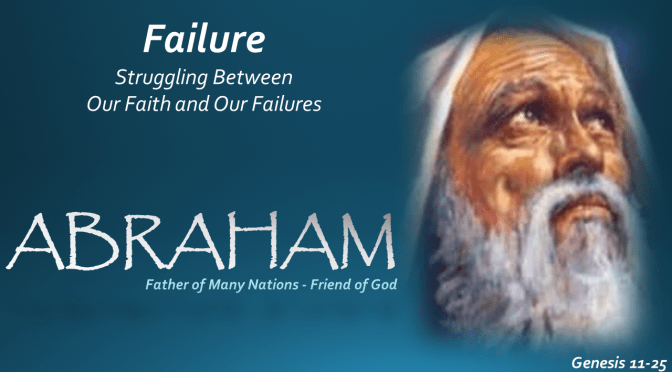
Alive and Being Alive in Immanuel: Do We Know Where We are Going? Faith and Failure – Part One: Abram’s Faith. Genesis 12:1-9

Genesis 12:1-9Amplified Bible

Abram Journeys to Egypt

12 Now [in Haran] the Lord had said to Abram,

“Go away from your country,
And from your relatives
And from your father’s house,
To the land which I will show you;

And [a]I will make you a great nation,
And I will bless you [abundantly],
And make your name great (exalted, distinguished);
And you shall be a blessing [a source of great good to others];

And I will bless (do good for, benefit) those who bless you,
And I will curse [that is, subject to My wrath and judgment] the one who curses (despises, dishonors, has contempt for) you.
And in you all the families (nations) of the earth will be blessed.”

So Abram departed [in faithful obedience] as the Lord had directed him; and Lot [his nephew] left with him. Abram was seventy-five years old when he left Haran. Abram took Sarai his wife and Lot his nephew, and all their possessions which they had acquired, and the people (servants) which they had acquired in Haran, and they set out to go to the land of Canaan. When they came to the land of Canaan, Abram passed through the land as far as the site of Shechem, to the [great] terebinth (oak) tree of Moreh. Now the [b]Canaanites were in the land at that time. Then the Lord appeared to Abram and said, “I will give this land to your descendants.” So Abram built an altar there to [honor] the Lord who had appeared to him. Then he moved on from there to the mountain on the east of Bethel, and pitched his tent, with Bethel on the west and Ai on the east; and there he built an altar to the Lord and called on the name of the Lord [in worship through prayer, praise, and thanksgiving]. Then Abram journeyed on, continuing toward the Negev (the South country of Judah).

The Word of God for the Children of God.

Adeste Fidelis! Venite Adoremus! Dominum!

Gloria! In Excelsis Deo! Alleluia! Alleluia! Alleluia! Amen.

Through much of the country these last several days the mountains of snows have fallen and furiously – snow drifts several feet tall have covered cars and snow plows, ambulances and firetrucks and covered the doorways of houses.

Blizzards have returned! Worse than ever, the winds are howling and the wind chills are plummeting deep, to very dangerous and even life threatening levels.

Roads are impassable, homes and apartments are losing power, no heat to cook the food with, no heat to warm the place of abode, pipes are frozen, bursting.

People are trapped in their homes – medical conditions, health and safety.

“I’m dreaming of a white Christmas ….”

“Just like the ones I used to know ….”

Merry Christmas! ….

You have your White Christmas … Just not the one you wanted to know!

Immanuel God with Us and within us, if you can manage to somehow survive.

Christmas Bells are ringing everywhere people can by whatever means travel to; to celebrate that once a year moment with long distant family and friends too.

Christmas bells are silent, just past, and travelers are trying to return home from anywhere and everywhere around the globe their families were living in.

Except, outside too many locations … impassable and dangerous weather, far too dangerous for automobiles, four wheel drives and far worse for- airplanes.

Airports cannot release the planes for take off – they cannot plow their runways fast enough or at all – the risk of life and limb is simply far to dangerous to all.

Travelers are stuck in airports behind a myriad and myriad of cancelled flights.

In many places, during this Christmas season, this isn’t an unusual occurrence.

It is one which many travelers have learned how to accept and how to manage.

They know how to pack “for the occasion” – with snacks and a host of patience.

With experience, traveling gets easier, more familiar, much more manageable.

If we have previously navigated an airport or are at least familiar with the local language and likely weather, it’s not overwhelming to get where we are going.

But if we don’t know the way to our next gate or can’t read the signs pointing the way, or we suddenly encounter all the worse kind of weather conditions, we can soon feel lost and have no idea where we are and where we need to go next.

And, guess what?

New Years Eve and New Year’s Day are but a few days away ….

Another very popular travel day ….

And the weather is still going to be the weather ….

An we still have not figured out how to stop the weather from happening!

Jesus did …. Mark 4:35-41

When the weather went crazy dangerous on those disciples in that boat, they like many of today’s travelers traveling in these blizzard conditions, feared.

Jesus told his disciples …. we are absolutely going over to the “other side” of the waters and the disciples obediently loaded themselves into the boat and sailed.

They were obedient to their Rabbi – then things suddenly got crazy dangerous, the weather threatened their very lives and seasoned fisherman became afraid.

No matter what they tried, seasoned fisherman failed to right the ship in the storm, failed in their efforts to protect the lives of the others an they panicked.

They turn to wake their Rabbi … their Rabbi wakes up … and just as fast, the Rabbi rebukes the weather – “be still!” an then Rabbi turns to the disciples and wonders aloud to them ….

“Why are you so fearful?”

“How is it you have no faith?” (Mark 4:40)

THE STRUGGLE BETWEEN OBEDIENCE, FAITH AND OUR INEVITIBLE FAILURE

Abram soon to be Abraham was in a situation like that.

If we try to put ourselves in his sandals, we can see that it was no small thing to faithfully obey and follow God’s leading when he did not know where the other side was located and no one offered him a roadmap or a weather map to read.

There was only a promise from a God he had never met or experienced before.

God promised that Abraham would be a great nation and bring great blessings for “all peoples on earth,” but this would require a previously unknown, long, arduous journey and a new start, living among strangers in a faraway land.

“He did not know where he was going.”

In a miraculous demonstration of faith – against all of the best advice of his fellow countryman, he packed up and left what he knew of life behind him.

Here we pick up Genesis Chapter 12 …. Here we join the ancient Biblical story.

Genesis 12:1-20 – Faith and Failure

Genesis chapter 12 may be one of the most famous chapters in the Bible.

It forms the basis for pretty much everything that follows.

With the calling of Abraham God really begins to set a plan in motion to deliver the world from the problems that have occurred up to this point in the Bible.

I. Faith (Genesis 12:1-9)

II. Failure (Genesis 12:10-20)

Abraham is one of the most important men in all of history.

Though he lived about 4000 years ago, he is still a prominent figure today.

Christians hold up Abraham as our forefather.

Not necessarily as our physical descendant, but as our spiritual one.

He is the father of faith.

It is repeated over and over in the New Testament that He believed God, and it was credited to him as righteousness.

Christianity, which is all about faith in Jesus Christ, and walking with God by faith, holds up Abraham as an example to live by.

But for Christians of any generation, including ours, we have to admit that it’s awful hard to live up to that kind of faith standard.

We think of Abraham, or Abram, as this man of great faith who left his family, his home, his possession, just picked up, left one day when God told him to go.

He didn’t know where he was going.

He didn’t know how he would get there.

He didn’t know how he would feed himself or his family when he got there.

But God told Abram to go, and so obediently, Abram went.

That, however, is not quite the Abram of the Bible.

Was he yet a man of great faith?

Absolutely.

But do you want to know what encourages me most about Abram?

It’s not his faith, but his lack of faith.

I want to walk by faith. I want to trust God in all things, and never doubt, and never fear, and never worry – but that almost never works out – I get afraid!

And I could live my life and beat myself up all day about how Abram lived that way, therefore – “I should too – but why can’t I?, I just continuously fail!”

But when we get a real honest picture of Abram’s life, his times of great faith and trust in God, are balanced and offset by those intervening times of great doubt, disobedience and failure. Abram was not naturally a man of great faith.

Nor did he have some spiritual gift of faith, or some “secret” to trusting God.

No!

Abram became a man of great faith because for many years he had very little faith, and even in those times, God continued to keep his promises to Abram.

In Genesis 12 and following, God appears personally to Abram multiple times, each time to develop faith in his life.

During these times, God tested Abram.

You would think that a man of faith would easily pass all the tests.

But think again.

In four of those tests, Abram faith in God failed miserably.

So here is the difference between a man of faith and a man of fear.

Abram was a man of faith not because he never doubted, and not because he never failed.

Abram did lots of both.

Abram was a man of faith because when he failed, when he fell flat on his face, he got up, brushed himself off, and started over again.

That’s faith.

A man of fear gives up.

A man of fear stays on the ground.

A man of fear stops trying.

Not Abram.

And that is why he is the father of faith.

It’s not that he has great faith, but that he has a great God.

Abram knows that even when he fails, God will not.

But this is a lesson that Abram had to live into, steadily learn over time.

His first lesson is found in Genesis 12.

This chapter contains both the faithful obedience of Abram and the doubting failure.

It contains a well rounded picture of the father of faith.

The beginning of his life of faith is in verses 1-9.

I. The Faith of Abram (Genesis 12:1-9)

Abram’s walk of faith begins with God’s promise.

Genesis 12:1-3. Now the Lord had said to Abram:
“Get out of your country,
From your family
And from your father’s house,
To a land that I will show you.

I will make you a great nation;
I will bless you
And make your name great;
And you shall be a blessing.

I will bless those who bless you,
And I will curse him who curses you;
And in you all the families of the earth shall be blessed.”

This is the first time God makes these promises to Abraham.

There are three promises of God here.

God promises to make Abram a great nation,

Go promises to give him a great name,

and Go promises to bring great blessing upon the earth through Abram.

Down in Genesis 12:7, there is also the promise of land.

Together, these are the promises of God to Abram.

These promises are often called the Abrahamic Covenant, and God will repeat it and make it unconditional in Genesis 15.

It is these promises of God, these covenants from God, that Abram’s faith is founded upon.

Abram was a man of faith because he knew and believed the promises of God.

If you an I want to develop faith, you an I must know what God has said in His Word, and especially what promises He has made to you and me.

How can you an I trust the promises if we don’t know what the promises are?

Romans 10:17 says that faith comes by hearing and hearing by the Word of God.

If you an I want to be a person of faith, you an I must be in the Word of God.

You an I must read the promises, understand the promises, and as the hymn says, you an I must set a standard of living, to be “Standing on the Promises.”

The promises given to Abram were unconditional promises.

This will become much more evident in chapter 15.

The Abrahamic covenant did not depend on Abram’s faithfulness or the faithfulness of his descendants.

There are those who say today that Israel has lost their right to the land, they are no longer the chosen nation because of their constant sin and rebellion.

That is making the Abrahamic covenant based upon the works and faithfulness of the people of Israel, rather than the Word and faithfulness of God.

It is true Abram and many of his descendants did have times of disobedience.

Sometimes for hundreds of years.

But God always keeps His promises, even when great failure blossomed.

God has promised that Israel will be a great nation.

Isn’t it amazing that though Israel has always been a relatively small nation, and relatively few in number compared to the populations which surround it, yet, they are still one of the world powers in military, science and economics?

And they will become even greater during the 1000 year reign of Christ which is yet to come.

God also promised that He would make Abram’s name great.

I have already talked about how Abraham still makes the news today, even though he’s been dead for 4000 years.

Nobody else in history except for Jesus Christ has that claim to fame.

Abraham’s name truly is great.

There is also the promise in verse 3

God will bless those who bless Abram, and curse those who curse him, and all families on earth will be blessed through him.

That promise at the end of verse 3 is ultimately fulfilled in the person of Jesus Christ.

All nations on earth have been blessed through Abram, because it is through Abram’s descendants that Jesus Christ came into this world.

And when Jesus Christ returns again, and sets up His kingdom on earth, all the nations of the earth will be blessed again.

Abram hears these promises when he is still living in Haran, and so in verses 4 and following, He acts upon the promises and sets out.

Genesis 12:4-5. So Abram departed as the Lord had spoken to him, and Lot went with him. And Abram was seventy-five years old when he departed from Haran. Then Abram took Sarai his wife and Lot his brother’s son, and all their possessions that they had gathered, and the people whom they had acquired in Haran, and they departed to go to the land of Canaan. So they came to the land of Canaan.

When Abram left Haran, he took his wife Saria, and his nephew Lot with him.

As we learned last time we were in the book of Genesis, Abram probably left his father Terah in Haran.

His father had probably had enough of following God who-knows-where, and so wanted to stay in Haran. But Abram can wait no longer for he is now 75 years old. So he sets out with his wife Sarai and nephew and all of their possessions.

Can you imagine, at 75 years old, making such a change?

Most people, by the time they are 75, are pretty much set in their ways.

They are living where they are going to live, and they are comfortable there, and it’s hard to get them to change anything.

Of course, Abraham lived to be 175, so when he was 75, would be comparable to someone today being 39 if we consider it, try to figure it on a 90 year life span.

One of the reasons Abram is a man of faith is because he is willing to follow God anywhere, anytime, even when he’s 75 years old.

He departed and traveled south to Canaan, until they came to Shechem, which is in the middle, or very center of Canaan.

Genesis 12:6-7. Abram passed through the land to the place of Shechem, as far as the terebinth tree of Moreh. And the Canaanites were then in the land. Then the Lord appeared to Abram and said, “To your descendants I will give this land.” And there he built an altar to the Lord, who had appeared to him.

This is the fourth promise of God to Abram.

The first three were a great people, a great name, and great blessing.

Now we have the promise of Land.

The Land is part of the Abrahamic Covenant.

God doesn’t promise the land to Abram, but to his descendants.

This is not only a promise the land will eventually belong to his descendants, but also that he will have descendants.

God is promising to Abraham that he will have descendants, and that God will give them this land.

This promise was almost completely fulfilled when Joshua and the people of Israel entered the land about 600 years later.

But the first piece of land was obtained through a purchase made by Abram as a burial plot for his wife (Gen. 23:16-20).

Later, his grandson Jacob also bought some land in Shechem, near where Abram received the promise (Gen. 33:19).

Later, it is at the oak tree near Shechem (NIV, NAS, NKJV), possibly the same tree mentioned here, that Jacob and his companions rededicated themselves to God, and got rid of all of their idols and false gods (Genesis 35:4-5).

Six-hundred years later, when the Israelites come to Canaan in conquest, they begin their campaign by gathering at Shechem to remember the covenant, and build another altar to God (Joshua 8:30-35).

After they have defeated their enemies and have gained ownership of the land, Joshua calls the people once again to Shechem to show them that the promises have been kept.

He also asks the Israelites to make their own promises to God (Joshua 24) to serve Him and obey Him.

So this is what they do. Just as Abram builds an altar to God at Shechem, so also do the people of Israel 600 years later (Joshua 24:26-27).

It is at Shechem where Abram received the promise, and it is at Shechem that the people of Israel received the fulfillment of the promise. It is there that they also made a promise to obey God and serve Him faithfully, just as Abram did.

Imagine the relevance and significance of worshipping God in a place where 600 years before, your ancestor Abram had also worshipped God.

Imagine building an altar to God, possibly using the same stones Abram used.

Shechem was a special place for the people for it is where God first appeared to Abram in the Promised Land, where Abram first built an altar to worship God.

The altar was a symbolic and public way of worshipping God.

As long as the altar stood, it was a reminder to all who saw and knew what it meant that God spoke to Abram and promised this land to him.

When God makes promises to you, it is sometimes advisable to set up reminders for yourself.

Make an entry in your journal.

Put a sticky note on your cupboard.

I have daily written these devotionals over the last three years or so and sent them out to quite literally all over the world – It is my ministry unto the world.

It is a reminder of a promise God made to me and a promise I made to God.

As humans, we have a tendency to forget the promises of God.

Altars were a way Abram gave glory to God for these promises.

You and I can find similar means and methods to give glory to God and find ways to give Holy Spirit credit for helping me remember His promises to me.

In Genesis 12:8, Abram moves further south and builds another one of these altars.

Genesis 12:8. And he moved from there to the mountain east of Bethel, and he pitched his tent with Bethel on the west and Ai on the east; there he built an altar to the Lord and called on the name of the Lord.

This site becomes important later when Israel does finally begin to receive the land.

In the book of Joshua, after the walls of Jericho fall down, the Israelites go to attack Ai.

But they are soundly defeated.

Because Achan stole 200 pieces of silver, a wedge of gold and a Babylonian garment as spoils of war from Jericho and buried them, hid them in his tent.

After Achan’s sin is discovered, and he is put to death, they once again attack Ai, and this time they prevail.

Where Abram worshipped God, called on the name of the Lord, the Israelites also rededicated themselves to God by getting rid of the sin in their midst and then going forth to battle.

Abram’s altar and the Israelite’s actions between Bethel and Ai are another witness to their faithful, faith-filled dedication to serve and obey their God.

Genesis 12:9. So Abram journeyed, going on still toward the South.

We don’t know how long he stayed in each spot, what we are shown is Abram has no place to rest, no place to stop and settle down, no place to call home.

Though he has found a place that God will give to his descendants, it is not yet his.

He has followed God from Haran to Canaan.

God spoke to Abram and promised Him blessings and land.

Abram has built two altars to God.

Things seem to be going well for Abram.

He is making progress on his journey of faith.

When Abraham arrived at his destination, he built an altar and dedicated it to the Lord, who faithfully fulfilled His promise and who had brought him there.

What a wonderful message, what a wonderful witness and testimony in the midst of one of the most memorable pilgrimages in the pages of Scripture.

Where has God brought you?

Is your first thought to worship him for his faithfulness?

God continues to promise us spiritual blessings in this life and the next.

So let’s not forget to faithfully dedicate the steps of our lives to our faithful God, even if, like Abram to Abraham it’s mostly unclear exactly where God is leading.

Tomorrow, we will dedicate and devote some critical time to Genesis 12:10-20.

Here we will try to delve deeper into the Failures of Abram (Genesis 12:10-20)

In the name of God, the Father and God the Son and God the Holy Spirit,

Let us Pray,

God of Heaven’s Armies, You tell me to put my faith and my trust in You when I am afraid. Dear God, right now I confess I am definitely afraid. I am afraid of things that are happening in my life. I am afraid for my future. I am afraid for my loved ones. I feel helpless, hopeless. I cannot breathe. The walls are closing in around me. I can feel the anxieties near and I need Your protection. Come into me, dear God, and fill me with Your Holy Spirit. I need You now! Help me to put my hope in You. I thank You for being my rock and my shield. Thank You for being my God in whom I can really trust. I praise You because even when I was faithless, You remained faithful to me. You have never changed nor ever withdrew Your love from me. I love You, God.

Adeste Fidelis! Venite Adoremus! Dominum!

Gloria! In Excelsis Deo! Alleluia! Alleluia! Alleluia! Amen.

https://translate.google.com/