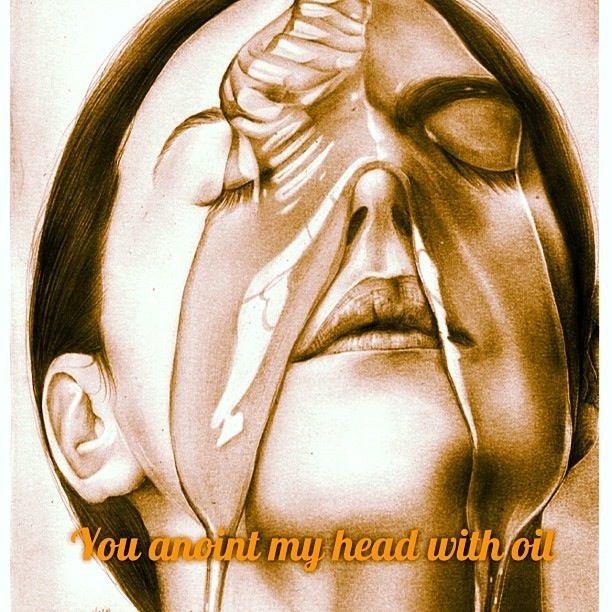
Whatever You do for God, Do it All with Gusto! Because He “Anoints” Our Heads With Oil and All of Our Cups Overflow! Psalm 23:5, Ecclesiastes 9:7-10

Psalm 23:5 New International Version

You prepare a table before me
    in the presence of my enemies.
You anoint my head with oil;
    my cup overflows.

Ecclesiastes 9:7-10New International Version

Go, eat your food with gladness, and drink your wine with a joyful heart, for God has already approved what you do. Always be clothed in white, and always anoint your head with oil. Enjoy life with your wife, whom you love, all the days of this meaningless life that God has given you under the sun—all your meaningless days. For this is your lot in life and in your toilsome labor under the sun. 10 Whatever your hand finds to do, do it with all your might, for in the realm of the dead, where you are going, there is neither working nor planning nor knowledge nor wisdom.

The Word of God for the Children of God.

Adeste Fidelis! Venite Adoremus! Dominum.

Gloria! In Excelsis Deo! Alleluia! Alleluia! Alleluia! Amen.

In this psalm, we see a beautiful portrait of God as our good and faithful Shepherd Who leads us by still waters and guides us into the way of peace.

He is, indeed, worthy of our worship and praise.

He is the One Who upholds and protects, Who blesses and comforts, Who bountifully provides good things for us in the presence of our enemies.

Enemies, up to and including ourselves as our own worst enemies.

And He is the One Who intercedes for us in heavenly places.

The picture is painted in this well-loved psalm of David, is that of our faithful God, our merciful and gracious Saviour, our good and caring Shepherd Who keeps us, protects us, provides for us through all the changing scenes of life.

Our faithful, and merciful God first identified Himself as Jehovah-Jireh, our gracious Provider, to Abraham when he was halted, by the Lord, from offering up his son, first born son, Isaac, as his sacrifice of abiding love and obedience.

And throughout both testaments, we discover God as the One Who provides rain and sunshine for the earth, nourishment for the flowers and ravens, a father for the fatherless, a righteous judgment for the widow, a friend for the friendless.

Our faithful God is the one who fed the hungry multitude, provides comfort for the broken-hearted, gives succor to the weak, strength to the weary, hope to the afflicted, salvation to all who trust in Christ Jesus for the forgiveness of sins, for while we were yet His enemies, grievous unrelenting sinners, God in His grace provided a Kinsman-Redeemer to save His people from their sins.

Our good and loving God supplies all our needs, according to His riches in glory, through Christ Jesus our Savior.

And here in this well-loved and oft-repeated psalm of David, we discover:

“The Lord has prepared a table before us in the presence of our enemies. He has anointed our head with oil, our cup of overflows with His goodness and love.”

Though we may be afflicted on all sides… pressured, perplexed, and persecuted for righteousness sake, we are not forgotten nor abandoned by our Heavenly Lord… for Jesus is with us always and forever, even to the end of the age.

He has prepared a table before us, in the presence of those that hate and despise us, He has covered it with all we need and every spiritual blessing – which He Himself had purchased for us through His own life’s blood, on Calvary’s Cross.

Though we live in the combat-zone of this fallen world system, we have peace with God through our Lord Jesus Christ… and the peace of God which guards our hearts in the midst of an abundantly, severely crooked and perverse generation.

The anointing oil that is being continuously poured over our heads is the soothing ointment of His incomparable never-ending love.

It is a precious promise to all His children, for we have been made kings and priests and prophets of the living God – and have an eternal guarantee that His Word is faithful and true and all of His promises are ‘Yes’ and ‘Amen’ in Christ.

Surely, in the company of all of God’s angels and with David we can proclaim,

“My cup of blessing runneth over,” for His grace is limitless, His love is boundless, His charity and mercy endures from one generation to another.

Why such an inconceivable magnitude of maximum Joy?

Because together, in the presence of our Great Shepherd, we have just seen, and envisioned and witnessed and can now testify to all the prophetic descriptions of heavenly places like green pastures, quiet waters, and paths of righteousness.

By the Word of God for the Children of God, our heads have been anointed with His oil of abundant life and incomprehensible love and now our cups overflow.

We have seen through the Word of God for His Children, the strong, steady hand of the ever vigilant shepherd at work with his shepherd’s rod and staff.

By the Word of God for His Children, We have received the invitation to the table of the Lord which is prepared for his precious flock before our enemies.

And now there is one more activity we need to plumb, to see in this final scene.

“He Anoints My Head With Oil”

This may seem like an odd custom since it is something that never occurs much anymore in our own time and culture, in our faith traditions and in our church.

Maybe this custom of pouring oil over the head needs a little more explanation.

First of all, we are not talking about the kind of oil that comes from petroleum.

The 1st century people in the Bible did not drill any oil out of the ground, they did not even know what petroleum oil was, nor would they have any use for it.

So, please do not think at all about oil in the Bible as anything like we use today.

We are not talking about motor oil; it’s not the 5W-30 synthetic blend you find at the Valvoline shop or any local vehicle repair establishments down the road.

The region around the Mediterranean is perfect climate for growing olive trees.

The most common oil in Israel was olive oil used for cooking.

There were also other plant-based oils used mostly as perfumes and medicines from such sources as myrrh and nard.

It is probably the closest equivalent to what we use today as “Essential Oils” (if you are familiar with the use that term).

Let’s also remember that the people back in Bible times did not all have showers in their homes, and there was no such thing as shampoo and perm in that time.

The use of fragrant oils in their hair was a common way of what people in that day would have considered basic hygiene.

Not that people would do this every day as we might consider hygiene to be part of our regular habits; it was more the mark of a special occasion in their time.

Putting fragrant perfume in hair was considered part of the expectation to be presentable before coming to a party, other type of important social gathering.

That’s the launching point we are taking today in order to consider how this last scene of Psalm 23 applies into our world today.

Jump with me, then, to the Book of Ecclesiastes for another brief glimpse at how this cultural custom of ointment poured in a person’s hair shows up.

Ecclesiastes 9:7-10 New International Version

Go, eat your food with gladness, and drink your wine with a joyful heart, for God has already approved what you do. Always be clothed in white, and always anoint your head with oil. Enjoy life with your wife, whom you love, all the days of this meaningless life that God has given you under the sun—all your meaningless days. For this is your lot in life and in your toilsome labor under the sun. 10 Whatever your hand finds to do, do it with all your might, for in the realm of the dead, where you are going, there is neither working nor planning nor knowledge nor wisdom.

Perhaps it is helpful to explain that anointing with oil had several other uses and meanings in the Bible.

This may help clear up any confusion for people who may be familiar with many of the other places in scripture that anointing with oil occurs.

It shows up as a medicinal practice for healing since they thought that fragrant oils had significantly positive medical benefits.

It also shows up as a symbolic declaration of royalty; kings would be anointed as a part of the Coronation sequence.

It also would take place as part of the burial ritual whenever somebody in those ancient of days and that time passed away.

I do not think the anointing with oil mentioned in Psalm 23 has anything to do with these functions of ointment.

Context of Psalm 23:5 makes it clear anointing with oil is understood as basic hygiene people would do as preparation for joining a special social occasion.

And this is certainly the same function of anointing we see in Ecclesiastes 9:8.

For this devotional today, then, let’s dig into what is happening in these few verses in Ecclesiastes as a way of helping us understand what David means by this scene in which the shepherd is seen anointing his flock of sheep with oil.

Ecclesiastes can be a difficult book of the Bible to contextually understand.

I can see where this passage from chapter 9 might be easily misunderstood.

At eye level the way it comes at us translated into the English language, it might seem like a kind of an off-putting and depressing outlook on our everyday life.

One big proverbial hardcore slap in the face saying “You might as well just go eat your dinner because your meaningless, ridiculous life isn’t going anywhere else.”

Of course, through revelation from the Holy Spirit, there’s definitely something much different going on in this passage; and it is not have a depressing outlook.

The key here is that we cannot get hung up on a few English words which don’t do the best job of conveying to readers all the richness of the Hebrew language.

Let me pull at two examples of difficult Hebrew words in Ecclesiastes, and one Hebrew word from Psalm 23.

In the book of Ecclesiastes, our NIV Bibles repeat the theme of “meaningless” over and over again (an eye popping 33 times) throughout the entire book.

Other English translations use the word “vanity” as the repeated theme.

The Hebrew word is hebel.

It literally comes from the same Hebrew root as “a breath.”

Hebel carries with it the nuance of being incredibly insignificant or extremely momentary.

I would say that in the context of Ecclesiastes, the word “momentary” would be a much better English word to use in order to capture what the wisdom writer is really trying to say about the experience of human life when compared to God.

It is not that life is meaningless in the sense that human life has no purpose.

It is more the point of Ecclesiastes to show human life is so very momentary when placed in comparison and contrast directly next to the eternity of God.

Hang onto that one. we will pull it back in a minute to consider how the brief and limited experience of human life plays into understanding this passage.

The other Hebrew word in Ecclesiastes I want us to consider here is heleq.

The NIV translates this into English as “lot.”

Verse 10 says that our lot in life and in all our toilsome work is simply to enjoy our family and a meal.

I think the word “lot” might just make it sound like a random fate over which we have absolutely no control.

An English dictionary defines lot as fate, predicament, plight, or doom.

It is generally considered a negative thing.

But this is not the meaning of the Hebrew word heleq.

It refers instead to something which we can better be defined as “portion, distribution, allocation, or share.”

The wisdom writer in Ecclesiastes is pointing out that even in this human life which is so very momentary and comparatively brief next to the eternity of God, in grace, Jehovah Jireh still freely, gifts, gives out a portion/share of goodness.

The writer of Ecclesiastes identifies this portion/share of goodness from God coming in the simple little things of life.

Enjoying the blessing of good food and drink in the company of family and friends is the example of goodness to which the writer refers in this chapter.

And about these simple enjoyments, the wisdom writer says in verse 8.

Always be clothed in white, and always anoint your head with oil. 

Here again, the wearing of bright clothing and pouring of fragrant ointment in the hair is an expression of a special social occasion.

This kind of celebration didn’t happen every day.

But the point of Ecclesiastes here is to say treat every single day like that.

Life is so very momentary, take each new day as a precious gift from God.

And each new day which we receive from God contains the portion/share of his blessing for us to enjoy.

Treat every single day as a singularly unique, singularly special example of God’s grace, because these unique and special examples of God’s grace show up most often every single day in the simple, most ordinary little things of life.

Look at how Eugene Peterson translates these verses from Ecclesiastes in his Message version of the Bible.

Ecclesiastes 9:7-10The Message

7-10 Seize life! Eat bread with gusto,
Drink wine with a robust heart.
Oh yes—God takes pleasure in your pleasure!
Dress festively every morning.
Don’t skimp on colors and scarves.
Relish life with the spouse you love
Each and every day of your precarious life.
Each day is God’s gift. It’s all you get in exchange
For the hard work of staying alive.
Make the most of each one!
Whatever turns up, grab it and do it. And heartily!
This is your last and only chance at it,
For there’s neither work to do nor thoughts to think
In the company of the dead, where you’re most certainly headed.

This is why verse 10 can go on to say, in a more contemporary sense: “Go ahead! Do not fear! Whatever your hand finds to do, do it with all your might for God.”

“There is only one way to go, in whatever you do for God,

Whatever You Do For God … Just Max it out! Go for the Gusto!

Do not ever underestimate exactly how much God is right there with you even in the small or inconsequential, ordinary or less than ordinary, things of this life.

How frequently do we fail to realize, or do we take for granted the ways in which all of the tiny simple blessings, the miracles of each and every day stack up to be a never ending stream of Jehovah Jireh’s faithful and abiding provision of grace.

But, the often unspoken truth of the matter is we do miss it because so often we will see these things as so tiny and ordinary and insignificant and momentary.

Yet this is exactly the place in our everyday lives where God chooses to meet us.

Even though Ecclesiastes points to this daily provision of blessing as our “lot in life” (our portion/share), it stacks up day after day, week after week, and month after month, year after year becoming an extraordinary gift beyond measure.

Our proper place then is to see each new day as an extension of that gift from God. “Always be clothed in white, and always anoint your head with oil.”

Always treat each and every new day as a remarkably special gift from God.

Bringing it back to god and Psalm 23 now.

The seventh and final scene is one of embracing the LORD as our shepherd each and every day.

It is a recognition of just how incredibly remarkable it is that the eternal creator of the universe who have existed forever and ever beyond our brief momentary lives, that this God, Jehovah Jireh chooses to make himself our shepherd.

That Jehovah God redeems us in his love which, through grace, portions itself our to us each and every day.

Here’s a secret.

The word anointing never actually shows up in Psalm 23.

Yes, I know we have been focusing this entire last scene on a line from Psalm 23 which says he anoints my head with oil.

The Hebrew word for anointing is mashach.

https://www.blueletterbible.org/kjv/1ki/19/16/t_conc_310016

https://www.blueletterbible.org/lexicon/h4886/kjv/wlc/0-1/

But that’s not the word which David uses here in Psalm 23.

https://www.blueletterbible.org/kjv/psa/23/1/t_conc_501005

https://www.blueletterbible.org/lexicon/h1878/kjv/wlc/0-1/

It is a much more obscure Hebrew word, dashen, which only shows up eleven times in the entire Bible.

Most of those times it is translated into English as “fatten” or “make fat.” It carries the idea of making something bigger or more abundant.

Do you see what David is actually saying here in Psalm 23?

The LORD is my shepherd who dashen [anoints?] my head with oil.

No; we are to understand that it’s far, far, more deeper than that.

The LORD is my shepherd who dashen [abundantly pours out an excessively lavish amount] of oil upon my head.

Contemplating the depths of David’s heart and soul at its writing, perhaps this is why David chose to finish the verse of Psalm 23:5 with “my cup overflows.”

Let’s find an application by connecting these two passages from Psalm 23 and Ecclesiastes 9.

Perhaps we all find ourselves from time to time stuck waiting for something better.

Like so many of you, I’m waiting right now for a time when we can all have more economic certainty, lower inflation rates, better housing markets.

I would love to be able to fulfill a life long dream of building a log cabin for my retirement from plans my late father drew up when he was preparing to retire.

He never got a chance to fulfill those dreams because he got sick and died.

I would love to fulfill that legacy for my family, but interest rates are too high.

Maybe it’s waiting for our health to stabilize, a job promotion; maybe it is waiting to be done with school; maybe, like me, it’s waiting for retirement.

We can always make a million excuses why we might think the ‘real’ anointing of God’s blessing in our lives has not yet arrived.

We get trapped into thinking the anointing of God’s blessing is some kind of heavenly lottery which at some point is going to just dump upon us because scripture tells us that the blessing of God is extravagantly abundant.

So that’s what we expect: extravagant abundance.

And then real life intrudes and our lives are stuck waiting for it to “unstuck.”

Scripture is not wrong. God’s blessing is extravagantly abundant.

But what we should also see from scripture today is that the blessing of God is portioned out to be exactly what we need for each and every day.

The extravagant abundance of God’s blessing is not something for which you have to wait.

You and I have got it already.

You and I are receiving it right now.

And God constantly weaves his blessing into all the tiny ordinary pieces and places of everyday life.

The poet of Ecclesiastes says,

“whatever your hand find to do, do it with all your might.”

Do not miss the opportunity to treat each and every new day as a miracle gift from God filled with exactly what it is you and I need from God, to live in his will and thrive abundantly as a disciple of His Son and our Savior Jesus.

It may look small and ordinary and insignificant and momentary.

But day after day, week after week, month after month, year after year it piles up into a lifelong testimony which declares:

Psalm 23 Amplified Bible

The Lord, the Psalmist’s Shepherd.

A Psalm of David.

23 The Lord is my Shepherd [to feed, to guide and to shield me],
I shall not want.


He lets me lie down in green pastures;
He leads me beside the still and quiet waters.


He refreshes and restores my soul (life);
He leads me in the paths of righteousness
for His name’s sake.


Even though I walk through the [sunless] [a]valley of the shadow of death,
I fear no evil, for You are with me;
Your rod [to protect] and Your staff [to guide], they comfort and console me.


You prepare a table before me in the presence of my enemies.
You have anointed and refreshed my head with [b]oil;
My cup overflows.


Surely goodness and mercy and unfailing love shall follow me all the days of my life,
And I shall dwell forever [throughout all my days] in the house and in the presence of the Lord.

The whole Psalm 23:5 experience serves to strengthen our faith, draw us closer to our heavenly Father, and to envision and realize just how faithful He truly is.

In the name of God, the Father and God the Son and God the Holy Spirit,

Let us Pray,

Heavenly Father, how I praise and thank You for Your Word and the comfort and strength it gives me. Thank You that You are my Shepherd and my Provider. Thank You that You are with me through the darkest days as well as during the sunny times, and thank You that You have provided all that I need, according to Your riches in glory. Thank You that You are my God and Saviour. You have, indeed, prepared an overflowing table before me in the presence of my enemies and have anointed my head with the oil of abundant, eternal gladness. My cup overflows with Your never-ending blessings, for which I give praise and shout “thank You!” In Jesus’ name.

Adeste Fidelis! Venite Adoremus! Dominum.

Gloria! In Excelsis Deo! Alleluia! Alleluia! Alleluia! Amen.

https://translate.google.com/

What if we are Contemplating Falling Out of Love with God? We Desire No time alone with God? Our Preference? We will devote No more time for God. Psalm 13

Psalm 13 The Message

13 1-2 Long enough, God—
    you’ve ignored me long enough.
I’ve looked at the back of your head
    long enough. Long enough
I’ve carried this ton of trouble,
    lived with a stomach full of pain.
Long enough my arrogant enemies
    have looked down their noses at me.

3-4 Take a good look at me, God, my God;
    I want to look life in the eye,
So no enemy can get the best of me
    or laugh when I fall on my face.

5-6 I’ve thrown myself headlong into your arms—
    I’m celebrating your rescue.
I’m singing at the top of my lungs,
    I’m so full of answered prayers.

The Word of God for the Children of God.

Adeste Fidelis! Venite Adoremus! Dominum.

Gloria! In Excelsis Deo! Alleluia! Alleluia! Alleluia! Amen.

David the psalmist had feelings of God-forgottenness.

He had a multitude of times of being surrounding by enemies.

This was no brief time, these were extended periods of time – weeks, months and perhaps even a short number of years.

He wrote of the consistent continuous feeling of aloneness one can feel when it seems God has turned His face away and the enemy is forever at the gate of life.

Does it seem as if right now that David’s thoughts are now seeping into your soul becoming your thoughts, leaking like a sieve, from a heart which is fast becoming a stranger to the feelings of love, to the desire for feeling any love?

What if we and our heart and our soul are at the point where we are simply tired of believing and hearing from men, “the Lord is my Shepherd, I have all I need.”

We are at or nearing the “breaking point” where those encouraging words “God is Love” is very fast becoming utter nonsense, wildly clashing cymbals, gongs.

We will hear no more of “God’s Love” – “do not dare to step on my last nerve!”

Do we dare to believe that our current measure of our alleged forever “unfailing love” for the Lord our God can even .01% fail and falter under the worst of tests?

Do we dare to believe such a notion our “unfailing faith, steadfast hope and our immovable love for God are miles and miles from the very precipice of failure?

Do we dare to allow ourselves to believe we are so iron clad strong in ourselves?

Do we dare to allow ourselves to believe that any failure of our faith, any failure of our hope in our future, any failure of our Love for God is 100% inconceivable?

If David had dared to have those thoughts, failure was inconceivable, that he should throw God out of his life we would not now have the words of Psalm 23.

What of our fleeting thoughts, feelings about God’s 100% Love?

Dare we to ask ourselves, our “Sermon in Shoes” Christianity, the question:

ARE WE FALLING OUT OF LOVE WITH GOD, OUR SAVIOR JESUS?

Never say Never …. We are not God, our Savior Jesus or the Holy Spirit!

Failure is always a meal that has been prepared for our feasting on our tables!

Failure is always waiting to be served, to be placed in some corner of our plate.

We can in no way escape failure …. it will forever be before us.

Despite the unceasing fervency of our prayers ….

God will not remove failure from our DNA!

Jesus, the Logos, will not remove the word failure from the Holy Scriptures.

The Holy Spirit will not remove our self will nor keep us from failure, failing.

Failure is always an option – it is absolutely inescapable!

But then again, even though we may have lost or given up “that loving feeling,” our God who is love, has not lost or minimally given up on that “loving feeling.”

God is still speaking directly to us even though we refuse to listen any longer.

The face of God is still facing us, the Words of God still mouthing these words as if we are always directly looking at each other – face to face and eye to eye:

1 Corinthians 13:1-10 The Message

The Way of (GOD’S) Love

13 If I speak with human eloquence and angelic ecstasy but don’t love, I’m nothing but the creaking of a rusty gate.

If I speak God’s Word with power, revealing all his mysteries and making everything plain as day, and if I have faith that says to a mountain, “Jump,” and it jumps, but I don’t love, I’m nothing.

3-7 If I give everything I own to the poor and even go to the stake to be burned as a martyr, but I don’t love, I’ve gotten nowhere. So, no matter what I say, what I believe, and what I do, I’m bankrupt without love.

Love never gives up.
Love cares more for others than for self.
Love doesn’t want what it doesn’t have.
Love doesn’t strut,
Doesn’t have a swelled head,
Doesn’t force itself on others,
Isn’t always “me first,”
Doesn’t fly off the handle,
Doesn’t keep score of the sins of others,
Doesn’t revel when others grovel,
Takes pleasure in the flowering of truth,
Puts up with anything,
Trusts God always,
Always looks for the best,
Never looks back,
But keeps going to the end.

8-10 Love never dies. Inspired speech will be over some day; praying in tongues will end; understanding will reach its limit. We know only a portion of the truth, and what we say about God is always incomplete. But when the Complete arrives, our incompletes will be canceled.

I have been a Christian for a long time – just over 21 years. 

The weirdest thing to me about being a Christian is how often I will forget the miracle of God’s love.

I forget the power of it.

I will take it for granted at every opportunity I get. 

I forget how wonderful it is that a holy God should pursue me.

It stops being such a big deal. 

It stops feeling so amazing.

I fall out of love with him a bit.

For a long time, whenever I’d hear the phrase “God loves us,” I pictured a kind, doting, grandpa.

But you know what? 

Grandpa love is not the kind of love you get with God.

God is a lot more like a spouse.

God’s Love for me is Sometimes Uncomfortable

God pursues us with this wonderful, miraculous love. 

Then He moves in, begins turning everything upside-down and inside out. 

He wants us to share everything with him. 

He wants us to talk to him. 

He wants us to consult him about all our decisions. 

He’s always there, aware of everything.

And he wants us to give him our all.

That kind of love love – true love – isn’t all that comfortable. 

It doesn’t always feel miraculous. 

It doesn’t always feel easy or cozy or even based in reality. 

In fact, the love of God doesn’t feel all that miraculous when I am busy living in my faults, failures and failings, because God is busy rearranging my entire life.

Even when the Prodigal Son angrily left the home of his Father, Love remained in the home, love waited for the Prodigal to return, love waited to welcome him.

Do We Get too Used to God’s Love?

God’s love isn’t very comfortable, but even so, over time we get used to it.

That happens sometimes with love.

I was single for so long; at first, then met my wife, and the sudden, subtle prospect of one day, every day of being with my wife felt like a great gift.

Fast-forward a 12 1/2 years and I’ve gotten used to her. 

She’s always around. 

I can hardly remember what it felt like to be single.

I hardly want to remember what it felt like to be dedicated to my singleness.

This happens with God’s love too — especially for those of us who grew up in the church. 

We can hardly remember a time when we didn’t know God’s love. 

We get used to it.

We might even get “too” used to it.

We start to take Him and all He is and forever will be, for granted a little.

Acknowledge that Sometimes God’s Love Hurts

Sometimes we will fail God and we will struggle greatly to hold on to any kind of truth that God still loves us because God lets us suffer. 

We hear the words, “God loves you and He has a wonderful plan for your life,” but then we look around, and maybe our life’s not all that wonderful.

We ask “How can a loving God, an all-powerful God, let this bad stuff happen?”

How, Why, do we keep trusting in the love of God when we are so disappointed?

I try to remember that God is not me and I am not Him.

And sometimes that is a rather tough one for my belief system to sort out.

He’s mysterious and big. 

He’s complicated. 

His ways are not my ways, and his thoughts are not my thoughts.

When I do not want to, I still need to keep giving God the benefit of the doubt.

I need to keep believing in God’s good intentions for me, in the fact that he never allows pain unless it has a purpose. 

He loves me. 

The best thing I can do when I am hard at work distancing myself from God is not distance myself so far from God’s face or give him the silent treatment.

That just makes me more miserable. 

His love is the source of all comfort.

The prophet Jeremiah understood this. 

In the book of Lamentations, Jeremiah is crying out to God. He’s devastated — and with good reason.

He weeps. 

He yells at God.

But then he says this: 

Though the Lord brings grief, he will show compassion, so great is his unfailing love. For he does not willingly bring affliction or grief to any human being (Lamentations 3:32).

He also says this: 

Because of the LORD’s great love, we are not consumed, for his compassions never fail. They are new every morning; great is your faithfulness. I say to myself, “The LORD is my portion; therefore I will wait for Him” (Lamentations 3:22-24).

This is what we have to hold on to. 

The LORD is our portion — his love might not make perfect sense to us. 

But it’s also what keeps us from falling apart.

It’s the only thing, really, that ultimately brings us from utter sadness to joy.

We Will Have to Contemplate Falling in Love Again!

So what do we do when the excitement of God’s love seems to wear off?

When I start to get irritated with my wife, when I start to think it’s no big deal I am married to this woman, I work very hard at thinking back to the beginning. 

I take some time to remember our early days.

I call to mind all the reasons I can recall I fell in love with her in the first place.

We can do this with God too.

 We should do it. 

In fact, it’s why God gave us the ritual of communion (the Lord’s Supper). 

The bread broken for us, the blood spilled for us — it’s the labored discipline of remembering over and over again how wonderful it is Jesus gave himself for us.

By reading, studying the Word of God, meditating on the cross, we can go back.

The other thing I do is I ask myself, “What would life be like without him?” 

I imagine how life would look if my wife did not love me.

Imagine what life would be if God didn’t love me. 

Imagine if my Savior Jesus had not died for me.

Being a faithful human being, I will get angry and I will sin mightily ….

I cannot help myself.

I cannot help being myself …. Romans 7:13-25

It’s all too easy to take God’s love for granted.

It is all too easy being all too human – and turn my face and walk away.

But it’s also easy to be bowled over by God’s love all over again.

Psalm 13The Message

13 1-2 Long enough, God—
    you’ve ignored me long enough.
I’ve looked at the back of your head
    long enough. Long enough
I’ve carried this ton of trouble,
    lived with a stomach full of pain.
Long enough my arrogant enemies
    have looked down their noses at me.

3-4 Take a good look at me, God, my God;
    I want to look life in the eye,
So no enemy can get the best of me
    or laugh when I fall on my face.

5-6 I’ve thrown myself headlong into your arms—
    I’m celebrating your rescue.
I’m singing at the top of my lungs,
    I’m so full of answered prayers.

Dare Yourself – To Fall in Love with God AGAIN!

If God feels far away, go back to the beginning, back to the cross, and labor to remember what God has done for you. 

Read the accounts of Jesus’ sacrifice each day for the next week.

Meditate on them, asking God to show you the depth of his love for you.

If your life is in turmoil, give God the benefit of the doubt. 

If you have been giving him the silent treatment, you can return to him right now, knowing God will hear your prayer.

Commit to an extended time of prayer each day for a week.

Start your prayer time by listing out the qualities of God.

Focus on who God is and who you ARE NOT. 

No matter the ceaseless fervency, motivation of, or behind our prayers,

We can never pray ourselves into actually becoming God.

God will not answer that prayer as we prayed it – it is not in His will.

Acknowledge and Remember – We ARE NEVER stronger than GOD!

Bring your concerns to God and then take time to listen to him.

Dare to ask thyself; Where Am I in my own relationship with God?

In the name of God, the Father and God the Son and God the Holy Spirit,

Let us Pray,

O soul are you weary and troubled
No light in the darkness you see
There’s light for a look at the Savior
And life more abundant and free

Turn your eyes upon Jesus
Look full in his wonderful face
And the things of earth will grow strangely dim
In the light of his glory and grace

His word shall not fail you he promised
Believe him and all will be well
Then go to a world that is dying
His perfect salvation to tell

Turn your eyes upon Jesus
Look full in his wonderful face
And the things of earth will grow strangely dim
In the light of his glory and grace

O soul are you weary and troubled
No light in the darkness you see
There’s light for a look at the Savior
And life more abundant and free

Turn your eyes upon Jesus
Look full in his wonderful face
And the things of earth will grow strangely dim
In the light of his glory and grace

Adeste Fidelis! Venite Adoremus! Dominum.

Gloria! In Excelsis Deo! Alleluia! Alleluia! Alleluia! Amen.

https://translate.google.com/

My Success Reframed by God: “I Will Surely Be Blessed Even Though (____) Because The Lord Is All I Ever Need.” Psalm 23

Psalm 23Amplified Bible

The Lord, the Psalmist’s Shepherd.

A Psalm of David.

23 The Lord is my Shepherd [to feed, to guide and to shield me],
I shall not want.

He lets me lie down in green pastures;
He leads me beside the still and quiet waters.


He refreshes and restores my soul (life);
He leads me in the paths of righteousness
for His name’s sake.


Even though I walk through the [sunless] [a]valley of the shadow of death,
I fear no evil, for You are with me;
Your rod [to protect] and Your staff [to guide], they comfort and console me.

You prepare a table before me in the presence of my enemies.
You have anointed and refreshed my head with [b]oil;
My cup overflows.


Surely goodness and mercy and unfailing love shall follow me all the days of my life,
And I shall dwell forever [throughout all my days] in the house and in the presence of the Lord.

The Word of God for the Children of God.

Adeste Fidelis! Venite Adoremus! Dominum.

Gloria! In Excelsis Deo! Alleluia! Alleluia! Alleluia! Amen.

Most everyone has heard of the 23rd Psalm even if they can’t quote it correctly.

It’s a poem with no peer and has been called the sweetest psalm ever written.

Abraham Lincoln read it to cure his blues, and President George W. Bush read it publicly to calm our nation’s fears after 9-11.

We could very easily and simply call it the psalm that calms the savaged soul.

Since this psalm is so familiar, we are in danger of missing the depth of its meaning.

Because its setting is in the world of sheep and shepherds, many of us can slide right past its richness.

Are you aware the Bible refers to us as sheep nearly two hundred times?

This is not usually a compliment because sheep are smelly, stubborn, and prone to wander.

One commentary explains that this passage is a hymn of resting confidently in the Lords care.

It uses two images: the first is the Lord as a shepherd who cares for the sheep.

We see this in verses 1 through four.

The Lord is my shepherd – He makes me lie down in green pastures, do you know what green pastures in Israel looked like?

They are not the image that may come to your mind of rolling meadows and hills of green with alfalfa waist high but they are rather more like this:

The regions in Israel where shepherds live are predominantly wilderness areas.

They have two seasons:

First is the rainy season from November through March (when even the desert becomes green), and then the dry season from April through October when the landscape is brown.

Even during the rainy season, the wilderness grasses remain short.

Blades of grass grow in the shade of rocks, where moisture is trapped.

At first glance, the “green pastures” of Israel look like a barren, rocky wasteland.

But each day, a few blades of grass grow and there is enough to nourish the flocks for another day

The Lord providing and giving provision for the sheep (or for us) is not giving us more than we will ever need but rather providing our needs for the moment.

The shepherd will take care of his flock, and the sheep are not worried about tomorrow,

They are not worried about an hour from now, they are definitely not worried about the current circumstance for they are taken care of by the Shepherd.

The truth is that the Good Shepherd will lead you in green pastures and by the still waters.

This psalm paints the peaceful picture of the Lord’s care for his children.

Ask the Lord to refresh your soul and guide you along righteous paths of healing and restoration.

Experiencing this rest requires submission to the shepherd

Louie Giglio writes in his book, Don’t give the enemy a seat at your table,

“You may be surrounded by pressures and troubles and uncertainties and misunderstandings, but God has set a table for you in the middle of all this. God’s got your back. He is the Lord of all creation. All strength and power and authority belong to Him. He’s king of the universe. When God is walking you through the valley, you can stop worrying about managing all the outcomes. You can stop looking over your shoulder.”

Which leads us into the second image in verses 5 and 6.

Where we see the Lord as Host who cares for his guest.

These two images are familiar experiences in David’s life but they also elicit and evoke other ideas which were common in the ancient Near East, with the chief deity as shepherd of his people and also the deity as chief host of the meal.

In worship, the faithful celebrate God’s greatness and majesty; and when they sing this psalm, they see the magnitude of His majesty in the way he personally attends to each and every one of his covenant lambs.

A single flock can have as few as 10 animals or as much as hundreds of them.

A good Shepherd knows each and every sheep in the flock regardless of how big the numbers could be, (John 10:3-5).

“To him the gatekeeper opens. The sheep hear his voice, and he calls his own sheep by name and leads them out. When he has brought out all his own, he goes before them, and the sheep follow him, for they know his voice. A stranger they will not follow, but they will flee from him, for they do not know the voice of strangers.””

Likewise, David when he uses the metaphor of the Shepherd to describe God, talks not just about a designation or a name for the Lord, but the relationship between God and his covenant children.

He is the shepherd for Israel as a whole; and in being such, He is the shepherd for each faithful Israelite as well.

Verse 4 says, “even though I walk through the valley of the shadow of death, I will fear no evil for you are with me, your rod and your staff, they comfort me.”

The shadow of death itself may be the shadow that death casts or it may be what scholars say is “deep darkness”.

In Job 10:21-22 it’s written, before I go–never to return–to a land of darkness and gloom, to a land of utter darkness, of deep shadow and disorder, where even the light is like darkness.”

In the ESV Study Bible that the shadow of death is perhaps the idea that in a valley in the desert in Judah one can encounter deep shadows, and cannot know for sure who (whether bandits) or what (animals, flash floods) lurks in them.

Even in such periods of suspense and danger, the faithful find assurance that God is with them, and thus they need not fear.

Greg Morse, staff writer from DesiringGod writes this,

“We do not often consider who leads us into the valley. This path of deathly shadows was not self-chosen. The sheep, sheepish as they are, do not walk willingly into unlit places. They aren’t a lion to be so careless; dark paths are where sheep die. So how did David end up walking there of all places? His Shepherd led him. Christ, the good Shepherd, lays us down in green pastures, leads beside still waters, and guides us through dark valleys.”

How important to realize this?

When life overwhelms us, we are tempted to believe that — if we were truly his — we would never travel into such places.

But David thinks otherwise.

When he writes, “I shall fear no evil for you are with me,” David does not see a Shepherd scratching his head wondering where they took a wrong turn.

David trusts that his Shepherd meant for him to pass this way!

Even though there are challenges in life,

God goes before us into and through all the blind bends and corners.

God is with us in all the North, East, South, West twists and turns.

God is 100% reliable, faithful and just and trustworthy and true.

God is worth thanking in highs and lows.

This looks different for everyone, but we see in scripture that the Lord fulfills his promises and his faithfulness is certain.

We see that Even though Abraham and Sarah were far beyond childbearing age, God gave them a child to fulfill His promise. (Genesis 18:13-14, 21:1-2)

a. God declared his name Abraham, which means “Father of many nations” and yet at the age of 99 he had never had a single child with his wife Sarah who was 90 years old at the time – no heirs to legitimately carry on the family lineage.

They were visited by three men and one of them told Abraham that Sarah would bear a child in the next year.

Despite laughing, Sarah soon became pregnant and bore a son to Abraham, at the very moment which had been predicted.

Abraham, then a hundred years old, named the child “Isaac.”

Isaac would go on to become a crucial character in the biblical narrative, fathering Jacob the eventual Patriarch of Twelve Tribes of the Israelites.

God used this to test Abraham and Sarah but used them mightily through their trust and His faithfulness. When you are tempted to give up while you wait, look at the examples in scripture of God’s faithfulness to deliver, even when the circumstance seems to point otherwise.

Or how about this? Even though building an ark seemed odd, it saved Noah’s family and God’s faithfulness was revealed. (Genesis 6:11-14; 7:22, 6-7)

Now the earth was corrupt in God’s sight, and the earth was filled with violence. 12 And God saw the earth, and behold, it was corrupt, for all flesh had corrupted their way on the earth. 13 And God said to Noah, “I have determined to make an end of all flesh,[a] for the earth is filled with violence through them. Behold, I will destroy them with the earth. 14 Make yourself an ark of gopher wood.[b] Make rooms in the ark, and cover it inside and out with pitch.

The Lord was bringing destruction to the Earth yet he was faithful in his promise to Noah.

Noah endured and in the end God was right about the flood He was bringing, and He saved Noah and his family just like He promised.

Even though all of Job’s possessions and health were taken, he stayed faithful to God. (Job 1:13-22)

13 One day when Job’s sons and daughters were feasting and drinking wine at the oldest brother’s house, 14 a messenger came to Job and said, “The oxen were plowing and the donkeys were grazing nearby, 15 and the Sabeans attacked and made off with them. They put the servants to the sword, and I am the only one who has escaped to tell you!”

16 While he was still speaking, another messenger came and said, “The fire of God fell from the heavens and burned up the sheep and the servants, and I am the only one who has escaped to tell you!”

17 While he was still speaking, another messenger came and said, “The Chaldeans formed three raiding parties and swept down on your camels and made off with them. They put the servants to the sword, and I am the only one who has escaped to tell you!”

18 While he was still speaking, yet another messenger came and said, “Your sons and daughters were feasting and drinking wine at the oldest brother’s house, 19 when suddenly a mighty wind swept in from the desert and struck the four corners of the house. It collapsed on them and they are dead, and I am the only one who has escaped to tell you!”

20 At this, Job got up and tore his robe and shaved his head. Then he fell to the ground in worship 21 and said:

“Naked I came from my mother’s womb,

and naked I will depart.[a]

The Lord gave and the Lord has taken away;

    may the name of the Lord be praised.”

22 In all this, Job did not sin by charging God with wrongdoing.

Job was faithful to God and served Him.

Even so, he greatly suffered. Job knew though that his suffering was not worth comparing to the blessing of not cursing God but continue following God.

What an affirmation of faith, what an incredible example this is, to serve and stand firm in our faith in Jesus Christ no matter the circumstance or suffering.

Let’s look back at Psalm 23 verse 4 again,

5. “Even though I walk through the valley of the shadow of death, I will fear no evil.”(Psalm 23:4)

This verse reminds me of another long forgotten message — now blessedly, thanks be to God for Holy Spirit, gratefully recalled to the forefront of my soul:

I appreciated the insight of another pastor who once preached to me one Lenten Season,

“Moses teaches us how to thank God for giving us a whole myriad of blessings.”

Let me say that again,

“Moses teaches us how to thank God for giving us a whole myriad of blessings.”

Deuteronomy 8:1-10Amplified Bible

God’s Gracious Dealings

“Every commandment that I am commanding you today you shall be careful to do, so that you may live and multiply, and go in and possess the land which the Lord swore [to give] to your fathers. And you shall remember [always] all the ways which the Lord your God has led you these forty years in the wilderness, so that He might humble you and test you, to know what was in your heart (mind), whether you would keep His commandments or not. He humbled you and allowed you to be hungry and fed you with manna, [a substance] which you did not know, nor did your fathers know, so that He might make you understand [by personal experience] that man does not live by bread alone, but man lives by every word that proceeds out of the mouth of the Lord. Your clothing did not wear out on you, nor did your feet swell these forty years. Therefore, know in your heart (be fully cognizant) that the Lord your God disciplines and instructs you just as a man disciplines and instructs his son. Therefore, you shall keep the commandments of the Lord your God, to walk [that is, to live each and every day] in His ways and fear [and worship] Him [with awe-filled reverence and profound respect]. For the Lord your God is bringing you into a good land, a land of brooks of water, of fountains and springs, flowing forth in valleys and hills; a land of wheat and barley, and vines and fig trees and pomegranates, a land of olive oil and honey; a land where you will eat bread without shortage, in which you will lack nothing; a land whose stones are iron, and out of whose hills you can dig copper. 10 When you have eaten and are satisfied, then you shall bless the Lord your God for the good land which He has given you.

He then continues by saying, “David comes along and teaches us how to thank God not just for the myriad and myriads of blessings but also “even though….”

Psalm 23:4-5

Even though I walk through the valley of the shadow of death, I will fear no evil, for you are with me; your rod and your staff, they comfort me. You prepare a table before me in the presence of my enemies; you anoint my head with oil; my cup overflows.

This remembered pastor wrote,

“This is a graduated form of gratitude. This is the remedial level. Again, Moses taught us to Thank God “ for the” blessing . But this is the place where you learn to praise God even through every single “even though” we can think of.”

This is where you could have everything of the very worst kind of mess breaking loose in one area of your life, but say,

“Even though I walk through the valley of the shadow of death, I will not fear …

— it is well with my soul when peace like a river which attendeth my way, when sorrow like sea billows roll,

— even though my heart is broken,

it is still well well with my soul.

— even though you and I are in the direst straights, grieving the loss of a job, grieving the loss of our health and wellness, or grieving the loss of loved ones,

it is yet an still well with our souls.

— even though I’m going through ____,

it is now and forever well with my soul and God is still forever and ever, faithful

“EVEN THOUGH.

This is the table where you learn to thank God for what you can see.

This is the table where you learn to trust God with what you cannot.

Even though I walk through the darkest valley.

We see the “Even though ___, God is faithful theme” continue throughout scripture.

John 6:1-14Amplified Bible

Five Thousand Fed

After this, Jesus went to the other side of the Sea of Galilee (or [a]Sea of Tiberias). A large crowd was following Him because they had seen the signs (attesting miracles) which He continually performed on those who were sick. And Jesus went up on the mountainside and sat down there with His disciples. Now the Passover, the feast of the Jews, was approaching. Jesus looked up and saw that a large crowd was coming toward Him, and He said to Philip, “Where will we buy bread for these people to eat?” But He said this to test Philip, because He knew what He was about to do. Philip answered, “Two hundred denarii (200 days’ wages) worth of bread is not enough for each one to receive even a little.” One of His disciples, Andrew, Simon Peter’s brother, said to Him, “There is a little boy here who has five barley loaves and two fish; but what are these for so many people?”  10 Jesus said, “Have the people sit down [to eat].” Now [the ground] there was [covered with] an abundance of grass, so the men sat down, about [b]5,000 in number. 11 Then Jesus took the loaves, and when He had given thanks, He distributed them to those who were seated; the same also with the fish, as much as they wanted. 12 When they had eaten enough, He said to His disciples, “Gather up the leftover pieces so that nothing will be lost.” 13 So they gathered them up, and they filled twelve large baskets with pieces from the five barley loaves which were left over by those who had eaten. 14 When the people saw the sign (attesting miracle) that He had done, they began saying, “This is without a doubt the promised Prophet who is to come into the world!”

6. John Chapter 6:1-14 gives the picture of how 5,000 men and their families ate and ate and ate until they were full with food leftover …..

EVEN THOUGH there were only five loaves of bread and two fish!

An author describes John chapter 6:1-14 like this,

When the disciples saw the crowds and their lack of resources, they were each overwhelmed and knew there was an unsolvable problem.

But when they looked to Jesus, the problem was solved and the Lord provided.

There is never too large of a lack that God cannot provide.

But similar to before, God will be glorified whether that means He provides, or He doesn’t intervene.

If He doesn’t intervene, it doesn’t mean that he can’t, but that it’s not in line with his will.

Know that He is able. He is infinite in resources, while we are finite in ours.

7. Even though Jesus was put to death, He was raised from the dead. (Matthew 28:6)

God’s power is able to do the unthinkable—raise the Lord Jesus Christ, the promised Messiah from the dead to fulfill His ultimate plan from before the foundation of the world.

8. Even though Paul was a persecutor of Jesus and the church, his heart was turned and God saved him. (Acts 9:1-19)

God can change any heart, even the hardest stone heart that you know of.

The beauty of the Gospel is that Jesus is the only savior of sinners and He is all-powerful, not incapable to save because the coldness of one’s heart.

His power is able to turn the greatest wretch into a radical lover of Jesus.

9. Even though Peter was in chains and bound by guards, he miraculously escaped from the prison. (Acts 12:5-19)

And possibly the biggest one,

10. Even though we are sinners, God came to save us. (Romans 5:8)

Many people miss the truth implied by the fact that Christ died for us while we were still sinners.

The chronology is important. Christ did not wait for us to “clean up our act”; He sacrificed Himself even though we were still actively, vigorously opposed to Him

Salvation does not depend on our meeting God halfway, on our all keeping the commandments, or trying to be as good as we can.

No, God completed the work of our salvation even though we were in a state of open rebellion against Him.

That’s grace.

Even though Shadrach, Meshach and Abednego were thrown into the fiery furnace, God delivered them from it,

You see this is the even though….

God is faithful, for each and every single depth of faith that we want to have.

Let me give some context on this passage from Daniel 3,

Three young men named Shadrach, Meschach and Abednego were taken from their homes in Israel when they were children.

They, along with Daniel, became important men in Babylon.

The king of Babylon had created a huge statue as an idol.

This was to be used for people to worship the king.

He had made a law that said that all who did not bow down and worship the idol would be thrown into a furnace of fire.

Shadrach, Meshach and Abednego had become governors in the kingdom.

But they did not allow their position to keep them from obeying God.

They refused to bow down to the idol. As a result they were put into the fiery furnace.

However, they did not burn up and die.

In fact, the Bible says they were walking around in the furnace.

And, there was a fourth person in the fire with them.

The king said that it appeared to be the Son of God!

The fire is extinguished.

They were brought out of the furnace and the king repented of his pride and worshiped God.

Their faith inflated and they said to the kind, “even though we are thrown into the blazing furnace, the God we serve is able to deliver us from it, and he will deliver us from Your Majesty’s hand.

But even if he does not, we want you to know, Your Majesty, that we will not serve your gods or worship the image of gold you have set up.”

Whether or not they were rescued, the faith that they showed is the depth that we want. Even though, stayed faithful to God regardless of the circumstances.

What is the commonality in all these things?

The power of God.

And, God works through our obedience: our obedience to trust him within the most impossible circumstances,

the obedience to rely on him even in tough times, and the obedience to worship him even when the most unexplainable things happen to us.

In all these “EVEN THOUGH” things, we can trust in him and we can faithfully say that He is 100% faithful.

Look at the ending verses of the book of God’s Prophet Habakkuk, 

Habakkuk 3:16-19Amplified Bible

16 
I heard and my whole inner self trembled;
My lips quivered at the sound.
Decay and rottenness enter my bones,
And I tremble in my place.
Because I must wait quietly for the day of distress,
For the people to arise who will invade and attack us.
17 
Though the fig tree does not blossom
And there is no fruit on the vines,
Though the yield of the olive fails
And the fields produce no food,
Though the flock is cut off from the fold
And there are no cattle in the stalls,
18 
Yet I will [choose to] rejoice in the Lord;
I will [choose to] shout in exultation in the [victorious] God of my salvation!

19 
The Lord God is my strength [my source of courage, my invincible army];
He has made my feet [steady and sure] like hinds’ feet
And makes me walk [forward with spiritual confidence] on my [a]high places [of challenge and responsibility].

For the choir director, on my stringed instruments.

The Sovereign Lord is my strength;

he makes my feet like the feet of a deer, he enables me to tread on the heights.

The phrases we see in Habakkuk’s prayer lay out a strong cause and effect relationship for us as an example to follow.

Even though bad things happen, I will still praise the Lord.

Even though bad things happen, I will not let my mind be lost to the enemy and even though _______, God is faithful.

This past Veterans Day, I heard an Iraqi War veteran say ….

Even Though I cannot walk, and I am confined to a wheelchair;

Even Though half my face is paralyzed, and I cannot even smile;

Even Though I am extremely impaired, and I cannot take care of my kids;

Yet I will rejoice in the Lord,

I will be joyful in God my savior!

He finishes by saying;

“This is not the faith of a Christian who “believes” in God only when the sun shines. This is not a faith that easily wilts under pressure. This faith flourishes even though the pressure is on. This faith says, Even though bad things are still happening, and they will continue until the day I die, I will still forever praise the Lord.”

Like this veteran, how might we personalize Habakkuk’s prayer?

Even though I am under intense (_________) pressure….

Even though my body walks through the valley of the shadow of (_____)

Even though my spirit wanders through the valley of the shadow of (_____)

Even though ______

Yet I will rejoice in the Lord

I will be joyful in God my Savior

Brothers and sisters, Fix your eyes on the good shepherd today.

No matter what circumstances, tell yourself

Even though I am Blessed and Highly Favored and Successful ….

Even though failure seems to define every single move that I make ….

“Even though … I will choose to obey God”

What is your blank space you are dealing with that even in the midst of these circumstances, you are choosing to say yes to God, surrender your life to him.

What act of obedience is God calling you to do in regards to that circumstance?

Is he asking you to Trust or wait or go?

Could God be asking you to worship or seek Him or give to Him all of those “even though” moments or how about even submitting each of them to Him?

Seek God today through His Word and in prayer, and wait upon him for

He. Is. Faithful.

He. Is. True.

He. Is. Life.

He is the Lord, who is our Shepherd and we have all that we will ever need!

EVEN THOUGH ….

EVEN THROUGH ….

In the name of God, the Father and God the Son and God the Holy Spirit,

Let us Pray,

Thank You Father that You are the faithful, good and righteous God. You are the Lord who always keeps Your promises.

You are gracious and merciful in salvation.

We thank You for Your faithfulness throughout the centuries, throughout all the millennia; You have always kept Your promises, Your plans for our salvation have been unwavering.

We thank You Father that You are the God who makes promises out of a character of love and grace, and keeps those promises with all faithfulness even though we will all continue to sin mightily against you.

We thank you for all that you are continually doing in our homes, in our lives, in our communities, in our church. God, we are abundantly blessed by your faithfulness and your continuous goodness to us. We ask that this devotional message be impactful for us as we inspect ourselves and find the blank space that we need to surrender to you. God, we fervently seek after you in prayer, in your word and we now wait upon you.

Adeste Fidelis! Venite Adoremus! Dominum.

Gloria! In Excelsis Deo! Alleluia! Alleluia! Alleluia! Amen.

 https://translate.google.com/

Whether Living a Mindset of Success or Living a Mindset of Failure: Living Into a Mindset of Spirit, of His Life, His Peace. Romans 8:5-8

Romans 8:5-8 The Message

5-8 Those who think they can do it on their own end up obsessed with measuring their own moral muscle but never get around to exercising it in real life. Those who trust God’s action in them find that God’s Spirit is in them—living and breathing God! Obsession with self in these matters is a dead end; attention to God leads us out into the open, into a spacious, free life. Focusing on the self is the opposite of focusing on God. Anyone completely absorbed in self ignores God, ends up thinking more about self than God. That person ignores who God is and what he is doing. And God isn’t pleased at being ignored.

The Word of God for the Children of God.

Adeste Fidelis! Venite Adoremus! Dominum.

Gloria! In Excelsis Deo! Alleluia! Alleluia! Alleluia! Amen.

Lately, I have been focusing my devotional efforts on success and failure, being in an living out the “balanced” “Sermon in Shoes” God devoted Christian life –

In my search and study of the Scriptures, learning an praying over the idea of flesh vs. spirit, I’ve been reading through Paul’s letter to the Romans recently.

And I am stuck on one passage that I keep coming back to over and over.

I am kind of stuck on it, not because it is particularly difficult to understand.

But because it has just grabbed hold of my heart and my soul and won’t let go.

Am I “a Sermon in Shoes” living according to the Spirit?

Or am I “a Sermon in Shoes” living according to the flesh?

Is there supposed to be some kind of balance between the two mindsets?

Not to be “so heavenly minded to be no earthly good ….”

Not to be “so earthly minded to be no heavenly good ….”

Living in the Flesh or Living in the Spirit?

Romans 8:5-8 New International Version

Those who live according to the flesh have their minds set on what the flesh desires; but those who live in accordance with the Spirit have their minds set on what the Spirit desires. The mind governed by the flesh is death, but the mind governed by the Spirit is life and peace. The mind governed by the flesh is hostile to God; it does not submit to God’s law, nor can it do so. Those who are in the realm of the flesh cannot please God.

This passage provides a test.

Am I living according to the flesh, or according to the Spirit?

In this passage the flesh refers to my own nature, who I just naturally am. 

In our natural state we all live according to the flesh.

And in that state our minds are set on what the flesh desires. 

Is this necessarily a bad thing?

Is this necessarily a good thing?

The best answer to either one is probably …. Not in and of itself.

It is just what we are. 

For some, the flesh desires things that are hurtful to self and others.

And we condemn the expression of those desires. 

For others, the flesh desires things that are helpful to self and others.

Things of beauty, wisdom, knowledge and understanding, peace and love.

We rightfully, righteously hold these in high regard and set them as examples.

But what both of these extremes, and any middle ground, hold in common, is that they are hostile to God.

They are unable to please him, and lead to death.

It is not too challenging to apply this to an icy path on the “broad road leading us to our own inevitable and eternal destruction. (Matthew 7:13-14)

We find it altogether different to apply it to a great humanitarian who dedicates his life to helping the helpless. 

But Paul is clear that if I am following the desires of my own nature I am in deep trouble – stunningly it makes no difference where those desires might lead us.

Paul contrasts this person with the one whose mind is set, not on what they want, but on what God’s Spirit wants.

That one will experience life and peace in relationship with their Creator. 

It is ironic that only in dying to self will I find true life.

Only in giving up will I discover what I was created to be.

Life in the Flesh, Life in the Spirit: Taking the Test

It is so easy to read and study this passage without actually taking the test.

I have done it for several decades.

But it is demanding an answer now.

As I walk through my day, do I do what I want, or what the Spirit wants of me?

Do I take any quantity or quality time to inquire of the Spirit what he wants?

Or do I just take my own quantity, quality time to just act on my own desires?

Am I trying to please God?

Or am I doing what I want and hoping and praying that it is pleasing to him? 

According to Paul’s teachings here, if my response is the latter, then I am not pleasing him, but I am actually using my time to be more, more hostile to him.

No matter how good my actions might be, if it is in response to my own desire rather than at the Spirit’s leading, then, guess what folks, I have fallen short.

I am afraid too much of my life is lived without regard for the Spirit’s leading.

But this passage is stuck on a continuous replay cycle in my mind and soul.

It rigorously, vigorously challenges me every single day to change the channel, listen to the Spirit rather than to my own success vs. failure nature and desires.

Will I dare to let go of the tightly held reins of my success vs. failure mindset and lifestyle, which I have continuously, purposely, tightly held for so long?

What Are The Two Lives Referring To?

Paul shifts from preaching (second-person) to teaching (third-person) so that you an I can better understand the message of this passage more clearly.

He elaborates on two types of people — those who live according to the flesh vs. those who live according to the Spirit. 

In describing these two groups of “spiritual” people, Paul establishes a key spiritual principle.

In verse 5, we notice 2 verbs laid out — “set” and “live”.

What is the implicit connection between these 2 verbs? 

Paul is saying that we live according to what we set our minds on. 

What does it mean to set?

It carries with it the idea of choosing to build upon something only after careful inspection.

It is a simple, but very important principle. 

Many of us think that we are autonomous, self-sovereign, rational human beings, but this is not true.

We are the sum of our choices, and so much of who we are is a result of what we chose yesterday.

Romans is helping us see that those who live in the Spirit have set their mind on things in the Spirit, and those who do not, have made the choice not to. 

We need to set our minds on something.

There’s no way we can choose not to set our minds on anything.

Yet, many of us have neglected this simple truth.

So, what have you set your mind on? 

What have you fixed your thoughts on?

What have you chosen to be the site of your daydreaming, imagination and fantasizing?

A simple way of identifying it, would be to think about the things that have succeeded and disappointed and failed you, encouraged you, given you hope.

After all, Romans 8:5 remind us that the way we live reflect where we have set our thoughts and minds. 

Let’s press it a bit further.

What is one implication of this verse?

If you are a “Sermon in Shoes” Christian today, it means that there was a time when you lived in the flesh and set your mind on things of the flesh, but there was a turning point to mark the change to the mind, to mark life in the Spirit.

It could be that moment when you realized the greatness of God and His love became real and evident when told to you.

It could also be that heart warming moment when before, church, Bible study, sermons and prayer were all boring and did not make sense, but then they did.

What marks the Christian and what changes in the mind of a Christian?

The Christian sees truths about his or her true state, and has a fundamental awareness of his or her inability to do what God requires.

Or, as Reverend Dr. Timothy Keller aptly describes it, we suddenly realize that

“we are more sinful and flawed in ourselves than we ever dared believe, yet at the very same time we are more loved and accepted in Jesus Christ than we would have ever dared ourselves to hope before.” 

The good news of what our Savior Jesus Christ did became the very wisest of good news indeed, and the truths of the gospel becomes ever more clear and truly results in transformative actions such as gratitude, forgiveness, love, etc.

Dear “Sermon in Shoes” Christian, does this begin to describe your journey?

Whether our life has been abundantly blessed with life’s successes …

Whether our life has been abundantly weighed down with life’s failures …

Do you know, Oh Christian, you’re a sermon in shoes?
Jesus calls upon you, to spread the gospel news,
(1) So walk it, and talk it, a sermon in shoes.
(2) Live it, and give it, a sermon in shoes.
(3) Teach it, and preach it, a sermon in shoes.
(4) Know it, and show it, a sermon shoes.
(Ruth Harms Calkin)

In the name of God, the Father and God the Son and God the Holy Spirit,

Let us Pray,

Psalm 16 The Message

16 1-2 Keep me safe, O God,
    I’ve run for dear life to you.
I say to God, “Be my Lord!”
    Without you, nothing makes sense.

And these God-chosen lives all around—
    what splendid friends they make!

Don’t just go shopping for a god.
    Gods are not for sale.
I swear I’ll never treat god-names
    like brand-names.

5-6 My choice is you, God, first and only.
    And now I find I’m your choice!
You set me up with a house and yard.
    And then you made me your heir!

7-8 The wise counsel God gives when I’m awake
    is confirmed by my sleeping heart.
Day and night I’ll stick with God;
    I’ve got a good thing going and I’m not letting go.

9-10 I’m happy from the inside out,
    and from the outside in, I’m firmly formed.
You canceled my ticket to hell—
    that’s not my destination!

11 Now you’ve got my feet on the life path,
    all radiant from the shining of your face.
Ever since you took my hand,
    I’m on the right way.

Adeste Fidelis! Venite Adoremus! Dominum.

Gloria! In Excelsis Deo! Alleluia! Alleluia! Alleluia! Amen.

https://translate.google.com/

The Absolute Surety of God’s Love for Us. What More is there for us to say? What More is there for us to do now? 1 John 4:7-21

This probably comes as no surprise to you, but since covid-19 rearranged so many of our lives and schedules, we have changed how much time we spend looking at a screen, whether it’s a tv, smartphone, laptop, or computer screen.

As a whole, we are spending a significant amount of time on these devices.

With that increased usage comes an increase in our exposure to hateful and divisive behaviors.

Anger, violence, and unrest that is posted to social media platforms only reflects and magnifies the anger, violence, and unrest in our communities.

With all of this unrest in our global communities, some people may reasonably wonder exactly where God is in all of this.

Others are max tempted to question the quality and quantity of God’s goodness.

They might ask,

They might shout,

They might scream at the top of their collective lungs,

They might march in the streets, raising high signs of protest and indignation,

“If God is so good, then how can He allow all of this hate and violence to exist?

But just because there is human hatred and violence in our presence, this in no way negates God’s goodness and love.

You see, the world’s concept of love cannot hope to compare with God’s love.

I am referring to God’s love that was on display when He gave His one and only Son to die on the cross for the sins of the world.

We can’t do anything to deserve God’s love, but He loves us anyway.

God’s love abides forever, and He wants us to be sure of His love for us.

Today we will be using 1 John 4 for our focal passage.

John has already spoken to us twice on the theme of love as we looked at his writings in 1 John chapters 2 and 3.

Now he was dealing with the topic for the third time.

It is critically important here to know this about Scripture: when Scripture addresses a matter even once, it is important, but when God inspires a biblical writer to address a topic repeatedly, we should really sit up and take notice.

So, let us “sit up” and take notice once again to what God tells us about love.

1 John 4:7-10Amplified Bible

God Is Love

Beloved, let us [unselfishly] [a]love and seek the best for one another, for love is from God; and everyone who loves [others] is born of God and knows God [through personal experience]. The one who does not love has not become acquainted with God [does not and never did know Him], for God is love. [He is the originator of love, and it is an enduring attribute of His nature.] By this the love of God was displayed in us, in that God has sent His [One and] only begotten Son [the One who is truly unique, the only One of His kind] into the world so that we might live through Him. 10 In this is love, not that we loved God, but that He loved us and sent His Son to be the propitiation [that is, the atoning sacrifice, and the satisfying offering] for our sins [fulfilling God’s requirement for justice against sin and placating His wrath].

The Word of God for the Children of God. Gloria! In Excelsis Deo! Alleluia! Amen.

Love is the very nature of God.

So, John writes,

“Love is from God, and love comes from God because God is love.”

Love is not just another characteristic of God among many.

It’s God’s very nature from which all the other attributes come.

Everything that comes from God can be attributed to His love for us.

So, if God judges, He judges in love.

That does not mean God condones sin, but in love, He is exposed to that sin and sent His son to die for sin’s penalty.

Most all of us are familiar with John 3:16, that says

“For God so loved the world that he gave his only begotten son that whosoever believes in him shall not perish but have everlasting life.”

1 John 4 verse 9, John is reminding us that God sent His one and only Son into the world so that we can know that God loves us.

The origin of Love is God.

Love began with God.

So, Jesus is the manifestation of God’s love.

God showed his love toward us by sending His Son to pay our sin debt.

How great is God’s love?

The answer to that is that God’s love is seen in the value of the gift: God gave His one and only Son (John 3:16-17).

And that is an extremely valuable gift.

So, God sent His Son as a demonstration of His love for us.

The Greek word used in 1 John 4 verse 9 for “only son” is the same word that was used to describe Abraham’s offering up of his only son, Isaac.

Let’s go back in Scripture several hundred years and I will explain that.

In Genesis 22, God tested Abraham.

He told Abraham to take his only son, Isaac, whom Abraham loved, to the land of Mariah and offer him as a burnt offering on the mountain to God.

Abraham did not question God but obeyed God immediately.

The story reaches its climax when Abraham, who had bound Isaac and laid him on the altar, raised his knife to the sky.

It was not until then that God’s angel called to Abraham, telling Abraham not to harm the boy.

Abraham proved his reverent fear of God.

God knew Abraham’s heart and knew that Abraham would carry out God’s order to sacrifice his son Isaac.

Then, in a beautiful display of His vast mercy and grace, God provided a ram to sacrifice in young Isaac’s place.

God, out of His love, provided the substitute sacrifice.

Do you and I see the similarities?

God spared Abraham’s son, but the difference is He didn’t spare His own Son on the cross.

God willingly gave His Son to die in our place, and Jesus willingly took the punishment for our sins upon Himself.

God did not do this because we are lovable, rays of sunshine on a stormy day.

By no means.

He loved and sent His Son to rescue us, not because we are lovable, but because God is love.

So, the greatness of God’s love is seen in the costliness of His self-sacrifice for us who are so utterly and completely undeserving.

So now with all of that in mind John writes,

“Let us love one another, because love is from God, and everyone who loves has been born of God and knows God.”

1 John 4:11 – “Dear friends, if God loved us in this way, we also must love one another.”

We’ve already seen in 1 John 4:7 the command to love one another.

John repeated that twice more here in 1 John 4 verse 11 and then in verse 12.

With this call to love one another as God loved us comes great responsibility.

We are to love others as God has loved us.

That is an enormously tall order.

Are we even capable of such an indescribable magnitude of Love?

God has loved us with a boundless, changeless, ultimate self-sacrificing love.

God still loves us in the same way today, as he seeks to display that magnitude of love through us.

So, we saw in 1 John chapter 4 verses 8-9, that God revealed His love when His Son, Jesus, became the sacrifice for our sins.

He took away our sin, but He didn’t just take away the bad.

He gave to us as well.

What did he give us?

Jesus gave us life that we might live through Him.

Now you are perhaps asking the inevitable question, what does that mean?

That clearly means that we are to live in Him, which means we are to allow others to see His love in and through us.

People should see Jesus’s love shine from us without us saying a word.

To love with God’s love gives evidence that we have a relationship with the One who displays His love through us.

Then, if we didn’t understand the positive side of that, John States it negatively in 1 John chapter 4 verse 8. “The one who does not love, does not know God.”

Now that all sounds pretty and nice doesn’t it?

But here comes the test.

Think about your relationships right now.

It is reasonably safe to say there is someone that you find difficult to love.

It is reasonably safe to say there is someone that you find impossible to love.

It is reasonable safe to say there is that someone you have no trouble hating.

Your instructions here are to ask God to help you love these individuals as He loves them.

Again, that is a pretty tall order.

Kind of like standing or sitting still as someone runs nails down a chalkboard.

But it is not something that, through God’s miracles, we cannot accomplish.

John goes a little deeper and says:

1 John 4:12 – 13 – “No one has ever seen God. If we love one another, God remains in us, and his love is made complete in us. 13 This is how we know that we remain in him and he in us: He has given us of his Spirit.”

John reminds us here that no one has ever seen God.

So how do we even know that God is around?

Believers reveal the presence of God through the way they love one another.

The very fact that we love one another serves as evidence that God remains in us, and we remain in Him.

We embrace God’s love, He comes to live in us, and His love pours out of us as we love others.

So, when individual or groups of people see the mutual love given and shared between brothers and sisters in Christ, they see the display of God’s love.

A quick recap.

When we accept Christ as our personal Savior, the Holy Spirit comes to live within us.

In that, we now possess the fruit of that spirit.

One of those fruits is love.

As a Christian, love is the fruit of God’s indwelling Spirit.

God is perfect in His love.

He Lacks nothing.

But God’s love is made complete when that love flows through us.

God has chosen to use His people as channels of His love.

So, we are to present ourselves to Him daily as instruments of His continual love.

When we love others, we cooperate with God’s redemptive plan for the world, so that others can be sure of God’s love for them.

Let me ask you.

If you ever plan on going to another particular church and you see the church members fighting and quarreling among each other, is that a church you would want to attend, give of your time, tithe and other material spiritual resources?

On the other hand, if you go to another church and the people are loving and caring and show a genuine love toward one another, is that a church you would like to attend and be part of, give of your time and tithe and material resources?

I rest my case.

And here’s the thing.

Putting God’s love on display is to be a continuous, ongoing activity.

Now we will all have to admit that there are times when it is hard to love, especially when we feel that we have been wronged or hurt by someone.

It is in those moments, in our humanity, that the last thing we want to do is express forgiveness and extend acts of kindness to that person.

But God has commanded us to love one another as God first loved us, and what God commands, He makes possible through the max example set by His Son.

Will we, do it?

Sadly, probably not!

It is in our sin nature that we simply find it much too easy to magnify hate.

Can we, do it? Can we unconditionally love one another as God first did?

Yes, we can!

If we willingly surrender our whole selves – hurts, hang-ups and hates too – and sacrifice all of those hurts, hang-ups and hates on the altar of His Mercy.

Psalm 103:1-5Amplified Bible

Praise for the Lord’s Mercies.

A Psalm of David.

103 Bless and affectionately praise the Lord, O my soul,
And all that is [deep] within me, bless His holy name.


Bless and affectionately praise the Lord, O my soul,
And do not forget any of His benefits;


Who forgives all your sins,
Who heals all your diseases;


Who redeems your life from the pit,
Who crowns you [lavishly] with lovingkindness and tender mercy;


Who satisfies your years with good things,
So that your youth is renewed like the [soaring] eagle.

So, we are to love, not for our enfeebled sake, but for the sake of Jesus Christ.

And the key to transforming boundless hate into loving others is in loving God.

Luke 6:27-36Amplified Bible

27 “But I say to you who hear [Me and pay attention to My words]: [a]Love [that is, unselfishly seek the best or higher good for] your enemies, [make it a practice to] do good to those who hate you, 28 bless and show kindness to those who curse you, pray for those who mistreat you. 29 Whoever [b]strikes you on the cheek, offer him the other one also [simply ignore insignificant insults or losses and do not bother to retaliate—maintain your dignity]. Whoever takes away your coat, do not withhold your shirt from him either. 30 Give to everyone who asks of you. [c]Whoever takes away what is yours, do not demand it back. 31 Treat others the same way you want them to treat you. 32 If you [only] love those who love you, what credit is that to you? For even sinners love those who love them. 33 If you do good to those who do good to you, what credit is that to you? For even sinners do the same. 34 If you lend [money] to those from whom you expect to receive [it back], what credit is that to you? Even sinners lend to sinners expecting to receive back the same amount. 35 But love [that is, unselfishly seek the best or higher good for] your enemies, and do good, and lend, [d]expecting nothing in return; for your reward will be great (rich, abundant), and you will be sons of the Most High; because He Himself is kind and gracious and good to the ungrateful and the wicked. 36 Be merciful (responsive, compassionate, tender) just as your [heavenly] Father is merciful.

The more we love God, the more of God’s love will flow out of us toward others.

Picture it as a garden hose attached to the outdoor faucet of a house.

When the faucet is turned on, the water flows.

The hose doesn’t produce the water.

It is only the conduit for the water to flow freely.

In ourselves, we might find it difficult, impossible to love, especially to love unconditionally, as God loves.

But when we are attached to Him, when we remain in Christ as Jesus said (John 15:1-5), His love flows freely through us.

And I would commend all of you reading this for your demonstrations of your sacrifices of unconditional mercy towards one another, love of one another.

God loves watching us constantly encouraging others. Writing notes, making phone calls, giving of your time, and just spending time with one another.

That lets others know we truly care. And remember what God has always said. If we want to make a lasting impact on our society and community, then just care.

Our lives ought to be characterized by daily acts of kindness.

We should serve in order to share Christ’s sacrifice that gave us salvation.

To love others is to seek their highest good.

God’s presence, God’s mercy, God’s love does not just seek to meet needs, but it aims to max exceed those needs in maximum abundance in the name of Christ.

Let me give you a biblical example.

The gospel of Mark 2:1-12, illustrates for us a crystal-clear example of loving sacrificial service with genuine gospel intent.

You might remember the story.

Four men carried a paralyzed man on a mat to meet Jesus, believing Jesus was able to heal the man.

But when they arrived, the crowd’s size made it impossible for the men to get their friend to Jesus.

But they refused to give up.

They would not be denied.

Their love for their friend compelled them to max out the extra mile.

They had that man’s highest good at heart.

The men climbed to the top of the house, removed the roof, and lowered their friend before Jesus.

And Jesus, who is love, not only healed the man but also forgave his sins.

What a beautiful example of tangible acts of kindness.

What a glorious example of seeking someone’s highest good.

If only you and I had such a story to tell …. imagine the max impact on others!

1 John 4:19-21 – “We love because he first loved us. 20 If anyone says, “I love God,” and yet hates his brother or sister, he is a liar. For the person who does not love his brother or sister whom he has seen cannot love God whom he has not seen. 21 And we have this command from him: The one who loves God must also love his brother and sister.”

John didn’t leave any gray areas here, did he?

Nor did he sugarcoat his words. “If anyone says I love God and yet hates his brother or sister he is a liar.”

Then to further stress that truth, John said, “For the person who does not love his brother or sister whom he has seen cannot love God whom he has not seen.

The statements strike to the core of the issue.

Of course, some would say it’s easier to love God because He first loved us.

But John argued just the opposite.

Logically, it’s easier to show love to people who are visibly present, rather than God, who is an invisible spirit.

So here is the issue.

A failure to love people whom we can see is a failure to love God whom we cannot see, and a failure to love is hate.

It gets down to this, we live out our love for God when we choose to love other people whom we would find it easier to rationalize and fully realize our hate.

Love overcomes hate.

There is so much visible hate in our world today that it is vitally important that Christians love one another. But our love should not stop with other Christians.

Impossible love needs to go out into the world and seek to win the lost to Christ.

Jesus came in human flesh because He loved us. He gave His life out of love for the lost, and we are to follow His example.

We, too, are to love the sinner.

We are to love the down cast and broken.

We are to love the weak and lonely.

We are to love the sick and needy.

We are to love the least of these as Jesus said. (Matthew 25:34-40)

So, to be sure of God’s maximum love, there is something we must do.

How can we be sure of God’s love for us?

Commit yourself to love like Jesus, who unselfishly gave His life for others.

Try to keep in mind and max love like the four men who did whatever it took to get their paralyzed friend to Jesus.

Practice sacrificial, transforming love like the Good Samaritan who willingly set aside the traditional hatred of others towards him, to meet a stranger’s needs.

This is the kind of love that grabs someone’s attention and changes the world.

By showing our love for one another, even those we declare our worst enemy, it will “heap coals on their heads,” help others to be sure of God’s love for them.

Maybe you have never felt God’s love. If you have not, is it because you have never asked Jesus Christ, God’s son, to come and pour his love into your life.

Why not do that now?

Stuff your pride under the chair and take that first critical step toward Jesus.

Your heart and your soul and your whole life will surely be glad you did.

Pray unto the Father and Author and Weaver of your life and ask Him to come into your heart and instruct and guide and love your life from this day forward.

In the name of God, the Father and God the Son and God the Holy Spirit,

Let us Pray,

Loving Heavenly Father, You have loved me with immeasurable love. You are love. I pray that I will be strengthened in my inner being – in my soul – with the love that is wider than I can understand, deeper than I am able to imagine, and greater than I could ever know. As You encourage and embolden me, may I more fully know the mystery of the Gospel as revealed in my life. In the love of Christ, I pray. Amen.

https://translate.google.com/