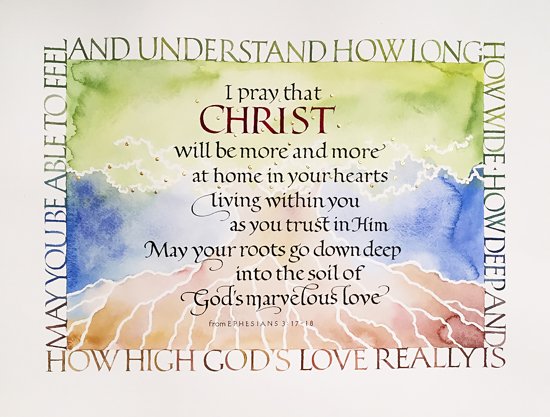
Utterly Unconventional Love of God and Saint Valentine’s Day. Ephesians 3:17-19

Ephesians 3:14-21Amplified Bible

14 For this reason [grasping the greatness of this plan by which Jews and Gentiles are joined together in Christ] I bow my knees [in reverence] before the Father [of our Lord Jesus Christ], 15 from whom every family in heaven and on earth [a]derives its name [God—the first and ultimate Father]. 16 May He grant you out of the riches of His glory, to be strengthened and spiritually energized with power through His Spirit in your inner self, [indwelling your innermost being and personality]17 so that Christ may dwell in your hearts through your faith. And may you, having been [deeply] rooted and [securely] grounded in love, 18 be fully capable of comprehending with all the saints (God’s people) the width and length and height and depth of His love [fully experiencing that amazing, endless love]; 19 and [that you may come] to know [practically, through personal experience] the love of Christ which far surpasses [mere] knowledge [without experience], that you may be filled up [throughout your being] to all the fullness of God [so that you may have the richest experience of God’s presence in your lives, completely filled and flooded with God Himself].

20 Now to Him who is able to [carry out His purpose and] do superabundantly more than all that we dare ask or think [infinitely beyond our greatest prayers, hopes, or dreams], according to His power that is at work within us, 21 to Him be the glory in the church and in Christ Jesus throughout all generations forever and ever. Amen.

The Word of God for the Children of God.

Adeste Fidelis! Venite Adoremus! Dominum.

Gloria! In Excelsis Deo! Alleluia! Alleluia! Alleluia! Amen.

God gave us Jesus as a way of saying, “I love you and you are special to me.”

That is a really great gift, isn’t it?

Much better than Valentine’s cards, or candy, or flowers.

Still, we have those special people in our lives whom we need to give our fullest possible attention to – our wives, our sweethearts, our very good friends, those co-workers who work with us and beside us and those whom we may supervise.

Treat them special because they are special – who and what and why they are is absolutely 100% irreplaceable – every single one of their lives utterly matters.

They need to know that they are truly respected, loved and deeply appreciated.

God’s Unconventional Love versus Valentine’s Day

Ephesians 3:14-19The Message

14-19 My response is to get down on my knees before the Father, this magnificent Father who parcels out all heaven and earth. I ask him to strengthen you by his Spirit—not a brute strength but a glorious inner strength—that Christ will live in you as you open the door and invite him in. And I ask him that with both feet planted firmly on love, you’ll be able to take in with all followers of Jesus the extravagant dimensions of Christ’s love. Reach out and experience the breadth! Test its length! Plumb the depths! Rise to the heights! Live full lives, full in the fullness of God.

Everyday is a special day when we open our eyes, take that next breath, set our feet upon the floor, walk forth into the kitchen get that very first cup of coffee.

We look outside, greet the morning, are welcomed by the dawn’s new sun.

A hand that raises the blades of a Venetian blind to look out the window at the sky of a sunny day.

Tomorrow, however, is a wee bit more of a special day.

Yes, it is Valentine’s Day.

But does everyone know the origin of this day?

It is a very old tradition which started because of a Bishop named Valentinus.

He lived back in the days of the Roman Empire.

Long ago, Roman officials were against young people getting married in the church.

Many young Christians wanted to be married by the priest, in the church, with God’s blessing.

Valentinus was sympathetic to these people and continued to help marry them, even though he was often threatened by the government authorities.

Sadly, he was taken to Rome and put to death for his faith and his defiance of the Emperor’s rule.

In memory and honor of Saint Valentinus, young couples started talking about choosing a Valentine, when they were actually talking about choosing a bride.

Now we call this day, Saint Valentine’s Day.

In the modern era, many people give their sweethearts Valentine’s Day cards with hearts all over them.

Some people give candies or flowers.

A red carnation or a red rose means “I love you.”

These are all ways that people show their love.

But God also gave us a gift to show us that He loved us.

It was Jesus. God gave us Jesus as a way of saying, “I love you and you are special to me.”

That is a really great gift, isn’t it?

Much better than cards, or candy, or flowers.

Today, let us meditate on biblical love, the greatest love of all time.

There once was a very old pastor, who was suffering from a long battle with cancer.

A few days before his death, he continued to hold on to a special verse that was the source of his inspiration.

He placed a bookmark where his favorite scripture passage was written:

“Who shall separate us from the love Christ? Shall tribulation, or distress, or persecution, or famine, or nakedness, or peril, or sword?” (Romans 8:34-35 KJV).

Despite facing such a trail in his life, the old pastor was most certainly blessed with the power “to grasp how wide and long and high and deep is the love of Christ;” a love that surpasses knowledge.

As children of God, we understand the fact that the root and foundation of creation is love.

It “surpasses knowledge.”

We know about human love.

Human love comes with the understanding that love comes as a reward for being good, for being faithful, being trustworthy and true, for being kind, for giving gifts, and for acting and for responding with appropriate behavior.

But this is not the same as the love which is embedded in the foundation of creation.

This is not the love that surpasses knowledge.

This is not the love that Paul prays we might have the power to grasp.

God’s love flows freely, without consideration of reward or any plan of equal or unequal or non-existent compensation.

This is a love that is not inherent to human nature.

We are more inclined to return love for love.

But the Scripture says,

“… how is it to your credit if you receive a beating for doing wrong and endure it? But if you suffer for doing good and you endure it, this is commendable before God. To this you were called, because Christ suffered for you, leaving you an example that you should follow in his steps” (1 Peter 2:20-21).

If we are to approach love in the way of biblical love, we must meditate on what it means when the Bible says, we must love God and each other as ourselves.

“Greater love has no one than this: to lay down one’s life for one’s friends. You are my friends if you do what I command. I no longer call you servants, because a servant does not know his master’s business. Instead, I have called you friends, for everything that I learned from my Father I have made known to you. You did not choose me, but I chose you and appointed you so that you might go and bear fruit–fruit that will last–and so that whatever you ask in my name the Father will give you. This is my command: Love each other.” (John 15:13-17)

Today, I would like to meditate on 3 questions about this amazing kind of love.

The first question is this:

Where does Love come from?

Where Does Love Come From?

Now some of you would answer, ‘that’s easy–it comes from within.’

Some may say, ‘It’s something that happens naturally as we mature as human beings.’

However, remember how hard it is to teach children to share?

That sharing instinct is not natural to them, but it is taught.

A human instinct is: self-survival.

C.S. Lewis, the famed English scholar, studied the various Greek words for love.

He came to distinguish the difference between what he called “needed love” and “gift love.”

Needed love is described as self-evident.

It is the most common kind of love in our world.

It is a mortal and human concept of love.

I love you, BECAUSE you love me.

I love you, because you provide for me, because you support me, and because you meet my needs.

Mr. Lewis illustrates that when we humans say to another, “I love you,” what we are really meaning is, “I need you, I want you. You hold value in my life.”

Now in contrast to “needed love” Mr. Lewis describes “gift love.”

This form of loving is born of fullness and wholeness.

The goal of gift love is to enrich and enhance the person whom it loves.

It does not require anything in return, nor does it hold requirements.

“Gift love moves out to bless and to increase rather than to acquire or to diminish. Gift love is more like a bountiful, artesian well that continues to overflow than a vacuum or a black hole. (C.S. Lewis)”

Mr. Lewis concludes this is what God’s love is all about. God’s love is gift love, not needed love.

This, of course, is the meaning of agape love; unconditional love.

Are we capable of agape love– loving as God loves?

To an extent we are.

But, we must go to the source of love, and the source of all love is God.

Jesus says in John’s narrative today, “As the Father has loved me, so have I loved you. (John 15:13)”

Perfect love does not come from within, it only comes from above.

And when God lives within us, we become capable of expressing perfect love.

Please take secure hold of your BIBLES and turn with me to 1 John 4:7-11.

In his first epistle, John writes,

“Dear friends, let us love one another, for love comes from God. Everyone who loves has been born of God and knows God. Whoever does not love does not know God, because God is love.” So, that is the answer to the first question: where does love come from? It comes from God. Then John adds, “This is how God showed his love among us: He sent his one and only Son into the world that we might live through him. This is love: not that we loved God, but that he loved us and sent his Son as an atoning sacrifice for our sins.” (1 John 4:7-11).

The Second Question is ….

What does this Love look like?

A young girl came home one day bursting with good news.

“Mom, Dad, I know why we had to learn grammar!” she exclaimed.

“It is so we can understand God.”

Her mom and dad gave her a puzzled look, so the young girl explained.

“God is love, and love can be a noun, an adjective, an adverb, or a verb.”

What a powerful concept!

Now doesn’t that preach a sermon or three lasting all the live long day!

Love isn’t just a vague feeling.

It is an action, an attitude, a spirit, and a character trait.

Since Jesus was filled with the Spirit of God, his every attitude, thought, word, action and deed was motivated by the love of God for Him and too, vice versa.

He was motivated completely and without reservation by love.

So, what does love look like?

Gift love is best illustrated with Jesus, a blameless man, hanging on a cross simply and solely because of God’s love for us.

We cannot meet any of God’s needs or even all of God’s commands.

But God’s nature is to give love, unconditionally, unconventionally, even at times when we do not deserve it.

As John writes,

“This is how God showed his love among us: He sent his one and only Son into the world that we might live through him. This is love: not that we loved God, but that he loved us and sent his Son as an atoning sacrifice for our sins.” (1 John 4:9-10)

God’s gift love is a pure and perfect love.

It is an unconventional, never-ending, and everlasting kind of love.

It does not ask for you to meet up to requirements, and it does not ask for compensation.

No matter how many times we sin or fall short of the Glory of God, His love never left us.

No matter how many times the world rebuked Him, His love never left us.

What does love look like?
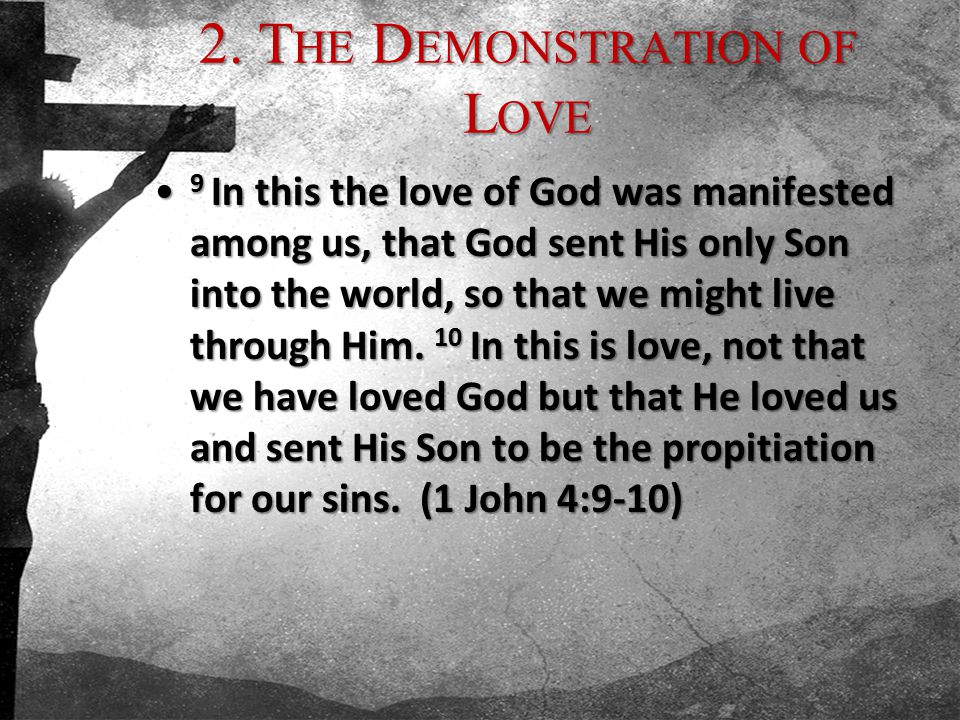
There is no Greater and more Powerful image than Jesus on the Cross.

That is perfect love.

Perfect love looks like God, for He is love.

God and love are not two realities; they are one.

God’s infinite power of being is: the infinite power of love.

In every movement of love we are dwelling in God and God in us.

And when we accept the Holy Spirit into our lives, we allow God’s perfect love to be pictured through us.

We can also illustrate perfect love through the way we live.

Through every attitude, thought, word, and deed, we have.

Christians are called to be a reflection of the image of God.

We reflect God’s perfect love so that others can also see what true perfect love looks like.

Love unconditionally, unconventionally to all.

Now, the third and last question is:

What does such love require from us?

Jesus answers this question in John 15:13-17,

“My command is this: Love each other as I have loved you. Greater love has no one than this: to lay down one’s life for one’s friends. You are my friends if you do what I command. I no longer call you servants, because a servant does not know his master’s business. Instead, I have called you friends, for everything that I learned from my Father I have made known to you. You did not choose me, but I chose you and appointed you so that you might go and bear fruit–fruit that will last–and so that whatever you ask in my name the Father will give you. This is my command: Love each other.”

Jesus has issued the command: “Love each other as I have loved you.”

We are required by God’s command to love others as he has loved us–not with needed love, but with gift love.

Not because of anything they can or have done for us, but because of what our Lord and Savior Jesus Christ has done for us.

Luke 6:27-32Amplified Bible

27 “But I say to you who hear [Me and pay attention to My words]: [a]Love [that is, unselfishly seek the best or higher good for] your enemies, [make it a practice to] do good to those who hate you, 28 bless and show kindness to those who curse you, pray for those who mistreat you. 29 Whoever [b]strikes you on the cheek, offer him the other one also [simply ignore insignificant insults or losses and do not bother to retaliate—maintain your dignity]. Whoever takes away your coat, do not withhold your shirt from him either. 30 Give to everyone who asks of you. [c]Whoever takes away what is yours, do not demand it back. 31 Treat others the same way you want them to treat you. 32 If you [only] love those who love you, what credit is that to you? For even sinners love those who love them.

The world lives by the philosophy: “Scratch my back and I’ll scratch yours.”

To do good for people who are incapable of doing anything for you in return.

This is gift love, agape love. It is the love of God.

And of course, dear brother and sisters, this is the hardest form of love to give.

It is hard to love someone unconventionally when they cannot or will not or refuse to do the same for you.

But when the Spirit of the Lord is within, He will give you the strength to love.

The strength to be patient and compassionate.

The strength to reflect agape love to others who do not know God.

For the greatest command was to love God, and the second greatest command was to love one another.

Concluding Reflection’s: Love That Surpasses Knowledge

Ephesians 3:16-19Easy-to-Read Version

16 I ask the Father with his great glory to give you the power to be strong in your spirits. He will give you that strength through his Spirit. 17 I pray that Christ will live in your hearts because of your faith. I pray that your life will be strong in love and be built on love. 18 And I pray that you and all God’s holy people will have the power to understand the greatness of Christ’s love—how wide, how long, how high, and how deep that love is. 19 Christ’s love is greater than anyone can ever know, but I pray that you will be able to know that love. Then you can be filled with everything God has for you.

Love is commonly considered an emotion—a feeling, inclination of the heart.

Love involves knowing the person we love, and yet even that knowledge is not the end of love.

Paul reminds his readers of this basic truth when he prays that they may “know this love that surpasses knowledge.”

Paul is talking here about the love of God, and he’s saying that it’s not enough to know about God without having love for God.

The standard of love that believers strive for is to “be filled to the measure of all the fullness of God.”

That’s a high standard indeed!

God is, in every way, far beyond what our minds can comprehend or our hearts can contain.

We will never achieve this total fullness!

But what a powerful prayer this is—and what a wonderful goal to guide us in living our life!

To be continually growing in this “fullness of God” and his love is the delight of discipleship.

This is a wonderful prayer offered for us—but it’s also a prayer to offer on behalf of others.

What a transformation of our relationships when an entire community of Christ’s disciples experiences together a growing fullness of God’s love.

It’s beyond our ability to imagine!

Valentines Day is known as the day of love.

But God’s love lasts for eternity.

It is a perfect LOVE that loves unconditionally and unconventionally.

Where does perfect love come from?

It comes from God alone, and works within us when we become His children.

What does perfect love look like?

It looks like Jesus, a blameless man, hanging on a cross, for a world which did not deserve Him.

And as His children we reflect that image through our actions, our attitudes, thoughts, words, and deeds.

And what does such perfect love require out of us?

It requires us to move beyond “needed love” and give “gift love”.

To look around at others who are in need of God’s love and to give it to them–not asking what they can do for us, remembering what Christ has done for us.

In the name of God, the Father and God the Son and God the Holy Spirit,

Let us Pray,

We bow our hearts before You, Father God. You are the Creator of everything we see in heaven and on earth. We pray that out of Your glorious, unlimited resources, You would strengthen our hearts and minds through the power of Your Holy Spirit. May Your love be the rich soil in which our lives are rooted. May Your love be the only firm foundation upon which we build, so that, together with all Your people everywhere, we would come to truly understand how long, how high, how wide and how deep Your love really is—how it far surpasses anything we can imagine. God, fill us with the fullness and the power that comes from You alone, so that our lives would reflect your goodness and grace to the world around us.  Lord, fill us to overflowing with the knowledge and the wisdom of your fullness so that we love you more and serve you better. Help us to keep offering this prayer for others, that we may all grow in you.

Adeste Fidelis! Venite Adoremus! Dominum.

Gloria! In Excelsis Deo! Alleluia! Alleluia! Alleluia! Amen.

https://translate.google.com/

“Ambitious” Guests of Honor: Jesus Teaches About Humility and Service. Luke 14:7-14

Luke 14:7-14 Amplified Bible

Parable of the Guests

Now Jesus began telling a parable to the invited guests when He noticed how they had been selecting the places of honor at the table, saying to them, “When you are invited by someone to a wedding feast, do not sit down [to eat] at the place of honor, since a more distinguished person than you may have been invited by the host, and he who invited both of you will come and say to you, ‘Give this man your place,’ and then, in disgrace you proceed to take the last place. 10 But when you are invited, go and sit down [to eat] at the last place, so that when your host comes, he will say to you, ‘Friend, move up higher’; and then you will be honored in the presence of all who are at the table with you. 11 For everyone who exalts himself will be humbled [before others], and he who habitually humbles himself (keeps a realistic self-view) will be exalted.”

12 Jesus also went on to say to the one who had invited Him, “When you give a luncheon or a dinner, do not invite your friends or your brothers or your relatives or wealthy neighbors, otherwise they may also invite you in return and that will be your repayment. 13 But when you give a banquet or a reception, invite the poor, the disabled, the lame, and the blind, 14 and you will be blessed because they cannot repay you; for you will be repaid at the resurrection of the [a]righteous (the just, the upright).”

The Word of God for the Children of God.

Adeste Fidelis! Venite Adoremus! Dominum.

Gloria! In Excelsis Deo! Alleluia! Alleluia! Alleluia! Amen.

Parable of the Honored Ambitious Guests …

The guests and host of a banquet met Jesus.

At the banquet, the guests tried to sit in seats of honor, near the place where the host would sit.

This was common in that society, which cared about honor for people who were respectable and had status in the community.

It was also common to invite people over who would invite you back, because you could then benefit socially from attending another dinner party hosted by someone else.

But Jesus introduced a different kind of world by what he said to the guests and the host.

He told them to sit in the least honorable seats, and to invite guests who were too poor to return the invitation.

In this way Jesus revealed a way of life in which status doesn’t matter, and in which shame and honor are erased.

Jesus revealed this way of life in his teachings, and he made this way of life possible by becoming the most despised outsider of all.

He died on a cross and bore the worst of all rejections in order to make God’s kingdom a reality in our world.

God’s kingdom is the only place where the only status that matters is that we are “loved by God.”

God’s kingdom is a gift that Jesus Christ gives to us.

Jesus Teaches About Ambition, Humility, Service

Ambition can be a powerful ally or a destructive enemy.

If your ambition is misplaced and fueled by shallow wants and superficial desires, you will find yourself perpetually dissatisfied, ultimately discontent.

The Bible talks about that type of ambition in Matthew 6:24, warning against greed and the insatiable desire to earn more money than you could ever spend.

If wealth and riches and status are your ambition, you will never be satisfied.

There is nothing wrong with ambition or about being ambitious ….

There is nothing wrong with Christian or with a Christian being ambitious.

There’s nothing wrong with making money, but you have to own the money; you can’t let it own youlove of money is not supposed to be our ambition.

You and I have to have a more sacred purpose that’s greater than money.

The money will come to you through hard work and God’s blessing.

Your greater purpose should be what your ambitions push you towards.

Matthew 6:33 affirms this by giving us the insight that God knows our desires.

God knows what fuels us, and if we aren’t scheming and plotting to send someone to ruination, He wants to bless us with the things that we seek.

Jesus advises that if you and I seek first the Kingdom of God then He will give you and I everything that you and I need, and more.

Humility and service are just two of the other values that Jesus not only taught but exemplified during His earthly ministry.

On so many occasions in the Bible, we read Jesus teaching His disciples to always consider others before themselves. Jesus repeatedly emphasized the importance of self-denial and service to others.

In Luke 14:7-14, Jesus used the occasion of a banquet to give insight into humility and service.

He addressed the guest regarding humility in verses 7 to 10, And in verses 12 to 14, He spoke to the host about serving others.

Luke 14:7-14The Message

Invite the Misfits

7-9 He went on to tell a story to the guests around the table. Noticing how each had tried to elbow into the place of honor, he said, “When someone invites you to dinner, don’t take the place of honor. Somebody more important than you might have been invited by the host. Then he’ll come and call out in front of everybody, ‘You’re in the wrong place. The place of honor belongs to this man.’ Embarrassed, you’ll have to make your way to the very last table, the only place left.

10-11 “When you’re invited to dinner, go and sit at the last place. Then when the host comes he may very well say, ‘Friend, come up to the front.’ That will give the dinner guests something to talk about! What I’m saying is, If you walk around all high and mighty, you’re going to end up flat on your face. But if you’re content to be simply yourself, you will become more than yourself.”

12-14 Then he turned to the host. “The next time you put on a dinner, don’t just invite your friends and family and rich neighbors, the kind of people who will return the favor. Invite some people who never get invited out, the misfits from the wrong side of the tracks. You’ll be—and experience—a blessing. They won’t be able to return the favor, but the favor will be returned—oh, how it will be returned!—at the resurrection of God’s people.”

Be Ambitious and Humble Yourself and Be Exalted …

Jesus’ teaching is clear – do not think so highly of yourself that you always come expect the very best treatment at all times.

No matter who you think or believe or perceive yourself to be when you are in public or in society, remember that there’s always somebody higher than you.

Being ambitious might be good at times but certainly not on many occasions.

Imagine a famous big city mayor who went to a wedding banquet along with his bodyguards and servicemen.

Upon his arrival, the host was too busy attending to other guests so he could not personally welcome him.

Thinking he was the most highly regarded guest, the mayor naturally walked into the dining hall and sat, took the best seat and made himself comfortable.

When the host noticed his presence, he came and whispered to his ear that the seat he occupied is reserved for the governor.

At this very public event, the mayor had no choice but to get up so the governor could take his rightful seat.

With all of the media outlets present, and their cameras following his every move, what a huge embarrassment for the mayor knowing all eyes are on him.

Humility and the “Ambitious Famous” Christian

Humility is a fundamental grace in the Christian life, and yet it is elusive.

There may be times when we think we deserve VIP treatment because of who we are in the church or society.

We are the Pastor – therefore we are entitled to the very best parking space.

Head of Table: We were the chairperson for the building committee and we just carried out the most successful capital campaign in the history of the church.

The Matriarch and the Patriarch of the Church – Head of the Line meal tickets.

Or perhaps there have been times when we ourselves exhibited false humility.

Do you think you have this “I am all this, that and the other, ergo…” virtue?

Please allow me to say, “If you know you have it, you have already flaunted it!”

As someone rightly said, “Humility is not thinking meanly of ourselves; it is simply not thinking of ourselves at all.” 

Jesus is the greatest example of humility, and we would do well to ask the Holy Spirit to enable us to more imitative of Him and significantly less of ourselves.

A True Act of Ambitious Charity

The Lord Jesus also emphasized the importance of treating people equally regardless of their social and economic status.

Unfortunately, when we are the one’s who are hosting a banquet, we prefer to invite rich and powerful people – trying to increase our status and self esteem.

But Jesus told the host of the banquet that when he holds a feast, he should be extraordinarily radical and also invite the poor, the lame, and the blind.

Why should the host do what Jesus said?

It’s because these people won’t be able to repay him.

They could not invite him back because they couldn’t afford to host a banquet!

However, the host will raise his standard of living in the eyes of the community he is living, showing true compassion, receiving his reward at the resurrection.

The reality is that whenever we host a party, we just prefer to invite our friends, relatives, and the rich and famous.

We want to have people who can bring the very best, most expensive gifts or those who can invite us to their party in the future.

Of course, there’s nothing wrong with inviting these people.

When Rabbi Jesus said, “Do not invite your friends, brothers, relatives, or rich neighbors,” He did not mean absolute prohibition.

Such language is common in Semitic discourse and is used for emphasis.

Jesus’ point here is that inviting one’s friends and relatives cannot be classified as a spiritual act of charity.

It may also be a rebuke against those prone to reserve their hospitality for rich neighbors.

They intentionally do this knowing that these guests will automatically feel obligated to return the favor.

And if they fail to automatically invite us back we take an automatically offense and as an excuse to discontinue the relationship – bear an everlasting grudge.

Greatness and Servanthood and Ambition …

Matthew 20:20-28Amplified Bible

Preferred Treatment Asked

20 Then [Salome] the [a]mother of Zebedee’s children [James and John] came up to Jesus with her sons and, kneeling down [in respect], asked a favor of Him. 21 And He said to her, “What do you wish?” She answered Him, “Command that in Your kingdom these two sons of mine may sit [in positions of honor and authority] one on Your right and one on Your left.” 22 But Jesus replied, “You do not realize what you are asking. Are you able to drink the cup [of suffering] that I am about to drink?” They answered, “We are able.” 23 He said to them, “You will drink My cup [of suffering]; but to sit on My right and on My left this is not Mine to give, but it is for those for whom it has been prepared by My Father.”

24 And when the [other] ten heard this, they were resentful and angry with the two brothers. 25 But Jesus called them to Himself and said, “You know that the rulers of the Gentiles have absolute power and lord it over them, and their great men exercise authority over them [tyrannizing them]. 26 It is not this way among you, but whoever wishes to become great among you shall be your servant, 27 and whoever wishes to be first among you shall be your [willing and humble] slave; 28 just as the Son of Man did not come to be served, but to serve, and to give His life as a ransom for many [paying the price to set them free from the penalty of sin].”

In Matthew 20:26-27, Jesus taught His disciples that greatness is parallel to servanthood.

Jesus said in response to the request of James and John’s mother for them to be given high places in God’s Kingdom.

In his reply, Jesus poignantly highlighted about being a “servant.” 

The word here means a “slave” and our English word “deacon” comes from it.

Not every servant was a slave, but every slave was a servant.

The Lord was teaching His disciples that the style of greatness and leadership for believers is different.

The Gentile leaders dominate in a dictatorial fashion, using carnal power and authority.

Believers are to do the opposite.

They lead must by being servants and giving themselves away for others, as Jesus did.

Sadly, in the church today we have many “celebrities” but so very few servants.

There are many who want to “flaunt” their authority but few who want to take the towel and water filled basin and get on their knees and wash “dirty” feet.

But while there are people who are still willing to serve, it’s interesting to note that they also have their motives.

Some are sincerely serving only to glorify God but others serve for honor and place and recognition of their “ambitious,” “obviously superior spirituality.”

What’s your motive for serving God and others?

Some final reflections and ambitious thoughts …

In Philippians 2:3-4, Paul uses the example of Jesus’ humility and service to encourage believers to do the same.

He uses the word “selfishness” which is sometimes rendered “strife” because it refers to “us versus them versus everybody, anybody else” rivalry.

It speaks of the pride that prompts people to push for their own way.

And then Paul encourages the church to have humility of mind.

It was a term of derision with the idea of being low, shabby, and humble.

The basic definition of true humility is regarding others as more important than yourself.

Our motive for being humble and serving others must be the praise of God and not the applause of men.

We must care significantly more about our eternal reward in heaven and not the temporary “we cannot take it with us to the grave” pseudo recognition on earth.

Remember, “You can’t get your reward twice” (Matthew 6:1-8).

On the day of judgment, many who today are first in the eyes of men will be last in God’s eyes.

And many who are last in the eyes of men will be first in the eyes of God (Luke 13:30).

The story is told about a wise man who shunned publicity.

He would speak every once in a while and when he speaks everyone listens to him.

After speaking he would immediately hide away into his own private place.

There would be rare times that he granted interviews and when he does he would always point to God as the giver of whatever wisdom that he possesses.  

Many of us may be tempted to own to ourselves the wisdom or material wealth that we presently have.

But we should not allow ourselves to be possessed by that temptation, for who are we to own to ourselves what we have?

We have to always remember that we are mere vessels of God, whatever we have comes from God.     

In our gospel text, Jesus highlights the great virtue of humility.

Jesus tells us to always be humble and not to crave for attention and adulation.

Why?

For the simple reason that the more humbler we are the more that Jesus is seen both with us and within us and emanating outward into the world from us.

The humbler we are the more the we become His effective vessels in this world. 

The humbler you are the more that you allow Jesus’ light to shine upon you.

The humbler you are the more that you allow Jesus’ light to shine out from you.

The more light which emanates from us, more the light of Savior Jesus shines.

Maybe in some part of the earth we still walk on, the light of His Salvation;

Overly Ambitious Thoughts and Overly Ambitious Christians

Matthew 5:13-16 Amplified Bible

Disciples and the World

13 “You are the [a]salt of the earth; but if the salt has [b]lost its taste (purpose), how can it be made salty? It is no longer good for anything, but to be thrown out and walked on by people [when the walkways are wet and slippery].

14 “You are the light of [Christ to] the world. A city set on a hill cannot be hidden; 15 nor does anyone light a lamp and put it under a basket, but on a lampstand, and it gives light to all who are in the house. 16 Let your light shine before men in such a way that they may see your good deeds and moral excellence, and [recognize and honor and] glorify your Father who is in heaven.

Do we walk/talk the kind of “shining” humility, our Savior now requires of us?

We walk/talk the kind of “shining” servanthood our Savior now requires of us?

I am pondering the imponderable possibilities if the answers are actually: YES!

In the name of God, the Father and God the Son and God the Holy Spirit,

Let us Pray,

Lord God, we are shocked and awed by the kind of kingdom Jesus has introduced—it seems upside down and backwards to us. Its simple wisdom is wonderfully radical to us, the possibilities which would come from actual practice are enormous. We thank you for the great love that your kingdom reveals when we allow it to shape our lives.

Hospitable God, you invite us to a banquet where the last may be first, where the humble and the mighty trade places. Let us share your abundance with no fear of scarcity; let us greet strangers as angels you have sent! Send your Holy Spirit now so that we may find a place at your table and welcome others with radical hospitality. In the name of our Lord and Savior Jesus, Guest at all our tables, we pray.  Amen.

Adeste Fidelis! Venite Adoremus! Dominum!

Gloria! In Excelsis Deo! Alleluia! Alleluia! Alleluia! Amen.

https://translate.google.com/

What Is this Spiritual Gift of Faith? 1Corinthians 12:4-11

1 Corinthians 12:4-11Amplified Bible

Now there are [distinctive] varieties of spiritual gifts [special abilities given by the grace and extraordinary power of the Holy Spirit operating in believers], but it is the same Spirit [who grants them and empowers believers]. And there are [distinctive] varieties of ministries and service, but it is the same Lord [who is served]. And there are [distinctive] ways of working [to accomplish things], but it is the same God who produces all things in all believers [inspiring, energizing, and empowering them]. But to each one is given the manifestation of the Spirit [the spiritual illumination and the enabling of the Holy Spirit] for the common good. To one is given through the [Holy] Spirit [the power to speak] the message of wisdom, and to another [the power to express] the word of knowledge and understanding according to the same Spirit; to another [wonder-working] faith [is given] by the same [Holy] Spirit, and to another the [extraordinary] gifts of healings by the one Spirit; 10 and to another the working of [a]miracles, and to another prophecy [foretelling the future, speaking a new message from God to the people], and to another discernment of spirits [the ability to distinguish sound, godly doctrine from the deceptive doctrine of man-made religions and cults], to another various kinds of [unknown] tongues, and to another interpretation of tongues. 11 All these things [the gifts, the achievements, the abilities, the empowering] are brought about by one and the same [Holy] Spirit, distributing to each one individually just as He chooses.

The Word of God for the Children of God.

Adeste Fidelis! Venite Adoremus! Dominum.

Gloria! In Excelsis Deo! Alleluia! Alleluia! Alleluia! Amen.

Spiritual Gift of Faith

Today, let’s learn something about the spiritual gift of faith.

Your first reaction to this might be, “How can faith be a gift?

Aren’t we all supposed to have faith as believers in Jesus Christ?”

Faith is absolutely a gift!

It is specifically mentioned as a spiritual gift in scripture (1 Corinthians 12:9).

Because it is a spiritual gift, that means not everyone has the gift of faith.

And that’s okay.

We can all strive for faith, but for some people the confidence in the truth of God comes more naturally than to others.

Do you know a person who can continue to trust in God no matter what comes their way?

A person who can see where God is working in your life when you can’t see it?

People with the spiritual gift of faith are unshakeable in their reliance on God’s promises and are a source of encouragement for the rest of us when we feel like embracing the world or giving up on God or think that God has given up on us.

Here is how we can define the gift of faith:

Faith is the exceptional ability to hold fast to the truth of God in Jesus Christ in spite of pressures, problems, and obstacles to faithfulness.

Much more than just belief, faith is a gift which empowers an individual or a group of people to hold fast to its identity in Christ in the face of any challenge.

The gift of faith enables believers to rise above pressures and problems that might otherwise cripple them.

Faith is characterized by an unshakable trust in Jehovah God to deliver on God’s promises, no matter what.

The gift of faith inspires those who might be tempted to give up to hold on.

Those gifted with Faith create a foundation upon which true community can be built and sustained.

It is critical for people possessing the gift of Faith to make, take opportunities to share their beliefs, their learning, most importantly, their life experiences.

Faith stories have powerful and transforming effects.

Faith is a prominent gift in witnessing congregations, where personal stories are shared in group settings, worship, Sunday school classes, or Bible studies.

Faith is the exceptional ability to hold fast to the truth of God in Jesus Christ in spite of pressures, problems, and obstacles to faithfulness.

Our Bible gives us many examples of individuals with the spiritual gift of faith.

Hebrews 11:1-12 The Message

Faith in What We Don’t See

11 1-2 The fundamental fact of existence is that this trust in God, this faith, is the firm foundation under everything that makes life worth living. It’s our handle on what we can’t see. The act of faith is what distinguished our ancestors, set them above the crowd.

By faith, we see the world called into existence by God’s word, what we see created by what we don’t see.

By an act of faith, Abel brought a better sacrifice to God than Cain. It was what he believed, not what he brought, that made the difference. That’s what God noticed and approved as righteous. After all these centuries, that belief continues to catch our notice.

5-6 By an act of faith, Enoch skipped death completely. “They looked all over and couldn’t find him because God had taken him.” We know on the basis of reliable testimony that before he was taken “he pleased God.” It’s impossible to please God apart from faith. And why? Because anyone who wants to approach God must believe both that he exists and that he cares enough to respond to those who seek him.

By faith, Noah built a ship in the middle of dry land. He was warned about something he couldn’t see, and acted on what he was told. The result? His family was saved. His act of faith drew a sharp line between the evil of the unbelieving world and the rightness of the believing world. As a result, Noah became intimate with God.

8-10 By an act of faith, Abraham said yes to God’s call to travel to an unknown place that would become his home. When he left he had no idea where he was going. By an act of faith he lived in the country promised him, lived as a stranger camping in tents. Isaac and Jacob did the same, living under the same promise. Abraham did it by keeping his eye on an unseen city with real, eternal foundations—the City designed and built by God.

11-12 By faith, barren Sarah was able to become pregnant, old woman as she was at the time, because she believed the One who made a promise would do what he said. That’s how it happened that from one man’s dead and shriveled loins there are now people numbering into the millions.

  • Verse 4 – By faith, Abel brought a better sacrifice to God than Cain
  • Verse 5 – By faith, Enoch skipped death
  • Verse 7 – By faith, Noah built a ship
  • Verse 8 – By faith, Abraham said yes to God
  • Verse 11 – By faith, barren Sarah became pregnant
Faith in Scripture ….

Mark 9:23 (NRSV)
Jesus said to him, “If you are able!—All things can be done for the one who believes.”

Luke 8:48 (NRSV)
He said to her, “Daughter, your faith has made you well; go in peace.”

Luke 17:19 (NRSV)
Then he said to him, “Get up and go on your way; your faith has made you well.”

Luke 18:42 (NRSV)
Jesus said to him, “Receive your sight; your faith has saved you.”

Romans 4:18-21 (NRSV)
Hoping against hope, he believed that he would become “the father of many nations,” according to what was said, “So numerous shall your descendants be.” He did not weaken in faith when he considered his own body, which was already as good as dead (for he was about a hundred years old), or when he considered the barrenness of Sarah’s womb. No distrust made him waver concerning the promise of God, but he grew strong in his faith as he gave glory to God, being fully convinced that God was able to do what he had promised.

God gives us believers gifts of the Holy Spirit.

We do not know why exactly God’s will is for us to have any of these gifts, but we are thankful for any blessings, gifting’s, and corrections that He gives us.

Faith — it is a gift, and all we need is about the size of a mustard seed (Matthew 17:20).

To each and every one of us, a measure of faith has been assigned by God (Romans 12:3).

Moses had faith to lead Israel to the Promised Land, Sarah had faith that she would conceive even in her old age, and Noah had faith that God had spoken to him to build the ark even when everyone thought he was crazy (Hebrews 11).

There isn’t any formula that is alongside this gift of faith, and to think that there would be, it would be much more difficult to have faith.

Believing in faith is easy, but in our finite minds, thoughts barricade what is truly simple.

For by grace you have been saved through faith. And this is not your own doing; it is the gift of God, not a result of works, so that no one may boast (Ephesians 2:8-9).

Faith without proof

There are miracles everywhere mentioned in the New Testament.

Many people today have seen what the goodness of God can do through miracles.

In Mark 2, Jesus was in a crowded house in Capernaum.

There were four men carrying a paralytic man, trying to reach Jesus.

They had to make a hole in the roof of the house in order to bring the paralyzed man to be healed by Jesus.

This act was an act of faith by the four men, and Jesus saw their faith in the man being healed of his affliction.

Well, the man not only got healed but his sins were forgiven.

Miracles are a wondrous gift, but having faith without seeing is believing that it is possible even though it seems impossible (2 Corinthians 5:7).

“Now faith is the substance of things hoped for, the evidence of things not seen” (Hebrews 11:1). 

Our hope is in Christ alone.

Without faith, there is no hope.

We have faith that when winter begins to thaw, and all the snow begins to fade away, that the seeds that were planted in the previous season shall burst forth.

Springtime is a time of refreshment, a time of anticipated, expectant joy to see what was planted, will be planted and is to soon come up from the cold ground.

We don’t see the seeds with our own eyes, but by faith, we have the hope to see green leaves, diverse colors of flowers coming up to bring out joy and harvest.

Childlike Faith ….

Matthew 18:1-6 Amplified Bible

Rank in the Kingdom

18 At that time the disciples came to Jesus and asked, “Who is greatest in the kingdom of heaven?” He called a little child and set him before them, and said, “I assure you and most solemnly say to you, unless you repent [that is, change your inner self—your old way of thinking, live changed lives] and become like children [trusting, humble, and forgiving], you will never enter the kingdom of heaven. Therefore, whoever [a]humbles himself like this child is greatest in the kingdom of heaven. Whoever receives and welcomes one [b] child like this in My name receives Me; but whoever causes one of these little ones who believe in Me to stumble and sin [by leading him away from My teaching], it would be better for him to have a heavy millstone [as large as one turned by a donkey] hung around his neck and to be drowned in the depth of the sea.

Children are like sponges.

Children are naturally inquisitive about almost everything in their little world.

They max out their efforts absorbing everything they can see, smell, taste, and touch, and hear.

In a classroom, it is a teacher’s job to assure that the children are learning what is being taught.

Children learn from their families as to what is wrong and what is right.

But what they are the best at is having faith.

Think about the inquisitiveness of your own children right now.

What are they constantly getting themselves into?

What holds their “undivided” attention?

What is their “wish-list?”

What are their dreams?

As it might be applicable, be observant and give an answer to those questions for those of us who have grandchildren or great grandchildren inside our lives.

Think about when you were a child, what did you have hope for?

I hoped that I could see the world that God created.

As I got older, I realized what goes into making those dreams come true.

I then began to see that it may not ever happen, and my faith became less in that area of my life.

I let my fears become more and more of my reality because I didn’t truly believe that I could travel the world.

But, perhaps, one season, by God’s Grace, that dream of travel will come true.

I believe and have faith God will bring me to places that He wills for my life. 

In Romans 10:17, the Bible states, “So faith comes from hearing, and hearing through the word of Christ.” 

Our thoughts can be louder than the Word of God if we let them.

The Holy Spirit within us shows us what is truth and what is not.

The gift of faith is truth and grace that has been given to us through the sacrifice of Jesus Christ.

The spiritual gift of faith is steadfastly believing the truth, God’s truth alone.

No matter what happens whether you receive what you are believing in or not, your confidence cannot be swayed.

The fear, worry, and circumstances do not determine your level of faith.

If God has given you this spiritual gift of faith, then trust, without doubt, that He will absolutely do as He absolutely wills for your life.

In the name of God, the Father and God the Son and God the Holy Spirit,

Let us Pray,

All-Powerful Father, I bow before You because You are awesome and worthy of all the praise. Your word declares that I can do all things through You who strengthens me! I put all my trust in You. You alone are my God. You alone are my joy. You are my heart and my soul. You are the grass under my feet and the sky above. You are seen and unseen, Father. Keep me at Your right hand forever, fill me with Your grace, and make me Yours all the days of my life. Father, we thank you for everything, and we love you with all that we are. I pray that those that have been given this spiritual gift of faith will never waiver. I pray that we will trust and believe you always God. 

 Adeste Fidelis! Venite Adoremus! Dominum.

Gloria! In Excelsis Deo! Alleluia! Alleluia! Alleluia! Amen.

https://translate.google.com/

And As Enoch First Did, How Are We to Walk in Fellowship with God? Genesis 5:21-24

Genesis 5:21-24Amplified Bible

21 When Enoch was sixty-five years old, he became the father of Methuselah. 22 Enoch walked [in habitual fellowship] with God three hundred years after the birth of Methuselah and had other sons and daughters. 23 So all the days of Enoch were three hundred and sixty-five years. 24 And [in reverent fear and obedience] Enoch walked with God; and he was not [found among men], because God took him [away to be home with Him].

The Word of God for the Children of God.

Adeste Fidelis! Venite Adoremus! Dominum

Gloria! In Excelsis Deo! Alleluia! Alleluia! Alleluia! Amen.

We are assured that no matter where our Christian walk takes us, God our Father, His Son Jesus and Holy Spirit will be there with us along the way.

Walking with God is sharing our thoughts honestly with the Lord.

That means talking with him on a daily basis.

You may be surprised to discover that of all the people mentioned in the Bible, only three—Enoch, Noah, and Levi— are expressly said to have walked with God. Their stories are found in Genesis chapters 5 and 6 and Malachi 2.

Studying Enoch’s life provides clues to how he lived a lifestyle pleasing to God.

The account of Enoch’s walk with God is told in the book of Genesis.

The writer records that Enoch walked [in habitual fellowship] with God three hundred years after he became the father of Methuselah and then that at the age of three hundred and sixty-five years, Enoch walked with God; and he was not, for God took him (Genesis 5:24).

This scripture reveals Enoch began to walk with God after his 65th birthday.

How old are you?

A recent newspaper article stated that today’s average life expectancy of a person living in the United States is about 75 years.

How many years have you left to walk in habitual fellowship with God?

After three hundred years as God’s habitual walking companion on earth, God invited Enoch to continue his walk in heaven.

Enoch, like the later prophet Elijah, went directly to heaven without dying.

Enoch’s goal was to walk in habitual fellowship with God.

Enoch’s goal was to reverently and obediently please God. 

Think about this …. how many thousands of years ago was this ….

And how primitive or advanced was their thought process way back when?

To know what [habitual fellowship] was ….

To know what obedience was ….

To know what reverent obedience was ….to ONE God alone and not many gods?

What did it mean in that ancient context to say Enoch walked with the Lord ….

“In Habitual Fellowship” ….

What does that mean?

Above and beyond all others that Enoch and Noah were the ones mentioned?

Can you and I insert that ancient vision into our 2023 contemporary vision?

That is a pretty significant adjustment for us to make – to give Enoch a place in our 2023 pulpits, worship services, prayer meetings and fellowship gatherings.

How would that ancient witness testimony connect with our own witness story?

Would it connect with us at all?

Would it relate to us in anyway?

Would it connect us with God?

Would it strengthen or weaken or do nothing for our personal faith journey?

We know so precious little, if anything, about the actions Enoch demonstrated that God took such an extraordinary notice of – that He took Him Home (verse 24).

It would be so easy to insert our own judgments and interpretations and visions and deeds of all of those remarkable “ancient” “reverent and obedient” actions.

In the New Testament, the Hebrew writer reveals two key actions that enabled Enoch to walk with God. 

By faith, Enoch was taken up so that he should not see death; he was not found because God took him up, for he obtained the witness that before his being taken up, he was pleasing to GodAnd without faith, it is impossible to please Him (Hebrews 11:5,6a). 

  1.  Enoch was pleasing to God. Enoch did what God wanted him to do. His actions reflected God’s Will for his life.
  2.  Enoch was faithful to God. The Bible says that without faith, it is impossible to please God. Enoch, through his faith, pleased God. Enoch is an example of the righteous man that Paul wrote about in Romans 1: 17, But the righteous man shall live by faith.

Many people suffer from the misconception that walking with God is about church attendance, Bible study, praying, and contributing to the needy.

It’s true, people who walk with God engage in these activities.

But, Enoch’s life highlights the genuine basis of walking with God.

From the start, it looks as though Enoch fared more regrettable than the other patriarchs.

He lived on earth for only 365 years, far shorter than the other patriarchs.

Enoch was transferred straightforwardly to heaven without dying.

At that point, however, that would imply that Enoch actually lived longer than any patriarch, for he never saw death.

So, if we think about it, Enoch is the longest living human of all, even though Methuselah lived on earth for 969 years.

But we are not specifically looking at the period or lifespan of Enoch or the other patriarchs. 

Genesis 5:22 is quick to break with the example seen up to this point.

To no one’s surprise, we are given the number of years that a man lived subsequent to fathering the child who might prompt Noah and his children.

This time, however, we are enlightened with something regarding a man:

“And Enoch walked with God,” a reality that will be rehashed in the verses that follow.

What Does it Mean to Walk with God?

In the Bible, the articulation “walked with God” alludes to somebody who is respectful and dedicated to the Lord, bringing about God’s approval.

For Enoch’s situation, this was so crucial a point that it is referenced two times: both here and in Genesis 5:24.

This entry is expected to clarify the genealogical record from Adam to Noah, so there are not many different subtleties given.

We truly do not know much in regards to Enoch.

In any case, we truly do realize that God decided to eliminate him from the earth before his earthly passing.

Enoch is the first of the men recorded in this section whose story does not end with the expression “and he died.”

This was an occasion like Elijah’s end of service when God took him “up by a whirlwind into heaven” (2 Kings 2:9-12).

Up to Genesis 5:23, 895 years old is the youngest listed age at the point of death for the patriarchs.

No details are given except that God was responsible.

Physical death happened to all of the men listed, with the exception of Enoch.

Genesis 5:24 is one of the most puzzling verses in the Bible.

Considering how completely astounding and strange this occasion is, we may have expected more subtleties.

But every expression of the Bible is centered around a specific reason.

For this situation, the genuine object is to clarify the lineage from Adam to Noah, through Seth.

Most definitely, precisely what befell Enoch is unimportant.

What we can be sure of is that Enoch “walked with God.”

Truth be told, this is such a significant piece of who Enoch was that it is rehashed twice in this chapter.

To live by faith in the Almighty means to make a relationship with God part of your ordinary way of life, to respect God with your decisions in each part of life.

Enoch’s case is strange in all of Scripture, in all of mankind’s set of experiences.

What is the significance here?

Enoch “was not, for God took him?”

Obviously, in light of Enoch’s living by faith in the Almighty, God kept Enoch from passing on.

Rather, God just removed him.

By faith Enoch was taken from this life, so that he did not experience death: “He could not be found, because God had taken him away.” For before he was taken, he was commended as one who pleased God (Hebrews 11:5).

This existence of confidence (life of faith), Hebrews tells us, satisfied God in such a way God kept Enoch from passing from this life in an ordinary manner.

So, what was it about Enoch’s walk with God?

Walking in God’s Direction

The way for us to walk is marked.

We are to watch for any obstacles that will present themselves before us, and we are to walk as Christ walked.

Walking “as he walked” or living as Christ did does not mean that we are to us pick 12 devotees, perform extraordinary supernatural miracles, or be crucified.

We cannot duplicate the existence of Christ, since quite a bit of that had to do with his way of life as God’s Son, his walk with God, his exceptional job in dying for all sin, and the social setting of the Roman world during the first century.

To live today as Christ did, we should follow his lessons and illustration of complete submission to God and to the loving service to others (1 John 2:6; 1 Peter 2:21).

Walking at God’s Pace

As we walk, we are to spread the Good News of the Gospel of Savior Jesus Christ.

We are not to try and walk ahead of the Lord nor are we to lag behind him.

Walking requires wearing shoes to help protect our feet from the elements and the terrain that we walk on.

Some are for running, walking, orthopedic issues, or just for style.

Roman soldiers regularly wore sandals (shoes), which permitted them to move rapidly during a fight and gave their feet protection.

Here Paul envisions the shoes as the “preparation of the gospel of peace.”

Shoes made a fighter prepared to fight.

The “gospel of peace” in like manner prepares a Christian for spiritual battles.

Any individual who has strolled around outside without any shoes realizes that a few regions are beyond reach when you are shoeless.

Shoes empower you to go anyplace.

The gospel secures our faith in specific essential, widespread certainties.

Without that, we would be slipping.

One of the world’s most normal issues today is that of stress, which comes in several types.

However, the peace offered through the gospel is the response to the greater part of our day-by-day tension.

We can cast our cares upon him because he cares for us (1 Peter 5:7).

Further, interfacing the idea with the “gospel of peace” may likewise recommend the possibility of Christians bringing the gospel into everyday struggles, sharing it anywhere they go (Matthew 28:18-20).

Christians are given the “gospel of peace to be prepared for the fight to come and to help other people confronting spiritual battles (Ephesians 6:15).

Walking in Progress and Intimacy with God

Any parent knows that a child must first learn to crawl, then walk, before they can run.

A child must take simple steps first then successive steps.

Walking in progress with God means to “walk by faith.”

That means Christians are to live, make it a habit, by faith.

Suffering comes and suffering goes.

We are to live with courage and refuse to give up in our walk (2 Corinthians 5:7).

Paul tells us that we that have to accept Christ as Lord and Savior should walk (to live and think by faith) in him (Colossians 2:6).

Works are vital for the Christian life (1 John 3:17-18) but works should be the result of saving faith.

Walking in intimacy is also about honestly sharing our thoughts with the Lord.

That means we are talking with him on a daily basis.

Walking to the Destination Which God Has Prepared

Getting to a specific destination that we want to arrive at means that we must take one step at a time.

We may have to be prepared to get outside of our comfort zone.

We cannot also walk where it is easy to walk.

A smooth flat surface will not always be present for us to take our steps upon.

We are assured that no matter where or when our God starts us on our Christian walk, or why takes us, Christ will be there with us along the way (Hebrews 13:5).

In the name of God, the Father and God the Son and God the Holy Spirit,

Let us Pray,

15 God, who gets invited
    to dinner at your place?
How do we get on your guest list?

“Walk straight,
    act right,
        tell the truth.

3-4 “Don’t hurt your friend,
    don’t blame your neighbor;
        despise the despicable.

“Keep your word even when it costs you,
    make an honest living,
        never take a bribe.

“You’ll never get
blacklisted
if you live like this.”

[Psalm 15 The Message]

https://translate.google.com/

Our Gracious Host Forever Following, and Our Vigilant Shepherd is Forever Keeping Us Safe Inside His Dwelling Place. Psalm 23:6

Psalm 23 King James Version

23 The Lord is my shepherd; I shall not want.

He maketh me to lie down in green pastures: he leadeth me beside the still waters.

He restoreth my soul: he leadeth me in the paths of righteousness for his name’s sake.

Yea, though I walk through the valley of the shadow of death, I will fear no evil: for thou art with me; thy rod and thy staff they comfort me.

Thou preparest a table before me in the presence of mine enemies: thou anointest my head with oil; my cup runneth over.

Surely goodness and mercy shall follow me all the days of my life: and I will dwell in the house of the Lord for ever.

The Word of God for the Children of God.

Adeste Fidelis! Venite Adoremus! Dominum.

Gloria! In Excelsis Deo! Alleluia! Alleluia! Alleluia! Alleluia! Amen.

https://www.blueletterbible.org/kjv/psa/23/6/t_conc_501006

Throughout Psalm 23, David reveals the intimate, personal nature of his close relationship with the Lord.

David has said “me” a total of six times, “I” four times, and “my” seven times.

In this beloved psalm, David writes a total of seventeen personal references in only six verses, making this passionate song of trust intensely, self-disclosing.

We expect this emphasis, because walking with the LORD by faith involves, first and foremost, a close fellowship with Him.

At its essence, true spirituality is not about going through the empty motions of bare religion.

Nor is it about the mere external activities of longstanding rituals.

Rather, a life with God is about knowing Him and loving His Son, Jesus Christ, in intimate, personal communion. 

As we approach the last verse, verse 6, Psalm 23 steadily builds to this closing crescendo.

David writes, “Surely goodness and lovingkindness will follow me all the days of my life, and I will dwell in the house of the LORD forever” (verse 6).

Here, David builds upon the vivid analogy that he used in the previous verse.

In this context, he sees himself as a special guest in a grand banquet hall, where he is being served a feast by the LORD Himself. 

However, this dining hall is located in a very special place.

It is found in a royal palace—but not merely a worldly ruler’s palace.

It is found in the dwelling place of the highest of nobility—in “the house of the LORD.”

“Surely Goodness and Lovingkindness”

David begins with this emphatic word, “Surely” (ak).

This word could be translated as “indeed,” “absolutely,” “beyond any doubt,” or even “only.”

There is no place for any equivocation in David’s mind about what he says next.

He is deeply persuaded of what he is about to affirm.

This steadfast conviction should mark every believer.

David says that “goodness” (lob) will follow him.

This word speaks of the abundant blessings and lavish benefits God has bestowed upon him.

In this word is evidenced the spiritual prosperity that he has experienced in following the Lord – All that David has needed, God has always provided. 

David also confesses that the “lovingkindness” (hesed) of the LORD has followed him.

This is the Lord’s unconditional, loyal, royal love for David—and for all who put their trust in Him.

This word comes from the Hebrew root (hasad) that means ‘to bend down, to bow down.’

This describes God’s condescending love as He reaches all the way down from heaven to where exactly David is.

Could there be anything greater given to David’s life than the “goodness and lovingkindness” of the LORD?

God has given him the very best portion in His great love.

His steadfast, covenantal love for His own people never wavers, even in the furnace of affliction.

God gave each of us the very best portion of His great love – His Son Jesus.

John 3:16-17 King James Version

16 For God so loved the world, that he gave his only begotten Son, that whosoever believeth in him should not perish, but have everlasting life.

17 For God sent not his Son into the world to condemn the world; but that the world through him might be saved.

“Will Follow Me”

David adds that the Lord’s goodness and lovingkindness “will follow me.”

“Follow” (radap) means ‘to pursue after, to chase after, to run after.’

He knows that God’s mercy and grace are in close pursuit of his life.

No matter wherever he goes, he cannot get away from these ever-following assurances.

Regardless of whatever he does, he cannot escape them.

They will never let him go, even when circumstances seem to deny their reality.

These two attributes of God—“goodness and lovingkindness”—actually represent God Himself, who is continually pursuing David.

It is the figure of speech known as personification, which assigns humanlike qualities to inanimate objects.

To be sure, these two attributes represent God, who is personally following David and caring for his every need. 

By this testimony, David states that God is relentless in His love toward him.

David is assured though he will falter and fail, God will never give up on him.

Regardless of how he may disappoint the LORD, he is persuaded that God will never stop pursuing and caring for him.

Even if he trips and falls, he knows God will never distance Himself from him. 

Instead, God will pick up His servant and continue to walk with him.

David will testify elsewhere, “The steps of a man or established by the LORD, and He delights in his way. When he falls, he will not be hurled headlong, because the LORD is the One who holds his hand” (Psalm 37:23-24).

This is an irrevocable promise firmly established in God’s own faithfulness.

“All the Days of My Life”

God’s love for David will follow him “all the days of my life.”

This tender affection and unchanging allegiance of God will be a never-ending pursuit of David to the end of his days. 

His devotion toward God will surely fluctuate.

There will be times when it will strengthen or subside.

But God’s love for him is ever strong and steadfast.

God’s loyal love for David does not depend upon his love in return.

God’s love for David depends upon God Himself, who never weakens or wavers.

This is why God’s lovingkindness is always following after David.

Likewise, this same love of God is always in hot pursuit of every believer.

This divine love never takes a day off.

It never rests, never sleeps, never stops, never stumbles (Psalm 121:4).

Even in the midst of trying times, the love of God never goes on sabbatical, never takes a vacation.

It is ever strong toward us, ever sure. 

“And I Will Dwell in the House of the Lord”

The last line begins with the word “and,” which indicates that what follows is inseparably connected with what preceded it.

With great certainty, David knows that he will “dwell in the house of the Lord.”

“Dwell” (yasab) means ‘to sit down and stay.’

It conveys the idea of making one’s own abode or home.

This is to say, David will always be at home in the Lord’s presence, always in personal relationship with Him, no matter where he goes.

David pictures this meal in which God serves him as taking place “in the house of the Lord.”

Of course, the temple in Jerusalem has not yet been built by his son Solomon.

Instead, this “house” represents the intimate fellowship that David enjoys with the Lord as he lives in the very presence of God each day.

David is pointing his readership to the close communion, intimate interaction that he has with the Lord.

“Forever”

The relationship between David and the Lord will last “forever.”

What starts in this lifetime will never come to an end.

The word “forever” here means literally ‘for the length of days, for prolonged, never-ending days.’

Once David began this relationship with the Lord, he knew it would never be severed.

In the words of this analogy, once David moves into the house of the Lord, he will never move out.

This is the eternal security of every believer.

The Lord Himself is their dwelling place.

Once they dwell in the house of the Lord, they will always be living in the fullness of His love and grace. 

David wants us to know that the Lord who pursues us with lovingkindness is He who keeps us forever.

The Lord who is ever following us is ever keeping us.

Once God begins His pursuit of us, He will never let us go.

No believer can be separated from the love of God, our great Shepherd, Host, and King.

Jehovah God is dwelling within us exactly right now so that we may dwell with Him, both now and forever more.

Let all of His Children raise up!

Bless His holy name!

Jehovah Ra’a, the Lord is our Shepherd, is with us and exactly right beside us, both now and forever more.

Let all of sheep of His pasture turn their heads and give their fullest attention!

Bless His holy name!

The essential truth of our Christian life is that God has come to save us and live in us as “‘Immanuel,’ which translated means, ‘God with us’” (Matthew 1: 23).

This is the essential truth of our ministering to the Lord as well.

Forever we are Safe, Sitting in His sanctuary, abiding and residing in His house

Ministering unto the Lord, from within the sanctuary our inner temple, this is our response to the truth of Immanuel.

Because God is with us, abiding in us, and calling us to abide in Him, indeed to become one with Him, even as He and the Father are one (John 15:4, 10:14-15, 17:21-24), we joyfully, innately, instinctively, obediently, we respond, as God’s Own New Covenant priesthood (Revelation 1:5-6, 5:9-10, 1 Peter 2:5-9).

“Ministering to the Lord” (Acts 13:2) is surely what we know we must do, what our spirit within desperately, longingly yearns for, because God does live within us.

So it is a right and good and joyful thing for us to frequent the temple of the Holy Spirit within us (1 Corinthians 3:16), our “inner room” (Matthew 6:6), so we may be with our Lord in His presence, offering praise and adoration, stillness and reflection, gratitude and humility, even as He securely envelopes us in His Own “goodness and lovingkindness.”

The simple point I make here is that the more quality time and frequency we spend in God’s house now, dwelling within us, the more consistently sure we will be, every day, that “I will dwell in the house of the Lord forever.” Amen.

Love and dwell with our Lord now and looking forward to our joy of loving Him and our joy of dwelling with Him forever, always remembering with 100% joy that, “we love, because He first loved us” (1 John 4:19), we live because He lives.

We praise, thank, and bless You Lord God. Yes Lord, we gratefully and joyfully dwell in Your house today.

“Surely goodness and lovingkindness will follow me all the days of my life, and I will dwell in the house of the Lord forever.” Hallelujah!

In the name of God, the Father and God the Son and God the Holy Spirit,

Let us Pray,

Psalm 150The Message

150 1-6 Hallelujah!
Praise God in his holy house of worship,
    praise him under the open skies;
Praise him for his acts of power,
    praise him for his magnificent greatness;
Praise with a blast on the trumpet,
    praise by strumming soft strings;
Praise him with castanets and dance,
    praise him with banjo and flute;
Praise him with cymbals and a big bass drum,
    praise him with fiddles and mandolin.
Let every living, breathing creature praise God!
    Hallelujah!

Adeste Fidelis! Venite Adoremus! Dominum.

Gloria! In Excelsis Deo! Alleluia! Alleluia! Alleluia! Amen.

https://translate.google.com/

5 Ways to Truly Engage, Enjoy Christ. Luke 24:28-35

Luke 24:28-35 Amplified Bible

28 Then they approached the village where they were going, and He acted as if He were going farther. 29 But they urged Him [not to go on], saying, “Stay with us, because it is almost evening, and the day has just about ended.” So He went inside to stay with them. 30 And it happened that as He reclined at the table with them, He took the bread and blessed it, and breaking it, He began giving it to them. 31 Then their eyes were [suddenly] opened [by God] and they [clearly] recognized Him; and He vanished from their sight. 32 They said to one another, “Were not our hearts burning within us while He was talking with us on the road and opening the Scriptures to us?” 33 They got up that very hour and went back to Jerusalem, and found the eleven [apostles] gathered together and those who were with them, 34  saying, “The Lord has really risen and has appeared to Simon [Peter]!” 35  They began describing in detail what had happened on the road, and how Jesus was recognized by them when He broke the bread.

The Word of God for the Children of God.

Adeste Fidelis! Venite Adoremus! Dominum.

Gloria! In Excelsis Deo! Alleluia! Alleluia! Alleluia! Amen.

The disciples had been with Jesus for three years.

They had sat at his feet and seen him as their Teacher.

They had followed his instructions as their Lord and Master.

Jesus was also their Friend, and they loved sharing their hearts with him.

Jesus was their Messiah, and they enjoyed being with Him, in His presence.

But, as Henri Nouwen puts it, “His body and blood and their body and blood had not yet become one.”

Now, after his resurrection, Jesus broke bread with two of his followers, and this brought their relationship to a whole new level.

Jesus revealed Himself through the Scriptures, showed them the way by going before them and opening up a whole new realm as he is explaining his mission, Father God’s redemption plan for sinners, as told throughout Holy Scriptures.

As Jesus gave them the bread, they recognized him.

They realized that their Lord, Master, Teacher, and Friend was with them again.

He was alive!

He was with them!

They carried on an engaging conversation with Him for several miles.

When evening had come, they stopped and rested with Him and ate with Him.

He broke bread and shared the bread with them – and their EYES were OPENED!

The revelation: “The Lord Jesus had risen from the dead!”

This revelation brought them to their feet.

They returned (ran back as fast as they could) to Jerusalem to tell their story, and they found the other disciples saying, “It is true! The Lord has risen …!”

The reality of Christ’s resurrection brings the community of faith together to celebrate and enjoy the One who NOW walks with us, NOW lives within us!

Joyful, joyful, we adore thee,
God of glory, Lord of love;
hearts unfold like flowers before thee,
opening to the sun above.
Melt the clouds of sin and sadness;
drive the dark of doubt away.
Giver of immortal gladness,
fill us with the light of day!

Luke 24:28-35 The Message

28-31 They came to the edge of the village where they were headed. He acted as if he were going on but they pressed him: “Stay and have supper with us. It’s nearly evening; the day is done.” So he went in with them. And here is what happened: He sat down at the table with them. Taking the bread, he blessed and broke and gave it to them. At that moment, open-eyed, wide-eyed, they recognized him. And then he disappeared.

32 Back and forth they talked. “Didn’t we feel on fire as he conversed with us on the road, as he opened up the Scriptures for us?”

A Ghost Doesn’t Have Muscle and Bone

33-34 They didn’t waste a minute. They were up and on their way back to Jerusalem. They found the Eleven and their friends gathered together, talking away: “It’s really happened! The Master has been raised up—Simon saw him!”

35 Then the two went over everything that happened on the road and how they recognized him when he broke the bread.

Now, I want to ask you some very important and rather personal questions:

Why did Jesus walk all those miles with those two folks on the Emmaus Road?

Why did Jesus first choose to come close to those two raging skeptics?

Why did Jesus choose to come to your skeptical self and reveal Himself to you?

Why did Jesus first choose to reveal himself to those two raging skeptics?

Why did Jesus choose to reveal Himself to your skeptical self through Scripture?

In that most unexpected of moments, what did you feel when your eyes opened?

Why do you believe Jesus chose to “open your all too skeptical eyes?”

Why did Jesus save you?

Some might think it’s to take us to heaven or to bless us. (Psalm 23:5-6)

While these things are part of it, they are not the main reason.

The main reason Jesus revealed Himself to you, opened your eyes to His life and saved you is so He could be in a BFF intimately personal relationship with you.

I know that may seem mightily overwhelming when you think of who Jesus is and where you were, who you are and where and who we are, but it is 100% true.

For the joy which was before Him, and is now before you, since Jesus saved you for relationship, how can you make the most of it and truly enjoy Jesus Christ? 

5 Ways You Can Enjoy Christ

1. Engage His Presence

Enjoying Christ means being able to enjoy his presence.

The best way to enter his presence is through worship. 

Psalm 22:3 says God inhabits the praises of his people.

This verse means God sits among the people who praise him.

When you worship, you get God’s attention, and he draws near to you.

The one thing God desires more than anything else is to be close to you. He desires this because He wants, deeply desires for you to enjoy his presence. 

There are so many Scriptures that invite us into his presence and the beauty of his presence is everything we need is there.

You will find joy, peace, comfort, freedom, and the ability to leave every worry and care behind you.

If you really want to enjoy Christ, then you must spend time in his presence.

Spending quality time in his presence does not always mean you always have to open your mouth and say something.

Sometimes sitting quietly, in His sanctuary, in private before him and allowing his Spirit to minister unto, you is exactly what you need. (2 Samuel 7:18-29)

You cannot enjoy Christ without being in his presence, so make quality time for it – take every advantage of it and God in Christ promises you will not regret it.  

2. Engage His Promises

Part of building your relationship with Jesus is studying and praying, getting to know what he says, reveals in His Holy Scriptures, and promises He has made.

Sometimes we like to focus on the promises of blessing, but what is greater than those are his promises to be with you.

If it comes down to making a choice between having the One who blesses or the blessing, His wisdom says choosing the One who blesses wins out every time.

One way to really enjoy Christ is to think of the many promises he has made to walk with you through life.

“…And surely I am with you always, to the very end of the age” (Matthew 28:20).

“So do not fear, for I am with you: do not be dismayed, for I am your God. I will strengthen you and help you; I will uphold you with my righteous right hand” (Isaiah 41:10).

When You’re Between a Rock and a Hard Place

43 1-4 But now, God’s Message,
    the God who made you in the first place, Jacob,
    the One who got you started, Israel:
“Don’t be afraid, I’ve redeemed you.
    I’ve called your name. You’re mine.
When you’re in over your head, I’ll be there with you.
    When you’re in rough waters, you will not go down.
When you’re between a rock and a hard place,
    it won’t be a dead end—
Because I am God, your personal God,
    The Holy of Israel, your Savior.
I paid a huge price for you:
    all of Egypt, with rich Cush and Seba thrown in!
That’s how much you mean to me!
    That’s how much I love you!
I’d sell off the whole world to get you back,
    trade the creation just for you.
(Isaiah 43:1-4 Message)

“The Lord himself goes before you and will be with you; he will never leave you nor forsake you. Do not be afraid; do not be discouraged” (Deuteronomy 31:8).

“For I am convinced that neither death nor life, neither angels nor demons, neither the present nor the future, nor any powers, neither height nor depth, nor anything else in all creation, will be able to separate us from the love of God that is in Christ Jesus our Lord” (Romans 8:38-39).

I know God has promised to provide and bless and those things are wonderful.

But knowing he will be with you is the greatest of all the promises because if he is with you and for you, then who can be against you (Romans 8:31)?

The comfort, the place of Shalom, knowing there is nothing in this life that can ever separate you from His love sets a foundation for you to love, enjoy Jesus. 

3. Engage and Value His Purpose

If you want to enjoy your relationship with Christ, then you need to value the things he values.

His purpose for your life and your purpose for your life must align.

If these two things don’t agree, then you will never enjoy Christ.

Part of his purpose for you is to walk in obedience and avoid sin.

There was a 30 year period of time in my life where I allowed sin to rule, which was clearly never in alignment with even .001% of Jesus’s purpose for my life.

I can assure you those were the most miserable times in my life. 

I have discovered the best place to be in life is walking in the center of his will.

When you innately know you are doing what God has called you to do, there is a definite place satisfaction and a decisive source of enjoyment that comes that is utterly, fully and completely unmatched by anything, anyone else on this earth.

This has nothing to do with how big or small your family is, how much money you o an do not make or how successful, how big a failure you are in your career.

Those things are not germane nor are they the foundation of enjoying Christ.

When you walk and talk with Jesus, listen to His Words with intent to align your life with His life, His purpose, there is no greater joy you will ever experience!

4. Engage His People

You cannot enjoy your life with Christ if you do not engage with and enjoy his people.

A friend I know who is married and has one kid recently told me this story.

He and his wife were invited to share a family dinner with another couple.

They could find no one to watch their son and asked if they could bring them.

They were told they were welcome, but we don’t really want kids in our house.

That dinner never happened. 

A friendship was damaged …

You cannot say you love Jesus if you don’t love the ones he calls his own.

It is simply not possible.

Here is how the Bible puts it.

“Whoever claims to love God yet hates a brother or sister is a liar. For whoever does not love their brother and sister, whom they have seen, cannot love God, whom they have not seen” (1 John 4:20).

Make a friend, Be a friend, Bring a friend to Christ ….

If you are going to enjoy Christ, then you must learn to enjoy his people.

So often we focus on the faults and failures, failings and imperfections we see in others, and most of the time they are quickly obvious and easy to spot, mention.

I know mine are.

But guess what?

So are yours.

We are all imperfect people who are reflections of a perfect Christ.

Sometimes we get it wrong and mess this up, but as the expression goes, you do not throw the baby out with the bath water.

If you want to enjoy Christ, you cannot separate that from enjoying his people.

By the way, you better get used to His people because you are going to spend eternity with them, so you might as well enjoy them now.

5. Engage His Position

The last thing you need to enjoy Christ is to engage the position he must have in your life.

He must be Lord of all.

The truth of walking and talking with Jesus is either He is Lord of absolutely everything, or He is Lord of absolutely nothing.

There is no in between.

People that never make Jesus Lord of their life never experience the full joy of walking with Jesus.

When Jesus is Lord, and he sits at the center of your life, then life takes on a whole new perspective.

You will face many of the same challenges, but you will do so with Jesus at the helm of your life.

Knowing this alone can free you from anxiety because if He is at the wheel, you will arrive safely wherever He wants you to go. 

Build Your Relationship

Enjoying Christ is all about the relationship you and I share with Him, and if you and I miss this, then you and I miss it all.

The fact is you and I have someone we can be completely transparent with, who knows everything thing about us good and bad, yet still desires to fellowship.

This is truly amazing.

I encourage you to lean muchly into your Koinonia relationship with Jesus.

Be intentional about spending time with Him, make him the center of your life.

If you do, you will discover your walk with him will get sweeter and sweeter every day.

I will leave you with the words from a song by the Heritage Singers.

“I just keep falling in love with Him
Over and over, and over, and over, again
I keep falling in love with Him,

Over and over, and over and over again
He gets sweeter and sweeter as the days go by,

Oh, what a love between my Lord and I
I keep falling in love with Him
Over and over, and over, and over, again.”

In the name of God, the Father and God the Son and God the Holy Spirit,

Let us Pray,

Psalm 100 The Message

100 1-2 On your feet now—applaud God!
    Bring a gift of laughter,
    sing yourselves into his presence.

Know this: God is God, and God, God.
    He made us; we didn’t make him.
    We’re his people, his well-tended sheep.

Enter with the password: “Thank you!”
    Make yourselves at home, talking praise.
    Thank him. Worship him.

For God is sheer beauty,
    all-generous in love,
    loyal always and ever.

Adeste Fidelis! Venite Adoremus! Dominum.

Gloria! In Excelsis Deo! Alleluia! Alleluia! Alleluia! Amen.

https://translate.google.com/

An Attitude Adjustment? How Can We Know ‘Goodness and Mercy Will Follow’ Us When We are Hurting? Psalm 23:6

Psalm 23Authorized (King James) Version

Psalm 23

A Psalm of David.

The Lord is my shepherd; I shall not want.
He maketh me to lie down in green pastures:
he leadeth me beside the still waters.
He restoreth my soul:
he leadeth me in the paths of righteousness for his name’s sake.
Yea, though I walk through the valley of the shadow of death,
I will fear no evil: for thou art with me;
thy rod and thy staff they comfort me.
Thou preparest a table before me in the presence of mine enemies:
thou anointest my head with oil; my cup runneth over.
Surely goodness and mercy shall follow me all the days of my life:
and I will dwell in the house of the Lord for ever.

The Word of God for the Children of God.

Adeste Fidelis! Venite Adoremus! Dominum.

Gloria! In Excelsis Deo! Alleluia! Alleluia! Alleluia! Amen.

One of the great hymns of the faith is “Surely Goodness and Mercy.”

In its verses, this hymn summarizes what is taught in Psalm 23.

The chorus, of which I’m sure you are familiar, simply quotes verse 6.

Please read Psalm 23, then sing along with this hymn (at least verse 1):

A pilgrim was I, and a wandering—In the cold night of sin I did roam

When Jesus the kind Shepherd found me—And now I am on my way home.

Surely goodness and mercy shall follow me All the days, all the days of my life;

Surely goodness and mercy shall follow me All the days, all the days of my life.

If you want to keep singing, then you’ll have to look up the other verse in your hymnal or online, but please wait to do so until after you have finished reading the rest of this devotional.

Of all the words that David could have used to describe the blessings of God, he chose “goodness and mercy.”

In this brief study of this Psalm, we have previously talked about our Shepherd providing for us, about restoring our souls, leading us, comforting us, securing us, anointing us with oil, fattening our lives, and overflowing us with blessings.

David sums all this up as “goodness and mercy.”

Goodness supplies all of our needs, and mercy saves us from our sin.

What wondrous blessings our Shepherd has lavished upon us!

Yet, the focus of this final verse is not on the blessings of goodness and mercy, but on their temporal extent—how long will they last – they will last forever!

God’s goodness and mercy will follow me “all the days of my life.”

This means that God is good and merciful when the days are bright and sunny, and when the days are dark and grey.

God lavishes me with goodness and mercy in the days of feasting and in the days of fasting.

God shows me goodness and mercy when I am in the prime of life, and when I walk through the valley of the shadow of death. 

Surely goodness and mercy shall follow me all the days of my life!

But God’s goodness and mercy are not limited to this life only!

They will be shown to me “forever!”

When I pass from this life to the next, “I will dwell in the house of the Lord.”

I will not be condemned to destruction.

I will not be made to pay for my sins.

I will not be isolated from my Lord. I will dwell in His house forever!

Surely goodness and mercy will follow me, all the days of my eternal life!

What Does ‘Surely Goodness and Mercy Will Follow Me’ Mean?

This verse appears in the beginning of Psalm 23:6. 

“Surely goodness and mercy shall follow me all the days of my life: and I will dwell in the house of the Lord forever.” 

King David wrote this Psalm.

It very eloquently an passionately speaks of the goodness of God.

One of the rewards of being a Christian is the love that God shows to us.

He loves all His creation.

However, submitting to God and accepting Jesus Christ as personal Savior affords us special benefits.

As Christians, God’s goodness and mercy are available to us even when we miss the mark.

We have access to Him through Jesus Christ.

We can ask for forgiveness, and it is like we have a clean slate.

You will not receive this sort of treatment from man.

Man keeps a record of our faults and is quick to remind us of who we were.

Sometimes it is hard to imagine someone just forgetting about all the stuff that you used to do, but that’s God. God sees our worth.

He sees the brighter picture. 

Jeremiah 29:11 reads, “I know the plans that I have for you says the Lord, thoughts of peace and not of evil, to give you an expected end.”

I pray that God will help you to grasp what it means to know that goodness and mercy shall follow you all the days of your life.

The goodness and mercy of God especially follows you when you are hurting.

Psalms 34:18 says, “The Lord is nigh unto them that are of a broken heart; and saved such as be of a contrite spirit.”

Contrite means to show remorse or be filled with guilt.

You can feel the presence of God draw near to you best when you are in tears.

That is a comforting feeling.

Even when no one else wants to listen, God will draw near to you.

You might say goodness and mercy have not always followed me.

The Bible says that “in this life you will have tribulation but be of good cheer; I have overcome the world” (John 16:33).

God’s peace will allow us to remain stable in an unstable world.

His peace has already overcome the world.

What is the Context of Psalm 23?

Most Christians learned Psalm 23 in Sunday School, or your parents made you read it at home until you memorized it.

In the Kingdom of God, people are often referred to as sheep.

The church leader or pastor is referred to as the shepherd.

Here King David uses the imagery of a shepherd to show God’s blessing and protection of His people (The KJV Study Bible, Barbour Publishing, 2011).

You might ask, why does my pastor care about what I am doing?

As much as we do not like people in our business, pastors are shepherds.

Ultimately, God will hold them accountable for how they tended the sheep.

We are sheep.

If you go line by line, you realize that since the Lord is your shepherd; you shall not want for anything.

I have heard some Saints say that they do not want for nothing.

Think about your life.

You have everything that you need and many things that you want.

You have so much stuff until you must give it away annually.

I know people with some incredible wardrobe closets.

A lot of people would be happy with just two week’s supply of the clothes in someone else’s closet.

God gives us what we need and much of what we want.

When God makes us to lie down in green pastures, that is symbolism for basic needs.

Verse three says “He restoreth my soul.”

God restores you when life or the enemy seeks to depress you and worry you about the cares of this life.

All humans sleep and should wake up refreshed.

I remember the host of times when I have felt that I had a difficult day, all I would desire to do, is to just go to sleep where ever, when ever convenient.

When I would awaken, I would feel refreshed and just have a different outlook on things.

It is a trick of the enemy to make us feel like our situation is the worst that it could be.

That is why you and I need to discipline ourselves to read the Word of God every single day, pray the Holy Spirit, and find out what God says about the situation.

God as shepherd also guides us. 

Psalms 23:4 says “Yea, though I walk through the valley of the shadow of death, I will fear no evil: for thou art with me, thy rod and thy staff they comfort me.” 

We should not be fearful living this life.

God is our shepherd.

Many times the wife and I I have driven by the scene of an accident and thought that if we had been five minutes earlier, that could have been us.

God is going before us and making the crooked places straight (Isaiah 45:2).

We have been, by measures and degrees ill and perhaps even sometimes close to death, but our ever vigilant God sets his rod and staff, keeps us here on purpose.

There are twists and turns on this walk called life, but God is always near us.

Verse five says “Thou preparest a table before me in the presence of mine enemies: thou anointest my head with oil: my cup runneth over.”

I have been in both enlisted in the Navy and an Officer in the Army.

I have completed both of their Basic Trainings.

During marches from this point of some place to that far off place called “somewhere else, who knows where,” we sang cadences to keep in step. 

I have often marched to the song;

“You dig one ditch, you better dig two.”

“You never know whose coming for you!”

Often, your blessing is in the presence of your enemies.

Everyone is not your friend, and you are a nice person.

Different people have different motives and intents, but the plan of the Lord prevails (Proverbs 19:21).

Like a Lion lurking in the brush, the enemy of mankind is wily and persistent- constantly looking to redirect our steps away from where God requires us to be

It is important to note that if you know the purpose that God has for you, you need to stick with the plan, aware of the plan and let Him work out the kinks.

You can talk to God about issues and ask Him to fix it.

Sometimes, I am amazed at what He will do if you just ask Him.

It is even better when you can hear that He is listening.

So I try to be careful about what I say and do because I know that He is listening, and we can always on the fact that He will at the most inconvenient of time (for me anyway) “drop a dime” on you and a quarter on me and on those around us.

God also gives us integrity checks.

So step up to the test.

God, your Shepherd is with your every single “pilgrim” step of the way.

What is God’s Goodness?

God’s goodness is His love.

God is love and, God is good.

Many of us can say that we do not deserve to be here.

Sometimes people do not want God to have mercy on people that have done some awful things.

I remember a soul chilling phrase from the movie Chicago when the defendant was asked why she killed someone. She said, “He had it coming.”

I am still amazed about who God chooses to use.

He is not calling us up and asking for permission to use certain people.

God looks at the heart and sees how repentant people are (1 Samuel 16:7).

His Word says that He is married to the backslider (Jeremiah 3:14).

When we sin, we must repent.

God knows that we are not perfect.

He knows that temptation and trials are all around.

We must get in the Word so that we have some help for what we face.

Look to Luke 15:11-32.

Read about the prodigal son.

He came in like a spoiled brat and demanded what he thought was his.

You normally get these things at the reading of the will.

His still living father gave him his inheritance early.

The younger son went away, lived his life as he saw fit and best for him and in the midst of all his presumed joy and happiness, things did not go as planned.

He ended up broke, wishing he could eat any food with the pigs.

He stood up, took a long accounting of himself in his mirror, returned home, presumably by the longest and the narrowest and the safest paths possible.

Amazingly, Radically, His father waited at home, treated him well at his return.

Sometimes, God will allow us to learn, earn our Doctorates in Life, through the “long way around the barn” school of hard knocks, but in His goodness and in His mercy He remains steadfast, waiting at home, stands ready to receive us.

How Can We Know Goodness and Mercy Will Follow Us Every Day?

Episode by episode, long experience, David knew God’s record of faithfulness.

Episode by episode, experience by experience, we too can know God’s record.

If you have been around for any length of time, you have experienced God’s goodness and his mercy and probably never even fully realized it every day.

If you need confirmation, become the prodigal son as he turns away from the smells and sights of the pig sties, turns around, determines that at no matter what the cost in time and effort and risk, steels himself, and just goes home.

Become that prodigal son and on the “journey home” just search the scriptures.

Look at the scriptures from beginning to end and the many clouds of witnesses.

Read the stories, as much as humanly possible, pray the scriptures, purposely become the people of the scriptures – become like Abraham, leave it all behind.

Pick everything up, go to that far off, unknown place where God is sending you.

Where step after step, meal after meal, day after day, trial after trial, tribulation after tribulation, God is setting up your table of abundance in full sight of every single enemy who will seek to stop you in your tracks from going home to God.

How long did it take for the prodigal son to finally crest the hill where he finally saw, took a glance of home – the Lord who is our Shepherd, guided every step!

Along the way, how many fields and meadows and still waters did the prodigal take his rest in, refresh and bathe himself by and long gulps, slaked his thirst.

Most importantly, look at Jesus who God sent as a sacrifice and atonement for our sins – because ultimately – that prodigal son – made it all the way home.

Hard steps?

Absolutely to be expected ….

Yet by Psalm 23, we must not allow ourselves to give up on the goodness of God.

Because our Father awaits us at our eternal home ….

“AND WEI SHALL DWELL IN THE HOUSE OF THE LORD OUR GOD, FOREVER ….”

In the name of God, the Father and God the Son and God the Holy Spirit,

Let us Pray,

Psalm 24 The Message

24 1-2 God claims Earth and everything in it,
    God claims World and all who live on it.
He built it on Ocean foundations,
    laid it out on River girders.

3-4 Who can climb Mount God?
    Who can scale the holy north-face?
Only the clean-handed,
    only the pure-hearted;
Men who won’t cheat,
    women who won’t seduce.

5-6 God is at their side;
    with God’s help they make it.
This, Jacob, is what happens
    to God-seekers, God-questers.

Wake up, you sleepyhead city!
Wake up, you sleepyhead people!
    King-Glory is ready to enter.

Who is this King-Glory?
    God, armed
    and battle-ready.

Wake up, you sleepyhead city!
Wake up, you sleepyhead people!
    King-Glory is ready to enter.

10 Who is this King-Glory?
    God-of-the-Angel-Armies:
    he is King-Glory.

Adeste Fidelis! Venite Adoremus! Dominum.

Gloria! In Excelsis Deo! Alleluia! Alleluia! Alleluia! Amen.

https://translate.google.com/

Attitude Adjustment: Our Leaving Matters in God’s Hands. Genesis 16

Genesis 16Amplified Bible

Sarai and Hagar

16 Now Sarai, Abram’s wife, had not borne him any children, and she had an Egyptian maid whose name was Hagar. So Sarai said to Abram, “See here, the Lord has prevented me from bearing children. I am asking you to go in to [the bed of] my maid [so that she may bear you a child]; perhaps I will [a]obtain children by her.” And Abram listened to Sarai and did as she said. After Abram had lived in the land of Canaan ten years, Abram’s wife Sarai took Hagar the Egyptian [maid], and gave her to her husband Abram to be his [secondary] wife. He went in to [the bed of] Hagar, and she conceived; and when she realized that she had conceived, she looked with contempt on her mistress [regarding Sarai as insignificant because of her infertility]. Then Sarai said to Abram, “May [the responsibility for] the wrong done to me [by the arrogant behavior of Hagar] be upon you. I gave my maid into your arms, and when she realized that she had conceived, I was despised and looked on with disrespect. May the Lord judge [who has done right] between you and me.” 6 But Abram said to Sarai, “Look, your maid is entirely in your hands and subject to your authority; do as you please with her.” So Sarai treated her harshly and humiliated her, and Hagar fled from her.

But [b]the Angel of the Lord found her by a spring of water in the wilderness, on the road to [Egypt by way of] Shur. And He said, “Hagar, Sarai’s maid, where did you come from and where are you going?” And she said, “I am running away from my mistress Sarai.” The Angel of the Lord said to her, “Go back to your mistress, and submit [c]humbly to her authority.” 10 Then the Angel of the Lord said to her, “I will greatly multiply your descendants so that they will be too many to count.” 11 The Angel of the Lord continued,

“Behold, you are with child,
And you will bear a son;
And you shall name him Ishmael (God hears),
Because the Lord has heard and paid attention to your persecution (suffering).
12 
“He (Ishmael) will be a wild donkey of a man;
His hand will be against every man [continually fighting]
And every man’s hand against him;
And he will dwell in defiance of all his brothers.”

13 Then she called the name of the Lord who spoke to her, “You are [d]God Who Sees”; for she said, “Have I not even here [in the wilderness] remained alive after [e]seeing Him [who sees me with understanding and compassion]?” 14  Therefore the well was called Beer-lahai-roi (Well of the Living One Who Sees Me); it is [f]between Kadesh and Bered.

15 So Hagar gave birth to Abram’s son; and Abram named his son, to whom Hagar gave birth, [g]Ishmael (God hears). 16 Abram was eighty-six years old when Hagar gave birth to Ishmael.

The Word of God for the Children of God

Adeste Fidelis! Venite Adoremus! Dominum.

Gloria! In Excelsis Deo! Alleluia! Alleluia! Alleluia! Amen.

Today’s story centers on the painful triangle of relationships between Abram, Sarai, and Sarai’s slave Hagar.

The ancient story contains moral weakness, self pity, jealousy, competition, contempt, scorn, rejection, revenge, meanness, and other emotional violence.

When the situation becomes unbearable, Sarai sends Hagar to Abram that Abram should have sexual relations with her and then bear the family a child.

A child is conceived and this is where things really break down.

Hagar looks down with jealousy and contempt upon Sarai in her infertility.

What had started with Sarai good intentions, her self sacrifice to give Abram a lasting hope for the continued future of his lineage, just turned seriously sour.

Sarai blamed Abram ….

Sarai wanted maximum accountability from Abram for Hagar’s behaviors.

Then Sarai said to Abram, “May [the responsibility for] the wrong done to me [by the arrogant behavior of Hagar] be upon you. I gave my maid into your arms, and when she realized that she had conceived, I was despised and looked on with disrespect. May the Lord judge [who has done right] between you and me.” 

Abram washes his hands of the matter ….

But Abram said to Sarai, “Look, your maid is entirely in your hands and subject to your authority; do as you please with her.” So Sarai treated her harshly and she humiliated her, and Hagar fled from her.

But now she is in a desperate situation: pregnant and alone in the desert with barely enough provisions for survival.

It all began with a promise from God to secure Abram’s family future.

Time had lapsed and a hopeful, hope-filled promise turned into a situation of impatience and desperation, a lapse of personal faith in God to change lives.

We are greatly shocked by the sequence of events – great promise to an even greater descent into great jealously, rage, humiliation – threatening the family.

Putting the prospect of great hope in a blessed and abundant future in jeopardy.

But the one thing we notice which seems to be missing from this tragic story is anyone’s attempt to seek out God, to pray for change, courage, patience, mercy.

The one thing we do not see is any sincere desire for an “attitude adjustment.”

To caught up in their very raw emotions …. there is no offer of prayer to God.

This instantaneous moment when all Abram, Hagar and Sarai can see is each other trying to sort out an extraordinarily volatile situation by their own wills.

Was grace an unknown commodity?

Was the thought of compassion or mercy an unknown commodity lost to anger?

On the human side … very much so.

Too fast to respond with raw unfiltered emotions is all too soon our first hope, first response for lasting meaningful successful resolution to a hopeless cause.

But, what if we were to counsel these parties and try to insert a moment or two of “attitude adjustment” – set these people apart – insert another perspective?

Remind them in the midst of this, there’s grace and mercy in this raw story too.

Remind them and ourselves of the promise: the presence, sovereignty of God?

The name for God in this text draws from the Hebrew word ‘roi’, which has to do with “looking,” “appearance,” “seeing,” and “sight.”

Abram and Sarai seem to have lost their sight, vision, of God’s faithfulness.

Yet, alone and utterly forsaken in the desert—in her darkest moment—Hagar realizes that El Roi, “the God who sees,” sees her, has never lost sight of her.

Some choose to see God, envision God, prayed, inserted into their situations.

Look for hope in seemingly hopeless situations ….

Believe all things “impossible in our eyes” are always possible in God’s eyes.

Others?

Like Abram and Sarai (and perhaps us?) in that moment …. not so much ….

Don’t we all find ourselves at times in desperate situations?

Even if our circumstances are not desperate, they can certainly be difficult at times, and we can absolutely feel as if we will never have a hope for any future.

Life was harsh and difficult in those ancient of days and even today is difficult, and living in today as a Christian does not mean we are spared those difficulties.

As we will continue to confront and face illness, unemployment, heartache, broken relationships, separations and divorces and other moral challenges, we are always and forever will be confronted by this single fundamental question:

Is their an “Attitude Adjustment” anywhere in our futures?

Is there time for a “God sized” “Attitude Adjustment” anywhere in our plans?

Is God’s perspective going to be even minimally, voluntarily sought out?

Remember the faithful Promises of God for an abundant future of hope?

Not our own hope or lack of hope we exclusively reserved for ourselves?

Lose sight of God’s wisdom to know how we should respond to adversity?

Walk the narrow paths of God’s promises?

Walk the broad pathways which lead to our destruction? (Matthew 7:13-14)

Walk the path of faith or will we try to take matters into our own hands?

Abraham was a man who was just like us—he experienced both triumph and failure in his walk of faith.

God had personally promised Abram to make his family a nation and to bless the world through someone from that nation (Genesis 12:1-3).

Though childless, elderly Abraham and his wife, Sarah, would have their “very own son” who would be their heir (Genesis 15:4).

Abraham “believed the LORD, and he counted it to him as righteousness” an even Sarah herself received the ability to conceive Isaac. (Hebrews 11:8-11)

But after years and years of waiting, Abram and Sarai’s faith had wavered.

They were expecting God to act in good faith, but now had grown impatient.

Presumably, on a monthly basis, their hopes would rise and collapse—and with every passing month and year, Sarah grew older, sadder, and more impatient.

So it was that they reached an explosive crisis of faith.

They knew that God is real, that God is all-powerful, and that God had promised them a son, but they also knew they both got older and didn’t yet have a son.

Would they allow the questions of their hearts to overturn their faith or would they allow their vision of faith in God to overturn the questions of their hearts?

The verses above narrate the sorry conclusion: they took matters into their own hands, and the “best” solution that they adopted was a destructive self-effort.

In doubting and despair, Sarai ordered Abram to sleep with her maid servant, Hagar, in hopes of bringing about the promised child, and Abraham complied.

Perhaps this was acceptable practice in that time and culture, based on the idea that the children of such a union would belong to the owner of the slave-girl.

Abram undoubtedly informed Sarai of God’s promise to him, and Sarai perhaps thought that this was necessary in order to bring about God’s plan for them.

Ancient and Contemporary 20/20 hindsight being what it is, always will be;

It was the wrong decision.

Doubting that God would keep His promise, they instead sought to bring it about by their own (immoral) actions.

They made their decision based on expediency.

They didn’t ask, What is right? 

They asked, What can we do for ourselves that will “work things out” for us? 

They allowed pragmatism to be their guide over and against faith—and in doing so, they brought about more suffering, more pain, and more heartache for themselves and for Hagar.

They thought intervening by their own devices and their understanding of human nature would simplify things; instead, it complicated everything.

Making Attitude Adjustment, Leaving Matters in God’s Hands

Whenever we set faith aside and apply self-effort, we complicate our lives.

Whenever we seek to take things into our own hands and make our own plans instead of trusting God to keep His promises, we end up with chaos, heartache.

Faith and waiting go hand in hand.

Do not lose heart as you sit in life’s waiting rooms.

It is always right to wait upon God, and it is always right to wait for God.

God sees and knows everything and everyone.

We do not know everything and everyone.

But we can know God more than we do now – if we want to know Him more.

If we want to surrender the sum total of who we believe we are in our eyes.

What areas of life do we need to “make adjustments” to live this out today?

But even in times of hopelessness,

can we adjust our way of thinking an believing we are each Blessedly Assured:

El Roi, “the God who sees,” is 100% watching over us, 100% seeing us, 100% protecting, 100% providing for us all in our darkest hour of need (Psalm 23)?

It is too deep in our human nature, our bleakest moments we too feel all alone.

What is my natural response?

What is your natural response?

What is our natural response?

With a bit of tweaking (attitude adjustment) by the Lord our Savior,

By God’s matchless grace, faithful mercy. one and done forgiveness and love,

What might our “God-Adjusted” responses become?

Job 19:23-27Amplified Bible

Job Says, “My Redeemer Lives”

23 
“Oh, that the words I now speak were written!
Oh, that they were recorded in a scroll!
24 
“That with an iron stylus and [molten] lead
They were engraved in the rock forever!
25 
“For I know that my Redeemer and Vindicator lives,
And at the last He will take His stand upon the earth.
26 
“Even after my [mortal] skin is destroyed [by death],
Yet from my [immortal] flesh I will see God,
27 
Whom I, even I, will see for myself,
And my eyes will see Him and not another!
My heart faints within me.

El Roi, “the God who sees,” has never lost sight of us, promises to care for us.

Surely, the Goodness and Mercy of God do follow us all the days of our lives!

What greater, more blessed assurance can we “adjust” ourselves to believing?

In the name of God, the Father and God the Son and God the Holy Spirit,

Let us Pray,

Psalm 16 The Message

16 1-2 Keep me safe, O God,
    I’ve run for dear life to you.
I say to God, “Be my Lord!”
    Without you, nothing makes sense.

And these God-chosen lives all around—
    what splendid friends they make!

Don’t just go shopping for a god.
    Gods are not for sale.
I swear I’ll never treat god-names
    like brand-names.

5-6 My choice is you, God, first and only.
    And now I find I’m your choice!
You set me up with a house and yard.
    And then you made me your heir!

7-8 The wise counsel God gives when I’m awake
    is confirmed by my sleeping heart.
Day and night I’ll stick with God;
    I’ve got a good thing going and I’m not letting go.

9-10 I’m happy from the inside out,
    and from the outside in, I’m firmly formed.
You canceled my ticket to hell—
    that’s not my destination!

11 Now you’ve got my feet on the life path,
    all radiant from the shining of your face.
Ever since you took my hand,
    I’m on the right way.

Adeste Fidelis! Venite Adoremus! Dominum.

Gloria! In Excelsis Deo! Alleluia! Alleluia! Alleluia! Amen.
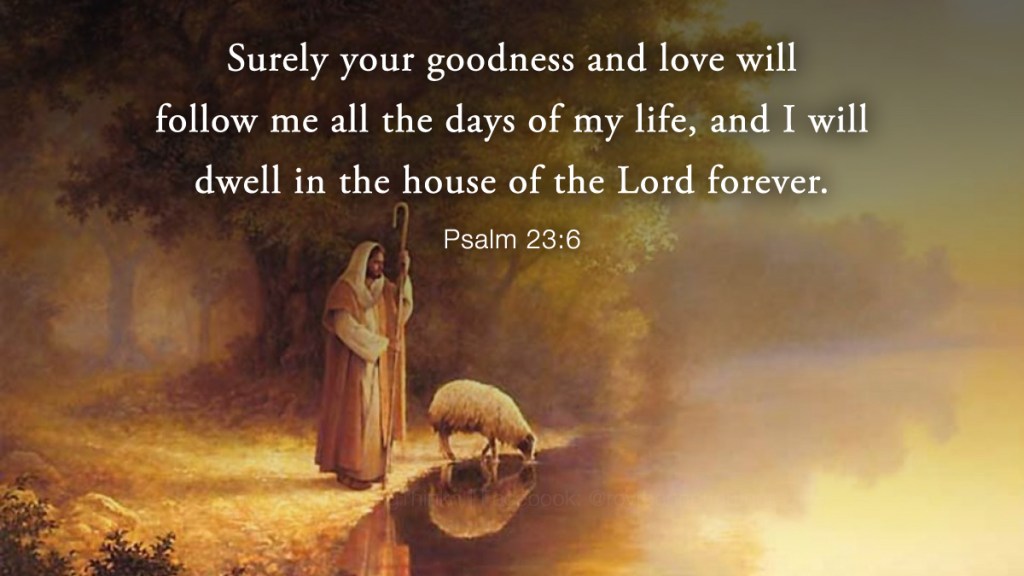
https://translate.google.com/

The Quickest and Most Courageous Way to Make an Attitude Adjustment. Hebrews 4:10-13

Hebrews 4:10-13 Amplified Bible

10 For the one who has once entered His rest has also rested from [the weariness and pain of] his [human] labors, just as God rested from [those labors uniquely] His own. 11 Let us therefore make every effort to enter that rest [of God, to know, experience it for ourselves], so that no one will fall by following the same example of disobedience [as those who died in the wilderness]. 12 For the word of God is living and active and full of power [making it operative, energizing, and effective]. It is sharper than any two-edged [a]sword, penetrating as far as the division of the [b]soul and spirit [the completeness of a person], and of both joints and marrow [the deepest parts of our nature], exposing and judging the very thoughts and intentions of the heart. 13 And not a creature exists that is concealed from His sight, but all things are open and exposed, and revealed to the eyes of Him with whom we have to give account.

The Word of God for the Children of God.

Adeste Fidelis! Venite Adoremus! Dominum.

Gloria! In Excelsis Deo! Alleluia! Alleluia! Alleluia! Amen.

The 19th-century English preacher Charles Haddon Spurgeon once said the Reformation began when Martin Luther found an old discarded Bible in his monastery.

As he postured himself, he began to read it, subtly God’s Word grew like a seed in his heart and his soul, and the result was a world-transforming movement.

But this gentle image of a seed is not the way the incomparable power of God’s Word is described in Hebrews 4:12, one of the key verses in the foundational idea of sola Scriptura, or “Scripture alone.”

Here God’s Word is described as a sharp, powerful, and precise blade, dividing the whole complete truth from all of the rebellious lies we harbor in our hearts.

Only Scripture has this power—not the traditions of any church, nor the acutely accurate insights of any leader.

As Luther said, “A simple layman armed with Scripture is greater than the mightiest pope without it.”

Indeed, in speaking about the Reformation that he initiated, Luther said, “I did nothing. The Word did everything.”

God’s Word, the Bible, has a precision and a power we will find nowhere else.

Will you let it be active in you?

Read it with an open heart?

Let it form the words that come from your mouth?

Let it shape the actions you take?

Adjusting (without our permission and utterly against our wills) our attitudes?

Eventually arriving at the God anointed place where only by knowing and living in and through God’s Word can we please him and serve him in our daily lives?

Is there enough moral courage to let the Word of God take command of our life?

What Does it take to be Courageous?

Isaiah 45:5-7Amplified Bible


“I am the Lord, and there is no one else;
There is no God except Me.
I will embrace and arm you, though you have not known Me,

That people may know from the rising to the setting of the sun [the world over]
That there is no one except Me.
I am the Lord, and there is no other,

The One forming light and creating darkness,
Causing peace and creating disaster;
I am the Lord who does all these things.

Courage back-builds as we spend time soaked in the Truth of God’s Word.

Understanding who God is and who we are as His children allows us to realize our need for Him.

When we don’t know what’s going to happen, God is already there.

He is all-knowing, everywhere, all of the time.

There is no other God, …..

Isaiah repeated three times in today’s key verses.

Any time a word or phrase is repeated in Scripture, we can assume it’s of heightened importance. 

There is no other God. 

He alone is mighty to save.

He gives us what we need to live the lives He’s put us on earth to live, before we even know who He is.

We have a never-ending supply of courage available to us, through Christ Jesus.

His Holy Spirit lives in us, activating a supernatural bravery in each of us who dare to publicly proclaim Him our Lord and our Savior.

The One True God, Father, Son, and Holy Spirit.

There is no other – period!

There can never be another – period!

There will never be another – period!

Our only living hope is in living for Him.

Our only living hope comes from living from Him,

…. as does the courage and bravery we need to wait patiently on Him. 

How does the Word of God define Courage?

Joshua 1:5-9Amplified Bible

No man will [be able to] stand before you [to oppose you] as long as you live. Just as I was [present] with Moses, so will I be with you; I will not fail you or abandon you. Be strong and confident and courageous, for you will give this people as an inheritance the land which I swore to their fathers (ancestors) to give them. Only be strong and very courageous; be careful to do [everything] in accordance with the entire law which Moses My servant commanded you; do not turn from it to the right or to the left, so that you may prosper and be successful wherever you go. This Book of the Law shall not depart from your mouth, but you shall read [and meditate on] it day and night, so that you may be careful to do [everything] in accordance with all that is written in it; for then you will make your way prosperous, and then you will be [a]successful. Have I not commanded you? Be strong and courageous! Do not be terrified or dismayed (intimidated), for the Lord your God is with you wherever you go.”

Courage is born from confidence in our Creator.

Courage shows up 124 times in the Amplified translation of the Bible.

https://www.biblegateway.com/quicksearch/?quicksearch=courage&version=AMP

The dictionary definition of courage is “the quality of mind or spirit that enables a person to face difficulty, danger, pain, etc., without fear; bravery.”

We aren’t promised an easy life following Christ Jesus, but we are guaranteed all we need is the courage drawn from living into, out from, the unchangeable moral, ethical truths in, and throughout the length and breadth of the Word of God to move forward boldly to accomplish what the Lord has set us here to do.

Halley’s Bible Handbook Notes explains “God’s superiority over idols is proven by His ability to foretell the future.

Says Isaiah, our God, whom we worship in our Hebrew nation, not only can do what human beings do, He can do some things that they cannot do: He can foretell things to come.” 

Psalm 27:14 says, 

“Wait patiently for the LORD. Be brave and courageous. Yes, with patiently for the LORD.”

Courage can be stillness, seeking the Lord and waiting patiently for His direction and wisdom.

Instead of rushing to the aid of others to download a situation in exchange for opinions, we wait on the Lord.

Instead of allowing our reactions to go unfiltered, we wait on the Lord’s direction.

It sometimes takes more courage to be still and silent.

Jesus often retreated to pray to the Lord, and returned strengthened.

Isaiah wrote:

“Don’t be afraid, for I am with you. Don’t be discouraged, for I am your God. I will strengthen you and help you. I will hold you up with my victorious right hand” (Isaiah 41:10).

God is doing all of the work!

He is with us, and He is God!

He strengthens us and helps us. He holds us up in His victorious right hand. Christ Jesus sits at the right hand of the Father, victorious over death.

He willingly sacrificed His life for us on the cross, rose three days later, and then ascended into heaven to be seated at the right hand of His Father.

It’s His sacrifice and His victory we draw strength from!

Moses told God’s people, and Joshua, before they entered the promised land:

“So be strong and courageous! Do not be afraid and do not panic before them. For the LORD you God will personally go ahead of you. He will neither fail you nor abandon you” (Deuteronomy 31:6).

God is doing all of the work!

He is with us, and He is God!

He strengthens us and helps us. He holds us up in His victorious right hand.

Christ Jesus sits at the right hand of the Father, victorious over death.

He willingly sacrificed His life for us on the cross, rose three days later, and then ascended into heaven to be seated at the right hand of His Father.

It’s His sacrifice and His victory we draw strength from!

Moses told God’s people, and Joshua, before they entered the promised land:

“So be strong and courageous! Do not be afraid and do not panic before them. For the LORD you God will personally go ahead of you. He will neither fail you nor abandon you” (Deuteronomy 31:6).

Quickest Way From Timidity to Courage to Attitude Adjustment

Hebrews 4:12Amplified Bible

12 For the word of God is living and active and full of power [making it operative, energizing, and effective]. It is sharper than any two-edged [a]sword, penetrating as far as the division of the [b]soul and spirit [the completeness of a person], and of both joints and marrow [the deepest parts of our nature], exposing and judging the very thoughts and intentions of the heart.

Have you ever found yourself in need of an attitude adjustment?

If so, be encouraged, as you’ve reached the most critical step in receiving one by acknowledging and recognizing, confessing and believing you are in need of it. 

Realizing and recognizing there are wrong attitudes in your heart and mind is the breakthrough moment to a new attitude.

So many of us walk around, living day-to-day with no idea we might need some adjustments. 

For sure, God is quick to recognize wrong attitudes in us, even if we think we’re covering them up with our words.

“These people honor Me with their lips, but their hearts are far from Me” (Matthew 15:8).

Although wrong attitudes are often easy for us to see in others, for some reason, they are usually very difficult to see in ourselves.

Because it is sometimes almost impossible to see wrong attitudes within us, what is the quickest way to an attitude adjustment? 

As Hebrews 4:12 explains, when we commit to reading God’s Word, it has the power to cut through our soul and spirit and to judge our heart’s attitudes.

Nothing else in the world has the ability to do so like the living Word of God.

God’s Word Actively Exposes and Corrects Wrong Attitudes

God’s Word is so vital to our daily lives and the quickest way to recognize and reveal hidden mindsets, especially helpful in addressing and adjusting wrong and sinful attitudes.

Because it is alive and active, it doesn’t ever grow outdated or irrelevant to correct current incorrect thoughts and ways of thinking. 

Before wrong attitudes can enter our hearts, God’s Word has the power to stop them before we accept them into our thinking.

As 2 Timothy 3:16 explains, “All Scripture is God-breathed and is useful for teaching, rebuking, correcting and training in righteousness”

Three Ways God’s Word Adjusts Attitudes

As well, Proverbs 6:21,22 describes three ways it has the ability to help us live daily with the right attitude when we take the time to make it the top priority in our lives by reading, studying, and applying it to our lives. 

”Bind them always on your heart; fasten them around your neck. When you walk, they will guide you; when you sleep, they will watch over you; when you awake, they will speak to you.”

1. God’s Word guides our attitudes.

His Living Word will not ask our permission to take the lead in our lives to help us guide our thoughts, Words, and actions each and every day to be aligned with His ways over worldly wisdom and philosophies. 

As 2 Corinthians 10:5 explains, with God’s Living and Active Word,

“We demolish arguments and every pretension that sets itself up against the knowledge of God, and we take captive every thought to make it obedient to Christ.”

2. God’s Word protects our attitudes as we sleep.

Have you ever woken up in a bad mood, feeling disgruntled, upset, negative, and on edge, not knowing why?

Well, that isn’t just by accident.

The enemy of our souls works through the night to influence our thoughts and attitudes. 

But as Christians, we don’t have to wake up with wrong thinking and mindsets because God says His words will protect and watch over us when we’re sleeping, guarding our hearts and minds against the onslaught of the enemy’s attacks.

His Word works as a shield against the enemy’s midnight assaults.

As Proverbs 30:5 assures, “Every word of God is flawless; He is a shield to those who take refuge in Him.”

3. God’s Word speaks to our attitudes during the day.

When we’re awake, God will personally speak to us through His Word.

Because it is alive and active, when we take the time to read it, study it and too, know it, God will speak to us through it at times when we need to hear His voice.

Although some think and believe God’s Word only speaks to us in a general way, truth and Holy Spirit reality reveals He speaks through it to our hearts, to our souls and minds in very personal deep, life-changing, transformational ways.

Intersecting Faith and Life:

How is your attitude today?

How is your attitude right exactly in this exacting moment?

Did you wake up in a bad mood?

Wake up on the Wrong side of the bed or the leftover grounds Coffee Pot?

Too many twists and turns and not enough “straight roads ahead?”

Everybody and their grandmother honking their horns behind a stalled car?

Most of us often don’t recognize wrong attitudes within ourselves, or even worse, until somebody else notices us, repeatedly, annoyingly starts tapping on our shoulder, or nudges their elbows in our ribcage and we justify having them.

If you and I are not sure how you and I are doing today, Pray to God to expose any wrong attitudes in your heart and correct wrong thinking with His Word.

A Hand holding a wrench to adjust the brain in an opened human head.
adjusting, fixing or changing, or creating a new ,better way of thinking.

In the name of God, the Father and God the Son and God the Holy Spirit,

Let us Pray,

Lord, today, in this moment I must confess that sometimes I choose to focus on the contraries and negatives, instead of focusing on what you’ve called me to focus on. Help me take the words of Philippians 4:8 to heart. Help me to find those Words of Scripture which in every moment of every day, will help me to narrow my focus onto whatever is true, noble, right, pure, lovely and admirable, so that my attitude may adjusted, fine tuned to reflect and honor you. As I practice shifting my perspective, keep my heart from growing cold or bitter. Teach me to remember that I am not a slave to my negative emotions. Because of your Holy Spirit, I can tell those emotions to be removed and turn my eyes to the things of you, instead. In Jesus’ name, amen.

Adeste Fidelis! Venite Adoremus! Dominum.

Gloria! In Excelsis Deo! Alleluia! Alleluia! Alleluia! Amen.

https://translate.google.com/

Benefits and Value of God’s Wisdom. Proverbs Chapter 2

Proverbs 2:1-5 English Standard Version

The Value of Wisdom

My son, if you receive my words
    and treasure up my commandments with you,
making your ear attentive to wisdom
    and inclining your heart to understanding;
yes, if you call out for insight
    and raise your voice for understanding,
if you seek it like silver
    and search for it as for hidden treasures,
then you will understand the fear of the Lord
    and find the knowledge of God.

The Word of God for the Children of God.

Adeste Fidelis! Venite Adoremus! Dominum.

Gloria! In Excelsis Deo! Alleluia! Alleluia! Alleluia! Amen.
Wisdom, Knowledge and Happiness

As a boy, Charles Dickens knew poverty from bitter experience.

He never forgot what he had learned.

Many of his novels deal with the huge gap between wealth and poverty.

Perhaps the most unforgettable is A Christmas Carol.

Its main character, Ebenezer Scrooge, is a “grasping, clutching, covetous old sinner” who can squeeze blood out of a stone.

Bob Cratchit, his underpaid bookkeeper, shivers in his unheated corner of the office.

But Bob has learned to be content in his situation.

At the meager Cratchit-family Christmas dinner, Bob proposes a toast: “Merry Christmas to Mr. Scrooge, the founder of the feast!”

Mrs. Cratchit objects with the scornful words about Scrooge, but Bob, in all humility replies mildly, “My dear, it’s Christmas … and for the children!”

For all his poverty, Cratchit has wisdom and happiness.

But Scrooge, for all his wealth, has a bleak and miserable “business sense” life.

Here is something of the complexity and mystery about wealth and poverty.

Most people think and deeply believe that wealth brings happiness.

But that is not always so.

Happiness and contentment can exist in the midst of scarcity.

What’s more, the rich can be righteous, and they can be a blessing to the poor.

And just the opposite is equally true, the righteous poor can be a humble and humbled and humbling blessing to the rich – all one needs is a bit more wisdom.

Knowledge of God, Understanding of God through study of His Word, Faith in God, Wisdom from God and living by his love are the keys to finding happiness.

The “Keys” to “Finding” Happiness

Have you ever had someone try to sell you something? What’s the typical pattern a salesperson uses? First, they tell you all the amazing benefits of their service or product. “Our miracle product…

…will lower cholesterol…”
…will help you burn fat and lose weight…”
…will keep your information safe and secure…”
…will give you better gas mileage…”
…will make you happy and content…”

And then once you’re convinced they show you the price tag…

“For only four payments of $999.99…”
“If you only eat Subway for breakfast, lunch, and dinner every day…”
“If you sign up for our monthly never-ending subscription-based service…”
“Your monthly car payment can be as low as…”
“If you sign your life and soul over we will…”

The typical pattern is—here’s the benefits and then here’s how you get them.

Today, I want to reverse that pattern.

First, I want to tell you how to get wisdom, then I want to tell you its benefits.

This is the pattern our passage takes and I like it because when I finally tell you the benefits of wisdom you’ll be able to weigh in your own mind if it’s worth it.

So first… 

How to get Wisdom

Wisdom is “skill for living”, but living God’s way instead of our own way.

Once again the father-figure in Proverbs is teaching his son (who we can all put ourselves in the place of) how to get wisdom.

He tells him four ways to get wisdom (not four different ways).

You should do them all if you want to get wisdom.

Proverbs 2:1-5New International Version

Moral Benefits of Wisdom

My son, if you accept my words
    and store up my commands within you,
turning your ear to wisdom
    and applying your heart to understanding—
indeed, if you call out for insight
    and cry aloud for understanding,
and if you look for it as for silver
    and search for it as for hidden treasure,
then you will understand the fear of the Lord
    and find the knowledge of God.

The first way to get wisdom we find in verse one.

1. BELIEF IN GOD’S WORD (VERSE 1)

The father-figure says, “My son, if you accept my words and store up my commands within you…”

The author Solomon is talking about a father’s words found in the book of Proverbs, but he’s also talking about God’s whole Word, the Hebrew Scriptures.

The word for commands (mitzvah) can also mean the laws God gave his people Israel (Genesis 26:5; Exodus 26:28).

So it’s like Solomon or the father-figure is saying, “My son, if you want wisdom, believe in God’s Word.” 

Each one of us comes to a turning point in our lives where we have to decide the final rule for our lives.

Is it going to be God’s unchanging perfect words and commands that although they are hard we know they are good, true, and best?

Or are we going to choose our own feelings and intuitions and desires and what the world says is best?

God’s Word offers us a firm-foundation for our lives, a foundation that won’t let us down.

But if we choose anything else we’re choosing something that might say one thing today and a different thing tomorrow.

Eggs are good for you. Eggs are bad for you.

Drink coffee. Coffee is bad for you.

Drink more milk. Drink soy milk. Drink almond milk.

Turn right when we should have turned left or stayed straight and narrow.

Stay with Gasoline Vehicles or “Go Green” with Hybrids and Electric cars.

This career path or that career path

How about with what we understand to be the “serious things” of our lives?

Changing and Shifting winds, sands, and crashing waves “defining” what our “correct” Morals and Ethics are “supposed to be” according to the wisest of the most educated, connected, influential, powerful, wealthy “people” on internet.

How many issues can you think or heard of where 10-20 years ago everyone said one things was seriously averse, now today people say just the opposite?

That is generational shifting sands, that’s stormy waters (James 1:5-8).

How about those who “stay the course on the narrow road” and stay steadfast:

“I only want to build my life on the rock of God’s Word that never changes!” 

Resolving the Ceaseless Conflict between belief and unbelief in Christ the Lord.

Does knowledge and understanding the Word of God for His Children and the outpouring of the anointing oils its blessed wisdom still have any relevance?

First, we get wisdom by believing in God’s Word.

2. MEMORIZATION OF GOD’S WORD (VERSE 1)

We’re still in verse one. What does it mean to “store up” something?

Did any of you prepare for the Y2K bug?

So kids, a long time ago everyone was worried that when the clocks on our computers turned from December 31st 1999 to January 1st 2000 there was going to be a computer meltdown that would cause world food shortages and financial errors—basically, the apocalypse to end all apocalypses.

So prepare people stored up canned food, powdered food, dried food, and water and drinks that would not go bad.

Our single person household bought whole shelves of Kool-Aid powdered drink.

So by golly if the world failed I am still going to have a storehouse of Kool-Aid.

And when Y2K came and no one but Blockbuster video had problems I still had my Kool-Aid powdered drink, for a while it tasted good, then I got tired of it all.

Wisdom ended up throwing most of it out, to this day wisdom will not drink it.

I “stored up” for the long term to avert disaster.

But so much of what I had stored up for the long term spoiled, went to waste.

Likewise, God calls us to “store up” his Word within us to avert disaster in our lives.

How do we do that?

By memorizing themes and passages weaved in and throughout the Bible.

I want to encourage everyone to “store up” God’s Word in our own hearts because God uses it to strengthen us, give us hope, and teach us how to live.

Outline, underline, color mark foundational verses from the bible – what text speaks to your heart and to your soul and to your life at the moment you read it.

Put it on your mirror or fold it over in your Bible, somewhere you will see it and memorize it.

Read, study, pray and memorize other verses too, one’s that will remind you of the never ending relevance, significance of hope and God’s love and promises. 

Second, we get wisdom by memorizing God’s Word. 

3. ACCEPTANCE OF GOD’S WORD (VERSE 2)

Proverbs 2:2 says to turn our ears to wisdom and apply our hearts to understanding.

Do you ever get in a disagreement and the person you are fighting with says, “You’re not listening to me!”

Sometimes that’s true.

One person is not paying attention because they’re too busy talking or thinking.

But usually that means “You’re not agreeing with me.” 

Proverbs 2:2 is saying to get wisdom we need to hear it with our ears and accept it with our hearts and agree to it with our lives.

We need to open ourselves up and let God’s Words and ways sink deep into who we are.

In Hebrew culture the heart was the core of a person, their true identity.

We do not want God’s Word to go in one ear and out the other, but go in through the ear, through the mind, and down deep into our heart.

When I prepare devotionals that’s one of the things I think about.

I want God’s Word to affect me first but then I want it to affect you all too.

We don’t want to just sit here and hear without listing or agreeing.

The absolute significance of God’s Word and truth is too eternally important. 

Third, we get wisdom by accepting God’s Word. 

4. ASK GOD FOR IT THROUGH PRAYER (VERSES 3 AND 4)

This is perhaps the simplest way to get wisdom, ask God for it.

Verse 3 tells us to “call out for insight and cry aloud for understanding” (NIV).

If you and I want wisdom, pray that God will give us some.

Sometimes prayer is the only step we take.

We ask God for wisdom but we don’t try to memorize and understand his Word.

Prayer goes hand and hand with God’s Word.

It’s like peanut butter and jelly or eggs and bacon or it is like fish and chips.

God’s Word and prayer together make a delicious wisdom platter.

If you and I want wisdom, we have to ask God for it. (1 Kings 3:5-15) 

James 1:5 If any of you lacks wisdom, you should ask God, who gives generously to all without finding fault, and it will be given to you. (NIV) 

One of the points Spurgeon makes is that wisdom isn’t just knowing how to “be wise ‘enough’ to make the ‘right decisions’,” but wisdom is a character quality molded, shaped, then reshaped by “interpreting” our experiences.

When you and I pray for wisdom it’s not only that we would make the right choice (it is that) but it’s also praying that God would make us into the kind of people who would make the right choice.

It’s praying God would mold, shape, develop and transform our moral and our ethical character so we choose to do we do it with integrity and discernment. 

So how do we get wisdom? 

First, by believing in God’s Word.

Second, by studying and memorizing God’s Word.

Third, by accepting God’s Word,

and fourth, by asking God for wisdom through prayer. 

Now I’ve told you how to get wisdom, but what are the benefits of wisdom?

What makes it worth doing all those things?

What makes it worth signing up for and sitting inside a classroom for?

The Benefits and Value of Wisdom

The point of these things is not just to do them for the sake of doing them, but for the sake of something greater.

Did you ever watch those old Mastercard commercials?

A man and woman walk into a gas station.

As the gas station attendant rings up their purchases he says:

chips: $3
frozen beverage: $2
gas: $31
starting a new life together: priceless… 

But then the woman shakes her head “no” so the gas station attendant tries again.

rekindling a fire that never went out? (she shakes her head again)
satisfying a much-needed slushy fix?… Priceless.

So what’s the priceless things we are seeking by pursuing wisdom?

God himself. 

Proverbs 2:5-6New International Version

then you will understand the fear of the Lord
    and find the knowledge of God.
For the Lord gives wisdom;
    from his mouth come knowledge and understanding.

Verse 5 says if we seek wisdom, “then you will understand the fear of the Lord and find the knowledge of God.”

The fear of the Lord is believing that God’s “threats are real and his promises are true”.

Jesus’ death on the cross and resurrection from the grave shows us that God’s threats are real—that if we don’t deal with our sins he will put us to death—but his promises are real—that if we put our faith and trust in him he will forgive us of our sins and cleanse us from all unrighteousness.

It’s as we come to understand who God is through Christ Jesus that we begin to actually know God.

Do you want to know about God or know God?

You might know a lot of things about your favorite celebrity or professional sports athlete, you might know what movies they’re in or their batting average, but that doesn’t mean you know them.

There’s a simple test for if you know them.

Do they know you?

If I were to walk up to Tom Cruise or Tom Brady and if I were to name drop your name what would they say?

“Oh yeah. I know him!” Or more likely … “I am sorry, Who?” 

Come with me one step further.

If I were to walk up to God and to name drop your name what would he say?

“Oh yes, I know him/her. I love him/her very much … Or “I am sorry, Who?”

We seek wisdom because we’re seeking God.

We want to know him.

But the next verse tells us this is only possible by God’s grace.

Proverbs 2:6 
For the Lord gives wisdom;
from his mouth come knowledge and understanding. (NIV)

We can only know God if we want to acknowledge God, to know us.

We can only acquire wisdom if God wants to give it to us.

It’s both an “as we seek” and an “as he gives” kind of exchange.

We seek to obey and know God and God gives us a relationship with him.

Or put it in the reverse.

God gives us a relationship with him and so we obey and know God. 

What’s the priceless benefit of wisdom? Knowing God himself. 

The benefits just keep growing out of this.

If you know God you are part of the family and God protects you.

Proverbs 2:7-8New International Version

He holds success in store for the upright,
    he is a shield to those whose walk is blameless,
for he guards the course of the just
    and protects the way of his faithful ones.

Benefit and Value of God’s Protection (Verses 7-19)

Proverbs 2:7-19 New International Version

He holds success in store for the upright,
    he is a shield to those whose walk is blameless,
for he guards the course of the just
    and protects the way of his faithful ones.

Then you will understand what is right and just
    and fair—every good path.
10 For wisdom will enter your heart,
    and knowledge will be pleasant to your soul.
11 Discretion will protect you,
    and understanding will guard you.

12 Wisdom will save you from the ways of wicked men,
    from men whose words are perverse,
13 who have left the straight paths
    to walk in dark ways,
14 who delight in doing wrong
    and rejoice in the perverseness of evil,
15 whose paths are crooked
    and who are devious in their ways.

16 Wisdom will save you also from the adulterous woman,
    from the wayward woman with her seductive words,
17 who has left the partner of her youth
    and ignored the covenant she made before God.[a]
18 Surely her house leads down to death
    and her paths to the spirits of the dead.
19 None who go to her return
    or attain the paths of life.

God’s wisdom grants us protection from potential disasters.

I don’t mean natural disasters but rather God’s wisdom protect us from ourselves, from bad things we might do.

God’s wisdom protects us from:

  • Committing injustice (v9-11) – Sinning against others by treating them unfairly. If God gives us his wisdom we will want to treat others with fairness and equity even at cost to ourselves.
  • Wicked men (or women) who love sin (v12-15) – “those who take advantage of others for their own gain.” As God grants us wisdom and character like His we won’t be drawn to them but will learn how to recognize them for who they are.
  • Unfaithful women (or men) who break their marriage promise (v16-19) Verse 16 says that “Wisdom will save you […] from the wayward woman with her seductive words.” (NIV) Sometimes beauty might cause a break in marriage vows but often it is words, words of affirmation and acceptance. It’s a listening ear. Emotional adultery comes before acting it out. God gives us wisdom so we know how to stay away from relationships that lead to this kind of disaster.

But there’s one more benefit to wisdom. 

A FOREVER HOME WITH GOD (VERSES 20 to 22)

Proverbs 2:20-22New International Version

20 Thus you will walk in the ways of the good
    and keep to the paths of the righteous.
21 For the upright will live in the land,
    and the blameless will remain in it;
22 but the wicked will be cut off from the land,
    and the unfaithful will be torn from it.

Proverbs 2:21 says, “For the upright will live in the land, and the blameless will remain in it;” (NIV)

It’s an interesting way to close this passage in Proverbs because it’s a reminder to the Israelite people that they get to stay in the promised land if they obey God and keep his commandments (Exodus 20:1-17). 

But where’s the promise for us?

The benefits of wisdom are knowing God, protection from mistakes in this life, and an eternal home with God in the life to come.

Hebrews says that the heroes of our faith “were longing for a better country—a heavenly one” (Hebrews 11:16).

If that’s you, if you are the one longing for a better home, then pursue wisdom.

Seek God by believing his Word, memorizing it, accepting it, and prayer.

John 14:5-14New International Version

Jesus the Way to the Father

Thomas said to him, “Lord, we don’t know where you are going, so how can we know the way?”

Jesus answered, “I am the way and the truth and the life. No one comes to the Father except through me. If you really know me, you will know[a] my Father as well. From now on, you do know him and have seen him.”

Philip said, “Lord, show us the Father and that will be enough for us.”

Jesus answered: “Don’t you know me, Philip, even after I have been among you such a long time? Anyone who has seen me has seen the Father. How can you say, ‘Show us the Father’? 10 Don’t you believe that I am in the Father, and that the Father is in me? The words I say to you I do not speak on my own authority. Rather, it is the Father, living in me, who is doing his work. 11 Believe me when I say that I am in the Father and the Father is in me; or at least believe on the evidence of the works themselves. 12 Very truly I tell you, whoever believes in me will do the works I have been doing, and they will do even greater things than these, because I am going to the Father. 13 And I will do whatever you ask in my name, so that the Father may be glorified in the Son. 14 You may ask me for anything in my name, and I will do it.

Wisdom is a gift, but it’s a gift we help work for.

Knowing God is a gift!

Spending eternity with him is a gift!

His protection is a gift!

But they are gifts we have to choose to seek by choosing to seek His wisdom.

John 14:1-3New International Version

Jesus Comforts His Disciples

14 “Do not let your hearts be troubled. You believe in God[a]; believe also in me. My Father’s house has many rooms; if that were not so, would I have told you that I am going there to prepare a place for you? And if I go and prepare a place for you, I will come back and take you to be with me that you also may be where I am.

Let our hearts not be troubled.

Believe in God!

Believe in His Resurrected Son, Jesus!

Believe in God’s Holy Spirit!

Let our Hearts Seek His wisdom and we WILL find our forever home with God!

In the name of God, the Father and God the Son and God the Holy Spirit,

Let us Pray,

Holy God, Word made flesh,
let us come to this word open to being surprised.
Silence our agendas; banish our assumptions; cast out our casual detachment.
Confound our expectations; clear the cobwebs from our ears;
penetrate the corners of our hearts with this word.
We know that you can, we pray that you will,
and we wait with great anticipation. Amen.

Empty us, Great God, of all that prevents us
from hearing what you want us to hear.
Empty us of our preconceptions,
our preoccupations and our prejudices.
Empty us that we might be filled
with your Spirit and your Word.
Empty us that we might be filled for ministry and mission.
In Christ’s name we pray, Amen.

Calm us now, O Lord, into a quietness that heals and listens.
Open wounded hearts to the balm of your Word.
Speak to us in clear tones so that we might feel our spirits leap for joy
and skip with a living hope as your resurrection witnesses. Amen.

Adeste Fidelis! Venite Adoremus! Dominum.

Gloria! In Excelsis Deo! Alleluia! Alleluia! Alleluia! Amen.

https://translate.google.com/