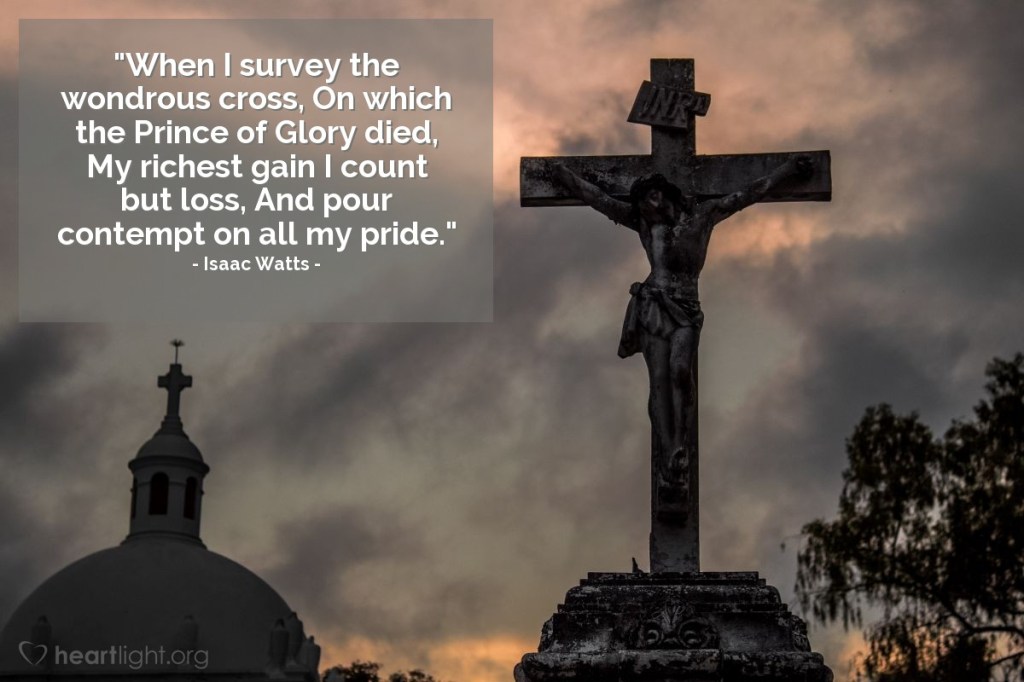
When do we survey the indescribable shame, total ugliness of the Cross? Hebrews 12:1-3

Hebrews 12:1-3 Lexham English Bible

The Example of Jesus’ Suffering

12 Therefore, since[a] we also have such a great cloud of witnesses surrounding us, putting aside every weight and the sin that so easily ensnares us[b], let us run with patient endurance the race that has been set before us, fixing our eyes on Jesus, the originator and perfecter of faith, who for the joy that was set before him endured the cross, disregarding the shame, and has sat down at the right hand of the throne of God. For consider the one who endured such hostility by sinners against himself,[c] so that you will not grow weary in your souls and give up.

Word of God for the Children of God

Glory be to the Father,
and to the Son, and to the Holy Ghost;
as it was in the beginning,
is now, and ever shall be,
world without end. Amen, amen.

How many crosses do you own?

Where are they, and in what style? Writing and recording this today, I could see several crosses around me. There is the cross I wear around my neck and the wooded one around my neck; I also have a wonderfully hand-crafted cross of nails hanging on my wall. These crosses are all simple, artistic and beautiful.

Such majestic representations of the cross pair well with the regal language we use to describe it.

We may speak about the victory we received or how the simple cross testifies to  salvation, love, and forgiveness.

We might sing about the Old Rugged Cross and cherish it deeply.

A favorite hymn of my church growing up described the cross as erected on “some green hill far away outside the city wall.”

It all seems quite regal, quaint, and nostalgic, doesn’t it?

Don’t get me wrong—there is truth in all of this. The cross is a moment of victory, and love and forgiveness coming our way because of it. But there is a deeper too often overlooked truth we must remember: Jesus’s cross was ugly.

Jesus did not die upon some majestic religious symbol.

In the ancient world, the cross was a brutal execution tool, reserved for those deemed unworthy of respect or dignity.

Written in Roman law was the decree that no Roman citizen could be killed on the cross.

The cross was reserved for the worst of the worst, declaring them less than nothing.

The reason why Jesus died on the “green hill far away outside the city wall” wasn’t because this was a place of scenic beauty; no, it was a place wherein the crucified could be mocked. It was the place of the skull, signifying how cut off the crucified was from all life, love, and relationships, and provision for life.

When Jesus hung upon the cross, those standing by Jesus didn’t muse about the love of God; they mocked him.

They derided him.  

They insulted him. “You who could save others, save yourself!” they jeer.  

Come down from the cross, if you can,” they cry. And that grand sign above Jesus, “This is the King of the Jews,” was not written as some statement of faith. This was Pilate declaring defeat over any would-be Israelite King. 

No. Jesus didn’t take on that which was beautiful or majestic, as if it were something easy and dignified. He endured the cross, taking on its shame.

On the cross, Jesus took upon himself everything that makes us squirm, recoil, and feel uncomfortable.

But it was this that testifies to who Jesus is.

Intersecting Faith and Life

Jesus shows his true nature; reveals his fullness as the Messiah, the Savior, the Lord of all, not because he escapes the cross, nor transforms it into some easy, much desirable symbol.

No, He proves who he is, the salvation he brings by hanging there and taking upon himself not an easy or beautiful cross but of derision, mockery, shame.

Jesus scorns all that the cross represents; he shows that he is the pioneer and perfecter of our faith precisely because he understands this is the will of His Father God, obediently endures the cross, takes it on, and does not forsake it.

The cross, therefore, is the symbol of faith precisely because it is ugly, extreme, and a symbol of shame, abandonment, and derision.

The cross represents everything not beautiful, majestic, nor surrounded by pleasantry and Ease.

It symbolizes faith because it is into that place that Jesus entered.

it is into that place we all must enter and utterly embrace and own the moment.

So, as you think about the cross, dare to take a moment and be uncomfortable today.  Dare to be affected. Dare to recognize the very scorn and derision that Jesus felt as he hung brutally beaten and bloodied, dying on the cross for you.

And allow that fact to teach you Jesus doesn’t, will not ever wait for you to feel comfortable and victorious. Jesus doesn’t stand on the sidelines of life trying to avoid the mess. He comes to you in the very place where you should feel the very harshest derision, the utmost profound guilt, and the worst ever shame.

The ugliness of the cross means that Jesus embraces you in all the places where you feel ugly. 

So, look to Jesus. Embrace the cross and uncover how Jesus’s love meets us.

In the name of God, the Father and God the Son and God the Holy Spirit,

Praying …

Suffering and Waiting for Deliverance

For the music director; according to The Doe of the Dawn. A psalm of David.[a]

22 My God, my God why have you forsaken me?
Why are you far from helping me, far from the words of my groaning?
O my God, I call by day and you do not answer,
and by night but I have no rest.[b]
Yet you are holy,
enthroned on the praises of Israel.
Our ancestors[c] trusted you;
they trusted and you delivered them.
They cried to you and were saved;
they trusted you and were not ashamed.
But I am a worm and not a man,
scorned by humankind and despised by people.
All who see me mock me.
They open wide their lips;
they shake the head, saying:
“He trusts Yahweh.[d] Let him rescue him.
Let him deliver him because he delights in him.”
Yet you took me from the belly;
you made me trust while on my mother’s breasts.
10 On you I was cast from the womb.
From my mother’s belly you have been my God.
11 Do not be far from me
because trouble is near;
because there is no helper.
12 Many bulls have encircled me;
mighty bulls of Bashan have surrounded me.
13 They open their mouth against me
like a lion tearing and roaring.
14 I am poured out like water,
and all my bones are out of joint.
My heart is like wax;
it is melted within me.[e]
15 My strength is dry like a potsherd,
and my tongue is sticking to my jaws;
and you have placed me in the dust of death.
16 Because dogs have surrounded me;
a gang of evildoers has encircled me.
Like the lion[f] they are at my hands and my feet.
17 I can count all my bones;
they gaze, they look at me.
18 They divide my garments among them,
and for my clothing they cast lots.[g]
19 But you, O Yahweh, do not remain distant.
O my help, hasten to help me.
20 Rescue my life from the sword,
my only life from the power of the dogs.[h]
21 Save me from the mouth of the lion,
and from the horns of the wild oxen answer me.
22 I will tell your name to my brothers;
inside the assembly I will praise you.
23 You who revere Yahweh, praise him!
Glorify him, all you seed of Jacob,
and be in awe of him, all you seed of Israel,
24 because he has not despised nor abhorred the affliction of the afflicted,
and has not hid his face from him;
but he listened to him when he cried for help.
25 From you is my praise.
In the great assembly,
I will pay my vows before those who revere him.
26 The afflicted will eat and will be satisfied.
Those who seek him will praise Yahweh.
May your[i] heart live forever.
27 All the ends of the earth
will remember and turn to Yahweh.
All the families of the nations
will worship before you.
28 Because the kingship belongs to Yahweh,
and he rules over the nations.
29 All the healthy ones[j] of the earth will eat and worship.
Before him all of those descending into the dust will kneel,
even he who cannot keep his soul alive.
30 Descendants[k] will serve him.
Regarding the Lord, it will be told to the next generation.
31 They will come and tell his saving[l] deeds
to a people yet to be born, that he has done it.

Glory be to the Father,
and to the Son, and to the Holy Ghost;
as it was in the beginning,
is now, and ever shall be,
world without end. Amen, amen.
https://translate.google.com/

If Hope Does Not Disappoint Us, Why Then Are Christians Disappointed All the Time? Romans 5:3-5

Author Hal Lindsey said, “Man can live about forty days without food, about three days without water, about eight minutes without air… but only for one second without hope.”

Hope not only affects how we live, it determined whether or not some people survive such catastrophic events such as natural disasters, devastating family, financial or healthcare news or the sudden unexpected loss of a loved one.

So, how is your hope?

Does it bounce back after being hit?

Or does it pop like a balloon lanced by a pin?

On what or WHO is your hope based?

The Bible shows us that people of faith are people of hope.

That makes sense, doesn’t it?

Those who trust God have more reason for hope than those who don’t.

But hardcore problems without visible solutions test the faith and challenge the hope of even the most devout.

Even when we are “poster children” for disappointment, guess what …

The Bible says to encourage each other every day (Hebrews 4:13).

Romans 5:3-5 The Message

3-5 There’s more to come: We continue to shout our praise even when we’re hemmed in with troubles, because we know how troubles can develop passionate patience in us, and how that patience in turn forges the tempered steel of virtue, keeping us alert for whatever God will do next. In alert expectancy such as this, we’re never left feeling shortchanged. Quite the contrary—we can’t round up enough containers to hold everything God generously pours into our lives through the Holy Spirit!

The Word of God for the Children of God.

Adeste Fideles! Laeti Triumphantes! Venite Adoremus! Dominum.

Gloria! In Excelsis Deo! Alleluia, Alleluia, Alleluia, Amen.

Romans 4, the Apostle Paul recounts the story of the Patriarch Abraham.

Romans 4:1-3 English Standard Version

Abraham Justified by Faith

4 What then shall we say was gained by Abraham, our forefather according to the flesh? For if Abraham was justified by works, he has something to boast about, but not before God. For what does the Scripture say? “Abraham believed God, and it was counted to him as righteousness.”

For the new followers in Rome, Paul greatly emphasized Abraham’s faith.

Paul said even Abra­ham, who was considered a God-fearing and good man, was praiseworthy not because he was so good but because in faith, he believed God.

If we ourselves go read the story of Abraham in Genesis, we will find quite a few examples of Abraham making substantial mistakes and committing great sins.

For example, twice focused only on what mattered most to himself and he lied and told an Egyptian that his wife, Sarah, was his sister (Genesis 12 and 20).

Abraham was a good man in many ways, but he was an ordinary, flawed person, like anyone else.

The great thing about Abraham was not anything about Abra­ham himself; it was his focus on the “one thing:” he faithfully put his trust and hope in God.

Abraham slowly disciplined his focus on what mattered most: believed God’s promises, Abraham faithfully put his hope in God’s being true to his ­promises.

The same is very much true for our disciplining our focus away from us today.

If we focus all of our hope in our own power or our own goodness or strength, we will constantly and continuously be indescribably hopelessly disappointed.

In ourselves, we do not have enough goodness to give us hope for the future.

Focus on faith in God, given to us by Holy Spirit, is the surest source of hope.

Do you and I have any of that self same disciplined focus on hope in God alone?

A Disciplined Focus on God’s Brand of “Sure Hope”

Hebrews 12:1-3 The Message
Discipline in a Long-Distance Race

12 1-3 Do you see what this means—all these pioneers who blazed the way, all these veterans cheering us on? It means we’d better get on with it. Strip down, start running—and never quit! No extra spiritual fat, no parasitic sins. Keep your eyes on Jesus, who both began and finished this race we’re in. Study how he did it. Because he never lost sight of where he was headed—that exhilarating finish in and with God—he could put up with anything along the way: Cross, shame, whatever. And now he’s there, in the place of honor, right alongside God. When you find yourselves flagging in your faith, go over that story again, item by item, that long litany of hostility he plowed through. That will shoot adrenaline into your souls!

A disciplined focus on Hope.

It’s the oxygen our souls need to thrive.

Hope is the wild-eyed creature that pops up after the enemy tries to eradicate the very beating of faith in our hearts.

It’s the essence of being a disciplined Christ-follower and as a hopeless, broken world watches us under an electron Microscope, as they scornfully question, “If hope does not disappoint us, why are you Christians disappointed all the time?”

However, before we can answer that question, we need to define what hope is.

Hope looks like light, seeing hundreds of fireflies lighting up a dark night.

Hope is the long barren heavily scorned and mocked Hannah praying fervently, disciplined in her knowing God hears her while she’s taken for a drunken fool.

Hope is a father staying at hope forgiving his undisciplined wayward child.

Hope is the oxygen our souls need to breathe to stay alive.

Hope is a category 5 torrential downpour that washes the world clean.

Hope is uncountable millions of little green shoots being nourished, unearthed after a long and cold winter’s nap and stretching and reaching to the heavens.

Hope is praying your loved one will be found alive after tragedy strikes.

Hope is knowing we will be reunited with our loved ones on the other side of heaven.

Hope is the soldier at war in a far away land who begged God to use His words to care for, to heal and to love his son or daughter miles away.

Hope is a foster child finally finding his forever home in a family that fiercely loves, protects and cares for them.

Hope is watching your autistic child make a friend.

Hope is walking hand in hand with God the Father, Jesus Christ, Holy Spirit.

What Does ‘Hope Does Not Disappoint Us’ Mean?

The biblical definition of hope is “confident expectation.” 

Christian hope is rooted in faith in the divine salvation in Christ (Galatians 5:5) and through the love poured into us through God’s Holy Spirit (Romans 5:5).

What have you and I been hoping for?

Have we been trying to discipline our hope away from the world and unto God?

Where have we been disciplining our minds, where are we focusing our Hope?

Did anything above resonate with your heart?

Or have you given up?

Maybe you and I are too afraid to invest in hope again because we dread the possibility that if we try too hard to discipline ourselves, we will lose all hope?

Or perhaps we simply don’t remember what hope even feels like anymore.

We are physically, mentally, spiritually exhausted from trying to recall what hope looks, tasted, feels, sounds like – we do not care to know what hope is.

If you’re in this camp, we need to go back to the Bible, discipline ourselves back unto Word of God, to understand God’s hope isn’t the same as the world’s hope.

God’s hope is not and never will be the same as the world’s definition of hope.

Both denote a positive expectation, but the world’s hope is rooted in a fallible person, situation, or thing. God’s hope is rooted in Him.

The basis of Christian hope is found Hebrews 11:1, “Now faith is the substance of things hoped for.”

The Greek word for hope in this passage is ‘hypostasis.  

The anonymous author wrote in the book of Hebrews, “Faith is the ‘hypostasis of things hoped for…” which literally means “that which underlies.”

Meaning our faith in Christ underlies our hope, the deeper our faith is, the more difficult it is for hope to be overthrown and turned into disappointment.

A hope that does not disappoint means God has given us hope that raises up to our defense – to become our sword and shield in the midst of disappointment.

This kind of hope is found not in our avoidance of suffering but our working through it with God the Father, Son and Holy Spirit because, suffering produces joy, perseverance; perseverance, character; and character, hope. (James 1:2-4)

What Is the Context of Romans 5:5?

“Therefore, since we have been declared righteous (justified) through faith, we have peace with God through our Lord Jesus Christ, through whom we have gained access by faith into this grace in which we now stand. And we boast in the hope of the glory of God. Not only so, but we also glory in our sufferings, because we know that suffering produces perseverance; perseverance, character; and character, hope. And hope does not put us to shame, because God’s love has been poured out into our hearts through the Holy Spirit, who has been given to us,” Romans 5:1-5.

We learn what hope means in God’s kingdom through the words of Paul beginning in the fifth chapter of Romans. Full

Here, Paul tells us we have justice, peace, grace, perseverance, character, and hope which is all built on the faith we have in Christ.

The kind of hope that does not disappoint that Paul is talking about here is the kind of disciplined hope that only God can give.

This kind of hope Fully Relies On God—His power, His promises, and the sacrifices He alone made for us.

This type of hope carries a promise because of what He has accomplished.

As we read through the rest of Romans 5, we learn we have this hope because Jesus died for us while we were yet his utterly worst enemies (Romans 5:8).

We have been justified and we will be delivered from all things.

God didn’t save us based on our own righteousness.

We were saved because of our faith, hope and belief and love for God’s Son.

This hope points directly to the glory of God – “we boast in our hope of sharing in the glory of God” (Romans 5:2).

This means, no matter what comes our way: suffering, turmoil, tragedy, death, and heartbreak. God will conquer it all.

In other words, “Hope has a sanctifying effect. We who look expectantly for the return of Christ, knowing that when we see him we shall become like him, and purify ourselves “as he is pure” (1 John 3:3 ).

Hope also stimulates good works.

Following his teaching on the resurrection of the dead, Paul exhorts readers to do be “steadfast and immovable doing the Lord’s work abundantly since such “labor is not in vain” (1 Corinthians 15:51-58 ).”

Then, How Exactly Can Christians Hope When They Experience Disappointments?

Throughout Scripture, we find the same message trusting in God’s promises and hoping in the Lord:

“Let us hold unswervingly to the hope we profess, for he who promised is faithful” Hebrews 10:23.

“I pray that your hearts will be flooded with light so that you can understand the confident hope he has given to those he called—his holy people who are his rich and glorious inheritance” Ephesians 1:18.

“I wait for the LORD, my whole being waits, and in his word, I put my hope” Psalm 130:5.

If we read in between the vast array of scriptures about hope, we will also find hundreds of people inside the Bible who experienced true utter disappointment: Adam, Eve, Hagar, Job, Hannah, Moses, Sarah, David, Jacob, Gideon, Jeremiah, Isaiah, Jonah, the exiles, Nehemiah, Jesus, the Disciples, Paul, Elijah, others.

Yes! Even Jesus experienced disappointment during his ministry: when the people didn’t receive His message, when His disciples struggled with doubt, or when He encountered those legalistic religious leaders who wanted to kill Him.

Yet, each and every one of these biblical accounts of real-life people are marked by moments of every single one of them decisively overcoming disappointment.

They also went to accomplish great things for God and some even accomplished things beyond their wildest dreams.

The common thread of each of them was their hope in God.

Their belief in God was bigger than their disappointment.

Instead of blaming God when tragedy struck, instead, they turned to God.

“Hope in God transcends the lost hopes of human frailty and sin and begins to take effect in our lives precisely when human hopes are gone” (Romans 4:18).

How can Christians hope when we experience disappointments?

We put our hope in the Lord as we look at Paul’s example in Philippians 4:4.

Here, Paul was suffering greatly but he was writing to the church in Philippi which happened to be a church that was exceptionally poor.

But Paul was writing to them from a Roman Prison to encourage them to keep a disciplined, focused hope as they learn to be content with having much or little.

Paul wrote to encourage them through his example walking with Christ, even in the midst of disappointment, he could deal with humble means or prosperity.

No matter the circumstance Paul persevered through hope because no matter what came, he “can do all things through Christ’s strength, (Philippians 4:13, ESV).

The exact same One whose Grace strengthened Paul and provided contentment, courage, and a disciplined and focused hope is exact the same One working all things together—even disappointment—for our good too (Romans 8:28).

Because of the Sovereignty of God, Jesus’ resurrection power at work in us, the Holy Spirit interceding and praying for us when we have not the wherewithal to intercede for self, we can breathe in His kind of Hope that does not disappoint.

In the name of God, the Father and God the Son and God the Holy Spirit,

Let us Pray,

Prayer for a Hope That Does Not Disappoint

Lord God, our Creator, Author of our Life and Perfecter of our Hope, we raise our hearts, our souls, our hands high to thank you for your peace and for being our true source of hope. No matter what we walk through, may we lean on you. I believe that the hope you give us will not disappoint. You are working through every struggle and hardship we face. We will not be disappointed because of the salvation and blessing of a heavenly inheritance through Jesus Christ. Help us to abound in joy and to rest in your loving arms. Give us grace, strength, to lean on your powerful promises today.

Dear God, we praise you because you are true to your promises, we thank you that you are the true source of hope. Help us, by your Holy Spirit, to put our hope in you.

Adeste Fideles! Laeti Triumphantes! Venite Adoremus! Dominum.

Gloria! In Excelsis Deo! Alleluia, Alleluia, Alleluia, Amen.

https://translate.google.com/

Growing Up to Become a Child – Descriptions of a Childlike Faith. Matthew 18:1-5

Matthew 18:1-6Amplified Bible

Rank in the Kingdom

18 At that time the disciples came to Jesus and asked, “Who is greatest in the kingdom of heaven?” He called a little child and set him before them, and said, “I assure you and most solemnly say to you, unless you repent [that is, change your inner self—your old way of thinking, live changed lives] and become like children [trusting, humble, and forgiving], you will never enter the kingdom of heaven. Therefore, whoever [a]humbles himself like this child is greatest in the kingdom of heaven. Whoever receives and welcomes one [b] child like this in My name receives Me; but whoever causes one of these little ones who believe in Me to stumble and sin [by leading him away from My teaching], it would be better for him to have a heavy millstone [as large as one turned by a donkey] hung around his neck and to be drowned in the depth of the sea.

The Word of God for the Children of God.

Adeste Fidelis! Venite Adoremus! Dominum.

Gloria! In Excelsis Deo! Alleluia! Alleluia! Alleluia! Amen.

Growing Up to Become a Child

What does the man, Rabbi Jesus, mean by saying to his disciples that we each need to “change and become like the little children who are among us”?

One clue we have here is that Jesus is responding to the question “Who is the greatest in the kingdom of heaven?”

And he replies, “Whoever takes the lowly position of this child is the greatest in the kingdom of heaven.”

In the Gospel narratives about Jesus and his disciples (Matthew, Mark, Luke, and John), we somehow find that the disciples often argued over which of them was, is and is about to become greatest; they seem to have been a competitive group.

And it seems they were thinking of greatness in terms of authority, leadership, knowledge, ­power, influence, “one above equals,” thrones and of other things.

So Jesus is seemingly telling all of his disciples that they need to change their attitudes about greatness and to become lowly and humble like little children.

Jesus’ followers, whether ancient or contemporary need to die to their selfish ambitions, realize that, just as little children depend on parents and caregivers, we are all totally dependent on Father God for all our needs and future living.

Here’s another hypothetical thought. A man in his sixties said, “Last week my five-year-old grandson said he wanted to be a firefighter when he grew up. I replied, ‘And when I grow up, I want to be a five-year-old boy.’ My grandson stared at me with wide, wondering eyes.”

Have you looked around at your own children or grandchildren and pictured yourself having such a “wide eyed wondering hypothetical conversation?”

Have you looked around at God’s world with “wide, wondering eyes” lately?

That’s something which I long for when I look at my own almost nine year old grandson when hear the clarion call to change and to become like a little child.

Descriptions of a Childlike Faith

Rabbi Jesus’ statement to His disciples in Matthew 18:3 about them not entering the kingdom of heaven unless they are converted and become as little children speak volumes and volumes of truth of the importance of living a childlike faith.

But what is childlike faith?

What makes one’s faith childlike?

Faith which is Rooted in Security

During the days of childhood, one learns how to survive and prosper, how to live under authority, how to live, love and share, and how to serve and praise.

A well-cared-for child has no worries about house or car or any credit card payments, no anxious moments over getting married to the right one, career or job opportunities, no apprehensions about failure, no thoughts of vengeance.

David exemplified this kind of faith while he was on the run from Saul.

Psalm 131:1-2Amplified Bible

Childlike Trust in the Lord.

A Song of [a]Ascents. Of David.

131 Lord, my heart is not proud, nor my eyes haughty;
Nor do I involve myself in great matters,
Or in things too difficult for me.


Surely I have calmed and quieted my soul;
Like a weaned child [resting] with his mother,
My soul is like a weaned child within me [composed and freed from discontent].

In Psalm 131:1-2, David compared the calmness and serenity he had in the Lord to that of a weaned child with his mother.

Composed, content with God and the works He was doing in his life, David did not concern himself with great matters such as any selfish ambition and self-promotion – rather, he found serenity and security in his relationship with God.

Surely goodness and mercy and unfailing love shall follow me all the days of my life,
And I shall dwell forever [throughout all my days] in the house and in the presence of the Lord. (Psalm 23:6)

To have a childlike faith is to find serenity and security in our relationship with God no matter the circumstance.

Faith Which Praises

Jesus loved children. He loved to use children to teach hard-headed and hard-hearted grown-ups about faith and praise.

While preaching in the region of Judea, Christ was encircled by a great crowd.

Matthew 19:13-15Amplified Bible

Jesus Blesses Little Children

13 Then children were brought to Jesus so that He might place His hands on them [for a blessing] and pray; but the disciples reprimanded them. 14 But He said, “Leave the children alone, and do not forbid them from coming to Me; for the kingdom of heaven belongs to such as these.” 15 After placing His hands on them [for a blessing], He went on from there.

He later reminded the priests and scribes that “the mouth of babes and nursing infants” would offer praise fitting for God’s Anointed (Matthew 21:16).

When Jesus entered Jerusalem riding on a colt, a very great multitude that included children cried out saying, “Hosanna to the Son of David! Blessed is He who comes in the name of the Lord! Hosanna in the highest” (Matthew 21:9)!

The sound of the children praising Jesus in the temple courts made the chief priests and scribes indignant.

In response, Jesus quoted from Psalm 8:2.

God does not only want prayer in His house, He also delights in praise.

To have a childlike faith is to have a heart that always longs to praise and glorify God in each and every life’s circumstance.

Faith Which Believes

Jesus used the lad with the five barley loaves and the two small fish to feed five thousand people (John 6:9).

To show His power over death, Jesus used a little girl. Jairus, a ruler in the synagogue, fell at Jesus’ feet begging Him to come to his house and save his dying twelve-year-old daughter.

Jesus agreed and tried to make His way with Jairus, but the surrounding crowd made the trip difficult.

Word came that Jairus’ daughter had died.

But Jesus responded, “Do not be afraid, only believe and she will be made well” (Luke 8:50).

At the house, as the parents wept over their loss, Jesus said, “She is not dead but sleeping” (Luke 8:52).

Through tears, the people laughed at the impossibility of what they heard.

Jesus then asked everyone to leave the room, and then He said, “Little girl, arise” (Luke 8:54), and she did!

Romans 4:17 says that “God gives life to the dead and calls those things which do not exist as though they did.”

Jesus spoke to the girl with the power of God, and she was raised from the dead.

Jairus’ faith definitely played a part in the miracle healing of his daughter just like the faith of the woman who had been bleeding for 12 years had made her well (Luke 8:43-48).

Nothing is impossible with God if we would just believe.

This is what it means to have childlike faith.

Faith Which is Humble

Another time, Jesus used a child to teach humility.

In Matthew 18:1-5, we read how the disciples came to Jesus asking, “Who then is the greatest in the kingdom of heaven?” and how did Jesus respond?

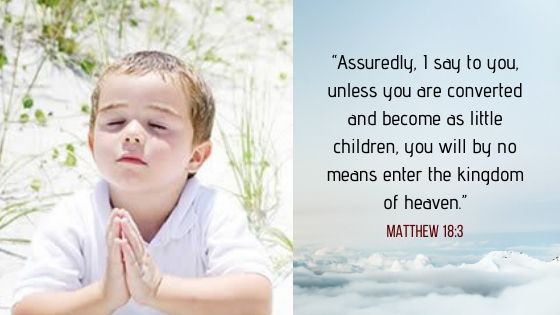
He called a little child to Him, set the little child in the midst of them, and said, “Assuredly I say to you, unless you are converted and become as little children, you will by no means enter the kingdom of heaven.”

He then went on to say, “Therefore whoever humbles himself as this little child is the greatest in the kingdom of heaven. And whoever receives one little child like this in My name receives Me.”

The fact that Jesus had been sharing with the disciples that truth about His approaching suffering and death did not affect them for they were thinking only of, about themselves and what position they would have in His Kingdom.

So self-absorbed were the disciples in this matter that they actually argued with each other in the presence of Rabbi Jesus himself (Luke 9:46).

Pride – the very sin that caused Satan to be cast down from heaven is what’s causing people to think of themselves more highly than others.

When Christians are living for themselves and not for others, conflict and division are bound to result (James 4:1-2).

True humility means knowing ourselves, accepting ourselves, and being ourselves – our best self – to the glory of God ALONE!.

It means avoiding two extremes:

Thinking less of ourselves than we ought to (as did Moses when God called him, Exodus 3:11), or thinking more of ourselves than we should (Romans 12:3).

The truly humble person does not deny the gifts God has given him or her but uses them to the glory of God.

The truly humble person also helps to build up others, not to tear them down.

Hebrews 12:1-3Amplified Bible

Jesus, the Example

12 Therefore, since we are surrounded by so great a cloud of [a]witnesses [who by faith have testified to the truth of God’s absolute faithfulness], stripping off every unnecessary weight and the sin which so easily and cleverly entangles us, let us run with endurance and active persistence the race that is set before us, [looking away from all that will distract us and] focusing our eyes on Jesus, who is the Author and Perfecter of faith [the first incentive for our belief and the One who brings our faith to maturity], who for the joy [of accomplishing the goal] set before Him endured the cross, [b]disregarding the shame, and sat down at the right hand of the throne of God [revealing His deity, His authority, and the completion of His work].

Just consider and meditate on Him who endured from sinners such bitter hostility against Himself [consider it all in comparison with your trials], so that you will not grow weary and lose heart.

This person is a stepping-stone, not a stumbling block.

This person is a building block not a stumbling block.

Thus, we must seek to remove from our lives anything that makes us stumble.

If we don’t, we will cause others to stumble as well.

Which Jesus Himself said was not a very good, very healthy, very wise, idea.

Matthew 18:6Amplified Bible

but whoever causes one of these little ones who believe in Me to stumble and sin [by leading him away from My teaching], it would be better for him to have a heavy millstone [as large as one turned by a donkey] hung around his neck and to be drowned in the depth of the sea.

An unspoiled child has the characteristics that make for humility: trust, dependence, a desire to make others happy, and an absence of boasting or selfish desires to be greater than others.

By our nature, we are all rebels who want to be celebrities instead of servants.

And so we need a great deal of teaching for us to learn the lesson of humility.

Concluding Thoughts ….

As Christians, we are encouraged to have childlike faith.

To have faith like a child is to completely embrace, trust our heavenly Father’s goodness, care, provision, leadership, His security, vigilance and protection.

Have you experienced the peace of a well-cared-for child in letting Jesus take care of your worries?

Have you found the healing that faith in Jesus brings?

Have you praised His name with the joy of a child?

Have you answered Jesus’ call in childlike faith, asking Him to be your Savior?

In the name of God, the Father and God the Son and God the Holy Spirit,

Let us Pray,

Psalm 17The Message

17 1-2 Listen while I build my case, God,
    the most honest prayer you’ll ever hear.
Show the world I’m innocent—
    in your heart you know I am.

Go ahead, examine me from inside out,
    surprise me in the middle of the night—
You’ll find I’m just what I say I am.
    My words don’t run loose.

4-5 I’m not trying to get my way
    in the world’s way.
I’m trying to get your way,
    your Word’s way.
I’m staying on your trail;
    I’m putting one foot
In front of the other.
    I’m not giving up.

6-7 I call to you, God, because I’m sure of an answer.
    So—answer! bend your ear! listen sharp!
Paint grace-graffiti on the fences;
    take in your frightened children who
Are running from the neighborhood bullies
    straight to you.

8-9 Keep your eye on me;
    hide me under your cool wing feathers
From the wicked who are out to get me,
    from mortal enemies closing in.

10-14 Their hearts are hard as nails,
    their mouths blast hot air.
They are after me, nipping my heels,
    determined to bring me down,
Lions ready to rip me apart,
    young lions poised to pounce.
Up, God: beard them! break them!
    By your sword, free me from their clutches;
Barehanded, God, break these mortals,
    these flat-earth people who can’t think beyond today.

I’d like to see their bellies
    swollen with famine food,
The weeds they’ve sown
    harvested and baked into famine bread,
With second helpings for their children
    and crusts for their babies to chew on.

15 And me? I plan on looking
    you full in the face. When I get up,
I’ll see your full stature
    and live heaven on earth.

Adeste Fidelis! Venite Adoremus! Dominum.

Gloria! In Excelsis Deo! Alleluia! Alleluia! Alleluia! Amen.

https://translate.google.com/