A Lesson about Wholly Refreshing Our Priorities: What is the significance to us to make, take time, with the Holy One? Mark 1:35-39

Mark 1:35-39 New International Version

Jesus Prays in a Solitary Place

35 Very early in the morning, while it was still dark, Jesus got up, left the house and went off to a solitary place, where he prayed. 36 Simon and his companions went to look for him, 37 and when they found him, they exclaimed: “Everyone is looking for you!”

38 Jesus replied, “Let us go somewhere else—to the nearby villages—so I can preach there also. That is why I have come.” 39 So he traveled throughout Galilee, preaching in their synagogues and driving out demons.

The Word of God for the Children of God.

Adeste Fideles! Laeti Triumphantes! Venite Adoremus! Dominum

Gloria! In Excelsis Deo! Alleluia, Alleluia, Alleluia! Amen.

What’s least important?

What’s most important?

What has no priority whatsoever?

We usually consider whatever is the most urgent to be the most important.

When we need to use the bathroom, for example, that particular need becomes both urgent and important, something that must for the moment take priority over everything else lest we risk great personal, perhaps public embarrassment.

For a Diabetic individual, monitoring their blood sugar levels throughout the day on a regular basis is quite important as is meal planning and Insulin shots.

Many things take a top priority spot in our lives.

Many things take a low priority spot in our lives.

Higher priority items might sometimes be a classic movie or television show we watched in our youths and now we’ve been waiting to see the reruns streamed.

It might be planning, a “bucket list” trip we want to take, or a special event we want to arrange – a wedding anniversary or attend – your child’s violin recital.

Sometimes it might be something we want to buy, maybe some new music, a pair of jeans, a computer, or have been saving a long time for: a car or a house.

The priority might be education, a relationship, a job, a job promotion, a fun long term project.

It might be recovery, rest and rehabilitation from an illness, an accident, a crime, tragedy or a difficult ordeal – a parent or spouse or child passed away.

Making Time, Taking Time, Giving Time Away

In the streaming series The Chosen, one episode depicts Jesus returning to a camp where he and his disciples are staying for the night.

It is late, and Jesus has spent the day healing crowds of people.

He stumbles into camp, exhausted from the day’s ministry.

The disciples can only watch him, surprised at how tired he is.

His teaching and healing work must have been exhausting.

Though he was fully God, Jesus was also fully human, so he still got tired and still needed his sleep to recover from the days busyness. (Mark 4:38; John 4:6).

A Lesson About Assessing Reassessing Our Priorities

Mark 1:35-39 New Living Translation

Jesus Preaches in Galilee

35 Before daybreak the next morning, Jesus got up and went out to an isolated place to pray. 36 Later Simon and the others went out to find him. 37 When they found him, they said, “Everyone is looking for you.”

38 But Jesus replied, “We must go on to other towns as well, and I will preach to them, too. That is why I came.” 39 So he traveled throughout the region of Galilee, preaching in the synagogues and casting out demons.

Prayer is a Priority

Prayer is the kind of priority that lies at the root of all the others — at the root of life itself.

It’s a lot like eating; if we rarely eat, our physical health will suffer.

We’ll be weak and sick.

It will affect our ability to carry on the activities of life.

In a similar way, if we rarely pray, our spiritual life will lack vitality.

We will approach the challenges and successes of life on our own, as though we are not totally dependent on God even for life itself.

Without prayer, we prioritize pride, begin to take credit for the good things in our lives, chalking them all up to our skill, knowledge, wisdom and hard work.

We begin to forget that all our skill, knowledge, wisdom and hard work are gifts of God—God alone gave us the mind, body and circumstances of life which have enabled us to have and develop those attributes.

On the other hand, without the discipline of prayer, we fall into fear, anxious worry and even despair at the failures, frustrations and bad events in our lives.

We become unsure of God’s love for us, unsure that God stands with us, God is always accessible and always available, always receptive in each our problems.

The length and breadth of God’s Word reminds us we will definitely feel alone and afraid, doubtful about our ability to cope with what life is heaping onto us.

The disciplined practice of Prayer is the grease, we might say, which keeps the gears and wheels of life well and sufficiently lubricated, in good working order.

Without prayer, we see ourselves as alone against the world, left to fend off the storms of life on our own wits and brawn.

It is in the course of bending our souls in prayer we learn to see the true state of things — that we are all creatures within God’s creation, creatures dependent on our Maker, on all of the other parts of the creation, and as such, never alone.

Hard to Find Time

It’s a crowded, hectic world for most people.

Opportunities for time alone, much less for prayer, are more and more limited.

Life already has its cascade of immediate demands, its already duly scheduled priorities lined up to overwhelm us and keep us forever playing catch-up—jobs, classes, homework, housework, yard work, kids, church, health problems, car repairs, home repairs, accidents, ants, traffic, crowds, lines, appointments and, oh yes, hopefully prayerfully enough time to experience that good quality sleep.

Of course, there might well also be a considerable amount of time that we could devote to prayer that we use on other things — things that don’t really have the kind or measure of priority that the discipline of prayer should should receive.

For example, most of us have our favorite television show, and that’s fine.

But how often do we find ourselves sitting in front of the television — watching shows we do not really care about, just “lazy television” — just because nobody had the proper measure of motivation to get up and turn the infernal thing off?

We make priorities out of things we care about.

It isn’t that we don’t care about the discipline of regular prayer, it’s just that it often seems like it just becomes one more chore on top of all the other chores we have to get done around the house, and since God does not cry or whine when God does not get his dinner or send collection agents out to repossess the washing machine, we’ll automatically put prayer farther down the priority list.

It might be helpful to see the discipline of prayer in a different light from that of one more chore to get done before supper (or after) turn off the light at night.

Time with God is different from all other time.

It defuses the stress, refreshes and rejuvenates the heart, spirit and the soul.

It relaxes the mind and body to release unto God our worries, our anger, fear and anxieties.

It’s a better antidote to frustration than nibbling on donuts or chocolate bars.

It sufficiently fills our need for intimacy better than affairs or pornography.

It’s a far more productive way to handle anger than exploding at our spouses and children. It lasts; those alternatives don’t.

Therapy, Not a Duty

It’s easy to view prayer as a duty, an obligation.

When we do that, prayer becomes hard, something to put off, a burden and pressure all by itself.

What a tragedy.

We would hardly consider talking to our best friends a duty.

We talk to them because we like them.

It’s a spiritual lift to talk to them.

It helps us feel better, reminds us we are actually not alone in this world, gives us strength to carry on.

It’s harder with God.

God’s invisible.

And God does verbally not say much.

Sometimes we wonder if God’s even there at all.

We have the Bible, but a book is not the actually same as an oral conversation.

Talking to God takes place, you could say, in our heads, by faith, not by sight, taste or touch or sound.

We cannot look God in the eye, smell him, shake his hand or pat his back.

Instead, we “sense” his presence in some spiritual, unseen way.

We believe.

We trust.

We have faith.

The Holy Spirit, also invisible, tasteless and odorless, communicates God’s reality to us on a level other than our five physical senses.

We do not understand it; we can only experience it.

Spending this quality time with God is great therapy.

Therapy is necessary remedial treatment of a bodily disorder, whether physical, emotional or psychological.

When we think of prayer as much needed therapy, rather than as “our Christian duty,” it puts prayer into a clearer perspective, I personally believe.

When we go through our daily, weekly, monthly routines without consciously acknowledging God as the root and core of our lives (which he is), our attitudes, emotions, psyche, even the bones in our bodies (Psalm 6:2, Psalms 31:10, 32:3, Psalm 42:10, Psalm 102:3) suffer the ill effects of trying to live as though we are self-existent — not dependent on God and his creation for our life and being.

To hand over our concerns to God, whether for ourselves or for others, reminds us that our present lives and the remaining future of our life are in God’s hands.

Even our past, with all its baggage of sin, selfishness and ignorance, is in God’s redemptive hands.

The act of acknowledging God as the loving, wise and powerful Being that he is is remedial treatment for fear, worry and frustration.

It’s like an expert massage, removing tension and stress from our muscles, only better.

Who would not appreciate a great massage from God’s own hands every day?

Prayer is the perfect therapy for our tense, knotted and stressed spirits, and the best thing about it … it’s absolutely free!

We can take a moment for a quick spiritual “rubdown” in the form of silent prayer just about any time we want during the day.

And we can set aside time for a good, long session at times that work with our schedules.

Think about it: if we had an unlimited valued gift certificate for a free full-body massage every day, we would likely find a way to work it into our schedules as regularly as possible — even if we had to get up set our alarms before everybody else and hightail it down to the gym or the spa before it opened up at 5:30 a.m.

We would do that because we know what good therapy it is and how good it makes us feel.

Not a Substitute For Action

There is another thing we can learn and appreciate from Jesus’ early morning hike to a solitary place for prayer.

When it’s time for action, it’s time for action.

When your child or your spouse needs your attention, it is not the time to go off and play a round of golf, but is an absolute time for us to stop, drop and to pray.

And the again, when you need to repair a faucet, or make a call, or to prepare a meal, it’s not the time make excuses and to disappear for an hour in a closet.

We can and should be able to pray any time, any place, while we go about our business – but we absolutely need to attend to the business of caring for home.

The time to go to a solitary place for extended prayer is a time when we don’t have other more pressing priorities, duties, responsibilities and obligations.

How did Jesus do it?

In the instance cited in this passage, he got up early, before the regular day’s activities began.

You might find that other times work better for you.

The point is, see prayer as a priority that will make all your other priorities more manageable and less stressful.

Let your prayer time be a time to relax, to let God’s love bathe and salve your frayed nerves, your taut emotions, your exhausted and frightened heart.

Let prayer time be your time to rest in God, to let him renew your strength, brighten your hope, sharpen your faith.

Has prayer slipped to the bottom of your “to do” list? Why not set aside some time today for an overdue therapy session with the Master Therapist?

For reflection:

  • Does prayer seem like a chore to you? Why or why not?
  • Do you have trouble thinking of things to pray about? Have you thought of sitting quietly with God as a valuable part of your prayer time?
  • What are some of the ways prayer has helped you?
  • How would you describe “answered prayer”?
  • What is your favorite place for prayer?

Take Time for the Holy One

Mark 1:35-37 New International Version
Jesus Prays in a Solitary Place

35 Very early in the morning, while it was still dark, Jesus got up, left the house and went off to a solitary place, where he prayed. 36 Simon and his companions went to look for him, 37 and when they found him, they exclaimed: “Everyone is looking for you!”

Our reading for today explains that after a long day of teaching and healing, Jesus rose early in the morning to pray. Jesus needed time to connect with his Father in prayer, resting in his Father’s presence and focusing on his purpose.

He had come to do much more than heal people in Capernaum, even though that was clearly important while he was there.

When the disciples went out and found him, he said, “Let us go somewhere else—to the nearby villages—so I can preach there also. That is why I have come.”

Jesus deliberately, intentionally, purposely moved off quietly, spent time alone in prayer with his Father in Heaven, and he remained focused upon his purpose.

If this was important to Jesus, it is certainly important for his followers too.

There is perhaps no better gage of a man’s spiritual maturity than his secret devotion to God in prayer.

You show me someone that is lax in private prayer, I will show you someone that is a spiritual infant.

I don’t care how long they have known Christ, if they have no secret devotion to God; they remain in a stage of immaturity.

Our public prayers will tend to be ritualistic; they will tend to be mechanical, often repetitious, and sometimes ostentatious.

We will have no appetite for the Word; we will have no burden for the lost.

We will be infatuated with the pleasures of this world.

People without a private prayer life will lack power in ministry.

The theme of Christ will seldom be prominent in their conversations because it’s not dominant in their heart.

In fact I have never met a person with a robust private prayer life who struggles with debilitating depression, addictions, or some life-dominating sin.

I have never heard a spouse complain about a husband or wife who is faithful in private prayer.

I’ve never heard a child weep because they have a father or mother that prays too much.

I would ask everyone, do they only prayer before meals or do they ever pray before dawn?

Most if they are honest, would say their prayer life is limited to before meals.

Or when some great crisis comes into their lives.

But frankly, most people are unfamiliar with the mercy seat.

They are strangers to the throne of grace.

Communing with the Savior of their souls is just not as high priority as it should be because it is not the first and foremost desire of their hearts.

And why is this?

Well partly because we are a very undisciplined people, but primarily also it’s because we prioritize love of other things more than we love the Lord our God.

I have learned that prayer is the drill that bores deep into the caverns of living water.

I have learned that prayer is what calls upon the Spirit to give fresh life to the spiritually dead and dissolve hardened hearts.

As a Lay Pastor, I have learned that it is prayer that ignites a preacher with holy zeal and transforms his clumsy long winded rhetoric into tongues of holy fire.

I have learned, beloved, that it is the personal exercise of prayer, disciplined, fervent, private, persistent prayer that transforms weak, shallow, cowardly Christians, and their “skin and bones” Christianity into mighty warriors of the Cross and that is what Christ wants, I want for you, that is what I want for me.

Dear Christian, secret prayer was our Savior’s habit, the question is, is it ours?

If not, why not?

If the Son of God who had no sin had such an indescribably intense desire to labor in private prayer, how much more should we being so prone to our sin?

Frankly most Christians are mere “spiritual loiterers”, they are not laborers in prayer, and yet this is not the example of the Lord.

As we look at verse 35, again, where we read, “In the morning, while it was still dark, Jesus got up, left the house, and went away to a secluded place, and was praying there.”

I believe there are 4 great lessons emerging from this text which I pray each of us will take some quality and quantity of time to focus carefully upon:

  1. Prayer reveals an intense longing to commune with God
  2. Prayer should be the first priority to prepare our day.
  3. Solitude is the Sanctuary of prayer.
  4. Prayer is as important in times of blessing as it is in times of distress.

So first, Prayer reveals an intense longing to commune with God.

Let’s look at this more closely.

Now any of us who have ever spent time teaching know it is an exhausting task especially when you are interacting with people as the Lord had done that day.

Then if we have ever experienced intense, powerful healing encounters, and certainly I have never experienced it like Jesus, we cannot appreciate tiredness.

My friends that is utterly exhausting.

Yet, we see here,

He doesn’t give up, He doesn’t stay in bed and sleep.

Instead, we see the incarnate Christ who was without sin, therefore without any need for confession, He had no pleading, no need for forgiveness of sin, and no need for restoration, instead He longs to be with His Father and the Holy Spirit.

Remember, Jesus knew that His source of strength (certainly the place where He would go to supplicate for all that the Father had given Him) was His Father.

But we see in this text from Mark’s narrative that His intense longing for intimate communion was motivated primarily by His perfect love and His intimate enjoyment of “taking time away” his sweet fellowship with Him.

Again, does this describe you?

Hopefully you’ve experienced this at some human level.

Just think of your husband or you wife, those of you that are married.

I know that the times that I have that I can spend with my dear wife is done not out of duty, but out of intense love and intense desire.

It’s motivated by my love for her and her love for me, which results in the true oneness of fellowship and the joy that flows from that.

How much more the soul satisfying perfections of the triune Godhead.

Now think about it very long and very deeply and very intently and purposely,

no man—save the God-man Jesus—has ever known the soul satisfying joy of perfect fellowship and communion with God the Father and the Holy Spirit.

While every saint enjoys some level of faith, joy and fellowship, because of the varying places we are with respect to our walk with Christ, we still, even though our fellowship is imperfect, we still enjoy spending time with the Lord.

How much more so the Lord Jesus?

I think about the imperfect fellowship that we have right now.

Our communion is hampered because of remaining sin, because of our unredeemed bodies that await their final glorification.

That is why Paul said in 1 Corinthians 13:9:

“we (only) know in part…but when the perfect comes (eternal state), the partial will be done away…For now we see in a mirror dimly, but then face to face; (can you imagine what that will be like), now I know in part, but then I shall know fully just as I also have been fully known.”

But folks even now in our state of unredeemed humanness, chronic sin, that sweetness, that ineffable joy of communing with the lover of our souls is the single greatest experience that we have available to us this side of heaven.

If that does not ring true of you, then you know nothing of a secret devotion to God in prayer.

All who have truly tasted of the Lord, who have experienced the inexpressible joy of being in His presence, have experienced His power, want more and more.

We are never satisfied – that is why David declared in Psalm 34:8. “O taste and see that the LORD is good; how blessed is the man who takes refuge in Him.”

Be sure to spend personal time with the Father, Son, and Holy Spirit each day.

Joyful Rest in a Frantic World

Psalm 4:6-8 English Standard Version

There are many who say, “Who will show us some good?
    Lift up the light of your face upon us, O Lord!”
You have put more joy in my heart
    than they have when their grain and wine abound.

In peace I will both lie down and sleep;
    for you alone, O Lord, make me dwell in safety.

The great majority of humans are forever striving after the four winds.

We chase all sorts of things to satisfy our souls but keep ending up empty-handed.

We wonder, “Who will show us some good?”

Put differently, as Mark’s gospel narrative intimates; “Where can I find joy, meaning, and hope in the frenetic pace and frustrating pursuits of this life?”

Thankfully, the psalmist does not leave us to wonder about what we need most:

“Lift up the light of your face upon us, O LORD.”

The great need of David’s day—and our day, thousands of years later—is to embrace and be embraced by the living God.

So David points out just how the greatest pleasures pale in comparison to finding the one true, living God.

Abounding in life’s good gifts, be they grain or wine or anything else, is certainly no bad thing.

But knowing God through the discipline of prayer is infinitely, gloriously better.

How many people today live in the hope that the experience of tomorrow will bring the joy they seem to lack today?

“Just a little more money; then I can be happy. Just a little more of this or that, and then I will be satisfied.”

But it’s not the promise of a nicer car, a bigger house, a perfect spouse, or a better job that truly gives us lasting peace and rest.

There is only one way to be able to lie down and sleep in peace, content and secure.

What makes such rest possible?

“You alone, O Lord, make me dwell in safety.”

Only when we find all we need in studying scripture, knowing the Lord and know He is smiling at us will we be able to lie down without anxiety or regret.

As we lie down on our bed at night (as Jesus did) and reflect on the day (as Jesus did), or as all of tomorrow’s to-dos race through your mind (as Jesus did), how will we possibly hold it together (again as Jesus did) that very next morning?

What will give you the stability and security that every human being in the world longs for?

In the end, it won’t be the money in your account.

It won’t be the home-security system.

It won’t be enjoying admiration from your community.

It is the example of the disciplined practice of prayer set before us by the Lord Jesus alone, who leads all His beloved children to true peace, rest, and security.

In the arms of the Good Shepherd, you can dwell in safety and rest in peace.

Be sure, when you lie down tonight (as Jesus did) or when worries rear their heads today, to remember our Savior prays for you and is looking after you.

Jesus had a regular, disciplined time to be alone with his Father each day.

His quiet time with his Father was intentional; it was a priority he himself built into his day, and it required his fullest effort — effort to wake up early before everyone else, and effort to go out away from everyone else so he could talk with the Father by himself.

How intentional and how disciplined is your daily prayer time with the Father?

That is where our rest and peace are truly and faithfully, eternally to be found.

In the name of God, the Father and God the Son and God the Holy Spirit,

Let us Pray,

O loving and tender Father, God Almighty who has the power to save, forgive me for those periods in my life when I have let my time with you suffer. I now confess that I let other things and the hectic pace of my life steal away my time with you. It is my prayer that you Empower, inspire, my resolve to fully and faithfully and finally place you first in my whole heart and hard set in my daily schedule. In Jesus’ name, I pray.
https://translate.google.com/

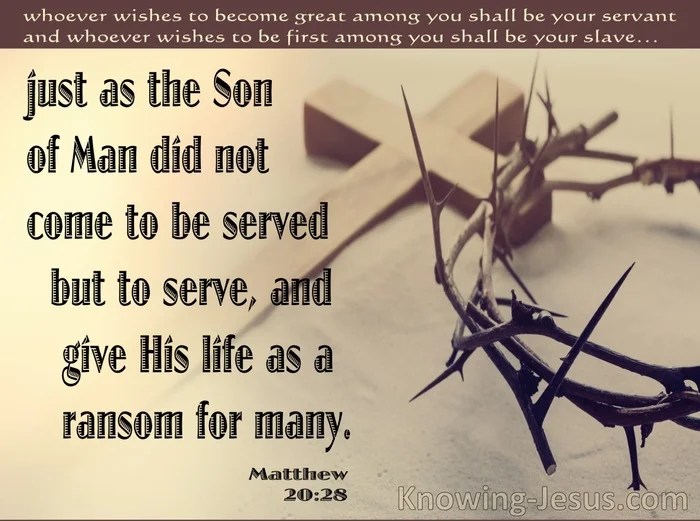
A Ransom Paid in Full: Reflecting, Understanding, the Justice of God. Matthew 20:24-28

Matthew 20:24-28 Amplified Bible

24 And when the [other] ten heard this, they were resentful and angry with the two brothers. 25 But Jesus called them to Himself and said, “You know that the rulers of the Gentiles have absolute power and lord it over them, and their great men exercise authority over them [tyrannizing them]. 26 It is not this way among you, but whoever wishes to become great among you shall be your servant, 27 and whoever wishes to be first among you shall be your [willing and humble] slave; 28 just as the Son of Man did not come to be served, but to serve, and to give His life as a ransom for many [paying the price to set them free from the penalty of sin].”

The Word of God for the Children of God.

Adeste Fidelis! Venite Adoremus! Dominum.

Gloria! In Excelsis Deo! Alleluia, Alleluia, Alleluia, Amen.

Background: He Who Has Ears, Let Them Hear …

Matthew 20:17-19Amplified Bible

Death, Resurrection Foretold

17 As Jesus was going up to Jerusalem, He took the twelve [disciples] aside, and along the way He said to them, 18 “Listen carefully: we are going up to Jerusalem; and the Son of Man will be handed over to the chief priests and scribes (Sanhedrin, Jewish High Court), and they will [judicially] condemn Him and sentence Him to death,  19 and will hand Him over to the Gentiles (Roman authorities) to be mocked and scourged and crucified, and He will be raised [to life] on the third day.”

On the journey to Jerusalem Jesus predicts that his death will take place there.

Jesus takes his disciples aside to report to them that it will include wholesale betrayal, humiliation and condemnation by the religious leaders of his people.

Those who should be welcoming him as the promised Messiah will instead sentence him to suffering and death, thoughtlessly handing him over to to a brutal time and season of mocking, flogging, and crucifixion by the Romans.

Then Jesus also shockingly predicted that he would rise again three days after!

But it seems that after hearing the predictions about Jesus’ suffering and death, the disciples somehow tuned out.

It’s as if they missed hearing the promise that “on the third day” he would be “raised to life!”

When the time came and Jesus died on a cross, the disciples were a despondent group of followers wondering about the suddenness what had just happened.

As predicted, in the Garden of Gethsemane they scattered in fear, at the arrival of the Temple Authorities unjustly leaving the burial, preparations to others. (See Matthew 26:56; 27:45-28:10.)

In this critical moment, there was no expectation of Jesus’ coming to life again!

In our own day and age, considering the number of years which have come, and passed us by since those events transpired, is our own “hearing” any different?

As we again, for the umpteenth time approach Jesus’ entry into Jerusalem, as we again come to the umpteenth recitation and those sermons of Palm Sunday, as we again try to come to realization of what we know is to come, has already transpired, has already been written and narrated – why is any of this relevant?

We have not heard with our own ears the actual voice of Jesus as the disciples.

We could not immediately begin the process of giving it our fullest attention.

We could not be stunned in the same way as the disciples were upon hearing it.

We could not be apathetic or excited or wondering or stunned or any of that.

We did not talk, or walk, hear or listen to and with Jesus in that moment – in a more contemporary colloquial sense of the moment – “walk and chew gum and do everything else (preparing ourselves for the Passover) all at the same time.

Nowadays, we do not all concern ourselves to prepare to celebrate the Passover.

We are not looking for donkeys or mules or horses to ride to be paraded about.

We are not looking for “Upper Rooms” – Just sanctuaries inside our churches.

No Gardens of Gethsemane …

It is doubtful to the utmost we are worried about our running away naked in the middle of the night with thoughts of running away, betraying our own Savior.

Jesus will not be arrested again.

He will not be betrayed, mocked and humiliated in such a horrible way again.

We will not have to subject ourselves to the sight, witnessing him dying again.

All these things have already come to pass and by faith we believe and accept it.

Now, what experiences do we have to substitute for those of what the disciples witnessed first hand, experienced to the utmost first hand, threatened by too?

We hear pandemic, dire economic warnings or a doctor’s frightening diagnosis, and we’ll soon forget Jesus’ words: “I am with you always” (Matthew 28:20).

We experience ridicule or rejection and forget that God’s Word warns that we may be called to share in Christ’s sufferings (John 15:18-20; Romans 8:17).

Facing them throughout the year is hard enough, but how much of that effort includes an intense time of self examination, reflection upon the Cross itself?

Facing them mutually, letting God work, let’s remember Jesus was raised to life.

We know what happened then to Jesus – three days later, as promised, he arose!

Our belief in the Resurrection of our Savior is core central to our Christian faith.

Yes! We absolutely love and live for and utmost sacrificially serve a risen Savior!

But the lingering question, the utmost intense question we probably devote so precious little of our time to study, reflecting upon: what relevance is the Cross?

A Personal Reflection: Why the Cross?

24-28 When the ten others heard about this, they lost their tempers, thoroughly disgusted with the two brothers. So Jesus got them together to settle things down. He said, “You’ve observed how godless rulers throw their weight around, how quickly a little power goes to their heads. It’s not going to be that way with you. Whoever wants to be great must become a servant. Whoever wants to be first among you must be your slave. That is what the Son of Man has done: He came to serve, not be served—and then to give away his life in exchange for the many who are held hostage.”

Why does Jesus take his disciples aside to shock, awe them with his prophecy?

Why are such momentous words and such miraculous history transforming events still to be read and found, studied and prayed over and celebrated too?

Why is such a detailed, embarrassing account of the failure of the disciples?

Why do we celebrate ourselves being re-subjected to these terrible moments?

To give us another opportunity to run away from Jesus, recoil from them, him?

To mostly learn and then relearn to repeatedly avoid re-living the indescribable intensity of those moments, to make them our own as God repeatedly call us to?

Why the ugliness of the Cross … to learn, to relearn to hug its wondrous beauty?

Why such an intense concentration, centralized focus on the Cross at Calvary?

Why such an ugly, not so gentle, intentional, purposeful, graphic reminder?

Why didn’t God simply say, “Look, everyone, I know you have sinned against Me, but I am going to pardon you right now. It’s okay. I forgive all of you!”

God didn’t do that because it doesn’t work with His nature and character.

The justice of God requires obedience and sacrifice.

He could not accept us into fellowship with Himself unless we paid the penalty—or someone paid it on our behalf.

Romans 3:25 tells us, “For God presented Jesus as the sacrifice for sin. People are made right with God when they believe that Jesus sacrificed his life, shedding his blood. This sacrifice shows that God was being fair when he held back and did not punish those who sinned in times past” (NLT).

The cross demonstrates the ultimate expression of the justice of God.

At the cross of Calvary, the love and justice of God met.

Yes, God had to satisfy His justice.

The Scriptures say, “The person who sins is the one who will die” (Ezekiel 18:20 NLT), “the wages of sin is death” (Romans 6:23 NLT), and “without the shedding of blood, there is no forgiveness” (Hebrews 9:22 NLT).

God was saying, “My righteous requirements must be met.

But I love humanity beyond their ability to acknowledge, fully measure and comprehend, and there is no way they can do it on their own.

So, I must, and I WILL help them.”

Therefore, He sent His only begotten Son Jesus to bridge the gap. (John 3:16-17)

This is why Jesus Christ is the only way to God.

People like to say that all roads lead to God.

People also like to say that the road to hell is paved with our good intentions.

It really concerns me when I hear Christians parrot statements to that effect.

There is only one path.

There is only one way.

If that were not true, then why did Jesus have to die?

If all roads lead to God, then why did Jesus go through the indescribable anguish, the immeasurable humiliation, torture, and pain of the cross?

Matthew 20:26-28 Amplified Bible

26 It is not this way among you, but whoever wishes to become great among you shall be your servant, 27 and whoever wishes to be first among you shall be your [willing and humble] slave; 28 just as the Son of Man did not come to be served, but to serve, and to give His life as a ransom for many [paying the price to set them free from the penalty of sin].”

The primary reason Jesus came to this earth was to save us, to die for our sins.

Paid in Full

Jesus’ mission was a matter of “search and rescue.”

He came to seek and save those who were lost (Luke 19:10).

He not come to be served but to serve, give his life as a ransom for many.

Mark 10:42-45 Amplified Bible

42 Calling them to Himself, Jesus said to them, “You know that those who are recognized as rulers of the Gentiles lord it over them; and their powerful men exercise authority over them [tyrannizing them]. 43 But this is not how it is among you; instead, whoever wishes to become great among you must be your servant, 44 and whoever wishes to be first and most important among you must be slave of all. 45 For even the Son of Man did not come to be served, but to serve, and to give His life as a [a]ransom for many.”

He fulfilled that mission by giving his life at Calvary “as a ransom for many.”

As Jesus hung on the cross and spoke the words “It is finished” (John 19:30), he was announcing that his mission was now accomplished.

Because he was obedient and faithful to His Father, offered his perfect life as the sacrifice for sin, God was pleased to welcome home all his lost children!

https://www.blueletterbible.org/esv/jhn/19/30/t_conc_1016030

https://www.blueletterbible.org/lexicon/g5055/esv/mgnt/0-1/

The brief sentence “It is finished” translates from just a single word teleō in the original Greek text.

The same word was used by shopkeepers to announce that someone’s bill was finally paid.

When the final payment was made on a purchased item, the merchant would say “Tetelestai” (“It is finished”) – in other words, the debt was paid in full.

When I made the last payment on the first car I ever bought, I remember how good it felt to see the bank teller stamp “Paid in Full” on my loan documents.

Never again would another payment be required!

As Jesus said “It is finished” on the cross, he was assuring us that his mission was complete.

He had paid in full all the costs required for our sin.

And when we faithfully focus our lives, when we centralize our lives now place our full faith-filled trust in him, our debt for sin is forever wiped off the books!

On that Hill far away, stood an Old Rugged Cross, the emblem of suffering and shame. And on that old cross Jesus suffered and died to pardon and sanctify me.

In the name of God, the Father and God the Son and God the Holy Spirit,

Let us Pray,

Loving Lord, I praise and thank You for Jesus, my Mighty Savior and Servant King. Lord, today I pour out my life as an offering to You. I pray that I would serve You wholeheartedly and my service would bless those around me and be a witness to bring many to the knowledge of salvation in Jesus. O God, thank you that Jesus has bought salvation for me! He has done everything needed for me to know you, love you, and serve you now and forever! Amen. Thank You that Jesus gave His life as a ransom for me and for all who would believe in His name. In Jesus’ name, AMEN.

Adeste Fidelis! Venite Adoremus! Dominum.

Gloria! In Excelsis Deo! Alleluia, Alleluia, Alleluia, Amen.

https://translate.google.com/

Could Jeremiah 29:11 Have A Far, Far Deeper Meaning, Truth for Us Today? Jeremiah 29:8-14

Jeremiah 29:8-14 The Message

8-9 Yes. Believe it or not, this is the Message from God-of-the-Angel-Armies, Israel’s God: “Don’t let all those so-called preachers and know-it-alls who are all over the place there take you in with their lies. Don’t pay any attention to the fantasies they keep coming up with to please you. They’re a bunch of liars preaching lies—and claiming I sent them! I never sent them, believe me.” God’s Decree!

10-11 This is God’s Word on the subject: “As soon as Babylon’s seventy years are up and not a day before, I’ll show up and take care of you as I promised and bring you back home. I know what I’m doing. I have it all planned out—plans to take care of you, not abandon you, plans to give you the future you hope for.

12 “When you call on me, when you come and pray to me, I’ll listen.

13-14 “When you come looking for me, you’ll find me.

“Yes, when you get serious about finding me and want it more than anything else, I’ll make sure you won’t be disappointed.” God’s Decree.

“I’ll turn things around for you. I’ll bring you back from all the countries into which I drove you”—God’s Decree—“bring you home to the place from which I sent you off into exile. You can count on it.

The Word of God for the Children of God.

Adeste Fidelis! Venite Adoremus! Dominum.

Gloria! In Excelsis Deo! Alleluia, Alleluia, Alleluia, Amen.

How rare is the Word of God today?

How rare is the genuine understanding of the Word of God today?

How rare is the genuine truth of the Word of God sought after today?

How rare is the person who seeks after the genuine truth of God’s Word?

How rare is the person who actually, diligently, genuinely, seeks to apply the wisdom and the genuine truth of the Word of God to their lives?

How rare is the person who actually, diligently, genuinely applies the genuine truth of the Word of God to their lives?

How rare is the person who then actually, diligently, genuinely, seeks with all of their heart, souls, minds and strength, to diligently, genuinely teach all others? (Deuteronomy 6:4-9)

Do we genuinely want to know, love, experience God through His Word alone?

Do we really and genuinely want to surprise ourselves by seeking His Kingdom?

The True Deeper Meaning of Jeremiah 29:11 Might Surprise You

Jeremiah 29:11 is one of the most well-known and quoted verses in the Bible.

It’s promise is held dearly by Christians all over the world.

But despite it’s popularity the meaning of Jeremiah 29:11 is often misused and misapplied.

It’s one of the most misquoted verses in the entire Bible. 

While many Christians have this verse memorized and hanging on their walls, the context in which it’s written is often ignored.

The Bible passage of Jeremiah 29:11 is a popular verse that we, as Christians, cling to in times of trials and hardships.

Whenever problems occur in our earthly lives, we always find safe refuge in the Word of God and one of those verses is Jeremiah 29:11.

Because of this,

it is essential to understand the historical as well as the literary context of the verse to give us a deeper understanding as to why Jeremiah wrote it.

When we ignore the context in which the Bible is written we can quite literally make it say anything we want. 

What We Commonly Get Wrong About Jeremiah 29:11 Meaning

Jeremiah 29:11 is everywhere.

From coffee mugs to graduation speeches this verse is plastered everywhere.

Yet despite the popularity the meaning of Jeremiah 29:11 is often misapplied. 

Most commonly the meaning of Jeremiah 29:11 is applied as a personal promise.

That God has a wonderful and perfect plan for ME.

Many take this verse and apply it specifically to them, that God has their life perfectly mapped out, and that they only have to walk in obedience to God. 

Others take this verse a step further claiming this verse is a continuous promise of health and wealth.

Since we are children of the King we would, could, should only hope to expect the best from God.

With this view, anything less than that view, pain and suffering are interpreted as a sign of disobedience, being disciplined by our God for our true lack of faith. 

The main problem with these interpretations of Jeremiah 29:11 is that they are very ME centered.

It’s all about what God can and is going to do for ME.

And that’s not the meaning of Jeremiah 29:11.

Or the Bible for that matter. 

Where do we begin to more deeply, genuinely acknowledge, the grace of God?

When do we acknowledge the genuine authority, sovereignty, power, of God’s exclusive to God truth behind Psalm 46:10-11?

Psalm 46:10-11 The Message

8-10 Attention, all! See the marvels of God!
    He plants flowers and trees all over the earth,
Bans war from pole to pole,
    breaks all the weapons across his knee.
“Step out of the traffic! Take a long,
    loving look at me, your High God,
    above politics, above everything.”

11     Jacob-wrestling God fights for us,
    God-of-Angel-Armies protects us.

See all of the marvels of God and God alone!

The alleged marvels of humanity are not even mentioned by the Psalmist!

The sovereignty of God and God alone is where everything remains the same.

Psalm 46:10-11 Amplified Bible

10 
“Be still and know (recognize, understand) that I am God.
I will be exalted among the nations! I will be exalted in the earth.”
11 
The Lord of hosts is with us;
The God of Jacob is our stronghold [our refuge, our high tower]. Selah.

So, accounting for it being about God alone, what does Jeremiah 29:11 mean?

Let’s dive into the context and find out. 

The Meaning Of Jeremiah 29:11 In Context Historically

Context matters. In fact, I would say context is king.

When we are reading the Bible we cannot ignore the context in which what we are reading is written in. 

That means we should do three things when reading the Bible: 

  1. Look at the surrounding verses
  2. Consider the original audience 
  3. Look at the larger narrative of the Bible

What is the history behind his words and what is the reasoning?

What is its literal meaning and how can we apply it to our daily lives, not just during tribulations, but rather, as followers of Jesus Christ and children of God?

To help us understand the meaning of Jeremiah 29:11 we will focus primarily on the first two in the list above.

Let me just say this, the common ways this passage is interpreted does not fit the Biblical narrative – the Bible teaches selflessness not a ME centered faith. 

When you rewind a little bit from Jeremiah 29:11 what you see is God talking to the nation of Israel through the prophet Jeremiah.

What Does ‘For I Know the Plans I Have for You’ Mean in Jeremiah 29:11 

Based on the historical context of the verse and the major events that happened in the past, we can understand why Jeremiah said the words in Jeremiah 29:11.

His primary goal was to speak to God’s people amidst hardships and suffering.

The people on the long march into Babylonian captivity needed to know there was some kind of hope they could latch themselves onto to face down reality.

The people were ready to grasp onto any smidgen of reality that would reveal for them that somewhere in this national tragedy befalling them, there is hope.

The unfolding breadth, unrelenting scope of trauma in every which direction of recent events of Babylonian siege, and plunder and war, of this disaster abound.

No one was immune from the impossible to measure effects of its devastation.

National identity was being systematically, violently stripped away from them.

Even their beloved Temple, where God was always to be found – was destroyed.

The Temple where God resided, was desecrated beyond repair – God was gone.

No God in residence…the spiritual trauma behind that thought – unfathomable.

Can anyone of us identify with this feeling?

Their lifeline to God and His divine protection – violently, visibly, severed.

Can anyone of us identify with this feeling?

No lifeline to God was equated with having no Hope of seeing Hope ever again.

Can anyone of us identify ourselves with this feeling?

The people of God were asking for an immediate rescue from the suffering that they were experiencing, and the counter-cultural, against the grain, prophet Jeremiah had a huge responsibility to tell them the truth about God’s promise.

He was also tasked to rebuke a very huge and ultra convincing lie that the false prophet Hananiah had widely circulated, which was not a very easy task to do.

This verse was his message, inspired by God’s guidance, to tell the people that God’s response is not an immediate answer, rather, God has a plan to prosper His people amidst hardships, God has a promise for the future of His people.

The needed caveat to these words – being after seventy years of exile is done.

The duration of the exile would continue until God had designed it to be over.

There would be no avoiding it or getting away from its experience or its effects.

The exile was a done deal.

Praying would not end it before its anointed and appointed time.

The exile was going to have to be fully, inescapably, endured. (Psalm 137)

Considering the coming tragedy of that march to Babylon, and what the people already had to endure and bear witness to (Psalm 137:8-9), it was a bitter time!

If we reflect on the words of Jeremiah, we can see the wisdom that God gave him during those trying times.

He starts with a clear, direct message, “‘For I know the plans I have for you,”

These words can be interpreted as a direct message and an assurance that God knows their plans.

And then, the verse continues with a more profound explanation of God’s plan, “‘plans to prosper you and not to harm you, plans to give you hope and a future’” (Jeremiah 29:11).

These words give more detail of His plan — to inspire His people to continue on, to persevere through the very harshest of seasons, times and circumstances.

The Historical Context of ‘For I Know the Plans I Have for You’ in Jeremiah 29:11

In its context, Jeremiah is speaking to his fellow people as they were forced to exile from their home in Jerusalem to Babylon and, now, under enemy rule.

There was too much turmoil in terms of emotional and physical stress among the believers of God during this time.

To add to this, there was also a false prophet named Hananiah who gave false hope to the Jews regarding the prophecy of God.

According to Hananiah, God promises to relieve the Jews of their suffering after two years and would come back to their home.

This was a false prophecy that Jeremiah heard and rebuked. We can read this verse further in Jeremiah 28:15-17;

Jeremiah 28:15-17 Amplified Bible

1Then the prophet Jeremiah said to Hananiah the prophet, “Listen now, Hananiah, the Lord has not sent you, and you have made this people trust in a lie. 16 Therefore thus says the Lord, ‘Behold, I am about to send you away from the face of the earth. This year you will die, because you have spoken  and have counseled rebellion against the Lord.’”

17 So Hananiah the [false] prophet died [two months later], the same year, in the seventh month.

Imagine Jeremiah having to tell the Jews that instead of two years, they would live in Babylon for 70 years and endure it as it is written in Jeremiah 29:4-10,

This is what the Lord Almighty, the God of Israel, says to all those I carried into exile from Jerusalem to Babylon: “Build houses and settle down; plant gardens and eat what they produce. Marry and have sons and daughters; find wives for your sons and give your daughters in marriage, so that they too may have sons and daughters. Increase in number there; do not decrease. Also, seek the peace and prosperity of the city to which I have carried you into exile. Pray to the Lord for it, because if it prospers, you too will prosper.” Yes, this is what the Lord Almighty, the God of Israel, says: “Do not let the prophets and diviners among you deceive you. Do not listen to the dreams you encourage them to have. They are prophesying lies to you in my name. I have not sent them,” declares the Lord.

This is what the Lord says: “When seventy years are completed for Babylon, I will come to you and fulfill my good promise to bring you back to this place.”

Jeremiah was tasked to deliver a message that God’s people would have to live, build houses, marry, pray for peace, and prosper in a city that was not theirs.

It was an arduous, difficult task, and Jeremiah had to give the people an inspirational message and thus the words in Jeremiah 29:11 were written.

What Deeper Meaning Would, What Could, What Should, ‘For I Know the Plans I Have for You’ Genuinely Mean for Us Today?

Indeed, Jeremiah 29:11 is a great reminder amidst the longevity of suffering, God alone has a boundless God sized plan for us to prosper and hope for our future.

We should not give up. We may be experiencing different situations such as the severe health or a financial crisis or a family relationship on the brink of being torn apart, the verse tells us that these things are in passing and God has a plan.

Just as what happened in the past with the Jews in Babylon, we may experience “lets grasp for human straws” hopeful words of false prophets like Hananiah.

The much beloved verse also reminds us not to believe in human things that are too good to be true and instead, trust God alone, His Grace, His processes alone.

For it is only in trusting His process we can all be assured of hope for the future.

Lastly, this much cherished verse also reminds us that if we seek God in our hearts, we will never be weary even if we experience suffering in our lives.

Let God alone transform our mindsets of unrelenting suffering to unrelenting joy in the Lord and the Lord alone who is our strength. (2 Corinthians 12:7-10)

More Bible Verses about Hope

But they who wait for the Lord shall renew their strength; they shall mount up with wings like eagles; they shall run and not be weary; they shall walk and not faint.  ~ Isaiah 40:31

For in this hope we were saved. Now hope that is seen is not hope. For who hopes for what he sees? But if we hope for what we do not see, we wait for it with patience.Romans 8:24-25

Blessed be the God and Father of our Lord Jesus Christ! According to his great mercy, he has caused us to be born again to a living hope through the resurrection of Jesus Christ from the dead ~ 1 Peter 1:3

For whatever was written in former days was written for our instruction, that through endurance and through the encouragement of the Scriptures we might have hope. ~ Romans 15:4

May the God of hope fill you with all joy and peace in believing, so that by the power of the Holy Spirit you may abound in hope. ~ Romans 15:13

Rejoice in hope, be patient in tribulation, be constant in prayer. ~ Romans 12:12

Now faith is the assurance of things hoped for, the conviction of things not seen.Hebrews 11:1

2 Timothy 3:14-17 Amplified Bible

14 But as for you, continue in the things that you have learned and of which you are convinced [holding tightly to the truths], knowing from whom you learned  them,  15 and how from childhood you have known the sacred writings (Hebrew Scriptures) which are able to give you the wisdom that leads to salvation through faith which is in Christ Jesus [surrendering your entire self to Him and having absolute confidence in His wisdom, power and goodness]. 16 All Scripture is God-breathed [given by divine inspiration] and is profitable for instruction, for conviction [of sin], for correction [of error and restoration to obedience], for training in righteousness [learning to live in conformity to God’s will, both publicly and privately—behaving honorably with personal integrity and moral courage]; 17 so that the [a]man of God may be complete  and proficient, outfitted and thoroughly equipped for every good work.

Seek out the deeper meanings, immeasurable truths of the Word of God.

The entirety of our lives is a Tapestry weaved by the Grace of God by God.

In Christ Jesus, our Savior, in Him alone our hope is found (Acts 4:8-12)

Give God 100% of the Glory – saving or hoarding none of it for yourselves.

Give God 100% of the Praise – saving or hoarding none of it for yourselves.

Give God 100% of the Honor – saving or hoarding none of it for yourselves.

In the name of God, the Father and God the Son and God the Holy Spirit,

Let us Pray,

Majesty, worship His majesty
Unto Jesus be all glory, honor and praise,
Majesty, kingdom authority
Flow from His throne, unto His own
His Anthem raise
Majesty, worship His majesty

Unto Jesus be all glory, honor and praise,
Majesty, kingdom authority
Flow from His throne, unto His own
His Anthem raise

So exalt, lift up on high, the name of Jesus
Magnify, come glorify Christ Jesus the King
Majesty, worship His majesty

Jesus who died, now glorified
King of all kings

Copyright: 

1981 New Spring (Admin. by Brentwood-Benson Music Publishing, Inc.)

https://translate.google.com/

Becoming Like Christ: Steps Towards Spiritual Freedom. 2 Corinthians 3:17

2 Corinthians 3:12-18 Amplified Bible

12 Since we have such a [glorious] hope and confident expectation, we speak with great courage, 13 and we are not like Moses, who used to put a veil over his face so that the Israelite’s would not gaze at the end of the glory which was fading away. 14 But [in fact] their minds were hardened [for they had lost the ability to understand]; for until this very day at the reading of the old covenant the same veil remains unlifted, because it is removed [only] in Christ. 15 But to this day whenever Moses is read, a veil [of blindness] lies over their heart; 16 but whenever a person turns [in repentance and faith] to the Lord, the veil is taken away. 17 Now the Lord is the Spirit, and where the Spirit of the Lord is, there is liberty [emancipation from bondage, true freedom]. 18 And we all, with unveiled face, continually seeing as in a mirror the glory of the Lord, are progressively being transformed into His image from [one degree of] glory to [even more] glory, which comes from the Lord, [who is] the Spirit.

The Word of God for the Children of God.

Adeste Fidelis! Venite Adoremus! Dominum.

Gloria! In Excelsis Deo! Alleluia, Alleluia, Alleluia, Amen.

Becoming Like Christ

2 Corinthians 3:15-18 Amplified Bible

15 But to this day whenever Moses is read, a veil [of blindness] lies over their heart;  16 but whenever a person turns [in repentance and faith] to the Lord, the veil is taken away. 17 Now the Lord is the Spirit, and where the Spirit of the Lord is, there is liberty [emancipation from bondage, true freedom]. 18 And we all, with unveiled face,  continually seeing as in a mirror the glory of the Lord, are progressively being transformed into His image from [one degree of] glory to [even more] glory, which comes from the Lord, [who is] the Spirit.

If the Holy Spirit’s work in us is like the work of a master gardener, what is the Spirit growing in us?

The Spirit wants to reproduce Jesus’ character in us.

Our reading from 2 Corinthians today states that we “are being transformed into [Jesus’] image with ever-increasing glory.”

In other words, the Holy Spirit’s aim is to make us more and more like Jesus.

The Holy Spirit’s work is to nudge us, prod us, move us, transform us and shape us to think and act and be more like our Savior Jesus, for us to better mirror Jesus in our character, to increasingly help us love like Jesus in our daily life.

Of course, it’s not an overnight rush job.

The Spirit doesn’t guarantee delivery in full by 8:00 a.m. the next day—or even within a few days, months, years or decades.

This isn’t the work of a courier driver.

This is the work of the Master Gardener, the One with a master’s vision of the finished garden, the One who daily, gradually toils and works in our lives until the desired spiritual fruit eventually sprouts, blossoms, unto the glory of God.

There are times when the Holy Spirit’s work in us will be immediate, dramatic, and maybe even spectacular.

But usually the Spirit’s work in us is slow, subtle and gentle.

That’s the Holy Spirit’s trademark.

We are made in God’s image, in the image of God we are created, (Genesis 1:26-27) but that sacred image became spoiled and polluted in us because of sin.

So now God is slowly remaking that image in us—to be like our Savior Jesus!

Steps Towards Spiritual Freedom

Have we truly noticed that most of our unrest comes from ourselves?

We get stuck ruminating on the things we can’t change or control.

Un-forgiveness stops us from moving toward healing in our relationships.

Pervasive negativity prevents us from enjoying the moment.

Exhaustion keeps us functioning as only a shadow version of ourselves.

Repeated excuses keep us trying the same things over and over again that are no longer capable of working, are burning bridges and stop us from changing.

Fear, guilt and shame stop us cold from accepting God’s free gift of grace. 

Our unhappiness lives in our souls and finding peace starts as a process of Holy Spirit-led self-discovery.

How many of us will spend our lives turning a blind eye to our own hangups?

In our own stubborn blindness, we refuse to consider that maybe the rhythm of frustration we are up against might be something we have the power to change.

It’s so much easier to render our judgments, and then blame our surroundings.

To point out the sliver in our neighbor’s eye, all while avoiding our own planks. (Matthew 7:1-5)

We so often live stuck in a giant sheet of bubble wrap we wrapped around us.

Thank God He is patient with us! 

Thank God that God knows exactly what to do with bubble wrap – POP IT!

How, then, do we allow ourselves to be “popped by God” to get us past our blindness and grab onto the gracious freedom that God promises each of us?

1. Freedom comes when we abandon pride. 

The path towards freedom begins with a surrendering of the pride we each hold that claims we have what we need to fix ourselves all on our own.

This pride tells us to be ashamed, embarrassed, fearful and humiliated when we don’t live up to our own internal standards.

It relies on rules and religion rather than grace and a relationship with Jesus.

Step one towards freedom and making peace with the people God created us to be is to abandon our pride.

The Bible teaches that pride comes before a fall (Proverbs 16:18), and the humble find wisdom (Proverbs 11:2). 

2. God’s wisdom teaches us how to change. 

Wisdom helps us change.

Only through God’s miraculous truth can we see the way past the same thought processes which keep us trapped, wrapped, in our own fears, shame, bitterness. 

James 1:5 prompts us to ask God for wisdom when we don’t have it.

He gives it freely when we have a humble heart.

When we read and study God’s Word, spend time in his church, seek Him and His Kingdom through prayer, we discover what godly wisdom looks like.

Proverbs 1:7 instructs us that wisdom is found in the context of community.

We have to be willing to accept advice and instruction when we are stuck and looking for a new way forward. 

Proverbs 3:7 tells us that wisdom turns away from evil.

If our own set patterns get us stuck in sin over and over, then God’s wisdom, and our Savior’s Cross, His Resurrection power moves us away from that evil temptation that keeps repeatedly keeps maliciously tugging at our souls.  

3. Freedom points us towards others.

Interestingly God gives us the internal power through the Holy Spirit to find spiritual freedom, not so we can just enjoy ourselves better.

Even though a free you is a happier you and is a you that you can be confident in and enjoy.

The purpose of this Christ-purchased freedom is that we can serve others.

Isaiah 61:1 tells us God’s spirit in our lives gives us the ability to bring good news to the poor, assist the brokenhearted, and set free those imprisoned in this world!

We are set free, so we can help others find that same freedom.

When we find ourselves stuck, wrapped in our own frustrations or even upset with others in our lives because their sin nature is making our lives harder, we are invited to draw on God’s spirit to see new ways to love and to serve others.  

4. God’s spirit sets us free. 

2 Corinthians 3:17 says, “Now the Lord is the Spirit, and where the Spirit of the Lord is, there is freedom.”

There is a mysterious element to spiritual freedom.

Freedom is an indescribable moment or journey that can take time where Heaven meets us here on Earth.

Areas I’ve sought freedom in has been anxiety over diabetes management.

For me, this freedom journey has taken years, but God has been my faithful teacher and sustainer through step forward and backward, each up and down.

Other times our freedom is like a dam breaking all at once.

The old life is washed away in an instant, and a new one is ready to begin.

Why does God work one way in my life and a different way in yours?

That is part of the mystery of the Spirit.

God is connectional and relational and not a rule-based God, which is why each of us has a singularly unique and diverse and vastly different spiritual journey.

One thing the Bible does tell us is that if we want to find freedom in our lives, we have to seek His Kingdom through His Holy Spirit.  

Matthew 6:33 Amplified Bible

33 But first and most importantly seek (aim at, strive after) His kingdom and His righteousness [His way of doing and being right—the attitude and character of God], and all these things will be given to you also.

John 8:36 says, “So if the Son sets you free, you will be free indeed.”

Jesus came to Earth, so we could not only escape death and join his family, but so we could experience freedom in our lives here on Earth.

I am so thankful that God has not left me as I was.

He is always renewing my mind and spirit.

May you, by God’s grace, take steps toward spiritual growth and freedom today.

In the name of God, the Father and God the Son and God the Holy Spirit,

Let us Pray,

Jesus, my Savior, I have been listening to too many lies for far too long. I have been tricked one too many times by the enemy and I am frustrated. I need to be free from these lies. Jesus, I know that You are true and that the truth will set me free. Jesus, help me to rejoice in the truth. I need to believe the truth. I pray that it really would set me free. Help me with my unbelief, Jesus. Holy Spirit, You know my heart, and know that I need help believing. Thank You, Jesus, that You offer truth to Your children. Thank You for Your patience with me. In Your glorious name, I pray.

Adeste Fidelis! Venite Adoremus! Dominum.

Gloria! In Excelsis Deo! Alleluia! Alleluia! Alleluia! Amen.

https://translate.google.com/

Distant or Delighted? Not Feeling the Love of God? How About Learning to See Jesus With a Smile? 1 John 3:1-3

1 John 3:1-3 Amplified Bible

Children of God Love One Another

See what an incredible quality of love the Father has shown to us, that we would [be permitted to] be named and called and counted the children of God! And so we are! For this reason the world does not know us, because it did not know Him. Beloved, we are [even here and] now children of God, and it is not yet made clear what we will be [after His coming]. We know that when He comes and is revealed, we will [as His children] be like Him, because we will see Him just as He is [in all His glory]. And everyone who has this hope [confidently placed] in Him purifies himself, just as He is pure (holy, undefiled, guiltless).

The Word of God for the Children of God.

Adeste Fidelis. Venite Adoremus. Dominum.

Gloria. In Excelsis Deo. Alleluia, Alleluia, Alleluia, Amen.

See How Well We Are Lavished With Love?

1 John 3:1 New International Version

See what great love the Father has lavished on us, that we should be called children of God! And that is what we are! The reason the world does not know us is that it did not know him.

The word lavish presents a picture of extravagant abundance.

It is almost too much, too generous and luxurious.

Being lavish borders on being wasteful.

But the Father has lavished his love on us.

God’s love is even more than what a wonderful mother showers on her infant.

Isaiah 66:12-14 New International Version

12 For this is what the Lord says:

“I will extend peace to her like a river,
    and the wealth of nations like a flooding stream;
you will nurse and be carried on her arm
    and dandled on her knees.
13 As a mother comforts her child,
    so will I comfort you;
    and you will be comforted over Jerusalem.”

14 When you see this, your heart will rejoice
    and you will flourish like grass;
the hand of the Lord will be made known to his servants,
    but his fury will be shown to his foes.

God’s love and care are supplied all the time.

God’s love is a constant bombardment of affection and care.

We may be as oblivious as an infant to the presence of his love, but God still continues to pour his love into our lives.

God’s love flows into us deeply, redefines who we are at the very core of our heart, mind and soul.

When we open our hearts to God’s love, we are transformed by it.

We are remade, regenerated into children of God.

It is God who makes us his children, not us.

We cannot earn that status.

It is a gift of God’s great love.

Because we are sinners, we do not understand God’s love for us at first.

We don’t even know we need him until we realize we are stuck in sin and cannot save ourselves.

We become God’s children when we receive Jesus as our Savior (John 1:12).

Not one of us is worthy of God’s love.

We cannot earn it.

God just loves us.

We would not be God’s children if he were not already deeply in love with us.

How amazing is that!

Being said with an exclamation mark, what if we turned that into a question?

“How Amazing Is That?”

I Really Do Not Feel God’s Love.

Psalm 13 Authorized (King James) Version

Psalm 13

To the chief Musician, A Psalm of David.

How long wilt thou forget me, O Lord? for ever?
how long wilt thou hide thy face from me?
How long shall I take counsel in my soul,
having sorrow in my heart daily?
how long shall mine enemy be exalted over me?
Consider and hear me, O Lord my God:
lighten mine eyes, lest I sleep the sleep of death;
lest mine enemy say, I have prevailed against him;
and those that trouble me rejoice when I am moved.
But I have trusted in thy mercy;
my heart shall rejoice in thy salvation.
I will sing unto the Lord,
because he hath dealt bountifully with me.

Have you ever said or thought these words in public or in private?

If so, you’re not alone.

Truth Be Told, Too many times I have really struggled with the disconnect between knowing that God loves me and actually seeing, and feeling His love.

It might be tempting to brush aside the discomfort of this disconnect and get on with the responsibilities of life.

“After all,” some will pat you on the back, say, “love is an action, not a feeling.”

But if you look closely at the love displayed in the Bible, it’s clear that it’s not just automatic rote Christian responsibility—it’s also passionate emotion.

God doesn’t just act lovingly toward us, He feels love for us.

And He doesn’t want us to only understand His love, but to experience it in a deep way, a deeply visual and tactile way – to visualize it and touch it daily.

If, like me, you’ve struggled with a disconnect between knowing about God’s love and actually seeing, feeling it, accept your feelings as being quite real.

Sometimes, like the Psalmist who penned Psalm 13, we will not feel loved.

Sometimes, like the Psalmist who penned Psalm 13, we will not see God’s love.

Psalm 13 is someone’s deepest expression of a heart and soul in angry anguish.

It has remained in the Bible through countless edits because God wants you the reader to know, the maximum extent to which God feels, visualizes our hearts.

Heart Distant or Delighted? Learning to See Jesus With a Smile …

Psalm 13:5-6 Authorized (King James) Version

But I have trusted in thy mercy;
my heart shall rejoice in thy salvation.
I will sing unto the Lord,
because he hath dealt bountifully with me.

1 John 3:3 Amplified Bible

And everyone who has this hope [confidently placed] in Him purifies himself, just as He is pure (holy, undefiled, guiltless).

I recall many years ago sitting in a circle with the other members of my Bible study group when our leader invited us to imagine what Jesus’ face looks like.

Dutifully, I closed my eyes and tried to picture Him.

The image that appeared was of a man with long, greyish silver locks and dull, piercing brown eyes.

His unsmiling lips were hard set in a neutral line.

He didn’t look disapproving, but he didn’t look very happy either.

As I studied His face, I felt sad, fearful, and unsure of how He felt about me.

I was deeply troubled by this experience because, intellectually, I knew God always loved me deeply and felt positively—even passionately—about me.

Throughout the Bible, God describes His love in the most tender terms known to humankind.

He compares His love for us to the love a parent has for their child—a warm, welcoming, compassionate love (Isaiah 66:13; 1 John 3:1).

He also describes His love for us as the love a groom has for his bride—a passionate, ardent, sacrificial love (Revelation 19:7; Ephesians 5:25-27).

Yet, my picture of Jesus that evening revealed that, deep down, I also perceived Him as uppermost serious and restrained, maybe even a little depressed at me.

It also highlighted my fear that I was not a source of joy or pleasure to God, and that, though He loved me, it suddenly felt more being with a distant, aloof love.

I knew this isn’t how God wanted me to view Him.

Ephesians 3:18, the apostle Paul prayed, “May you have the power to understand, as all God’s people should, how wide, how long, how high, and how deep his love is. May you experience the love of Christ, though it is too great to understand fully” (NLT).

More than anything, I wanted to experience the love of God—I wanted to feel it, not just know about it.

So I started asking God to take my understanding beyond intellect and into a more studious, scriptural, deep heart knowing of my value to Him.

1 John 3:1 Amplified Bible

Children of God Love One Another

See what an incredible quality of love the Father has shown to us, that we would [be permitted to] be named and called and counted the children of God! And so we are! For this reason the world does not know us, because it did not know Him.

Truth be told, sometimes it’s so much easier to notice the love people have for you than the love God has for you.

Why?

Because you can physically see them and the way they express love.

But when it comes to God, it can be challenging to see, understand, the extent to which He loves you.

After all, none of us can physically see Him on this side of Heaven.

That’s why God gave us His Word… to help us to see, feel, and understand who He is and how much He really does love us. 

See, throughout the Bible, God is described as an all-powerful and eternally just God, but also as deeply loving to those He created.

In the entire biblical story, God is presented as a character who strongly cares for us… so much so that He even allowed His Son, Jesus Christ, to enter this world to bring about a redeemed and restored relationship with humanity.

In fact, Jesus is the physical embodiment of God’s eternal love, showing us that His love is a real, tangible being we can cling to and put our hope in rather than just an abstract concept we cannot ever hope to even begin to .01% understand.

Now, before we dive further into how Jesus loves us, first let’s clarify the meaning of biblical love.

BIBLICAL LOVE

1 Corinthians 13:4-7 Amplified Bible

Love endures with patience and serenity, love is kind and thoughtful, and is not jealous or envious; love does not brag and is not proud or arrogant. It is not rude; it is not self-seeking, it is not provoked [nor overly sensitive and easily angered]; it does not take into account a wrong endured. It does not rejoice at injustice, but rejoices with the truth [when right and truth prevail]. Love bears all things [regardless of what comes], believes all things [looking for the best in each one], hopes all things [remaining steadfast during difficult times], endures all things [without weakening].

There are many different kinds of love.

There is parental love, brotherly love, and romantic love.

When anyone says the word love, we often first associate it with anything from dating to sex.

But, the word is so much more broad than we often think.

According to the above passage, biblical love is simply putting the needs of others before your own. 

All of us fall short of the expectation set by this passage at some point, because selflessness does not come naturally to us (Romans 3:23).

But, the good news of the Gospel is that God perfectly embodies these four verses.

He is the one that created love in the first place!

In turn, this means that God is LOVE itself (1 John 4:8).

And because He is love, He displays this quality not only through His words, but through His actions as well.

GOD’S DEVOTED LOVE

Psalm 103:12-14 Amplified Bible

12 
As far as the east is from the west,
So far has He removed our transgressions from us.
13 
Just as a father loves his children,
So the Lord loves those who fear and worship Him [with awe-filled respect and deepest reverence].
14 
For He knows our [mortal] frame;
He remembers that we are [merely] dust.

As any good father would, God feels sentiment and shows affection toward His children.

This picture of God as the perfect Father is a deeply intimate one because it illustrates how far [east from west], He would go to keep us safe and secure.

Another illustration of God’s love is seen in Hosea 2:14-23.

Rather than a father this time, this Bible story describes a faithful husband that comforts and treasures his wife – which is also meant to be seen as a metaphor for God’s devoted love to an unfaithful Israel.

Despite Israel’s unfaithfulness, God expressed His infinite love for His people all the more through love poetry, painting a beautiful image of God’s extreme devotion and affection towards His Bride, the Church.

LOVE AS AN ACTION

Romans 5:8-10 Amplified Bible

But God clearly shows and proves His own love for us, by the fact that while we were still sinners, Christ died for us. Therefore, since we have now been justified [declared free of the guilt of sin] by His blood, [how much more certain is it that] we will be saved from the [a]wrath of God through Him. 10 For if while we were enemies we were reconciled to God through the death of His Son, it is much more certain, having been reconciled, that we will be saved [from the consequences of sin] by His life [that is, we will be saved because Christ lives today].

But, love is not merely a feeling.

Love is also an action… that God shows from the very beginning of the Bible.

Out of His love, God established a rescue plan for humanity in the wake of Adam and Eve’s sin (Genesis 3:15).

Out of His great love, God freed Israel from slavery in Egypt – not because they earned it, but because they were His people (Exodus 12-14).

Out of His love, God became fully human, yet fully God through the person of Jesus Christ – living a perfect life and dying a death we deserved so that we could all be restored into unto, a right relationship with Him (John 3:16-17).

In each scenario, all of God’s actions toward His people are motivated by pure love. He doesn’t just say He loves us, but He actually does something about it.

THE LOVE OF JESUS

John 15:13-16Amplified Bible

13 No one has greater love [nor stronger commitment] than to lay down his own life for his friends. 14 You are my friends if you keep on doing what I command you. 15 I do not call you servants any longer, for the servant does not know what his master is doing; but I have called you [My] friends, because I have revealed to you everything that I have heard from My Father. 16 You have not chosen Me, but I have chosen you and I have appointed and placed and purposefully planted you, so that you would go and bear fruit and keep on bearing, and that your fruit will remain and be lasting, so that whatever you ask of the Father in My name [as My representative] He may give to you.

By coming into the world and sacrificing his own life for us, Jesus demonstrated the ultimate love of God.

He died for us because He considered us friends worth dying for (John 15:15).

This is the radical love that Jesus showed during his time on Earth… and still shows us today even if we do not see it in quite the same way we see the love of our friends and family.

So, when asking the question “Does Jesus love me?” the simple answer is “yes.”

Jesus really does love you not because of anything you have done, but because of who He is!

In the name of God, the Father and God the Son and God the Holy Spirit,

Let us Pray,

Almighty God, we praise and thank you for making us children of God, not through our own power and piety but through our baptism into crucified and risen Lord Jesus Christ. We turn daily to you, and in that turning we find peace, courage and purpose. Make your whole church a witness to the great good news of Christ’s resurrection. Father God, may we have the grace and the power of the Holy Spirit to grasp how immeasurable wide and deep and high and long is your love for us, expressed in all that Savior Jesus has done for us, that we may be your children. In his name, Amen.

Adeste Fidelis. Venite Adoremus. Dominum.

Gloria. In Excelsis Deo. Alleluia, Alleluia, Alleluia, Amen.

https://translate.google.com/

Question for Today: What Does it Mean Today to Love Our Neighbors as We All Love Ourselves? Mark 12:30-31 [28-34]

Mark 12:28-34 Amplified Bible

28 Then one of the scribes [an expert in Mosaic Law] came up and listened to them arguing [with one another], and noticing that Jesus answered them well, asked Him, “Which commandment is first and most important of all?” 29 Jesus answered, “The first and most important one is: ‘Hear, O Israel, the Lord our God is one Lord; 30 and you shall love the Lord your God with all your heart, and with all your soul (life), and with all your mind (thought, understanding), and with all your strength.’ 31 This is the second: ‘You shall [unselfishly] [a]love your neighbor as yourself.’ There is no other commandment greater than these.” 32 The scribe said to Him, “Admirably answered, Teacher; You truthfully stated that He is One, and there is no other but Him; 33 and to love Him with all the heart and with all the understanding and with all the strength, and to [unselfishly] love one’s neighbor as oneself, is much more than all burnt offerings and sacrifices.” 34 When Jesus saw that he had answered thoughtfully and intelligently, He said to him, “You are not far from the kingdom of God.” And after that, no one would dare to ask Him any more questions.

The Word of God for the Children of God.

Adeste Fidelis. Venite Adoremus. Dominum.

Gloria. In Excelsis Deo. Alleluia, Alleluia, Alleluia, Amen.

Sometimes, the most important things aren’t difficult to grasp. 

If they seem difficult to grasp, it is most likely because we ourselves, in our all too clumsy humanity have made it so because we ourselves have deemed it to be infinitely more important to be complex than simplified – it just feels “better.”

God desires us to be exclusively devoted to Him with all of our being, and to also be loving to others who surround us. 

The covenant demands of God placed square upon our character boil down to the observance of these two fundamental principles that go echelons beyond laws and reveal God’s character [God IS Love] to the very hearts of all people.

Love Your Neighbor As Yourself

Mark 12:29-31Authorized (King James) Version

29 And Jesus answered him, The first of all the commandments is, Hear, O Israel; The Lord our God is one Lord: 30 and thou shalt love the Lord thy God with all thy heart, and with all thy soul, and with all thy mind, and with all thy strength: this is the first commandment. 31 And the second is like, namely this, Thou shalt love thy neighbour as thyself. There is none other commandment greater than these.

We learn many rules growing up:

Brush your teeth,

Look both ways before crossing the street,

Always tell the truth.

Which of these is most important?

What do you believe is the single most important Truth you have ever heard?

Rabbi Jesus was asked a similar question by an expert in the Mosaic Law: Of the many commands and regulations in the law of God, which one tops the list?

Jesus did not hesitate: “Love God above all”—and he quickly added the second: “Love your neighbor as yourself.”

And what kind of love does this refer to?

In connection with God’s love for us, this is unconditional, unconventional, love—totally gracious, totally generous, and totally with no strings attached.

Notice especially that Jesus says, “Love your neighbor as yourself.”

This means that if we are to love our neighbors unconditionally and generously, we will be required by God to love ourselves that self same way too!

God does not make junk.

God does not make mistakes.

We are created in God’s image; we are his masterpieces.

It’s not to just okay to love myself: God expects me to celebrate the person he created me to be – every moment celebrate God exactly as God celebrates us!

The Golden Rule Jesus gave us—“Do to others what you would have them do to you” (Matthew 7:12)—is another way of saying this command to love God and honor God and love and honor our neighbor as we love and honor ourselves.

Loving others well depends at least partly on our capacity to love ourselves.

What Does it Mean to Love Your Neighbor as Yourself?

Would it, Should it, Could it, surprise you to learn that loving your neighbor as yourself is found eight times in the Bible.

Not once, Not even twice but Eight times.

Go ahead and search for them – Seek Ye First the Kingdom of God.

Loving your neighbor as yourself is so important to God that He not only repeats Himself, He makes it a command.

And not just one in a list of many commands.

Rabbi Jesus coupled the command to love your neighbor as yourself with loving God with all our heart, all our soul, all our mind, and with all of our strength. 

James calls it the royal law.

It sounds beautiful, and it is when we obey it.

But loving your neighbor as yourself isn’t always easy.

That’s why God made it a command.

He knew we’d struggle.

Making it a commandment is actually to our benefit.

How is that?

We have to be reverently and deliberately obedient

We have to do it on purpose.

We have to be intentional about it.

Sometimes even out of our need.

But if we love God as God love us … obedience just flows from us naturally.  

This is what it means to love your neighbor as yourself:
1. Loving your neighbor means receiving God’s love.

Too begin to love your neighbor as yourself, you need to know two things:

you need to know what love is and that you are loved. 

The Bible tells us “this is love. Not that we loved God but that He loved us and sent his Son as a propitiation…” (1 John 4:10).

You and I are the object of this love.

God loves you.

God loves me.

Knowing this is imperative.

And not just that we are loved in a general kind of way, but deeply loved and unconditionally and unconventionally loved.

We tap into this when we understand that God loved us first. [John 3:16-17]

He’s the source of our love.

God loved us even before Jesus gave Himself for us.

God the Father is the source of all love.

Before we can give this love we need to receive it for ourselves.

You cannot give to someone what you yourself do not have.

2. Loving your neighbor means loving ourselves as well.

To love your neighbor as yourself as commanded, you need to measure love correctly.

The measurement within this command is—as yourself.

To love your neighbor as yourself you need to love yourself.

This is something that gets badly misunderstood in the body of Christ often.

It gets mixed up with dying to self and denying self as if we need to destroy our self.

This is not true. 

Jesus died for each and every one of us.

If Jesus valued us enough to go through what He went through, we each have a sacred responsibility to Him to value what He values exactly as He valued it .

We need to love what He loves – us.

The Bible tells us the Father loves us as much as He loves Jesus (John 17:20-23).

20 Neither pray I for these alone, but for them also which shall believe on me through their word; 21 that they all may be one; as thou, Father, art in me, and I in thee, that they also may be one in us: that the world may believe that thou hast sent me. 22 And the glory which thou gavest me I have given them; that they may be one, even as we are one: 23 I in them, and thou in me, that they may be made perfect in one; and that the world may know that thou hast sent me, and hast loved them, as thou hast loved me. [Authorized King James Version]

When we dare to simplify it: How dare we not love what the Father loves?

Learning to love ourselves prepares and helps us to love our neighbor.  

3. Loving your neighbor means showing grace.

Knowing God is love and that this love is for you is not enough.

It needs to be developed and matured.

Imagine if you had a field of good soil and a bag of top notch seeds.

Would they produce a crop all by themselves?

No. The seeds must be planted and cared for.

Grace takes the seed of His love and the soils of our hearts and souls and creates fruit for the kingdom of God. 

The Bible says, “it’s God who works in us both to will and to do of His good pleasure” (Philippians 2.13).

Loving Him and our neighbor pleases Him.

Grace helps us do this.

Grace teaches us proper love, honor and respect for ourselves and for our neighbor – our freely receiving His grace empowers us all to freely give it.  

4. Loving your neighbor means acting with compassion.

From Luke’s Narrative of the Gospel, when Jesus was asked, “Who is my neighbor?” He responded with a story: the Good Samaritan [10:25-37].

Even those who have no love for God see the value of the story.

What is the bottom line of this story?

Who did Jesus say was being a neighbor?

The one who had compassion. 

Compassion is not simply a warm fuzzy feeling in our hearts.

Compassion does something.

A heart moved by compassion cannot sit idly by while someone suffers a need.

Loving God and Loving your neighbor as you are Loving yourself is being moved by God, the Father, Son and Holy Spirit to help to the full extent of your ability.

5. Loving your neighbor means looking out for their wellbeing.

The NIV translation of 1 Corinthians 13 says, “love protects.” 

In Philippians 2:4 it says, “Let each of you look not only to his own interests, but also to the interests of others.” 

Loving your neighbor as yourself is to look out for other people’s wellbeing. 

To look out for them is to pay attention.

You notice if they need something and then you help.

For example, their clothing tag is sticking out or they have food on their face so you let them know.

Or something more serious like when a neighbor has surgery or becomes sick.

Concerned for their health, well-being, I head over to their home with a meal or a loaded gift card so if they aren’t able to cook, they won’t have to cook, can eat.

6. Loving your neighbor means serving them.

Serving from the heart is kindness in action.

Kindness is one of the attributes of love listed in 1 Corinthians 13.

The surprisingly wonderful thing about kindness, though, is you can do acts of kindness without kindness residing in your heart.

If the kind thing is done out of duty then it isn’t love. 

Jesus said he came to serve (Mark 10:45, Luke 19:10, Matthew 20:28).

God, who is love, came to serve.

Love serves.

For you to love your neighbor as yourself, you’ll have a heart to serve them.

Let them know you’re there for them.

If they need a ride somewhere, you drive them.

If they need their dog or cat checked on while out of town, you do that for them.

Other examples are getting their mail for them or taking them a meal if they’re not well.

Examples in a public setting are to let people in front of you in line at the store or in traffic.

7. Loving your neighbor means speaking kindly.

The childhood rhyme about sticks and stones versus words is not true.

Words build up or tear down.

God created the world using words.

The Bible says Jesus IS the Word (John 1:1). 

To love your neighbor as yourself is to use words to build them up.

Speaking words of encouragement to someone who’s down is the most obvious example but there are hosts upon hosts and myriads and myriads of others.

We can be more intentional with our words by looking for and magnifying the good.

We can always find something good if we’ll take the time to look for it.

Examples of this are giving someone a simple smile, a simple compliment and simply telling someone how much you genuinely appreciate them.  

8. Loving your neighbor means making allowances for other people’s humanity.

We live in a day and age when offense is as common as breathing.

Criticism is running rampant.

Love is not easily offended or critical.

Everyone does dumb things; no one is always right or knows everything.

We’re all a work in progress. 

I remember sitting through a green light.

I wasn’t trying to inconvenience anyone.

I got stuck in grieving daze because a family member might die.

I remember that when I encounter people driving too slow, sitting at lights, or even cutting me off.

Maybe they have a reason.

Maybe they’re just being human.

We’re imperfect beings that do perfectly dumb things often. 

Giving people the benefit of the doubt is loving your neighbor.

For example, I had someone honking their truck horn flailing their arms and cursing because I didn’t speed through an almost red light.

They were behind me and so they got stuck at the red light with me.

I don’t know why they were so angry but they may have had other pressing circumstances surrounding them that day – I prayed for them.

9. Loving your neighbor means sharing in their joys and sorrows.

The Bible says we are to “rejoice with those who rejoice, mourn with those who mourn” (Romans 12:15). 

Celebrating can be difficult for us at times, especially if our neighbor is getting something we have longed for.

For example, a new job, a raise, or a pregnancy.

Celebrating with them in spite of our own pain is a strong show of love. 

Likewise, mourning with our neighbor can be hard if we don’t know what to say, or have recently lost something or someone ourselves.

Loving God, Loving your neighbor as yourself is showing up and being there with your heart open, allowing them to be what they are, and support them.

10. Loving your neighbor means forgiving.

Forgiveness is a big deal to God.

Bible says He planned it for us from the foundation of the world (Ephesians 1:4).

Jesus frequently spoke forgiveness over others that resulted in the healing of their bodies. 

Forgiveness is freely given to us and to love your neighbor as yourself you’ll pass the forgiveness on.

Jesus highlighted this in His story in Matthew 18 when Peter asks how many times is he to forgive.

He tells the story of a king who forgave an enormous debt to one of his servants.

This servant failed to pass the forgiveness on.

He demanded payment of a small debt from his neighbor.

When the king heard of it, he had his servant remanded for his debt, revoking the debt cancellation.

Jesus’ story tells us that love always forgives.

We all need forgiveness, so loving your neighbor is to forgive them as you have been forgiven.

In both the Hebrew [Old] and New Testaments we are commanded by God to love our neighbors as ourselves.

On several occasions Jesus himself says that is a part of fulfilling God’s law.

Again and again God shows us how to love others.

The call to love our neighbor is not complicated, but it can be challenging to follow.

It means more than being hospitable, tolerant, patient, and kind.

It means more than showing respect and honoring others.

It also means more than just being civil with people you disagree with—even though it also means all of that.

Loving our neighbor implies that the well-being of others matters—so we should work for justice, protection, and opportunities for others to thrive.

It means listening to others.

It also shows that the possibilities for showing love and care for our neighbors is endless and could leave us overwhelmed by all the needs for neighborly love!

Yet all of us can love our neighbors in the name of Jesus Christ.

We can honor, love and respect them enough to show how the love of Jesus is forever shaping us to love God with all our heart, soul, mind, and strength.

As you are loved, Jesus says, so love one another (see John 13:34).

In the name of God, the Father and God the Son and God the Holy Spirit,

Let us Pray,

Dear God, thank You for Your unconditional love. Lord, help me to know myself and to love myself. If I don’t feel self-worth, how can I expect someone else to cherish me? Help me to develop a healthy self-identity, remembering that I am a child of the King, created in Your image. Help me know who I really am, what I really want from life, and what I want in the person I will spend my life with. Thank you, Lord, for loving me so completely that I am being completely changed! Help me to be more aware of your Love so I may love my neighbor with the love you have for the world.

Adeste Fidelis. Venite Adoremus. Dominum

Gloria. In Excelsis Deo. Alleluia, Alleluia, Alleluia, Amen.

 https://translate.google.com/

Our God is Truly an Awesome God: We Are All Fearfully and Wonderfully Made. Genesis 1:27, Psalm 139:14

Genesis 1:27 Authorized (King James) Version

27 So God created man in his own image, in the image of God created he him; male and female created he them.

Psalm 139:14Authorized (King James) Version

14 I will praise thee; for I am fearfully and wonderfully made:
marvellous are thy works;
and that my soul knoweth right well.

The Word of God for the Children of God.

Adeste Fidelis. Venite Adoremus. Dominum.

Gloria. In Excelsis Deo. Alleluia, Alleluia, Alleluia, Amen.

The Infinite, Personal God

After God flung the galaxies into the vast universe; after He created the sun, earth, and moon, the sea, dry land, plants, and animals, God made humankind.

God made us like himself in many ways—in his image.

He gave us a soul/spirit and a physical body.

Each of us has a heart, a mind, a personality, and power to rule the earth and to make it fruitful and beautiful.

We each have inalienable dignity, something which cannot be taken from us, because we are made in the image of God – in His Image we are fearfully and most wonderfully made – and our hearts, souls ought to know this quite well.

God’s infinite, intimate and personal nature showed itself when the Creator nit just created us but He too, walked and talked with Adam and Eve in the garden.

It showed itself when God came to Abraham as a traveler, ate lunch with him.

God desires to be our friend because He is personal.

At the same time God is infinitely powerful, the Master of the universe who created it all by his word.

What an amazing God we serve!

So great, so mightily amazing—and yet He loves each one of us personally!

Wonderfully Made—and Remade

I praise you because I am fearfully and wonderfully made. . . . Search me, God. . . See if there is any offensive way in me, and lead me in the way everlasting. —  Psalm 139:14, 23-24

These verses from Psalm 139 ought to remind each and every single one of us that while each one of us is a beautiful creation of the Lord, there are likewise offensive ways inside us that need to be dealt with.

After the fall into sin (Genesis 3), we human beings continue to live as precious works of the Creator while also needing to be redeemed from sin, brokenness.

So in his great and amazing love for us, God sent his Son, Jesus Christ, to pay the price for our sin and to give us new life forever with him.

And now the Spirit of God lives in us, guiding us to become like Jesus.

He leads us “in the way everlasting.”

The apostle Paul describes it this way: “I no longer live, but Christ lives in me” (Galatians 2:20), giving each and every single one of us, one of the very clearest statements in the Bible about dying to live.

The fact that we are fearfully and wonderfully made—and remade—leads us to some of the most glorious announcements in Scripture, like this one:

“You are a chosen people, a royal priesthood, a holy nation, God’s special possession, that you may declare the praises of him who called you out of darkness into his wonderful light. Once you were not a people, but now you are the people of God; once you had not received mercy, but now you have received mercy” (1 Peter 2:9-10).

Question of the day: What Does it Mean to Be Fearfully and Wonderfully Made? Psalm 139:14

Psalm 139:14 says that God made all the delicate, inner parts of my body.

He knit me together within my mother’s womb.

I was made Infinitely, Intimately, Wonderfully complex.

God knew me as He was painstakingly designing me with much loving care.

I didn’t just evolve into what I am.

I was created and designed with a purpose.

And the blueprints of me are similar to other human beings but they’re not exactly the same.

I am unique—and so are you.

Our human body is a unique design of multiple systems that all work intricately together.

The cardiovascular system gives you the heart and lungs to pump our blood to carry oxygen through veins and arteries, throughout our whole body to move.

The muscular system gives you the ability to move, lift, and hold things.

The digestive system processes food into energy and discards waste.

The immune system keeps you healthy.

The DNA determines your gender.

The eyes cause you to see.

The nose lets you smell.

The tongue and mouth let you eat and taste.

The ears enable you to hear.

And your skin enables you to feel textures. 

You have the ability to uniquely encounter an incredibly unique diverse world with an equally amazing diverse body!

Then you were also blessed with a brain so you can think, process, and create.

Isaac Asimov said the brain is “the most complex and orderly arrangement of matter in the universe.”

Your emotions help you to relate to other people and feel compassion.

All of these systems (plus many more) were uniquely designed to make you who you are.  

God Created You and Me With Love On Purpose

You have the innate ability to discern right from wrong.

Although, that ability is hindered somewhat until we connect with your Creator.

He didn’t just design you to do your own thing.

He created you so you would desire an ongoing relationship with Him.

You were made with a hole in the center of your soul that only one thing fits.

Until you find that very specific something, you will never be fulfilled.

And that very specific something is God Himself.

You were designed with an intense need of your Creator, God.

Without a relationship with Him, you will always be searching for something to fill that void. 

Drugs, alcohol, food, money, sex, material goods, occupations, hobbies, travel, success, fame—these are just some of the myriad of ways in which we try to fill that empty space inside.

But none of those things will ever, can ever fill it.

They are like round pegs in square holes.

The vacant areas at the edges will still leave you desiring more of something else.

Whatever we attempt to put in there will dissipate because it never completely fills the space.

Those things were never meant to fill the space; they never can.

Sadly, many continue to shove mismatched pegs into that hole.

A little of this, a little of that… hoping that one day they will feel complete.

They surmise that this thing over here didn’t work but maybe this other thing will do it.

They just have not found the one right thing yet but one day they hope they will.

One day…

  • I’ll have enough money to feel safe and secure.
  • I’ll find the perfect spouse that will complete me.
  • I’ll get my dream sports car and life will be grand.
  • I’ll be on television and people will know my name.
  • I’ll be the best in my field and people will scout me out.

“One day” will never come.

If you’re not happy with who you are today, right here and right now, you’ll never be.

You’ll never be happy with who you are today unless you begin to praise God for creating us just as we are – male, female, both fearfully and wonderfully made. [Genesis 1:27]

Stop Looking at Everyone Else, Look Only Unto God

Isaiah 64:7-8Authorized (King James) Version

And there is none that calleth upon thy name,
that stirreth up himself to take hold of thee:
for thou hast hid thy face from us,
and hast consumed us, because of our iniquities.
But now, O Lord, thou art our father;
we are the clay, and thou our potter;
and we all are the work of thy hand.

When you do finally realize that without God you are unable to make the most of yourself, that’s when those things of old subtly, suddenly begin to change.

The clay cannot mold itself no matter how hard it tries.

However, God, the Potter, cannot only mold His clay but He also knows what His original design of you was.

He is both a Master Potter and a Master Architect with an Infinite Master Plan.

Sometimes in this fallen world, people are born with birth defects that disrupt one or more of the intricate systems of the body.

God foresaw even those defects and uses them for good when we look to Him. 

Even our weaknesses are fearfully and wonderfully made. [2Corinthians 12:7-10]

A blind person can develop hearing beyond the normal capacity.

Conjoined twins can teach us about getting along with one another, for they have to do it 24/7.

Someone born without arms develops the ability to use their feet in wondrous ways.

Another born without legs develops the upper body strength to get around smoothly.

We all have weaknesses that sometimes make us feel like we are of no use.

But God’s grace is sufficient to cover our weaknesses.

More than that, God’s power is made perfect in our weaknesses.

Weaknesses keep me humble and leaning on God’s strength which is much more sufficient than my own.

One More Question for Today: Should I always feel like I am “Fearfully and Wonderfully” made?

No. Sin and pride always want to drag me back into my own way of thinking.

The same thinking that kept me reaching for those mismatched pegs.

Those thoughts tell me that I can do whatever I want, by myself, without God.

They lie and they don’t even make sense.

They say I can do anything but then turn around and also say that I’m not good enough to do what I want to do.

Feelings can’t be trusted unless they line up with the Word of God.

And the Word of God tells me that I’m fearfully and wonderfully made for a specific purpose.

Therefore, with God’s help, I will love walking in that purpose as often as I can.

Whether I always feel it or not, I can trust God and His plans for my very life.

“For we are God’s masterpiece. He has created us anew in Christ Jesus, so we can do the good things he planned for us long ago.” (Ephesians 2:10)

God doesn’t call us his children because we measure up to some standard of behavior.

God adopts us as his children because he has chosen us in love.

It’s that simple.

The Apostle Paul wrote,

“Because of his great love for us, God, who is rich in mercy, made us alive with Christ even when we were dead in transgressions—it is by grace you have been saved.”

In other words, God created us, fearfully, wonderfully, weaved us together.

God made us alive in Christ before there was any spiritual fruit in our lives!

We were as good as dead before God’s grace touched our lives, and dead trees certainly can’t bear any fruit.

Soil that has no nutrients isn’t any good for growing a crop.

It’s not the growth of fruit in our life that saves us; it’s simply the gracious favor of our Creator God shown to us in the life, resurrection of his Son, Jesus.

Our God is an Awesome God.

With Wisdom Power and Love,

He Reigns from Heaven Above,

With Wisdom, Power and Love,

Our God is an Awesome God.

In the name of God, the Father and God the Son and God the Holy Spirit,

Dear Lord, Thank You for fearfully and wonderfully creating each of us. Thank You for our uniqueness, thank You for giving us worth in Your eyes. Help us live as the one You uniquely intended us to be. Help us abide instead of strive, living peacefully, fully and joyfully as heirs to Your Kingdom and co-heirs with Christ. In Jesus’ Name.

Adeste Fidelis. Venite Adoremus. Dominum.

Gloria. In Excelsis Deo. Alleluia, Alleluia, Alleluia, Amen.

https://translate.google.com/

What is God Like? He is Merciful and Gracious, Slow to Anger, Abounding in Steadfast Love, in Goodness, and Truth. Exodus 34:5-9

Exodus 34:5-9Amplified Bible

Then the Lord descended in the cloud and stood there with Moses as he proclaimed the Name of the Lord. Then the Lord passed by in front of him, and proclaimed, “The Lord, the Lord God, compassionate and gracious, slow to anger, and abounding in lovingkindness and truth (faithfulness); keeping mercy and lovingkindness for thousands, forgiving iniquity and transgression and sin; but He will by no means leave the guilty unpunished, visiting (avenging) the iniquity (sin, guilt) of the fathers upon the children and the grandchildren to the third and fourth generations [that is, calling the children to account for the sins of their fathers].” Moses bowed to the earth immediately and worshiped [the Lord]. And he said, “If now I have found favor and lovingkindness in Your sight, O Lord, let the Lord, please, go in our midst, though it is a stiff-necked (stubborn, rebellious) people, and pardon our iniquity and our sin, and take us as Your possession.”

The Word of God for the Children of God.

Adeste Fidelis. Venite Adoremus. Dominum.

Gloria. In Excelsis Deo. Alleluia, Alleluia, Alleluia, Amen.

What is God Like?

A little boy was working hard on drawing a picture from his Sunday School and his daddy came up from behind, asked him what he was working so hard on.

The son replied, “Drawing a picture of God.”

His daddy said, “You can’t do that, son, Nobody knows what God looks like.”

But the little boy remained undeterred, continued to draw for several minutes.

Without stopping his work, he looked at his picture with satisfaction and said very matter-of-factly, held it in his daddy’s face : “They will in a few minutes.”

We may never know what God’s physical features are, but from the beginning, He does reveal His attributes to us so we can each know what He is about, like.

In Exodus 34:6-7, rather than painting a picture a visual description of God, he writes a list about God’s invisible qualities.

From this, we learn God is merciful and gracious.

Keeping mercy and lovingkindness for the thousands.

He is slow to anger and abounding in steadfast love.

He is abounding in goodness and truth

He is longsuffering and willing to forgive.

Forgiving iniquity, transgression and sin.

We also learn that God will not spare the wicked from punishment.

We also learn that God expects us to automatically respond to who He is with an attitude of repentance and with worship that is worthy of being in His Presence.

“Show Me Your Ways Lord, That I May Find Favor”

Exodus 33:12-13Amplified Bible

Moses Intercedes

12 Moses said to the Lord, “See, You say to me, ‘Bring up this people,’ but You have not let me know whom You will send with me. Yet You have said, ‘I know you by name, and you have also found favor in My sight.’ 13 Now therefore, I pray you, if I have found favor in Your sight, let me know Your ways so that I may know You [becoming more deeply and intimately acquainted with You, recognizing and understanding Your ways more clearly] and that I may find grace and favor in Your sight. And consider also, that this nation is Your people.”

In Exodus 33:12-13, Moses asked God to teach him more about God’s ways.

Moses said,

“See, You say to me, ‘Bring up this people.’ But You have not let me know whom You will send with me. Yet You have said, ‘I know you by name, and you have also found grace in My sight.’ Now therefore, I pray, if I have found grace in Your sight, show me now Your way, that I may know You and that I may find grace in Your sight.”

In gracious response to Moses’ request for God to show him more about who He was, God shows Moses favor, God passes by Moses and proclaims the attributes about Himself, revealing to a much humbled Moses more about His character.

God wanted Moses (and us) to know that He is not an angry, impersonal God.

Instead, He is a God that loves us, unconventionally, while also being a just God who will hold His Children to account for their words and deeds and punish sin.

The result of God’s revelation to Moses was that Moses bowed to the ground at once and worshiped God because Moses knew all he needed to accomplish the task God had called him to do was to be in and remain in, the presence of God.

“Hear My Cry Lord, Show Me More of Your Ways”

When was the last time we cried out to God and said,

“Lord show me more of your ways?”

Just as God answered Moses, God will answer us today.

It might be through the Words of truth and life found through scripture that you read and study or in a sermon from your pastor or a song on the radio.

When our desire to know more about God is a longing that is from the heart, God will most abundantly, decisively, definitely and directly reveal Himself.

Where are the “Crying Christians?”

Isaiah 2:2-3 Amplified Bible


Now it will come to pass that
In the last days
The mountain of the house of the Lord
Will be [firmly] established as the [a]highest of the mountains,
And will be exalted above the hills;
And all the nations will stream to it.

And many peoples shall come and say,
“Come, let us go up to the mountain of the Lord,
To the house (temple) of the God of Jacob;
That He may teach us His ways
And that we may walk in His paths.”
For the law will go out from Zion
And the word of the Lord from Jerusalem.

“All nations” is one of my favorite phrases in the Bible.

God is an inclusive God. When he established a beachhead in our fallen world by starting a little nation called Israel, he was already thinking big.

God’s plan was to reach out through Israel to call all nations to himself.

Now, in 2023, Revival has broken out quite literally all over the world.

Thousands upon thousands are responding … they are crying out to God …

Onto the street Corners, into the streets of cities all across the globe …

Into College Campuses …

Into Churches whose pews had more accumulated dust than congregants.

Into malls and supermarkets …

Into the maximum security prisons …

Into the incarcerated for life hearts of violent life long criminals …

Into countries where Jesus Christ is not necessarily the most favored name.

The Word of God for the Children of God goes forth …

Repentance and Baptisms …

“Show us Your Ways, O’ Lord, that we may find Grace and Favor IN THY sight.”

Transformations …

The Message of Salvation through Christ and Christ alone.

God has a Plan …

Jeremiah 29:11-14Amplified Bible

11 For I know the plans and thoughts that I have for you,’ says the Lord, ‘plans for peace and well-being and not for disaster, to give you a future and a hope. 12 Then you will call on Me and you will come and pray to Me, and I will hear [your voice] and I will listen to you. 13 Then [with a deep longing] you will seek Me and require Me [as a vital necessity] and [you will] find Me when you search for Me with all your heart. 14 I will be found by you,’ says the Lord, ‘and I will restore your fortunes and I will [free you and] gather you from all the nations and from all the places where I have driven you,’ says the Lord, ‘and I will bring you back to the place from where I sent you into exile.’

Jeremiah 29:13 says,

“You will seek me and find me, when you seek me with all your heart.”

How bad do you really want to know more about the Exodus 34:6-7 God?

How badly do you want people to know more about the Exodus 34:6-7 God?

How much do you long for the presence of the Exodus 34:6-7 God to lead you to what He’s called you to do?

With what effort do you seek the Goodness and Mercy, the Slow to Anger and abounding in Steadfast Love, the Faithful and Forgiving and Max Truth of God?

What effort do you bring your Worship, cry out to God: “Show Me Your Ways?”

What strength of plea arises from your heart and soul: “If I have found Favor?”

What percentage of your prayer life includes … “That I May Know God’s Grace?”

What percentage of your heart is “firmly prostrated” before the Lord, your God?

What percentage of thy soul is “squarely grounded” in the life of Savior Christ?

Percentage of thy only hope is saturated in nothing less than the blood of Jesus?

God’s promise of a gospel that reaches “to the ends of the earth” is being realized (Acts 1:8).

All nations are streaming toward the mountain of the Lord’s temple—not by pilgrimage to a physical temple in Jerusalem, but by coming to Jesus, the one alone who fulfills the temple’s deepest meaning of God’s presence among us.

Praise God for the amazing things He alone is doing right now within us.

Praise God for the amazing things He alone is doing right now among us.

Praise God for the amazing things He alone is doing within our homes.

Praise God for the amazing things He alone is doing within our families.

Praise God for the amazing things He alone is doing among our friends.

Praise God for the amazing things He alone is doing among our neighbors.

Praise God for the amazing things He alone is doing within our schools.

Praise God for the amazing things He alone is doing upon, within our streets.

Praise God for the amazing things He alone is doing upon, within our prisons.

Praise God for the amazing things He alone is doing within our communities.

Praise God for all the amazing things He alone is doing within our country.

Praise God for the amazing things He alone is doing right now in our world.

And thank Him that in a tragically shrinking world we can yet experience, be a thriving community with fellow believers from across all cultures and nations.

In the name of God, the Father and God the Son and God the Holy Spirit,

Let us Pray,

Psalm 150 The Message

150 1-6 Hallelujah!
Praise God in his holy house of worship,
    praise him under the open skies;
Praise him for his acts of power,
    praise him for his magnificent greatness;
Praise with a blast on the trumpet,
    praise by strumming soft strings;
Praise him with castanets and dance,
    praise him with banjo and flute;
Praise him with cymbals and a big bass drum,
    praise him with fiddles and mandolin.
Let every living, breathing creature praise God!
    Hallelujah!

Adeste Fidelis. Venite Adoremus. Dominum.

Gloria. In Excelsis Deo. Alleluia, Alleluia, Alleluia, Amen.

https://translate.google.com/

Lenten Preparation for Repentance: When Our Defenses Crumble, Where Will We Run to take Refuge? Psalm 11

Psalm 11 Amplified Bible

The Lord a Refuge and Defense.

To the Chief Musician. A Psalm of David.

11 In the Lord I take refuge [and put my trust];
How can you say to me, “Flee like a bird to your mountain;

For look, the wicked are bending the bow;
They take aim with their arrow on the string
To shoot [by stealth] in darkness at the upright in heart.

“If the foundations [of a godly society] are destroyed,
What can the righteous do?”


The Lord is in His holy temple; the Lord’s throne is in heaven.
His eyes see, His eyelids test the children of men.

The Lord tests the righteous and the wicked,
And His soul hates the [malevolent] one who loves violence.

Upon the wicked (godless) He will rain coals of fire;
Fire and [a]brimstone and a dreadful scorching wind will be the portion of their cup [of doom].

For the Lord is [absolutely] righteous, He loves righteousness (virtue, morality, justice);
The upright shall see His face.

The Word of God for the Children of God.

Adeste Fidelis. Venite Adoremus. Dominum.

Gloria. In Excelsis Deo. Alleluia, Alleluia, Alleluia, Amen.

What does it mean to ‘rend the heart,’ and not just the clothing?

Much more than simply giving a whole array of apologies for bad behaviour.

David the Psalmist is urging the people to remember God’s covenant promises.

It’s easy to make outward shows of penitence without reaching inward to the heart.

David calls for the same depth of repentance which Jesus calls for.

To that end, as we once again prepare ourselves for tomorrow, Ash Wednesday for me to reminds each of us that Lent is so very much more than simply a time apologize for our “weaknesses” so just to ‘get my life back on track,’ as it were.

Lent is a time of focusing what ought to be our habit of seeing the heart anyway.

Above all, Lent reminds us of the character of God, which we all too easily lose sight of when we stray from those habits of the heart: forgiving and gracious, merciful and compassionate, slow to anger and abounding in steadfast love.

But, once we commit ourselves to the works of God, the Father, Son and Holy Spirit, once we send our hearts into engaging with the sword of God’s Word,

It is promised by the Lord that changes and transformations will take place.

When those changes and transformations start and God is getting under our skins, into our souls, there is no stopping God from achieving His desired ends.

It is only a matter of choosing our desired response – run to self or run to God.

Build our own Castles, taking safe refuge in our own self defense mechanisms, or as the Prophet Isaiah predicted would one day have to happen to humanity;

Isaiah 2:2-5Amplified Bible


Now it will come to pass that
In the last days
The mountain of the house of the Lord
Will be [firmly] established as the [a]highest of the mountains,
And will be exalted above the hills;
And all the nations will stream to it.


And many peoples shall come and say,
“Come, let us go up to the mountain of the Lord,
To the house (temple) of the God of Jacob;
That He may teach us His ways
And that we may walk in His paths.”
For the law will go out from Zion
And the word of the Lord from Jerusalem.


And He will judge between the nations,
And will mediate [disputes] for many peoples;
And they will beat their swords into plowshares and their spears into pruning hooks.
Nation will not lift up the sword against nation,
And never again will they learn war.


O house of Jacob, come, let us walk in the light of the Lord.

In our hearts an in our souls …

The Mountain of the Lord is firmly established as the Highest Mountain.

When the people say … come, let us go up to the Mountain of the Lord,

To the House of the God of Jacob;

That He may teach us His ways …

That we may walk in His paths…”

Then the Revival of our Hearts and our Souls may truly have their re-birth.

O’ House of Jacob …

O’ Body of Christ …

O’ Child of God …

COME …

Choose This Day Where You Should Run For Refuge

11 In the Lord I take refuge [and put my trust];
How can you say to me, “Flee like a bird to your mountain;
[Psalm 11:1]

When it comes to degrees and measures of crises in our life, it is not a matter of whether they will come but when and then just how hardcore they will be.

When they do arrive in whatever capacity and catastrophe, our response will be to flee to a safe refuge— a safe haven somewhere or something or someone we implicitly trust will keep us safe and protect us from all the pounding storms.

So the question then will not be whether we will flee but where we will flee to.

Some of us will take the advice of David’s friends in Psalm 11.

These advisors urged him to “flee like a bird to your mountain.”

Difficulty had come for David, seemingly in the form of threats to his life, with wicked people preparing to aim their arrows at him (Psalm 11:2).

The counsel he received was essentially to head for the hills, to get away, to go somewhere that removed him from adversity as fast as he could if not faster.

David did not heed this advice.

But what about you?

But what about me?

While you and I likely will never face armed foes threatening you with violence, and for those whose lives intersected with combat zones, crisis will come to you someday, in one form or another, in some measure and some degree or another.

It could be social pressure, peer pressure, to compromise biblical convictions, an unwanted diagnosis, or intense relational or financial or an personal strife.

Where will you flee?

Where will I flee?

Will we too head for the hills, finding some form of escapism, be it an effort at numbing yourself with endless media consumption or abusing a substance, or throwing yourself into hyperdrive, frenetic activity in another part of your life?

Or will you and I be able to say with David, “In the LORD I take refuge”?

David had seen God deliver him from bears, lions, and a Philistine giant.

The Lord had more than sufficiently proven Himself to be a trustworthy refuge, and David remembered those moments and took that to heart, relying on God.

David knew the Lord was a mighty refuge; that had been borne out again and again in his life – his trust in God was grounded and rooted deep in experience, making it sturdy enough to withstand life’s darkness and the Evil One’s darts.

Have your eyes been opened to God’s trustworthiness?

Have you trusted Him in response?

If you are a Christian, remember that your new life began by taking refuge in the Lord Jesus Christ.

Once, you were facing the wrath of an eternal God, with no hope to be found.

The only hope you had was to cast yourself on God’s mercy and embrace the salvation offered in Christ, and so you fled to Him and found eternal refuge.

God desires for you and me to seek refuge in Him not only at the beginning of the journey but until Christ returns or calls us home, and not only for eternal salvation but in the measures and degrees of storms of this concourse of life.

Trouble will come—and when it does, you can either head for the hills or you can lift up your eyes beyond the hills and to the Lord “who made heaven and earth” (Psalm 121:2), facing the crisis with 100% confidence and, yes, even joy.

100% Trust, Confidence and yes, even Joy … in God, the Father.

100% Trust, Confidence and yes, even Joy … in God, the Son.

100% Trust, Confidence and yes, even Joy … in God, the Holy Spirit.

In the name of God, the Father and God the Son and God the Holy Spirit,

Let us Pray,

Lord God Almighty, shaper and ruler of all creatures, we pray for your great mercy, that you guide us towards you, for we cannot find our way. And guide us to your will, to the need of our soul, for we cannot do it ourselves. And make our mind steadfast in your will and aware of our soul’s need. Pray, Lord, to shield us against our foes, seen and unseen. Teach us to do your will, that we may inwardly love you before all things with a pure mind. For you alone are our maker and our redeemer, our help, our very best friend, comfort, our trust, our hope; praise and glory be to you now and forever.

Adeste Fidelis. Venite Adoremus. Dominum.

Gloria. In Excelsis Deo. Alleluia, Alleluia, Alleluia, Amen.

https://translate.google.com/