But Jesus, knowing their thoughts, said, “Why do you think evil in your hearts?” Dangers Of Evil Thoughts? Matthew 9:1-8  

Matthew 9:1-8 New King James Version

Jesus Forgives and Heals a Paralytic(A)

9 So He got into a boat, crossed over, (B)and came to His own city. 2 (C)Then behold, they brought to Him a paralytic lying on a bed. (D)When Jesus saw their faith, He said to the paralytic, “Son, be of good cheer; your sins are forgiven you.”

3 And at once some of the scribes said within themselves, “This Man blasphemes!”

4 But Jesus, (E)knowing their thoughts, said, “Why do you think evil in your hearts? 5 For which is easier, to say, ‘Your sins are forgiven you,’ or to say, ‘Arise and walk’? 6 But that you may know that the Son of Man has power on earth to forgive sins”—then He said to the paralytic, “Arise, take up your bed, and go to your house.” 7 And he arose and departed to his house.

8 Now when the multitudes saw it, they (F)marveled[a] and glorified God, who had given such power to men.

The Word of God for the Children of God

Glory be to the Father,
and to the Son, and to the Holy Ghost;
as it was in the beginning,
is now, and ever shall be,
world without end. Amen, amen.

The Heart of Thoughts: Unmasking Evil Intentions

In Matthew chapter 9, we find Jesus in a crowded house in Capernaum, a town located on the northern shore of the Sea of Galilee.

The house is filled by people eager to hear Jesus teach and witness His miracles.

Among the crowd are the Pharisees, religious leaders well known for their strict adherence to the Jewish law.

The scene is tense as the Pharisees watch closely, skeptical of Jesus’ abilities and questioning His authority to forgive sins.

Jesus, already perceiving their thoughts, responds with a powerful statement which both challenges their beliefs and demonstrates His divine authority.

The paralyzed man, lying on the mat, waits in anticipation for Jesus’ response, unaware of the profound impact this encounter will have on his life.

As we dive into the depths of Matthew 9:4, where it is recorded,

“And Jesus knowing their thoughts said, Wherefore think ye evil in your hearts?”

We are drawn into a profound reflection on the nature of our thoughts and the condition of our hearts.

This verse presents a striking moment when Jesus, with divine insight, recognizes not only the words spoken by the religious leaders but also to discern the hidden unspoken motives and thoughts that lie beneath them.

To understand the weight of this encounter, we must consider the context.

Jesus is challenging the thoughts and intentions of those present in this verse, including the village people whose collective intention is being taught by Jesus

Jesus is highlighting the idea He knows our innermost thoughts and feelings, and ultimately God knows them too.

He deliberately separates the Pharisee’s questions why they are allowing evil thoughts to take root in their hearts, from those whose thoughts were pure and education focused, implying it’s our choice to entertain such negative motives.

Pray about how often negative thoughts and intentions take root in our hearts.

Jesus is calling us to reflect on what we allow to occupy our minds and hearts.

Are we nurturing thoughts of kindness, love, compassion, or unchecked evil thoughts to take root, and ever so slowly to grow, emerge, fester within us?

Jesus is reminding us that our thoughts will ultimately shape our actions and negatively impact, influence our current and future relationships with others.

Ask ourselves when we wake up, several times a day, “how is it with our souls?”

Let’s strive to instead of negative intentions, fill our minds and hearts with positive and Godly intentions, seeking to align our thoughts with His will.

Jesus is emphasizing the importance of guarding our hearts and minds against evil influences and ensuring that our thoughts, motives, align with God’s will.

To emphasize that significant impact, Jesus had just performed a miraculous healing in their sight, demonstrating His authority over both sickness and sin.

But His proclamation to the paralytic – “Son, be of good cheer; thy sins be forgiven thee” – stirred up more disbelief and hostility among the scribes and Pharisees.

Rather than celebrating the healing, they publicly questioned Jesus’ authority and legitimacy to heal and forgive the paralytic man, leading to a subsequent moment where Jesus directly, harshly, addressed their contrarian hearts.

That sudden challenge posed by Jesus, “Wherefore think ye evil in your hearts?” serves as a sudden powerful reminder that our thoughts are not merely fleeting notions; they are open to rapid scrutiny, they’ll reveal the core of who we are.

Matthew 9:4 is about Jesus knowing the thoughts of the Pharisees and revealing his divine authority to forgive sins.

Our thoughts can either align with God’s truth, reflecting love and grace, and forgiveness or can align with the darkness that lingers within, manifesting as envy, jealousy, judgment, pride, and bitterness and worse – acts of violence.

In the eyes of the scribes and Pharisees, Jesus’ actions were perhaps viewed as blasphemous, demeaning, threatening, their established order and authority.

Their hearts were greatly troubled, and instead of seeking understanding or reflection, they allowed for planning hostility and evil thoughts to take root.

Herein lies a pivotal lesson for us as believers: we won’t like it, except we must continually confront the nature of our thoughts and the condition of our hearts.

Are our thoughts and actions aligned with God’s will, or do we such harbor negative hateful, hurtful intentions, that lean toward the dark, destructive?

Jesus’ inquiry invites every single one us to take God’s time to self-examine.

God’s anointed time with prayer and study for self reflection begs the question:

What thoughts, actions, have we been allowing to occupy, live in our minds?

Think first then ask questions later or not at all?

Act then think about what happened later, blind and silent to consequences?

Are we quick to judge others or harbor ill will?

Reflecting on this passage from Matthew compels us to search our hearts for any dark negative inclinations that could fester into something more sinister.

Moreover, this passage is empowering as it reminds us of Jesus’ omniscience.

Despite being aware of our thoughts, He still notices us, He still approaches us in love, asks where we are, extending forgiveness even in our flawed condition.

Such a response of forgiveness where punishment was more deserved, should prayerfully spur us on to a deeper relationship with Him where confession and repentance are not viewed as burdens but pathways to restoration and renewal.

Consider the Apostle Paul’s exhortation in 2 Corinthians 10:3-12, urging us to bring every thought into captivity to the obedience of Christ.

2 Corinthians 10:3-12 Evangelical Heritage Version

3 For even though we walk in the flesh, we do not wage war in the way the sinful flesh does. 4 Certainly, the weapons of our warfare are not those of the flesh, but weapons made powerful by God for tearing down strongholds. We tear down thoughts 5 such as all arrogance that rises up against the knowledge of God, and we make every thought captive so that it is obedient to Christ. 6 And we are ready to punish every disobedience when your obedience is fully restored.

7 You are looking at things only according to the outward appearance. If anyone has convinced himself that he belongs to Christ, let him consider this about himself: We belong to Christ just as much as he does. 8 Indeed, even if I may boast some more about our authority, which the Lord has given for building you up and not for tearing you down, I will not be put to shame. 9 My purpose is not to seem as if I am trying to frighten you by my letters. 10 For some say, “His letters are weighty and strong, but his physical presence is weak, and his speech amounts to nothing.” 11 Let such a person consider this: What we are, by our word through letters when we are away, is just what we will be in our work when we are present.

12 To be sure, we do not dare to classify or compare ourselves with some of those who speak highly of themselves. On the contrary, when they measure themselves only by themselves and compare themselves with themselves, they are not wise.

This call to action operates under the realization that while we cannot always control the thoughts that first enter our minds, we can choose how to respond.

By leaning into the wisdom of the Holy Spirit, we can discern which thoughts align with God’s indelible truth and which need to be dismissed as unworthy.

And as the already divided and division minded Body of Christ moves forward?

Let’s pick up our bibles and ponder over our thoughts and their true origins.

Let us lay bare our hearts before the Lord, allowing His light of forgiveness to illuminate any darkness and deception that may be hidden within within us.

Jesus knows our thoughts; He knows our struggles – He knows everything.

He invites us into a relationship where we can repent of our sins and seek mercy, forgiveness and allow Him to transform the very core of our being.

May we pray over things which are pure, lovely, truthful and of good report and, through this disciplined process, reflect the heart of Christ to a world in need.

In prayer, pray for God to reveal those areas in your heart where you may have permitted negative evil thoughts to take root. Surrender these to Him and seek His strength to guide you towards a heart that mirrors His love and compassion.
In the name of God, the Father and God the Son and God the Holy Spirit …

Praying …

Psalm 92

A psalm; a song; for the day of worship.

1 It is good to give thanks to Yahweh,
    to make music to praise your name, O Elyon.
2 It is good to announce your mercy in the morning
    and your faithfulness in the evening
3         on a ten-stringed instrument and a harp
            and with a melody on a lyre.

4 You made me find joy in what you have done, O Yahweh.
    I will sing joyfully about the works of your hands.
5 How spectacular are your works, O Yahweh!
    How very deep are your thoughts!

6 A stupid person cannot know
    and a fool cannot understand
7         that wicked people sprout like grass
            and all troublemakers blossom like flowers,
                only to be destroyed forever.

8 But you, O Yahweh, are highly honored forever.
9 Now look at your enemies, O Yahweh.
    Now look at your enemies.
        They disappear, and all troublemakers are scattered.

10 But you make me as strong as a wild bull,
    and soothing lotion is poured on me.
11 My eyes gloat over those who spy on me.
    My ears hear the cries of evildoers attacking me.

12 Righteous people flourish like palm trees
    and grow tall like the cedars in Lebanon.
13 They are planted in Yahweh’s house.
    They blossom in Elohim’s courtyards.
14 Even when they are old, they still bear fruit.
    They are always healthy and fresh.
15 They make it known that Yahweh is decent.
    He is my rock.
        He is never unfair.

Glory be to the Father,
and to the Son, and to the Holy Ghost;
as it was in the beginning,
is now, and ever shall be,
world without end. Amen, amen.

https://translate.google.com

Normalizing Evil or Nullifying Good, Selective Adherence Torah Covenant, a third Evil, a third Good, a third God? Isaiah 5:20-24

Isaiah 5:20-24 Complete Jewish Bible

20 Woe to those who call evil good
and good evil,
who change darkness into light
and light into darkness,
who change bitter into sweet
and sweet into bitter!

21 Woe to those seeing themselves as wise,
esteeming themselves as clever.

22 Woe to those who are heroes at drinking wine,
men whose power goes to mixing strong drinks,
23 who acquit the guilty for bribes
but deny justice to the righteous!
24 Therefore, as fire licks up the stubble,
and the chaff is consumed in the flame;
so their root will rot,
and their flowers scatter like dust;
because they have rejected the Torah
of Adonai-Tzva’ot,
they have despised the word
of the Holy One of Isra’el.

The Word of God for the Children of God

Glory be to the Father,
and to the Son, and to the Holy Ghost;
as it was in the beginning,
is now, and ever shall be,
world without end. Amen, amen.
In the profound words of Isaiah 5:20 (KJV),

“Woe unto them that call evil good, and good evil; that put darkness for light, and light for darkness; that put bitter for sweet, and sweet for bitter!”

These potent words serve as a cautionary cry, echoing throughout the ages down into our contemporary society, where moral, justice, injustice, ethical confusion often reigns.

The prophet Isaiah, living in a time of significant societal unrest and moral decline, speaks a timeless to that truth that still resonates today.

The call of evil masquerading as good is a chilling reality we witness all around us. It is not an ancient dilemma but a persistent struggle in our modern world.

We not only observe values being redefined, but a profound shift in perception where behavior deemed unholy is celebrated, and righteousness is scorned.

The darkness, once easily recognized as evil, antithetical to Torah, becomes insidious, creeping in under the guise of acceptance, tolerance, and even love.

Those who stand firm in the truth often find themselves labeled as intolerant or prejudiced, bigoted, for clinging to what the Torah Scripture defines as good.

Understanding this scripture is paramount for the believer.

It calls us to examine our own hearts and minds.

Are there moral areas in our lives where we find ourselves blurred in our moral discernment?

Have we allowed society’s norms to affect our definition of right and wrong, to the point where we are becoming apathetic, totally desensitized to the truth?

Proverbs 4:23 reminds us,

“Keep thy heart with all diligence; for out of it are the issues of life.”

We must rigorously safeguard our hearts against the deceptive philosophies that seek to redefine truth.

Genesis 3:1-7  Complete Jewish Bible

3 Now the serpent was more crafty than any wild animal which Adonai, God, had made. He said to the woman, “Did God really say, ‘You are not to eat from any tree in the garden’?” 2 The woman answered the serpent, “We may eat from the fruit of the trees of the garden, 3 but about the fruit of the tree in the middle of the garden God said, ‘You are neither to eat from it nor touch it, or you will die.’” 4 The serpent said to the woman, “It is not true that you will surely die; 5 because God knows that on the day you eat from it, your eyes will be opened, and you will be like God, knowing good and evil.” 6 When the woman saw that the tree was good for food, that it had a pleasing appearance and that the tree was desirable for making one wise, she took some of its fruit and ate. She also gave some to her husband, who was with her; and he ate. 7 Then the eyes of both of them were opened, and they realized that they were naked. So they sewed fig leaves together to make themselves loincloths.

Isaiah’s sorrowful proclamation—“Woe unto them”—is a heavy warning.

It denotes not just sadness but also impending judgment upon those who arrogantly disrupt the created order established by God.

When we place ourselves in opposition to the divine standards of morality, we court danger. This verse serves as a reminder that there exists a reality beyond our subjective experiences and societal trends—of God’s unchanging truth.

“Putting darkness for light” is not merely a matter of perspective—it’s a rejection of God’s holy character.

As children of the light (1 Thessalonians 5:5), we are called to be discerning and to shine brightly in a world that craves darkness. Our light should illuminate paths of righteousness and not conform to the shadows of societal acceptance.

The latter part of the verse—“that put bitter for sweet, and sweet for bitter”—reveals a deeper issue.

It suggests a willful distortion of reality, where pleasure and fulfillment are sought in places that lead only to despair and destruction.

We live in a culture that often equates personal fulfillment with indulgence, but true sweetness is found only in our obedience and alignment with God’s will.

Explore Faiths

To combat this moral erosion, we must understand our identity in Christ.

As Christians, we are called not only to embody good but to actively proclaim it.

We are to engage the culture with love, speaking the truth in grace but with resolute conviction.

Ephesians 5:8-9 tells us,

“For ye were sometimes darkness, but now are ye light in the Lord: walk as children of light: (For the fruit of the Spirit is in all goodness and righteousness and truth;)”.

In understanding our transformation from darkness to light, we recognize our role as beacons drawing others to the true source of sweetness—Jesus Christ.

Finally, Isaiah 5:20 serves as both a warning and a clarion call to the faithful.

Let us heed its message by holding steadfast to the truth, discerning good from evil, and advocating for righteousness in a world that desperately needs light.

Let us strive to ensure our actions and voices reflect God’s standards, speaking out against the evil cloaked in good, while offering that true sweetness found only in Savior Christ.

Joshua 1:6-9  Complete Jewish Bible

6 “Be strong, be bold; for you will cause this people to inherit the land I swore to their fathers I would give them. 7 Only be strong and very bold in taking care to follow all the Torah which Moshe my servant ordered you to follow; do not turn from it either to the right or to the left; then you will succeed wherever you go. 8 Yes, keep this book of the Torah on your lips, and meditate on it day and night, so that you will take care to act according to everything written in it. Then your undertakings will prosper, and you will succeed. 9 Haven’t I ordered you, ‘Be strong, be bold’? So don’t be afraid or downhearted, because Adonai your God is with you wherever you go.”

Let it remind us of that critical importance of grounding ourselves in God’s Word, navigate this world with the moral clarity that can only come from Him.

In the name of God, the Father and God the Son and God the Holy Spirit,

Praying ….

Psalm 1  Complete Jewish Bible

Book I: Psalms 1–41

1 How blessed are those
who reject the advice of the wicked,
don’t stand on the way of sinners
or sit where scoffers sit!
2 Their delight
is in Adonai’s Torah;
on his Torah they meditate
day and night.
3 They are like trees planted by streams —
they bear their fruit in season,
their leaves never wither,
everything they do succeeds.

4 Not so the wicked,
who are like chaff driven by the wind.
5 For this reason the wicked
won’t stand up to the judgment,
nor will sinners
at the gathering of the righteous.
6 For Adonai watches over
the way of the righteous,
but the way of the wicked
is doomed.

Glory be to the Father,
and to the Son, and to the Holy Ghost;
as it was in the beginning,
is now, and ever shall be,
world without end. Amen, amen.

https://translate.google.com

Rest for that soul that feels crowded. As that herd of deer seeks after those waters of a peaceful stream, my soul longs for the Courtyards of the Lord. Psalm 84

Psalm 84  New International Version

Psalm 84[a]

For the director of music. According to gittith.[b] Of the Sons of Korah. A psalm.

1 How lovely is your dwelling place,(A)
    Lord Almighty!
2 My soul yearns,(B) even faints,
    for the courts of the Lord;
my heart and my flesh cry out
    for the living God.(C)
3 Even the sparrow has found a home,
    and the swallow a nest for herself,
    where she may have her young—
a place near your altar,(D)
    Lord Almighty,(E) my King(F) and my God.(G)
4 Blessed are those who dwell in your house;
    they are ever praising you.[c]

5 Blessed are those whose strength(H) is in you,
    whose hearts are set on pilgrimage.(I)
6 As they pass through the Valley of Baka,
    they make it a place of springs;(J)
    the autumn(K) rains also cover it with pools.[d]
7 They go from strength to strength,(L)
    till each appears(M) before God in Zion.(N)

8 Hear my prayer,(O) Lord God Almighty;
    listen to me, God of Jacob.
9 Look on our shield,[e](P) O God;
    look with favor on your anointed one.(Q)

10 Better is one day in your courts
    than a thousand elsewhere;
I would rather be a doorkeeper(R) in the house of my God
    than dwell in the tents of the wicked.
11 For the Lord God is a sun(S) and shield;(T)
    the Lord bestows favor and honor;
no good thing does he withhold(U)
    from those whose walk is blameless.

12 Lord Almighty,
    blessed(V) is the one who trusts in you.

Word of God for the Children of God

Glory be to the Father,
and to the Son, and to the Holy Ghost;
as it was in the beginning,
is now, and ever shall be,
world without end. Amen, amen.
Psalm 84 is a lament of longing for the house of the Lord, probably written by a Levite who normally served in the temple but was now barred from it.

It is one of several “psalms of Zion,” and its dominant note is yearning for the courtyards of God’s house and the blessings which were to be found there.

The Psalmist is using the language of “soul,” “heart,” and “flesh” to express completeness of desire.

He even expresses a deep sorrowful envy for all of the small birds which have unhindered access to construct their nests all over the temple and the altar.

The central section affirms God will bless all who make the pilgrimage to Zion, as their joyful expectations of blessings rather than curses transform those very difficult ways into places of much needed rest, refreshment, spiritual reflection.

A prayer for the king follows, since as the king rests, prospers in Jerusalem, the faithful can more easily come to God’s house.

The psalmist ends his lament by declaring that one short day in God’s presence is better than a thousand elsewhere, reflecting a main theme of the Psalter: that recognizing our own weaknesses, trusting in the Lord and taking refuge in him.

For Christians, it points to the overwhelming joy of those gathering with other believers for worship and prayer which provides strength to keep faith going.

Rest is something we certainly all desire – crave, even – but it is difficult to find in today’s lightening fast-paced life.

It so often feels like the demands just keep coming.

Our schedules are all full, our to-do lists seem to grow longer – between work, our families, the kids, the chores, and …well, you name it – not to mention the subtle and not so subtle trials that kick in our front doors and come our way.

We even stay busy on weekend getaways and vacations.

How often do we need a vacation from our vacation?

Yeah…me too.

What if the rest we’re chasing is right there in front of us?

What if there is a better way?

Psalm 16 NIV

A miktam[a] of David.

1 Keep me safe,(A) my God,
    for in you I take refuge.(B)

2 I say to the Lord, “You are my Lord;(C)
    apart from you I have no good thing.”(D)
3 I say of the holy people(E) who are in the land,(F)
    “They are the noble ones in whom is all my delight.”
4 Those who run after other gods(G) will suffer(H) more and more.
    I will not pour out libations of blood to such gods
    or take up their names(I) on my lips.

5 Lord, you alone are my portion(J) and my cup;(K)
    you make my lot(L) secure.
6 The boundary lines(M) have fallen for me in pleasant places;
    surely I have a delightful inheritance.(N)
7 I will praise the Lord, who counsels me;(O)
    even at night(P) my heart instructs me.
8 I keep my eyes always on the Lord.
    With him at my right hand,(Q) I will not be shaken.(R)

9 Therefore my heart is glad(S) and my tongue rejoices;
    my body also will rest secure,(T)
10 because you will not abandon me to the realm of the dead,(U)
    nor will you let your faithful[b] one(V) see decay.(W)
11 You make known to me the path of life;(X)
    you will fill me with joy in your presence,(Y)
    with eternal pleasures(Z) at your right hand.(AA)

We are looking for real rest – rest that refreshes our exhausted souls and, in turn, refreshes everything else.

We already know that kind of secure rest is found in only one place – when we truly find rest in the Lord.

Jesus extended the invitation to us all in Matthew 11:28: “Come to me, all you who are weary and burdened, and I will give you rest.”

In the very next verse 29, Jesus promises, “…you will find rest for your souls.”

The Lord’s invitation was not meant just for the people of Jesus’ day  – it was for all of us.

Today. Right here, right now.

Jesus said “all.”

But…how do we get there?

How do we find that rest that we know is waiting for us?

Let’s remember that after six days of creation, God rested on the seventh day (Genesis 2:2-3) – with that, confirmed rest as a fundamental part of our lives.

Clearly, our Creator does not grow weary; He was modeling for us an essential that would be part of scripture – a part of our lives – forever – our Sabbath rest.

The scriptures set aside a special day for worship and for rest from physical labor.

But Sabbath rest was merely a foreshadowing of the true Sabbath that was to come – Jesus.

Jesus invites us to something much greater than a day off from our work.

He invites us to Himself.

Jesus fulfilled the command for a Sabbath rest – as He fulfilled the entire Old Covenant Law.

Leviticus 23:3  New International Version

The Sabbath

3 “‘There are six days when you may work,(A) but the seventh day is a day of sabbath rest,(B) a day of sacred assembly. You are not to do any work;(C) wherever you live, it is a sabbath to the Lord.

Matthew 12:1-8  New International Version

Jesus Is Lord of the Sabbath(A)(B)

12 At that time Jesus went through the grainfields on the Sabbath. His disciples were hungry and began to pick some heads of grain(C) to eat them. 2 When the Pharisees saw this, they said to him, “Look! Your disciples are doing what is unlawful on the Sabbath.”(D)

3 He answered, “Haven’t you read what David did when he and his companions were hungry?(E) 4 He entered the house of God, and he and his companions ate the consecrated bread—which was not lawful for them to do, but only for the priests.(F) 5 Or haven’t you read in the Law that the priests on Sabbath duty in the temple desecrate the Sabbath(G) and yet are innocent? 6 I tell you that something greater than the temple is here.(H) 7 If you had known what these words mean, ‘I desire mercy, not sacrifice,’[a](I) you would not have condemned the innocent. 8 For the Son of Man(J) is Lord of the Sabbath.”

The author of Hebrews told us,

“There remains, then, a Sabbath-rest for the people of God; for anyone who enters God’s rest also rests from their works, just as God did from his.” (4:9-10)

Jesus is our Sabbath – He is our rest.

Finding rest for our souls is as simple as stepping into the peace, joy, freedom, assurance, and grace which only Jesus provides.

As they say, simple but not easy.

Life can indeed feel like a never-ending treadmill, can’t it?

So often – too often – we carry what seem like very heavy burdens.

Stress about our work, our finances, our families.

We feel self-inflicted constant pressure to function to meet expectations.

And yet, 2026, Jesus’ invitation still speaks directly to our hearts – to our souls crowded by weariness.

He speaks with words which are both powerful and tender

– “Come to me…and I will give you rest.”

Resting in God does not mean that we are to ignore life’s responsibilities, or that we can pretend our challenges no longer exist.

It means that we lean on our Lord to carry the weight that we were never meant to carry alone.

While in this life we turn to temporary rest – like vacations, weekend getaways, or even the gym – Jesus offers us so much more.

He offers a spiritual rest – one which quiets our souls.

It replaces our anxiety with His peace.

In Psalm 84, the writer compares being in the house of God – even as a lowly doorkeeper for one day – to a thousand days in the swirling evil of this world.

Finding rest there for that day.

In Psalm 23, David tells us,

“The Lord is my shepherd, I lack nothing. He makes me lie down in green pastures. He leads me beside still waters.”

Both are imagery of a shepherd bringing calm and peace to his flock.  

In John 10:11, Jesus tells us He is the “good shepherd” – and we will find that calm, peace, comfort, and rest in His hands.

The Gift of Rest

Leviticus 23:3  English Standard Version

The Sabbath

3 (A)“Six days shall work be done, but on the seventh day is a Sabbath of solemn rest, a holy convocation. You shall do no work. It is a Sabbath unto the Lord in all of your dwelling places.

Our culture tends to wear busyness like a badge of honor.

We work long hours; we juggle family, church, and school responsibilities; and we take our work with us when we go on vacation.

When people ask us how we are doing, though exhausted, we take pride in our sighing, “Busy!”

We need to ask, “Are we doing all this just to be seen, valued, and affirmed?”

Leviticus 23 opens a section about feasts and festivals that God called his people to observe.

These events created a sense of rhythm and structure for God’s people, and the first of these was the weekly Sabbath.

Every seven days, the people were to set their work aside and rest.

As noted in Exodus 20:8-11, resting reminded Israel that God, not their labor, sustained the world, and Deuteronomy 5:12-15 made clear that God, not their labor, was their salvation.

Today most Christians observe Sunday as their day of rest and worship.

Why? Because Jesus, who rose on the first day of the week, gives us a greater rest than the people of Israel had in the time of Leviticus.

Jesus’ death and resurrection means that the work of perfect obedience has been completed; he has provided the rest that our souls long for.

In Jesus we are free from the relentless work of trying to earn our worth and to live as if we bear the weight of the world on our shoulders.

Are we weary and burdened?

Weak and heavy laden?

Jesus invites you to find rest in him.

Set aside time this week to enjoy the rest and worship God graciously gives us.

In the name of God, the Father, and God the Son and God the Holy Spirit,

Praying …

Psalm 23 English Standard Version

The Lord Is My Shepherd

A Psalm of David.

23 The Lord is my (A)shepherd; I shall not (B)want.
2     He makes me lie down in green (C)pastures.
He leads me beside still waters.[a]
3     He (D)restores my soul.
He (E)leads me in (F)paths of righteousness[b]
    for his (G)name’s sake.

4 Even though I (H)walk through the valley of (I)the shadow of death,[c]
    I will (J)fear no evil,
for (K)you are with me;
    your (L)rod and your staff,
    they comfort me.

5 You (M)prepare a table before me
    in (N)the presence of my enemies;
you (O)anoint my head with oil;
    my (P)cup overflows.
6 Surely[d] goodness and mercy[e] shall follow me
    all the days of my life,
and I shall (Q)dwell[f] in the house of the Lord
    (R)forever.[g]

Glory be to the Father,
and to the Son, and to the Holy Ghost;
as it was in the beginning,
is now, and ever shall be,
world without end. Amen, amen.
https://translate.google.com

This Is Serious Business, Rebels; Go! Always Keep Your Eyes upon Eternity, living with His Kingdom in focus and trusting the fullness of His promises. Isaiah 46:1-4

Isaiah 46:1-4  The Message

This Is Serious Business, Rebels

46 1-2 The god Bel falls down, god Nebo slumps.
    The no-god hunks of wood are loaded on mules
And have to be hauled off,
    wearing out the poor mules—
Dead weight, burdens who can’t bear burdens,
    hauled off to captivity.

3-4 “Listen to me, family of Jacob,
    everyone that’s left of the family of Israel.
I’ve been carrying you on my back
    from the day you were born,
And I’ll keep on carrying you when you’re old.
    I’ll be there, bearing you when you’re old and gray.
I’ve done it and will keep on doing it,
    carrying you on my back, saving you.

Word of God for the Children of God

Glory be to the Father,
and to the Son, and to the Holy Ghost;
as it was in the beginning,
is now, and ever shall be,
world without end. Amen, amen.
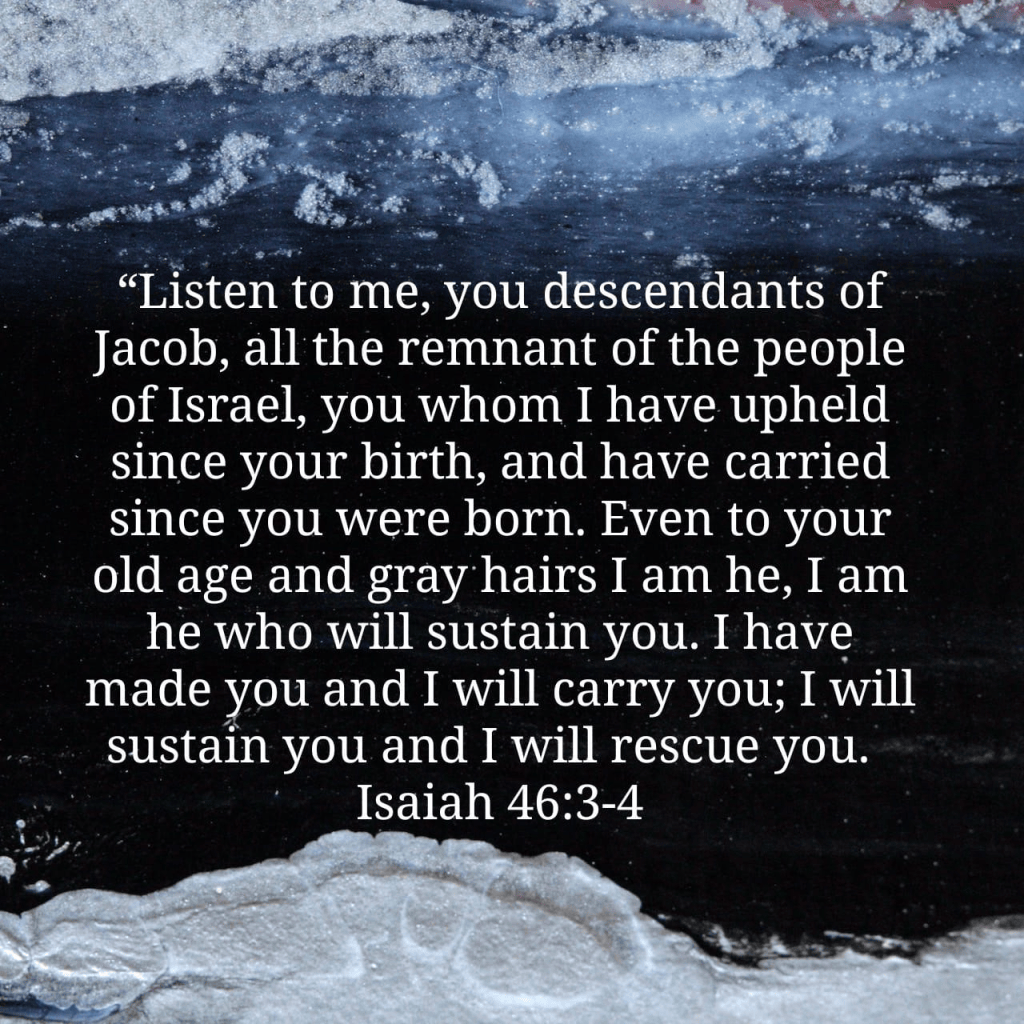
Carried by Grace: A Reflection on Isaiah 46:3

In the hustle and bustle of today’s technological life, it is all too easy to feel unnoticed, unsupported, and even lost and abandoned.

Yet, in Isaiah 46:3, we encounter a profound truth of God’s unwavering care:

“Hearken unto me, O house of Jacob, and all the remnant of the house of Israel, which are borne by me from the belly, which are carried from the womb.”

This verse not only summons us to listen but also serves as a much needed reminder of God’s enduring presence and compassion throughout our lives.

To truly grasp the depth of this verse, we must first understand the context in which it was written.

The Israelites faced tumultuous times; they were in exile, contending with oppression, and experiencing uncertainty about their future.

God, through His prophet Isaiah, addresses them as a tender father would his children.

Isaiah 46:3  King James Version

3 Hearken unto me, O house of Jacob, and all the remnant of the house of Israel, which are borne by me from the belly, which are carried from the womb:

The phrase “hearken unto me” signifies more than mere listening; it calls for profound attention and response.

God invites His people into a deeper relationship, one centered, founded, upon understanding and trust.

In our own lives, when we face such a magnitude of difficulties, do we stop, take the time cease our striving, hands over our ears to “hearken” to God’s voice?

The metaphor of being “borne by me from the belly” and “carried from the womb” paints an image of intimacy.

God is not a distant deity; He is present from our very beginnings.

The Hebrew people, as descendants of Jacob, are reminded that from the very first moments of their conception, they have been under His watchful eye and loving care.

This speaks to us as well, reminding us that before we ever took our first breath, we were known and beloved by God.

As Psalm 139:13-14 proclaims,

“For thou hast possessed my reins: thou hast covered me in my mother’s womb. I will praise thee; for I am fearfully and wonderfully made.”

How reassuring it is to know that God is intimately involved in our lives even before they unfold fully.

Moreover, the imagery of being carried suggests a gentle guidance and provision.

In our most vulnerable states, when we feel like we cannot move forward, we are reminded that God is the one who carries us.

Life can feel overwhelming, especially when we face loss, heartache, or the daily struggles that wear us down.

In those moments, God is there to cradle us, much like a mother carries her child, providing safety and reassurance.

Our trials do not go unnoticed; they are met with divine support.

1 Peter 5:7 encourages us to “Cast all your care upon him; for he careth for you.”

This reveals not only the invitation to bring our burdens but also affirms His readiness to carry them alongside us.

Reflecting on this verse also brings forth the notion of preservation.

The phrase “remnant of the house of Israel” signifies a group that remains after calamity, suggesting on going hope even in difficult circumstances.

To be part of a remnant means to be preserved for a unique future purpose.

Just as the Israelites were promised restoration, so we too have the assurance that God is constantly working in our trials to bring about His divine plans.

Even when we feel small amidst the chaos of life, we are part of something much larger—a promise and purpose that transcends our understanding.

Our reflection on Isaiah 46:3, lets us take an intentional moment to recognize our dependence on God.

We are not alone in our struggles, nor are we forsaken in times of distress.

Instead, we are cradled by grace, borne from our very beginnings, and carried through every season of our lives.

I pray we allow this truth to resonate deep within us, drawing us closer to the heart of our Heavenly Father.

Let us learn to hearken—open our ears and hearts—to the gentle whispers of His love, support, and guidance.

In doing so, we find peace, purpose, and a lasting assurance that we are not just existing, but thriving under His 24×7 caring embrace.

It has always been a great comfort for believers to realize that we are fearfully and wonderfully made and embraced and that the Lord knows us before we are born, for He forms us in our mother’s womb.

Indeed, He has scheduled every day of our lives, watches over our every move and fully, faithfully remains with us, even when we wander far away from Him.

But this verse 4 assures us that it is not only our early years about which the Lord is interested.

He is with us every day of our lives, from the cradle to the grave.

He cares for us from the womb to the tomb, from start to finish, from birth to death, and for every day and season in between.

The Lord is not only interested in us during the first flush of youth, our years of vigorous actions, or our blushing adult activities when we are motoring along through the prime of life.

He also is deeply interested in us as we stumble forward, advancing into our twilight years, and even on into the frailty of old age.

The Lord loves and cares for each one of us when our hair has turned grey, or silver or turned snowy white or flat fallen off of our heads in total baldness.

Our knees have grown feeble, and our faces have become furrowed with huge wrinkles. He cares for us when our hands start to tremble, our mouths begin to dribble, and our minds become increasingly confused and forgetful.

He has promised to carry us and care for us in every season of life, including our very last season, because He is our Heavenly Father and we are His people.

He has made us and He has promised to faithfully carry us, care for us, help us, and deliver us all the days of our life.

At our very last breaths, the end of our life, He will take us home to be with Himself in heavenly glory, for He has promised:

“And even to your old age I am he; and even to hoar hairs will I carry you: I have made, and I will bear; even I will carry, and will deliver you.”

There is No One Like God

This can be summed up by declaring, proclaiming, this …

The Lord God is unique.

There is no one like him.

He is the Lord, “and there is no other.”

God is incomparably great.

He is above and beyond all creation.

He did not have to create the universe to be God; he was already God before the foundation of the earth.

God is not an idol made by human imagining; he is the one who gives life to all.

God is not vulnerable or fleeting like the rulers of this world.

His throne is unshakable.

His kingdom is eternal.

He cannot be challenged nor defeated by any enemy or coalition.

God is the undefeated victor in all battles.

He does not share his glory with anyone.

He does not decentralize his power.

On the contrary, in God’s hands are all power and authority.

The Lord is incomparably holy, separate from everything and everyone.

In him there is no fault.

He is pure in who he is and perfect in all he does.

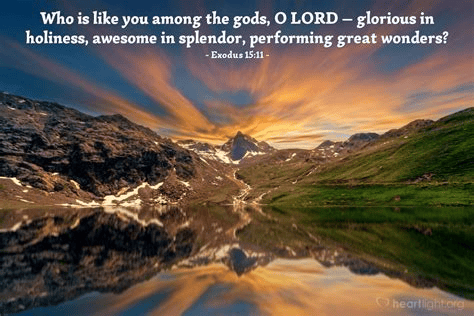
Moses declared, “Who among the gods is like you, LORD? Who is like you—majestic in holiness, awesome in glory, working wonders?” (Exodus 15:11).

We can trust in God because his sovereignty is unlimited.

His love is eternal, and no one can separate us from that love.

His wisdom is perfect, and therefore none of his plans can be thwarted.

In the name of God, the Father and God the Son and God the Holy Spirit …

Praying …

Psalm 29

A Psalm of David.

1 Give unto the Lord, O ye mighty,
give unto the Lord glory and strength.
2 Give unto the Lord the glory due unto his name;
worship the Lord in the beauty of holiness.

3 The voice of the Lord is upon the waters:
the God of glory thundereth: the Lord is upon many waters.
4 The voice of the Lord is powerful;
the voice of the Lord is full of majesty.
5 The voice of the Lord breaketh the cedars;
yea, the Lord breaketh the cedars of Lebanon.
6 He maketh them also to skip like a calf;
Lebanon and Sirion like a young unicorn.
7 The voice of the Lord divideth the flames of fire.
8 The voice of the Lord shaketh the wilderness;
the Lord shaketh the wilderness of Kadesh.
9 The voice of the Lord maketh the hinds to calve,
and discovereth the forests:
and in his temple doth every one speak of his glory.

10 The Lord sitteth upon the flood;
yea, the Lord sitteth King for ever.
11 The Lord will give strength unto his people;
the Lord will bless his people with peace.

Glory be to the Father,
and to the Son, and to the Holy Ghost;
as it was in the beginning,
is now, and ever shall be,
world without end. Amen, amen.
https://translate.google.com

Do not be naive. Do not be fooled nor fall into a pit of deepest complacency. Immoral and disobedient times with one’s who boast of an allergy to God are on our horizons. 2 Timothy 3:1-5

2 Timothy 3:1-5 New Living Translation

The Dangers of the Last Days

3 You should know this, Timothy, that in the last days there will be very difficult times. 2 For people will love only themselves and their money. They will be boastful and proud, scoffing at God, disobedient to their parents, and ungrateful. They will consider nothing sacred. 3 They will be unloving and unforgiving; they will slander others and have no self-control. They will be cruel and hate what is good. 4 They will betray their friends, be reckless, be puffed up with pride, and love pleasure rather than God. 5 They will act religious, but they will reject the power that could make them godly. Stay away from people like that!

Word of God for the Children of God.

Glory be to the Father,
and to the Son, and to the Holy Ghost;
as it was in the beginning,
is now, and ever shall be,
world without end. Amen, amen.
A long time ago, in a garden far far away, the serpent whispered to humanity’s unsuspecting souls “There’s no worry, there is plenty of time” but Christians know they need to live every single day for the Lord as if it could be their last.

Don’t they?

8 Then I heard the Lord asking, “Whom should I send as a messenger to this people? Who will go for us?”

I said, “Here I am. Send me.”

9 And he said, “Yes, go, and say to this people,

‘Listen carefully, but do not understand.
    Watch closely, but learn nothing.’
10 Harden the hearts of these people.
    Plug their ears and shut their eyes.
That way, they will not see with their eyes,
    nor hear with their ears,
nor understand with their hearts
    and turn to me for healing.”[b]

11 Then I said, “Lord, how long will this go on?”

And he replied,

“Until their towns are empty,
    their houses are deserted,
    and the whole country is a wasteland;
12 until the Lord has sent everyone away,
    and the entire land of Israel lies deserted.
13 If even a tenth—a remnant—survive,
    it will be invaded again and burned.
But as a terebinth or oak tree leaves a stump when it is cut down,
    so Israel’s stump will be a holy seed.”

Perhaps we do not know?

Perhaps we do not bother to care?

Perhaps we are too busy taking life for granted?

Perhaps we are too busy taking God for granted?

Perhaps we are too busy believing God is long since dead and buried?

Perhaps we are too busy listening to the serpent whispering in our ears?

Are we observing, do we have situational awareness … something is not kosher?

Has the serpent dulled our senses to that final nth degree of imperceptibility?

So many questions being asked … but who is the One asking these questions?

Genesis 1:1-5 Amplified Bible

The Creation

1 In the beginning God ([a]Elohim) [b]created [by forming from nothing] the heavens and the earth. 2 The earth was [c]formless and void or a waste and emptiness, and darkness was upon the face of the deep [primeval ocean that covered the unformed earth]. The Spirit of God was moving (hovering, brooding) over the face of the waters. 3 And God said, [d]“Let there be light”; and there was light. 4 God saw that the light was good (pleasing, useful) and [e]He affirmed and sustained it; and God separated the light [distinguishing it] from the darkness. 5 And God called the light day, and the darkness He called night. And there was [f]evening and there was [g]morning, one day.

Where are the curious ones who bother to look, observe, to hear, to be obedient?

Where are the ones publicly declaring; “my heart was strangely warmed?”

Psalm 19 Amplified Bible

The Works and the Word of God.

To the Chief Musician. A Psalm of David.

19 The heavens are telling of the glory of God;
And the expanse [of heaven] is declaring the work of His hands.
2 
Day after day pours forth speech,
And night after night reveals knowledge.
3 
There is no speech, nor are there [spoken] words [from the stars];
Their voice is not heard.
4 
Yet their voice [in quiet evidence] has gone out through all the earth,
Their words to the end of the world.
In them and in the heavens He has made a tent for the sun,
5 
Which is as a bridegroom coming out of his chamber;
It rejoices as a strong man to run his course.
6 
The sun’s rising is from one end of the heavens,
And its circuit to the other end of them;
And there is nothing hidden from its heat.

7 
The law of the Lord is perfect (flawless), restoring and refreshing the soul;
The statutes of the Lord are reliable and trustworthy, making wise the simple.
8 
The precepts of the Lord are right, bringing joy to the heart;
The commandment of the Lord is pure, enlightening the eyes.
9 
The fear of the Lord is clean, enduring forever;
The judgments of the Lord are true, they are righteous altogether.
10 
They are more desirable than gold, yes, than much fine gold;
Sweeter also than honey and the drippings of the honeycomb.
11 
Moreover, by them Your servant is warned [reminded, illuminated, and instructed];
In keeping them there is great reward.
12 
Who can understand his errors or omissions? Acquit me of hidden (unconscious, unintended) faults.
13 
Also keep back Your servant from presumptuous (deliberate, willful) sins;
Let them not rule and have control over me.
Then I will be blameless (complete),
And I shall be acquitted of great transgression.
14 
Let the words of my mouth and the meditation of my heart
Be acceptable and pleasing in Your sight,
O Lord, my [firm, immovable] rock and my Redeemer.

In uncertain turbulent times, God calls each and every one of us to steadfast faith, resilient hope, and genuine godliness, authentic humility, anchored in Savior Jesus Christ, His indelible truth, not swayed by counterfeit spirituality.

God has spoken through His Prophets and His Son and His Apostles – “I AM.”

He has not left us guessing or grasping in the dark.

He places His hand on our shoulder through the apostle Paul and whispers, Steady now. Take courage. I see what you see, and I will guide you through.

2 Timothy is a letter from an older shepherd to a younger one—a seasoned saint encouraging a timid pastor.

Picture Paul, weathered and wise, passing the torch to Timothy, who faces a congregation and a culture churning with confusion.

The ink of this letter feels warm, like a father’s arm around a son.

It names the ache of the age and points us to the Anchor who holds in every storm.

Hebrews 6:17-20 Amplified Bible

17 In the same way God, in His desire to show to the heirs of the promise the unchangeable nature of His purpose, intervened and guaranteed it with an oath, 18 so that by two unchangeable things [His promise and His oath] in which it is impossible for God to lie, we who have fled [to Him] for refuge would have strong encouragement and indwelling strength to hold tightly to the hope set before us. 19 This hope [this confident assurance] we have as an anchor of the soul [it cannot slip and it cannot break down under whatever pressure bears upon it]—a safe and steadfast hope that enters within the veil [of the heavenly temple, that most Holy Place in which the very presence of God dwells], 20 where Jesus has entered [in advance] as a forerunner for us, having become a High Priest forever according to the order of [a]Melchizedek.

Paul tells us plainly: there would be days marked by both pressure and peril, by counterfeit spirituality and a carousel of teachers who dazzle but do not deliver.

It sounds familiar, doesn’t it?

Our calendars are crowded, our newsfeeds are loud, and our spirits can feel thin.

And yet, right here—right now—God calls us to walk in clarity, courage, and compassion. He calls us to be a people of resilient hope and rugged holiness.

He calls us to hold truth with tenderness and to trust Christ with tenacity.

J. I. Packer once wrote, “A little knowledge of God is worth more than a great deal of knowledge about him.”

That lands near the center of our passage today.

So many words swirl.

So much content streams.

Yet the living knowledge of God—knowing Him, loving Him, listening to Him—gives ballast to the soul and brightness to our steps.

Today, we sit under a 2000 years old text identifying the times and lifts our eyes unto the heavens which God took from chaos’ iron clad grasp to hope and love.

It will help us to better understand the crisis of the last days, teach us how to face sham spirituality and false teaching, and strengthen our resolve to keep step with the truth while we wait for the appearing of our Savior and King.

The point is not panic; the point is preparation.

The goal is not fear; the goal is faithfulness.

The goal is not inaction, sitting playing video games; The goal is obedience.

And do we know what faithfulness looks like in an age like ours? It looks like a steady heart, a sound mind, a soft word, and a stubborn hope in Jesus Christ.

Psalm 81:15 Amplified Bible

15 
Those who hate the Lord would pretend obedience to Him and cringe before Him,
And their time of punishment would be forever.

And dare we know what authentic obedience would look like in an age like ours?

In the name of God, the Father and God the Son and God the Holy Spirit

Praying …

Psalm 128 Amplified Bible

Blessedness of the Fear of the Lord.

A Song of [a]Ascents.

128 Blessed [happy and sheltered by God’s favor] is everyone who fears the Lord [and worships Him with obedience],
Who walks in His ways and lives according to His commandments.
2 
For you shall eat the fruit of [the labor of] your hands,
You will be happy and blessed and it will be well with you.
3 
Your wife shall be like a fruitful vine
Within the innermost part of your house;
Your children will be like olive plants
Around your table.
4 
Behold, for so shall the man be blessed and divinely favored
Who fears the Lord [and worships Him with obedience].

5 
May the Lord bless you from Zion [His holy mountain],
And may you see the prosperity of Jerusalem all the days of your life;
6 
Indeed, may you see your [family perpetuated in your] children’s children.
Peace be upon Israel!

Glory be to the Father,
and to the Son, and to the Holy Ghost;
as it was in the beginning,
is now, and ever shall be,
world without end. Amen, amen.
https://translate.google.com/

The blessings of persecution? “Count yourself blessed every time someone cuts you down or throws you out, and every time someone smears you or so blackens your name to discredit me.” Luke 6:17-23

Luke 6:17-23 The Message

You’re Blessed

17-21 Coming down off the mountain with them, he stood on a plain surrounded by disciples, and was soon joined by a huge congregation from all over Judea and Jerusalem, even from the seaside towns of Tyre and Sidon. They had come both to hear him and to be cured of their diseases. Those disturbed by evil spirits were healed. Everyone was trying to touch him—so much energy surging from him, so many people healed! Then he spoke:

You’re blessed when you’ve lost it all.
God’s kingdom is there for the finding.

You’re blessed when you’re ravenously hungry.
Then you’re ready for the Messianic meal.

You’re blessed when the tears flow freely.
Joy comes with the morning.

22-23 “Count yourself blessed every time someone cuts you down or throws you out, every time someone smears or blackens your name to discredit me. What it means is that the truth is too close for comfort and that that person is uncomfortable. You can be glad when that happens—skip like a lamb, if you like!—for even though they do not like it, I do . . . and all heaven applauds. And know that you are in good company; my preachers and witnesses have always been treated like this.

Word of God for the Children of God

Glory be to the Father,
and to the Son, and to the Holy Ghost;
as it was in the beginning,
is now, and ever shall be,
world without end. Amen, amen.
Blessed in our Brokenness? Our Embracing the High Cost of Discipleship?

In a world that often equates happiness with acceptance, Luke 6:22 challenges our understanding of what it means to be blessed.

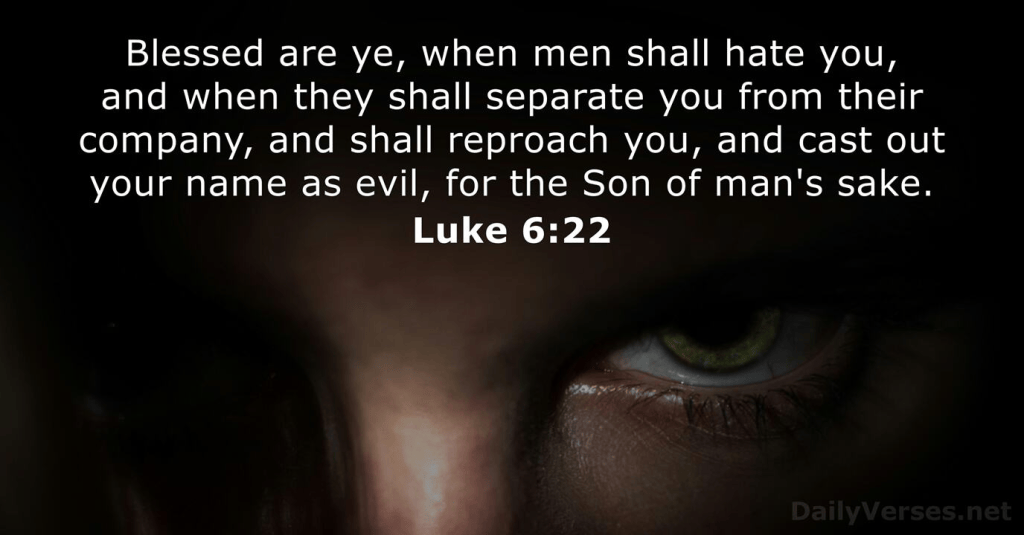
The verse states, “Blessed are ye, when men shall hate you, and when they shall separate you from their company, and shall reproach you, and cast out your name as evil, for the Son of man’s sake.” (KJV).

At first glance, these words may seem perplexing, especially in a culture that idolizes popularity and social approval.

The idea of being blessed in the face of hatred and rejection is counterintuitive and can elicit deep feelings of bewilderment or dread.

However, to fully grasp the depth of Jesus’ message from Luke 6:22, we must explore the context in which these words were spoken and what they mean for us as followers of Savior Christ today.

In the Sermon on the Mount, where this teaching appears, Jesus addresses His disciples and offers them a deep radical perspective on the nature of blessings.

He contrasts societal norms with the Kingdom values that He is instituting.

Being blessed by God is not confined to moments of prosperity or public acclaim; it includes the experience of trials and tribulations for His sake.

In a sense, this passage invites us to consider, redefine what it means to be blessed, urging us to find solace in our pain and strength in our weakness.

The phrase “when men shall hate you” speaks to the reality of persecution that often accompanies a life dedicated to the teachings of Jesus.

Followers of Christ, we will find ourselves at odds with the values of the world.

Our beliefs may lead to violent hostility from those who do not share our faith or understanding of righteousness.

This is not merely a theoretical statement.

It is a call to recognize and prepare for the inevitable conflicts that can arise when we choose under all conditions to stand steadfast and firm in our faith.

The next part of the verse, “and when they shall separate you from their company,” adds another hardcore layer to our calling as Jesus’ disciples.

Jesus acknowledges that enduring persecution, rejection, comes at a price—perhaps that price is exclusion, alienation from friends, family, or community.

This separation can be one of the hardest experiences to endure, as human beings are inherently social creatures.

This very separation, painful as it may be, can serve to draw us closer to Christ.

When we lay down our earthly affiliations for the sake of following Him, we open ourselves up to a new reality; a much deeper, more intimate fellowship with Jesus, who identified with betrayal, rejection and understood our pain.

To be reproached and to have one’s name cast out as evil is a daunting prospect.

It resonates with the image of the early Christians, who faced scorn, contempt, persecution, even publicly humiliating painful deaths for their steadfast faith.

In today’s context, while perhaps not facing physical persecution, many still encounter slander, misunderstanding, or even hostile environments stemming from their Christian beliefs and values — some will even face being murdered.

We may have experienced such persecution at school; maybe we took a stand for the Bible, then we suddenly found ourselves isolated from your peer group.

We may have tasted the pain of being ostracized by a friend, friendship group, or passed over for promotion at work, because we explained to someone who Jesus is, why He died, and what that means. Why we do have legitimate hope.

We may even know the pain of being spurned by members of our own family because of our faith.

If we stand up, stand out for Christ, then ever so subtly and yet so very clearly the hatred begins to spill out, and the sense of scorn is nearly overwhelming.

There is nothing easy or enjoyable about being maligned or left out when we choose to live in obedience to God.

Indeed, there is great heartache that accompanies rejection.

How, then, are we to find blessing and comfort in its midst?

We must cling to the truth Jesus speaks of here: that when we find ourselves on the receiving end of the world’s hatred as a response to our faithfulness to the Son of Man, nothing has gone wrong: we are, truth, in a place to know blessing.

In other words, this sort of mistreatment is tangible evidence of our genuine faith and relationship with the Lord.

Furthermore, Jesus promises that if we acknowledge Him before men, He will also acknowledge us before His Father in heaven (Matthew 10:32-33).

32-33 “Stand up for me against world opinion and I’ll stand up for you before my Father in heaven. If you turn tail and run, do you think I’ll cover for you?

The man or woman who leads a holy life—who is prepared to speak and obey God’s word with boldness, who refuses to seek the narrow middle way between an obedient life and a popular one—will eventually collide head-on with the diesel locomotive destination the ungodly and incur the enmity of the world.

How are we being called to risk rejection in order to speak of Christ or live for Christ?

Do not lose heart!

Instead, respond to slander against you or dislike of you on account of the gospel with grace by rejoicing, “for behold, your reward is great in heaven.”

The world has nothing to offer that comes close to comparing with that.

The fact Jesus directly identifies with these experiences as a sign of blessing is transformative.

He invites us to embrace trials, they are indicators of our commitment to Him.

Ultimately, understand the key phrase in this verse “for the Son of man’s sake.”

Our suffering is not arbitrary; it is directly tied to our relationship with Christ.

When we endure hardship for His name, we align ourselves with His mission and express our steadfast, immovable commitment to His life and teachings.

In this context, our pain becomes purposeful.

When faced with hatred, ostracization, and reproach, we remind ourselves that we share in the greater narrative of Christ’s redemptive work, which is framed by betrayal, public humiliation, near complete rejection and unconditional love.

In a society that often dismisses or diminishes the personal cost of discipleship, Luke 6:22 serves as a vital reminder that our only true identity and worth are not determined by the acceptance of the world, but by our status as children of God.

Thus, let us rejoice in our trials and take comfort in the assurance that, through our endurance of, perseverance, the pain and ridicule, we are indeed “blessed.”

As we reflect on this verse, let us ask ourselves:

How do we respond to moments of betrayal, humiliation, scorn, rejection?

Do we allow our response to drive us deeper into the arms of Christ, or do we seek validation elsewhere?

May we first strive to seek out, look directly into, the face of God.

Let the intensity of our gaze strive to reflect a steadfast faith in Savior Christ, knowing every single trial for His name’s sake draws us closer to Him and also inspire us to sacrifice self, enriching our inheritance in the Kingdom of Heaven.

In the name of God, the Father and God the Son and God the Holy Spirit …

Praying ….

Psalm 19 The Message

19 1-2 God’s glory is on tour in the skies,
    God-craft on exhibit across the horizon.
Madame Day holds classes every morning,
    Professor Night lectures each evening.

3-4 Their words aren’t heard,
    their voices aren’t recorded,
But their silence fills the earth:
    unspoken truth is spoken everywhere.

4-5 God makes a huge dome
    for the sun—a superdome!
The morning sun’s a new husband
    leaping from his honeymoon bed,
The daybreaking sun an athlete
    racing to the tape.

6 That’s how God’s Word vaults across the skies
    from sunrise to sunset,
Melting ice, scorching deserts,
    warming hearts to faith.

7-9 The revelation of God is whole
    and pulls our lives together.
The signposts of God are clear
    and point out the right road.
The life-maps of God are right,
    showing the way to joy.
The directions of God are plain

    and easy on the eyes.
God’s reputation is twenty-four-carat gold,
    with a lifetime guarantee.
The decisions of God are accurate
    down to the nth degree.

10 God’s Word is better than a diamond,
    better than a diamond set between emeralds.
You’ll like it better than strawberries in spring,
    better than red, ripe strawberries.

11-14 There’s more: God’s Word warns us of danger
    and directs us to hidden treasure.
Otherwise how will we find our way?
    Or know when we play the fool?
Clean the slate, God, so we can start the day fresh!
    Keep me from stupid sins,
    from thinking I can take over your work;
Then I can start this day sun-washed,
    scrubbed clean of the grime of sin.
These are the words in my mouth;
    these are what I chew on and pray.
Accept them when I place them
    on the morning altar,
O God, my Altar-Rock,
    God, Priest-of-My-Altar.

Glory be to the Father,
and to the Son, and to the Holy Ghost;
as it was in the beginning,
is now, and ever shall be,
world without end. Amen, amen.
https://translate.google.com

Jesus’ compassion, God’s abundant provision. Public demonstration of grace through action; feeding those 5000 hungry souls. Matthew 14:13-21

Matthew 14:13-21 Revised Standard Version

Feeding the Five Thousand

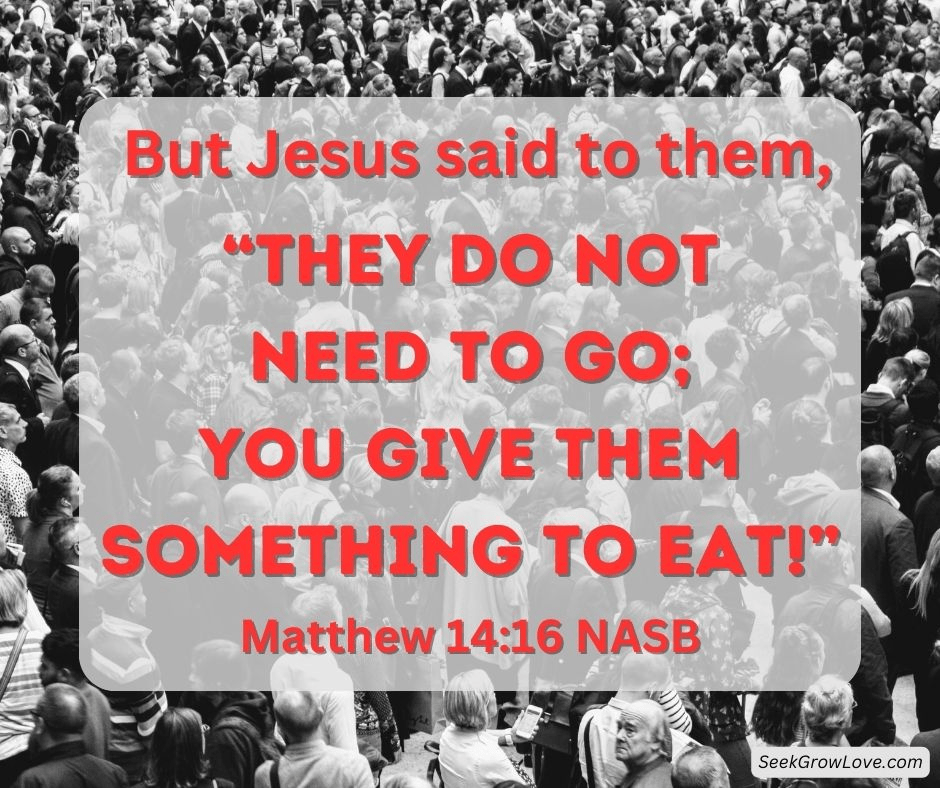
13 Now when Jesus heard this, he withdrew from there in a boat to a lonely place apart. But when the crowds heard it, they followed him on foot from the towns.  14  As he went ashore he saw a great throng; and he had compassion on them, and healed their sick. 15 When it was evening, the disciples came to him and said, “This is a lonely place, and the day is now over; send the crowds away to go into the villages and buy food for themselves.” 16 Jesus said, “They need not go away; you give them something to eat.” 17 They said to him, “We have only five loaves here and two fish.”  18 And he said, “Bring them here to me.” 19 Then he ordered the crowds to sit down on the grass; and taking the five loaves and the two fish he looked up to heaven, and blessed, and broke and gave the loaves to the disciples, and the disciples gave them to the crowds. 20 And they all ate and were satisfied. And they took up twelve baskets full of the broken pieces left over. 21 And those who ate were about five thousand men, besides women and children.

Word of God for the Children of God

Glory be to the Father,
and to the Son, and to the Holy Ghost;
as it was in the beginning,
is now, and ever shall be,
world without end. Amen, amen.
This story about miraculously feeding more than 5,000 people is usually told from the viewpoint of the disciples.

Except, it is now 2026 and I wonder what it was like to be a person in the crowd.

I try to imagine being surrounded by thousands of people—men and women of all shapes, sizes, and ages.

You would probably also see young children running around as parents tried to corral them along the shoreline.

Teenagers and young adults just hanging out because this is where the crowd is.

And seniors slowly shuffling to find a place close enough to Jesus so they could sit and hear him speak.

It was probably a very similar example of what our contemporary people have called “organized chaos.”

Even Jesus’ disciples didn’t know what to do with the hungry followers (see vv. 15-17).

What was it like to see the calm and measured face of Jesus in the midst of such a hectic scene?

How did Jesus know he could feed all those hungry people with just “five loaves of bread and two fish”?

Jesus knew he could feed the starving crowd because he was and is the Son of God, who not only provided the bread and fish but also created the earth and established everything in it, from the waters where the fish lived to the land that provided miraculous manna from heaven, the grain used to bake bread.

Having faith and trust in His connection to His Father, knowing the power of His Father, would give Jesus the opportunity to invite others to know him too.

Physical hunger is very real in our world today.

Nearly 32% of the world’s population does not have access to a healthy diet. actionagainsthunger.org

Global Food Insecurity Statistics

Current Estimates

  • Total Number of People Facing Hunger: Approximately 673 million people faced hunger in 2024, which represents about 8.3% of the global population.
  • Food Insecurity Levels: Around 2.3 billion people experienced moderate or severe food insecurity in 2024, a significant increase from pre-pandemic levels.

Statistics highlight the ongoing global food insecurity crisis, affecting millions, underscoring the need for urgent action to improve access to nutritious food.

 World Health Organization (WHO) data.unicef.org

However, as tragic, enraging and horrifying as those numbers truly are, an overlooked, undervalued and very different kind of hunger is even far more common: that hunger is identified as spiritual emptiness and insecurity.

It crosses all socio-economic, cultural boundaries, demographics don’t matter.

It encompasses all known social horizons, extends from the poor to the rich, and from the young to the old – no one is immune, everyone is at high risk.

Of course, precise statistics on spiritual hunger are impossible to determine.

But it’s safe to ­assume the number of those who are spiritually hungry in this world is significantly higher than 2.5 billion. Where is the bread and fish now?

In today’s narrative from Matthew, Jesus reaches out to people who are both physically and spiritually hungry.

Taking those five loaves and two fish, he looks to heaven and gives thanks.

After breaking the loaves, he gives them to his disciples to distribute to the large crowd of people.

And the miracle happens!

Everyone eats and is satisfied, and there are baskets of leftovers.

How big were those twelve baskets full of the broken pieces left over?

The exact size of the twelve baskets is not specified, but they were likely small baskets carried by hand, commonly used by travelers to hold their food.

These baskets were known as “cophinus” in the Jewish tradition.

What were the typical dimensions of small hand-carried baskets in ancient times?

Small hand-carried baskets in ancient times varied in size, but they were often designed to be easily manageable, usually around 12 to 18 inches in diameter.

These dimensions allowed for eminently practical use in gathering and carrying and distributing the remaining leftover items more efficiently.

After they ate and were satisfied, what was left over was picked up.

Twelve baskets of broken pieces, one basket for each apostle, now filled with the faith that Jesus will provide.

Not only provision for the apostles but for each and every person they seek to serve and save in the name of Jesus Christ.

For each fish or half loaf distributed, a full basket was returned.

In the Bible, twelve is a perfect number, a symbol of God’s ultimate power and authority or a number of completion.

Having 12 baskets left over tells us this was no error; this is irrefutable proof of the Holy Spirit’s hand in this miracle.

But why was there left-over food?

Why didn’t Jesus just feed the 5,000 and say “Hooray! We had enough food!”

No – he went above and beyond.

His miracle reached beyond the 5,000 men, women and.

It proved to the disciples through their faith in giving of the 5 loaves and 2 fish, their generosity and faith was returned with a blessing of food in abundance.

When giving in sacrificial faith, heartfelt compassion, the Lord provides. 

Now let’s talk about those leftovers that were gathered in broken pieces.

Jesus broke bread, performed the miracle, multiplied the food, fed the people… and the disciples are left picking up the pieces.

I can’t help but compare this to how some of the individuals seeking assistance feel… broken, lost or in pieces, physically and spiritually starving or starved.

Just as no food is left to waste, no food left on our meal plates – no person is left to waste – even a physically, mentally broken person is worth being picked up.

Together, with faith in His provision, as a body of Christ, we can come together and provide. We can use our God given gifts to pick up the broken pieces and put them in our basket – our community – our church – provide spiritual support.

By sharing this miraculous narrative, we as disciples are able to faithfully support the lost, the last and the least as we are taught through the Gospel.

God promised with the coming of the true Shepherd, the wilderness would become a rich pasture where his sheep would be gathered and fed (Ezekiel 34:23-31).

Jesus is the only true Shepherd who miraculously provides for all our needs.

Please accept his invitation if you struggle with hunger in your belly, heart!

Psalm 34:8-10 Amplified Bible

8 
O taste and see that the Lord [our God] is good;
How blessed [fortunate, prosperous, and favored by God] is the man who takes refuge in Him.
9 
O [reverently] fear the Lord, you His saints (believers, holy ones);
For to those who fear Him there is no want.
10 
The young lions lack [food] and grow hungry,
But they who seek the Lord will not lack any good thing.

He alone can satisfy!

In the name of God, the Father and God the Son and God the Holy Spirit …

Praying ….

Psalm 107:1-9 New King James Version

BOOK FIVE

Psalms 107–150

Thanksgiving to the Lord for His Great Works of Deliverance

107 Oh, give thanks to the Lord, for He is good!
For His [a]mercy endures forever.
2 Let the redeemed of the Lord say so,
Whom He has redeemed from the hand of the enemy,
3 And gathered out of the lands,
From the east and from the west,
From the north and from the south.

4 They wandered in the wilderness in a desolate way;
They found no city to dwell in.
5 Hungry and thirsty,
Their soul fainted in them.
6 Then they cried out to the Lord in their trouble,
And He delivered them out of their distresses.
7 And He led them forth by the right way,
That they might go to a city for a dwelling place.
8 Oh, that men would give thanks to the Lord for His goodness,
And for His wonderful works to the children of men!
9 For He satisfies the longing soul,
And fills the hungry soul with goodness.

Glory be to the Father,
and to the Son, and to the Holy Ghost;
as it was in the beginning,
is now, and ever shall be,
world without end. Amen, amen.
https://translate.google.com

Any possibility that we are somehow related to each other? But he replied to the man who told him, “Who is my mother, and who are my brothers?” Matthew 12:46-50

Matthew 12:46-50 English Standard Version

Jesus’ Mother and Brothers

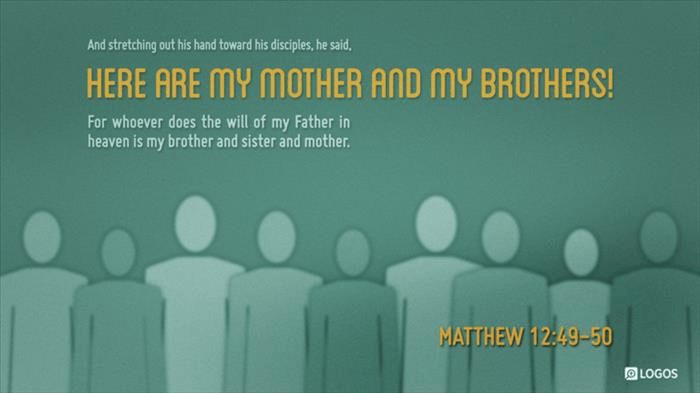
46 While he was still speaking to the people, behold, his mother and his brothers[a]  stood outside, asking to speak to him.[b] 48 But he replied to the man who told him,  “Who is my mother, and who are my brothers?” 49 And stretching out his hand toward his disciples, he said, “Here are my mother and my brothers!  50 For  whoever does the will of my Father in heaven is my brother and sister and mother.”

Word of God for the Children of God.

Glory be to the Father,
and to the Son, and to the Holy Ghost;
as it was in the beginning,
is now, and ever shall be,
world without end. Amen, amen.
Have we ever noticed how our family refrigerators becomes a gallery of grace?

Smudged fingerprints.

Crayon drawings.

Photos held up by a magnet that looks like a banana.

Report cards with coffee stains.

A wedding or birthday invitation tucked next to a grocery list.

That door tells a story.

We want to belong.

We want to know there’s a table where our chair is waiting, where our name is known, where our face is welcomed, what things the kids or the wife needs.

Some of us carry rich memories—bedtime prayers, board games, grandpa’s jokes, our grandma’s favorite recipes all written out and heavily marked up.

Others carry wounds—empty seats at holiday tables, phone calls that never came, words that bit and stayed, business meetings everyone ‘forgot’ about.

Our story matters.

And today, we open our hearts to the One who, from beginning to end, sees the whole story and still sets another place at the table.

Jesus knows the sweetness and the strain of family.

He honored His mother.

He cared for His disciples.

He understands the complicated calendar of weddings, funerals, newborn cries, and late-night arguments.

There is a line from J. I. Packer that whispers hope into this moment:

“Adoption is the highest privilege that the gospel offers.” (J. I. Packer, Knowing God)

Adoption means God wants you in His family.

It means you’re not a guest on probation; you’re a son or daughter by grace. It means our story is held by a Father who is wise, kind, and wonderfully present.

When Jesus spoke in our passage from Matthew’s narrative, He was surrounded by people with first and last names, lineages, and loyalties.

He didn’t cancel those ties.

He called people into something even larger—something that carries us when our circles feel thin and strengthens us when our circles feel strong.

He set the family table of the kingdom, invited each one us to sit close to him.

Can we picture this scene?

A crowded room.

Dust in the sunlight.

Whispers about His family waiting at the door.

Then Jesus lifts His hand toward ordinary followers—fishermen, tax collectors, quiet hearts and curious minds—and speaks the language we ache to hear:

“Here.”

Here is home.

Here is kinship.

Here is a place in the circle for anyone who says, “Father, Your will first.”

He doesn’t shrink the family; He stretches it.

He opens the circle to include weary and exhausted singles and big families, grandmothers and teens, introverts and extroverts, the steady and the shaky.

He forms a family out of faith and obedience, where love is learned, where respect forgiveness is practiced, and where priorities point to the Father.

So, friend, bring your scrapbook of smiles and scars.

Bring your Saturday soccer, Sunday football schedule and your sleepless nights.

Bring the name you can’t stop praying for.

Bring the grief you thought would never lift.

There’s grace for parents and patience for prodigals, lepers, and Samaritans.

There’s comfort for empty nests and calm for crowded houses.

There’s wisdom for reunions and healing for rifts.

Jesus isn’t far from your family.

He stands in the middle of everyday life—between work, errands and emails—and says, “Here are my family members.”

And with that word, He hands you a place to belong and a purpose to live: the will of God the Father.

He creates a new family, extended family circles, around the Father’s will, how His kingdom shapes the way we care for those folks under our roof, the “who are the people in our neighborhood?” people seated beside us in His churches.

If our souls and stomachs are empty, come feast on the manna from heaven.

If our hearts feels tired, take a breath.

If our faith feels thin, take a seat.

There is a chair with our names on it, and God our Father is glad we are here.

Picture the moment in your mind’s eye.

Jesus is teaching inside a packed house.

A message comes from the edge of the crowd.

His mother and brothers want to speak with Him.

Every ear tilts toward the door.

Every eye eagerly anticipates, listens and looks for His response.

He does not brush past the weight of family ties.

He speaks with family words.

He asks a question that makes everyone think.

Then He points to His learners and names them with the same words people used for the folks outside.

His reply is not cold.

It is careful. He is showing what belonging looks like when God leads the way.

This scene carries the scent of home life.

There is a mother who cares.

There are brothers who act with concern.

There is timing, and there is need.

Matthew wants us to see all of that.

Our human bonds are real.

They absolutely matter.

In this moment Jesus does not make them small.

He makes God’s purpose shine right in the middle of them.

We also hear the echo of God’s commands.

Scripture calls for honor toward parents.

Scripture blesses children and ties households together.

Jesus never scraps those words.

He confronts people who look for loopholes to dodge care for their families.

He tells the truth about vows that pretend to be holy but starve a mother or a widow or an orphan, diminish father’s covenant status in tirelessly raising, and teaching and defending and leading and nurturing, giving his all to his family.

So when He speaks here, He is not making a new rule that cancels the old ones.

He is showing the heart behind them.

The Father’s will must guide the way we care, the way we schedule, the way we answer the knock at the door.

Notice the simple gesture in the room.

He aims attention toward the people at His feet.

He gives them family names.

That is not a dismissal of kin outside.

That is a window into the heart of God.

The Father builds a household through faith and obedience.

God’s family grows as people listen and live by His words.

Jesus is not shrinking love.

He is showing exactly where it comes from and exactly where it is all going.

Look again at the key line.

“Whoever does the will of my Father in heaven is my brother and sister and my mother.”

Action matters.

Not loud claims.

Not loud emotions.

The will of the Father named in teaching, prayers, and daily choices.

When a person follows that will, Jesus uses family words for that person.

He is not trading one clan for another.

He is raising the flag over a new home that can hold every kind of story.

This is a word of grace.

Think of people in that room with no famous last name.

Think of people with messy pasts.

Think of people who were always outside the important doors.

Jesus points to them and gives them a place near His heart, at His meal table.

This is also a word of clarity.

Kinship with Jesus does not come by standing close or hearing a lot.

It shows up in trust that becomes obedience.

It shows up in doing what the Father wants, even when it is quiet and unseen.

That helps us read the tension in the scene.

Some might ask, “Is He pushing His mother away?”

The text does not say that.

The text shows a Teacher who refuses to let earthly claims direct His mission.

He is not driven by pressure.

He is led by the Father.

When He gives new names to His followers, He is not swapping love. He is opening a home that sits higher than our bloodlines and holds them steady.

This word shapes the way we treat the people in our homes.

If the will of the Father is the mark of true kinship, then the best way to love our relatives is to lead one another toward that will.

We speak truth with patience.

We forgive in real time.

We keep our word.

We repent when we are wrong.

We pray, not as a last resort, but as regular breath.

These acts honor family because they honor God.

There are days when family plans press hard.

There are days when hurt feelings cloud the room.

Matthew’s scene shows a calm center.

The Father’s will sets the pace.

We make time for worship, work and rest in ways that reflect God’s wisdom.

That means we set boundaries that guard love from manipulation.

That means we guard the weak.

We do not return insults.

We do not nurse grudges.

We carry one another’s needs to the Lord and move our feet toward peace.

It also means we see marriage, singleness, parenting, caregiving, and aging as places to do the Father’s will.

These are not side jobs.

These are places where obedience takes shape.

We do not need grand gestures.

We need faithful steps.

We need gentleness that answers anger with a soft word.

We need courage that tells the truth when silence would be easier.

We need patience that keeps serving when thanks are slow.

This word changes how we see the people sitting around us as we follow Jesus.

He names His followers with family terms.

That is not a metaphor tossed in the air.

That is a call to real care.

Look around a local church with that in mind.

We are not customers.

We are kin.

We do not pass each other like ships.

We show up.

We notice needs.

We carry burdens.

We celebrate small steps.

We make space for tears.

The scene in Matthew gives us a pattern.

Jesus identifies those who do the Father’s will as His own family.

So our shared life cannot be thin.

We spend time together.

We learn names.

We break bread.

We make phone calls.

We share rides.

We show up in waiting rooms.

We pray in living rooms.

We are not in a rush to move on when someone is hurting.

We treat one another like family because that is what Jesus says we are.

In the name of God, the Father and God the Son and God the Holy Spirit. Amen

Praying …

Psalm 133 English Standard Version

When Brothers Dwell in Unity

A Song of Ascents. Of David.

133 Behold, how good and pleasant it is
    when brothers dwell in unity![a]
2 It is like the precious oil on the head,
    running down on the beard,
on the beard of Aaron,
    running down on the collar of his robes!
3 It is like the dew of Hermon,
    which falls on the mountains of Zion!
For there the Lord has commanded the blessing,
    life forevermore.

Glory be to the Father,
and to the Son, and to the Holy Ghost;
as it was in the beginning,
is now, and ever shall be,
world without end. Amen, amen.

https://translate.google.com

Have I learned to kiss the wave that throws me against the Rock of Ages? Embrace the full depth of God’s love, protection, and provision, even in the midst of all of my not so good times? Psalm 57

Tehillim 57 Orthodox Jewish Bible

57 (For the one directing. Set to Do Not Destroy. Mikhtam of Dovid, when he had fled from Sha’ul into the me’arah [cave]). Channeni, O Elohim, channeni; for my nefesh taketh refuge in Thee; yes, in the tzel (shadow) of Thy wings will I make my refuge, until these devastations pass by.

2 (3) I will cry out unto Elohim Elyon; unto El that fulfilleth all things for me.

3 (4) He shall send from Shomayim, and save me from the disgrace of him that would swallow me up. Selah. Elohim shall send forth His chesed (lovingkindness) and His emes (truth).

4 (5) My nefesh is among lions, and I lie even among them that devour Bnei Adam, whose shinayim (teeth) are spears and khitzim (arrows), and their leshon a sharp cherev.

5 (6) Be Thou exalted, O Elohim, above Shomayim; let Thy kavod be above kol ha’aretz.

6 (7) They have prepared a reshet (net) for my steps; my nefesh is bowed down; they have dug a pit before me, into the midst whereof they are fallen themselves. Selah.

7 (8) My lev is nachon (steadfast), O Elohim, my lev is nachon; I will sing and make music.

8 (9) Awake, my kavod (glory, soul, life); awake, nevel and kinnor; I myself will awake the shachar (dawn).

9 (10) I will give thanks unto Thee, Adonoi, among the peoples; I will sing of Thee among the peoples.

10 (11) For Thy chesed is gadol unto Shomayim, and Thy emes unto the heights.

11 (12) Be Thou exalted, O Elohim, above Shomayim; let Thy kavod be above kol ha’aretz (all the earth).

The Word of God for the Children of God

Glory be to the Father,
and to the Son, and to the Holy Ghost;
as it was in the beginning,
is now, and ever shall be,
world without end. Amen, amen.

We are diving deeper into the Word of God today, taking a journey back in time to a cave (fortress) in Adullam, where a young David was hiding from King Saul.

Cave of Adullam was originally a stronghold referred to in the Old Testament, near the town of Adullam, where future King David sought refuge from King Saul. The word “cave” is usually used but “fortress”, which also has a similar appearance in writing, is used as well. 

During this period, David passed up several opportunities to kill Saul, who in turn was attempting to kill his young rival, whose followers believed had been chosen by God to succeed King Saul. 

It was in this cave David penned these profound words of Psalm 57, a psalm ringing with faith, hope, and unshakeable trust in God’s protection, provision, and presence.

Charles Spurgeon once said, “I have learned to kiss the wave that throws me against the Rock of Ages.”

Isn’t that so true, church?

Even in our darkest times, God is there.

He’s our rock and our refuge.

He’s the One we can embrace when the waves of life threaten to knock us down.

David, even in this seemingly hopeless situation, found solace and protection in God.

This is a powerful testament to God’s unwavering protection, a theme that resonates throughout the Bible and even in our lives today.

The cave’s symbolism: The cave, in many ways, symbolizes the trials and tribulations we all face.

It’s dark, it’s cold, and it’s isolating.

It’s a place where fear and uncertainty can easily take hold in that darkness.

Yet, it’s in this very place which David found God’s protection.

He was not alone in the cave or fortress; God was with him.

This is a profound reminder for us no matter how dark our circumstances may seem, God is there.

He’s our protector,

He’s our shield,

He’s our fortress.

His presence is a refuge of strength where we can find safety and security.

His protection:

Verse 1 says, “I look to you for protection. I will hide beneath the shadow of your wings until the danger passes by.”

The imagery of hiding beneath God’s wings brings to mind a mother bird shielding her young from predators.

This is the kind of protection God offers us – a protection that is nurturing, comforting, encompassing and secure.

It’s a protection that doesn’t merely shield us from predators, but also provides us with the unshakeable assurance that we are also cared for and utterly loved.

His deliverance:

David was confident that God would not only protect him but also deliver him from his enemies.

This is echoed in verse 3, “He will send help from heaven to rescue me, disgracing those who hound me.”

God’s protection is not passive; it’s active.

He doesn’t just shield us from harm; He fights for us.

He steps into our battles and brings about victory.

Extends to our emotional and spiritual well-being:

In the cave, David was not just hiding from Saul’s physical threats, but he was also wrestling with feelings of fear, anxiety, and despair.

Yet, in the midst of this emotional turmoil, David found peace and comfort in God’s presence.

This reminds us that God’s protection encompasses our whole being. He guards our hearts and minds, providing us with peace that surpasses all understanding.

Our own ‘cave experiences’: We can draw strength from David’s example.

We can look to God for protection, knowing that He is our refuge and strength, an ever-present help in trouble.

We can rest in His promises, confident that He will deliver us from our enemies and provide us with peace in the midst of our storms.

God’s Provision

In the midst of David’s distress, he found solace in the provision of God.

This is a profound truth that we must grasp – God’s provision is not limited to our times of peace and prosperity.

In fact, it is often in the cave, in the midst of our trials and tribulations, that God’s provision becomes most evident.

His purpose:

David cries out to God Most High, “to God who will fulfill his purpose for me.”

Even in the cave, David understood that God had a purpose for his life.

He knew that his current circumstances were not just an accident, but a part of God’s divine plan.

This is a comforting thought for us today.

No matter what we are going through, we can trust that God has a purpose for our lives and He will fulfill it.

His promise:

David declares, “He will send help from heaven to rescue me, disgracing those who hound me. My God will send forth his unfailing love and faithfulness.”

Even in the darkness and hidden depths of the cave, David was confident in God’s promises.

He knew that God would send help from heaven, that He would find him, that He would rescue him, and that His love and faithfulness would never fail.

Watchman Nee once said:

“Outside of Christ, I am weak; in Christ, I am strong. Outside of Christ, I cannot; in Christ, I am more than able.” His strength becomes our strength. His provision becomes our provision. His victory becomes our victory.

He is our God, and He will provide.

God’s Presence

David, in the midst of his fear and uncertainty, was acutely aware of God’s presence with him in the cave.

David’s words reveal a deep sense of God’s nearness, even in the midst of his having to elude Saul’s forces.

David’s confidence in God’s presence:

“I will cry out to God Most High, to God who will fulfill his purpose for me.”

This is a powerful declaration of faith, asserting that God is not only present, but continually active working in David’s life to fulfill His divine purpose.

Even in the deepest recesses of that cave, David understood that God was with him, guiding his steps and working out His plan.

David’s plea for mercy:

This is in the opening verse of the psalm and is a testament to his belief in God’s presence and his reliance on God’s compassion and grace.

He knew that he could always call out to God in his distress and that God would hear him. No matter how dire our circumstances may seem, we can always call out to God, confident in His presence and His willingness to show us all mercy.

His presence is our refuge, our comfort, and our hope.

Conclusion

What a journey David had then, and what a journey our Church has today!

We have walked into David’s cave, touched his cold fear, shared in his faith.

There is a multitude of caves from which we can seek refuge from our enemy.

Prayerfully, we’ve learned that even in the darkest of caves, God’s mercy and God’s protection are unwavering. He is our rock, our refuge, and our rescuer.

So, as we have now received His wisdom, look at what is going on when we go out into the world this week, let’s remember to cling to our Rock of Ages, no matter what fears today’s pursuing armies of Saul may threaten us all with.

Let’s embrace trust in His unfailing mercy and faithfulness, just like David did.

Remember, Saul’s envy, his jealousy, his anger, blood lust can have no effect. God’s true purpose for us will always be fulfilled, even in the midst of our trials.

The God of hope is already inside your cave, filling you with His Presence as you come to renewed faith in Him, warm your heart by the power of the Holy Spirit.

In the name of God, the Father and God the Son and God the Holy Spirit …

Tehillim 121 Orthodox Jewish Bible

121 (Shir HaMa’alot) I will lift up mine eyes unto the harim (hills), from whence cometh ezri (my help).

2 Ezri (my help) cometh from Hashem, Oseh Shomayim v’Aretz.

3 He will not allow thy regel to slip; He that is shomer over thee will not slumber.

4 Hinei, He that is shomer over Yisroel shall neither slumber nor sleep.

5 Hashem is the One shomer over thee; Hashem is thy shade upon thy right hand.

6 The shemesh shall not strike thee by day, nor the yarei’ach by night.

7 Hashem shall preserve thee from kol rah; He shall preserve thy nefesh.

8 Hashem shall be shomer over thy going out and thy coming in from this time forth, and even v’ad olam.

Glory be to the Father,
and to the Son, and to the Holy Ghost;
as it was in the beginning,
is now, and ever shall be,
world without end. Amen, amen.

https://translate.google.com

In the beginning our story began in a complete state of darkness. Our earth was formless and empty, a darkness, 9/11/01 hovered lingered on the deep. Genesis 1:1-5

Genesis 1:1-5 Complete Jewish Bible

Parashah 1: B’resheet (In the beginning) 1:1–6:8

1 In the beginning God created the heavens and the earth. 2 The earth was unformed and void, darkness was on the face of the deep, and the Spirit of God hovered over the surface of the water. 3 Then God said, “Let there be light”; and there was light. 4 God saw that the light was good, and God divided the light from the darkness. 5 God called the light Day, and the darkness he called Night. So there was evening, and there was morning, one day.

The Word of God for the Children of God

Glory be to the Father,
and to the Son, and to the Holy Ghost;
as it was in the beginning,
is now, and ever shall be,
world without end. Amen, amen.

Beginnings are important.

Backgrounds about characters in novels and movies help us see the situations that have shaped them.

Sometimes we will introduce ourselves by talking about our likes, dislikes, what it is we do for a living, what sort of day we are having or the weather or what is currently going on in the world around us with our thoughts and our feelings.

We recognize how much of who we are in any given moment of time has a lot to do with our interpretations of the situations and the people who came before us.

Similarly, the Bible’s first words about the earth are that it was “formless and empty” and that “darkness was over the surface of the deep”—a poetic way of saying that our world did not exist before God started speaking and creating.

Have you ever been in a room without any lights on? It can be so dark that you can’t see your hands in front of your face or even when you touch your nose.

The Bible begins with such an indescribable darkness that is deeper than that.

It’s the very deepest darkness biblical writers could imagine or conceive: the empty darkness of nothingness, chaos is everywhere, our world not existing.

However heavy and impossible our current circumstances may feel, the Bible reminds us that from the beginning our story begins with the God who speaks, who creates new life even in the midst of the deepest darkness imaginable.

In other words, with God there is a non stop, continuous cycle of hope. God speaks and the result is always the same – the old is gone new life is created.

2 Corinthians 5:16-19 Complete Jewish Bible

16 So from now on, we do not look at anyone from a worldly viewpoint. Even if we once regarded the Messiah from a worldly viewpoint, we do so no longer.  17  Therefore, if anyone is united with the Messiah, he is a new creation — the old has passed; look, what has come is fresh and new! 18 And it is all from God, who through the Messiah has reconciled us to himself and has given us the work of that reconciliation, 19 which is that God in the Messiah was reconciling mankind to himself, not counting their sins against them, entrusting to us the message of reconciliation.

Genesis 1:1-5 Amplified Bible

The Creation

1 In the beginning God ([a]Elohim) [b]created [by forming from nothing] the heavens and the earth. 2 The earth was [c]formless and void or a waste and emptiness, and darkness was upon the face of the deep [primeval ocean that covered the unformed earth]. The Spirit of God was moving (hovering, brooding) over the face of the waters. 3 And God said, [d]“Let there be light”; and there was light. 4 God saw that the light was good (pleasing, useful) and [e] He affirmed and sustained it; and God separated the light [distinguishing it] from the darkness. 5 And God called the light day, and the darkness He called night. And there was [f]evening and there was [g]morning, one day.

In the Bible we have God’s great story of the world from its beginning to its end.

This story includes not only complexity and beauty but also great tragedy and sorrow. One of the golden threads woven into this story focuses on the world’s true King. Who is this King, and what does true kingship look like on the earth?

In the Bible’s opening verses we hear God speaking.

In the ancient world, no one could make things happen the way a king could by just speaking. If the king said, “Let there be a great banquet,” all the servants immediately jumped into action. “Your wish is our command,” they would say.

In Genesis, God speaks as King, and the cosmos itself springs into being.

God can even make something out of nothing!

Light and darkness, day and night, water and sky, sun and moon, vegetation and creatures. Whole arenas of life are formed and filled.

And God the King affirms its cosmic importance, “It is good.”

Creator King builds by speaking, his lordship over all things is put on display.

Ancient kings in their earthly kingdoms would build temples, palaces, and gardens. The Creator King has built the marvelous temple-palace-garden complex that is creation, the whole universe, including our earthly home.

The world in which we “live and move and have our being” now exists because God our King continues to speak and uphold its existence (Colossians 1:16-17).

Colossians 1:15-20 Amplified Bible

15 He is the exact living image [the essential manifestation] of the unseen God [the visible representation of the invisible], the firstborn [the preeminent one, the sovereign, and the originator] of all creation. 16 For [a]by Him all things were created in heaven and on earth, [things] visible and invisible, whether thrones or dominions or rulers or authorities; all things were created and exist through Him [that is, by His activity] and for Him. 17 And He Himself existed and is before all things, and in Him all things hold together. [His is all of the controlling, cohesive force of the universe.] 18 He is also the head [the life-source and leader] of the body, the [b]church; and He is the beginning, [c]the firstborn from the dead, so that He Himself will occupy the first place [He will stand supreme and be preeminent] in everything. 19 For it pleased the Father for all the fullness [of deity—the sum total of His essence, all His perfection, powers, and attributes] to dwell [permanently] in Him (the Son), 20 and through [the intervention of] the Son to reconcile all things to Himself, making peace [with believers] through the blood of His cross; through Him, [I say,] whether things on earth or things in heaven.

9/11: Understanding God’s Sovereignty and Purpose

On September 11, 2001, our world was forever changed by the tragic events that unfolded.

Many people asked the question:

Where was God in the midst of this terrible tragedy?

As Christians, we believe that God is always present and in control, even in the face of evil and suffering.

While it may be difficult to comprehend why a loving God would allow such a tragedy to happen, we must always remember that God’s ways are higher than our ways and His thoughts are higher higher than our thoughts (Isaiah 55:9).

The Reality of Human Sinfulness

To understand why God allows evil and suffering in our world, we must first acknowledge the reality of human sinfulness.

The Bible tells us all have sinned and fall short of the glory of God (Romans 3:23). Humanity is desperately wicked and sinful (Romans 3:10-18). God allows human beings to commit sin for His own reasons and to fulfill His own purposes. This does not mean that God is responsible for the wicked acts of evil men.

God’s Eternal Perspective

God looks at things from an eternal perspective, while we often view things from an earthly perspective.

We wonder why God allowed Adam and Eve to sin and bring evil, death, and suffering upon all mankind.

However, it is important to remember that the purpose of all creation and all creatures is to glorify God.

God is glorified when His nature and attributes are displayed.

If there were no sin, God would have no opportunity to display His justice and wrath as He punishes sin.

Nor would He have the singular opportunity to show His grace, mercy, and love to all of our neighbors.

Matthew 25:40 Amplified Bible

40 The King will answer and say to them, ‘I assure you and most solemnly say to you, to the extent that you did it for one of these brothers of Mine, even the least of them, you did it for Me.’

The ultimate display of God’s grace was seen at the Cross, where Jesus died for our sins.

Here, we witness an inconceivable depth of unselfishness and unconditional obedience being gruesomely displayed in God’s Son, who knew no sin but was made sin for us so that we might become the righteousness of God in Him (2 Corinthians 5:21).

This was all to the praise of His glory (Ephesians 1:14).

Ephesians 1:7-14 Names of God Bible

7 Through the blood of his Son, we are set free from our sins. God forgives our failures because of his overflowing kindness. 8 He poured out his kindness by giving us every kind of wisdom and insight 9 when he revealed the mystery of his plan to us. He had decided to do this through Christ. 10 He planned to bring all of history to its goal in Christ. Then Christ would be the head of everything in heaven and on earth. 11 God also decided ahead of time to choose us through Christ according to his plan, which makes everything work the way he intends. 12 He planned all of this so that we who had already focused our hope on Christ would praise him and give him glory.

13 You heard and believed the message of truth, the Good News that he has saved you. In him you were sealed with the Holy Spirit whom he promised. 14 This Holy Spirit is the guarantee that we will receive our inheritance. We have this guarantee until we are set free to belong to him. God receives praise and glory for this.

Recognizing the Miracles Amidst Tragedy

When reflecting on September 11, it is easy to focus solely on the tragedy and forget the vast number of miracles which God wrought that day.

Despite the scope of the devastation, there were countless instances where lives were buried under tons of rubble and were saved and people were able to escape.

These miracles remind us God was present even amidst the darkness and chaos.

Psalm 46:1-3 King James Version

46 God is our refuge and strength, a very present help in trouble.

2 Therefore will not we fear, though the earth be removed, and though the mountains be carried into the midst of the sea;

3 Though the waters thereof roar and be troubled, though the mountains shake with the swelling thereof. Selah.

For instance, a small group of firemen and one civilian survived in a very tiny stairwell as one of the towers collapsed around them.

The passengers on Flight 93 fought against the terrorists, preventing further destruction.

These are but a few examples of the numerous miracles taking place that day.

Why This Matters in 2026 – 25th Anniversary

Understanding God’s sovereignty and purpose in the midst of tragedy is crucial for our faith. It reminds us that God is always in control, even when things seem beyond out of control. Moreover, it helps us trust in His wisdom and goodness, even when after 25 years we cannot ever expect to comprehend .1% of His ways.

Think About It

As we reflect on September 11, let us not only remember the tragedy but also the stories of hope and resilience.

Let us be reminded of the countless lives that have been changed for the better since that day.

It is possible that vast multitudes of people have turned to Christ as Savior and found salvation as a result of what happened.

When faced with enormously difficult circumstances or tragedies in our own lives, may we will find comfort in knowing that God is with us. Let us trust in His sovereignty and have faith that He works all things together for good to those who love Him and are called according to His purpose (Romans 8:28).

Spiritual Meaning of 9/11

The spiritual significance of 9/11, is often referred to as “angel number 911,” encompasses themes of transformation and renewal. This number is a powerful symbol that encourages individuals to embrace change and personal growth.

Key Themes
  • End of a Cycle: The number 9 signifies completion, indicating that a phase in our lives is concluding. This does not imply any negative ending but rather as a necessary transition to mark a starting line, make way for our new beginnings.
  • New Opportunities: The number 1, appearing twice in 911, emphasizes fresh starts and the courage to pursue new paths. It suggests that we are entering a period of time which God has filled with overflowing potential and possibilities.
  • Guidance and Support: Seeing 911 repeatedly is interpreted as a sign from the universe or higher powers, reminding us that we are never alone. It signifies that we are now being guided toward a more meaningful direction in our lives.
Spiritual Growth

The appearance of 911 can also indicates a spiritual awakening. It encourages us to shed old rusted patterns and embrace your true self. This number serves as a reminder to trust our intuition, recognize, use our God given gifts and talents.

Remember in spite of our differences are or what now divides us, from God’s covenant that the life of every person has great value.

Remembering 9/11 can also remind us of the value of individual lives. Every one of the thousands of people who passed away on 9/11 was created and loved by God and had people who loved them, as well.

When we remember people this way, we can focus on how every person we will encounter is someone who’s valuable because he or she is made in God’s image.

God’s Word Genesis 1:27 reveals: “So God created mankind in his own image.”

That includes people we agree with and people we see as our enemies, disagree with, as well as, people who are successful and people who are struggling. 

Jesus calls us to love all people – not just the people who are easy to love.

In Matthew 22:39, Jesus urges us to: “Love your neighbor as yourself.”

Remembering 9/11 can help us do so by changing the way we look at the people around us.

The person sitting next to us at church, the cashier at the store, the homeless person on the street, new biased and prejudices and all the difficult people in our lives all lives matter because they are all unconditionally valuable to God.

They’re all people God has created and loves – God wants us to love them too.

Let our fear and grief remind us to turn to God for help.

Finally, remembering 9/11 can teach us where to take our fear and grief.

The events of that day brought enormous fear and grief into Americans’ lives.

Many people lost loved ones.

Others lost their sense of safety. The emotional wounds people suffered on 9/11 have lasted for years.

But the Bible encourages us in Psalm 34:18 that: “The LORD is close to the brokenhearted and saves those who are crushed in spirit.”

What a wonderful promise!

Instead of telling us not to be afraid or sad, God promises to be near us.

God will fight fear with us and help us when we’re grieving.

When we remember painful events, we can bring those memories to God and honestly share our feelings with him.

We can also help people who are dealing with fear and grief.

Thankfully, death isn’t final for those who place their faith and trust in Jesus.

In John 11:25, Jesus tells us: “I am the resurrection and the life. The one who believes in me will live, even though they die.”

That promise doesn’t erase the pain of losing someone.

But it does give us hope beyond the grave.

Today, 25 years after 9/11, we can remember the lives that were lost without allowing fear to overwhelm us.

We can grieve with hope and still worship God because he gives us hope. Our memories of fear and grief – from 9/11, and from other challenges we’ve gone through – all can draw us closer to the God who is near to the brokenhearted.

In conclusion, while remembering 9/11 is painful, it’s also meaningful.

It can remind us to use our time wisely, walk humbly with God, show kindness, value every person, and bring our fear and grief to God.

Let’s honor those who survived, were wounded, passed away on that historic day by living, loving our own days with greater faithfulness, as God leads us!

Isaiah 11:6-10 The Message

A Living Knowledge of God

6-9 The wolf will romp with the lamb,
    the leopard sleep with the kid.
Calf and lion will eat from the same trough,
    and a little child will tend them.
Cow and bear will graze the same pasture,
    their calves and cubs grow up together,
    and the lion eat straw like the ox.
The nursing child will crawl over rattlesnake dens,
    the toddler stick his hand down the hole of a serpent.
Neither animal nor human will hurt or kill
    on my holy mountain.
The whole earth will be brimming with knowing God-Alive,
    a living knowledge of God ocean-deep, ocean-wide.

* * *

10 On that day, Jesse’s Root will be raised high, posted as a rallying banner for the peoples. The nations will all come to him. His headquarters will be glorious.

In the name of God, the Father and God the Son and the Holy Spirit. Amen

Psalm 46 The Message

46 1-3 God is a safe place to hide,
    ready to help when we need him.
We stand fearless at the cliff-edge of doom,
    courageous in sea storm and earthquake,
Before the rush and roar of oceans,
    the tremors that shift mountains.

    Jacob-wrestling God fights for us,
    God-of-Angel-Armies protects us.

4-6 River fountains splash joy, cooling God’s city,
    this sacred haunt of the Most High.
God lives here, the streets are safe,
    God at your service from crack of dawn.
Godless nations rant and rave, kings and kingdoms threaten,
    but Earth does anything he says.

7     Jacob-wrestling God fights for us,
    God-of-Angel-Armies protects us.

8-10 Attention, all! See the marvels of God!
    He plants flowers and trees all over the earth,
Bans war from pole to pole,
    breaks all the weapons across his knee.
“Step out of the traffic! Take a long,
    loving look at me, your High God,
    above politics, above everything.”

11     Jacob-wrestling God fights for us,
    God-of-Angel-Armies protects us.

Glory be to the Father,
and to the Son, and to the Holy Ghost;
as it was in the beginning,
is now, and ever shall be,
world without end. Amen, amen.

https://translate.google.com