
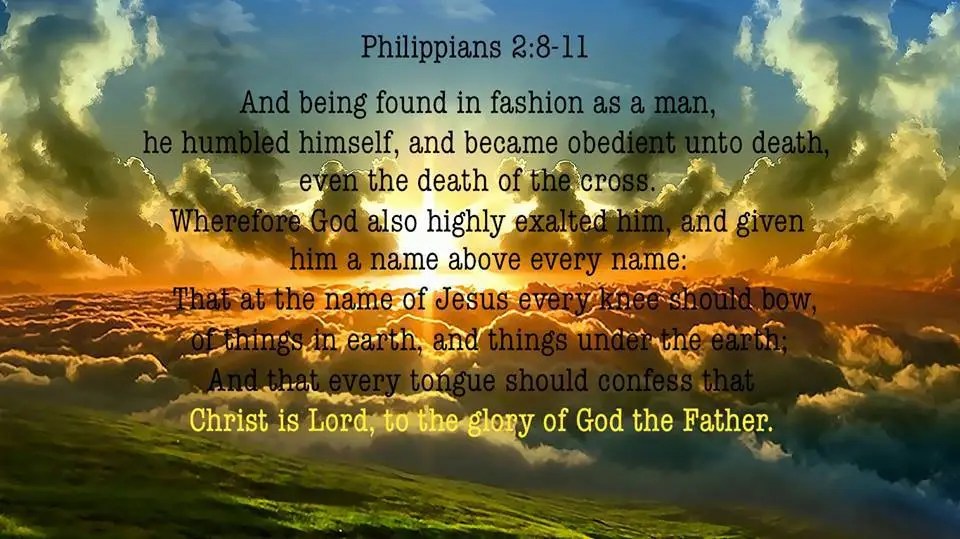
Philippians 2:5-11 Modern English Version
5 Let this mind be in you all, which was also in Christ Jesus,
6 who, being in the form of God,
did not consider equality with God something to be grasped.
7 But He emptied Himself,
taking upon Himself the form of a servant,
and was made in the likeness of men.
8 And being found in the form of a man,
He humbled Himself
and became obedient to death,
even death on a cross.
9 Therefore God highly exalted Him
and gave Him the name which is above every name,
10 that at the name of Jesus every knee should bow,
of those in heaven and on earth and under the earth,
11 and every tongue should confess that Jesus Christ is Lord,
to the glory of God the Father.[a]
Word of God for the Children of God
Glory be to the Father,
and to the Son, and to the Holy Ghost;
as it was in the beginning,
is now, and ever shall be,
world without end. Amen, amen.
The famous passage about Christ in Philippians 2:5-11 is usually described as a “hymn,” and is usually taken to celebrate the inverted parabola of Christ’s descent from heaven, his incarnation as man, nadir of his death on the cross, followed by his return to heaven and exaltation to a position equal to or perhaps higher than the one he left.
The phrase “being in the form of God” is understood to be a reference to his pre-existent divinity, though scholars disagree wildly over how exactly en morphē theou would express that idea. Perhaps the commonest views would be that morphē somehow refers either to the inner nature of God or to his glory.
Christ made the decision not to exploit his pre-existent status—not to hold on to the equality with God that he had by virtue of being in the form of God.
Instead, he emptied himself of at least some part of his divinity and became incarnate as a man.
At the lowest point of his cosmic journey, he was crucified, as though of no more value than a slave.
God, however, raised him from the dead, and restored him to his former heavenly position and status.
The “name” given to him has been variously interpreted (Lord? God?), but there is general agreement Jesus now receives the worship to which only YHWH was entitled according to Isaiah:
Turn to me and be saved, all the ends of the earth! For I am God, and there is no other. By myself I have sworn; from my mouth has gone out in righteousness a word that shall not return: “To me every knee shall bow, every tongue shall swear allegiance.” (Is. 45:22–23)
In a very real sense the best summary of the message of the Bible and the most fundamental truth in this universe is simply this: Jesus Christ is Lord.
Most theologians agree that “the name” that Paul refers to in verse 9 can only be “Lord” (Philippians 2:11).
Here, the Greek word for “Lord” is kyrios, which is also used as the translation of God’s divine name, Yahweh, over 6,000 times in the Septuagint (the Greek translation of the Old Testament)—the name that is rendered in most English Bibles today as Lord.
Paul’s implied use of God’s divine name emphasizes Jesus’ divinity, just after he has reminded us about Jesus’ humiliation during His time on earth.
Comprising four consonants (YHWH), Yahweh is basically unpronounceable in Hebrew—and purposefully so, for Jews did not dare take this divine name of God upon their lips.
Yet Yahweh, the indescribable God, came to earth as the incarnate Christ and revealed Himself to men and women.
He humbly went to the cross, and then He was raised to the highest place—His rightful place—and given this name “above every name.”
Says one commentator, “He has changed the ineffable name, into a name uttered by man and desirable by all the world.”
In the one who bears this name, God’s majesty “is all arrayed in robes of mercy.”
Old Testament prophecy reinforces this idea again and again.
In Isaiah 45, God gives a description that applies exclusively to Himself: “There is no other god besides me, a righteous God and a Savior; there is none besides me” (Isaiah 45:21).
Paul, once an aggressive opponent of Christ and His followers, applies this very description to Christ, making an impressive declaration of His deity.
He points out that Jesus has been publicly exalted to the position that was rightfully His even before He came to earth to suffer humiliation on our behalf.
He is now seated at the Father’s right hand.
His majesty is there for all who know Him as Savior to see.
His identity is unclouded and undoubted.
God is the only Savior—and Jesus is that Savior, of whom it was said, “You shall call his name Jesus, for he will save his people from their sins” (Matthew 1:21).
Years after Paul first had his eyes opened to the truth about who Jesus is, we can still catch a sense of awed reverence and love in his words to the Philippians.
Jesus Christ is LORD.
He possesses the name above all names.
Paul never allowed familiarity with this truth to breed complacency about it.
Neither must we.
Pause now and allow each word to prompt you to an awed praise of this man: Jesus, the Savior of His people… Christ, the long-promised King… is LORD, the indescribable, revealed God. And you get to call Him “brother” (Hebrews 2:11).
The Higher Glory
We have been talking about having the mindset of Christ and following his example of humility.
When it comes to humility, no one can be humbler than Christ, who gave up his own life so that all who call on his name can be saved to have new life forever.
And because Jesus did that, God also raised him from the grave and “exalted him to the highest place.”
He started out as the Son of God in heaven,
Then he willingly became a suffering servant who swooped down to the lowest of depths by dying on a cross for our sake. Then God reversed it all and swung Jesus upward to rule in heaven over everything.
The words Paul uses to describe this position have to do with the power of the highest name: “God . . . gave him the name that is above every name.”
And what is that name?
It is Jesus (meaning “Savior”), and it is Christ (meaning “Anointed One”).
Jesus Christ is the Lord, the sovereign ruler, over all things.
His name is so glorious the day will come when every knee will bow to honor him, every tongue will sing songs to “acknowledge that Jesus Christ is Lord.”
Jesus Christ, who died and rose again, is Lord of the cosmos.
All glory be to him forever and ever!

In the Name of the Father, Son, and Holy Spirit ….
Praying ….
Psalm 19
For the Music Director. A Psalm of David.
1 The heavens declare the glory of God,
and the firmament shows His handiwork.
2 Day unto day utters speech,
and night unto night declares knowledge.
3 There is no speech and there are no words;
their voice is not heard.
4 Their line has gone out through all the earth,
and their words to the end of the world.
In them has He set a tent for the sun,
5 which is like a bridegroom coming out of his chamber;
it rejoices as a strong man to run a race.
6 Its going forth is from one end of the heavens,
and its circuit extends to the other end,
and there is nothing hidden from its heat.
7 The law of the Lord is perfect,
converting the soul;
the testimony of the Lord is sure,
making wise the simple;
8 the statutes of the Lord are right,
rejoicing the heart;
the commandment of the Lord is pure,
enlightening the eyes;
9 the fear of the Lord is clean,
enduring forever;
the judgments of the Lord are true
and righteous altogether.
10 More to be desired are they than gold,
yes, than much fine gold;
sweeter also than honey and the honeycomb.
11 Moreover by them is Your servant warned,
and by keeping them comes great reward.
12 Who can understand his errors?
Cleanse me from secret faults.
13 Keep back Your servant also from presumptuous sins;
may they not rule over me.
Then I will be upright
and innocent from great transgression.
14 Let the words of my mouth and the meditation of my heart
be acceptable in Your sight,
O Lord, my strength and my Redeemer.

 Loving God, Living God, Loving Hope, Living Hope, Loving Living Life His Way! "Many things are possible for the person who has hope. Even more is possible for the person who has faith. And still more is possible for the person who knows how to love. But everything is possible for the person who practices all three virtues." - Brother Lawrence (1605-1691), Practicing the Presence of God (1692).
An Israeli perspective of Arab dhimmi racism and its impact on the post Shoah guilty European bias which hates the continued existence of Jews; as expressed through classic church/new Israel replacement theology; Romans 10:12–13 – “For there is no distinction between Jew and Greek, since the same Lord of all is rich to all who call on him. For everyone who calls on the name of the Lord will be saved.” Monotheism violates both the first and second Sinai commandments.
Israel “recaptured” Samaria from Jordan in the 1967 Six-Day War. After 1948 “Palestine” ceased to exist. Jordan, named its illegal – according to the UN condemnation – “occupation” of its “West Bank”; only Pakistan and Britain recognized the Jordanian nationalization of its “West Bank”. Never once from 1948 – 67 did Jordan validate a “Palestine” of its illegally occupied “West Bank”. The UN did not pass a single resolution titled “Condemnation of Jordan,” it refused to recognize the annexation. Even Yasser Arafat’s PLO Charter did not view Jordan’s illegal occupation of its ’48 “West Bank” as “occupied Palestine”. In international law, non‑recognition of an annexation is the mechanism for declaring it invalid. No different from the UN rejection of Indonesia’s ‘East Timor’, Turkey’s ‘Northern Cyprus’, Russia’s ‘Crimea’. The PLO Charter of 1964 likewise did not view Egyptian rule over Gaza as “occupied Palestinian territory”. The collective UN position was unmistakably that Jordan had no sovereignty over the West Bank; but starting with the purposely vague language of 242 “territories occupied in the recent [1967] conflict”, perfectly clarified by 2334 the UN declares sovereignty to Palestine; despite the cold hard fact that Israel – not a protectorate mandate territory and that Arab Israeli wars determine its borders! Therefore, the post‑1967 terminology is a political invention, not a continuation of pre‑1967 legal reality.
But post ’67, BBC propaganda screamed “occupied Palestinian territories” – inclusive of both Samaria and Gaza! Britain had no mandate, and therefore no legal claim to make this condemnation of Israel. The same equally applies to the UN through its 242 “all States” propaganda; which serve as the foundation for UN condemnations of Israeli “illegal” settlements of “Palestinian lands”; UN 2334 and the UN open recognition of the “Palestinian State” – proof of propaganda. Never in all human recorded history has their ever existed a “land of Palestine” – not under Ottoman or Arab empires.
The characterization of land as “occupied Palestinian territories” by both the UN and BBC and French propaganda evokes strong reactions, particularly among those who view this language as delegitimizing Israel’s claims, primarily based upon the 1923 British establishment of Trans-Jordan bordering “Israel” at the Jordan river. The application and interpretation of resolutions, such as UN Resolution 242, initiated to “international claims”/”competing narratives” by foreign outside States regarding “land rights and statehood” with a pro Arab bias which fundamentally rejects dhimmi Jews equal rights to achieve self-determination in the Middle East post the 1917 Balfour Declaration which served as the basis for the League division of Lebanon and Syria awarded to France and Palestine, Trans-Jordan awarded to Britain – based upon the secret accords known today as Sykes-Picot.
No Israeli-Palestinian “conflict” exists in reality because post the declaration of Jewish national Independence in 1948 the UN “protectorate” over “Palestine” ceased to exist. No different than this mandate ceased to exist as a “British mandate territory” officially ended after it turned that “mandate territory” back to the UN in 1948. From that moment on the British Crown had no more say in the determination of Israeli Independence than it does to determine the Capital of Austin Texas. This equally applies to the post WWII established UN.
Post-1948, no separate national entity represented as “Palestine” in international law or governance, particularly under Jordanian control of its illegally occupied West Bank and Egyptian control of Gaza – until 1967. The phrase “recaptured” to describe Israel’s actions during the 1967 Six-Day War reflects a perspective that emphasizes a historical and religious connection to the land. This contrasts with views that describe the action as an occupation of land that was already controlled by Jordan — which the UN itself condemned as illegal in 1950.
UN Resolution 242 and consecutive resolutions employed as Foreign State imperialism propaganda rhetoric which seeks peace. War the result of all British two state solutions! India/Pakistan, Iraq\Kuwait, and two Koreas and two Vietnams glaring examples of ‘great power’ foreign national interests imposed upon “conquered” lands. Great Power international “diplomacy” – the British labelled as “maintaining the balance of power” – which suited British [לאו דווקא] strategic interests.
The UN’s later recognition of a Palestinian state a further attempt to rewrite historical claims and narratives that do not acknowledge the complexities of sovereignty and self-determination in the context of this region. The framing of successful Israel national Independence by media outlets – such as the BBC and other organizations – have promoted wars not peace. Shalom requires “trust”, peace simply a propaganda “label” of rhetoric. The success of Allied propaganda during WWI which unilaterally declared the Germans as “the Hun barbarians at the gates” produced profound effects on public perception. Critics argue – propaganda rhetoric language that injects “occupation”, aligns with Arab narratives which switched the term Nakba from Arab disastrous military defeat unto Arab stateless Palestinian refugees. No Arab country has yet to end or terminate the refugee status which UNWRA promotes and serves this particular political foreign ‘Great Power States’ imperialist agendas.
Propaganda that Israel repeatedly violates “international law”, simply another gross example of UN Great Power manipulations expressed through BBC and MSM propaganda arms of foreign states attempts to ‘control the narrative’ through words. Israel as an independent nation – its international borders determined through wars and the diplomacy its establishes with regional state powers. Neither the Parliament of London or any other distant foreign power determines where Israel establishes its Capital much less its international borders with other nation states which share common borders.
From 1948-67 no recognized sovereign “Palestine” in international law. Jordan and Egypt did not treat their respective areas as “Palestine,” and the UN did not recognize their sovereignty there. Therefore, the later phrase “occupied Palestinian territories” — not a continuation of pre‑1967 legal language, but a post‑1967 political construction.
UN SC 242 (1967) inserts the phrase “withdrawal of Israeli armed forces from territories occupied in the recent conflict,” not “all the territories” and not “Palestinian territories”; UN SC 2334 (2016) morphs into “occupied Palestinian territory, including East Jerusalem,” and labels Israeli settlements there as having “no legal validity.” This effectively retrofits a Palestinian sovereignty claim onto areas that, pre‑1967, had no recognized Palestinian state and no recognized Jordanian/Egyptian sovereignty either. 2334 and the UN’s recognition of “Palestine” as a non‑member observer state (2012) represent a political re‑narration, not a neutral continuation of Mandate‑era law.
Post‑1967 BBC usage of “occupied Palestinian territories” mirrors the UN’s later terminology, not the earlier legal reality. Britain, having ended its Mandate in 1948, has no legal standing to define Israel’s borders or capital, yet its media and diplomacy still act as if they are arbiters of legitimacy; a continuation of Great Power narrative control—the same mentality that carved up the region under Sykes–Picot and Mandate arrangements. Language like “occupation,” “illegal settlements,” “Palestinian territories” is not neutral description; it’s weaponized vocabulary that encodes a particular political and historical judgment.
The Abraham Accords invalidates European Middle East politics. In strict legal terms, the Middle East and North African conflict, while acknowledging both terrorist violence with its consequential suffering consequence domino-effect/impact, in strict legal terms, this ongoing-conflict most basically pits Israel against neighboring Arab states rather than Arab nationalist Palestinian nationalist movements. While the Romans renamed Judea unto Palestine, the Roman empire long since dead. The Arab empire uprooted the Roman empire – hook, line, and sinker. Therefore 19th Century French maps sold to the ‘sick man of Europe’, as empty as the deceased Ottoman empire. No different from the dead League of Nations “Palestine mandate”, and the dead British, French, Nazi, and USSR communist empires; their world order no long exists – even the flies not interested in the dry bones of their corps. The League of Nations, and how much more so the post WWII UN have no power to create pre‑existing sovereign “Palestine”. Despite the UN or Britain\French propaganda, continuous retroactive attempts to resurrect – like Jesus on the 3rd day – this dead Roman corpse from its grave.
UNRWA and its permanent Arab refugee status of both ’48 and ’67 Arabs who sought to complete the Nazi Shoah by throwing the Jews into the Sea, such propaganda rhetoric – employed as a deliberate political tool, not a humanitarian necessity—sustaining statelessness to maintain a grievance narrative whose evil intent exploded on Oct 7th 2023 when UNWRA officials participated together with Hamas and Islamic Jihad terrorists in the massacre of 1200 or more Israelis; coupled with the Red Cross refusal to visit for some two years the captured Israeli hostages held under barbaric conditions. The League “Palestine Mandate” stood upon the foundation of the Balfour Declaration. Post ’67 UN declarations changed the goal-posts. Immediately after the declaration of Israeli Independence, the UN had no protectorate over “Palestine”; anymore than did Britain after it returned the League mandate back to the UN.
The post‑Shoah European narrative toward Israel reflects a convergence of Arab dhimmi attitudes toward Jews, Christian supersessionist theology, and Great Power political interests. This convergence has produced a persistent bias that frames Jewish sovereignty as an anomaly to be corrected rather than a legitimate expression of national self‑determination. The language of “occupation,” “illegal settlements,” and “Palestinian territories” is not a continuation of pre‑1967 legal reality but a political vocabulary constructed after the Six‑Day War, retroactively projecting sovereignty onto a territory that—between 1948 and 1967—neither Jordan nor Egypt treated as “Palestine,” and which the UN itself refused to recognize as belonging to either state.
The Abraham Accords further expose the obsolescence of European frameworks, demonstrating that regional peace emerges from regional actors—not from external powers imposing narratives rooted in outdated colonial assumptions. The UN’s and European states’ continued use of “occupied Palestinian territories” reflects not legal continuity but political reinvention, shaped by post‑colonial guilt, theological inheritance, and geopolitical interests.
LikeLike