What Does it Really Look Like to ‘Honor Your Father and Mother’? Exodus 20:12, Deuteronomy 5:16

    Honoring your father and your mother is the only commandment out of the Ten Commandments that is followed by a promise, Honor your father and your mother, as the Lord your God has commanded you, that your days may be long, and that it may be well with you in the land which the Lord your God is giving you. (Deuteronomy 5:16)

    Exodus 20:12Amplified Bible

    12 “Honor (respect, obey, care for) your father and your mother, so that your days may be prolonged in the land the Lord your God gives you.

    The Word of God for the Children of God.

    Adeste Fidelis. Venite Adoremus. Dominum.

    Gloria. In Excelsis Deo. Alleluia, Alleluia, Alleluia, Amen.

    Most Christians are very familiar with the verse “honor your father and mother”, but few actually know of it’s origin in the Bible.

    The command to honor your father and mother actually comes from the Old Testament book of Exodus 20 in the story of the 10 Commandments.

    However, it is also a command that is repeated several times in both the Old and New Testament. 

    Chapter 20 of the Book of Exodus serves as a powerful reminder of the intimate relationship God has with humankind.

    This passage specifically reveals the intense care and concern that God shows toward His Children.

    Today this chapter remains popular because of a very special occurrence – the Ten Commandments.

    At eighty plus years old, after venturing up to Mount Sinai, Moses, a father, brought down the Ten Commandments, rules given Him directly from God.

    The Ten Commandments described ten precepts for how God expected His people to behave.

    This monumental moment follows after the Israelites fled Egypt. 

    Chapter 19 in the Book of Exodus details how the Israelites camped in the wilderness, now living a life outside of slavery for a few months.

    God informs Moses that He desires to bless the nation of Israel.

    However, He also wants them to keep a covenant with Him (Exodus 19:5-6).

    The Ten Commandments serve as part of that covenant.

    One of these commandments spoke to the relationship between a child and parent and is a guideline we as Christians still ought to be following today.

    Exodus 20:12The Message

    12 Honor your father and mother so that you’ll live a long time in the land that God, your God, is giving you.

    The reason this commandment in addition to the other nine is still relevant today is because Jesus indicated such to later believers (Matthew 5:17-20).

    Jesus did not abolish the law, but rather came to fulfill it.

    The Apostle Paul wrote to the followers at the church at Ephesus;

    Ephesians 5:1-2 Amplified Bible

    Be Imitators of God

    Therefore become imitators of God [copy Him and follow His example], as well-beloved children [imitate their father]and walk continually in love [that is, value one another—practice empathy and compassion, unselfishly seeking the best for others], just as Christ also loved you and gave Himself up for us, an offering and sacrifice to God [slain for you, so that it became] a sweet fragrance.

    We are to do our part yet today in abiding in Jesus, by these commandments.

    Today, I do not believe there is little to no controversy about whether or not the Ten Commandments are still relevant.

    What has been up for rather contentious debate in the meaning of “honor” in the context of parents and children.

    There are many instances of children being the victims of incest, abandonment, neglect, or other severe and seriously exploitive forms of ultra damaging abuse.

    In these situations, how does a child honor a parent, when the parent lacks any concept or context of abiding in God, His Son Jesus and have honor for the child.

    To understand this commandment, we have to examine the original context.

    What Is the Original Meaning of Honor Your Father and Mother in Exodus 20?

    The commandment to honor our father and mother is the fifth of the ten mentioned.

    The commandment to precedes this one is honoring the Sabbath, followed by the commandment to not murder.

    Scripture explains the reason why the commandment should be followed.

    Exodus 20:12Amplified Bible

    12 “Honor (respect, obey, care for) your father and your mother, so that your days may be prolonged in the land the Lord your God gives you.

    The benefit of abiding by this commandment is longer life, specifically for the Israelites venturing on toward the Promised Land.

    Dennis Prager [https://dennisprager.com/] emphasizes that though this could be viewed as a reward, this is also a reason.

    And many of the other commandments are not given explicit reasons to be followed.

    Prager suggests in a society where parents are honored by children, the society is bound to survive longer, than a society with a weaker family structure.

    This commandment in Exodus is mentioned a number of other times in the Bible, each time as an admonishment to God’s people to better establish them. 

    Deuteronomy 5:16 tells us, “Honor your father and your mother, as the LORD your God has commanded you, so that your days may be long and that it may go well with you in the land that the LORD your God is giving you.”

    Ephesians 6:2 states: “Honor your father and mother” – which is the first commandment with a promise”

    God blesses the people when their parents are honored, but the people are punished when they do not.

    To honor is to hold someone in high regard or reverence.

    The word honor does not mean agree with or even obey, but does suggest in this context a child should hold the highest utmost respect for both of their parents.

    Now that we better understand the original context and interpretation of the commandment to honor thy mother and father, we can try to discern how this precept applies to modern-day life.

    How Can Christians ‘Honor Your Father and Mother’ Today?

    With an understanding of the word honor, there need not be a change in how parents are respected by children today.

    However, with modern cultural shifts, this commandment for some has taken on a different interpretation.

    We can perhaps better, more prayerfully understand the proper ways of honoring parents by first understanding how honoring should not appear.

    As Dennis Prager discusses in his video analysis of the commandment, some parents yearn to be loved, rather than honored.

    The visual example given in his video is that of a parent showering their child with gifts in order to receive affection.

    This same parent when trying to discipline their child instead receives severe retaliation from them.

    This is definitively not an example of a child honoring their parent because instead of respecting them as an “authority” figure, they are simply seeking what else, exactly how much more they can manipulate, gain from the parent.

    Much like the Bible commands us to love others, the call to honor our parents is an outward action – something we do for others.

    Honoring our parents is therefore not contingent upon what they give in return.

    Within the Ten Commandments, verse 12 of Exodus 20 gives no clarification as to what parents are to be honored or even how.

    We can conclude then that all parents are deserving of honor, and we can use the context of love within the Bible to discern appropriate ways to show honor.

    We can even in some instances see how people have honored God as Father as an example.

    Ways we can appropriately honor our parents include:

    Expressing Gratitude
    Parents invest time and effort into raising children.

    Those reasons alone are enough to show them gratitude for the sacrifices they make.

    Parents provide shelter, food, clothing.

    For every action they do in their support of their child is in itself a far more than sufficient reason for expressing their appreciation and gratitude.

    Spending Time Together
    When physically possible, children can and should get together with their parents.

    This acknowledges their existence and places a level of importance upon the relationship.

    If being together physically is not an option, calling a parent on the phone for a check-in is also beneficial.

    Dennis Prager shares with fellow believers he called his parents once a week.

    Serve
    Another way for children to honor their parents is to find creative ways to serve their desires, wants and needs, much like parents perform on behalf of children.

    To Honor or Not to Honor

    It goes without saying and preaching to the choir that modern parenting is not equivalent to the parenting in ancient biblical Jewish culture.

    Children today learn differently and have certain responsibilities such as owning a cell phone [I never did], which was not true for past generations.

    No matter the time, parents should always be honored.

    One concern followers, nonbelievers have with the commandment is the issue of bad parents, individuals who have abused their children by various means.

    The Bible does not qualify which parents deserve honoring.

    Additionally, Jesus mentions we are to love others as ourselves (Matthew 22:39) and to bless those who persecute us (Romans 12:14).

    We, therefore, know that even when seemingly impossible, we should all do our best to express love for our parents, our children as we express love for our God.

    This fifth commandment, however, does not advocate for putting ourselves in danger with bad parents.

    Applying this commandment for children who have been abused will look different in terms of how they show their honoring.

    Spending time together may be an impossibility but talking on the phone or writing a letter could prayerfully be an option depending on the circumstance.

    Sometimes we have to set boundaries in relationships, and whenever that is the case we have to pray unto our ABBA God for wisdom, so that we may honor His commandment and honor our parents while keeping ourselves safe (James 1:5).

    There are no easy or set human answers how to be complete, perfect parents.

    As Mom’s and Dad’s together …

    The very best we can do is diligently consult the Word of God for His Children.

    Study it …

    Like Jesus did, intentionally plumb its depths, its ways, its truths and its life.

    Pray without ceasing over every aspect of it, revelation from it …

    Koinonia, Fellowship with our ABBA Father, His Son Jesus, Holy Spirit, other Parents …

    Finally,

    Be Still, Be Quiet, know only God is God, and can, should be, exalted as God.

    Matthew 6:25-33New King James Version

    Do Not Worry

    25 “Therefore I say to you, do not worry about your life, what you will eat or what you will drink; nor about your body, what you will put on. Is not life more than food and the body more than clothing? 26 Look at the birds of the air, for they neither sow nor reap nor gather into barns; yet your heavenly Father feeds them. Are you not of more value than they? 27 Which of you by worrying can add one [a]cubit to his [b] stature?

    28 “So why do you worry about clothing? Consider the lilies of the field, how they grow: they neither toil nor spin; 29 and yet I say to you that even Solomon in all his glory was not [c]arrayed like one of these. 30 Now if God so clothes the grass of the field, which today is, and tomorrow is thrown into the oven, will He not much more clothe you, O you of little faith?

    31 “Therefore do not worry, saying, ‘What shall we eat?’ or ‘What shall we drink?’ or ‘What shall we wear?’ 32 For after all these things the Gentiles seek. For your heavenly Father knows that you need all these things. 33 But seek first the kingdom of God and His righteousness, and all these things shall be added to you.

    In the name of God, the Father and God the Son and God the Holy Spirit,

    Let us Pray,

    Heavenly Father, thank You for my parents and for giving me life. Thank You for the pleasant and harsh lessons I have learned and the good times and the bad we have shared together. Forgive me for the times when I have not sufficiently honored my father and mother as I ought – for I am now acutely aware that this is dishonoring to You. From this day forward, I pray that I should honour You in all my interactions with my own family and with my friends, and may my life be honoring to You.

    Adeste Fidelis. Venite Adoremus. Dominum.

    Gloria. In Excelsis Deo. Alleluia, Alleluia, Alleluia, Amen.

    https://translate.google.com/

    Honoring Parents, Honoring God. Exodus 20:12

    Exodus 20:12Amplified Bible

    12 “Honor (respect, obey, care for) your father and your mother, so that your days may be prolonged in the land the Lord your God gives you.

    The Word of God for the Children of God.

    Adeste Fidelis. Venite Adoremus. Dominum.

    Gloria. In Excelsis Deo. Alleluia, Alleluia, Alleluia, Amen.
    The fifth commandment is simultaneously a simple instruction and an indispensable element of the well-being of entire societies.

    When the Lord gives the command “Honor your father and mother,” He is laying down the essential blueprint for maintaining the stability of families, communities, the Body of Christ and His churches and hosts of all nations.

    What does it mean to honor your parents?

    The word for “honor” carries the notion of weight and heaviness; children ought to feel the weight of respect for their parents.

    By this fifth commandment, God places the full weight of responsibility for the lifetime of moral and ethical upbringing of the children and their instruction in righteous living, firmly and squarely on the shoulders of the father and mother.

    By this “God” weight, this weight of God, Parents are owed such high regard because God has placed upon them in their roles, the stewardship of such a role, accountability to such a role, to raise the next generation of children, is worth many times over, far beyond its utmost maximum possible weight in honor.

    While children are in view here, the Bible also has much to say about parenting that honors God (see also Ephesians 6:4; Colossians 3:21). — More on this later.

    How does a child display this honor?

    In several ways.

    For one, a child ought to show practical respect to his or her parents.

    This can be as simple as speaking well of our parents, showing them courtesy, looking them in the eye, and addressing them with a due sense of deference.

    Second, it involves genuine love; there should be heartfelt expressions of affection between parents and their children.

    Third, unless it would involve disobeying God, a child ought to obey what his or her mom and dad say.

    This expectation is found all over Proverbs: for example, “Hear, my son, your father’s instruction, and forsake not your mother’s teaching” (Proverbs 1:8).

    Fourth, a child should submit to their parents’ discipline and authority.

    All good parents discipline their children (though it must not be done in anger nor vindictively or disproportionately), and children should ought to be taught to implicitly trust such discipline is for their long-term good (Hebrews 12:5-11).

    In ancient Israel, respect for ones parents was valued so highly that those who disregarded it flagrantly or persistently faced the death penalty (Deuteronomy 21:18-21).

    Why such a significant consequence?

    Because the home provides the most essential and vital training ground, the success of which affects how the child will relate to authorities of all kinds.

    We never outrun authority in our lives.

    There are political authorities we are called to obey (Romans 13:1-7).

    Spiritual authorities we are to respect (Hebrews 13:17; 1 Thessalonians 5:12).

    And those of advanced years we are commanded to honor (Leviticus 19:32).

    Most significantly, when children are taught how, when they learn over time to honor their parents, even despite their parents’ many imperfections, they learn what it too means to learn how to honor our ABBA, our perfect heavenly Father.

    Reverence for parents is an integral part of reverence for God.

    Because parental authority is God-given, for children to learn to honor their parents is to come to that place of spiritual maturity and honor God Himself.

    So if you are a parent [age not specific] with children [age?] at home, it is not loving (though it may be easier) to fail to insist that your children honor you.

    If you are an adult with parents still living, it is a matter of obedience to God you still show them the honor they are due, not according to how well (or other- wise) you feel they raised you but according to the position the Lord gave them.

    As you honor them, you will be pleasing Him and showing those around you that God-given authority, when exercised in a godly way, is a blessing to all.

    Honoring Parents …

    It may come as a surprise to many of us this commandment is not age-specific.

    It’s a commandment not just for the young but for children of all ages.

    God asks parents be worthy of honor in the way they relate to their children.

    And God commands that children obey and show respect for their parents in line with doing what is right.

    This means both are to act appropriately at each stage of their lives together.

    This commandment came to a society without the support systems that many of us are used to.

    Adult children were totally responsible to look after aging parents.

    God reminds us that as long as we have parents, we are to honor them, seeing that their living is respectable and they are well cared for.

    It’s not just a matter of doing what our parents tell us to do when we are young.

    It’s a matter of showing our utmost respect, life-long honor to the parents who gave us life, sacrificed incredibly all to raise us, launched us upon life’s journey.

    The apostle Paul calls this “the first commandment with a promise.”

    God indicates when we honor the parents with whom we are in relationship, he will honor us and He will surely and certainly bless us.

    Some parents are easier to honor than others.

    But respecting to the utmost those whom the Lord has chosen to place over us opens a door to abundant blessings.

    By honoring our parents and others whom God places in authority over us, we honor and glory and our utmost worship and praise unto our Father in heaven.

    Which is what each and everyone of us were created, shaped by God, to do …

    In the name of God, the Father and God the Son and God the Holy Spirit.

    Let us Pray,

    Heavenly Father, ABBA Father, thank You for my parents and for giving me life. My First ABBA, Thank You for the lessons I have learned and the good times we have shared together. Forgive me for the times when I have not honored my father and mother as I ought – for I am aware that this is dishonoring to You. From this day forward, I pray that I may honour You in all my interactions with my family and my friends, and may my whole life be honoring unto You. This I pray in Jesus’ name.

    Adeste Fidelis. Venite Adoremus. Dominum.

    Gloria. In Excelsis Deo. Alleluia, Alleluia, Alleluia, Amen.
    https://translate.google.com/

    The Second Commandment: Have or Make No Image Engraved or in Mind. Exodus 20:1-4

    Exodus 20:1-4 Amplified Bible

    The Ten Commandments

    20 Then God spoke all these words:

    “I am the Lord your God, who has brought you out of the land of Egypt, out of the house of slavery.

    “You shall have no other gods before Me.

    “You shall not make for yourself any idol, or any likeness (form, manifestation) of what is in heaven above or on the earth beneath or in the water under the earth [as an object to worship].

    The Word of God for the Children of God.

    Adeste Fidelis. Venite Adoremus. Dominum.

    Gloria. In Excelsis Deo. Alleluia, Alleluia, Alleluia, Amen.

    The Ten Commandments

    The Ten Commandments are the supreme expression of God’s will in the Old Testament and merit our close attention.

    They are to be thought of not as the ten most important commands among hundreds of others, but as a digest of the entire Torah.

    The foundation of all of the Torah rests in these Ten Commandments, and somewhere within them we should be able to find all the law.

    Jesus expressed the essential unity of the Ten Commandments with the rest of the law when he summarized the law in the famous words,

    “ ‘You shall love the Lord your God with all your heart, and with all your soul, and with all your mind.’ This is the greatest and first commandment. And a second is like it: ‘You shall love your neighbor as yourself.’ On these two commandments hang all the law and the prophets” (Matthew 22:37-40). 

    All the law, as well as laws of the prophets, is indicated whenever the Ten Commandments are expressed.

    The essential unity of the Ten Commandments with the rest of the law, and their continuity with the New Testament, invites each and every on us to apply them to today’s ministries broadly in light of the rest of the Holy Scriptures.

    That is, when applying the Ten Commandments, we will take into account related passages of Scripture in both the Hebrew [Old] and New Testaments.

    “You Shall Have No Other Gods before Me” (Exodus 20:3)

    The first commandment reminds us that everything in the Torah flows from the love we have for God, which in turn is a response to the love he has for us.

    This unconventional, inexpressible miracle of love was demonstrated by God’s deliverance of Israel “out of the house of slavery” in Egypt (Exodus 20:2).

    In our heart of hearts, from within the deepest depths of our souls, nothing else in our lives should concern us more than our desire to love and be loved by God.

    If we do have some other concern stronger to us than our love for God, and who of us does not have other “stronger concerns,” they are not so much that we are breaking God’s rules, but that we are not really in relationship with Father God.

    The other concern—be it money, power, security, recognition, sex, or anything else—has become our god.

    These gods will have their own commandments at odds with God’s, and we will inevitably violate the Torah as we try to comply with these god’s requirements.

    Observing the Ten Commandments is only conceivable for those who start by being determined to diligently study, to pray at having no other god than God.

    In the realm of work, this means that we are not to let work or its requirements and fruits displace God as our most important concern in life.

    “Never allow anyone or anything to threaten God’s central place in your life,” as Dr. David W. Gill [https://www.davidwgill.org/] puts it. 

    Because many people work primarily to make money for their and their family’s future, we might just conclude that an inordinate desire for money is probably one of the most common work-related dangers to the first commandment.

    Jesus warned of exactly this danger. “No one can serve two masters…. You cannot serve God and wealth” (Matthew 6:24).

    But almost anything related to work can become twisted in our desires to the point that it interferes with our love for God.

    How many promising up and coming, careers come to a tragic end because the means to accomplish things for the love of God—such as political power, financial sustainability, steadfast commitment to the job, status among peers, or superior performance—become their alpha to omega ends in themselves?

    When, for example, recognition on the job becomes simply far more important than character on the job, is it not a sign that their reputation is displacing their love of God the Father, Son, Holy Spirit, as ultimate Alpha to Omega concern?

    A practical touchstone in balancing life lived in the world of man and God is to just ask whether our love of God is shown by the way we treat people on the job.

    “Those who say, ‘I love God,’ and hate their brothers or sisters, are liars; for those who do not love a brother or sister whom they have seen, cannot love God whom they have not seen. The commandment we have from him is this: those who love God must love their brothers and sisters also” (1 John 4:20-21).

    If we put our individual concerns ahead of our concern for the people we work with, for, and among, then we have made our individual concerns our god.

    In particular, if we treat other people as things to be manipulated, obstacles to overcome, instruments to obtain what we want, or simply neutral objects in our field of view, then we starkly demonstrate that we do not love God with all our heart, soul, and mind as required by the Word of God for the Children of God.

    In this context, we can begin to list some work-related actions that have a high potential to interfere with our love for God.

    Doing work that violates our conscience.

    Working in an organization where we have to harm others to succeed.

    Working such long hours that we have little time to pray, worship, rest, and otherwise deepen our relationship with God.

    Working among people who demoralize us or seduce us away from our love for God.

    Working where alcohol, drug abuse, violence, sexual harassment, corruption, disrespect, racism, or other inhumane treatments mar the image of God in us and the people we encounter in our work – our co-workers and our neighbors.

    If we can find ways to avoid these dangers at work—even if it means finding a new job—it would be wise for us to seek God, study, pray, to consider to do so.

    If that is not possible, we can at least be aware that we need help and support to maintain our love of God in the face of our work.

    “You Shall Not Make for Yourself an Idol” (Exodus 20:4)

    The second commandment raises the issue of idolatry.

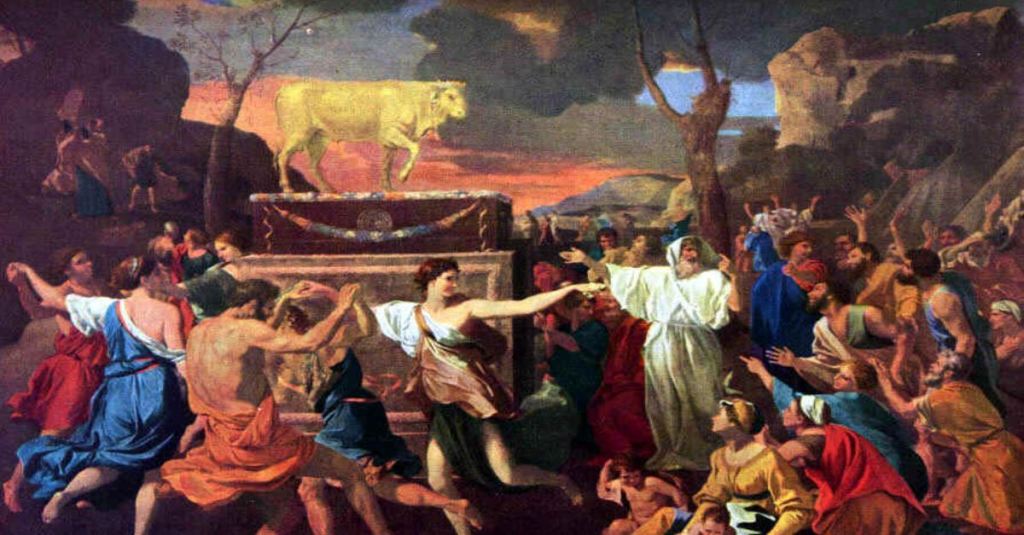
    Making and then Naming our Golden calves then marketing them for all to see.

    Idols are gods of our own creation, gods that have nothing to them that did not originate with us, gods that we feel we control.

    In ancient times, idolatry often took the form of worshiping physical objects.

    But the issue is really one of trust and devotion.

    On what “shirt” do we ultimately pin our hope of well-being and success upon?

    On whose “lapel” should we ultimately pin our hopes of well-being and success upon?

    Anything, Anyone, which is not capable of fulfilling our hope—that is, anything other than God—is an idol, whether or not it is a physical object, even a person.

    The story of a family forging an idol with the intent to manipulate God, and the disastrous personal, social, and economic consequences which then tragically follow, are memorably told in Judges 17-21.

    In the world of work, it is common to speak of money, fame, and power as potential idols, and rightly so.

    They are not idolatrous, per se, and in fact may be utterly necessary for us to accomplish our roles in God’s creative and redemptive work in the world.

    Yet when we then imagine that we have ultimate control over them, or that by achieving them our safety and prosperity will be secured, we have begun the so inevitable “foot to shovel to earth to digging our grave” descent into idolatry.

    The same may occur with virtually every other element of success, including our preparation, hard work, creativity, risk, wealth and other resources, and favorable circumstances.

    As Christian workers, we have to recognize how important these are.

    As God’s people, we must recognize when we begin to idolize them.

    By God’s grace alone, we can overcome the temptation to worship these good things in their own right.

    The development of genuinely godly wisdom and skill for any task is “so that your entire trust may be in the Lord alone” [Proverbs 22:19].

    The distinctive element of idolatry is the human-made nature of the idol.

    At work, a danger of idolatry arises when we mistake our power, knowledge, and opinions for reality.

    When we stop holding ourselves accountable to the standards we set for others, cease listening to others’ ideas, or seek to crush those who disagree with us, are we not beginning to make and shape, obsess over our graven idols of ourselves?

    No Image Engraved or in Mind [eXODUS 20:4]

    Exodus 20:4 Amplified Bible

    “You shall not make for yourself any idol, or any likeness (form, manifestation) of what is in heaven above or on the earth beneath or in the water under the earth [as an object to worship].

    If the first commandment

    “You shall have no other gods before me” (Exodus 20:3)—deals with the object of our worship, the second commandment deals with the manner of our worship.

    What the second commandment tells us is that it is not enough that we worship the correct God; we must also worship Him correctly.

    The crystal clear and immediate meaning of the command is that God is to be worshiped without any visual symbols of Him.

    Why the prohibition?

    Because God is spirit: infinite and unfathomably great.

    No physical representation could ever do justice to His glory and grandeur.

    The problem with statues, shrines, and pictures is not that they don’t look good but that no matter how good they look, they will all inevitably severely blur the truth about God’s nature and character.

    Such images will tend to distract men and women from genuinely worshiping the true and living God, [John 4:20-24] instead leading them to naively worship whatever physical representation of God is placed before them in the sanctuary.

    Yet the second commandment takes us beyond mere images and idol-making and into our own thought life.

    Our hands may be innocent of the skills and craftsmanship of hand making graven images, but our thoughts and imaginations are so seldom unskilled.

    Any conception of God in our minds and hearts that is not derived from Scripture runs foul of this command.

    When God gave strict instructions for the building of the temple, He ordered that the ark of the covenant, on which His presence would dwell, should reside in the Most Holy Place (Exodus 26:34).

    What was inside the ark?

    Perhaps most significant is what was not in it: it contained no visible, physical, hand shaped representation of God.

    Instead, there were the two tablets of the Ten Commandments.

    It was as if God was saying to His people, as He says to us, Don’t look for Me in shrines, paintings, or statues. I’m not there. Look for Me in My word.

    So we take our cues from God. If we want to worship Him—if we want to meet with Him and know what He is like—we must conform our minds to His word.

    Our own attempts to conceive of God apart from divine revelation will utterly, invariably fail.

    He has published His truth in His word, and so we are to tether ourselves to what is revealed there.

    What’s at stake in this is the integrity not only of our worship but also of our lives—because when people go wrong in their worship, they’ll end up going wrong in their living.

    Anything and anyone that encourages us to worship the correct God incorrectly will prove to be a detriment to our spiritual growth.

    What an absolute tragedy it would be to embrace an image and miss the person of Christ, to sit at a shrine and miss the Savior, to worship a misconception and fail to know our Lord and Savior Jesus Christ through the Holy Words of God.

    Instead, resist the temptation to modify God in your mind or to conform Him to your own graven image, and be sure to KNOW Him as He has revealed Himself.

    In the name of God, the Father and God the Son and God the Holy Spirit,

    Let us Pray,

    The Joy of Integrity Prayer

    God, my Father, my Guide and Guardian of my life, illuminate my mind so I can better understand just how you want me to live. Your Living Word tells me that people of integrity who diligently follow after your instructions are joyful. You have said that those who obey your laws and search for you with all their hearts are blessed and happy. I plead with you for my own share of that indescribable joy! Intercessor Holy Spirit, please guard me and my thoughts against allowing evil to influence what I believe and do. Help me walk only in your paths. May my actions, and my worship more consistently reflect what you have said is right, good.

    Adeste Fidelis. Venite Adoremus. Dominum.

    Gloria. In Excelsis Deo. Alleluia, Alleluia, Alleluia, Amen.

    https://translate.google.com/

    What does it mean for us to have no other gods before God? Exodus 20:1-3

    Exodus 20:1-3Amplified Bible

    The Ten Commandments

    20 Then God spoke all these words:

    “I am the Lord your God, who has brought you out of the land of Egypt, out of the house of slavery.

    “You shall have no other gods before Me.

    The Word of God for the Children of God.

    Adeste Fidelis. Venite Adoremus. Dominum.

    Gloria. In Excelsis Deo. Alleluia, Alleluia, Alleluia, Amen.

    Perhaps the most basic truth about the God of Scripture is He is the only one.

    There is no other.

    This truth ought to simplify things for us because it teaches us that there is only one who is the worthy object of our love, loyalty, and devotion.

    But the hearts of men and women are not so easily convinced or instructed.

    And so it is necessary for God to give us the first commandment: “You shall have no other gods before me.”

    The danger is not that there are actual other gods for us to worship but that we have a proclivity for making them.

    On first glance, this first command is straightforward.

    To live for a god other than the true God would be like taking a second spouse while your first spouse is still alive and still happy to be your spouse.

    Worse, it would be like taking a second spouse who is in truth a figment of your imagination.

    It would be a seriously severe breach of an exclusive relationship.

    We must not kid ourselves that we are immune from the possibility of breaking this commandment.

    Many of us read it and then picture people bowing down before statues or going through elaborate rituals, and those mental images assure us that we are not in much danger of violating it.

    Yet the commandments are not restricted to our outward actions but also relate to the disposition of our minds and hearts.

    From this perspective, there is the tough realization we may not be as far from those mental images as we assume.

    We may not have statues to which we bow down, but maybe we have segments of our lives that we keep away from God, preserving them under the authority and exclusive sovereignty of some other little “deity”—ourselves, perhaps.

    Ask yourself:

    “Do I joyfully acknowledge God’s exclusive comprehensive claim on my life?”

    “Is God in Alpha to Omega charge of my family, my work, my relationships, my money, my dating, my use of my time, my talents, my gifts and my services?”

    Take a close and honest look to see if there are portions of life you try to keep from Him.

    In addition to our keeping, “secreting” things away from God, another form of danger is functionally replacing Him.

    When we put our family, our job, our hobbies, or anything else in the place that is God’s alone, we violate the first commandment.

    To the degree that we allow anyone or anything besides obedience to God to direct our course day to day, we defy His law.

    So we are not so safe from the possibility of breaking this commandment as we may think!

    While we must acknowledge the truth that there is one God, we must also beware our own ability to put things in His place.

    If we do not daily submit ourselves to Him and entrust the entirety of our lives to Him, something will take His place.

    We are made to worship.

    The question is, are you going to worship the living God or are you going to pretend there is another?

    Put serious focus on these words: ‘Thou shalt have no other gods before me.’

    God’s Word leads us to the full life Christ died for us to live.

    The Ten Commandments are guardrails for our modern-day lives.

    We no longer live in the Old Testament church, where animal sacrifices upon altars were required for breaking God’s laws.

    Today, we live under the new covenant, ushered in by Christ Jesus and His sacrifice on the cross to forgive our multitude of sins.

    We cannot follow the Ten Commandments through our own sheer will but can aim to through the power of the Holy Spirit given to us at salvation.

    Still, we will never hit the mark of perfection as Christ did. He loved the Father with His whole heart, soul, and mind.

    Thankfully, perfection is not required of us.

    What Does ‘Thou Shalt Have No Other Gods before Me’ Mean?

    “Jesus replied: ‘Love the Lord your God with all your heart and with all your soul and with all your mind.’ This is the first and the greatest commandment. And the second is like it: ‘Love your neighbor as yourself.'” Matthew 22:37-39

    In ancient times, and in some places and people groups around the globe today, people worship a variety of gods.

    God clearly stated, “I am,” and commands His people to worship Him alone.

    “No deity, real or imagined, is to rival the one true God in Israel’s heart and life” (NIV Study Bible).

    Worshipping other gods gives a false sense of security from a source other than God, who is everywhere, all-powerful, and all-knowing.

    The Hebrew, often translated as ‘besides me’ or ‘before me,’ means ‘in my presence.

    The point is that nothing else can qualify as god in your life.

    The true God is not only to be number one but the only one. 

    Other gods can also constitute things we place higher than God in our lives.

    The Bible defines these as idols, and they can be anything from money and possessions to food and working out or people and relationships.

    Anything or anyone we place above God is another god.

    As Christians, we are a “chosen people, a royal priesthood, a holy nation” 1 Peter 2:9). 

    We are God’s people, set apart to live according to his ways.

    His ways are not, and never will be, our ways.

    Our tendencies are to cave to the cravings of our flesh and fall prey to the thinking they will give us the comfort and happiness we need.

    God is faithful to bless us in this life, but there is no blessing bigger and more important than the source of the blessing.

    Our marriages, best friends, jobs, houses, habits, and hobbies all take a serious backseat to the ONLY One who numbers our days.

    Why Is it Important That ‘Thou Shalt Have No Other Gods before Me’ Is the First Commandment?

    “For there is one God and one mediator between God and mankind, the man Christ Jesus, who gave himself as a ransom for all people.” [1 Timothy 2:5]

    God’s laws are for our own good.

    He is a loving Father who provides rules, boundaries, and discipline for His children as any good parent/caregiver does.

    We don’t earn or keep our salvation by following God’s rules.

    Obedience is a heart issue, which expresses our faith and trust in the Lord by instilling limits in our lives.

    He has our best interest in mind.

    Though Christians do not believe achieving the law is demanded for salvation, they still see the Ten Commandments as the establishment of God’s moral law. 

    Jesus called people to an even higher standard by obeying the commandments not only in their behavior but also in their hearts and minds.

    When we take the time to be with God each day through prayer, worship, and the Word, we get to know Him better.

    We’re not promised an understanding of all of the ways of God, but the deeper our relationship is with Him, the more we trust and obey.

    God’s timing in waiting until the third order to give the commandments was no coincidence.

    He had already proven Himself as their Deliverer and Provider and it was time to test their faith and reveal His divine standards for them.

    God’s people knew then He who He was to them: their Provider and Deliverer.

    He is unchanging.

    He’s still our Provider and Deliverer today, and so much more.

    Why Did God Need to Say ‘Thou Shalt Have No Other Gods before Me’?

    “When the people saw that Moses was so long in coming down from the mountain, they gathered around Aaron and said, ‘Come, make us gods who will go before us. As for this fellow Moses who brought us up out of Egypt, we don’t know what has happened to him.'” Exodus 32:1

    God’s people struggled with faithfulness to Him.

    In their fickleness, impatience, and lack of faith, they quickly turned to the temptation to worship as other nations did.

    This time, it was by creating a golden calf representing Baal to worship.

    But over time, Scripture mentions others gods they worshipped, too: Molek, Chemosh, Dagon, Asherah, and more.

    In ancient times, this law steered people away from the many false gods worshipped by various cultures. 

    God’s people were surrounded by other nations who worshipped other gods.

    I imagine, much like we easily compare ourselves to others who live different lifestyles today, God’s ancient people often wondered what life would be like if they worshiped other gods.

    It’s a temptation they often fell into and angered God with.

    What Other Gods Might Christians Be Tempted to Bow Down to Today?

    “Jesus said to him, ‘Away from me, Satan! For it is written: ‘Worship the Lord your God, and serve him only.'” Matthew 4:10

    Before we are tempted to think of God’s ancient people in a bad light, we have to realize that the devil tempted even Jesus to worship other gods!

    In the modern, new covenant age we live in, we are tempted every day to look outside of the providence, provision of God for something the world promises to give us.

    In fact, the world will always tempt us to believe we are entitled to certain things, such as amenities and circumstances.

    When we genuinely seek to obey it with all our hearts, the first commandment guards us against falling for those lies.

    In Modern times, this Commandment is a warning against elevating money or other worldly things to god-like status in our lives.

    We could include social media, the Internet, shopping, coffee, or even our gym memberships.

    Anything we are tempted to find happiness and peace in other than God is a lie that will end up failing us. 

    Outside of Christ, we are only wretched.

    But in Christ Jesus, united to him, we are completely forgiven of our constant failure to keep them, his constant and perfect keeping of them is credited to us.

    Jesus died for us, knowing we would not only be tempted by these things but fall prey to them, too.

    Sometimes, we dive right in without much convincing or swaying.

    The hope of Christ Jesus assures us forgiveness when we turn from those idols and other gods- no matter how deep we’re in – and come back to the Lord, who is our all in all.

    The first commandment addresses a very human struggle, unavoidable even to the most faithful. Following this commandment perfectly is not God’s goal.

    He knows we can’t do that.

    He is much more concerned with our hearts, our trust in and obedience to Him.

    The Holy Spirit will convict us when we’re falling off the rails.

    And when we are genuinely repentant to turn back to Jesus, over and over again, He eagerly welcomes us all, washes us with His living water, again and again.  

    God always has our best interest in mind.

    He loves us so much He sacrificed His one and only Son Jesus on the cross for the forgiveness of our sins.

    He saved us from ourselves before we saw our first fleck of sunlight.

    He knit us in our mother’s womb with such care, gifted us with talents, and gave each of us a unique purpose on this earth no one else can accomplish.

    Our God loves us wholly, perfectly, and completely.

    In Him, we find peace and happiness, hope and comfort, encouragement and love.

    The true gauge of our lives is measured only by God, the Father, through our relationship with Him through Christ Jesus, our Savior.

    He alone knows, and can plumb the deepest depths of our hearts and our souls.

    In the name of God, the Father and God the Son and God the Holy Spirit,

    Let us Pray,

    A Prayer to Have No Other Gods before God

    Abba, Father. 

    You are the best Father to us. Yahweh, You are the path to peace, hope, and grace. Christ Jesus, Messiah, we come to the Father through You alone, by Your sacrifice to forgive our sins. Holy Spirit, You convict and counsel us when we fall away and stray from the guardrails intended to help us live our lives to the full. Help us to cling to this commandment, to love You alone, God. May our lives bring glory to You, today and always. Help us to grow a love for Your Word that inspires us to come to You daily through it, Father. You tell us to pray about everything. Let us each take Your wisdom into every day of our lives and let it fill our hearts to the brim. We pray to saturate our minds with Your wisdom so that we follow it in our daily lives, Father. 

    Adeste Fidelis. Venite Adoremus. Dominum.

    Gloria. In Excelsis Deo. Alleluia, Alleluia, Alleluia, Amen.

    https://translate.google.com/

    Loved by and Belonging to God, the Giver of Law and the Giver of Liberty. Exodus 20:1-2

    Exodus 20:1-2 Complete Jewish Bible

    20 Then God said all these words:

    א “I am Adonai your God, who brought you out of the land of Egypt, out of the abode of slavery.

    The Word of God for the Children of God.

    Adeste Fidelis. Venite Adoremus. Dominum.

    Gloria. In Excelsis Deo. Alleluia, Alleluia, Alleluia, Amen.

    The Ten Commandments are some of the most recognizable words in the entire Biblical Canon, yet they are often among the most misunderstood.

    How has the coming of Jesus transformed these ancient laws?

    Do these commandments still matter to Christians today in 2023?

    What does it look like to obey them in today’s world?

    What do they tell us about God and His Love for His beloved Children?

    In this devotional message we see in verses 1-2 three truths about the Law: it’s given by God, it follows the Gospel, and it’s the path of freedom.

    Loved By and Belonging to God

    Adonai, The Lord who claims our allegiance is God, our Creator and Savior.

    God delivered Israel when he brought them out of Egypt.

    They had been slaves there for hundreds of years.

    Faithful to his covenant promises to Abraham, Isaac, and Jacob (Genesis 12:1-3; 15:13-21; Exodus 3), God called this people his own and continued his work of making them into a nation through which all other nations would be blessed.

    Then, many years later, through Jesus, a descendant of Abraham, God brought salvation to the world—and today God includes all who believe in Christ as his people, his worldwide family.

    So if we believe in our Savior Christ, we belong to God, and we are His alone.

    1 Peter 2:9-10 Complete Jewish Bible

    But you are a chosen people,[a] the King’s cohanim,[b] a holy nation,[c] a people for God to possess![d] Why? In order for you to declare the praises of the One who called you out of darkness into his wonderful light. 10 Once you were not a people, but now you are God’s people; before, you had not received mercy, but now you have received mercy.[e]

    1 Peter 2 puts it, we are a holy nation set apart to be “God’s special possession.”

    From the beginning, it was love that created us and has bound us to God.

    And since our relationship with God is based on love, God’s law is not a burden but a means of unconventional liberty towards showing love to our neighbors.

    God, The Giver of Law and Liberty

    Exodus 20:1-2King James Version

    20 And God spake all these words, saying,

    I am the Lord thy God, which have brought thee out of the land of Egypt, out of the house of bondage.

    To faithfully read and respond to the Ten Commandments, we must first make a diligent effort to pray and study them, understand what they are and are not.

    We find clarity in the truth that lies at their head: “I am the LORD your God.”

    This poignant reminder of who God is precedes the instructions that follow.

    In other words, the I am of God’s person grounds the you shall of His commands.

    He can command us because of who He is.

    The psalmist further expresses this:

    “Know that the LORD, he is God! It is he who made us, and we are his” (Psalm 100:3).

    God created us, and His being our Creator grants Him rights and authority over His creation.

    Regardless of the efforts of our world to reject the creational handiwork of God, thus His authority over our lives, His role as our Ruler remains unthreatened.

    He has made us; we are His.

    When we should remember who spoke the law, we are in a position to grasp the purpose of the Ten Commandments as well as to understand what they are not.

    First, the commandments are not a formal list of dos and don’ts given to restrict our personal freedoms.

    God is NOT the Ultimate Cosmic Killjoy

    God is not the Ultimate cosmic killjoy.

    In fact, if you wanted to provide a heading for the Ten Commandments, you could instead call them “The Ultimate Guidelines to Freedom and Joy.”

    They do not restrict our freedom but rather give us a blueprint for joy, showing us how life works best.

    Second, the commandments are not intended as a ladder up which we climb to attain acceptance with God.

    No such ladder has ever existed!

    God brought His people out of slavery—from Egypt in the exodus, and from sin and death at the cross—before He called us to obey Him.

    So we obey God because we have been “brought out by God,” not in order for us to somehow believe we could ever persuade Him to do so on our own time line.

    If that were the case, why then did the bondage last as long as it did despite all the years of crying, pleading by the generations of Israelites held in bondage?

    Until Moses had been prepared by 80 years of life at the pinnacle of authority, then at the bottom of authority for His “Burning Bush” encounter with God.

    Rather than being rules that save us, the Ten Commandments serve as a mirror in which we should see ourselves, revealing the depths of our sin and our need for a Savior—and they show how we can all live every day to please our Savior.

    Third, the Ten Commandments have not been rendered anywhere near obsolete by the coming of our Lord and Savior Jesus Christ.

    When Jesus said the two greatest commandments were to love God and love our neighbor, He was summarizing the Ten Commandments (Mark 12:28-31 AKJV).

    28 And one of the scribes came, and having heard them reasoning together, and perceiving that he had answered them well, asked him, Which is the first commandment of all? 29 And Jesus answered him, The first of all the commandments is, Hear, O Israel; The Lord our God is one Lord: 30 and thou shalt love the Lord thy God with all thy heart, and with all thy soul, and with all thy mind, and with all thy strength: this is the first commandment. 31 And the second is like, namely this, Thou shalt love thy neighbour as thyself. There is none other commandment greater than these.

    What does it mean to love God with our heart, soul, mind, and strength?

    The first four commandments tell us. [Exodus 20 verses 3-11]

    What does it look like to love our neighbor as ourselves?

    The final six commandments flesh that out. [Exodus 20 verses 12-17]

    Jesus, master teacher that He was, summed up the ten with the two.

    When we see all this, we are ready to read the Ten Commandments and let them transform our lives.

    We must see the sin that the commandments reveal and respond in repentance and faith in the only One who fulfilled the law and offers Himself as our Savior.

    He, the Lord Jesus Christ, will ensure that this law is not merely etched into our conscience but also inscribed upon our hearts and upon our souls.

    Give yourselves unto the Lord our God and His way, and His Truth and His Life you and I will find everlasting love, everlasting joy and His everlasting liberty.

    In the name of God, the Father and God the Son and God the Holy Spirit …

    Let us Pray,

    Psalm 40The Message

    40 1-3 I waited and waited and waited for God.
        At last he looked; finally he listened.
    He lifted me out of the ditch,
        pulled me from deep mud.
    He stood me up on a solid rock
        to make sure I wouldn’t slip.
    He taught me how to sing the latest God-song,
        a praise-song to our God.
    More and more people are seeing this:
        they enter the mystery,
        abandoning themselves to God.

    4-5 Blessed are you who give yourselves over to God,
        turn your backs on the world’s “sure thing,”
        ignore what the world worships;
    The world’s a huge stockpile
        of God-wonders and God-thoughts.
    Nothing and no one
        compares to you!
    I start talking about you, telling what I know,
        and quickly run out of words.
    Neither numbers nor words
        account for you.

    Doing something for you, bringing something to you—
        that’s not what you’re after.
    Being religious, acting pious—
        that’s not what you’re asking for.
    You’ve opened my ears
        so I can listen.

    7-8 So I answered, “I’m coming.
        I read in your letter what you wrote about me,
    And I’m coming to the party
        you’re throwing for me.”
    That’s when God’s Word entered my life,
        became part of my very being.

    9-10 I’ve preached you to the whole congregation,
        I’ve kept back nothing, God—you know that.
    I didn’t keep the news of your ways
        a secret, didn’t keep it to myself.
    I told it all, how dependable you are, how thorough.
        I didn’t hold back pieces of love and truth
    For myself alone. I told it all,
        let the congregation know the whole story.

    11-12 Now God, don’t hold out on me,
        don’t hold back your passion.
    Your love and truth
        are all that keeps me together.
    When troubles ganged up on me,
        a mob of sins past counting,
    I was so swamped by guilt
        I couldn’t see my way clear.
    More guilt in my heart than hair on my head,
        so heavy the guilt that my heart gave out.

    13-15 Soften up, God, and intervene;
        hurry and get me some help,
    So those who are trying to kidnap my soul
        will be embarrassed and lose face,
    So anyone who gets a kick out of making me miserable
        will be heckled and disgraced,
    So those who pray for my ruin
        will be booed and jeered without mercy.

    16-17 But all who are hunting for you—
        oh, let them sing and be happy.
    Let those who know what you’re all about
        tell the world you’re great and not quitting.
    And me? I’m a mess. I’m nothing and have nothing:
        make something of me.
    You can do it; you’ve got what it takes—
        but God, don’t put it off.

    Adeste Fidelis. Venite Adoremus. Dominum.

    Gloria. In Excelsis Deo. Alleluia, Alleluia, Alleluia, Amen

    https://translate.google.com/