
Barriers to Christmas Joy: About Confronting or Celebrating Family estrangement this Holiday Season? Psalm 27:9-10

Psalm 27:1-10 Amplified Bible

A Psalm of Fearless Trust in God.

A Psalm of David.

27 The Lord is my light and my salvation—
Whom shall I fear?
The Lord is the refuge and fortress of my life—
Whom shall I dread?

When the wicked came against me to eat up my flesh,
My adversaries and my enemies, they stumbled and fell.

Though an army encamp against me,
My heart will not fear;
Though war arise against me,
Even in this I am confident.


One thing I have asked of the Lord, and that I will seek:
That I may dwell in the house of the Lord [in His presence] all the days of my life,
To gaze upon the beauty [the delightful loveliness and majestic grandeur] of the Lord
And to meditate in His temple.

For in the day of trouble He will hide me in His shelter;
In the secret place of His tent He will hide me;
He will lift me up on a rock.

And now my head will be lifted up above my enemies around me,
In His tent I will offer sacrifices with shouts of joy;
I will sing, yes, I will sing praises to the Lord.


Hear, O Lord, when I cry aloud;
Be gracious and compassionate to me and answer me.

When You said, “Seek My face [in prayer, require My presence as your greatest need],” my heart said to You,
“Your face, O Lord, I will seek [on the authority of Your word].”

Do not hide Your face from me,
Do not turn Your servant away in anger;
You have been my help;
Do not abandon me nor [a]leave me,
O God of my salvation!
10 
Although my father and my mother have abandoned me,
Yet the Lord will take me up [adopt me as His child].

11 Teach me Your way, O Lord,
And lead me on a level path
Because of my enemies [who lie in wait].
12 
Do not give me up to the will of my adversaries,
For false witnesses have come against me;
They breathe out violence.
13 
I would have despaired had I not believed that I would see the goodness of the Lord
In the land of the living.
14 
Wait for and confidently expect the Lord;
Be strong and let your heart take courage;
Yes, wait for and confidently expect the Lord.

Word of God for the Children of God.

Glory be to the Father,
and to the Son, and to the Holy Ghost;
as it was in the beginning,
is now, and ever shall be,
world without end. Amen, amen.


Psalm 27:9-10 is perfect as a personal reminder that God takes care of you and/or as an evangelism tool to witness to others about Him. 

Psalm 27 is a prayer/poem attributed to King David; it is a cry for help in a time of great distress, a renewed vow of faithfulness to God, ultimately a statement of belief in His power and complete trust in the protection only God can provide.

9-10 You’ve always been right there for me;
    don’t turn your back on me now.
Don’t throw me out, don’t abandon me;
    you’ve always kept the door open.
My father and mother walked out and left me,
    but God took me in.

A father and a mother are the primary source of protection and safety for any child in this world.

If you were born and/or grew up fatherless and/or motherless, you can easily identify with this Scripture.

If you grew up in a broken or violent, abusive, unstable, drug infested home, and were physically and/or emotionally abandoned by one or both parents at some point, you can also easily identify with this Scripture, because you know for a fact that your parents, might have endangered, neglected abandoned you.

A father and a mother are the primary source of protection and safety for any child in this world. If you were born and/or grew up fatherless and/or motherless, you can easily identify with this Scripture. If you grew up in a broken or abusive home, and were physically and/or emotionally abandoned by one or both parents at some point, you can also easily identify with this Scripture, because you know for a fact that your parents abandoned you.

It is much harder to identify with it, if you grew up in a… so called… “normal family”, with so called “good parents”, who worked hard and provided for you, and even harder if you grew up in a so called “Christian household”, where Sundays were all about church and the Lord. So, the message of this Bible verse applies to everyone, not just those who grew up fatherless and/or motherless for one reason or another.

Let’s put it this way: if you grew up in a performance based environment and you were conditionally loved and accepted, you were not loved at all! If your father and mother’s love was based on your achievements, they didn’t love you at all, and you were spiritually abandoned by them!

Conditional love is a form of abuse that breaks the heart and it is probably the hardest form of abuse to understand. It is a form of abuse because it is conditional acceptance based on performance and achievements, it is shame based love and acceptance, it makes you feel defective like there is something wrong with you, in such environment there is no room for failure, nor for relaxing or slowing down, you live under pressure all the time in order to achieve what is asked of you and fulfill the expectations of your parents.

If your parents made you feel rejected because you failed to live up to their expectations, they broke your heart and abandoned you spiritually!

If your parents loved you, but only because you devoted yourself entirely to live up to their expectations and succeeded, they broke your heart and abandoned you spiritually!

If you grew up in a family where mom and dad weren’t in TRUE covenant relationship with God, not relating to Him in TRUE knowledge and responsibility (… if they went to church on Sunday doesn’t mean they were in covenant relationship with God, it only means they followed religion), mom and dad were not treating each other like Christ, children were brought up in a home where the family was not in covenant relationship with God and didn’t love the children like Christ… you have a broken heart and were spiritually abandoned by your parents!

Children abandoned by their parents grow up with a lack of personal identity; their true identity in Christ is shattered and a new identity is shaped by the parents’ expectations and the baggage that comes with it, or by the rebellion to such expectations. In either one of these cases this new identity becomes their life and reality.

King David’s earthly father pretty much fit the description (1 Samuel 16)! His father didn’t have much consideration for him; he thought highly of his other sons because they had the physical appearance of strong warriors, and because of that he thought that one of them would surely make a great king for Israel.

But, as Scripture says, “the Lord does not see as man sees; for man looks at the outward appearance, but the Lord looks at the heart” – 1 Samuel 16:7. David’s father thought less of him because he was the youngest and wasn’t tall and strong like his brothers, he didn’t see much potential in David and favored his brothers because of their strength.

David had a heart for God, but his father didn’t see that as a point of strength, but of weakness. David’s father didn’t do much to encourage his youngest son’s self-esteem and self-confidence; so, David grew up not having much of a father to count on for support and encouragement, even though his father was a “good father”, always present in the household, and took care of all his children, including him.

When the prophet Samuel went to Bethlehem to look for Israel’s new king among Jesse’s sons and anoint him, David’s father was well pleased to bring all his sons before Samuel, but didn’t mention to Samuel that he had another son (David) who was not present; that’s because he didn’t have much consideration for him, and didn’t think he had what it takes to be a king, nor that he had any ability to lead the nation and the army, but God knew his heart and chose him.

If your father and mother didn’t raise you in the TRUE knowledge of God, didn’t teach you the TRUE Principles of His Kingdom and didn’t love and protect you the way God would love you and protect you, then your parents may have been good parents by world standards, but spiritually they abandoned you.

So, what now?

If you are a Christian and love God more than this world, you are not fatherless and motherless, you are not left to yourself, in your loneliness and brokenness, to figure things out and make it. God is your protective Father and His Law will guide you and sustain you!

In order to understand the practical meaning of this verse, we need to read the entire chapter of Psalm 27, where we see that God’s protection is directly linked to, intertwined and dependent upon the sincere heart of the believer who offers sacrifices with joy (verse 6) and seeks God’s face (verse 8).

The offering of sacrifices in the Old Testament Temple was the physical act of the spiritual renunciation of one’s own earthly desires and sin. The New Testament parallel to this is “offering ourselves as a living sacrifice” (Romans 12:1) or “offering up spiritual sacrifices” (1 Peter 2:5), meaning repentance of sin and renunciation of carnal desires. Seeking God’s face means to seek who He is, and, knowing that He is holy, we are to seek holiness and conform to Him, which can be achieved by following God’s Law and renouncing all that is contrary to it and of this world.

And, sure enough, King David states in Psalm 27:4 – “One thing I have desired of the Lord, that will I seek: that I may dwell in the house of the Lord all the days of my life.”

To be in the house of the Lord in the Old Testament meant to be ritually sanctified and therefore legally acceptable to enter God’s Temple; and to dwell in the house of the Lord meant to dwell, in a figurative way, among all those believers who keep themselves ritually sanctified and are therefore legally accepted to be in God’s presence, in a nutshell it means to be part of God’s holy people and in covenant with the Father.

In order to be ritually sanctified and lawfully accepted by God, people had to follow His Law, that was based on His righteousness, and apply it to their daily life with a joyous heart (not because it was imposed on them), knowing that obeying God’s Commandments is His love and a source of blessing.

Things are the same today in the New Testament era; the only difference is that under the New Covenant all rituals are abolished, but NOT God’s Law.

Matthew 5:17 – “Do not think that I came to destroy the Law or the Prophets. I did not come to destroy but to fulfill.”

1 John 5:3 – “This is the love of God, that we keep His Commandments.”

John 15:10 – “If you keep My Commandments, you will dwell in My love.”

To obey God’s Commandments is the Narrow Way that Jesus talked about, it’s what gives your heavenly Father the power and right to call you His child, keep you in His safe place and protect you from adversities.

King David always turned to the Lord, for strength, protection, encouragement, support and hope. He knew that the way to God is the way of His Law, and in verse 11 he prayed “Teach me Your way, O Lord, and lead me in a path of justice and uprightness because of my enemies.”

The Psalm ends with these verses, generally translated as follows:

11-12 Point me down your highway, God;
    direct me along a well-lighted street;
    show my enemies whose side you’re on.
Don’t throw me to the dogs,
    those liars who are out to get me,
    filling the air with their threats.

13-14 I’m sure now I’ll see God’s goodness
    in the exuberant earth.
Stay with God!
    Take heart. Don’t quit.
I’ll say it again:
    Stay with God.

Psalm 27:11-14 Names of God Bible

11 Teach me your way, O Yahweh.
    Lead me on a level path
    because I have enemies who spy on me.
12 Do not surrender me to the will of my opponents.
    False witnesses have risen against me.
        They breathe out violence.
13 I believe that I will see the goodness of Yahweh
    in this world of the living.

14 Wait with hope for Yahweh.
    Be strong, and let your heart be courageous.
    Yes, wait with hope for Yahweh.

The word translated as wait literally means to bind together by twisting; figuratively it means to be strong and robust, as the implication is that when you bind something together by twisting you will make it strong and robust.

https://www.blueletterbible.org/lexicon/h6960/kjv/wlc/0-1/

Bottom line – the practical application for today is: 

your parents might have failed you, but if you bind yourself together with God by obeying His Law and conforming to Jesus, which is His love, He will be your Father forever and He will take care of you.

Please, drop any bias, rationales, hindrances, share this powerful Bible message with others: realize we are all, will become, fatherless and motherless in a way or another. Realize all our shared vulnerabilities, Psalm 46:10 hope in the Lord.

He is the perfect Father, holy and sinless, always close by protective and loving, He teaches us the way of righteousness, which guides us and leads us moves us on the right path, strengthening our heart in time of need and keeps us from falling into sin and its harsh and painful consequences.

He is our Savior and our deliverer.

Do not be silent, practice the love of God with someone, friends or enemies or complete strangers, clean or unclean. Let them know that if their father and mother have abandoned, abused, neglected them, to hope in God. Truth is the Lord will 100% take care of them as a loving Father with his beloved children!

In the name of God, the Father the Son and the Holy Spirit ….

Praying …..

Psalm 78:1-8 English Standard Version

Tell the Coming Generation

A Maskil[a] of Asaph.

78 Give ear, O my people, to my teaching;
    incline your ears to the words of my mouth!
I will open my mouth in a parable;
    I will utter dark sayings from of old,
things that we have heard and known,
    that our fathers have told us.
We will not hide them from their children,
    but tell to the coming generation
the glorious deeds of the Lord, and his might,
    and the wonders that he has done.

He established a testimony in Jacob
    and appointed a law in Israel,
which he commanded our fathers
    to teach to their children,
that the next generation might know them,
    the children yet unborn,
and arise and tell them to their children,
    so that they should set their hope in God
and not forget the works of God,
    but keep his commandments;
and that they should not be like their fathers,
    a stubborn and rebellious generation,
a generation whose heart was not steadfast,
    whose spirit was not faithful to God.

Glory be to the Father,
and to the Son, and to the Holy Ghost;
as it was in the beginning,
is now, and ever shall be,
world without end. Amen, amen.
https://translate.google.com/

Shall we rub our eyes—we can hardly bring ourselves to believe it! This is the very day which God acted—let us celebrate and be festive! Psalm 118:24

Psalm 118:21-25 The Message

21-25 Thank you for responding to me;
    you’ve truly become my salvation!
The stone the masons discarded as flawed
    is now the capstone!
This is God’s work.
    We rub our eyes—we can hardly believe it!
This is the very day God acted—
    let’s celebrate and be festive!
Salvation now, God. Salvation now!
    Oh yes, God—a free and full life!

Word of God for the Children of God

Glory be to the Father,
and to the Son, and to the Holy Ghost;
as it was in the beginning,
is now, and ever shall be,
world without end. Amen, amen.

The beauty of fall colors is both breathtaking and brief.

We look outside and see the brilliant reds, oranges, and yellows of fall leaves, and we feel inspired when we’re enjoying the sight of them.

But we also know the truth: those same leaves will soon dry up and fall to the ground. Their beauty doesn’t last forever. The colorful fall foliage season is fleeting, and if we don’t pay attention, we might miss the chance to enjoy it. 

The opportunities God gives us to enjoy each day are also temporary.

Time keeps moving, and each day comes and goes only once. If we aren’t making the most of our time, we may let those opportunities slip by.

Every single day is a gift from God.

God makes each day with good purposes, and he places us in it to rejoice and be glad by fully embracing the opportunities it brings us. 

But how often do we forget this?

We constantly rush through our schedules, get caught up in stress, or focus on disappointments, thoughts drift toward what went wrong yesterday or what might go wrong tomorrow.

Meanwhile, the gift of today quietly slips through our fingers.

It’s like standing under a tree during the season of peak fall colors and never once looking up to enjoy the wonder that’s around us. 

The Bible tells us to rejoice in this day.

Not yesterday, which is already gone.

Not tomorrow, which hasn’t come yet.

God wants us to enjoy this day we’re living right now. 

Our days won’t all be easy.

Many days in our fallen world bring challenging circumstances into our lives.

We may not feel glad.

But God’s call to rejoice and be glad doesn’t depend on our circumstances. It depends on our relationships with him. God made this day, and he is with us in it. God’s presence with us throughout each day is enough reason to be glad. 

The beauty of fall leaves is precious because it doesn’t last forever.

In the same way, today is precious because it won’t come again.

We can’t repeat it, and we can’t hold onto it once it passes.

This truth can inspire us to pay closer attention to all the opportunities God gives us to feel glad.

We can start to notice and celebrate by sharing a meal with our friends and families, laughing with our children, watching a sunset, or just, sit, enjoying listening to music. Everything we enjoy is a reason to thank God and celebrate! 

We can feel glad even when we feel pain at the same time.

When we’re going threw challenging situations, remembering that our good God is still with us helps us notice the good that God brings into each day.

We can choose not to waste today’s blessings just because they’re mixed in with painful circumstances.

The more we look for God’s goodness, the more we can find it and appreciate it. 

Every day we wake up is another opportunity from God to enjoy our lives.

When we practice rejoicing today, we can build lives full of gladness every day.

We can become people who live fully each day God gives us. 

Psalm 118 was the final prayer song in the liturgy of the Passover feast, which celebrated Israel’s freedom from slavery.

Israel was the stone that the builders of civilization had rejected, but God made his people the cornerstone of his plan for the world.

The apostles referred to Jesus also as the stone that was rejected, and he is now the all-important cornerstone of God’s kingdom.

Jesus is the Messiah who rode into Jerusalem as Israel’s king.

Though rejected by the Jews, he became the foundation stone for a new temple.

And he will come again as the heavenly sovereign Judge.

He ultimately is the one who says, “I will not die but live.”

Jesus the Messiah rises from the depths to the heights, and in the process he takes us along with him.

The rejected stone becomes the new cornerstone, and we become living stones essential to God’s new building (1 Peter 2:5).

The word for “cornerstone” can also be interpreted as “capstone,” indicating that Jesus becomes the crowning glory of the building that is the temple or the kingdom of God, and we will share in his glory (Romans 8:17).

No longer rejected but precious; no longer worthless but important—that’s our new identity in Christ.

Let’s pay attention to the wonder of God’s work in our lives every day so we don’t miss everything God wants us to enjoy today. When we do so, we’ll find plenty of blessings from our God to celebrate before the very next day comes! 

In the name of the Father and of the Son and of the Holy Spirit …

Praying …..

29 1-2 Bravo, God, bravo!
    Gods and all angels shout, “Encore!”
In awe before the glory,
    in awe before God’s visible power.
Stand at attention!
    Dress your best to honor him!

God thunders across the waters,
Brilliant, his voice and his face, streaming brightness—
God, across the flood waters
.

God’s thunder tympanic,
God’s thunder symphonic.

God’s thunder smashes cedars,
God topples the northern cedars.

The mountain ranges skip like spring colts,
The high ridges jump like wild kid goats.

7-8 God’s thunder spits fire.
God thunders, the wilderness quakes;
He makes the desert of Kadesh shake.

God’s thunder sets the oak trees dancing
A wild dance, whirling; the pelting rain strips their branches.
We fall to our knees—we call out, “Glory!”

10 Above the floodwaters is God’s throne
    from which his power flows,
    from which he rules the world.

11 God makes his people strong.
God gives his people peace.

Glory be to the Father,
and to the Son, and to the Holy Ghost;
as it was in the beginning,
is now, and ever shall be,
world without end. Amen, amen.

https://translate.google.com/

Fresh Air for Rusty Souls: entering into His Courtyard, place where God meets men and women clothed in His Wardrobe of Holiness. Psalm 96:7-9

Psalm 96:7-9 New American Standard Bible

7 [a]Ascribe to the Lord, you families of the peoples,
[b]Ascribe to the Lord glory and strength.
8 [c]Ascribe to the Lord the glory of His name;
Bring an [d]offering and come into His courtyards.
Worship the Lord in [e]holy attire;
Tremble before Him, all the earth.

Word of God for th Childrn of God

Glory be to the Father,
and to the Son, and to the Holy Ghost;
as it was in the beginning,
is now, and ever shall be,
world without end. Amen, amen.
1. Holy, holy, holy! Lord God Almighty!
Early in the morning our song shall rise to thee.
Holy, holy, holy! merciful and mighty!
God in three Persons, blessed Trinity!

2. Holy, holy, holy! all the saints adore thee,
Casting down their golden crowns around the glassy sea.
Cherubim and seraphim, falling down before thee,
Who was and is and evermore shall be.

3. Holy, Holy, Holy! though the darkness hide thee,
Though the eye of sinful man thy glory may not see,
Only thou art holy; there is none beside thee,
Perfect in pow’r, in love, and purity.

4. Holy, holy, holy! Lord God Almighty!
All thy works shall praise thy name, in earth, and sky, and sea;
Holy, holy, holy! merciful and mighty!
God in three Persons, blessed Trinity. Author: Reginald Heber (1826)

The saints in the Bible knew of God’s holiness and adored Him.

When God passed by Moses in the cleft of the rock, Moses tasted the holiness of God.

When Elijah called down fire from heaven on the false prophets of Baal, the people saw the holiness of God.

When Ananias and Saphira were struck dead for lying to the Holy Spirit, the church knew the holiness of God.

But other than a relatively few cautionary tales, the New Covenant people were somehow able to partake in the holiness of God without being consumed by it.

I don’t know that we will ever really “comprehend” the full holiness of God.

And that’s too bad.

We throw that term around a lot—holiness—and we have a sense that his holiness is not to be trifled with, but I don’t think we know how to wrap our finite minds around the concept.

We know God as a loving Father—guiding, providing, and protecting.

That one is easier to absorb, at least in theory.

We know God as revealed through his Son, Jesus—compassionate, servant-hearted, gentle, and caring.

We know God through the infilling of the Holy Spirit—empowering, energizing, and enabling us to do his bidding.

But the holiness of God—do we really know him that way?

Exodus 33:19-22 New American Standard Bible

19 And He said, “I Myself will make all My goodness pass before you, and will proclaim the name of the Lord before you; and I will be gracious to whom I will be gracious, and will show compassion to whom I will show compassion.” 20 He further said, “You cannot see My face, for mankind shall not see Me and live!” 21 Then the Lord said, “Behold, there is a place [a]by Me, and you shall stand there on the rock; 22 and it will come about, while My glory is passing by, that I will put you in the cleft of the rock and cover you with My hand until I have passed by.

We cannot behold the holiness of God for ourselves and still stay alive.

When God’s back passed by Moses in the cleft of the rock, Moses beheld the holiness of God.

Before the weary embarrassed unsuccessful Priests of Baal, Elijah called down fire from heaven on the false prophets, the people saw the holiness of God.

But other than a relatively few cautionary tales, the New Covenant people were somehow able to partake in the holiness of God without being consumed by it.

What is the purpose of Psalm 19:7:8?

Psalm 19:7–8 explains how different portions of Scripture shape us inwardly and outwardly.

God’s law (Torah) is perfect (Ps. 19:7), blameless, like a prize-winning animal. It is exactly the right thing, for any given moment just when we need answers.

What does Psalm 96:8 mean for us?

Bring to God what is due to him; or, render such an acknowledgment as he deserves and claims.

Fully acknowledge him as God, and acknowledge him to be such a God as he is.

Let the honor due to God as such be given him; and let the honor due to him, for the character which he actually has, be wholly ascribed to him.

What is the meaning of Psalm 96:7-9?

Psalm 96:7-9 invites all humankind to “ascribe” strength and glory to the Lord and to offer in his courts worship that is appropriate for the sovereign God.

What does Psalm 96 verse 9 mean for us?

The psalmist calls on all people—of the entire world—to give proper worship to God.

Because of His divine nature, the miracles He has done, the Lord deserves to be praised.

Psalm 96:7-9

bring an offering and come into his courts. 

Worship unto the Lord in the splendor of his holiness; tremble before him, all the earth. Three times in a row God directly challenges us to “ascribe,” or give, unto the Lord exactly what is due His name.

Other so-called “gods” are owed nothing, are as nothing to be given anything.

Those who humbly enter His courtyards to worship the Lord should mightily celebrate His holiness, power, and judgment.

I wish that for you—and for me, too—that we could partake in God’s holiness without being consumed by it.

In conclusion, as I meditated upon this psalm I am challenged by the notion my worship of God ought to correspond to the greatness and worthiness of God. 

That’s why after saying “Ascribe to the LORD the glory due his name” (v.8a), the psalmist follows up by calling worshipers to respond in a manner appropriate to his particular covenant (v.8b).

But as my worship fails to execute this thesis, this psalm provides a remedy: dwell long upon the greatness of God and His saving works; and let that be the primary motivation for worship due God.

In summation, our worship is based on great thoughts of God; and great thoughts of God fuel the worship of God.

I am not sure how we can come into that kind of experience—and perhaps I do not really know what I am asking for—but there is something deep within my spirit crying out to know more and more of God in the beauty of his holiness.

May God grant us a deeper, richer transformational revelation of His Divine holiness so we can authentically worship him in the splendor of his holiness.

In the name of God, the Father the Son and the Holy Spirit

Praying …

Psalm 100 NASB

All People Exhorted to Praise God.

A Psalm for [a]Thanksgiving.

100 Shout joyfully to the Lord, all the earth.
Serve the Lord with jubilation;
Come before Him with rejoicing.
Know that the Lord [b]Himself is God;
It is He who has made us, and [c]not we ourselves;
We are His people and the sheep of His pasture.

Enter His gates with [d]thanksgiving,
And His courtyards with praise.
Give thanks to Him, bless His name.
For the Lord is good;
His mercy is everlasting
And His faithfulness is to all generations.

Glory be to the Father,
and to the Son, and to the Holy Ghost;
as it was in the beginning,
is now, and ever shall be,
world without end. Amen, amen.

https://translate.google.com/

Have we now transgressed that line in the sand singing solely to listen to ourselves singing our own praises to ourselves, not God, in our worship? Psalm 96:1-3

Psalm 96:1-3 Complete Jewish Bible

96 Sing to Adonai a new song!
Sing to Adonai, all the earth!
Sing to Adonai, bless his name!
Proclaim his victory day after day!
Declare his glory among the nations,
his wonders among all peoples!

Word of God for the Children of God

Glory be to the Father,
and to the Son, and to the Holy Ghost;
as it was in the beginning,
is now, and ever shall be,
world without end. Amen, amen.

Sing to Give, Not Get, Praise

God made us to sing songs. I used to sing into my toothbrush, holding it up like a microphone while imagining myself belting out Little Orphan Annie’s songs with all the vibrato of a Broadway star.

Whether you ever dreamed of signing a recording contract or you’re the sort that hums softly under your breath, your vocal cords were designed to make a joyful noise (music). But left to ourselves we often sing in order to be praised.

Psalm 96 urges us to use our voices not in order to earn praise, but to give it.

Three times David tells us to “sing to the Lord.”

This repetition should automatically signal, “Pay attention!”

God created your vocal cords not for your praise but to give praise to Him.

Not Just Any Song

What is this new song we’re to sing?

That number 1 on the latest top 40 on the Hit Parade?

Your favorite classic traditional old hymn from your church’s hymnal?

No No No — a thousand times No!

The newness springs from its daily-ness.

Just as Jesus taught us to pray every day for the bread of life to eat, fruit of the vine to drink, forgiveness for sin, rescue from evil, the psalmist shows us how to respond to God’s answers to our prayers: with all new songs sung every day.

In our consumer culture, we tend to think new means different, changed, or better than the old version.

But in Psalm 96, new means unending and undiminished.

Irish biblical scholar the late Alec Motyer (1924 – 2016) says the new songs commanded here correspond to the new mercies celebrated in

Lamentations 3:22-23. “Just as [God’s] ‘compassion’ is ‘new every morning’ so is [our] responsive song” (Psalms by the Day, 72).

16 He has broken my teeth with gravel
and pressed me down into ashes.
17 I have been so deprived of peace,
I have so forgotten what happiness is,
18 that I think, “My strength is gone,
and so is my hope in Adonai.”

19 Remember my utter misery,
the wormwood and the gall.
20 They are always on my mind;
this is why I am so depressed.

21 But in my mind I keep returning to something,
something that gives me hope —
22 that the grace of Adonai is not exhausted,
that his compassion has not ended.
23 [On the contrary,] they are new every morning!
How great your faithfulness!
24 “Adonai is all I have,” I say;
“therefore I will put my hope in him.

25 Adonai is good to those waiting for him,
to those who are seeking him out.
26 It is good to wait patiently
for the saving help of Adonai.

We sing from day to day because God’s salvation is at work in us day to day.

The timeless hymn Amazing Grace captures the meaning of new with the line,

“When we’ve been there 10,000 years, bright shining as the sun / We’ve no less days to sing His praise than when we’ve first begun.”

Command and Invitation

The song’s newness also stems from who it is doing the singing. “All the earth” is both a command and invitation cloaked here in mystery, but revealed fully at the cross.

As Paul says in Ephesians 3:6,

“This mystery is that the Gentiles are fellow heirs, members of the same body, and partakers of the promise in Christ Jesus through the gospel.”

Every person in every people group in all the earth is commanded to give God the praise that is His due.

But they are also invited to join in the chorus of joyful worship and noisy praise as they bless His name in response to His grace.

This is not unfeeling obligation, but wide-eyed wonder and heartfelt response to God’s overwhelming goodness!

Scripture reveals that what God commands, He will accomplish.

In Revelation 5, the Apostle John gives us a vision of heaven where the four living creatures and the 24 elders lie prostrate before the Lamb in worship.

Verse 9 tells us they, too, are singing a new song, saying,

Worthy are you to take the scroll and to open its seals, for you were slain, and by your blood you ransomed people for God from every tribe and language and people and nation, and you have made them a kingdom and priests to our God, and they shall reign on the earth (v. 9-10).

This song is full of past tense verbs: of actions accomplished, of vast peoples ransomed, of a kingdom and priests prepared to reign.

What was commanded in Psalm 96—a global response of praise for a great and costly salvation—Jesus has accomplished.

He alone is worthy to open the scroll because He was slain on the cross.

By His atoning blood He ransomed a people from all the peoples for God.

Jesus our Savior is worthy of worship today, tomorrow, and every day for all of eternity.

Our exuberant praises should never cease, our songs never come to an end, they are to be new every morning from today, and forever.

For Reflection
  1. These verses contain five sets of instructions repeated in sets of three. In addition to “sing, sing, sing…to the Lord, to the Lord, to the Lord,” what else does the passage require of God’s people?
  2. What songs do you sing when you’re in the car, in the shower, in the mood to sing? How might you grow your daily musical response to God’s mercy and grace?
  3. Start now. Sing a song of praise to God wherever you are.

In the name of God, the Father the Son and the Holy Spirit

Praying …

Psalm 98 Complete Jewish Bible

98 (0) A psalm:

(1) Sing a new song to Adonai,
because he has done wonders.
His right hand, his holy arm
have won him victory.
Adonai has made known his victory;
revealed his vindication in full view of the nations,
remembered his grace and faithfulness
to the house of Isra’el.

All the ends of the earth have seen
the victory of our God.

Shout for joy to Adonai, all the earth!
Break forth, sing for joy, sing praises!
Sing praises to Adonai with the lyre,
with the lyre and melodious music!
With trumpets and the sound of the shofar,
shout for joy before the king, Adonai!
Let the sea roar, and everything in it;
the world, and those living in it.
Let the floods clap their hands;
let the mountains sing together for joy
before Adonai, for he has come to judge the earth;
he will judge the world rightly and the peoples fairly.

Glory be to the Father,
and to the Son, and to the Holy Ghost;
as it was in the beginning,
is now, and ever shall be,
world without end. Amen, amen.

https://translate.google.com/

How, in what ways have we forgotten God in our worship? The When and What of Praising God. Psalm 96:1-3

Psalm 96:1-3 The Message

96 1-2 Sing God a brand-new song!
Earth and everyone in it, sing!
Sing to God—worship God!

2-3 Shout the news of his victory from sea to sea,
Take the news of his glory to the lost,
News of his wonders to one and all!

Word of God for the Children of God

Glory be to the Father,
and to the Son, and to the Holy Ghost;
as it was in the beginning,
is now, and ever shall be,
world without end. Amen, amen.
The other day I was driving to my Doctor’s appointment downtown and as our Lord so kindly saw fit, I drove through six consecutive downtown green lights.

I never had to stop or even slow down!

Upon arrival at the hospital, I immediately took satisfaction this rare sliver of grace the Lord extended to me. I’ve even told other people about it. How often does one make six straight green lights over a stretch of rush hour city driving?

I couldn’t help but reflect about all those providential green lights–how much more impactful are the glorious deeds spoken of God extolled in Psalm 96:1-3.

Are we, should we be, regularly be telling, singing, of God’s awesomeness?

We are told to sing (three times), to tell, and to declare the glory of our great God–each of these in the imperative, which means we are commanded to do so.

This command is carried out “from day to day” so we are to continuously praise God.

This applies to when the little things are good–like making six green lights–just as much as when the big things are bad, like what Job experienced (Job 1:20-21; 2:10).

We are to sing, tell, and declare the glory of our great God “among the nations” and “among all the peoples.”

This means His praise should be on our lips while in line at the grocery store, sitting next to our classmates, co-workers, and interacting with our spouses, children, and family members.

Our praising of God should not be limited to church morning or our private prayer lives.

It should flow out of us as naturally as water comes out of the ground.

The psalmist leaves no doubt about what the content of our praise should be:

God’s salvation, God’s glory, and God’s marvelous works.

At the time of this psalm’s writing, the ultimate act fitting this bill would have been God’s deliverance of His people from Pharaoh and into the Promised Land.

But that was only a pointer to the true deliverance, the true land of rest, the true salvation in Jesus Christ.

Thus, our songs of praise, telling of His salvation, declarations of His wonderful works, should always culminate in extolling the person, work of Jesus Christ.

It is Jesus who took the Father’s wrath (Psalm 75:7-8; John 18:11), it is Jesus who paid our debt (Colossians 2:14), it is Jesus who gives us His righteousness (2 Corinthians 5:21), and yes, it is Jesus who enabled me to make 6 consecutive green lights (Proverbs 16:33).

As a follower of Christ, He should be the primary subject of our continual praise, Raise up! May we be an inspired people of relentless praise of the One true God!

In the name of God, the Father the Son and the Holy Spirit

Praying …

Psalm 148

Creation’s Praise of the Lord

Hallelujah!
Praise the Lord from the heavens;
praise him in the heights.
Praise him, all his angels;
praise him, all his heavenly armies.
Praise him, sun and moon;
praise him, all you shining stars.
Praise him, highest heavens,
and you waters above the heavens.
Let them praise the name of the Lord,
for he commanded, and they were created.
He set them in position forever and ever;
he gave an order that will never pass away.

Praise the Lord from the earth,
all sea monsters and ocean depths,
lightning[a] and hail, snow and cloud,
stormy wind that executes his command,
mountains and all hills,
fruit trees and all cedars,
10 wild animals and all cattle,
creatures that crawl and flying birds,
11 kings of the earth and all peoples,
princes and all judges of the earth,
12 young men as well as young women,
old and young together.
13 Let them praise the name of the Lord,
for his name alone is exalted.
His majesty covers heaven and earth.
14 He has raised up a horn for his people,
resulting in praise to all his faithful ones,
to the Israelites, the people close to him.
Hallelujah!

Glory be to the Father,
and to the Son, and to the Holy Ghost;
as it was in the beginning,
is now, and ever shall be,
world without end. Amen, amen.

https://translate.google.com/

Feasting or Snacking or Nibbling or on a Hunger Strike? Their delight is in the law of the Lord, and on his law they meditate both day and at night. Psalm 1

Psalm 1 The Message

How well God must like you—
    you don’t walk in the ruts of those blind-as-bats,
    you don’t stand with the good-for-nothings,
    you don’t take your seat among the know-it-alls.

2-3 Instead you thrill to God’s Word,
    you chew on Scripture day and night.
You’re a tree replanted in Eden,
    bearing fresh fruit every month,
Never dropping a leaf,
    always in blossom.

4-5 You’re not at all like the wicked,
    who are mere windblown dust—
Without defense in court,
    unfit company for innocent people.

God charts the road you take.
The road they take leads to nowhere.

Word of God for the Children of God

Glory be to the Father,
and to the Son, and to the Holy Ghost;
as it was in the beginning,
is now, and ever shall be,
world without end. Amen, amen.

Finding, embracing our Happiness in What We Avoid

Psalm 1

The Two Ways

How happy is the one who does not
walk in the advice of the wicked
or stand in the pathway with sinners
or sit in the company of mockers!
Instead, his delight is in the Lord’s instruction,
and he meditates on it day and night.
He is like a tree planted beside flowing streams[a]
that bears its fruit in its season,
and its leaf does not wither.
Whatever he does prospers.

The wicked are not like this;
instead, they are like chaff that the wind blows away.
Therefore the wicked will not stand up in the judgment,
nor sinners in the assembly of the righteous.

For the Lord watches over the way of the righteous,
but the way of the wicked leads to ruin.

Happiness includes having the courage to avoid destructive situations. We can draw the line in uncertain friendships. We can walk away from compromising situations. We can say no to opportunities that could lead to wrongdoing.

This is how God describes his followers who seek to honor him and to live by his Word. When we are supplied with wisdom from God, we can avoid misfortunes, regrets, and many troubles by learning to exactly how say no before it’s too late.

Rather than walking in step with the wicked, “those who belong to Christ Jesus” can “keep in step with the Spirit” (Galatians 5:24-25).

In Christ, we are given new life and “called to be free” (5:13).

It doesn’t mean we are free to follow our old sinful nature. Rather, we are called to “serve one another humbly in love” (5:13), following the whole law of God.

If we walk in the way of the wicked, stand proudly with sinners, or sit dutifully among mockers, we will be just like them, and we will not enjoy the happiness of life that God wants for us.

We will be blown away like dust in the wind, for “the way of the wicked leads to destruction.”

Psalm 1 is often described as teaching about the two ways: the way of godly wisdom, and the way of foolish wickedness. “Blessed [or happy] is the one who . . .” avoids the way of wickedness but delights in the way of the Lord.

God’s truth will always outweigh and outlive all its detractors.

As the prophet Isaiah proclaims, “The grass withers, the flower fades, but the word of our God will stand forever” (Isaiah 40:8).

As the Psalter opens, we find that the blessed person—the truly happy one—delights in the enduring truth of God’s word.

The very words of the Lord are precious to them; each word tastes sweeter than honey (Psalm 19:10).

Yet such a person doesn’t only delight in the law of the Lord; they also meditate upon it.

Meditation is akin to the process of digestion.

It is possible, in physical terms, just to stick food in your mouth and do nothing with it, but that will add nothing of nutritional value to your body.

We risk the same with God’s word if we come to it Sunday by Sunday and turn to it day by day without intentional meditation.

Often we feel as if our lives are racing by at 100 miles an hour.

Daily time in God’s word becomes a chore to complete, just to say we’ve done it.

Instead, we need to continually find ways to store up God’s word in our hearts (Psalm 119:11).

We need consciously to take time to chew it over, to ask throughout the day, What does this verse really mean? How should it shape my thoughts and actions in this situation? What is it showing me about the glory of God? How might God use it to conform me to the image of Christ?”

We are not called to snack on the Scriptures but to feast on them.

There is no end to God’s excellencies, there is no end to the riches of His word.

What will it mean for you to meditate on it?

By prayer, seek the help of the Spirit of God to harness your heart and mind to the text.

Carefully consider what the Bible has to say.

Ponder it.

Probe it.

Chew on it

throughout the day to release as many soul-nourishing nutrients as you can.

Psalm 139:23-24 Christian Standard Bible

23 Search me, God, and know my heart;
test me and know my concerns.
24 See if there is any offensive[a] way in me;
lead me in the everlasting way.

What does Psalm 1:2 teach us?

It explains that in which true blessedness –deep, rich, real, God-bestowed, God-centered happiness– consists. And it does so in the very first sentence.

Psalm 1:1-2 “Blessed is the man” . . . [whose] “delight is in the law of the Lord.”

Notice there is no opposition of blessing and obedience, or of delight and duty.

What is the simple explanation of Psalm 1?

Psalm 1 is called a wisdom psalm because we learn that happiness results from our choice to follow God’s direction of life.

In this psalm the writer sets forth two ways or two directions in life.

One is the right way that leads to happiness, and the other is the wrong way that leads to misery.

What is the moral of Psalms 1?

Psalm 1 proclaims truths echoed in the book of Proverbs: that 

following the wisdom of God is the best and wisest way to live.

Like Proverbs, this psalm declares that those who obey God’s teachings can avoid serious consequences arising from committing to sin and disobedience.

What is the warning in Psalm 1?

This Psalm has a warning and a promise.

The warning describes the downward journey of a person who would rather listen to the chorus of this world rather than the word of God.

While the great promise of His happiness is for the righteous only.

And as you meditate on the law of your Lord, ask God not just to increase your knowledge of Him but o change you from the inside out to be more like His Son.

As you see His word go to work in your heart and mind and life, you will come more and more to experience continuous delight in reading it and living by it.

In the name of God, the Father the Son and the Holy Spirit

Praying ….

Psalm 32

The Joy of Forgiveness

Of David. A Maskil.

How joyful is the one
whose transgression is forgiven,
whose sin is covered!
How joyful is a person whom
the Lord does not charge with iniquity
and in whose spirit is no deceit!

When I kept silent, my bones became brittle
from my groaning all day long.
For day and night your hand was heavy on me;
my strength was drained[a]
as in the summer’s heat.Selah
Then I acknowledged my sin to you
and did not conceal my iniquity.
I said, “I will confess my transgressions to the Lord,”
and you forgave the guilt of my sin. Selah

Therefore let everyone who is faithful pray to you immediately.[b]
When great floodwaters come,
they will not reach him.
You are my hiding place;
you protect me from trouble.
You surround me with joyful shouts of deliverance. Selah

I will instruct you and show you the way to go;
with my eye on you, I will give counsel.
Do not be like a horse or mule,
without understanding,
that must be controlled with bit and bridle
or else it will not come near you.

10 Many pains come to the wicked,
but the one who trusts in the Lord
will have faithful love surrounding him.
11 Be glad in the Lord and rejoice,
you righteous ones;
shout for joy,
all you upright in heart.

Glory be to the Father,
and to the Son, and to the Holy Ghost;
as it was in the beginning,
is now, and ever shall be,
world without end. Amen, amen.

https://translate.google.com/

Engine of Repentance: Let us all take a good look at the way we are living, let us all reorder our lives under God. Lamentations 3:37-42

Lamentations 3:37-42 The Message

God Speaks Both Good Things and Hard Things into Being

37-39 Who do you think “spoke and it happened”?
    It’s the Master who gives such orders.
Doesn’t the High God speak everything,
    good things and hard things alike, into being?
And why would anyone gifted with life
    complain when punished for sin?

40-42 Let’s take a good look at the way we’re living
    and reorder our lives under God.
Let’s lift our hearts and hands at one and the same time,
    praying to God in heaven:
“We’ve been contrary and willful,
    and you haven’t forgiven.

Word of God for the Children of God

Glory be to the Father,
and to the Son, and to the Holy Ghost;
as it was in the beginning,
is now, and ever shall be,
world without end. Amen, amen.

How often do we actually take the time to humbly examine our ways?

Seriously. This is a serious question for these serious days we are navigating!

Think about it.

How often do we sit down and put our lives under God’s microscope?

We can glance over our everyday lives and not think much about them.

Yet, if we consider each passing thought, each insensitive or thoughtless word that comes spewing out of our mouth, every careless action that we do out of habit, how would they hold up against the Word?

Don’t we think, don’t we .01% believe it might be a good idea to actually make it a practice to regularly scrutinize our lives?

Yes, I said “”scrutinize”.

To judge ourselves.

Not in the way of condemning ourselves, but rather in the way of cleaning out our lives.

Even Paul said in 1 Corinthians 11:29-32.

1 Corinthians 11:29-32 The Message

29-32 If you give no thought (or worse, don’t care) about the broken body of the Master when you eat and drink, you’re running the risk of serious consequences. That’s why so many of you even now are listless and sick, and others have gone to an early grave. If we get this straight now, we won’t have to be straightened out later on. Better to be confronted by the Master now than to face a fiery confrontation later.

How do you know if someone has truly repented?

Does it involve more than simply feeling sorry?

One of the most common misconceptions about biblical repentance is that it is primarily an emotion.

We tend to measure the legitimacy of repentance by how badly the person feels about themselves. Lamentations offers a different view.

The mark of genuine repentance is more a matter of understanding than emotion.

Verse 40 describes the nature of true repentance: “Let us examine our ways and test them, and let us return to the LORD.”

Many people who are not yet Christians may have a hard time imagining themselves accepting Christ.

Maybe they have had some bad experiences with Christians in the past and can’t imagine themselves being one of “them.”

Perhaps they carry hurts or shame and they can’t imagine letting go of what happened a long time ago.

In situations like that, it can be helpful to provide someone with chances to “borrow” your faith for a while to try it on.

For instance, offering to pray for someone can be a great way to let people embrace your faith without strings attached.

You could say something like,

“When I’m feeling stressed, I find that prayer (just talking to God) really helps. Would you like me to pray for you?”

Most people are fairly open to being prayed for by someone else, even if they haven’t prayed much or aren’t sure what they believe about God or prayer.

Each situation of prayer and conversation about God registers in a person’s mind as a little faith experience.

Every time someone hears a good rumor of things God has done, or every time God’s Word somehow influences their own life story, they’ll begin to imagine what God might do in their whole life. And that’s a step in the right direction.

Repentance begins when we carefully consider our attitudes and actions, agree with God’s assessment, and then maybe turn ourselves around to face the Lord.

What is more, the engine that drives true repentance is hope.

The nature of this hope is expressed in verses 31–32.

It is the conviction that “no one is cast off by the Lord forever” if they come to Him in true repentance.

This assurance springs from God’s own compassion, an “unfailing love” that cannot be exhausted.

God’s unfailing love provides the theological framework for understanding the afflictions and sorrows that will continue to be the subject of this devotional.

Although there is a divine hand behind them (vv. 37–39),

God takes no pleasure in the injustices inflicted by the agents who enact His discipline or from the suffering experienced by His people (vv. 33–36).

Repentance is not stoic resignation that dispassionately accepts suffering.

Nor is it necessarily a kind of spiritual depression that fills us with self- loathing. Repentance is a biblically informed view of ourselves that has been enlightened by God’s goodness and holiness. We may be grieved by what we learn, but the ultimate goal is to compel us to lift our gaze to God’s mercy.

Go Deeper

Have you confused repentance with regret?

Have you spent so much time dwelling on your regret you have forgotten grace?

Psalm 32:1-2 New King James Version

The Joy of Forgiveness
A Psalm of David. A [a]Contemplation.

32 Blessed is he whose transgression is forgiven,
Whose sin is covered.
Blessed is the man to whom the Lord does not [b]impute iniquity,
And in whose spirit there is no deceit.

In the name of God, the Father the Son and the Holy Spirit ….

Praying …

Psalm 32 New King James Version

The Joy of Forgiveness
A Psalm of David. A [a]Contemplation.

32 Blessed is he whose transgression is forgiven,
Whose sin is covered.
Blessed is the man to whom the Lord does not [b]impute iniquity,
And in whose spirit there is no deceit.

When I kept silent, my bones grew old
Through my groaning all the day long.
For day and night Your hand was heavy upon me;
My vitality was turned into the drought of summer. Selah
I acknowledged my sin to You,
And my iniquity I have not hidden.
I said, “I will confess my transgressions to the Lord,”
And You forgave the iniquity of my sin. Selah

For this cause everyone who is godly shall pray to You
In a time when You may be found;
Surely in a flood of great waters
They shall not come near him.
You are my hiding place;
You shall preserve me from trouble;
You shall surround me with songs of deliverance. Selah

I will instruct you and teach you in the way you should go;
I will guide you with My eye.
Do not be like the horse or like the mule,
Which have no understanding,
Which must be harnessed with bit and bridle,
Else they will not come near you.

10 Many sorrows shall be to the wicked;
But he who trusts in the Lord, mercy shall surround him.
11 Be glad in the Lord and rejoice, you righteous;
And shout for joy, all you upright in heart!

Glory be to the Father,
and to the Son, and to the Holy Ghost;
as it was in the beginning,
is now, and ever shall be,
world without end. Amen, amen.

https://translate.google.com/

That Darkness is My Closest Friend. The Darkness is My Only Best Friend.  The Only ‘Friend’ I have is Darkness. Psalm 88

Psalm 88 Young’s Literal Translation

88 A Song, a Psalm, by sons of Korah, to the Overseer, `Concerning the Sickness of Afflictions.’ — An instruction, by Heman the Ezrahite. O Jehovah, God of my salvation, Daily I have cried, nightly before Thee,

My prayer cometh in before Thee, Incline Thine ear to my loud cry,

For my soul hath been full of evils, And my life hath come to Sheol.

I have been reckoned with those going down [to] the pit, I have been as a man without strength.

Among the dead — free, As pierced ones lying in the grave, Whom Thou hast not remembered any more, Yea, they by Thy hand have been cut off.

Thou hast put me in the lowest pit, In dark places, in depths.

Upon me hath Thy fury lain, And [with] all Thy breakers Thou hast afflicted. Selah.

Thou hast put mine acquaintance far from me, Thou hast made me an abomination to them, Shut up — I go not forth.

Mine eye hath grieved because of affliction, I called Thee, O Jehovah, all the day, I have spread out unto Thee my hands.

10 To the dead dost Thou do wonders? Do Rephaim rise? do they thank Thee? Selah.

11 Is Thy kindness recounted in the grave? Thy faithfulness in destruction?

12 Are Thy wonders known in the darkness? And Thy righteousness in the land of forgetfulness?

13 And I, unto Thee, O Jehovah, I have cried, And in the morning doth my prayer come before Thee.

14 Why, O Jehovah, castest Thou off my soul? Thou hidest Thy face from me.

15 I [am] afflicted, and expiring from youth, I have borne Thy terrors — I pine away.

16 Over me hath Thy wrath passed, Thy terrors have cut me off,

17 They have surrounded me as waters all the day, They have gone round against me together,

18 Thou hast put far from me lover and friend, Mine acquaintance [is] the place of darkness!

Word of God for the Children of God

Glory be to the Father,
and to the Son, and to the Holy Ghost;
as it was in the beginning,
is now, and ever shall be,
world without end. Amen, amen.

No sadder psalmPsalm 88 is regarded as the saddest psalm, the most desolate of all 150 psalms. It is considered the most despairing and bleak passage in the Bible with its sobering themes of unrelenting darkness, sufferingagonyhelplessness, even  hopelessness, due to the apparent absence of God

It is a profound expression of anguish and despair. It has no uplifting or hopeful themes like many other psalms. Yet it is significant as an individual lament psalm where the psalmist knows nothing but sorrow and agony. But even in the darkness of his grief he turns to God for deliverance (Ps 88:1).

The bleakest of all the prayers in the psalms.

Psalm 88 is written by one who is ill for a long time, friendless, near to death and ends in darkness (Ps 88:18), in contrast to most psalms that end with a note of confidence or praise (Ps 13:1-2, 5-6; 22:1-2, 30-31).

It is a “psalm without hope,” a poignant, unrelenting and intense lament, expressing deep distressdespairanguish, a profound sense of abandonment.

He pours out his soul in a raw and honest prayer.

He describes his overwhelming suffering, both outward and inward, his physical and emotional afflictions, and a feeling of profound darkness and of being forsaken by both God and human companions.

Throughout the psalm, he questions God’s apparent absence and the purpose of his afflictions.

The tone remains bleak, and the psalm concludes with a sense of isolation, lonelinessdespair and darkness, making it a most somber and desolate psalm.

Unlike many other psalms of lament, Psalm 88 lacks any clear resolution or any expression of hope, highlighting the raw, unremitting nature of the psalmist’s suffering.

Hoping without hope.

The psalmist has almost given up on God, but not completely, as he still prays and hopes that God will save him from his predicament.

But it’s still a prayer as the psalmist continues to turn to God to voice his sheer anguish and call for help.

It is a model prayer for anyone who seems to have met with silence from God.

Skip it

Psalm 88 is skipped over by most pastors, who prefer Bible passages that are full of singing God’s praises and speaking of God’s goodness.

But Psalm 88 does the very opposite!

The author of this psalm does not speak of God positively at all.

In fact, he is blaming and accusing God for his whole life situation, being quite sarcastic, questioning God’s goodness, and more or less rebuking God out of his anguish and frustration!

It is one of the rawest, most insightful, and most human chapters of the Bible.

And in its rawest presentation it is absolutely beautiful, unbelievably grabbing at every single heart string God weaved into us and even strangely comforting.

No ComfortNo Hope and No Answers

The darkness deepens.

The darkest depths.

Darkness is my closest friend.

Darkness without light; trust without hope.

A prayer in the darkness of despair.

The darkness of the soul: patient faith, faithful patience.

A petition to be saved from death.

A cry from the grave.

A cry of pain and sorrow.

A desperate prayer from deep affliction.

A sermon for sufferers.

How to deal with dark times?

Facing the deepest darkness of despair and abandonment?

Contemplating the hidden God as the hostile God?

Life without Comfort (Ps 88:1-9). Complaints against God’s action.

Death without Hope (Ps 88:10-12). Challenges to God’s wisdom.

Questions without Answers (Ps 88:13-18). Charges against God’s conduct.

    While still praying and crying out to God to save him (Ps 88:1, 9, 13), the psalmist’s existential reality is as follows:

    1. Sleepless (Ps 88:1-2).
    2. Overwhelmed (Ps 88:3-5).
    3. Ruined (Ps 88:6-9).
    4. Dying (Ps 88:10-12).
    5. Rejected (Ps 88:13-14).
    6. Darkness (Ps 88:15-18).

    consider also these additional Questions:

    • Can you live a life without comfort (1-9)?
    • Can you die without hope (10-12)?
    • Can you live with questions without answers (13-18)?
    • Can you live when there is no light at the end of the tunnel?
    • Can you go on trusting God when you feel abandoned by God (and friends)?
    • Can you live by faith when the future seems dark and bleak?
    • Can you express raw, honest emotions of anger and frustration towards God during difficult times? Or just be thankful?

    In the name of God, the Father the Son and the Holy Spirit

    Praying …

    Psalm 86 Complete Jewish Bible

    86 (0) A prayer of David:

    (1) Listen, Adonai, and answer me,
    for I am poor and needy.
    Preserve my life, for I am faithful;
    save your servant,
    who puts his trust in you
    because you are my God.
    Take pity on me, Adonai,
    for I cry to you all day.

    Fill your servant’s heart with joy,
    for to you, Adonai, I lift my heart.
    Adonai, you are kind and forgiving,
    full of grace toward all who call on you.
    Listen, Adonai, to my prayer;
    pay attention to my pleading cry.
    On the day of my trouble I am calling on you,
    for you will answer me.

    There is none like you among the gods, Adonai;
    no deeds compare with yours.
    All the nations you have made
    will come and bow before you, Adonai;
    they will honor your name.
    10 For you are great, and you do wonders;
    you alone are God.

    11 Adonai, teach me your way,
    so that I can live by your truth;
    make me single-hearted,
    so that I can fear your name.
    12 I will thank you, Adonai my God,
    with my whole heart;
    and I will glorify your name forever.
    13 For your grace toward me is so great!
    You have rescued me from the lowest part of Sh’ol.

    14 God, arrogant men are rising against me,
    a gang of brutes is seeking my life,
    and to you they pay no attention.
    15 But you, Adonai,
    are a merciful, compassionate God,
    slow to anger
    and rich in grace and truth.
    16 Turn to me, and show me your favor;
    strengthen your servant, save your slave-girl’s son.
    17 Give me a sign of your favor,
    so that those who hate me
    will see it and be ashamed,
    because you, Adonai,
    have helped and comforted me.

    Glory be to the Father,
    and to the Son, and to the Holy Ghost;
    as it was in the beginning,
    is now, and ever shall be,
    world without end. Amen, amen.
    https://translate.google.com/

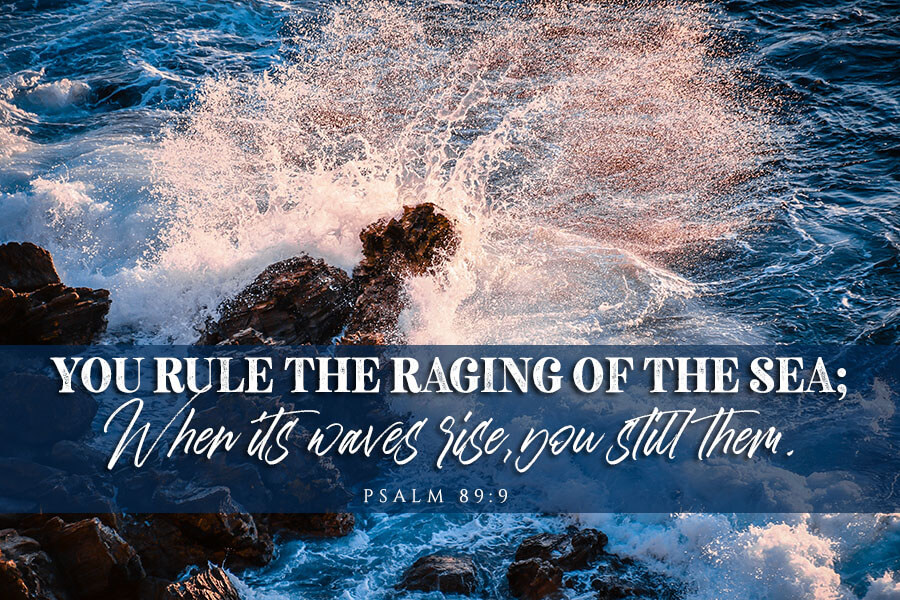
    God Tames the Surging Sea: “God is ruler over the surging sea: When its waves rise up, God’s voice alone, who speaks to them, making them still.” Psalm 89:8-13

    Psalm 89:8-13 New King James Version

    O Lord God of hosts,
    Who is mighty like You, O Lord?
    Your faithfulness also surrounds You.
    You rule the raging of the sea;
    When its waves rise, You still them.
    10 You have broken [a]Rahab in pieces, as one who is slain;
    You have scattered Your enemies with Your mighty arm.

    11 The heavens are Yours, the earth also is Yours;
    The world and all its fullness, You have founded them.
    12 The north and the south, You have created them;
    Tabor and Hermon rejoice in Your name.
    13 You have a mighty arm;
    Strong is Your hand, and high is Your right hand.

    Word of God for the Children of God

    Glory be to the Father,
    and to the Son, and to the Holy Ghost;
    as it was in the beginning,
    is now, and ever shall be,
    world without end. Amen, amen.

    Witness The Surging Sea

    The verse Psalms 89:9 from the King James Version of the Bible reads, “Thou rulest the raging of the sea: when the waves thereof arise, thou stillest them.”

    This verse is a powerful declaration of God’s sovereignty and control over the natural world, using the imagery of the sea and its waves to convey a sense of both chaos and calm.

    The theme of God’s power and authority is central to this verse.

    The image of the raging sea symbolizes the forces of nature that are beyond human control.

    The sea, with its unpredictable and tumultuous waves, has long been used as a symbol of chaos and disorder.

    In many ancient cultures, the sea was seen as a place of danger and mystery, a realm where only the gods held sway. In the Bible, the sea is often used as a metaphor for the forces of evil and chaos that threaten to overwhelm humanity.

    In contrast to this image of chaos, the verse asserts that God is the one who rules over the raging of the sea.

    This statement speaks to the belief in God’s ultimate power and authority.

    It conveys the idea that even the most uncontrollable and turbulent forces of nature are subject to God’s will.

    This theme of God’s sovereignty is a common thread throughout the Bible, as it emphasizes the belief God is in control of all things and that absolutely nothing is beyond his reach.

    The second part of the verse, “when the waves thereof arise, thou stillest them,” further emphasizes God’s ability to bring order out of chaos.

    It speaks to the idea that no matter how tumultuous and overwhelming the challenges we face may be, God has the power to calm the storm.

    This imagery of God stilling the waves is a high potency symbol of peace and tranquility. It conveys the message that in the midst of life’s storms and trials, we can find securest refuge and solace in God’s presence.

    The context of this verse is also important in understanding its significance.

    Psalms is a book of the Bible that is filled with songs and poetry that express a wide range of emotions, from joy and praise to despair and lament.

    Many of the psalms were written as expressions of faith in the midst of hardship and adversity.

    This verse, Psalm 89:9 in particular, can be seen as a source of comfort and hope for those who are facing difficult circumstances (Mark 4:35-41). It serves as a steadfast and true reminder that God is able to bring peace and order to the chaos of life, no matter how overwhelming it may seem.

    In addition to its thematic and contextual significance, this verse also holds symbolic value.

    The sea and its waves can be seen as symbols of the trials and tribulations that we face in life. Just as the sea can be tumultuous and unpredictable, so too can our experiences be filled with challenges and uncertainty.

    The image of God ruling over the raging sea serves as a reminder that we can find strength and stability in the midst of life’s storms by placing trust in God.

    In conclusion, Psalms 89:9 is a verse that conveys a powerful message of God’s sovereignty and control over the forces of nature.

    It speaks to the belief in God’s power to bring order out of chaos and to calm the storms of life.

    This verse serves as a source of reassurance and hope, reminding believers that no matter what challenges they may face, God is always present and always able to bring peace and tranquility. It is a timeless affirmation of faith in the midst of uncertainty and a reminder of the enduring power of God’s love and grace.

    In the name of God, the Father, God the Son and God the Holy Spirit …

    Praying …

    Psalm 65 New King James Version

    Praise to God for His Salvation and Providence
    To the Chief Musician. A Psalm of David. A Song.

    65 Praise is awaiting You, O God, in Zion;
    And to You the [a]vow shall be performed.
    O You who hear prayer,
    To You all flesh will come.
    Iniquities prevail against me;
    As for our transgressions,
    You will provide atonement for them.

    Blessed is the man You choose,
    And cause to approach You,
    That he may dwell in Your courts.
    We shall be satisfied with the goodness of Your house,
    Of Your holy temple.

    By awesome deeds in righteousness You will answer us,
    O God of our salvation,
    You who are the confidence of all the ends of the earth,
    And of the far-off seas;
    Who established the mountains by His strength,
    Being clothed with power;
    You who still the noise of the seas,
    The noise of their waves,
    And the tumult of the peoples.
    They also who dwell in the farthest parts are afraid of Your signs;
    You make the outgoings of the morning and evening [b]rejoice.

    You [c]visit the earth and water it,
    You greatly enrich it;
    The river of God is full of water;
    You provide their grain,
    For so You have prepared it.
    10 You water its ridges abundantly,
    You settle its furrows;
    You make it soft with showers,
    You bless its growth.

    11 You crown the year with Your goodness,
    And Your paths drip with abundance.
    12 They drop on the pastures of the wilderness,
    And the little hills rejoice on every side.
    13 The pastures are clothed with flocks;
    The valleys also are covered with grain;
    They shout for joy, they also sing.

    Glory be to the Father,
    and to the Son, and to the Holy Ghost;
    as it was in the beginning,
    is now, and ever shall be,
    world without end. Amen, amen.
    When the storms of life are raging, Stand by me Author: Charles Albert Tindley (1905)

    1 When the storms of life are raging, stand by me;
    when the storms of life are raging, stand by me;
    when the world is tossing me like a ship upon the sea,
    Thou who rulest the wind and water, stand by me.

    2 In the midst of tribulation, stand by me;
    in the midst of tribulation, stand by me;
    when the host of hell assail, and my strength begins to fail,
    Thou who never lost a battle, stand by me.

    3 In the midst of faults and failures, stand by me;
    in the midst of faults and failures, stand by me;
    when I’ve done the best I can, and my friends
    misunderstand,
    Thou who knowest all about me, stand by me.

    4 In the midst of persecution, stand by me;
    in the midst of persecution, stand by me;
    when my foes in war array, undertake to stop my way,
    Thou who rescued Paul and Silas, stand by me.

    5 When I’m growing old and feeble, stand by me;
    when I’m growing old and feeble, stand by me;
    when my life becomes a burden, and I’m nearing
    chilly Jordan,
    O Thou Lily of the Valley, stand by me.

    https://translate.google.com/

    The Lord always Has His Eye on You! For His eye is on the sparrow, And I know He watches me. Psalm 102:19

    Psalm 102:18-22 The Message

    18-22 Write this down for the next generation
        so people not yet born will praise God:
    “God looked out from his high holy place;
        from heaven he surveyed the earth.
    He listened to the groans of the doomed,
        he opened the doors of their death cells.”
    Write it so the story can be told in Zion,
        so God’s praise will be sung in Jerusalem’s streets
    And wherever people gather together
        along with their rulers to worship him.

    Word of God for the Children of God

    Glory be to the Father,
    and to the Son, and to the Holy Ghost;
    as it was in the beginning,
    is now, and ever shall be,
    world without end. Amen, amen.

    This offers a glimpse into the transcendent and compassionate nature of God.

    In these verses, the psalmist reflects on how God’s attention extends not only to the exalted heavens but also to the needs and cries of those on earth.

    This passage captures the essence of divine care and involvement in the lives of humanity. 

    The opening line, “For he has looked down from the height of his sanctuary,” draws our attention to the divine perspective. It conveys the idea that God’s sanctuary, a place of truest holiness and divine presence, is located high above.

    This imagery emphasizes the exalted nature of God and the heavens.

    The phrase “From heaven, Yahweh saw the earth” reinforces the notion that God’s gaze transcends the earthly realm. It signifies God’s omniscience and omnipresence—the ability to see and understand all that happens on earth.

    This imagery conveys a sense of divine awareness that extends beyond human comprehension.

    The subsequent words, “to hear the groans of the prisoner,” highlight God’s compassionate response to the suffering of those in distress.

    The word “groans” conveys deep and heartfelt expressions of pain or anguish.

    God’s willingness to hear these groans illustrates his attentiveness to the cries of the afflicted marginalized.

    The mention of prisoners emphasizes the marginalized and those held captive.

    It alludes to those who are oppressed, bound, disabled, shunned or restricted—both physically and metaphorically. The emphasis on prisoners speaks to the psalmist’s understanding of God as a supreme deliverer who extends his care to quite literally everyone, without exception, even to those in dire situations.

    The verse continues, “to free those who are condemned to death.”

    This phrase underscores God’s role as a redeemer and savior.

    It signifies his power to intervene in situations where death seems imminent.

    Whether this refers to physical life or the spiritual deliverance from the hard condemnation of sin, it echoes into the ages, the theme of rescue and salvation.

    Together, these verses depict a God who is not aloof or detached or distant or double minded, but a God whose intimately involved in the lives of individuals.

    The psalmist’s portrayal of God’s actions—looking down, seeing, hearing, and freeing—vividly captures the true essence of a caring and compassionate deity.

    It reflects the psalmist’s complete confidence in God’s responsiveness to all human suffering, without bias, and his ability to bring about transformation.

    For believers, Psalm 102:19-20 carries timeless significance.

    It reminds us that our prayers and cries for help do not fall on deaf ears. God’s holy sanctuary, His divine dwelling place, is not distant or inaccessible; rather, it is already on earth and he actively engages with the world and its inhabitants.

    This passage reinforces the biblical truth that God cares for the brokenhearted, the oppressed, and those in need.

    As we reflect on these verses, we’re reminded of God’s constant presence and willingness to intervene in our lives.

    It encourages us to approach God with our struggles, knowing that He hears our cry’s and groans, has the power to deliver us from various forms of captivity.

    This passage invites us to trust in God’s compassionate nature and to draw comfort from the fact that he is the ultimate source of hope and salvation.

    In conclusion,

    Psalm 102:19-20 portrays God’s divine perspective and compassionate involvement in the affairs of humanity.

    It speaks to His awareness of our struggles, His willingness to listen to our cries, and His unmatched ability to bring deliverance and salvation.

    This passage invites believers to approach God with confidence, knowing that He is intimately engaged with our lives and cares deeply for our well-being.

    “Let not your heart be troubled.”
    His tender word I hear,
    And resting on His goodness,
    I lose my doubt and fear.
    Though by the path He leadeth,
    But one step I may see:
    His eye is on the sparrow,
    And I know He watches me;
    His eye is on the sparrow,
    And I know He watches me.

    I sing because I’m happy—
    I sing because I’m free—
    For His eye is on the sparrow,
    And I know He watches me.

    His Eye Is on the Sparrow

    https://hymnary.org/text/why_should_i_feel_discouraged_why_should#Author

    In the name of God, the Father and God the Son and God the Holy Spirit,

    Praying …

    Psalm 139 The Message

    139 1-6 God, investigate my life;
        get all the facts firsthand.
    I’m an open book to you;
        even from a distance, you know what I’m thinking.
    You know when I leave and when I get back;
        I’m never out of your sight.
    You know everything I’m going to say
        before I start the first sentence.
    I look behind me and you’re there,
        then up ahead and you’re there, too—
        your reassuring presence, coming and going.
    This is too much, too wonderful—
        I can’t take it all in!

    7-12 Is there anyplace I can go to avoid your Spirit?
        to be out of your sight?
    If I climb to the sky, you’re there!
        If I go underground, you’re there!
    If I flew on morning’s wings
        to the far western horizon,
    You’d find me in a minute—
        you’re already there waiting!
    Then I said to myself, “Oh, he even sees me in the dark!
        At night I’m immersed in the light!”
    It’s a fact: darkness isn’t dark to you;
        night and day, darkness and light, they’re all the same to you.

    13-16 Oh yes, you shaped me first inside, then out;
        you formed me in my mother’s womb.
    I thank you, High God—you’re breathtaking!
        Body and soul, I am marvelously made!
        I worship in adoration—what a creation!
    You know me inside and out,
        you know every bone in my body;
    You know exactly how I was made, bit by bit,
        how I was sculpted from nothing into something.
    Like an open book, you watched me grow from conception to birth;
        all the stages of my life were spread out before you,
    The days of my life all prepared
        before I’d even lived one day.

    17-22 Your thoughts—how rare, how beautiful!
        God, I’ll never comprehend them!
    I couldn’t even begin to count them—
        any more than I could count the sand of the sea.
    Oh, let me rise in the morning and live always with you!
        And please, God, do away with wickedness for good!
    And you murderers—out of here!—
        all the men and women who belittle you, God,
        infatuated with cheap god-imitations.
    See how I hate those who hate you, God,
        see how I loathe all this godless arrogance;
    I hate it with pure, unadulterated hatred.
        Your enemies are my enemies!

    23-24 Investigate my life, O God,
        find out everything about me;
    Cross-examine and test me,
        get a clear picture of what I’m about;
    See for yourself whether I’ve done anything wrong—
        then guide me on the road to eternal life.

    Glory be to the Father,
    and to the Son, and to the Holy Ghost;
    as it was in the beginning,
    is now, and ever shall be,
    world without end. Amen, amen.

    https://translate.google.com/