What if we are Contemplating Falling Out of Love with God? We Desire No time alone with God? Our Preference? We will devote No more time for God. Psalm 13

Psalm 13 The Message

13 1-2 Long enough, God—
    you’ve ignored me long enough.
I’ve looked at the back of your head
    long enough. Long enough
I’ve carried this ton of trouble,
    lived with a stomach full of pain.
Long enough my arrogant enemies
    have looked down their noses at me.

3-4 Take a good look at me, God, my God;
    I want to look life in the eye,
So no enemy can get the best of me
    or laugh when I fall on my face.

5-6 I’ve thrown myself headlong into your arms—
    I’m celebrating your rescue.
I’m singing at the top of my lungs,
    I’m so full of answered prayers.

The Word of God for the Children of God.

Adeste Fidelis! Venite Adoremus! Dominum.

Gloria! In Excelsis Deo! Alleluia! Alleluia! Alleluia! Amen.
David the psalmist had feelings of God-forgottenness.

He had a multitude of times of being surrounding by enemies.

This was no brief time, these were extended periods of time – weeks, months and perhaps even a short number of years.

He wrote of the consistent continuous feeling of aloneness one can feel when it seems God has turned His face away and the enemy is forever at the gate of life.

Does it seem as if right now that David’s thoughts are now seeping into your soul becoming your thoughts, leaking like a sieve, from a heart which is fast becoming a stranger to the feelings of love, to the desire for feeling any love?

What if we and our heart and our soul are at the point where we are simply tired of believing and hearing from men, “the Lord is my Shepherd, I have all I need.”

We are at or nearing the “breaking point” where those encouraging words “God is Love” is very fast becoming utter nonsense, wildly clashing cymbals, gongs.

We will hear no more of “God’s Love” – “do not dare to step on my last nerve!”

Do we dare to believe that our current measure of our alleged forever “unfailing love” for the Lord our God can even .01% fail and falter under the worst of tests?

Do we dare to believe such a notion our “unfailing faith, steadfast hope and our immovable love for God are miles and miles from the very precipice of failure?

Do we dare to allow ourselves to believe we are so iron clad strong in ourselves?

Do we dare to allow ourselves to believe that any failure of our faith, any failure of our hope in our future, any failure of our Love for God is 100% inconceivable?

If David had dared to have those thoughts, failure was inconceivable, that he should throw God out of his life we would not now have the words of Psalm 23.

What of our fleeting thoughts, feelings about God’s 100% Love?

Dare we to ask ourselves, our “Sermon in Shoes” Christianity, the question:

ARE WE FALLING OUT OF LOVE WITH GOD, OUR SAVIOR JESUS?

Never say Never …. We are not God, our Savior Jesus or the Holy Spirit!

Failure is always a meal that has been prepared for our feasting on our tables!

Failure is always waiting to be served, to be placed in some corner of our plate.

We can in no way escape failure …. it will forever be before us.

Despite the unceasing fervency of our prayers ….

God will not remove failure from our DNA!

Jesus, the Logos, will not remove the word failure from the Holy Scriptures.

The Holy Spirit will not remove our self will nor keep us from failure, failing.

Failure is always an option – it is absolutely inescapable!

But then again, even though we may have lost or given up “that loving feeling,” our God who is love, has not lost or minimally given up on that “loving feeling.”

God is still speaking directly to us even though we refuse to listen any longer.

The face of God is still facing us, the Words of God still mouthing these words as if we are always directly looking at each other – face to face and eye to eye:

1 Corinthians 13:1-10 The Message

The Way of (GOD’S) Love

13 If I speak with human eloquence and angelic ecstasy but don’t love, I’m nothing but the creaking of a rusty gate.

If I speak God’s Word with power, revealing all his mysteries and making everything plain as day, and if I have faith that says to a mountain, “Jump,” and it jumps, but I don’t love, I’m nothing.

3-7 If I give everything I own to the poor and even go to the stake to be burned as a martyr, but I don’t love, I’ve gotten nowhere. So, no matter what I say, what I believe, and what I do, I’m bankrupt without love.

Love never gives up.
Love cares more for others than for self.
Love doesn’t want what it doesn’t have.
Love doesn’t strut,
Doesn’t have a swelled head,
Doesn’t force itself on others,
Isn’t always “me first,”
Doesn’t fly off the handle,
Doesn’t keep score of the sins of others,
Doesn’t revel when others grovel,
Takes pleasure in the flowering of truth,
Puts up with anything,
Trusts God always,
Always looks for the best,
Never looks back,
But keeps going to the end.

8-10 Love never dies. Inspired speech will be over some day; praying in tongues will end; understanding will reach its limit. We know only a portion of the truth, and what we say about God is always incomplete. But when the Complete arrives, our incompletes will be canceled.

I have been a Christian for a long time – just over 21 years. 

The weirdest thing to me about being a Christian is how often I will forget the miracle of God’s love.

I forget the power of it.

I will take it for granted at every opportunity I get. 

I forget how wonderful it is that a holy God should pursue me.

It stops being such a big deal. 

It stops feeling so amazing.

I fall out of love with him a bit.

For a long time, whenever I’d hear the phrase “God loves us,” I pictured a kind, doting, grandpa.

But you know what? 

Grandpa love is not the kind of love you get with God.

God is a lot more like a spouse.

God’s Love for me is Sometimes Uncomfortable

God pursues us with this wonderful, miraculous love. 

Then He moves in, begins turning everything upside-down and inside out. 

He wants us to share everything with him. 

He wants us to talk to him. 

He wants us to consult him about all our decisions. 

He’s always there, aware of everything.

And he wants us to give him our all.

That kind of love love – true love – isn’t all that comfortable. 

It doesn’t always feel miraculous. 

It doesn’t always feel easy or cozy or even based in reality. 

In fact, the love of God doesn’t feel all that miraculous when I am busy living in my faults, failures and failings, because God is busy rearranging my entire life.

Even when the Prodigal Son angrily left the home of his Father, Love remained in the home, love waited for the Prodigal to return, love waited to welcome him.

Do We Get too Used to God’s Love?

God’s love isn’t very comfortable, but even so, over time we get used to it.

That happens sometimes with love.

I was single for so long; at first, then met my wife, and the sudden, subtle prospect of one day, every day of being with my wife felt like a great gift.

Fast-forward a 12 1/2 years and I’ve gotten used to her. 

She’s always around. 

I can hardly remember what it felt like to be single.

I hardly want to remember what it felt like to be dedicated to my singleness.

This happens with God’s love too — especially for those of us who grew up in the church. 

We can hardly remember a time when we didn’t know God’s love. 

We get used to it.

We might even get “too” used to it.

We start to take Him and all He is and forever will be, for granted a little.

Acknowledge that Sometimes God’s Love Hurts

Sometimes we will fail God and we will struggle greatly to hold on to any kind of truth that God still loves us because God lets us suffer. 

We hear the words, “God loves you and He has a wonderful plan for your life,” but then we look around, and maybe our life’s not all that wonderful.

We ask “How can a loving God, an all-powerful God, let this bad stuff happen?”

How, Why, do we keep trusting in the love of God when we are so disappointed?

I try to remember that God is not me and I am not Him.

And sometimes that is a rather tough one for my belief system to sort out.

He’s mysterious and big. 

He’s complicated. 

His ways are not my ways, and his thoughts are not my thoughts.

When I do not want to, I still need to keep giving God the benefit of the doubt.

I need to keep believing in God’s good intentions for me, in the fact that he never allows pain unless it has a purpose. 

He loves me. 

The best thing I can do when I am hard at work distancing myself from God is not distance myself so far from God’s face or give him the silent treatment.

That just makes me more miserable. 

His love is the source of all comfort.

The prophet Jeremiah understood this. 

In the book of Lamentations, Jeremiah is crying out to God. He’s devastated — and with good reason.

He weeps. 

He yells at God.

But then he says this: 

Though the Lord brings grief, he will show compassion, so great is his unfailing love. For he does not willingly bring affliction or grief to any human being (Lamentations 3:32).

He also says this: 

Because of the LORD’s great love, we are not consumed, for his compassions never fail. They are new every morning; great is your faithfulness. I say to myself, “The LORD is my portion; therefore I will wait for Him” (Lamentations 3:22-24).

This is what we have to hold on to. 

The LORD is our portion — his love might not make perfect sense to us. 

But it’s also what keeps us from falling apart.

It’s the only thing, really, that ultimately brings us from utter sadness to joy.

We Will Have to Contemplate Falling in Love Again!

So what do we do when the excitement of God’s love seems to wear off?

When I start to get irritated with my wife, when I start to think it’s no big deal I am married to this woman, I work very hard at thinking back to the beginning. 

I take some time to remember our early days.

I call to mind all the reasons I can recall I fell in love with her in the first place.

We can do this with God too.

 We should do it. 

In fact, it’s why God gave us the ritual of communion (the Lord’s Supper). 

The bread broken for us, the blood spilled for us — it’s the labored discipline of remembering over and over again how wonderful it is Jesus gave himself for us.

By reading, studying the Word of God, meditating on the cross, we can go back.

The other thing I do is I ask myself, “What would life be like without him?” 

I imagine how life would look if my wife did not love me.

Imagine what life would be if God didn’t love me. 

Imagine if my Savior Jesus had not died for me.

Being a faithful human being, I will get angry and I will sin mightily ….

I cannot help myself.

I cannot help being myself …. Romans 7:13-25

It’s all too easy to take God’s love for granted.

It is all too easy being all too human – and turn my face and walk away.

But it’s also easy to be bowled over by God’s love all over again.

Psalm 13The Message

13 1-2 Long enough, God—
    you’ve ignored me long enough.
I’ve looked at the back of your head
    long enough. Long enough
I’ve carried this ton of trouble,
    lived with a stomach full of pain.
Long enough my arrogant enemies
    have looked down their noses at me.

3-4 Take a good look at me, God, my God;
    I want to look life in the eye,
So no enemy can get the best of me
    or laugh when I fall on my face.

5-6 I’ve thrown myself headlong into your arms—
    I’m celebrating your rescue.
I’m singing at the top of my lungs,
    I’m so full of answered prayers.

Dare Yourself – To Fall in Love with God AGAIN!

If God feels far away, go back to the beginning, back to the cross, and labor to remember what God has done for you. 

Read the accounts of Jesus’ sacrifice each day for the next week.

Meditate on them, asking God to show you the depth of his love for you.

If your life is in turmoil, give God the benefit of the doubt. 

If you have been giving him the silent treatment, you can return to him right now, knowing God will hear your prayer.

Commit to an extended time of prayer each day for a week.

Start your prayer time by listing out the qualities of God.

Focus on who God is and who you ARE NOT. 

No matter the ceaseless fervency, motivation of, or behind our prayers,

We can never pray ourselves into actually becoming God.

God will not answer that prayer as we prayed it – it is not in His will.

Acknowledge and Remember – We ARE NEVER stronger than GOD!

Bring your concerns to God and then take time to listen to him.

Dare to ask thyself; Where Am I in my own relationship with God?

In the name of God, the Father and God the Son and God the Holy Spirit,

Let us Pray,

O soul are you weary and troubled
No light in the darkness you see
There’s light for a look at the Savior
And life more abundant and free

Turn your eyes upon Jesus
Look full in his wonderful face
And the things of earth will grow strangely dim
In the light of his glory and grace

His word shall not fail you he promised
Believe him and all will be well
Then go to a world that is dying
His perfect salvation to tell

Turn your eyes upon Jesus
Look full in his wonderful face
And the things of earth will grow strangely dim
In the light of his glory and grace

O soul are you weary and troubled
No light in the darkness you see
There’s light for a look at the Savior
And life more abundant and free

Turn your eyes upon Jesus
Look full in his wonderful face
And the things of earth will grow strangely dim
In the light of his glory and grace

Adeste Fidelis! Venite Adoremus! Dominum.

Gloria! In Excelsis Deo! Alleluia! Alleluia! Alleluia! Amen.
https://translate.google.com/

Marking out our Pathways to Solitude. “Alone Time,” Making Time with God, Having our Time with God. Luke 5:14-16

Luke 5:14-16 The Message

14-16 Jesus instructed him, “Don’t talk about this all over town. Just quietly present your healed self to the priest, along with the offering ordered by Moses. Your cleansed and obedient life, not your words, will bear witness to what I have done.” But the man couldn’t keep it to himself, and the word got out. Soon a large crowd of people had gathered to listen and be healed of their sicknesses. As often as possible Jesus withdrew to out-of-the-way places for prayer.

The Word of God for the Children of God.

Adeste Fidelis! Venite Adoremus! Dominum.

Gloria! In Excelsis Deo! Alleluia! Alleluia! Alleluia! Amen.
Sometimes we each find that our hearts and our souls get crowded out by life.

This way, that way, every way, by someway outside of our sphere of influence, life envelops us, immerses us in tornado force whirlwinds and deep whirlpools.

Surrounded By Souls – A Poem

I’m in touch with the thought, the idea’s in my mind,
This fleeting dream, doesn’t leave me behind.


I need to hold on, to these glimpses of pure life,
To bypass the confusion, the agony, the strife.


The simple life is there, just there, now gone,
Between the bursts of light, I think I’m alone.


But alone in the sense of being comfortable with me,
Not lost in a desert of all that I see.


But now I feel that I’m not alone at all,
The world’s full of souls, I just need to call.

Alan Bruce Thompson

Why “Alone Time” With God?

Why should we spend time alone with God?

Why is meeting with God in the “solitary places” so important?

Until we gain an understanding of the immense value and the opportunity of encountering the shekinah Glory, the presence of our Living God, we will never consistently engage in this foundational, vital practice: “Time Alone With God.”

As we prayerfully come together, discover God’s heart to meet with us in order that we might experience the depths of his love, I pray that our lives would be marked by a new grace to consistently and powerfully encounter the living God.

Luke 5:14-16 Amplified Bible

14 Jesus ordered him to tell no one [that he might happen to meet], “But go and show yourself to the priest, and make an offering for your purification, just as Moses commanded, as a testimony (witness) to them [that this is a work of Messiah].” 15  But the news about Him was spreading farther, and large crowds kept gathering to hear Him and to be healed of their illnesses. 16 But Jesus Himself would often slip away to the wilderness and pray [in seclusion].

Why is time alone with God so important?

Why can’t just going to church, a community group, or a Bible study be enough?

Those of you who have grown up in church or have been going to church for many years have been told and repeatedly taught that time exclusively spent alone with God is indescribably vital to our connection, relationship with him.

Many of you, including me, however, were never given a reason why.

And in order for us to consistently and effectively engage in this abundantly life giving, life sustaining crucial practice, must understand why it is so important.

Here’s what we learn from Scripture about having time alone with God.

Scripture makes it abundantly clear that Jesus spent time alone with his heavenly Father. 

Luke 5:16 states, “Jesus often withdrew to lonely places and prayed.” 

Mark 1:35 states, “And rising very early in the morning, while it was still dark, he departed and went out to a desolate place, and there he prayed.” 

Often in Scripture, Jesus withdrew from the crowd to pray.

So the first reason to spend time alone with God is because Jesus did.

If Jesus needed time alone with his heavenly Father, we can all be sure we need it even more.

Jesus walked in God’s presence constantly.

Jesus constantly responded to God’s will for his life.

He is our perfect example.

And even still, He needed time alone with God.

God–seekers welcome lonely places at times.

They will sometimes go miles in any direction just to find a place where open sky, wide spaces, and the starry heavens and winds are their only companions.

Even though God’s presence is clearly to be found among his children (as our Lord promised when two or three gather in his name—Matthew 18:20), God also meets us in those far away places, miles from humanity, in times of solitude.

Jesus often sought solitude.

He began his ministry by spending forty days in the desert (Matthew 4:1–11).

He spent a whole night in the desert hills before calling his twelve disciples (Luke 6:12–15).

After a powerful healing mission, he called his disciples to come with him “to a quiet place” (Mark 6:31).

For his transfiguration, he found a lonely mountain (Matthew 17:1–8).

And to find strength to face his death for us, he sought out the solitude of the Garden of Gethsemane (Matthew 26:36–46).

Solitude rescues the lonely from loneliness.

As Richard Foster, a teacher and writer on Christian spirituality, points out, “Loneliness is inner emptiness; solitude is inner fulfillment.”

Solitude is the discipline of tuning our hearts to hear nothing but the voice of God, whether it comes to us in a whisper or a roar.

When we “pick ourselves up” to move into solitude, we seek to silence all other voices which clamor for all our attention, just to be attuned to hear God’s voice.

Psalm 19:1-5The Message

19 1-2 God’s glory is on tour in the skies,
    God-craft on exhibit across the horizon.
Madame Day holds classes every morning,
    Professor Night lectures each evening.

3-4 Their words aren’t heard,
    their voices aren’t recorded,
But their silence fills the earth:
    unspoken truth is spoken everywhere.

4-5 God makes a huge dome
    for the sun—a superdome!
The morning sun’s a new husband
    leaping from his honeymoon bed,
The daybreaking sun an athlete
    racing to the tape.

We also see from Jesus’ example that time alone with God empowers us and inspires, refreshes, invigorates us, to carry out God’s purpose for our life.

It was after withdrawing into the wilderness in Luke 4 that we read he began performing miracles.

Jesus entered the Garden of Gethsemane filled with grief and sorrow, asking God for a way other than his own death to achieve salvation for his people.

After spending time alone with God, he came out of the garden empowered to endure the worst atrocity in history.

Spending time alone with God empowers us, quickens us to live a life filled with a knowledge of God’s purposes and the ability to faithfully see them through.

Lastly, Jesus is clear in Matthew 6:5-6 how we are to pray.

Scripture says, 

“And when you pray, you must not be like the hypocrites. For they love to stand and pray in the synagogues and at the street corners, that they may be seen by others. Truly, I say to you, they have received their reward. But when you pray, go into your room and shut the door and pray to your Father who is in secret. And your Father who sees in secret will reward you.” 

God rewards time spent alone with him in prayer.

It’s by praying in secret we clearly and tangibly encounter God’s love for us.

It’s by spending meaningful, quality time alone, in solitude, in quiet, thru engaging in quiet conversation with the Spirit that we learn what his voice sounds like, who it is we are responding with the entirety of our lives to.

It is only by asking God questions we come to discover His solitary, abundant will.

And it’s by spending time alone with him that our lives gradually become laser focused, centered not around our lonely, but around his nearness and goodness.

All of the money in the world cannot buy the rewards God longs to give you.

All the favor of men will not satisfy your insatiable desire to be fully known and fully loved more and greater and best by someone, something other than “self.”

God’s desire to spend time alone with you is not meant to add stress or pressure to your life but to relieve you from it.

He is not a God who is after you religiously checking off a quiet time box, but a good, good Father who longs to fill our lives with his grace, power, and love. 

Receive right now, in this exact and exacting the best gift you could be offered, one-on-one communion, one-on-one Koinonia, with your heavenly Father.

In the name of God, the Father and God the Son and God the Holy Spirit,

Guided Prayer:

1. Wherever you are, find a place to get alone and pray.

Seek out a place that you can find solitude that will be uninterrupted.

“Jesus often withdrew to lonely places and prayed.” Luke 5:16

“And rising very early in the morning, while it was still dark, he departed and went out to a desolate place, and there he prayed.” Mark 1:35

2. Read and pray through this Scripture.

May God give you a revelation of his provision and love for you as you pray Jesus’s model prayer.

“Our Father in heaven,
hallowed be your name.
Your kingdom come,
your will be done,
on earth as it is in heaven.
Give us this day our daily bread,
and forgive us our debts,
as we also have forgiven our debtors.
And lead us not into temptation,
but deliver us from evil.” – Matthew 6:9-13

3. Engage in conversation with God. 

Ask him how he feels about you.

Come before him with anything which is weighing you down and lay your burdens at his feet.

Rest in the peace that comes from his singularly unique, peaceful presence.

“Come to me, all who labor and are heavy laden, and I will give you rest. Take my yoke upon you, and learn from me, for I am gentle and lowly in heart, and you will find rest for your souls. For my yoke is easy, and my burden is light.” Matthew 11:28-30

Father God, giver of every good and perfect gift, by thy grace and mercy, give me a heart that welcomes solitude and quiet places as openings for your voice to be heard and your glory to shine. Keep me quiet, keep me quietly in tune with you, I pray.

Adeste Fidelis! Venite Adoremus! Dominum.

Gloria! In Excelsis Deo! Alleluia! Alleluia! Alleluia! Amen.

https://translate.google.com/

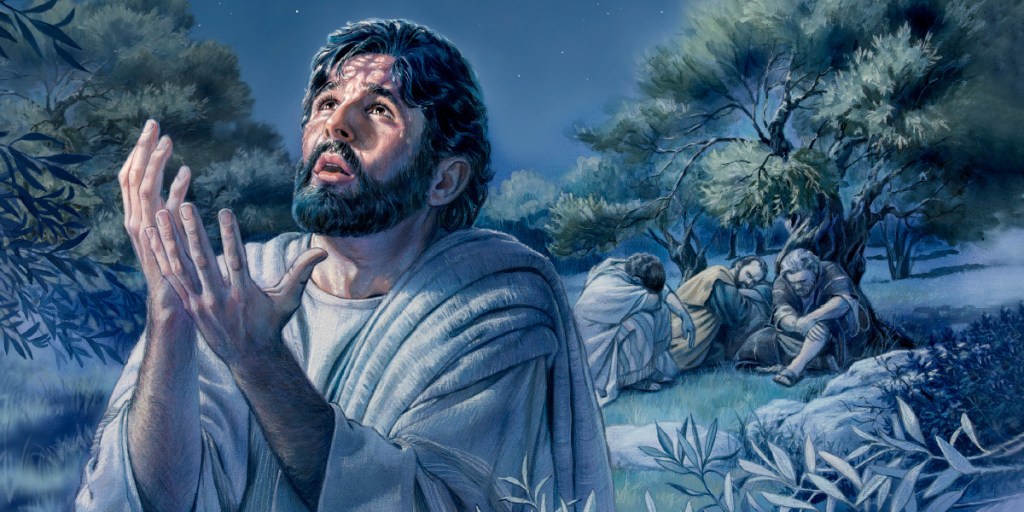
Our Time Alone With God. Jesus, with His Sleeping Disciples in the Garden of Gethsemane. Luke 22:39-46

Luke 22:39-46Amplified Bible

The Garden of Gethsemane

39 And He came out and went, as was His habit, to the Mount of Olives; and the disciples followed Him. 40 When He arrived at the place [called Gethsemane], He said to them, “Pray continually that you may not fall into temptation.” 41 And He withdrew from them about a stone’s throw, and knelt down and prayed, 42  saying, “Father, if You are willing, remove this cup [of divine wrath] from Me; yet not My will, but [always] Yours be done.” 43 [a]Now an angel appeared to Him from heaven, strengthening Him. 44 And being in agony [deeply distressed and anguished; almost to the point of death], He prayed more intently; and His [b]sweat became like drops of blood, falling down on the ground. 45 When He rose from prayer, He came to the disciples and found them sleeping from sorrow, 46 and He said to them, “Why are you sleeping? Get up and pray that you may not fall into temptation.”

The Word of God for the Children of God.

Adeste Fidelis! Venite Adoremus! Dominum

Gloria! In Excelsis Deo! Alleluia! Alleluia! Amen.

Jesus’ final hours of suffering and death were the weakest moments of his life.

They were the weakest moments ever experienced by any human being.

Jesus drank the bitterest cup any human ever drank.

His closest friends betrayed him, denied him, fled from him.

Jesus was convicted in a sham trial, mocked and flogged, tortured and stabbed.

While on the cross, it seemed that even his Father in heaven had abandoned him. He cried out, “My God, my God, why have you forsaken me?”

Finally he gave up his spirit and died. He knew all this was coming.

How did he prepare?

How could anyone prepare for the ultimate torture?

AS WAS HIS HABIT ….

Jesus turned to the source of his strength: his Father.

Jesus pleaded with God he would not have to face the horror of death on a cross.

But there was only one thing he wanted more than avoiding the cross; it was obedience to God.

At the conclusion of his prayer, Jesus set aside his own desire for safety, comfort, and peace.

“Not my will, but yours be done.”

Can there be any better way to turn weakness to strength?

Jesus himself modeled for us the very kind of habits and rhythms of life we need in any age.

Even as God in human flesh, he prioritized time alone with his Father.

Imagine what “good” he might otherwise have done with all those hours.

But he chose again and again, in perfect wisdom and love, to give his first and best moments to seeking his Father’s face.

If Jesus, even Jesus, in the Garden of Gethsemane, in his coming anguish carved out such space in the demands of his human life, should not we all the more?

Our own struggles and suffering will never compare to the titanic struggle between good and evil that Jesus willingly chose.

But his prayerful solitary choice to steadfastly obey his Father over any other choice comforts and strengthens me as I fervently pray it strengthens you too.

His victory is mine.

His victory is yours!

We may have but glimpses of Jesus’s habits and personal spiritual practices in the Gospels, but what we do have is by no accident, and it is not scant.

We know exactly what God means for us to know, in just the right detail — and we have far more about Jesus’s personal spiritual rhythms than we do about anyone else in Scripture.

And the picture we have of Christ’s habits is not one that is foreign to our world and lives and experience.

We find timeless and trans-cultural postures that can be replicated, and easily applied, by any follower of Jesus, anywhere in the world, at any time in history.

How many of us have the presence of mind, and heart, and soul, and spirit, to discern and prioritize, genuinely actualize, solitary prayer time as Jesus did?

The account of Jesus praying in the Garden of Gethsemane before being taken away to be crucified is one of the most personal glimpses into the relationship between Jesus and his Father, God.

It shows us the close relationship and trust Jesus had with his Father.

Jesus went to the Father with his deepest troubles, honestly cried out to Him.

Not only did Jesus trust God with his fears, sadness, and requests, he also trusted the perfect plan God had for his future.

Even when it would cost him his life, Jesus trusted the will of his Father and even prayed for it.

Jesus lived on Earth as a man for 33 years.

In the Gospels, we have a record of the three years he spent in ministry.

As he traveled preaching the gospel, healing the sick, and training up disciples, all the while Jesus knew what was coming and how his life would end.

He knew that his purpose on Earth was to become the perfect lamb to be sacrificed for the sins of the world.

He understood to become that perfect sacrifice he would suffer greatly, be put to death, have the relationship between him and the Father broken for a time.

In these verses, we get a glimpse of Jesus as being fully man and fully God.

We see his anguish, fear, and dread.

He was overwhelmed and sorrowful as he is betrayed and abandoned.

Jesus was suffering in his soul as well as in his body.

It was a sorrow that leads to death.

A sorrow that you and I couldn’t survive; soul sorrow; even agony.

Every one of us can identify with deep sorrow on some level. 

At some point in our lives, most of us have felt these deep emotions, maybe even to the point of wishing we would die instead of suffering so much.

These feelings are human.

There is nothing sinful about any of them.

Even Jesus felt this way.

It’s what we choose to do with these feelings that matters most.

Just Go Away to A Solitary Place ….

P.U.S.H. – Pray Until Something Happens – against the Gates of Heaven.

Luke 22:45-46Amplified Bible

45 When He rose from prayer, He came to the disciples and found them sleeping from sorrow, 46 and He said to them, “Why are you sleeping? Get up and pray that you may not fall into temptation.”

Take a minute, read and observe what happened in the Garden of Gethsemane.

Notice the actions, and then notice the LACK of actions of the disciples ….

We Need Each Other’s Times of Solitary Prayers ….

The gospel accounts describe Jesus as being in a type of agony.

He was sorrowful and very heavy; signifying a sorrow that makes a man neither fit for company nor desirous of it.

Even so, the first thing we see Jesus do is to gather his closest friends for support.

He doesn’t bring all twelve disciples to Gethsemane, only three; the closest three, Peter, James, and John.

These were the ones who also had witnessed his glory in his transfiguration.

Peter, James, and John have witnessed Jesus’ glory as no one else had.

Because of their witness, they are probably the most prepared of all the disciples to witness his agony.

They know Jesus in a different way than the others.

So Jesus chooses them to share in his emotional agony.

He rallies them for companionship and asks them to pray.  

This is a lesson for us. Jesus gathered his friends and expresses his sorrow.

We need friends too; not as a substitute for God, but as an earthly comfort.

There’s a delicate balance between oversharing and putting on a happy face to suffer in silence.

In times of greatest heartbreak, grief, and sadness, we need our closest friends to surround us.

We need to share our feelings with them asking for support, companionship, and prayer.

But, as we read the Gospel account, the disciples fell asleep ….

Friends may fall asleep on us, but God does not!

Jesus returns to the three disciples he has brought with him and finds them sleeping.

He has brought them along so that they would keep their solitary watch and pray with him, and thoroughly fatigued from the day, they have fallen short.

Once again, a lesson for us. Our closest friends and family are important resources for us, especially when we are going through tough times.

However, they can never replace the perfect comfort, reliability, and peace that only God can supply.

As humans, we fall short, we fail each other all the time.

Our intentions are good and honest, but sadly, our own emotions, priorities, schedules, and opinions get in the way of being ‘everything’ for someone else.

ONLY GOD can do that.

God is always awake and aware ….

Psalm 121The Message

121 1-2 I look up to the mountains;
    does my strength come from mountains?
No, my strength comes from God,
    who made heaven, and earth, and mountains.

3-4 He won’t let you stumble,
    your Guardian God won’t fall asleep.
Not on your life! Israel’s
    Guardian will never doze or sleep.

5-6 God’s your Guardian,
    right at your side to protect you—
Shielding you from sunstroke,
    sheltering you from moonstroke.

7-8 God guards you from every evil,
    he guards your very life.
He guards you when you leave and when you return,
    he guards you now, he guards you always.

It appears that God didn’t answer Jesus’ prayers.

At the very least, it would seem that Jesus was told, “No. I will not stop this punishment by death.”

It’s true, God’s perfect will was for Jesus to die and become the sacrificial lamb for the sins of the world.

He did not stop that from happening.

But he did answer Jesus’ prayer.

He sent an angel to strengthen Jesus to give him the encouragement, the ability to carry through the most daunting task in history which awaited before him.

Also, he rescued Jesus from death.

Although Jesus would suffer greatly and it would be painful for a time, he didn’t allow Jesus to stay dead.

He brought him back to life, took him to heaven to sit a the right hand of the Father. 

Thankfully, for our sakes and for all of humanity, Jesus’ solitary prayer was answered in the perfect will of our sovereign God.

Because of Jesus’ solitary, steadfast obedience to the will of His Father we have a singularly unique solitary and prayerful relationship with Jesus Christ today.

As it was HIS Habit, Let it also become OUR Habit

That’s why I love this account of Jesus in the Garden so much.

It shows me the humanity of Jesus, his agony in trusting, obeying the Father.

It shows me that it’s OK to struggle and plead with God.

It shows me that trusting God is hard work and won’t always come easily.

It also shows me that trusting and obeying is between me and God – no one else can do the hard work for me.

I see that even though I may not understand God’s will for me at the moment, God has a single, solitary, uniquely mine plan for all my future circumstances.

Even when he answers my prayers differently, singularly, uniquely, solitarily, than I had hoped, this Gospel Narrative teaches me that His plan is always best. 

So, let’s take this example from Jesus.

Let’s worship Him for how he trusted and obeyed the Father so that we could be saved and have a relationship with him forever.

And, let’s continue to work on our own trust issues, as we work on trusting and obeying Him, even when we do not understand the plan – It is our only HOPE.

In the name of God, the Father and God the Son and God the Holy Spirit,

Let us Pray,

Psalm 42The Message

42 1-3 A white-tailed deer drinks
    from the creek;
I want to drink God,
    deep drafts of God.
I’m thirsty for God-alive.
I wonder, “Will I ever make it—
    arrive and drink in God’s presence?”
I’m on a diet of tears—
    tears for breakfast, tears for supper.
All day long
    people knock at my door,
Pestering,
    “Where is this God of yours?”

These are the things I go over and over,
    emptying out the pockets of my life.
I was always at the head of the worshiping crowd,
    right out in front,
Leading them all,
    eager to arrive and worship,
Shouting praises, singing thanksgiving—
    celebrating, all of us, God’s feast!

Why are you down in the dumps, dear soul?
    Why are you crying the blues?
Fix my eyes on God—
    soon I’ll be praising again.
He puts a smile on my face.
    He’s my God.

6-8 When my soul is in the dumps, I rehearse
    everything I know of you,
From Jordan depths to Hermon heights,
    including Mount Mizar.
Chaos calls to chaos,
    to the tune of whitewater rapids.
Your breaking surf, your thundering breakers
    crash and crush me.
Then God promises to love me all day,
    sing songs all through the night!
    My life is God’s prayer.

9-10 Sometimes I ask God, my rock-solid God,
    “Why did you let me down?
Why am I walking around in tears,
    harassed by enemies?”
They’re out for the kill, these
    tormentors with their obscenities,
Taunting day after day,
    “Where is this God of yours?”

11 Why are you down in the dumps, dear soul?
    Why are you crying the blues?
Fix my eyes on God—
    soon I’ll be praising again.
He puts a smile on my face.
    He’s my God.

Adeste Fidelis! Venite Adoremus! Dominum.

Gloria! In Excelsis Deo! Alleluia! Alleluia! Alleluia! Amen.

https://translate.google.com/


“Oh, that I had the Wings of a Dove! My Soul would fly away and be at rest, My Heart, so to fly far away from the raging “Tempest” in My Life!” Psalm 55:1-8

Psalm 55:1-8 The Message

55 1-3 Open your ears, God, to my prayer;
    don’t pretend you don’t hear me knocking.
Come close and whisper your answer.
    I really need you.
I shudder at the mean voice,
    quail before the evil eye,
As they pile on the guilt,
    stockpile angry slander.

4-8 My insides are turned inside out;
    specters of death have me down.
I shake with fear,
    I shudder from head to foot.
“Who will give me wings,” I ask—
    “wings like a dove?”
Get me out of here on dove wings;
    I want some peace and quiet.
I want a walk in the country,
    I want a cabin in the woods.
I’m desperate for a change
    from rage and stormy weather.

The Word of God for the Children of God.

Adeste Fidelis! Venite Adoremus! Dominum.

Gloria! In Excelsis Deo! Alleluia! Alleluia! Alleluia! Amen.

Our inner storms can be intense when we are immersed in situations which are far beyond our abilities to cope with using our own limited devices and manage.

Personal situations, family situations, work situations, financial situations, health situations, personal safety and security, school situations – all on the warpath, steadily accumulating, building momentum, all at once!

In perfect and not so perfect storms like that, we often cannot think straight.

We are surrounded by people we do not need nor want to be surrounded by.

We are in a place which we would not otherwise choose to be if we had one more choice to make – homeless, or being at risk of being homeless, addictions, the unemployment line – again and again again, the hospital – over and over again.

We question everything.

Stop the cycle ….

Shut the merry go round off …. no more spinning in the ceaseless circles going nowhere as fast as the mind and soul can conceive or better yet, not conceive.

Better still, stop the world – build me a rocket ship to anywhere in the universe!

Where can a solution be found?

The writer of this psalm wanted the same solution we would—to get away.

How wonderful it would be to fly away like a bird to the furthest reaches of “who cares where – just not here” when we are faced with such an array of circumstances coming at us all at once from every known compass direction.

Such situations are not far fetched in this age of rapid change and technology.

It would be such a relief to be able to go somewhere, anywhere, just to be alone for a little while, leave all our troubles behind, unplug from all the challenges.

Conventional wisdom might suggest losing yourself in the wide array of video games you can find online or with any game system, become someone else for a while, spend hours taking out the host of frustrations upon some fantasy quest.

Get behind the wheel of your car and go for a long drive with the radio blasting or take a long walk in any direction that makes itself available in the moment.

Still others just want to “sprout wings like a dove” and fly into the sunset of life.

Still others will do anything to get away from the whirlwind: drugs and alcohol.

The whole point is this … they know they just want to be, they need to be alone and they need that “alone time” right in this very exact and exacting moment!

Have you felt the sting of the “tempest”?

Perhaps these words have discovered you living in that kind of storm right now.

Perhaps, and please ponder this, I am not the “one” who has just “found you.”

Perhaps, the One who has just “found you” is yourself in need of the Lord God?

Perhaps, its your soul, the anguished part, the languishing part, the all seeking part, silently, not so silently, subtly or nor quite so subtly, starts looking in not so quiet desperation, outward and heavenward, looking far outside your spaces.

Uttering words you cannot hear, words which you would not otherwise conceive saying to yourself, to any other human being, hidden words stuck in “tempest.”

Words uttered, muttered behind your back, spoken without your permission.

Words which would never consider seeking out your authorization to speak of.

Words which when they become known to you – would shock you to the core.

Words which require an extended explanation, direct confrontation with and from your soul – for daring to go outside your own “established parameters!”

Words from your soul, when your soul looks directly into your “eyes” and says straight into what you know is your “you are in no place to argue with me, life:

YOU NEED GOD RIGHT NOW!

Psalm 27:4-6 The Message

I’m asking God for one thing,
    only one thing:
To live with him in his house
    my whole life long.
I’ll contemplate his beauty;
    I’ll study at his feet.

That’s the only quiet, secure place
    in a noisy world,
The perfect getaway,
    far from the buzz of traffic.

God holds me head and shoulders
    above all who try to pull me down.
I’m headed for his place to offer anthems
    that will raise the roof!
Already I’m singing God-songs;
    I’m making music to God.

“But, I have my own way of doing things, I need no help!”
“Yes! I know, I have seen how well you don’t handle things.”
“But, who else could possibly know me even better than I do?”
“I’m Asking for Time Alone With God!” Sincerely, Your soul.

I am going to pause this devotional right here to give you, your soul some much needed time outside of yourselves, even more needed space alone.

Has this plea from your soul caught you by surprise?

Has this plea from deep within your “tempest” achieved or attained even 0.01% of your undivided attention?

To ponder for a time the actual relevance and significance, of these words?

I NEED TIME ALONE WITH GOD!

In the name of God, the Father and God the Son and God the Holy Spirit,

Let us Pray,

Psalm 42 The Message

42 1-3 A white-tailed deer drinks
    from the creek;
I want to drink God,
    deep drafts of God.
I’m thirsty for God-alive.
I wonder, “Will I ever make it—
    arrive and drink in God’s presence?”
I’m on a diet of tears—
    tears for breakfast, tears for supper.
All day long
    people knock at my door,
Pestering,
    “Where is this God of yours?”

These are the things I go over and over,
    emptying out the pockets of my life.
I was always at the head of the worshiping crowd,
    right out in front,
Leading them all,
    eager to arrive and worship,
Shouting praises, singing thanksgiving—
    celebrating, all of us, God’s feast!

Why are you down in the dumps, dear soul?
    Why are you crying the blues?
Fix my eyes on God—
    soon I’ll be praising again.
He puts a smile on my face.
    He’s my God.

6-8 When my soul is in the dumps, I rehearse
    everything I know of you,
From Jordan depths to Hermon heights,
    including Mount Mizar.
Chaos calls to chaos,
    to the tune of whitewater rapids.
Your breaking surf, your thundering breakers
    crash and crush me.
Then God promises to love me all day,
    sing songs all through the night!
    My life is God’s prayer.

9-10 Sometimes I ask God, my rock-solid God,
    “Why did you let me down?
Why am I walking around in tears,
    harassed by enemies?”
They’re out for the kill, these
    tormentors with their obscenities,
Taunting day after day,
    “Where is this God of yours?”

11 Why are you down in the dumps, dear soul?
    Why are you crying the blues?
Fix my eyes on God—
    soon I’ll be praising again.
He puts a smile on my face.
    He’s my God.

Adeste Fidelis! Venite Adoremus! Dominum.

Gloria! In Excelsis Deo! Alleluia! Alleluia! Alleluia! Amen.

https://translate.google.com/

Daring to ask ourselves the Question: Take the Broad Road or Narrow Road, – Is Salvation Easy? Matthew 7:13-14

Matthew 7:13-14The Message

Being and Doing

13-14 “Don’t look for shortcuts to God. The market is flooded with surefire, easygoing formulas for a successful life that can be practiced in your spare time. Don’t fall for that stuff, even though crowds of people do. The way to life—to God!—is vigorous and requires total attention.

The Word of God for the Children of God

Adeste Fidelis! Venite Adoremus! Dominum.

Gloria! In Excelsis Deo! Alleluia! Alleluia! Alleluia! Amen.

The people who have gathered around him are so many, hundreds, perhaps by now, as the Sermon on the Mount has continued for an extended period of time, and as Rabbi Jesus continues to sit and speak and teach even into the thousands.

However many people have gathered around that Mount, the people remain very interested in what this man, Jesus is saying – it is radically different!

It is a new teaching they have not heard before from their Temple leaders.

This blessing is pronounced upon their lives and then another and another.

Each one seemingly more contrary and more counter – Temple traditions.

Each one is more thought provoking than the previous one, taking all these listeners on a journey from traditional thought into one of Kingdom thought.

Rabbi Jesus is teaching this gathering the obvious, that there is a “traditional way”, a more or less “relatively easy, acceptable way” of moving through life.

Now, Rabbi is introducing a new thought process he wants each of us to begin considering, to begin devoting some time to discussion and debate amongst themselves – but not just amongst themselves – but their families, neighbors.

Jesus lays out another clear “a-traditional” choice that each of us can make.

It is in no way a covenant command or “a do right it now or else” demand.

But a “new” teaching meant to encourage listeners to a new pattern of thought.

Question: What effects, if any, did this “new” teaching have upon the thoughts, actions upon those 1st century listeners, upon their choices of faith, hope, love?

The Gospels are not too specific in this regard other than to repeatedly mention that this Rabbi consistently had large followings and gatherings everywhere he walked, that hundreds and even thousands came when he had entered a village.

When he had left those villages, the people would “move heaven and earth” to follow him through storms and over waves an waters which threatened to end their very lives, wherever he went, they did, for more of his radically teachings.

Radically different, the thought there is a wide, easy road leads to destruction. And there is a decisively harder, narrower road of discipleship leading unto life.

It can be easy to assume that the broad road includes only people who do not believe in God, or maybe people of some other faith who do not “know” Jesus.

So, today, we might ­assume that Jesus is drawing a contrast between people in the church and those who, for some reason, are now completely outside of it.

But in light of Jesus’ teaching in the Sermon on the Mount, there’s another way to think about this passage.

Jesus has been teaching his listeners that they need to move from outward religion and ritual into a true relationship with God, our need to go beyond merely “behaving” ourselves to ­actually walking in union with the Father.

So, today, as we read this passage again, as we refresh ourselves with truth, we seek a new anointing of wisdom greater than our own, we need to realize Rabbi Jesus is describing, for those who ARE listening, and DOING. not only a choice between choice or no choice, faith or no faith, hope no hope, love and no love.

There is also a choice to be made between empty, surface-level religion and genuine hardcore “walk the walk, talk the talk, living the life” discipleship.

The call of this passage is to move “beyond” rituals or cultural faith and to truly enter a full-life, full throated relationship with God, a connection marked by our maximum dependence and maximum an utter submission unto his will.

IS THE CHOICE OF SALVATION AN EASY CHOICE?

Matthew 7:13-14Easy-to-Read Version

The Way to Heaven and the Way to Hell

13 “You can enter true life only through the narrow gate. The gate to hell is very wide, and there is plenty of room on the road that leads there. Many people go that way. 14 But the gate that opens the way to true life is narrow. And the road that leads there is hard to follow. Only a few people find it.

Here is the appeal to which Jesus has been moving through the whole sermon.

He gives those who had gathered that day, those who were listening, the call to choose, decide now about becoming a citizen of God’s kingdom and inheriting eternal life, or remaining a citizen of this fallen world and receiving damnation.

The way to life is on God’s terms alone; the way to destruction is on any terms a person wants to contrive, because every way but God’s leads unto the same fate.

Rabbi Jesus has been teaching the people to begin thinking of, about, God’s own standards throughout the sermon, standards that are holy and perfect and that are a-traditional, diametrically opposed to the self-righteous, self-sufficient, hypocritical standards of man-typified by those of the scribes and Pharisees.

He introduces to them the very real possibility of what God’s kingdom is like and having them compare, contrast, what its people are like-and are not like.

Now, here, Rabbi Jesus presents the choice of entering the kingdom or not.

Rabbi Jesus focuses upon the inevitable decision every person must make, the crossroads where he must decide on the gate he will enter, the way he will go.

Our lives are filled with “brutally” complicated internet driven decisions-what to wear, colors in vogue, what to eat, where to go, what to do, what to say, what not to say, what to buy, whom to marry, what career to follow, and on and on.

Many so called- and allegedly complicated decisions are actually “trivial and insignificant,” and some are beyond critically essential and life-changing.

The most critical of all is our decision about Jesus Christ and His kingdom.

That is the ultimate choice that determines our eternal destiny.

It is that decision that Rabbi Jesus introduces here and calls upon us to make.

In perfect harmony with His absolute sovereignty, God has always allowed men to choose Him or not, to “follow Him or walk away” and He has always pleaded with them to decide for Him or face the consequences of a choice against Him.

Since mankind has consistently turned their backs on Him from the Fall, God has bent every effort, spared no cost in wooing His creatures back to Himself.

He has provided and shown the way, leaving nothing to man but the choice. God made His choice by providing the way of redemption.

The choice is now and forever more present before the entirety of mankind.

While Israel was in the wilderness the Lord instructed Moses to tell the people,

“I call heaven and earth to witness against you today, that I have set before you life and death, the blessing and the curse. So choose life in order that you may live, you and your descendants, by loving the Lord your God, by obeying His voice, and by holding fast to Him” (Deuteronomy 30:19–20).

After Israel came into the Promised Land, at the end of his long life, Joshua confronted the people again with a choice: of continuing to serve the Egyptian and the Canaanite gods they had adopted or of turning to the Lord who had delivered them from Egypt and given them the land promised to Abraham.

“Choose for yourselves this today whom you will serve ….” Joshua pleaded (Joshua 24:13–15).

On Mount Carmel the prophet Elijah asked the people of Israel,

“How long will you hesitate between two opinions? If the Lord is God, follow Him; but if Baal, follow him” (1 Kings 18:21).

The Lord commanded Jeremiah to set the choice again before His people:

“Thus says the Lord, ‘Behold, I set before you the way of life and the way of death’ ” (Jeremiah 21:8).

In John 6:66–69, Jesus called for a choice from all of the people who gathered:

“As a result of this many of His disciples withdrew, and were not walking with Him anymore. Jesus said therefore to the twelve, ‘You do not want to go away also, do you?’ Simon Peter answered Him, ‘Lord, to whom shall we go? You have words of eternal life. And we have believed and have come to know that You are the Holy One of God.’ ”

That is the choice to compare and contrast call God has been making to men since they turned away from Him, and it is the supreme appeal of His Word.

In his poem The Ways, late British poet, hymnwriter John Oxenham wrote,   

To every man there openeth
    A Way, and Ways, and a Way,
    And the High Soul climbs the High Way,
    And the Low Soul gropes the Low,
    And in between, on the misty fiats,
    The rest drift to and fro.
    But to every man there openeth
    A High Way and a Low,
    And every man decideth
    The Way his soul shall go.

He also writes the hymn “In Christ There is No East or West.” (1908)

1 In Christ there is no east or west,
in him no south or north,
but one great fellowship of love
throughout the whole wide earth.

2 In Christ shall true hearts ev’rywhere
their high communion find.
His service is the golden cord
close binding humankind.

3 Join hands, then, people of the faith,
whate’er your race may be.
All children of the living God
are surely kin to me.

4 In Christ now meet both east and west,
in him meet south and north.
All Christly souls are joined as one
throughout the whole wide earth.

The not so simple process of making the compare and contrast, world versus God choice we are asked by Rabbi Jesus to make is complicated by being simply somewhere in between the poem and the hymn, our souls and His eternal life.

In the name of God, the Father and God the Son, and God the Holy Spirit,

Let us Pray,

Psalm 16The Message

16 1-2 Keep me safe, O God,
    I’ve run for dear life to you.
I say to God, “Be my Lord!”
    Without you, nothing makes sense.

And these God-chosen lives all around—
    what splendid friends they make!

Don’t just go shopping for a god.
    Gods are not for sale.
I swear I’ll never treat god-names
    like brand-names.

5-6 My choice is you, God, first and only.
    And now I find I’m your choice!
You set me up with a house and yard.
    And then you made me your heir!

7-8 The wise counsel God gives when I’m awake
    is confirmed by my sleeping heart.
Day and night I’ll stick with God;
    I’ve got a good thing going and I’m not letting go.

9-10 I’m happy from the inside out,
    and from the outside in, I’m firmly formed.
You canceled my ticket to hell—
    that’s not my destination!

11 Now you’ve got my feet on the life path,
    all radiant from the shining of your face.
Ever since you took my hand,
    I’m on the right way.

Adeste Fidelis! Venite Adoremus! Dominum.

Gloria! In Excelsis Deo! Alleluia! Alleluia! Alleluia! Amen.

https://translate.google.com/

The Divine Order of Things: Seeking the Lord Who Is our God: Walking, Living, Upon the Straight and the Narrow Path. Matthew 7:13-14

Matthew 7:13-14 Holman Christian Standard Bible

Entering the Kingdom

13 “Enter through the narrow gate. For the gate is wide and the road is broad that leads to destruction, and there are many who go through it. 14 How narrow is the gate and difficult the road that leads to life, and only a few find it.

The Word of God for the Children of God.

Adeste Fidelis! Venite Adoremus! Dominum

Gloria! In Excelsis Deo! Alleluia! Alleluia! Alleluia! Amen.
To a newspaper inquiry asking what is wrong with the world, the writer and philosopher and Christian Apologist and Literary Critic, G. K. Chesterton sent back the shortest letter the editor had ever received:

Dear Sir, Regarding your article “What’s wrong with the world?”—I am. Yours truly, G. K. Chesterton

This demonstrates a humility that is lacking in most people.

Frankly, most of us would much rather note to the utmost detail someone else’s shortcomings rather than their own.

However, it is worth a minute or two of our attention to note the first step to transformation is for us to discover our own faults and face up to our sins.

Rather than denying our failures and getting too defensive about the foolish choices we’ve made, we must admit we have wandered from God’s pathway.

The road to God is narrow.

The way of heaven is straight. 

I have learned this from reading, studying and praying over and through the Word of God and from personal experience, as well as from divine revelations. 

It is literally a straight and narrow path.

It is straighter, narrower, and more difficult than most Christians realize.

Let’s look at what the Scriptures say about this topic.

Straight is Jehovah God’s Divine Order

As it is written in the book of the words of Isaiah the prophet: “A voice of one calling in the wilderness, ‘Prepare the way for the Lord, make straight paths for him. Every valley shall be filled in, every mountain and hill made low. The crooked roads shall become straight, the rough ways smooth.'” (Luke 3:4-5)

“They have left the straight way and wandered off to follow the way of Balaam son of Bezer, who loved the wages of wickedness.” (2 Peter 2:15)

“Who have left the straight paths to walk in dark ways,” (Proverbs 2:13)

“I instruct you in the way of wisdom and lead you along straight paths.” (Proverbs 4:11).

“He led them by a straight way to a city where they could settle.” (Psalm 107:7).

“In all your ways submit to him, and he will make your paths straight.” (Proverbs 3:6).

“Whoever has understanding keeps a straight course.” (Proverbs 15:21b).

“Do not turn to the right or the left; keep your foot from evil.” (Proverbs 4:27; cf., Joshua 1:7).

The apostle Paul said the ways of the Lord are straight (Acts 13:10).

The Scripture says, “Trust in the LORD with all your heart And do not lean on your own understanding. In all your ways acknowledge Him, And He will make your paths straight.” (Proverbs 3:5-6).

Also see the following Scriptures in the NASB version: Deuteronomy 32:5; Psalm 5:8. Psalm 18:26; 125:5; Proverbs. 2:15; 3:5-6; 8:9; 17:20; 21:8; 28:6, 18; Isaiah 40:3, 59:8; Ecclesiastes 7:13, Jeremiah 31:9, Ezekiel 1:9,12; 10:22; 46:9; Philippians 2:15.

Narrow is Jehovah God’s Divine Order

Rabbi Jesus said, “Enter through the narrow gate. For wide is the gate and broad is the road that leads to destruction, and many enter through it. But  small is the gate and narrow the road that leads to life, and only a few find it.” (Matthew 7:13-14).

He said this at the end of His sermon on the mount, which summarizes the content of that sermon recorded in Matthew 5-7.

In that sermon, He taught that something you say can put you in danger of the fire of hell (Matthew 5:22).

The sin of adultery can be committed in your heart without even having physical contact with the other person (Matthew 5:28).

He taught the need for radical obedience to God at all costs (Matthew 5:29-30).

Indeed, it is not only our outward actions that must be perfect, but also our thoughts, motives, and words (Matthew 5:48).

As much as possible for any person, self must be denied, the body kept under subjection, corruptions put to death; temptations must be resisted on a daily basis; duties must be carried out that are against our natural tendencies.

We must wrestle, with ourselves, against cultural and worldly ways which morally and ethically distract us from God, we must watch in everything, and walk with care and prudence, wary of that which would endanger our souls.

We must change and transform our attitudes and perceptions of how life works to pass through our many trials and tribulations (John 16:33; 1 Peter 4:12-19).

Radically new attitudes, thoughts and perceptions and new ways of addressing how we approach living life in the presence of God come to the forefront of life.

Fruits of the Holy Spirit

22 For we know that the whole creation has been moaning together as in the pains of childbirth until now. 23 And not only this, but we too, who have the first fruits of the Spirit [a joyful indication of the blessings to come], even we groan inwardly, as we wait eagerly for [the sign of] our adoption as sons—the redemption and transformation of our body [at the resurrection]. 24 For in this hope we were saved [by faith]. But hope [the object of] which is seen is not hope. For who hopes for what he already sees? (Romans 8:22-24 Amplified)

16 But I say, walk habitually in the [Holy] Spirit [seek Him and be responsive to His guidance], and then you will certainly not carry out the desire of the [a] sinful nature [which responds impulsively without regard for God and His precepts]. 17 For the sinful nature has its desire which is opposed to the Spirit, and the [desire of the] Spirit opposes the [b]sinful nature; for these [two, the sinful nature and the Spirit] are in direct opposition to each other [continually in conflict], so that you [as believers] do not [always] do whatever [good things] you want to do. 18 But if you are guided and led by the Spirit, you are not subject to the Law. 19 Now the practices of the  [c] sinful nature are clearly evident: they are sexual immorality, impurity, sensuality (total irresponsibility, lack of self-control), 20 [d]idolatry, [e]sorcery, hostility, strife, jealousy, fits of anger, disputes, dissensions, factions [that promote heresies], 21 envy, drunkenness, riotous behavior, and other things like these. I warn you beforehand, just as I did previously, that those who practice such things will not inherit the kingdom of God. 22 But the fruit of the Spirit [the result of His presence within us] is love [unselfish concern for others], joy, [inner] peace, patience [not the ability to wait, but how we act while waiting], kindness, goodness, faithfulness, 23  gentleness, self-control. Against such things there is no law. 24 And those who belong to Christ Jesus have crucified the [f]sinful nature together with its passions and appetites. (Galatians 5:16-24 Amplified)

We must go through many hardships to enter the kingdom of God (Acts 14:22).

We must learn and practice and weave God into our life, discipline ourselves to more fully rely upon God, the Father and God the Son and God the Holy Spirit.

This is definitely not the way that the majority of the “self reliant” people go.

Most people go through the wide gate and take the broad road that leads to destruction.

But only a few seek, find, the small gate and the narrow road that leads to life.

All too many are going to their destruction, but only a few are going to heaven.

He also said, “Make every effort to enter through the narrow door, because many, I tell you, will try to enter and will not be able to.” (Lk 13:24).

If many try and are unable to enter through this narrow door, then it must be very narrow.

It’s difficult to find and difficult to get through, so every effort must be made to do so.

It’s hard but not impossible by God’s grace if we strive.

We will not be able to enter if you are complacent or half-hearted, because there are many Sins that will keep you and me from Heaven.

The devil has set many traps for you to try and capture you into hell.

We must avoid all the side roads.

It’s easy to be lured away from the straight path by the ways of seductive materialism, pride, and sensual satisfaction.

To avoid these and more, we have to name sin for what it is and not allow its evil influence to sidetrack us.

A relatively recent hymn based on Psalm 23 offers divine encouragement:

THE LORD MY SHEPHERD RULES MY LIFE Christopher Idle Hymn Text Words © 1977 The Jubilate Group (admin. Hope Publishing Company)

1 The Lord my shepherd rules my life
and gives me all I need;
he leads me by refreshing streams,
in pastures green I feed.
2 The Lord revives my failing strength,
he makes my joy complete;
and in right paths, for his name's sake,
he guides my faltering feet.

How Jehovah God Brings it All Together For Our Sakes

Alive, we are constantly and continuously staring at an upcoming crossroads.

Alive, we are constantly and continuously confronted by “forks” in our paths.

The Scriptures clearly teach that in everything the straight way is God’s way.

Indeed, the way to heaven is both straight and narrow. 

In fact, it is more so than even either you and I actually think it is.

But even one second, one minute, hour in heaven will make it all worthwhile.

Therefore, we must study and pray and strive to enter the Kingdom of God on the way of righteousness, holiness, and truth.

It’s long past the divinely allowable time we cease from standing in the broad and crooked path of sinners, and going along with the crowd.

It’s high time we consecrate ourselves to our Savior Jesus, and follow Him with pure and simple devotion (2 Corinthians 11:3). 

Continuously Seek Him earnestly (Psalm 63:1), stay close to Him (Psalm 63:8).

Let neither our Hearts nor our Souls be Troubled this day nor any other day;

Cling to God! All you His people, let’s Pray for the Ancient Paths once again.

In the name of God, the Father and God the Son and God the Holy Spirit,

Let us Pray …. (Psalm 40 the Message)

40 1-3 I waited and waited and waited for God.
    At last he looked; finally he listened.
He lifted me out of the ditch,
    pulled me from deep mud.
He stood me up on a solid rock
    to make sure I wouldn’t slip.
He taught me how to sing the latest God-song,
    a praise-song to our God.
More and more people are seeing this:
    they enter the mystery,
    abandoning themselves to God.

4-5 Blessed are you who give yourselves over to God,
    turn your backs on the world’s “sure thing,”
    ignore what the world worships;
The world’s a huge stockpile
    of God-wonders and God-thoughts.
Nothing and no one
    compares to you!
I start talking about you, telling what I know,
    and quickly run out of words.
Neither numbers nor words
    account for you.

Doing something for you, bringing something to you—
    that’s not what you’re after.
Being religious, acting pious—
    that’s not what you’re asking for.
You’ve opened my ears
    so I can listen.

7-8 So I answered, “I’m coming.
    I read in your letter what you wrote about me,
And I’m coming to the party
    you’re throwing for me.”
That’s when God’s Word entered my life,
    became part of my very being.

9-10 I’ve preached you to the whole congregation,
    I’ve kept back nothing, God—you know that.
I didn’t keep the news of your ways
    a secret, didn’t keep it to myself.
I told it all, how dependable you are, how thorough.
    I didn’t hold back pieces of love and truth
For myself alone. I told it all,
    let the congregation know the whole story.

11-12 Now God, don’t hold out on me,
    don’t hold back your passion.
Your love and truth
    are all that keeps me together.
When troubles ganged up on me,
    a mob of sins past counting,
I was so swamped by guilt
    I couldn’t see my way clear.
More guilt in my heart than hair on my head,
    so heavy the guilt that my heart gave out.

13-15 Soften up, God, and intervene;
    hurry and get me some help,
So those who are trying to kidnap my soul
    will be embarrassed and lose face,
So anyone who gets a kick out of making me miserable
    will be heckled and disgraced,
So those who pray for my ruin
    will be booed and jeered without mercy.

16-17 But all who are hunting for you—
    oh, let them sing and be happy.
Let those who know what you’re all about
    tell the world you’re great and not quitting.
And me? I’m a mess. I’m nothing and have nothing:
    make something of me.
You can do it; you’ve got what it takes—
    but God, don’t put it off.

Adeste Fidelis! Venite Adoremus! Dominum

Gloria! In Excelsis Deo! Alleluia! Alleluia! Alleluia! Amen.

https://translate.google.com/

I am Precious in God’s Sight. The God of the Impossible Knows MY whole Name! I Know He Knows All Your Names Too! Isaiah 43:1-7

Isaiah 43:1-7Evangelical Heritage Version

The Lord’s New Act of Salvation

43 

But now this is what the Lord says,
the Lord who created you, O Jacob,
the Lord who formed you, O Israel.
    Do not be afraid, because I have redeemed you.
    I have called you by name. You are mine.
    When you cross through the waters, I will be with you.
    When you cross the rivers, they will not sweep you away.
    When you walk through fire, you will not be burned,
    and the flame will not set you on fire.

    Because I am the Lord your God,
    the Holy One of Israel, your Savior,
    I gave Egypt as your ransom,
    Cush and Seba in exchange for you.
    Because you are precious and honored in my eyes,
    and I myself love you,
    I will give people in exchange for you,
    and peoples in exchange for your life.
    Do not be afraid, because I am with you.
    From the east I will bring your offspring,
    and from the west I will gather you.
    I will say to the north, “Give them back!”
    and to the south, “Do not hold them.”
    Bring my sons from far away
    and my daughters from the end of the earth—
    everyone who is called by my name,
    everyone I created for my glory,
    everyone I formed,
    yes, everyone I have made.

The Word of God for the Children of God. Gloria! In Excelsis Deo! Alleluia! Amen.

One of those things I really have a hard time with in this Christmas season are the writing an the sending of the traditional array of all those Christmas Cards.

I am always the one who is either incredibly late or incredibly lazy preferring the “contact list” on my smart phone and then dialing the ones I remember I have some kind of almost formal relationship or more than mere acquaintance.

I look at my smart phones contact list which is quite long with nearly every one of the letters of the alphabet having at least three or four and several with more.

Sometimes when I’m wrestling to figure out what is on God’s heart for me to say to them or if I am going to write a Christmas Card to them, what do I say?

Try taking “mental image” of each one, look at the names one by one and pray,

“Lord, I do not know if I remember our last conversation or I do not remember the physical face of this person, what is on your heart for this person, that family?”

“Lord, I have nothing on my heart for this person, this family, I know you know far more than I do , what’s on your heart for this person? How can I pray for them? 

The answer from heaven, the Word of God for His Children, came straight away,

“Pray that they will all come to know that they are all precious in my sight.”

So that is what I will be striving to do this year.

Another vision caught my soul, somebody who I hadn’t even met yet or learned anything at all about, that person on the street corner with their signs, the ones who will drive their cars and trucks around me, beside me and long past me and when I drive past the hospitals, rehab centers, hospices, the police stations and the Fire and Rescue stations and the packed Mall Stores, all of the restaurants,

The answer came crashing headlong into my ever questioning spirit again ….

“Even if you send no cards or make no calls, even if you only pray in silence …. “

“Pray they will ALL come to know that they are absolutely precious in my sight.”

“I know everyone of them by name and I desire each of them to know my Name!”

I cannot ever claim I have minimally mastered the art of hearing God’s voice.

But does that answer sound like God to you?

I know that’s how he genuinely wants me to learn to look at each of you, to be communicating the ancient messages of Isaiah 43: 1 -7, be continually praying its ancient truths to all my neighbors as being absolutely precious in his sight.

I haven’t mastered that, yet either.

But it definitely sounds like something original and worth my maximum effort.

Starting a new Christmas Tradition – Pray without Ceasing for my Neighbors!

Drive around some neighborhoods I am a stranger to – Pray Isaiah 43:1-7

Isaiah 43:1-7Easy-to-Read Version

God Is Always With His People

43 Jacob, the Lord created you. Israel, he made you, and now he says, “Don’t be afraid. I saved you. I named you. You are mine. When you have troubles, I am with you. When you cross rivers, you will not be hurt. When you walk through fire, you will not be burned; the flames will not hurt you. That’s because I, the Lord, am your God. I, the Holy One of Israel, am your Savior. I gave Egypt to pay for you. I gave Ethiopia and Seba to make you mine. You are precious to me, and I have given you a special place of honor. I love you. That’s why I am willing to trade others, to give up whole nations, to save your life.

“So don’t be afraid, because I am with you. I will gather your children and bring them to you. I will gather them from the east and from the west. I will tell the north: Give my people to me. I will tell the south: Don’t keep my people in prison. Bring my sons and daughters to me from the faraway places. Bring to me all the people who are mine—the people who have my name. I made them for myself. I made them, and they are mine.

(Neighbors, Neighborhoods)

The Lord created you.

He made you, and now the Lord God says, “Do not be afraid, I saved you.”

“I have named you!”

“You are Mine!”

“When you have troubles, I am with you. when you cross rivers, you will not be hurt. When you walk through fire, you’ll not be burned; flames wont hurt you.”

“That’s because, I, the Lord, am your God, I am your Savior.”

“I gave my only Son, Jesus for you. I gave him to you to make you mine.”

“You are all absolutely precious to me, and I have given you a place of honor.”

“I Love you with an everlasting Love, that is why I gave my own Son for you.”

“To save your life!”

“So don’t be afraid, because I am with you. I will gather your children and bring them to you. I will gather them from the east and from the west. 

I will tell the north: Give my people to me. I will tell the south: Don’t keep my people in prison. Bring my sons and daughters to me from the faraway places.

Bring to me all the people who are mine—the people who have my name. I made them for myself. I made each and everyone of them, and they are mine.”

I do not have to know even one of their names, I do not even have to know who they are in the grand scheme which is God’s own exclusive plan for all of them.

I just have to recognize the power of God in the Word of God for His Children to make a difference, will one day, perhaps immediately, make all the difference.

When I’m driving around, I’m walking around, and I’m praying Isaiah 43:1-7,

What might be the possible outcomes of God working in and through my neighbors?

From the first verses of Genesis to the last verse of Revelation, provides endless examples of how the presence of the Lord empowers his people to live for him.

Take Moses, for example.

He was convinced that without God’s presence in his life, it was useless for him to attempt anything.

When he spoke face to face with the Lord, he stated boldly,

“If Your Presence does not go with us, do not bring us up from here” (Exodus 33:15). 

He was saying, “Lord, if you’re not with us, we are not going to make it. We will not go a single step without the assurance of your presence.”

God’s presence is what sets us apart from nonbelievers.

The Old Testament is filled with accounts of great blessings that came to those who had God’s presence with them.

For instance, God’s presence was so evident in Abraham’s life that even the heathen around him recognized the difference between their lives and his.

Heathen king Abimelech said, “God is with you in all that you do” (Genesis 21:22).

God promised Joshua that no enemy could stand against him when his presence was with him:

“No man shall be able to stand before you all the days of your life; as I was with Moses, so I will be with you. I will not leave you nor forsake you. Be strong and of good courage” (Joshua 1:5-6). 

When God’s Spirit is present in your life, you can be a conqueror because you securely place 100% trust in his promise to be with you in everything you do.

God shared with His Prophet Isaiah a special promise he makes to all he loves:

“Fear not, for I have redeemed you; I have called you by your name; you are Mine … I am the Lord your God, the Holy One of Israel, your Savior … Fear not, for I am with you” (Isaiah 43:1, 3, 5). 

With God’s presence abiding in you, you can go through any fire and not just survive, but be kept safe and protected through it all.

Just as it was with Moses, Abraham and countless others God touched because someone prayed, a high powered testimony of God’s presence in your life today.

We are God’s creations, we have come from him, his children, and whether we like it or not he will always feel an unshakeable connection to us, a desire for us.

God loves us with a parent’s love, only better than any human parent can do.

He created us, but then, maybe to pin the thought down a little stronger,

the thought is repeated with a slightly different spin in the next phrase, “he who formed you, O Israel.”

Can you hear a little more care in that?

He formed us.

He is forming us every day.

The Bible tells us over and over again that God is molding us.

He teaches us.

He disciplines those whom he loves.

We like to think God’s exclusive job is to just give us lots of cool stuff, lie the abundance of His life, but the Bible talks much more about how he brings tests, adversities into our lives to teach us His precious character and make us strong.

When I was trying to learn all I can about just what it means when God said we are precious in his sight, I looked up other places in the Hebrew Old Testament where the same Hebrew word, translated “precious” here, is used.

It’s used of precious stones, maybe diamonds or emeralds or rubies, things that are kingly expensive, just plain hard to get at and also very beautiful to look at.

1 Kings 7:9, the word is used to describe the massive foundation stones used in building Solomon’s palace, “costly stones, cut according to measure, sawed with saws, back and front.”

Take some quality time to meditate about a huge stone, weighing tons, maybe 5 feet deep, 8 feet long, 3 or 4 feet high, cut by hand out of a quarry, dragged by hand across miles of countryside without anything close to what we would consider a decent road, shaped so the front and back were smooth and the sides shaped so that it would fit perfectly with the other stones brought together.

This was before the days of high tech power tools or dynamite and it took an incredible amount of people doing an impossible amount of work to prepare even one of those stones. Every one that made it, that got fitted perfectly into the building had a huge investment in it and must have been worth an awful lot.

Is there anyone here reading this today in whom God has not already made an incredible investment to make you what you are today?

He is steadily building His church into His Image with a great deal of care, molding each and every one of us very carefully, chipping away at our rough spots, the parts that stick out and keep the other stones from fitting close to us.

It’s a huge job.

It’s an impossible job

He has invested an awful lot in us.

And that makes us even more precious.

And often times when he is chipping away at our rough spots and those tests and adversities start to fly fast and thick we can feel like he’s mad at us or has abandoned us, but no, he’s loving us and teaching us.

He’s molding us.

And we often look back at the darkest times of our lives and look at the lessons we learned there, the growth we experienced and, looking back we would not wish it has been any other way because those lessons, his wise forming, was so incomprehensibly valuable, so undeniably precious and so indescribably God.

Time shows us God’s wisdom and love are always there if we will accept them.

The first verse goes on, “Do not fear, I have redeemed you.”

That’s another reason that God loves us.

He has redeemed us.

And here we need to give some background.

These words of Isaiah are not addressed to wonderful children of God who are hanging in the temple all day, studying God’s word, obeying it wholeheartedly.

He’s writing this to a nation of Israel that had squandered God’s gift of the temple and now it had been destroyed.

When things had gotten tough they had turned their backs on God, making alliances with pagan kings, serving pagan gods.

And as they set off on their own in defiance of the god who created them and had formed them.

They were invaded.

Jerusalem was destroyed.

Most of the people were forced to migrate into exile in faraway lands. You can read about it in the Hebrew Testament in Second Kings and Second Chronicles.

These words of God’s love in Isaiah 43 weren’t spoken in a time when God’s people made it easy to love them.

They had disobeyed terribly.

They had lost their freedom and their land.

And if you back up and read the previous chapter, Isaiah 42, you will see some of the poignant phrases used to describe how God saw his people at the time.

They were:

That they are blind towards him.

They had been robbed and plundered by their enemies.

They are now trapped by their foolishness.

And who behaves well when they feel trapped by their own foolishness?

And God is really angry with them.

But it’s the anger of someone who cares. Because they are precious in his sight he wants so much more for them and he just doesn’t give up working on them.

That’s when this word “redemption” is needed.

God’s children are in trouble.

And he was taking it upon himself to sacrifice everything to bail them out.

If we take the time to ponder 2022, we may find ourselves identifying with it.

Being a parent at parent-teacher conferences is fun when your kid is the one who has all the “A” papers posted on the bulletin boards at school and when you know the teacher is just going to rave about how well your kid is doing.

But what if your kid is the one who always gives the teacher a very hard time, and there will be none of your child’s homework posted in the classroom, and he has carved nasty words into the top of his desk, and other parents are getting mad at you for what your kid has done to their kid.

That’s when love is tested.

That’s when the question gets harder,

“am I going to sacrifice everything so I can be there for my child or not?”

Our God sees himself as our redeemer, the family member who bails us out when we get in trouble.

In the Hebrew Testament, Abraham’s nephew Lot made a foolish decision to settle in the immoral city of Sodom.

One day Sodom was raided and Lot and his family were captured to be sold as slaves and all his property was stolen.

Well, old Uncle Abraham took off in hot pursuit with his servants and they made a surprise attack upon those raiders and he got his nephew back out of trouble.

In one of the most incredible stories of the Bible, the prophet Hosea had a wife who betrayed him, having affair after affair.

Finally she left him altogether.

She became a prostitute.

Then one day he found her up for sale in a slave market, used up, spiritually hardened, embittered. And Hosea redeemed his wife. He bought her out of slavery and he brought her home again and he cared for her and he loved her.

I hope we never come to speak of God’s love for us lightly.

He has paid such an impossibly high price for us.

Jesus died on the cross to redeem us from our sins.

He has put his precious name upon us, and we have repeatedly brought high dishonor upon that precious name.

But he’s our parent, our teacher, our husband, our redeemer.

He has invested so much in every single one of us we are precious in his sight.

Now go outside look around, walk around, drive around your neighborhoods.

Do you see anyone who is not absolutely precious in God’s sight?

We all probably can find someone who rubs us the wrong way.

We can all find somebody whom we know or at least suspect still needs a lot of God’s shaping before they are finished.

Let’s help each other spot them, anybody who is somebody who still needs some of God’s exclusive shaping, a lot of God’s shaping raise both your hands.

We all should have our hands up.

We may see somebody we suspect is off in exile right now, feeling very far from God, desperately grasping at straws trying to get their life back under control.

Maybe you can see that they aren’t making wise choices in that desperation.

Maybe they are uncomfortable to have around.

Maybe you can see they still have a lot of rough edges that need trimming.

But is there anyone in all of those neighborhoods who is not absolutely precious in God’s sight?

Remember how Solomon’s Temple was carefully built? It’s when the stones all come together out of the quarry, they are first hewn, then by struggle, brought to the area where they are to be placed, fitted close together that imperfections show up and out and final trimming can happen and all the stones be perfected.

He loves us when we are unlovely.

He is so committed to us that he keeps working on us, chipping away on our rough edges.

Sometimes he uses us to knock each other’s rough edges off.

Sometimes that person who just doesn’t seem to fit near you at all is just the exact person you need to show you, reveal, what work you still need done.

Verses 5 and 6 talk about God gathering the scattered Israelites from the four corners of the earth, north, south, east and west, gathering them together.

How many of us will walk or drive south today?

How many of us will walk or drive north today?

How many of us will walk or drive east today?

How many of us will walk or drive west today?

How many have rely on GPS to get around?

Look around you – at all those neighbors and all those neighborhoods too,

He’s gathering the stones to build something here. I don’t know yet all of what it will be. But every last one of us has a place because every one of us is precious.

And when he brings us stones close together and things start to rub, we can be tempted to push away.

But what kind of building can God build if the stones refuse to be shaped?

Or they themselves insist on leaving big gaps between themselves, or they look at that stone that just came in from the quarry and they see the rough edges and they say, send it back, we don’t want it, it is not precious, just throw it far away?

No, God brings us together so we can see the spots that need trimming down.

And the closer we come to one another and the more we rub against each other the more opportunity we have to grow and be conformed into his image.

And so when we feel the rubbing start to happen, we don’t push away.

We need each other.

We are all absolutely precious in the sight of God, Jesus and the Holy Spirit!

We need to learn how all of God plans to fit every single one of us together.

We need to learn to lovingly adapt our lives to each other.

We need to learn to talk things out when there are rough spots.

We need to see through God’s eyes, that every one of us is precious in His sight.

Take a walk through your neighborhood – Pray for all of those precious to God.

Take a drive through your neighborhoods – Pray for all of those precious to God.

Start a new Christmas tradition ….

Unleash our PRECIOUS God ….

Unleash His PRECIOUS Son Jesus Christ ….

Unleash God, the PRECIOUS Holy Spirit ….

Imagine all of the precious Miracles which are about to unfold before you ….

In the name of God, the Father and God the Son and God the Holy Spirit,

Let us Pray,

To our God and soon coming Savior, I give You thanks. God, I pray today that You will reveal the fullness of yourself to me and each of those placed in my life. As we walk and drive around our neighbors and our neighborhoods, May we each have that precious encounter from the One and Only true and living God. I pray that the desires of our hearts shall be to seek after You that we may know You, experience You and we will all learn how to be men and women precious after God’s own heart, Amen.

https://translate.google.com/

Who among us does not long to hear these words pointing them, directing them, to their Living Hope: “Behold the Lamb of God who takes away the sin of the World?” John 1:25-34

John 1:25-34Amplified Bible

25 They asked him, “Why then are you baptizing, if you are not the Christ, nor Elijah, nor the Prophet?” 26 John answered them, “I baptize [only] [a]in water, but among you there stands One whom you do not recognize and of whom you know nothing. 27 It is He [the preeminent One] who comes after me, the [b]strap of whose sandal I am not worthy to untie [even as His slave].” 28 These things occurred in Bethany across the Jordan [at the Jordan River crossing], where John was baptizing.

29 The next day he saw Jesus coming to him and said, “Look! The Lamb of God [c]who takes away the sin of the world! 30 This is He on behalf of whom I said, ‘After me comes a Man who has a higher rank than I and has priority over me, for He existed before me.’ 31 [d]I did not recognize Him [as the Messiah]; but I came baptizing [e]in water so that He would be [publicly] revealed to Israel.” 32 John gave [further] evidence [testifying officially for the record, with validity and relevance], saying, “I have seen the [f]Spirit descending as a dove out of heaven, and He remained upon Him. 33 I did not recognize Him [as the Messiah], but He who sent me to baptize [g]in water said to me, ‘He upon whom you see the Spirit descend and remain, this One is He who baptizes with the Holy Spirit.’ 34 I myself have [actually] seen [that happen], and my testimony is that this is the Son of God!”

The Word of God for the Children of God. Gloria! In Excelsis Deo! Alleluia! Amen.

John, the Baptizer was born miraculously to aged parents (Luke 1:11-18), had the mission of preparing the way for Christ, the Messiah.

As a Charismatic preacher, he drew great crowds. He denounced people’s sins, called for immediate repentance, and baptized many who turned back to God.

The high point in John’s life came when he was baptizing at the Jordan River and Jesus approached him. John called out, “Look, the Lamb of God, who takes away the sin of the world!” He also had exclaimed, “This is the Son of God.”

A low point came, however, when John was in prison and began to wonder if Jesus really was the Messiah (Matthew 11:1-5).

From deep within his prison cell John the Baptist sent friends to find out, and Jesus assured him by saying that the sick were being healed, the dead were being raised, and the good news of God’s kingdom was being preached.

The first time we read the word “lamb” in the Hebrew Testament, the speaker is Isaac, is asking his father Abraham, “Where is the lamb for the [sacrifice]?” (Genesis 22:7).

In the New Testament at the beginning of Jesus’ ministry, we see this word again as John announces, “Look, the Lamb of God …”

John pointed us to Jesus, the Son of God, instead of himself, as the Lamb who came to meet our very deepest need by becoming the sacrifice for all our sin.

What truly matters to us is that John identified Jesus not once but twice before others as the Lamb of God and that we understand the meaning. Only through Jesus do we receive salvation. Jesus, God’s son, died a sacrificial lamb for all.

Why Did John Say, ‘Behold the Lamb of God’?

For any devout Jew in the time of Jesus, a lamb would have evoked powerful religious meaning.

Far more than a typical food source in that day, a lamb was considered the most appropriate sin-substitute when it came to making ritual sacrifices, which were a huge part of the role of the Jewish Temple and community tradition back then.

Jesus himself was raised Jewish and came from a long line of Israelites dating back to Abraham, the first major patriarch in the Bible.

Abraham’s son was Isaac, and his grandson was Jacob, from whom the 12 tribes of Israel came. Jesus was descended from the tribe of Judah, a son of Jacob.

They all would have been very familiar with the need to regularly make animal sacrifices to the Lord as a way to atone for their sins, particularly the sacrifice of an unblemished lamb as a way of cleansing, purifying, and honoring the Lord (Exodus 12:3-13; Leviticus 14:10-25).

But when John the Baptist encounters the man Jesus walking towards him in the wilderness, as Jesus is walking toward him, John announces, “Behold, the Lamb of God, who takes away the sin of the world!” (John 1:29, ESV).

Why would John refer to Jesus as a lamb, which was a typical religious sacrifice?

Why a lamb of God?

And what does he mean, who “takes away” sin?

Why did John say, “Behold the Lamb of God”?

https://www.blueletterbible.org/esv/jhn/1/29/t_conc_998029

What Does This Text Mean?

In the original Greek used by the Apostle John, who wrote the Book of John, he uses the Greek word ide for behold, meaning “look,” “see here,” or “consider.”

https://www.blueletterbible.org/lexicon/g2396/esv/mgnt/0-1/

He uses amnos for lamb, meaning exactly that — a young sheep.

https://www.blueletterbible.org/lexicon/g286/esv/mgnt/0-1/

And he uses theos for God, referring to “the one true God.”

https://www.blueletterbible.org/lexicon/g2316/esv/mgnt/0-1/

He also uses the word airō for takes away, which means “carries away” or “gets rid of.”

https://www.blueletterbible.org/lexicon/g142/esv/mgnt/0-1/

He uses hamartia for sin, meaning “wrongdoing.”

https://www.blueletterbible.org/lexicon/g266/esv/mgnt/0-1/

And he uses kosmos for the word world, referring to the entire world — that is, the universe, not just the local place in which he is situated.

https://www.blueletterbible.org/lexicon/g2889/esv/mgnt/0-1/

Essentially, what John the Baptizer is communicating to everyone nearby:

Essentially, what John the Baptizer is communicating to generations to come:

“Look, it’s God’s lamb who gets rid of the wrongdoings of the entire universe.”

Who among us, right in this exact moment, do not long to hear these words?

Who among us, right in this exact moment, does not need to hear these words ringing and resounding through, into every last empty cell of their their souls?

We’re in constant state of need to hear someone exclaiming “Hope is Possible!”

Hope, indeed our Living Hope is Here – And he is Jesus Christ – The Son of God!

This would have been a powerful and revelatory statement to make about Jesus.

Why Were Sacrifices Important to Jewish Culture Then?

Sacrifices had been prioritized in the Bible since the very first days. Genesis 4:4 talks about how Abel gave the Lord the very best firstborn of his flock of sheep (that is, a lamb), which greatly pleased God.

We also know Jesus’ descendant Abraham was severely tested by God and asked to sacrifice his only son. heir, Isaac, with whom God had promised to establish His covenant and bring forth a multitude of offspring.

Isaac’s apparently innocent question to his father, “Where is the lamb for a burnt offering?” (Genesis 22:7) is a poignant moment between them, for only Abraham knew he was supposed to be sacrificing Isaac upon the mountain.

Father Abraham insisted to Isaac that God would provide, and God did indeed, providing a ram at the last moment for him to sacrifice instead of his own son.

Exodus, Leviticus, and Deuteronomy further prescribe animal sacrifices, usually a lamb but also other animals, as a way for the Jewish people to make up for their wrongdoings, providing forgiveness and the removal of sin.

But these were temporary sacrifices.

They had to be done repeatedly — yearly or whenever a person was in need of cleansing from unrighteousness — to ensure good standing with the Lord.

What Was the Context of This Verse, ‘Behold, the Lamb of God’?

In this first chapter of John, we are introduced to John the Baptist, whom the Bible here calls “a man sent from God, whose name was John. He came as a witness, to bear witness about the light, that all might believe through him” (John 1:6-7).

But Scripture is extraordinarily careful to note that John himself admitted he was not the light but rather the precursor to that light, the one who introduced, the one who announced, who pointed us to the light or bore witness in advance.

Like the person, the Master of Ceremonies, asked to introduce the main speaker onstage, John was the introducer; and Jesus was the “keynote,” the main event.

Later in this first chapter of John’s narrative, we are told priests and Levites from Jerusalem asked John who he was, for he’d been baptizing people in the wilderness and urging them to turn from sin.

They asked if he was a prophet or even if he was the great prophet of old Elijah.

No, John said, adding, “I am the voice of one crying out in the wilderness, ‘Make straight the way of the Lord,’ as the prophet Isaiah said” (John 1:23).

He further added that he was baptizing with water as a way of forging the path to Jesus, so he could bear witness and point Jesus out when the time came.

And indeed, John emphatically added, “I have seen and have borne witness that this is the Son of God” (John 1:34).

Does John Actually Say Jesus Is the Lamb of God?

John reiterates twice that Jesus is the Lamb of God, first here, when he’s with the priests and Levites and sees Jesus walking toward him, and then the next day, when he’s standing with two disciples and sees Jesus, he points this out again: “Behold, the Lamb of God” (John 1:36).

Those two disciples included Andrew, who immediately followed Jesus and then went to fetch his brother, Simon Peter.

The two were Jesus’ first disciples and among the 12 apostles.

Make no mistake, John is saying: Jesus is the Lamb of God.

The Apostle Paul describes him later as “Christ, our Passover lamb, (who) has been sacrificed” (1 Corinthians 5:7).

What Does ‘Lamb of God’ Mean?

There are two key inferences here. One is that Jesus, as the “lamb” of God, is God’s perfect sacrifice.

Sacrificial lambs were required by Levitical Code to be unblemished, typically the best of the best, pure, and perfect.

They also were innocent — blood, and lives, were exchanged as debt payment.

In His willing sacrifice on the cross, Jesus paid our sin debt penalty “once for all” (Colossians 2:14).

It’s a substitute for sin, the way the people could enter the presence of God, to atone for wrongdoing, and what God was willing to accept to make things right.

John was perhaps referring to Scripture foretold in Isaiah 53:7, where the prophet described the savior of the world as one oppressed and inflicted, a “lamb that is led to the slaughter.”

The other meaning is the lamb being described in the Book of Revelation, the triumphant “Lamb standing, as though it had been slain, with seven horns and with seven eyes, which are the seven spirits of God sent out into all the earth” (Revelation 5:6).

Did John Know What He Meant Here?

We aren’t told whether John knew what he was alluding to by calling Jesus the “Lamb of God,” especially as later he seemed doubtful and sent word asking if Jesus really was the one who was to come (Matthew 11:3).

That doesn’t really matter, though, for sometimes people speak words of the Lord without understanding what they fully mean, such as in prophecy.

What matters is that John the Baptizer clearly identified Jesus not once but twice before others as the Lamb of God and that we understand the meaning.

John the Baptizer’s intent and meaning are very clear! Only through Jesus do we receive salvation. Jesus, God’s son, died a sacrificial lamb for all (John 3:16), but only those who genuinely repent, believe and follow Him receive that salvation.

We must understand that Jesus is the only way — indeed, as the Apostle John later notes Jesus as stating, “The way and the truth and the life” (John 14:6).

So, behold, all reading this piece — Jesus is Lord, Word become flesh, the Living God, our living Hope whose innocence, purity and perfect, divine nature paid the price of our sins forevermore so we who believe may live forever with Him.

He did this for you, for me, and for us all.

He is the Lamb of God, and we are His.

John the Baptizer repeatedly proclaimed him ….

Can any of us here claim that we repeatedly proclaim the exact same sentiment?

In the name of God, the Father and God the Son and God the Holy Spirit,

Let us Pray,

Most Holy and Gracious God,

You have enriched and enlightened us by the revelation of your eternal Christ. 

Comfort us in our mortality

and strengthen us to walk the path of your desire,

so that by word and deed we may manifest the gracious news

of your faithfulness and love.

Most Holy God, Giver of every Good and Perfect Gift,

Divine Father of the man Jesus who asked the disciples,

“What are you looking for,”

and who offered the invitation to “Come and See,”

open our hearts to what you reveal and give us the courage to follow. 

By Your Spirit aid us in our journey,

so that like John the Baptizer, our words and deeds point to the Lamb of God. 

For those who are suffering, let us likewise point to Christ through comfort. 

For those who are hungry, let us point to Christ through the giving of bread. 

For those in the grip of despair, let us point to Christ through our example of hope.

Almighty God,

whose Son our Savior Jesus Christ is the light of the world:

Grant that your people, illumined by your Word,

may shine with the radiance of Christ’s glory,

that he may be known, worshiped, and obeyed to the ends of the earth.

We pray this in the name of Jesus Christ,

who lives and reigns with you and the Holy Spirit,

One God in Three – now and forever, Alleluia! Alleluia! Alleluia! Amen.

https://translate.google.com/

Do We Recognize Jesus Christ as Our One, Only true King? Revelation 5:13

Revelation 5:11-14Amplified Bible

Angels Exalt the Lamb

11 Then I looked, and I heard the voice of many angels around the throne and [the voice] of the living creatures and the elders; and they numbered myriads of myriads, and thousands of thousands (innumerable), 12 saying in a loud voice,

“Worthy and deserving is the Lamb that was sacrificed to receive power and riches and wisdom and might and honor and glory and blessing.”

13 And I heard every created thing that is in heaven or on earth or under the earth [in Hades, the realm of the dead] or on the sea, and everything that is in them, saying [together],

“To Him who sits on the throne, and to the Lamb (Christ), be blessing and honor and glory and dominion forever and ever.”

14 And the four living creatures kept saying, “Amen.” And the elders fell down and worshiped [Him who lives forever and ever].

The Word of God for the Children of God. Gloria! In Excelsis Deo! Alleluia! Amen.

The Bible makes it crystal clear that history is moving purposefully towards a definite conclusion.

That reality is one of the distinctive features of the biblical worldview.

One way that Christianity distinguishes itself, in other words, is in the matter of how all things come to a close.

Sometimes, in looking at old historical photographs we may just find ourselves asking,

“Where am I in this picture?”—or, “Am I even in this picture?”

“Do I recognize the person, the people or the place or the moment?”

“Is it a random small piece of history or a very specific and significant one?

“I wonder what is really happening in the picture – what is its real story?”

Is there enough personal interest in the story for me to do more research, to want to know every single detail of the time, the people, the place, the events?

When it comes to our envisioning or picturing God’s plan, though, every single person, people and place on earth is included in Revelation’s picture of history.

No one is missing from the story.

Everyone who believed or did not believe on Jesus as their Savior are included.

And when history comes to a close, it will surely end in division and separation.

Jesus spoke about this separation when He said that the sheep and goats will be divided (Matthew 25:31-46): light and darkness will be delineated, and those who believed on Jesus as their Savior will be set apart from those who do not.

No one will be left out, though tragically some will have chosen to be shut out.

Therefore, our position in this big picture matters.

All of history’s ebb and flow is to be viewed in light of the fact that there is a throne in heaven and that throne is not empty; rather, it is occupied by God, who is in control. Jesus is King, and He is seated at the right hand of the throne.

Although many do not yet recognize His kingdom, many refuse to recognize His Kingdom, or have not been introduced, it doesn’t alter the reality He yet reigns.

From humanity’s fall to the end of time there exist, as the great fourth-century theologian Augustine of Hippo put it, two rival cities—two rival loves.

By our sinful human nature, we are involved in the city of man, and only by God’s grace will we ever be involved in and ever be devoted to the city of God.

2 Corinthians 5:1-5Amplified Bible

The Temporal and Eternal

5 For we know that if the earthly tent [our physical body] which is our house is torn down [through death], we have a building from God, a house not made with hands, eternal in the heavens. For indeed in this house we groan, longing to be clothed with our [immortal, eternal] celestial dwelling, so that by putting it on we will not be found naked. For while we are in this tent, we groan, being burdened [often weighed down, oppressed], not that we want to be unclothed [separated by death from the body], but to be clothed, so that what is mortal [the body] will be swallowed up by life [after the resurrection]. Now He who has made us and prepared us for this very purpose is God, who gave us the [Holy] Spirit as a pledge [a guarantee, a down payment on the fulfillment of His promise].

The Word of God says The earthly city, the city of man, our earthly tent, our physical body is destined to be torn down by time, pass away through death.

But the heavenly city, God’s kingdom, will absolutely go on forever and ever!

Reading our text from Revelation 5:11-14, the many Angels around the throne and the voice of the living creature and the Elders, who numbered “myriads of myriads, and thousands of thousands – innumerable (verse 11) recognized Him.

Saying in a loud voice –

“Worthy and deserving is the Lamb that was sacrificed to receive power and riches and wisdom and might and honor and glory and blessing.” (verse 12)

From within the context of our own 21st jumble of our own “Christian-ality”

Our own personal expressions of devotion, personal expressions of obedience, adherence to the precepts and commandments and covenants set by our God,

In our ministries and missions, our forays into all the streets and back alley ways, all the highways and byways and boulevards of God’s Neighborhood, Luke 10:1-3, Acts 2:43-47, 1 Corinthians 12:14-26, and Galatians 3:27-29)

Enemies or Friends, Faults, Failures, Fears, Flaws, Sins not withstanding …

In the eyes of God, we are ALL Children of God …. Without any Exceptions,

From the fears, failures and faults of mankind, however, exceptions okayed,

Do ALL Lives absolutely, unequivocally, without exception, equally Matter?

Do we recognize with our whole hearts our souls, our voices – Jesus as King?

How each of us give God in Christ an answer is a matter of eternal significance.

And how we give an answer to God is also a matter of present consequence. (Matthew 5:13-16, Matthew 23:23-33, Mark 3:31-35, Mark 4:21-29, Mark 7:1-16, Luke 10:25-37, Luke 11:33-36, Luke 19:1-10, John 5:1-15, and Acts 3:1-10)

If Jesus is your One and Only true King, then you will live as His subject, seeking to obey Him even when His command cuts against all your biases, preferences.

If Jesus is your King, you will be loyal and obedient to Him above all others, for this world is not yours or mine home and you and I are just passing through.

As the Apostle Paul wrote, “Our citizenship is in heaven, and from it we await a Savior, the Lord Jesus Christ” (Philippians 3:20).

Be sure to live as a citizen of a better country and a subject of a greater King.

When our earthly tents take their last breaths, will we spend eternity joining with Angels and Elders in bringing Him honor and glory, praise and worship?

I pray we may give a good answer to God, do so in our words and conduct today.

In the name of God, the Father and God the Son and God the Holy Spirit,

Let us Pray,

God of ALL truth, sometimes I not sure if I’m actually hearing your voice, or if it’s just my own thoughts or even another spirit. Sharpen my spiritual hearing, Lord, so I can recognize your words when you are speaking to me. Help me know it’s really, only you, with no doubt or second-guessing. When I’m asking for your guidance in important decisions, give me your peace that surpasses understanding with your answer alone. Help me remember that your words to me will never go against your written word in the Bible. Give me a clear mind and push out all my confusion. I pray this in the name of Jesus Christ, My King and My Savior and Best Friend Amen.

https://translate.google.com/

I’m Humbled! I’m Being Humbled! I’m Learning How to Walk Naturally in the Supernatural Anointing of a Living God.

2 Kings 5:8-14 Amplified Bible

Now when Elisha the man of God heard that the king of Israel had torn his clothes, he sent word to the king, asking, “Why have you torn your clothes? Just let Naaman come to me, and he shall know that there is a [true] prophet in Israel.” So Naaman came with his horses and chariots and stopped at the entrance of Elisha’s house. 10 Elisha sent a messenger to him, saying, “Go and wash in the Jordan seven times, and your flesh will be restored to you, and you will be clean.” 11 But Naaman was furious and went away and said, “Indeed! I thought ‘He would at least come out to [see] me and stand and call on the name of the Lord his God and wave his hand over the place [of leprosy] and heal the leper.’ 12 Are not Abana and Pharpar, the rivers of Damascus [in Aram], better than all the waters of Israel? Could I not wash in them and be clean?” So, he turned and went away in a rage. 13 Then his servants approached and said to him, “My father, if the prophet had told you to do some great thing, would you not have done it? How much more then, when he has said to you, ‘Wash, and be clean?’” 14 So he went down and plunged himself into the Jordan seven times, just as the man of God had said; and his flesh was restored like that of a little child, and he was clean.

The Word of God for the Children of God. Gloria! In Excelsis Deo! Alleluia! Amen.

He was the top commander in a powerful army.

He knew all the right people. His king regarded him as “a great man.”

He was a great military leader with many great victories on the battlefield.

He was a powerful man and a powerful leader.

His soldiers followed him, put their lives on the line without question, onto the fields of combat assured he would always lead them to victory after victory,

He had not failed his men or his king.

He was a confident man and had every reason to be.

He had influence and money.

He had an Army which was loyal to him.

He had servants at his beck and call.

He had an entourage that followed him everywhere.

His every command was followed.

And he was a leper.

Leprosy changed everything for Naaman. And this leprosy set the stage for an intriguing drama, a story that tells us something of what baptism is about.

Most of us, in our most honest moments, would choose to exercise power over walking in weakness, influence over being ignored, and prestige over neglect.

We love to be the ones who are in command, making the decisions and getting the perks and the promotions, not the one who depends on another’s mercy.

Yet, with all of his influence, Naaman found that no one could help him. And in this one area of his life, he couldn’t help himself. He was at the end of his rope.

So he went to see the prophet of God in Israel.

The prophet’s instructions, though, seemed like a joke, an insult.

Wash in the Jordan?!

What was wrong with the waters of the rivers of his native country?

Yet, they were insufficient – they had not cleansed him of his leprosy.

Now, he was desperate – his circumstances and condition were intolerable.

Naaman would gladly have done some great deed—anything!

—to be cleansed of his leprosy and to earn the favor of the God of Israel.

But the God of Israel doesn’t work that way.

God remembers His own and cares for His own, but His own does not mean only the people of Israel.

• It refers ultimately to everyone who is willing to acknowledge God, believe and worship Him, as the one and only true God.

• So, God’s grace is not going to be confined within the borders of Israel.

God wants to bring the world back to Himself, starting with Israel.

We see here the grace of God extending to a foreigner, an Aramean commander of the Syrian army.

• Naaman had everything – position, status, fame, success – and leprosy.

• The last one spoilt everything. With leprosy, the rest matters little. He has a need that is beyond him.

The author of this passage was inspired by it, wanted us to see this. Look at the words he used to describe his good life – a great man in the sight of his master (King), highly regarded, gained many victories in battles, and a valiant soldier.

• He is a great man, with great reputation, great capability, great courage, great accomplishments, AND a great sickness.

• The author ended the trail of accolades with “and he had leprosy”.

He needs God.

At the end of the day, what we really need isn’t what this world can offer us.

• Naaman needs a miraculous cure for his leprosy.

His own native waters were insufficient for the task.

It seems Naaman’s influences did not extend to his commanding the waters of his native land to cleanse him. His presence did not move the waters one inch.

I can envision him, in his desperation, standing on the water’s edge and over and over again, shouting command after command – “cleanse me my waters!”

That failing him, further enraged at the desperation of his physical plight, walking into the waters of his native land, raising his fist against his waters.

He would walk, maybe even run, deeper and deeper into the waters, dunking himself over and over and over again yelling, “cleanse me, I command you!”

Yet for all of his power and influence, for all of the victories he achieved on the battlefield, for all the loyalty he commanded of others, the love of his own king,

The Leprosy moved not one inch from his body.

He had no command over his own body – he could not command his Leprosy to leave him – he commanded thousands but could not command his own healing.

None of his servants had any power to heal him.

None of his own loyal soldiers could do anything to help their commander.

Anyone and everyone around him only communicated their utter helplessness.

Thousands and thousands and thousands of shoulders shrugging, apologizing.

What did that kind of helplessness look like to Naaman?

What does that kind of helplessness look like to us right now.

What did those feelings of complete helplessness do for Naaman’s self-esteem?

What do those feelings of complete helplessness do for our own self-esteem?

What does Helpless Pie taste like?

What does Hopeless Pie taste like?

What does Humble Pie taste like?

For Naaman, it tasted a whole lot like Leprosy.

What a new experience for Naaman – In complete command of everything and of everyone around him – except in this one thing – commanding his healing.

The author was moved by this, wanted us to see this. Look at the words he used to describe Naaman’s good life – a great man in the sight of his master (King), highly regarded, gained many victories in battles, and a loyal, valiant soldier.

• He is a great man, with great reputation, great capability, great courage, great accomplishments, AND a great sickness.

• The author ended the trail of accolades with the buzz killing statement of Naaman’s inescapable and undeniably painful reality “and he had leprosy”.

He needs God.

At the end of the day, what we really need isn’t what this world can offer us.

• Naaman needs a miraculous cure for his leprosy. He needs God to heal him.

• So, the story goes, he went seeking for God’s help, through a prophet of Israel.

That’s at first glance.

A casual reading gives us this picture of a man seeking God.

• But on closer reading, it is more accurate to say, God is reaching out to him.

• The author says God has been giving him victories in battles.

• 5:1 “He was a great man in the sight of his master and highly regarded, BECAUSE through him the Lord had given victory to Aram.” (5:1)

• His reputation was given by the God, because his successes were given BY God.

This is the GRACE of God. God showed him favour.

And then we see another of God’s sovereign act.

A young Israelite girl was captured in one of those Aramean raids and ended up as a servant for Naaman’s wife (5:2).

“Why does not my master, Naaman seek out Elisha, the Prophet in Israel …?”

• The words of this servant girl became the critical bridge for Naaman to be introduced to the prophet of God in Samaria. Ultimately, to God Himself.

• The whole story hangs on her still small voice speaking up, the daring, minor role she played and the few words she said, and we do not even know her name.

We do not even know whether or not the little girl was rewarded for her caring

• You don’t need a name to serve God or doing something significant like caring for others – daring to put your life out there, then risking rebuke, risking wrath and risking an unknown punishment for opening our mouths against authority.

And I sincerely hope and pray we don’t serve God, care for others, looking for a name and a reputation too.

• Be amazed at how God works to fulfil His will.

He can surprise us.

This young servant girl’s words of daring, caring, were brought before the King!

• Naaman used her timely words to ask for permission to go seek for this prophet.

The King took up the girl’s suggestion!

The King gave him an official letter to see the King of Israel. They might have thought that such a great prophet must be working in the King’s own courts.

• The King of Israel was taken aback and read this as a possible excuse for the Syrians to start a war, for failing to heal their commander.

• The plan almost backfired until Elisha, God’s anointed Prophet heard of the outburst and sent a message.

The King did not look for the prophet. He doesn’t know what to do next.

• Again we see the providence of God. God works at every step of this story to make this encounter possible.

Naaman was re-directed to see the prophet, with his entourage of horses and chariots (5:9). We can imagine the grandeur of this visit.

• But when he arrived at the door of Elisha’s house, Elisha remained indoors.

A messenger came out and gave him a blunt order: “Go, wash yourself seven times in the Jordan, and your flesh will be restored, and you will be cleansed.” (5:10).

• It was a test of faith moment. But this was unacceptable to a reputable man.

Elisha did not even greet him, his entourage, when he was already at his door.

2 Kings 5:11-12 “But Naaman went away angry and said, “I thought that he would surely come out to me and stand and call on the name of the LORD his God, wave his hand over the spot and cure me of my leprosy. 12Are not Abana and Pharpar, the rivers of Damascus, better than any of the waters of Israel? Couldn’t I wash in them and be cleansed?” So, he turned and went off in a rage.

• Naaman had certain expectations – he had earned and expected “due respect.”

But instead, a simple servant of Elisha had written, spoken, a simple message.

He had already written God’s script for Him: “This is what you should do and how you should do it.”

• This sounded so familiar to me because very often, we come to God in the same manner – with a certain set agenda and script.

• We have our own very specific, very detained ideas and expectations of how God ought to do things for us, and when the things don’t synchronize with our expectations, we become disappointed, not at circumstances but WITH GOD.

Moreover, going to river Jordan wasn’t going to be that simple a walk. They are now in Samaria. River Jordan would take a while, some travelling (40km away).

• Grumbling, “it would be so much easier to wash in the rivers nearer home.”

• Grumbling and dissatisfied, in the spur of the moments, he decided to leave.

His servants stepped in and talked some sense to him.

Again, we witness the providence of God acting through Naaman’s soldier!

• What do you really want?

To save face and uphold your reputation? Or to get yourself healed? If that is what you want, just do this simple thing – “wash seven times and be cleansed!” (5:13)

• This simply worded instruction carries with it a promise. Elisha did not say, “You go wash at Jordan and see what happens.” Like what some doctors say.

But the promise was given: “… and your flesh will be restored, and you will be cleansed.” (5:10).

The challenge is, can Naaman separate himself from his grumbling, trust the words of the prophet fully. It’s a crisis of faith. Can he obey what God has said?

• By God’s grace, Naaman did what he was told, and he was completely healed – “his flesh was restored and became clean like that of a young boy.” (5:14).

Naaman’s change was not just physical.

We witnessed a change that was both physical and supernaturally spiritual.

• Naaman returned back to thank Elisha and within the short discourse which followed, we see witness him addressing himself as “your servant” – 5 times in 5:15-18. No longer the proud commander with great accolades.

• He saw his true self before a true God. He confessed his faith in God: “Now I know that there is no God in all the world except in Israel…” (5:15)

• And asked for forgiveness from God for having to accompany his King when he enters the temple of Rimmon (5:18).

We see the reach of God’s grace.

God extended grace and this foreigner received it and believed God.

• In a time of great apostasy when most within Israel would not want God, this foreigner believed that Israel’s God is the only true God.

• Jesus made this comment in Luke 4:27 “And there were many in Israel with leprosy in the time of Elisha the prophet, yet not one of them was cleansed – only Naaman the Syrian.” This foreigner was willing to believe God.

Naaman was humbled and grateful and wanted to give the prophet some gifts.

• Elisha refused any reward, obviously and rightly so, because this has nothing to do with him.

• It has been the work of God from the beginning, and everything happened by the providence of God. This has been a display of God’s amazing grace!

• And that explains why what happened next is such a great aversion to God.

2 Kings 5:19-27Amplified Bible

19 Elisha said to him, “Go in peace.” So Naaman departed and was a good distance away from him,

20 when Gehazi, the servant of Elisha the man of God, said, “My master has spared this Naaman the Aramean (Syrian), by not accepting from him what he brought. As the Lord lives, I will run after him and get something from him.” 21 So Gehazi pursued Naaman. When Naaman saw someone running after him, he got down from the chariot to meet him and said, “Is all well?” 22 And he said, “All is well. My master has sent me to say, ‘Just now two young men of the sons of the prophets have come to me from the hill country of Ephraim. Please give them a [a]talent of silver and two changes of clothes.’” 23 Naaman said, “Please take two talents.” And he urged him [to accept] and tied up two talents of silver in two bags with two changes of clothes and gave them to two of his servants; and they carried them in front of Gehazi. 24 When he came to the hill, he took them from their hand and put them in the house [for safekeeping]; and he sent the men away, and they left. 25 Then he went in and stood before his master. Elisha asked him, “Where have you been, Gehazi?” He said, “Your servant went nowhere.”

26 Elisha said to him, “Did my heart not go with you, when the man turned from his chariot to meet you? Is it a [proper] time to accept money and clothing and olive orchards and vineyards and sheep and oxen and male and female servants? 27 Therefore, the leprosy of Naaman shall cling to you and to your descendants forever.” So Gehazi departed from his presence, a leper as white as snow.

Elisha was adamant in refusing Naaman’s gifts, but his servant Gehazi was eager to get them as Elisha’s “due reward.” In fact, he ran after them, literally.

• If this has been the work of God’s grace, then no one could, should, take credit for it. No one should take any reward for this and rob God of His rightful glory.

• Gehazi’s actions robbed God of His glory and marred the character of God.

Firstly Gehazi’s action itself transgressed half of the Ten Commandments.

1st – You shall have no other gods before Me.

3rd – You shall not take the name of the LORD your God in vain.

8th – You shall not steal.

9th – You shall not bear false witness against your neighbour. (He lied a few times.)

10th – You shall not covet.

But his most serious offense was the distortion of the truth about God.

• His behaviour ran contrary to all that God represents, giving the impression that the healing can be paid for, and as a sure reward, we can buy God’s favour.

• That’s precisely the distorted thinking of pagan worshippers, that man can bribe or manipulate the favor of their God into giving them what they want.

The message that Elisha conveyed – that this healing is free, it is the grace of God alone, it is the work of God alone and you don’t have to give me anything – was destroyed by this greedy act of Gehazi.

• Naaman was made to “pay”, so it seems, for the healing that he had just received. And Elisha was the one asking for it, on the pretext that he had visitors.

• It implied that the God of Israel was a “taker”, just like Baal and the rest of the pagan gods.

Little servant girls, Prophets like Elisha, wakes us out of our self-sufficiency.

The humble, humbled unknown servant girl dared and risked everything to care enough about her Master – “be healed, go and find Elisha the Prophet in Israel.”

Elisha didn’t even greet the entourage.

He sent a messenger to say, in effect, “Go, humble yourself. And be cleansed.”

• But God is HOLY (set apart, separate, distinct) and unlike any other.

He has no comparison or competition.

Gehazi’s action pulled the character of God down to the level of pagan gods.

• He was undoing what God has done – showing goodness and grace to Naaman – revealing Israel’s God as very unlike other gods.

• Gehazi put a price on the goodness and grace of God. God’s honor was badly tarnished, and His glory shaded, shadowed, robbed by Gehazi most sinful act.

• Hence the judgement of God. It is fair and it is right.

It more than just about greed and lying; it is about the holiness of God.

• God upholds His Name and glory. His judgement could be worse. He was gracious.

We have tasted God’s goodness and grace today.

We’ve come to know Him and what He has done, through Jesus.

“What can wash away my sin?
Nothing but the blood of Jesus.
What can make me whole again?
Nothing but the blood of Jesus.
Refrain:
O precious is the flow
that makes me white as snow;
no other fount I know;
nothing but the blood of Jesus.”

• Let us rejoice and give thanks.

Let us walk in the supernatural anointing of the blood of our Savior Jesus Christ.

Let us bow down, kneel down, prostrate ourselves, and humbly worship Him.

Let us honor and glorify Him in every way possible.

Are we willing to be humbled as Naaman?

Are we ready, willing and able to walk in humility s Naaman was?

In the name of God, the Father and God the Son and God the Holy Spirit,

Let us Pray,

Write Your Words of Grace on My Heart, O’ God of my Salvation,

Everlasting Father, thank you that you have revealed yourself to me. May I not forget your teaching but keep your commands in my heart. Through your power, prolong my life, bringing me peace and prosperity. May your love and faithfulness never leave me, write your words on my heart. May your grace transform my life, that I may be gracious to others. Let me trust in you with all your heart and lean not on my own understanding; in all your ways may I submit to you, and you will make my paths straight. Through Savior Jesus Christ, our Lord. Alleluia! Alleluia! Amen.

https://translate.google.com/