Romans 15:4 "For whatever was written in earlier times was written for our instruction, so that through perseverance and the encouragement of the Scriptures we might have hope."
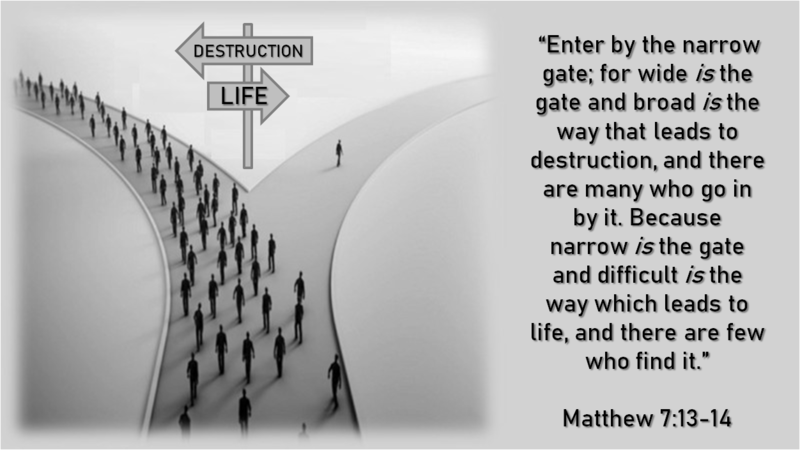
13-14 “Don’t look for shortcuts to God. The market is flooded with surefire, easygoing formulas for a successful life that can be practiced in your spare time. Don’t fall for that stuff, even though crowds of people do. The way to life—to God!—is vigorous and requires total attention.
The Word of God for the Children of God.
Adeste Fidelis! Venite Adoremus! Dominum
Gloria! In Excelsis Deo! Alleluia! Alleluia! Alleluia! Amen.
When given the chance, I will argue to no end that much of life’s success boils down to one simple maxim: do the real thing and stop doing fake alternatives.
DOING THE “REAL THINGS” NOT THE “FAKE ALTERNATIVES”
Knowing the “differences” always begins by our daring to ask ourselves:
“How would I do this, if doing it well and good were all that mattered?”
“How would I do this, if convenience made all the difference in doing it well?”
“How would I do this, if I had all the time in the world to draft the best plan?”
“How would I do this, if I had a matter of a few hours to draft the best plan?”
“How would I do this, if this situation was life or death and I need a plan now?”
Do I still do the absolute best that I can or do I start looking for “shortcuts”?
Do I throw all caution into the tornadic whirlwinds of inconceivable change?
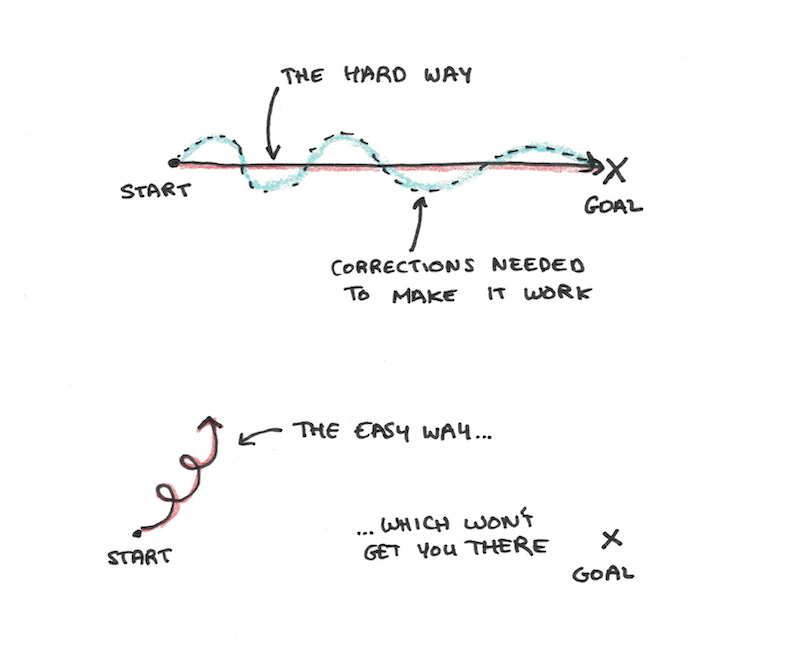
The Easy Way or The Hard Way?
The High Road or the Low Road?
The Paved Road over the Mountains or the Rained out, Rutted out Dirt Path?
Which will get me to the place I want to be? I need to be? – with the least risk?
How desirous, am I to going all out to get there, risking life, limb and liberty?
Which will get me to the one single place which Jehovah God requires me to be?
My asking each of us these poignant questions this soon in the New Year ….
Now, in answering them, you might object: “You don’t have enough time. You have two jobs, kids and responsibilities – Doing it well sounds too daunting.”
This is okay.
The point of this thought experiment is not to deny that obstacles to living into the Christian life under the all watchful eyes and presence of God do fully exist.
Rather it is an effort to open your eyes, in this moment, to begin thinking about how connected to God or distracted from God, to stop and consider the road you are on, the road you need to be on, the road which Jehovah God requires of you.
Rather, it’s to start with the best plan and make accommodations as needed.
The “Christian life” never remains an easy one.
The “Christian life” is never going to stop happening.
Sometimes, our “Christian life” is absolutely going to spiral out of our control.
Apathy and Complacency become a threat, what results is usually much closer to not the ideal than if you simply start with something that feels easy enough.
The Good News is this:
JEHOVAH GOD IS ALWAYS IN CONTROL!
As we seek out our God, as we meditate daily (do we meditate daily?) about our immersing ourselves in our life journey with Jesus, the Way, I so fervently pray that we find that Rabbi Jesus offers to each of us lots of helpful guidelines for us.
Our Scripture for today from Matthew 7:13-14, comes at the end of his “Sermon on the Mount,” which is like a guidebook for everyday living in God’s kingdom.
Sometimes this style of living is called “the Christian counter-culture.”
That’s because the God-honoring lifestyle of following Jesus often goes against popular opinion – In other words, reality check – we take the road less traveled.
Taking the narrow road doesn’t mean we are narrow-minded or we just prefer to go against what “everyone else is doing.”
It means, simply, we do what we do because God calls us to do what is right.
Jesus indicates that many people want to follow an “anything goes” lifestyle.
But in that kind of world people tend to be selfish, uninhibited, putting their own desires ahead of everything else, and lots of other people will get hurt.
Eventually that kind of life leads to self-destruction, so, in the end, it hurts the selfish individual too.
How many lives, marriages, families, communities, and societies have been harmed, even destroyed because people have insisted on going their own way?
Rabbi Jesus calls us to choose which way we will walk
…..“the seldom taken high risk, straight and narrow gate … that leads to life.”
….”the easiest path with least amount of risk and the least level of resistance” which will inevitably lead us down the pathway to our inevitable destruction.
In John 10:7 he calls himself “the gate.”
He alone opens the way to life—now and for eternity!
“Outside” the Presence of Jehovah God ….
FIRST:
Ask yourself the easy, easier and the easiest questions.
Ask yourself the hard, harder and hardest questions.
THEN ULTIMATELY – IN THE PRESENCE OF JEHOVAH GOD ….
Ask yourself the “easy, easier and the easiest” questions.
Ask yourself the hard, harder and hardest” questions.
Now contemplate ….
Choose this day where your heart and soul genuinely rest ….
Self …. Now you’ve got my feet on the life path, all radiant from the shining of your face. Ever since you took my hand, I’m on the right way.
Jehovah God …. Now you’ve got my feet on the life path, all radiant from the shining of your face. Ever since you took my hand, I’m on the right way.
WALK ON THE PATH THAT SERVES YOU BEST!
In the name of God, the Father and God the Son and God the Holy Spirit,
Let us Pray,
Most Merciful God, You are invisible to us, Your salvation is opaque to us, and Your grace is an enduring mystery. Who is it who can actually plumb the depths of Your wonders? Who has seen Your face and yet lived? Lord, let me comprehend You. Help me to understand the astonishing depths of Your love and grace. Forgive us, Lord, for wanting to go our own “easy, easier, an easiest” way. Have your way with us; mold us and remake us, guiding us to do what is right in all we do. Help me to continue to grow up into this infinite affection, that I may walk upon Your pathway to life, that I may serve you and your neighbors more, and become “more” pleasing to You. Amen.
Adeste Fidelis! Venite Adoremus! Dominum
Gloria! In Excelsis Deo! Alleluia! Alleluia! Alleluia! Amen.
13 “Enter through the narrow gate. For the gate is wide and the road is broad that leads to destruction, and there are many who go through it. 14 How narrow is the gate and difficult the road that leads to life, and only a few find it.
The Word of God for the Children of God.
Adeste Fidelis! Venite Adoremus! Dominum
Gloria! In Excelsis Deo! Alleluia! Alleluia! Alleluia! Amen.
To a newspaper inquiry asking what is wrong with the world, the writer and philosopher and Christian Apologist and Literary Critic, G. K. Chesterton sent back the shortest letter the editor had ever received:
Dear Sir, Regarding your article “What’s wrong with the world?”—I am. Yours truly, G. K. Chesterton
This demonstrates a humility that is lacking in most people.
Frankly, most of us would much rather note to the utmost detail someone else’s shortcomings rather than their own.
However, it is worth a minute or two of our attention to note the first step to transformation is for us to discover our own faults and face up to our sins.
Rather than denying our failures and getting too defensive about the foolish choices we’ve made, we must admit we have wandered from God’s pathway.
The road to God is narrow.
The way of heaven is straight.
I have learned this from reading, studying and praying over and through the Word of God and from personal experience, as well as from divine revelations.
It is literally a straight and narrow path.
It is straighter, narrower, and more difficult than most Christians realize.
Let’s look at what the Scriptures say about this topic.
Straight is Jehovah God’s Divine Order
As it is written in the book of the words of Isaiah the prophet: “A voice of one calling in the wilderness, ‘Prepare the way for the Lord, make straight paths for him. Every valley shall be filled in, every mountain and hill made low. The crooked roads shall become straight, the rough ways smooth.'” (Luke 3:4-5)
“They have left the straight way and wandered off to follow the way of Balaam son of Bezer, who loved the wages of wickedness.” (2 Peter 2:15)
“Who have left the straight paths to walk in dark ways,” (Proverbs 2:13)
“I instruct you in the way of wisdom and lead you along straight paths.” (Proverbs 4:11).
“He led them by a straight way to a city where they could settle.” (Psalm 107:7).
“In all your ways submit to him, and he will make your paths straight.” (Proverbs 3:6).
“Whoever has understanding keeps a straight course.” (Proverbs 15:21b).
“Do not turn to the right or the left; keep your foot from evil.” (Proverbs 4:27; cf., Joshua 1:7).
The apostle Paul said the ways of the Lord are straight (Acts 13:10).
The Scripture says, “Trust in the LORD with all your heart And do not lean on your own understanding. In all your ways acknowledge Him, And He will make your paths straight.” (Proverbs 3:5-6).
Also see the following Scriptures in the NASB version: Deuteronomy 32:5; Psalm 5:8. Psalm 18:26; 125:5; Proverbs. 2:15; 3:5-6; 8:9; 17:20; 21:8; 28:6, 18; Isaiah 40:3, 59:8; Ecclesiastes 7:13, Jeremiah 31:9, Ezekiel 1:9,12; 10:22; 46:9; Philippians 2:15.
Narrow is Jehovah God’s Divine Order
Rabbi Jesus said, “Enter through the narrow gate. For wide is the gate and broad is the road that leads to destruction, and many enter through it. But small is the gate and narrow the road that leads to life, and only a few find it.” (Matthew 7:13-14).
He said this at the end of His sermon on the mount, which summarizes the content of that sermon recorded in Matthew 5-7.
In that sermon, He taught that something you say can put you in danger of the fire of hell (Matthew 5:22).
The sin of adultery can be committed in your heart without even having physical contact with the other person (Matthew 5:28).
He taught the need for radical obedience to God at all costs (Matthew 5:29-30).
Indeed, it is not only our outward actions that must be perfect, but also our thoughts, motives, and words (Matthew 5:48).
As much as possible for any person, self must be denied, the body kept under subjection, corruptions put to death; temptations must be resisted on a daily basis; duties must be carried out that are against our natural tendencies.
We must wrestle, with ourselves, against cultural and worldly ways which morally and ethically distract us from God, we must watch in everything, and walk with care and prudence, wary of that which would endanger our souls.
We must change and transform our attitudes and perceptions of how life works to pass through our many trials and tribulations (John 16:33; 1 Peter 4:12-19).
Radically new attitudes, thoughts and perceptions and new ways of addressing how we approach living life in the presence of God come to the forefront of life.
Fruits of the Holy Spirit
22 For we know that the whole creation has been moaning together as in the pains of childbirth until now. 23 And not only this, but we too, who have the first fruits of the Spirit [a joyful indication of the blessings to come], even we groan inwardly, as we wait eagerly for [the sign of] our adoption as sons—the redemption and transformation of our body [at the resurrection]. 24 For in this hope we were saved [by faith]. But hope [the object of] which is seen is not hope. For who hopes for what he already sees?(Romans 8:22-24Amplified)
16 But I say, walk habitually in the [Holy] Spirit [seek Him and be responsive to His guidance], and then you will certainly not carry out the desire of the [a] sinful nature [which responds impulsively without regard for God and His precepts]. 17 For the sinful nature has its desire which is opposed to the Spirit, and the [desire of the] Spirit opposes the [b]sinful nature; for these [two, the sinful nature and the Spirit] are in direct opposition to each other [continually in conflict], so that you [as believers] do not [always] do whatever [good things] you want to do. 18 But if you are guided and led by the Spirit, you are not subject to the Law. 19 Now the practices of the [c] sinful nature are clearly evident: they are sexual immorality, impurity, sensuality (total irresponsibility, lack of self-control), 20 [d]idolatry, [e]sorcery, hostility, strife, jealousy, fits of anger, disputes, dissensions, factions [that promote heresies], 21 envy, drunkenness, riotous behavior, and other things like these. I warn you beforehand, just as I did previously, that those who practice such things will not inherit the kingdom of God. 22 But the fruit of the Spirit [the result of His presence within us] is love [unselfish concern for others], joy, [inner] peace, patience [not the ability to wait, but how we act while waiting], kindness, goodness, faithfulness, 23 gentleness, self-control. Against such things there is no law. 24 And those who belong to Christ Jesus have crucified the [f]sinful nature together with its passions and appetites. (Galatians 5:16-24 Amplified)
We must go through many hardships to enter the kingdom of God (Acts 14:22).
We must learn and practice and weave God into our life, discipline ourselves to more fully rely upon God, the Father and God the Son and God the Holy Spirit.
This is definitely not the way that the majority of the “self reliant” people go.
Most people go through the wide gate and take the broad road that leads to destruction.
But only a few seek, find, the small gate and the narrow road that leads to life.
All too many are going to their destruction, but only a few are going to heaven.
He also said, “Make every effort to enter through the narrow door, because many, I tell you, will try to enter and will not be able to.” (Lk 13:24).
If many try and are unable to enter through this narrow door, then it must be very narrow.
It’s difficult to find and difficult to get through, so every effort must be made to do so.
It’s hard but not impossible by God’s grace if we strive.
We will not be able to enter if you are complacent or half-hearted, because there are many Sins that will keep you and me from Heaven.
The devil has set many traps for you to try and capture you into hell.
We must avoid all the side roads.
It’s easy to be lured away from the straight path by the ways of seductive materialism, pride, and sensual satisfaction.
To avoid these and more, we have to name sin for what it is and not allow its evil influence to sidetrack us.
A relatively recent hymn based on Psalm 23 offers divine encouragement:
1 The Lord my shepherd rules my life
and gives me all I need;
he leads me by refreshing streams,
in pastures green I feed.
2 The Lord revives my failing strength,
he makes my joy complete;
and in right paths, for his name's sake,
he guides my faltering feet.
How Jehovah God Brings it All Together For Our Sakes
Alive, we are constantly and continuously staring at an upcoming crossroads.
Alive, we are constantly and continuously confronted by “forks” in our paths.
The Scriptures clearly teach that in everything the straight way is God’s way.
Indeed, the way to heaven is both straight and narrow.
In fact, it is more so than even either you and I actually think it is.
But even one second, one minute, hour in heaven will make it all worthwhile.
Therefore, we must study and pray and strive to enter the Kingdom of God on the way of righteousness, holiness, and truth.
It’s long past the divinely allowable time we cease from standing in the broad and crooked path of sinners, and going along with the crowd.
It’s high time we consecrate ourselves to our Savior Jesus, and follow Him with pure and simple devotion (2 Corinthians 11:3).
Continuously Seek Him earnestly (Psalm 63:1), stay close to Him (Psalm 63:8).
Let neither our Hearts nor our Souls be Troubled this day nor any other day;
Cling to God! All you His people, let’s Pray for the Ancient Paths once again.
In the name of God, the Father and God the Son and God the Holy Spirit,
Let us Pray …. (Psalm 40 the Message)
40 1-3 I waited and waited and waited for God. At last he looked; finally he listened. He lifted me out of the ditch, pulled me from deep mud. He stood me up on a solid rock to make sure I wouldn’t slip. He taught me how to sing the latest God-song, a praise-song to our God. More and more people are seeing this: they enter the mystery, abandoning themselves to God.
4-5 Blessed are you who give yourselves over to God, turn your backs on the world’s “sure thing,” ignore what the world worships; The world’s a huge stockpile of God-wonders and God-thoughts. Nothing and no one compares to you! I start talking about you, telling what I know, and quickly run out of words. Neither numbers nor words account for you.
6 Doing something for you, bringing something to you— that’s not what you’re after. Being religious, acting pious— that’s not what you’re asking for. You’ve opened my ears so I can listen.
7-8 So I answered, “I’m coming. I read in your letter what you wrote about me, And I’m coming to the party you’re throwing for me.” That’s when God’s Word entered my life, became part of my very being.
9-10 I’ve preached you to the whole congregation, I’ve kept back nothing, God—you know that. I didn’t keep the news of your ways a secret, didn’t keep it to myself. I told it all, how dependable you are, how thorough. I didn’t hold back pieces of love and truth For myself alone. I told it all, let the congregation know the whole story.
11-12 Now God, don’t hold out on me, don’t hold back your passion. Your love and truth are all that keeps me together. When troubles ganged up on me, a mob of sins past counting, I was so swamped by guilt I couldn’t see my way clear. More guilt in my heart than hair on my head, so heavy the guilt that my heart gave out.
13-15 Soften up, God, and intervene; hurry and get me some help, So those who are trying to kidnap my soul will be embarrassed and lose face, So anyone who gets a kick out of making me miserable will be heckled and disgraced, So those who pray for my ruin will be booed and jeered without mercy.
16-17 But all who are hunting for you— oh, let them sing and be happy. Let those who know what you’re all about tell the world you’re great and not quitting. And me? I’m a mess. I’m nothing and have nothing: make something of me. You can do it; you’ve got what it takes— but God, don’t put it off.
Adeste Fidelis! Venite Adoremus! Dominum
Gloria! In Excelsis Deo! Alleluia! Alleluia! Alleluia! Amen.
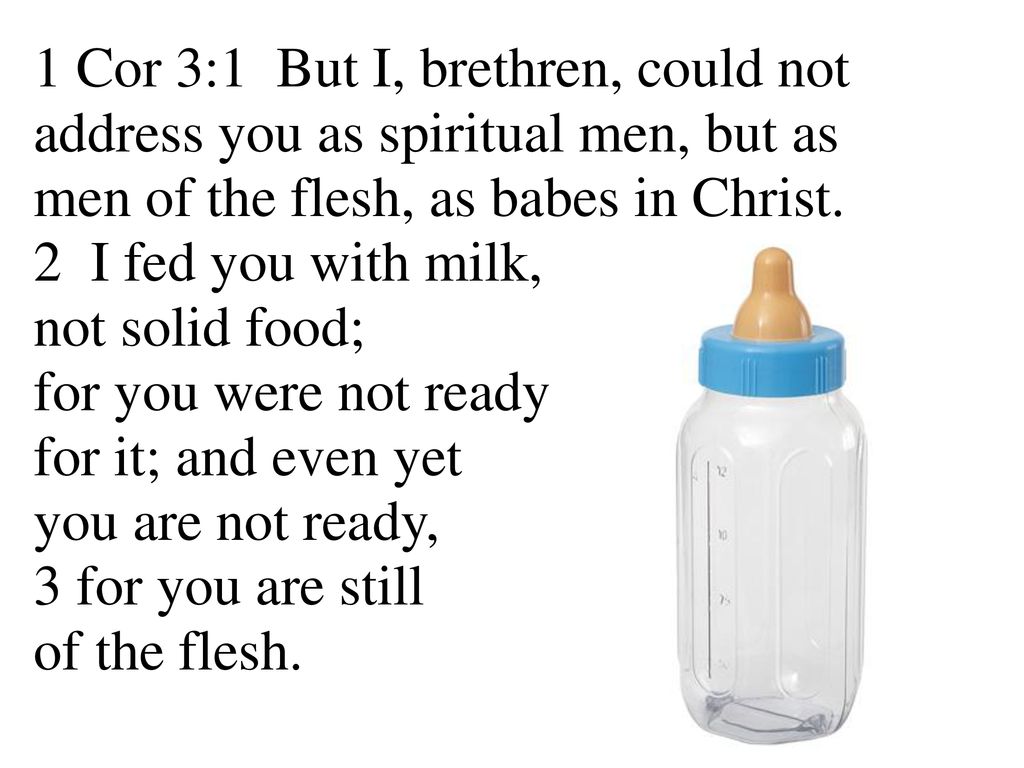
3 However, brothers and sisters, I could not talk to you as to spiritual people, but [only] as to [a]worldly people [dominated by human nature], mere infants [in the new life] in Christ! 2 I fed you with milk, not solid food; for you were not yet able to receive it. Even now you are still not ready. 3 You are still [b] worldly [controlled by ordinary impulses, the sinful capacity]. For as long as there is jealousy and strife and discord among you, are you not [c]unspiritual, and are you not walking like ordinary men [unchanged by faith]? 4 For when one of you says, “I am [a disciple] of Paul,” and another, “I am [a disciple] of Apollos,” are you not [proving yourselves unchanged, just] ordinary people?
The Word of God for the Children of God.
Adeste Fidelis! Venite Adoremus! Dominum
Gloria! In Excelsis Deo! Alleluia! Alleluia! Alleluia! Amen.
The Bible describes new believers as feeding on “milk.”
We need to come to a point where we are no longer “spiritual babies” but mature into “spiritual adults.”
The most important reason is for our lives to reflect the nature of Jesus Christ.
Spiritual maturity is something that should be a priority for every Christian. It’s important in our lives for how we serve God, interact with other people, and take care of our families.
As we get into our topic, I invite you to take a moment to ask the Holy Spirit to open your understanding of His word and will. It is the Holy Spirit that reveals the word of God to us.
What Is Spiritual Maturity According to the Bible?
Many people claim to be Christians, but there is a difference between being a fan of Jesus and a follower of Jesus.
Our measure of spiritual maturity can define what side of the fence we are on.
To be a follower of Jesus is to deny yourself, take up your cross, and follow him.
“Then he called the crowd to him along with his disciples and said: ‘Whoever wants to be my disciple must deny themselves and take up their cross and follow me’” (Mark 8:34).
The Gospel of Luke gives us an even more specific reference by saying we must do so on a daily basis.
23 And He was saying to them all, “If anyone wishes to follow Me [as My disciple], he must deny himself [set aside selfish interests], and take up his cross daily [expressing a willingness to endure whatever may come] and follow Me [believing in Me, conforming to My example in living and, if need be, suffering or perhaps dying because of faith in Me]. (Luke 9:23)
And the Gospel of Matthew adds statement to this discussion ….
48 You, therefore, will be perfect [growing into spiritual maturity both in mind and character, actively integrating godly values into your daily life], as your heavenly Father is perfect. Matthew 5:48
The Gospel of Matthew raises the standard even higher by telling us to what exacting measure we are expected to devote the entirety of our lives – Utterly!
Discipleship Is Costly
24 Then Jesus said to His disciples, “If anyone wishes to follow Me [as My disciple], he must deny himself [set aside selfish interests], and take up his cross [expressing a willingness to endure whatever may come] and follow Me [believing in Me, conforming to My example in living and, if need be, suffering or perhaps dying because of faith in Me].(Matthew 16:24)
Let’s take a moment to reflect on the past.
Do you remember where the Lord met you?
More than likely, he met you in your mess.
God is so good that he pushes beyond the barriers of the world’s rejection to meet his lost sheep wherever and whenever and why ever they may be there.
Here is one thing we must resolve to try harder to understand infinitely better.
Though God meets us in our mess and accepts us as we are, he does not want us to stay that way.
Therefore let us move beyond the elementary teachings about Christ and be taken forward to maturity, not laying again the foundation of repentance from acts that lead to death, and of faith in God (Hebrews 6:1).
God’s plan is for us to move beyond the elementary teachings and to grow more and more into the image of Jesus Christ.
This is what spiritual maturity is — for all our characteristics to be more like Jesus in every way.
Why Is Spiritual Maturity Important?
The Bible describes new believers as feeding on “milk.”
We need to come to a point where we are no longer “spiritual babies” but mature into “spiritual adults” (1 Corinthians 3:2).
We need to grow into eating “solid food” and not only feed ourselves but feed others as well.
The most important reason to mature would be for our lives to reflect the nature of Jesus Christ.
There are also many other reasons for maturing such as:
Being able to lead our families like Jesus
Disciple other believers
Being equipped for every good work
To see the kingdom of God
Do you know, Oh Christian, you’re a sermon in shoes? Do you know, Oh Christian, you’re a sermon in shoes? Jesus calls upon you, to spread the gospel news, (1) So walk it, and talk it, a sermon in shoes. (2) Live it, and give it, a sermon in shoes. (3) Teach it, and preach it, a sermon in shoes. (4) Know it, and show it, a sermon in shoes. (Ruth Harms Calkin)
What Else Does the Word of God Reveal?
Submit to one another out of reverence for Christ. Wives, submit yourselves to your own husbands as you do to the Lord. For the husband is the head of the wife as Christ is the head of the church, his body, of which he is the Savior. Now as the church submits to Christ, so also wives should submit to their husbands in everything. Husbands, love your wives, just as Christ loved the church and gave himself up for her (Ephesians 5:21-25).
Only a person who is constantly maturing, being constantly matured by God can effectively lead and serve the family in this way.
Therefore go and make disciples of all nations, baptizing them in the name of the Father and of the Son and of the Holy Spirit, and teaching them to obey everything I have commanded you. And surely I am with you always, to the very end of the age” (Matthew 28:16-20).
So that the servant of God may be thoroughly equipped for every good work (2 Timothy 3:17).
To be equipped for every good work and make disciples, we need to have more knowledge of God’s Word, how to apply it and teach it.
This is something that an only come as a result of our growing in the Lord.
Jesus replied, “Very truly I tell you, no one can see the kingdom of God unless they are born again” (John 3:3).
Spiritual maturity is an expected result when we are born again.
Spiritual Maturity is ever so critically important for edifying the Kingdom of God because we are not called to remain the same sinful person we once were.
If we compare this scripture along with Mark 8:34 from earlier, we will see that in order for us to see the kingdom of God, we will need to do two things:
Be born again and carry our cross, utterly completely, daily and to follow Jesus.
What this combination does is lead us into a new Christ-centered life.
When you are born again, the Holy Spirit makes his dwelling in you and changes you to be more like Jesus.
It is a process known as regeneration.
The Holy Spirit is removing the residue of the world and sin and making you new in Christ.
Carrying our cross as the Word of God expects, to follow Jesus is putting away the whole of our old self with its host of sinful desires, to being obedient to him.
Spiritual maturity places greater and greater importance on our living holy.
It is important to maintain this lifestyle because Jesus says without being born again, we will not see the kingdom of God.
This is the beginning of spiritual maturity.
Our maturity is a reflection of our relationship with God.
But the fruit of the Spirit is love, joy, peace, forbearance, kindness, goodness, faithfulness, gentleness and self-control. Against such things there is no law (Galatians 5:22-23).
If we are not maturing in our relationship with God, we cannot bear fruit of the Spirit.
Our maturity also helps us grow in wisdom, knowledge, and understanding.
The wise in heart are called discerning, and gracious words promote instruction (Proverbs 16:21).
How to Achieve Spiritual Maturity
I want to leave you with steps you can take to mature spiritually.
These very steps will guarantee spiritual growth when diligently applied.
First, we must build a life of prayer and worship.
Intimacy is what God is looking for and this is how the Holy Spirit will fill you.
“Look to the Lord and his strength; seek his face always” (1 Chronicles 16:11).
We also must be reading our Bibles and applying it to our everyday lives.
Do not merely listen to the word, and so deceive yourselves. Do what it says. Anyone who listens to the word but does not do what it says is like someone who looks at his face in a mirror and, after looking at himself, goes away and immediately forgets what he looks like. But whoever looks intently into the perfect law that gives freedom, and continues in it — not forgetting what they have heard, but doing it—they will be blessed in what they do (James 1:22-25).
Last, we need to also congregate with a spirit-filled church family.
And let us consider how we may spur one another on toward love and good deeds, not giving up meeting together, as some are in the habit of doing, but encouraging one another — and all the more as you see the Day approaching (Hebrews 10:24-25).
Growing spiritually requires growing in prayer, worship, and knowledge of the Bible.
Most importantly, to mature spiritually means to grow in faith and repentance.
I want to make it a point that spiritual maturity is a process.
The grace of the Lord Jesus allows us to grow in our faith and the more we do, the more we will look like Jesus.
Turn your eyes upon Jesus Look full in his wonderful face And the things of earth will grow strangely dim In the light of his glory and grace ….
In the name of God, the Father and God the Son and God the Holy Spirit,
Let us Pray,
Jesus, Perfecter of my Faith, my only Savior, You have taught us through Your Apostle Paul that we should leave childish things behind us, and look to You to move forward to a greater understanding of spiritual matters. Part of maturity is learning when to do this, and acting upon the motivation to press forward. Help me to recognize when it is time for me to grow up. Allow me to take on new spiritual challenges, that I may be ever more refined through service to You and my neighbor. In Your precious name.
Adeste Fidelis! Venite Adoremus! Dominum
Gloria! In Excelsis Deo! Alleluia! Alleluia! Alleluia! Amen.
3 However, brothers and sisters, I could not talk to you as to spiritual people, but [only] as to [a]worldly people [dominated by human nature], mere infants [in the new life] in Christ! 2 I fed you with milk, not solid food; for you were not yet able to receive it. Even now you are still not ready. 3 You are still [b]worldly [controlled by ordinary impulses, the sinful capacity]. For as long as there is jealousy and strife and discord among you, are you not [c]unspiritual, and are you not walking like ordinary men [unchanged by faith]? 4 For when one of you says, “I am [a disciple] of Paul,” and another, “I am [a disciple] of Apollos,” are you not [proving yourselves unchanged, just] ordinary people?
The Word of God for the Children of God.
Adeste Fidelis! Venite Adoremus! Dominum
Gloria! In Excelsis Deo! Alleluia! Alleluia! Alleluia! Amen.
I remember very vividly those moments in my young life when Mama standing in front of me, her hands poised on her hips, her eyes glaring with hot coals of fire and saying in no nonsense tones, “Just what is the big idea, young man?”
Instinctively I definitely knew that my mother was not asking me an abstract question about any theory outside of her own regarding right versus wrong.
Her question was not a question at all—it was a thinly veiled, soul piercing, “wait until your father gets home” accusation.
Her words were easily translated to mean,
“Why are you doing what you are doing?”
She was challenging me to justify my behavior with a valid idea.
Obviously, I had none – and knew better than to even try and offer one.
Some years ago, several “friends” asked myself and a whole “likeminded” group of “interested Christian’s” – in all earnestness – essentially the exact same question with the same exact intensity and purpose of the stare.
It was just the beginning of the New Year ….
They asked, “What’s the big idea of the Christian life anyway?”
They were interested in the overarching, ultimate goal of the Christian life.
To answer his question,
In my lay person’s mind, several thoughts came to the forefront as I just “watched” this group of people espouse their individual thoughts and those of their friends and their Pastors.
I fell back onto the theologian’s prerogative and gave them a Latin term I had just encountered, but not yet began to understand, in my own personal studies.
I said, to myself and to “them” as I read the Facebook conversation unfold:
From my own “youthful” Christian experience, I commented back to them;
“The big idea of the Christian life is Coram Deo – Life in our Savior Christ Jesus.
Coram Deo captures the essence of the Christian life.”
It was not long before that group of “like-minded Christians” had me banned entirely from commenting or posting any further – clearly, I got someone mad.
Clearly, I got a whole bunch of somebodies mad, offended a whole lot of souls.
In all likelihood, I offended people with what they perceived as “my hypocrisy.”
Clearly they were not going to give me any chance of redemption, were not the least bit interested in offering me mercy or forgiveness so to God be the Glory!
Over the intervening years of independent study of the scriptures and also the writing of these devotions, and an abundantly fervent effort at my prayer life,
I have since learned more about “Coram Deo”
It is nowhere near a thorough understanding because it is such a broad term.
It will mean different things to different people based on their experiences.
If you are reading this and you have been academically trained, and educated through Seminary or Schools of Theology and also have your degrees and your ordinations in hand – you will obviously have a higher understanding than I do.
Please feel free to enlighten me further on my “understanding” of this matter if my own “uninformed” and “uneducated” efforts at explaining it here fall a bit short.
What I have “discovered” is briefly this ….
This phrase literally refers to something that takes place in the presence of, or before the face of, God.
To live Coram Deo is to live one’s entire life in the presence of God, under the authority of God, to the glory of God.
To live in the presence of God is to understand that whatever we are doing and wherever we are doing it, we are all acting under the all judging gaze of God.
God is omnipresent.
There is no place so remote, so invisible to the naked eye of human kind, that we can escape His penetrating gaze. (Psalm 139:1-13)
To be aware of the presence of God is also to be acutely aware of His complete sovereignty.
The uniform experience of the saints is to recognize that if God is God, then He is indeed sovereign.
When Saul was suddenly confronted by the full refulgent glory of the risen Christ on the road to Damascus, his immediate question, “Who Are You, Lord?”
He wasn’t the least bit sure who was suddenly speaking to him, but he knew that whomever it was, was abundantly and certainly far sovereign over him.
Our Living under divine sovereignty involves more than a reluctant submission to sheer sovereignty which is suddenly motivated out of a fear of punishment.
It involves recognizing that there is no higher goal than offering honor to God.
Our lives, in that very instant of being in the Presence of our Savior are to be, become living sacrifices, oblations offered in a spirit of adoration and gratitude.
To live all of life Coram Deo is to live a life of integrity.
It is a life of wholeness that finds its unity and coherency in the majesty of God.
A fragmented life is a life of disintegration.
It is marked by inconsistency, disharmony, division, divisiveness, disunity, confusion, conflict, contradiction, spiritual immaturity, hypocrisy and chaos.
The Christian who compartmentalizes his or her life into two sections of the religious and the nonreligious has failed to grasp the big idea.
The big idea is that either all of our life is religious or none of life is religious.
To divide life between the religious and the nonreligious is itself a sacrilege.
I believe this means that if a person fulfills his or her vocation as a steelmaker, attorney, or laborer or homemaker Coram Deo, then that person is acting every bit as religiously as a soul-winning evangelist who lives to fulfill his vocation.
It means that David was as religious when he obeyed God’s call to be a shepherd and Warrior as he was when he was anointed with the special grace of kingship.
It means that Jesus was every bit as religious when He worked in His father’s carpenter shop, ministered to people, as He was in the Garden of Gethsemane.
There is much truth in our making the statement that integrity and maturity is found where men and women try to live their lives in a pattern of consistency.
It is a pattern that functions the same basic way in church and out of church.
It is a life that is open before God.
It is a life in which all that is done is done as “unto the Lord.”
It is a life lived by principle, not personality or expediency; by humility before God, obedience to the covenant precepts of God not prideful, blatant defiance.
A life lived under the tutelage of conscience, imprisoned by the Word of God.
Coram Deo. . . before the face of God. That’s the big idea. Next to this idea our other goals and ambitions become mere trifles.
Life lived fully, completely, abundantly in the presence of Savior Jesus Christ!
We are each “Sermons in Our Shoes” ….
Do you know, Oh Christian, you’re a sermon in shoes? Do you know, Oh Christian, you’re a sermon in shoes? Jesus calls upon you, to spread the gospel news, (1) So walk it, and talk it, a sermon in shoes. (2) Live it, and give it, a sermon in shoes. (3) Teach it, and preach it, a sermon in shoes. (4) Know it, and show it, a sermon in shoes. (Ruth Harms Calkin)
A “Coram Deo” reminder courtesy of the Holy Spirit, that where ever a Christian walks, whenever he or she talks, is expected to share the Gospel news to others.
Whether it be by one’s actions, attitudes, or personal testimony,
Coram Deo – by their baptism, a Christian is always “A Sermon In Shoes.”
Again and again as it is necessary in our immaturity to repeat it It goes along with something American evangelist Dwight L. Moody (1837-1899) once said:
“The preaching that this world most needs most is the sermons in shoes that are walking and talking with Jesus Christ.”
Coram Deo . . . in the presence and under the max authority of Jehovah God ….
Coram Deo … looking square into His eyes and lived before the face of God.
That’s the big idea.
Next to this idea all of our other goals and ambitions become mere trifles.
So, from within your own life experiences what is your understanding of;
“Coram Deo ….”
Is it what you “thought it was?”
Is it where you believed it was?
Be it RESOLVED then, this is what needs to be addressed to make it RIGHT …
In the name of God, the Father and God the Son and God the Holy Spirit,
Let us Pray,
THE COVENANT PRAYER IN THE WESLEYAN TRADITION ….
“I am no longer my own, but thine. Put me to what thou wilt, rank me with whom thou wilt. Put me to doing, put me to suffering. Let me be employed by thee or laid aside for thee, exalted for thee or brought low for thee. Let me be full, let me be empty. Let me have all things, let me have nothing. I freely and heartily yield all things to thy pleasure and disposal. And now, O glorious and blessed God, Father, Son, and Holy Spirit, thou art mine, and I am thine. So be it. And the covenant which I have made on earth, let it be ratified in heaven. Amen.”
Adeste Fidelis! Venite Adoremus! Dominum
Gloria! In Excelsis Deo! Alleluia! Alleluia! Alleluia! Amen.
1 The beginning of the [facts regarding the] good news of [a]Jesus Christ, the Son of God.
The Word of God for the Children of God. Gloria! In Excelsis Deo! Alleluia! Amen.
We humans love to hear and tell stories.
When our children are young they ask mommy and daddy to read them their bed time stories – they want and desire our presence before they go to sleep.
We tell them, we read to them the same stories which had become our favorite stories which our own parents read to us every night when we were that young.
Sometimes we looked to our Grand Parents to tell us the stories of their youth, when they were the ones who were our age – we love to hear how they grew up.
We love to hear of their experiences, we want to partake of their wisdom, how they had “fun” in their day, what music did they listen to, where did they travel.
Sometimes we go to our Grand Parents first instead of our parents because we have stories we believe in our hearts we cannot or could, should not tell them.
Perhaps we are in a place where we do not trust our parents with our stories.
Telling and Sharing our Stories breaks the monotony of the “ho-hums” and the “hum-drums” of our own thoughts, our excruciatingly boring circumstances.
We tell them at work about bosses who think too much of themselves.
We tell stories to friends who give us feedback with laughter or tears or other stories in return. We tell stories around kitchen tables with families and friends.
The man, Rabbi Jesus entered into the lives of those first century Jews just by quietly walking into the moment, so often without any formal announcement.
What we do not read in the Gospels is this man, this Rabbi Jesus, does not raise his hands, clap his hands loudly together or raise his voice – “Yo! Here I am!”
Subtlety is his hallmark way of introducing himself into the life of the moment.
Matthew 5:1-2Amplified Bible
The Sermon on the Mount; The Beatitudes
5 When Jesus saw the crowds, He went up on the mountain; and when He was seated, His [a]disciples came to Him. 2 Then He began to teach them, saying,…
Jesus “saw the crowds” and without shouting “Hey, everyone, I see you!” he quietly went up the mountain and he quietly sat down, His went to Him absent any verbal summons from their Rabbi’s mouth, then he began to ‘teach’ them.
Luke 4:14-21Amplified Bible
Jesus’ Public Ministry
14 Then Jesus went back to Galilee in the power of the Spirit, and the news about Him spread through the entire region. 15 And He began teaching in their synagogues and was praised and glorified and honored by all.
16 So He came to Nazareth, where He had been brought up; and as was His custom, He entered the synagogue on the Sabbath, and stood up to read. 17 The scroll of the prophet Isaiah was handed to Him. He unrolled the scroll and found the place where it was written,
18 “The Spirit of the Lord is upon Me (the Messiah), Because He has anointed Me to preach the good news to the poor. He has sent Me to announce release (pardon, forgiveness) to the captives, And recovery of sight to the blind, To set free those who are oppressed (downtrodden, bruised, crushed by tragedy), 19 to proclaim the favorable year of the Lord [the day when salvation and the favor of God abound greatly].”
20 Then He rolled up the scroll [having stopped in the middle of the verse], gave it back to the attendant and sat down [to teach]; and the eyes of all those in the synagogue were [attentively] fixed on Him. 21 He began speaking to them: “Today this Scripture has been fulfilled in your hearing and in your presence.”
Coming out of His hardcore, deeply intimate temptation experience, He walked out of the wilderness, full of the Holy Spirit and straight into earthly ministry.
The “news abut him spread throughout the entire region …”
And he ‘began’ teaching in their synagogues …
He returned to his home in Nazareth, where he had been brought up and raised by His parents, His grandparents … heard their stories told and retold to him.
And “as was His custom …” “he entered the synagogue on the Sabbath …” and without him giving their leadership a chance to introduce him as an “Itinerant Rabbi” … he just quietly stood up … and instantly made his presence known.
Without any verbal or unspoken complaints for “being rude,” they handed Him the Scroll of God’s Prophet Isaiah, and without challenging Jesus’ credentials, they permitted him to take authority and full command of the sacred moment.
The man, Rabbi Jesus, without asking or saying “thank you” exercised that full and complete authority “granted (or surrendered) to him and read God’s Word.
John 1:1-5Amplified Bible
The Deity of Jesus Christ
1 In the beginning [before all time] was the Word ([a]Christ), and the Word was with God, and [b]the Word was God Himself. 2 He was [continually existing] in the beginning [co-eternally] with God. 3 All things were made and came into existence through Him; and without Him not even one thing was made that has come into being. 4 In Him was life [and the power to bestow life], and the life was the Light of men. 5 The Light shines on in the [c]darkness, and the darkness did not understand it or overpower it or appropriate it or absorb it [and is unreceptive to it].
We have these words from the Gospel Narrative from John …
“In the Beginning [before all time] ….”
Telling us in no uncertain terms, Jesus is THE WHOLE STORY …. has always been THE WHOLE STORY and Jesus will forever remain THE WHOLE STORY!
We have the relating of these stories from ‘the beginnings’ of the Gospel’s of Matthew and Mark and Luke and John in the hopes we will “enter into them.”
God, the Father and God the Son and God the Holy Spirit place these stories in front of us – in the sure and constant hope – our lives will be changed by entry.
God enters our lives by way of the myriads and myriads of these biblical stories.
We become truly human by taking these Words of Jesus’ stories into our lives.
Author Karen Lee-Thorp aptly remarked, “Most of the Bible consists of stories. Why? Partly because God knew people that like and remember stories better than lists of abstract propositions. And even more important, the stories remind us that all of life is His story, and that God is never an abstract doctrine, but a Person.”
The Narrator Mark begins his gospel account with the story of Jesus, not moral principles or ethical concepts. We enter into life with Jesus by way of the first words of this story, we first find our Jesus in the story of God’s salvation for us.
John the Baptist begins the story by telling us about Jesus.
But John the Baptist is only a part of the preface of this great story that begins quietly but immediately proceeds, is about to not so quietly unfold before us!
So we find that the beginning story quickly moves on to tell about Jesus, the promised Messiah, and his saving message: the good news of God’s kingdom.
Every story about Jesus also helps us recognize our own stories of sin, grace, and blessing. The gospel is the main story, and it shapes the stories of us all.
In the name of God, the Father and God the Son and God the Holy Spirit,
Let us Pray,
God of surprises you call us from the narrowness of our traditions to new ways of being church, from the captivities of our culture to creative witness for justice, from the smallness of our horizons to the bigness of your vision.
Jesus, wounded healer, you call us from preoccupation with our own histories and hurts to daily tasks of peacemaking, from privilege to pilgrimage, from insularity to inclusive community.
Holy, transforming Spirit, you call us from fear to faithfulness, from clutter to clarity, from a desire to control to deeper trust, from the refusal to love to a readiness to risk.
Gloria! In Excelsis Deo! Alleluia! Alleluia! Alleluia! Amen.



 Loving God, Living God, Loving Hope, Living Hope, Loving Living Life His Way! "Many things are possible for the person who has hope. Even more is possible for the person who has faith. And still more is possible for the person who knows how to love. But everything is possible for the person who practices all three virtues." - Brother Lawrence (1605-1691), Practicing the Presence of God (1692).