The Compelling Truth: What is the Importance of Family Devotions? Deuteronomy 6:4-9

Deuteronomy 6:4-9 Amplified Bible

“Hear, O Israel! The Lord is our God, the Lord is one [the only God]! You shall love the Lord your God with all your heart and mind and with all your soul and with all your strength [your entire being]. These words, which I am commanding you today, shall be [written] on your heart and mind. You shall teach them diligently to your [a]children [impressing God’s precepts on their minds and penetrating their hearts with His truths] and shall speak of them when you sit in your house and when you walk on the road and when you lie down and when you get up. And you shall bind them as a sign on your hand (forearm), and they shall be used as [b]bands (frontals, frontlets) on your forehead. You shall write them on the [c]doorposts of your house and on your gates.

The Word of God for the Children of God.

Adeste Fidelis! Venite Adoremus! Dominum.

Gloria! In Excelsis Deo! Alleluia, Alleluia, Alleluia! Amen.

Parents, Grandparents and God’s Children of all ages and walks of and among life, what first comes to our mind when we meditate about “family devotions”?

Does it include regular times set apart for your family read Scripture? Prayer? Worship in song? Formal Bible instruction with age-appropriate resources?

Yes, all these things and quite a few things more characterize family devotions.

And all serve to glorify and honor God and too will definitely come to benefit our children and our families as we instruct them in what is most important.

I don’t think there’s a mandate to be found in sacred Scripture that is more solemn than this one. That we are to teach our children the truth of God’s Word is a sacred, holy responsibility that God gives to His people. And it’s not something that is to be done only one day a week in Sunday school. We can’t abdicate the responsibility to the church. The primary responsibility for the education of children according to Scripture is the family, the parents.

(R. C. Sproul, “The Most Solemn Mandate in the Bible for Parents,” ligonier.org)

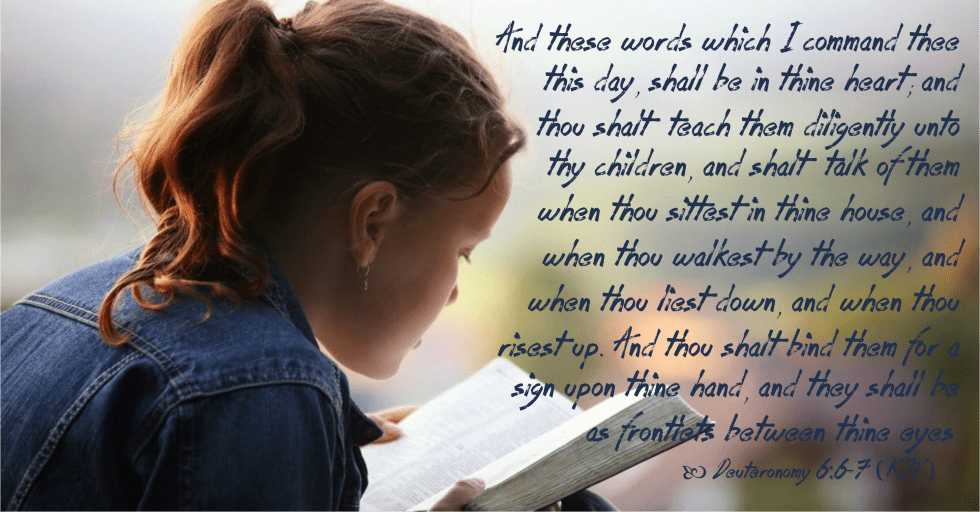
God instructed the nation of Israel in Deuteronomy 6:6–9,

“And these words that I command you today shall be on your heart. You shall teach them diligently to your children, and shall talk of them when you sit in your house, and when you walk by the way, and when you lie down, and when you rise. You shall bind them as a sign on your hand, and they shall be as frontlets between your eyes. You shall write them on the doorposts of your house and on your gates.”

This ancient passage of text makes it abundantly clear that God’s forever intent is for parents to teach their children and each other about God and His ways.

God’s Word should be at the forefront of our lives and the center of our homes.

Thousands of years later, Apostle Paul echoes the importance of these words.

Ephesians 6:4 says, “Fathers, do not provoke your children to anger, but bring them up in the discipline and instruction of the Lord.” One way we teach our children this truth is by coming together as a family to be in God’s Word and praying together.

The wisest of the wise King Solomon: Proverbs 22:6 gives this wisdom: “Train up a child in the way he should go; even when he is old he will not depart from it.”

As parents who love God and who deeply believe and cherish Him, we want to help our, and future generations of children also come to love and believe Him.

Deliberately, Intentionally, Purposefully, our setting aside time for our family devotions each day will show our children that God is the very center of our lives, and spending time with Him is our priority, and we desire to do His will.

We want to show them that it’s okay, God can be the center of their lives, too.

We also want them to be taught, see how God guides them through life in their community, schools, family, and decisions – so they may teach their children.

To raise them up with critically important biblical values that they may one day, as might be needed, to emphasize these values before school board authorities.

Advocate, Communicate, Educate, the highest values of acceptance and sanctity of all life which God indelibly places upon everyone – without any exceptions.

Living, Loving, Moving, Being enveloped in the Word feeds us with everything we need from advice, to wisdom, to morals and ethics and unto His salvation.

It sets us up with a rock solid, sure and certain and steadfast and immovable foundation, a place for all to turn to in times of trials, tribulations, and praise.

Family devotions are a wonderful time for discussions with your children.

As you and your family read through God’s Word together, you can discuss the ways in which it is inescapably relevant to their lives.

For example, some of your discussions might include the ways in which God’s character applies to our understanding of our morals, attitudes and behaviors.

Be sure to not only discuss troublesome behaviors, but positive ones as well.

Your discussions might also include questions about how and why the world works the way it does.

You might just find yourselves talking about your relationships with others and all the ways in which God’s character and His commands help transform those.

These discussions can help your children see that God’s Word is “living and active” (Hebrews 4:12) and “profitable for teaching, for reproof, for correction, and for training in righteousness, that the man of God may be complete, equipped for every good work” (2 Timothy 3:16b–17).

Family devotions help create a firm foundation for your children’s spiritual growth.

In diligently and prudently practicing the spiritual disciplines of reading and studying God’s Word of fellowship and praying together, you help train your children to incorporate and carry these “God” practices with them through life.

You’re also helping them to learn the immeasurable dimensions, the infinite applications of the truth of God’s Word and to come to know, love, Him better.

When we dive into God’s Word, we are teaching our children that God loves and cares about them and us relentlessly.

When we come together to God to pray, to seek Him, we are showing our children we have access to a God who is holy, loving, able to meet our needs.

Our family devotions will likely challenge our faith and contribute infinitely to our spiritual growth as well.

Family devotions also help us meaningfully connect with our children in the midst of a sometimes hectic world.

Taking time to pause to focus on God together is the sweet intimacy of Christian fellowship.

A family time that is deliberately, intentionally, personally, purposely set apart can also serve as a time to honor God and each other, to relate with one another.

As we share our joys and our concerns, our struggles and trials, prayer requests or discuss how God’s Word applies to our lives, we are sharing God in our lives.

Dedicating this time to focus on your children and on God can help strengthen your relationships with your child.

Family devotions do not have to be elaborate.

You can keep them as simple as reading through a passage that pertains to issues you might be facing in your family, to reading through a certain book of the Bible, or purchasing age-appropriate devotional books.

You can include time for worshiping with music if you desire.

Psalm 139:23-24 Amplified Bible

23 
Search me [thoroughly], O God, and know my heart;
Test me and know my anxious thoughts;
24 
And see if there is any wicked or hurtful way in me,
And lead me in the everlasting way.

There is no set time-length that family devotions have to last, but you can be assured that you will soon find this experience to be a joyful time together.

At the conclusion of your time together, pray for God’s goodness in your family, any requests of friends and family, and for His abundant guidance in your lives.

Psalm 139:1-18 Amplified Bible

God’s Omnipresence and Omniscience.

To the Chief Musician. A Psalm of David.

139 O Lord, you have searched me [thoroughly] and have known me.

You know when I sit down and when I rise up [my entire life, everything I do];
You understand my thought from afar.

You scrutinize my path and my lying down,
And You are intimately acquainted with all my ways.

Even before there is a word on my tongue [still unspoken],
Behold, O Lord, You know it all.

You have enclosed me behind and before,
And [You have] placed Your hand upon me.

Such [infinite] knowledge is too wonderful for me;
It is too high [above me], I cannot reach it.


Where can I go from Your Spirit?
Or where can I flee from Your presence?

If I ascend to heaven, You are there;
If I make my bed in Sheol (the nether world, the place of the dead), behold, You are there.

If I take the wings of the dawn,
If I dwell in the remotest part of the sea,
10 
Even there Your hand will lead me,
And Your right hand will take hold of me.

11 
If I say, “Surely the darkness will cover me,
And the night will be the only light around me,”

12 
Even the darkness is not dark to You and conceals nothing from You,
But the night shines as bright as the day;
Darkness and light are alike to You.

13 
For You formed my innermost parts;
You knit me [together] in my mother’s womb.

14 
I will give thanks and praise to You, for I am fearfully and wonderfully made;
Wonderful are Your works,
And my soul knows it very well.
15 
My frame was not hidden from You,
When I was being formed in secret,
And intricately and skillfully formed [as if embroidered with many colors] in the depths of the earth.

16 
Your eyes have seen my unformed substance;
And in Your book were all written
The days that were appointed for me,
When as yet there was not one of them [even taking shape].

17 
How precious also are Your thoughts to me, O God!
How vast is the sum of them!
18 
If I could count them, they would outnumber the sand.
When I awake, I am still with You.

Remember to always praise God for His answers to your prayers, too.

Create an environment that is calm, loving, and memorable, one that your children will want to foster, nurture, impress, upon the lives of their children.

“But grow in the grace and knowledge of our Lord and Savior Jesus Christ. To him be the glory both now and to the day of eternity. Amen” (2 Peter 3:18).

Family devotions are a crucial means of declaring, living out family priorities.

By turning to God’s Word and prayer together every day (or most days, at least), we model the uncompromising centrality of these practices in our Christian life.

These daily times together will also prove an important means of our building closeness within our family…

Our devotions call us to a family experience each day.

Hebrews 6:19-20 Amplified Bible

19 This hope [this confident assurance] we have as an anchor of the soul [it cannot slip and it cannot break down under whatever pressure bears upon it]—a safe and steadfast hope that enters within the veil [of the heavenly temple, that most Holy Place in which the very presence of God dwells],20 where Jesus has entered [in advance] as a forerunner for us, having become a High Priest forever according to the order of [a]Melchizedek.

Our time away with God, the Father, Son and Holy Spirit and each other gives expression to this “confident assurance” we have all an anchor for our souls.

We each have our own hopes and dreams we desire to see lived in each other.

And while few of them are remarkably miraculous on their own, it is their gradual and steadfast accumulation which will add up to something special.

And then there is the benefit of building a habit that adds structure and stability to the family’s shared life.

As we have emphasized family devotions, we will gradually find out it becomes a kind of disciplined, organizing structure to the God life we all share together…

Through disciplined family devotions we model our own discipline of personal devotions, for the two closely, inextricably, inescapably, resemble one another.

By relating to the Lord as a family, we teach how to relate to him as individuals.

Growing up in a prayer-filled home is a beautiful and powerful thing.

Parents can pray over their children from the moment they are conceived through adulthood.

Children can learn alongside their parents how to pray to the Lord themselves.

Siblings can pray for and with one another as they resolve conflict and build strong relationships.

Extended family can cover loved ones in prayer through both joyful and challenging seasons.

Families can pray together more often than just before dinner, and it can be a life-changing and spiritually transformative experience that not only brings family members closer to God, but blessedly, ultimately closer to one another! 

It is the kind of disciplined habit, perhaps like eating and praying together, and attending church together, that anchors family to the centrality of Jesus Christ.

In the name of God, the Father and God the Son and God the Holy Spirit,

Let us Pray,

“Let the message of Christ dwell among you richly as you teach and admonish one another with all wisdom through psalms, hymns, and songs from the Spirit, singing to God with gratitude in your hearts. And whatever you do, whether in word or deed, do it all in the name of the Lord Jesus, giving thanks to God the Father through him.” Colossians 3:16-17

Lord, I pray that the message of Christ and his sacrifice is the root of gratitude in my and my family’s heart. That His gracious gift leads me and my family into thankful living, setting a timeless example for the rest of my family and their children. That they will have their own truly abiding relationship with Jesus one day, and that You would grow gratitude in their hearts out of the acceptance of Jesus as their Savior. Lead us to do everything in the name of Jesus and give thanks to You through Him.

Adeste Fidelis! Venite Adoremus! Dominum.

Gloria! In Excelsis Deo! Alleluia, Alleluia, Alleluia, Amen.

https://translate.google.com/

Benefits and Value of God’s Wisdom. Proverbs Chapter 2

Proverbs 2:1-5 English Standard Version

The Value of Wisdom

My son, if you receive my words
    and treasure up my commandments with you,
making your ear attentive to wisdom
    and inclining your heart to understanding;
yes, if you call out for insight
    and raise your voice for understanding,
if you seek it like silver
    and search for it as for hidden treasures,
then you will understand the fear of the Lord
    and find the knowledge of God.

The Word of God for the Children of God.

Adeste Fidelis! Venite Adoremus! Dominum.

Gloria! In Excelsis Deo! Alleluia! Alleluia! Alleluia! Amen.

Wisdom, Knowledge and Happiness

As a boy, Charles Dickens knew poverty from bitter experience.

He never forgot what he had learned.

Many of his novels deal with the huge gap between wealth and poverty.

Perhaps the most unforgettable is A Christmas Carol.

Its main character, Ebenezer Scrooge, is a “grasping, clutching, covetous old sinner” who can squeeze blood out of a stone.

Bob Cratchit, his underpaid bookkeeper, shivers in his unheated corner of the office.

But Bob has learned to be content in his situation.

At the meager Cratchit-family Christmas dinner, Bob proposes a toast: “Merry Christmas to Mr. Scrooge, the founder of the feast!”

Mrs. Cratchit objects with the scornful words about Scrooge, but Bob, in all humility replies mildly, “My dear, it’s Christmas … and for the children!”

For all his poverty, Cratchit has wisdom and happiness.

But Scrooge, for all his wealth, has a bleak and miserable “business sense” life.

Here is something of the complexity and mystery about wealth and poverty.

Most people think and deeply believe that wealth brings happiness.

But that is not always so.

Happiness and contentment can exist in the midst of scarcity.

What’s more, the rich can be righteous, and they can be a blessing to the poor.

And just the opposite is equally true, the righteous poor can be a humble and humbled and humbling blessing to the rich – all one needs is a bit more wisdom.

Knowledge of God, Understanding of God through study of His Word, Faith in God, Wisdom from God and living by his love are the keys to finding happiness.

The “Keys” to “Finding” Happiness

Have you ever had someone try to sell you something? What’s the typical pattern a salesperson uses? First, they tell you all the amazing benefits of their service or product. “Our miracle product…

…will lower cholesterol…”
…will help you burn fat and lose weight…”
…will keep your information safe and secure…”
…will give you better gas mileage…”
…will make you happy and content…”

And then once you’re convinced they show you the price tag…

“For only four payments of $999.99…”
“If you only eat Subway for breakfast, lunch, and dinner every day…”
“If you sign up for our monthly never-ending subscription-based service…”
“Your monthly car payment can be as low as…”
“If you sign your life and soul over we will…”

The typical pattern is—here’s the benefits and then here’s how you get them.

Today, I want to reverse that pattern.

First, I want to tell you how to get wisdom, then I want to tell you its benefits.

This is the pattern our passage takes and I like it because when I finally tell you the benefits of wisdom you’ll be able to weigh in your own mind if it’s worth it.

So first… 

How to get Wisdom

Wisdom is “skill for living”, but living God’s way instead of our own way.

Once again the father-figure in Proverbs is teaching his son (who we can all put ourselves in the place of) how to get wisdom.

He tells him four ways to get wisdom (not four different ways).

You should do them all if you want to get wisdom.

Proverbs 2:1-5New International Version

Moral Benefits of Wisdom

My son, if you accept my words
    and store up my commands within you,
turning your ear to wisdom
    and applying your heart to understanding—
indeed, if you call out for insight
    and cry aloud for understanding,
and if you look for it as for silver
    and search for it as for hidden treasure,
then you will understand the fear of the Lord
    and find the knowledge of God.

The first way to get wisdom we find in verse one.

1. BELIEF IN GOD’S WORD (VERSE 1)

The father-figure says, “My son, if you accept my words and store up my commands within you…”

The author Solomon is talking about a father’s words found in the book of Proverbs, but he’s also talking about God’s whole Word, the Hebrew Scriptures.

The word for commands (mitzvah) can also mean the laws God gave his people Israel (Genesis 26:5; Exodus 26:28).

So it’s like Solomon or the father-figure is saying, “My son, if you want wisdom, believe in God’s Word.” 

Each one of us comes to a turning point in our lives where we have to decide the final rule for our lives.

Is it going to be God’s unchanging perfect words and commands that although they are hard we know they are good, true, and best?

Or are we going to choose our own feelings and intuitions and desires and what the world says is best?

God’s Word offers us a firm-foundation for our lives, a foundation that won’t let us down.

But if we choose anything else we’re choosing something that might say one thing today and a different thing tomorrow.

Eggs are good for you. Eggs are bad for you.

Drink coffee. Coffee is bad for you.

Drink more milk. Drink soy milk. Drink almond milk.

Turn right when we should have turned left or stayed straight and narrow.

Stay with Gasoline Vehicles or “Go Green” with Hybrids and Electric cars.

This career path or that career path

How about with what we understand to be the “serious things” of our lives?

Changing and Shifting winds, sands, and crashing waves “defining” what our “correct” Morals and Ethics are “supposed to be” according to the wisest of the most educated, connected, influential, powerful, wealthy “people” on internet.

How many issues can you think or heard of where 10-20 years ago everyone said one things was seriously averse, now today people say just the opposite?

That is generational shifting sands, that’s stormy waters (James 1:5-8).

How about those who “stay the course on the narrow road” and stay steadfast:

“I only want to build my life on the rock of God’s Word that never changes!” 

Resolving the Ceaseless Conflict between belief and unbelief in Christ the Lord.

Does knowledge and understanding the Word of God for His Children and the outpouring of the anointing oils its blessed wisdom still have any relevance?

First, we get wisdom by believing in God’s Word.

2. MEMORIZATION OF GOD’S WORD (VERSE 1)

We’re still in verse one. What does it mean to “store up” something?

Did any of you prepare for the Y2K bug?

So kids, a long time ago everyone was worried that when the clocks on our computers turned from December 31st 1999 to January 1st 2000 there was going to be a computer meltdown that would cause world food shortages and financial errors—basically, the apocalypse to end all apocalypses.

So prepare people stored up canned food, powdered food, dried food, and water and drinks that would not go bad.

Our single person household bought whole shelves of Kool-Aid powdered drink.

So by golly if the world failed I am still going to have a storehouse of Kool-Aid.

And when Y2K came and no one but Blockbuster video had problems I still had my Kool-Aid powdered drink, for a while it tasted good, then I got tired of it all.

Wisdom ended up throwing most of it out, to this day wisdom will not drink it.

I “stored up” for the long term to avert disaster.

But so much of what I had stored up for the long term spoiled, went to waste.

Likewise, God calls us to “store up” his Word within us to avert disaster in our lives.

How do we do that?

By memorizing themes and passages weaved in and throughout the Bible.

I want to encourage everyone to “store up” God’s Word in our own hearts because God uses it to strengthen us, give us hope, and teach us how to live.

Outline, underline, color mark foundational verses from the bible – what text speaks to your heart and to your soul and to your life at the moment you read it.

Put it on your mirror or fold it over in your Bible, somewhere you will see it and memorize it.

Read, study, pray and memorize other verses too, one’s that will remind you of the never ending relevance, significance of hope and God’s love and promises. 

Second, we get wisdom by memorizing God’s Word. 

3. ACCEPTANCE OF GOD’S WORD (VERSE 2)

Proverbs 2:2 says to turn our ears to wisdom and apply our hearts to understanding.

Do you ever get in a disagreement and the person you are fighting with says, “You’re not listening to me!”

Sometimes that’s true.

One person is not paying attention because they’re too busy talking or thinking.

But usually that means “You’re not agreeing with me.” 

Proverbs 2:2 is saying to get wisdom we need to hear it with our ears and accept it with our hearts and agree to it with our lives.

We need to open ourselves up and let God’s Words and ways sink deep into who we are.

In Hebrew culture the heart was the core of a person, their true identity.

We do not want God’s Word to go in one ear and out the other, but go in through the ear, through the mind, and down deep into our heart.

When I prepare devotionals that’s one of the things I think about.

I want God’s Word to affect me first but then I want it to affect you all too.

We don’t want to just sit here and hear without listing or agreeing.

The absolute significance of God’s Word and truth is too eternally important. 

Third, we get wisdom by accepting God’s Word. 

4. ASK GOD FOR IT THROUGH PRAYER (VERSES 3 AND 4)

This is perhaps the simplest way to get wisdom, ask God for it.

Verse 3 tells us to “call out for insight and cry aloud for understanding” (NIV).

If you and I want wisdom, pray that God will give us some.

Sometimes prayer is the only step we take.

We ask God for wisdom but we don’t try to memorize and understand his Word.

Prayer goes hand and hand with God’s Word.

It’s like peanut butter and jelly or eggs and bacon or it is like fish and chips.

God’s Word and prayer together make a delicious wisdom platter.

If you and I want wisdom, we have to ask God for it. (1 Kings 3:5-15) 

James 1:5 If any of you lacks wisdom, you should ask God, who gives generously to all without finding fault, and it will be given to you. (NIV) 

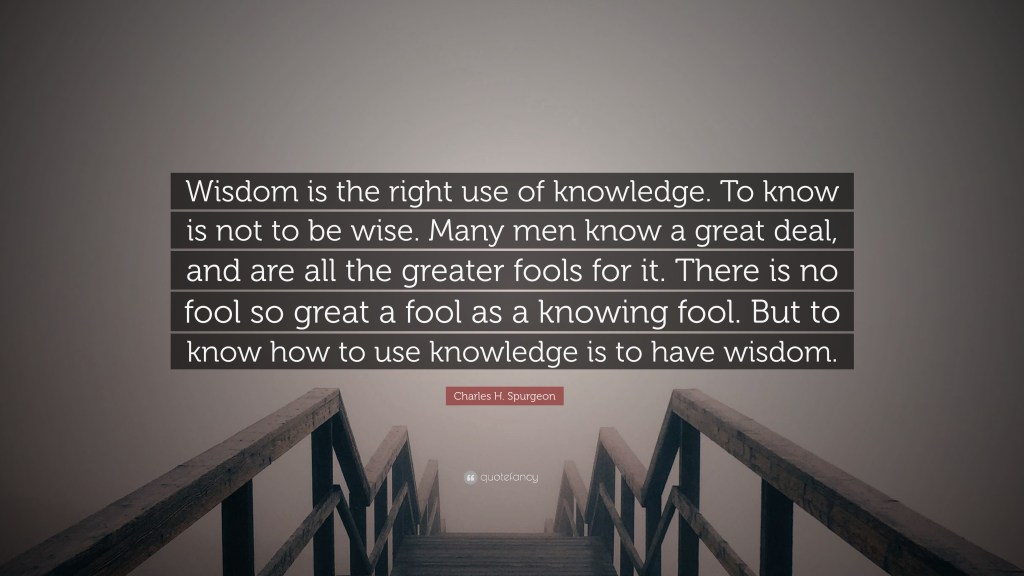
One of the points Spurgeon makes is that wisdom isn’t just knowing how to “be wise ‘enough’ to make the ‘right decisions’,” but wisdom is a character quality molded, shaped, then reshaped by “interpreting” our experiences.

When you and I pray for wisdom it’s not only that we would make the right choice (it is that) but it’s also praying that God would make us into the kind of people who would make the right choice.

It’s praying God would mold, shape, develop and transform our moral and our ethical character so we choose to do we do it with integrity and discernment. 

So how do we get wisdom? 

First, by believing in God’s Word.

Second, by studying and memorizing God’s Word.

Third, by accepting God’s Word,

and fourth, by asking God for wisdom through prayer. 

Now I’ve told you how to get wisdom, but what are the benefits of wisdom?

What makes it worth doing all those things?

What makes it worth signing up for and sitting inside a classroom for?

The Benefits and Value of Wisdom

The point of these things is not just to do them for the sake of doing them, but for the sake of something greater.

Did you ever watch those old Mastercard commercials?

A man and woman walk into a gas station.

As the gas station attendant rings up their purchases he says:

chips: $3
frozen beverage: $2
gas: $31
starting a new life together: priceless… 

But then the woman shakes her head “no” so the gas station attendant tries again.

rekindling a fire that never went out? (she shakes her head again)
satisfying a much-needed slushy fix?… Priceless.

So what’s the priceless things we are seeking by pursuing wisdom?

God himself. 

Proverbs 2:5-6New International Version

then you will understand the fear of the Lord
    and find the knowledge of God.
For the Lord gives wisdom;
    from his mouth come knowledge and understanding.

Verse 5 says if we seek wisdom, “then you will understand the fear of the Lord and find the knowledge of God.”

The fear of the Lord is believing that God’s “threats are real and his promises are true”.

Jesus’ death on the cross and resurrection from the grave shows us that God’s threats are real—that if we don’t deal with our sins he will put us to death—but his promises are real—that if we put our faith and trust in him he will forgive us of our sins and cleanse us from all unrighteousness.

It’s as we come to understand who God is through Christ Jesus that we begin to actually know God.

Do you want to know about God or know God?

You might know a lot of things about your favorite celebrity or professional sports athlete, you might know what movies they’re in or their batting average, but that doesn’t mean you know them.

There’s a simple test for if you know them.

Do they know you?

If I were to walk up to Tom Cruise or Tom Brady and if I were to name drop your name what would they say?

“Oh yeah. I know him!” Or more likely … “I am sorry, Who?” 

Come with me one step further.

If I were to walk up to God and to name drop your name what would he say?

“Oh yes, I know him/her. I love him/her very much … Or “I am sorry, Who?”

We seek wisdom because we’re seeking God.

We want to know him.

But the next verse tells us this is only possible by God’s grace.

Proverbs 2:6 
For the Lord gives wisdom;
from his mouth come knowledge and understanding. (NIV)

We can only know God if we want to acknowledge God, to know us.

We can only acquire wisdom if God wants to give it to us.

It’s both an “as we seek” and an “as he gives” kind of exchange.

We seek to obey and know God and God gives us a relationship with him.

Or put it in the reverse.

God gives us a relationship with him and so we obey and know God. 

What’s the priceless benefit of wisdom? Knowing God himself. 

The benefits just keep growing out of this.

If you know God you are part of the family and God protects you.

Proverbs 2:7-8New International Version

He holds success in store for the upright,
    he is a shield to those whose walk is blameless,
for he guards the course of the just
    and protects the way of his faithful ones.

Benefit and Value of God’s Protection (Verses 7-19)

Proverbs 2:7-19 New International Version

He holds success in store for the upright,
    he is a shield to those whose walk is blameless,
for he guards the course of the just
    and protects the way of his faithful ones.

Then you will understand what is right and just
    and fair—every good path.
10 For wisdom will enter your heart,
    and knowledge will be pleasant to your soul.
11 Discretion will protect you,
    and understanding will guard you.

12 Wisdom will save you from the ways of wicked men,
    from men whose words are perverse,
13 who have left the straight paths
    to walk in dark ways,
14 who delight in doing wrong
    and rejoice in the perverseness of evil,
15 whose paths are crooked
    and who are devious in their ways.

16 Wisdom will save you also from the adulterous woman,
    from the wayward woman with her seductive words,
17 who has left the partner of her youth
    and ignored the covenant she made before God.[a]
18 Surely her house leads down to death
    and her paths to the spirits of the dead.
19 None who go to her return
    or attain the paths of life.

God’s wisdom grants us protection from potential disasters.

I don’t mean natural disasters but rather God’s wisdom protect us from ourselves, from bad things we might do.

God’s wisdom protects us from:

  • Committing injustice (v9-11) – Sinning against others by treating them unfairly. If God gives us his wisdom we will want to treat others with fairness and equity even at cost to ourselves.
  • Wicked men (or women) who love sin (v12-15) – “those who take advantage of others for their own gain.” As God grants us wisdom and character like His we won’t be drawn to them but will learn how to recognize them for who they are.
  • Unfaithful women (or men) who break their marriage promise (v16-19) Verse 16 says that “Wisdom will save you […] from the wayward woman with her seductive words.” (NIV) Sometimes beauty might cause a break in marriage vows but often it is words, words of affirmation and acceptance. It’s a listening ear. Emotional adultery comes before acting it out. God gives us wisdom so we know how to stay away from relationships that lead to this kind of disaster.

But there’s one more benefit to wisdom. 

A FOREVER HOME WITH GOD (VERSES 20 to 22)

Proverbs 2:20-22New International Version

20 Thus you will walk in the ways of the good
    and keep to the paths of the righteous.
21 For the upright will live in the land,
    and the blameless will remain in it;
22 but the wicked will be cut off from the land,
    and the unfaithful will be torn from it.

Proverbs 2:21 says, “For the upright will live in the land, and the blameless will remain in it;” (NIV)

It’s an interesting way to close this passage in Proverbs because it’s a reminder to the Israelite people that they get to stay in the promised land if they obey God and keep his commandments (Exodus 20:1-17). 

But where’s the promise for us?

The benefits of wisdom are knowing God, protection from mistakes in this life, and an eternal home with God in the life to come.

Hebrews says that the heroes of our faith “were longing for a better country—a heavenly one” (Hebrews 11:16).

If that’s you, if you are the one longing for a better home, then pursue wisdom.

Seek God by believing his Word, memorizing it, accepting it, and prayer.

John 14:5-14New International Version

Jesus the Way to the Father

Thomas said to him, “Lord, we don’t know where you are going, so how can we know the way?”

Jesus answered, “I am the way and the truth and the life. No one comes to the Father except through me. If you really know me, you will know[a] my Father as well. From now on, you do know him and have seen him.”

Philip said, “Lord, show us the Father and that will be enough for us.”

Jesus answered: “Don’t you know me, Philip, even after I have been among you such a long time? Anyone who has seen me has seen the Father. How can you say, ‘Show us the Father’? 10 Don’t you believe that I am in the Father, and that the Father is in me? The words I say to you I do not speak on my own authority. Rather, it is the Father, living in me, who is doing his work. 11 Believe me when I say that I am in the Father and the Father is in me; or at least believe on the evidence of the works themselves. 12 Very truly I tell you, whoever believes in me will do the works I have been doing, and they will do even greater things than these, because I am going to the Father. 13 And I will do whatever you ask in my name, so that the Father may be glorified in the Son. 14 You may ask me for anything in my name, and I will do it.

Wisdom is a gift, but it’s a gift we help work for.

Knowing God is a gift!

Spending eternity with him is a gift!

His protection is a gift!

But they are gifts we have to choose to seek by choosing to seek His wisdom.

John 14:1-3New International Version

Jesus Comforts His Disciples

14 “Do not let your hearts be troubled. You believe in God[a]; believe also in me. My Father’s house has many rooms; if that were not so, would I have told you that I am going there to prepare a place for you? And if I go and prepare a place for you, I will come back and take you to be with me that you also may be where I am.

Let our hearts not be troubled.

Believe in God!

Believe in His Resurrected Son, Jesus!

Believe in God’s Holy Spirit!

Let our Hearts Seek His wisdom and we WILL find our forever home with God!

In the name of God, the Father and God the Son and God the Holy Spirit,

Let us Pray,

Holy God, Word made flesh,
let us come to this word open to being surprised.
Silence our agendas; banish our assumptions; cast out our casual detachment.
Confound our expectations; clear the cobwebs from our ears;
penetrate the corners of our hearts with this word.
We know that you can, we pray that you will,
and we wait with great anticipation. Amen.

Empty us, Great God, of all that prevents us
from hearing what you want us to hear.
Empty us of our preconceptions,
our preoccupations and our prejudices.
Empty us that we might be filled
with your Spirit and your Word.
Empty us that we might be filled for ministry and mission.
In Christ’s name we pray, Amen.

Calm us now, O Lord, into a quietness that heals and listens.
Open wounded hearts to the balm of your Word.
Speak to us in clear tones so that we might feel our spirits leap for joy
and skip with a living hope as your resurrection witnesses. Amen.

Adeste Fidelis! Venite Adoremus! Dominum.

Gloria! In Excelsis Deo! Alleluia! Alleluia! Alleluia! Amen.

https://translate.google.com/