
An Attitude Adjustment? How Can We Know ‘Goodness and Mercy Will Follow’ Us When We are Hurting? Psalm 23:6

Psalm 23Authorized (King James) Version

Psalm 23

A Psalm of David.

The Lord is my shepherd; I shall not want.
He maketh me to lie down in green pastures:
he leadeth me beside the still waters.
He restoreth my soul:
he leadeth me in the paths of righteousness for his name’s sake.
Yea, though I walk through the valley of the shadow of death,
I will fear no evil: for thou art with me;
thy rod and thy staff they comfort me.
Thou preparest a table before me in the presence of mine enemies:
thou anointest my head with oil; my cup runneth over.
Surely goodness and mercy shall follow me all the days of my life:
and I will dwell in the house of the Lord for ever.

The Word of God for the Children of God.

Adeste Fidelis! Venite Adoremus! Dominum.

Gloria! In Excelsis Deo! Alleluia! Alleluia! Alleluia! Amen.
One of the great hymns of the faith is “Surely Goodness and Mercy.”

In its verses, this hymn summarizes what is taught in Psalm 23.

The chorus, of which I’m sure you are familiar, simply quotes verse 6.

Please read Psalm 23, then sing along with this hymn (at least verse 1):

A pilgrim was I, and a wandering—In the cold night of sin I did roam

When Jesus the kind Shepherd found me—And now I am on my way home.

Surely goodness and mercy shall follow me All the days, all the days of my life;

Surely goodness and mercy shall follow me All the days, all the days of my life.

If you want to keep singing, then you’ll have to look up the other verse in your hymnal or online, but please wait to do so until after you have finished reading the rest of this devotional.

Of all the words that David could have used to describe the blessings of God, he chose “goodness and mercy.”

In this brief study of this Psalm, we have previously talked about our Shepherd providing for us, about restoring our souls, leading us, comforting us, securing us, anointing us with oil, fattening our lives, and overflowing us with blessings.

David sums all this up as “goodness and mercy.”

Goodness supplies all of our needs, and mercy saves us from our sin.

What wondrous blessings our Shepherd has lavished upon us!

Yet, the focus of this final verse is not on the blessings of goodness and mercy, but on their temporal extent—how long will they last – they will last forever!

God’s goodness and mercy will follow me “all the days of my life.”

This means that God is good and merciful when the days are bright and sunny, and when the days are dark and grey.

God lavishes me with goodness and mercy in the days of feasting and in the days of fasting.

God shows me goodness and mercy when I am in the prime of life, and when I walk through the valley of the shadow of death. 

Surely goodness and mercy shall follow me all the days of my life!

But God’s goodness and mercy are not limited to this life only!

They will be shown to me “forever!”

When I pass from this life to the next, “I will dwell in the house of the Lord.”

I will not be condemned to destruction.

I will not be made to pay for my sins.

I will not be isolated from my Lord. I will dwell in His house forever!

Surely goodness and mercy will follow me, all the days of my eternal life!

What Does ‘Surely Goodness and Mercy Will Follow Me’ Mean?

This verse appears in the beginning of Psalm 23:6. 

“Surely goodness and mercy shall follow me all the days of my life: and I will dwell in the house of the Lord forever.” 

King David wrote this Psalm.

It very eloquently an passionately speaks of the goodness of God.

One of the rewards of being a Christian is the love that God shows to us.

He loves all His creation.

However, submitting to God and accepting Jesus Christ as personal Savior affords us special benefits.

As Christians, God’s goodness and mercy are available to us even when we miss the mark.

We have access to Him through Jesus Christ.

We can ask for forgiveness, and it is like we have a clean slate.

You will not receive this sort of treatment from man.

Man keeps a record of our faults and is quick to remind us of who we were.

Sometimes it is hard to imagine someone just forgetting about all the stuff that you used to do, but that’s God. God sees our worth.

He sees the brighter picture. 

Jeremiah 29:11 reads, “I know the plans that I have for you says the Lord, thoughts of peace and not of evil, to give you an expected end.”

I pray that God will help you to grasp what it means to know that goodness and mercy shall follow you all the days of your life.

The goodness and mercy of God especially follows you when you are hurting.

Psalms 34:18 says, “The Lord is nigh unto them that are of a broken heart; and saved such as be of a contrite spirit.”

Contrite means to show remorse or be filled with guilt.

You can feel the presence of God draw near to you best when you are in tears.

That is a comforting feeling.

Even when no one else wants to listen, God will draw near to you.

You might say goodness and mercy have not always followed me.

The Bible says that “in this life you will have tribulation but be of good cheer; I have overcome the world” (John 16:33).

God’s peace will allow us to remain stable in an unstable world.

His peace has already overcome the world.

What is the Context of Psalm 23?

Most Christians learned Psalm 23 in Sunday School, or your parents made you read it at home until you memorized it.

In the Kingdom of God, people are often referred to as sheep.

The church leader or pastor is referred to as the shepherd.

Here King David uses the imagery of a shepherd to show God’s blessing and protection of His people (The KJV Study Bible, Barbour Publishing, 2011).

You might ask, why does my pastor care about what I am doing?

As much as we do not like people in our business, pastors are shepherds.

Ultimately, God will hold them accountable for how they tended the sheep.

We are sheep.

If you go line by line, you realize that since the Lord is your shepherd; you shall not want for anything.

I have heard some Saints say that they do not want for nothing.

Think about your life.

You have everything that you need and many things that you want.

You have so much stuff until you must give it away annually.

I know people with some incredible wardrobe closets.

A lot of people would be happy with just two week’s supply of the clothes in someone else’s closet.

God gives us what we need and much of what we want.

When God makes us to lie down in green pastures, that is symbolism for basic needs.

Verse three says “He restoreth my soul.”

God restores you when life or the enemy seeks to depress you and worry you about the cares of this life.

All humans sleep and should wake up refreshed.

I remember the host of times when I have felt that I had a difficult day, all I would desire to do, is to just go to sleep where ever, when ever convenient.

When I would awaken, I would feel refreshed and just have a different outlook on things.

It is a trick of the enemy to make us feel like our situation is the worst that it could be.

That is why you and I need to discipline ourselves to read the Word of God every single day, pray the Holy Spirit, and find out what God says about the situation.

God as shepherd also guides us. 

Psalms 23:4 says “Yea, though I walk through the valley of the shadow of death, I will fear no evil: for thou art with me, thy rod and thy staff they comfort me.” 

We should not be fearful living this life.

God is our shepherd.

Many times the wife and I I have driven by the scene of an accident and thought that if we had been five minutes earlier, that could have been us.

God is going before us and making the crooked places straight (Isaiah 45:2).

We have been, by measures and degrees ill and perhaps even sometimes close to death, but our ever vigilant God sets his rod and staff, keeps us here on purpose.

There are twists and turns on this walk called life, but God is always near us.

Verse five says “Thou preparest a table before me in the presence of mine enemies: thou anointest my head with oil: my cup runneth over.”

I have been in both enlisted in the Navy and an Officer in the Army.

I have completed both of their Basic Trainings.

During marches from this point of some place to that far off place called “somewhere else, who knows where,” we sang cadences to keep in step. 

I have often marched to the song;

“You dig one ditch, you better dig two.”

“You never know whose coming for you!”

Often, your blessing is in the presence of your enemies.

Everyone is not your friend, and you are a nice person.

Different people have different motives and intents, but the plan of the Lord prevails (Proverbs 19:21).

Like a Lion lurking in the brush, the enemy of mankind is wily and persistent- constantly looking to redirect our steps away from where God requires us to be

It is important to note that if you know the purpose that God has for you, you need to stick with the plan, aware of the plan and let Him work out the kinks.

You can talk to God about issues and ask Him to fix it.

Sometimes, I am amazed at what He will do if you just ask Him.

It is even better when you can hear that He is listening.

So I try to be careful about what I say and do because I know that He is listening, and we can always on the fact that He will at the most inconvenient of time (for me anyway) “drop a dime” on you and a quarter on me and on those around us.

God also gives us integrity checks.

So step up to the test.

God, your Shepherd is with your every single “pilgrim” step of the way.

What is God’s Goodness?

God’s goodness is His love.

God is love and, God is good.

Many of us can say that we do not deserve to be here.

Sometimes people do not want God to have mercy on people that have done some awful things.

I remember a soul chilling phrase from the movie Chicago when the defendant was asked why she killed someone. She said, “He had it coming.”

I am still amazed about who God chooses to use.

He is not calling us up and asking for permission to use certain people.

God looks at the heart and sees how repentant people are (1 Samuel 16:7).

His Word says that He is married to the backslider (Jeremiah 3:14).

When we sin, we must repent.

God knows that we are not perfect.

He knows that temptation and trials are all around.

We must get in the Word so that we have some help for what we face.

Look to Luke 15:11-32.

Read about the prodigal son.

He came in like a spoiled brat and demanded what he thought was his.

You normally get these things at the reading of the will.

His still living father gave him his inheritance early.

The younger son went away, lived his life as he saw fit and best for him and in the midst of all his presumed joy and happiness, things did not go as planned.

He ended up broke, wishing he could eat any food with the pigs.

He stood up, took a long accounting of himself in his mirror, returned home, presumably by the longest and the narrowest and the safest paths possible.

Amazingly, Radically, His father waited at home, treated him well at his return.

Sometimes, God will allow us to learn, earn our Doctorates in Life, through the “long way around the barn” school of hard knocks, but in His goodness and in His mercy He remains steadfast, waiting at home, stands ready to receive us.

How Can We Know Goodness and Mercy Will Follow Us Every Day?

Episode by episode, long experience, David knew God’s record of faithfulness.

Episode by episode, experience by experience, we too can know God’s record.

If you have been around for any length of time, you have experienced God’s goodness and his mercy and probably never even fully realized it every day.

If you need confirmation, become the prodigal son as he turns away from the smells and sights of the pig sties, turns around, determines that at no matter what the cost in time and effort and risk, steels himself, and just goes home.

Become that prodigal son and on the “journey home” just search the scriptures.

Look at the scriptures from beginning to end and the many clouds of witnesses.

Read the stories, as much as humanly possible, pray the scriptures, purposely become the people of the scriptures – become like Abraham, leave it all behind.

Pick everything up, go to that far off, unknown place where God is sending you.

Where step after step, meal after meal, day after day, trial after trial, tribulation after tribulation, God is setting up your table of abundance in full sight of every single enemy who will seek to stop you in your tracks from going home to God.

How long did it take for the prodigal son to finally crest the hill where he finally saw, took a glance of home – the Lord who is our Shepherd, guided every step!

Along the way, how many fields and meadows and still waters did the prodigal take his rest in, refresh and bathe himself by and long gulps, slaked his thirst.

Most importantly, look at Jesus who God sent as a sacrifice and atonement for our sins – because ultimately – that prodigal son – made it all the way home.

Hard steps?

Absolutely to be expected ….

Yet by Psalm 23, we must not allow ourselves to give up on the goodness of God.

Because our Father awaits us at our eternal home ….

“AND WEI SHALL DWELL IN THE HOUSE OF THE LORD OUR GOD, FOREVER ….”

In the name of God, the Father and God the Son and God the Holy Spirit,

Let us Pray,

Psalm 24 The Message

24 1-2 God claims Earth and everything in it,
    God claims World and all who live on it.
He built it on Ocean foundations,
    laid it out on River girders.

3-4 Who can climb Mount God?
    Who can scale the holy north-face?
Only the clean-handed,
    only the pure-hearted;
Men who won’t cheat,
    women who won’t seduce.

5-6 God is at their side;
    with God’s help they make it.
This, Jacob, is what happens
    to God-seekers, God-questers.

Wake up, you sleepyhead city!
Wake up, you sleepyhead people!
    King-Glory is ready to enter.

Who is this King-Glory?
    God, armed
    and battle-ready.

Wake up, you sleepyhead city!
Wake up, you sleepyhead people!
    King-Glory is ready to enter.

10 Who is this King-Glory?
    God-of-the-Angel-Armies:
    he is King-Glory.

Adeste Fidelis! Venite Adoremus! Dominum.

Gloria! In Excelsis Deo! Alleluia! Alleluia! Alleluia! Amen.

https://translate.google.com/

Matthew 5:7 AMP, “Blessed [content, sheltered by God’s promises] are the merciful, for they will receive mercy.

My Prayer is “Lord have Mercy! Christ, have Mercy! Lord have Mercy upon Me!!!”

Today, I am pondering how God treats us much, much better than we deserve.

Today, I am pondering just how much better we could be if we ourselves treated others, others being those whom God has called to be our neighbors, as God has treated us from the very beginning of all things. God mercifully created all of us. He gave us the responsibility to be care-full, care-filled stewards of each other. Yet, it is obvious even to the untrained, unobservant observer, there is failure! Even in the midst of all of our greatest failures to care for each other, God, in the single greatest act of mercy sent His Son Jesus to us to save, not condemn.

That fundamental, undergirding spiritual truth is the reality of grace. He has seen us in our very worst sins and had mercy on us because of his great love for us (see Romans 6:6-12). Even though we have repeatedly proved unfaithful and undependable, both individually and as a group, God has yet been gracious and profoundly merciful. He has repeatedly offered forgiveness, help, redemption, and salvation when we least deserved it. We have all been failures as stewards. We have had more than our fair share of success stories, but those failures ….!

Rather than dealing with us strictly as law would demand, God has dealt with us as a loving father does with his children. This conditioning reality must show up in us also. How can we truly claim to be his children and not be merciful as God has always been merciful with us? What about our mutual stewardship?

How can we call for retribution against our brothers and sisters, when fairness would demand we pay a great penalty for our sin? In the Kingdom family, mercy rules. When that mercy is so easily brushed aside, forgotten by us, then God has promised to judge our very own standard of mercilessness when he judges us. Matthew 7:1-2. Yet as long as we are merciful to others, God will show us mercy.

The Beatitudes are a description of the characteristics of people who belong to Christ’s kingdom. Matthew 4 we read Jesus was preaching, “Repent, for the kingdom of heaven is at hand.” Then Jesus went through Galilee proclaiming the gospel of the kingdom and is healing diseases and afflictions among the people. As Jesus goes up the mountain, he is reenacting the great law-giver Moses going up the mountain and receiving the Law from God’s own fingers. Jesus is now declaring the law, that is, the covenant of the kingdom of heaven.

In Matthew 5:7 Jesus said, “Blessed are the merciful, for they shall receive mercy.”

Matthew 5:7 The Message

“You’re blessed when you care. At the moment of being ‘care-full,’ you find yourselves cared for.

The Word of God for the Children of God. Gloria! In Excelsis Deo! Alleluia! Amen.

You are blessed when you care.

Someone else is being blessed when you care.

Your family is being blessed when you care.

Your friends are being blessed when you care.

Your next-door neighbors are being blessed when you care.

Your community is being blessed when you care.

Being across the globe as I am, I am blessed when you care.

The Body of Christ is being blessed when you care.

At the moment of being care – full you find yourselves cared for.

At the moment you are being care – full I find myself being cared for.

At the moment of being care – filled you find yourselves being cared for.

At the moment you are being care – filled, I find myself being cared for.

Jesus came to give us life, a life full of abundance.

Jesus came to give us life, a life filled with abundance.

Jesus came to care about our lives full of abundance.

Jesus came to care about our lives being filled to abundance

Jesus came to care for our lives filled with abundance.

In the single greatest act of mercy, God sent His Son to show He cares.

In the single greatest act of mercy, God sent His Son to care about us.

In the single greatest act of mercy, God sent His Son to care for us.

What else can be said here?

What else can God do here which He has not already done in abundance?

How much more will God continue to do for us through His Son Jesus?

What about this continuous revelation of mercy we have done nothing for?

Understanding God’s revelation of Mercy

The word “mercy” is used in the Gospel of Matthew to refer to showing compassion, pity, and favor toward the suffering and needy (Matthew 9:27; 15:22; 17:15; 18:33; 20:30).

We get a good experience for this word when we read the parable of the Good Samaritan (Luke 10). Remember that there was a man who fell among robbers and was suddenly beaten severely. A priest and a Levite pass by and do not offer assistance. But a Samaritan, someone the Israelites avoided at all costs, comes to his aid, takes him to an inn, and pays for his care. Jesus then asks, “Which of these three, do you think, proved to be a neighbor to the man who fell among the robbers?” (Luke 10:36) The lawyer responded, “The one who showed him mercy” (Luke 10:37). Here we see that mercy is showing compassion, pity, and favor.

Mercy, therefore, is not just a feeling. Mercy is not some detached feeling or a sentiment that does nothing. Mercy is a feeling that causes the individual to act.

Sometimes we describe mercy as not giving to others what they deserve. While there is truth to this declaration, we are going to see that this is not a complete definition for mercy. Mercy is not merely refusing to bring judgment on those deserving of judgment. Mercy is genuine compassion expressed in genuine help and selfless, sacrificial compassion and selfless concern shown in selfless acts.

The people in God’s kingdom are those who are free givers of mercy. Mercy is something that is freely shown, not merely felt. Later in Matthew, Jesus will call mercy one of the weightier matters of the law (Matthew 23:23).

Matthew 23:23 Amplified Bible

23 “Woe to you, [self-righteous] scribes and Pharisees, hypocrites! For you give a tenth (tithe) of your mint and dill and cumin [focusing on minor matters] and have neglected the weightier [more important moral and spiritual] provisions of the Law: justice and mercy and faithfulness; but these are the [primary] things you ought to have done without neglecting the others.

Mercy was not a characteristic of 1st century culture, nor ours today. A popular Roman philosopher called mercy, “The disease of the soul.” It was the sign of supreme weakness. The Roman world in Jesus’ day did not show a lot of mercy.

Jesus healed the sick, gave sight to the blind, made the lame to walk, the deaf to hear, and raised the dead. He was the friend of sinners. He forgave prostitutes, tax collectors, and religious rulers. He took children in His arms and blessed them. He showed mercy to everyone and in return they betrayed him, they repeatedly attempted to stone Him, throw him off cliffs and united to kill Him.

The ancient world then was a place of coercive violence and intimidation, but not mercy. The quality and quantity of Mercy was not very “politically correct.”

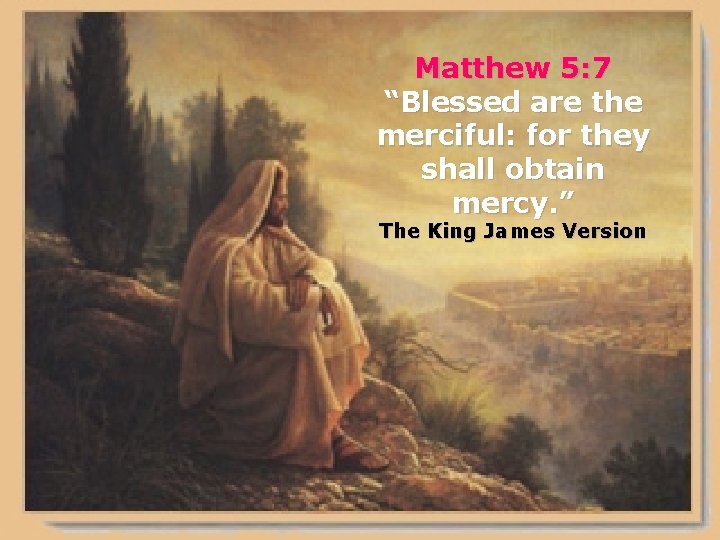
Just like the other beatitudes in which Jesus promises blessing for living in ways contrary to our nature, He climbs a hill, the people gather around him, and He says in Matthew 5:7, “Blessed are the merciful, for they shall obtain mercy.”

Matthew 5:43 records the saying was to love your neighbor and hate your enemy. We see in these cultures that mercy, if it was given, was reserved for those who had been merciful only to you. Our world today is not far removed spiritually from the Roman world when Jesus gave these blessed statements.

One too many world cultures say the same thing: “If you don’t look out for yourself, no one else will.” Another slogan today: “Don’t get mad, get even.” People are still treated like things, power is the supreme deity, and financial success is the most important thing in life. There is even the saying to, “Show no mercy ever.” Today, just as then, mercy is weakness in the minds of most.

The Standard of Mercy of God our Creator

We see Jesus showing mercy on many occasions. He looked on people and was moved with pity and compassion (Matthew 9:36; 14:14; 15:32). Jesus showed compassion on the sinful woman caught in adultery. Jesus always showed compassion and love toward the people. This is what attracts us to Jesus!

He truly cared for people. He had a legitimate concern for their needs and difficulties. In fact, we see the ugliness of the human heart with how the religious leaders treated Jesus. You will notice in the gospels the more Jesus showed mercy and compassion, the more the religious leaders hated Jesus and looked for opportunities to kill him.

The hatred grew so great that the people and leaders betrayed him, had Jesus arrested without cause, nailed to a cross. Yet, even while hanging on the cross, with nails driven through his outstretched hands, we see the mercy of Jesus. “Father, forgive them; for they do not know what they are doing” (Luke 23:34).

Notice in this we see a distinction between mercy and forgiveness. The mercy of our Lord is the basis for his desire to forgive us. “…he saved us, not because of works done by us in righteousness, but according to his own [standard of] mercy, by the washing of regeneration and renewal of the Holy Spirit, whom he poured out on us richly through Jesus Christ our Savior…” (Titus 3:5–6). 

Mercy was the basis upon which forgiveness was extended. God’s forgiveness of our sins flow from his abundant mercy.

But God, being rich in mercy, because of the great love with which he loved us, even when we were dead in our trespasses, made us alive together with Christ—by grace you have been saved— and raised us up with him and seated us with him in the heavenly places in Christ Jesus, (Ephesians 2:4–6 ESV)

Please notice that Ephesians makes the same distinction between mercy and forgiveness. Because God is rich in mercy with great love for us, he saved us by grace and made us alive together with Christ. While Jesus is on the cross, we see his full extent of mercy as he extends the opportunity of forgiveness to them.

We must be merciful because this is the very character of God. Jesus declared, “Be merciful, even as your Father is merciful” (Luke 6:36). The mercy of God should be renewed in our minds and hearts at least every Sunday as we partake of the Lord’s Supper. The Lord’s Supper reminds us of the mercy of God that we have experienced. God’s mercy is the covenanted basis of our own forgiveness.

This covenant teaches us something valuable. Our lack of forgiveness and our unwillingness to forgive others comes from a lack of mercy for others. Mercy drives forgiveness. If I am not driven to be forgiving, then I am not driven to be merciful. If I am not merciful, then I am not living in the kingdom of heaven.

The Challenge of God’s Standard of Mercy

Mercy is a challenge to develop in our character. Showing mercy means making ourselves vulnerable. We will be hurt by what other people do to us. We will extend ourselves to help people without reciprocation or thanks. We will give of ourselves unto those who need us without regard for receiving something in return. Compassion and pity are not often praised in our world, but it is the very heart of God, revealed through Jesus Christ, that we are showing to the world.

Mercy is not earned. Just like grace is no longer grace if it is earned, mercy is no longer mercy if it is deserved. Mercy is compassion that is undeserved. We are not to show mercy to whom we think deserve our mercy. We are to be like the character of God, extending mercy to all. Show mercy when people sin against us. The merciful expend a great measure of themselves to freely assist others.

But sometimes we misunderstand mercy. Mercy does not mean sin is ignored. We know this because God is merciful toward us but that does not mean our sins are ignored. Mercy recognizes the reality of sin. Mercy has the recognition of wrongdoing. Jesus did not show mercy by pretending that people were not sinning. Jesus did not show mercy by not convicting the people of their sins.

Jesus was being merciful by identifying sins and giving sinners the hope for forgiveness through him. Mercy identifies our sin but then shows the way to reconciliation with God. Mercy does good toward the other even in the face of opposition or evil.

Now think about what Jesus taught a couple times in the Gospel of Matthew: “I desire mercy, not sacrifice.” This declaration ought to be weighty to us and must not be emptied of its impact. God wants people who have a heart for him and for others. God does not want passive, heartless, soulless pew sitters.

We are people who help and heal. I am so troubled to hear how often Christians have an argument or a moment of an unkind word, and rather than showing mercy, there is division. People leave the congregation and go to another.

People get their feelings hurt and dwell in bitterness and leave. Going to church is not the test to know if you have received God’s mercy. Being merciful to others is the test to know if you have in truth experienced and received God’s mercy. Mercy is not desiring for other people to do good for others. Mercy is when we seek and act upon opportunities to be mercy givers, like the Good Samaritan in Luke 10.

Think about what the prophet Micah declared to the people:

And what does the Lord require of you? To act justly and to love mercy [kindness; ESV] and to walk humbly with your God. (Micah 6:8 NIV)

They Shall Receive God’s Standard of Mercy

The sinner’s plea can only be the words, “God, be merciful to me, a sinner” (Luke 18:13). God only shows mercy to the merciful. “Blessed are the merciful for they shall receive mercy.”

Listen to the chilling words of James:

For judgment is without mercy to one who has shown no mercy. Mercy triumphs over judgment. (James 2:13 ESV)

What terrifying words to hear! Judgment will be without mercy to the one who has shown no mercy.

We also have another saying: that person is getting what they deserve. But is that what we want to have happen to us? Do we want to get what we deserve for how we have treated others?

I know I have made many, many mistakes and I do not want to get what I truly deserve. for making them. You know others have been merciful toward you with your flaws and errors. Yet how often we will refuse to help people and refuse to be merciful because we think the person should not have put themselves in this mess in the first place! “They are only getting what they deserve.”

But we want others to be merciful toward us and not give us what we deserve. Further, we want God to be merciful toward us and not give us what we deserve. Do we seriously want to get what we deserve for how we have treated God?

Mercy toward others begins in our lives by having a penetrating awareness of our own desperate need of mercy from others, and especially from God.

It is mercy that shows compassion to the helpless (Luke 10:37) and extends forgiveness even to the one who gives repeated offense (Matthew 18:21-22). But this is what is important: mercy is not prompted by the appeal of certain qualities of the offender. We see this truth when God showed mercy to us through the cross (Romans 5:8-10).

Matthew 18:33 “And should not you have had mercy on your fellow servant, as I had mercy on you?” God’s standard of mercy compels us to be gracious, kind, compassionate, merciful toward others. We love God because He first loved us!

Blessed are the merciful for they shall receive mercy.

Oh, how we need this!

Oh, how we need to live this!

Oh, how we need to love this!

Oh, how we need to move on this!

Oh, how we need to go forth with this!

Oh, how we need to experience this!

Oh, how we need to reveal this!

Pray! Let God’s mercy transform your heart to be mercy givers to all people.

Let mercy flow like as an everlasting stream flowing from the heart of God!

In the name of God, the Father, and God the Son and God the Holy Spirit,

Let us pray,

Heavenly Father, how I praise and thank You for Your manifold mercy towards me, in that while I was yet a sinner, and at enmity with You… You did not give me what I deserve, but showed me mercy and love, by redeeming my life and clothing me in the righteousness of Christ. May I imitate the merciful way that Christ lived by bestowing Your mercy and compassion on all those with whom I come in contact. May I live as You would have me live in Jesus’ name – and for His glory, Alleluia! Alleluia! Alleluia! AMEN.

https://translate.google.com/

In Christ, we are being Transformed into a New Creation! We are Helping More People Become God’s Friends!

One of my favorite past times involves watching the array of home renovation shows on television and you tube.  There is simply something magical about the transformation of a tired old room or tired old house into a cozy place of rest.  From dated, decrepit and broken to new, refreshed and restored.  From hideous and unsightly to beautiful and welcoming.  From useless to hopeful and useful.

Having participated through several renovation projects following the days of Hurricane Katrina, I can assure you there is nothing magical about the process itself!  Our Volunteer in Mission team I spent two years renovating old homes.  It was dirty, tedious and tiresome.  Many days were spent tearing down the old walls, pulling out nails, getting dirty, tired, and sometimes, frustrated.  But the results were homes that were beautiful, refreshing, functional, and welcoming.

Why is it that our human nature receives so much satisfaction in viewing the process of transformation?  We delight in watching this progression over and over again as is evidenced by the popularity of renovating shows on HGTV and similar channels.  We simply can’t get enough of seeing what was once old and ugly being changed and renewed into something our minds had not conceived.

Perhaps we are drawn into this reclamation process because it reflects the very work, we wish we could do on ourselves if we should be granted the chance to do it over again and differently. Perhaps it is the recognition what God longs to do in each of our hearts, souls and lives.  When we receive Christ as our Savior, scripture claims we “exchange our old life for a new one.”  We exchange sin for forgiveness, pride for humility, legalism for grace, fear for love, weakness for strength, immorality for morality, self-defeat for victory in God, anger for joy.

2 Corinthians 5:11-21 Easy-to-Read Version

Helping People Become God’s Friends

11 We know what it means to fear the Lord, so we try to help people accept the truth. God knows what we really are, and I hope that in your hearts you know us too. 12 We are not trying to prove ourselves to you again. But we are telling you about ourselves. We are giving you reasons to be proud of us. Then you will have an answer for those who are proud about what can be seen. They do not care about what is in a person’s heart. 13 If we are crazy, it is for God. If we have our right mind, it is for you. 14 The love of Christ controls us, because we know that one person died for everyone. So, all have died. 15 He died for all so that those who live would not continue to live for themselves. He died for them and was raised from death so that they would live for him.

16 From this time on we do not think of anyone as the world thinks of people. It is true that in the past we thought of Christ as the world thinks. But we don’t think that way now. 17 When anyone is in Christ, it is a whole new world. [a] The old things are gone; suddenly, everything is new! 18 All this is from God. Through Christ, God made peace between himself and us. And God gave us the work of bringing people into peace with him. 19 I mean that God was in Christ, making peace between the world and himself. In Christ, God did not hold people guilty for their sins. And he gave us this message of peace to tell people. 20 So we have been sent to speak for Christ. It is like God is calling to people through us. We speak for Christ when we beg you to be at peace with God. 21 Christ had no sin, but God made him become sin[b] so that in Christ we could be right with God.

The Word of God for the Children of God. Gloria! In Excelsis Deo! Alleluia! Amen.

“Therefore, if anyone is in Christ, the new creation is come; the old has gone, the new is here!”  2 Corinthians 5:17 NIV

There are those among us who are deeply pondering the questions: “can who I am now, can where I am now, can my future be brighter and more hopeful and hope-filled than it is right now?” What chance is there that the outlook on my life would be, could be, should be, will be changed if I had a chance to do it over again?” “What can I do to remove myself from my past choices, and decisions?” “There is no more of me which I can surrender, I have done all I know how to do!” “But I am still stuck, in my here and my now and I am going nowhere fast.

Who is it who is not asking themselves this series of questions in these times? We do not dare to surrender ourselves to the ravages of pandemic, we want to live, we want to be wholly alive healthy and wholly more prosperous than we were yesterday and the day before that. Someone once said we were promised a future filled with hope and prosperity, but who said it and where is it right now?

Jeremiah 29:10-14Easy-to-Read Version

10 This is what the Lord says: “Babylon will be powerful for 70 years. After that time, I will come to you people who are living in Babylon. I will keep my good promise to bring you back to Jerusalem. 11 I say this because I know the plans that I have for you.” This message is from the Lord. “I have good plans for you. I don’t plan to hurt you. I plan to give you hope and a good future. 12 Then you will call my name. You will come to me and pray to me, and I will listen to you. 13 You will search for me, and when you search for me with all your heart, you will find me. 14 I will let you find me.” This message is from the Lord. “And I will bring you back from your captivity. I forced you to leave this place. But I will gather you from all the nations and places where I have sent you,” says the Lord, “and I will bring you back to this place.”

Where we are now and where we have been and where our current outlook on our future is right now will definitely continue to have a powerful influence on who we are in this moment. We cannot escape our past, but we can refresh it. We can change our perspectives; we can re-interpret them and reframe them. We can choose to reassign, re-consign them into the waters of forgetfulness. We can give them their beach towels, their beach umbrellas and just walk away.

We take a chance; we exercise our God-given right to risk everything on the sure belief that there is an absolutely better future waiting for us to discover it and experience it. We take a chance; we risk it all in faith that God does in fact have the greater and greatest plan for our future than we did. Once we surrender our lives unto, into, God, He sends his Holy Spirit to dwell within us and begin a process of transformation.  But into what exactly are we all being transformed?

“And we all, who with unveiled faces contemplate the Lord’s glory, are being transformed into his image with ever-increasing glory, which comes from the Lord, who is the Spirit.” 2 Corinthians 3:18

GOD SLOWLY TRANSFORMS US

Transformed into the image of God.  Though we are created by God in His image, sin taints how we view God and, therefore, how we see ourselves. An incorrect view of God leads us into a warped view of ourselves.  But once His Spirit lives within us, God begins to peel back the layers of deceit and doubt that cloud our vision of Him, and which prevent us from reflecting His image in our lives.

Just as any home renovation takes time, our transformation is slow and steady. Day by day, God strips us off the old habits and old thoughts that keep us blind and replaces it with truth.  Though the echoes of our old life will come calling, we do not have to assign them any priority or relevance or any power over us.  Sometimes, we fear that we haven’t changed at all, but rest assured, if you are walking obediently in God’s Word, you are not the same person you used to be!

Exercising this personal risk of choosing God and choosing transformation does and will not come easily.  Though God does the internal work, we are called to surrender every inside and outside area of our life and live in obedience to His will. If it seems like hand-to-hand combat with an enemy you cannot see, it is because it is supposed to be internal hand to hand combat! We will Overcome!

Liken your experience to watching a jumbo jet soaring gracefully in the skies.  From the ground, the flight seems smooth and graceful.  We would never know, unless you are on the plane, the amount of turbulence the passengers could be or actually are experiencing.  In the same way, we feel every bump and bruise in our journey with Christ, and sometimes we get discouraged because it gets so very difficult.  But that’s not what others see.  They see your victories, your joy, your faithfulness, your hopefulness.  They see the light of Christ in your life.

Along with the old passing away, “the new has come!” Old, dead things are replaced with new dynamic, vibrant living things, full of an empowered life and the indescribable glory of God. The newborn soul delights in the things of God, abhors the past things of the world and the flesh. Our purposes, feelings, our desires, understandings are fresh and different. We see the world differently.

The Bible seems to be a new book, and though we may have read it before, there is a beauty about it which we never saw before, and which we wonder at not having perceived. The whole face of nature seems to us to be changed, and we seem to discover ourselves in a new world. The heavens and the earth are filled with new wonders, and all things seem now to speak forth the praise of God.

There are new feelings toward all people—a new kind of love toward family and a refreshed kind of love for neighbors, a new compassion never before felt for enemies, and a new love for all mankind. The things we once loved, we now detest. The sin we once held onto, we now desire to put away forever. We “put off the old man with his deeds” (Colossians 3:9), and put on the “new self, created to be like God in true righteousness and holiness” (Ephesians 4:24).

What about the Christian who continues to sin?

There is a substantial difference between continuing to sin and continuing to live in sin. No one reaches sinless perfection in this life, but the redeemed Christian is being sanctified (made holy) day by day, sinning less and hating it more each time he fails. Yes, we still sin, but unwillingly and less and less frequently as we mature. Our new self-hates the sin that still has a hold on us.

The difference is that the new creation is no longer a slave to sin, as we formerly were. We are now freed from sin, and it no longer has any measure or degree of power over us (Romans 6:6-7). Now we are Holy Spirit empowered by and for righteousness. We now have the choice to “let sin reign” or to count ourselves “dead to sin but alive to God in Christ Jesus” (Romans 6:11-12).

Best of all, now we have “holy boldness,” and the power to choose the latter.

The new creation is a wondrous thing, formed in the mind of God and created by His power and for His glory. When we reflect on the ways in which we have grown and matured, we can see how slowly, ever so slowly, God has been chipping away at places in our lives that needed restoring.  Be encouraged by the promise found in Philippians 1:6“Being confident of this, that he who began a good work in you will carry it on to completion until the day of Christ Jesus.”

In the name of God, the Father and God the Son and God the Holy Spirit,

Let us now pray,

Psalm 40 The Message

40 1-3 I waited and waited and waited for God.
    At last he looked; finally he listened.
He lifted me out of the ditch,
    pulled me from deep mud.
He stood me up on a solid rock
    to make sure I wouldn’t slip.
He taught me how to sing the latest God-song,
    a praise-song to our God.
More and more people are seeing this:
    they enter the mystery,
    abandoning themselves to God.

4-5 Blessed are you who give yourselves over to God,
    turn your backs on the world’s “sure thing,”
    ignore what the world worships;
The world’s a huge stockpile
    of God-wonders and God-thoughts.
Nothing and no one
    compares to you!
I start talking about you, telling what I know,
    and quickly run out of words.
Neither numbers nor words
    account for you.

Doing something for you, bringing something to you—
    that’s not what you’re after.
Being religious, acting pious—
    that’s not what you’re asking for.
You’ve opened my ears
    so I can listen.

7-8 So I answered, “I’m coming.
    I read in your letter what you wrote about me,
And I’m coming to the party
    you’re throwing for me.”
That’s when God’s Word entered my life,
    became part of my very being.

9-10 I’ve preached you to the whole congregation,
    I’ve kept back nothing, God—you know that.
I didn’t keep the news of your ways
    a secret, didn’t keep it to myself.
I told it all, how dependable you are, how thorough.
    I didn’t hold back pieces of love and truth
For myself alone. I told it all,
    let the congregation know the whole story.

11-12 Now God, don’t hold out on me,
    don’t hold back your passion.
Your love and truth
    are all that keeps me together.
When troubles ganged up on me,
    a mob of sins past counting,
I was so swamped by guilt
    I couldn’t see my way clear.
More guilt in my heart than hair on my head,
    so heavy the guilt that my heart gave out.

13-15 Soften up, God, and intervene;
    hurry and get me some help,
So those who are trying to kidnap my soul
    will be embarrassed and lose face,
So anyone who gets a kick out of making me miserable
    will be heckled and disgraced,
So those who pray for my ruin
    will be booed and jeered without mercy.

16-17 But all who are hunting for you—
    oh, let them sing and be happy.
Let those who know what you’re all about
    tell the world you’re great and not quitting.
And me? I’m a mess. I’m nothing and have nothing:
    make something of me.
You can do it; you’ve got what it takes—
    but God, don’t put it off.

Gloria! In Excelsis Deo! Alleluia! Alleluia! Alleluia! Amen.

https://translate.google.com/