

2 Timothy 3:14-17 Amplified Bible
14 But as for you, continue in the things that you have learned and of which you are convinced [holding tightly to the truths], knowing from whom you learned them, 15 and how from childhood you have known the sacred writings (Hebrew Scriptures) which are able to give you the wisdom that leads to salvation through faith which is in Christ Jesus [surrendering your entire self to Him and having absolute confidence in His wisdom, power and goodness]. 16 All Scripture is God-breathed [given by divine inspiration] and is profitable for instruction, for conviction [of sin], for correction [of error and restoration to obedience], for training in righteousness [learning to live in conformity to God’s will, both publicly and privately—behaving honorably with personal integrity and moral courage]; 17 so that the [a]man of God may be complete and proficient, outfitted and thoroughly equipped for every good work.
The Word of God for the Children of God.
Glory be to the Father,
and to the Son, and to the Holy Ghost;
as it was in the beginning,
is now, and ever shall be,
world without end. Amen, amen.
The authority, sufficiency, infallibility, and inerrancy of Scripture are doctrines that are absolutely foundational to the ongoing work of God and His church.
We well can we authentically engage a slowly disintegrating, lost and hurting world with the gospel truth unless we are 100% convinced of its divine origin.
As Bishop J.C. Ryle (1816-1900) wrote, without the Bible as a “divine book to turn to as the basis of their doctrine and practice,” Christians “have no solid ground for present peace or hope, and has no right to claim the attention of mankind.”[1]
1 Bible Inspiration: Its Reality and Nature(William Hunt, 1877), p 6.
Apostle Paul towards the end of his life, addressed this very issue when he sternly reminded Timothy that “all Scripture is breathed out by God.”
In other words, the Bible is not a human product infused with divinity; it’s a divine gift produced through human instrumentality. Its every book, chapter, sentence, word and syllable was originally given by God’s inspiration.
The doctrine of Scripture, like many other Christian doctrines, can be hugely challenging to grapple with.
But the fact that something is difficult to understand does not undermine its depths of authentic hardcore truthfulness.
Furthermore, when it comes to the doctrine of Scripture, there are matters that we can consider objectively.
For example, it’s easy to see that the Bible is a completely harmonious work.
While it was written by more than thirty authors over a period of about fifteen hundred years, all the writers tell the same story, giving the same account of this world, the character of its Creator, and the problem of the human heart, and broken spirit all pointing to the same wonderful way of salvation through the sacrifice of the Lamb of God—all the way from Genesis through Revelation!
The Bible also transcends time, culture, gender, wealth, power and intellect.
Some books may fit a certain person, a certain era, or a certain place, but there is no other book that perfectly stands up to the challenges of every day and of every age and to the myriad and myriad of questions that confronts life itself.
The brightest minds, the greatest thinkers, charismatic of speakers, cannot exhaust the riches of God’s word, and yet, at the same time, even young girls and boys can read their Bibles and discover its truth transforming their lives.
Try to plumb for yourselves the utter depths of Genesis 1:1 Amplified Bible
The Creation
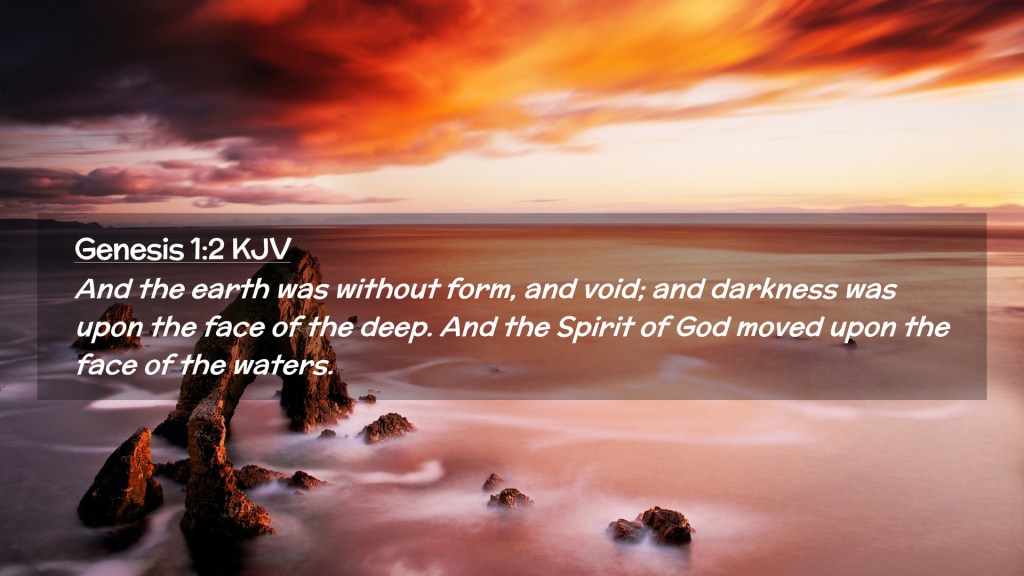
1 In the beginning God ([a]Elohim) [b]created [by forming from nothing] the heavens and the earth.
Your efforts may be so vast, so comprehensive, so mind boggling, so fully enriching, so empowering, overwhelming, you may never get to verse 2.
2 The earth was [a]formless and void or a waste and emptiness, and darkness was upon the face of the deep [primeval ocean that covered the unformed earth]. The Spirit of God was moving (hovering, brooding) over the face of the waters.
Once you look up at a clear star filled night sky or through a telescope, at the pictures from the Hubble and James Webb Space telescopes, try to calculate what it means to go from one end of the universe to the other or trying to find the exact center of an ever expanding universe then hearing that it would take you tens of trillions of light years (look that up) if not more to accomplish it.
Who else but God, the Father and God the Son and God the Holy Spirit can ever hope to speak of it in such a way that the finite intellect and wisdom of mankind can grasp even .01% what our own finite eyes can observe and thoughts grasp?
Psalm 19 Amplified Bible
The Works and the Word of God.
To the Chief Musician. A Psalm of David.
19 The heavens are telling of the glory of God;
And the expanse [of heaven] is declaring the work of His hands.
2
Day after day pours forth speech,
And night after night reveals knowledge.
3
There is no speech, nor are there [spoken] words [from the stars];
Their voice is not heard.
4
Yet their voice [in quiet evidence] has gone out through all the earth,
Their words to the end of the world.
In them and in the heavens He has made a tent for the sun,
5
Which is as a bridegroom coming out of his chamber;
It rejoices as a strong man to run his course.
6
The sun’s rising is from one end of the heavens,
And its circuit to the other end of them;
And there is nothing hidden from its heat.
7
The law of the Lord is perfect (flawless), restoring and refreshing the soul;
The statutes of the Lord are reliable and trustworthy, making wise the simple.
8
The precepts of the Lord are right, bringing joy to the heart;
The commandment of the Lord is pure, enlightening the eyes.
9
The fear of the Lord is clean, enduring forever;
The judgments of the Lord are true, they are righteous altogether.
10
They are more desirable than gold, yes, than much fine gold;
Sweeter also than honey and the drippings of the honeycomb.
11
Moreover, by them Your servant is warned [reminded, illuminated, and instructed];
In keeping them there is great reward.
12
Who can understand his errors or omissions? Acquit me of hidden (unconscious, unintended) faults.
13
Also keep back Your servant from presumptuous (deliberate, willful) sins;
Let them not rule and have control over me.
Then I will be blameless (complete),
And I shall be acquitted of great transgression.
14
Let the words of my mouth and the meditation of my heart
Be acceptable and pleasing in Your sight,
O Lord, my [firm, immovable] rock and my Redeemer.
The authority, sufficiency, infallibility, and inerrancy of Scripture are the grounds on which we must stand; and we have divine help in order to do so.
The same Spirit that inspired the word of God illumines the word of God and illuminates our sin darkened wisdom, convinces us that it is 100% the word of God, given to us so that we may believe in Him who is the Word made flesh.
It is as the Spirit does this work in you that your belief in the divine authorship of Scripture is undergirded and moves from only being an intellectual assent to becoming a doctrine raising to becoming an active starvation level hunger for more of the word—and more of the one who is both its author and its subject.
The Power of the Word of God, the Word of Truth
Acts 6:5-8 Amplified Bible
5 The suggestion pleased the whole congregation; and they selected [a]Stephen, a man full of faith [in Christ Jesus], and [filled with and led by] the Holy Spirit, and Philip, Prochorus, Nicanor, Timon, Parmenas, and Nicolas (Nikolaos), a proselyte (Gentile convert) from Antioch. 6 They brought these men before the apostles; and after praying, they laid their hands on them [to dedicate and commission them for this service].
7 And the message of God kept on growing and spreading, and the number of disciples continued to increase greatly in Jerusalem; and a large number of the priests were becoming obedient to the faith [accepting Jesus as Messiah and acknowledging Him as the Source of eternal salvation].
8 Now Stephen, full of grace (divine blessing, favor) and power, was doing great wonders and signs (attesting miracles) among the people.
It is tucked away almost like a fleeting footnote within the biblical story of the rapid growth of the church of Christ in the first months after Jesus’ death, resurrection, and ascension to heaven.
And yet, recalling the rejection and betrayal Jesus experienced from his very own people, these so few words in today’s verse come as a surprise: “a large number of priests became obedient to the faith.”
Perhaps for a while these priests had gone along with the efforts of their leaders, thinking that if they could force people to stop talking about Jesus, the whole matter would just go away.
Perhaps for a while they had tried to go along with covering up the evidence of Jesus’ resurrection.
It was probably very difficult for some of these priests to change; after all, they had spent their whole lives serving in the temple worship, bringing sacrifices and doing many other rituals on behalf of the people. But now they were called to fulfill new previously unknown roles as believers in Jesus, whom they had opposed but who was also acknowledged the Messiah they had been waiting for.
This little footnote note reminds us how the penetrating virus of self-deception can be overwhelmed and healed by the medicine of simply admitting the truth.
As Jesus himself promised, “The truth will set you free” (John 8:32).
Are you ready acknowledge Jesus as God’s Messiah?
Are we ready to acknowledge the Word of God as being 100% authentic?
In the name of God, the Father and God the Son and God the Holy Spirit,
Let us Pray,
Psalm 29
A psalm by David.
1 Give to Yahweh, you heavenly beings.
Give to Yahweh glory and power.
2 Give to Yahweh the glory his name deserves.
Worship Yahweh in his holy splendor.
3 The voice of Yahweh rolls over the water.
The El of glory thunders.
Yahweh shouts over raging water.
4 The voice of Yahweh is powerful.
The voice of Yahweh is majestic.
5 The voice of Yahweh breaks the cedars.
Yahweh splinters the cedars of Lebanon.
6 He makes Lebanon skip along like a calf
and Mount Sirion like a wild ox.
7 The voice of Yahweh strikes with flashes of lightning.
8 The voice of Yahweh makes the wilderness tremble.
Yahweh makes the wilderness of Kadesh tremble.
9 The voice of Yahweh splits the oaks[a]
and strips the trees of the forests bare.
Everyone in his temple is saying, “Glory!”
10 Yahweh sat enthroned over the flood.
Yahweh sits enthroned as Melek forever.
11 Yahweh will give power to his people.
Yahweh will bless his people with peace.
Glory be to the Father,
and to the Son, and to the Holy Ghost;
as it was in the beginning,
is now, and ever shall be,
world without end. Amen, amen.



 Loving God, Living God, Loving Hope, Living Hope, Loving Living Life His Way! "Many things are possible for the person who has hope. Even more is possible for the person who has faith. And still more is possible for the person who knows how to love. But everything is possible for the person who practices all three virtues." - Brother Lawrence (1605-1691), Practicing the Presence of God (1692).