The Fourth Commandment: Our Rest, Our Witness. Remember the Sabbath. Exodus 20:8-11

Exodus 20:8-11 Amplified Bible

“Remember the Sabbath (seventh) day to keep it holy (set apart, dedicated to God). Six days you shall labor and do all your work, 10 but the seventh day is a Sabbath [a day of rest dedicated] to the Lord your God; on that day you shall not do any work, you or your son, or your daughter, or your male servant, or your female servant, or your livestock or the temporary resident (foreigner) who stays within your [city] gates. 11 For in six days the Lord made the heavens and the earth, the sea and everything that is in them, and He rested (ceased) on the seventh day. That is why the Lord blessed the Sabbath day and made it holy [that is, set it apart for His purposes].

The Word of God for the Children of God.

Adeste Fidelis. Venite Adoremus. Dominum.

Gloria. In Excelsis Deo. Alleluia, Alleluia, Alleluia, Amen.

Keep the Sabbath [verse 8]

Remember the Sabbath day, to keep it holy. Exodus 20:8

Throughout history there have been well-meaning, earnest Christians who have, perhaps without their ever knowing it, who have come to functionally believe the Ten Commandments are really only the Nine Commandments.

Somewhere along the way, some have decided the fourth commandment is not like the rest of the commandments but rather as a relic that belongs in the past.

In truth, though, the ancient command to remember the Sabbath and keep it holy has abiding significance for us all, even today.

Why has this simple command fallen on such hard times?

Some have claimed that its regulations and penalties were tied to the old covenant, so it must no longer be relevant.

Yet we do not treat the other commandments this way.

Others have said that the way Jesus spoke of being “lord of the Sabbath” (Matthew 12:8) diminished the commandment’s significance and force.

What about Jesus’ apparent intent here?

What the man Rabbi Jesus sought to overturn was not the Sabbath itself but the host of hypocritical external rules of the Pharisees.

I have long suspected what keeps most Christians from thinking of the fourth commandment as we ought to is simply that we do not like its implications.

We do not like, nor appreciate all of the subtle and not so subtle ways it intrudes into our lives, into our leisure and whatever else takes precedence in our hearts.

So we act as though this command is in a different category from the other nine.

However, If we truly want to grasp the significance of the Sabbath and respond to it in a God-honoring way, we must all embrace, as a conviction, the real truth that God has intentionally set aside the Sabbath day as distinct from the rest.

This was the case in the week of creation, with God resting on the seventh day and declaring it sanctified.

The church, in the age of the new covenant, then changed the day from the seventh day of the week to the first day to mark the resurrection of Christ.

In both cases, we see that the distinction of the day is woven into God’s work of creation and redemption.

With that conviction in place, we can see that the day is not simply a day set apart from other days, but it is, in Gospel Truth, a day set apart unto the Lord.

By not seeing it this way, we’ll be tempted to view our spiritual exercises on the Lord’s Day as something to “get over with” in order to “get on with” our week.

If this is our mentality, we stand condemned by the fourth commandment.

The Sabbath ought to be treasured for what it is: a gift of a day on which we enjoy, uninterrupted by leisure commitments or (if possible) by employment, the privilege of God’s presence, the study of God’s word, and the fellowship of God’s people.

Seen like that, this command becomes an invitation: not only to just something we should do but something we will each come to learn how to love to do.

If this is not how you have been viewing God’s Sabbath, then ask yourself:

What’s preventing you from honoring the Lord’s Day?

Take stock of your habits and receive the gift of the Sabbath.

From that next Sunday, be sure that your priority is not to make the Lord’s Day convenient but to make the Lord’s day exclusively about God, to keep it holy.

Keep the Sabbath [verses 9-10]

Six days you shall labor and do all your work, 10 but the seventh day is a Sabbath [a day of rest dedicated] to the Lord your God; on that day you shall not do any work, you or your son, or your daughter, or your male servant, or your female servant, or your livestock or the temporary resident (foreigner) who stays within your [city] gates. [verses 9, 10]

Having established the fourth commandment remains what it has always been—a commandment of the Lord—and as such it is relevant to our lives, we can now turn our hearts, souls, minds, to thinking profitably about how to keep it.

But we must be careful as we get specific about honoring the Sabbath.

The Lord Jesus, after all, had some very harsh, strong words for the Pharisees regarding the way their moral specificity had become a means not of obedience but of self-righteousness (Mark 2:23 – 3:6).

With “quaking and trembling knees” and maturing humility, let’s take some quality time to consider how are we to remember the Sabbath and keep it holy.

Let us try to explore: How do we prevent worldly concerns—those of leisure, recreation, and work—from infringing on our enjoyment and worship of God?

Let’s think first of public worship.

What kinds of conversations do you typically have prior to the worship service?

Are they concerned at any point with exclusively the things of God, or only ever with sports – making it to the home team game, family, and every other thing?

It takes a conscious and a thoroughly intentional act of the will to give eternal matters the very highest measure of maxed priority in our minds and mouths.

If you were to determine that in your preparation for worship you would set aside every priority which looms, loomed so large on other days, I guarantee the focus of your time at church would be changed.

The same goes for after the service.

When the last song has been sung and the service is over, how long does it take for your mind and conversation to return to worldly matters?

If we were instead to:

commit to spending time after the service speaking to one another about the greatness of God, the truth of His word, and the wonder of His dealings with us,

and praying with one another about the week ahead and the trials we face, then we would begin to understand better the “one another” passages in the New Testament about:

encouraging one another (Hebrews 10:25),

speaking the truth to one another (Ephesians 4:25), and

building one another up (1 Thessalonians 5:11)

—for we would then be prioritizing ourselves to actually living them out.

Similarly, in our private affairs on the Lord’s Day, spiritual improvement should still take priority.

That may mean additional family worship, reading edifying books, prayer, discussion of what was preached that morning, and more—but whatever it means, we should make it our aim not to let the cares of the other six days push into our efforts of growing our spiritual enjoyment of the first day of the week.

If we want to profit from keeping the Sabbath, and if we want to take the fourth commandment more seriously, then our convictions must fuel our actions, and our daily aspirations must turn into daily practices.

Avoid making unique rules that only serve to foster self-righteousness, but consider whether anything worldly needs to change, be re-prioritized Godly.

How would, should, could you change to keep the Sabbath holy the next time Sunday comes round, then Monday, then Tuesday then Wednesday and so on?

Our Sabbath Rest as Our Witness

[sermon illustrations]

The college student broke down in tears over his coffee.

Driven by competition for limited space in a pre-law program, he had just poured himself into studying virtually nonstop, eight hours a day seven days a week. After seven months he found he lost the ambition for learning—and nearly for life itself.

Driven by the desire for promotion and the prospect for more money for him an his growing family, [……….] takes extra work home every single night to get the one up on his fellow workers – he stays up till midnight every night for weeks. Taking no time for dinner with his wife or leisure time his young kids, he hears them crying.

Our reading today states that “in six days the LORD made the heavens and the earth … but he rested on the seventh day.”

The ambition and creativity we bring to work is a reflection of our mindset on our Creator’s sovereignty over our lives and over the lives we genuinely value.

It’s part of how we reflect his image and a big part of how we serve as witnesses for him.

God also rested on the seventh day, however, and he calls us to do the same.

For us, good work hinges on good rest.

Without good rest our good work suffers.

The discipline of regular rest is a witness in our fast-paced world, especially when that time is focused on enjoying our Creator.

It speaks of God’s love to command what’s good for us.

Our ambitions would otherwise serve only to distract us from him and drive us into the ground if we let them.

How will you take our rest the rest of this week and this next weekend?

For the sake of good work later, let’s rest.

For the sake of sanity, let’s rest.

For the sake of glory to God in regular worship and fellowship, let’s rest.

God blesses those who “work hard” at resting in the Lord Jesus Christ.

Let’s trust him to establish the work and rest of our hands (see Psalm 90:17).

In the name of God, the Father and God the Son and God the Holy Spirit,

Let us Pray,

God, grant us and all our loved ones true rest on this Sabbath Day. May Your Holy and Sacred Presence drive out from among us anger and fear, worry and regret. Send your blessing upon us, that we may be people of the Word. Lord of work and of rest, thank you for these gifts. Help us to work hard and rest well. Please provide work where we need it. Please also bless whatever years of retirement rest we may have.

Adeste Fidelis. Venite Adoremus. Dominum.

Gloria. In Excelsis Deo. Alleluia, Alleluia, Alleluia, Amen.

https://translate.google.com/

“Stones of Remembrance!” God’s Call to Remember Revival. Joshua 4:4-7, 19-24

Joshua 4:4-7 Amplified Bible

Then Joshua called the twelve men whom he had appointed from the sons of Israel, one man from each tribe; and Joshua said to them, “Cross over again to the ark of the Lord your God into the midst of the Jordan, and each of you take up a stone on his shoulder, according to the number of the tribes of the sons of Israel, so that this may be a sign among you; when your children ask later, ‘What do these stones mean to you?’ then you shall say to them that the waters of the Jordan were cut off before the ark of the covenant of the Lord; when it crossed the Jordan, the waters of the Jordan were cut off. So these stones shall become a memorial for Israel forever.”

Joshua 4:19-24 Amplified Bible

19 Now the people came up from the Jordan on the tenth [day] of the first month and encamped at Gilgal on the eastern border of Jericho. 20 And those twelve stones which they had taken from the Jordan, Joshua set up in Gilgal. 21 He said to the sons of Israel, “When your children ask their fathers in time to come, ‘What do these stones mean?’ 22 then you shall let your children know, ‘Israel crossed this Jordan on dry ground.’ 23 For the Lord your God dried up the waters of the Jordan for you until you crossed over, just as the Lord your God did to the Red Sea, which He dried up before us until we had crossed; 24 so that all the peoples of the earth may know [without any doubt] and acknowledge that the hand of the Lord is mighty and extraordinarily powerful, so that you will fear the Lord your God [and obey and worship Him with profound awe and reverence] forever.”

The Word of God for the Children of God. 

Adeste Fidelis! Venite Adoremus! Dominum.

Gloria! In Excelsis Deo! Alleluia! Alleluia! Alleluia! Amen.

The Christian life is, in a sense, one big call to remember.

Our Lord Jesus, speaking of the new-covenant meal of Communion, told us, “Do this in remembrance of me” (Luke 22:19, emphasis added).

Every Lord’s Supper, then, offers us the opportunity to remember together all that is pictured in the bread and wine.

Deuteronomy similarly envisions a scenario in which a son asks his father;

“What is the meaning of the testimonies and statutes and the rules that the LORD our God has commanded you?” (Deuteronomy 6:20).

The father responds by telling Israel’s story of redemption, highlighting that what God instructs is “for our good always” (v 24).

The book of Joshua, too, commends the same kind of commemoration when the Lord instructs the people to set up 12 memorial stones at the Jordan River, so the stones would become revival “to the people of Israel a memorial forever.”

God wanted His people then—and wants His people today—to ever remember His faithfulness and to tell, testify, confess, to teach others what He has done.

Such remembrances and memorials have always been a significant time to worship and praise for the miraculous works only Himself demonstrates.

But in a day [like now] with endless competing claims on our attention and affections, we need more reminders of God’s faithfulness than ever before.

It’s notable that the examples above are concrete and interpersonal.

We participate in the Lord’s Supper together, and it offers us a multisensory experience to help us remember.

The twelve stones at the Jordan River constituted a physical memorial.

The instruction of Deuteronomy encourages us to have conversations about God’s faithfulness and goodness in our homes.

Please note that the word “conversations” is PLURALIZED.

Meaning more than one –

But not just conversations … but full blown WORSHIP and PRAISE and PRAYER.

But not just one person conversing with the Lord, but a whole bunch of people, putting themselves in front of their “memorial stones” to remember the Lord.

For today’s Christians, every Sunday presents us with the opportunity to gather and remember with God’s people.

But we are going to need more than a weekly touchpoint to sustain ourselves.

Ask yourself: 

What habits can I cultivate to remember God’s goodness?

How can I catalog His faithfulness to me and share that with others?

What “memorials” can I set up so that I can remember how God delivered me?

Opportunities to continuously see, instantly recall God’s faithfulness abound.

All we need to do is constantly, continuously look and instantly remember.

Revival at Asbury University in Wilmore, Kentucky – 2023

I do hope and pray that Christians have stable and established faith in Christ. 

I feel prayerful. Hopeful.

In fact, I’ve gotten choked up more than once over the last couple days at the thought that a genuine outpouring of the Holy Spirit could be happening among our Methodist brothers and sisters.

So I have mainly been praying two things:

1. Oh, God. Let it be. Let your mercy pour down in genuine revival, and let these reports be true. And let it not end in Wilmore.

2. Pass me not, O gentle Savior. Hear my humble cry. While on others Thou art calling, Do not pass me by. Savior, Savior, Hear my humble cry. While on others Thou art calling, Do not pass me by.

Maybe you will be moved mightily to pray, praise and worship this way as well.

It is of the nature of revival that we cannot know the true extent of it until days, months, and even years afterward.

Acts 5:33-39Amplified Bible

Gamaliel’s Counsel

33 Now when they heard this, they were infuriated and they intended to kill the apostles. 34 But a Pharisee named [a]Gamaliel, a teacher of the Law [of Moses], highly esteemed by all the people, stood up in the Council (Sanhedrin, Jewish High Court) and ordered that the men be taken outside for a little while. 35 Then he said to the Council, “Men of Israel, be careful in regard to what you propose to do to these men. 36 For some time ago Theudas rose up, claiming to be somebody [of importance], and a group of about four hundred men allied themselves with him. But he was killed, and all who followed him were scattered and came to nothing. 37 After this man, Judas the Galilean rose up, [and led an uprising] during the time of the census, and drew people after him; he was also killed, and all his followers were scattered. 38 So in the present case, I say to you, stay away from these men and let them alone, for if this plan or action is of men [merely human in origin], it will fail and be destroyed; 39 but if it is of God [and it appears that it is], you will not be able to stop them; or else you may even be found fighting against God!”

The distinguishing marks of revival may begin with an outpouring of the Spirit of grace, but that is only the commencement if the work of the Holy Spirit is to prove real and to be authentic and unstoppable, and a major mover of people.

“How do you tell if it is really a work of God? It’s not how high you jump, it’s how straight and how far you will walk when you finally land.”

The last great spiritual awakening in America took place during the late 1960s and early 1970s.

It was a nation divided by war, and things were very dark.

But when things are really dark, God’s light can shine brightly.

Cover headlines from Time magazine went from “Is God Dead?” in 1968 to “Jesus Revolution” in 1971.

What a difference a few years can make, especially when God intervenes.

America needs a spiritual awakening, and the church needs a revival.

The World needs a spiritual awakening ….

An awakening takes place when God sovereignly pours out His Spirit and it impacts a culture.

That is what happened during the Jesus Revolution, and that is what happened during multiple spiritual awakenings in the long history of these United States, predating its establishment as a nation.

A revival, on the other hand, is what the church must experience.

A revival occurs when the church comes back to life, when it becomes what it was always meant to be.

It’s a returning to passion.

I think many times we overly mystify the idea of revival.

We don’t really need to.

Another word we could use for revival is restoration, and that is what the church needs.

Speaking at a conference in 1917, R. A. Torrey gave this prescription for revival:

Let a few of God’s people, they don’t need to be many, get thoroughly right with God themselves—the rest will count for nothing unless you start right there; then let them band themselves together to pray for a revival until God opens the heavens and comes down. Then let them put themselves at God’s disposal to use them as He sees fit. That will bring a revival to any church, any community.

We can’t organize a revival, but we can agonize for it in prayer.

We can call on God to send it.

We can call on the people to come, to consider and to receive God [Acts 2:37-47]

Draw near unto the Lord our God and the Lord will draw near to us.

Psalm 73:28 Amplified Bible

28 
But as for me, it is good for me to draw near to God;
I have made the Lord God my refuge and placed my trust in Him,
That I may tell of all Your works.

Ecclesiastes 5:1Amplified Bible

Your Attitude Toward God

Guard your steps and focus on what you are doing as you go to the house of God and draw near to listen rather than to offer the [careless or irreverent] sacrifice of fools; for they are too ignorant to know they are doing evil.

Matthew 11:25-30Amplified Bible

Come to Me

25 At that time Jesus said, “I praise You, Father, Lord of heaven and earth [I openly and joyfully acknowledge Your great wisdom], that You have hidden these things [these spiritual truths] from the wise and intelligent and revealed them to infants [to new believers, to those seeking God’s will and purpose]. 26  Yes, Father, for this way was well-pleasing in Your sight. 27 All things have been handed over to Me by My Father; and no one fully knows and accurately understands the Son except the Father; and no one fully knows and accurately understands the Father except the Son, and anyone to whom the Son [deliberately] wills to reveal Him.

28 “Come to Me, all who are weary and heavily burdened [by religious rituals that provide no peace], and I will give you rest [refreshing your souls with salvation]. 29 Take My yoke upon you and learn from Me [following Me as My disciple], for I am gentle and humble in heart, and you will find rest (renewal, blessed quiet) for your souls. 30 For My yoke is easy [to bear] and My burden is light.”

James 4:8Amplified Bible

Come close to God [with a contrite heart] and He will come close to you. Wash your hands, you sinners; and purify your [unfaithful] hearts, you double-minded [people].

Where is our Hope for Revival and Remembrance?

Psalm 85 Amplified Bible

Prayer for God’s Mercy upon the Nation.

To the Chief Musician. A Psalm of the sons of Korah.

85 O Lord, You have [at last] shown favor to Your land [of Canaan];
You have restored [from Babylon] the captives of Jacob (Israel).

You have forgiven the wickedness of Your people;
You have covered all their sin. Selah.

You have withdrawn all Your wrath,
You have turned away from Your burning anger.


Restore us, O God of our salvation,
And cause Your indignation toward us to cease.

Will You be angry with us forever?
Will You prolong Your anger to all generations?

Will You not revive us and bring us to life again,
That Your people may rejoice in You?

Show us Your lovingkindness, O Lord,
And grant us Your salvation.


I will hear [with expectant hope] what God the Lord will say,
For He will speak peace to His people, to His [a]godly ones—
But let them not turn again to folly.

Surely His salvation is near to those who [reverently] fear Him [and obey Him with submissive wonder],
That glory [the manifest presence of God] may dwell in our land.
10 
Steadfast love and truth and faithfulness meet together;
Righteousness and peace kiss each other.
11 
Truth springs from the earth,
And righteousness looks down from heaven.
12 
Indeed, the Lord will give what is good,
And our land will yield its produce.
13 
Righteousness will go before Him
And will make His footsteps into a way [in which to walk].

In a worship song from the early 2000s, singer/songwriter Brian Doerksen sings,

“Jesus, hope of the nations/ Jesus, comfort for all who mourn/ You are the source of heaven’s hope on earth.”

As believers in Christ, we recognize and worship Jesus as the true hope of the world, and yet it’s astounding how often we pin our hopes on ­human beings.

In all of our history books, it is clear that people are far more inclined to find hope in leaders, politicians, and celebrities rather than in the one true God.

Why do we do this?

Proverbs 11:4-8 warns that placing hope in humans is futile because any human power will come to nothing.

As the apostle Paul tells us, “There is no authority except that which God has established” (Romans 13:1).

By saying this, Paul is assuring believers that in all situations, even in the midst of national turmoil’s and global crises, God is the one who holds all ­authority.

Any human who has “power” has it only because God allows it to be so.

2 Chronicles 7:1-3Amplified Bible

The Shekinah Glory

When Solomon had finished praying, fire came down from heaven and consumed the burnt offering and the sacrifices, and the [[a]Shekinah] glory and brilliance of the Lord filled the house. The priests could not enter the house of the Lord because the glory and brilliance of the Lord had filled the Lord’s house. When all the people of Israel saw how the fire came down and saw the glory and brilliance of the Lord upon the house, they bowed down on the stone pavement with their faces to the ground, and they worshiped and praised the Lord, saying, “For He is good, for His mercy and lovingkindness endure forever.”

In other words, through our continuous praise and worship, all our hopes and all our desires must lie with the Only One who is on the throne of the universe.

Our prayers and our worship must be oriented toward Christ, for he is truly the only hope—the only one who can change minds and transform hearts, disperse powers, and bring edification, and redemption and restoration, to bring revival.

In the name of God, the Father and God the Son and God the Holy Spirit,

Let us Pray ….

Creator God, you made every living thing, and you hold all things together. Lord, we your Children now pray for you bring restoration to this world that desperately needs your leadership and authority. Please use Your church and their lives as catalysts for renewal, restoration and revival. We have heard of Your great works; please do them again, “stones of remembrance” in our day. And all for the glory, honor and praise of Jesus Christ, our only crucified, Resurrected and returning Lord, Savior and King.

Adeste Fidelis! Venite Adoremus! Dominum.

Gloria! In Excelsis Deo! Alleluia! Alleluia! Alleluia! Amen.

https://translate.google.com/

Church Worship which truly Counts: “I am the Church. You are the Church. We are the Church Together.” Isaiah 1:10-17

“A man’s got to take care of himself!” Yeah, we do have to be responsible folks. But part of being responsible, part of being blessed — at least as God sees it — is to care for others, to stick up for the disadvantaged, and to intervene when someone else is being exploited. After all, we are our “brother’s and sister’s keeper!”

Poverty in any form, in all forms, in all circumstances, is too often caused by injustice. While justice occurs where relationships are “just right,” injustice happens when by some human mechanism, those relationships are broken.

Injustice includes the misuse of power, exploitation of the weak, denial of basic human rights, valuing money more than people, and self-indulgence in the face of all human sufferings. It can take many forms. It can be personal or societal.

One thing we know for sure is that God hates such injustice because it harms his children, whom he loves. Through His prophet Isaiah, God shows that even our own best worship can be utterly distasteful to him if we do not practice justice.

Injustice makes our religious practices unacceptable to God. Prayers, songs, lavish worship services—they are all 100% meaningless if we do not do justice.

The role of prophets was to call people back to faithful living, to repent of their unjust practices, to embrace justice as a lifestyle.

Isaiah talks about seeking justice, advocating and defending the oppressed, and speaking up for the fatherless and the widow, and in Isaiah chapter 58 he adds that we should share of our abundance with the hungry, provide shelter to the poor wanderer, and more and far more. God’s prophet Micah adds we should all “act justly,” “all love mercy,” and “all walk humbly” with our God (Micah 6:8).

The good news is that God yet loves those who are unjust, summons them and accepts repentance and transforms us to do justice out of joyful service to him.

Isaiah 1:10-17Amplified Bible

God Has Had Enough

10 
Hear the word of the Lord [rulers of Jerusalem],
You rulers of [another] Sodom,
Listen to the law and instruction of our God,
You people of [another] Gomorrah.
11 
“What are your multiplied sacrifices to Me [without your repentance]?”
Says the Lord.
“I have had enough of [your] burnt offerings of rams
And the fat of well-fed cattle [without your obedience];
And I take no pleasure in the blood of bulls or lambs or goats [offered without repentance].
12 
“When you come to appear before Me,
Who requires this of you, this trampling of My [temple] courts [by your sinful feet]?
13 
“Do not bring worthless offerings again,
[Your] incense is repulsive to Me;
[Your] New Moon and Sabbath [observances], the calling of assemblies—
I cannot endure wickedness [your sin, your injustice, your wrongdoing] and [the squalor of] the festive assembly.
14 
“I hate [the hypocrisy of] your New Moon festivals and your appointed feasts.
They have become a burden to Me;
I am weary of bearing them.
15 
“So when you spread out your hands [in prayer, pleading for My help],
I will hide My eyes from you;
Yes, even though you offer many prayers,
I will not be listening.
Your hands are full of blood!

16 
“Wash yourselves, make yourselves clean;
Get your evil deeds out of My sight.
Stop doing evil,
17 
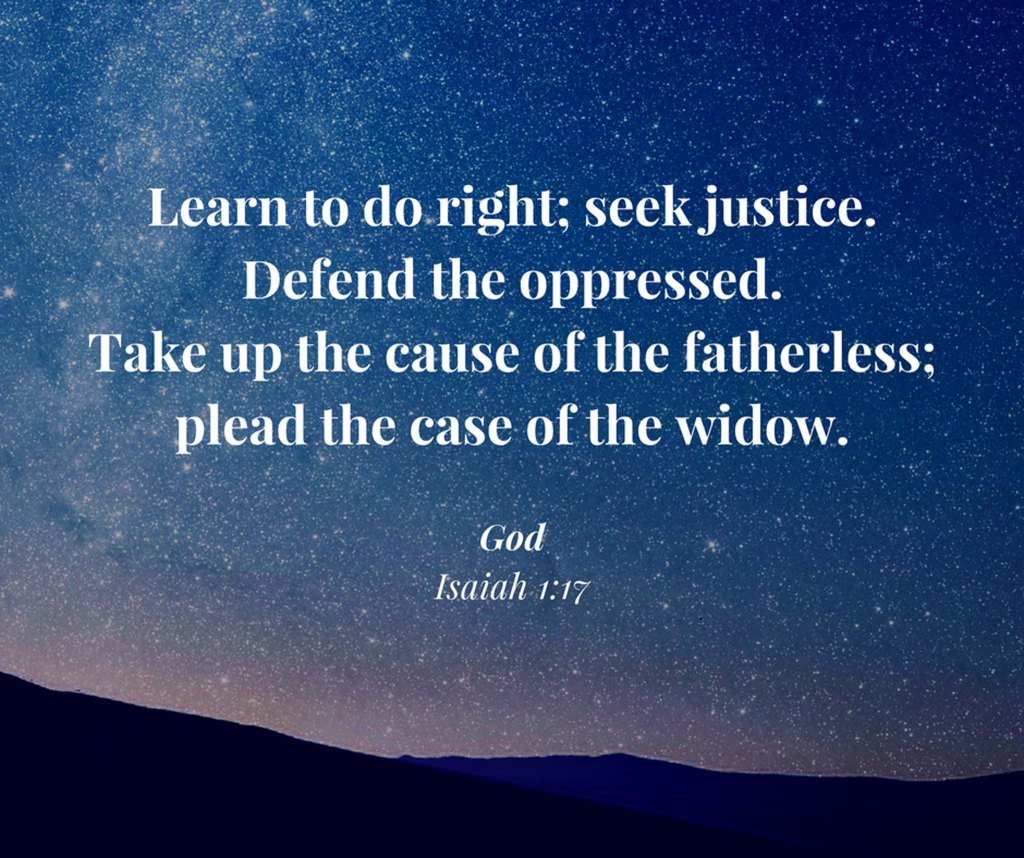
Learn to do good.
Seek justice,
Rebuke the ruthless,
Defend the fatherless,
Plead for the [rights of the] widow [in court].

The Word of God for the Children of God. Gloria! In Excelsis Deo! Alleluia! Amen.

Justice.

What does your heart hear when it hears that word uttered in your company?

What does your soul hear when it hears that word uttered in your company?

What do your hands and feet want to do when your heart and soul summons them into some manner of action when that word is uttered in your presence?

“Justice” is one of those words that is loaded with meanings and different interpretations.

Definitions, Perceptions, Understandings, “Hands On, Hands Off” Applications of “justice” swiftly divide people, political parties, countries, even churches.

While “justice” is almost impossibly hard to define, and apply, many people of note have tried to describe it or illustrate it. Here are just a few examples:

  • “The more laws, the less justice” (Cicero).
  • “True peace is not merely the absence of war; it is the presence of justice” (Jane Addams).
  • “Justice that loves gives is a surrender, justice that law gives is a punishment” (Gandhi).
  • “The moral arc of the universe is long, but it bends toward justice” (MLK).
  • “Injustice anywhere is a threat to justice everywhere” (MLK).
  • “Never forget that justice is what love looks like in public” (Dr. Cornel West).

The best definition, illustration, and description of “justice” are the words of Jesus, “Do to others what you would have them do to you” (Matthew 7:12).

What does that look like in real life?

Jesus shows us in His parable of the Sheep and the Goats in Matthew 25:31-46.

In that parable Jesus says that true disciples feed the hungry, give water to the thirsty, show hospitality to the immigrant (regardless of their legal standing), clothing the naked which includes taking care of the homeless, providing health care for the sick, and advocating and speaking out against mass incarceration.

All of these are “social justice” issues. Jesus makes them a heaven and hell issue. Thus, ought they better be a central part of our 2022 church’s mission?

Justice and the Kingdom of God

The Old Testament idea of “justice” became the New Testament concept of the “kingdom of God” or “kingdom of heaven.” 

During the four-hundred-year period between the close of the Old Testament and the birth of Jesus, the phrase, “Kingdom of God” became a rallying cry for the Jews, creating an anticipation of the coming of the Messiah.

At that time, what God wants done in heaven will be realized on earth.

By the time of Jesus’ birth, the anticipation that the Messiah would soon come was at a fever pitch. Before Jesus came, there were others who came, claiming to be the Messiah, and the Roman Empire killed them all!

After His baptism, Jesus proclaimed, “The time has come…the kingdom of God is near. Repent and believe the good news” (Mark 1:15).

God’s kingdom would be characterized by love of justice, love of mercy and walking humbly with God.

By stating God’s kingdom was “near,” 

Jesus was proclaiming that His kingdom had arrived (present reality), is arriving (continued presence), and will arrive in the future (future hope).

Thus, the kingdom of God is both “now and not yet.” 

You see the “now and not yet” of the kingdom in Jesus’ words, reading from the Prophet Isaiah, in Luke 4:18-19, “The Spirit of the Lord is on me, because he has anointed me to preach good news to the poor. He has sent me to proclaim freedom for the prisoners and recovery of sight for the blind, to release the oppressed… (this is the NOW of the kingdom of God) …to proclaim the year of the Lord’s favor” 

(a reference to the Year of Jubilee, the NOT YET of the kingdom). 

Justice, and a just society, are at the very heart of who God is and what He wants His people to be!

But justice is, by no one’s definition, easy work and neither is it glamorous.

Advocating and fighting for justice will make you infamous, not famous.

It is dirty work. It requires sacrifice.

It can ruin your reputation and your life.

It could lead to “crucifixion.”

But advocating and fighting for justice is what it means to follow Jesus.

Dr. Cornel West said, “Justice is what love looks like in public.” 

I would most definitely add, “Justice is what Jesus looks like in public.”

The Prophet Isaiah

Since the Old Testament idea of “justice” is the New Testament concept of the “kingdom of God,” and since Jesus quoted from Isaiah more than any other Old Testament book or person, I now draw your prayerful attention to Isaiah 1:17.

Isaiah prophesied during a time when both Israel and Judah had reached their zenith in prosperity and political power. (Sound familiar?)

But the people of God had turned their backs on God. (Sound Familiar?)

Not in obvious ways, but in subtle ways of saying they trusted in God but were relying on their own prosperity and political power. (Sound familiar?)

Their problem was not atheism, but syncretism, adding other philosophies and world views into your faith in God. (Sound Familiar?) In other words, the people were not denying God, but “adding” to their belief in God. (Sound familiar?)

Furthermore, there were two competing political ideologies vying for their attention, allegiance. (Sound familiar?) One was Egypt. The other was Syria.

With whom would God’s people align themselves and their “ideologies”?

Isaiah, whose name means, “the Lord is salvation, comes on the scene and says, “You, God’s people, don’t pledge your allegiance to anything or anyone but God, Himself, who is the only source of true salvation.” 

Isaiah, more than any other prophet, prophesies that God is going to send the Messiah, who will set up a new government, a new nation, and a new way of life.

Our citizenship is in His kingdom, not in any kingdoms of this world. 

And that new kingdom, God’s kingdom, is characterized by the love of justice, love of mercy, and “their love” of their walking humbly with their loving God.

In chapter one, Isaiah condemns God’s people for being a rebellious nation. Listen to what God says through His prophet…

  • “…I reared children and brought them up, but they have rebelled against me…” (v. 2).
  • “…the ox knows his master, the donkey his owner’s manger, but Israel does not know, my people do not understand…” (v. 3). Could I re-word this verse? “The elephant knows his master, the donkey his owner’s manger, but my people neither know me nor understand me.”
  • “…they have forsaken the LORD; they have spurned the Holy One of Israel…” (v. 4).
  • “…your country is desolate, your cities burned with fire…” (v. 7).
  • “…the multitude of your sacrifices—what are they to me?’ says the LORD…” (v. 11).
  • “…stop bringing meaningless offerings…” (v. 13).
  • “…when you spread out your hands in prayer, I will hide my eyes from you; even if you offer many prayers, I will not listen…” (v. 15).

After fifteen verses of strong condemnation, Isaiah’s tone and tenor starts to change.

He writes, “Wash and make yourselves clean. Take your evil deeds out of my sight! Stop doing wrong, learn to do right!” (vv. 16-17).

Now, notice the very first thing Isaiah tells the people of God to do after telling them to “Stop doing wrong, learn to do right!”

It wasn’t to go out and build large churches.

It wasn’t to go out and create incredible youth programs so kids don’t get bored.

It wasn’t to coddle up to people in power so you can have a seat at the table.

It wasn’t even a list of personal sins you need to confess.

NO!

The very first thing God tells His people to do is to “Seek justice” (v. 17).

And if you are unclear on where to start, “…encourage the oppressed. Defend the cause of the fatherless, plead the case of the widow” (v. 17).

Two things stand out for me about the biblical idea of justice in this verse.

First, justice is at the very core of who God is.

Second, justice is about standing with and speaking with the most vulnerable in our society.

The simplest meaning of the Hebrew word for justice, mishpat (pronounced mish-past) is to treat people equitably.

The idea is to grant people their rights, giving people what they are due.

Mishpat occurs over 400 times in the Old Testament.

Ultimately, the biblical idea of justice is about restoration and reconciliation more than it is about punishment.

Proverbs 31:8 reads, “Speak up for those who cannot speak for themselves, for the rights of all who are destitute.” 

In ancient days, the “destitute,” the extremely vulnerable, were categorized in four groups:

(1) The widows. The Hebrew word, almanah, denotes not just a woman whose husband had died but also a once married and now divorced or abandoned woman who is need of financial and legal support.  

(2) The orphans. The Hebrew word, yathom, means “fatherless.” Thus, a child of a single mom was also an “orphan.” 

(3) The immigrants.

(4) The poor. The Bible is full of verses about our care for these “destitute” and vulnerable people. Here is just a sampling:

  • Deuteronomy 10:17-18 – “For the LORD your God is God of gods and Lord of lords, the great God, mighty and awesome, who shows no partiality and accepts no bribes. He defends the cause of the fatherless and the widow…”
  • Exodus 22:22-24 – “Do not take advantage of a widow or an orphan. If you do and they cry out to me, I will certainly hear their cry. My anger will be aroused, and I. Will kill you with the sword.”
  • Deuteronomy 27:19 – “Cursed is the man who withholds justice from the alien, the fatherless or the widow.”
  • Psalm 35:10 – “Who is like you, O Lord? You rescue the poor from those too strong for them, the poor and needy from those who rob them.”
  • Psalm 72:4 – “He will defend the afflicted among the people and save the children of the needy; he will crush the oppressor.”
  • Proverbs 13:223 – “A poor man’s field may produce abundant food, but injustice sweeps it away.”

“Added to the quartet of widows, orphans, immigrants, and poor would be all those who suffer at the hands of injustice. It could be the prisoner, the leper, the prostitute, the drug addict, the sinner (including sexual sins of all orientation), the person with AIDS or some other communal disease, the mentally disabled—the list could go on. If the good news of God’s kingdom is not good news to the least and the last—the widow, the orphan, the immigrant, and the poor—then it is not good news for anyone” (Evangelism for the 21st Century, p. 84).

In addition to people, the Bible also talks about systemic injustices that the church is to be addressing.

Just like there were four categories of people, there are four categories of systems:

(1) Economics. (2) Equality. (3) The environment. (4) The sanctity of life.

Here is just a brief sampling of what the Bible says:

  • Proverbs 22:16 – “He who is kind to the poor lends to the LORD, and he will reward him for what he has done.”
  • Proverbs 20:23 – “The LORD detests differing weights, and dishonest scales do not please him.”
  • Acts 10:34-35 – “Then Peter began to speak: ‘I now realize how true it is that God does not show favoritism but accepts men from every nation who fear him and do what is right.”
  • Galatians 3:28 – “There is neither Jew nor Greek, slave nor free, male nor female, for you all one in Christ Jesus.”
  • Jeremiah 2:7 – “I brought you into a fertile land to eat its fruit and rich produce. But you came and defiled my land and made my inheritance detestable.”

“Standing up for life most definitely means vigorously fighting for the rights of the unborn, but it could also mean speaking out against capital punishment…We need to expand sanctity of life to include fighting against human trafficking and for affordable housing, affordable, and available education. Furthermore, it should include speaking out against war…Finally, included in a comprehensive sanctity of life would be understanding the need for better and more affordable, healthcare for all” (Evangelism for the 21st Century, p. 94).

CONCLUSION

Look back with me at the beginnings of this 1st chapter of God’s Prophet Isaiah.

After a very strong condemnation in Isaiah 1:1-15, God tells us what we, as His people, are to be doing, and it’s all about, (gasp! gulp! gasp!) dare I even say it,

“Social Justice.”

Isaiah then concludes this section of his prophecy by stating something that if you have been in church for any amount of time have heard.

These are very familiar verses.

And I bet you have heard them, but every time you have heard them it has been in the context of confessing your personal sins so you can receive forgiveness.

But notice, in context, these verses are not about personal sins, rather, they are about the sin of God’s people not fighting for justice in their society!

Isaiah says, “‘Come now, let us reason together,’ says the LORD. ‘Though your sins are like scarlet, they shall be as white as snow; though they are red like crimson, they shall be like wool. If you are willing and obedient, you will eat the best from the land; but if you resist and rebel, you will be devoured by the sword.’ For the mouth of the LORD has spoken” (Isaiah 1:18-20 AMP).

May we understand that justice is at the very heart of God. Thus, fighting for justice should be at the very core of who we are, and what we do, as His people.

May the church understand justice is at the heart of God. Thus, our fighting for justice should be at the very core of who we are, and what we do, as His people.

I am the church! 
You are the church!
We are the church together!
All who follow Jesus,
all around the world!
Yes, we're the church together!

(Richard K. Avery and Donald S. Marsh 1972)

In the name of God, the Father and God the Son and God the Holy Spirit,

Let us Pray,

Remove the hearts of stone, of division and of selfishness, O God, which keeps me and your church from caring for the downtrodden, abused, forgotten, and broken. Give us your eyes of concern and Jesus’ heart of compassion to see them and minister to them. In his name, the Lord Jesus Christ, I pray. Alleluia! Amen.

https://translate.google.com/