Romans 15:4 "For whatever was written in earlier times was written for our instruction, so that through perseverance and the encouragement of the Scriptures we might have hope."
99 The Lord reigns, let the peoples tremble; He [a]is enthroned above the cherubim, let the earth shake! 2 The Lord [b]is great in Zion, And He is exalted above all the peoples. 3 Let them praise Your great and awesome name; Holy is [c]He. 4 The [d]strength of the King loves [e]justice; You have established [f]equity; You have executed [g]justice and righteousness in Jacob. 5 [h]Exalt the Lord our God And worship at His footstool; Holy is He.
6 Moses and Aaron were among His priests, And Samuel was among those who called on His name; They called upon the Lord and He answered them. 7 He spoke to them in the pillar of cloud; They kept His testimonies And the statute that He gave them. 8 O Lord our God, You answered them; You were a forgiving God to them, And yet an avenger of their evil deeds. 9 Exalt the Lord our God And worship at His holy hill, For holy is the Lord our God.
The Word of God for the Children of God.
Glory be to the Father, and to the Son, and to the Holy Ghost; as it was in the beginning, is now, and ever shall be, world without end. Amen, amen.
BOW BEFORE GOD
In times of disappointments, distress and heartaches sometimes the only thing to do is to simply place ourselves in humble submission before our great God.
When doubt floods into our minds, there is a comfort to be found.
Looking away from our situation to the vastness and holiness of our Lord, we find comfort in Him.
But what do the words mean, here, “to worship at his footstool?”
Here is what we find in the Barnes Notes on the Bible commentary:
“the reference here is to the footstool on which the feet of a king rested when he sat on his throne or chair of state.”
Even as those kings of old would make decisions for justice from their thrones, we can trust that our High King is listening to our stories and tears, and hearing our pleas, and making decisions for holiness and justice from His own throne.
When we bow our hearts before Him, we recognize His king-ship over our lives.
WORSHIP AT HIS FOOTSTOOL
It is not just our approaching our King, there is one more necessary action that this verse speaks of, and that is not to just bow, but to also bring worship there.
Many servants bowed before those kings of old and they brought their petitions.
Yet not many humbled themselves to worship that king.
We have been given the privilege to come into the courts of our most High King.
This is made possible because of the way that His son, Jesus, opened for us.
Will we come, and bow and worship before the holiness and might of our Lord?
Can we permit ourselves a time of sacred pause today and bring unto Him our highest measure of utter surrender, highest praise before our Holiest of Holies?
Are We Authentic About Worship at God’s Footstool?
Psalm 99 The Message
99 1-3 God rules. On your toes, everybody! He rules from his angel throne—take notice! God looms majestic in Zion, He towers in splendor over all the big names. Great and terrible your beauty: let everyone praise you! Holy. Yes, holy.
4-5 Strong King, lover of justice, You laid things out fair and square; You set down the foundations in Jacob, Foundation stones of just and right ways. Honor God, our God; worship his rule! Holy. Yes, holy.
6-9 Moses and Aaron were his priests, Samuel among those who prayed to him. They prayed to God and he answered them; He spoke from the pillar of cloud. And they did what he said; they kept the law he gave them. And then God, our God, answered them (But you were never soft on their sins). Lift high God, our God; worship at his holy mountain. Holy. Yes, holy is God our God.
When this psalm was written, each nation claimed top honors for its gods.
But Israel knew who the God above all gods truly is—the Lord God Almighty.
But do I, You, we the Church truly know who the God above all gods truly is?
2 Corinthians 4:1-5 New American Standard Bible 1995
Paul’s Apostolic Ministry
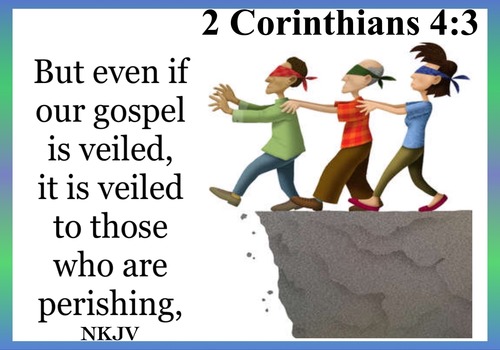
4 Therefore, since we have this ministry, as we received mercy, we do not lose heart, 2 but we have renounced the things hidden because of shame, not walking in craftiness or adulterating the word of God, but by the manifestation of truth commending ourselves to every man’s conscience in the sight of God. 3 And even if our gospel is veiled, it is veiled [a]to those who are perishing, 4 in whose case the god of this [b]world has blinded the minds of the unbelieving [c]so that they might not see the light of the gospel of the glory of Christ, who is the image of God.5 For we do not preach ourselves but Christ Jesus as Lord, and ourselves as your bond-servants [d]for Jesus’ sake.
Paul had a glorious ministry that flung wide-open the door of salvation to men.
He opened up the Word of God and taught the glorious gospel of grace to Jew and Gentile alike.
This apostle of God revealed so many of the biblical truths and treasures which we have received as a free gift of grace, by our trusting in Christ Jesus as Savior.
Paul had been a strict Jew – a Pharisee of the Pharisees.
Paul had followed the traditions of men.
But since his being commissioned by God as His apostle unto the Gentiles and renouncing his former ways, he insightfully recognized that the very deceitful handling of God’s Word by the legalistic Pharisees, that combined with Satan’s crafty deceit, caused the shining light of the gospel of God to be hidden to those that were lost, and veiled to those that are perishing.
Satan, the scheming god of this world, has cunningly placed a veil of deception and dark shadows of deceit over the hearts, souls and minds of those unsaved.
Although Paul faithfully taught the truth of God’s Word, the minds of sinners have been blinded to the truth and deceived by Satan, the cruel god of this age.
Paul discovered that God’s grace is sufficient, that His strength is freely supplied and His mercies are new every morning.
Despite his careful teaching, his systematic delivery of the gospel, and his earnest desire to clarify the truth of God’s Word through precept and practice, Paul recognized the gospel remained hidden to those that were perishing – for the god of this world has cast a veil over the Word of God, which has shrouded the truth from those that are lost, misguided, misdirected and dead in their sin.
Yet the magnificent God, who has no human limitations, chose to do something even more revealing and even more magnificent than we could all comprehend.
God took on our humanity to become one of us.
Jesus Christ, who with God the Father and the Holy Spirit is the God above all gods, chose to humble himself so that instead of kneeling at God’s footstool in awe and wonder, we could sit at his feet.
All Men, women, and children were invited to gather around Jesus as he told stories about the kingdom of God, taught people how to live as true worshipers of God, had compassion, healed diseases, bruised hearts, and withered spirits.
What’s more, Jesus’ final act of worship was died and rose again and ascended to heaven, where he again sits on the eternal throne.
Everything is under his feet, even the last and bitterest enemy of all: death (1 Corinthians 15:21-26).
21 For since by a man came death, by a man also came the resurrection of the dead. 22 For as in Adam all die, so also in [a]Christ all will be made alive. 23 But each in his own order: Christ the first fruits, after that those who are Christ’s at His coming, 24 then comes the end, when He hands over the kingdom to the God and Father, when He has abolished all rule and all authority and power. 25 For He must reign until He has put all His enemies under His feet. 26 The last enemy that will be abolished is death.
May we each be ready and willing and able to share the good news of salvation with those whose ears are deaf and eyes are blinded to the truth – so they may hear the good news of the gospel of grace – come to the footstool and be saved.
Hallelujah! Let our 24/7 worship declare that Our God reigns forever and ever!
In the name of God, the Father and God the Son and God the Holy Spirit,
Let us Pray,
Heavenly Father, thank You for the many witnesses to the Word of truth. Thank You that salvation is freely available to all who will open their eyes to the truth of Your Word and unblock their ears to the satanic lies and deceptions that come from the evil one. Look down in pity on those that are in the valley of indecisions and bring many into saving faith this day, through the convicting work of the Holy Spirit.
100 Shout joyfully to the Lord, all the earth. 2 Serve the Lord with gladness; Come before Him with joyful singing. 3 Know that the Lord [b]Himself is God; It is He who has made us, and [c]not we ourselves; We are His people and the sheep of His pasture.
4 Enter His gates with [d]thanksgiving And His courts with praise. Give thanks to Him, bless His name. 5 For the Lord is good; His lovingkindness is everlasting And His faithfulness to all generations.
Glory be to the Father, and to the Son, and to the Holy Ghost; as it was in the beginning, is now, and ever shall be, world without end. Amen, amen.
Revelation 4:8-11 New American Standard Bible 1995
8 And the four living creatures, each one of them having six wings, are full of eyes around and within; and day and night [a]they do not cease to say,
“Holy, holy, holy is the Lord God, the Almighty, who was and who is and who [b]is to come.”
9 And when the living creatures give glory and honor and thanks to Him who sits on the throne, to Him who lives forever and ever, 10 the twenty-four elders will fall down before Him who sits on the throne, and will worship Him who lives forever and ever, and will cast their crowns before the throne, saying,
11 “Worthy are You, our Lord and our God, to receive glory and honor and power; for You created all things, and because of Your will they [c]existed, and were created.”
The Word of God for the Children of God.
Glory be to the Father, and to the Son, and to the Holy Ghost; as it was in the beginning, is now, and ever shall be, world without end. Amen, amen.
Heaven’s throne room is filled with sounds of praise and worship.
The four living creatures give round-the-clock adoration to the One on the throne.
“Holy, holy, holy is the Lord God Almighty,” they proclaim.
This is a picture of all creation eternally honoring God as the Creator and Lord over all things—the only one worthy of all praise.
Creation’s eternal song of praise—led by the four living creatures— serves as a call to worship for the twenty-four elders.
God’s people cannot help responding in worship when surrounded by the authentic, enthusiastic praises of all the rest of creation.
All God’s people in his worldwide church—young and elderly, seekers and established followers—help each other celebrate and confess with praise.
Together, we join with the rest of creation, eternally saying, eternally singing;
“You are worthy, our Lord and God, to receive glory and honor and power, for you [alone] created all things, and by your will they . . . have their being.”
This picture serves to remind us that just as creation constantly, and eternally proclaims the glory of God (Psalm 19), so can all God’s people—in our work, our play, our relationships each day as well as when we gather for a worship service.
Psalm 19 New American Standard Bible 1995
The Works and the Word of God.
For the choir director. A Psalm of David.
19 The heavens are telling of the glory of God; And their expanse is declaring the work of His hands. 2 Day to day pours forth speech, And night to night reveals knowledge. 3 There is no speech, nor are there words; Their voice is not heard. 4 Their [a]line has gone out through all the earth, And their utterances to the end of the world. In them He has placed a tent for the sun, 5 Which is as a bridegroom coming out of his chamber; It rejoices as a strong man to run his course. 6 Its rising is from [b]one end of the heavens, And its circuit to the [c]other end of them; And there is nothing hidden from its heat.
7 The law of the Lord is [d]perfect, restoring the soul; The testimony of the Lord is sure, making wise the simple. 8 The precepts of the Lord are right, rejoicing the heart; The commandment of the Lord is pure, enlightening the eyes. 9 The fear of the Lord is clean, enduring forever; The judgments of the Lord are true; they are righteous altogether. 10 They are more desirable than gold, yes, than much fine gold; Sweeter also than honey and the drippings of the honeycomb. 11 Moreover, by them Your servant is warned; In keeping them there is great reward. 12 Who can discern his errors? Acquit me of hidden faults. 13 Also keep back Your servant from presumptuous sins; Let them not rule over me; Then I will be [e]blameless, And I shall be acquitted of great transgression. 14 Let the words of my mouth and the meditation of my heart Be acceptable in Your sight, O Lord, my rock and my Redeemer.
All things identified in Psalm 19 give their glory and honor and praise unto God for bringing them all into being, and he keeps all creation in his constant care.
With all that revelation of what God has implanted onto our souls, realize that Our all creating, all life-sustaining God is worthy to receive our praise always.
In this moment of writing, I couldn’t help but enter into a sacred time of prayer;
Psalm 19:12-14 Amplified Bible
12 Who can understand his errors or omissions? Acquit me of hidden (unconscious, unintended) faults. 13 Also keep back Your servant from presumptuous (deliberate, willful) sins; Let them not rule and have control over me. Then I will be blameless (complete), And I shall be acquitted of great transgression. 14 Let the words of my mouth and the meditation of my heart Be acceptable and pleasing in Your sight, O Lord, my [firm, immovable] rock and my Redeemer.
And in the midst of that praying, this thought was placed deep into my soul;
There is something about those words “eternal” and “worship” used together!
It puts one’s soul into a deeply sacred place of indescribable amazement and too wonderment, one should wonder how amazing would it be to worship God 24/7!
What Would it Look Like to Worship God 24/7?
Revelation 4:8-11 Amplified Bible
8 And the four living creatures, each one of them having six wings, are full of eyes all over and within [underneath their wings]; and day and night they never stop saying,
“Holy, holy, holy [is the] Lord God, the Almighty [the Omnipotent, the Ruler of all], who was and who is and who is to come [the unchanging, eternal God].”
9 Whenever the living creatures give glory and honor and thanksgiving to Him who sits on the throne, to Him who lives forever and ever, 10 the twenty-four elders fall down before Him who sits on the throne, and they worship Him who lives forever and ever; and they throw down their crowns before the throne, saying,
11 “Worthy are You, our Lord and God, to receive the glory and the honor and the power; for You created all things, and because of Your will they exist, and were created and brought into being.”
I rose to my feet in the dim light of the Orthodox sanctuary as the opening strains of music and chanting called the congregation to a time of worship.
This was my very first time experiencing worship of God in an Orthodox church.
I had no idea what to expect when the two priests began to chant and pray.
My heart lifted to God as I joined in singing about the glories of heaven.
I closed my eyes, and the lyrics formed a picture in my mind.
Leaning into the presence of God and Jesus, Holy Spirit, I basked in His love.
However, in the second stanza of the song, like nails on a chalkboard, a wrong word or an unintelligible word wrenched me out from my attitude of worship.
I realize you’re probably wondering who notices such things. I admit, I’m one of those grammar freaks who’s bothered by a subjective pronoun used as the object of a preposition. If your eyes glazed over at this explanation, please don’t stop reading. I promise I will bring this around to a point quite relevant to you.
I must profusely, sincerely apologize for how easily a small grammatical error derailed my soul away from my worship of the God who created the universe.
I wonder if you, too, have been distracted from giving God all the attention He is worthy of receiving.
I assume most people will not be bothered by a deviance from English language standards.
But I suspect we all have felt the tug-of-war between the world and worship.
The writer of Revelation painted a scene depicting the throne room of heaven.
Almighty God sits at the center in the place of honor surrounded by four unusual beings and twenty-four elders.
The main purpose of the four beings is worship. Day and night, they repeat words of praise to the King seated on the throne.
The elders respond by saying,
“You are worthy, O Lord our God, to receive glory and honor and power. For you created all things, and they exist because you created what you pleased” (Revelation 4:11 NLT).
Please notice though that absolutely nothing ever distracts these worshipers.
The presence of God is so utterly riveting that all else fades into insignificance.
Then this thunders into my soul: God created us to be 24/7 worshipers too!
Worship is more than the musical or sermon or ending part of a church service.
The Apostle Paul said every aspect of our lives can glorify God, even our daily consumption of nutrition.
“So whether you eat or drink, or whatever you do, do it all for the glory of God” (1 Corinthians 10:31 NLT).
Try contemplating 24/7 that all of the following can be filled with worship:
• Attention to excellence in our jobs to please God
• Sacrifice of ourselves to raise the next generation to love Jesus
• Wholesome thoughts that elevate God to His rightful place of honor
• Time spent in meditation on the Word and communication with God
• Confession of sins to cleanse our hearts
• Study of the Bible to increase our knowledge and magnify the Lord
How often, though, do distractions yank us from our worship of God in these activities?
For most, grammar won’t divert our attention from our Lord.
But if you’re like me, your own agenda and plans can eclipse the view of our Creator.
Economics, Entertainment, politics, and social media also rank high on my list of distractions.
Even more insidious are the thoughts inside my head that control me—worry about the future and memories of the past. Finally, incorrect ideas about God’s character too interfere with our desire to live a life that glorifies, worships Him.
God is worthy of our dedicated worship that offers much more than perfunctory singing on Sunday mornings. He deserves all the praise we can muster because He created us. He designed us to please Himself. Even more, with unconditional love, and provision He provides all we need. Our worship brings Him pleasure.
As our Creator, God knows wholehearted 24/7 worship of Him is best for us.
When we eliminate distractions and make Him the center of our attention, we enjoy the rich and satisfying life Jesus promised (John 10:10).
John 10:9-16 Amplified Bible
9 I am the Door; anyone who enters through Me will be saved [and will live forever], and will go in and out [freely], and find pasture (spiritual security). 10 The thief comes only in order to steal and kill and destroy. I came that they may have and enjoy life, and have it in abundance [to the full, till it overflows].
11 [a]I am the Good Shepherd. The Good Shepherd [b]lays down His [own] life for the sheep. 12 But the hired man [who merely serves for wages], who is neither the shepherd nor the owner of the sheep, when he sees the wolf coming, deserts the flock and runs away; and the wolf snatches the sheep and scatters them. 13 The man runs because he is a hired hand [who serves only for wages] and is not concerned about the [safety of the] sheep. 14 I am the Good Shepherd, and I know [without any doubt those who are] My own and My own know Me [and have a deep, personal relationship with Me]— 15 even as the Father knows Me and I know the Father—and I lay down My [very own] life [sacrificing it] for the benefit of the sheep. 16 I have [c] other sheep [beside these] that are not of this fold. I must bring those also, and they will listen to My voice and pay attention to My call, and they will become [d]one flock with one Shepherd.
Friends, let’s examine every facet of our lives to root out any distractions from 24/7 worship of God.
We don’t want anything, even a small grammatical error, to pull us away from our God-given purpose.
Intersecting Faith & Life:
Consider this article I found on my news feed … thoughts and comments?
Ask God to help you evaluate the various parts of your life for distractions that might be diluting your wholehearted worship. Meditate upon psalms of praise and Lament until they dominate all your thoughts and influence your actions.
In the name of God, the Father and God the Son and God the Holy Spirit,
Let us Pray,
Psalm 96 New American Standard Bible 1995
A Call to Worship the Lord the Righteous Judge.
96 Sing to the Lord a new song; Sing to the Lord, all the earth. 2 Sing to the Lord, bless His name; Proclaim good tidings of His salvation from day to day. 3 Tell of His glory among the nations, His wonderful deeds among all the peoples. 4 For great is the Lord and greatly to be praised; He is to be feared above all gods. 5 For all the gods of the peoples are [a]idols, But the Lord made the heavens. 6 Splendor and majesty are before Him, Strength and beauty are in His sanctuary.
7 [b]Ascribe to the Lord, O families of the peoples, [c]Ascribe to the Lord glory and strength. 8 [d]Ascribe to the Lord the glory of His name; Bring an [e]offering and come into His courts. 9 Worship the Lord in [f]holy attire; Tremble before Him, all the earth. 10 Say among the nations, “The Lord reigns; Indeed, the world is firmly established, it will not be moved; He will judge the peoples with [g]equity.”
11 Let the heavens be glad, and let the earth rejoice; Let the sea [h]roar, and [i]all it contains; 12 Let the field exult, and all that is in it. Then all the trees of the forest will sing for joy 13 Before the Lord, for He is coming, For He is coming to judge the earth. He will judge the world in righteousness And the peoples in His faithfulness.
Glory be to the Father, and to the Son, and to the Holy Ghost; as it was in the beginning, is now, and ever shall be, world without end. Amen, amen.
33 Sing for joy in the Lord, O you righteous ones; Praise is becoming to the upright. 2 Give thanks to the Lord with the lyre; Sing praises to Him with a harp of ten strings. 3 Sing to Him a new song; Play skillfully with a shout of joy. 4 For the word of the Lord is upright, And all His work is done in faithfulness. 5 He loves righteousness and justice; The earth is full of the lovingkindness of the Lord.
6 By the word of the Lord the heavens were made, And by the breath of His mouth all their host. 7 He gathers the waters of the sea together [a]as a heap; He lays up the deeps in storehouses. 8 Let all the earth fear the Lord; Let all the inhabitants of the world stand in awe of Him. 9 For He spoke, and it was done; He commanded, and it [b]stood fast. 10 The Lord nullifies the counsel of the nations; He frustrates the plans of the peoples. 11 The counsel of the Lord stands forever, The plans of His heart from generation to generation. 12 Blessed is the nation whose God is the Lord, The people whom He has chosen for His own inheritance.
13 The Lord looks from heaven; He sees all the sons of men; 14 From His dwelling place He looks out On all the inhabitants of the earth, 15 He who fashions [c]the hearts of them all, He who understands all their works. 16 The king is not saved by a mighty army; A warrior is not delivered by great strength. 17 A horse is a false hope for victory; Nor does it deliver anyone by its great strength.
18 Behold, the eye of the Lord is on those who fear Him, On those who [d]hope for His lovingkindness, 19 To deliver their soul from death And to keep them alive in famine. 20 Our soul waits for the Lord; He is our help and our shield. 21 For our heart rejoices in Him, Because we trust in His holy name. 22 Let Your lovingkindness, O Lord, be upon us, According as we have [e]hoped in You.
Glory be to the Father, and to the Son, and to the Holy Ghost; as it was in the beginning, is now, and ever shall be, world without end. Amen, amen.
Though I wasn’t a carpenter by trade, in my youth I loved to work with wood.
I enjoyed the effort of taking pieces of scrap wood of any size or shape and condition and just transforming them into something useful and pleasing.
As creatures made in the image of God, (Genesis 1:26-28) we all have an inborn desire to make things useful and lovely.
In this stewardship we imitate God, who created the heavens and the earth.
For the reader Psalm 33 recalls God’s almighty power in creating everything around us: the sky, the sun, the stars, the mountains, the rivers, the oceans.
God not only created all that we see; he also created good things we can’t see—like air, gravity, and sound, as well as forgiveness, love, goodness, and justice.
God did this, as the psalm says in verse 6, through the power of his spoken word.
When we say, with the Apostle’s Creed, that God is the “creator of heaven and earth,” we are acknowledging, declaring and recalling that the same God who made the mountains, forests, the rivers and oceans made each one of us too.
Psalm 139:13-18 New American Standard Bible 1995
13 For You formed my [a]inward parts; You wove me in my mother’s womb. 14 I will give thanks to You, for [b]I am fearfully and wonderfully made; Wonderful are Your works, And my soul knows it very well. 15 My [c]frame was not hidden from You, When I was made in secret, And skillfully wrought in the depths of the earth; 16 Your eyes have seen my unformed substance; And in Your book were all written The days that were ordained for me, When as yet there was not one of them.
17 How precious also are Your thoughts to me, O God! How vast is the sum of them! 18 If I should count them, they would outnumber the sand. When I awake, I am still with You.
What’s more, we are declaring and praising that this God hasn’t stepped back from what he has made; no, he still delights in preserving and in sustaining it.
We can each take great comfort in knowing that the all-powerful Creator and sustainer, God Almighty, is the one that we also call our heavenly Father.
There is never a time or a single moment that God does not care for us and too about us; he knows what we need; he will never let us slip from his tender care.
How Can We Use Our Creative Talents to Glorify God?
Genesis 1:1-5 New American Standard Bible 1995
The Creation
1 In the beginning God created the heavens and the earth. 2 The earth was [a] formless and void, and darkness was over the [b]surface of the deep, and the Spirit of God was [c]moving over the [d]surface of the waters. 3 Then God said, “Let there be light”; and there was light. 4 God saw that the light was good; and God separated the light from the darkness. 5 God called the light day, and the darkness He called night. And there was evening and there was morning, one day.
It is written in the very first line of the Bible: “In the beginning God created…” (Genesis 1:1, emphasis added).
Creativity begins with God.
He had a very definite plan and design for the cosmos and spoke it into being.
We have a written account of how creation came to be, and how the very first people were made by God. God spoke, made, and revealed it all through the written word. He was behind the entire creative order that we see around us.
When we do look at the intricacy of a human being, the intricacy of a snowflake, the symmetry of a butterfly, or the perfect location of the earth’s position in the rest of the solar system, we see the deep intricate handiwork of our Creator God.
He also planned that we would be made in His image (Genesis 1:26), so it is no surprise that we get to experience the wonder and joy of creativity ourselves.
With all of this God given uniquely individualized creative potential, do we ever wonder exactly how we can all use our uniquely creative talents to glorify God?
Give All the Glory and Praise to God Alone
Whatever we do, we are to do it to the glory of God (1 Corinthians 10:31).
That includes our creative endeavors.
As the apostle Paul shared,
“Whatever you do, work at it with all your heart, as working for the Lord, not for human masters, since you know that you will receive an inheritance from the Lord as a reward. It is the Lord Christ you are serving” (Colossians 3:23-24).
In Colossians 1:16 it says: “For in him all things were created: things in heaven and on earth, visible and invisible, whether thrones or powers or rulers or authorities; all things have been created through him and for him.”
It is through Jesus that everything has been made and it is all for Him (John 1:3).
God made the universe through His Son (Hebrews 1:2) and it is by faith that “we understand that the universe was formed at God’s command, so that what is seen was not made out of what was visible” (Hebrews 11:3). It is right and good and joyful to give all glory to the One who made it all and for whom it is all for.
It also fulfills the command to “love the Lord your God with all your heart, and with all your soul, and with all your mind, and with all your strength” (Luke 10:27).
What we create should not be worshiped, nor should we glorify ourselves or others in our creative pursuits.
That does not mean that we do not enjoy or appreciate what we create, but we acknowledge, remember to keep our love and affections in their rightful place.
Not Only Praise but Participate in God’s Masterpiece
Genesis 2:19-23 New American Standard Bible 1995
19 Out of the ground the Lord God formed every beast of the field and every bird of the [a]sky, and brought them to the man to see what he would call them; and whatever the man called a living creature, that was its name. 20 The man gave names to all the cattle, and to the birds of the [b]sky, and to every beast of the field, but for [c]Adam there was not found a helper [d]suitable for him. 21 So the Lord God caused a deep sleep to fall upon the man, and he slept; then He took one of his ribs and closed up the flesh at that place. 22 The Lord God [e] fashioned into a woman the rib which He had taken from the man, and brought her to the man. 23 The man said,
“This is now bone of my bones, And flesh of my flesh; [f]She shall be called [g]Woman, Because [h]she was taken out of [i]Man.”
We all have the immense privilege of joining with God in His creative purposes for the world. It was God’s wonderful idea to create people and to get the first man to name the livestock, the birds and the wild animals (Genesis 2:20).
God “brought them to the man to see what he would name them; and whatever the man called each living creature, that was its name” (Genesis 2:19).
From the very beginning every moment of this was God’s idea to involve us in the creative stewardship of His creation, it was not an idea of our own making.
God made the first woman as a helper, creating her from the rib of the man, and he named her too (Genesis 2:21-23). They would work together in the world.
God invites every single one of us to uniquely participate in His grand design on earth, and His kingdom purposes.
We are made in His image and formed by Him, and God has a plan and a purpose, establishing our steps (Proverbs 16:9).
We can each use our creative talents for good or for ill, but as we look to Jesus, our desires will become more and more like His. Using our creativity enables us to uniquely express a part of who God has designed us to be (Psalm 139:13-16).
That will look different for each person, as we are all individuals with unique gifts and abilities, yet we are all “fearfully and wonderfully made” by Him (Psalm 139:14).
Glorify God by Our Love for Others with Our Creativity
Mark 12:28-34 New American Standard Bible 1995
28 One of the scribes came and heard them arguing, and recognizing that He had answered them well, asked Him, “What commandment is the [a]foremost of all?” 29 Jesus answered, “The foremost is, ‘Hear, O Israel! The Lord our God is one Lord; 30 and you shall love the Lord your God with all your heart, and with all your soul, and with all your mind, and with all your strength.’ 31 The second is this, ‘You shall love your neighbor as yourself.’ There is no other commandment greater than these.” 32 The scribe said to Him, “Right, Teacher; You have truly stated that He is One, and there is no one else besides Him; 33 and to love Him with all the heart and with all the understanding and with all the strength, and to love one’s neighbor as himself, is much more than all burnt offerings and sacrifices.” 34 When Jesus saw that he had answered intelligently, He said to him, “You are not far from the kingdom of God.” After that, no one would venture to ask Him any more questions.
It is important to remember the first two commandments as we create: love the Lord your God and love your neighbor as yourself.
Loving the Lord comes first. We need to spend time with Him regularly; it is vital to build and nurture a relationship with our Heavenly Father. As we do this, it will truly transform our longings and desires to love and serve others.
God loves the people whom He created, and He designed us to be in community together. As we create to the glory and honor of God and out of love for Him, it will spill over into how we use our talents, our time, our resources for others.
This might look like caring for those in need, volunteering our skills, designing something to the best of our ability with utmost integrity, photographing or painting beautiful landscapes to show God’s work on display, so much more.
There are endless opportunities to be creative.
The people in our homes, communities and our churches and the wider world can be mightily blessed, uplifted and too inspired by our God-given creativity.
Manage Our Creative Talents Well
James 1:12-17 New American Standard Bible 1995
12 Blessed is a man who perseveres under trial; for once he has [a]been approved, he will receive the crown of life which the Lord has promised to those who love Him. 13 Let no one say when he is tempted, “I am being tempted [b]by God”; for God cannot be tempted [c]by evil, and He Himself does not tempt anyone. 14 But each one is tempted when he is carried away and enticed by his own lust. 15 Then when lust has conceived, it gives birth to sin; and when sin [d]is accomplished, it brings forth death. 16 Do not be [e]deceived, my beloved brethren. 17 Every good thing given and every perfect gift is from above, coming down from the Father of lights, with whom there is no variation or [f]shifting shadow.
We are to steward what God has given us and remember that all good gifts come from Him (James 1:17).
Even as we are diligent with our time, resources and creative talents, we can continue to learn and develop in our creativity.
As we look to Him who is the giver and provider of all we need, we worship Him alone, rather than anything that we create.
Throughout the Bible, there are examples of humans using their gifts and abilities to create things to worship other than God.
We see it when the Israelites created a golden calf to worship (Exodus 32) and in the construction of the Tower of Babel (Genesis 11:1-4).
In both cases, they made a god or a name for themselves, demonstrating the skill, but also the deep-rooted pride of mankind.
Even idolizing people made in the image of God lends itself to the worship of the creation rather than the Creator (Romans 1:25).
There is risk and temptation to pursue and follow created things and step into idolatry, rather than to worship God.
Therefore, we must bring our creativity before the Lord, knowing it is Him that we are serving, and we should use our talents wisely.
Embrace the Skills Given to Us
Exodus 35:10-19 New American Standard Bible 1995
Tabernacle Workmen
10 ‘Let every skillful man among you come, and make all that the Lord has commanded: 11 the [a]tabernacle, its tent and its covering, its hooks and its boards, its bars, its pillars, and its [b]sockets; 12 the ark and its poles, the [c] mercy seat, and the curtain of the screen; 13 the table and its poles, and all its [d]utensils, and the bread of the [e]Presence; 14 the lampstand also for the light and its utensils and its lamps and the oil for the light; 15 and the altar of incense and its poles, and the anointing oil and the fragrant incense, and the screen for the doorway at the [f] entrance of the tabernacle; 16 the altar of burnt offering with its [g]bronze grating, its poles, and all its [h]utensils, the [i]basin and its stand; 17 the hangings of the court, its pillars and its [j]sockets, and the screen for the gate of the court; 18 the pegs of the tabernacle and the pegs of the court and their cords; 19 the [k]woven garments for ministering in the holy place, the holy garments for Aaron the priest and the garments of his sons, to minister as priests.’”
God gives skills to different people. We are all given certain abilities, even if it might take us a little while to discover or develop what they are.
In the building of the Tabernacle, there were many who had different skills given to them by God which would be used to complete it: “All who are skilled among you are to come and make everything the Lord has commanded” (Exodus 35:10).
It is a beautiful picture of some of God’s people who were “willing and whose heart moved them” and brought materials and offerings to God for this work (Exodus 35:21-22).
Men and women all participated together, and there was willingness and skill involved to make what God had commanded come to be. Are we also willing to offer our unique skills in whatever way is needed for God’s glory and purpose?
God Equips Whose He Calls
Exodus 35:30-35 New American Standard Bible 1995
30 Then Moses said to the sons of Israel, “See, the Lord has called by name Bezalel the son of Uri, the son of Hur, of the tribe of Judah. 31 And He has filled him with the Spirit of God, in wisdom, in understanding and in knowledge and in all [a] craftsmanship; 32 [b]to make designs for working in gold and in silver and in [c] bronze, 33 and in the cutting of stones for settings and in the carving of wood, so as to perform in every inventive work. 34 He also has put in his heart to teach, both he and Oholiab, the son of Ahisamach, of the tribe of Dan. 35 He has filled them with [d]skill to perform every work of an engraver and of a designer and of an embroiderer, in [e]blue and in purple and in scarlet material, and in fine linen, and of a weaver, as performers of every work and makers of designs.
God also equips those whom He calls to a specific task.
In the building of the Tabernacle, the Lord chose Bezalel of the tribe of Judah, and filled him with the Spirit of God, with wisdom, understanding, knowledge and all kinds of skills, to make artistic designs (Exodus:35:30-35).
He also equipped him and Oholiab of the tribe of Dan to be able to teach others. God is the one who fills us with the skills for the tasks that He has called us to.
The creative process means walking through trials and frustrations at times, but can also develop our perseverance and character.
God can use our creativity to shape and transform us into the likeness of Jesus as we seek to use our creative talents for His glory.
He is interested in our hearts.
As we create, we can ask Jesus to help us honor Him in our pursuits.
We can use our creativity to build up believers, spread the good news to those who do not know Jesus, support those in need, and use it as a way to provide an income for our families.
As we surrender, yield to God, continually thinking “not my will but yours be done,” He can take our creative offering, transform it for His glory, purposes.
God saw the two loaves and five fish, and He was the One who filled the crowd.
Give Him your creative talents, no matter how big or small, and let Him deeply satisfy your every need.
As pastor and theologian Reverend Dr. John Piper said:
“God is most glorified in you when you are most satisfied in him.”
23 Search me, O God, and know my heart; Try me and know my anxious thoughts; 24 And see if there be any [a]hurtful way in me, And lead me in the everlasting way.
In the name of God, the Father and God the Son and God the Holy Spirit,
Let us Pray,
Psalm 148 New American Standard Bible 1995
The Whole Creation Invoked to Praise the Lord.
148 [a]Praise [b]the Lord! Praise the Lord from the heavens; Praise Him in the heights! 2 Praise Him, all His angels; Praise Him, all His hosts! 3 Praise Him, sun and moon; Praise Him, all stars of light! 4 Praise Him, [c]highest heavens, And the waters that are above the heavens! 5 Let them praise the name of the Lord, For He commanded and they were created. 6 He has also established them forever and ever; He has made a decree which will not pass away.
7 Praise the Lord from the earth, Sea monsters and all deeps; 8 Fire and hail, snow and clouds; Stormy wind, fulfilling His word; 9 Mountains and all hills; Fruit trees and all cedars; 10 Beasts and all cattle; Creeping things and winged fowl; 11 Kings of the earth and all peoples; Princes and all judges of the earth; 12 Both young men and virgins; Old men and children.
13 Let them praise the name of the Lord, For His name alone is exalted; His glory is above earth and heaven. 14 And He has lifted up a horn for His people, Praise for all His godly ones; Even for the sons of Israel, a people near to Him. [d]Praise [e]the Lord!
Glory be to the Father, and to the Son, and to the Holy Ghost; as it was in the beginning, is now, and ever shall be, world without end. Amen, amen.
Philippians 2:5-11 New American Standard Bible 1995
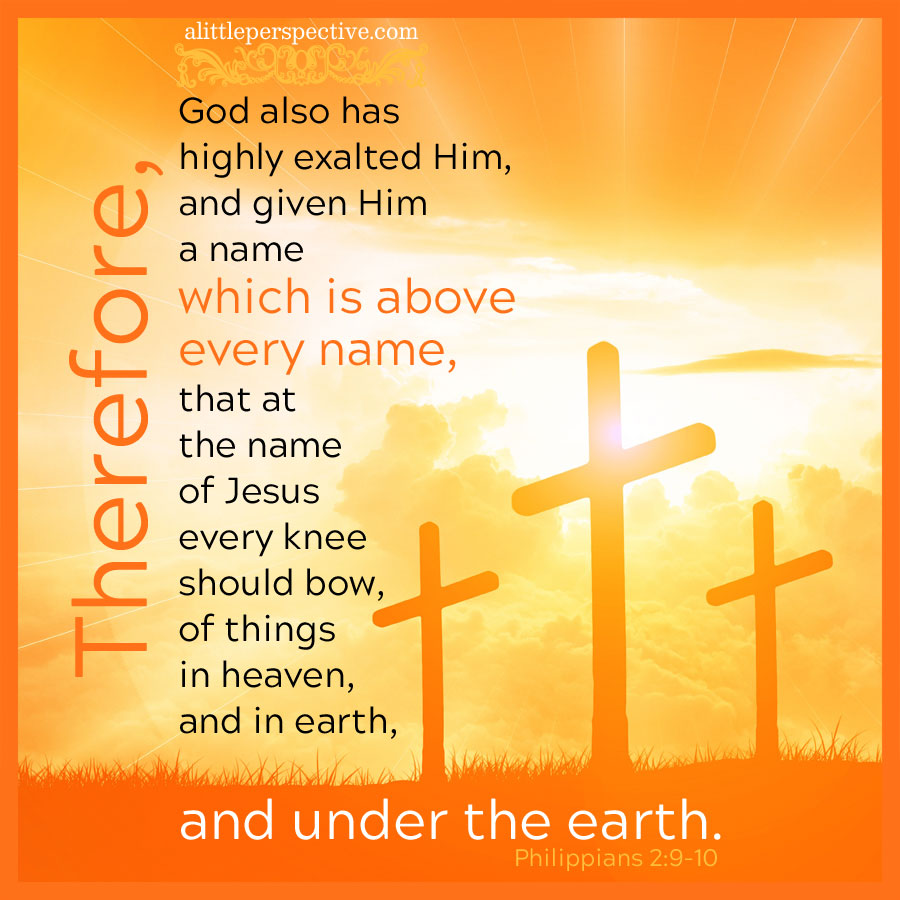
5 Have this attitude [a]in yourselves which was also in Christ Jesus, 6 who, although He existed in the form of God, did not regard equality with God a thing to be [b] grasped, 7 but [c]emptied Himself, taking the form of a bond-servant, and being made in the likeness of men. 8 Being found in appearance as a man, He humbled Himself by becoming obedient to the point of death, even death [d]on a cross. 9 For this reason also, God highly exalted Him, and bestowed on Him the name which is above every name, 10 so that at the name of Jesus every knee will bow, of those who are in heaven and on earth and under the earth, 11 and that every tongue will confess that Jesus Christ is Lord, to the glory of God the Father.
The Word of God for the Children of God.
Glory be to the Father, and to the Son, and to the Holy Ghost; as it was in the beginning, is now, and ever shall be, world without end. Amen, amen.
The Only Higher Glory
Philippians 2:9 Amplified Bible
9 For this reason also [because He obeyed and so completely humbled Himself], God has highly exalted Him and bestowed on Him the name which is above every name,
We have been talking about our having the mindset of Christ and following his example of humility.
When it comes to humility, no one can be humbler than Christ, who gave up his own life so that all who call on his name can be saved to have new life forever.
And because Jesus did that, the Word of God says that God also raised him from the grave and “exalted him to the highest place.”
He started out as the Son of God in heaven.
Then he willingly became a suffering servant who swooped down to the lowest of depths by dying on a cross for our sake.
Then God, as only God is able, reversed it all and swung Jesus upward to rule in heaven over everything.
The words Apostle Paul uses to describe this position have to do with the power of the highest name: “God . . . gave him the name that is above every name.” And what is that name? It is Jesus (meaning “Savior”), and it is Christ (meaning “Anointed One”). Jesus Christ is the Lord, the sovereign ruler, over all things.
His name is so glorious the day will come when every knee will bow to honor him, every tongue will sing songs to “acknowledge that Jesus Christ is Lord.”
Jesus Christ, who died and rose again, is Lord of the cosmos.
All glory be to him forever and ever!
The Only Rightly Exalted, The Only Greater Exaltation
Philippians 2:5-8 Amplified Bible
5 Have this same attitude in yourselves which was in Christ Jesus [look to Him as your example in selfless humility], 6 who, although He existed in the form and unchanging essence of God [as One with Him, possessing the fullness of all the divine attributes—the entire nature of deity], did not regard equality with God a thing to be grasped or asserted [as if He did not already possess it, or was afraid of losing it]; 7 but emptied Himself [without renouncing or diminishing His deity, but only temporarily giving up the outward expression of divine equality and His rightful dignity] by assuming the form of a bond-servant, and being made in the likeness of men [He became completely human but was without sin, being fully God and fully man]. 8 After He was found in [terms of His] outward appearance as a man [for a divinely-appointed time], He humbled Himself [still further] by becoming obedient [to the Father] to the point of death, even death on a cross.
Philippians 2:5-8 is a beautiful statement concerning Christ’s humanity, deity, ministry, and humiliation.
Having mapped the humility of the incarnate Son of God all the way to His death on a cross, where does your mind go next? Naturally, we think of the resurrection. But Paul does not. He takes us directly to Christ’s exaltation.
There is, Paul says, a logical connection between Jesus’ humiliation and His exaltation: “Therefore God has highly exalted him”(v 8, emphasis added).
What is this exaltation?
It is that the Father has given His Son the throne and ordered this world so that one day
“at the name of Jesus every knee should bow, in heaven and on earth and under the earth, and every tongue confess that Jesus Christ is Lord, to the glory of God the Father” (v 10-11).
But why is His exaltation fitting?
Scripture gives us several answers.
First, Christ’s exaltation is fitting because it fulfills Old Testament prophecy and demonstrates that God keeps His word.
The worldwide recognition of Jesus as Lord will occur because God promised it would.
Six hundred years before Jesus arrived on the stage of human history, Isaiah recorded these words from God: “Behold, my servant shall act wisely; he shall be high and lifted up, and shall be exalted” (Isaiah 52:13).
And so Christ came to bear the pain and sin of the world, fulfilling the role of Suffering Servant, lifted up on a cross, then raised to be exalted on His throne.
As Paul wrote elsewhere,
“All the promises of God find their Yes in him” (2 Corinthians 1:20).
Second, Christ’s exaltation is fitting because He is God.
The Bible teaches us all that the Son is One with the Father. On account of His divinity, exaltation is an absolute necessity; there is nowhere else for God to sit!
No other seat is suitable for the Son except at His Father’s right hand.
Finally, Christ’s exaltation is fitting because He is the dear Son of His Father.
God the Father watched the Son obediently go to the cross to fulfill the covenant of redemption and heard Him cry out in pain,
“My God, my God, why have you forsaken me?” (Matthew 27:46).
The Father knew that the Son underwent that agony out of love for the Father and love for His people.
Matthew 23:37 Amplified Bible
Lament over Jerusalem
37 “[a]O Jerusalem, Jerusalem, who murders the prophets and stones [to death] those [messengers] who are sent to her [by God]! How often I wanted to gather your children together [around Me], as a hen gathers her chicks under her wings, and you were unwilling.
The Father would not leave His perfect Son in that dire condition.
How could the Father’s love do anything other than exalt the Son from His lowly state?
Christ’s humiliation for us and exaltation above us are surely enough to bring us to the point where we bow in joyful submission to Him.
They show us that there is only one who has the absolute unchallengeable status to demand our obedience and the character to deserve our adoration.
They remind us that the best thing about heaven will be the most glorious person in heaven:
I will not gaze at glory, but on my King of grace; Not at the crown He giveth, but on His pierced hand; The Lamb is all the glory of Immanuel’s land.[1]
1 Anne R. Cousin, “The Sands of Time Are Sinking” (1857).
In the name of God, the Father and God the Son and God the Holy Spirit,
Let us Pray,
Dear God, please help us to bow our knees and confess with our mouths the truth about Jesus’ cosmic glory. Make us witnesses of this splendid gospel truth. Amen.
Psalm 19 New American Standard Bible 1995
The Works and the Word of God.
For the choir director. A Psalm of David.
19 The heavens are telling of the glory of God; And their expanse is declaring the work of His hands. 2 Day to day pours forth speech, And night to night reveals knowledge. 3 There is no speech, nor are there words; Their voice is not heard. 4 Their [a]line has gone out through all the earth, And their utterances to the end of the world. In them He has placed a tent for the sun, 5 Which is as a bridegroom coming out of his chamber; It rejoices as a strong man to run his course. 6 Its rising is from [b]one end of the heavens, And its circuit to the [c]other end of them; And there is nothing hidden from its heat.
7 The law of the Lord is [d]perfect, restoring the soul; The testimony of the Lord is sure, making wise the simple. 8 The precepts of the Lord are right, rejoicing the heart; The commandment of the Lord is pure, enlightening the eyes. 9 The fear of the Lord is clean, enduring forever; The judgments of the Lord are true; they are righteous altogether. 10 They are more desirable than gold, yes, than much fine gold; Sweeter also than honey and the drippings of the honeycomb. 11 Moreover, by them Your servant is warned; In keeping them there is great reward. 12 Who can discern his errors? Acquit me of hidden faults. 13 Also keep back Your servant from presumptuous sins; Let them not rule over me; Then I will be [e]blameless, And I shall be acquitted of great transgression. 14 Let the words of my mouth and the meditation of my heart Be acceptable in Your sight, O Lord, my rock and my Redeemer.
Glory be to the Father, and to the Son, and to the Holy Ghost; as it was in the beginning, is now, and ever shall be, world without end. Amen, amen.
42 “Behold, My Servant, whom I [a]uphold; My chosen one in whom My soul delights. I have put My Spirit upon Him; He will bring forth justice to the [b]nations. 2 “He will not cry out or raise His voice, Nor make His voice heard in the street. 3 “A bruised reed He will not break And a dimly burning wick He will not extinguish; He will faithfully bring forth justice. 4 “He will not be disheartened or crushed Until He has established justice in the earth; And the coastlands will wait expectantly for His [c]law.”
5 Thus says God the Lord,
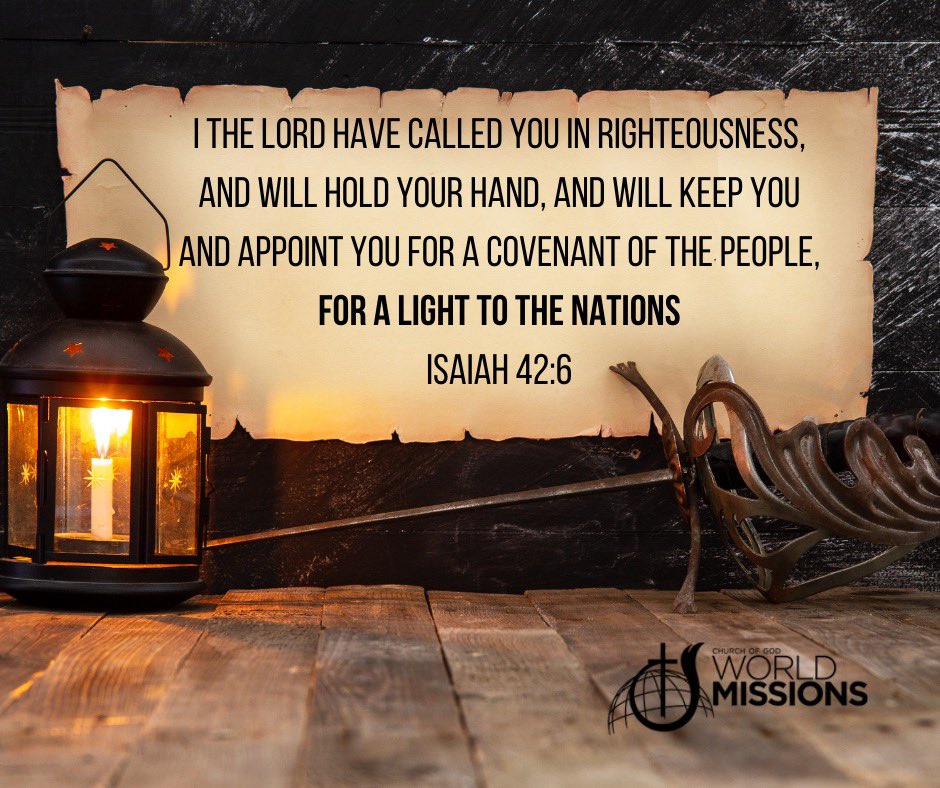
Who created the heavens and stretched them out, Who spread out the earth and its [d]offspring, Who gives breath to the people on it And spirit to those who walk in it, 6 “I am the Lord, I have called You in righteousness, I will also hold You by the hand and watch over You, And I will appoint You as a covenant to the people, As a light to the nations, 7 To open blind eyes, To bring out prisoners from the dungeon And those who dwell in darkness from the prison. 8 “I am the Lord, that is My name; I will not give My glory to another, Nor My praise to [e]graven images. 9 “Behold, the former things have come to pass, Now I declare new things; Before they spring forth I proclaim them to you.”
The Word of God for the Children of God.
Changes and transitions can bring uncertainty and stress, but they also present new opportunities for growth and transformation.
In times of change, we can find comfort and assurance in recognizing that God is leading us, making a way even in the most challenging circumstances.
As we step into new seasons, we can trust that God is leading us on a path of purpose and fulfillment.
Like a stream in the wasteland, God provides us with refreshment and direction in situations that are unfamiliar and may even be threatening (Isaiah 35).
Isaiah 35 New American Standard Bible 1995
Zion’s Happy Future
35 The wilderness and the desert will be glad, And the [a]Arabah will rejoice and blossom; Like the crocus 2 It will blossom profusely And rejoice with rejoicing and shout of joy. The glory of Lebanon will be given to it, The majesty of Carmel and Sharon. They will see the glory of the Lord, The majesty of our God. 3 Encourage the [b]exhausted, and strengthen the [c]feeble. 4 Say to those with anxious heart, “Take courage, fear not. Behold, your God will come with vengeance; The recompense of God will come, But He will save you.” 5 Then the eyes of the blind will be opened And the ears of the deaf will be unstopped. 6 Then the lame will leap like a deer, And the tongue of the mute will shout for joy. For waters will break forth in the wilderness And streams in the [d]Arabah. 7 The [e]scorched land will become a pool And the thirsty ground springs of water; In the haunt of jackals, its resting place, Grass becomes reeds and rushes. 8 A highway will be there, a roadway, And it will be called the Highway of Holiness. The unclean will not travel on it, But it will be for him who walks that way, And fools will not wander on it. 9 No lion will be there, Nor will any vicious beast go up on it; [f]These will not be found there. But the redeemed will walk there, 10 And the ransomed of the Lord will return And come with joyful shouting to Zion, With everlasting joy upon their heads. They will [g]find gladness and joy, And sorrow and sighing will flee away.
Though changes in our lives may feel overwhelming —especially if they are forced on us—we have the promise that God is with us every step of the way.
God equips each and every one of us with the grace, strength and wisdom we need to face the an unforeseeable future with assurance and His confidence.
In times of transition, let’s surrender our plans and desires to God, seeking his will and guidance. As we embrace new beginnings, we can all move forward in faith, knowing that God is our constant companion and the author of our story.
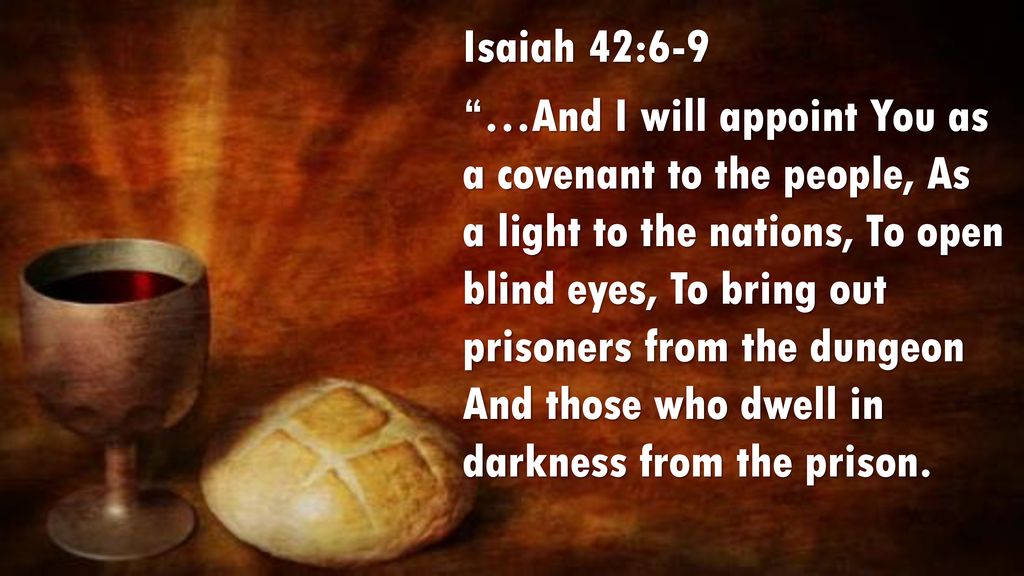
Isaiah 42:6-9 …And I will appoint You as a covenant to the people, As a light to the nations, To open blind eyes, To bring out prisoners from the dungeon And those who dwell in darkness from the prison.
In the name of God, the Father and God the Son and God the Holy Spirit,
Let us Pray,
Faithful God, in times of change help us to trust in you for guidance and provision. Open our eyes to new things that you are doing in our lives. Help us to embrace change with courage and faith, knowing you are always with us. In Jesus’ name.
Psalm 23 New American Standard Bible 1995
The Lord, the Psalmist’s Shepherd.
A Psalm of David.
23 The Lord is my shepherd, I [a]shall not want. 2 He makes me lie down in green pastures; He leads me beside [b]quiet waters. 3 He restores my soul; He guides me in the [c]paths of righteousness For His name’s sake.
4 Even though I walk through the [d]valley of the shadow of death, I fear no [e]evil, for You are with me; Your rod and Your staff, they comfort me. 5 You prepare a table before me in the presence of my enemies; You [f]have anointed my head with oil; My cup overflows. 6 [g]Surely goodness and lovingkindness will follow me all the days of my life, And I will [h]dwell in the house of the Lord [i]forever.
Glory be to the Father, and to the Son, and to the Holy Ghost; as it was in the beginning, is now, and ever shall be, world without end. Amen, amen.
Philippians 2:1-4 New American Standard Bible 1995
Be Like Christ
2 Therefore if there is any encouragement in Christ, if there is any consolation of love, if there is any fellowship of the Spirit, if any [a]affection and compassion, 2 make my joy complete [b]by being of the same mind, maintaining the same love, united in spirit, intent on one purpose. 3 Do nothing [c]from [d] selfishness or empty conceit, but with humility of mind regard one another as more important than yourselves; 4 do not merely look out for your own personal interests, but also for the interests of others.
The Word of God for the Children of God.
Glory be to the Father, and to the Son, and to the Holy Ghost; as it was in the beginning, is now, and ever shall be, world without end. Amen, amen.
As followers of Christ, we are called to embrace a servant attitude, putting the needs of others far before our own.
This humility echoes the very heart of Jesus, who came not “to be served, but to serve, and to give his life as a ransom for many” (Mark 10:45).
In a world that far too often exalts self-promotion and personal gain, we stand apart by valuing others far above ourselves. Our mindsets; we seek to meet the needs of people around us, extending all kindness, empathy, and compassion.
A servant attitude begins with a heart shaped and transformed by God’s love.
As we live in all the selfishness around us, in God’s presence, we learn how to lay down our ambitions and egos, making room for selflessness and sacrificial love. We act with grace and with love toward others, just as God has done for us.
By Paul’s words in Philippians, in every interaction, let’s consider the interests of others, seeking greater opportunities to serve in the both big and small ways.
Contrasting against worldly selfishness, may we be better known not by our alleged accomplishments and achievements and successes but by our love and by our humility and by our servant hearts that follow only the example of Jesus.
Disciples and the World and Lights in the Darkness?
Matthew 5:13-16New American Standard Bible 1995
Disciples and the World
13 “You are the salt of the earth; but if the salt has become tasteless, how [a]can it be made salty again? It is no longer good for anything, except to be thrown out and trampled under foot by men.
14 “You are the light of the world. A city set on a [b]hill cannot be hidden; 15 nor does anyone light a lamp and put it under a [c]basket, but on the lampstand, and it gives light to all who are in the house. 16 Let your light shine before men in such a way that they may see your good works, and glorify your Father who is in heaven.
In response to knowing the heart of God we are called to share the wonders of his invisible nature with a world in desperate need of him. God has chosen to use us to reveal himself. He’s filled us with the Spirit and empowered us to proclaim the good news of salvation and restored relationship with our Creator.
Jesus’ teaching on salt and light in the Sermon on the Mount is truly one of my favorite passages of Scripture related to sharing the heart of God with the world around us.
In Matthew 5:13-16The Message Jesus taught:
Salt and Light
13 “Let me tell you why you are here. You’re here to be salt-seasoning that brings out the God-flavors of this earth. If you lose your saltiness, how will people taste godliness? You’ve lost your usefulness and will end up in the garbage.
14-16 “Here’s another way to put it: You’re here to be light, bringing out the God-colors in the world. God is not a secret to be kept. We’re going public with this, as public as a city on a hill. If I make you light-bearers, you don’t think I’m going to hide you under a bucket, do you? I’m putting you on a light stand. Now that I’ve put you there on a hilltop, on a light stand—shine! Keep open house; be generous with your lives. By opening up to others, you’ll prompt people to open up with God, this generous Father in heaven.
One of the most powerful, empowering aspects of this passage is how Jesus begins by speaking identity over us.
God doesn’t tell us to go get some salt and share it.
He says we are salt.
He doesn’t tell us to go get a light and shine it.
He says we are a light.
Sharing God’s heart is a part of who we are.
As believers we’ve been redeemed—washed clean of our sins—that we might proclaim the excellencies of our Savior by living in line with our new identity.
The world is a dark place.
It is without hope.
It’s filled with the blind leading the blind and the needy seeking fulfillment from the needy. Our only hope is Jesus. The one, true Guide is the Holy Spirit.
We are called to a humble lifestyle of expelling the darkness around us with the powerful proclamation of God’s heart to love, provide for, and redeem all those who would simply say yes to him. We are each called to respond to Jesus’ call
We are summoned to cease putting a basket over the light he’s placed within us.
We don’t have to be apologetic for the hope we have.
We don’t have to fear the opinion of man.
We can love relentlessly, offer grace unexpectedly, and sacrifice ourselves so that others might see a glimpse of God’s heart.
“Let your light shine before others”today.
Don’t cover up who you are in Christ.
Seek to reveal God’s heart in all say and you do. And watch as the world around you is drawn to the light of God’s unconditional love revealed through your life.
Guided Prayer:
1. Meditate on Jesus’ words in the Sermon on the Mount.
Renew your mind to who you are in Christ.
Matthew 5:13-16 Easy-to-Read Version
You Are Like Salt and Light
13 “You are the salt of the earth. But if the salt loses its taste, it cannot be made salty again. Salt is useless if it loses its salty taste. It will be thrown out where people will just walk on it.
14 “You are the light that shines for the world to see. You are like a city built on a hill that cannot be hidden. 15 People don’t hide a lamp under a bowl. They put it on a lampstand. Then the light shines for everyone in the house. 16 In the same way, you should be a light for other people. Live so that they will see the good things you do and praise your Father in heaven.
2. In what ways are you covering up your light?
In what ways are you living in fear or according to the ways of the world?
Take time to engage in confession and receive God’s forgiveness and love.
3. Receive courage from God to live in accordance with your new identity as salt and light.
Ask God how you can be light in the darkness today. Ask him for specific ways you can reveal the hope you have in Jesus to others. Journal his response.
Oftentimes we see the things of God as a part of our life.
As soon as God starts trying to change the way we live day-to-day, we put a wall up over our hearts so we don’t have to change.
But to sequester God is to value this life over eternity.
To care more about the world’s opinion of us than who God says we are is to try and make God a servant of the world and its systems.
God is the Creator.
He alone is King.
And he alone knows best as our loving Father.
To section off your life and allow God only into parts is to live foolishly.
Crown God as King over every part of you.
Choose to live as salt and light. And experience life where God is allowed to manifest himself, bless you in every way he can, and use your life to change the world for the better. May your day today be filled with all the fullness of God.
In the name of God, the Father and God the Son and God the Holy Spirit,
Let us Pray,
Spirit of God, mold my heart in humility and love to imitate the Lord Jesus. Help me to value others above myself and to serve selflessly. May I reflect Christ’s love for the benefit of others in this world each day. In Jesus’ name, Alleluia! Alleluia! Amen.
Psalm 46 New American Standard Bible 1995
God the Refuge of His People.
For the choir director. A Psalm of the sons of Korah, [a]set to Alamoth. A Song.
46 God is our refuge and strength, [b]A very present help in [c]trouble. 2 Therefore we will not fear, though the earth should change And though the mountains slip into the heart of the [d]sea; 3 Though its waters roar and foam, Though the mountains quake at its swelling pride. [e]Selah.
4 There is a river whose streams make glad the city of God, The holy dwelling places of the Most High. 5 God is in the midst of her, she will not be moved; God will help her [f]when morning dawns. 6 The [g]nations made an uproar, the kingdoms tottered; He [h]raised His voice, the earth melted. 7 The Lord of hosts is with us; The God of Jacob is our stronghold. Selah.
8 Come, behold the works of the Lord, [i]Who has wrought desolations in the earth. 9 He makes wars to cease to the end of the earth; He breaks the bow and cuts the spear in two; He burns the chariots with fire. 10 “[j]Cease striving and know that I am God; I will be exalted among the [k]nations, I will be exalted in the earth.” 11 The Lord of hosts is with us; The God of Jacob is our stronghold. Selah.
Glory be to the Father, and to the Son, and to the Holy Ghost; as it was in the beginning, is now, and ever shall be, world without end. Amen, amen.
5 Then He *poured water into the basin, and began to wash the disciples’ feet and to wipe them with the towel with which He was girded. 6 So He *came to Simon Peter. He *said to Him, “Lord, do You wash my feet?” 7 Jesus answered and said to him, What I do you do not realize now, but you will understand hereafter.” 8 Peter *said to Him, “Never shall You wash my feet!” Jesus answered him, “If I do not wash you, you have no part with Me.”
The Word of God for the Children of God.
Glory be to the Father, and to the Son, and to the Holy Ghost; as it was in the beginning, is now, and ever shall be, world without end. Amen, amen.
There have been moments in my life when different trials have blindsided me.
Things like heart disease resulting in urgent triple bypass surgery, unexpected job loss, or a host of other sudden situations where I just felt utterly caught off guard by what I believed and understood to be true about God. Ever been there?
Recently, I was reading the gospel of John, chapter 13.
You know the story. The disciples and Jesus met in the upper room to celebrate the Passover.
We call this the Last Supper.
As the disciples gathered in the room, there was no servant to wash feet.
This would have been absolutely unheard of in Middle East culture where everyone’s feet would get dirty and dusty.
You could feel the tension in the room.
The disciples anxiously looked at each other, wondering who would take the place of a servant and wash feet.
Then Rabbi Jesus wrapped a towel around His waist, got down on His knees, and began washing feet.
Peter was appalled!
Maybe he even felt a bit guilty for not being willing to be the one who would serve others.
In any case, he questioned the Lord with the words, “Lord, are you going to wash my feet?”
We could paraphrase, “Lord are You really going to be the one to wash our feet?
In Peter’s mind, this didn’t make any sense; how could the Lord of the universe stoop so low?
Then Jesus spoke these profound words, “You do not realize now what I am doing, but later you will understand” (John 13:7). Those words are so profound!
Though Peter may have left everything to follow Jesus, watched in amazement as He saw Him transfigured at the top of the holy mount, and unashamedly proclaimed “Thou are the Christ the Son of the living God,” he could not begin to understand the staggering spiritual significance of Christ’s act of humility,
when He laid aside His garments, girded Himself with a towel, and began to wash the disciples’ feet.
Even today, are we no different than Peter in that we too have allegedly left everything behind, allegedly we also have sacrificed much of ourselves and unashamedly proclaimed our deep faith, we are the Body of Christ the church?
How well do we, like Peter, and probably the rest of the assembled disciples, grasp the profound significance of the words Jesus spoke in the Upper Room?
With all the volume of information we have available in the 21st century, that those first disciples did not have, “You do not realize now what I am doing, but later you will understand” (John 13:7), do we still struggle so hard to understand Jesus’ acts?
1 Corinthians 8:1-6 New American Standard Bible 1995
Take Care with Your Liberty
8 Now concerning things sacrificed to idols, we know that we all have knowledge. Knowledge [a]makes arrogant, but love edifies. 2 If anyone supposes that he knows anything, he has not yet known as he ought to know; 3 but if anyone loves God, he is known by Him.
4 Therefore concerning the eating of things sacrificed to idols, we know that [b]there is no such thing as an idol in the world, and that there is no God but one. 5 For even if there are so-called gods whether in heaven or on earth, as indeed there are many gods and many lords, 6 yet for us there is but one God, the Father, from whom are all things and we exist for Him; and one Lord, Jesus Christ, by whom are all things, and we exist through Him.
Affiliation, disaffiliation, clashes of our wills against God’s will, personalities and ideologies crashing and smashing and grinding together as earthquakes, hurt feelings, who wants to offend our greatest enemy being sin when we are so fearful of offending each other over use of correct pronouns, gender identity.
By the shock-horror of the cruel Cross, the distressing denial of His Lord at the unjust trial, the bewildering amazement at His glorious Resurrection, the really breathtaking baptism of the Holy Spirit at Pentecost, the astonishing inclusion of the Gentiles into the family of God, and the many hidden mysteries of the Church that were almost entirely revealed to the apostle Paul,
were all enfolded, yet enshrouded in one simple act – when Jesus rose from the Passover supper, poured water into a basin, began to wash the disciples’ feet.
No wonder the Lord answered Peter and answers His church still today: “What I’m doing you don’t understand now, but afterward you will know.”
The manifestation of God’s love towards the fallen race of man at Calvary as the entire floodgates of God’s wrath was poured out on His dearly-beloved and only-begotten Son, was beyond Peter’s comprehension at that time, but by the power of the Holy Spirit he, and in turn us, would later receive illumination.
For a time, in those ancient of days, before the birth of the church at Pentecost neither he nor any of the gathered disciples minimally understood the spiritual significance of what they had witnessed, although afterwards things would be made plain – but with the passage of 2000 + years, is it any more plainer to us?
What appeared as a series of bizarre and unaccountable circumstances that defied reality, reason, was later to be recognized as the necessary prerequisite to the glorious gospel of grace.
And as the unveiling of God’s plans and purposes continued to unfold before their eyes, they gained spiritual understanding and developed a deepening awareness of God perfect plans and purposes for humanity, but have we also?
When, like the apostle Peter, we come face to face with a whole series of bizarre circumstances that seem to shake, shatter our lives, divide and disaffiliate our churches, we may not understand the reason for life’s twists and turns but we can trust Him, knowing that His ways are perfect and His grace is sufficient.
Like the disciples on that night before the Cross, we may not be comfortable with the Words Jesus speaks to us, with the truth he tries to convey, with the shock-horror that we witness or the unjust way that life seems to be unfolding.
We may not understand the spiritual significance of all that is happening in our life and the lives of those we care about, but can we come to our place, our own Upper Rooms together and trust our Heavenly Father for He is still in control?
He knows the end from the beginning and all His ways are perfect, ours are not?
Although we may not know the meaning and mystery of all that we are called upon to bear in this world, let us remember that we may not understand what is happening now, but hereafter, by God’s Gospel, we shall know as we are known.
May we learn, as Peter did, that there is One God, One faith, One Baptism that what may be shadowed to our understanding today is being used by God to work together for good, to His praise and for our eternal benefit. (Romans 8:26-39)
Often in our lives, we believe God is moving in one direction only to discover the plan is completely different, there is no rhyme or reason or rationale to be seen.
Trusting God in Uncertainty
Uncertainty can leave us feeling vulnerable and afraid.
But in the midst of life’s unknowns, we have a trustworthy anchor: God’s unwavering presence and faithfulness. (Hebrews 6:17-20)
17 [a]In the same way God, desiring even more to show to the heirs of the promise the unchangeableness of His purpose, [b]interposed with an oath, 18 so that by two unchangeable things in which it is impossible for God to lie, we who have [c]taken refuge would have strong encouragement to take hold of the hope set before us. 19 [d]This hope we have as an anchor of the soul, a hope both sure and steadfast and one which enters [e]within the veil, 20 where Jesus has entered as a forerunner for us, having become a high priest forever according to the order of Melchizedek.
When we are faced with uncertainty, do we remember that God is in control?
God is faithful, and his plans for us are good?
As the Body of Christ, we can absolutely, implicitly, trust the Lord to strengthen us, and to help us, upholding us all with his righteous right hand (Isaiah 41:10)?
In the face of uncertainty and the unknown, we find comfort in the reliability of God’s character and faithfulness.
God is our refuge and strength, always present to help in times of trouble (Psalm 46:1).
With the Lord by our side, we need never fear the future. “Righteousness and justice are the foundation of [his] throne; love and faithfulness” surround him.
When we face uncertain times, let’s lean on God’s promises? Can we draw near to God in prayer, seeking his guidance and wisdom. In the Lord’s embrace, we can find the assurance that he’s leading us on a path of purpose and fulfillment?
The questions could go on endlessly.
When the persistent reality we face is that things don’t seem to turn out like we anticipate, feeling disappointed with God, asking, “Did I really truly hear those profound words from Him?” “You do not realize now what I am doing, but later you will understand” (John 13:7) realizing after 2000 years, we still do not get it?
The bigger question is, “How do I trust a God I don’t understand?”
In order to trust God when we don’t understand, we have to be brutally honest with our feelings.
We can’t deny or numb feelings of disappointment, hoping they’ll go away.
Instead, we must authentically dump them at the feet of Jesus.
Remember the story of Lazarus dying found in John 11.
Mary and Martha, Lazarus’s sisters, felt devastated and disappointed that Jesus hadn’t shown up in time.
Both of them said to Jesus, “If only you had been here.”
They were honest in their feelings. Jesus felt deep empathy for them and wept with them. No judgment. nor condemnation – just entering into their sorrow even though moments later, He knew He would raise Lazarus from the dead.
When we feel disappointed with God’s response, we must cling not to all our disparities of personalities, ideologies, but what we know about His character.
Returning to what all ideologies know to be true will help settle our souls.
The Gospel …
John 14:6 New American Standard Bible 1995
6 Jesus *said to him, “I am the way, and the truth, and the life; no one comes to the Father but through Me.
If we always understood God, He wouldn’t be God. He would be our equal.
Yet, all we still today, have each again inexplicably fallen into another trap:
Isaiah 53:1-3 New American Standard Bible 1995
The Suffering Servant
53 Who has believed our message? And to whom has the arm of the Lord been revealed? 2 For He grew up before Him like a tender [a]shoot, And like a root out of parched ground; He has no stately form or majesty That we should look upon Him, Nor appearance that we should [b]be attracted to Him. 3 He was despised and forsaken of men, A man of [c]sorrows and acquainted with [d]grief; And like one from whom men hide their face He was despised, and we did not esteem Him.
Isaiah 53:4-6 New American Standard Bible 1995
4 Surely our [a]griefs He Himself bore, And our [b]sorrows He carried; Yet we ourselves esteemed Him stricken, [c]Smitten of God, and afflicted. 5 But He was [d]pierced through for our transgressions, He was crushed for our iniquities; The chastening for our [e]well-being fell upon Him, And by His scourging we are healed. 6 All of us like sheep have gone astray, Each of us has turned to his own way; But the Lord has caused the iniquity of us all To [f]fall on Him.
All we still have not struggled enough to understand the message of Calvary as Jesus did throughout his earthly ministry now being summed up by John 13:7.
We just do not “get it!”
Do we even want to “get it?”
One has to wonder how much like Peter in that Upper Room we are right now!
The simple truth is the Gospel is not a Gospel of Peter or about Peter or those in that Upper Room at the moment Jesus got up and divested himself of his cloak.
It is the Gospel of Jesus Christ-ONE GOD ONE GOSPEL ONE TRUTH FOR US ALL!
Instead, He is vastly beyond our imagination. Yet, according to His Word; He is always good and just. He loves us. He is faithful, He will do what’s best for us.
The truth is that our trust muscles are strengthened ONLY as we go through life’s disappointments – TOGETHER!
We each walk by faith and not excuses, explanations, and irrational rationale.
If we continue to come together, (Philippians 2:1-18) authentically bring our feelings before God and together nonjudgmentally cling to what we know to be true about His character, our One faith will grow stronger even in our suffering.
As we each lean into Jesus, He will whisper reassurance to our broken hearts.
Intersecting Faith & Life:
As you reflect on your affiliated and or disaffiliated life so far, what have been situations that have arisen that have made it difficult for you to max trust God?
What do you feel God is inviting you to do in this season to bolster your faith?
In the name of God, the Father and God the Son and God the Holy Spirit,
Let us Pray,
Matthew 6:6-13 New American Standard Bible 1995
6 But you, when you pray, go into your inner room, close your door and pray to your Father who is in secret, and your Father who sees what is done in secret will reward you.
7 “And when you are praying, do not use meaningless repetition as the Gentiles do, for they suppose that they will be heard for their many words. 8 So do not be like them; for your Father knows what you need before you ask Him.
9 “Pray, then, in this way:
‘Our Father who is in heaven, Hallowed be Your name. 10 ‘Your kingdom come. Your will be done, On earth as it is in heaven. 11 ‘Give us this day [a]our daily bread. 12 ‘And forgive us our debts, as we also have forgiven our debtors. 13 ‘And do not lead us into temptation, but deliver us from [b]evil. [c][For Yours is the kingdom and the power and the glory forever. Amen.’]
Heavenly Father, thank You for this precious picture in the upper room, when in humble submission to the Father’s will, the Lord Jesus laid aside His garment and began to wash the feet of His bewildered disciples. Lord, there are many times in my life that I do not understand the reason that You allow certain things to happen, but help me to simply trust You in all things and enable me to pray, “Thy will not mine be done.” Open my understanding to all that You are seeking to teach me, and may I grow in grace as I submit to Your will for my life. In Jesus’ name I pray, AMEN.
1 The beginning of the gospel of Jesus Christ, the Son of God. 2 As it is written in [a]the Prophets:
“Behold, I send My messenger before Your face, Who will prepare Your way before You.” 3 “The voice of one crying in the wilderness: ‘Prepare the way of the Lord; Make His paths straight.’ ”
4 John came baptizing in the wilderness and preaching a baptism of repentance [b]for the remission of sins. 5 Then all the land of Judea, and those from Jerusalem, went out to him and were all baptized by him in the Jordan River, confessing their sins.
6 Now John was clothed with camel’s hair and with a leather belt around his waist, and he ate locusts and wild honey. 7 And he preached, saying, “There comes One after me who is mightier than I, whose sandal strap I am not worthy to stoop down and loose. 8 I indeed baptized you with water, but He will baptize you with the Holy Spirit.”
The Word of God for the Children of God.
Glory be to the Father, and to the Son, and to the Holy Ghost; as it was in the beginning, is now, and ever shall be, world without end. Amen, amen.
Do I need a fresh start with God?
Do you need a fresh start with God?
Do we, being the Body of Christ, being the Church, need a fresh start with God?
If we do, in as much as we are going to be authentic and honest in the presence of a knowing God the opening verse of the gospel of Mark has something for us.
It speaks of Jesus Christ, the Son of God, who came to offer new beginnings to all who seek God’s mercy and strength in a time of need.
Mark’s opening words immediately remind us of the first verse of the Bible: “In the beginning God created the heavens and the earth” (Genesis 1:1).
Mark apparently wanted his readers to immediately remember that God is always present and always at work in the very beginning of all good things.
When God created the world, everything was good.
But Adam and Eve sinned against God, and things began to go wrong.
But that was not the end of the story, for God immediately set out to restore what was lost, and his work centered on the coming of His Son, Jesus Christ.
Individually and Corporately (the church), what does this mean for us?
Well, we know God loves us and did not turn away from his rebellious creation.
God came into the world through Christ Jesus to save us from our sin and its consequences.
Because Jesus came to die in our place, paying the price for our sin, all who believe in him are not under sin’s curse anymore.
They are given a new beginning, and that is what the gospel (“good news”) is all about.
Have you, have we (the church) received a new beginning through Jesus Christ?
How would we know we have received a new beginning through Jesus Christ?
How are we to Tell if Something Is truly a ‘God Thing’
Exodus 3:14-15 Complete Jewish Bible
14 God said to Moshe, “Ehyeh Asher Ehyeh [I am/will be what I am/will be],” and added, “Here is what to say to the people of Isra’el: ‘Ehyeh [I Am or I Will Be] has sent me to you.’” 15 God said further to Moshe, “Say this to the people of Isra’el: ‘Yud-Heh-Vav-Heh [Adonai], the God of your fathers, the God of Avraham, the God of Yitz’chak and the God of Ya‘akov, has sent me to you.’ This is my name forever; this is how I am to be remembered generation after generation.
“It’s a God thing” is a common enough way, believers and non-believers, to describe an event or situation people believe was influenced or guided by God.
The circumstances that surround what happened occur in such a way that only God himself could have orchestrated them, or that is at least how it appears.
Yet, like Moses, how can we ever decipher if something is a “God thing” or not?
To be clear in answering this question, I will only speak to the way God moves in the lives of his children.
I am doing this because God’s primary motive in the lives of unbelievers is to bring them to salvation in Christ.
1 Timothy 2:1-7 New King James Version
Pray for All Men
2 Therefore I [a]exhort first of all that supplications, prayers, intercessions, and giving of thanks be made for all men, 2 for kings and all who are in [b] authority, that we may lead a quiet and peaceable life in all godliness and [c]reverence. 3 For this is good and acceptable in the sight of God our Savior, 4 who desires all men to be saved and to come to the knowledge of the truth. 5 For there is one God and one Mediator between God and men, the Man Christ Jesus, 6 who gave Himself a ransom for all, to be testified in due time, 7 for which I was appointed a preacher and an apostle—I am speaking the truth [d]in Christ and not lying—a teacher of the Gentiles in faith and truth.
However, once you and I and the church gets saved, God desires to make you more like Christ and to position you to accomplish his purpose for your life.
So, with that context established, let’s consider a few different ways we can know if something is a “God thing.”
1. When it brings our attention, focus back to Christ
John 15:26-27 New American Standard Bible 1995
26 “When the [a]Helper comes, whom I will send to you from the Father, that is the Spirit of truth who proceeds from the Father, He will testify about Me, 27 [b] and you will testify also, because you have been with Me from the beginning.
In the world today, it is not the politicians nor the global power brokers but it is the Holy Spirit who is the one who shifts and orchestrates the events in our life.
When he is at work, he will always point your focus and attention back to Christ.
The Holy Spirit does this because salvation is found only in Jesus’ name.
Acts 4:8-12 New American Standard Bible 1995
8 Then Peter, [a]filled with the Holy Spirit, said to them, “[b]Rulers and elders of the people, 9 if we are [c]on trial today for a benefit done to a sick man, [d]as to how this man has been made well, 10 let it be known to all of you and to all the people of Israel, that [e]by the name of Jesus Christ the Nazarene, whom you crucified, whom God raised from the dead—[f]by [g]this name this man stands here before you in good health. 11 [h]He is the stone which was rejected by you, the builders, but which became the chief corner stone. 12 And there is salvation in no one else; for there is no other name under heaven that has been given among men by which we must be saved.”
However, Jesus Christ is also our model and the one we strive to be like.
As Christians, when the Holy Spirit is at work in your life, he aims to transform you so you look like Christ.
For this reason, everything he does brings Christ into the center.
If you can’t point to Christ, if you can’t glorify Christ, or if it doesn’t challenge you to become more like Christ, then you must question if God is really in it.
One of the simplest ways to know if something is God is to look at who is getting the glory.
If Christ is not being glorified, then God is not in it.
It does not matter how “spiritual” an experience you have; if Jesus is not at the center, then God has no part in it.
That’s why you can’t always judge something by how it makes you feel or the result. It would be best to consider whose direction that event is moving you in.
2. When it confirms God is aware of your situation
Isaiah 38:1-6 New American Standard Bible 1995
Hezekiah Healed
38 In those days Hezekiah became [a]mortally ill. And Isaiah the prophet the son of Amoz came to him and said to him, “Thus says the Lord, ‘Set your house in order, for you shall die and not live.’” 2 Then Hezekiah turned his face to the wall and prayed to the Lord, 3 and said, “Remember now, O Lord, I beseech You, how I have walked before You in truth and with a whole heart, and have done what is good in Your sight.” And Hezekiah wept [b]bitterly.
4 Then the word of the Lord came to Isaiah, saying, 5 “Go and say to Hezekiah, ‘Thus says the Lord, the God of your father David, “I have heard your prayer, I have seen your tears; behold, I will add fifteen years to your [c]life. 6 I will deliver you and this city from the hand of the king of Assyria; and I will defend this city.”’
There may be times in our lives when we pray secretly for things, and God responds to our secret cries.
In Isaiah 38, the prophet Isaiah told Hezekiah he would die.
In response, he cried out to God and wept bitterly before the Lord in prayer.
Isaiah had no knowledge that Hezekiah was praying for God’s mercy, yet when he came to Hezekiah, he brought an answer to the prayer that Hezekiah prayed.
It was a God Thing – God was at work.
There may be things you pray for or situations you are going through.
In this season, maybe someone brings the right word or even the right provision that you need.
Especially when you have never expressed it to anyone else.
You could go for prayer, and someone prays for your need without you telling them what your need is.
Or, you could sit in church one day, the pastor “reads your mail,” meaning they preach as if they know exactly what we are going through, we never told them.
Situations like these are what God uses to show that he is completely aware of your situation and that he has not forgotten you.
3. When it meets a need at just the right time
Ecclesiastes 3:11 New American Standard Bible 1995
God Set Eternity in the Heart of Man
11 He has made everything [a]appropriate in its time. He has also set eternity in their heart, [b]yet so that man will not find out the work which God has done from the beginning even to the end.
When God is truly in something, he has a way of showing up at just the right time and providing exactly what you need.
It is not a coincidence when you hear the right word, the right song, the right encouragement, or receive the right provision at the moment you need it.
I know sometimes we wish we didn’t have to experience it this way. However, the only way you will ever know God is authentically faithful is if you must be in a situation where he can prove his faithfulness to you and you praise God for it.
4. When it Rightly aligns with the word of God
2 Timothy 2:14-19 New King James Version
Approved and Disapproved Workers
14 Remind them of these things, charging them before the Lord not to [a]strive about words to no profit, to the ruin of the hearers. 15 Be diligent to present yourself approved to God, a worker who does not need to be ashamed, rightly dividing the word of truth. 16 But shun profane and [b]idle babblings, for they will [c]increase to more ungodliness. 17 And their message will spread like cancer. Hymenaeus and Philetus are of this sort, 18 who have strayed concerning the truth, saying that the resurrection is already past; and they overthrow the faith of some. 19 Nevertheless the solid foundation of God stands, having this seal: “The Lord knows those who are His,” and, “Let everyone who names the name of [d]Christ depart from iniquity.”
A recent blog I read celebrated the idea of a “never-ending vacation.”
Faced with all the ugly long term prospects of an unfulfilling relationship, an unfulfilling job, and the constant demands of everyday life, many people dream of “just leaving it all behind” and heading for a place with no responsibilities.
While it can surely be good and desirable thing to have a change of pace in life, the temptation to run away from all our responsibilities will lead to trouble and will inevitably and perhaps permanently, damage the relationships in our lives.
In 2 Timothy 2 the apostle Paul mentions two individuals who ran away from home spiritually.
Apparently they got caught up in false teachings about the resurrection and undermined the hope that believers had in Christ.
The false teachers aggressively painted a picture that misled people to wander from the good news of Jesus—that we are saved by grace through faith in Jesus Christ, who died for our sins and rose again so that we can live forever with him.
No matter how much we might enjoy learning new things in life, we need the “solid foundation” of scriptural truth that we can depend on to provide us with our spiritual home. We need a place where we are known and accepted in grace.
2 Timothy 3:10-17 New King James Version
The Man of God and the Word of God
10 But you have carefully followed my doctrine, manner of life, purpose, faith, longsuffering, love, perseverance, 11 persecutions, afflictions, which happened to me at Antioch, at Iconium, at Lystra—what persecutions I endured. And out of them all the Lord delivered me. 12 Yes, and all who desire to live godly in Christ Jesus will suffer persecution. 13 But evil men and impostors will grow worse and worse, deceiving and being deceived. 14 But you must continue in the things which you have learned and been assured of, knowing from whom you have learned them, 15 and that from childhood you have known the Holy Scriptures, which are able to make you wise for salvation through faith which is in Christ Jesus.
16 All Scripture is given by inspiration of God, and is profitable for doctrine, for reproof, for correction, for [a]instruction in righteousness, 17 that the man of God may be complete, thoroughly equipped for every good work.
Let’s be careful about the stories we tell and the “chatter” we might engage in.
This means we are responsible for knowing and correctly applying what God has said in his word. When you know what his word says, here is what happens.
Ephesians 4:11-16 New King James Version
11 And He Himself gave some to be apostles, some prophets, some evangelists, and some pastors and teachers, 12 for the equipping of the saints for the work of ministry, for the [a]edifying of the body of Christ, 13 till we all come to the unity of the faith and of the knowledge of the Son of God, to a perfect man, to the measure of the stature of the fullness of Christ; 14 that we should no longer be children, tossed to and fro and carried about with every wind of doctrine, by the trickery of men, in the cunning craftiness of deceitful plotting, 15 but, speaking the truth in love, may grow up in all things into Him who is the head—Christ— 16 from whom the whole body, joined and knit together by what every joint supplies, according to the effective working by which every part does its share, causes growth of the body for the edifying of itself in love.
So many people easily deceive themselves and believe that God is orchestrating activities that contradict his word.
Unfortunately, because they are not studious, they are unfamiliar with his word, they don’t and wont always recognize that God is not any part of it.
If you want to be sure if something is a genuine God thing, check to see how it aligns with the holy scripture. If it doesn’t, then you know what the answer is.
In all that we say, do, we should ask ourselves, “Does it point people to Christ?”
5. When you look at the results (but not always)
Isaiah 55:8-11 New American Standard Bible 1995
8 “For My thoughts are not your thoughts, Nor are your ways My ways,” declares the Lord. 9 “For as the heavens are higher than the earth, So are My ways higher than your ways And My thoughts than your thoughts. 10 “For as the rain and the snow come down from heaven, And do not return there without watering the earth And making it bear and sprout, And furnishing seed to the sower and bread to the eater; 11 So will My word be which goes forth from My mouth; It will not return to Me empty, Without accomplishing what I desire, And without succeeding in the matter for which I sent it.
One Thanksgiving, our pastor once told this story to the children in our church.
He showed the children and the congregation a pumpkin and an acorn, and he said he could never figure out why God had created such a small seed for a large tree and why he had created such a large oversized gourd for such a small plant.
It seemed that in a creation that was proportional an oak tree should have a large seed, about the size of a pumpkin, and a small plant like a pumpkin vine should have a small seed, about the size of an acorn.
But then he went on to explain to the church that one day while he was walking through the woods, looking at the leaves an acorn fell and hit him on the head–and suddenly he realized that God must always know exactly what he is doing.
Often in our life we see and experience things that don’t seem to make sense to us, just as often we are all called to trust that God truly knows what he is doing.
God reminds us of this when he says, “My thoughts are not your thoughts, neither are your ways my ways … As the heavens are higher than the earth, so are my ways higher than your ways and my thoughts than your thoughts.”
Even in the confusion of life, we can be assured that when things do not make sense to us, God knows what he is doing and we can all trust him to care for us.
John 19:28-30 New American Standard Bible 1995
28 After this, Jesus, knowing that all things had already been accomplished, to fulfill the Scripture, *said, “I am thirsty.” 29 A jar full of sour wine was standing there; so they put a sponge full of the sour wine upon a branch of hyssop and brought it up to His mouth. 30 Therefore when Jesus had received the sour wine, He said, “It is finished!” And He bowed His head and gave up His spirit.
For example, Jesus followed the Father in perfect obedience, getting him nailed to a cross. In the short term, that outcome did not look so good. However, in the long term, “It is Finished” meaning that his obedience paid for our salvation.
So yes, results absolutely matter, but not more than your obedience to what God desires you to do.
While results can indicate that God is doing something supernatural, we must measure those results according to God’s standards and not worldly priorities.
Otherwise, we may consistently think God is doing something he is not part of.
Little is much when we know God is absolutely in it – it is His thing – not ours!
In the name of God, the Father and God the Son and God the Holy Spirit,
Let us Pray,
Psalm 84 New American Standard Bible 1995
Longing for the Temple Worship.
For the choir director; [a]on the Gittith. A Psalm of the sons of Korah.
84 How lovely are Your dwelling places, O Lord of hosts! 2 My soul longed and even yearned for the courts of the Lord; My heart and my flesh sing for joy to the living God. 3 The bird also has found a house, And the swallow a nest for herself, where she may lay her young, Even Your altars, O Lord of hosts, My King and my God. 4 How blessed are those who dwell in Your house! They are ever praising You. [b]Selah.
5 How blessed is the man whose strength is in You, In [c]whose heart are the highways to Zion! 6 Passing through the valley of [d]Baca they make it a [e]spring; The early rain also covers it with blessings. 7 They go from strength to strength, [f]Every one of them appears before God in Zion.
8 O Lord God of hosts, hear my prayer; Give ear, O God of Jacob! Selah. 9 Behold our shield, O God, And look upon the face of Your anointed. 10 For a day in Your courts is better than a thousand outside. I would rather stand at the threshold of the house of my God Than dwell in the tents of wickedness. 11 For the Lord God is a sun and shield; The Lord gives grace and glory; No good thing does He withhold [g]from those who walk [h]uprightly. 12 O Lord of hosts, How blessed is the man who trusts in You!
Glory be to the Father, and to the Son, and to the Holy Ghost; as it was in the beginning, is now, and ever shall be, world without end. Amen, amen.
17 Is anyone crying for help? God is listening, ready to rescue you.
18 If your heart is broken, you’ll find God right there; if you’re kicked in the gut, he’ll help you catch your breath.
19 Disciples so often get into trouble; still, God is there every time.
20 He’s your bodyguard, shielding every bone; not even a finger gets broken.
The Word of God for the Children of God.
Glory be to the Father, and to the Son, and to the Holy Ghost; as it was in the beginning, is now, and ever shall be, world without end. Amen, amen.
Grieving is a natural response to loss and sorrow. In the midst of our pain we find comfort and peace in the assurance that God is near to the brokenhearted.
When we experience loss, we turn to God in prayer, pouring out our hearts before him.
He completely understands our pain, and in his tender compassion the Lord continuously offers comfort and peace, peace surpassing our understanding.
Grieving is a natural process that requires time and grace. We allow ourselves to mourn, knowing that God wipes every tear and also holds us close to his heart.
Psalm 56:8 The Message
8 You’ve kept track of my every toss and turn through the sleepless nights, Each tear entered in your ledger, each ache written in your book.
In times of sorrow, we can draw strength from fond memories of the ones we have lost. Their legacy lives on through the impact they have had in our lives, and we can certainly thank God for the ways he has blessed us through them.
As we walk with God through our grief, through Scripture and prayer we find truest hope in the resurrection and eternal life promised in Christ, our Savior.
Looking not to our grief but trusting in all of God’s promises, we hold on to the assurance that our loved ones who have passed away are safe in his loving arms.
Bigger Gospel Picture: Our Sadness unto His Gladness
John 20:20-31 The Message
To Believe
19-20 Later on that day, the disciples had gathered together, but, fearful of the Jews, had locked all the doors in the house. Jesus entered, stood among them, and said, “Peace to you.” Then he showed them his hands and side.
20-21 The disciples, seeing the Master with their own eyes, were awestruck. Jesus repeated his greeting: “Peace to you. Just as the Father sent me, I send you.”
22-23 Then he took a deep breath and breathed into them. “Receive the Holy Spirit,” he said. “If you forgive someone’s sins, they’re gone for good. If you don’t forgive sins, what are you going to do with them?”
24-25 But Thomas, sometimes called the Twin, one of the Twelve, was not with them when Jesus came. The other disciples told him, “We saw the Master.”
But he said, “Unless I see the nail holes in his hands, put my finger in the nail holes, and stick my hand in his side, I won’t believe it.”
26 Eight days later, his disciples were again in the room. This time Thomas was with them. Jesus came through the locked doors, stood among them, and said, “Peace to you.”
27 Then he focused his attention on Thomas. “Take your finger and examine my hands. Take your hand and stick it in my side. Don’t be unbelieving. Believe.”
28 Thomas said, “My Master! My God!”
29 Jesus said, “So, you believe because you’ve seen with your own eyes. Even better blessings are in store for those who believe without seeing.”
30-31 Jesus provided far more God-revealing signs than are written down in this book. These are written down so you will believe that Jesus is the Messiah, the Son of God, and in the act of believing, have real and eternal life in the way he personally revealed it.
The first Easter did not look like a typical Easter celebration.
Before Jesus’ resurrection was discovered, the day was marked by tears, devastation, and bewilderment—not joy, hope, and praise.
The disciples were gathered out of fear, to protect one another, not to sing “Christ the Lord is risen today, Alleluia!”[1]
1 Charles Wesley, “Christ the Lord Is Risen Today” (1739).
The truth is in their overwhelming grief and sadness, they sat in sadness; for them, their story had come to a grinding halt, with the next page 100% blank.
Or so they thought.
The Gospel does not attempt to deny or try to idealize the grief felt by Christ’s followers after His crucifixion.
They didn’t understand what had happened, and they certainly didn’t know what would happen next.
Their sadness reveals humanity’s limitations in knowing the bigger picture.
Despite the Old Testament prophecies and Jesus’ own foretelling of His death (Mark 8:31; 9:31; 10:33-34), John’s Gospel tells us that they “as yet did not understand the Scripture, that he must rise from the dead” (John 20:9).
They didn’t understand that when Jesus said from the cross, “It is finished” (19:30), He was not expressing any defeat but declaring everlasting victory.
This victory meant resurrection.
And as the resurrected Savior came to the disciples in their darkness, fear, and sadness, He brought transformation.
Their unbelief turned to belief, an affirmation of faith, and their sadness turned unto His brand of gladness.
That gladness was rooted in the fact that they understood that Jesus had risen from the dead.
Their faith and their future returned and were rooted in this wonderful reality.
The darkness of their despair made the light of the resurrection all the more glorious.
If you are looking for an idol that will just make you glad, your search will be in vain, through the Scriptures and prayer you should look for the God of the Bible.
He does make us glad—more so than anyone or anything or anyplace else—but He often starts by making us sad.
We are saddened by this broken world, saddened by our own sin, saddened that on the cross Jesus died for our wickedness, disobedience, and disinterest.
It is only through truly feeling such sorrow that we can fully understand the gladness that comes with our account being settled, our debt being paid, our sins being forgiven, and our wrongs being forgiven and forgotten. (Psalm 32)
We can know the gladness of a love that loves us even though we are not worthy of it—that loves us when we don’t want to listen.
What kind of love is this?
It is the love of God for men and women, for you and me!
Today, look away from yourself and look at Him.
This is love, and when we know we are loved in this way, we are able to see the healing in the harm, sadness can be the soil in which eternal gladness grows.
About which part of your life—perhaps a part full of pain, or regret, or anxiety—do you need to hear this today?
Remember that whatever you are walking through, it remains true that Christ the Lord is risen, Christ the Lord is fully Alive and we can all sing, Hallelujah!
In the name of God, the Father and God the Son and God the Holy Spirit,
Let us Pray,
Compassionate God, in our grief may we find comfort in you. Draw near and hold us close as we mourn. Thank you for all of your promises. Thank you for understanding our pain and our tears. Help us to find hope in the resurrection and eternal life you have made possible for us in thy Son Jesus. Alleluia! Alleluia! Alleluia! Amen.
Psalm 84 New American Standard Bible 1995
Longing for the Temple Worship.
For the choir director; [a]on the Gittith. A Psalm of the sons of Korah.
84 How lovely are Your dwelling places, O Lord of hosts! 2 My soul longed and even yearned for the courts of the Lord; My heart and my flesh sing for joy to the living God. 3 The bird also has found a house, And the swallow a nest for herself, where she may lay her young, Even Your altars, O Lord of hosts, My King and my God. 4 How blessed are those who dwell in Your house! They are ever praising You. [b]Selah.
5 How blessed is the man whose strength is in You, In [c]whose heart are the highways to Zion! 6 Passing through the valley of [d]Baca they make it a [e]spring; The early rain also covers it with blessings. 7 They go from strength to strength, [f]Every one of them appears before God in Zion.
8 O Lord God of hosts, hear my prayer; Give ear, O God of Jacob! Selah. 9 Behold our shield, O God, And look upon the face of Your anointed. 10 For a day in Your courts is better than a thousand outside. I would rather stand at the threshold of the house of my God Than dwell in the tents of wickedness. 11 For the Lord God is a sun and shield; The Lord gives grace and glory; No good thing does He withhold [g]from those who walk [h]uprightly. 12 O Lord of hosts, How blessed is the man who trusts in You!
Glory be to the Father, and to the Son, and to the Holy Ghost; as it was in the beginning, is now, and ever shall be, world without end. Amen, amen.
4-5 Celebrate God all day, every day. I mean, revel in him! Make it as clear as you can to all you meet that you’re on their side, working with them and not against them. Help them see that the Master is about to arrive. He could show up any minute!
6-7 Don’t fret or worry. Instead of worrying, pray. Let petitions and praises shape your worries into prayers, letting God know your concerns. Before you know it, a sense of God’s wholeness, everything coming together for good, will come and settle you down. It’s wonderful what happens when Christ displaces worry at the center of your life.
The Word of God for the Children of God.
Glory be to the Father, and to the Son, and to the Holy Ghost; as it was in the beginning, is now, and ever shall be, world without end. Amen, amen.
Our culture surrounds us with things that subtract from our ability to find peace and tranquility.
Let’s be honest—we live in an instant generation—we literally despise waiting for anything. Tranquility is not instantaneous and neither is it always welcome.
We would not be able to handle dial-up Internet.
Today, if it doesn’t load in less than two seconds, then something is wrong.
Earbuds, iPads, social media, sports, shopping and work.
All of these contribute to our busyness.
They are not bad in and of themselves, but they detract us from our tranquility.
Tranquility is an inner sense of calm that “surpasses all understanding” (Philippians 4:7).
This is from God and, I believe, that it’s mostly found through relational, intimate prayer.
Finding tranquility in moments of still prayer is not easy to do in our instant culture, so here are a few tips.
Slow down
In John Ortberg’s book, Soul Keeping, he suggests that the challenges of the world test the depths and elasticity of the soul.
Like a computer’s operating system, our soul integrates everything—the will, body, emotions and seeks harmony.
When we overload the system, it is bound to crash.
We need to slow down.
We’re so busy doing life, that we forget about life.
In our packed schedules, we have one gear—fast.
Slowing down allows us to carve out intentional time to get alone with the Creator.
We can’t find tranquility in crammed calendars.
A friend of mine made an acrostic for the word, busy—“bent under Satan’s yoke.”
I like that.
I learned that slowing down for intentional times of prayer, increased my peace and ability to wait on God.
As it’s been said, we were created for camel time, for horse and buggy time.
Right up until 1900, mankind rode upon horseback or walked.
This allowed times for processing and time for prayer.
We had intentional alone time with God.
Nowadays, we shut our car doors, turn on the XM satellite, and away we go.
What is the concept of tranquility?
The noun tranquility means “a state of peace and quiet,” like the tranquility you feel in the woods, at the shore of a quiet lake or inside a beautiful cathedral.
Tranquility can also describe a person’s disposition …
What does tranquility in my heart mean?
I suggest it means a peaceful, calm state, without noise, violence, worry, etc.: living in peace and tranquility.
What is the spiritual meaning of tranquility?
It is a state of mind that transcends external circumstances, enabling we as individuals to experience serenity, harmony, and a deep sense of contentment.
Why is tranquility important?
Tranquility has also been suggested to improve mental health and reduce psychological distress by reducing stress and anxiety, allowing one to have more control over their thoughts, helping one to sleep better and to take more time to carefully consider, derive new solutions, to manage difficult situations.
What is the difference between peace and tranquility?
Peace is a broader concept that encompasses societal and global harmony, while tranquility primarily relates to an individual’s inner state of calmness and serenity.
Peace can involve resolving conflicts, while tranquility focuses on achieving a peaceful and tranquil state of mind.
Lets take it a step or two further …
What does the Bible say about tranquility?
10 “Be still and know (recognize, understand) that I am God. I will be exalted among the nations! I will be exalted in the earth.” 11 The Lord of hosts is with us; The God of Jacob is our stronghold [our refuge, our high tower]. Selah.Psalm 46:10-11
Jesus Comforts His Disciples
14 “Do not let your heart be troubled; [a]believe in God, believe also in Me. 2 In My Father’s house are many dwelling places; if it were not so, I would have told you; for I go to prepare a place for you. 3 If I go and prepare a place for you, I will come again and receive you to Myself, that where I am, there you may be also.John 14:1-3
Be anxious for nothing, but in everything by prayer and supplication, with thanksgiving, let your requests be made known to God; and the peace of God, which surpasses all understanding, will guard your hearts and minds through Christ Jesus. Philippians 4:4-7
25 “These things I have spoken to you while abiding with you. 26 But the Helper, the Holy Spirit, whom the Father will send in My name, He will teach you all things, and bring to your remembrance all that I said to you. 27 Peace I leave with you; My peace I give to you; not as the world gives do I give to you. Do not let your heart be troubled, nor let it be fearful.John 14:25-27
What is the meaning of divine tranquility?
Divine Tranquility is a graceful tribute designed to convey solace, compassion, and unwavering support during times of loss.
All this GOD depth of meaning to be found in that single word – TRANQUILITY!
Having read these meanings, have you the reader begun to feel any Tranquility?
Finding Tranquility in God’s Presence
Philippians 4:4-7 Amplified Bible
4 Rejoice in the Lord always [delight, take pleasure in Him]; again I will say, rejoice! 5 Let your gentle spirit [your graciousness, unselfishness, mercy, tolerance, and patience] be known to all people. The Lord is near. 6 Do not be anxious or worried about anything, but in everything [every circumstance and situation] by prayer and petition with thanksgiving, continue to make your [specific] requests known to God. 7 And the peace of God [that peace which reassures the heart, that peace] which transcends all understanding, [that peace which] stands guard over your hearts and your minds in Christ Jesus [is yours].
n a world filled with uncertainty and turmoil, the peace of God offers us solace and tranquility.
It is a peace that surpasses all understanding, guarding our hearts and minds in Christ Jesus.
To experience the peace of God, we surrender our anxieties and worries to him in prayer.
We present our requests with thanksgiving, knowing God cares deeply for us.
In God’s presence we find comfort, assurance, and a quiet confidence that he is in control.
The peace of God is not dependent on our circumstances but on our trust in him.
It is a supernatural peace that defies logic and goes echelons beyond our human understanding.
As we focus on the Lord and on his great mercy, care, and faithfulness to us, we find peace that transcends the chaos around us.
In every situation, let’s turn to God, seeking his peace.
May we cultivate a heart of gratitude, knowing that God is our truest source of strength and security. As we abide in him, his peace will guard our hearts and minds, enabling us to navigate life’s challenges with grace and confidence.
In the name of God, the Father and God the Son and God the Holy Spirit,
Let us Pray,
Psalm 23 Amplified Bible
The Lord, the Psalmist’s Shepherd.
A Psalm of David.
23 The Lord is my Shepherd [to feed, to guide and to shield me], I shall not want. 2 He lets me lie down in green pastures; He leads me beside the still and quiet waters. 3 He refreshes and restores my soul (life); He leads me in the paths of righteousness for His name’s sake.
4 Even though I walk through the [sunless] [a]valley of the shadow of death, I fear no evil, for You are with me; Your rod [to protect] and Your staff [to guide], they comfort and console me. 5 You prepare a table before me in the presence of my enemies. You have anointed and refreshed my head with [b]oil; My cup overflows. 6 Surely goodness and mercy and unfailing love shall follow me all the days of my life, And I shall dwell forever [throughout all my days] in the house and in the presence of the Lord.
Glory be to the Father, and to the Son, and to the Holy Ghost; as it was in the beginning, is now, and ever shall be, world without end. Amen, amen.