
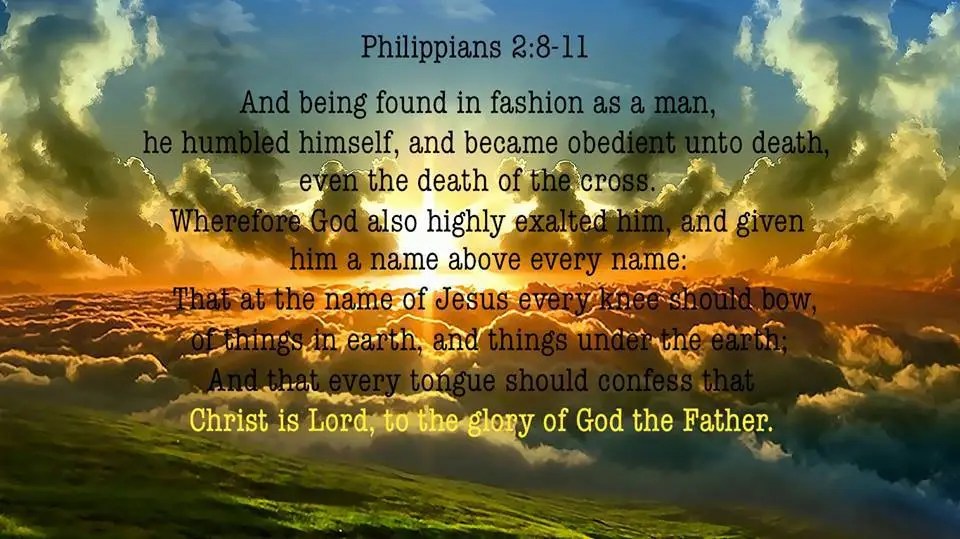
Philippians 2:5-11 Modern English Version
5 Let this mind be in you all, which was also in Christ Jesus,
6 who, being in the form of God,
did not consider equality with God something to be grasped.
7 But He emptied Himself,
taking upon Himself the form of a servant,
and was made in the likeness of men.
8 And being found in the form of a man,
He humbled Himself
and became obedient to death,
even death on a cross.
9 Therefore God highly exalted Him
and gave Him the name which is above every name,
10 that at the name of Jesus every knee should bow,
of those in heaven and on earth and under the earth,
11 and every tongue should confess that Jesus Christ is Lord,
to the glory of God the Father.[a]
Word of God for the Children of God
Glory be to the Father,
and to the Son, and to the Holy Ghost;
as it was in the beginning,
is now, and ever shall be,
world without end. Amen, amen.
The famous passage about Christ in Philippians 2:5-11 is usually described as a “hymn,” and is usually taken to celebrate the inverted parabola of Christ’s descent from heaven, his incarnation as man, nadir of his death on the cross, followed by his return to heaven and exaltation to a position equal to or perhaps higher than the one he left.
The phrase “being in the form of God” is understood to be a reference to his pre-existent divinity, though scholars disagree wildly over how exactly en morphē theou would express that idea. Perhaps the commonest views would be that morphē somehow refers either to the inner nature of God or to his glory.
Christ made the decision not to exploit his pre-existent status—not to hold on to the equality with God that he had by virtue of being in the form of God.
Instead, he emptied himself of at least some part of his divinity and became incarnate as a man.
At the lowest point of his cosmic journey, he was crucified, as though of no more value than a slave.
God, however, raised him from the dead, and restored him to his former heavenly position and status.
The “name” given to him has been variously interpreted (Lord? God?), but there is general agreement Jesus now receives the worship to which only YHWH was entitled according to Isaiah:
Turn to me and be saved, all the ends of the earth! For I am God, and there is no other. By myself I have sworn; from my mouth has gone out in righteousness a word that shall not return: “To me every knee shall bow, every tongue shall swear allegiance.” (Is. 45:22–23)
In a very real sense the best summary of the message of the Bible and the most fundamental truth in this universe is simply this: Jesus Christ is Lord.
Most theologians agree that “the name” that Paul refers to in verse 9 can only be “Lord” (Philippians 2:11).
Here, the Greek word for “Lord” is kyrios, which is also used as the translation of God’s divine name, Yahweh, over 6,000 times in the Septuagint (the Greek translation of the Old Testament)—the name that is rendered in most English Bibles today as Lord.
Paul’s implied use of God’s divine name emphasizes Jesus’ divinity, just after he has reminded us about Jesus’ humiliation during His time on earth.
Comprising four consonants (YHWH), Yahweh is basically unpronounceable in Hebrew—and purposefully so, for Jews did not dare take this divine name of God upon their lips.
Yet Yahweh, the indescribable God, came to earth as the incarnate Christ and revealed Himself to men and women.
He humbly went to the cross, and then He was raised to the highest place—His rightful place—and given this name “above every name.”
Says one commentator, “He has changed the ineffable name, into a name uttered by man and desirable by all the world.”
In the one who bears this name, God’s majesty “is all arrayed in robes of mercy.”
Old Testament prophecy reinforces this idea again and again.
In Isaiah 45, God gives a description that applies exclusively to Himself: “There is no other god besides me, a righteous God and a Savior; there is none besides me” (Isaiah 45:21).
Paul, once an aggressive opponent of Christ and His followers, applies this very description to Christ, making an impressive declaration of His deity.
He points out that Jesus has been publicly exalted to the position that was rightfully His even before He came to earth to suffer humiliation on our behalf.
He is now seated at the Father’s right hand.
His majesty is there for all who know Him as Savior to see.
His identity is unclouded and undoubted.
God is the only Savior—and Jesus is that Savior, of whom it was said, “You shall call his name Jesus, for he will save his people from their sins” (Matthew 1:21).
Years after Paul first had his eyes opened to the truth about who Jesus is, we can still catch a sense of awed reverence and love in his words to the Philippians.
Jesus Christ is LORD.
He possesses the name above all names.
Paul never allowed familiarity with this truth to breed complacency about it.
Neither must we.
Pause now and allow each word to prompt you to an awed praise of this man: Jesus, the Savior of His people… Christ, the long-promised King… is LORD, the indescribable, revealed God. And you get to call Him “brother” (Hebrews 2:11).
The Higher Glory
We have been talking about having the mindset of Christ and following his example of humility.
When it comes to humility, no one can be humbler than Christ, who gave up his own life so that all who call on his name can be saved to have new life forever.
And because Jesus did that, God also raised him from the grave and “exalted him to the highest place.”
He started out as the Son of God in heaven,
Then he willingly became a suffering servant who swooped down to the lowest of depths by dying on a cross for our sake. Then God reversed it all and swung Jesus upward to rule in heaven over everything.
The words Paul uses to describe this position have to do with the power of the highest name: “God . . . gave him the name that is above every name.”
And what is that name?
It is Jesus (meaning “Savior”), and it is Christ (meaning “Anointed One”).
Jesus Christ is the Lord, the sovereign ruler, over all things.
His name is so glorious the day will come when every knee will bow to honor him, every tongue will sing songs to “acknowledge that Jesus Christ is Lord.”
Jesus Christ, who died and rose again, is Lord of the cosmos.
All glory be to him forever and ever!

In the Name of the Father, Son, and Holy Spirit ….
Praying ….
Psalm 19
For the Music Director. A Psalm of David.
1 The heavens declare the glory of God,
and the firmament shows His handiwork.
2 Day unto day utters speech,
and night unto night declares knowledge.
3 There is no speech and there are no words;
their voice is not heard.
4 Their line has gone out through all the earth,
and their words to the end of the world.
In them has He set a tent for the sun,
5 which is like a bridegroom coming out of his chamber;
it rejoices as a strong man to run a race.
6 Its going forth is from one end of the heavens,
and its circuit extends to the other end,
and there is nothing hidden from its heat.
7 The law of the Lord is perfect,
converting the soul;
the testimony of the Lord is sure,
making wise the simple;
8 the statutes of the Lord are right,
rejoicing the heart;
the commandment of the Lord is pure,
enlightening the eyes;
9 the fear of the Lord is clean,
enduring forever;
the judgments of the Lord are true
and righteous altogether.
10 More to be desired are they than gold,
yes, than much fine gold;
sweeter also than honey and the honeycomb.
11 Moreover by them is Your servant warned,
and by keeping them comes great reward.
12 Who can understand his errors?
Cleanse me from secret faults.
13 Keep back Your servant also from presumptuous sins;
may they not rule over me.
Then I will be upright
and innocent from great transgression.
14 Let the words of my mouth and the meditation of my heart
be acceptable in Your sight,
O Lord, my strength and my Redeemer.









 Loving God, Living God, Loving Hope, Living Hope, Loving Living Life His Way! "Many things are possible for the person who has hope. Even more is possible for the person who has faith. And still more is possible for the person who knows how to love. But everything is possible for the person who practices all three virtues." - Brother Lawrence (1605-1691), Practicing the Presence of God (1692).