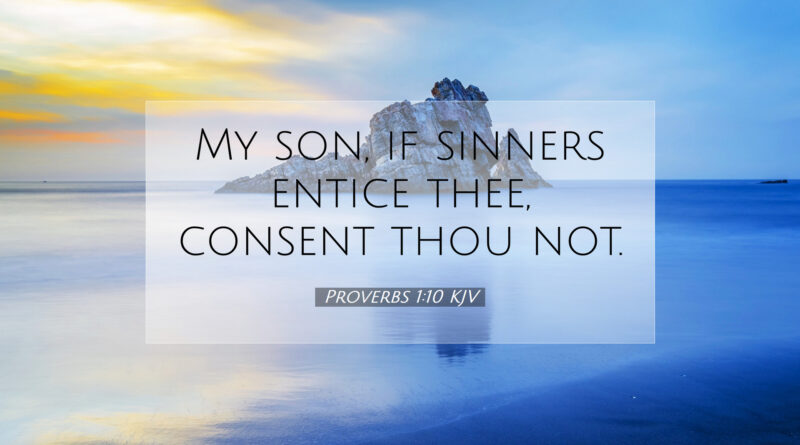
Romans 15:4 "For whatever was written in earlier times was written for our instruction, so that through perseverance and the encouragement of the Scriptures we might have hope."
13 Who among you is wise and intelligent? Let him by his good conduct show his [good] deeds with the gentleness and humility of true wisdom. 14 But if you have bitter jealousy and selfish ambition in your hearts, do not be arrogant, and [as a result] be in defiance of the truth. 15 This [superficial] wisdom is not that which comes down from above, but is earthly (secular), natural (unspiritual), and even demonic. 16 For where jealousy and selfish ambition exist, there is disorder [unrest, rebellion] and every evil thing and morally degrading practice.
Word of God for the Children of God
Glory be to the Father, and to the Son, and to the Holy Ghost; as it was in the beginning, is now, and ever shall be, world without end. Amen, amen.
From the Manger to the Cross: Live Well, Live Wisely or ….
According to 1 Kings 3 in the Bible, King Solomon was told by God that he could ask for anything he wanted, blank check signed by God, and he would receive it.
Instead of asking for a long life, riches, popularity, or power, Solomon asked for wisdom. He understood that the “wisdom that comes from heaven” is the one thing we need more than anything else if we are to be what God wants us to be.
According to our reading in James for today, wisdom is not some intellectual gift that makes us intelligent.
True wisdom does not come from an high I.Q. or from high scores on college entrance exams.
It’s easy to confuse wisdom and intelligence.
If someone has all the right answers and too an encyclopedic knowledge of seemingly every subject, and particularly of Bible verses, we may be big time prone to automatically assume that they are wise—and they very well could be.
But equally, they may well not be, for raw intellectual ability and the capacity to retain such a vast magnitude of facts doesn’t necessarily equate with wisdom.
In his epistle, James links wisdom not with knowledge but with good conduct and meekness.
The one who is wise in God’s sight acts in a way that accords with the humility (Philippians 2:3-4), gentleness (Ephesians 4:2), and joy (1 Thessalonians 5:16) that God asks of His people.
God, who needs no counselor (Romans 11:34), doesn’t need us either to impress Him with what we know.
God tells us what draws His appreciative gaze is the man or woman, girl, boy, who is “humble and contrite in spirit and trembles at my word” (Isaiah 66:2).
James has a memorable phrase for this approach to ourselves and to life: “the meekness of wisdom.”
A genuinely wise person knows how much they don’t know.
They know that however much they know, it’s only a tiny portion of the total vastness of the knowledge that God has.
Intelligence marked by wisdom will not become polluted by showy displays of verbosity or railroad others with intellectual vigor.
Instead, it will be marked by a humility that always aims to build others up with whatever we have—being physical, intellectual, spiritual, emotional strength.
Wisdom echoes the prophet Isaiah, who acknowledged, “The Lord God has given me the tongue of those who are taught, that I may know how to sustain with a word him who is weary” (Isaiah 50:4).
The truly wise maintain a high view of God, a sober view of themselves, and a generous view of other people.
How do I know if I have a high view of God?
If I am constantly aware of just how much I depend on Him for everything.
How will I know if I have a sober view of myself?
I am aware of my own shortcomings and understand all I have is only what I have received from God—if I am in the habit of pointing away from myself instead of toward myself.
How do I know if I have a generous view of other people?
If I am routinely building them up instead of cutting them down.
This is the sort of wisdom which pleases God, which the world so desperately needs from us—a gentle wisdom demonstrating itself in good conduct and in consistent meekness.
How does this challenge you?
How will you pursue living with this true wisdom today?
True wisdom is a gift from God, given to help us live life as God expects us to.
It is the kind of wisdom which literally affects every area of our everyday lives.
Says James, “The wisdom that comes from heaven is first of all pure; then peace-loving, considerate, submissive, full of mercy and good fruit, impartial and sincere.”
This is the wisdom each one of us needs. Putting our faith into practice, hearing God’s Word and doing it, beginning with asking God for his wisdom (James 1:5).
Without it, we cannot be what God wants us to be.
Ask God today and every day to fill you with his wisdom.
Pray for the presence of the Holy Spirit to help you experience “the wisdom that comes from heaven.”
In the name of the Father, and of the Son, and of the Holy Spirit
Praying ….
Description of a Citizen of Zion.
A Psalm of David.
15 O Lord, who may lodge [as a guest] in Your tent? Who may dwell [continually] on Your holy hill? 2 He who walks with integrity and strength of character, and works righteousness, And speaks and holds truth in his heart. 3 He does not slander with his tongue, Nor does evil to his neighbor, Nor takes up a reproach against his friend; 4 In his eyes an evil person is despised, But he honors those who fear the Lord [and obediently worship Him with awe-inspired reverence and submissive wonder]. He keeps his word even to his own disadvantage and does not change it [for his own benefit]; 5 He does not put out his money at interest [to a fellow Israelite], And does not take a bribe against the innocent. He who does these things will never be shaken.
Glory be to the Father, and to the Son, and to the Holy Ghost; as it was in the beginning, is now, and ever shall be, world without end. Amen, amen.

24 There is nothing better for a man than to eat and drink and assure himself that there is good in his labor. Even this, I have seen, is from the hand of God. 25 For who can eat and who can have enjoyment without Him? 26 For to the person who pleases Him God gives wisdom, knowledge, and joy; but to the sinner He gives the work of gathering and collecting so that he may give to one who pleases God. This too is vanity and chasing after the wind.
Word of God for the Children of God
Glory be to the Father, and to the Son, and to the Holy Ghost; as it was in the beginning, is now, and ever shall be, world without end. Amen, amen.
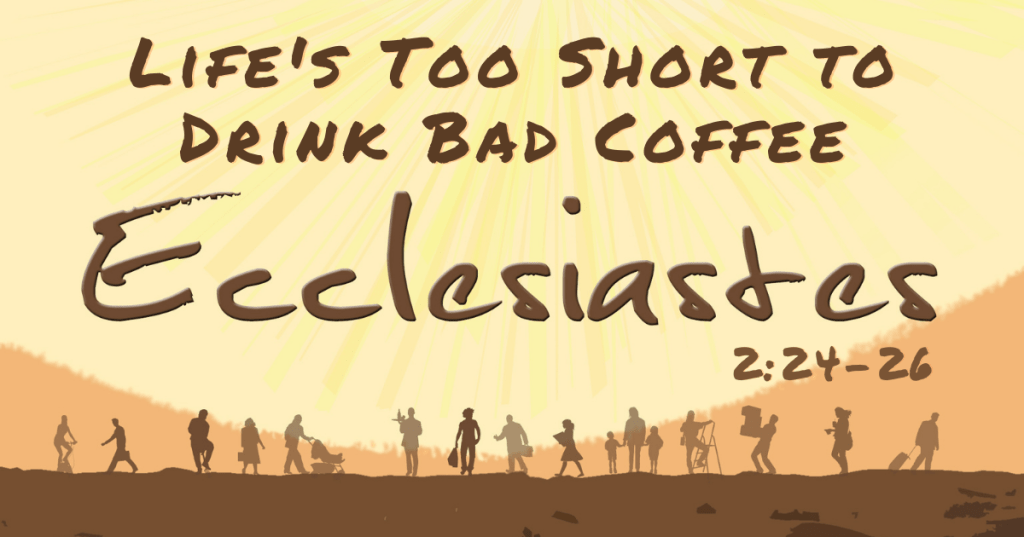
“Ecclesiastes 2:24 (KJV) – There is nothing better for a man, than that he should eat and drink, and that he should make his soul enjoy good in his labour. This also I saw, that it was from the hand of God.”
The book of Ecclesiastes is traditionally attributed to King Solomon, who had reigned over Israel in 10th century BCE, and known for his wisdom and wealth.
In this verse, Solomon reflects on the fleeting nature of life and the ultimate futility of worldly pursuits.
He encourages his audience to find satisfaction in the simple pleasures of life and to acknowledge that these pleasures come as gifts from the hand of God.
The verse begins with the affirmation that there is nothing better for a person than to eat, drink, and enjoy the fruit of their labor.
This echoes a theme found throughout Ecclesiastes, which emphasizes the transience of life and the absence of ultimate meaning in human pursuits.
Despite this seemingly pessimistic perspective, Solomon’s message is one of acceptance and contentment in the face of life’s challenges and uncertainties.
The theme of enjoying the simple pleasures of life is echoed in other passages of the Bible, such as Psalm 34:8, which says,
“Taste and see that the Lord is good; blessed is the one who takes refuge in him.”
This theme is also consistent with the much broader message of Ecclesiastes, which advocates for a genuine balanced, measured approach to life, avoiding excessive, obsessive, attachments to wealth, power, or hedonistic pleasure.
Solomon’s assertion these pleasures come “from the hand of God” underscores the idea of divine providence and belief all good things ultimately come from God.
This echoes a common biblical theme of acknowledging God’s sovereignty and provision in all aspects of life.
It also serves as a timely reminder to be grateful for the blessings we receive, recognizing that even the simplest, simplified joys of life are gifts from God.
The broader context of Ecclesiastes is quite important for understanding the significance of this verse.
The book as a whole reflects on the fleeting nature of life and the pursuit of meaning and purpose in the face of mortality.
Solomon explores various avenues in search of fulfillment, including wisdom, pleasure, and wealth, but ultimately concludes that true satisfaction is found in fearing God and joyfully keeping his commandments (Ecclesiastes 12:13).
Ecclesiastes 2:24 serves as a reminder to find contentment and joy in the present moment, rather than striving after fleeting pleasures or earthly wealth.
It encourages a perspective of gratitude and mindfulness, recognizing that even the simple acts of eating, drinking, enjoying one’s labor are gifts to be savored and appreciated.
Symbolically, the act of eating and drinking can be seen as a metaphor for nourishment and sustenance, both physical and spiritual.
Enjoying the fruits of one’s labor reflects the satisfaction that comes from hard work and accomplishment.
Through these simple acts, Solomon invites his audience to find fulfillment in the everyday, rather than in the pursuit of grandiose or unattainable goals.
Ecclesiastes 2:24 offers a message of contentment, gratitude, and mindfulness, reminding readers to find joy in the simple pleasures of life and acknowledge God’s provision in all things.
It is a call to embrace the present moment and find fulfillment in the here and now, rather than constantly striving after ephemeral pursuits.
In doing so, the verse encapsulates the much broader themes of Ecclesiastes and offers a perspective that is both timeless and relevant to readers today.
DAILY LIFE WITH GOD
(Ecclesiastes 2:24-26)
Central Idea: We are to enjoy our daily lives as gifts from the hand of God.
Purpose: To encourage believers to find contentment in God.
Our happiness in life comes from the hand of God (2:25).
The simple pleasures of life are God’s gifts for us to enjoy (2:26a).
God judges sinners with the frustration of working for God’s people (2:26b).
In the name of God, the Father the Son and the Holy Spirit ….
Praying …
Psalm 23 Authorized (King James) Version
Psalm 23
A Psalm of David.
1 The Lord is my shepherd; I shall not want. 2 He maketh me to lie down in green pastures: he leadeth me beside the still waters. 3 He restoreth my soul: he leadeth me in the paths of righteousness for his name’s sake. 4 Yea, though I walk through the valley of the shadow of death, I will fear no evil: for thou art with me; thy rod and thy staff they comfort me. 5 Thou preparest a table before me in the presence of mine enemies: thou anointest my head with oil; my cup runneth over. 6 Surely goodness and mercy shall follow me all the days of my life: and I will dwell in the house of the Lord for ever.
Glory be to the Father, and to the Son, and to the Holy Ghost; as it was in the beginning, is now, and ever shall be, world without end. Amen, amen.
7 He who corrects a scoffer gains abuse for himself, and he who rebukes the wicked gets hurt.[a] 8 Do not rebuke a scoffer, lest he hate you; rebuke the wise and he will love you. 9 Give to a wise one and he will become more wise; teach[b] a righteous one and he will increase learning.
Foolishness’ Banquet
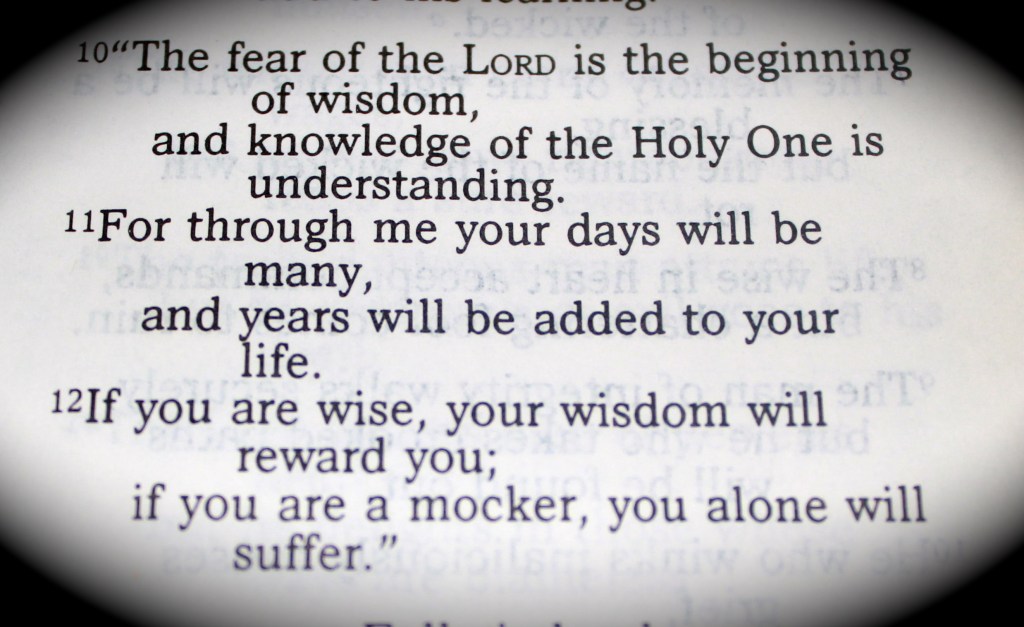
10 The start of wisdom is fear of Yahweh, and knowledge of the Holy One,[c] insight. 11 For by me your days shall increase, and years of life shall multiply for you. 12 If you are wise, you are wise for yourself, and if you scoff, alone you shall bear it.
Word of God for the Children of God
Glory be to the Father, and to the Son, and to the Holy Ghost; as it was in the beginning, is now, and ever shall be, world without end. Amen, amen.
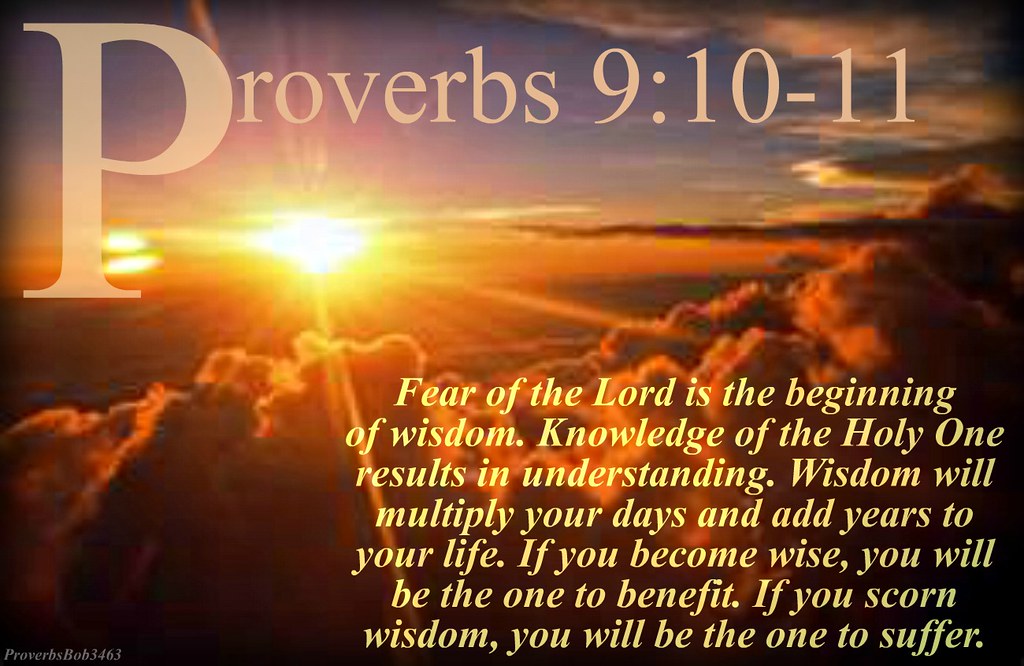
Proverbs 9:10-12 Amplified Bible
10 The [reverent] fear of the Lord [that is, worshiping Him and regarding Him as truly awesome] is the beginning and the preeminent part of wisdom [its starting point and its essence], And the knowledge of the Holy One is understanding and spiritual insight. 11 For by me (wisdom from God) your days will be multiplied, And years of life shall be increased. 12 If you are wise, you are wise for yourself [for your own benefit]; If you scoff [thoughtlessly ridicule and disdain], you alone will pay the penalty.
I tend to err on the side of caution.
If there is risk involved, I will pause and evaluate the situation so that I can make a decision that will keep me as protected and safe as much as possible.
From an early age I learned respecting things like laws of gravity, the authority of people in charge, was better than disrespecting things that I cannot control.
That helps me understand what the author of Proverbs is saying here.
Fearing the Lord does not mean being blind scared of God, as if he were a tyrant waiting to take his anger out on us.
To fear the Lord is to give him respect and reverence. After all, God is the Creator who graciously crafted a covenant with his people.
He deserves our respect.
God has promise d to provide his people with all that they need.
He deserves our maximum reverence.
Revering the Lord is the first step in developing a vibrant relationship with him.
Revering God calls for us to submit ourselves humbly to him—seeking him, listening to him, and obeying him.
Fearing the Lord puts us in the primo position of a servant who loves God and trusts God. That is where God wants us to be, and that is where we need to be.
In the name of God, the Father the Son and the Holy Spirit …
Praying …
Don’t Assume You Know It All
3 1-2 Good friend, don’t forget all I’ve taught you; take to heart my commands. They’ll help you live a long, long time, a long life lived full and well.
3-4 Don’t lose your grip on Love and Loyalty. Tie them around your neck; carve their initials on your heart. Earn a reputation for living well in God’s eyes and the eyes of the people.
5-12 Trust God from the bottom of your heart; don’t try to figure out everything on your own. Listen for God’s voice in everything you do, everywhere you go; he’s the one who will keep you on track. Don’t assume that you know it all. Run to God! Run from evil! Your body will glow with health, your very bones will vibrate with life! Honor God with everything you own; give him the first and the best. Your barns will burst, your wine vats will brim over. But don’t, dear friend, resent God’s discipline; don’t sulk under his loving correction. It’s the child he loves that God corrects; a father’s delight is behind all this.
Glory be to the Father, and to the Son, and to the Holy Ghost; as it was in the beginning, is now, and ever shall be, world without end. Amen, amen.
15 Fools suppose their way is straight, but the wise pay attention to advice.
Word of God for the Children of God
Glory be to the Father, and to the Son, and to the Holy Ghost; as it was in the beginning, is now, and ever shall be, world without end. Amen, amen.
Are We Learning From the Examples of Others?
I had a friend who was a very handy repairman. One day I discovered a leak in my plumbing and didn’t know how to fix it.
I went to him for advice, and he showed me how to fix the problem. His help saved me hundreds of dollars, avoiding water damage throughout my house.
Over the years, I have realized oft, the importance of learning from others’ experiences.
Observing others’ successes and mistakes can provide valuable lessons.
We often think we must figure everything out on our own, but wisdom invites us to learn from others.
Proverbs helps us see that surrounding ourselves with wise mentors and friends can profoundly help in our decision making and growth.
There were, times when I didn’t heed advice, and I faced hard consequences.
Ignoring a mentor’s caution about a business venture, for example, led to a financial loss.
Looking back, I can see how pride and stubbornness can cloud judgment, leading to avoidable mistakes. Learning from others calls for humility and openness, patience, recognizing that we don’t, wont, have all the answers.
God strategically, subtly, places people in our lives to guide and teach us.
In addition, the Bible is filled with stirring stories of people who had learned valuable lessons through their experiences—both good and bad. By observing their wise, foolish, examples, we gain insight into living wisely and faithfully.
Proverbs 3:5-8 Complete Jewish Bible
5 Trust in Adonai with all your heart; do not rely on your own understanding. 6 In all your ways acknowledge him; then he will level your paths.
7 Don’t be conceited about your own wisdom; but fear Adonai, and turn from evil. 8 This will bring health to your body and give strength to your bones.
In the name of God, the Father, the Son, and the Holy Spirit;
Pray,
Psalm 14 Complete Jewish Bible
14 (0) For the leader. By David:
(1) Fools say in their hearts, “There is no God.” They deal corruptly, their deeds are vile, not one does what is right.
2 From heaven Adonai observes humankind to see if anyone has understanding, if anyone seeks God. 3 But all turn aside, all alike are corrupt; no one does what is right, not a single one. 4 Don’t they ever learn, all those evildoers, who eat up my people as if eating bread and never call on Adonai? 5 There they are, utterly terrified; for God is with those who are righteous. 6 You may mock the plans of the poor, but their refuge is Adonai.
7 How I wish Isra’el’s salvation would come out of Tziyon! When Adonai restores his people’s fortunes, Ya‘akov will rejoice, Isra’el will be glad!
Glory be to the Father, and to the Son, and to the Holy Ghost; as it was in the beginning, is now, and ever shall be, world without end. Amen, amen.
3 For even Christ pleased not himself; but, as it is written, The reproaches of them that reproached thee fell on me. 4 For whatsoever things were written aforetime were written for our learning, that we through patience and comfort of the scriptures might have hope. 5 Now the God of patience and consolation grant you to be likeminded one toward another according to Christ Jesus: 6 that ye may with one mind and one mouth glorify God, even the Father of our Lord Jesus Christ.
The Word of God for the Children of God.
Glory be to the Father, and to the Son, and to the Holy Ghost; as it was in the beginning, is now, and ever shall be, world without end. Amen, amen.
Romans 15:4 in the King James Version of the Bible reads,
“For whatsoever things were written aforetime were written for our learning, that we through patience and comfort of the scriptures might have hope.”
This verse is a eye opening reminder of the importance of our learning from the ancient writings and scriptures to find hope, comfort, and patience in our lives.
The book of Romans was written by the apostle Paul to the believers in Rome, both Jewish and Gentile Christians.
In this particular passage, Paul is urging the believers to come together in unity, to accept one another, and to edify build each other up in their faith.
He emphasizes the 100% unquestionable importance of the scriptures and the wisdom found in them to bring hope, comfort, and patience to the believers as they navigate their the long winding course of life and the challenges they face.
The phrase “whatsoever things were written aforetime” refers to the Old Testament scriptures, which were the primary religious texts for the early Christian believers.
These writings include the stories of the patriarchs, the laws of Moses, the History books, the Psalms, Proverbs, Job, and the words of the prophets.
Paul is here highlighting their invaluable timeless wisdom and lessons found in these ancient texts, encouraging the believers to read, study, learn, from them.
The verse continues, “were written for our learning”. This points to the 100% relevance of the Old Testament scriptures for the New Testament believers.
Even though the Old Testament was written centuries before the time of Jesus, the teachings and stories contained within it still hold in valuable lessons and insights for believers today.
The scriptures provide a foundation of understanding and knowledge that can guide believers in their personal worship, prayer time, faith and in their lives.
Paul goes on to say,
“that we through patience and comfort of the scriptures might have hope.”
He is making for us here a direct connection between the scriptures and the qualities of patience, perseverance in our trials, comfort, faith and in hope.
The Old Testament scriptures offer believers patience by showing them examples of perseverance and endurance in the face of trials. They provide comfort through the promises of God’s presence and care for His people.
And ultimately, they offer faith and hope by pointing to the redemptive work of God at Calvary, His never ending faithfulness to His people throughout history.
This verse carries several important themes central to the Christian faith.
First, it emphasizes the unity and continuity between the Old Testament and the New Testament.
It shows the Old and New Testament scriptures are a cohesive whole, with the Old Testament laying the foundation for the New Testament.
It also highlights the importance of learning and studying the scriptures, recognizing them as a valuable source of wisdom and guidance for believers.
Additionally, it underscores the biblically essential qualities of patience, faith, comfort, and hope that the scriptures can bring to those who engage with them.
The context of this verse within the book of Romans is significant as well.
Throughout the letter, Paul addresses threatening issues of division and disunity within the Roman church. He is exhorting the believers to come together in love and to build each other up in their faith. By pointing to the scriptures as the source of our hope, comfort, and patience, Paul is encouraging the believers to turn first to God’s word as a unifying force in their community.
Symbolically, this verse represents the timeless nature of God’s word and the enduring relevance of the scriptures for our answering the hardest hardcore of questions for non-believers, skeptics, seekers and believers of all generations.
It points to the idea that the myriad of stories and teachings of the Bible are not just for ancient history, but living and active sources of truth and guidance for those who seek them, who desire learning, who desire transformation in life.
It also symbolizes the cutting edge transformative power of the scriptures to bring about patience, comfort, hope, power of change in the lives of believers.
Hebrews 4:12 Authorized (King James) Version
12 For the word of God is quick, and powerful, and sharper than any two-edged sword, piercing even to the dividing asunder of soul and spirit, and of the joints and marrow, and is a discerner of the thoughts and intents of the heart.
Romans 15:4 is a powerful cutting edge reminder of the importance of engaging with the scriptures as a source of faith, hope, comfort, patience for believers.
It poignantly emphasizes the unity between the Old and New Testaments, the value of learning from the ancient writings, and the transformative nature of God’s word. It serves as an invaluable, timeless encouragement, for believers to turn firstly to the scriptures as a source of wisdom and guidance in their lives.
Why does the Old Testament Authentically Matter?
Romans 15:3-6 New American Standard Bible 1995
3 For even Christ did not please Himself; but as it is written, “The reproaches of those who reproached You fell on Me.” 4 For whatever was written in earlier times was written for our instruction, so that through perseverance and the encouragement of the Scriptures we might have hope. 5 Now may the God [a] who gives perseverance and encouragement grant you to be of the same mind with one another according to Christ Jesus, 6 so that with one accord you may with one [b]voice glorify the God and Father of our Lord Jesus Christ.
While we may understand the importance of God’s word for our lives, we might also wonder, deep down, why we should study Old Testament stories. What can us modern people gain from such a study? Why not focus on the New Testament exclusively and the stories solely of what Jesus and His apostles did and said?
Here is the answer (among the many) I offer to the readership of this blog: these ancient segments of history are significant not just for the biblical characters or for Israel but also for you and me—indeed, for the entire world!
Such a sweeping claim may sound like hyperbole. But if we approach our study of the Bible with certain convictions in mind, we will begin to understand and be convinced, as the apostle Paul was clearly convinced, that the Old Testament was written for us, was written for us to study, instruct, that it offers us hope.
The first conviction is that there is unity to the Bible, from creation in Genesis to the new creation in Revelation.
In between is the record of humanity’s fall and the chaos and brokenness of the universe that flowed from it.
Through it all, we discover the story of redemption and the plan and purpose of God to put together a people of His very own.
We need to read the whole of that story, from start to finish.
The second conviction guiding our study of God’s word is this biblical unity exists not because it is a collection of religious documents but because it is the word of God, written by men who “spoke from God as they were carried along by the Holy Spirit” (2 Peter 1:21).
We need to read all of what God has chosen to tell us.
Thirdly, there is the conviction that we need our Bibles to understand human history, our own little histories, and our contributory place within history.
Much of what is happening within us and around us does not make sense apart from an understanding of human nature and God’s sovereignty at work as it is being revealed in and through the Holy Scriptures.
Finally, we hold the conviction that the Bible, including the Old Testament, is a prophetic book about Jesus.
If we take our eyes away from Jesus, then we don’t just lose our way around the length, width, depths, heights of the universe; we also lose our way around the Bible. The Old Testament points us to Christ, prepares us for Christ, and shows us pictures of Christ. One of the first questions we ought always to be asking is;
“How does this record of things show me good news about Savior Jesus Christ?”
With these convictions in mind, we can have real confidence as we study the Old Testament that it is instructive. But not only that: it is full of hope, for it shows us our Savior. The more we read the passages of these Old Testament as books written by God, through His Spirit, about His Son, the more we grow in hope, in faith, in His wisdom and understanding, and into the likeness of our Savior.
In the name of God, the Father and God the Son and God the Holy Spirit,
Let us Pray,
Proverbs 3 New International Version
Wisdom Bestows Well-Being
3 My son, do not forget my teaching, but keep my commands in your heart, 2 for they will prolong your life many years and bring you peace and prosperity.
3 Let love and faithfulness never leave you; bind them around your neck, write them on the tablet of your heart. 4 Then you will win favor and a good name in the sight of God and man.
5 Trust in the Lord with all your heart and lean not on your own understanding; 6 in all your ways submit to him, and he will make your paths straight.[a]
7 Do not be wise in your own eyes; fear the Lord and shun evil. 8 This will bring health to your body and nourishment to your bones.
9 Honor the Lord with your wealth, with the firstfruits of all your crops; 10 then your barns will be filled to overflowing, and your vats will brim over with new wine.
11 My son, do not despise the Lord’s discipline, and do not resent his rebuke, 12 because the Lord disciplines those he loves, as a father the son he delights in.[b]
13 Blessed are those who find wisdom, those who gain understanding, 14 for she is more profitable than silver and yields better returns than gold. 15 She is more precious than rubies; nothing you desire can compare with her. 16 Long life is in her right hand; in her left hand are riches and honor. 17 Her ways are pleasant ways, and all her paths are peace. 18 She is a tree of life to those who take hold of her; those who hold her fast will be blessed.
19 By wisdom the Lord laid the earth’s foundations, by understanding he set the heavens in place; 20 by his knowledge the watery depths were divided, and the clouds let drop the dew.
21 My son, do not let wisdom and understanding out of your sight, preserve sound judgment and discretion; 22 they will be life for you, an ornament to grace your neck. 23 Then you will go on your way in safety, and your foot will not stumble. 24 When you lie down, you will not be afraid; when you lie down, your sleep will be sweet. 25 Have no fear of sudden disaster or of the ruin that overtakes the wicked, 26 for the Lord will be at your side and will keep your foot from being snared.
27 Do not withhold good from those to whom it is due, when it is in your power to act. 28 Do not say to your neighbor, “Come back tomorrow and I’ll give it to you”— when you already have it with you. 29 Do not plot harm against your neighbor, who lives trustfully near you. 30 Do not accuse anyone for no reason— when they have done you no harm.
31 Do not envy the violent or choose any of their ways.
32 For the Lord detests the perverse but takes the upright into his confidence. 33 The Lord’s curse is on the house of the wicked, but he blesses the home of the righteous. 34 He mocks proud mockers but shows favor to the humble and oppressed. 35 The wise inherit honor, but fools get only shame.
Glory be to the Father, and to the Son, and to the Holy Ghost; as it was in the beginning, is now, and ever shall be, world without end. Amen, amen.
11 Send your resources out over the seas; eventually you will reap a return. 2 Divide your merchandise into seven or eight shares, since you don’t know what disasters may come on the earth. 3 If the clouds are full of rain, they empty themselves on the earth. Whether a tree falls toward the north or the south, the place where the tree falls is where it stays. 4 He who keeps watching the wind will never sow; he who keeps looking at the clouds will never reap. 5 Just as you don’t know the way of the wind or how bones grow in a pregnant woman’s womb, so you don’t know the work of God, the maker of everything. 6 In the morning, sow your seed; and don’t slack off until evening; for you don’t know which sowing will succeed, this, or that, or if both will do well. 7 Then the light will be sweet, and it will be a pleasure to see the sun. 8 For if a person lives many years, let him take joy in them all; yet remembering that there will be many days of darkness, that all to come is futile.
The Word of God for the Children of God.
Glory be to the Father, and to the Son, and to the Holy Ghost; as it was in the beginning, is now, and ever shall be, world without end. Amen, amen.
Solomon exhorts men to live joyfully and responsibly while at the height of their energy—investing themselves wisely into living their life and making the most of every opportunity, knowing that God will evaluate every aspect of life.
What is the here and now, the hear and know, meaning of Ecclesiastes 11:8?
We should take care of ourselves, not everyday is going to be our very best day choose to honor God, honor Sabbath day, choose to enjoy every day of our lives.
We should not just try to forget the dark days, but to remember the days of darkness. It is from the days of darkness we can learn the most and grow.
In many respects, the days of darkness, the Category 5 days of what feels like all the worst days of our lives in one, brings potential for gratitude for God’s light.
Psalm 139:11-18 Easy-to-Read Version
11 Suppose I wanted to hide from you and said, “Surely the darkness will hide me. The day will change to night and cover me.” 12 Even the darkness is not dark to you. The night is as bright as the day. Darkness and light are the same. 13 You formed the way I think and feel.[a] You put me together in my mother’s womb. 14 I praise you because you made me in such a wonderful way. I know how amazing that was!
15 You could see my bones grow as my body took shape, hidden in my mother’s womb.[b] 16 You could see my body grow each passing day.[c] You listed all my parts, and not one of them was missing. 17 Your thoughts are beyond my understanding.[d] They cannot be measured! 18 If I could count them, they would be more than all the grains of sand. But when I finished, I would have just begun.[e]
How precious to me are your thoughts, O God? How vast is the sum of them? If I should live long enough to count them, they are far far more than the sand. I awake, from my category 5 darkest moments and I am still with you and you are still with me, I discover that above even the greatest distractions, tumults of living my life, You are above them, You are bigger than them, give us Your rest.
IF I will, would, should, could, whether I want to or need to or not … honor God, honor His Sabbath and accept the day of His rest … it will go very well with me!
Isaiah 58:13-14 English Standard Version
13 “If you turn back your foot from the Sabbath, from doing your pleasure[a] on my holy day, and call the Sabbath a delight and the holy day of the Lord honorable; if you honor it, not going your own ways, or seeking your own pleasure,[b] or talking idly;[c] 14 then you shall take delight in the Lord, and I will make you ride on the heights of the earth;[d] I will feed you with the heritage of Jacob your father, for the mouth of the Lord has spoken.”
Can you explain .01% the meaning of Ecclesiastes 11:8?
This verse, like much of the Book of Ecclesiastes, is laden with profound wisdom and existential reflection.
To fully grasp its meaning, we must examine the context of the verse within the broader narrative of Ecclesiastes and the theological and philosophical themes it addresses.
The Book of Ecclesiastes, traditionally attributed to King Solomon, is a unique piece of wisdom literature in the Old Testament.
It grapples with the complexities and apparent contradictions of human existence.
The author, often referred to as “the Teacher” or “Qoheleth,” explores the fleeting nature of life, the pursuit of meaning, and the inevitability of death. Ecclesiastes is characterized by its candid, almost melancholic tone, as it delves into the paradoxes of joy and sorrow, wisdom and folly, and life and death.
Ecclesiastes 11:8 is situated within a passage that encourages a balanced approach to life, recognizing both its joys and its inevitable hardships.
The verse can be divided into two parts:
the first part encourages the enjoyment of life, while the second part serves as a sobering reminder of life’s darker moments.
Enjoying Life
The opening phrase, “However many years anyone may live, let them enjoy them all,” underscores a recurring theme in Ecclesiastes: the importance of finding joy in the present moment.
This exhortation to enjoy life is not a call to hedonism or reckless indulgence, but rather an invitation to appreciate the simple pleasures and blessings that life offers.
Throughout Ecclesiastes, Teacher often emphasizes the value of enjoying the fruits of one’s labor, companionship of loved ones, and the beauty of creation.
For instance, Ecclesiastes 3:12-13 states, “I know that there is nothing better for people than to be happy and to do good while they live. That each of them may eat and drink, and find satisfaction in all their toil—this is the gift of God.”
This perspective is echoed in Ecclesiastes 9:7-9, where the Teacher advises,
“Go, eat your food with gladness, and drink your wine with a joyful heart, for God has already approved what you do. Always be clothed in white, and always anoint your head with oil. Enjoy life with your wife, whom you love, all the days of this meaningless life that God has given you under the sun—all your meaningless days.”
The Teacher’s counsel to enjoy life is rooted in the recognition that our time on earth is limited and unpredictable.
By encouraging us to embrace joy, the Teacher is not dismissing the reality of suffering but rather advocating for a balanced perspective that acknowledges both the good and the bad.
Remembering the Days of Darkness
The second part of the verse, “But let them remember the days of darkness, for there will be many,” serves as a poignant reminder of the inevitability of suffering and the transient nature of life.
The “days of darkness” can be interpreted in several ways.
They may refer to periods of hardship, grief, and loss that are an inescapable part of the human experience. Alternatively, they could symbolize the ultimate darkness of death, which casts a shadow over all our earthly endeavors.
The Teacher’s acknowledgment of the “days of darkness” is a recurring theme in Ecclesiastes.
In Ecclesiastes 7:2-4, he writes, “It is better to go to a house of mourning than to go to a house of feasting, for death is the destiny of everyone; the living should take this to heart. Frustration is better than laughter, because a sad face is good for the heart. The heart of the wise is in the house of mourning, but the heart of fools is in the house of pleasure.”
Here, Teacher suggests that facing forward, confronting the reality of death and suffering can lead to greater wisdom and a deeper appreciation of life.
By urging us to remember the days of darkness, the Teacher is not advocating for a pessimistic or fatalistic outlook.
Rather, he is encouraging a realistic and mature understanding of life that embraces both its joys and its sorrows. This balanced perspective can help us to wisely navigate the complexities of existence with greater resilience and grace.
Finding Meaning in the Midst of Meaninglessness
While Ecclesiastes often emphasizes the futility of earthly endeavors, it also contains glimpses of hope and wisdom that point us toward a more enduring source of meaning.
The Teacher acknowledges the limitations of human understanding and the mysteries of God’s purposes.
In Ecclesiastes 3:11, he writes,
“He has made everything beautiful in its time. He has also set eternity in the human heart; yet no one can fathom what God has done from beginning to end.”
This verse suggests that while we may not fully comprehend the divine plan, there is a sense of eternity and transcendence that God has placed within us.
Our seeking, our searching, our exploration, our discovery of that longing for meaning and our awareness of life’s fleeting nature can lead us to seek a deeper relationship with God, who is our only ultimate source of wisdom and purpose.
Moreover, the Teacher concludes the book with a summons to reverence and obedience to God.
Ecclesiastes 12:13-14, he writes, “Now all has been heard; here is the conclusion of the matter: Fear God and keep his commandments, for this is the duty of all mankind. For God will bring every deed into judgment, including every hidden thing, whether it is good or evil.”
This final exhortation underscores the importance of kingdom living a life that is grounded in faith, hope, trust and obedience to God. While the pursuits and pleasures of this world may be fleeting and ultimately unsatisfying, a life lived in reverence to God holds the promise of eternal significance and fulfillment.
Conclusion
Ecclesiastes 11:8, with its dual emphasis on enjoying life and remembering the days of darkness, encapsulates the paradoxical wisdom of the Teacher.
It covenants us to HUG, fully embrace the joys of life with gratitude while maintaining a sober awareness of life’s inevitable hardships and the transient nature of our earthly existence.
By acknowledging, recognizing the limitations of worldly pursuits and seeking a deeper relationship with God, we can go forth, to explore, discover, pray, find an enduring meaning and purpose in the midst of life’s Category 5 complexities.
As we reflect on this verse and the broader message of Ecclesiastes, we are now reminded of the importance of living with both joy and wisdom, embracing the present moment while keeping our eyes fixed on the eternal. In doing so, we can try to navigate the paradoxes of life with greater resilience, grace, and hope.
In the name of God, the Father and God the Son and God the Holy Spirit,
Let us Pray,
Psalm 92 English Standard Version
How Great Are Your Works
A Psalm. A Song for the Sabbath.
92 It is good to give thanks to the Lord, to sing praises to your name, O Most High; 2 to declare your steadfast love in the morning, and your faithfulness by night, 3 to the music of the lute and the harp, to the melody of the lyre. 4 For you, O Lord, have made me glad by your work; at the works of your hands I sing for joy.
5 How great are your works, O Lord! Your thoughts are very deep! 6 The stupid man cannot know; the fool cannot understand this: 7 that though the wicked sprout like grass and all evildoers flourish, they are doomed to destruction forever; 8 but you, O Lord, are on high forever. 9 For behold, your enemies, O Lord, for behold, your enemies shall perish; all evildoers shall be scattered.
10 But you have exalted my horn like that of the wild ox; you have poured over me[a] fresh oil. 11 My eyes have seen the downfall of my enemies; my ears have heard the doom of my evil assailants.
12 The righteous flourish like the palm tree and grow like a cedar in Lebanon. 13 They are planted in the house of the Lord; they flourish in the courts of our God. 14 They still bear fruit in old age; they are ever full of sap and green, 15 to declare that the Lord is upright; he is my rock, and there is no unrighteousness in him.
Glory be to the Father, and to the Son, and to the Holy Ghost; as it was in the beginning, is now, and ever shall be, world without end. Amen, amen.
4 The king went to Gibeon to offer sacrifices, for that was the most important high place, and Solomon offered a thousand burnt offerings on that altar. 5 At Gibeon the Lord appeared to Solomon during the night in a dream, and God said, “Ask for whatever you want me to give you.”
6 Solomon answered, “You have shown great kindness to your servant, my father David, because he was faithful to you and righteous and upright in heart. You have continued this great kindness to him and have given him a son to sit on his throne this very day.
7 “Now, Lord my God, you have made your servant king in place of my father David. But I am only a little child and do not know how to carry out my duties. 8 Your servant is here among the people you have chosen, a great people, too numerous to count or number. 9 So give your servant a discerning heart to govern your people and to distinguish between right and wrong. For who is able to govern this great people of yours?”
10 The Lord was pleased that Solomon had asked for this. 11 So God said to him, “Since you have asked for this and not for long life or wealth for yourself, nor have asked for the death of your enemies but for discernment in administering justice, 12 I will do what you have asked. I will give you a wise and discerning heart, so that there will never have been anyone like you, nor will there ever be. 13 Moreover, I will give you what you have not asked for—both wealth and honor—so that in your lifetime you will have no equal among kings. 14 And if you walk in obedience to me and keep my decrees and commands as David your father did, I will give you a long life.”
The Word of God for the Children of God.
Glory be to the Father, and to the Son, and to the Holy Ghost; as it was in the beginning, is now, and ever shall be, world without end. Amen, amen.
Grow the Church or give God all the glory and satisfy the needs and the wants of my tiny congregation and close the church and transfer the deed onto another younger growing church with significant demographics in our neighborhood?
So, many was the occasion which I just sat there next to their altar, looking up at the eternal light the church has had hanging there since its inception 1956.
I was praying, reading Scripture, twisting my hands, my stomach in knots, feeling intense pressure to make a forward thinking decision for which I had literally no education or experience or wisdom of the ages for me to make.
This small little church with only seven ladies in the congregation – needed a Pastor except thy literally had no funds from which to compensate them from.
I have no degrees in Ministry or Theology or any related discipline to know just how I was going to proceed. Usually, I am a quick on my feet thinker. I pride myself on my decisiveness. Yet, in this case, I struggled with moving forward when I read both the best options and the final outcomes appeared beneficial.
I knew what my supervisors wanted me to do with the church – be done with it, let it disappear, let it be forgotten about, from the dust it came so let it return.
It did not seem to matter to anyone in charge how it got done as long as it was done quickly, quietly, with no fanfare – just move it out of the way of progress.
So much to do, so many questions I was not smart enough nor wise enough to ask, so many decisions and so many answers and choices I never had to make.
Leading worship … insurance matters when a steam pipe original to 1956 had burst sending hot steam and water in their kitchen destroying what vestiges of a functional church campus had to offer any other interested congregations.
On top of that was a severe snow and ice weather event over our region which played havoc with our power and our heating system – and we had an adjacent Children’s Preschool Center attached to the Church educating kids since 1965.
It played havoc with getting an insurance adjustor to assess the damage and issue any checks for clean up and repair and restoration. Then someone had barreled their car headlong through our church sign in front of the church. So, now there was the no small matter of insurance money for replacement for a church that was being closed out of existence or under a new management.
It only got even more complicated when we had to work with the incoming church and their Pastor to work out the logistics of transference of the deed and keep the Preschool functioning and the various other community organizations which had a long history of highly positive community and neighborhood roots.
“Holy Spirit … Where are You? God, are you anywhere near this neighborhood? Savior Jesus, where is your promise of hope for a future, growth, prosperity?”
I was far outside my league taking on this level of responsibility without any sufficient knowledge, experience or wisdom – failure was written everywhere.
So, this became my go to verse for my prayers …
1 Kings 3:9 The Message
9 “Here’s what I want: Give me a God-listening heart so I can lead your people well, discerning the difference between good and evil. For who on their own is capable of leading your glorious people?” [In the name of My Savior Jesus, Alleluia! Amen]
I learned from this experience; Scripture often speaks of making wise decisions and reading, studying and using Scripture helps guide us and direct our choices.
There are numerous topics on which we can point to specific verses and see a black-and-white answer how we should respond properly in those situations.
Do you have a question about whether you should forgive your neighbor? Ephesians 4:32 says, “Be kind to one another, tenderhearted, forgiving one another, as God in Christ forgave you.”
Do you wonder if God cares if you stop going to church? Hebrews 10:25 shares, “Not giving up meeting together, as some are in the habit of doing, but encouraging one another—and all the more as you see the Day approaching.”
Do you question if God desires for you to submit to authority? Romans 13:1 admonishes, “Everyone must submit himself to the governing authorities, for there is no authority except that which God has established. The authorities that exist have been established by God.”
What if we simply do not believe in ourselves to take upon ourselves His calling?
Proverbs 3:5-12 The Message
5-12 Trust God from the bottom of your heart; don’t try to figure out everything on your own. Listen for God’s voice in everything you do, everywhere you go; he’s the one who will keep you on track. Don’t assume that you know it all. Run to God! Run from evil! Your body will glow with health, your very bones will vibrate with life! Honor God with everything you own; give him the first and the best. Your barns will burst, your wine vats will brim over. But don’t, dear friend, resent God’s discipline; don’t sulk under his loving correction. It’s the child he loves that God corrects; a father’s delight is behind all this.
As one of my favorite devotional writers says, there are places where the Bible man shouts to God. But what about the areas in which the Bible only faintly, barely audibly whispers? How do we know what prayerful decision to make?
In 1 Kings chapter 3, we find the young King Solomon.
He had just taken over the throne from his father, David. Solomon was likely in his early twenties, lacked any experience, and was understandably nervous and anxious about being a new Head of State leading the great nation of Israel.
One night, the Lord came to Solomon in a dream.
God told Solomon to ask for whatever he wanted, and God would give to him.
In essence, God gave young King Solomon, a “blank check” which had God’s own signature on the bottom line. “Ask anything and ye shall receive it all!”
9 “Here’s what I want: Give me a God-listening heart so I can lead your people well, discerning the difference between good and evil. For who on their own is capable of leading your glorious people?” [In the name of My Savior Jesus, Alleluia! Amen]
In our key verse, we find Solomon’s wise response, “So give your servant a discerning heart to govern your people and to distinguish between right and wrong. For who is able to govern this great people of yours?” 1 Kings 3:9 NIV.
Of all the things King Solomon could have asked for, he asked for wisdom and discernment to lead his nation for as long as God gave him the breath to do so.
Wisdom is the ability to use your given knowledge well, while discernment, specifically godly discernment, is the ability to unhesitatingly fully rely on God (FROG) when praying for the wisest decisions for even the very worst choices.
Solomon was already wise even before asking the Lord to give him wisdom. He knew that in his strength, he would fail at leading this great nation. But, with the Lord on his side, guiding and directing his steps, he would be prosperous.
The Lord did grant Solomon wisdom, blessing him with wealth and honor.
While Solomon’s reign was successful, and there were times when he followed the Lord’s ways, there were other times when he turned from God.
Throughout Solomon’s life, we see the consequences of choosing the very best of human wisdom over allowing the Lord alone to lead, guide and direct him.
Thankfully, the Lord quickly granted grace and mercy when Solomon strayed and asked for forgiveness. The Lord was more concerned with Solomon’s heart and the motivations behind his choices, not necessarily the choices themselves.
The same is true for us today.
The Lord desires we serve and submit to Him with our hearts, minds, and souls.
Mark 10:35-45 Disciples’ Literal New Testament
Two Disciples Jockey For Position In The Kingdom. He Says, It Is Not Mine To Give
35 And James and John, the sons of Zebedee, approach Him, saying to Him, “Teacher, we want You to do for us whatever we ask You”. 36 And the One said to them, “What do you want Me to do for you?” 37 And the ones said to Him, “Grant to us that we may sit one on Your right side and one on the left side in Your glory”. 38 But Jesus said to them, “You do not know what you are asking. Are you able to drink the cup which I drink, or to be baptized the baptism which I am baptized?” 39 And the ones said to Him, “We are able”. And Jesus said to them, “You will drink the cup which I drink. And you will be baptized the baptism which I am baptized. 40 But the sitting on My right side or on the left side is not Mine to give, but it is for whom it has been prepared”.
Whoever Wants To Be First Shall Be Your Slave. Even I Came To Serve
41 And having heard-of it, the ten began to be indignant about James and John. 42 And having summoned them, Jesus says to them, “You know that the ones having-the-reputation-of [a] being rulers of the Gentiles are lording-over[b] them, and their great ones are exercising-authority-over[c] them. 43 But it is not so among you. But whoever wants to become great among you shall be your servant, 44 and whoever wants to be first among you shall be slave of all. 45 For even the Son of Man did not come to be served, but to serve, and to give His life as a ransom for many”.
So next time you face even the most difficult, even most controversial decision, precisely one where whatever you choose will be received with anger, vitriol or positive affirmations, take time to pick up your Bibles, Read the Scriptures, pray and ask the Lord for His wisdom, discernment. Lean into the Holy Spirit, listen for the ways He speaks to your heart, and whatever you decide, glorify the Lord.
Let’s Pray:
Psalm 111 Complete Jewish Bible
111 Halleluyah!
I will wholeheartedly give thanks to Adonai in the council of the upright and in the assembly. 2 The deeds of Adonai are great, greatly desired by all who enjoy them. 3 His work is full of majesty and splendor, and his righteousness continues forever. 4 He has gained renown for his wonders. Adonai is merciful and compassionate. 5 He gives food to those who fear him. He remembers his covenant forever. 6 He shows his people how powerfully he works by giving them the nations as their heritage. 7 The works of his hands are truth and justice; all his precepts can be trusted. 8 They have been established forever and ever, to be carried out truly and honestly. 9 He sent redemption to his people and decreed that his covenant should last forever. His name is holy and fearsome — 10 the first and foremost point of wisdom is the fear of Adonai; all those living by it gain good common sense. His praise stands forever.
Heavenly Father, we are thankful that we don’t have to experience life alone; we have the presence of the Holy Spirit inside our hearts. When we are at a crossroads, please guide us and let us feel at peace. Thank you for giving us the Bible; its timeless truths help us live daily to glorify You. We love you, Lord. May our heart’s desire be to always seek to bring you honor and glory, forever and ever. In Jesus’ Name. Amen.
Glory be to the Father, and to the Son, and to the Holy Ghost; as it was in the beginning, is now, and ever shall be, world without end. Amen, amen.
7 “He who corrects a scoffer only gets insulted; reproving a wicked man becomes his blemish. 8 If you reprove a scoffer, he will hate you; if you reprove a wise man, he will love you. 9 Give to a wise man, and he grows still wiser; teach a righteous man, and he will learn still more. 10 The fear of Adonai is the beginning of wisdom, and knowledge of holy ones is understanding. 11 For with me, your days will be increased; years will be added to your life. 12 If you are wise, your wisdom helps you; but if you scoff, you bear the consequences alone.”
The Word of God for the Children of God.
Glory be to the Father, and to the Son, and to the Holy Ghost; as it was in the beginning, is now, and ever shall be, world without end. Amen, amen.
In today’s world, we are flooded with information – misinformation, fake news manipulated news to satisfy someone’s propaganda, someone’s ulterior motive someone else’s political or financial or “I need to be in control of it all” agenda.
From every manner of social media to 24-hour news cycles, covering just about every imaginable angle, from good, to bad to outright criminal or falsified, we have more access to more knowledge (%wisdom??) than any other generation.
Yet, despite this abundance of information, wisdom seems increasingly scarce.
People make decisions every day that lead to pain, confusion, and chaos.
Who is smart enough or discerning or wise enough to sort out fact from fiction?
What is missing?
Personally, I tend to err on the far side of caution. If there is risk involved, I will pause and evaluate, even over-evaluate the given situation so that I can make a rational and “well reasoned” decision that should keep me as safe as possible.
At an early age I learned from my parents that respecting things like the law of gravity, that rocks are always going to be harder than my skull, the authority of the people in charge was better than disrespecting things that I cannot control.
Basically what they did was to deeply ingrain, weave into my young soul the Ten Commandments.
Exodus 20 Complete Jewish Bible
20 Then God said all these words:
א 2 “I am Adonai your God, who brought you out of the land of Egypt, out of the abode of slavery.
ב 3 “You are to have no other gods before me. 4 You are not to make for yourselves a carved image or any kind of representation of anything in heaven above, on the earth beneath or in the water below the shoreline. 5 You are not to bow down to them or serve them; for I, Adonai your God, am a jealous God, punishing the children for the sins of the parents to the third and fourth generation of those who hate me, 6 but displaying grace to the thousandth generation of those who love me and obey my mitzvot.
ג 7 “You are not to use lightly the name of Adonai your God, because Adonai will not leave unpunished someone who uses his name lightly.
ד 8 “Remember the day, Shabbat, to set it apart for God. 9 You have six days to labor and do all your work, 10 but the seventh day is a Shabbat for Adonai your God. On it, you are not to do any kind of work — not you, your son or your daughter, not your male or female slave, not your livestock, and not the foreigner staying with you inside the gates to your property. 11 For in six days, Adonai made heaven and earth, the sea and everything in them; but on the seventh day he rested. This is why Adonai blessed the day, Shabbat, and separated it for himself.
ה 12 “Honor your father and mother, so that you may live long in the land which Adonai your God is giving you.
ו 13 “Do not murder.
ז (14) “Do not commit adultery.
ח (15) “Do not steal.
ט (16) “Do not give false evidence against your neighbor.
י 14 (17) “Do not covet your neighbor’s house; do not covet your neighbor’s wife, his male or female slave, his ox, his donkey or anything that belongs to your neighbor.”
(A: vii) 15 (18) All the people experienced the thunder, the lightning, the sound of the shofar, and the mountain smoking. When the people saw it, they trembled. Standing at a distance, 16 (19) they said to Moshe, “You, speak with us; and we will listen. But don’t let God speak with us, or we will die.” 17 (20) Moshe answered the people, “Don’t be afraid, because God has come only to test you and make you fear him, so that you won’t commit sins.”
What’s Missing? What has been/gone un-noticed?
The Bible gives us the answer.
I have found that the Bible contains all the answers to all the questions we will ever ask, even those answers to those questions we are not wise enough to ask.
Proverbs 9:10 (NLT) declares, “Fear of the Lord is the foundation of wisdom. Knowledge of the Holy One results in good judgment.”
Proverbs 9:10 Amplified Bible “The [reverent] fear of the Lord [that is, worshiping Him and regarding Him as truly awesome] is the beginning and the preeminent part of wisdom [its starting point and its essence], And the knowledge of the Holy One is understanding and spiritual insight.”
Proverbs 9:10 Easy-to-Read Version “10 Wisdom begins with fear and respect for the Lord. Knowledge of the Holy One leads to understanding.
Proverbs 9:10 Contemporary English Version
“10 Respect and obey the Lord! This is the beginning of wisdom.[a] To have understanding, you must know the Holy God.
Here, we see that true wisdom, the kind that emanates from the Word of God, which wisely used, leads to a flourishing life, begins with the fear of the Lord.
2 Timothy 3:14-17 Amplified Bible
14 But as for you, continue in the things that you have learned and of which you are convinced [holding tightly to the truths], knowing from whom you learned them, 15 and how from childhood you have known the sacred writings (Hebrew Scriptures) which are able to give you the wisdom that leads to salvation through faith which is in Christ Jesus [surrendering your entire self to Him and having absolute confidence in His wisdom, power and goodness]. 16 All Scripture is God-breathed [given by divine inspiration] and is profitable for instruction, for conviction [of sin], for correction [of error and restoration to obedience], for training in righteousness [learning to live in conformity to God’s will, both publicly and privately—behaving honorably with personal integrity and moral courage]; 17 so that the [a]man of God may be complete and proficient, outfitted and thoroughly equipped for every good work.
That truth, brought to remembrance by the Holy Spirit of God helps me to reason out, pray through, discern, what the author of Proverbs is saying here.
Fearing the Lord does not mean being scared of God, as if he were a tyrant waiting to take his anger out on us.
To fear the Lord is to give him respect and reverence.
After all, God is the Creator who graciously made a covenant with his people.
He deserves our respect.
God has promised to provide his people with all that they need. He deserves our reverence.
Revering the Lord is the first step in developing a vibrant relationship with him.
Revering God calls for us to submit ourselves humbly to him—seeking him, listening for him and to him, and obeying him, and serving with Him. Fearing the Lord puts us in the position of a true servant who loves God and trusts God.
That is precisely where God wants us to be, and that is where we need to be.
To understand the fear of the Lord, we must first clarify what it is not.
Fear in this context isn’t a terror making us cower in dread or guilt before God.
Instead, the Hebrew word for fear here, yirah, refers to a reverence, awe, and deep respect for God.
It is a recognition of His greatness, holiness, and authority over all creation.
Psalm 111:10 (NLT) reinforces this: “Fear of the Lord is the foundation of true wisdom. All who obey his commandments will grow in wisdom.”
To fear the Lord is to acknowledge, recognize Him as the sovereign King and Creator, to stand in awe of His power, majesty, to align our lives with His will.
In contrast, the opposite of fearing the Lord is living as though God does not matter or is irrelevant.
This is the essence of foolishness, according to the Bible. Psalm 14:1 (NLT) declares: “Only fools say in their hearts, ‘There is no God.’”
When we flat out reject or refuse to acknowledge the fear of the Lord, we turn away from the very source of wisdom.
” To fear God is not to be afraid of Him but to stand in awe of His majesty, power, and greatness.”
Proverbs 9:10 tells us that the fear of the Lord is the foundation of wisdom. Just as a building cannot stand without a strong foundation, our lives cannot, won’t flourish without the foundation of wisdom that begins with reverence for God.
Wisdom, in biblical terms, is not simply knowledge or intelligence.
The Hebrew word hokmah refers to skill in living—our knowing how to apply knowledge in the right way at the right time. It is the ability to to learn through experience to live well, to make choices that lead to life, peace, and godliness.
In James 1:5 (NLT), we are strongly encouraged to seek this wisdom: “If you need wisdom, ask our generous God, and he will give it to you. He will not rebuke you for asking.” The wisdom we need comes from God alone, and it begins when we humbly recognize our need for Him in every area of our lives.
The world offers many competing definitions of wisdom.
Some seek wisdom in self-help books, others in success, wealth, or power or by media produced over dramatized, paid appearance televised self help programs.
But true wisdom is found in God’s Word and through a relationship with Him.
Colossians 2:3 (NLT) tells us, “In him (Christ) lie hidden all the treasures of wisdom and knowledge.” Jesus is the living embodiment of God’s wisdom, and through Him, we can each access, act upon the wisdom that leads to eternal life.
Imagine trying to build a house on sand. No matter how beautiful or well-designed the house is, it will crumble because its foundation is weak.
This is what life is like when we build without God.
But when we build on the solid rock of God’s wisdom, our lives can withstand the storms of life (Matthew 7:24-27).
The Fear of the Lord and Good Judgment
The second part of Proverbs 9:10 promises that “Knowledge of the Holy One results in good judgment.” When we grow in our understanding of who God is—His holiness, His justice, His mercy—it leads to better decision-making.
The phrase good judgment can also be translated as discernment.
Discernment is the ability to distinguish between right and wrong, good and evil, truth and lies.
In a world filled with moral confusion, we desperately need this discernment.
Hebrews 5:14 (NLT) says: “Solid food is for those who are mature, who through training have the skill to recognize the difference between right and wrong.”
The more we grow in our knowledge of God, the more our minds are disciplined and trained to think as He thinks and to make decisions that align with His will.
This is why Romans 12:2 (NLT) instructs us all: “Don’t copy the behavior and customs of this world, but let God transform you into a new person by changing the way you think. Then you will learn to know God’s will for you, which is good and pleasing and perfect.”
When we fear the Lord and seek His wisdom, He transforms our minds and equips us with the discernment needed to navigate life’s challenges.
“True wisdom is the ability to see life from God’s perspective, and it comes as we grow in our relationship with Him.” – Reverend Dr. Charles Stanley
Living in the Fear of the Lord
So, what does it look like to live in the fear of the Lord?
First, it means living a life of obedience.
Proverbs 8:13 (NLT) says: “All who fear the Lord will hate evil.” When we fear the Lord, we align our lives with His Word, rejecting sin and pursuing holiness.
Second, it means living a life of trust.
Psalm 34:9 (NLT) encourages us: “Fear the Lord, you his godly people, for those who fear him will have all they need.”
When we revere God, we trust Him to provide for our needs and guide us in every situation.
Finally, living in the fear of the Lord means walking in humility.
Proverbs 22:4 (NLT) declares: “True humility and fear of the Lord lead to riches, honour, and long life.”
Recognizing our dependence on God, we approach life with humility, understanding that every blessing comes from Him.
Think of a compass.
Without it, a sailor can easily get lost at sea, drifting off course.
The fear of the Lord is like that compass—it keeps us on course, guiding us toward the life God intends for us.
Conclusion: A Call to Wisdom
In closing, the fear of the Lord is not just an abstract concept.
It is a way of life. It is the surest foundation upon which we build everything, and it leads us to true wisdom, good judgment, and a life that honor’s God.
Today, I challenge each and every one of us to examine our hearts. Are we living in the fear of the Lord? Are we sure, building our lives on the foundation of His wisdom, or are we following the world’s definitions of success and knowledge?
In the name of God the Father and God the Son and God the Holy Spirit,
Let us Pray,
Psalm 14 Complete Jewish Bible
14 (0) For the leader. By David:
(1) Fools say in their hearts, “There is no God.” They deal corruptly, their deeds are vile, not one does what is right.
2 From heaven Adonai observes humankind to see if anyone has understanding, if anyone seeks God. 3 But all turn aside, all alike are corrupt; no one does what is right, not a single one. 4 Don’t they ever learn, all those evildoers, who eat up my people as if eating bread and never call on Adonai? 5 There they are, utterly terrified; for God is with those who are righteous. 6 You may mock the plans of the poor, but their refuge is Adonai.
7 How I wish Isra’el’s salvation would come out of Tziyon! When Adonai restores his people’s fortunes, Ya‘akov will rejoice, Isra’el will be glad!
Psalm 139:23-24 The Message
23-24 Investigate my life, O God, find out everything about me; Cross-examine and test me, get a clear picture of what I’m about; See for yourself whether I’ve done anything wrong— then guide me on the road to eternal life.
Glory be to the Father, and to the Son, and to the Holy Ghost; as it was in the beginning, is now, and ever shall be, world without end. Amen, amen.
1 The proverbs of Shlomo the son of David, king of Isra’el, 2 are for learning about wisdom and discipline; for understanding words expressing deep insight; 3 for gaining an intelligently disciplined life, doing what is right, just and fair; 4 for endowing with caution those who don’t think and the young person with knowledge and discretion. 5 Someone who is already wise will hear and learn still more; someone who already understands will gain the ability to counsel well; 6 he will understand proverbs, obscure expressions, the sayings and riddles of the wise.
7 The fear of Adonai is the beginning of knowledge, but fools despise wisdom and discipline.
The Word of God for the Children of God.
Glory be to the Father, and to the Son, and to the Holy Ghost; as it was in the beginning, is now, and ever shall be, world without end. Amen, amen.
Two things my parents always tried to teach me growing up: what we need are ‘wisdom’ and ‘discipline’. ‘Wisdom’ is living from God’s perspective on life and ‘discipline’ is having the character to consistently do what you know is right.
We must have a “starvation level” of hunger for God’s wisdom and pursue it. Reverent Fear of God is the first step in the quest for a meaningful existence.
Acquiring wisdom is not a particularly hard thing to do.
Who we hang around with, who we call our friends, who we call our enemies, who we choose to ignore or to scorn altogether for some arbitrary reason has a huge influence on who you become. God says Choose your relationships wisely.
Good and blessed things tend to flow from wise and disciplined behavior both exhibited in public or in private ways (but not in a magical or guaranteed way).
Lady Wisdom yearns to set people free from their foolish ways and to impart a spirit of wisdom to them so that they will become more disciplined and wise.
Wisdom proactively shouts and cries out to the simple-minded, urging them to change.
How often she has called out to us.
How often we have neglected her advice – to our own detriment.
If we reject the call of wisdom over and over again, we move beyond the reach of her help. We may then search for her but it may will be far too late. We will have eaten too much, stomached too much of the bitter fruit of living our own way.
Our own complacency will have destroyed us.
What’s the point?
Listen to wisdom!
Accept her advice and pay attention to her correction.
If you do, you will live in peace and safety, unafraid of harm.
Do we hear the shriek of urgency of Wisdom’s appeal!
Her appeal is made to all.
To be complacent is as bad as outright rejection.
Lady Wisdom wants the fool, the inexperienced, immature (simple), and the mocker to know and see for themselves the horrible consequences of their not obeying her, so they will turn back to God respond positively to her right away.
Great advice for wise living.
While I do not want to be thought of as an “all wise know-it-all,” I definitely don’t want to be a fool.
The word “fool” is used more than 80 times in the Bible. None of those men-tions me by name, but I don’t want the descriptions there to fit me either. I especially don’t want to be listed as a fool in some record that God might keep.
Thankfully, Proverbs is a book that God gives to help us, to inform us, to see and hear just what a fool is so that we can fight against becoming one. From the beginning it pits wisdom against foolishness. Sometimes the invitation is to embrace what is wise; other times the challenge is to fist fight what is foolish.
Proverbs is a collection of wisdom sayings that tell us the way things are.
In this world there is wisdom, and there is folly. Wisdom comes from reading and studying to learn disciplined living God’s way, and folly comes from going our own way. God gives us Proverbs to help us see that our heart and character must 100% be shaped by him, so we can live wisely in all kinds of situations.
Ultimately, disciplined living, morally, ethically, wisely, is 100% about being more Christlike than flesh like: having the mind of Christ, who is perfectly wise.
The Bible calls Jesus “the wisdom of God.” And a wisdom-shaped heart, and a wisdom crafted wisdom shape soul and spirit is essentially one that has Christ at the exact center of it. In that way, I want to be that “Christ-Like wise guy.”
If any of us, are fool enough to believe we are all wise
Shalom!
2 Regard it all as joy, my brothers, when you face various kinds of temptations; 3 for you know that the testing of your trust produces perseverance. 4 But let perseverance do its complete work; so that you may be complete and whole, lacking in nothing. 5 Now if any of you lacks wisdom, let him ask God, who gives to all generously and without reproach; and it will be given to him. 6 But let him ask in trust, doubting nothing; for the doubter is like a wave in the sea being tossed and driven by the wind. 7 Indeed that person should not think that he will receive anything from the Lord, 8 because he is double-minded, unstable in all his ways. (James 1:2-5 CJB)
It takes a lot of wisdom to run a business.
It takes a lot of wisdom to be a good husband and a good wife
It takes a lot of wisdom to raise children.
It takes a lot of wisdom to be a family to reverently fear, honor, worship God.
It takes a lot of wisdom to be a teacher or a leader in the community.
It takes a lot of wisdom to be a faithful, conscientious worker and to live well, especially as a Christian in these days of foolish rampant divisive immorality.
Think of all the issues we face every day.
Where shall I draw the line between what is right and what is wrong?
How shall I determine what is moral and what is immoral?
How shall I determine what is ethical and what is unethical?
How can I make decisions that are God directed, disciplined, and wise?
The entire book of Proverbs in the Old Testament is written to help believers draw the line in the sand between what is Godly wisdom and human folly.
When Solomon came to the throne to fill the shoes of his father, David, the first thing he asked God for was a wise and discerning heart. (1 Kings 3:4 – 14)
This request pleased God greatly.
Here in the New Covenant book of James, God repeats how pleased he is when his children ask for wisdom.
God is so pleased that he will never turn them down.
What an invitation!
We learn wisdom through disciplined study of God’s Word.
We gain wisdom through the experiences of living.
We develop wisdom by watching and learning from others.
We also receive wisdom when we ask God for it.
According to James, we all ought to be praying for wisdom daily.
James 5:14-20 Disciples’ Literal New Testament
Pray For One Another So That You May Be Healed
14 Is anyone among you sick? Let him summon the elders of the church, and let them pray over him, having anointed[a] him with oil in the name of the Lord. 15 And the prayer of [b] faith will restore[c] the one being ill, and the Lord will raise him. And if he has committed[d] sins, it will be forgiven him. 16 Therefore be confessing-out[e] your sins to one another, and be praying for one another so that you may be healed. A prayer[f] of a righteous person can-do much while working[g]. 17 Elijah was a person of-like-nature to us, and he prayed with prayer[h] that it not rain. And it did not rain upon the land for three years and six months. 18 And he prayed again and the heaven gave rain, and the earth produced its fruit.
Try To Turn Back Those Who Stray From The Truth
19 My brothers, if anyone among you errs[i] from the truth and someone turns him back, 20 let him know that the one having turned-back a sinner from the error of his way will save his[j] soul[k] from death, and will cover a multitude of sins.
And “God, who 100% gives generously to all without finding fault,” will give it.
In the name of God, the Father and God the Son and God the Holy Spirit,
Let us Pray,
Psalm 14 Complete Jewish Bible
14 (0) For the leader. By David:
(1) Fools say in their hearts, “There is no God.” They deal corruptly, their deeds are vile, not one does what is right.
2 From heaven Adonai observes humankind to see if anyone has understanding, if anyone seeks God. 3 But all turn aside, all alike are corrupt; no one does what is right, not a single one. 4 Don’t they ever learn, all those evildoers, who eat up my people as if eating bread and never call on Adonai? 5 There they are, utterly terrified; for God is with those who are righteous. 6 You may mock the plans of the poor, but their refuge is Adonai.
7 How I wish Isra’el’s salvation would come out of Tziyon! When Adonai restores his people’s fortunes, Ya‘akov will rejoice, Isra’el will be glad!
Glory be to the Father, and to the Son, and to the Holy Ghost; as it was in the beginning, is now, and ever shall be, world without end. Amen, amen.
15 Laziness casts one into a deep sleep [unmindful of lost opportunity], And the idle person will suffer hunger.
Proverbs 19:15 Complete Jewish Bible
15 Laziness makes people fall asleep, and an idle person will go hungry.
Proverbs 19:15 The Message
15 Life collapses on loafers; lazybones go hungry.
The Word of God for the Children of God.
Glory be to the Father, and to the Son, and to the Holy Ghost; as it was in the beginning, is now, and ever shall be, world without end. Amen, amen.
Long ago, in the bustling marketplace of a small ancient town, a group of merchants and townspeople gathered around a well-known teacher named Ezra. The sun beat down on the dusty streets as Ezra, a wise and respected figure in the community, began to share his teachings from the Book of Proverbs. To the ever busy merchants His words were filled with wisdom and insight, drawing in a large, curious crowd eager to learn from his knowledge.
Among the listeners was a young man named Jacob, who had come to the marketplace for the first time to sell his goods. Intrigued by the teachings of Ezra, Jacob decided to set business aside and stay and listen, finding himself captivated by the new wisdom being shared. As the discussion continued, more people joined the group, eager to soak in the words of wisdom being imparted.
The scene was filled with a sense of community and learning, as people from all walks of life came together to set their busyness aside for a few moments, listen and reflect on this time of teachings of Proverbs. The marketplace buzzed with conversation and contemplation, as Ezra’s words now resonated with all those gathered around him, sparking introspection and discussion among the crowd.
What is Proverbs 19:15 about?
This verse from Proverbs is highlighting the contrast between two different attitudes and their respective outcomes in life.
Laziness is depicted as a negative trait that can lead to poverty, indicating that when one is not willing to put in the necessary effort and work hard, they are likely to severely suffer from lack, and insufficiency and poverty and hunger.
On the other hand, diligence is shown as a positive quality that results in wealth and honor. Individuals demonstrate a commitment to their work or tasks by being diligent, leading to success, prosperity, and respect from others.
We can and should vigorously search ourselves as we reflect on this verse: are we approaching our responsibilities and goals with laziness or with diligence?
Are we willing to put in the effort and hard work needed to achieve success and honor, or are we more convenience in taking shortcuts and avoiding hard work?
It serves as a reminder that our attitudes and actions have direct consequences on our outcomes in life.
Choosing to be diligent sets us up for a future filled with abundance and respect, while succumbing to laziness may lead us down a path of lack and mediocrity.
Let’s strive to cultivate a mindset of diligence in all aspects of our lives to reap the rewards of wealth and honor.
Understanding what Proverbs 19:15 really means
Proverbs 19:15 New American Standard Bible 1995
15 Laziness casts into a deep sleep, And an idle [a]man will suffer hunger.
Proverbs 19:15 delves into the repercussions of laziness and underscores the significance of diligence in our daily endeavors.
Positioned within the wisdom literature of the Bible, this verse offers practical guidance for navigating life’s challenges.
The phrase “Laziness brings on deep sleep” vividly portrays how idleness can plunge individuals into a state of physical and spiritual unawareness.
It serves as a stark reminder of the consequences of inactivity, urging us to remain cognizant, vigilant and purposeful in our actions. Similarly, the assertion that “The shiftless go hungry” emphasizes that those who fail to exert effort or take initiative are bound to experience scarcity and deprivation.
Drawing parallels with other biblical passages enhances our understanding of Proverbs 19:15’s timeless wisdom.
Proverbs 6:6-11, extols the greater virtues of industriousness by highlighting the ant’s diligent nature and contrasting it with the outcomes of slothfulness.
Complete Jewish Bible
6 Go to the ant, you lazybones! Consider its ways, and be wise. 7 It has no chief, overseer or ruler; 8 yet it provides its food in summer and gathers its supplies at harvest-time. 9 Lazybones! How long will you lie there in bed? When will you get up from your sleep? 10 “I’ll just lie here a bit, rest a little longer, just fold my hands for a little more sleep” — 11 and poverty comes marching in on you, scarcity hits you like an invading soldier.
In 2 Thessalonians 3:10-15, Apostle Paul underscores the important principle that one who simply refuses to work should not partake in the fruits of labor, emphasizing personal responsibility and the high value of industriousness.
10 For even when we were with you, we gave you this command: if someone won’t work, he shouldn’t eat! 11 We hear that some of you are leading a life of idleness — not busy working, just busybodies! 12 We command such people — and in union with the Lord Yeshua the Messiah we urge them — to settle down, get to work, and earn their own living. 13 And you brothers who are doing what is good, don’t slack off! 14 Furthermore, if anyone does not obey what we are saying in this letter, take note of him and have nothing to do with him, so that he will be ashamed. 15 But don’t consider him an enemy; on the contrary, confront him as a brother and try to help him change.
Ecclesiastes 10:18 further elucidates the tangible repercussions of negligence, illustrating how laziness can lead to structural decay and material want.
Ecclesiastes 10:10-18 Complete Jewish Bible
10 If the [hatchet’s] iron [blade] is blunt, and [its user] doesn’t sharpen it, he will have to exert more effort; but the expert has the advantage of his skill. 11 If a snake bites before it is charmed, the snake-charmer has no advantage. 12 The words spoken by the wise bring them favor, but the lips of a fool swallow him up. 13 What he says starts with foolishness and ends with wicked madness. 14 A fool keeps talking and talking, yet no one knows what the future will bring — can anyone tell a person what will happen after he’s gone? 15 The efforts of a fool wear him out; he doesn’t even know the way to town!
16 Woe to you, land, when your king is a child, and your leaders start their parties in the morning! 17 Happy are you, land, when your king is well-born, and your princes eat at the proper time, in order to stay strong, not to get drunk! 18 When the owner is lazy, the roof sags; when hands are idle, the house leaks.
The relevance of Proverbs 19:15 in contemporary society is quite striking, particularly in a world where distractions and procrastination abound.
It serves as a poignant reminder of the importance of proactive engagement and the perils of complacency.
In a culture that often glorifies instant gratification and shortcuts, this verse prompts us to embrace diligence and conscientious effort.
By heeding its counsel, we can avert the pitfalls of laziness and ensure that our needs are adequately met.
Consider a student who habitually delays assignments, reveling in fleeting moments of leisure until impending deadlines loom ominously.
As pressure mounts and stress escalates, the student may find themselves ensnared in a cycle of unmet obligations and missed opportunities.
This narrative mirrors the consequences of “deep sleep” and “hunger” delineated in Proverbs 19:15, offering a tangible illustration of the verse’s enduring relevance in everyday life.
In conclusion, Proverbs 19:15 stands as a beacon of timeless wisdom, urging us to embrace diligence and conscientiousness in all our pursuits. By cultivating a spirit of hard work and responsibility, we can sidestep the snares of laziness and ensure our well-being. Let us now heed the call to reflect on our habits, striving to embody the virtues of diligence and industry in our daily lives.
Are we seeking His wisdom or pursuing folly in life?
We are presented with a choice in life of whether to pursue wisdom or folly.
Seeking wisdom leads to growth, understanding, and making sound decisions that benefit both oneself and others.
Wisdom enables us to navigate life’s challenges with clarity and discernment, ultimately leading to a meaningful and fulfilling existence.
On the contrary, pursuing folly only brings about negative consequences, confusion, and ultimately, regret. Folly leads us astray from the path of righteousness and leaves us in a state of ignorance and foolishness.
Therefore, it is clear that seeking wisdom is the path to a flourishing and successful life, while continually pursuing folly only leads to destruction and disappointment.
We can cultivate a life of purpose, peace, and fulfillment by aligning our actions with wisdom. We should each continually strive to seek wisdom, learn from our experiences, and make sounder choices that reflect on the values of wisdom and understanding as we navigate the rapidly accelerating complexities of our lives.
Application
Are you harnessing the power of knowledge and understanding in your journey through life? J
Just like tending to your career or nurturing your loved ones, nurturing wisdom is vital for your spiritual growth. Dive deep into the depths of the Word, letting it illuminate your path with wisdom like a guiding light in the darkness. How can you let the teachings of Proverbs 19:15 shape your quest for enlightenment and insight, guiding your steps as you navigate the complexities of modern life?
In the name of God, the Father and God the Son and God the Holy Spirit,
Let us Pray,
Psalm 16 Complete Jewish Bible
16 (0) Mikhtam. By David:
(1) Protect me, God, for you are my refuge. 2 I said to Adonai, “You are my Lord; I have nothing good outside of you.” 3 The holy people in the land are the ones who are worthy of honor; all my pleasure is in them.
4 Those who run after another god multiply their sorrows; To such gods I will not offer drink offerings of blood or take their names on my lips.
5 Adonai, my assigned portion, my cup: you safeguard my share. 6 Pleasant places were measured out for me; I am content with my heritage.
7 I bless Adonai, my counselor; at night my inmost being instructs me. 8 I always set Adonai before me; with him at my right hand, I can never be moved; 9 so my heart is glad, my glory rejoices, and my body too rests in safety; 10 for you will not abandon me to Sh’ol, you will not let your faithful one see the Abyss. 11 You make me know the path of life; in your presence is unbounded joy, in your right hand eternal delight.
Glory be to the Father, and to the Son, and to the Holy Ghost; as it was in the beginning, is now, and ever shall be, world without end. Amen, amen.