Are We Asking Ourselves the Hardest Questions? Broad Road to Narrow, Do We Know How to Move Past all of our “Epic” Failures? Hebrews 4:15-16

Hebrews 4:15-16Amplified Bible

15 For we do not have a High Priest who is unable to sympathize and understand our weaknesses and temptations, but One who has been tempted [knowing exactly how it feels to be human] in every respect as we are, yet without [committing any] sin. 16 Therefore let us [with privilege] approach the throne of grace [that is, the throne of God’s gracious favor] with confidence and without fear, so that we may receive mercy [for our failures] and find [His amazing] grace to help in time of need [an appropriate blessing, coming just at the right moment].

The Word of God for the Children of God.

Adeste Fidelis! Venite Adoremus! Dominum.

Gloria! In Excelsis Deo! Alleluia! Alleluia! Alleluia! Amen.

“FAILURE IS NEVER AN OPTION!”

How often have we heard that line from our parents, our teachers, our coaches?

It is one of those infamous statements which serves to drive us, our competitive natures in life: “to succeed is everything, failure will never learn you anything.”

To fail is to fall short, to be perceived as weak, to break down, to fall, to not strive for “being good enough”, to not reach your purpose, to lack success.

No wonder we are so afraid of anything which minimally connects us to failure!

When it comes to failure, we must decide whose rules we are playing by.

Would you and I rather be a success in business and a failure as a parent, or vice versa or would I/we rather be successful by the world’s standards or by God’s?

Now is the time to decide what definitions of success and failure you will live by.

Hebrews 4:15-16The Message

The High Priest Who Cried Out in Pain

14-16 Now that we know what we have—Jesus, this great High Priest with ready access to God—let’s not let it slip through our fingers. We don’t have a priest who is out of touch with our reality. He’s been through weakness and testing, experienced it all—all but the sin. So let’s walk right up to him and get what he is so ready to give. Take the mercy, accept the help.

Believe it or Not ….

Contrary to popular belief, counter-cultural to the maximum ….

Failure is the most important step to reaching success, but it can still feel like it’s crushing your soul.

To make failure your friend and not your enemy, you must overcome it.

Here are some strategies for moving on after a tough break….

Identify: What is Failure

Failure is defined as a lack of success, but its true definition is really up to you.

Small things can be failures.

Maybe you blew an easy task today at work, or forgot to grab something important when you left home for work in a hurry or when at the store.

We all make mistakes, and the mistakes we make that have some weight to them — big or small — the weight of them make us feel like we’ve failed.

Normally, we reserve the word failure for the bigger things.

The times when we’ve let others down, and, more importantly, ourselves.

Trying our hardest, every ounce of effort, our maximum best to do something important and then failing is when it really stings, and shakes your confidence.

Sometimes failure can leave a huge and visible scar — but it doesn’t have to.

Even our successes can be interpreted as “epic” failures ….

In the National Football League, the competition for the worst record and the right to draft the “#1” player out of the College ranks is highly competitive.

Our desire to win never really goes away despite all the epic failures and losses.

This season 2022, two teams were vying for that “#1” game changing player.

Houston Texans and the Chicago Bears.

All Houston had to do was fail to win their final game of the season – and the #1 pick of the 2023 College draft was theirs: the opportunity to change everything.

Except their competitive nature that Sunday lead to a come from behind victory.

The end result, however, was they had a 1/2 game better record than the Bears.

The end result of their hard fought success was their failure to achieve being the number one failure for the 2022 regular season – and the first 2023 draft pick!

Judging a Good Failure or Bad Success will have to wait for time to pass us by.

And how the two teams work and coach and mentor their ways through them.

Succeed or Fail, Feel What You Need to Feel … It is Okay with God!

Failure can take a hefty emotional toll, and that’s okay with God.

What’s important is getting the negative feelings you have out of your system so you can regroup and tackle what’s next.

Don’t keep how you feel trapped inside of you like a shaken up soda.

Bottling your emotions can lead to two things:

  • An emotional outburst: Eventually the pressure will build and it will be too much for you to contain. In a moment of weakness, everything you’ve kept inside could explode and set you back even further. This not only affects your mental state, but it can affect your relationships too. When you have an outburst, the people you care about often end up in the crossfire.
  • Creeping negativity: If you only loosen the cap, the negativity will slowly and persistently enter your mind. You need to openly confront the mistakes you made and give yourself the chance to feel it all. Otherwise, anxiety will start to linger in the back of your mind and the soft hiss of failure will continue. TBT, Constant anxiety is incredibly unhealthy and can lead to even more problems.

So, how do you let it all out?

There are a few ways to get the bad,

and — most importantly — retain the knowledge you gained:

  • Set aside some time: It’s ok to feel like you’ve hit rock bottom. Completely ignoring what happened isn’t helpful, so set aside a specific amount of time to wallow as much as you want. Take some time to be angry, upset and frustrated so you can get it all out. If it’s something small, all you may need is an hour to pace around or cry in a pillow. For something larger, give yourself a full 24 hours to let it all out and wake up the next day with a clean slate. If you need more than a day, that’s OK, but make sure it’s an amount of time set by you and that you stick to it. You get that time to be as mopey as you want, but when it’s over, move on.
  • Talk about it: Talk to somebody you know about how you’re feeling. It’s well known that just talking about something can make you feel better. Take a load off and express yourself. Chances are whoever you talk to will try to make you feel better, but even if they do not, saying and processing how you feel out loud puts that information out somewhere besides taking up residence in your brain.
  • Don’t let it become a part of your identity: Failure is something that happens, not something you are. Just because you haven’t found a successful way to do something doesn’t mean you are a failure at that thing. Be careful not to blur the lines between making mistakes and being that someone who only makes mistakes. Our actions may define us, but our failures do not. The actions you take to move past failure and reach success will define you in the end.

Failure, left unaddressed can leave an open wound and it’s unwise to ignore it.

Without acknowledging it, wounds will continue to hurt, take longer to heal.

Look at the Failure of Others

Don’t think for a second that you’re the only person on the planet to nose dive.

Often we look at other’s success, assume they have everything together when the reality is that they assuredly encounter failure just as much as anyone else.

Some are better at hiding it than others, but failure is universal.

Before you start bashing yourself for not hitting the mark, explore the world of failure and see how vast it truly is.

What successful person do you look up to?

Take a look at the failures they have encountered in their lives and work.

Read biographies, blogs, and listen to witness talks, testimonies and speeches.

Successful people talk about failure just as much as they talk about success, and it is because they respect how important it is to embrace it.

Even the greatest people in our world have fallen, and fallen hard at one point or another –

Ask yourself, “What if these people had let their failure shut them down?”

  1. Basketball Hall of Famer, Michael Jordan, was cut from his high school team.
  2. Walt Disney was fired from his job at a newspaper early in his career–they said he lacked imagination.
  3. Steven Spielberg was rejected from film school three times.
  4. John Grisham’s first book, “A Time to Kill”, was rejected twenty-eight times.
  5. Albert Einstein had the label “mentally slow” put on his permanent school record.
  6. Henry Ford’s first two automobile companies failed.
  7. Oprah Winfrey was fired from an early job as a television news anchor.
  8. Jerry Seinfeld was booed off stage in his first stand-up comedy appearance.
  9. Sir James Dyson suffered through 5,126 failed prototypes before he landed on the first working Dyson vacuum.
  10. Elvis Presley was fired from the Grand Ole Opry and was told to go back to truck driving.
  11. Colonel Harland Sanders of KFC fame was rejected over 1000 times before finding a franchise partner.

You will Fail, I will Fail and Your friends and family will fail too.

We will all inevitably fail at something ….

Think about failures they have encountered, remember that you are not alone.

It is never to point and laugh, but to reveal to yourself that failure is ok.

You are human, I am human …. just like everybody else.

Feel better?

You should.

We have all been there.

It’s all in our frame of reference and determination to keep moving forward, to move off of the broad road to destruction to the narrow road leading to Life that is lived in the presence of God, the Father, God the Son, and God the Holy Spirit.

It is choosing to redefine our frame of reference which is always in our control.
SPEAKING OF GOD THE FATHER, SON AND HOLY SPIRIT ….

Changing our Frame of Reference, our Conceptualizations about failure ….

According to today’s devotional Bible text in Hebrews chapter 4:15-16, there is Someone who does understand – infinitely more than we do: Our Savior Jesus.

He came to earth to live our lives from beginning to end.

Came down, Born as a human being who dealt with all kinds of struggles and challenges just as we do in life, he identified with us—and much more, because he also gave his life so that we can have new life and be reconciled with God.

As Hebrews assures us, we have a high priest who can feel what we feel.

As The Message puts it,

“We don’t have a priest who is out of touch with our reality. He’s been through weakness and testing, experienced it all—all but the sin.”

When no one else understands or knows how we feel, the Lord Jesus knows.

If you feel alone and misunderstood, isolated by failure, by your failures, come and talk to him – He 100% knows how you feel, what you have gone through.

Have I mentioned that failure is a good thing?

Re-Read and ponder carefully the Beatitudes …. Matthew 5:1-16 (Amplified)

Pay careful attention and consideration to what is said between the [_____]

The Sermon on the Mount; The Beatitudes

When Jesus saw the crowds, He went up on the mountain; and when He was seated, His [a]disciples came to Him. Then He began to teach them, saying,

“Blessed [spiritually prosperous, happy, to be admired] are the poor in spirit [those devoid of spiritual arrogance, those who regard themselves as insignificant], for theirs is the kingdom of heaven [both now and forever].

“Blessed [forgiven, refreshed by God’s grace] are those who mourn [over their sins and repent], for they will be comforted [when the burden of sin is lifted].

“Blessed [inwardly peaceful, spiritually secure, worthy of respect] are the [b] gentle [the kind-hearted, the sweet-spirited, the self-controlled], for they will inherit the earth.

“Blessed [joyful, nourished by God’s goodness] are those who hunger and thirst for righteousness [those who actively seek right standing with God], for they will be [completely] satisfied.

“Blessed [content, sheltered by God’s promises] are the merciful, for they will receive mercy.

“Blessed [anticipating God’s presence, spiritually mature] are the pure in heart [those with integrity, moral courage, and godly character], for they will see God.

“Blessed [spiritually calm with life-joy in God’s favor] are the makers and maintainers of peace, for they will [express His character and] be called the sons of God.

10 “Blessed [comforted by inner peace and God’s love] are those who are persecuted for [c]doing that which is morally right, for theirs is the kingdom of heaven [both now and forever].

11 “Blessed [morally courageous and spiritually alive with life-joy in God’s goodness] are you when people insult you and persecute you, and falsely say all kinds of evil things against you because of [your association with] Me. 12 Be glad and exceedingly joyful, for your reward in heaven is great [absolutely inexhaustible]; for in this same way they persecuted the prophets who were before you.

Disciples and the World

13 “You are the [d]salt of the earth; but if the salt has [e]lost its taste (purpose), how can it be made salty? It is no longer good for anything, but to be thrown out and walked on by people [when the walkways are wet and slippery].

14 “You are the light of [Christ to] the world. A city set on a hill cannot be hidden; 15 nor does anyone light a lamp and put it under a basket, but on a lampstand, and it gives light to all who are in the house. 16 Let your light shine before men in such a way that they may see your good deeds and moral excellence, and [recognize and honor and] glorify your Father who is in heaven.

It can be hard to reframe your thinking to that “Beatitude way”, but changing your definition and worldly vs. heavenly perception of failure can help us cope.

Failure is God’s Gift to us, a gifted chance of learning and growing opportunity, spiritual immaturity to spiritual maturity in God, that is necessary for growth.

John 21:15-19The Message

Do You Love Me?

15 After breakfast, Jesus said to Simon Peter, “Simon, son of John, do you love me more than these?”

“Yes, Master, you know I love you.”

Jesus said, “Feed my lambs.”

16 He then asked a second time, “Simon, son of John, do you love me?”

“Yes, Master, you know I love you.”

Jesus said, “Shepherd my sheep.”

17-19 Then he said it a third time: “Simon, son of John, do you love me?”

Peter was upset that he asked for the third time, “Do you love me?” so he answered, “Master, you know everything there is to know. You’ve got to know that I love you.”

Jesus said, “Feed my sheep. I’m telling you the very truth now: When you were young you dressed yourself and went wherever you wished, but when you get old you’ll have to stretch out your hands while someone else dresses you and takes you where you don’t want to go.” He said this to hint at the kind of death by which Peter would glorify God. And then he commanded, “Follow me.”

Peter knew he had failed Jesus.

No one had to tell him.

But Jesus used that failure three times to help Peter focus on Him and grow.

How can Jesus use failure for our spiritual growth?

Failure is not fatal in the eyes of Jesus.

Failure teaches us that we need a Savior.

Peter heard the word “love” from the lips of Jesus again, again and again.

Jesus was not testing him but reaffirming his love for Peter by asking him to see his life lived out far beyond the depths of his failures, reaffirm his love for Jesus.

Peter also learned that Jesus had not given up on him.

Jesus came directly to him and called him to lead again.

Jesus gifted Peter a singularly unique opportunity to lead by dying to himself –

Jesus even predicted in his death, Peter would quite successfully glorify God.

Peter had wandered, so Jesus had to get him back on track.

As Lord and Savior, failures or successes, He calls the shots in our lives.

Failure can bring us back to the Lord, who by His grace and mercy finds us “out fishing naked with the boys” and gives us another opportunity to follow him.

Every mistake is a learning opportunity, and after we have moved past our emotions, it’s important to revisit your mistakes with a new perspective.

Look at what we did that went wrong, but also look at what we did that was right, and what we can do better next time – failure is rarely so black and white.

Come to him boldly, with confidence, and tell him exactly how you feel. And when you do, you will “receive mercy and find grace” in your time of need.

In the name of God, the Father and God the Son and God the Holy Spirit,

Let us Pray,

Psalm 16The Message

16 1-2 Keep me safe, O God,
    I’ve run for dear life to you.
I say to God, “Be my Lord!”
    Without you, nothing makes sense.

And these God-chosen lives all around—
    what splendid friends they make!

Don’t just go shopping for a god.
    Gods are not for sale.
I swear I’ll never treat god-names
    like brand-names.

5-6 My choice is you, God, first and only.
    And now I find I’m your choice!
You set me up with a house and yard.
    And then you made me your heir!

7-8 The wise counsel God gives when I’m awake
    is confirmed by my sleeping heart.
Day and night I’ll stick with God;
    I’ve got a good thing going and I’m not letting go.

9-10 I’m happy from the inside out,
    and from the outside in, I’m firmly formed.
You canceled my ticket to hell—
    that’s not my destination!

11 Now you’ve got my feet on the life path,
    all radiant from the shining of your face.
Ever since you took my hand,
    I’m on the right way.

Adeste Fidelis! Venite Adoremus! Dominum.

Gloria! In Excelsis Deo! Alleluia! Alleluia! Alleluia! Amen.

https://translate.google.com/

Daring to ask ourselves the Question: Take the Broad Road or Narrow Road, – Is Salvation Easy? Matthew 7:13-14

Matthew 7:13-14The Message

Being and Doing

13-14 “Don’t look for shortcuts to God. The market is flooded with surefire, easygoing formulas for a successful life that can be practiced in your spare time. Don’t fall for that stuff, even though crowds of people do. The way to life—to God!—is vigorous and requires total attention.

The Word of God for the Children of God

Adeste Fidelis! Venite Adoremus! Dominum.

Gloria! In Excelsis Deo! Alleluia! Alleluia! Alleluia! Amen.

The people who have gathered around him are so many, hundreds, perhaps by now, as the Sermon on the Mount has continued for an extended period of time, and as Rabbi Jesus continues to sit and speak and teach even into the thousands.

However many people have gathered around that Mount, the people remain very interested in what this man, Jesus is saying – it is radically different!

It is a new teaching they have not heard before from their Temple leaders.

This blessing is pronounced upon their lives and then another and another.

Each one seemingly more contrary and more counter – Temple traditions.

Each one is more thought provoking than the previous one, taking all these listeners on a journey from traditional thought into one of Kingdom thought.

Rabbi Jesus is teaching this gathering the obvious, that there is a “traditional way”, a more or less “relatively easy, acceptable way” of moving through life.

Now, Rabbi is introducing a new thought process he wants each of us to begin considering, to begin devoting some time to discussion and debate amongst themselves – but not just amongst themselves – but their families, neighbors.

Jesus lays out another clear “a-traditional” choice that each of us can make.

It is in no way a covenant command or “a do right it now or else” demand.

But a “new” teaching meant to encourage listeners to a new pattern of thought.

Question: What effects, if any, did this “new” teaching have upon the thoughts, actions upon those 1st century listeners, upon their choices of faith, hope, love?

The Gospels are not too specific in this regard other than to repeatedly mention that this Rabbi consistently had large followings and gatherings everywhere he walked, that hundreds and even thousands came when he had entered a village.

When he had left those villages, the people would “move heaven and earth” to follow him through storms and over waves an waters which threatened to end their very lives, wherever he went, they did, for more of his radically teachings.

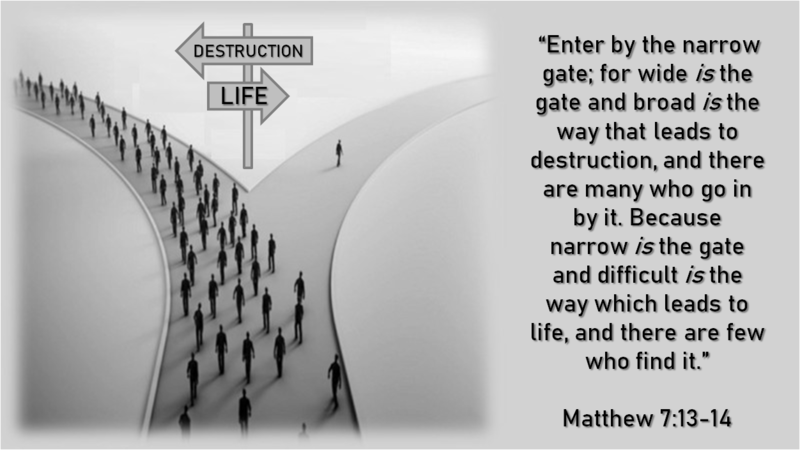
Radically different, the thought there is a wide, easy road leads to destruction. And there is a decisively harder, narrower road of discipleship leading unto life.

It can be easy to assume that the broad road includes only people who do not believe in God, or maybe people of some other faith who do not “know” Jesus.

So, today, we might ­assume that Jesus is drawing a contrast between people in the church and those who, for some reason, are now completely outside of it.

But in light of Jesus’ teaching in the Sermon on the Mount, there’s another way to think about this passage.

Jesus has been teaching his listeners that they need to move from outward religion and ritual into a true relationship with God, our need to go beyond merely “behaving” ourselves to ­actually walking in union with the Father.

So, today, as we read this passage again, as we refresh ourselves with truth, we seek a new anointing of wisdom greater than our own, we need to realize Rabbi Jesus is describing, for those who ARE listening, and DOING. not only a choice between choice or no choice, faith or no faith, hope no hope, love and no love.

There is also a choice to be made between empty, surface-level religion and genuine hardcore “walk the walk, talk the talk, living the life” discipleship.

The call of this passage is to move “beyond” rituals or cultural faith and to truly enter a full-life, full throated relationship with God, a connection marked by our maximum dependence and maximum an utter submission unto his will.

IS THE CHOICE OF SALVATION AN EASY CHOICE?

Matthew 7:13-14Easy-to-Read Version

The Way to Heaven and the Way to Hell

13 “You can enter true life only through the narrow gate. The gate to hell is very wide, and there is plenty of room on the road that leads there. Many people go that way. 14 But the gate that opens the way to true life is narrow. And the road that leads there is hard to follow. Only a few people find it.

Here is the appeal to which Jesus has been moving through the whole sermon.

He gives those who had gathered that day, those who were listening, the call to choose, decide now about becoming a citizen of God’s kingdom and inheriting eternal life, or remaining a citizen of this fallen world and receiving damnation.

The way to life is on God’s terms alone; the way to destruction is on any terms a person wants to contrive, because every way but God’s leads unto the same fate.

Rabbi Jesus has been teaching the people to begin thinking of, about, God’s own standards throughout the sermon, standards that are holy and perfect and that are a-traditional, diametrically opposed to the self-righteous, self-sufficient, hypocritical standards of man-typified by those of the scribes and Pharisees.

He introduces to them the very real possibility of what God’s kingdom is like and having them compare, contrast, what its people are like-and are not like.

Now, here, Rabbi Jesus presents the choice of entering the kingdom or not.

Rabbi Jesus focuses upon the inevitable decision every person must make, the crossroads where he must decide on the gate he will enter, the way he will go.

Our lives are filled with “brutally” complicated internet driven decisions-what to wear, colors in vogue, what to eat, where to go, what to do, what to say, what not to say, what to buy, whom to marry, what career to follow, and on and on.

Many so called- and allegedly complicated decisions are actually “trivial and insignificant,” and some are beyond critically essential and life-changing.

The most critical of all is our decision about Jesus Christ and His kingdom.

That is the ultimate choice that determines our eternal destiny.

It is that decision that Rabbi Jesus introduces here and calls upon us to make.

In perfect harmony with His absolute sovereignty, God has always allowed men to choose Him or not, to “follow Him or walk away” and He has always pleaded with them to decide for Him or face the consequences of a choice against Him.

Since mankind has consistently turned their backs on Him from the Fall, God has bent every effort, spared no cost in wooing His creatures back to Himself.

He has provided and shown the way, leaving nothing to man but the choice. God made His choice by providing the way of redemption.

The choice is now and forever more present before the entirety of mankind.

While Israel was in the wilderness the Lord instructed Moses to tell the people,

“I call heaven and earth to witness against you today, that I have set before you life and death, the blessing and the curse. So choose life in order that you may live, you and your descendants, by loving the Lord your God, by obeying His voice, and by holding fast to Him” (Deuteronomy 30:19–20).

After Israel came into the Promised Land, at the end of his long life, Joshua confronted the people again with a choice: of continuing to serve the Egyptian and the Canaanite gods they had adopted or of turning to the Lord who had delivered them from Egypt and given them the land promised to Abraham.

“Choose for yourselves this today whom you will serve ….” Joshua pleaded (Joshua 24:13–15).

On Mount Carmel the prophet Elijah asked the people of Israel,

“How long will you hesitate between two opinions? If the Lord is God, follow Him; but if Baal, follow him” (1 Kings 18:21).

The Lord commanded Jeremiah to set the choice again before His people:

“Thus says the Lord, ‘Behold, I set before you the way of life and the way of death’ ” (Jeremiah 21:8).

In John 6:66–69, Jesus called for a choice from all of the people who gathered:

“As a result of this many of His disciples withdrew, and were not walking with Him anymore. Jesus said therefore to the twelve, ‘You do not want to go away also, do you?’ Simon Peter answered Him, ‘Lord, to whom shall we go? You have words of eternal life. And we have believed and have come to know that You are the Holy One of God.’ ”

That is the choice to compare and contrast call God has been making to men since they turned away from Him, and it is the supreme appeal of His Word.

In his poem The Ways, late British poet, hymnwriter John Oxenham wrote,   

To every man there openeth
    A Way, and Ways, and a Way,
    And the High Soul climbs the High Way,
    And the Low Soul gropes the Low,
    And in between, on the misty fiats,
    The rest drift to and fro.
    But to every man there openeth
    A High Way and a Low,
    And every man decideth
    The Way his soul shall go.

He also writes the hymn “In Christ There is No East or West.” (1908)

1 In Christ there is no east or west,
in him no south or north,
but one great fellowship of love
throughout the whole wide earth.

2 In Christ shall true hearts ev’rywhere
their high communion find.
His service is the golden cord
close binding humankind.

3 Join hands, then, people of the faith,
whate’er your race may be.
All children of the living God
are surely kin to me.

4 In Christ now meet both east and west,
in him meet south and north.
All Christly souls are joined as one
throughout the whole wide earth.

The not so simple process of making the compare and contrast, world versus God choice we are asked by Rabbi Jesus to make is complicated by being simply somewhere in between the poem and the hymn, our souls and His eternal life.

In the name of God, the Father and God the Son, and God the Holy Spirit,

Let us Pray,

Psalm 16The Message

16 1-2 Keep me safe, O God,
    I’ve run for dear life to you.
I say to God, “Be my Lord!”
    Without you, nothing makes sense.

And these God-chosen lives all around—
    what splendid friends they make!

Don’t just go shopping for a god.
    Gods are not for sale.
I swear I’ll never treat god-names
    like brand-names.

5-6 My choice is you, God, first and only.
    And now I find I’m your choice!
You set me up with a house and yard.
    And then you made me your heir!

7-8 The wise counsel God gives when I’m awake
    is confirmed by my sleeping heart.
Day and night I’ll stick with God;
    I’ve got a good thing going and I’m not letting go.

9-10 I’m happy from the inside out,
    and from the outside in, I’m firmly formed.
You canceled my ticket to hell—
    that’s not my destination!

11 Now you’ve got my feet on the life path,
    all radiant from the shining of your face.
Ever since you took my hand,
    I’m on the right way.

Adeste Fidelis! Venite Adoremus! Dominum.

Gloria! In Excelsis Deo! Alleluia! Alleluia! Alleluia! Amen.
https://translate.google.com/

Asking Ourselves the Easy and Hard Questions About Walking Upon the Broad or Straight and Narrow Paths. Matthew 7:13-14

Matthew 7:13-14The Message

Being and Doing

13-14 “Don’t look for shortcuts to God. The market is flooded with surefire, easygoing formulas for a successful life that can be practiced in your spare time. Don’t fall for that stuff, even though crowds of people do. The way to life—to God!—is vigorous and requires total attention.

The Word of God for the Children of God.

Adeste Fidelis! Venite Adoremus! Dominum

Gloria! In Excelsis Deo! Alleluia! Alleluia! Alleluia! Amen.

When given the chance, I will argue to no end that much of life’s success boils down to one simple maxim: do the real thing and stop doing fake alternatives.

DOING THE “REAL THINGS” NOT THE “FAKE ALTERNATIVES”

Knowing the “differences” always begins by our daring to ask ourselves:

“How would I do this, if doing it well and good were all that mattered?”

“How would I do this, if convenience made all the difference in doing it well?”

“How would I do this, if I had all the time in the world to draft the best plan?”

“How would I do this, if I had a matter of a few hours to draft the best plan?”

“How would I do this, if this situation was life or death and I need a plan now?”

Do I still do the absolute best that I can or do I start looking for “shortcuts”?

Do I throw all caution into the tornadic whirlwinds of inconceivable change?

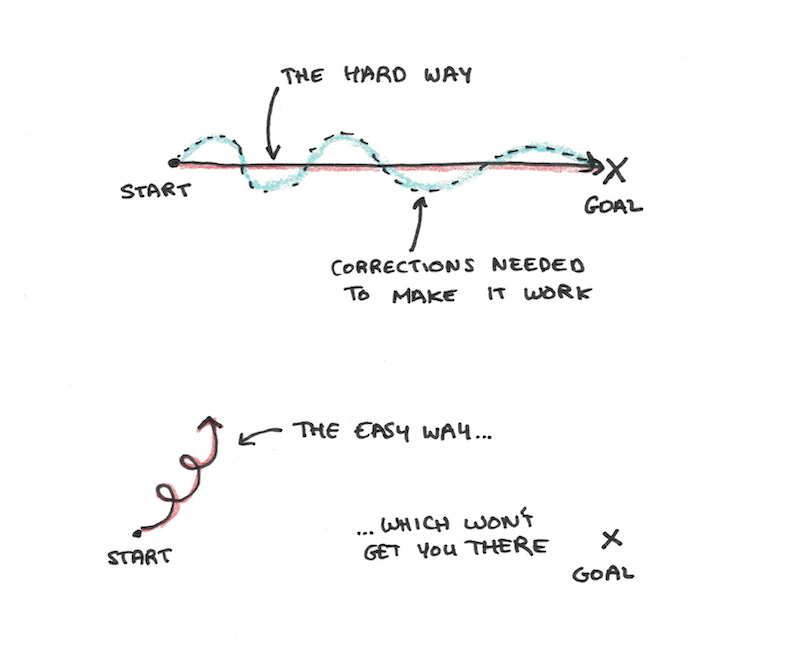
The Easy Way or The Hard Way?

The High Road or the Low Road?

The Paved Road over the Mountains or the Rained out, Rutted out Dirt Path?

Which will get me to the place I want to be? I need to be? – with the least risk?

How desirous, am I to going all out to get there, risking life, limb and liberty?

Which will get me to the one single place which Jehovah God requires me to be?

My asking each of us these poignant questions this soon in the New Year ….

Now, in answering them, you might object: “You don’t have enough time. You have two jobs, kids and responsibilities – Doing it well sounds too daunting.”

This is okay.

The point of this thought experiment is not to deny that obstacles to living into the Christian life under the all watchful eyes and presence of God do fully exist.

Rather it is an effort to open your eyes, in this moment, to begin thinking about how connected to God or distracted from God, to stop and consider the road you are on, the road you need to be on, the road which Jehovah God requires of you.

Rather, it’s to start with the best plan and make accommodations as needed.

The “Christian life” never remains an easy one.

The “Christian life” is never going to stop happening.

Sometimes, our “Christian life” is absolutely going to spiral out of our control.

Apathy and Complacency become a threat, what results is usually much closer to not the ideal than if you simply start with something that feels easy enough.

The Good News is this:

JEHOVAH GOD IS ALWAYS IN CONTROL!

As we seek out our God, as we meditate daily (do we meditate daily?) about our immersing ourselves in our life journey with Jesus, the Way, I so fervently pray that we find that Rabbi Jesus offers to each of us lots of helpful guidelines for us.

Our Scripture for today from Matthew 7:13-14, comes at the end of his “Sermon on the Mount,” which is like a guidebook for everyday living in God’s kingdom.

Sometimes this style of living is called “the Christian counter-culture.”

That’s because the God-honoring lifestyle of following Jesus often goes against popular opinion – In other words, reality check – we take the road less traveled.

Taking the narrow road doesn’t mean we are narrow-minded or we just prefer to go against what “everyone else is doing.”

It means, simply, we do what we do because God calls us to do what is right.

Jesus indicates that many people want to follow an “anything goes” lifestyle.

But in that kind of world people tend to be selfish, uninhibited, putting their own desires ahead of everything else, and lots of other people will get hurt.

Eventually that kind of life leads to self-destruction, so, in the end, it hurts the selfish individual too.

How many lives, marriages, families, communities, and societies have been harmed, even destroyed because people have insisted on going their own way?

Rabbi Jesus calls us to choose which way we will walk

…..“the seldom taken high risk, straight and narrow gate … that leads to life.”

….”the easiest path with least amount of risk and the least level of resistance” which will inevitably lead us down the pathway to our inevitable destruction.

In John 10:7 he calls himself “the gate.”

He alone opens the way to life—now and for eternity!

“Outside” the Presence of Jehovah God ….

FIRST:

Ask yourself the easy, easier and the easiest questions.

Ask yourself the hard, harder and hardest questions.

THEN ULTIMATELY – IN THE PRESENCE OF JEHOVAH GOD ….

Ask yourself the “easy, easier and the easiest” questions.

Ask yourself the hard, harder and hardest” questions.

Now contemplate ….

Choose this day where your heart and soul genuinely rest ….

Self …. Now you’ve got my feet on the life path,
    all radiant from the shining of your face.
Ever since you took my hand,
    I’m on the right way.

Jehovah God …. Now you’ve got my feet on the life path,
    all radiant from the shining of your face.
Ever since you took my hand,
    I’m on the right way.

WALK ON THE PATH THAT SERVES YOU BEST!

In the name of God, the Father and God the Son and God the Holy Spirit,

Let us Pray,

Most Merciful God, You are invisible to us, Your salvation is opaque to us, and Your grace is an enduring mystery. Who is it who can actually plumb the depths of Your wonders? Who has seen Your face and yet lived? Lord, let me comprehend You. Help me to understand the astonishing depths of Your love and grace. Forgive us, Lord, for wanting to go our own “easy, easier, an easiest” way. Have your way with us; mold us and remake us, guiding us to do what is right in all we do. Help me to continue to grow up into this infinite affection, that I may walk upon Your pathway to life, that I may serve you and your neighbors more, and become “more” pleasing to You. Amen.

Adeste Fidelis! Venite Adoremus! Dominum

Gloria! In Excelsis Deo! Alleluia! Alleluia! Alleluia! Amen.

https://translate.google.com/

The Divine Order of Things: Seeking the Lord Who Is our God: Walking, Living, Upon the Straight and the Narrow Path. Matthew 7:13-14

Matthew 7:13-14 Holman Christian Standard Bible

Entering the Kingdom

13 “Enter through the narrow gate. For the gate is wide and the road is broad that leads to destruction, and there are many who go through it. 14 How narrow is the gate and difficult the road that leads to life, and only a few find it.

The Word of God for the Children of God.

Adeste Fidelis! Venite Adoremus! Dominum

Gloria! In Excelsis Deo! Alleluia! Alleluia! Alleluia! Amen.

To a newspaper inquiry asking what is wrong with the world, the writer and philosopher and Christian Apologist and Literary Critic, G. K. Chesterton sent back the shortest letter the editor had ever received:

Dear Sir, Regarding your article “What’s wrong with the world?”—I am. Yours truly, G. K. Chesterton

This demonstrates a humility that is lacking in most people.

Frankly, most of us would much rather note to the utmost detail someone else’s shortcomings rather than their own.

However, it is worth a minute or two of our attention to note the first step to transformation is for us to discover our own faults and face up to our sins.

Rather than denying our failures and getting too defensive about the foolish choices we’ve made, we must admit we have wandered from God’s pathway.

The road to God is narrow.

The way of heaven is straight. 

I have learned this from reading, studying and praying over and through the Word of God and from personal experience, as well as from divine revelations. 

It is literally a straight and narrow path.

It is straighter, narrower, and more difficult than most Christians realize.

Let’s look at what the Scriptures say about this topic.

Straight is Jehovah God’s Divine Order

As it is written in the book of the words of Isaiah the prophet: “A voice of one calling in the wilderness, ‘Prepare the way for the Lord, make straight paths for him. Every valley shall be filled in, every mountain and hill made low. The crooked roads shall become straight, the rough ways smooth.'” (Luke 3:4-5)

“They have left the straight way and wandered off to follow the way of Balaam son of Bezer, who loved the wages of wickedness.” (2 Peter 2:15)

“Who have left the straight paths to walk in dark ways,” (Proverbs 2:13)

“I instruct you in the way of wisdom and lead you along straight paths.” (Proverbs 4:11).

“He led them by a straight way to a city where they could settle.” (Psalm 107:7).

“In all your ways submit to him, and he will make your paths straight.” (Proverbs 3:6).

“Whoever has understanding keeps a straight course.” (Proverbs 15:21b).

“Do not turn to the right or the left; keep your foot from evil.” (Proverbs 4:27; cf., Joshua 1:7).

The apostle Paul said the ways of the Lord are straight (Acts 13:10).

The Scripture says, “Trust in the LORD with all your heart And do not lean on your own understanding. In all your ways acknowledge Him, And He will make your paths straight.” (Proverbs 3:5-6).

Also see the following Scriptures in the NASB version: Deuteronomy 32:5; Psalm 5:8. Psalm 18:26; 125:5; Proverbs. 2:15; 3:5-6; 8:9; 17:20; 21:8; 28:6, 18; Isaiah 40:3, 59:8; Ecclesiastes 7:13, Jeremiah 31:9, Ezekiel 1:9,12; 10:22; 46:9; Philippians 2:15.

Narrow is Jehovah God’s Divine Order

Rabbi Jesus said, “Enter through the narrow gate. For wide is the gate and broad is the road that leads to destruction, and many enter through it. But  small is the gate and narrow the road that leads to life, and only a few find it.” (Matthew 7:13-14).

He said this at the end of His sermon on the mount, which summarizes the content of that sermon recorded in Matthew 5-7.

In that sermon, He taught that something you say can put you in danger of the fire of hell (Matthew 5:22).

The sin of adultery can be committed in your heart without even having physical contact with the other person (Matthew 5:28).

He taught the need for radical obedience to God at all costs (Matthew 5:29-30).

Indeed, it is not only our outward actions that must be perfect, but also our thoughts, motives, and words (Matthew 5:48).

As much as possible for any person, self must be denied, the body kept under subjection, corruptions put to death; temptations must be resisted on a daily basis; duties must be carried out that are against our natural tendencies.

We must wrestle, with ourselves, against cultural and worldly ways which morally and ethically distract us from God, we must watch in everything, and walk with care and prudence, wary of that which would endanger our souls.

We must change and transform our attitudes and perceptions of how life works to pass through our many trials and tribulations (John 16:33; 1 Peter 4:12-19).

Radically new attitudes, thoughts and perceptions and new ways of addressing how we approach living life in the presence of God come to the forefront of life.

Fruits of the Holy Spirit

22 For we know that the whole creation has been moaning together as in the pains of childbirth until now. 23 And not only this, but we too, who have the first fruits of the Spirit [a joyful indication of the blessings to come], even we groan inwardly, as we wait eagerly for [the sign of] our adoption as sons—the redemption and transformation of our body [at the resurrection]. 24 For in this hope we were saved [by faith]. But hope [the object of] which is seen is not hope. For who hopes for what he already sees? (Romans 8:22-24 Amplified)

16 But I say, walk habitually in the [Holy] Spirit [seek Him and be responsive to His guidance], and then you will certainly not carry out the desire of the [a] sinful nature [which responds impulsively without regard for God and His precepts]. 17 For the sinful nature has its desire which is opposed to the Spirit, and the [desire of the] Spirit opposes the [b]sinful nature; for these [two, the sinful nature and the Spirit] are in direct opposition to each other [continually in conflict], so that you [as believers] do not [always] do whatever [good things] you want to do. 18 But if you are guided and led by the Spirit, you are not subject to the Law. 19 Now the practices of the  [c] sinful nature are clearly evident: they are sexual immorality, impurity, sensuality (total irresponsibility, lack of self-control), 20 [d]idolatry, [e]sorcery, hostility, strife, jealousy, fits of anger, disputes, dissensions, factions [that promote heresies], 21 envy, drunkenness, riotous behavior, and other things like these. I warn you beforehand, just as I did previously, that those who practice such things will not inherit the kingdom of God. 22 But the fruit of the Spirit [the result of His presence within us] is love [unselfish concern for others], joy, [inner] peace, patience [not the ability to wait, but how we act while waiting], kindness, goodness, faithfulness, 23  gentleness, self-control. Against such things there is no law. 24 And those who belong to Christ Jesus have crucified the [f]sinful nature together with its passions and appetites. (Galatians 5:16-24 Amplified)

We must go through many hardships to enter the kingdom of God (Acts 14:22).

We must learn and practice and weave God into our life, discipline ourselves to more fully rely upon God, the Father and God the Son and God the Holy Spirit.

This is definitely not the way that the majority of the “self reliant” people go.

Most people go through the wide gate and take the broad road that leads to destruction.

But only a few seek, find, the small gate and the narrow road that leads to life.

All too many are going to their destruction, but only a few are going to heaven.

He also said, “Make every effort to enter through the narrow door, because many, I tell you, will try to enter and will not be able to.” (Lk 13:24).

If many try and are unable to enter through this narrow door, then it must be very narrow.

It’s difficult to find and difficult to get through, so every effort must be made to do so.

It’s hard but not impossible by God’s grace if we strive.

We will not be able to enter if you are complacent or half-hearted, because there are many Sins that will keep you and me from Heaven.

The devil has set many traps for you to try and capture you into hell.

We must avoid all the side roads.

It’s easy to be lured away from the straight path by the ways of seductive materialism, pride, and sensual satisfaction.

To avoid these and more, we have to name sin for what it is and not allow its evil influence to sidetrack us.

A relatively recent hymn based on Psalm 23 offers divine encouragement:

THE LORD MY SHEPHERD RULES MY LIFE Christopher Idle Hymn Text Words © 1977 The Jubilate Group (admin. Hope Publishing Company)

1 The Lord my shepherd rules my life
and gives me all I need;
he leads me by refreshing streams,
in pastures green I feed.
2 The Lord revives my failing strength,
he makes my joy complete;
and in right paths, for his name's sake,
he guides my faltering feet.

How Jehovah God Brings it All Together For Our Sakes

Alive, we are constantly and continuously staring at an upcoming crossroads.

Alive, we are constantly and continuously confronted by “forks” in our paths.

The Scriptures clearly teach that in everything the straight way is God’s way.

Indeed, the way to heaven is both straight and narrow. 

In fact, it is more so than even either you and I actually think it is.

But even one second, one minute, hour in heaven will make it all worthwhile.

Therefore, we must study and pray and strive to enter the Kingdom of God on the way of righteousness, holiness, and truth.

It’s long past the divinely allowable time we cease from standing in the broad and crooked path of sinners, and going along with the crowd.

It’s high time we consecrate ourselves to our Savior Jesus, and follow Him with pure and simple devotion (2 Corinthians 11:3). 

Continuously Seek Him earnestly (Psalm 63:1), stay close to Him (Psalm 63:8).

Let neither our Hearts nor our Souls be Troubled this day nor any other day;

Cling to God! All you His people, let’s Pray for the Ancient Paths once again.

In the name of God, the Father and God the Son and God the Holy Spirit,

Let us Pray …. (Psalm 40 the Message)

40 1-3 I waited and waited and waited for God.
    At last he looked; finally he listened.
He lifted me out of the ditch,
    pulled me from deep mud.
He stood me up on a solid rock
    to make sure I wouldn’t slip.
He taught me how to sing the latest God-song,
    a praise-song to our God.
More and more people are seeing this:
    they enter the mystery,
    abandoning themselves to God.

4-5 Blessed are you who give yourselves over to God,
    turn your backs on the world’s “sure thing,”
    ignore what the world worships;
The world’s a huge stockpile
    of God-wonders and God-thoughts.
Nothing and no one
    compares to you!
I start talking about you, telling what I know,
    and quickly run out of words.
Neither numbers nor words
    account for you.

Doing something for you, bringing something to you—
    that’s not what you’re after.
Being religious, acting pious—
    that’s not what you’re asking for.
You’ve opened my ears
    so I can listen.

7-8 So I answered, “I’m coming.
    I read in your letter what you wrote about me,
And I’m coming to the party
    you’re throwing for me.”
That’s when God’s Word entered my life,
    became part of my very being.

9-10 I’ve preached you to the whole congregation,
    I’ve kept back nothing, God—you know that.
I didn’t keep the news of your ways
    a secret, didn’t keep it to myself.
I told it all, how dependable you are, how thorough.
    I didn’t hold back pieces of love and truth
For myself alone. I told it all,
    let the congregation know the whole story.

11-12 Now God, don’t hold out on me,
    don’t hold back your passion.
Your love and truth
    are all that keeps me together.
When troubles ganged up on me,
    a mob of sins past counting,
I was so swamped by guilt
    I couldn’t see my way clear.
More guilt in my heart than hair on my head,
    so heavy the guilt that my heart gave out.

13-15 Soften up, God, and intervene;
    hurry and get me some help,
So those who are trying to kidnap my soul
    will be embarrassed and lose face,
So anyone who gets a kick out of making me miserable
    will be heckled and disgraced,
So those who pray for my ruin
    will be booed and jeered without mercy.

16-17 But all who are hunting for you—
    oh, let them sing and be happy.
Let those who know what you’re all about
    tell the world you’re great and not quitting.
And me? I’m a mess. I’m nothing and have nothing:
    make something of me.
You can do it; you’ve got what it takes—
    but God, don’t put it off.

Adeste Fidelis! Venite Adoremus! Dominum

Gloria! In Excelsis Deo! Alleluia! Alleluia! Alleluia! Amen.

https://translate.google.com/

Being A Sermon in Shoes: Living Out Our Lives Walking, Wearing the Sandals of our Rabbi Jesus: Walking by Faith Upon His Straight, and Narrow Path. Matthew 7:13-14

Matthew 7:13-14New King James Version

The Narrow Way

13 “Enter by the narrow gate; for wide is the gate and broad is the way that leads to destruction, and there are many who go in by it. 14 [a]Because narrow is the gate and [b]difficult is the way which leads to life, and there are few who find it.

The Word of God for the Children of God.

Adeste Fidelis! Venite Adoremus! Dominum.

Gloria! In Excelsis Deo! Alleluia! Alleluia! Alleluia! Amen.
Every child of God walks by “faith,” each and every step that we take reveals to God’s neighborhood, to all God’s neighbors, the visible measure of our “faith.”

Our Christianity is our most visible part and we must have the willingness to hear, a doubtless heart to believe, godly sorrow to repent, be unashamed to confess, the obedience to be baptized, the moral strength to endure till the end.

When we are willing to take up our cross and follow after Christ, we are taking the right steps on the straight and narrow path that leads to life everlasting.

At one time or another, I can practically guarantee that every Christian has heard another person tell them – (truth be told – this was my favorite line.)

“I do not need God, I do not need Jesus, I do not need church, I don’t really need anyone’s religion; I just try to be that good person and live by the Golden Rule.”

It’s not uncommon to hear people talk like this, usually they are trying to say “not interested” “go away” minimize God’s demand for how we should “live.”

As long as our visible “lifestyle” communicates to everyone around us, that we innately treat others as we want to be treated, God should accept us—right?

And usually this is enough to dissuade us from furthering the conversation.

We may never even start that conversation because we have assured ourselves beforehand that that is exactly the “automatic” response we will each receive.

The Question then becomes, If our Rabbi Jesus were to turn around in the exact moment we had that thought, looked us straight and narrowly into our eyes,

What would those soul piercing eyes immediately, not so subtly communicate?

Do you know, Oh Christian, you’re a sermon in shoes?
Jesus calls upon you, to spread the gospel news,
(1) So walk it, and talk it, a sermon in shoes.
(2) Live it, and give it, a sermon in shoes.
(3) Teach it, and preach it, a sermon in shoes.
(4) Know it, and show it, a sermon in shoes.
(Ruth Harms Calkin)

Rabbi Jesus most likely wore very simple sandals ….

So, without Rabbi Jesus ever using any words, can we hear his eyes tell us ….

“Do you know, Oh Christian, I am a sermon in very simple sandals ….?”

“Do you know, Oh Christian, I am a sermon in very simple sandals ….?”

“I am calling upon you, to spread the gospel news ….

“(1) So I walk it, and talk it, a sermon in very simple sandals ….”

“(2) So I live it an give it, a sermon in very simple sandals ….”

“(3) So I teach it, and preach it, a sermon in very simple sandals ….”

“(4) Because I know it, therefore I show it, a sermon in very simple sandals ….”

Matthew 7:13-14 The Message

Being and Doing

13-14 “Don’t look for shortcuts to God. The market is flooded with surefire, easygoing formulas for a successful life that can be practiced in your spare time. Don’t fall for that stuff, even though crowds of people do. The way to life—to God!—is vigorous and requires total attention.

Have we ever stopped to consider how demanding Jesus’ words truly are?

How challenging is it to meet the needs of others with the same creativity, the same energy, the spontaneity, the same devotion that we want from others?

No wonder the man Rabbi Jesus describes this way of life as narrow and small.

The man Rabbi Jesus poignantly points out only a few are walking on this road.

When we are walking down any paved or gravel or well trod path through the middle of a forest – we will probably see signs everywhere along the way which sternly tell us to “stay on the path, protect our forests and protect our wildlife.”

We definitely want to see the forest through the trees so we walk the pathway which is before us, prepared by somebody before us that we might enjoy it all.

We want to keep the rest of the forest pristine for those who are coming after us, that they too may enjoy the enormous beauty God has placed before them.

We do not want to be the one person who ruins someone else’s experience.

We make every effort we can to stay on the pathway someone else prepared.

As tempting as it is to wander through forest glades, through flowing streams.

Christianity is like that …. staying on the moral and ethical path Jesus gave us by his giving up quite literally everything of “value” to him (Philippians 2:5-11).

Romans 5:6-8The Message

6-8 Christ arrives right on time to make this happen. He didn’t, and doesn’t, wait for us to get ready. He presented himself for this sacrificial death when we were far too weak and rebellious to do anything to get ourselves ready. And even if we hadn’t been so weak, we wouldn’t have known what to do anyway. We can understand someone dying for a person worth dying for, and we can understand how someone good and noble could inspire us to selfless sacrifice. But God put his love on the line for us by offering his Son in sacrificial death while we were of no use whatever to him.

Despite all of the opposition he would receive, despite all the plots against his life, all the violence, humiliations he had to endure from both friend and foe, to walking out the straight and narrow pathway leading to a place called Golgotha.

To Communicate, for our “attentive(?)” listening ears the Immortal Words …

“Father, forgive them – for they know not what they do ….” Luke 23:33-35

“It is Finished….” John 19:28-30

After His resurrection … to receive the motivation of all motivations ….

John 21:15-17Amplified Bible

The Love Motivation

15 So when they had finished breakfast, Jesus said to Simon Peter, “Simon, son of John, do you love Me more than these [others do—with total commitment and devotion]?” He said to Him, “Yes, Lord; You know that I [a]love You [with a deep, personal affection, as for a close friend].” Jesus said to him, “Feed My lambs.” 16 Again He said to him a second time, “Simon, son of John, do you love Me [with total commitment and devotion]?” He said to Him, “Yes, Lord; You know that I love You [with a deep, personal affection, as for a close friend].” Jesus said to him, “Shepherd My sheep.” 17 He said to him the third time, “Simon, son of John, do you love Me [with a deep, personal affection for Me, as for a close friend]?” Peter was grieved that He asked him the third time, “Do you [really] [b]love Me [with a deep, personal affection, as for a close friend]?” And he said to Him, “Lord, You know everything; You know that I love You [with a deep, personal affection, as for a close friend].” Jesus said to him, “Feed My sheep.

Are you and I willing to receive, to immerse ourselves into such a motivation, prepared to love, say, your overbearing employer with kindness and courtesy?

Are you and I willing to sacrificially meet the needs of your spouse, children, and neighbors even if your needs aren’t the ones which not about to be met?

Will you and I care for the least lovely persons around us without expecting anything in return?

Psalm 23:4-6Amplified Bible


Even though I walk through the [sunless] [a]valley of the shadow of death,
I fear no evil, for You are with me;
Your rod [to protect] and Your staff [to guide], they comfort and console me.

You prepare a table before me in the presence of my enemies.
You have anointed and refreshed my head with [b]oil;
My cup overflows.

Surely goodness and mercy and unfailing love shall follow me all the days of my life,
And I shall dwell forever [throughout all my days] in the house and in the presence of the Lord.

How about those who are truly difficult to love – like your own “enemies?”

Preparing a table before them ….

with the prospect of “anointing and refreshing their heads with oil ….

extending the invitation to God’s “goodness and mercy and unfailing love” which will absolutely follow them for all of the remaining days of their lives ….”

to dwell forever, throughout all their remaining days, in the house and in the presence of the Lord – who could, on confession, be their everlasting salvation.

When we are being transformed by the enormity of the love of Jesus, who is our Savior, we can definitely, but with difficulty, walk on this narrowed way of life.

Rabbi Jesus alone lived and loved this way….

Rabbi Jesus alone live and loved and died for us this way ….

Jesus walked the narrow way out his sealed tomb,

Peter, John and Mary Magdalene walked the narrow way down and through the narrow opening of the tomb – witnessed and testified to its eternal emptiness.

Jesus is Resurrected, Jesus is ALIVE!

He calls us to follow, the narrow path, serving not in our own strength but in his.

How will his love empower you to walk, love others with his kindness today?

In the name of God, the Father and God the Son and God the Holy Spirit,

Let us Pray,

Heavenly Father, thank You for sending Your Son to us that we may come to know Your greater and ever more wiser and eternal ways, that through His teachings we may experience the only meaningful pathway to everlasting life, that in Christ Jesus, my Savior, I have been saved by grace and have an eternal inheritance kept for me in heaven. I pray that I may be disciplined enough to die daily to all that is of self and live every day of my life for Christ. Help me to choose to enter the narrow gate of disciplined, dedicated discipleship, which leads to an abundant life here on earth.

Adeste Fidelis! Venite Adoremus! Dominum

Gloria! In Excelsis Deo! Alleluia! Alleluia! Alleluia! Amen.

https://translate.google.com/

“Coram Deo” Living Our Lives in the Presence of Christ Who is Our Savior: Six Biblical Essentials For Christian Maturity. Selected Verses Hebrews 12

Hebrews 12:1-3Amplified Bible

Jesus, the Example

12 Therefore, since we are surrounded by so great a cloud of [a]witnesses [who by faith have testified to the truth of God’s absolute faithfulness], stripping off every unnecessary weight and the sin which so easily and cleverly entangles us, let us run with endurance and active persistence the race that is set before us, [looking away from all that will distract us and] focusing our eyes on Jesus, who is the Author and Perfecter of faith [the first incentive for our belief and the One who brings our faith to maturity], who for the joy [of accomplishing the goal] set before Him endured the cross, [b]disregarding the shame, and sat down at the right hand of the throne of God [revealing His deity, His authority, and the completion of His work].

Just consider and meditate on Him who endured from sinners such bitter hostility against Himself [consider it all in comparison with your trials], so that you will not grow weary and lose heart.

The Word of God for the Children of God.

Adeste Fidelis! Venite Adoremus! Dominum.

Gloria! In Excelsis Deo! Alleluia! Alleluia! Alleluia! Amen.

My parents did what they could to provide a “religious experience” for me.

The thing that they didn’t really do was provide a spiritual experience.

The religious experience that I had was a mixed one where I participated in some of the traditions of the Catholic Church, the Sunday School of the Church of the Brethren and finally Saturdays in the Synagogue and Hebrew School.

Most of the time, being as child like as I was I didn’t know why I did what I did; I just did it because a whole bunch of adults in authority over me had told me to.

The bulk of the participation was confined to Saturday mornings, and twice a week Hebrew School for which it was forbidden of me to speak about to friends.

It didn’t really matter what happened during the other other days.

There was my Bar Mitzvah in 1974 which mattered very deeply to me.

We celebrated The High Holidays of Rosh Hashana, Yom Kippur, Passover and growing up celebrating the eight days of Chanukah over the one day of Xmas.

However, being that I was not “born” of the Jewish Faith, I was never really taught how to take the teachings of the “faith” and develop a set of spiritual principles that should have become my life’s value system as I grew older.

20/20 hindsight, I can say that I never really believed I matured spiritually.

It was mostly a collection of “disjointed” “disconnected” teachings from some a whole series very well educated, very well intentioned people – My Rabbi is someone who I remember with the utmost fondness for his great compassion.

But there was never really anything anybody taught me, book wise, experience wise, which gave me the necessary foundation to “seek God first and foremost.”

For most of my teenage years and well into my adulthood, God was virtually nothing to me, as my Father, as my Creator, my help in my troubles, my friend or my redeemer, prayer partner, sustainer, maintainer, or even my Savior.

I had little experience or knowledge of Jesus whose name was not mentioned in our household because a whole lot of people told me Jews did not believe in him.

No one ever “invited me” – Isaiah 55:1-3 – to turn to God and freedom in Him. So consequently, I learned overmuch how to turn to me and my survival skills.

Turning unto God for anything was simply the furthest thought from my mind.

I simply did not know how and there were precious few people I would listen to.

I always sensed that there was something inside me which kept me on a path of sound morals and ethics – knowing right from wrong, my personal convictions.

Something inside me which told me to weigh out the pro and con of my choices.

Though I would never dare to assign them to God or His Son or the Holy Spirit.

I guess that God was always somewhere in the very deepest recesses of my soul.

Just never allowed to get close enough to the forefront to be even minimally acknowledged or permitted any measure of relevance to my day to day living.

Hebrews 12:1-3Easy-to-Read Version

We Also Should Follow Jesus’ Example

12 We have all these great people around us as examples. Their lives tell us what faith means. So we, too, should run the race that is before us and never quit. We should remove from our lives anything that would slow us down and the sin that so often makes us fall. We must never stop looking to Jesus. He is the leader of our faith, and he is the one who makes our faith complete. He suffered death on a cross. But he accepted the shame of the cross as if it were nothing because of the joy he could see waiting for him. And now he is sitting at the right side of God’s throne. Think about Jesus. He patiently endured the angry insults that sinful people were shouting at him. Think about him so that you won’t get discouraged and stop trying.

There were no “great people” around me to show me the ways of the faithful.

There were no “great clouds of witnesses” lingering anywhere nearby or even in the heavens above – just rain clouds and thunder storms flooding my cellar.

I never knew to look for Jesus, at Jesus, towards Jesus – never heard his name.

Consequently, I never spent any measure of time thinking or believing on Jesus.

Over time, things changed …. I literally had to almost die to call out unto God.

I can say now people will usually turn to God for help when their foundations are shaking, only to learn that it is God, through Christ, who is shaking them.

Sometimes God needs to do things to us to get our attention.

The spiritually mature person does not have to turn to God when things get tough, because they believe God is standing right next to them.

They do not scream Oh God, when they are fearful of suddenly losing their life, they only have to “whisper” and they have the faith that He hears their words.

Why do some people have this ability to be at peace even in the face of greatest adversity, and tragedy?

By experience, I don’t believe spiritual maturity is something that just happens.

A person does not wake up one morning and find themselves with a renewed outlook on life.

It is definitely something that has to be cultivated from the bottom up.

The roots have to be developed and then a person will begin to see the flowers.

In my case I did not start this process until I was 40 years old.

From the time I was 14 years old I never could figure out what I believed in.  

I believed there was a “God,” but I didn’t have a value system or a commitment to any one source helping me to connect, inspire, or uplift me on a regular basis.

Whenever a wave of life hit me I would reach into the chambers of my soul and discover there wasn’t anything I could use to help me deal with life’s problems. 

I never made the connection between spiritual maturity and overall maturity as a person of faith.

A spiritually mature person knows how to take the spiritual dimension and apply the principles of their belief system to their life on a daily basis.

I have always enjoyed The Serenity Prayer.

“God grant me the serenity to accept the things I cannot change, the courage to change the things I can, and the wisdom to know the difference.” 

In order for me to accept things I could not change and to develop wisdom I needed to plug into a daily source to draw from and to gain daily inspiration.

With a discipline born from years, I found the daily reading of the scriptures helped me gain insights into the battles of life and offered answers to questions that I otherwise never would have been able to come up with on my own device.

Working to establish a discipline of reading, I would discover verses in scripture that I would meditate on and make them part of my prayer and thought life.

From such a discipline, God, through Christ and the Holy Spirit, has born much spiritual fruit with in me – as I daily read, study, pray and write these devotions.

The evangelist Martin Luther once said, “I have so much to do today, that I will have to spend two hours praying instead of one.”

Scripture reading and prayer and writing these devotions have become for me a necessary source of Jehovah God for me to draw energy from, to attain wisdom from, to get the daily emotional strength I need to prayerfully manage my day.

Many people gain energy and insights from other areas.

Inspirational literature, walks in the park, or even melodious music can inspire some.

A fundamental belief system that gives a person a path to follow and that can make them almost unflappable and have inner peace is very private and very different for each person – each of us needs to resolve to find God in Scripture.

There are core principles spiritually immature people need to work on to make them their own, which spiritually mature people have adopted as a part of life.

These essential principles are already resting deep inside the silent chambers of a person’s heart, placed by God, and I believe they are universal to everyone.

When the ground starts to quake a person who has a strong core understands the reason for the earth quake and has the confidence that there is a way out.

The Christian life is not a series of a few special performances; it is steady persistence for a lifetime.

Many of us can produce a burst of enthusiasm now and then.

That’s not particularly difficult.

The real challenge is to stay the course over the long haul—not a flash in the pan but steady, stable, and persevering in the essentials of maturing faith.

I believe that Reading, Studying, Praying, through the second half of Hebrews 12 presents us all with a “beginning” to-do list of sorts for the Christian life.

It’s not by any means any quick-fix, three-easy-steps-to-success kind of list, but it does offer us six important ways to walk in enduring Christian maturity.

Hebrews 12:12-13 Easy-to-Read Version

Be Careful How You Live

12 You have become weak, so make yourselves strong again. 13 Live in the right way so that you will be saved and your weakness will not cause you to be lost.

Keep Strong and Straight

Despondency is one of the great avenues of attack from the Evil One.

Our disconnections, our discouragements are his delight, and he can uses them to great effect, for Christians in daily living, even for those involved in ministry.

To serve Christ is not to walk around in blissful unawareness of life’s realities.

The Christian life involves serious struggle.

Therefore,

this call to step forward—in “the strength that God supplies” (1 Peter 4:11), as it were—must not only ring in our ears but quake and reverberate in our hearts.

Those who seek to follow Christ must be prepared to declare, I absolutely refuse to gratify the devil by staying downhearted.

He would love nothing more than to see our arms enfeebled, our quaking knees buckling under his devices, and our paths veering off the course of obedience.

Pursue Harmony and Holiness

Hebrews 12:14Easy-to-Read Version

14 Try to live in peace with everyone. And try to keep your lives free from sin. Anyone whose life is not holy will never see the Lord.

“Strive” is probably a more appropriate translation for the imperative here.

It communicates concentrated, vigorous effort.

The author is saying, 

I want you to pursue this with the passion of a hound pursuing a fox.

And the fox we are to pursue is the twofold goal of harmony and holiness.

Maintaining peace requires serious striving.

Christ purchased peace, and “he himself is our peace” (Ephesians 2:14).

Discord is inevitable in our fractured age, even in the church—but this is no reason to ever consider giving up!

We strive to grow in harmony and to shed the burdens and sins that hold us back from it.

Jesus Himself told us, “By this all people will know that you are my disciples, if you have love for one another” (John 13:35).

We won’t have perfect harmony before Christ returns, but in reliance on the Holy Spirit, we can each strive to be a small taste of heavenly community.

And how do we foster such harmony?

Well, holiness provides the steady framework, the fertile soil, for the harmony that we enjoy.

As we grow in holiness together from the shared wellspring of the Holy Spirit at work in our hearts, we will also grow in harmony with one another, with God.

Neither harmony nor holiness is an optional extra – they come from the work of Christ’s Spirit in us and within us thus are evidence we all really belong to Him.

Grow in God’s Grace Not in Humanity’s Bitterness

Hebrews 12:15Easy-to-Read Version

15 Be careful that no one fails to get God’s grace. Be careful that no one loses their faith and becomes like a bitter weed growing among you. Someone like that can ruin your whole group.

How can we miss the grace of God?

We may be surprised how easy it is to do so!

When the Scriptures are taught, when the sacraments of the Lord’s Supper and baptism are practiced, when the church fellowships together, it is still possible for us to sit around, wipe the dust off our bibles, sit with our fingers in our ears.

The phrases “bitter weed” “root of bitterness” in this verse draws its language from Deuteronomy 29, in which Moses warns Israel about their hearts:

“Beware lest there be among you a root bearing poisonous and bitter fruit” (verse 18).

This is someone “who, when he hears the words of this sworn covenant, blesses himself in his heart, saying, ‘I shall be safe, though I walk in the stubbornness of my heart’” (v. 19, emphasis added).

James echoes this warning with the command to “be doers of the word, and not hearers only, deceiving yourselves” (James 1:22, emphasis added).

When we hear without really listening, then we end up having all the trappings of Christianity while worldliness is still rooted in our hearts.

Envy, bitterness, anger, rage, and despondency begin to make our souls numb, impervious to what God really wants for us.

We must pull these destructive weeds up by the root and instead let the grace of God fill our hearts so that we can be disciplined hearers and doers of His Word.

Reject Immorality and Godlessness

Hebrews 12:15-17Easy-to-Read Version

15 Be careful that no one fails to get God’s grace. Be careful that no one loses their faith and becomes like a bitter weed growing among you. Someone like that can ruin your whole group. 16 Be careful that no one commits sexual sin. And be careful that no one is like Esau and never thinks about God. As the oldest son, Esau would have inherited everything from his father. But he sold all that for a single meal. 17 You remember that after Esau did this, he wanted to get his father’s blessing. He wanted that blessing so much that he cried. But his father refused to give him the blessing, because Esau could find no way to change what he had done.

The original hearers of the Epistle to the Hebrews lived in an overwhelmingly pagan society—perhaps an not unlike our own, in which promiscuity outpaces modesty nearly everywhere they walked and talked and we, today, now look.

In such a sexually charged setting, it is imperative God’s people demonstrate how we are both set apart to God and set apart from sin.

As the apostle Paul commends, we must “flee from sexual immorality” (1 Corinthians 6:18).

How does Esau fit in?

His story serves as a parable of an outsized physical appetite.

In the heat of the moment, he exchanged his heritage and home for something quick and easy and potentially appealing and probably appetizing and cheap.

Like him, you can build your life for decades, throw it away in five minutes in a fit of unchecked lust—or rage, pride, or greed, or cheapened, for that matter.

We must not sell out to sin.

The tradeoff is simply never worth it, never going to be worth it, no matter what we self actualize, rationalize or temptation promises in the moment.

Discipline Yourselves to Listen Only to God

Hebrews 12:25-26Easy-to-Read Version

25 Be careful and don’t refuse to listen when God speaks. Those people refused to listen to him when he warned them on earth. And they did not escape. Now God is speaking from heaven. So now it will be worse for those who refuse to listen to him. 26 When he spoke before, his voice shook the earth. But now he has promised, “Once again I will shake the earth, but I will also shake heaven.”[a]

By reading, studying and praying through the OT, time and again, God sent prophets to warn His people—and all too often, the people refused to listen.

Their willful ignorance eventually resulted in 70 years of exile.

If God did that to people who refused His earthly prophets, then we surely should think twice before we refuse the word of His very Son from heaven.

Luke 16:19-31New Living Translation

Parable of the Rich Man and Lazarus

19 Jesus said, “There was a certain rich man who was splendidly clothed in purple and fine linen and who lived each day in luxury. 20 At his gate lay a poor man named Lazarus who was covered with sores. 21 As Lazarus lay there longing for scraps from the rich man’s table, the dogs would come and lick his open sores.

22 “Finally, the poor man died and was carried by the angels to sit beside Abraham at the heavenly banquet.[a] The rich man also died and was buried, 23 and he went to the place of the dead.[b] There, in torment, he saw Abraham in the far distance with Lazarus at his side.

24 “The rich man shouted, ‘Father Abraham, have some pity! Send Lazarus over here to dip the tip of his finger in water and cool my tongue. I am in anguish in these flames.’

25 “But Abraham said to him, ‘Son, remember that during your lifetime you had everything you wanted, and Lazarus had nothing. So now he is here being comforted, and you are in anguish. 26 And besides, there is a great chasm separating us. No one can cross over to you from here, and no one can cross over to us from there.’

27 “Then the rich man said, ‘Please, Father Abraham, at least send him to my father’s home. 28 For I have five brothers, and I want him to warn them so they don’t end up in this place of torment.’

29 “But Abraham said, ‘Moses and the prophets have warned them. Your brothers can read what they wrote.’

30 “The rich man replied, ‘No, Father Abraham! But if someone is sent to them from the dead, then they will repent of their sins and turn to God.’

31 “But Abraham said, ‘If they won’t listen to Moses and the prophets, they won’t be persuaded even if someone rises from the dead.’”

From this Parable in Luke, we certainly can learn to point to specific steps of obedience for clarity’s sake, but generally speaking, we always return to this foundation of the faith: hearing what GOD says and putting it into practice.

It’s profoundly simple, and simply profound: do not dismiss God who speaks.

Worship God and God alone with Reverence and Awe

Hebrews 12:28-29Easy-to-Read Version

28 So we should be thankful because we have a kingdom that cannot be shaken. And because we are thankful, we should worship God in a way that will please him. We should do this with respect and fear, 29 because our God is like a fire that can destroy us.

The final essential of Hebrews 12 is to worship God acceptably and properly, “with reverence and awe.”

We ought to set aside superficial and trivial controversies about worship style to experience and declare the glory of God with His people.

And beyond our corporate gatherings, our very lives should be becoming a “living sacrifice, holy and acceptable to God, which is your spiritual worship” (Romans 12:1).

Our God, a great and “consuming fire” (Deuteronomy 4:24), is absolutely worthy to have our entire lives devoted to Him.

To give our whole selves to God and practice these six essentials isn’t a responsibility to be carried out grudgingly.

It is our privilege and pleasure to live as God intends us to.

He has written the whole of His story, of His glory across time and space, and—wonder upon wonder!—all who confess Christ Jesus as Lord and will Savior find themselves an abundant, essential, critically important part of His master plan.

When we live and act in accord with what He sets forth and pursue obedience over a lifetime, He will use us to His Abundance to keep writing His story and to keep inviting and to keep drawing others into His kingdom on Earth.

Are these essentials our duty?

Sure they are.

They are also our delight as we “Coram Deo” live to display Christ’s greatness.

In the name of God, the Father and God the Son and God the Holy Spirit,

Let us Pray,

Lord of Power, Lord of my Life, sometimes I feel weak and crushed. I feel like I am trying to run a race with sprained or broken ankles. I do not know how I can go on like this. Please, make haste to bring strength to my legs so that despite the pain of this life, I can keep moving forward. Give me hope, wisdom and faith, keeping my eyes on the prize and looking forward to eternal life in Your heavenly kingdom.

Adeste Fidelis! Venite Adoremus! Dominum.

Gloria! In Excelsis Deo! Alleluia! Alleluia! Alleluia! Amen.

https://translate.google.com/

“Coram Deo” – Living Our Lives in the Presence of God. Why is Our Spiritual Maturity Important? 1Corinthians 3:1-4

1 Corinthians 3:1-4 Amplified Bible

Foundations for Living

3 However, brothers and sisters, I could not talk to you as to spiritual people, but [only] as to [a]worldly people [dominated by human nature], mere infants [in the new life] in Christ! I fed you with milk, not solid food; for you were not yet able to receive it. Even now you are still not ready. You are still [b] worldly [controlled by ordinary impulses, the sinful capacity]. For as long as there is jealousy and strife and discord among you, are you not [c]unspiritual, and are you not walking like ordinary men [unchanged by faith]? For when one of you says, “I am [a disciple] of Paul,” and another, “I am [a disciple] of Apollos,” are you not [proving yourselves unchanged, just] ordinary people?

The Word of God for the Children of God.

Adeste Fidelis! Venite Adoremus! Dominum

Gloria! In Excelsis Deo! Alleluia! Alleluia! Alleluia! Amen.

The Bible describes new believers as feeding on “milk.”

We need to come to a point where we are no longer “spiritual babies” but mature into “spiritual adults.”

The most important reason is for our lives to reflect the nature of Jesus Christ.

Spiritual maturity is something that should be a priority for every Christian. It’s important in our lives for how we serve God, interact with other people, and take care of our families.

As we get into our topic, I invite you to take a moment to ask the Holy Spirit to open your understanding of His word and will. It is the Holy Spirit that reveals the word of God to us.

What Is Spiritual Maturity According to the Bible?

Many people claim to be Christians, but there is a difference between being a fan of Jesus and a follower of Jesus.

Our measure of spiritual maturity can define what side of the fence we are on.

To be a follower of Jesus is to deny yourself, take up your cross, and follow him. 

“Then he called the crowd to him along with his disciples and said: ‘Whoever wants to be my disciple must deny themselves and take up their cross and follow me’” (Mark 8:34).

The Gospel of Luke gives us an even more specific reference by saying we must do so on a daily basis.

23 And He was saying to them all, “If anyone wishes to follow Me [as My disciple],  he must deny himself [set aside selfish interests], and take up his cross daily [expressing a willingness to endure whatever may come] and follow Me [believing in Me, conforming to My example in living and, if need be, suffering or perhaps dying because of faith in Me]. (Luke 9:23)

And the Gospel of Matthew adds statement to this discussion ….

48 You, therefore, will be perfect [growing into spiritual maturity both in mind and character, actively integrating godly values into your daily life], as your heavenly Father is perfect. Matthew 5:48

The Gospel of Matthew raises the standard even higher by telling us to what exacting measure we are expected to devote the entirety of our lives – Utterly!

Discipleship Is Costly

24 Then Jesus said to His disciples, “If anyone wishes to follow Me [as My disciple], he must deny himself [set aside selfish interests], and take up his cross [expressing a willingness to endure whatever may come] and follow Me [believing in Me, conforming to My example in living and, if need be, suffering or perhaps dying because of faith in Me]. (Matthew 16:24)

Let’s take a moment to reflect on the past.

Do you remember where the Lord met you?

More than likely, he met you in your mess.

God is so good that he pushes beyond the barriers of the world’s rejection to meet his lost sheep wherever and whenever and why ever they may be there.

Here is one thing we must resolve to try harder to understand infinitely better.

Though God meets us in our mess and accepts us as we are, he does not want us to stay that way.

Therefore let us move beyond the elementary teachings about Christ and be taken forward to maturity, not laying again the foundation of repentance from acts that lead to death, and of faith in God (Hebrews 6:1). 

God’s plan is for us to move beyond the elementary teachings and to grow more and more into the image of Jesus Christ.

This is what spiritual maturity is — for all our characteristics to be more like Jesus in every way.

Why Is Spiritual Maturity Important?

The Bible describes new believers as feeding on “milk.”

We need to come to a point where we are no longer “spiritual babies” but mature into “spiritual adults” (1 Corinthians 3:2).

We need to grow into eating “solid food” and not only feed ourselves but feed others as well.

The most important reason to mature would be for our lives to reflect the nature of Jesus Christ.

There are also many other reasons for maturing such as:

  • Being able to lead our families like Jesus
  • Disciple other believers
  • Being equipped for every good work
  • To see the kingdom of God

Do you know, Oh Christian, you’re a sermon in shoes?
Jesus calls upon you, to spread the gospel news,
(1) So walk it, and talk it, a sermon in shoes.
(2) Live it, and give it, a sermon in shoes.
(3) Teach it, and preach it, a sermon in shoes.
(4) Know it, and show it, a sermon in shoes.
(Ruth Harms Calkin)

What Else Does the Word of God Reveal?

Submit to one another out of reverence for Christ. Wives, submit yourselves to your own husbands as you do to the Lord. For the husband is the head of the wife as Christ is the head of the church, his body, of which he is the Savior. Now as the church submits to Christ, so also wives should submit to their husbands in everything. Husbands, love your wives, just as Christ loved the church and gave himself up for her (Ephesians 5:21-25).  

Only a person who is constantly maturing, being constantly matured by God can effectively lead and serve the family in this way.

Therefore go and make disciples of all nations, baptizing them in the name of the Father and of the Son and of the Holy Spirit, and teaching them to obey everything I have commanded you. And surely I am with you always, to the very end of the age” (Matthew 28:16-20).

So that the servant of God may be thoroughly equipped for every good work (2 Timothy 3:17).

To be equipped for every good work and make disciples, we need to have more knowledge of God’s Word, how to apply it and teach it.

This is something that an only come as a result of our growing in the Lord.

Jesus replied, “Very truly I tell you, no one can see the kingdom of God unless they are born again” (John 3:3).

Spiritual maturity is an expected result when we are born again.

Spiritual Maturity is ever so critically important for edifying the Kingdom of God because we are not called to remain the same sinful person we once were.

If we compare this scripture along with Mark 8:34 from earlier, we will see that in order for us to see the kingdom of God, we will need to do two things:

Be born again and carry our cross, utterly completely, daily and to follow Jesus.

What this combination does is lead us into a new Christ-centered life.

When you are born again, the Holy Spirit makes his dwelling in you and changes you to be more like Jesus.

It is a process known as regeneration.

The Holy Spirit is removing the residue of the world and sin and making you new in Christ.

Carrying our cross as the Word of God expects, to follow Jesus is putting away the whole of our old self with its host of sinful desires, to being obedient to him.

Spiritual maturity places greater and greater importance on our living holy.

It is important to maintain this lifestyle because Jesus says without being born again, we will not see the kingdom of God.

This is the beginning of spiritual maturity.

Our maturity is a reflection of our relationship with God.

But the fruit of the Spirit is love, joy, peace, forbearance, kindness, goodness, faithfulness, gentleness and self-control. Against such things there is no law (Galatians 5:22-23).

If we are not maturing in our relationship with God, we cannot bear fruit of the Spirit.

Our maturity also helps us grow in wisdom, knowledge, and understanding.

The wise in heart are called discerning, and gracious words promote instruction (Proverbs 16:21).

How to Achieve Spiritual Maturity

I want to leave you with steps you can take to mature spiritually.

These very steps will guarantee spiritual growth when diligently applied.

First, we must build a life of prayer and worship.

Intimacy is what God is looking for and this is how the Holy Spirit will fill you.

“Look to the Lord and his strength; seek his face always” (1 Chronicles 16:11).

We also must be reading our Bibles and applying it to our everyday lives.

Do not merely listen to the word, and so deceive yourselves. Do what it says. Anyone who listens to the word but does not do what it says is like someone who looks at his face in a mirror and, after looking at himself, goes away and immediately forgets what he looks like. But whoever looks intently into the perfect law that gives freedom, and continues in it — not forgetting what they have heard, but doing it—they will be blessed in what they do (James 1:22-25).

Last, we need to also congregate with a spirit-filled church family.

And let us consider how we may spur one another on toward love and good deeds, not giving up meeting together, as some are in the habit of doing, but encouraging one another — and all the more as you see the Day approaching (Hebrews 10:24-25).

Growing spiritually requires growing in prayer, worship, and knowledge of the Bible.

Most importantly, to mature spiritually means to grow in faith and repentance.

I want to make it a point that spiritual maturity is a process.

The grace of the Lord Jesus allows us to grow in our faith and the more we do, the more we will look like Jesus.

Turn your eyes upon Jesus
Look full in his wonderful face
And the things of earth will grow strangely dim
In the light of his glory and grace
….

In the name of God, the Father and God the Son and God the Holy Spirit,

Let us Pray,

Jesus, Perfecter of my Faith, my only Savior, You have taught us through Your Apostle Paul that we should leave childish things behind us, and look to You to move forward to a greater understanding of spiritual matters. Part of maturity is learning when to do this, and acting upon the motivation to press forward. Help me to recognize when it is time for me to grow up. Allow me to take on new spiritual challenges, that I may be ever more refined through service to You and my neighbor. In Your precious name.

Adeste Fidelis! Venite Adoremus! Dominum

Gloria! In Excelsis Deo! Alleluia! Alleluia! Alleluia! Amen.
https://translate.google.com/

Alive and Our Being Alive in God: Part Two – Our Inevitable Struggle Between Faith and our Failures. Genesis 12:10-20

Genesis 12:10-20Amplified Bible

10 Now there was a famine in the land; and Abram went down into Egypt to live temporarily, for the famine in the land was oppressive and severe. 11 And when he was about to enter Egypt, he said to Sarai his wife, “Listen: I know that you are [a]a beautiful woman; 12 so when the Egyptians see you, they will say, ‘This is his wife’; and they will kill me [to acquire you], but they will let you live. 13 Please tell them that you are [b]my sister so that things will go well for me for your sake, and my life will be spared because of you.” 14 And when Abram entered Egypt, the Egyptians saw that Sarai was very beautiful. 15 Pharaoh’s princes (officials) also saw her and praised her to Pharaoh; and the woman was taken [for the purpose of marriage] into Pharaoh’s house (harem). 16 Therefore Pharaoh treated Abram well for her sake; he acquired sheep, oxen, male and female donkeys, male and female servants, and camels.

17 But the Lord punished Pharaoh and his household with severe plagues because of Sarai, Abram’s wife. 18 Then Pharaoh called Abram and said, “What is this that you have done to me? Why did you not tell me that she was your wife? 19 Why did you say, ‘She is my sister,’ so that I took her as my wife? Now then, here is your wife; take her and go!” 20 So Pharaoh commanded his men concerning him; and they escorted him on his way, with his wife and all that he had.

The Word of God for the Children of God.

Adeste Fidelis! Venite Adoremus! Dominum!

Gloria! In Excelsis Deo! Alleluia! Alleluia! Alleluia! Amen.

ABRAHAM’S FAITH AND FAILURES

The time between God’s promise to Abraham and its fulfillment spanned about twenty five years!  During that time, Abraham made several wrong attempts to help God fulfill His promise.  There were times, also, when Abraham made some decisions that revealed a definite lack of faith and decisive distrust in God. 

ABRAHAM FAILS! GOD’S FAITHFULNESS

Despite obvious failings amidst his successes, Abraham is a wonderful example of a man who lived by faith but continued to make mistakes in judgement.  The bottom line is we’ll fail yet God continues to remain faithful to His promises to Abraham, even in the midst of Abraham’s bad decisions and faithless choices. 

OUR FAILURES AND GOD’S FAITHFULNESS

We are told there are two ‘inevitables’ in life: death and taxes.

In leading with your life as a follower of Christ, I believe there are two other ‘inevitables’ we need to be more acutely aware of as well: faith and failure.

As Abraham’s descendants today, we will still inevitably and faithfully fail our God. Thankfully though God’s faithfulness in the face of our inevitable failures is, only but by the indescribable grace and faithful mercy of ABBA God still true. 

For His promise to us is still, “Let not your hearts be troubled” “I will never leave you nor forsake you” (John 14:1; Deuteronomy 31:6; Hebrews 13:5).

Our failures in our faithfully living for God will never deter God’s promises!

But now we come to Genesis 12 verses 10-20 to a time of failure in Abram’s life.

II. The Failure of Abram (Genesis 12:10-20)

Though he began with faith, a time of trouble leads to disobedience and doubt.

It all begins with growing, maturing sense of desperation, a time of famine.

12:10. Now there was a famine in the land, and Abram went down to Egypt to dwell there, for the famine was severe in the land.

I do not know if Abram should have gone to Egypt or not.

The way this part of the story reads, it sounds to me like it was a bad decision on Abram’s part to go to Egypt.

Nowhere do we read in the scriptures is Abram directly or indirectly condemned for his decision to go down to Egypt, but later developments, as made evident in this passage from Genesis, makes it clear his actions did not stem from faith.

Abram did not consult God, but acted independently.

No altars were built in Egypt which are mentioned, nor are we told that Abram ever called upon on the name of the Lord that he and Sarai should journey there.

His request of Sarai [later in the passage] also reflects his spiritual condition. It would thus be safe to say that Abram’s faith failed in the face of that famine.”

So we can’t be certain, but it seems that God wanted Abram to stay in Canaan – even with a famine.

Where God guides, He provides.

It was not God’s intention for Abram to leave Canaan and go to Egypt.

Now a time of testing had come upon Abram.

Not a time of plenty, but a time of wanting.

A time of famine.

Abram faced a choice.

He could stay in the land God had called him to, and trust in God to provide, or he could leave the land and trust in man, specifically the Egyptians, to provide.

Abram did what most of us do in times of trouble.

Abram trusted in man.

Abram stopped believing in God’s promises, and left for Egypt.

Through this whole chapter, we read of God speaking to Abram to tell him where to go.

We read of God appearing to Abram.

We read of Abram building altars and calling on the name of the Lord.

We read none of those things here.

In a time of trial, Abram ignored the promises of God, turned to Egypt for help.

This will become a pattern for Israelites.

Later, in another famine, Jacob and his entire family moves to Egypt.

This eventually leads to the enslavement of the Israelites to the Egyptians.

During the time of the kings, many of them made alliances with Egypt through marriage or treaties rather than trusting in God for help.

Many of the prophets warned the people of Israel about turning to Egypt for help rather than turning to God.

All of this began when Abram, the man of faith, turned to Egypt rather than turning to God.

This shift in trust leads to another failure.

He begins a pattern of lying.

Genesis 12:11-13. And it came to pass, when he was close to entering Egypt, that he said to Sarai his wife, “Indeed I know that you are a woman of beautiful countenance. Therefore it will happen, when the Egyptians see you, that they will say, ‘This is his wife’; and they will kill me, but they will let you live. Please say you are my sister, that it may be well with me for your sake, and that I may live because of you.”

Abram knows that his wife is beautiful, and that Egyptians are notorious for wanting to marry the most beautiful women.

If there was a husband in the way, it was okay to murder that husband.

So Abram concocts a lie to tell the Egyptians.

He is going to ask his wife to lie for him, so he asks her by beginning with a compliment.

Hopefully, we men compliment our wives more often than just when we want something from her.

Here, Abram wants Sarai to lie for him.

It really is only a half lie, for Sarai is Abram’s half sister (Genesis 20:12).

This is how Abram justified his lie.

It’s a little white lie.

What could it hurt?

It is also a pragmatic lie.

If Abram tells the truth, he might end up violently losing his life.

But notice what this lie does.

It not only reveals a lack of trust in God’s promises, but it also threatens their fulfillment.

In Genesis 12:10, Abram begins to trust in the Egyptians to keep him alive, now Abram is trusting in his wife.

I heard one pastor preach, “Abram was clinging to his wife’s petticoat for protection and blessing, rather than to the promises of God.”

Not only this, but his actions were a direct threat to his wife’s purity and the fulfillment of God’s promises.

God promised descendants to Abram.

Inherent in this promise is a promise that neither Abram or Sarai would not die until this promise is fulfilled.

20/20 hindsight being what it is with all of the commentaries we have to judge,

We can probably say Abram was not wrong in considering the possibility that someone would appreciate his wife as more beautiful and desire her for a wife.

Absent the cultural, historical context, we can probably also judge that it was not even wrong to suppose that someone might even kill him to marry her.

If we were doing an after-action debriefing with him, Abram was wrong to assume that this would happen and that the only way to prevent it was to lie.

Nowhere is the sure, certain promise and the protection of God considered.

Sinful deception is therefore begun before any real danger is ever experienced.

Abram has stopped trusting in God, and is fearful of a some danger not even encountered yet, and so turns to his own plans to provide his own protection.

Notice from Genesis 12:12 that Abram only thought the Egyptian men would find Sarai attractive.

And it was a common occurrence for men to murder other men just to get their wives.

Abram wanted to avoid being murdered so he decided to use this half truth about Sarai being his sister.

In such a situation, Abram, posing as Sarai’s brother, could agree to a marriage, but would insist on a long betrothal period.

Then, when the famine in Canaan was over, they could just pick up and leave.

No harm done.

It was the perfect plan.

But as the saying goes, “The best laid plans of mice and men often go astray.”

In verse 14, things seem to begin just fine.

Genesis 12:14. So it was, when Abram came into Egypt, that the Egyptians saw the woman, that she was very beautiful.

Abram was right.

He had a beautiful wife.

The Egyptian men saw her and thought she was beautiful.

Many of them are probably thinking of marrying her.

So far, Abram’s plan was working out just right.

But something happens in Genesis 12:15 that Abram never counted on.

Genesis 12:15. The princes of Pharaoh also saw her and commended her to Pharaoh. And the woman was taken to Pharaoh’s house.

It never entered Abram’s mind that Pharaoh might be interested in Sarai.

While Abram could put off the plans of other men, Pharaoh would not take no for an answer.

He took her into his palace, awaiting the time of the consummation of the union.

Part of this involved giving gifts to Abram.

Genesis 12:16. He treated Abram well for her sake. He had sheep, oxen, male donkeys, male and female servants, female donkeys, and camels.

During this time, Sarai would likely undergo a relatively long period of preparation for her presentation to Pharaoh very similar to the preparation Esther went through before presenting herself to King Ahasuerus (Esther. 2:12-14).

Can you or I imagine the lonely, agonizing nights Abram must have spent, wondering what was going on in the palace?

Abram had asked Sarai to lie so that it would go well with him (verse 13).

And it did go well.

Pharaoh sent many gifts to Abram and treated him royally.

The only thing which kept Abram from enjoying his treatment was the realization of what it meant.

Pharaoh was giving these things to Abram as a dowry.

It did go well with Abram, but without Sarai, his wife.

I believe you and I can see ourselves doing an intervention here: Prosperity is never a blessing without the peace which comes from being right with God.

But God is not thwarted by lies, doubt or our mistakes.

His promises are not so easily broken by man.

He made promises to Abram, and although Abram has stopped trusting in those promises, and is living in sin and deception, God intervenes, not only to protect Sarai and Abram, but also protect the faithful fulfilling of His promise to them.

Genesis 12:17-19. But the Lord plagued Pharaoh and his house with great plagues because of Sarai, Abram’s wife. And Pharaoh called Abram and said, “What is this you have done to me? Why did you not tell me that she was your wife? 19Why did you say, ‘She is my sister’? I might have taken her as my wife. Now therefore, here is your wife; take her and go your way.”

Abram was confronted by Pharaoh and soundly rebuked.

Abram had no excuse or explanation.

So far as we are told, he did not utter a word in his defense.

No doubt this was the wise thing to do in the light of Abram’s offense.

Pharaoh was not one to be challenged or angered unnecessarily.

Today, we can see the raging irony of the situation is obvious.

Here is a pagan correcting a prophet (cf. 20:7).

It was a sharp royal rebuke that Abram would painfully remember.

How sad, however, that Abram could not dare to speak, for this no doubt hindered any testimony to his faith in the living God Who had called him.

Christian conduct in the face of adversity does greatly affect their credibility.

Genesis 12:20. So Pharaoh commanded his men concerning him; and they sent him away, with his wife and all that he had.

We see here the patience of God with Abram, for Abram comes away from his mistake with more blessings and riches than when he came.

Abraham becomes richer than he was.

This is a curious discipline.

You would think that God would discipline Abram in a different way.

Rather than make Abram richer because of his lack of trust, you would think God would make Abram a bit more poorer and then to make him more wiser.

Well, these extra riches are double-edged.

Negatively, this is probably how Abram received Sarai’s maidservant Hagar.

When it comes down to it, every failure significantly impacts a relationship because any degree or measure of personal failure in life involves people.

We will read later his marriage to Sarai was negatively impacted. how Hagar inevitably becomes a great stumbling block to Sarai and Abram later in life.

for it is through Hagar that Abram risks making his greatest mistake ever.

But the positive aspect of this blessing is that it shows God’s great love and patience with Abram.

God is not out to destroy and punish Abram for his lack of trust.

No, God is showing Abram love and patience.

God is showing Abram longsuffering and kindness.

Even when Abram stops trusting in God, and makes his bad decisions, God continues to watch over Abram, and even bless him despite those decisions.

Today, we might even conjecture as to how foolish Abram’s fears must have appeared in the light of history.

In order to avoid a famine, Abram was forced to face down a Pharaoh.

The might of Egypt was not employed against him, but was commanded to assure his safe arrival in Canaan.

Indeed, Abram left Egypt even richer than he had come.

But none of this was the result of Abram’s faithless and dishonest actions.

It was the product of undeserved grace and mercy and providential care.

I am not saying you should go out and sin to see if God will bless you even though you’ve sinned.

That’s not the lesson of this story.

Possibly, Abram would have been much more blessed if he had stayed in Canaan.

Maybe many of the Canaanites would have left, and Abram would have received some of the land right then – we really don’t know what would have happened.

The point of this devotional account is God remains faithful to us, even when we are faithless.

Above it all, most of us literally have no desire to be known as ‘failure experts’.

And He can bless us, even when we are “experts,” have PhD’s in being wrong.

Hebrews 12:4-11Amplified Bible

A Father’s Discipline

You have not yet struggled to the point of shedding blood in your striving against sin; and you have [a]forgotten the divine word of encouragement which is addressed to you as sons,

“My son, do not make light of the discipline of the Lord,
And do not lose heart and give up when you are corrected by Him;

For the Lord disciplines and corrects those whom He loves,
And He punishes every son whom He receives and welcomes [to His heart].”

You must submit to [correction for the purpose of] discipline; God is dealing with you as with sons; for [b]what son is there whom his father does not discipline? Now if you are exempt from correction and without discipline, in which all [of God’s children] share, then you are illegitimate children and not sons [at all]. Moreover, we have had earthly fathers who disciplined us, and we submitted and respected them [for training us]; shall we not much more willingly submit to the Father of [c]spirits, and live [by learning from His discipline]? 10 For our earthly fathers disciplined us for only a short time as seemed best to them; but He disciplines us for our good, so that we may share His holiness. 11 For the time being no discipline brings joy, but seems sad and painful; yet to those who have been trained by it, afterwards it yields the peaceful fruit of righteousness [right standing with God and a lifestyle and attitude that seeks conformity to God’s will and purpose].

Sometimes He does discipline us, for He disciplines those He loves.

But sometimes He wins us over with grace and mercy.

He teaches us to be faithful to Him by revealing His faithfulness to us.

This is a step forward in Abram’s faith development.

He has learned that God is a God of love, not of fear.

He has learned that God is a God of abundant blessing, not of destruction.

He has learned that God keeps His promises, even when we do not.

When our faith no longer knows where to look, God’s eyes are 100% upon us!

When our faith slides, slips and stumbles, God does not!

When our faith falls asleep, enters a coma on us, God remains awake!

When our faith plants us on our faces on the ground and fails, God does not!

Abram has learned when God promises the end, He also provides the means.

You and I do not, and cannot, accomplish God’s will with evil methods.

These are wonderful truths for Abram to have learned, and will aid him as he continues to grow and develop into the father of faith we all know and love.

As we close out 2022 and prepare ourselves to enter upon a New Year in 2023;

Are you and I anticipating, expecting, facing a time and a season of testing?

Can you and I safely say God has called you and me to something, and all it seems is He has called you and me into a time of true faith versus famine?

Keep trusting.

Do not short circuit the test.

If you and I try to bypass the test, God will just make you and me face a different test in a different way in a different place to achieve the same outcome for God.

If Abram had been given the choice of tests – a life lived through a famine or his wife in a Pharaoh’s harem – we can rest sure he would have chosen the famine.

And then in the end, Abram had to go back to living through a famine anyway.

Of course, he had been abundantly blessed by God with more animals and more servants to aid him, but the famine just made it more difficult to feed them all.

When God puts you and me in a faith versus famine test, do not try to bypass it.

Just pass it.

Do not sidestep it.

Walk through it.

Abram has gone from faith to failure, and now back to faith.

It is an oft-repeated, much cyclical lesson, we can learn much from ….

by our inevitable faults, the magnitude of our failings and failures ….

– by our faithfulness to God in prayer – we will see how long it lasts.

Immanuel, Immanuel, His name is called Immanuel ….

God with us,

God within us,

God revealed in us ….

God being revealed through us ….

His name is still, to this day and beyond, called Immanuel ….

John 17:6-12Amplified Bible

“I have manifested Your name [and revealed Your very self, Your real self] to the people whom You have given Me out of the world; they were Yours and You gave them to Me, and they have kept and obeyed Your word. Now [at last] they know [with confident assurance] that all You have given Me is from You [it is really and truly Yours]. For the words which You gave Me I have given them; and they received and accepted them and truly understood [with confident assurance] that I came from You [from Your presence], and they believed [without any doubt] that You sent Me. I pray for them; I do not pray for the world, but for those You have given Me, because they belong to You; 10 and all things that are Mine are Yours, and [all things that are] Yours are Mine; and I am glorified in them. 11 I am no longer in the world; yet they are still in the world, and I am coming to You. Holy Father, keep them in Your name, the name  which You have given Me, so that they may be one just as We are. 12 While I was with them, I was keeping them in Your name which You have given Me; and I guarded them and protected them, and not one of them was lost except [a]the son of destruction, so that the Scripture would be fulfilled.

Do not fear becoming a ‘failure expert’ and allow it to paralyze you from learning to lead with your life.

Faith-filled, Faithfully Learn through all degrees of failure how to lead your own life well by recovering from your failure for Jesus has prayed for you.

There is nothing more beautiful to Jesus than to see His prayer to His Father answered in and through you, through your failings and through your raisings.

He knows there is a source of strength to be found in those who recover from their failure. 

All because they have come to know through recovery that their source is Him.

The One who prayed for firm faith to remain in Him before they ever wiped the fruit of the vine from their “leaking lips” and promptly went out and failed.

Our Struggle between Faith and failure is always an inevitable one for all of us.

Genesis to Revelation – all the promises of God remain 100% faithful and true!

The war has already been won so you may win your battle.

If maybe today, you are one who feels like a ‘faith in God failure expert’

I now join with God, the Father, Son, Spirit, in praying that you recover well.

In the name of God, the Father and God the Son and God the Holy Spirit,

O Lord, Mighty in Power, equally mighty in grace and mercy and forbearance, You say that I should have faith in You so that I will be upheld. I do, Mighty Lord. I give over the full measure and weight of my failings and failures over to you. I place all my faith in You. You strengthen me. Your divine life force keeps my spirit alive and burning fiercely for You. I know that with You I can overcome anything. Thank You for remaining faithful to Your chosen people. Thank You for guiding me in my life and helping me to become a vessel for Your will. I pray that I may continue to put my faith and trust in You because You know all things. You know what the hearts of Your people need, and I believe You will help me through whatever this life brings. Amen.

Adeste Fidelis! Venite Adoremus! Dominum!

Gloria! In Excelsis Deo! Alleluia! Alleluia! Alleluia! Amen.
https://translate.google.com/

To Being Alive! To Be Able to Live! To be Living Into His Truth! “I Will Look Up to You, Immanuel, I Will Lift Up My Soul.” Psalm 25:1-15

Psalm 25:1-15Amplified Bible

Prayer for Protection, Guidance and Pardon.

A Psalm of David.

25 To You, O Lord, I lift up my soul.

O my God, in You I [have unwavering] trust [and I rely on You with steadfast confidence],
Do not let me be ashamed or my hope in You be disappointed;
Do not let my enemies triumph over me.

Indeed, none of those who [expectantly] wait for You will be ashamed;
Those who turn away from what is right and deal treacherously without cause will be ashamed (humiliated, embarrassed).


Let me know Your ways, O Lord;
Teach me Your paths.

Guide me in Your truth and teach me,
For You are the God of my salvation;
For You [and only You] I wait [expectantly] all the day long.

Remember, O Lord, Your [tender] compassion and Your loving kindnesses,
For they have been from of old.

Do not remember the sins of my youth or my transgressions;
According to Your lovingkindness remember me,
For Your goodness’ sake, O Lord.


Good and upright is the Lord;
Therefore He instructs sinners in the way.

He leads the humble in justice,
And He teaches the humble His way.
10 
All the paths of the Lord are lovingkindness and goodness and truth and faithfulness
To those who keep His covenant and His testimonies.
11 
For Your name’s sake, O Lord,
Pardon my wickedness and my guilt, for they are great.

12 
Who is the man who fears the Lord [with awe-inspired reverence and worships Him with submissive wonder]?
He will teach him [through His word] in the way he should choose.
13 
His soul will dwell in prosperity and goodness,
And his descendants will inherit the land.
14 
The secret [of the wise counsel] of the Lord is for those who fear Him,
And He will let them know His covenant and reveal to them [through His word] its [deep, inner] meaning.
15 
My eyes are continually toward the Lord,
For He will bring my feet out of the net.

The Word of God for the Children of God.

Adeste Fidelis! Venite Adoremus! Dominum!

Gloria! In Excelsis Deo! Alleluia! Alleluia! Alleluia! Amen.
O soul are you weary and troubled
No light in the darkness you see
There’s light for a look at the Savior
And life more abundant and free

Turn your eyes upon Jesus
Look full in his wonderful face
And the things of earth will grow strangely dim
In the light of his glory and grace
.

To lift up our eyes upon Jesus ….

To look full in His wonderful face ….

To Let the things of this earth grow strangely dim ….

In the light of His Glory and Grace ….

Not in the darkness of my fears ….

Where the things of this earth grow not so strangely magnified ….

Where the things of this world go and grow not so strangely out of control ….

Psalm 25:1English Standard Version

Teach Me Your Paths

[a] Of David.

25 To you, O Lord, I lift up my soul.

To lift up our souls to God is to confess:

On you, O Lord, we depend; in you we trust, on you we wait and in you we take refuge. O Lord, unless you bless us, we perish.

To lift up our souls to God sets us apart from all who lift up their souls to fear, who look for happiness and refuge not from God, His Son Jesus and Holy Spirit, but, happiness from within dread in their own wisdom or strength or riches.

We lift up our souls unto and into the light of the God of our salvation, not to the dark of these vanities, but to you, O Lord, because you are the center of life.

To you, Immanuel, God with us, God within us, I Lift up my soul ….

You are the great King over all; You are the creator of all things.

This very cosmos that can so astonish us is the robe of glory with which you have clothed yourself.

You are good and very great.

We lift up our souls to you.

Psalm 25:1-2English Standard Version

Teach Me Your Paths

[a] Of David.

25 To you, O Lord, I lift up my soul.
O my God, in you I trust;
    let me not be put to shame;
    let not my enemies exult over me.

From this foundational stance spring two requests.

The first is that we not be put to shame.

We ask that God not abandon us, leave us disgraced, lost, but that instead he prize us and remain always committed to our future for the sake of his name.

Our second request is that we be shown the Lord’s ways.

We plead not only for mercy but for power and wisdom to live holy lives.

If the first request asks God to stay with us and be committed to our future, the second request asks that we stay with God and remain committed to his future.

Psalm 25:1-3English Standard Version

Teach Me Your Paths

[a] Of David.

25 To you, O Lord, I lift up my soul.
O my God, in you I trust;
    let me not be put to shame;
    let not my enemies exult over me.
Indeed, none who wait for you shall be put to shame;
    they shall be ashamed who are wantonly treacherous.

Can you and I recall a time when a stranger approached us out of the blue and asked what you and I believe about Savior Jesus Christ and the Christian faith?

I easily imagine that you and I have had very few, if any, experiences like that.

I can easily imagine that you and I have a lingering fear about this encounter.

To our shame we have this fear – a shame we may not know the Lord, may not be living the life which the Lord, our Savior calls us to live – “to be His Light.”

“To be His Salt and His Light unto the Gentiles… draw them closer to Immanuel.

Immanuel, God who came to Live with Us ….

Immanuel, God who came to Live within Us ….

Immanuel, God who came to Connect with us ….

Immanuel, God who came to Converse with us ….

Immanuel, God who came to share, shout, one or two Hallelujah’s with us.

Immanuel, God who came to dispel the myth that darkness always wins over.

Turn your eyes upon Jesus
Look full in his wonderful face
And the things of earth will grow strangely dim
In the light of his glory and grace

His word shall not fail you he promised
Believe him and all will be well
Then go to a world that is dying
His perfect salvation to tell

Turn your eyes upon Jesus
Look full in his wonderful face
And the things of earth will grow strangely dim
In the light of his glory and grace

Psalm 25:5-10Amplified Bible


Guide me in Your truth and teach me,
For You are the God of my salvation;
For You [and only You] I wait [expectantly] all the day long.


Remember, O Lord, Your [tender] compassion and Your lovingkindnesses,
For they have been from of old.


Do not remember the sins of my youth or my transgressions;
According to Your lovingkindness remember me,
For Your goodness’ sake, O Lord.


Good and upright is the Lord;
Therefore He instructs sinners in the way.

He leads the humble in justice,
And He teaches the humble His way.

10 
All the paths of the Lord are lovingkindness and goodness and truth and faithfulness
To those who keep His covenant and His testimonies.

To Live, Be Alive and Be Living the Truth

The ever living and always active Word of God calls Christians be alive in God, to live with God, to live in such a way that the truth of Christ is evident in our lives.

The power of our ever alive, living God’s abundant life through the Gospel is displayed, magnified, in the life of a believer by the transformation it brings.

One of the most common metaphors for truth in the Scripture is ‘light.’

In John 8, verse 12 Jesus says:

“Again Jesus spoke to them, saying, “I am the light of the world. Whoever follows me will not walk in darkness, but will have the light of life.”

Jesus says that those who follow Him will not walk in darkness.

His truth will illuminate their path.

The apostle John writes in 1 John 1:5-7,

“This is the message we have heard from him and proclaim to you, that God is light, and in him is no darkness at all. If we say we have fellowship with him while we walk in darkness, we lie and do not practice the truth. But if we walk in the light, as he is in the light, we have fellowship with one another, and the blood of Jesus his Son cleanses us from all sin.”

What do these ancient passages seek to teach us in these contemporary times?

They tell us God still matters, Immanuel still matters, Holy Spirit still matters!

They tell us we still matter just as much as God, Immanuel, Holy Spirit matters!

It means to be a Christian is to live a life that accords with the truth of God.

Jesus says that whoever follows Him, those are the ones who will have light.

John says the ones who walk in the darkness are not truly born again, no matter what they might say or believe about the nature of their relationship with God.

What this means is that if someone walks in the darkness (i.e. not according to God’s truth), they are not fully following Jesus, because if they were following Jesus fully and completely they would have the light, because Jesus is the light.

The good news is that Christians have truth to live by.

John 14:1-3Amplified Bible

Jesus Comforts His Disciples

14 “Do not let your heart be troubled (be afraid, cowardly). Believe [confidently] in God and trust in Him, [have faith, hold on to it, rely on it, keep going and] believe also in Me. In My Father’s house are many dwelling places. If it were not so, I would have told you, because I am going there to prepare a place for you. And if I go and prepare a place for you, I will come back again and I will take you to Myself, so that where I am you may be also.

As you and I follow Jesus, as you and I grow in your relationship with Him, you and I will learn truth, you will live truth, and little by little, or lot by lot, we will be living by the truth and your life, my life too will be completely transformed. 

It is a glorious thing to live the truth, to walk in the light of God’s Word, to learn practical biblical principles of everyday life, and to grow in your love for God.

I have discovered that it’s a rather curious thing: that many people fear coming unto Christ because they think or believe that they will have to make all kinds of radical changes in their life; they will have to utterly obey this rule or that rule.

Maybe because of this Christmas season we now find ourselves in this position.

Perhaps, blessedly, new worshippers, worshippers who were never introduced to Immanuel, curious neighbors, worshippers who left the church because of some disagreement or because life’s overwhelming circumstances, come in.

The truth is that yes, when you and I turn away from our sin, you and I will have to definitely give up some “many treasure things,” but it is also true when we live the truth of God’s word, and turn away from those things which anger God, He changes our desires so that we’ll desire Him more than we do those things.

That’s because when we are living the full truth, we are living life the way that God always meant for it to be lived, the way which God created life to be lived.

1 Peter 3:8-15Amplified Bible

Finally, all of you be like-minded [united in spirit], sympathetic, brotherly, kindhearted [courteous and compassionate toward each other as members of one household], and humble in spirit; and never return evil for evil or insult for insult [avoid scolding, berating, and any kind of abuse], but on the contrary, give a blessing [pray for one another’s well-being, contentment, and protection]; for you have been called for this very purpose, that you might inherit a blessing [from God that brings well-being, happiness, and protection]. 10 For,

“The one who wants to enjoy life and see good days [good—whether apparent or not],
Must keep his tongue free from evil and his lips from speaking guile (treachery, deceit).
11 
“He must turn away from wickedness and do what is right.
He must search for peace [with God, with self, with others] and pursue it eagerly [actively—not merely desiring it].
12 
“For the eyes of the Lord are [looking favorably] upon the righteous (the upright),
And His ears are attentive to their prayer (eager to answer),
But the face of the Lord is against those who practice evil.”

13 Now who is there to hurt you if you become enthusiastic for what is good? 14 But even if you should suffer for the sake of righteousness [though it is not certain that you will], you are still blessed [happy, to be admired and favored by God]. Do not be afraid of their intimidating threats, nor be troubled or disturbed [by their opposition]. 15 But in your hearts set Christ apart [as holy—acknowledging Him, giving Him first place in your lives] as Lord. Always be ready to give a [logical] defense to anyone who asks you to account for the hope and confident assurance [elicited by faith] that is within you, yet [do it] with gentleness and respect.

We ought to be prepared for such encounters, to be sure; the apostle Peter tells us to be always be ready to give a reason for the hope we have (1 Peter 3:15).

But opportunities to explain what we believe most often result not from these random encounters with strangers but from the way we live day in and day out before those who know us well.

How we live and what we believe ought to reflect our attachment to Christ.

This is one reason why Peter says Christians are “a people for [God’s] own possession” (1 Peter 2:9).

Our Koinonia, our intimate connection to Jesus as those who are in Him and belong to Him and Live for Him is comprehensive.

That means we are not at liberty to believe whatever we want; we are not free to form our own views of marriage, of sexuality, of finance, or of anything else.

Our view is now to reflect that of our Messiah and Teacher, Jesus.

But He is not content with His disciples simply knowing the truth.

They also need to be living the truth:

“If you know these things, blessed are you if you do them.” (John 13:17)

Believing must lead to doing. We are not free to behave in any way we like either, then. Our conduct is to reflect that of our sacrificial Savior, Jesus.

Many contemporary religions and secular creeds require nothing of your lifestyle; they leave you free to live as you please.

In fact, many make their guiding principle: you do what seems right to you.

But the call to Christian discipleship is utterly different, for at its heart it is a call to follow a King who is not you.

Psalm 25:10-15Amplified Bible

10 
All the paths of the Lord are lovingkindness and goodness and truth and faithfulness
To those who keep His covenant and His testimonies.
11 
For Your name’s sake, O Lord,
Pardon my wickedness and my guilt, for they are great.

12 
Who is the man who fears the Lord [with awe-inspired reverence and worships Him with submissive wonder]?
He will teach him [through His word] in the way he should choose.
13 
His soul will dwell in prosperity and goodness,
And his descendants will inherit the land.
14 
The secret [of the wise counsel] of the Lord is for those who fear Him,
And He will let them know His covenant and reveal to them [through His word] its [deep, inner] meaning.
15 
My eyes are continually toward the Lord,
For He will bring my feet out of the net.

God has strewn our path with hopeful, hope-filled, faithful, faith-filled and joyful and joy-filled, encouraging promises, scattered throughout His Word.

He has pledged to lead us in the paths of righteousness and make the way we take straight and secure.

But can we trust His promises?

Can we be certain that His Word is true?

Can we be certain that His Word is faithful?

Can we be certain that His Word is Grace filled?

Indeed we can and this truth is expressed in many of the early psalms of David.

Often in the Book of Psalms, we see David lifting up his heart to the Lord in prayer and praise and calling out to Him for guidance and pardon.

His prayers often contain a request for God’s help in the face of his enemies, which demonstrates a quiet and expectant confidence which declares that God is trustworthy, God is graceful, faithful to His Word and will not let him down.

The promises of God are founded on nothing less than the perfection of God’s holy nature.

They are rooted in the eternal faithfulness of His everlasting Word, and His Word is securely anchored on the rock of our salvation which is Jesus…

Whose name is ‘Faithful and True’ – “for Faithful is He who hath promised, Who also will do it.”

It was David who knew this to be true in his own life, and we find him reflecting on the wonder of the Lord as he prayerfully considers the goodness of God and His faithfulness in meeting sinners and teaching them the way of truth.

“All the paths of the LORD are lovingkindness and truth,” he writes,

“His ways lead to gracious love, and He shows His fidelity towards those who keep His covenant and His testimonies.”

The faithfulness, joyfulness, peacefulness, mercy, goodness, and grace of God, are no less true today than during that time when David discovered the Lord was his Shepherd, Who yet gently leads him beside the still waters, faithfully guides him into the way of peace, guards him in the valley of the shadow, and still he prepares a plentiful table of good things in the midst of all his enemies.

Only as we remain in Christ, rest in His love, walk in the path He has planned for us, we will discover all His paths are strewn with joy, goodness and grace.

O soul are you weary and troubled
No light in the darkness you see
There’s light for a look at the Savior
And life more abundant and free

Turn your eyes upon Jesus
Look full in his wonderful face
And the things of earth will grow strangely dim
In the light of his glory and grace

Immanuel, God within us, is working in our lives with an eternal perspective, and it is only as we walk in harmony with the Lord, remain in accordance with His revealed plans and purposes that we will remain in harmony with His truth.

The way we travel may not be the path of our choosing, we expected to trudge.

The path we take will be covered with difficulties and dangers… but His truth is sufficient, His faithfulness is sufficient for every eventuality we may encounter.

He is the ONLY One who knows exactly, exactingly, the best way for each of us to take for He is the WAY, the TRUTH, the LIFE and we need to trust Him to lead us aright, even when the route is overshadowed by dark and thunderous clouds. 

As we trust His Word, carry out His will, abide in Him, and He is us, we will bear the fruit of patience and hone our faith in Him.

His Way, Truth, Life will lead us deeper into fellowship with Himself, enable us to mature in the faith, grow in grace, and gain a deeper knowledge of the holy… for He desires us to enjoy a satisfying and unbroken communion with Himself.

The Lord knows that only as we Koinonia, commune with Him and obey His new commandment to, “love as I have loved,” will He be able to fully, joyfully faithfully pour His streams of living water through us, equip us to be channels of peace, comfort and refreshment to all those with whom we come in contact.

The call to the Christian life is not merely to believe the gospel but to “let your manner of life be worthy of the gospel of Christ” (Philippians 1:27).

We all fall short.

Do you have someone helping you, and whom you can help, in identifying areas of behavior which are not yet worthy of the gospel?

Lock arms with a brother or sister in Christ, shine the light of God’s Word on one another, and seek to bring the truth to life!

The church is God’s primary appointed means of reaching His world. You are part of that. But do not expect those around you to ask about the gospel—still less to repent and believe the gospel—if you are not living out that gospel:

You are writing a gospel,
A chapter each day,
By deeds that you do,
By words that you say.
Men read what you write,
Whether faithless or true,
Say! What is the gospel
According to you?

Anonymous

In the name of God, the Father and God the Son and God the Holy Spirit,

Let us Pray,

Immanuel, as we now look back on an old year, anticipate a new one, may we look to you at all times to uphold us and make us strong, that we not go down to defeat.

Lead me, Immanuel, in the path of Your choosing. Lead me I pray, along a level path, for Your name’s sake… for Your grace, peace and faithfulness are without measure. Thank You, ABBA Father, that You are a wise, and truthful and faithful God and the One who leads and guides, and You are the One Who corrects and trains, so shepherd Your Children along the path of Your choosing. I trust You to lead us along the path of grace, truth, and righteousness all the days of my life. This I ask in Jesus’ name!

Adeste Fidelis! Venite Adoremus! Dominum!

Gloria! In Excelsis Deo! Alleluia! Alleluia! Alleluia! Amen.
https://translate.google.com/

Paying Attention to God: Waiting for Something Definitely Better – For Our Salvation. Songs of Christmas, Songs of Simeon’s and Anna’s Joy. Luke 2:21-38

Luke 2:21-38Amplified Bible

Jesus Presented at the Temple

21 At the end of eight days, when He was to be circumcised, He was named Jesus, the name given [to Him] by the angel [Gabriel] before He was conceived in the womb.

22 And when the time for their purification came [that is, the mother’s purification and the baby’s dedication] according to the Law of Moses, they brought Him up to Jerusalem to present Him to the Lord [set apart as the Firstborn] 23 (as it is written in the Law of the Lord, “Every firstborn male that opens the womb shall be called holy [set apart and dedicated] to the Lord)24 and [they came also] to offer a sacrifice according to what is said in the Law of the Lord [to be appropriate for a family of modest means], “a pair of turtledoves or two young pigeons.”

25 Now there was a man in Jerusalem whose name was Simeon; and this man was righteous and devout [carefully observing the divine Law], and looking for the [a]Consolation of Israel; and the Holy Spirit was upon him. 26 It had been revealed to him by the Holy Spirit that he would not die before he had seen the Lord’s Christ (the Messiah, the Anointed). 27 Prompted by the Spirit, he came into the temple [enclosure]; and when the parents brought in the child Jesus, [b]to do for Him the custom required by the Law, 28 Simeon took Him into his arms, and blessed  and praised and thanked God, and said,

29 
“Now, Lord, You are releasing Your bond-servant to leave [this world] in peace,
According to Your word;
30 
For my eyes have seen Your Salvation,
31 
Which You have prepared in the presence of all peoples,
32 
A Light for revelation to the Gentiles [to disclose what was previously unknown],
And [to bring] the praise and honor and glory of Your people Israel.”

33 And His [legal] father and His mother were amazed at what was said about Him. 34 Simeon blessed them and said to Mary His mother, “Listen carefully: this Child is appointed and destined for the fall and rise of many in Israel, and for [c]a sign that is to be opposed— 35 and a sword [of deep sorrow] will pierce through your own soul—so that the thoughts of many hearts may be revealed.”

36 There was a prophetess, Anna, the daughter of Phanuel, of the tribe of Asher. She was very old, and had lived with her husband for seven years after her marriage, 37 and then as a widow to the age of eighty-four. She did not leave the [area of the] temple, but was serving and worshiping night and day with fasting’s and prayers. 38 She, too, came up at that very moment and began praising and giving thanks to God, and continued to speak of Him to all who were looking for the redemption and deliverance of Jerusalem.

The Word of God for the Children of God.

Adeste Fidelis! Venite Adoremus! Dominum!

Gloria! In Excelsis Deo! Alleluia! Alleluia! Alleluia! Amen.

A giddy old man stands chuckling in the temple with a baby in his arms.

Chuckling with giddy joy, or lost in wonder?

Then he announces that he has seen God’s salvation and he can die in peace.

But what has Simeon’s eyes, heart and soul seen, really?

It is just a little child in his arms, a speechless newcomer to the world.

Whatever salvation this baby might work is still only a promise and a hope. But Simeon stands there in grateful anticipation at the future he holds in his hands.

Then also working in the Temple, there is the prophetess Anna, also old and approaching the end of her days. She adds to the joy and praise of the moment.

38 She, too, came up at that very moment and began praising and giving thanks to God, and continued to speak of Him to all who were looking for the redemption and deliverance of Jerusalem.

And then the brief surprising moment of their joy and song comes to a close.

Mary and Joseph do what is required of them for their son in the Temple.

They go about living their lives – watching their son grow up to be very wise.

By the time Jesus becomes a grown man, Simeon and Anna will have died.

Both Simeon and Anna will never be able to see with their own eyes what Jesus does as he grows up, as he ministers unto Israel as the Savior of the world.

But in their patient faith they saw enough to know God is true to his promises.

Today we know more than they did, for we have the rest of the gospel story.

And now, we like Simeon and Anna, try to wait patiently, hoping for more.

Waiting patiently to sing our own songs, having tasted the kingdom’s presence, we wait in hunger and thirst for its coming completely when Jesus comes again.

But for now, may we stand here in patient faith, like Anna and Simeon, and say,

“We have seen him, and we have briefly experienced Him and that is enough for us for now. So, we will wait! We know and trust that the Lord will keep his promises.”

While we wait, we Pray the Holy Spirit to remind us of what we are waiting for.

Luke chapter 2 reveals five individuals who obeyed God’s Word and were truly blessed because of it.

The first two were Mary and Joseph.

They obeyed the law of God.

They were poor, and yet they obeyed.

Sometimes, their obedience was inconvenient for them, and yet they obeyed.

In Luke 2:25-38, we learn about Simeon and Anna who also obeyed God’s Word.

Let us please begin with Simeon who obeyed God’s Word in waiting for Jesus.

Simeon Obeys God’s Word in Waiting for God to Reveal his Promised Consolation.

Waiting.

We all do it.

How long will we all do it?

And do it EXPECTANTLY?

And do it PATIENTLY?

We spend half our life waiting.

We have waiting rooms, and waiting lines.

We wait to be seated, and we wait on the phone to speak to the operator.

Sometimes it seems that all we do is wait.

Our life is one mad rush to get from one waiting line to another, just to get from one line to only wait to get into another ridiculously long waiting line.

A report from a few years ago said on average, in our lifetimes, we devotedly will spend six months sitting at stoplights—and over 5 years waiting in lines.

Five years of your life and Five years of my life—devoted to waiting in lines!

That’s why I always try to keep my Kindle app active to carry a book with me.

You can get a whole lot of reading done in five years.

And there are sayings which we have all heard:

“Good things come to those who wait”

“Some things are worth waiting for.”

If good things come to those who wait, is there anything genuinely “that good” you and I would be willing to wait expectantly, patiently, our entire lives for?

It would have to be something absolutely, really miraculously good, right?

What about if someone offered you uncountable piles of money if you agree to wait for something they “say” it is absolutely miraculous, for your entire life?

Would you be willing to wait your entire life for hundreds of million dollars?

Maybe the prospect of seeing that miraculous pile of money has you thinking, has you tempted to shove everything you have aside to say “You bet I would?”

But what good is hundreds of million dollars going to be to you if at the exact moment you see it and you hold it, you only get it one minute before you die?

The prospects of that circumstance probably does not do much for you at all.

I do not think, seriously believe I would wait for my entire life for any one of those hundreds of million dollars – my time is truly more valuable than that.

But there are things I am waiting my entire life for.

And I’m not alone in this waiting line.

Many of you are probably waiting for pretty much the same miraculous thing.

But before we talk about what that is, I want us to look at Simeon who waited his entire life for something he hardcore believed was genuinely miraculous.

And I think it was definitely something worth waiting for.

If I was given the offer to wait my entire life for the miraculous same thing he miraculously waited his entire life for, I would expectantly, gladly, “just do it.”

We are introduced to Simeon in verse 25 with…

A. Two physical characteristics (Luke 2:25a)

And behold, there was a man in Jerusalem whose name was Simeon,

So here we meet the man we are looking at today, and right away we learn two physical truths about him.

First,

he was living in Jerusalem, which was the political and religious center of Israel at that time – and is still today.

Simeon was where all the action took place.

But more importantly, we learn that his name was Simeon.

The name Simeon means “JEHOVAH has heard.”

And we will see today Jehovah God truly did hear Simeon’s prayer (and also the myriad and myriad of prayers of many others during this time) and was sending to them, for their own personal witness song the greatest answer to prayer ever.

Those are his physical characteristics.

More intriguing still are Simeon’s spiritual characteristics.

B. Three spiritual characteristics (2:25b-26)

and this man was just and devout, waiting for the Consolation of Israel, and the Holy Spirit was upon him.

The first spiritual characteristic was that he was just and devout or righteous and devout.

The word “just” or “righteous” reveals his witness and testimony, shows his obedience of the Word toward other people.

The word devout expresses his obedience of the Word toward God.

He read and studied Torah, He knew what the Torah said, and he did it.

Again, such obedience is a prerequisite for being used greatly by God.

Now, it was the hope and prayer of every Jew that the Messiah would come, and bring peace and comfort to the people of Israel.

And Simeon was like all other Jews in this regard.

For we see secondly, in verse 25, he was waiting for the Consolation of Israel.

The Consolation of Israel is a reference for Jesus and is a frequent theme found in Isaiah 40-66.

Isaiah says the Messiah would come and so Simeon was waiting for him.

Sometimes, that’s what God calls us to do.

To wait.

It’s not a glamorous task.

It’s not one that gets anyone a lot of attention.

But sometimes, all God wants for us to do…is wait.

In fact, I genuinely believe that waiting, waiting in expectation, is an essential, and very much necessary element, of every single Christian’s maturing process.

Of feeling like we have been put on the backburner, or forgotten backstage.

We know God has gifted us with every good and perfect gift and called us to do something great, but it doesn’t seem like anything is happening in that singular direction.

That might be because God is calling you to wait.

It is God teaching you patience.

God is teaching me patience.

And all too often, if we do not wait, if we try to step out and do what we want, or even what we believe God wants for us, but we do not long wait for His timing, we will fall flat on our collective faces.

We know, these times of waiting can be incredibly fruitful times for us.

So why not anticipate that we will expectantly, innately, enjoy them.

Romans 12:1-2Amplified Bible

Dedicated Service

12 [a]Therefore I urge you, [b]brothers and sisters, by the mercies of God, to present your bodies [dedicating all of yourselves, set apart] as a living sacrifice, holy and well-pleasing to God, which is your rational (logical, intelligent) act of worship. And do not be conformed to this world [any longer with its superficial values and customs], but be [c]transformed and progressively changed [as you mature spiritually] by the renewing of your mind [focusing on godly values and ethical attitudes], so that you may prove [for yourselves] what the will of God is, that which is good and acceptable and perfect [in His plan and purpose for you].

Why not, while are waiting with high eagerness and with greatest expectations anyway, read, study, ponder, learn, as much about the Word of God as we can.

Become as much like Jesus Christ as you can.

A mushroom matures in a few days, but an oak tree takes hundreds of years.

Which would you rather be?

A mushroom, or an oak tree?

If you and I choose to wait for God’s timing, you and I will become like a tree planted by streams of water, that brings forth its fruit in its season (Psalm 1:3).

And as you and I wait, we might remember that God has not forgotten you.

And as you and I wait, we might realize that God truly hears all of our prayers.

And as you and I wait on the Lord, we might just figure out He will renew our strength, you and I will mount up with wings like eagles, you and I will run and you and I will not grow weary, you and I will both walk, we will both not faint. (Isaiah 40:31)

That’s what Simeon did.

God wanted him to wait for Jesus, and he did.

Patiently waiting is a wonderful spiritual characteristic to have.

The third spiritual characteristic of Simeon was that the Holy Spirit was upon him.

This is significant because at this time in God’s history, not all believers had the Holy Spirit upon them.

The Holy Spirit could come upon a person for a while, and then could leave later.

That’s why David prayed in Psalm 51, “take not your Holy Spirit from me.”

Prior to Pentecost in Acts 2, not all believers had the Holy Spirit.

He only came upon a few, and sometimes, only for a short while.

But now, today, in the church age, the Holy Spirit dwells within all believers.

Before Pentecost in Acts 2, the Holy Spirit only came upon certain individuals for certain tasks and responsibilities.

Now, after Pentecost, the Holy Spirit is within all believers permanently.

Simeon, however, was one of those privileged saints prior to Pentecost who had the Holy Spirit.

This means that Simeon was specifically, specially chosen by God to do something specific for God.

We learn what this task was in verse 26.

Luke 2:26. And it had been revealed to him by the Holy Spirit that he would not see death before he had seen the Lord’s Christ.

Simeon had been told by God that he would not die until Messiah came.

This is quite a promise of God to Simeon!

We don’t know exactly how old Simeon was here, but tradition suggests he was as much as 115 years old, but again, that is only tradition.

And so Simeon had been waiting for God for much of his life, and he knows that he will see the Messiah before he dies.

If I was alive at that time, and I knew this about Simeon, I would have hung out with Simeon all the time.

I never would have left his side.

I would have wanted to be there when he saw the Messiah.

The question though is, why would God tell Simeon this?

Why did God think it was important that someone be there to see Messiah?

Why is it so important for Simeon to spend his whole life waiting, just to see the Messiah?

That’s incredible, but what’s the point?

The point is found in Deuteronomy 19:14-15.

Laws of Landmark and Testimony

1“You shall not move your neighbor’s boundary mark, which the forefathers [who first divided the territory] have set, in the land which you will inherit in the land which the Lord your God is giving you to possess.

15 “A single witness shall not appear in a trial against a man for any wrong or any sin which he has committed; [only] [a]on the testimony or evidence of two or three witnesses shall a charge be confirmed.

We read and we learn from God’s Word, the Laws of Landmark and Testimony that on the evidence of two or three witnesses shall a matter then be confirmed.

Simeon was one of three witnesses that God used to confirm that Immanuel, the Messiah, had come to Israel in the flesh.

The shepherds were the first, Simeon is the second, and Anna is the third, whom we will look at in a bit.

But before we look at Anna, Simeon needs to do his witnessing.

Witnesses speak what they have seen and heard, and Simeon needs to speak.

So this is what he does in Luke 2:27-35.

The wait is over, and God has called upon Simeon to speak, and Simeon, though he has been on the sidelines for so long, obediently steps forth to be a witness.

C. The Wait is Over (Luke 2:27-35)

His witnessing was about two things. First, he blesses God. He thanks God for sending the Messiah.

Luke 2:27-32. So he came by the Spirit into the temple. And when the parents brought in the Child Jesus, to do for Him according to the custom of the law (they were coming to redeem Jesus with five pieces of silver), he took Him up in his arms and blessed God and said:

“Lord, now You are letting Your servant depart in peace,
According to Your word;
For my eyes have seen Your salvation
Which You have prepared before the face of all peoples,
A light to bring revelation to the Gentiles,
And the glory of Your people Israel.”

Simeon recognizes from verse 29, that his life of waiting for the Messiah was according to the Word of the Lord.

Everything we do needs to be according to the Word of the Lord.

If God’s Word has not said it, you most likely cannot trust it.

Simeon did have the Word from God that he would live to see the Messiah, and so now he says he can depart in peace, he can die now, his devout life, complete.

Are you and I at that place in our own lives?

If we discovered we were going to die tomorrow, would we be ready to go?

Would we be able to depart in peace?

That is an important question to ask of ourselves.

God can take us at any time, and we all need to be ready to go at any time.

This means being at peace with God, and peace with one another all the time.

Do we need to confess something to God?

Do it today.

Do we need to restore a relationship with someone, but we have been putting it off?

Do not delay any longer.

In verse 30, Simeon is ready to depart because he has seen his, our, salvation.

Whenever we see the word salvation, or save, in the Bible, we each need to ask ourselves, “Salvation from what?” or “Saved from what?”

Recall in Luke 1, we saw that both Mary and Zacharias, but especially Zacharias, looked upon the infant Immanuel as the coming Messiah who would soon deliver them from Roman rule, and who would conquer the enemies of Israel.

They thought Jesus was coming to conquer.

And Jesus will do that when He comes the second time, but His first coming was to defeat sin and death.

His second coming is to rule and reign; His first was to come, serve and die.

Simeon sees the truth.

We know this for two reasons, first, because of what he says in verses 31-32.

This salvation, Simeon says, has been prepared before the face of all peoples, and is

A light to bring revelation to the Gentiles, And the glory of Your people Israel.”

Simeon is showing that he understands that Christ is coming, not to deliver the Jews from their enemies, and place Israel at the head of the nations over all the Gentile nations, but instead, that this salvation is for all people and will bring light and revelation to the Gentiles.

You see, most Jews, when they thought of the Messiah, thought He was coming just for them, and just to crush the Gentiles under His feet.

But in contrast to this, there were some in Israel who were known as

“The Quiet in the Land.”

They had no dreams of violence and of power [or] of armies and banners; they believed in a life of constant prayer and quiet watchfulness until [the Messiah] should come. All their lives they waited quietly and patiently upon God.”

Simeon was one of these Jews called The Quiet in the Land.

He understood from the Word of God what most Jews in that day had missed.

He understood that Jesus came to be a light to the Gentiles, to bring salvation to the Gentiles, to reveal himself to the Gentiles.

And that He would do this through suffering as a servant, dying on the cross, and then raising from the dead.

And how thankful all of us should be that this is why he came the first time.

I believe that Simeon partially understood this purpose of Christ’s first coming, and he reveals this purpose here by what he says in thanksgiving to God.

But Simeon is not done.

He next turns to bless Joseph and Mary in Luke 2:33-35.

Luke 2:33-35. And Joseph and His mother marveled at those things which were spoken of Him. Then Simeon blessed them, and said to Mary His mother, “Behold, this Child is destined for the fall and rising of many in Israel, and for a sign which will be spoken against (yes, a sword will pierce through your own soul also), that the thoughts of many hearts may be revealed.”

This isn’t much of a blessing, is it?

Well, actually, it doesn’t appear that the blessing of Simeon to Joseph and Mary is recorded here.

We should read this passage as saying that Simeon blessed them, and then after he was done, he then speaks to them what we read in Luke 2:34-35.

The words of Simeon to Mary about a sword piercing her own heart is a prophecy about Christ’s coming crucifixion on Calvary’s cross.

It would be the most tragic event in the life of Mary, and yet, at the same time, the greatest salvation event of all time.

Mary’s soul would be pierced, and so will ours when we innately understand the suffering of Christ, that Jesus did it all to save us.

And if people get saved, God, in, through, Christ Jesus, considers it all worth it.

The rest of Simeon’s words to Joseph and Mary are again an indication that Simeon knows what Jesus has come for.

Not to raise up Israel and deliver them from Roman rule, but to cause the fall and rising of many in Israel, and to be spoken against.

The result will be that many hearts would be revealed.

This is exactly what happens in the life of Jesus.

Most of the leaders of Israel reject him, and so they fall from their positions.

Many of the poor accept him, and so are risen to leadership in the church.

Jesus was definitely spoken against by many.

And ultimately, the thoughts of many hearts were revealed.

Most people wanted a Messiah for selfish reasons.

They wanted to profit from the Messiah, or gain power from the Messiah.

The Gospel of Luke will show all of this to us as we go through it.

Simeon also reveals the thoughts of his own heart here.

He knew what kind of Messiah Jesus would be, and he had waited his whole life for this event, and now that it had come, he could finally depart in peace.

Simeon was the second of three witnesses.

Before we move on to Anna, let me just ask you, what are you waiting for?

What are you and I looking forward to?

Is it that next vacation?

Is it getting married?

Maybe having a child…or a grandchild?

Getting that promotion at work?

Any or All of those hundreds of millions of dollars someone promised us?

Hey, all of these things are good things to wait for.

All of these things are good things to accomplish in life.

All of these things are blessings from God.

But real contentment in life comes from knowing what to look forward to, from knowing what to wait for, from knowing exactingly who we are waiting for.

Simeon knew what to wait for. He waited for and looked forward to Messiah’s first coming.

And similarly, we are to wait for Christ’s Second Coming.

The New Testament tells us over and over that we should eagerly wait and anxiously look for the blessed appearing of our Lord and Savior, Jesus Christ (Romans 8:23-25; 1 Corinthians 1:7; 4:5; 1 Thessalonians 1:10; Titus 2:13).

Living with this in mind, knowing that Jesus could come today, or tomorrow, causes us to live with the right priorities.

It causes us to live with eternity in focus.

It causes us to do things that ultimately will matter for eternity, rather than just for the next moment, the next minute, hour day, next week, next millennium.

And furthermore, if we eagerly look for Christ’s coming, we will do everything we can to speed his coming.

In Matthew 24:14, it says that the end will come only after the whole world has heard the Gospel of the Kingdom.

Waiting for Jesus should cause us to be witnesses just as Simeon’s waiting for Jesus caused him to be a witness.

Let us turn now to see the third witness, Anna.

Simeon Obeyed God’s Word in Waiting for Jesus.

Anna Obeyed God’s Word in Worshiping Jesus.

III. Anna Obeyed God’s Word in Worshiping and Devoutly Serving God (Luke 2:36-38)

Just as with Simeon,

the account of Anna begins with a description of her characteristics.

A. Anna’s Characteristics (Luke 2:36-37a)

Luke 2:36-37a. Now there was one, Anna, a prophetess, the daughter of Phanuel, of the tribe of Asher. She was of a great age, and had lived with a husband seven years from her virginity; and this woman was a widow of about eighty-four years,

First, we learn that her name was Anna.

Her name comes from the Hebrew word for grace.

And the grace of God was definitely upon her as we see in the rest of these verses.

The grace of God was upon her first of all, in that she was a prophetess.

There are several women in the Bible who have this privilege and distinction; Miriam (Exodus 15:20), Deborah (Judges 4:4), Huldah (2 Kings 22:14) and of Philips daughters (Acts 21:9) are examples of others.

Anna’s work as a prophetess was to speak the Word of God, and share what she knew about Jesus with all who would listen to her.

This is what we will see her doing in Luke 2:38, and this was the basic ministry description of all prophets in the Bible also.

The next evidence of the grace of God in her life is the fact that she was of the tribe of Asher.

You say, “What does that have to do with the grace of God in her life?”

Well, Asher was one of the northern tribes of Israel that rebelled against God, and so was carried away into captivity by the Assyrians.


God has always kept a remnant of each tribe safe for himself. We can read the accounts in 1 and 2 Chronicles and other places in Scripture which clearly show the existence of other members of the other tribes of Israel. This is an example right here in Luke 2. Anna was of the tribe of Asher. She knew who she was, and so did everyone else. She did not go to Ethiopia. She did not come to America. She was not lost. She was in Israel. And that is an example of the grace of God. Though her ancestors had rebelled and been carried off into captivity, God had nevertheless raised her up to be one of these witnesses.

A final sign of the grace of God being upon her is her age. We learn here that she was married for seven years and a widow for 84 years. This either means that she was a widow who was 84 years old, or that she had been a widow for 84 years. If we go with the second possibility, which I think has the stronger case. She would then be about 104 years old.[9] But either way, she had been a widow for a very long time. And rather than grow bitter and resentful that she had been a widow so long, she became better.

Sorrow can do one of two things to you. It can make you hard, bitter, resentful and rebellious against God, or it can make you kinder, softer, more sympathetic. It can spoil your faith, or cause your faith to take deeper root. It all depends on how you choose to respond to the sorrow and trials in your life.[10] Anna chose the better path. She chose to reveal the grace of God in her life. And I think that is one reason God gave her a long life.

Do you know what she did with her long life? She served God with it. Look at the last half of verse 37.

B. Served God (Luke 2:37b)

Luke 2:37b. [she] did not depart from the temple, but served God with fastings and prayers night and day.

This tells us that Anna, like Simeon, was another one of those who were known as The Quiet in the Land.

She served God first of all by staying in the temple.

It says she didn’t even depart from the temple.

This means that she went to the temple as much as possible.

Nobody, not even the priests lived in the temple.

The High Priest alone had chambers there, but even He did not live there.

So it means that she was there as much as possible.

And while there, she served God by fasting and praying night and day.

This is a wonderful blessing to pour out upon God’s church and God’s people if you are able to do it.

It is sometimes true, not always, but sometimes, that those who are older do not need as much food and sleep as they did when they were younger.

So some of them, some of you, take the opportunity to become prayer warriors for God. You fast and pray. You pray during the night, and pray during the day.

There are many things that go into a healthy church and fruitful ministry,

but here we see two of the most important factors of becoming a healthy Christian and a healthy church.

If you and I want to become a healthy Christian, and we want this church to become healthy, you and I need to follow the example of Anna.

First, spend as much time as possible in church, worshipping God, serving God, fellowshipping with other Christians, learning the Word of God.

That’s the first thing. It will help you; it will help the church.

But secondly, spend as much time as possible praying.

Prayer is the lifeblood of the church.

Prayer is what keeps a church and it’s ministries supported, moving forward.

Prayer is what keeps you in communication with God.

Prayer is what holds back the spiritual forces of darkness.

Prayer is how you can support the pastor and the other laity leaders of your church – the elders and the Sunday school teachers and the music team and everybody else in anointed, voluntary and appointed leadership positions.

And we see this in Anna.

She was a prayer warrior.

Not only did she pray, but she fasted and prayed, and she did it night and day.

Oh, may God give every church many people like Anna who serve God with fasting and praying night and day.

Finally, in verse 38, we read of how Anna was the third witness for Christ coming as the Messiah.

She spoke of Jesus.

C. Spoke of Jesus (Luke 2:38)

Luke 2:38. And coming in that instant she gave thanks to the Lord, and spoke of Him to all those who looked for redemption in Jerusalem.

Like Simeon, she gave all her thanks to God for sending the Messiah, and then, not stopping there, she went out and spoke to everybody who was looking for redemption in Jerusalem.

She went around telling people that their Savior, their Redeemer had come.

She was the third witness.

What are some lessons from the lives of Simeon and Anna?

Both of them would be considered elderly by today’s standards, and yet neither one of them thought that being old meant that God was done with them.

Sometimes, in our modern interpretation and understanding the standards of our culture, those of us who are younger seem to think that those who are older have nothing to teach us, and sometimes, those of us who are older, believe it.

Other times, those who are older know they have a whole lot to teach those who are of the younger generations, but they would much rather spend the bulk of their hard earned retirement years fishing and golfing and playing card games.

Both of these views are wrong.

The Bible says those who are younger should learn from those who are older.

Titus 2, for example, encourages older woman to teach and train and disciple younger women how to be mothers and wives.

Older men also, can pass on great skills and truths to younger men.

Those who are older have priceless lessons and years of wisdom to pass on to those who are younger.

And these are not just lessons about cooking and gardening and parenting, but truths from the Bible and lessons on how to pray, or resist temptation, that you and I have hardcore learned over the years – all these things can be passed on.

Even in the church, there are hundreds of things that can be done by those who are older that younger people cannot and are not able to do.

You see, I believe that retirement is often God’s way of releasing the believer from daily responsibilities in order to allow him or her to devote more time and effort to a ministry.

Maybe we shouldn’t call it retirement anymore, but transition.

We transition from working for the world at your job to working for God in the church.

I believe that actually, the years we spent working in the world could actually be God preparing us for the real work of the ministry He wants you and I to do once we have matured in our years, we are reclassifying ourselves as being “retired.”

What skills, what lessons, what truths have you learned which we ourselves can pass on to the next coming generations?

How can we encourage?

How can we help our neighbors?

How can we minister to the needs of others?

Consider the maximum measure of brevity of the Kingdom of God ….

Consider the immeasurable dimensions of God’s entire Neighborhood ….

Consider the ultimately measurable dimensions of our Neighborhoods ….

For believers, the latter years can be the richest in all of life if they become a blessing and a blessed and fruitful part, an example, a mentor, of other lives.

The gentle touch of a seasoned life alive in Jesus Christ brings mutual enrichment.

The elderly should not be great social outcasts, but a living “overpass” between generations; not just a lonely dead end but a visible well-lighted avenue to lead younger people to the riches of a superlative time of living God’s abundant life.

Contentment is not a matter of age or energy level, neither is it a function of how many possessions you have accumulated.

Contentment and significance in life is measured by how open you are to serving God and sharing Him with others.

Even though death is imminent for Simeon and Anna, they have found the meaning of life, and what makes life significant.

They did not wait around for the next vacation, or the next toy, or the next adventure, nor for riches which would, in all probability, never materialize.

No, they waited for their Messiah Jesus Christ, and as they waited, they served God, they honored and worshiped God in any and every single way they could.

What are you and I waiting for?

Who are you and I waiting for?

I hope you and I are waiting for Jesus Christ.

And as you and I do, I hope you and I are wisely using the time and abilities and talents God has given to you and me.

The entirety of our lives has meaning when we spend it all waiting for Jesus.

In the name of God, the Father and God the Son and God the Holy Spirit,

Let us Pray,

Angels
Shepherds
Tourists
Magi
Except for Simeon…
Expectantly waiting for consolation of Israel
Righteous, Devout, Spirit filled
Promised no death until…Messiah seen
Temple duties…
Mary, Joseph, Jesus divinely bump into Simeon
Simeon sees, shakes, spirit soars, secures Savior skyward
Shouts Spirit filled Simeon
“Nunc Dimittis!” – NOW! I can depart…
In peace,
Perfect, pacific peace!
Eyes see salvation!
Light to Gentiles
Glory to Israel!
Family returns…Nazareth bound
How bout us?
We came, sang, prayed
Did we see shining Savior’s salvation?
Like Simeon depart in peace?
From the pew, church, life?
“Nunc Dimittis”!!
Now!
Depart
Return in Peace!

God, our shepherd,
you continue to blaze our paths
and point to who and what’s best for us.
You said in your Word
that though the human mind plans the way,
you direct our steps.
We can plan all we want but nothing is out of reach for you.
We pray that we surrender our pride, by your Spirit,
and wholeheartedly follow your direction
so that we may have a better understanding of our calling in Jesus Christ. 
In the exalted name of Jesus, your Son, and the power of your Holy Spirit,

Adeste Fidelis! Venite Adoremus! Dominum!

Gloria! In Excelsis Deo! Alleluia! Alleluia! Amen.

https://translate.google.com/