
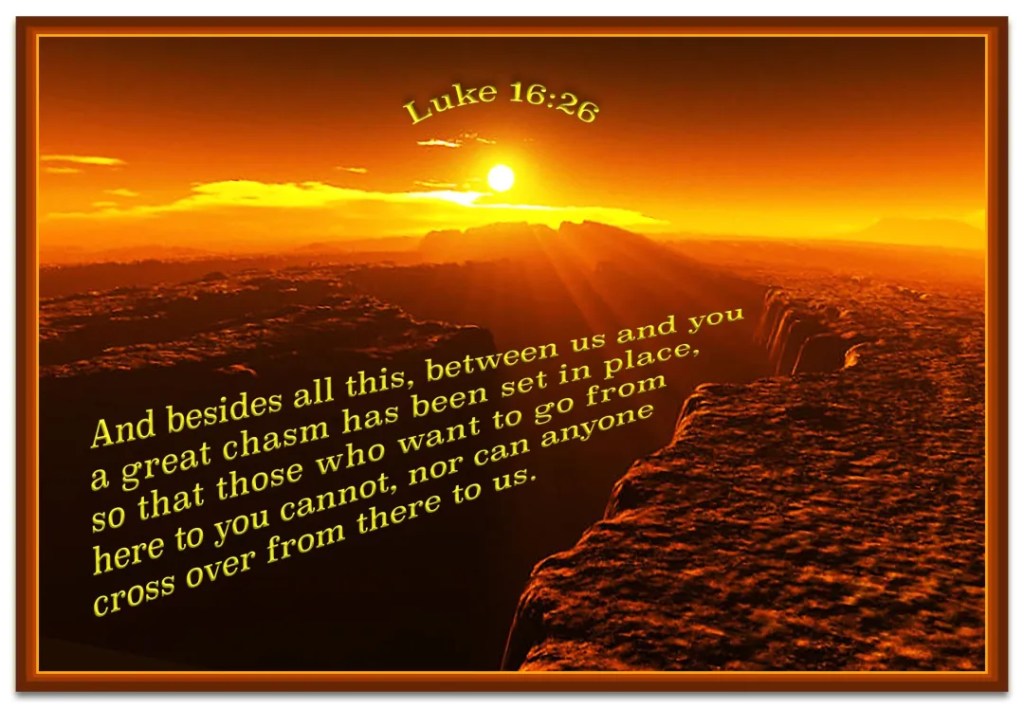
Luke 16:19-31 New King James Version
The Rich Man and Lazarus
19 “There was a certain rich man who was clothed in purple and fine linen and [a]fared sumptuously every day.
20 But there was a certain beggar named Lazarus, full of sores, who was laid at his gate, 21 desiring to be fed with [b]the crumbs which fell from the rich man’s table. Moreover the dogs came and licked his sores.
22 So it was that the beggar died, and was carried by the angels to Abraham’s bosom. The rich man also died and was buried. 23 And being in torments in Hades, he lifted up his eyes and saw Abraham afar off, and Lazarus in his bosom.
24 “Then he cried and said, ‘Father Abraham, have mercy on me, and send Lazarus that he may dip the tip of his finger in water and cool my tongue; for I am tormented in this flame.’ 25 But Abraham said, ‘Son, remember that in your lifetime you received your good things, and likewise Lazarus evil things; but now he is comforted and you are tormented. 26 And besides all this, between us and you there is a great gulf fixed, so that those who want to pass from here to you cannot, nor can those from there pass to us.’
27 “Then he said, ‘I beg you therefore, father, that you would send him to my father’s house, 28 for I have five brothers, that he may testify to them, lest they also come to this place of torment.’ 29 Abraham said to him, ‘They have Moses and the prophets; let them hear them.’ 30 And he said, ‘No, father Abraham; but if one goes to them from the dead, they will repent.’ 31 But he said to him, ‘If they do not hear Moses and the prophets, neither will they be persuaded though one rise from the dead.’ ”
Word of God for the Children of God
Glory be to the Father,
and to the Son, and to the Holy Ghost;
as it was in the beginning,
is now, and ever shall be,
world without end. Amen, amen.
The scene is a familiar one.
The mansion with the ornate ironwork front gate.
Marble steps and carved mahogany doors.
Overlooking a well cared for street.
A wealthy street marred only be the presence of a filthy beggar, sprawled beside the entrance to this palatial mansion.
A beggar who hardly moves, except when the garbage is put out, because that’s dinner time.
Inside the gate is the perfume of flowering plants, augmented by the essential oils the rich man used, quarantining him from the reality of the outside world.
Outside the gate is the smell of the street.
The unbearable stench of human waste and rotting flesh.
But the story isn’t so much about externals, as it is about people and their response to God’s word.
Two Actors
There are 2 actors in the story, as well as 5 brothers who take a subsidiary role.
The Rich Man
The first actor is a rich man.
In fact that’s the sum total of all we’re told about him.
“There was a rich man who was dressed in purple and fine linen and who feasted sumptuously every day.”
In fact if you think about it that’s not a very impressive obituary, is it?
You’d hope at the end of your life that people will be able to say more about you than that you were rich.
Even if your riches were achieved by your own efforts and not those of your family or people who worked for you, you’d still hope that there was more to say than just that.
Yet that’s all we’re told.
This man’s whole life is summed up in a sense by his riches.
Perhaps that’s how he saw it himself.
He wouldn’t be the first person to assess his life’s achievements by his bank balance, or by the power he’s able to wield, or by the fine food and clothing he affords himself.
Yet as we’ll see, such things are passing and in the long run don’t amount to anything.
The Poor Man
In stark contrast to the rich man is a man who lives in abject poverty.
He’s sprawled at the rich man’s gate, starving, longing to eat even the scraps that are left over after the rich man has finished feasting.
His skin is covered with sores, no doubt caused by malnutrition.
And the implication is that he’s starving because of the rich man’s neglect.
No doubt the rich man holds his handkerchief to his nose and looks the other way whenever he passes, trying his best to ignore this man.
Forget the call of God’s word to care for the poor.
Let someone else worry about that.
It isn’t my concern.
Who knows how he got himself in this state anyway.
In any case he got himself into it, he can get himself out of it.
And so the rich man ignores the beggar, while, we’re told even the dogs care for him to the extent of licking his sores clean.
Now we miss some of the impact of this throw away statement, because we live in a different culture as far as dogs are concerned.
We think about a dog and our thoughts are warm and rosy.
We think of that cute pet who greets us at the door when we get home.
Who plays chase with a tennis ball or a stick.
Who’s the faithful companion, who never disagrees with us when we complain to him.
But in Jesus’ day, dogs were despised animals, outsiders, curs, confined to wandering the streets.
Yet even these despised animals showed care to this poor beggar.
One Name – Lazarus
But the most striking thing about this man isn’t his poverty, or his sores.
It’s the fact that Jesus names him.
In fact this is the only occasion on which Jesus gives a name to a character in one of his parables.
Now that isn’t because this is based on a real story as some have wondered.
Rather it’s to show that there’s more to this man than his total poverty.
You see a name is important because it indicates a relationship. You only need a name if you’re known to someone. A name distinguishes you as an individual.
Now that doesn’t mean that the rich man didn’t have a name.
But as far as this story is concerned, he might as well not have.
On the other hand the poor man’s name is significant because of its meaning.
His name in fact tells us who he was known by.
’Lazarus’, in Hebrew, would be Eleazar.
And that means ’He whom God helps’.
Jesus gives him this name to indicate that Lazarus is one who waits on God to help him. He does not blame God for his situation. He does not plot revenge.
He simply waits for the vindication of the Lord.
He knows that as bad as his plight might be in this world, there is a life to come that will make this life fade into insignificance.
Here then is a story of contrasts.
Two men who are totally unequal.
One with incredible wealth, yet without identity.
The other poor beyond bearing, yet known personally to God.
2 types of inequality in fact.
Material and spiritual. Jesus wants us to consider which is the more important.
“What does it profit them if they gain the whole world,” Jesus said in Luke 9, “but lose or forfeit themselves?” (Luke 9:25 NRSV)
Two destinies
But not only do these 2 men lead different lives.
They also have 2 very different destinies.
First the poor man dies.
We’re not given any details of a funeral.
We’re probably expected to understand that such a man wouldn’t have been given a funeral.
At best he would have been carried away to a suitable place and his body burnt.
But that’s in fact irrelevant anyway, because we’re told the angels come and carry him to Abraham’s side.
Now, we mustn’t get carried away by the details here.
We have to remember that we’re reading a parable, and a parable is a device that teaches spiritual truths by allegorical means.
So the descriptions Jesus gives for the mode of transport or the details of heaven and hell aren’t meant to be taken literally.
They’re there purely to teach us spiritual truth.
The picture of Lazarus being carried by the angels to Abraham, is perhaps meant to remind us of Elijah, or even Enoch, who weren’t buried but were simply taken to be with God at the end of their lives.
And he’s taken as a sign that God is with him.
By contrast the rich man dies and is buried.
He has the full funeral.
No doubt someone reads an eloquent eulogy about his success in life, about the way God had obviously blessed him.
Yet the reality is far from anything that those mourning his death might imagine.
We find him in Hades, being tormented.
The nature of this torment isn’t commented on, though thirst and heat are implied by his request of Abraham. But again, the detail isn’t important.
What matters here is threefold:
1 Heaven and hell are real, whatever the reality of such states might be. Here’s what we glean from the parable.
Hell and heaven have the following contrast
Isolation or welcome
An awareness of what has been lost or gained
Utter separation from God or intimate companionship with God and his people.
In fact the rich man’s final state simply reflects his life on earth.
It’s simply a continuation of his separation from God.
The only difference is that on earth he was able to hide from himself his true condition.
The comfort and luxury in which he lived shielded him from his true spiritual condition. I guess the other difference is that while he was on earth he was still able to decide for himself exactly how to live. Now his ability to choose is gone.
2 Our personalities survive death in a conscious state.
The nature of heaven and hell could be characterized as God sustaining us in one of 2 states.
Either a state of bliss, in company with all who are believers, as represented by Abraham, or a state of total isolated anguish, represented by this lonely man separated from God by an uncross able chasm.
3 The 2 destinies indicate a great reversal of fortune.
Now again, we need to be careful how we read this story.
It would be easy to argue that this is just a story of how God evens things up in the end. How the rich in this world will suffer in the next and vice versa as though there were some global clearing house of life debts.
Some have used this sort of idea in fact to try to appease those who suffer from injustice in this world by promising the next world will reverse our fortunes: the poor will get revenge and the rich their comeuppance.
But that isn’t the point of this parable.
God isn’t a Galactic Robin Hood, robbing from the rich to give to the poor.
Rather God judges us on how we’ve responded to his word.
That’s the whole point of Abraham’s response in v29. ’They have Moses and the prophets; they should listen to them.’
You see the rich man has no excuse.
The Old Testament is chock full of warnings and instructions about looking after the poor.
God has been described as the God of the Poor, because of the emphasis he places on justice for the downtrodden, on stopping oppression and tyranny and the misuse of power by the rich.
In fact Jesus has just finished teaching about the use of wealth in the preceding passage,
There in v9 he says: “And I tell you, use worldly wealth to make friends for yourselves so when it is gone, they may welcome you into the eternal homes.”
This is what the rich man has failed to do.
He’s ignored the poor at his gate rather than using his wealth to make friends for eternity.
He may even have seen the poor man as a provision of God to show just how much God has blessed him.
The Key – God’s Word
The key to the parable comes in v29.
The rich man begs that Lazarus might be sent back to warn his 5 brothers of what awaits them that side of the grave.
But Abraham says,
“No, they have all the warning they need.”
God’s word has been given so we’ll know what the Lord requires of us.
What does Micah 6:8 say?
“He has told you, O mortal, what is good; and what does the LORD require of you but to do justice, and to love kindness, and to walk humbly with your God?” (Micah 6:8 NRSV)
The failure of the rich man was a failure to hear God’s word.
It was a failure to let God’s word be the arbiter of his actions.
The way we respond to God’s word seals our destiny.
Will we believe the gospel it presents or go on our way pretending all is well?
Will we take its teaching and apply it to our life?
Every time we open God’s Word, whether it’s here on a Sunday or during the week in the privacy of our quiet time, we open our lives to God’s appraisal.
Someone has said that every time we open God’s Word we stand before the gates of heaven and hell.
That’s how serious a matter it is to read God’s Word.
God’s Word is a word that calls for change, for repentance, for reformation.
God isn’t going to send us a Ghost of Christmas to Come like Scrooge saw.
He’s already given us his Word as a lamp to our feet and a light to our path, as a mirror to reflect the way we’re living, the way we’re shaping up or not.
And Jesus is also saying, if you won’t take that Word seriously, you won’t take anything seriously, even someone returning from the dead.
This is a parable, you see, that’s addressed not to the unbeliever.
If that were the case it would be a terrible thing, a message of despair rather than warning.
Rather it’s addressed to believers.
In the first instance of course it was addressed to the Pharisees, but equally it’s addressed to us, who claim to believe in the Word of God.
It’s meant as a warning to make sure that our lives measure up to God’s Word.
The way we act towards others in need matches the way God feels about them.
That we don’t let the busy-ness or the success of our lives hide the reality of the world we live in or the truth about our own spiritual life.
Now let me repeat, we have to be careful how we read this parable.
It’s all too easy to read a parable like this and feel despairing because we don’t measure up.
But that would be to go too far.
You see, the revelation of God has gone beyond Moses and the Prophets.
We now know more about how to please God than was revealed in the Old Testament alone.
Not that care of the needy is any less important to God, but he’s shown us through Jesus Christ how we can truly please him in the first instance.
Listen to what Jesus says in John 6: “They said to him, “What must we do to perform the works of God?” 29Jesus answered them, “This is the work of God, that you believe in him whom he has sent.” (John 6:28-29)
The primary response asked of us by God is that we believe in Jesus Christ.
That is that we believe that he is indeed the Son of God.
That he came in humility to bring us to God.
The failure of the rich man was that he failed to hear the Word of God.
Our failure or success will depend on the same thing: do we hear the Word of God, not just as it relates to riches and poverty, but as it relates to Jesus Christ and his place in our lives.
Of course a right use of our wealth should flow naturally from our faith in Jesus Christ but that’s secondary.
There’s both a warning and a promise in this strange tale of two men.
There’s the warning that to ignore God and those that God cares about in this life will have eternal consequences for us in the next.
But there’s also the promise that those who know and are known by God, who look to him for help, will enjoy his presence in eternity.
Why?
Because Jesus himself came as a Lazarus, as one who had nothing to rely on but the help that God gave him.
Because Jesus hung on a cross to take away the suffering that humanity deserves, to open the gateway to heaven for all who will turn to him for help.
Because he who was rich, for our sake became poor, so that by his poverty we might become rich.
Because Jesus now waits for us at the right hand of the Father.
And on the day of our own death will take us to sit with him and Abraham, and all who call on God as Father.
How can you know the assurance of that promise?
Not as some might think by making sure that we’ve cared for the poor.
That’s not actually the point of this parable.
Rather by first believing and then obeying the word of God.
By believing in Jesus as God’s instrument of salvation.
And as you believe, seeing how God gives his Spirit to live within you to enable you to care for the poor.
“It is no longer I who live, but it is Christ who lives in me. And the life I now live in the flesh I live by faith in the Son of God, who loved me and gave himself for me.” (Galatians 2:20)
Like the prophets who brought God’s Word to the people, Jesus had sympathy for the poor, rebuked rich people who were selfish, did nothing for the poor.
In Jesus’ parable, Lazarus who died was carried by angels to Abraham’s side in heaven, and the rich man was summarily sent to hell, where he was in torment.
The rich man had lived for his own pleasure and had ignored the message of Moses and the Prophets.
Lazarus had had no comfort in life, but in death he received the blessings of life with God in heaven.
This parable was a comfort to many slaves in the American South in the 1800s.
One of their spiritual songs speaks of God as the “Rock of my soul” in “the bosom of Abraham”— an expression referring to “Abraham’s side.”
Where could those slaves find justice when their children were ripped from their arms and sold down the river, when the earthly powers-that-be were stacked against them?
Isaiah 58:7-12 The Message
6-9 “This is the kind of fast day I’m after:
to break the chains of injustice,
get rid of exploitation in the workplace,
free the oppressed,
cancel debts.
What I’m interested in seeing you do is:
sharing your food with the hungry,
inviting the homeless poor into your homes,
putting clothes on the shivering ill-clad,
being available to your own families.
Do this and the lights will turn on,
and your lives will turn around at once.
Your righteousness will pave your way.
The God of glory will secure your passage.
Then when you pray, God will answer.
You’ll call out for help and I’ll say, ‘Here I am.’
A Full Life in the Emptiest of Places
9-12 “If you get rid of unfair practices,
quit blaming victims,
quit gossiping about other people’s sins,
If you are generous with the hungry
and start giving yourselves to the down-and-out,
Your lives will begin to glow in the darkness,
your shadowed lives will be bathed in sunlight.
I will always show you where to go.
I’ll give you a full life in the emptiest of places—
firm muscles, strong bones.
You’ll be like a well-watered garden,
a gurgling spring that never runs dry.
You’ll use the old rubble of past lives to build anew,
rebuild the foundations from out of your past.
You’ll be known as those who can fix anything,
restore old ruins, rebuild and renovate,
make the community livable again.
But the Lord saw their plight.
And he will bring eternal judgment to the oppressor.
And bring eternal justice to the oppressed.
In Jesus’ parable, the rich man’s sin was not that he was rich; it was that he refused to care for a person in need.
His stony heart ignored the call to share food with the hungry and to provide shelter and clothing for people in need (Isaiah 58:7-12).
In conclusion, Luke 16:25-26 holds a deep and profound meaning that encompasses themes of justice, mercy, and the consequences of our actions.
The context of this verse within the teachings of Jesus further emphasizes its importance in guiding our lives.
The symbolism present in the reversal of fortunes between the rich man and Lazarus is a powerful reminder of the importance of living a compassionate and righteous life.
Those verses challenges us to prioritize spiritual wealth over material wealth and to show kindness and generosity to those in need.

In the name of God, the Father the Son and the Holy Spirit,
Praying ….
Psalm 140
Prayer for Rescue
For the choir director. A psalm of David.
1 Rescue me, Lord, from evil men.
Keep me safe from violent men
2 who plan evil in their hearts.
They stir up wars all day long.
3 They make their tongues
as sharp as a snake’s bite;
viper’s venom is under their lips. Selah
4 Protect me, Lord,
from the power of the wicked.
Keep me safe from violent men
who plan to make me stumble.[a]
5 The proud hide a trap with ropes for me;
they spread a net along the path
and set snares for me. Selah
6 I say to the Lord, “You are my God.”
Listen, Lord, to my cry for help.
7 Lord, my Lord, my strong Savior,
you shield my head on the day of battle.
8 Lord, do not grant the desires of the wicked;
do not let them achieve their goals.
Otherwise, they will become proud. Selah
9 When those who surround me rise up,[b]
may the trouble their lips cause overwhelm them.
10 Let hot coals fall on them.
Let them be thrown into the fire,
into the abyss, never again to rise.
11 Do not let a slanderer stay in the land.
Let evil relentlessly[c] hunt down a violent man.
12 I[d] know that the Lord upholds
the just cause of the poor,
justice for the needy.
13 Surely the righteous will praise your name;
the upright will live in your presence.
Glory be to the Father,
and to the Son, and to the Holy Ghost;
as it was in the beginning,
is now, and ever shall be,
world without end. Amen, amen.
 Loving God, Living God, Loving Hope, Living Hope, Loving Living Life His Way! "Many things are possible for the person who has hope. Even more is possible for the person who has faith. And still more is possible for the person who knows how to love. But everything is possible for the person who practices all three virtues." - Brother Lawrence (1605-1691), Practicing the Presence of God (1692).