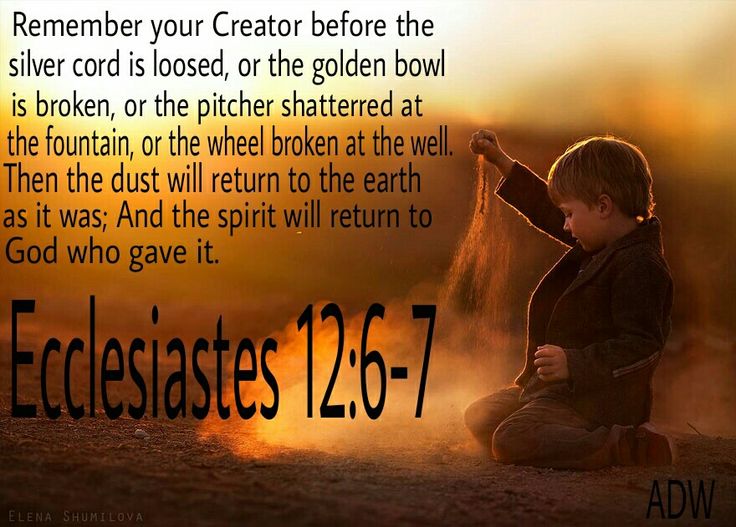
Do remember your Creator in your youth; before the Silver (Spinal) Cord is snapped; dust returns to the earth as it first was, and the Spirit returns to God who gave it. Ecclesiastes 12:1-8

Ecclesiastes 12:1-8 New American Standard Bible

Remember God in Your Youth

12 Remember also your Creator in the days of your youth, before the evil days come and the years approach when you will say, “I have no pleasure in them”; before the sun and the light, the moon and the stars are darkened, and clouds return after the rain; on the day that the watchmen of the house tremble, and strong men are bent over, the grinders stop working because they are few, and those who look through [a]windows grow [b]dim; and the doors on the street are shut as the sound of the grinding mill is low, and one will arise at the sound of the bird, and all the daughters of song will [c]sing softly. Furthermore,  people are afraid of a high place and of terrors on the road; the almond tree blossoms, the grasshopper drags itself along, and the caper berry is ineffective. For man goes to his eternal home while the mourners move around in the street. Remember your Creator before the silver cord is [d]broken and the golden bowl is crushed, the pitcher by the spring is shattered and the wheel at the cistern is crushed; then the dust will return to the earth as it was, and the [e]spirit will return to God who gave it. “Futility of futilities,” says the Preacher, “all is futility!”

Word of God for the Children of God

Glory be to the Father,
and to the Son, and to the Holy Ghost;
as it was in the beginning,
is now, and ever shall be,
world without end. Amen, amen.

Have you heard the term “silver cord” before?

Do you know where it comes from? It’s an interesting term to me because it’s unique. The phrase comes from one single place in history: Ecclesiastes 12:6-7: Amplified Bible

Earnestly remember your Creator before the silver cord [of life] is broken, or the golden bowl is crushed, or the pitcher at the fountain is shattered and the wheel at the cistern is crushed; then the dust [out of which God made man’s body] will return to the earth as it was, and the spirit will return to God who gave it.

It doesn’t show up anywhere else in the Bible, and yet it’s the term used to describe many metaphysical studies today: the link between the body and the spirit. What does it mean? We can tell from the verses themselves that it’s being used poetically to describe the process of death. But why a silver cord?

https://www.studylight.org/commentaries/eng/bul.html

E.W. Bullinger’s Companion Bible describes each of these elements via comparing them to actual body parts:

the silver cord: i.e. the spinal cord.

the golden bowl: i.e. the head, or skull.

pitcher: the failure of the heart.

Commentaries typically make similar assertions and leave it at that.

However, I think that this is too much of a scholarly explanation, and lacks the powerful, deeply poetic nuanced message of the divine Christ. There is much more to the silver cord due to the simple fact that it’s different from the rest.

Consider the following:

  1. When a wheel is broken at a well, it is useless and everything stops. No water can come up, and everything falls down
  2. When a pitcher shatters at the spring, the water falls down
  3. When a golden bowl is broken, whatever it was holding falls down
  4. When a silver cord is severed, one side stays up, and the other side falls down
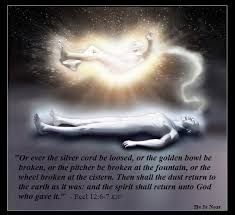
Solomon said that the dust returns to the ground it came from, and the spirit returns to God who gave it.

The silver cord is the only item in the list that has two sides: it binds and it looses, one side goes away and the other side remains.

So we know that it is specifically focused on the connection between the body and the spirit.

But why is it silver?

Shouldn’t the spirit be more valuable than our bodies?

Why would a golden bowl be used to describe our body, when our spirit is eternal?

Since this term was invented by the culture of the time of Solomon, lets engage with his language and his culture.

Silver & the Appointed Time

The word “silver” used by Solomon in Hebrew is kesef (כֶּסֶף). This word is derived from the Assyrian word kaspu (ܟ݁ܶܣܦ݁ܳܐ), which means “pale metal.”

What makes this special is that there is another word in the Bible that shares this same root word. This word is keseh (כֶּסֶא), which means “full moon,” “pale moonlight,” or “appointed time.” Keseh is very unique, as it is a word that only occurs once in the entire Bible.

Where does it occur?

Proverbs 7:19-21 Lexham English Bible

19 For there is no man[a] in his home;
    he has gone on a long journey.[b]
20 The bag of money he took in his hand,
    for on the day of the full moon he will come home.”
21 She persuades him with the greatness of her teachings;
    with her smooth lips she compels him.

https://www.blueletterbible.org/kjv/pro/7/20/t_conc_635020

https://www.blueletterbible.org/lexicon/h3677/kjv/wlc/0-1/

Depending on the translation you read, the highlighted words will say full moon, or appointed time.

This will depend on how a given translation treats literal word-for-word translation versus original author intent.

What if the woman’s husband came home early?

His appointed time would certainly have turned into an hour of reckoning.

We understand the literal word for “full moon” here to mean that it is the appointed time, or the hour of reckoning.

Passover, for example, always begins on the 15th day of the Hebrew month of Nisan, which lines up with the lunar cycle and guarantees that a full moon will be present every time.

Passover is a time to remember the hour of reckoning for Egypt, the appointed time when God would deliver his people from out of slavery. A full moon is highly significant in Jewish culture, and many other traditions surround it.

So, what does the connection between silver and the “appointed time” mean?

It helps us understand why the silver cord is not made out of gold.

Silver, a pale metal as the Assyrians would have described it, is a much smaller denomination of currency than gold.

Gold is something the average person at that time would have never touched.

Gold was used to fund wars, vast building projects, and to pay kings.

A debt of gold is especially burdensome, and Jesus compares the debt of sin owed unto God to ten thousand bags of gold:

Matthew 18:23-28 New International Version

23 “Therefore, the kingdom of heaven is like a king who wanted to settle accounts with his servants. 24 As he began the settlement, a man who owed him ten thousand bags of gold[a] was brought to him. 25 Since he was not able to pay, the master ordered that he and his wife and his children and all that he had be sold to repay the debt.

26 “At this the servant fell on his knees before him. ‘Be patient with me,’ he begged, ‘and I will pay back everything.’ 27 The servant’s master took pity on him, canceled the debt and let him go.

28 “But when that servant went out, he found one of his fellow servants who owed him a hundred silver coins.[b] He grabbed him and began to choke him. ‘Pay back what you owe me!’ he demanded.

Silver, on the other hand, is an order of magnitude lower in value than gold. See how the servant has other people owing him merely silver?

The difference is our debt of sin to God compared to our earthly debts with our neighbors.

Silver is of mortal concern, debts we make with one another on earth.

Silver is used to buy or rent smaller things, temporary things that come and go, like a field: Genesis 23:16

Or information: Matthew 26:15

Or people: Genesis 37:28

Silver is used to signify our fleeting life, a pale metal, a memorial for something greater. God used silver trumpets to call the Israelites during any possible time, even times when the moon wasn’t present: Numbers 10:1-2, Numbers 10:10

We see these silver trumpets foreshadowing the final return of Jesus, the day of highest reckoning, when the spirits of Christians are returned to God, and the silver cord is severed: Matthew 24:30-31

Concluding Thoughts …

Throughout scripture we see a pattern of silver being used to signify things that are borrowed, things that are temporarily in our possession.

While we live, our bodies and spirits are connected through the silver cord.

But we must remember God.

God gave the Israelites silver trumpets to be used as a memorial of all he has done for them, and to call them out of the wilderness. One day, Christians will be called with the same silver trumpets to return to God what is owned by God: our spirits. Our spirits belong to him, and will return to him when we die.

When the silver cord is severed, everything we owe to God will be reckoned.

Our bodies belong to the dust, and our spirits belong to God.

Remember that your life is borrowed from God.

We owe him an unsurmountable debt due to our sinful lives.

And yet, Jesus paid the same debt in the parable, ten thousand bags of gold, with his very life so that we could be free.

The silver cord serves as a reminder of who we as Christians belong to, how fleeting and how pale our lives and possessions are, and how we should be desperately, diligently forgiving those who are just as deeply indebted to us: Matthew 18:32-35

If you’re not sure where to begin with forgiving other people, Jesus gives us a simple answer: we should pray.

Pray and remember God before the silver cord is severed.

Matthew 6:9-15 New King James Version

In this manner, therefore, pray:

Our Father in heaven,
Hallowed be Your name.
10 Your kingdom come.
Your will be done
On earth as it is in heaven.
11 Give us this day our daily bread.
12 And forgive us our debts,
As we forgive our debtors.
13 And do not lead us into temptation,
But deliver us from the evil one.
[a]For Yours is the kingdom and the power and the glory forever. Amen.

14 “For if you forgive men their trespasses, your heavenly Father will also forgive you. 15 But if you do not forgive men their trespasses, neither will your Father forgive your trespasses.

Life is extremely fragile—the poetry written here by the author of Ecclesiastes is intended to demonstrate just how fragile it is.

It’s like a hanging lamp that is shattered as a result of just one little piece of the cord breaking.

Ecclesiastes 3:2 New King James Version

A time [a]to be born,
And a time to die;
A time to plant,
And a time to pluck what is planted;

Our lives here are held by a very, very slender sliver thread.

God created, God Owns, God is, holding the knife blade … ready to sever at our appointed time established by God Himself.

Children of God get ready …

In the name of God, the Father and God the Son and God the Holy Spirit,

Praying …

Psalm 90 Lexham English Bible

God’s Eternity and Human Frailty
A prayer of Moses, the man of God.[a]

90 O Lord, you have been our help[b] in all generations.[c]
Before the mountains were born
and you brought forth the earth and the world,
even from everlasting to everlasting, you are God.
You return man to the dust,
saying,[d] “Return, O sons of man.”
For a thousand years in your eyes
are like yesterday when it passes,
or like a watch in the night.
You sweep them away like a flood.
They fall asleep.[e]
In the morning they are like grass that sprouts anew.
In the morning it blossoms and sprouts anew;
by evening it withers and dries up.
For we are brought to an end by your anger,
and we hasten off[f] by your wrath.
You have put our iniquities before you,
our hidden sins into the light of your countenance.
For all of our days dwindle away in your rage;
we complete our years like a sigh.
10 As for the days of our years, within them are seventy years
or if by strength eighty years, and their pride[g] is trouble and disaster,
for it passes quickly and we fly away.
11 Who knows the strength of your anger,
and your rage consistent with[h] the fear due you?
12 So teach us to number our days
that we may gain a heart of wisdom.
13 Return,[i] O Yahweh. How long?
And have compassion on[j] your servants.
14 Satisfy us in the morning with your loyal love,
that we may sing for joy and be glad all our days.
15 Make us glad for as many days as you have afflicted us,
for as many years as we have seen calamity.
16 Let your work be visible to your servants,
and your majesty to their children.
17 And let the beauty of the Lord our God be upon us,
and establish for us the work of our hands,
yes, the work of our hands, establish it.

Glory be to the Father,
and to the Son, and to the Holy Ghost;
as it was in the beginning,
is now, and ever shall be,
world without end. Amen, amen.

https://translate.google.com/

God, the New Year Cometh; So please teach us to number our days, that we may present to You a heart of truest Brevity of Life, grow in thy wisdom. Psalm 90:12

Psalm 90 New American Standard Bible 1995

BOOK 4

God’s Eternity and Man’s Transitoriness.

A Prayer of [a]Moses, the man of God.

90 Lord, You have been our [b]dwelling place in all generations.
Before the mountains were born
[c]Or You gave birth to the earth and the world,
Even from everlasting to everlasting, You are God.

You turn man back into dust
And say, “Return, O children of men.”
For a thousand years in Your sight
Are like yesterday when it passes by,
[d]Or as a watch in the night.
You have [e]swept them away like a flood, they [f]fall asleep;
In the morning they are like grass which [g]sprouts anew.
In the morning it flourishes and [h]sprouts anew;
Toward evening it fades and withers away.

For we have been consumed by Your anger
And by Your wrath we have been [i]dismayed.
You have placed our iniquities before You,
Our secret sins in the light of Your presence.
For all our days have declined in Your fury;
We have finished our years like a [j]sigh.
10 As for the days of our [k]life, [l]they contain seventy years,
Or if due to strength, eighty years,
Yet their pride is but labor and sorrow;
For soon it is gone and we fly away.
11 Who [m]understands the power of Your anger
And Your fury, according to the fear [n]that is due You?
12 So teach us to number our days,
That we may [o]present to You a heart of wisdom.

13 Do return, O Lord; how long will it be?
And [p]be sorry for Your servants.
14 O satisfy us in the morning with Your lovingkindness,
That we may sing for joy and be glad all our days.
15 Make us glad [q]according to the days You have afflicted us,
And the years we have seen [r]evil.
16 Let Your work appear to Your servants
And Your majesty [s]to their children.
17 Let the favor of the Lord our God be upon us;
And [t]confirm for us the work of our hands;
Yes, [u]confirm the work of our hands.

The Word of God for the Children of God.

Glory be to the Father,
and to the Son, and to the Holy Ghost;
as it was in the beginning,
is now, and ever shall be,
world without end. Amen, amen.

What does brevity mean?

shortness of duration. especially : shortness or conciseness of expression.

What is brevity of a person?

the brevity of human life. the quality of expressing much in few words; terseness: Ironically, it is long-winded Polonius in Shakespeare’s Hamlet who famously says that brevity is the soul of wit.

Is brevity a good thing?

Maybe that’s why William Shakespeare said, “Brevity is the soul of wit.” One thing I know is brevity is powerful. People who can speak or write concisely and to the point are more successful.

Is brevity positive or negative?

Brevity rails against the non-essential, against filling time, against boredom, against self- indulgent long-windedness and against agonizing repetition.

Brevity guards against overconsumption and waste as brevity can be applied to space and things, as well as time. Brevity is economy.

Is brevity a skill?

Brevity is rare because it takes both skill and effort to simplify the complex.

It’s easier to remain ethereal, vague, and ambiguous than it is to communicate with purpose and clarity.

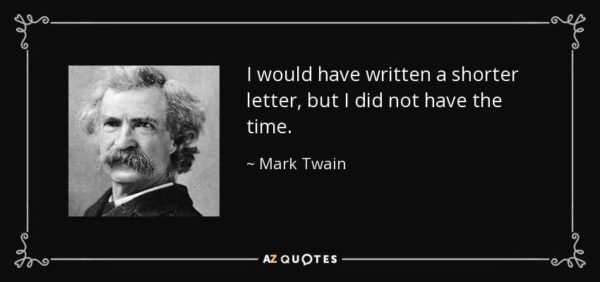
Or, I would have written a shorter sermon if God had given me the time.

Life is filled with “once in a lifetime” opportunities, but the big question is what we do with them when they present themselves? Do we so casually let them slip by, saying, “Maybe next time (if there is one). There is always another day”? Or, do we a John 3:16 moment seize them? Love them like God loved us, have a few more “come to Jesus” moments as we may not have as much time as we think?

Theologian Dr. Leslie Weatherhead calculated the average length of a life using the hours of 1 day to illustrate the importance of recognizing the value of time.

https://en.wikipedia.org/wiki/Leslie_Weatherhead

He concluded that if your age is 15, the time is 10:25 a.m. If your age is 20, the time is 11:34. If your age is 25, the time is 12:42 p.m. If you’re 30, the time is 1:51. If you’re 35, the time is 3:00. If you’re 40 the time is 4:08. At age 45, the time is 5:15. If you’re 50, the time is 6:25. By age 55, the time is 7:24. If you’re 60, the time is 8:42. If you’re 65, the time is 9:51. And if you’re 70 the time is 11 p.m.

Psalm 90:12 reminds us, “Teach us to number our days that we may apply our hearts to wisdom” (NKJV). Or as the Living Bible puts it, “Teach us to number our days and recognize how few they are; help us to spend them as we should.”

Ephesians 5:15 says, “So be careful how you live. Don’t live like fools, but like those who are wise” (NLT).

Paul wrote, “Don’t you realize that your body is the temple of the Holy Spirit, who lives in you and was given to you by God? You do not belong to yourself, for God bought you with a high price. So you must fully honor God with your body” (1 Corinthians 6:19–20 NLT).

Jesus said, “If any of you wants to be my follower, you must give up your own way, take up your cross daily, and follow me” (Luke 9:23 NLT).

This doesn’t mean that we must take a vow of poverty. It simply means we that we ultimately recognize that it 100% all belongs to God. Our lives belong to God. Our families belong to God. All our possessions belong to God. Everything is his.

So, in the coming year of 2025, make your chief New Years resolution to take what God has given to you and do the most that you can with it for his glory.

Remind yourself; God can do a lot with a little. If you don’t believe me, just ask the boy with the five loaves and two fish who gave everything he had to Jesus. It didn’t seem like a lot, but Jesus used them to feed a hungry thousands. Jesus can take a little, bless it and multiply it. He can use it beyond our wildest dreams.

Seizing upon our God Opportunity: “God, Do teach me to “Number My Days”” 

Psalm 139:23-24 Amplified Bible

23 
Search me [thoroughly], O God, and know my heart;
Test me and know my anxious thoughts;
24 
And see if there is any wicked or hurtful way in me,
And lead me in the everlasting way.

If we will earnestly and fervently pray, humble ourselves, take what we have and offer it to God, if we will be willing to do what He has placed before us and be faithful in the little things, then we can trust He will give us more to do.

I would rather try and fail than never try at all.

Any time you take a chance, you can fail. But it’s better to try than to never take chances and never have anything happen in your life.

So seize the day. Seize the moment. Seize the opportunities before you.

Don’t put it off too long, because you may not have as much time as you think.

Be motivated, be productive, be resolute with your life. Resolve to be productive with your time, talents, ministries. Seize the opportunities God has given you.

In the name of God, the Father and God the Son and God the Holy Spirit,

Let us Pray,

Ecclesiastes 3:1-13 The Message

There’s a Right Time for Everything

There’s an opportune time to do things, a right time for everything on the earth:

2-8 A right time for birth and another for death,
A right time to plant and another to reap,
A right time to kill and another to heal,
A right time to destroy and another to construct,
A right time to cry and another to laugh,
A right time to lament and another to cheer,
A right time to make love and another to abstain,
A right time to embrace and another to part,
A right time to search and another to count your losses,
A right time to hold on and another to let go,
A right time to rip out and another to mend,
A right time to shut up and another to speak up,
A right time to love and another to hate,
A right time to wage war and another to make peace.

9-13 But in the end, does it really make a difference what anyone does? I’ve had a good look at what God has given us to do—busywork, mostly. True, God made everything beautiful in itself and in its time—but he’s left us in the dark, so we can never know what God is up to, whether he’s coming or going. I’ve decided that there’s nothing better to do than go ahead and have a good time and get the most we can out of life. That’s it—eat, drink, and make the most of your job. It’s God’s gift.

Glory be to the Father,
and to the Son, and to the Holy Ghost;
as it was in the beginning,
is now, and ever shall be,
world without end. Amen, amen.

https://translate.google.com/

What Does it Mean for those who are Unsaved, Us as Christians that God Is Available and that God is Accessible? Psalm 90

Psalm 90 Amplified Bible

Book Four

God’s Eternity and Man’s Transitoriness.

A Prayer of Moses the man of God.

90 Lord, You have been our dwelling place [our refuge, our sanctuary, our stability] in all generations.

Before the mountains were born
Or before You had given birth to the earth and the world,
Even from everlasting to everlasting, You are [the eternal] God.


You turn man back to dust,
And say, “Return [to the earth], O children of [mortal] men!”

For a [a]thousand years in Your sight
Are like yesterday when it is past,
Or as a watch in the night.


You have swept them away like a flood, they fall asleep [forgotten as soon as they are gone];
In the morning they are like grass which grows anew—

In the morning it flourishes and springs up;
In the evening it wilts and withers away.


For we have been consumed by Your anger
And by Your wrath we have been terrified.

You have placed our wickedness before you,
Our secret sins [which we tried to conceal, You have placed] in the [revealing] light of Your presence.


For all our days pass away in Your wrath;
We have finished our years like a whispered sigh.
10 
The days of our life are [b]seventy years—
Or even, if because of strength, eighty years;
Yet their pride [in additional years] is only labor and sorrow,
For it is soon gone and we fly away.

11 
Who understands the power of Your anger? [Who connects this brevity of life among us with Your judgment of sin?]

And Your wrath, [who connects it] with the [reverent] fear that is due You?
12 
So teach us to number our days,
That we may cultivate and bring to You a heart of wisdom.

13 
Turn, O Lord [from Your fierce anger]; how long will it be?
Be compassionate toward Your servants—revoke Your sentence.
14 
O satisfy us with Your lovingkindness in the morning [now, before we grow older],
That we may rejoice and be glad all our days.

15 
Make us glad in proportion to the days You have afflicted us,
And the years we have suffered evil.
16 
Let Your work [the signs of Your power] be revealed to Your servants
And Your [glorious] majesty to their children.
17 
And let the [gracious] favor of the Lord our God be on us;
Confirm for us the work of our hands—
Yes, confirm the work of our hands.

The Word of God for the Children of God.

Adeste Fideles! Laeti Triumphantes! Venite Adoremus! Dominum.

Gloria! In Excelsis Deo! Alleluia, Alleluia, Alleluia, Amen.

“So, Lord God, Teach Us to Number Our Days,”

Often in life we think we are heading in the general direction of our goal, our life is moving steadily along on cruise control, we finally get to that somewhere , we look around and survey the landscape of all the success, but we still end up lost.

Though we might start out well, we might achieve what we feel is the best, but we can quickly realize that the best was not in fact, the best, then lose interest in seriously considering everything but exactly the next actions we must take.

A sudden barrage of questions arise within – are we living up to our potential?

Are we being “all we can be?”

Are we being “all we can be” for those who need us to be their “all we can be?”

Living unto, into our full potential, Living up and into to a set of standards?

Have you ever felt like you are not living up to your God potential?

Ever felt like you ought to be closer to God than you are?

Or that you ought to know God better than you do?

We all get to a point in life when we have seen so much of life, where we have experienced so much of life, or where we have sinned against God and how we believe God wants us to live. 

We succeed and then we fail.

We glorify God when we succeed and when we think we have done too many wrong things, have failed one too many times for God to continue to bless us.

We conclude we have sinned too much.

We have been too disobedient and we have wandered too far.

We have grown too old and too set in our ways, too inflexible in our thoughts.

Therefore God is done with us – change and transformation are not possible.

God won’t use me anymore.

God can’t use me anymore.

God will not use me anymore

God is through with me, God is certainly going to be washing His hands of me.

God is no longer available to me because I am no longer usable, available to God.

Have you been there?

Are you there right now?

Have I been there?

Am I there right now?

Without Exception

Without Purpose of Evasion

– Resoundingly, Undeniably, Undoubtedly, Absolutely – YES! YES! YES!

Here is some good news.

God is a 24 hour a day, 7 day a week God.

God is always available – ever vigilant, no slumber nor sleep, eyes always open!

God is always accessible!

The Kingdom of God is always going to be available.

The Kingdom of God is always going to be there.

The Kingdom of God is always going to be accessible.

The Question: will we ourselves always be available and accessible to God as God and the Kingdom of God is always and forever available, accessible to us?

Is our Prayer anything close to sounding like… (Psalm 90:12)

12 
So teach us to number our days,
That we may cultivate and bring to You a heart of wisdom
?

In order not to lose track of where we are going and why we are going there, the psalmist encourages us to “ask God to teach us to number our days.”

The writer is not talking about any exercise of basic, simple nor complex math—that being our counting the number of days that we might potentially live.

No one knows “the number of our days” but God himself.

Rather, the psalmist wants us to realize that nothing in this life except living for God should be our ultimate goal, or the ultimate treasure we have in mind.

Money, fame, possessions—none of that will last.

As a popular sayings go,

“When you die, you can’t take it with you.”

“Ain’t never seen any U-Haul trailers hauled behind no Hearses.”

“That We May Cultivate and Bring to You a Heart of Wisdom.”

God is not done with you.

One more time – God is not done with you.

God is not done with me.

God is not done with any of us. 

God has not quit on you.

God has not quit on me.

God has not given up on any of us. 

God is still available to you.

God is still available to me.

God is still at work.

God still speaks and God still wants to be known.

Four key insights into God’s availability from Moses’s encounter with God.

Key 1 – Avoid being so consumed with life that you miss what God is doing.

Let’s turn to the Scripture and pick up with Moses, who is still far from God.

One day Moses was tending the flock of his father-in-law, Jethro, the priest of Midian. He led the flock far into the wilderness and came to Sinai, the mountain of God. There the angel of the Lord appeared to him in a blazing fire from the middle of a bush. Moses stared in amazement. Though the bush was engulfed in flames, it didn’t burn up. “This is amazing,” Moses said to himself. “Why isn’t that bush burning up? I must go see it.” Exodus 3:1-3

Moses wasn’t so consumed with his job that he didn’t notice the burning bush.

Now many of us might wonder what Moses has to be consumed with.

He was herding sheep, which is exhausting, mainly because they would have had some Rams in it.

Female sheep are called Ewes.

Male sheep are called Rams.

According to most farmers, the Rams are evil.

While ewes (the female sheep) are generally docile, non-aggressive animals, this is not usually the case with rams (the male sheep), especially during the breeding season.

Rams can be very aggressive and have been known to cause serious injuries, even the death of people.

Therefore, a ram should never be trusted, even if it is friendly or was raised as a pet.

It is essential always to know where the ram is and to never turn your back on him.

Moses sees this burning bush.

Common sense would tell a sheepherder to move the sheep away from the fire.

But Moses didn’t let the business of watching sheep keep him from noticing the God thing.

He did not turn away from the God thing.

Instead, he turned toward it, which leads to the following key.

Key 2 – Allow curiosity to lead you toward God – even when uncomfortable.

Our most significant victories and achievements rarely happen when we are comfortable.

Instead, they occur when we are willing to step outside our comfort zone.

They happen when we take what little faith we may have and trust God.

Moses noticed something was up.

He saw something out of place and unusual, a bush that wasn’t being consumed by the fire.

So he chose to move closer and find out what was going on.

The Scripture continues:

When the Lord saw Moses coming to take a closer look, God called to him from the middle of the bush, “Moses! Moses!” “Here I am!” Moses replied. The Lord responded, “Take off your sandals, for you are standing on holy ground. I am the God of your father — the God of Abraham, the God of Isaac, and the God of Jacob.” When Moses heard this, he covered his face because he was afraid to look at God. Then the Lord told him, “I have certainly seen the oppression of my people in Egypt. I have heard their cries of distress because of their harsh slave drivers. Yes, I am aware of their suffering. The cry of the people of Israel has reached me, and I have seen how harshly the Egyptians abuse them. Now go, for I am sending you to Pharaoh. You must lead my people Israel out of Egypt.” Exodus 3:4-7,10

Moses had to be freaking out that God was speaking to Him.

But he is also leaning in.

So it seems to me that there are a set of God things happening around us today.

A spiritual awakening of sorts is happening on some college campuses, in micro-church and church planting movements.

Don’t run away.

Lean in. Check it out.

Key 3 – After you begin to investigate what God is doing, expect God to speak.

There is so much in this passage.

Let’s reread a piece of it.

So, we can take a closer look.

When the Lord saw Moses coming to take a closer look, God called to him from the middle of the bush, “Moses! Moses!” “Here I am!” Moses replied. The Lord responded, “Take off your sandals, for you are standing on holy ground. I am the God of your father — the God of Abraham, the God of Isaac, and the God of Jacob.” Exodus 3:4-5

God did not speak to Moses until after Moses began to investigate.

Did you catch that?

God didn’t speak until AFTER Moses took a tangible step toward God. 

God often waits for us to move closer to Him before He reveals more of Himself to us.

Here is the challenge.

We can get lost in our routine.

One of my favorite sayings goes like this:

“The problem with life is that it is so daily.” 

Life in the wilderness as a shepherd would have been way routine.

First, take care of the sheep.

Next, find grass for the sheep.

Then, find water for the sheep.

Repeat.

A bush on fire would have been unusual.

But what made it way unusual?

What made it unique?

  • The bush is not being consumed – it is burning but not burning up.
  • There is a divine presence in the bush – it is holy ground.
  • God speaks from the bush. 

Moses could have run away fast and furious.

But he chose to move in instead.

He chose to move toward God.

What’s the result of his moving closer to the things of God?

That leads to the fourth and final key.

Key 4 – Assume that continually moving closer to God will help you and me discover God more fully.

Moses discovers his purpose for the next phase of his life.

Moses gets the next step of his life laid out because of this connection with God.

“Now go, for I am sending you to Pharaoh. You must lead my people Israel out of Egypt.” Exodus 3:10

God being near to us isn’t just an old testament concept.

We see it all throughout the New Testament as well.

As Paul was reasoning with a crowd of atheists and people of other religions, he explained that God put people in specific times and places during history.

Check out Paul’s words:

“His purpose is for the nations to seek after God and perhaps feel their way toward him and find him — though he is not far from any one of us.” Acts 17:27

James – the leader of the early church – said it this way:

“Draw near to God, and he will draw near to you.” James 4:8

Here is what it means to me:

God is as available to you and me as you and I are to Him. 

Take advantage of that.

God is available to you as you are to Him. 

Check out the promise in the Old Testament that is repeated often:

“If you seek him, you will find him.” 1 Chronicles 28:9

Jesus says this as well:

“Keep on asking, and you will receive what you ask for. Keep on seeking, and you will find. Keep on knocking, and the door will be opened to you.” Matthew 7:7

Don’t miss this:

We serve a God who wants to be found. 

We serve a God who wants to be known. 

We serve a God who wants to be discovered.

If you and I are far from God, it is because you and I have chosen to be far from God.

If you and I are not as close to God as you and I wish, that is all on you and me.

When we discipline ourselves to number each day with God as our main focus and guide and guardian, we gain deep wisdom for this life and the life to come.

Draw close to God, and God will draw near to you and close to me.

Take a step toward God, and God steps toward you.

Of course, I can’t and wont promise that if you and I do this, all our problems, hurts, and pains will be solved.

But I can promise you that if you move toward God, God will move toward you.

God will be with you and me as we journey through the ups and downs of life.

God is available.

God is accessible.

Are you?

Am I?

Hmmmmmmmmmmmmmmmmmm …..

In the name of God, the Father and God the Son and God the Holy Spirit,

Let us Pray,

Almighty God, you are the source of all life. We know each day of our lives is a gift from your hand. Help us live each day in the light of your Word. Heavenly Father, thank You for each day of life and for the opportunities You have given me to live a life unto You. May each day of my life, from this day forward, be exercised in a way pleasing to You so that in all I say and do You may be glorified. In Jesus’ name I pray,

Adeste Fideles! Laeti Triumphantes! Venite Adoremus! Dominum.

Gloria! In Excelsis Deo! Alleluia, Alleluia, Alleluia, Amen.

https://translate.google.com/