
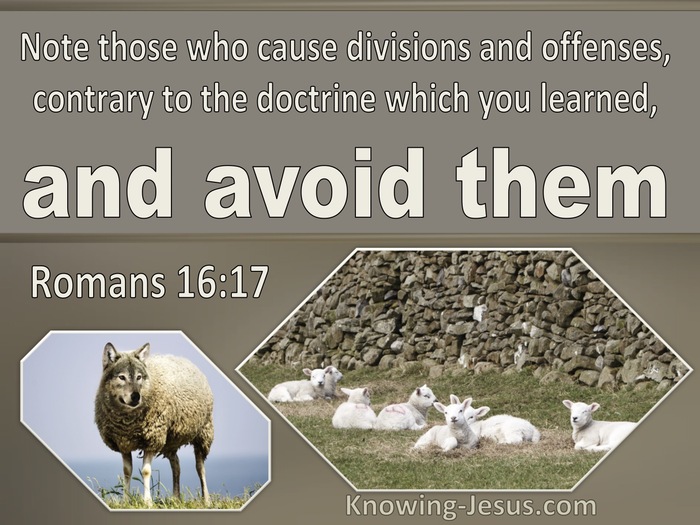
Romans 16:17-18 New American Standard Bible 1995
17 Now I urge you, brethren, keep your eye on those who cause dissensions and [a]hindrances contrary to the teaching which you learned, and turn away from them. 18 For such men are slaves, not of our Lord Christ but of their own [b]appetites; and by their smooth and flattering speech they deceive the hearts of the unsuspecting.
The Word of God for the Children of God.
Glory be to the Father,
and to the Son, and to the Holy Ghost;
as it was in the beginning,
is now, and ever shall be,
world without end. Amen, amen.
Apostle Paul became increasingly aware that after his departure, the enemy would not only seek to divide the Church through false teachers and demonic doctrines, but would also use clever words, internal dissentions and disunity to cause chaos, havoc and distress among Christians and divide the Body of Christ.
As he brings his long, instructive Roman epistle to a close, the one message Paul was prompted to leave with these dear people was about discord among the saints: “Keep your eye on those who cause dissensions and hindrances contrary to the teaching which you learned,” he warned, “and turn away from them.”
His final comments to the brethren in Rome concerned the gravest dangers of internal conflict and contention. Wrangling and verbal strife among Christian brethren and internal bickering is at great variance to the gospel of grace and ultimately seeks to create great “who is right?” destroy the unity of the Spirit.
1 Corinthians 1:10-13 New American Standard Bible 1995
10 Now I exhort you, brethren, by the name of our Lord Jesus Christ, that you all [a]agree and that there be no [b]divisions among you, but that you be [c]made complete in the same mind and in the same judgment. 11 For I have been informed concerning you, my brethren, by Chloe’s people, that there are quarrels among you. 12 Now I mean this, that each one of you is saying, “I am of Paul,” and “I of Apollos,” and “I of Cephas,” and “I of Christ.” 13 [d]Has Christ been divided? Paul was not crucified for you, was he? Or were you baptized [e]in the name of Paul?
In his final comments, Paul greeted twenty-six people in the Roman Church by name. Was he implying that some of them just might be contentious or was he warning them to watch for others who might cause disunity among the saints?
In either case, Paul knew the great damage caused when conflict and strife from conflicted interpretations of Torah, allowed to permeate the Christian Church.
False teachers and destructive doctrines infiltrating the Body of Christ was the biggest danger about which all the apostles warned in their letters, and in Acts 20, we read that Paul knew that vicious wolves would soon come smiling into the Church, twisting the truth, and scatter the flock of God after his death. But during his lifetime, we see Paul addressing internal strife among Christians.
Conflict, division, between believers was a deep concern that Paul challenged unrelentingly in a number of his epistles, because once murmuring, bickering, squabbling, and disunity, is allowed to percolate, the unity of the spirit in the bond of peace is crumbled, destroyed, and contrary to the teaching of the Word.
Misinformed, badly educated by teachers who are themselves badly taught, upside down biological teachings in scholastic institutions at all levels, young children. False teachers and heretical doctrines have become an increasingly serious problem in church communities and Christian fellowships today, but too often they are conceived by those who desire to cause division and disunity.
We should be alert and ready to know what the truth of the Gospel teaches and be knowledgeable of correct interpretations, sound accurate contextual biblical applications, studying to show ourselves approved of God, willing to turn away, correcting them, from who have this destructive spirit of division and discord.
Drifting away from biblical truth into apostasy or the deliberate infiltration of heretical teachings are a serious problem in any Christian fellowship, but let us never forget that they are often spawned from internal disagreements, division, and disunity, and should be dealt with before the witness of Christ is tarnished.
The enemy of God is the same evil one that comes to steal our peace, kill our hope, accuse the saints, and destroy our testimony.
He not only comes as a roaring lion but also as an angel of light.
With this in mind, just as individual members of the Church in Rome were exhorted to diligently identify those who caused division within their own congregation and turn away from them, we too should be prepared to address such disunity within our own churches and quickly deal with those that cause worldly dissensions and hindrances contrary to the teaching of God’s Word.
I urge you, brothers and sisters, to watch out for those who cause divisions and put obstacles in your way that are contrary to the teaching you have learned, Keep away from them. – Romans 16:17
Africa’s Victoria Falls produces a cloud of mist that is often heavy enough to impair visibility.
Once a man was walking the path that skirts the giant gorge, and he noticed a sign on the rim but could not fully make it out. Not wanting to miss whatever it might be noting, he slithered and slid and slipped, slogged his way through the mud out to the very brink only to read the message:
“Danger! Your standing on the very edge of a slippery, Crumbling Edge.”
As Christians, it can sometimes be easy to unwittingly miss the danger you’re in until you’ve gone too far.
This is especially true when it comes to right and wrong ideas of God.
You flip through the channels on TV at night and come across a preacher whose message sounds great at the beginning.
But when you really understand the kind of gospel he’s preaching, you realize it may be very different from what the Bible teaches.
Sadly, many once-faithful followers of Christ have built their house on this misty mud covered “crumbling edge” of mistaken misinformed faith, and their whole spiritual life is one fatal step away, fallen out from under them because they forgot to stand on the correctly educated e high ground of biblical truth.
So if you find yourself tempted to walk out into the heavy mist of dangerous doctrine where things may not seem as they should, watch out for the warning signs! Stay grounded in the truth of Scripture. Stay engaged with self and group Bible Study. Recognize when what’s being taught is not what the Bible teaches.
When you take the time to do that, you can be sure you’ll build your faith on the dry, solid rock of good doctrine and not on the crumbling edge of bad theology.
In the name of God, the Father and God the Son and God the Holy Spirit,
Let us Pray,
Psalm 25 Authorized (King James) Version
Psalm 25
A Psalm of David.
1 Unto thee, O Lord, do I lift up my soul.
2 O my God, I trust in thee: let me not be ashamed,
let not mine enemies triumph over me.
3 Yea, let none that wait on thee be ashamed:
let them be ashamed which transgress without cause.
4 Shew me thy ways, O Lord; teach me thy paths.
5 Lead me in thy truth, and teach me:
for thou art the God of my salvation;
on thee do I wait all the day.
6 Remember, O Lord, thy tender mercies and thy lovingkindnesses;
for they have been ever of old.
7 Remember not the sins of my youth, nor my transgressions:
according to thy mercy remember thou me
for thy goodness’ sake, O Lord.
8 Good and upright is the Lord:
therefore will he teach sinners in the way.
9 The meek will he guide in judgment:
and the meek will he teach his way.
10 All the paths of the Lord are mercy and truth
unto such as keep his covenant and his testimonies.
11 For thy name’s sake, O Lord, pardon mine iniquity;
for it is great.
12 What man is he that feareth the Lord?
him shall he teach in the way that he shall choose.
13 His soul shall dwell at ease;
and his seed shall inherit the earth.
14 The secret of the Lord is with them that fear him;
and he will shew them his covenant.
15 Mine eyes are ever toward the Lord;
for he shall pluck my feet out of the net.
16 Turn thee unto me, and have mercy upon me;
for I am desolate and afflicted.
17 The troubles of my heart are enlarged:
O bring thou me out of my distresses.
18 Look upon mine affliction and my pain;
and forgive all my sins.
19 Consider mine enemies; for they are many;
and they hate me with cruel hatred.
20 O keep my soul, and deliver me:
let me not be ashamed; for I put my trust in thee.
21 Let integrity and uprightness preserve me;
for I wait on thee.
22 Redeem Israel, O God, out of all his troubles.
Glory be to the Father,
and to the Son, and to the Holy Ghost;
as it was in the beginning,
is now, and ever shall be,
world without end. Amen, amen.

 Loving God, Living God, Loving Hope, Living Hope, Loving Living Life His Way! "Many things are possible for the person who has hope. Even more is possible for the person who has faith. And still more is possible for the person who knows how to love. But everything is possible for the person who practices all three virtues." - Brother Lawrence (1605-1691), Practicing the Presence of God (1692).