From Generation to Generation, One Great Cloud of Witnesses to Another; Praise God to the Heights of Heaven! Psalm 145

Psalm 145 Names of God Bible

Psalm 145[a]

A song of praise by David.

I will highly praise you, my Elohim, the Melek.
    I will bless your name forever and ever.
I will bless you every day.
    I will praise your name forever and ever.

Yahweh is great, and he should be highly praised.
    His greatness is unsearchable.
One generation will praise your deeds to the next.
    Each generation will talk about your mighty acts.
I will think about the glorious honor of your majesty
    and the miraculous things you have done.
People will talk about the power of your terrifying deeds,
    and I will tell about your greatness.
They will announce what they remember of your great goodness,
    and they will joyfully sing about your righteousness.
Yahweh is merciful, compassionate, patient,
    and always ready to forgive.
Yahweh is good to everyone
    and has compassion for everything that he has made.
10 Everything that you have made will give thanks to you, O Yahweh,
    and your faithful ones will praise you.
11 Everyone will talk about the glory of your kingdom
    and will tell the descendants of Adam about your might
12 in order to make known your mighty deeds
    and the glorious honor of your kingdom.
13 Your kingdom is an everlasting kingdom.
    Your empire endures throughout every generation.

14 Yahweh supports everyone who falls.
    He straightens the backs of those who are bent over.
15 The eyes of all creatures look to you,
    and you give them their food at the proper time.
16 You open your hand,
    and you satisfy the desire of every living thing.
17 Yahweh is fair in all his ways
    and faithful in everything he does.
18 Yahweh is near to everyone who prays to him,
    to every faithful person who prays to him.
19 He fills the needs of those who fear him.
    He hears their cries for help and saves them.
20 Yahweh protects everyone who loves him,
    but he will destroy all wicked people.

21 My mouth will speak the praise of Yahweh,
    and all living creatures will praise his holy name
        forever and ever.

The Word of God for the Children of God.

Glory be to the Father,
and to the Son, and to the Holy Ghost;
as it was in the beginning,
is now, and ever shall be,
world without end. Amen, amen.
David’s Generational Psalm of Praise

A. The Psalmist David, speaking on our behalf, on behalf of all generations to come, makes a vow to bless the name of the LORD “forever and ever” (Psalm 145:1); “Every day” to bless Him; to praise His name “for ever and ever” (Psalm 145:2). This is the only Psalm in the book with the words “of praise” in its title.

A lone voice opens the Psalm:

“I” will extol thee; “I” will bless (Psalm 145:1); “I” will bless; “I” will praise (Psalm 145:2).

“I” will speak and declare (Psalm 145:5-6).

The singer refers to the LORD as “my God, O king” (Psalm 145:1), and speaks “of the glorious honour of thy majesty” (Psalm 145:5).

This song of repeated praise is addressed to no earthly king, but to One King whose kingdom ‘is an everlasting kingdom’ (Psalm 145:13).

It is wonderful when, in our alone times with God, in our study and our prayer times, in our worship times, in our fellowship times, meal times, husband and wife times, family times, camping under the stars, we become thus enamored with singing His praises: but what we’ll discover about God, what we discover God to be, is not only for our alone times, but is also to be shared with others.

This is the role of ours and heavens testimony. “Generations” shall praise and declare, one to another (Psalm 145:4). We must not only pray for our children, and children’s children, etc.; but must teach them the great works of God, and obediently pass on to them the mantle of praise down through the generations.

Deuteronomy 6:4-9 Names of God Bible

Listen, Israel: Yahweh is our ElohimYahweh is the only God. Love Yahweh your  Elohim with all your heart, with all your soul, and with all your strength. Take to heart these words that I give you today. Repeat them to your children. Talk about them when you’re at home or away, when you lie down or get up. 8 Write them down, and tie them around your wrist, and wear them as headbands as a reminder. Write them on the doorframes of your houses and on your gates.

The word ‘men’ is not in the Hebrew of Psalm 145:6a, but by the next verse there is a reference to a plurality of persons – “they” – who shall utter and sing (Psalm 145:7).

https://www.blueletterbible.org/kjv/psa/145/6/t_conc_623006

Let the congregation of the Lord’s people, join in the praises of our great God!

https://www.blueletterbible.org/kjv/psa/145/7/t_conc_623007

The reasons for praise are based in the Person, the virtues, and the works of the LORD. He is my God and King (Psalm 145:1; cf. Revelation 19:16).

When we “bless” the LORD (Psalm 145:2) we add nothing to Him, but He shelters us with His Presence (Psalm 145:18Revelation 7:15).

The “great” LORD, whose “greatness is unsearchable” is still “greatly to be praised” (Psalm 145:3; cf. Job 5:9Romans 11:33).

We must adopt the attitude: I will praise Him, no matter what (Philippians 4:4)!

His “works” of Creation and Providence are matched by His “mighty acts” (Psalm 145:4; cf. Exodus 12:26-27 and the miracles of Jesus).

https://www.blueletterbible.org/kjv/psa/145/4/t_conc_623004

The “glorious honor” of His majesty is shown forth in His “wondrous works” (Psalm 145:5; cf. Creation story (Genesis 1,2) the Incarnation, the Cross, the Resurrection of Jesus, His Ascension, His intercession at the right hand of God, His Coming in Glory; also, the day of Pentecost the shedding abroad of the Holy Spirit).

“The LORD is gracious, full of compassion, slow to anger, and of great mercy” (Psalm 145:8).

https://www.blueletterbible.org/kjv/psa/145/9/t_conc_623008

This is similar to the self-revelation of the LORD unto Moses (cf. Exodus 34:6).

It is an integral part of Israel’s understanding of their God (cf. Numbers 14:18Nehemiah 9:17Jonah 4:2).

The last Hebrew word in Psalm 145:8, ‘hesed,’ speaks of covenant love, God not dealing with us as we deserve, but dealing with us as we are in Christ Jesus.

The long-suffering of God is the last thread of hope for a perishing generation (cf. 2 Peter 3:9).

We encounter a word which is translated “all” or “every” seventeen times throughout this Psalm.

There is a sense of inclusiveness here, but also the particularity of “each” (Psalm 145:9).

https://www.blueletterbible.org/kjv/psa/145/9/t_conc_623009

To say that the LORD is good to “all” could be quite general: to say that His tender mercies, or compassion, are over “all” His works, or “all” that He has made, is more specific, much, much deeper in its “heart-soul” implications.

We read in the New Testament about the whole Creation groaning (cf. Romans 8:22), eagerly awaiting the revelation of the children of God (cf. Romans 8:19).

Not only so, but those who have the firstfruits of the Spirit (Christians) are also groaning within ourselves as we await the redemption of the body (cf. Romans 8:23). Even the sufferings of the present time become more endurable when we consider the glory of our Savior God yet to be revealed in us (cf. Romans 8:18).

This psalm shows us the other side of that coin.

All of Creation shall praise the LORD, all His faithful shall bless Him (Psalm 145:10). This “all” is comprehensive, it is extensive, but it also comes down to the level of the ‘each’ as well as the ‘every’ on the uniquely individual level.

As David says in Psalm 103:1, ‘Bless the LORD, O my soul, and all that is within me bless His holy Name!’

Psalm 103:1-5 Names of God Bible

Psalm 103

By David.

Praise Yahweh, my soul!
    Praise his holy name, all that is within me.
Praise Yahweh, my soul,
    and never forget all the good he has done:
        He is the one who forgives all your sins,
            the one who heals all your diseases,
            the one who rescues your life from the pit,
            the one who crowns you with mercy and compassion,
            the one who fills your life with blessings
                so that you become young again like an eagle.

As well as praise, there is conversation (Psalm 145:11).

https://www.blueletterbible.org/kjv/psa/145/11/t_conc_623011

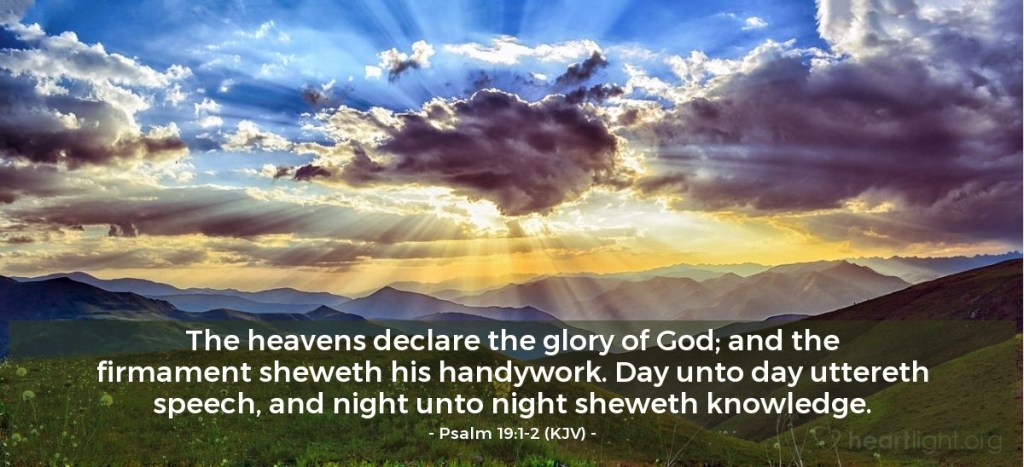
The Creation speaks forth God’s glory (Psalm 19:1).

https://www.blueletterbible.org/kjv/psa/19/1/t_conc_497001

It is also the case that those who are His saints, His faithful, do speak to one another the Word of God (cf. Malachi 3:16Ephesians 5:19Colossians 3:16).

Sharing our testimony is part and parcel of the Christian life.

Sharing heaven’s testimony is part and parcel of the Christian witness.

Psalm 29 Names of God Bible

Psalm 29

A psalm by David.

Give to Yahweh, you heavenly beings.
    Give to Yahweh glory and power.
Give to Yahweh the glory his name deserves.
    Worship Yahweh in his holy splendor.

The voice of Yahweh rolls over the water.
    The El of glory thunders.
        Yahweh shouts over raging water.
The voice of Yahweh is powerful.
    The voice of Yahweh is majestic.
The voice of Yahweh breaks the cedars.
    Yahweh splinters the cedars of Lebanon.
        He makes Lebanon skip along like a calf
            and Mount Sirion like a wild ox.
The voice of Yahweh strikes with flashes of lightning.
The voice of Yahweh makes the wilderness tremble.
    Yahweh makes the wilderness of Kadesh tremble.
The voice of Yahweh splits the oaks[a]
    and strips the trees of the forests bare.
        Everyone in his temple is saying, “Glory!”

10 Yahweh sat enthroned over the flood.
    Yahweh sits enthroned as Melek forever.
11 Yahweh will give power to his people.
    Yahweh will bless his people with peace.

This conversation is not only for the mutual encouragement, edification of those within the church (1 Thessalonians 5:11), but also for those who are outside the church.

https://www.blueletterbible.org/kjv/1th/5/11/t_conc_1116011

“The sons of men” (Psalm 145:12) is also a comprehensive expression, meaning (as some translations have it) “all people”!

https://www.blueletterbible.org/kjv/psa/145/12/t_conc_623012

Those who study Creation may well conclude that there is, after all, a God (and praise His Name, many have); but those who are exposed to genuine Christian conversation have an even better opportunity of discovering just Who He is!

There is also a comprehensiveness of God’s kingdom (Psalm 145:13).

https://www.blueletterbible.org/kjv/psa/145/13/t_conc_623013

It is both eternal and extensive (cf. Psalm 72:17).

Psalm 72:17-19 Names of God Bible

17 May his name endure forever.
    May his name continue as long as the sun shines.
    May all nations be blessed through him and call him blessed.

18 Thank Yahweh Elohim, the Elohim of Israel,
    who alone does miracles.
19 Thanks be to his glorious name forever.
    May the whole earth be filled with his glory.
    Amen and amen!

This is the same ‘kingdom of God’, or ‘kingdom of heaven’ about which Jesus speaks; and it belongs to Him, and all who are found in Him (cf. 2 Peter 1:11).

The LORD cares for the weak and vulnerable (Psalm 145:14).

He heard the cry of the children of Israel in their captivity and set His mind to deliver them (cf. Exodus 3:7-8).

Thereafter He taught His people to care for strangers, widows, and orphans – and the poor (cf. Exodus 22:21-23Exodus 22:25).

This care is continued in the church (cf. Hebrews 13:2James 1:27Galatians 2:9-10).

The LORD cares for those of His own who may otherwise fall (cf. Psalm 73:1-2).

He works ‘all’ things together for good (cf. Romans 8:28), for the good of His ‘peculiar’ people (cf. 1 Peter 2:9).

Whether they know it or not, all flesh is dependent upon the LORD for their daily provision (Psalm 145:15).

Whether they will acknowledge it or not, no man can find sufficient sustenance without the LORD.

It is better therefore to seek Him first, knowing that He will add to us ‘all these things’ (Matthew 6:33).

If God provides for the birds of the air, how much more for you (Matthew 6:25-27). It is good, therefore, to acknowledge God’s hand in all these things, and to gratefully receive His bountiful provision (Psalm 145:16).

Our trust in the LORD is not based in our individual ability to believe, but in His perfections. He is righteous in all His ways: He is just. He is kind in all He does:

He is holy (Psalm 145:17).

It is good that we can view the LORD as a God who is not only transcendent, but also immanent.

He is present within His Creation.

He is “near” to all who call upon Him (Psalm 145:18).

We should, therefore, ‘Seek the LORD while He may be found, call upon Him while He is near’ (Isaiah 55:6).

The one true God, God of all integrity (Deuteronomy 32:4John 14:61 John 5:20Revelation 19:11) draws “nigh” unto all who call upon Him “in truth” with a matching integrity of heart (Psalm 145:18).

It is of the LORD’s mercy that He also hears our petitions (Psalm 145:19).

This is particularly addressed to “those who fear Him” – those who revere His Name.

We may not all presumptuously or blasphemously call out His Name at every approach of trouble: but when we nurture a relationship with him, He is there for us, always.

He grants our desires because our desires are consistent with His. He hears our cry because we are His people. He ‘saves to the uttermost’ all that come to God via Jesus Christ, who forever lives to make intercession for us (Hebrews 7:25).

The LORD preserves all who love Him (Psalm 145:20). This is the other side of our own perseverance: ‘he who endures to the end shall be saved’ (Matthew 24:13). Yet we may not presume upon His grace: the God who is slow to anger (Psalm 145:8), is also the God who will punish the unrepentant (2 Peter 2:9).

The “each” and “every” of God’s 100x% comprehensive care find their final expression as the Psalmist speaks the praise of the LORD, and “all flesh” replies by “blessing” (speaking well of) His holy Name (Psalm 145:21). The groaning Creation (Romans 8:22) at last finds relief in the “for ever and ever.” Amen.

In the name of God, the Father and God the Son and God the Holy Spirit,

Let us Pray,

Psalm 19 Names of God Bible

Psalm 19

For the choir director; a psalm by David.

The heavens declare the glory of El,
    and the sky displays what his hands have made.
One day tells a story to the next.
    One night shares knowledge with the next
without talking,
    without words,
    without their voices being heard.
Yet, their sound has gone out into the entire world,
    their message to the ends of the earth.
    He has set up a tent in the heavens for the sun,
which comes out of its chamber like a bridegroom.
    Like a champion, it is eager to run its course.
        It rises from one end of the heavens.
            It circles around to the other.
                Nothing is hidden from its heat.

The teachings of Yahweh are perfect.
    They renew the soul.
    The testimony of Yahweh is dependable.
    It makes gullible people wise.
The instructions of Yahweh are correct.
    They make the heart rejoice.
    The command of Yahweh is radiant.
    It makes the eyes shine.
The fear of Yahweh is pure.
    It endures forever.
    The decisions of Yahweh are true.
    They are completely fair.
10 They are more desirable than gold, even the finest gold.
    They are sweeter than honey, even the drippings from a honeycomb.
11 As your servant I am warned by them.
    There is a great reward in following them.

12 Who can notice every mistake?
    Forgive my hidden faults.
13 Keep me from sinning.
    Do not let anyone gain control over me.
        Then I will be blameless,
            and I will be free from any great offense.

14 May the words from my mouth and the thoughts from my heart
    be acceptable to you, O Yahweh, my rock and my Go’el.

What is a go el in Hebrew?

redeemer, reclaimant. especially : a next of kin upon whom according to ancient Hebrew custom devolved certain family rights and duties including the avenging of a murdered kin’s blood and the redemption of the person or the property of a relative in debt or helpless circumstances.

Glory be to the Father,
and to the Son, and to the Holy Ghost;
as it was in the beginning,
is now, and ever shall be,
world without end. Amen, amen.
https://translate.google.com/

My God! My God! My ABBA Father, My Savior, How Great Art Thou on Earth as You are in Heaven? Psalm 19

Psalm 19 Complete Jewish Bible

19 (0) For the leader. A psalm of David:

2 (1) The heavens declare the glory of God,
the dome of the sky speaks the work of his hands.
3 (2) Every day it utters speech,
every night it reveals knowledge.
4 (3) Without speech, without a word,
without their voices being heard,
5 (4) their line goes out through all the earth
and their words to the end of the world.

In them he places a tent for the sun,
6 (5) which comes out like a bridegroom from the bridal chamber,
with delight like an athlete to run his race.
7 (6) It rises at one side of the sky,
circles around to the other side,
and nothing escapes its heat.

8 (7) The Torah of Adonai is perfect,
restoring the inner person.
The instruction of Adonai is sure,
making wise the thoughtless.
9 (8) The precepts of Adonai are right,
rejoicing the heart.
The mitzvah of Adonai is pure,
enlightening the eyes.
10 (9) The fear of Adonai is clean,
enduring forever.
The rulings of Adonai are true,
they are righteous altogether,
11 (10) more desirable than gold,
than much fine gold,
also sweeter than honey
or drippings from the honeycomb.
12 (11) Through them your servant is warned;
in obeying them there is great reward.

13 (12) Who can discern unintentional sins?
Cleanse me from hidden faults.
14 (13) Also keep your servant from presumptuous sins,
so that they won’t control me.
Then I will be blameless
and free of great offense.

15 (14) May the words of my mouth
and the thoughts of my heart
be acceptable in your presence,
Adonai, my Rock and Redeemer.

Glory be to the Father,
and to the Son, and to the Holy Ghost;
as it was in the beginning,
is now, and ever shall be,
world without end. Amen, amen.

There’s nothing quite like a triumphant hymn to truly make you feel closer to the Lord. When you sing out those lyrics, it’s almost like His power, strength and majesty and love just wash over us. And one of the most powerful hymns of all time is ‘How Great Thou Art.’ I just love hearing this amazing hymn and now that I know the story behind the song, it makes it that much more beautiful.

The hymn “How Great Thou Art” is a timeless worship song, cherished by generations of believers for its inspiring description of God’s greatness.

Its verses resonate deeply in our souls, leading us into genuine moments of awe as we contemplate the wonder of who God is and how God works in our world.

“How Great Thou Art” is a classic hymn that remains popular today because it invites us to marvel in fresh ways at our Creator’s beautifully designed creation, His majesty, His Power and his inspiring, wonderful presence in our lives.

Each verse of this song serves as one gateway after another to understanding God more deeply and celebrating our great God in worship. When we sing the beloved hymn “How Great Thou Art,” we can grow closer to our great God.

The hymn originated as a poem written by Swedish pastor Carl Boberg in 1885.

Boberg was inspired to write the poem after experiencing a wondrous sight in nature: a sudden thunderstorm followed by a clear, beautiful view over a bay.

The poem was set to music in Sweden, and the song later went through various translations. In the 20th century, British missionary Stuart Hine translated the hymn into English and expanded it with additional verses. Hine’s version of “How Great Thou Art” became popular around the world after George Beverly Shea sang it during Reverend Billy Graham’s evangelistic crusades in the 1950s.

Just as a subtle or most likely, not so subtle reminder, here are some truths for us to contemplate an awesome God, “How Great Thou Art,” reveals about God.

1. God’s indescribable glory in creation.

The opening lines of “How Great Thou Art” exclaim:

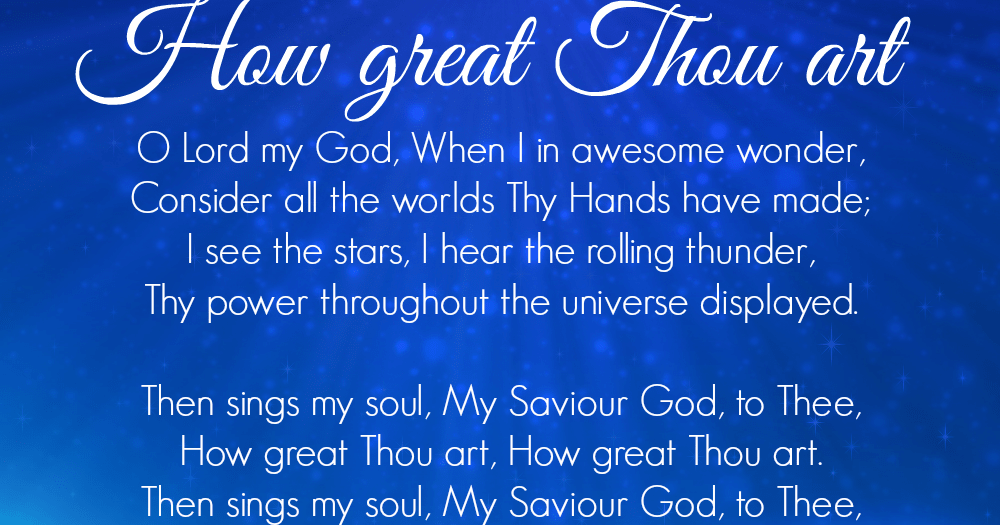
“O Lord my God,/when I in awesome wonder,/consider all the worlds thy hands have made./I see the stars/I hear the rolling thunder,/Thy power throughout the universe displayed.”

This echoes Psalm 19:1, which declares: “The heavens declare the glory of God; the skies proclaim the work of his hands.”

It also evokes the imagery revealed in Psalm 29:3-4: “The voice of the Lord is over the waters; the God of glory thunders, the Lord thunders over the mighty waters. The voice of the Lord is powerful; the voice of the Lord is majestic.”

As we enjoy God’s creation – from the sparkling stars to the powerful thunder, to the forest glades we each wander through – we can’t help but marvel at the wondrous beauty of its precise design and power.

 Nature itself is evidence of God’s glory and creativity. Romans 1:20 points out:

“For since the creation of the world God’s invisible qualities – his eternal power and divine nature – have been clearly seen, being understood from what has been made, so that people are without excuse.” 

Psalm 104:24 celebrates God’s creative power: “How many are your works, LORD! In wisdom you made them all; the earth is full of your creatures.” 

Job 9:10 says about God: “He performs wonders that cannot be fathomed, miracles that cannot be counted.”

Throughout the entire song, “How Great Thou Art” emphasizes the importance of noticing the wonder of God’s work around us. Every single part of God’s creation shows us something valuable about God that can inspire us with awe. Singing “How Great Thou Art” can motivate us to spend time in nature as often as possible, experiencing environments that help us discover God’s greatness.

2. God’s holiness and righteousness.

Another profound truth “How Great Thou Art” reveals about God is his perfect holiness and righteousness.

The awe expressed in the hymn’s refrain, “Then sings my soul, My Savior God, to Thee,/How great Thou art, How great Thou art!” reminds us of the vision of God’s holiness the Bible describes in Isaiah 6:3, where the seraphim angels call to one another:

“Holy, holy, holy is the Lord Almighty; the whole earth is full of his glory.”

God’s holiness means that he is absolutely uncorrupted by sin and completely morally pure.

Psalm 145:17 “The Lord is righteous in all his ways and faithful in all he does.”

The hymn’s refrain captures the reverent awe we feel when we think about God’s great holiness and righteousness.

In 2 Corinthians 5:21, we see that God’s holiness and righteousness are accessible to us through relationships with Jesus: “God made him who had no sin to be sin for us, so that in him we might become the righteousness of God.”

This profound truth should inspire us to praise God like the hymn’s refrain does. It aught also to motivate us all to live lives that reflect God’s character by growing to be more holy ourselves.

Ephesians 4:24 encourages us to: “… put on the new self, created to be like God in true righteousness and holiness.” The refrain of “How Great Thou Art” calls us to strive for a greater, deeper, reverence for God’s majesty. It highlights a grateful response to God’s perfect nature, inspires us to make that response our own.

3. God’s constant presence with us.

“How Great Thou Art” reflects on God’s constant presence with us as it describes experiencing the extraordinary presence of God during ordinary moments like walking in nature: “When through the woods and forest glades I wander,/and hear the birds sing sweetly in the trees./ When I look down, from lofty mountain grandeur/And see the brook, and feel the gentle breeze.”

In Psalm 23:4, King David also uses the imagery of walking to describe the power of God’s constant presence:

“Even though I walk through the darkest valley, I will fear no evil, for you are with me; your rod and your staff, they comfort me.”

Throughout the Bible, God promises us to be present with us.

In Exodus 33:14, God assures Moses, “My presence will go with you, and I will give you rest.”

In Matthew 28:20, Jesus promises his disciples: “…And surely I am with you always, to the very end of the age.” 

God’s presence is a tangible reality we each can experience regularly through reading,  study, prayer, meditation, other spiritual disciplines and practices.

In fact, if we have saving relationships with Jesus, God’s Holy Spirit comes to live right inside our souls, as 1 Corinthians 3:16 points out: “Don’t you know that you yourselves are God’s temple and that God’s Spirit dwells in your midst?”

Psalm 139 beautifully describes God’s presence with us everywhere, pointing out in verses 7-10:

“Where can I go from your Spirit? Where can I flee from your presence? If I go up to the heavens, you are there; if I make my bed in the depths, you are there. If I rise on the wings of the dawn, if I settle on the far side of the sea, even there your hand will guide me, your right hand will hold me fast.”

In its refrain, “How Great Thou Art” encourages us all to notice God’s loving presence with us wherever we go – even unto the furthest reaches of eternity.

4. God’s plan to save us.

One of the most moving verses in “How Great Thou Art” declares: “And when I think that God, his Son not sparing, sent him to die, I scarce can take it in./That on the cross, my burden gladly bearing,/He bled and died to take away my sin.”

This verse reminds us of what is perhaps the most famous Bible verse of all, John 3:16: “For God so loved the world that he gave his one and only Son, that whoever believes in him shall not perish but have eternal life.”

John 3:17 Complete Jewish Bible

17 For God did not send the Son into the world to judge the world, but rather so that through him, the world might be saved.

The timeless hymn’s reflection on God’s profound love for us through Jesus’s coming and ultimate sacrifice invites each and every single one of us to feel a reverent awe at God’s wondrous plan to save our souls from sin and death.

Jesus’ death on the cross made it possible for humanity to connect with God again, as 2 Corinthians 5:17-18:

“Therefore, if anyone is in Christ, the new creation has come: The old has gone, the new is here! All this is from God, who reconciled us to himself through Christ and gave us the ministry of reconciliation.”

In Ephesians 1:7-8, The Bible highlights the enormous generosity of God’s grace through his plan to save us:

“In him we have redemption through his blood, the forgiveness of sins, in accordance with the riches of God’s grace that he lavished on us…”.

Isaiah 53:5 prophesies about Jesus’ healing work for us on the cross:

“But he was pierced for our transgressions, he was crushed for our iniquities; the punishment that brought us peace was on him, and by his wounds we are healed.” 

Jesus offers forgiveness from sins to all who place their faith in him, fulfilling God’s plan to save us.

Singing “How Great Thou Art” can help us focus on the greatest gift of all that God has given us through Jesus, the world’s Savior. Just like the song says, we “scarce can take it in,” but it’s still important to remember it on a regular basis.

5. God’s Unchanging promise of eternal life.

“How Great Thou Art” concludes with a triumphant declaration of hope:

“When Christ shall come with shout of acclamation/And take me home, what joy shall fill my heart./ Then I shall bow, in humble adoration,/And then proclaim: ‘My God, how great Thou art!’”

This evokes the promise of Revelation 21:4, which envisions our future joy in heaven, saying about God:

“He will wipe every tear from their eyes. There will be no more death or mourning or crying or pain, for the old order of things has passed away.”

Jesus describes our eternal life with him when he says in John 14:2-3:

“My Father’s house has many rooms; if that were not so, would I have told you that I am going there to prepare a place for you? And if I go and prepare a place for you, I will come back and take you to be with me that you also may be where I am.” 

Titus 1:2 assures us that we have “…the hope of eternal life, which God, who does not lie, promised before the beginning of time.”

When we sing the song “How Great Thou Art,” we joyfully celebrate the reality of this unending hope. “How Great Thou Art” reminds us that our great God has prepared great joy for us to experience in heaven with him for eternity. 

In conclusion, “How Great Thou Art” is an incredibly stirring powerful worship hymn that resoundingly declares and proclaims and celebrates God’s greatness.

It invites us to

explore the wonders of God’s glory displayed in creation,

explore God’s perfect holiness and righteousness,

explore God’s constant presence with us,

explore God’s loving plan to save us,

discover God’s promise of eternal life for all who choose relationships with him.

As we sing “How Great Thou Art,” we cannot help but to perceive, to receive so much more of God’s awe-inspiring greatness and worship him with gratitude.

In the name of God, the Father and God the Son and God the Holy Spirit,

Let us Pray,

Psalm 29 Complete Jewish Bible

29 (0) A psalm of David:

(1) Give Adonai his due, you who are godly;
give Adonai his due of glory and strength;
give Adonai the glory due his name;
worship Adonai in holy splendor.

The voice of Adonai is over the waters;
the God of glory thunders,
Adonai over rushing waters,
the voice of Adonai in power,
the voice of Adonai in splendor.

The voice of Adonai cracks the cedars;
Adonai splinters the cedars of the L’vanon
and makes the L’vanon skip like a calf,
Siryon like a young wild ox.

The voice of Adonai flashes fiery flames;
the voice of Adonai rocks the desert,
Adonai convulses the Kadesh Desert.
The voice of Adonai causes deer to give birth
and strips the forests bare —
while in his temple, all cry, “Glory!”
10 Adonai sits enthroned above the flood!
Adonai sits enthroned as king forever!
11 May Adonai give strength to his people!
May Adonai bless his people with shalom!

Glory be to the Father,
and to the Son, and to the Holy Ghost;
as it was in the beginning,
is now, and ever shall be,
world without end. Amen, amen.
https://translate.google.com/

The Fullness of God’s glory is on tour across the skies, God-craft on exhibit across the greatest horizon. Psalm 19

Psalm 19 Complete Jewish Bible

19 (0) For the leader. A psalm of David:

2 (1) The heavens declare the glory of God,
the dome of the sky speaks the work of his hands.
3 (2) Every day it utters speech,
every night it reveals knowledge.
4 (3) Without speech, without a word,
without their voices being heard,
5 (4) their line goes out through all the earth
and their words to the end of the world.

In them he places a tent for the sun,
6 (5) which comes out like a bridegroom from the bridal chamber,
with delight like an athlete to run his race.
7 (6) It rises at one side of the sky,
circles around to the other side,
and nothing escapes its heat.

8 (7) The Torah of Adonai is perfect,
restoring the inner person.
The instruction of Adonai is sure,
making wise the thoughtless.
9 (8) The precepts of Adonai are right,
rejoicing the heart.
The mitzvah of Adonai is pure,
enlightening the eyes.
10 (9) The fear of Adonai is clean,
enduring forever.
The rulings of Adonai are true,
they are righteous altogether,
11 (10) more desirable than gold,
than much fine gold,
also sweeter than honey
or drippings from the honeycomb.
12 (11) Through them your servant is warned;
in obeying them there is great reward.

13 (12) Who can discern unintentional sins?
Cleanse me from hidden faults.
14 (13) Also keep your servant from presumptuous sins,
so that they won’t control me.
Then I will be blameless
and free of great offense.

15 (14) May the words of my mouth
and the thoughts of my heart
be acceptable in your presence,
Adonai, my Rock and Redeemer.

The Word of God for the Children of God.

Glory be to the Father,
and to the Son, and to the Holy Ghost;
as it was in the beginning,
is now, and ever shall be,
world without end. Amen, amen.
Then Sings My Soul, My Savior God to Thee …

The hymn “How Great Thou Art” is a timeless worship song, cherished by generations of believers for its inspiring description of God’s greatness.

Its verses resonate deeply in our souls, leading us into moments of awe as we contemplate the wonder of who God is and how God works in our world.

“How Great Thou Art” is a classic hymn that remains popular today because it invites us to marvel in fresh ways at our Creator’s beautifully designed creation and his wonderful presence in our lives.

Each verse of this song serves as a gateway to understanding God more deeply and celebrating our great God in worship. When we are all singing this most beloved hymn “How Great Thou Art,” we truly grow closer to our great God.

The hymn originated as a poem written by Swedish pastor Carl Boberg in 1885. Boberg was inspired to write the poem after experiencing a wondrous sight in nature: a sudden thunderstorm followed by a clear, beautiful view over a bay.

The poem was set to music in Sweden, and the song later went through various translations. In the 20th century, British missionary Stuart Hine translated the hymn into English and expanded it with additional verses. Hine’s version of “How Great Thou Art” became popular around the world after George Beverly Shea sang it during the Billy Graham’s evangelistic crusades in the 1950s.

Here are five truths “How Great Thou Art” reveals about God.

1. God’s great glory in creation.

The opening lines of “How Great Thou Art” exclaim:

“O Lord my God,/when I in awesome wonder,/consider all the worlds thy hands have made./I see the stars/I hear the rolling thunder,/Thy power throughout the universe displayed.”

This echoes Psalm 19:1, which declares: “The heavens declare the glory of God; the skies proclaim the work of his hands.”

It also evokes the imagery in Psalm 29:3-4: “The voice of the Lord is over the waters; the God of glory thunders, the Lord thunders over the mighty waters. The voice of the Lord is powerful; the voice of the Lord is majestic.”

As we enjoy God’s creation – from the sparkling stars to the powerful thunder – we can’t help but marvel at the wondrous beauty of its precise design, power. 

Nature itself is evidence of God’s glory and creativity. 

Romans 1:20 points out: “For since the creation of the world God’s invisible qualities – his eternal power and divine nature – have been clearly seen, being understood from what has been made, so that people are without excuse.”

Psalm 104:24 celebrates God’s creative power: “How many are your works, LORD! In wisdom you made them all; the earth is full of your creatures.” 

Job 9:10 says about God: “He performs wonders that cannot be fathomed, miracles that cannot be counted.”

Throughout the entire song, “How Great Thou Art” emphasizes the importance of noticing the wonder of God’s work around us.

Every single part of God’s creation shows us something valuable about God that can inspire us with awe.

Singing “How Great Thou Art” can motivate us to spend time in nature as often as possible, experiencing environments that help us discover God’s greatness.

2. God’s holiness and righteousness.

Another profound truth “How Great Thou Art” reveals about God is his perfect holiness and righteousness.

The awe expressed in the hymn’s refrain, “Then sings my soul, My Savior God, to Thee,/How great Thou art, How great Thou art!” reminds us of the vision of God’s holiness the Bible describes in Isaiah 6:3, where the seraphim angels call to one another: “Holy, holy, holy is the Lord Almighty; the whole earth is full of his glory.”

God’s holiness means that he is absolutely uncorrupted by sin and completely morally pure.

As Psalm 145:17 says: “The Lord is righteous in all his ways and faithful in all he does.” The hymn’s refrain captures the full reverent awe we feel when we think, search Scriptures and meditate about God’s great holiness and righteousness.

In 2 Corinthians 5:21, we read that God’s holiness and righteousness are accessible to us through relationships with Jesus: “God made him who had no sin to be sin for us, so that in him we might become the righteousness of God.”

This profound truth should inspire us to praise God like the hymn’s refrain does. It should also motivate us to live lives that reflect God’s character by growing to be more holy ourselves. (1 Peter 1:15-16)

15 But like the Holy One who called you, be holy yourselves in all your conduct [be set apart from the world by your godly character and moral courage]; 16  because it is written, “You shall be holy (set apart), for I am holy.”

Ephesians 4:24 encourages us to: “… put on the new self, created to be like God in true righteousness and holiness.” The refrain of “How Great Thou Art” calls us to a deeper reverence for God’s majesty. It highlights a grateful response to God’s perfect nature and inspires us, motivates us, to make that response our own.

3. God’s constant presence with us.

“How Great Thou Art” reflects on God’s constant presence with us as it describes experiencing the extraordinary presence of God during ordinary moments like walking in nature: “When through the woods and forest glades I wander,/and hear the birds sing sweetly in the trees./ When I look down, from lofty mountain grandeur/And see the brook, and feel the gentle breeze.”

In Psalm 23:4, King David also uses the imagery of walking to describe the power of God’s constant presence: “Even though I walk through the darkest valley, I will fear no evil, for you are with me; your rod and your staff, they comfort me.”

Throughout the Bible, God promises us to be present with us.

In Exodus 33:14, God assures Moses, “My presence will go with you, and I will give you rest.”

In Matthew 28:20, Jesus promises his disciples: “…And surely I am with you always, to the very end of the age.” 

God’s presence is a tangible reality we can experience regularly through prayer, meditation, and other spiritual practices.

In fact, if we have saving relationships with Jesus, God’s Holy Spirit comes to live right inside our souls, as 1 Corinthians 3:16 points out: “Don’t you know that you yourselves are God’s temple and that God’s Spirit dwells in your midst?”

Psalm 139 beautifully describes God’s presence with us everywhere, pointing out in verses 7-10: “Where can I go from your Spirit? Where can I flee from your presence? If I go up to the heavens, you are there; if I make my bed in the depths, you are there. If I rise on the wings of the dawn, if I settle on the far side of the sea, even there your hand will guide me, your right hand will hold me fast.”

In its refrain, “How Great Thou Art” encourages us to notice God’s loving presence with us wherever we go.

4. God’s plan to save us.

One of the most moving verses in “How Great Thou Art” declares: “And when I think that God, his Son not sparing, sent him to die, I scarce can take it in./That on the cross, my burden gladly bearing,/He bled and died to take away my sin.”

This verse reminds us of what is perhaps the most famous Bible verse of all, John 3:16: “For God so loved the world that he gave his one and only Son, that whoever believes in him shall not perish but have eternal life.”

The hymn’s reflection on God’s profound love for us through Jesus’s ultimate sacrifice invites us to feel awe at God’s wondrous plan to save our souls from sin and death.

Jesus’ death on the cross made it possible for humanity to connect with God again, as 2 Corinthians 5:17-18:

“Therefore, if anyone is in Christ, the new creation has come: The old has gone, the new is here! All this is from God, who reconciled us to himself through Christ and gave us the ministry of reconciliation.”

In Ephesians 1:7-8, The Bible highlights the enormous generosity of God’s grace through his plan to save us:

“In him we have redemption through his blood, the forgiveness of sins, in accordance with the riches of God’s grace that he lavished on us…”.

Isaiah 53:5 prophesies about Jesus’ healing work for us on the cross:

“But he was pierced for our transgressions, he was crushed for our iniquities; the punishment that brought us peace was on him, and by his wounds we are healed.”

Jesus offers forgiveness from sins to all who place their faith in him, fulfilling God’s plan to save us.

Singing “How Great Thou Art” can help us focus on the greatest gift of all that God has given us through Jesus, the world’s Savior. Just like the song says, we “scarce can take it in,” but it’s still important to remember it on a regular basis.

5. God’s promise of eternal life.

“How Great Thou Art” concludes with a triumphant declaration of hope:

“When Christ shall come with shout of acclamation/And take me home, what joy shall fill my heart./ Then I shall bow, in humble adoration,/And then proclaim: ‘My God, how great Thou art!’”

This evokes the promise of Revelation 21:4, which envisions our future joy in heaven, saying about God:

“He will wipe every tear from their eyes. There will be no more death or mourning or crying or pain, for the old order of things has passed away.”

Jesus describes our eternal life with him when he says in John 14:2-3:

“My Father’s house has many rooms; if that were not so, would I have told you that I am going there to prepare a place for you? And if I go and prepare a place for you, I will come back and take you to be with me that you also may be where I am.” 

Titus 1:2 assures us that we have “…the hope of eternal life, which God, who does not lie, promised before the beginning of time.”

When we sing the song “How Great Thou Art,” we joyfully celebrate the reality of this hope. “How Great Thou Art” reminds us that our great God has prepared great joy for us to experience in heaven with him for eternity. 

In conclusion, “How Great Thou Art” is a powerful worship hymn that declares and celebrates God’s greatness.

It beckons us, it invites us, it empowers us. to explore, to discover, the wonders of God’s glory displayed in creation, God’s perfect holiness and righteousness, God’s constant presence with us, God’s loving plan to save each of us, and also God’s total promise of eternal life for all who choose relationships with him.

As we sing “How Great Thou Art,” we can perceive so much more of God’s awe-inspiring greatness and worship him with reverence and with gratitude.

Gather with your friends, start a hymn sing to the tune “row, row your boat.”

Lose yourself, fully and completely and utterly in the fullness of our God …

In the name of God the Father and God the Son and God the Holy Spirit,

Let us Pray,

Psalm 29 Complete Jewish Bible

29 (0) A psalm of David:

(1) Give Adonai his due, you who are godly;
give Adonai his due of glory and strength;
give Adonai the glory due his name;
worship Adonai in holy splendor.

The voice of Adonai is over the waters;
the God of glory thunders,
Adonai over rushing waters,
the voice of Adonai in power,
the voice of Adonai in splendor.

The voice of Adonai cracks the cedars;
Adonai splinters the cedars of the L’vanon
and makes the L’vanon skip like a calf,
Siryon like a young wild ox.

The voice of Adonai flashes fiery flames;
the voice of Adonai rocks the desert,
Adonai convulses the Kadesh Desert.
The voice of Adonai causes deer to give birth
and strips the forests bare —
while in his temple, all cry, “Glory!”
10 Adonai sits enthroned above the flood!
Adonai sits enthroned as king forever!
11 May Adonai give strength to his people!
May Adonai bless his people with shalom!

Glory be to the Father,
and to the Son, and to the Holy Ghost;
as it was in the beginning,
is now, and ever shall be,
world without end. Amen, amen.
https://translate.google.com/

Where Exactly Is Our Hope Placed? Temporary Centrality of Our Hope Only In Ourselves. Proverbs 11:4-8

In a worship song from the early 2000s, singer/songwriter Brian Doerksen sings, “Jesus, hope of the nations/ Jesus, comfort for all who mourn/ You are the source of heaven’s hope on earth.”

Looking outward into the world for all of the hope to be found and mined from the ground in all of the far reaching places we have ever traveled on this planet?

Looking upward into the heavens and the uncountable number of far reaching constellations of stars and planets we can never hope to reach – we are limited to this time – to this place – unto these bodies – to these tents which wear out.

But, why should we seek to limit ourselves and where we look for our hope, to look in all the places where the only thing likely to be found is disappointment?

If the only thing we believe we can ever find in life is one disappointment after the other, how is we can continue to justify our personal search for true hope?

Proverbs 11:4-8 The Message

A thick bankroll is no help when life falls apart,
    but a principled life can stand up to the worst.

Moral character makes for smooth traveling;
    an evil life is a hard life.

Good character is the best insurance;
    crooks get trapped in their sinful lust.

When the wicked die, that’s it—
    the story’s over, end of hope.

A good person is saved from much trouble;
    a bad person runs straight into it.

The Word of God for the Children of God.

Adeste Fideles! Laeti Triumphantes! Venite Adoremus! Dominum.

Gloria! In Excelsis Deo! Alleluia, Alleluia, Alleluia, Amen.

Where is Your Hope?

There is a well known country song with the title of “I’ve Been Everywhere.”

Some of the places which account for having “been everywhere” include:

I’ve been to Reno, Chicago, Fargo, Minnesota
Buffalo, Toronto, Winslow, Sarasota
Wichita, Tulsa, Ottawa, Oklahoma
Tampa, Panama, Mattawa, La Paloma
Bangor, Baltimore, Salvador, Amarillo
Tocapillo, Baranquilla, and Perdilla, I’m a killer

I’ve been to Boston, Charleston, Dayton, Louisiana
Washington, Houston, Kingston, Texarkana
Monterey, Faraday, Santa Fe, Tallapoosa
Glen Rock, Black Rock, Little Rock, Oskaloosa
Tennessee to Tennessee Chicopee, Spirit Lake
Grand Lake, Devils Lake, Crater Lake, for Pete’s sake

I’ve been to Louisville, Nashville, Knoxville, Ombabika
Schefferville, Jacksonville, Waterville, Costa Rica
Pittsfield, Springfield, Bakersfield, Shreveport
Hackensack, Cadillac, Fond du Lac, Davenport
Idaho, Jellico, Argentina, Diamantina,
Pasadena, Catalina, see what I mean

I’ve been to Pittsburgh, Parkersburg, Gravelburg, Colorado
Ellensburg, Rexburg, Vicksburg, El Dorado
Larimore, Atmore, Haverstraw, Chatanika
Chaska, Nebraska, Alaska, Opelika
Baraboo, Waterloo, Kalamazoo, Kansas City
Sioux City, Cedar City, Dodge City, what a pity

I’ve been everywhere, man
Crossed the desert’s bare, man
I’ve breathed the mountain air, man
Of travel I’ve had my share, man
I’ve been everywhere

Where exactly in all of those places the song writer has claimed to have been, where exactly was their hope for what ever it was they hoped for, searched for, which compelled them, moved them from one geographical locale to another?

In a worship song from the early 2000s, singer/songwriter Brian Doerksen sings, “Jesus, hope of the nations/ Jesus, comfort for all who mourn/ You are the source of heaven’s hope on earth.”

Looking outward into the world for all of the hope to be found and mined from the ground in all of the far reaching places we have ever traveled on this planet?

Looking upward into the heavens and the uncountable number of far reaching constellations of stars and planets we can never hope to reach – we are limited to this time – to this place – unto these bodies – to these tents which wear out.

But, why should we seek to limit ourselves and where we look for our hope, to look in all the places where the only thing likely to be found is disappointment?

If the only thing we believe we can ever find in life is one disappointment after the other, how is we can continue to justify our personal search for true hope?

Recognizing God’s Sovereignty, Letting God Be True

Luke 12:16-21 English Standard Version

16 And he told them a parable, saying, “The land of a rich man produced plentifully, 17 and he thought to himself, ‘What shall I do, for I have nowhere to store my crops?’ 18 And he said, ‘I will do this: I will tear down my barns and build larger ones, and there I will store all my grain and my goods. 19 And I will say to my soul, “Soul, you have ample goods laid up for many years; relax, eat, drink, be merry.”’ 20 But God said to him, ‘Fool! This night your soul is required of you, and the things you have prepared, whose will they be?’ 21 So is the one  who lays up treasure for himself and is not rich toward God.”

In actuality for all of their bravado, sinners have a little fun – while alive.

They make huge plans for pleasure and posterity.

They expect and hope to do bigger and better things.

They plan to get everything rolling along more perfectly.

Then they die.

Then they have nothing but a casket to show for it.

Then they are nothing – except the book of memories from their funerals.

Death is the great equalizer.

It mercilessly rips from the rich all their wealth; it tears from the strong any athletic prowess; it corrupts the face, body, and hair of the beautiful; it removes the wits and memories of the intelligent; it neuters the authority and power of leaders; it takes from parents their beloved children; it leaves homeless those who loved their fine homes.

No matter what the sinners expected or hoped to do, Our Sovereign God sends His Shepherd to us on our deathbeds and just like that, God takes it all away.

And still we sinners must somehow still find and focus on these words of hope:

Job 1:20-21 English Standard Version

20 Then Job arose and tore his robe and shaved his head and fell on the ground and worshiped. 21 And he said, “Naked I came from my mother’s womb, and naked shall I return. The Lord gave, and the Lord has taken away; blessed be the name of the Lord.”

Instead of focusing on the ‘hope’ found from these words: “Curse God and Die.”

From the Parable in Luke’s Narrative, Jesus told of a rich man who planned new barns to hold his great wealth, and he said to himself, “Soul, thou hast much goods laid up for many years; take thine ease, eat, drink, and be merry.”

But God said to him, “Thou fool, this night thy soul shall be required of thee: then whose shall those things be, which thou hast provided?” (Luke 12:16-21).

Worldly men and woman arrive in life very naked and ignorant, and without exception, they leave the same helpless way – ignorant of what heaven holds.

Ignorant of what incomparable, indescribable, hope the Hope of Heaven has.

Yet they will still waste their lives chasing goals that disappear in one second – the second they die.

They see others die and take nothing with them, yet they keep running as fast as they can on the unmerciful treadmill of ambition, greed, and covetousness until it lets them go, hurls them and sends them off into their death and hell.

Psalm 14:1 New King James Version

Folly of the Godless, and God’s Final Triumph

To the Chief Musician. A Psalm of David.

14 The fool has said in his heart,
“There is no God.”
They are corrupt,
They have done abominable works,
There is none who does good.

One just wants to shout: “Curse God and Die,”

What fools!

Then they have nothing.

Then they are nothing.

Are such words too harsh?

Are such words not harsh enough?

They are nothing compared to the shock of the first second in hell.

In a horrible flash of understanding, every sinner will know there is a God, that their whole earthly life was a waste, that they’ll have an eternity of unbearable torment ahead.

They will not think for a second about the legacy of their big plans on earth, for in an instant they’ll be entirely gone – and remembered by only a precious few.

Why do we think strong warnings about such a future are unabashedly harsh?

Am I deceived by my illusion of the importance of my personal sovereignty?

Are you also deceived of the importance of your own personal sovereignty?

The world is insane!

They set goals of high salaries, prestigious positions, large houses, fancy cars, fine clothes, the most expensive schools for their children, and other ambitions.

Some of them say, even more will find their bully pulpits and charismatically preach and teach and so live like, “He who dies with the most toys – wins.”

They chase after their neighbors “accomplishments” daily to make sure they are not left behind in the mad rush to accumulate things, experience pleasure.

Then “here today then gone tomorrow” they lose everything in one second.

Consider what David wrote about this madness in Psalm 39.

He wrote, “Surely every man walketh in a vain shew: surely they are disquieted in vain: he heapeth up riches, and knoweth not who shall gather them” (Psalm 39:6).

Solomon, after experimenting with more than you can even imagine, added this summary: “I have seen all the works that are done under the sun; and, behold, all is vanity and vexation of spirit” (Ecclesiastes 1:14).

Believe it!

Consider what David wrote in Psalm 49.

Psalm 49:16-20 English Standard Version

16 Be not afraid when a man becomes rich,
    when the glory of his house increases.
17 For when he dies he will carry nothing away;
    his glory will not go down after him.
18 For though, while he lives, he counts himself blessed
    —and though you get praise when you do well for yourself—
19 his soul will go to the generation of his fathers,
    who will never again see light.
20 Man in his pomp yet without understanding is like the beasts that perish.

There the Lord ridiculed the insanity of the rich and their ambitions.

It is a sermon to warn all men of the vanity of worldly riches.

Whether a man or a woman is wise or foolish, they die, and they cannot take anything with him.

There is nothing a rich man or woman can do to buy their way out of death.

Everything sinners hope for and plan for ends at death – their expectations and hopes perish.

All they valued is totally wiped out by the reality of the grave they’ll rest in.

They will never again be able to travel across the vast expanses of the earth, watch another Super Bowl, attend a World Series, or bet on March Madness.

But righteous people have eternal hope in their death (Proverbs 10:28; 14:32), for their expectation is of another world that infinitely far outstrips this world by every degree and measure as light is infinitely superior to chaos and darkness.

Centrality of Hope Found Only in the Resurrection

1 Corinthians 15:51-58 New King James Version

51 Behold, I tell you a [a]mystery: We shall not all sleep, but we shall all be changed— 52 in a moment, in the twinkling of an eye, at the last trumpet. For the trumpet will sound, and the dead will be raised incorruptible, and we shall be changed. 53 For this corruptible must put on incorruption, and this mortal must put on immortality. 54 So when this corruptible has put on incorruption, and this mortal has put on immortality, then shall be brought to pass the saying that is written: “Death is swallowed up in victory.”

55 “O[b] Death, where is your sting?
O Hades, where is your victory?”

56 The sting of death is sin, and the strength of sin is the law. 57 But thanks be to God, who gives us the victory through our Lord Jesus Christ.

58 Therefore, my beloved brethren, be steadfast, immovable, always abounding in the work of the Lord, knowing that your labor is not in vain in the Lord.

As believers in Jesus Christ, we recognize and worship Jesus Christ as the only true hope of the world, and yet it remains undeniably astounding how often we still pin the length, breadth, depths and heights of our hopes on ­human beings.

In all of our history books, it is clear that people are more inclined to find hope in sinful leaders, politicians, and celebrities rather than upon the one true God.

Why do we do this?

Proverbs 11:4-8 continually warns readers even today that placing ‘forever’ hope in humans is futile because human power will 100% come to nothing.

As the apostle Paul tells us, “There is no authority except that which God has established” (Romans 13:1).

By saying this, Paul is assuring believers that in all situations, even in the midst of national turmoil and global crises, God forever remains the only one who has all the Sovereignty and will 100% perpetually hold on to all of God’s ­authority.

Jeremiah 29:10-14 English Standard Version

10 “For thus says the Lord: When seventy years are completed for Babylon, I will visit you, and I will fulfill to you my promise and bring you back to this place. 11  For I know the plans I have for you, declares the Lord, plans for welfare[a] and not for evil, to give you a future and a hope. 12 Then you will call upon me and come and pray to me, and I will hear you. 13 You will seek me and find me, when you seek me  with all your heart. 14 I will be found by you, declares the Lord, and I will restore your fortunes and gather you from all the nations and all the places where I have driven you, declares the Lord, and I will bring you back to the place from which I sent you into exile.

Any human who has “power” has it only because God allows it to be so.

In other words, our hopes and desires must be found, must lie, must rely on and with the only One who created and sits upon the throne of the universe.

Our prayers must be oriented toward Christ, for he is truly the only hope—

The only one with the Authority and the Sovereignty and the Power who can change our minds, transform hearts, disperse powers, and bring restoration.

Children of God, make no boast of tomorrow, for you do not know what will happen tomorrow (Proverbs 27:1).

Proverbs 27:1 New King James Version

My Son, Be Wise

27 Do not boast about tomorrow,
For you do not know what a day may bring forth.

While God allows us to make business plans, God expects us to do so in prudent wisdom, because we will not even, ever, know if we will be alive tomorrow, so we are to submit your plans to God’s will with these words: “For that ye ought to say, If the Lord will, we shall live, and do this, or that” (James 4:15).

We need the breath of life and the breath of God, for any of our plans to work.

In the name of God the Father and God the Son and God the Holy Spirit,

Let us Pray,

Psalm 19 The Message

19 1-2 God’s glory is on tour in the skies,
    God-craft on exhibit across the horizon.
Madame Day holds classes every morning,
    Professor Night lectures each evening.

3-4 Their words aren’t heard,
    their voices aren’t recorded,
But their silence fills the earth:
    unspoken truth is spoken everywhere.

4-5 God makes a huge dome
    for the sun—a superdome!
The morning sun’s a new husband
    leaping from his honeymoon bed,
The daybreaking sun an athlete
    racing to the tape.

That’s how God’s Word vaults across the skies
    from sunrise to sunset,
Melting ice, scorching deserts,
    warming hearts to faith.

7-9 The revelation of God is whole
    and pulls our lives together.
The signposts of God are clear
    and point out the right road.
The life-maps of God are right,
    showing the way to joy.
The directions of God are plain
    and easy on the eyes.
God’s reputation is twenty-four-carat gold,
    with a lifetime guarantee.
The decisions of God are accurate
    down to the nth degree.

10 God’s Word is better than a diamond,
    better than a diamond set between emeralds.
You’ll like it better than strawberries in spring,
    better than red, ripe strawberries.

11-14 There’s more: God’s Word warns us of danger
    and directs us to hidden treasure.
Otherwise how will we find our way?
    Or know when we play the fool?
Clean the slate, God, so we can start the day fresh!
    Keep me from stupid sins,
    from thinking I can take over your work;
Then I can start this day sun-washed,
    scrubbed clean of the grime of sin.
These are the words in my mouth;
    these are what I chew on and pray.
Accept them when I place them
    on the morning altar,
O God, my Altar-Rock,
    God, Priest-of-My-Altar.

Creator God, you made every living thing, and you hold all things together. Lord, bring restoration to this world that desperately needs your leadership and authority.

Adeste Fideles! Laeti Triumphantes! Venite Adoremus! Dominum.

Gloria! In Excelsis Deo! Alleluia, Alleluia, Alleluia, Amen.

https://translate.google.com/

Come! Please Look For Yourselves! To Witness The Stone is Now Rolled Away, Testify Death Is Now Utterly Defeated! Luke 24:1-8

Luke 24:1-8 New King James Version

He Is Risen

24 Now on the first day of the week, very early in the morning, they, [a]and certain other women with them, came to the tomb bringing the spices which they had prepared. But they found the stone rolled away from the tomb. Then they went in and did not find the body of the Lord Jesus. And it happened, as they were [b]greatly perplexed about this, that behold, two men stood by them in shining garments. Then, as they were afraid and bowed their faces to the earth, they said to them, “Why do you seek the living among the dead? He is not here, but is risen!  Remember how He spoke to you when He was still in Galilee, saying, ‘The Son of Man must be delivered into the hands of sinful men, and be crucified, and the third day rise again.’ ” And they remembered His words.

The Word of God for the Children of God.

Adeste Fidelis! Laeti Triumphantes! Venite Adoremus! Dominum.

Gloria! In Excelsis Deo! Alleluia, Alleluia, Alleluia, Amen.

There is a new song of Triumph coming forth from the Heavens above.

Psalm 19 The Message

19 1-2 God’s glory is on tour in the skies,
    God-craft on exhibit across the horizon.
Madame Day holds classes every morning,
    Professor Night lectures each evening.

3-4 Their words aren’t heard,
    their voices aren’t recorded,
But their silence fills the earth:
    unspoken truth is spoken everywhere.

4-5 God makes a huge dome
    for the sun—a superdome!
The morning sun’s a new husband
    leaping from his honeymoon bed,
The daybreaking sun an athlete
    racing to the tape.

That’s how God’s Word vaults across the skies
    from sunrise to sunset,
Melting ice, scorching deserts,
    warming hearts to faith.

7-9 The revelation of God is whole
    and pulls our lives together.
The signposts of God are clear
    and point out the right road.
The life-maps of God are right,
    showing the way to joy.
The directions of God are plain
    and easy on the eyes.
God’s reputation is twenty-four-carat gold,
    with a lifetime guarantee.
The decisions of God are accurate
    down to the nth degree.

10 God’s Word is better than a diamond,
    better than a diamond set between emeralds.
You’ll like it better than strawberries in spring,
    better than red, ripe strawberries.

11-14 There’s more: God’s Word warns us of danger
    and directs us to hidden treasure.
Otherwise how will we find our way?
    Or know when we play the fool?
Clean the slate, God, so we can start the day fresh!
    Keep me from stupid sins,
    from thinking I can take over your work;
Then I can start this day sun-washed,
    scrubbed clean of the grime of sin.
These are the words in my mouth;
    these are what I chew on and pray.

Accept them when I place them
    on the morning altar,
O God, my Altar-Rock,
    God, Priest-of-My-Altar.

Except, who is listening to these raucous words of song and triumph?

The heavens sing their words of the Glory and Triumph of God!

They emanate from the deepest reaches of heaven down to the earth below.

They begin echoing outward unto a sleeping humanity from a place of death.

Hushed and Quiet though they may be in this moment at that place of death, they are none the less quite real and quite audible to those who will come to it.

The song will come unexpectedly to those whose hearts and whose souls were prepared to be curious about it, receive it and see it and then utterly believe it!

In this place of uncleanness and death, there is a sure and certain witness here!

In this place of darkness and stench, there is a sure and certain testimony here!

Let us now lend our eyes and ears to what this witness and testimony might be.

“Welcome to this Happy morning!”

“Welcome all ye curious ones!”  

“Welcome all ye despondent ones!”

“Welcome all ye silent and tearful and mournful ones!”

“Welcome all ye defeated, downtrodden and broken ones!”

“Welcome all ye faith-filled and faithful and hope-filled hopeful ones!”

“It is wonderful to gather in our beautiful Kingdom of God to celebrate the glory and triumph of God and the Resurrection of our Lord and Savior Jesus Christ.”

Yes! there is, emanating from here a new, fresh song of witness and testimony.  

Except, no one in particular is hearing, even listening to the words of welcome.

In fact, if we were to look at this place in that moment, we would see nobody.

Perhaps because the deafening silence of the glorious words “He is not here!” “praise God” are coming from an empty tomb which has been beckoning others where no others are paying attention, in close proximity or listening distance.

The expectancy of the glorious and triumphant message found from within the empty tomb is not one that is even the least bit anticipated, shared nor shouted.

The “Behold, Our God Wins!” witness and the living breathing testimony of the empty tomb sits all alone in a darkened silence in a place of the unclean dead.

Now, finally – a group of women come over the hill and down a path leading to the tomb of the one whom in life had been believed to be their “Messiah King.”

Three days ago, he had been brutally killed, humiliated as the ultimate criminal.

Because of Sabbath rules, he had been hastily buried and sealed behind a rock.

The women came bearing spices which they had prepared to finish preparing the not so pleasant smelling body of their dead best friend and their king.

But instead of finding a sealed tomb they came upon an open one.

Amazingly, unexpectedly, the stone had somehow been rolled off to the side.

Curious and probably just a wee bit afraid of what they would or would not find, they enter the tomb of their Rabbi and find it empty – there was just no corpse.

The women had come to anoint his body for the burial when they suddenly encountered a pair of angels asking this question – “so, why are you here?”

Followed up by the good news, “He is not here; he has risen!

What a great and wholly unexpected sequence of “GOD” events for their souls.

Such wonderful good news.

The faith-filled faithful of God went to the tomb before all others were awake.

With their whole selves, in the darkness, their eyes beheld an open tomb and a rock much too heavy for them to remove by themselves rolled off to the side.

Instead of running away and screaming into the night to tell somebody else, the curiosity of the words to a new song reached their souls, so they all went inside.

They lingered inside and witnessed to an unanticipated, unexpected, emptiness inside the tomb of their fallen Rabbi they could not understand nor easily grasp.

As they were all greatly perplexed by this sequence of events, they clearly see the two men in shiny garments standing there, they clearly hear their words:

Then, as they were afraid and bowed their faces to the earth, they said to them, “Why do you seek the living among the dead? He is not here, but is risen!  Remember how He spoke to you when He was still in Galilee, saying, ‘The Son of Man must be delivered into the hands of sinful men, and be crucified, and the third day rise again.’ ”

“He is NOT here!”

“But, IS Risen!”

Jesus is alive!

Death is defeated!

Witness to, Testify that, The Stone Was Rolled Away

Luke 24:5-8 The Message

4-8 They were puzzled, wondering what to make of this. Then, out of nowhere it seemed, two men, light cascading over them, stood there. The women were awestruck and bowed down in worship. The men said, “Why are you looking for the Living One in a cemetery? He is not here, but raised up. Remember how he told you when you were still back in Galilee that he had to be handed over to sinners, be killed on a cross, and in three days rise up?” Then they remembered Jesus’ words.

The gospel of Luke opened with angels delivering messages to Zacharias, Mary, some shepherds quietly going about their everyday duties protecting the sheep.

And to the shepherds, it was a melodious message of great joy for all people.

The message delivered here was also a message of great joy to all people.

Death had been conquered.

Jesus had defeated the power of death.

No longer do we have to fear death.

Where, O death, is your victory? Where, O death, is your sting?(1 Corinthians. 15:55).

Implications: the Witness and Testimony of a Rock Rolled Away

When we consider Jesus as Messiah, most of us think immediately in personal terms: Jesus is my Messiah. He forgives my sins. He lives in me. 

All of which, of course, is true.

But 1st-century Jewish expectations concerning the messiahship of Jesus were far broader than that.

If we had talked with a 1st-century Jew about his or her messianic expectations, we would have discovered hopes that were, in a sense far grander in their scope.

The Jews anticipated that their long-awaited Messiah would come to defeat the pagans who held sway over them, to decisively conquer their enemies, then to rebuild the temple, and to once again establish God’s just rule upon the earth.

Theirs was a nationalistic hope—a hope that the Messiah would come and vindicate the nation of Israel.

Jesus’ arrival, together with the miracles He performed, stories He told, and the prophecies He fulfilled, built to a great crescendo of high expectation among His followers, that Jesus was in fact sent of God as their true conquering king.

But just when they began to think that He really would be the one to politically redeem the people of Israel, at Calvary they saw all of their messianic hopes hanging up on a Roman gibbet, a gallows, an ugly instrument of pain and death.

And when Jesus cried out, “It is finished” (John 19:30), many of them must have quite literally agreed – any hope for their future of prosperity – was “finished.”

Now the question beckons us: How, then, did this group of believers, whose messianic hopes had been buried in a Palestinian tomb, not only continue to believe that Jesus was the Messiah but stand in the streets near where He had been executed and make an unashamed declaration of His messiahship?

The answer comes reverberating through the pages of the New Testament is found in the witness of an immovable rock having been summarily removed, somebody physically entering an empty tomb: the bodily resurrection of Jesus!

The angelic announcement to the women who had brought spices to embalm a corpse provoked a radical reassessment of what the believers had witnessed on the past Friday and a complete change in their view of their lives and futures.

When the Messiah reappeared among them, as alive as ever, these previously sad, sorrowful, defeated, brokenhearted disciples were radically transformed into bold, joyful witnesses with the loudest heartfelt songs of God’s triumph.

They now have a sure and certain witness, bearing testimony to the reality of Christ resurrected with a body that could be seen, handled, and touched, and yet also possessing capacities to do what His pre-resurrection body had not done.

His earthly work of salvation was finished;

His life and His reign were most certainly not!

By His Resurrection,

By God’s own Authority and only through God’s power,

His life and His reign were most certainly never going to end

Only in the disciples’ actions that night, seeing the rock moved away, their display of courage and not fear, to physically enter the tomb, enter, witness its emptiness, exit the tomb, hear the words of the two white clad angels, their recognition of His risen presence did Christ’s messiahship finally make sense.

Indeed, what the early Jewish believers discovered when they “found the stone rolled away from the tomb” (Luke 24:2) and saw “Jesus himself stood among them” entering through a locked and sealed door and into the Upper Room (v 36) was that an eternal hope, joy, and triumphant power ignited within their hearts.

And these remain available to all who put their trust in Jesus, the resurrected Messiah.

It is the triumph of the resurrection, and only the triumph of the resurrection, changes our witness of sadness, sorrow, and defeat into hope, joy, and power.

It is the resurrection, and only the resurrection, that declares that our Messiah will defeat His enemies, will restore His people, and will rule from sea to sea.

The Glory of God, The Triumph of God that morning, The resurrection of Jesus our Lord, Savior will change everything about how you go about your day today.

In the name of God, the Father and God the Son and God the Holy Spirit,

Let us Pray,

We Are One with the Risen Christ

Lord of life, we lift our hearts to you. As the dawn breaks, may we carry the unity we share into every moment knowing that we are one with the risen Christ. Lord, we lift our eyes to you. As the sunrises, may this moment stay with us, reminding us to look for the beautiful colors of promise in your word. Lord, we lift our prayers to you. As the dew air falls, may we breathe this morning in and know that like the earth, you sustain us, keep us and work within us always. And so, we lift our voices to you. We celebrate the greatest day in history, when Jesus rose from death, defeated darkness and bathed the world in stunning resurrection light. May we ever live to praise you! Thank you Lord of my my life and my Salvation that, in you, I no longer need to fear death and its great unknown. Instead, I can face it with confidence, knowing that you have truly defeated it. And, that on the other side of death, I will be with you forever.

Adeste Fidelis! Laeti Triumphantes! Venite Adoremus! Dominum.

Gloria! In Excelsis Deo! Alleluia, Alleluia, Alleluia, Amen.

https://translate.google.com/

Motivated and Encouraged to Believe in God. Evidence which God Revealed that Proves He Exists. Believe God is revealing Himself through NATURE. Psalm 19

Get up early in the morning and witness the sunrise. Stay up late at night and behold the colors of the sunset arrayed against the far, untouchable horizon. The magnificence of the immense universe declares the wonderful handiwork of our Creator God. It forever tells of the amazing work of His creative hand.

It speaks to every single person who has ever lived on this terrestrial globe… of a caring God, Who, in the beginning, created the heavens; formed the earth and spoke, fashioned all that was made in those six astonishing days of creation.

Not one person could be indifferent to the heavenly glories of the day-time sky and the countless wonders of the stunning night-time sphere… as we gaze on the sun and moon and countless array of twinkling stars, which God in His own grace placed into the heavens on the third day of creation.

And God placed them there for signs and seasons… for endless days and for years. They were created to shed their radiant glow and life-giving warmth onto the earth. They were fashioned to rule the day and establish the night, as a perpetual reminder of God’s eternal goodness and His immeasurable greatness.

I need no other encouragement or motivation to know with all of my heart and with all of my soul and all of my mind and strength – to 100% believe in God.

Psalm 19:1-6 Authorized (King James) Version

Psalm 19

To the chief Musician, A Psalm of David.

The heavens declare the glory of God;
and the firmament sheweth his handywork.
Day unto day uttereth speech,
and night unto night sheweth knowledge.
There is no speech nor language,
where their voice is not heard.
Their line is gone out through all the earth,
and their words to the end of the world.
In them hath he set a tabernacle for the sun,
which is as a bridegroom coming out of his chamber,
and rejoiceth as a strong man to run a race.
His going forth is from the end of the heaven,
and his circuit unto the ends of it:
and there is nothing hid from the heat thereof.

The Word of God for the Children of God. Gloria! In Excelsis Deo! Alleluia! Amen.

Psalm 19 is one of the more well-known, beloved psalms—it’s been one of my favorites for as long as I can remember. After studying it a bit more closely, I came away with not only a better appreciation of the psalm itself, but for the true glory of God, which is the David’s whole reason for writing the psalm.

In this psalm, David sits down against the whole backdrop of his native land, from sunrise to sunset he contemplates everything which is before him, listens to what all of creation says about the glory of God, what the Scriptures teach us about the righteousness of God, and how we ought to respond in our prayers.

The Heavens Declare the Glory of God

David opens his psalm by observing the ceaseless speech of creation to glorify God:

1The heavens declare the glory of God,
     and the sky above proclaims his handiwork.

2Day to day pours out speech,
     and night to night reveals knowledge.

(Psalm 19:1-2 ESV)

The ESV has a great English version of Psalm 19, but there is always a lot lost in translation, no matter how faithful you can be to the text.

Look at the tremendously vivid verbs David selects to describe how creation announces the glory of God:

  • “The heavens declare the glory of God…” would be more literally translated recount, because it’s the word used for actual counting and numbering. When you say that someone recounts a story, however, there’s a sense that they are including every part of the story, bit by bit. All of the heavens have not merely declared the glory of God; they are enumerating every single wondrous detail of God’s glory.
  • “Day to day pours out speech…” is a very good word equivalent, because this word is used in Proverbs 18:4 to describe a flowing river.
  • “Night to night reveals knowledge…” property means “breathes out.” The exhaled breath of the night’s speech forms a gentler parallel image to the rushing water of the day’s speech.

Overall, the point of the first two verses is to declare the ceaseless nature of creation’s speech. There is never a silent moment during day or night when creation ceases to pour forth and breathe out its unified witness to God’s glory.

So, we might ask a brief question at this point: Why don’t we hear it? Is this speech bottled up in some kind of soundproof area so that we can’t hear it?

Not at all. Over the next few verses, David insists that the reach of creation’s voice is universal, so that there is no one who fails to hear it.

Creation’s Voice Praises God Through All the Earth

David continues his psalm:

3There is no speech, nor are there words,
     whose voice is not heard.

4Their voice goes out through all the earth,
     and their words to the end of the world.
In them he has set a tent for the sun,

     5which comes out like a bridegroom leaving his chamber,
     and, like a strong man, runs its course with joy.

6Its rising is from the end of the heavens,
     and its circuit to the end of them,
     and there is nothing hidden from its heat.

(Psalm 19:3-6 ESV)

Notice the insistence on the reach of creation’s voice:

  • “There is no speech, nor are there words, whose voice is not heard” (v. 3)
  • “Their voice goes out through all the earth” (v. 4)
  • “Their words [go out] to the end of the world” (v. 4)
  • The course of the sun “is from the end of the heavens, and its circuit to the end of them, and there is nothing hidden from its heat” (v. 6)

If creation’s single message is to announce the glory of God, and if creation’s voice reaches to the ends of the earth and beyond—so that there is absolutely nothing hidden from its reach—question then, how is it that we go through our lives mostly numb and oblivious to what creation is shouting at us at all times?

Certainly, there are points in life where a sunrise or a sunset catches our breath, or where we experience the overwhelming joy of looking out across a region of mountains after hiking to the top of one of the peaks, or perhaps where we are humbled to feel small in comparison to the vastness of all the world’s oceans.

But I believe that David clearly (heavenly) has something more in mind here.

All of creation is always declaring to us God’s glory. Every single microscopic organism and every furious tornado recounts the detail, creativity, and power of our Creator. For those who have eyes to see. for those who have ears to hear, let them be thoroughly still, to hear this sermon of praise to our God in heaven.

Why Christians Should Love God’s Creation

If this is true, then here are a few things we should consider in response.

First, this probably means that most of us need to get outside more often—and I’m thinking primarily about myself.

I’d much prefer to be in the artificially created comforts of my heated and air-conditioned home, sheltered from the rawness of nature, but I should probably consider how that short-circuits my ability to understand God.

Creating a carefully tamed environment to live out my days probably is not the single best teacher for understanding God as he is.

Second, this is a great motivation for Christians to pursue science, especially younger Christians who are trying to decide what to do with their lives.

In the current intellectual climate, many Christians are inherently suspicious of science, but Psalm 19 gives us a firm theological foundation for doing science, because science is the systematic exploration of God’s glory in creation.

In point of fact, the scientific revolution would never have happened without Christianity, because it was Christian theology that drove many of the first scientists to desire to discover horizons, exploring God’s world more closely.

The confusion today is that too many scientists actually promulgate a kind of philosophy (or even a religion) which takes as its first principle the belief that Psalm 19 isn’t true—that creation has nothing to do with proclaiming the glory of God. But as Bible believing Christians, I pray we know differently. Our science enlarges possibilities, expands our reach, view of God rather than shrinking it.

Finally, we need to make a mental note to allow ourselves to listen to creation’s praise of God. We are so busy in our lives that we fail to notice some spectacular beauty and wonder and terror within creation most of the time. Every second of every minute of every hour of every day and every night Creation is preaching to us a sermon every day of the week, if we would but listen to it – we’d know God!

As Christians, we should love creation, because creation is God’s handiwork.

In the name of God, the Father and God the Son and God the Holy Spirit,

Let us Pray,

Heavenly Father, when I look into the heavens and see the splendour of Your handiwork and the glories of Your creative power, I am moved as was David to proclaim Your glory and to declare the wonderful works of Your mighty hand. But when I look to the cross of Calvary and see Christ: – born, died, buried and resurrected to life… so that by faith in Him I might be reconciled back to God; be forgiven of my sins and become Your child and heir – I am lost in wonder love and praise, speak to me again and again, enlighten, illuminate me once more. Gloria! In Excelsis Deo! Alleluia! Alleluia! Alleluia! AMEN.

https://translate.google.com/

Psalm 19: Declare the Glory of God!

God our Creator, God the Author of our very lives reveals Himself to us in two ways—through the immeasurable expanse of nature and in His written Word.

What do we feel when we encounter God? How do we feel in recitation of this psalm?

We stand in awe of God’s creation and the God who is behind it all. At the same time, our hearts are filled with wonder, admiration, delight, and appreciation for the Word of God. Opening the Bible is like entering a cavern filled with gold, silver, and precious jewels. As we behold the glory, beauty, and holiness of our God, can we not help but be humbled? We hardly belong here. But yet we are all here by the grace of God for His glory. But that is where God’s salvation comes in to play. The psalm ends with confession of sins, a prayer for God’s cleansing, a prayer that our thoughts and our words are pleasing and glorifying unto God.

Psalm 19 The Message

19 1-2 God’s glory is on tour in the skies,
    God-craft on exhibit across the horizon.
Madame Day holds classes every morning,
    Professor Night lectures each evening.

3-4 Their words aren’t heard,
    their voices aren’t recorded,
But their silence fills the earth:
    unspoken truth is spoken everywhere.

4-5 God makes a huge dome
    for the sun—a superdome!
The morning sun’s a new husband
    leaping from his honeymoon bed,
The daybreaking sun an athlete
    racing to the tape.

That’s how God’s Word vaults across the skies
    from sunrise to sunset,
Melting ice, scorching deserts,
    warming hearts to faith.

7-9 The revelation of God is whole
    and pulls our lives together.
The signposts of God are clear
    and point out the right road.
The life-maps of God are right,
    showing the way to joy.
The directions of God are plain
    and easy on the eyes.
God’s reputation is twenty-four-carat gold,
    with a lifetime guarantee.
The decisions of God are accurate
    down to the nth degree.

10 God’s Word is better than a diamond,
    better than a diamond set between emeralds.
You’ll like it better than strawberries in spring,
    better than red, ripe strawberries.

11-14 There’s more: God’s Word warns us of danger
    and directs us to hidden treasure.
Otherwise, how will we find our way?
    Or know when we play the fool?
Clean the slate, God, so we can start the day fresh!
    Keep me from stupid sins,
    from thinking I can take over your work;
Then I can start this day sun-washed,
    scrubbed clean of the grime of sin.
These are the words in my mouth;
    these are what I chew on and pray.
Accept them when I place them
    on the morning altar,
O God, my Altar-Rock,
    God, Priest-of-My-Altar.

The Word of God for the Children of God. Gloria! In Excelsis Deo! Alleluia! Amen.

In his famous dissertation The End for Which God Created the World, Jonathan Edwards, the great American theologian, proclaimed God’s ultimate end is the manifestation of His glory. This glory is God’s unique excellence—the totality of His intrinsic perfections on display. We cannot pursue life’s ultimate purpose until we realize God created us to discover and declare His glory (1 Cor. 10:31).

The overarching theme of Psalm 19 is the glory of God displayed through the world He created (19:1–6) and the Word He spoke (19:7–14)—or through what we call natural and special revelation. All of creation declares the glory of God!

God’s Glory Is Declared Through His World

Psalm 19:1
The heavens declare the glory of God; and the firmament sheweth his handywork.

The Psalmist David begins by asserting that all of creation displays the glory of God. The entire heavenly panorama—the sun, stars and planets—is telling the story of His glory. The endless expanse of His creation is the work of His skillful hands. All nature shouts that God alone is divine, all-powerful, and all-wise.

Psalm 19:2–3 Authorized King James Version
Day unto day uttereth speech, and night unto night sheweth knowledge. There is no speech nor language, where their voice is not heard.

Every hour of everyday God’s message gushes forth like a mighty spring of water. Volumes are being communicated 24/7 about the knowledge of God. There is no language on earth that doesn’t hear God’s voice. He is not silent! If anyone claims to be an atheist, it is because he is deaf to the voice of creation.

Nevertheless, He left not himself without witness, in that he did good, and gave us rain from heaven, and fruitful seasons, filling our hearts with food and gladness. (Acts 14:17)

Psalm 19:4–6 Authorized King James Version
Their line is gone out through all the earth, and their words to the end of the world. In them hath he set a tabernacle for the sun, which is as a bridegroom coming out of his chamber, and rejoiceth as a strong man to run a race. His going forth is from the end of the heaven, and his circuit unto the ends of it: and there is nothing hid from the heat thereof.

The Psalmist David brilliantly uses the sun to illustrate how nature reveals God’s wisdom. The psalmist describes the heavens above the earth as a huge tent with the sun lighting the space like a torch. When the sun rises in the morning, its radiant brilliance is like a bridegroom who comes out of his tent beaming with happiness. And when the sun moves in its circuit around the earth, it is like an Olympic winner who genuinely enjoys running his course.

By pointing to the sun as God’s creative handiwork, David also dismantles the idol worship of the day represented in the sun gods. The Heavens declare the Glory of a living God not a god represented by our handiwork. (Acts 17:22-29)

God’s Glory Is Declared Through His Word

We can know that God exists through creation, but general revelation is insufficient for knowing the fullness of God’s character. It is only through Scripture that we are able to more fully comprehend the nature of God.

In Psalm 19:7–9 David gives us, as described by Spurgeon, “six descriptive titles of the word, six characteristic qualities mentioned, and six divine effects declared.” It is as if David picks up a diamond, turns in six different ways, and expresses the brilliance of each facet. https://archive.spurgeon.org/treasury/ps019.php

Psalm 19:7
The law of the Lord is perfect, converting the soul: the testimony of the Lord is sure, making wise the simple.

Authorized King James Version

The Hebrew word for law is Torah. It refers to the first five books of the Old Testament (Genesis through Deuteronomy). However, it doesn’t refer merely to laws, but rather to the doctrines or teachings emanating from these books. The law is fully sufficient (“perfect”) for all the needs of the spiritual life of God’s children and is effective to turn back and restore (“converting”) us when we sin and stray from God. (Exodus 15:22-26)

Psalm 19:7 Authorized King James Version
The testimony of the Lord is sure, making wise the simple.

testimony is a principle found in the law that requires obedience and serves as a warning if not kept. These regulations are pure, right and reliable. The Bible’s narratives consistently show what happens when people obey and disobey God. God gave His children these testimonies to guide the young and the naïve into and unto all God’s greater and greatest wisdom concerning our righteous living.

Psalm 19:8 Authorized King James Version
The statutes of the Lord are right, rejoicing the heart:

When a doctor gives you the right medicine to deal with your sickness, it makes you happy. In an even more important way, God’s precepts are true medicine for our souls. They are right for us and bring joy and happiness when followed.

Thy words were found, and I did eat them; and thy word was unto me the joy and rejoicing of mine heart. (Jeremiah 15:16)

Psalm 19:8
The commandment of the Lord is pure, enlightening the eye.

Authorized King James Version

God’s commands are pure, directing our lives morally and doctrinally into the light of God. Otherwise, we stumble along in darkness. As the psalmist prayed, “Thy word is a lamp unto my feet, and a light unto my path” (Psalm 119:105).

Psalm 19:9
The fear of the Lord is clean, enduring for ever:

When we spend quality time deep in the Word of God, it creates within us a reverential respect for God and a deep hatred for sin. This attitude toward sin is not hopelessly old-fashioned but eternally relevant for all people in all times.

Psalm 19:9
The judgments of the Lord are true and righteous altogether.

God’s declarations about what is right and wrong are reliable and trustworthy. You can build and mature your life on all the divine standards of the Scriptures.

Psalm 19:10–11
More to be desired are they than gold, yea, than much fine gold: sweeter also than honey and the honeycomb. Moreover by them is thy servant warned: and in keeping of them there is great reward.

David ends this section by stating the immeasurable value of the Word of God.

As we feed or souls on God’s truth, we discover that our souls are satisfied and delighted. It’s like having the sweet taste of honey perpetually in our mouths.

As we dig into God’s truth, we find that what we are mining is the purest gold possible. The Bible enriches those who engage in studying it and learning it. God’s Word too also protects us by admonishing us to avoid the destructive lifestyles and pathways of sin. Finally, God promises abundant, rewarding consequences if we but make a deliberate choice to strive to keep His Word by weaving it in and throughout our lives, preserving, protecting and obeying it.

Conclusion: Our Declaring the Glory of God

David’s eloquent conclusion to Psalm 19 links back to its introduction—God’s perfections have been put on display. He concludes with His desire to conform to that glory and not one single ounce of his own. As David turns his eyes from the world and the Word back to himself. Suddenly he becomes acutely aware of his own limitations and sinfulness. In light of this astonishing knowledge of God, David realizes what little knowledge he has of himself compared to God.

So the psalm concludes with a penetrating question and an earnest prayer.

Psalm 19:12
Who can understand his errors?

Ask yourselves these questions, as David came to question his place in the universe, and coming to the conclusion of his own insignificance, can anyone really comprehend God’s glorious perfections? Can anyone truly discern his own mistakes in the light of his ignorance of God’s glory? The starting point of conforming to God’s glory is our answering of David’s question with humility.

Psalm 19:12
Cleanse thou me from secret faults.

When we properly view ourselves in the light and glory of God’s perfections, we are “awakened” to the reality that we cannot hide our secrets. God knows, God comprehends, and God also judges everything about us. So, our earnest prayer should be for a deep, deeper still, cleansing of our own internal spiritual toxins.

Psalm 19:13
Keep back thy servant also from presumptuous sins; let them not have dominion over me.

Authorized King James Version

Knowing ourselves should also lead to fearing ourselves, just as Paul cried out, “O, wretched man that I am” (Romans 7:24). We must depend on God to protect us from ourselves! Knowing our flesh is weak, even when our spirit is willing (Matthew 26:41), we should echo what Christ taught us to pray, “Lead us [me] not into temptation, but deliver us [me] from evil” (Matthew 6:13).

Presumptuous sins are rooted in pride. The viewpoint of our flesh is “I can handle this. I can do this all on my own!” Self-reliance causes many failures. Therefore, our greatest protection from sin is glorious humility before God.

Psalm 19:14
Let the words of my mouth, and the meditations of my heart, be acceptable in thy sight, O Lord, my strength, and my redeemer.

David’s earnest prayer here is for internal spiritual transparency before God. Hypocrisy is the religious man’s favorite sin. It is disingenuous to live one way before man, another way before God. David, even through his great mistakes, was passionate about living sincerely before God. He prayed that his verbal communications and internal meditations would be pleasing in God’s sight!

In the end this would not be possible without God’s being our strength (rock), our deliverer and restorer (Redeemer).

Where can you rest your heart? Where can you find some respite for your own soul? Let me suggest that Psalm 19 helps. There are two voices, two qualities, and two responses that can bring the spirit of Psalm 19 to truest life for you.

1.  Seek the Two Powerful Voices of God

The first voice is the heavens or the firmamentPsalm 19:1-6 teach the heavens speak daily and speak every language on earth. There is not one person who does not hear the voice. It further describes the heavens as the tent for the sun.

Every person alive is under its influence as it daily makes its way across the sky.

So, what does it say? It declares the glory of God – it points people to God’s eternal power and divine nature (Romans 1:20).

Every day as we go outside and see or feel the effects of the sun on our faces, it is a blessed and true reminder to us of God’s eternal power, His divine nature.

Our response is to recognize the glory of God.

The second voice is the Word of God – the Bible. Psalm 19:7-9 states that as we read and study God’s Word, it transforms us. It restores us, makes us wiser, rejoices the heart, enlightens the eyes, helps us with truth and righteousness.

God’s Word tells us the story of mankind’s creation and fall, the possibility of redemption only in Jesus Christ, and future redemption. Through it we receive wisdom, grow in discernment, and are transformed into the image of God.

2. Explore the Two Qualities of God’s Word

The first quality is intrinsic valuePsalm 19:10 states, “They [God’s words] are of greater value than gold, than even a great amount of pure gold; they bring greater delight than honey, than even the sweetest honey from a honeycomb.”

The psalmist used two very valuable objects to describe the intrinsic value of the Bible. It is of far greater worth than a great amount of the finest gold. In addition, it is sweeter – and thus more desirable – than the finest honey. When the Bible was written, before modern times with all the sweets available today, honey was a delicacy. Here, the psalmist says that God’s words are even of greater delight than that.

The second quality is personal valuePsalm 19:11 teaches that by them you are warned (or in other words, reminded, instructed, and exhorted) and in keeping them through obedience there is a great reward.

So, the Bible provides you two incredible benefits – you receive a warning to help you guard your heart and life, plus you receive great rewards when you follow what the Bible teaches. This instruction and reward, of course, begins with Jesus – the warning of rejecting Him and the reward of accepting Him to receive forgiveness of sin. However, the instruction and reward are actually so much greater as the Bible’s teachings touch every part of life.
 

3. Respond Daily in Two Life-Changing Ways to God’s Word

The first response is the PRAYER of personal repentance. In Psalm 19:12-13 the psalmist prays the following prayer, “Who can know all his errors? Cleanse me for the sins I am unaware of. Plus, keep me from committing flagrant sins, and do not let those sins control me. Then I will be blameless and innocent of blatant rebellion.”

In this prayer, there is a sense of self-awareness and self-reflection. The idea is that you read God’s Word and then use its teachings to carefully consider your heart and life. You desire to follow God in every way. Therefore, you ask God to cleanse you from those sins you are unaware of that exist and to keep you from allowing the sins you are aware of to control and dominate you.

The second response is the prayer of personal surrender. The prayer of Psalm 19:14 is a PRAYER for all of us to pray each and every day after we have stopped to read and consider God’s voice in the Scriptures. “Let the words of my mouth, and the meditation of my heart be acceptable in Your sight, O Lord, my strength and my Redeemer.”

In this simple, yet ever so eloquent prayer, you essentially dedicate your words and your thoughts to God throughout your day.

Your goal is that God will be glorified and honored in all that you think and all that you say. By implication, this prayer means that there are no thoughtless moments or no idle words. Instead, you purposefully engage your mind throughout the day and intentionally use your words to bring honor to God.

Your thoughts reflect an unyielding spirit of worship (Psalm 42) that comes from your love of Christ; your words demonstrate a love of Christ and love of others as they seek to encourage, enrich, and embolden others.

Furthermore, this prayer reflects a humility that recognizes from Whom your strength actually comes – the power that only God provides in Christ through the indwelling Spirit. 

Feel Renewed in Your Response to Our World

As I personally, studiously reflect on Psalm 19, I want to live today in awareness of the two voices of God, two qualities of the Word, and the two responses to the Word. As you do this and daily become aware of God’s voice, the quality of God’s Word, and appropriate responses in prayer, your life will most definitely change.

It is impossible to reflect on God and His Word, to increasing desire His Word, and to pray in reflection of God’s Word without changing to become more like Christ. 

What are some helpful ways you can remind yourself of this?

Go outside at the crack of dawn and the darkest night and walk around some. Look at the sun, trees, grass, stars, sky. Remind yourself of God’s voice. Take along your Bible or your Bible app and read some of your favorite Scriptures.

Write out the prayer of Psalm 19:12-14. Try to read it every morning in prayer to God, try rehearsing it throughout your day, read it before bed as a nighttime prayer (at night you might add “and the dreams of my night” to the prayer).

Before long, you will have memorized it, and it will become a daily part of your prayer life. And along the way, will give all the glory you stored up for yourself and in turn heave it upon the God of all Creation, the Author of each of our lives.

In the name of God, the Father and God the Son and God the Holy Spirit,

Let us Pray,

Your work, O God, is glorious.
You light up the sunrise,
and spread out the sunset.
You place the distant stars throughout the universe,
and kindle the sun to warm the earth.
There is no work as wonderful as yours, Lord.
Nothing on earth compares with your craftsmanship.

Yet, in your inscrutable wisdom,
you have created human beings as workers,
as those who uniquely bear your divine image.
We have been honored to share in your divine work,
helping this world to be fruitful,
guarding it from damage and distress.

Indeed, I am a worker, made to be like you,
reflecting your image along with all people.
My work will never be anything as amazing as your work, O God.
But may what I do through my work, in some small way,
reflect your glory, your love, your truth, your beauty.

Gloria! In Excelsis Deo! Alleluia! Alleluia! Alleluia! Amen.


 https://translate.google.com/