
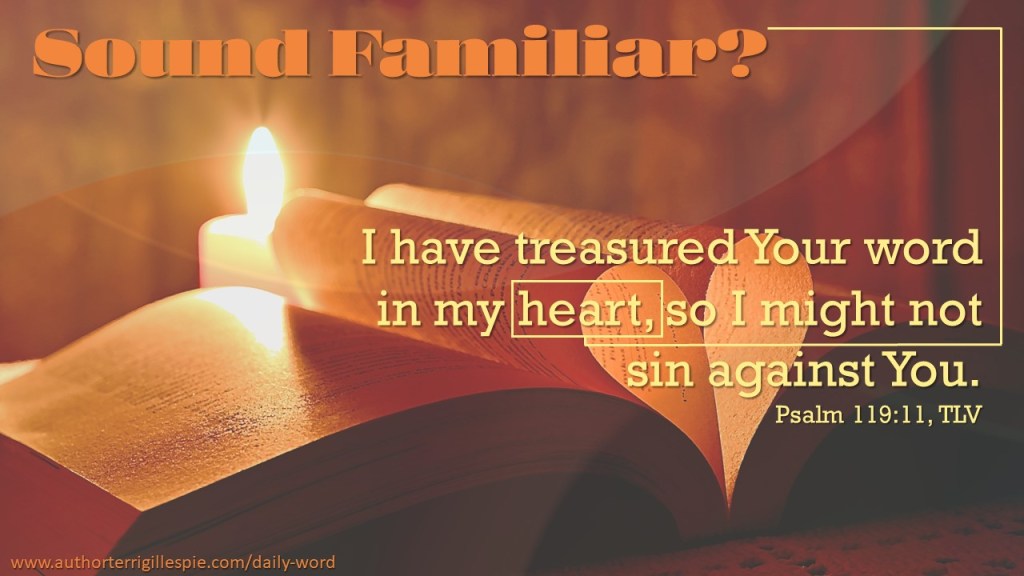
Psalm 119:9-16 The Message
9-16 How can a young person live a clean life?
By carefully reading the map of your Word.
I’m single-minded in pursuit of you;
don’t let me miss the road signs you’ve posted.
I’ve banked your promises in the vault of my heart
so I won’t sin myself bankrupt.
Be blessed, God;
train me in your ways of wise living.
I’ll transfer to my lips
all the counsel that comes from your mouth;
I delight far more in what you tell me about living
than in gathering a pile of riches.
I ponder every morsel of wisdom from you,
I attentively watch how you’ve done it.
I relish everything you’ve told me of life,
I won’t forget a word of it.
Word of God for the Children of God
Glory be to the Father,
and to the Son, and to the Holy Ghost;
as it was in the beginning,
is now, and ever shall be,
world without end. Amen, amen.
As parents, hopefully, we are all concerned for our children’s spiritual growth.
I’m assuming you’ve read this far into this article because you want tangible ways to nurture this growth. The great news is that caring is half the battle.
You’ve cared enough to lay the foundation in their formidable years, but now, as your children enter their adolescence it’s time to pivot. Our children are now critical thinkers and questioning their worldviews.
They will have serious questions about faith, the world, culture, themselves.
It’s time to create a culture within our homes for conversation and even doubt.
In her book Saving Leonardo, Professor Nancy Pearcey references a Fuller Youth Institute study that backs the idea that when adolescents are given their space to wrestle with their doubts, it actually deepens and strengthens their faith.
Becoming a safe space to wrestle with doubts might sound scary to us as parents, but it turns out that our children really, desperately, need this.
So, how do we brave the waters of becoming a safe place for doubt without accidentally wading into deconstructionism?
What is the main idea of deconstructionism?
Deconstruction denotes the pursuing of the meaning of a text to the point of exposing the supposed contradictions and internal oppositions upon which it is founded, grounded—supposedly showing that those foundations are 100% irreducibly complex, unstable, or impossible.
What is the core concept of deconstruction?
It challenges the traditional notions of language, meaning, and truth by exposing the contradictions and inconsistencies within texts and ideas.
At its core, deconstruction argues that all texts and ideas are composed of a series of oppositions or binary pairs, such as good/evil, presence/absence, or male/female.
What do deconstructionists believe?
Essentially, deconstructionists think they can interpret the real meaning of Scripture using their finite, fleshly understanding. They deny the existence of absolute truth because they are filled with confusion, conflict, and doubt.
Deconstructionism argues that logical structures based on binaries, or binary pairs, are the bones of society and language.
What is an example of deconstructionism?
A binary consists of two concepts that are presented as being at odds with each other. Examples include life/death, mind/body, and masculine/feminine.
3 Ways to Help Your Children’s Faith Grow This Summer
Step One: Open Up Your Heart
If you are a parent, which I assume you are because you’re still reading this article, you have an opportunity to meet your child on their terms.
We’ve already discussed all the factors that adolescents are currently facing, but the reality is that we just don’t know what we don’t know.
We don’t know what young people today are internalizing.
We likely don’t know what it’s like to be challenged with worldviews antithetical to a Christian worldview.
We don’t know what it’s like to have LGBTQ+ literature in our middle school libraries (if your child is in public school), we don’t know what it’s like to have gender-neutral bathrooms in our school or to have to compete against trans-athletes or forfeit, and we don’t know what it’s like to our gender challenged by our own peers at such a critical time of physical and cognitive development.
Sure, we had our own challenges in our upbringing, but the challenges our children face are almost incomprehensible to us. Given these factors and more, our hearts must be incredibly tender towards our children and their friends.
Keeping a tender heart opens us up in empathy to pray over the intricate aspects of our children’s lives. It helps us orient ourselves towards prayer, not just for our children but for their friends, the other children in their schools—and by extension—families in our communities.
Step Two: Open Up Your Home
I’ll be completely transparent when I tell you that this part is hard for me. Opening up my home means that I’m inviting loud, messy, stinky and sometimes crude teenage boys into my home.
And when I say stinky, I really mean it. I love a clean house. I love order.
I really love quiet.
Becoming “the house” means that my house is going to get messy, disorderly, and very loud, but becoming “the house” also means that I get to walk out my Christian faith right in front of my children.
Through meals and conversation the gospel is shared.
My children observe that a life dedicated to Christ is a life lived in action.
We do not close ourselves off from the rest of the world, instead we dig in, get messy and become as inclusive as possible.
This summer, consider starting a prayer journal in which you record your prayers over your children and all of their friends.
Next, model this for your children.
Engage your children in prayer, praying with them, over them, and for their friends.
Modeling an active prayer life for your children may have a massive ripple effect.
Step Three: Open Up Your Head
Okay, so you’ve become “the house,” now what?
Now, you listen, serve, and attend to the needs of your children and their friends. You feed them, stay engaged, invite them (youth group or Bible study), and create an environment where your children and their friends can ask the hard questions.
This part may feel somewhat tedious, but creating a safe environment in which young people can ask questions about faith will be fundamental in their spiritual development.
Now, this part might make you feel nervous.
“What if I don’t have all the answers?”
“What if my own child stumps me?”
My 11-year-old grandson stumps me all the time, but I’m willing to engage in a conversation with him.
Sometimes the best response is, “I don’t know the answer, but I’d love to research and pursue that with you.”
The reality is that we don’t have to know it all, but Christian responsibility means being open to learning and wrestling.
Don’t be in a rush to answer questions; instead be humble and willing to grow alongside your children.
Who knows, their questions might actually drive you to a deeper faith.
Bonus Step: Open Up Your Wallet
In opening up my heart, home, and head, I quickly learned that a fourth step was necessary.
I had to open my wallet, because snacks and tacos are expensive.
Gas money for driving all the kids everywhere they want to go is expensive.
Engaging our children and facilitating spiritual growth will always come at a cost, and, more often than not, that cost is monetary.
Additionally, the cost can be our time, or our preferences when we make choices that benefit our children and their friends more than ourselves.
Scripture reminds us time and time again, walking in faith is costly, but hopefully, when it comes to our children’s spiritual growth, we count that cost as gain.
In the name of God, the Father and God the Son and God the Holy Spirit
Praying …
Psalm 19 New American Standard Bible
The Works and the Word of God.
For the music director. A Psalm of David.
19 The heavens tell of the glory of God;
And their expanse declares the work of His hands.
2 Day to day pours forth speech,
And night to night reveals knowledge.
3 There is no speech, nor are there words;
Their voice is not heard.
4 Their [a]line has gone out into all the earth,
And their words to the end of the world.
In them He has placed a tent for the sun,
5 Which is like a groom coming out of his chamber;
It rejoices like a strong person to run his course.
6 Its rising is from [b]one end of the heavens,
And its circuit to the [c]other end of them;
And there is nothing hidden from its heat.
7 The Law of the Lord is [d]perfect, restoring the soul;
The testimony of the Lord is sure, making wise the simple.
8 The precepts of the Lord are right, rejoicing the heart;
The commandment of the Lord is pure, enlightening the eyes.
9 The fear of the Lord is clean, enduring forever;
The judgments of the Lord are true; they are righteous altogether.
10 They are more desirable than gold, yes, than much pure gold;
Sweeter also than honey and drippings of the honeycomb.
11 Moreover, Your servant is warned by them;
In keeping them there is great reward.
12 Who can discern his errors? Acquit me of hidden faults.
13 Also keep Your servant back from presumptuous sins;
Let them not rule over me;
Then I will be innocent,
And I will be blameless of great wrongdoing.
14 May the words of my mouth and the meditation of my heart
Be acceptable in Your sight,
Lord, my rock and my Redeemer.
Glory be to the Father,
and to the Son, and to the Holy Ghost;
as it was in the beginning,
is now, and ever shall be,
world without end. Amen, amen.
 Loving God, Living God, Loving Hope, Living Hope, Loving Living Life His Way! "Many things are possible for the person who has hope. Even more is possible for the person who has faith. And still more is possible for the person who knows how to love. But everything is possible for the person who practices all three virtues." - Brother Lawrence (1605-1691), Practicing the Presence of God (1692).